Optimization
Michael Cebulla
Technische Universit¨at Berlin, Fakult¨at f¨ur Elektrotechnik und Informatik, Institut f¨ur Softwaretechnik und Theoretische Informatik,
Franklinstr. 28/29, 10587 Berlin [email protected]
Abstract. We propose an architecture which supports the behavioral self-optimization of complex systems. In this architecture we bring to-gether specification-based reasoning and the framework of ant colony optimization (ACO). By this we provide a foundation for distributed reasoning about different properties of the solution space represented by different viewpoint specifications. As a side-effect of reasoning we prop-agate the information about promising areas in the solution space to the current state. Consequently the system’s decisions can be improved by considering the long term values of certain behavioral trajectories (given a certain situational horizon). We consider this feature to be a contribution toautonomic computing.
1 Introduction
The main target of our research consists in the definition of an architecture which supports the integration of reasoning and optimization thus enabling autonomic systems behavior. We take our starting point in the introduction of concepts for the knowledge-based fuzzy specification of various systemic as-pects (extending our results from [1]). We show how it is possible to inex-pensively check the conformance of these properties by traversing the solution space. These traversals of the solution space are performed by ant colonies. Ar-eas of the solution space which are promising w.r.t. to a certain specification are marked with numerical information (frequently called trail). This information is propagated to the current state where it can be exploited for the optimiza-tion of behavior. Since there are multiple aspects of systems behavior which are examined by ant colonies different sorts of trail have to be evaluated in the process of decision making. As we will see this task is performed by an entity referred to as thequeen.
After firstly giving a brief introduction to our usage of fuzzy description logics (in Section 2) we discuss a simplified application scenario (Section 3). The semantic and algorithmic aspects of reasoning are described in Section 4 and 5. The architectural integration is discussed in Section 6.
2 Fuzzy Description Logics
For the fuzzification of description logics fuzzy sets [5] are introduced into the semantics instead of the crisp sets used in the traditional semantics (cf. [2]). For more detailed discussion of these issues cf. e.g. [6, 7].
IfCis a concept thenCI will be interpreted as themembership degree
func-tion of the fuzzy conceptCw.r.t.I. Thus ifd∈∆I is an object of the domain
∆I then CI(d) gives us the degree of being the object d an element of the
fuzzy conceptC under the interpretationI [6]. For some selected constructors which were considered for description logics the interpretation function ·I has
to satisfy the following equations: ⊤I(d) = 1
⊥I(d) = 0
(C⊓D)I(d) =min(CI(d), DI(d)) (C⊔D)I(d) =max(CI(d), DI(d))
(¬C)I(d) = 1−CI(d) (∃R.C)I(d) =sup
d′∈∆I{min(RI(d, d′), CI(d′)} (∃T.C)I(d) =supd′∈∆I{min(TI(d, o), CI(o)} (qR.C)I(d) ={d|d∈∆I,|{d′|R(d, d′)>0}| ≥q} (modqR.C)I(d) ={d|d∈∆I, mod(|{d′|R(d, d′)>0}|)≥q}
(hq1, . . . , qniR.CI(d) ={d|d∈∆I,∀i∈ {1, . . . , n},#i(R(d, d′))≥qi}
Remarks. In addition to roles we also support functional roles T which are needed for the integration of fuzzy concrete domains ∆D (with o ∈∆D). We
support a very simple style of quantifications allowing the use of positive rational numbers q or fuzzy modifiers mod (defined by piecewise linear membership functions). In addition we support a construct of tuple-valued cardinality which will be used to represent quantification concerning different aspects. As we will see such tuples contain global numerical information from different sources (commonly referred to astrail).
about the conformance of specifications. Specifications concerning different as-pects of systems behavior are compared with the specification of the solution space. As we will see this is done by colonies of artificial ants. The require-ments related to conformance are represented by sets of constraints describing morphisms.This approach is heavily influenced by [8].
3 Fuzzy Specifications
In this section we describe a simple example which we use to illustrate some characteristics of our approach. We apply fuzzy terminologies to the description oflocations in sensor networks (cf. [9]). We use this concept as a high-level ab-straction since in many cases it does not make sense to address the individual components of a sensor network explicitly. Alternatively such systems provide the transparent access to data from interesting places (without having to men-tion individual components). Similar arguments and more details about sensor networks can be found in [10].
A terminological description of a location is shown in the following (simpli-fied example):
loc-wl-xyz=. 1.0 contains.Sensor1⊓0.7 contains.Sensor2⊓
0.6 contains.Sensor3
Sensor1 =. ∃energy.=.7⊓ ∃water-level.=8.5
Sensor2 =. ∃energy.=.8⊓ ∃water-level.=9.1
Sensor3 =. ∃energy.=.6⊓ ∃water-level.=8.9
As an example we introduce a terminological description of a simple location which contains three individual sensor components. The containment relation contains is quantified by a relevance value of the specific sensor component in the actual location. Note that this value is taken from the interval [0,1]Q.For the sake of our example sensor components contain data describing the current energy level and data concerning the water level. Note that the relationsenergy andwater-level have to be treated as functional roles containing objects which represent concrete domain values (cf. Section 2).
Scenario. For the sake of this presentation we assume that the system has to decide which location it prefers in order to retrieve information in a given situation. Thus the solution space in this scenario contains various behavioral alternatives which each corresponds to the choice of an individual location. Obviously the quality of a solution is determined by parameters likerelevance and energy-level. In our approach ant colonies have the task to retrieve this information (related to these two different aspects) and to mark the trajectories which conform best to their viewpoint specifications.
solution space. These specifications may concern different aspects like availabil-ity of energy, like relevance or like flooding.
high-energy =. Most contains.energy(High)
high-relevance=. Most contains.Sensor
flooding =. Most contains.water-level(High)
Each of these three viewpoint specifications describe a criteria whose value is important for the systems decision making. Note that in such specifications we can use fuzzy terms like most andhigh. Whilemost is defined in terms of fuzzy role quantification high is defined on concrete domain values of energy. Note that we are able to formulate less restrictive (and more robust) constraints using fuzzy concepts. In our framework such specifications are associated with colonies of ants which traverse the solution space (within a certain horizon) and check accessible paths for their conformance w.r.t. a certain specification.
4 Semantics
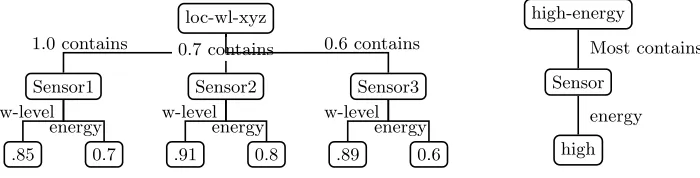
In the following we will extensively use the fact that we can consider specifi-cations as tree-like term structures. For example both the systems specifica-tion as well as the viewpoint specificaspecifica-tions can be represented in such a way (cf. Figure 1). We propose a syntax-directed approach for reasoning aboutfuzzy conformance which is based on the concurrent traversal of trees. Note that the promising paths in the solution space are marked with their value of confor-mance as a side-effect of reasoning.
loc-wl-xyz
Sensor1 1.0 contains
.85 w-level
0.7 energy
Sensor2 0.7 contains
.91 w-level
0.8 energy
Sensor3 0.6 contains
.89 w-level
0.6 energy
high-energy
Sensor
Most contains
[image:4.595.133.483.416.505.2]high energy
Fig. 1.Tree-like Representations of Specifications
Observations and Experiments. Intuitively, we say that two specifications are conform (to a certain degree) if they support similar observations and experi-ments. Observations and experiments on fuzzy specifications are described by fuzzy transition systems (FTS).
In the signature of the transition system we can see that the observation and transitions functions are multi-valued. In fact we are interested in observations (whose content is represented by a fuzzy terminological concept) which hold to a certain degree. On the other hand we want to know which costs are coupled with a certain state transition (triggered by a terminological role). Thus the application of the transition functionnext yields a result which corresponds to the (fuzzy quantification) of the role term which is used as parameter (frequently referred to ascosts).
Fuzzy Morphisms. In order to get a foundation for the notion of fuzzy confor-mance we rely on the notion of fuzzy morphism (cf. [11]).
Definition 1 (Fuzzy Morphism on FTS).A fuzzy morphismf between two fuzzy transitions systems A1 and A2 is given by: obs2(T) ≤ obs1(f(T)), and
next2(X2, T, X2′)≤next1(f(X2), f(T), f(X2′)),
X2×T X1×T
[0,1] [0,1]
f
obs1
obs2
≤
and
X2×T×X2 X1×T×X1
[0,1] [0,1]
f×id
next2
next1
[image:5.595.132.476.289.363.2]≤
Fig. 2.Fuzzy Homomorphism on Signatures
Note that we sometimes assume (in Figure 2 and elsewhere) that both spec-ifications use the same terminologyT.We interpret positive differences between observations as conformance values (e.g.obs2(T)−obs1(T)). As a side-effect of
reasoning the solution space is annotated with these values. In the following we heavily rely on an operational interpretation of these morphisms. For more details concerning this approach cf. [12].
5 Reasoning
In this section we heavily use the argument that morphisms can be mapped on bisimulations between automata (cf. [13]). We construct an automaton whose purpose is to recognize such bisimulations between two fuzzy tree automata. Such an automaton is called tree tuple automaton [3]. For the description of transition rules we use concepts from membrane computing (cf. [14]).
We exploit the characteristics of membrane computing and its computational properties for the creation and handling of multiple copies of tree automata. In our proposal the automaton for the recognition of bisimulation is implemented as a rewriting P-system (on structured objects) (cf. [14]). In this formalism we can use embedded membranes in order to articulate the tree-like structure of a term. In addition membranes contain multisets of terminal symbols or other information (e.g. trail). Consequently we can define transition rules for the processing of expressions using the paradigm of multiset rewriting. While (atomic) concept expressions are represented by molecules role expressions (and their cardinalites) are encoded in membrane labels. In order to deal with fuzzy expressions we support rational cardinalities of multisets. For more details on our usage of P-systems cf. [12].
Definition 2 (P-system for Bisimulation). A P-system for bisimulation is defined as a tuplePBS=hT, µ, w1, . . . , wm, R1, . . . Rmi,whereT is a
terminol-ogy and µ= [0[D]D[S]S]0 is the initial configuration (of the membrane
struc-ture).
While the membrane [D]Drepresents the systems description [S]Scontains a
viewpoint specification. Intuitively in each step of the simulation the necessary observations and experiments are drawn from the viewpoint specification (by
obsS and nextS) and then applied to the systems description (by obsD and
nextD). For simplicity we assume that both automata (and both specifications)
use the same terminologyT.
The behavior of the automaton is defined by the following rewriting rules: 1. Atomic Concepts A∈T :
[[DX]D[SA[Qα]Q]S]→[[DX,t
d
i]D[S[Qα]Q[S],whenobsD(A)≥obsS(A)
Note that a molecule representing the conformance value d is introduced into the systems specification per side-effect. Intuitively the moleculet(for trail) is related to theith viewpoint specification and represents a rational conformance valued.
2. Basic RolesQ∈T :
[[DX]D[S[Qα]Q]S]→[[Dann-lbl(tdi)]D[Sα]S],
whennextD(Q)≥nextS(Q)
These rules describe a test concerning the costs of transitions. Thus by a call to nextS we can retrieve the transitions which have to be supported
3. For the treatment of the constructors from fuzzy description logics the fol-lowing rules can be used (selected examples). Note that the operators have to be treated according to fuzzy semantics (cf. Section 2).
[[DX]D[SA⊓B]S]→[[⊓[[DX]D[SA]S][[DX]D[SB]S]]⊓]
[[DX]D[S∃Q.C]S] →[⊔i∈{1,...,k}[i[⊓[Dnexti]D[SQ]S
[Dnexti]D[SC]S]⊓]i],
In the rules for the processing of quantified role expressions (involving atomic roles) the terms labeled withihave to be created for eachi∈[1, kT]
wherekT is the branching factor of the tree. Intuitively this corresponds to
the creation of a copy of the automaton for each role filler ofQ. nexti are
procedures for the explicit navigation in trees (retrieving the ith subtree of the current node). As we will see the fuzzy semantics of the operators controls the propagation of trail.
4. The treatment of numeric quantification is similar to the treatment of quan-tification described above. For each role filler a copy of the automaton is created.
[[DX]D[SqQ.C]S] →[⊔i∈{1,...,k}[i[⊓[Dnexti]D[SQ]S
[Dnexti]D[SC]S]⊓]i] when #DQ≥q
[[DX]D[SmodqQ.C]S]→[⊔i∈{1,...,k}[i[⊓[Dnexti]D[SQ]S
[Dnexti]D[SC]S]⊓]i] whenmod(#DQ)≥q
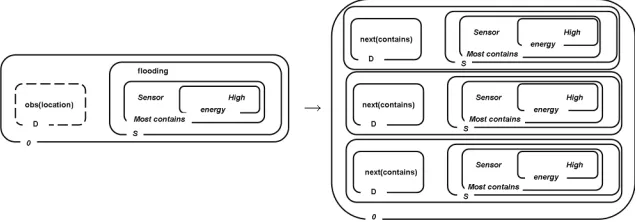
Example. While comparing the specifications from our example the situation in Figure 3 is constituted at some point. On the left hand side of the transfor-mation we see that experiments concerningmost containsare prescribed by the specification. Since there are three such experiments possible on the system’s description three copies of the automaton are created. Then the experiments concerningcontains are initiated concurrently (as shown at the right hand side of the rule). For this mechanism we rely on the fact thatmembrane division is a common and inexpensive operation in membrane computing (cf. [14]).
[image:7.595.140.459.487.598.2]→
Trail Propagation. In the final phase of reasoning about the conformance of a viewpoint specification the information represented by the trail is propagated. For this sake the numerical information is treated like a synthesized-attribute in attributed grammars (cf. [15]). Intuitively the information about promising locations in the solution space ispropagatedto the the current state thus increas-ing the quality of the system’s decisions. Again we exploit some characteristics of membrane computing for the reactive propagation of this information.
[image:8.595.162.454.199.246.2]→
Fig. 4.Example: Trail Propagation
In the example transition in Figure 4 we can see how trail information is propagated bottom-up through the membrane hierarchy. The rules for the propagation are determined by the semantics of the operators (in this case⊓). According to Zadeh’s logic the value of f is defined as the minimum of i, j, k.
6 Distributed Reasoning
We propose an architecture for the integration of high-level modeling, auto-mated reasoning and ant-colony optimization. Our goal is to propagate infor-mation about valuable places in the solution space in order to support decision making in the current state. Generally we propose that systems rely on solu-tions found by ant colonies during normal situasolu-tions while they have to depend on default values for their decision in highly dynamic situations (represented by so-called myopic heuristic information, cf. [4]).
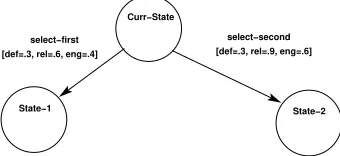
Example. In a simplified example we consider the situation that the system (represented by the queen) has to choose between two locations. Obviously at first sight it is not possible to decide which group of sensors to use (since heuristic information about the costs – as represented by attribute def – are equal concerning both alternatives).
Curr−State
State−1 State−2
select−second select−first
[image:9.595.220.390.177.255.2][def=.3, rel=.6, eng=.4] [def=.3, rel=.9, eng=.6]
Fig. 5.Example Situation
We assume that the ants examinations (concerning relevance and energy) resulted in the values shown in Figure 5. Consequently it is the queen which has to infer the best alternative from the available information. For this sake we define the queen as a tree tuple automaton which performs a simple version of multi-criteria optimization: the queen always selects the behavioral alternative which is marked with the greatest global value (depending on environmental parameters). Note that for simplicity we assume a non-fuzzy decision behavior of the queen always resulting in the choice of exactly one behavioral alternative.
[hα,βi[hs0,s1,s2iA1]hs0,s1,s2iA1[ht0,t1,t2iA2]ht0,t1,t2iA2]hα,βi→[A1. . .]A1
whenmax1,2(si)> max1,2(ti) andα > β
[hα,βi[hs0,s1,s2iA1]hs0,s1,s2iA1[ht0,t1,t2iA2]ht0,t1,t2iA2]hα,βi→[A1. . .]A1
whens0> t0 andβ > α
For the sake of example we give two rules which describe the queen’s decision making in our scenario. We encode the information about trail into membrane labels. The first rule describes how behavioral alternativeA1is selected on the
basis of trail information (represented by t1, t2, s1, s2). The global parameter
α denotes the weight of trail information (during normal environmental con-ditions) while β contains a high value when the situation is highly dynamic. This case is described by the second rule where alsoA1is selected but this time
on the basis of heuristic information (contained ins0, t0). Remember that trail
information tends to be useless in the presence of environmental changes.
7 Conclusion
autonomic systems. For this reason we propose to use colonies of artificial ants for the exploration of the solution space of complex systems. In this framework we support distributed and robust reasoning about high-level specifications. Knowledge about the systems properties is diffusing through the solution space thus supporting decentral and distributed forms of decision-making and control.
References
1. Peter Pepper, Michael Cebulla, Klaus Didrich, and Wolfgang Grieskamp. From program languages to software languages. The Journal of Systems and Software, 60, 2002.
2. Franz Baader and Werner Nutt. Basic description logics. In Franz Baader, Diego Calvanese, Deborah McGuinness, Daniele Nardi, and Peter Patel-Schneider, edi-tors,The Description Logic Handbook. Cambridge University Press, Cambridge, U.K., 2003.
3. H. Comon, M. Dauchet, R. Gilleron, F. Jacquemard, D. Lugiez, S. Tison, and M. Tommasi. Tree automata techniques and applications. Available on: http://www.grappa.univ-lille3.fr/tata, 1997. release October, 1rst 2002.
4. Marco Dorigo and Thomas St¨utzle. The ant colony optimization metaheuristic: Algorithms, applications, and advances. In Fred Glover and Gary A. Kochen-berger, editors, Handbook of Metaheuristics. Kluwer Acad. Publ.: Boston et.al, 2003.
5. Lofti A. Zadeh. Fuzzy sets. Information and Control, 8(3):338–353, 1965. 6. Umberto Straccia. Reasoning with fuzzy description logic. Journal of Artificial
Intelligence Research, 14:137–166, 2001.
7. Steffen H¨olldobler, Hans-Peter St¨orr, and Tran Dinh Khang. The fuzzy description logicALCF H with hedge algebras as concept modifiers. International Journal of
Advanced Computational Intelligence and Intelligent Informatics, 7(3):294–305, 2003.
8. Dusko Pavlovic, Peter Pepper, and Douglas Smith. Specification engineering. to appear, 2006.
9. David Culler, Deborah Estrin, and Mani Srivastava. Overview of sensor networks. IEEE Computer, 37:41–49, August 2000.
10. S. Madden, R. Szewczyk, M. Franklin, and D. Culler. Supporting aggregate queries over ad-hoc wireless sensor networks. InIEEE Workshop on Mobile Com-puting Systems and Applications, 2002.
11. George J. Klir and Bo Yuan.Fuzzy Sets and Fuzzy Logic. Theory and Applications. Prentice Hall, Upper Saddle River, N.J., 1995.
12. Michael Cebulla. Reasoning about knowledge and context awareness. InProc. of FLAIRS’06, 2006.
13. Jan Rutten. Automata and coinduction (an exercise in coalgebra). Technical report, Centrum voor Wiskunde en Informatica, Amsterdam, 1998.
14. Gheorghe P˘aun. Membrane Computing. An Introduction. Springer, Berlin, 2002. 15. Donald E. Knuth. Semantics of context-free languages. Theory of Computing