i
UNIVERSIDAD TÉCNICA PARTICULAR DE
LOJA
La Universidad Católica de Loja
ÁREA SOCIO HUMANÍSTICA
TITULACIÒN DE LICENCIADO EN CIENCIAS DE LA EDUCACIÓN
MENCIÓN: INGLÉS
Teachers and students` perceptions of teaching English in small classes
in Ecuador
TRABAJO DE FIN DE TITULACIÓN
AUTORA: Herrera Loján, Marjorie Lizbeth
DIRECTORA: Toro Gallardo, Lisset Vanessa
CENTRO UNIVERSITARIO LOJA
ii
Aprobación del Director del Trabajo de Fin de Titulación
Magister.
Lisset Vanessa Toro Gallardo DOCENTE DE LA TITULACIÓN
De mi consideración:
El presente trabajo de fin de titulación: “Teachers and students´ perceptions of teaching English in small classes in Ecuador” realizado por Marjorie Lizbeth Herrera Loján ha sido
orientado y revisado durante su ejecución, por cuanto se aprueba la presentación del mismo.
Loja, Septiembre de 2014
f.
iii
Declaración de autoría y cesión de derechos
“Yo Marjorie Lizbeth Herrera Loján declaro ser autora del presente trabajo de fin de titulación: “Teachers and students´ perceptions of teaching English in small classes in Ecuador”, de la Titulación de Ciencias de la Educación mención Inglés, siendo Vanessa
Lizbeth Toro Gallardo directora del presente trabajo; y eximo expresamente a la Universidad
Técnica Particular de Loja y a sus representantes legales de posibles reclamos o acciones
legales. Además certifico que las ideas, conceptos, procedimientos y resultados vertidos en el
presente trabajo investigativo, son de mi exclusiva responsabilidad.
Adicionalmente, declaro conocer y aceptar la disposición del Art. 67 del Estatuto
Orgánico de la Universidad Técnica Particular de Loja que en su parte pertinente
textualmente dice: “Forman parte del patrimonio de la Universidad la propiedad intelectual
de investigaciones, trabajos científicos o técnicos y tesis de grado que se realicen a través, o
con el apoyo financiero, académico o institucional (operativo) de la Universidad”
f.
Autor: Marjorie Lizbeth Herrera Loján
iv
Dedication
I dedicate this study to my family and friends. A special feeling of gratitude to my
husband, Fabian Correa, whose words of encouragement and push for tenacity cheered me.
There is no doubt in my mind that without his continued support I could not have completed
this process.
I also dedicate this study to my parents, Luis Herrera and Rocio Loján who have
supported me throughout this process. I will always appreciate all they have done. I dedicate
v
Acknowledgment
I wish to thank my tutor Mgs. Vanessa Toro for her countless hours of reflecting,
reading, encouraging, and most of all patience throughout the entire process.
My thanks and appreciation to the UTPL members for providing me any assistance
requested. Special thanks go to the secretary of my area Mgs. Patricia Ordoñes for the support
and assistance given to me through this entire program.
I must acknowledge as well the many friends, colleagues, students, teachers and other
vi
Contents
Cover
Aprobación del director del trabajo de fin de titulación
Declaración de autoría y cesión de derecho
Dedication
Acknowledgment
Contents
Abstract
Resúmen
Introduction
Method
Discussion
Literature review
Description, analysis, and interpretation of results
Conclusions
Recommendations
References
Annexes
i
ii
ii
iv
v
vi
1
2
3
5
7
22
42
43
44
vii
Abstract
The main purpose of this study, “Teachers and students` perceptions of teaching English in small classes in Ecuador”, is to determine teachers and students‟ perceptions of teaching and learning English in small classes. A total of 5 teachers and 40 students from an English
language institute from the city of Loja participated in the study. A questionnaire including
open-ended items was used for data collection. In order to carry out the quantitative and
qualitative analysis, the results obtained were described, analyzed and interpreted in relation
to the teachers and students` perceptions about teaching English in small classes in Ecuador.
The study reveals that teaching English in these types of classes have a positive effect
regarding students‟ progress and there are many benefits for teachers and students according
to the interviewed´ views. Some of these benefits are related with the facility in designing
activities, the higher attention and participation of students, the adequately class space, the
appropriate feedback and the greater interaction between teacher and students and between
students.
viii
Resumen
El principal propósito del presente estudio, “Percepciones de profesores y estudiantes de la enseñanza de inglés en clases pequeñas en Ecuador”, es determinar las percepciones de enseñar y aprender inglés en clases con pocos estudiantes. Un total de 5 maestros y 40
estudiantes de un Instituto de Inglés de la ciudad participaron en el estudio. Un cuestionario
con preguntas abiertas fue utilizado para la colección de datos. Con el fin de realizar el
análisis cuantitativo y cualitativo, los resultados obtenidos fueron descritos, analizados e
interpretados en relación con las percepciones de profesores y estudiantes acerca de enseñar
Inglés en clases pequeñas en Ecuador. El estudio reveló que enseñar inglés en este tipo de
clases tiene un efecto positivo en relación al progreso de los estudiantes y que hay muchos
beneficios para los profesores y estudiantes, según las percepciones de los entrevistados.
Algunos de estos beneficios están relacionados con la facilidad de diseñar actividades, mayor
atención y participación de los estudiantes, espacio de clase adecuado, apropiada
retroalimentación y mayor interacción entre estudiantes y profesores y entre estudiantes.
Palabras clave: clases con pocos estudiantes, percepciones de estudiantes y profesores,
enseñar inglés.
ix
Introduction
Ecuador is in the march for the best educational environment. For educators, students,
parents and government authorities the high quality in the teaching of English is an important
issue. In order to improve teaching and learning English, there are some factors that should be
taken into consideration. Among these, class size is considered one of the most important.
Classes might be small or large in size; the definition of a “small” or a “large” classroom might differ in different contexts. Likewise it should be noted that the related literature
suggests that there is a close relationship between class size and student achievement
(Cakmak, 2009).
The purpose of this study is to know the views of teachers and students regarding with
teaching and learning English in classes with a small number of students. In this study, the
researching questions are: What are the benefits of teaching and learning English in small
classes? What teaching strategies and resources benefit the teaching of English in small
classes? How do students feel about learning English in small classes? And are there any
limitations when teaching English in small classes?
Research literature provides some interesting conclusions. For example, a research
conducted by Din (1999) shows that small classes facilitate classroom management,
student-teacher interactions and individualized help from the student-teachers. This study also indicates that
although teachers did not identify a direct relationship between class size and student
achievement, evidently teachers prefer to teach in small classes. This is because small classes
benefit the teaching and learning process and teachers‟ work, and this warrants support from
all educators.
x
and Asia. This study reveals that smaller classes promote a strong sense of security in students
within classroom community and that learners feel more confident about participating in
English lessons (Harfitt, 2012). According to the results of this study, students‟ sense of anxiety can be reduced in smaller classes; in addition, class size reduction may assist in
breaking down cultural barriers. On the other hand, Konstantopoulos (2011) carried out a
study which purpose was to know if the class size effects differ across the sample of schools
as a result of differences in school context. This study shows that students in some schools
were in disadvantage when being in small classes compared to students who were in other
classes.
After this brief review of literature, it can be seen that there are a variety of views about
the relation between teaching English to small classes and student´s progress. Hence, it is
necessary to do further investigation.
The findings about the benefits of teaching and learning English in small classes, the
strategies and resources that benefit the teaching of English in small classes and the feelings
of students about learning English in small classes will give to future researchers a fundament
of the perspectives of teachers and students about teaching English in small classes. These
results are also for the benefit of teachers, students, parents and educational institutes.
This study is expected to contribute to take on a class size reduction program in
educational institutes since it shows the advantages of teaching English in small classes. This
study will also contribute to improve teachers ` methods and techniques for teaching English
in small classes; additionally the results of this study will contribute to students and parents
since they will have a better understanding about learning English in small classes.
xi
Method
The general approach of this study is Qualitative and Quantitative. The collected data
will be explored, explained, described, and analyzed.
Setting and Participants
The research was developed in an English institute from Loja, Ecuador. The
participants of the study were 5 teachers and a total of 40 students from five classes. The
teachers who participated in this study were trained teachers with years of experience in
teaching English to small classes. About students, they were from 5 English classes with
different levels and ages. The majority of these students are also learning English in large
classes in high school; for this reason, they can properly see the differences of being taught
English in small classes in the institute.
Procedures
The first step in the development of this study was to carry out a literature review.
Twelve books were selected in order to consider the critical points of current knowledge
about topics related like Teacher- student, and student-student interaction, class size, teaching
techniques, strategies or activities for teaching English to small classes and the learning
environment in small classes. Additionally, five studies were looked over in order to
have theoretical and methodological contributions to the researched topic: “Teachers and
students´ perceptions of teaching English in small classes”
After that, the field research was carried out. In order to enable the research process,
qualitative and quantitative methods were used.
A survey was applied for the sample of teachers and students. Likewise, observations
xii
After the participants completed the questionnaire, the information was gathered and
tabulated. The description, analysis, and interpretation of the results obtained were carried
out. The results obtained were sustained with all the data collected in the observation and the
related literature.
The techniques used in the research were survey, note-taking and observation. The
instruments used were a survey for all students and a parallel survey for teachers. Also, an
observation sheet was used as an instrument for the researcher to corroborate the teachers and
students „answers. The sentences in the survey were designed to collect the perceptions of
teachers and students about teaching English in small classes. These sentences were divided
in four sections. The first group of sentences gave information about the benefits of teaching
English in small classes. The second group provided data about the strategies and resources
that benefit the English learning in classes with few students. The third group of items was
developed in order to know the student´s feelings about learning English in small classes.
Finally, the last sentences were used to know whether there are limitations when teaching
xiii
Literature Review
This Literature review contains important information about topics as managing
learning, interactions in class, teaching techniques, strategies or activities and the environment
in small classes. Important data about five studies are also included. This literature review
contributes to this study because it provides important backgrounds and conclusions about the
theme of this research.
Managing learning
According to Nunan (1996), the way teachers give instructions is crucial to both
successful learning and teaching. The most important point that determines how successfully
students will learn is the way instructions are formulated. Therefore it is important that
teachers‟ directions related to academic activities and behavior are clear, precise and
effective.
Another important factor when managing learning is timing. Teaching takes time and
there is never enough of it; so managing time is one of the biggest challenges. Effective use of
school time begins with efficient organization and management. Fisher, Hoover and Mc Leod
(2003, p. 33) declares:
Effective time management is one of the skills necessary for
success in school as well as in everyday life and in the work world. Students
need time to practice, rehearse, review, apply, and connect new learning and
relate it to their everyday lives. Teachers who effectively manage time give
their students the best opportunity to learn and to develop personal habits
that lead to wise use of time.
The concept of 'time' when teaching, often involves pace, in other words, moving
xiv
sometimes can be a mistake. Pace needs to be appropriate: the learning needs to proceed
briskly, but not be rushed (Nunan, 1996). Teacher should use experience, intuition, and
feeling. For example, in the case that students are enjoying the activity, it would be better to
extend the time of it. “Planning decisions can be determined through questions such as the
following: How much time do I have? How many different tasks or activities can I reasonably
expect to complete in the time available?” (Nunan, 1996, p. 105).
In relation to feedback, it helps students to understand the subject being studied and
gives them clear guidance of how to improve their learning. Likewise, when teacher gives the
proper feedback, it will be easier to get over some problems and blockages in the process of
teaching-learning (Nunan, 1996).
In addition, for students it is significant to know how well they are doing when
learning. This is because the knowledge that they are doing well, gives students a sense of
achievement. As a result of it, students ‟motivation increases. Similarly, it is also important to
let students know when they have made a mistake; so that they will learn from it and take
corrective measures. Maxim (2009) argued that students expect feedback. Therefore, it is
essential for teachers to monitor students‟ learning and give them the becoming feedback.
Teacher- Student and Student- Student Interaction.
Teacher–student interaction is one of the most important element within the learning environment. This interaction positively affects students‟ level of development, engagement and motivation in learning English. Supportive and positive relationships between teachers
and students promote meaningful interaction. It also allows teacher train the students `skills
and abilities. Long (as cited in Richards, 2003) discusses the social interaction as a key of
language acquisition. Through negotiation, students can be involved in comprehensible
xv
Interaction in language classrooms are important social activities for students through
which they not only construct knowledge, but also build confidence and identity as competent
language users. Teachers need to promote the interaction in order to help students succeed.
The teacher- student interaction is very appropriate when introducing a new topic. In that
moment the brainstorming can be a good activity. Likewise interaction can take place through
introductory tasks or questions and also when correcting grammar and vocabulary tasks
(Richard, 2003).
Because interaction in classrooms is one of the leading conventions to enhance the
students‟ linguistic resources as well as equipping them with appropriate
communicative skills, it is crucial to include communicative activities in the syllabus.
Students‟ participation and interaction can help them enrich their linguistic resources and build their confidence to communicate with others in English. Apart from it, the teacher will
guide or monitor students to help them become more autonomous (Soler, 2008).
Interaction in class also involves student- student interaction. Conversations are part of
sociocultural activities; here students construct knowledge collaboratively. Conversation‟s
skills could be developed into spontaneous conversational activities. When students engage
into interactions, everyone can participate, get respected and get the decisions made jointly
(Johnson, 2002). We can conclude that conversations between and among learners in the
classroom contributes to engage students in a communicative dialogue.
In addition, when students talk about learning experiences, the language development
between students is encouraged. Consequently, learners have more chances to verify their
xvi
Student-student interaction also influence in the aspirations and achievement of
students. This type of interaction also develops social competencies and helps students to
assume the perspectives of others (Johnson, 2002).
In small groups, cooperative learning also influences on self- esteem, relationships and
positive attitudes. Therefore, teachers have to manage properly the problems that tend to be
between students in small groups. According to Johnson (2002) if these conflicts are managed
effectively, the motivation, the cognitive development and the moral reasoning of students
can increase. When students do not have the same point of view from their partner, they have
to look for more information or take another alternative. This results in a cognitive
restructuration and growth by students.
Additionally, Penny (2012) claims that small- group learning provides an environment
with several opportunities to interact face to face. This type of interaction is necessary
because it allows students exchange academic information. Likewise, in small- groups the
anxiety is lower and students feel more comfortable with the language; in addition, students
can concentrate better during the class. These cooperative grouping also increase the
possibility that English learners feel a part of the culture of the classroom as a whole.
Class Size
Class size is one of the most important factors that influence the teaching- learning
process. Many definitions about the concept of class size have been given by educationists.
According to Dudley and St John (2007), class size based on students‟ population can vary immensely; from having just one student in the classroom until having several hundred of
students. Class size is divided into two categories: Small classes and large classes. However,
there is not a clear concept yet; the notion of what is a small and what is a large class can
xvii
country. The smattering of what constitutes a large class or a small one depends on: situation,
purpose and experience (Dudley and St John, 2007). For example, in Nigeria or Indonesia one
hundred fifty students for English for academic purposes classes are not uncommon; hence
the perception of large classes also depends of what teachers consider as the largest class they
tend to teach.
Brown (2007) states that language classes should be around 12 to 15 students. He
thinks that classes should be large enough to give the class diversity; but small enough to
provide students with opportunities to participate. However, Brown (2007) emphasized that
too many classes are much larger; around the world there are common classes with fifty or
seventy five students.
In a large class the teacher concentrates more on management and control of students
than on achieving the lesson objectives. For that reason, teachers and students from large
classes have some difficulties in the teaching- learning process. Dudley and St John (2007)
agree that among the biggest difficulties that teachers of large classes have to face are the
control of behavior and noise. Assessment, feedback, individual attention, and the use of
mother tongue are some of the problems too. Likewise, Brown (2007) agrees that in large
classes the individual teacher- student attention is lower. Besides, other disadvantages are the
variety among students, and the fact that students‟ opportunities to speak are highly limited. Fortunately, there are some solutions to these problems. In order to make students feel
part of a community and not just lost in the crowd; teachers can assign students as much
interactive work as possible. Another recommendation is to include more pair work and group
work because in this way students have more chances to perform in English. Furthermore,
large classes give opportunities for innovation. Students usually ask each other for help and
xviii
By contrast, small classes have been found to have positive effects. Smaller classes
have more teacher- student interaction; in most situations there is direct contact between
teacher and students. Likewise, more learning activities take place in small classes. Students
in small classes participate more in classroom activities, and their behavior is better than in
large classes. Teachers in small classes are more relaxed because instead of just trying to
control the class, they can focus better on managing time, managing material, controlling
activities and monitoring relationship. Furthermore teachers can match more effectively each
student ´style (Dudley and St John, 2007).
Small classes are seen as the best type of classes. Teachers have more time to focus on
keeping the students interested in the class. Small classes usually does not face several issues
such as: noisy students, lack of didactic materials, not enough time to respond to each
student‟s necessity, the absence of target language practice due to common language speaking
among students. Thus, preparing the class can be easier than teaching in large classes
(Woodward, 2001).
Teaching Techniques, Strategies or Activities for Teaching English to Small Classes
Teaching strategies, techniques and activities help students to learn the contents.
Through this way students will be able to develop achievable goals in the future. The use of
different techniques, strategies and activities will give a successful teaching and learning.
(Herrell and Jordan, 2012)
One of the most effective pedagogical strategies that promote participation and
interaction is small groups and partners. It fosters a deeper and more active learning process
Herrell and Jordan (2012) states that small groups and partners provides instructors with
valuable demonstrations of the degree to which students understand particular topics or
xix
and teach each other. For instructors, group work can involve some preparation time. Despite
this, it is less time consuming than preparing another activity with the same benefits.
There are also several techniques based on the idea that a new language can be learned
through actions and that movements can help students learn and understand better. Several
students prefer the kinesthetic system of learning and Total physical response method is
particularly relevant to these kinesthetic learners who learn best when they can participate in
an activity. Some examples of techniques based on TPR method are: “Where are your keys?”, “Simon says”, these techniques combine information and skills through the use of the
movements and action. This combination of skills allows the student to assimilate information
and skills at a rapid rate. As a result, this success leads to a high degree of motivation. By
using these kinds of techniques, the teacher introduces the language through the use of
commands and they have students demonstrate their understanding through action responses.
(Herrell and Jordan, 2012).
Herrell and Jordan (2012) suggest that story reenactment is a great technique to a better
understanding of a text. In this strategy, students have to act out stories after they have read o
heard them. Story Reenactment strategy allows students comprehend better the text because
students have to act the story in sequence. This technique is ideal for small classes where the
space and the time dedicated to each student are higher.
Another excellent technique that can be applied for small classes is guided reading. In
this technique teacher provides support for small groups of readers as they learn to use various
reading strategies like context clues, letter and sound relationships, word structure, and so
forth (Herrell and Jordan, 2012). Although guided reading has been traditionally associated
with primary grades it can be modified and used successfully in all grade levels. This strategy
xx
In addition, in order to have a greater achievement, teachers in small classes can give
intensive class sessions to individual students. These classes or tutorials give students a higher
degree of involvement and engagement (Herrell and Jordan, 2012). There are several
activities students can do in tutorial in order to have a deeper understanding of the contents.
Through enrichment activities like story telling or discussion, students can see the
significance and implications of their knowledge and can apply what they have learned in new
contexts.
The related literature also encourage teachers to use strategies that help learners to
make connections among their past experiences, the content being studied, and the vocabulary
that is new or being used in an unfamiliar way. Role- play is an interesting strategy that can
build vocabulary through dramatization. English language learners have an opportunity to see
the vocabulary words used in context, as well as demonstrations of the different contexts
where the vocabulary can be used (Herrell and Jordan 2012).
Dhan (2008) also gives important strategies for small classes that can be useful. Some
of these strategies are pair reading, jigsaw and small group. They are a low- stakes way to
give credit for work. In a class, students do group exercises regularly; the purpose of them is
to accomplish the goals and objectives of the group. Among the characteristics is that
“students plan their own learning through open – ended tasks rather than following the teacher`s assignment” (Dhan, 2008).
Another technique that can provide the teacher with an opportunity to assess student´s
understanding of course material is discussion. Through this challenging technique, ideas can
be explored deeper because discussion allows students to introduce their own observations
and questions (Dhan, 2008). Furthermore, in discusses students participate more actively in
xxi
According to Dhan (2008) brainstorming is also a popular tool that helps to generate
creative solutions to a problem. It is especially useful for establishing patterns of thinking. As
a result students can develop new ways of looking at things. It also helps students overcome
many of the issues that can make group problem-solving a sterile and unsatisfactory process.
Doing this activity, students are able to think more freely and creatively and find numerous
new ideas and solutions. Participants give ideas as they occur to them. All the ideas are noted
down and are not criticized. Only when the brainstorming session is over the ideas are
evaluated.
Additionally, Dhan (2008) suggested the mural strategy as a visual material for
instruction and learning. Normally, students choose a particular theme and work on the mural
based on the theme. In groups, students paint a mural on large sheet of paper and present the
mural to the whole class. For the mural students can use a variety o artistic media such as
colored paper, crayons or piece of cloth. At the end of the activity, all the works based on
different but related themes are putted together to form an extensive mural with one big and
general theme.
Learning environment in Small Classes.
Small classes provide a better learning environment for students than large classes. In
small clases, students are closely observed and teachers have the opportunity to get to know
each student. Besides, in small classes students receive personalized attention. Furthermore,
the process of teaching- learning between teacher and students can be more satisfactory
(Flood, Lap, Squire and Jensen, 2003).
In small classes, teachers give students a better learning environment. Flood, Lap,
Squire & Jensen (2003) argue that teachers feel more comfortable in a small class because
xxii
more the strengths and weaknesses of each student. Apart from this fact, teachers in small
classes usually give students significant feedback.
Flood, Lap, Squire and Jensen (2003) wrote another characteristic of the environment
of small classes. They state that in small classes tend to be a greater achievement from
learners. Student participation and involvement is normally higher in small classes. For
example several studies have concluded that in smaller classes, students are more likely to
remain on task, and students seem to demonstrate greater self-control. Basically, smaller
classes results in a stronger motivation, less anxiety and better self- concept.
In addition, in small classes there are major percentages of interaction between students
and teachers. Dennick and Exley, (2004) states that in small classes talking, debate, discussion
and argument are also improved. Improvement of reading comprehension has also been
identified. Nevertheless, if students do not feel comfortable in the environment, they will not
participate freely and even they can be hostile.
On the other hand, seating arrangement is an important factor when talking about the
environment in small classes. Dennick and Exley (2004) argue that physical arrangement
influence in the interaction between student and teacher. The way the seats are arranged gives
the learners a message, so this factor is important for class environment.
Rows have been the typical seating arrangement in classrooms. Students are aligned in
such a way that they all face the front of the class. The teacher conducts the instruction from
the front position. This type of physical set-up allows the teacher see all the students nearly all
the time; it also allows the teacher to make eye-contact with all the students. At the same time,
students can also easily see a screen or board at the front. However, in rows arrangement the
xxiii
the interaction with teacher. According to Dennick and Exley (2004) this type of arrangement
sends the message that teaching and learning is a transmission process.
Some researchers think that students who sit at the back of the classroom will interact
less. Dennick and Exley (2004) argue that the best arrangement that could prevent that
problem is circular or semicircular arrangement of seats. In this way students have the
advantage to maintain eye contact not only with teacher, but also with students. To arrange
sits in this way, the room should be big enough to fit in books, charts and other classrooms
`stuffs.
On the contrary, Flood, Lap, Squire & Jensen (2003) claim that although conventional
knowledge suggests that circles, squares or horseshoes arrangement are better for interaction
and participation, the available researches does not support that idea. Bennett and Blundell
(1983) found that after working in groups, if teacher let students work individually in rows,
the quantity of work is increased and the quality is similar. Likewise, when students are
sitting in traditional rows, they have more attention from teacher.
Learning environment is an important factor for learning English in small classes. It is
significant to maintain an attractive environment because it is related with students‟ feeling.
An ugly environment has relationship with discontent and fatigue (Flood, Lap, Squire and
Jensen, 2003).
Additionally to the information provided thus far in this literature review, some studies
related to the teaching of English in small classes were also researched.
Din (1999) carry out a study with the purpose to know the kind of factor that is the
class size, the benefits of having small classes; and the steps teachers and students should
follow in order to teach and learn effectively. Din (1999) wanted to know what the
xxiv
In order to achieve his goal, Din (1999) designed a survey, which contained open ended
questions. It was applied to one hundred Chinese rural teachers from five different schools.
Each question in the survey was designed to collect the perceptions of the Chinese rural
teachers on class size.
The author concludes that Chinese rural teachers did not see a relationship between
class size and student achievement. Nevertheless, they think that small classes facilitate some
factors in the teaching- learning process. Some of these factors are classroom management
and student-teacher interaction. They also believed that in small classes help from teachers is
more individualized; teachers‟ workloads are reduced too. They consider that in order to promote learning between students from large classes there should be competition.
In a study conducted by Konstantopoulos (2011) the purpose was to know if the class
size effects differ across the sample of schools as a result of differences in school context.
Although school interventions are typically designed to be consistent across settings, the
author wanted to research if it is possible that class size effects differ across schools.
According with the author, the main objective of the study was to “compute the variance of the school distribution of class size effects”.
The meta-analysis method was used to analyze the data. Treatment effects were
computed for each school separately. Each school specific estimate of class size effects were
measured with different precision. For that reason, a weighted scheme was necessary to
combine estimates together. It also helped to calculate one overall treatment effect across
schools (Konstantopoulos, 2011).
A linear regression was used to compute class size effects with each school. After that,
a mixed or random effects meta-linguistic regression was used to combine the estimates. In
xxv
in the model district fixed effects because of the possibility that districts have contributed to
the school variability of the class size effects.
The author concludes that small class effect is crucial as well as positive, and important
in early grades. Another conclusion is that class size effects vary significantly across schools
in all grades. It results interesting that the small class effect is positive and significant in some
schools and negative and significant in others. The results of the study demonstrated that
school context matters and shapes class size effects.
Alghamdi and Gillies (2013) carried out a study with three purposes. The first was to
know the effect of cooperative learning in comparison to traditional small group learning on
the achievement of: EFL learners, grammatical knowledge of EFL learners and writing skills
of EFL learners.
The researcher arranged a workshop for teachers of the experimental groups who were
trained in cooperative learning skills. The researcher compared two groups: the cooperative
learning groups and the small groups who were not trained in cooperative learning skills.
A workshop was organized to train both teachers and students in the experimental
condition about basic skills of cooperative learning. Additionally the researcher invited
teachers to attend the workshop in order to lighten the basic skills for cooperative learning
intervention. Now the researcher introduced the training program. After that, the researcher
instructed the students in the experimental groups about social skills for group work. All
groups were taught the same subject matter and, the same content and they all received the
same amount of time for instruction.
The author concluded that there was a significant difference between the two
conditions, the experimental and the controlled condition. Another conclusion was that there
xxvi
cooperative learning environment, and those who were taught by using the traditional small
group method.
Apart from this study, Cakmak (2009) developed a study which major aim was to
identify the perceptions of student teachers concerning the effects of class size with regard to
the teaching process.
A survey with open-ended questions was developed to gather some information about
the perceptions of student teachers have about class size. Student teachers had to answer
questions related with their thoughts about class size, the effects of class size on student
achievement and on the behaviors of the teachers in teaching process.
A content analysis of the answers was carried out. All responses for each item were
typed in order in a computer file. Additionally, common and interesting points were identified
for a further investigation. The gathered information was useful since it showed student
teachers‟ views about class size effects. Additionally, student teachers‟ comments about the
items related to class size effects were presented as interesting views.
The conclusions of the author were that class size is an important dimension in planning
and performing effective teaching. Also there is a positive correlation between increasing
class size and progression; likewise there is a negative correlation between these two
concepts. Furthermore the student teachers‟ views supported this assumption in this study.
Harfitt (2012) carry out a study that sought to investigate the students‟ perspective about how class size reduction might alleviate language learning anxiety. This psychological
aspect of learning has a debilitating effect on students‟ classroom behavior. For this reason,
the aim of this study is to examine whether exposure to learning in a smaller class informs
xxvii
This study used multiple case studies in four Hong Kong secondary schools. Four
teachers were interviewed and the information stemmed from group and individual interviews
with two hundred thirty one students. Essentially seventy eight lessons were observed across.
At the end, the data were analyzed to identify any emergent patterns and themes.
The author concludes that the student voice can provide insights into language learning
classrooms. In addition, data from case studies shows that students‟ anxiety can be reduced in
xxviii
Description, analysis and interpretation of results
In this section, the description, analysis, and interpretation of the results obtained in
relation to the teachers and students` perceptions about teaching English in small classes in
Ecuador will be carried out. The results obtained are sustained with all the data collected in
the observation and the related literature.
[image:28.595.91.558.334.616.2]Qualitative and Quantitative Analysis What are the benefits of teaching and learning English in small classes?
Table 1
Teachers´ perceptions
No In small classes
T ot al ly ag re e A gr ee P ar ti al ly ag re e D is ag re e T O T A L
f % F % f % f % f %
1
It is easier to design activities that help students to apply what they have learned in classes
4 80 1 20 0 0 0 0 5 100
2
The students are attentive and participate in class activities.
5 100 0 0 0 0 0 0 5 100
3
The class space allows activities designed
for you to develop properly. 3 60 2 40 0 0 0 0 5 100
4 You can provide adequate feedback.
5 100 0 0 0 0 0 0 5 100
5
Activities that allow greater interaction between students perform.
5 100 0 0 0 0 0 0 5 100
6
There is more interaction between teacher and students.
4 80 1 20 0 0 0 0 5 100
7
It's easy for you to remember the names of the students.
4 80 1 20 0 0 0 0 5 100
Author: Marjorie Herrera
xxix
Table 2
Students` perceptions
No In small classes T
ot al ly ag re e A gr ee P ar ti al ly ag re e D is ag re e T O T A L
f % f % f % f % f %
1
The activities done help to apply what
students learned 31 77.5 9 22.5 0 0 0 0 40 100
2
The students are attentive and participate in
class activities 16 40 21 52.5 3 7.5 0 0 40 100
3
The students concentrate better because
there is not much noise in the classroom. 26 65 12 30 2 5 0 0 40 100
4
The class' space allows adequately develop
the activities assigned by the teacher. 32 80 7 17.5 1 2.5 0 0 40 100
5 The teacher provides appropriate feedback. 26 65 13 32.5 1 2.5 0 0 40 100
6 there is interaction between the students 24 60 16 40 0 0 0 0 40 100
7
There is interaction between teacher and
students 30 75 10 25 0 0 0 0 40 100
8 The teacher reminds the students´ name 30 75 8 20 1 2.5 1 2.5 40 100
Author: Marjorie Herrera.
Resource: students` questionnaire.
Tables 1 and 2 show the results obtained about teachers and students`perceptions of
teaching and learning English in small classes.
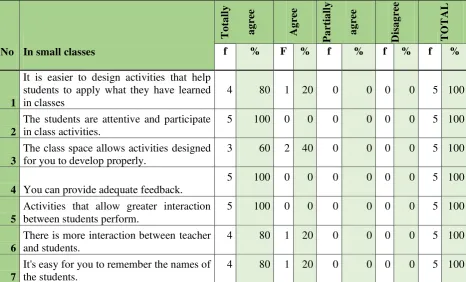
The first statement for teachers was to know if it is easier for them to design activities
that help students to apply what they have learned in classes. In response to this question,
80% of the interviewed teachers totally agree while 20% agree.
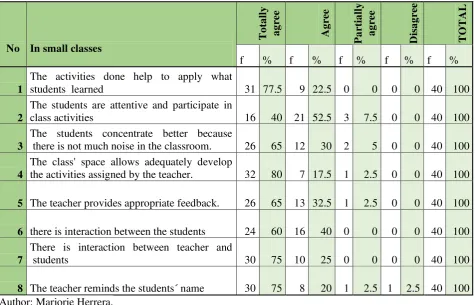
Similarly, students were asked if the activities done help them to apply what they have
learned in class. The results show that 77.5 % of students totally agree with that idea, while
22.5% of the interviewed agree.
These results reveal that for teachers it is easier to design activities that help students to
xxx
statement. In the same way, the majority of students claim that the activities done in class help
them to apply what they have learned. So it can be said that one of the benefits of teaching
English in small classes is that it is easier for teachers to design the activities; likewise, these
activities help student to apply what they have learned.
Furthermore, the observations in class support the answers given by teachers and
students. The activities used by teachers in small classes help students in their learning
process because most of them were interactive activities. It was observed that after each topic
taught, students had to complete activities where they could practice what they have learned.
There is more evidence that support that in small classes the activities done help
students to apply what they have learned. Tiberius (2013) wrote that smaller groups are more
efficient for doing activities that help them apply the new concepts they learned. In addition,
for teachers, it is easier to design activities for small groups because students are fewer so
teacher´s work is reduced (Din, 1999).
The next item in the teacher`s questionnaire was to know whether students are attentive
and participative in class activities. It showed that 100% of the interviewed teachers totally
agree. Similarly, students were asked if they are attentive and participative in class activities,
77.5% of the interviewed students totally agree, and 22.5% agree. An additional question was
asked for students to know if they can concentrate better because there is not much noise in
classroom, and 65% of the students totally agree with the statement while 35% agree and 5%
partially agree.
After analyzing the surveys, it can be established that students in small classes are more
attentive and participative. All teachers think that the attention and participation is higher in
small classes. Almost all students totally agree with their teachers and also believe that they
xxxi
Likewise, in the observations, it was noticed that students were attentive and
participative and more concentrated because there was not much noise in class. It was also
observed that the classes were very interactive because the teacher had designed activities to
increase the involvement of students. For example, teachers tended to ask students about how
their weekend was or what they have done the day before and every student had the
opportunity to participate. This percentage of participation is uncommon in long classes.
In regards with this statement, Flood, Lap, Squire, and Jensen (2003) found in their
research that students´ participation and involvement tend to increase in smaller classes.
The following statement shows that 60% of the interviewed teachers totally agree with
the idea that class space allows the development of the activities designed; meanwhile 40% of
teachers agree. Regarding students‟ answers, 80% of them agree with the idea that the class space allows the development of the activities designed by the teacher, 17.5% of students
agree, while 2.5% partially agree.
As the results show, most of the teachers and the students believe that the space in
small classes allows the development of the activities. A big percentage of students are totally
satisfied with the classroom space because it is big enough to develop any kind of activity.
Very few students just partially agree; it seems that sometimes they do not feel totally
comfortable in the classroom. However, these findings reveal that another benefit of teaching
English in small classes is that the space is appropriate for the development of the activities.
During the observations it was found that students could do the activities easily because
of the space; classrooms were big enough to have many kinds of activities. For example, in a
class it was observed an activity where students had to stand up, form groups and follow some
commands. The class space allowed the development of this and other type of activities
xxxii
These results are also sustained by the literature. Dennick and Exley (2004) wrote that
for small classes it is easier to find an appropriate room. In fact, small groups can feel
comfortable either in a big room or in a small room. This is undoubtedly another advantage
for teaching English to small classes.
Regarding feedback, 100% of the teachers surveyed totally agree with the idea that
feedback can be provided adequately in small classes. Similarly, students were asked a similar
question and 65% of them totally agree that the teacher provides appropriate feedback, 32.5%
of them agree and 2.5% partially agree.
The results show that teachers feel that feedback can be given properly in small classes.
On the other hand, not all students totally agree. Some of them think that feedback is not
always given. Nonetheless it was absolutely higher the percentage of students that totally
agree with the statement. Because of that, it can be established that feedback is properly given
in small classes.
According to the results obtained from the observations, teachers provided appropriate
feedback. Likewise, it was noticed that students usually participated in the feedback. All
teachers started the class by asking students about what they have learned the day before.
Teachers usually asked about vocabulary, grammar or reading. Hence the responses of
teachers and students agree with the observations done.
All these data is supported by Flood, Lap, Squire and Jensen (2003), who ensure that
teachers in smaller classes usually give a greater and better feedback than teachers who are in
larger classes.
With respect to whether the teacher designs activities that allow greater interaction
xxxiii
sentence was surveyed, 60% of them totally agree that the activities done in class help them to
interact with each other, and 40% of them agree.
As it can be seen, all of the teachers think that in small classes the activities performed
allow the interaction between students. Regarding to the student`s answers, the majority of
them totally agree. Afterwards, we can conclude that in small classes the interaction between
students is higher. This is an important benefit of teaching English in small classes.
In the observations done, it was noticed that most of the students interacted with their
partners. Teachers designed pair or group activities where students were able to have real
conversations. Likewise, because the students were few they felt confidence to ask to
classmates about any doubt .As it can be seen, the observations agree with the teacher and
students ´responses.
Regarding with the interaction between students, Johnson and Karen (2002)
emphasized the importance of student- student interaction in the educational success. They
argued that student-student interactions influence students` aspirations and achievement. For
this reason teachers in small classes foment this type of interaction.
The following item in the teacher´s questionnaire was to know if in small classes there
is interaction between teachers and students. It showed that 80% of the interviewed teachers
totally agree meanwhile 20% agree. Similarly, students were asked if there is interaction
between them and teachers and 75% of them totally agree, while 25% agree.
It was noticed that the data collected from teachers and students have similar
percentages in their responses. Almost every teacher and student agrees that another benefit of
teaching English in small classes is the higher interaction between students and teachers.
In addition, the results of the observations show that teachers interact with students.
xxxiv
Teachers were always helping students to resolve any activity and asking them about the
topic. In that way students interacted with teachers.
In relation to interaction between teachers and students Din (1999) claims that small
classes in schools provide an ideal environment for teacher-student interaction.
The following sentence in the teacher´s questionnaire was to know whether for teachers
it is easy to remember the name of students and 80% of the interviewed teachers totally agree
meanwhile 20% of them agree. A similar sentence was surveyed for students and 75% of the
interviewed students totally agree that teacher remember students‟ names, 20% of them agree meanwhile 2.5% partially agree, and 2.5% disagree.
The data confirms that another benefit of teaching English in small classes is that it is
easy for most of the teachers to remember their students „names. The large majority of
teachers agree with this fact. Likewise, most of the students admit that teachers can remember
their names.
Furthermore, it could be noticed that almost all of the teachers call each student by
his/her name. In order to call the students‟ attention or to encourage them, teachers tend to use
the names of the students to make students feel part of the class community.
In conclusion, it can be established that teaching and learning English in small classes
have many benefits for teachers and for students. The data available in tables 1 and 2, the
observations and the literature agree that some of the benefits are: the facility for teachers to
design activities that help student to apply what they have learned, the students are more
attentive and participative in class, the students concentrate better because there is not much
noise in the classroom, the class' space allows the adequately development of the activities
xxxv
and between students is higher. Finally, it is easier for teachers to remember the students‟ names.
The results obtained in relation to the benefits of teaching and learning English in small
classes are aligned to what Flood, Lapp and Jensen found. In their research, they explained
that teachers have always wanted smaller classes. They ensure that the reasons were because
discipline is better in smaller classes. They conclude that in smaller classes students are more
likely to remain on task, the teacher manages behavior of students better, and students seem to
demonstrate higher self-control. Likewise participation and involvement increase when
classes are small and teachers in smaller classes tend to give more and better feedback than
those in larger classes.
[image:35.595.86.548.421.713.2]What teaching strategies and resources benefit the teaching of English in small classes?
Table 3
Teachers` perceptions
No In small classes T
ot al ly ag re e A gr ee P ar ti al ly ag re e D is ag re e T O T A L
f % f % f % f % f %
8
Design and implement activities that allow
you to practice listening skills 4 80 1 20 0 0 0 0 5 100
9
Design and implement activities that allow
you to practice speaking skills 3 60 2 40 0 0 0 0 5 100
10
Design and implement activities that allow
you to practice reading skills 4 80 1 20 0 0 0 0 5 100
11
Design and implement activities that allow
you to practice writing skills 3 60 2 40 0 0 0 0 5 100
12 Design and implement group activities 4 80 1 20 0 0 0 0 5 100
13 Design and implement individual activities 5 100 0 0 0 0 0 0 5 100
14 Use technology resources 5 100 0 0 0 0 0 0 5 100
15 Use teaching materials 4 80 1 20 0 0 0 0 5 100
Author: Marjorie Herrera
xxxvi
Table 4
Students` perception
No In small classes T
ot al ly ag re e A gr ee P ar ti al ly ag re e D is ag re e T O T A L
f % F % f % F % f %
9
Activities to practice listening skills are
performed 30 75 9 22.5 1 2.5 0 0 40 100
10
Activities to practice speaking skills are
performed 30 75 10 25 0 0 0 0 40 100
11
Activities to practice reading skills are
performed 29 72.5 8 20 3 7.5 0 0 40 100
12
Activities to practice writing skills are
performed 28 70 11 27.5 1 2.5 0 0 40 100
13 Group activities are used 25 62.5 12 30 3 7.5 0 0 40 100
14 Individual activities are used 36 90 4 10 0 0 0 0 40 100
15 Technological resources are used 23 57.5 13 32.5 4 10 0 0 40 100
16 Teaching materials are used 17 42.5 15 37.5 7 17.5 1 2.5 40 100
Author: Marjorie Herrera
Resource: students` questionnaire
Tables 3 and 4 show the results obtained in relation to the perceptions of teachers and
students related to teaching strategies and resources that benefit the teaching of English in
small classes.
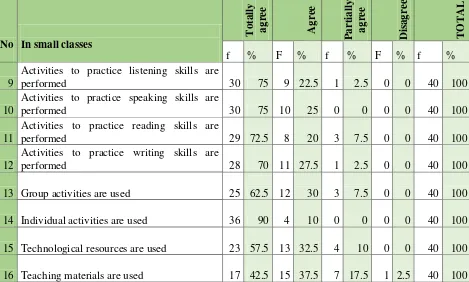
The eighth sentence was formulated in order to know if teachers design and implement
activities that allow the practice of listening skills, and 80% of teachers totally agree while
20% of them agree. For students, a similar sentence was used to know whether listening
activities are performed in class, and 75% of students totally agree, 22.5% agree and 2.5%
partially agree.
According to these results, we can see that the use of activities that allow the practice of
xxxvii
the majority of teachers claim they use listening activities and almost all students agree they
benefit from these kinds of activities.
Furthermore, in the observations of the different classes, it was seen that all of the
teachers use listening activities. It could be noticed that the tracks of listening were repeated
at least three times in order to help students to identify the ideas they listened.
According to whether teachers design and implement activities that allow students to
practice speaking skills, 60% of teachers totally agree, and 40% agree. In relation to the
students‟ answers, 75% of students totally agree that the activities performed in class let them
to practice speaking activities; meanwhile, 25% of them agree.
The data collected show that in small classes speaking activities are performed. It can
be noticed that teachers and students´ responses agree. Even though some of the teachers and
the students do not totally agree with this statement, the large majority believe that speaking
skills can be practiced in small classes. As a result we can conclude that speaking activities
benefit the teaching and learning process in small classes.
Related to the observations, it could be perceived that in fact, students can practice their
speaking abilities. It was noticed that most of the teachers take into account speaking
activities in order to develop communicative skills in students. Likewise students had benefits
from the activities designed.
The tenth statement for teachers was to know whether they design and implement
activities that allow students practice reading skills. The results showed that 80% of teachers
totally agree while 20% agree. In relation to students` answers, 72.5% of them totally agree
that activities to develop reading skills are performed, while the 20% agree and the 7.5%
xxxviii
As the results indicate, most of the teachers design reading activities. In the same way,
almost all of the students agree that the activities done in class help them to develop reading
skills. Very few students partially agree that reading activities are executed in class. These
evidences show that reading activities benefit the teaching and learning English in small
classes.
Additionally, it was observed that all teachers worked with students using reading
strategies. Students from small classes had benefit from that kind of activities because, among
other advantages, their vocabulary was increased.
The related literature agrees that reading activities benefit the effective teaching of
English. According to Herrell and Jordan (2012) the extensive interaction with reading is
extremely positive for learning English.
The eleventh sentence was to know whether teachers design and implement activities
that allow students to practice writing skills. The answers of teachers showed that 60% of
them totally agree while 40% agree. Students answered to a similar statement and the results
were that 70% of students totally agree, while 27.5% agree and the 2.5% practically agree that
activities to practice writing skills are performed.
These outcomes show that the majority of students believe that writing activities are
performed in class. A small number of students just partially agree with this statement. In
relation to teachers `answers, most of them think that they design and implement reading
activities. As a result, it can be concluded that activities that develop writing skills benefit
teaching English in small classes.
It was observed that almost all of the teachers designed writing activities to work with
students. Additionally, most of the students benefited from these activities. Some of the
xxxix
verb, modal or a vocabulary word. Other activities were related with writing about a theme
given by the teacher.
About designing and implementing group activities, 80% of the teachers interviewed
totally agree, and 20% of them agree. In connection with students‟ responses, 62.5% of the students surveyed totally agree, while 30% agree and 7.5% partially agree that group activities
are used.
These data confirm the fact that group activities benefit the teaching of English in small
classes. Although some students just partially agree that group activities are used in class, the
majority of teachers ensure they design and execute group work activities; furthermore, most
of the students agree they benefit from group activities. Therefore, we can conclude that
group work activities help the teaching of English in small classes.
During the observations done, group work activities were developed in the majority of
the classrooms. In most of the classes teachers used pair work or group work activities where
students had to collaborate together in order to achieve a goal.
Additionally, a study conducted by Alghamdi and Gillies (2013) agree that group work
activities are beneficial for teaching English in small classes. The study show that when
students work together in a cooperative learning, there is a increase in student`s achievement.
In relation to individual activities, 100% of the teachers totally agree that these types of
activities are implemented in small classes. Likewise, students were interviewed with a
similar sentence and 90% of them totally agree, while 10% agree that individual activities are
used in class.
The results confirm that individual activities are beneficial for teaching English in
small classes. Every teacher ensures that they often use individual work in class. Likewise,
xl
In the same way, it was observed that individual work was performed in classes.
Students individually worked in their sits using a worksheet, the book or other material
resource. For instance, in a class students had to complete four activities as a review for the
term test. Each learner had to solve the worksheet without any help of partners.
Concerning the benefit of individual work when teaching English in small classes,
Flood, Lap, Squire and Jensen (2003) wrote that the implementation of individual activities is
beneficial since it resulted in an increased quantity of work with a similar level of the quality
of work that teacher obtain when working in group activities.
The following sentence was surveyed in order to know if teachers use technological
resources. The results showed that 100% of the interviewed teachers totally agree. Similarly,
57.5% of the students totally agree that technological resources are used in classes, 32.5% of
them agree, while 10% partially agree.
According to these results, all of the teachers use technological resources when
teaching, but not all of the students totally agree with them. It seems that although the
majority of the students claim that teachers use technological resources and almost the rest of
students agree, a small number of students keep thinking that technological resources are not
fully used in classes. Nevertheless, the results show that most of the times technological
resources are used for the teaching of English in small classes.
During the observations, it was noticed that the teachers use technological resources to
teach English. Examples of these technological resources were the projector and multimedia
presentations. It was also observed that for all of the classes, every teacher brought a laptop to
show students, through the projector, complement information about the topic like a video or
xli
The importance of using technological resources for small classes is also pointed out by
Herrell and Jordan (2012) who indicate that technological resources can help teachers meet
the individual needs of students at diverse English levels and that technological resources can
be indispensable for providing learners with valuable language experiences when learning a
new language.
The last sentence for teachers was to know whether they use didactic resources when
teaching and 80% of the teachers totally agree, while 20% of them agree. Similarly, 42.5% of
students totally agree that material resources are used, 37.5% agree while 17.5% partially
agree, and 2.5% disagree.
The results show that the answers from teachers and students do not agree because the
larger majority of teachers totally agree they use resources materials while some students only
partially agree that material resources are used when teaching English and a few students
disagree. Nevertheless, students who disagree that didactic resources are used in class have a
very few percentage compared with students that totally agree or just agree. The conclusion is
that teachers and students use teaching materials in small classes in the teaching-learning
process.
During the class observations, it was noticed that most of the teachers used teaching
materials like worksheets, flashcards, charts and audio material. However, not all of the
teachers used extra didactic material apart from the book.
Herrell and Jordan (2012) agree that the using of teaching materials benefit English
teaching. They wrote that when teachers use teaching resources like charts students can