
Co creation for transdisciplinarity Adoption of participatory design and agile project management in collaborative research processes
264
0
0
Texto completo
(2) Co-creation for transdisciplinarity. 1.
(3) Co-creation for transdisciplinarity. CO-CREATION FOR TRANSDISCIPLINARITY Adoption of participatory design and agile project management in collaborative research processes Enric Senabre Hidalgo Dimmons.net Research Group PhD Dissertation. Information and Knowledge Society Doctoral Programme Internet Interdisciplinary Institute (IN3) Universitat Oberta de Catalunya (UOC). PhD Director: Mayo Fuster Morell (IN3-UOC) Thesis committee: Josep Perelló (Universitat de Barcelona) Laura Forlano (Illinois Institute of Technology). September 2019. PhD project and dissertation developed between 2016 and 2019 in the Dimmons.net research group.. This work is licensed under a Creative Commons Attribution-ShareAlike 4.0 International License.. 2.
(4) Co-creation for transdisciplinarity. 3.
(5) Co-creation for transdisciplinarity. Index. Abstract. 9. Acknowledgements. 12. FIRST PART: OVERVIEW OF THE STUDY, DESIGN OF RESEARCH AND CONTEXT. 16. 1. Overview of the study. 18. 1.1 Relevance of the project. 18. 1.1.1 Challenges in transdisciplinary research. 20. 1.1.2 Co-creation methods for transdisciplinarity: participatory design and agile project management 22 1.1.3 Transversal key concepts derived from previous research. 24. 1.2 Research questions and analytic process. 26. 1.3 Research methodology. 29. 1.3.1 Research methods applied. 29. 1.3.2 Selection of the case studies. 31. 1.3.3 Originality of the methodological approach 2. Context and state of the art. 34 37. 2.1 Collaborative work in networked knowledge organisations. 37. 2.1.1 Innovation from collaborative networks. 38. 2.1.2 Knowledge generation in teamwork. 38. 2.1.3 Organizational learning, between explicit and tacit knowledge. 40. 2.2 Transdisciplinarity and collaboration in research. 42. 2.2.1 Transdisciplinarity in research work. 43. 2.2.2 Beyond co-authored articles as scientific collaboration. 45. 2.2.3 Collaboration in small-scale science teams. 45. 2.2.4 Collaboration in large-scale research networks. 49. 2.2.5 Action research and citizen science as transdisciplinary collaboration 50 2.2.6 The collaborative tradition of action research. 52. 2.2.7 The emerging domain of citizen science. 54. 2.2.8 Acceleration of science, neoliberalism and academia. 57. 2.3 Co-creation as an emerging paradigm: participatory design and agile project management 58 2.4 The field of co-design. 58. 2.4.1 Origins of design thinking and relation to fields of knowledge. 58. 2.4.2. Evolution of design thinking. 59. 2.4.3. The emergence of participatory design. 60. 2.4.4 Characteristics of co-design. 61. 2.4 Agile project management. 62 4.
(6) Co-creation for transdisciplinarity. 2.4.1 Origins and adoption of agile principles. 62. 2.4.2 Two main agile practices: Scrum and Lean-Kanban. 64. 2.4.3 Applicability of agile outside software development. 67. 2.5 Main contributions to the state of the art. 68. 2.5.1 Co-design influence in the concepts of agile. 69. 2.5.2 Relation of agile principles with action research. 69. SECOND PART: COMPENDIUM OF PUBLICATIONS 3. Introduction to the publications. 72 74. 3.1 Main sections of the compendium. 74. 3.1 Summary of publications. 75. 4. Participatory design for research. 78. 4.1 Developing a research co-design toolkit. 79. 1. Introduction. 79. 2. Description of the co-design process. 80. 3. Preliminary conclusions. 87. 4. References. 88. 4.2 Participatory design of citizen science experiments. 90. 1. The study goal and aim of the analysis. 90. 2. Methodology of the study. 92. 2.1 Survey to participant students. 93. 2.2 Interviews with the team of scientists. 93. 3. Description of the co-design process. 93. 4. Results. 95. 4.1 Can co-creation contribute to a more collaborative form of citizen science?. 96. 4.2. How can science integrate social needs and concerns in its design and communication dynamics? 97 4.3. How can interdisciplinary work be coordinated to construct knowledge collaboratively?. 98. 4.4. How has knowledge been developed in this citizen science co-creation experience?. 99. 5. Discussion and conclusions. 101. 6. References. 102. 5. Agile management for research. 106. 5.1 Management of a multidisciplinary research project. 107. 1. Introduction. 107. 2. Agile Principles and Practices for Collaborative Research Projects. 107. 3. Case Study: Multidisciplinary Collaboration at the Dimmons Research Group. 109. 3.1. Using Agile Methods to Balance Flexibility and Coordination. 112. 3.2. Achieving Integration Within Heterogeneous Teams. 113. 4. Conclusion. 116. 5. References. 118 5.
(7) Co-creation for transdisciplinarity. 5.2 Adapting the scrum framework for agile project management of science 1. Introduction. 121 121. 1.1 Team-based collaboration in research. 121. 1.2 Agile project management. 123. 1.3 The scrum framework. 124. 2. Background. 126. 3. Methods. 127. 4. Case analysis and findings. 130. 4.1 Conditions for adopting agile methods in research. 130. 4.2 Adoption of scrum principles and tools. 132. 4.3 Challenges of APM adoption in a distributed research organisation 138 5. Discussion. 141. 6. References. 143. 6. Combined co-creation for research. 150. 6.1 Dotmocracy and planning poker for uncertainty management in collaborative research 1. Introduction. 151 151. 1.1 Uncertainty and open collaboration in research. 151. 1.2 Two digital cultures of co-creation: participatory design and Agile frameworks. 152. 2. Methodology. 154. 2.1 Selection of co-creation methods. 155. 2.2 Data sources and procedure. 155. 3. Results. 156. 3.1 Dotmocracy applied to collaborative research ideation. 157. 3.2 Planning poker applied to collaborative research management. 158. 4. Discussion and future research. 160. 5. References. 161. 6.2 Co-designed strategic planning and agile project management in academia: case study of an action research group 164 Abstract. 164. 1. Introduction. 165. 1.1 Strategic planning in the field of project management. 165. 1.2 State of the art on strategic planning applied to research. 166. 1.3 The co-creation approach: participatory design and agile project management. 166. 1.4. Research questions. 167. 2. Methodology. 168. 2.1 Background of the Dimmons case study. 168. 2.2 Participatory design for how to apply co-creation in strategic planning 169 2.3 Content analysis for the impact of a co-created strategic planning on APM of research 170 3. Results. 172 6.
(8) Co-creation for transdisciplinarity. 3.1 How can co-creation techniques and principles be used in leading the strategic planning process of a research group? Insights from the participatory design of the Dimmons strategic planning 173 3.2 What would be the influence of co-created strategic planning on the agile project management of research? Insights from the analysis of impact in Dimmons coordination 177 4. Discussion. 181. 5. References. 184. THIRD PART: GENERAL CONCLUSIONS AND DISCUSSION 7. Summary of research results. 189 191. 7.1 Co-creation approaches for transdisciplinary research: overall findings. 192. 7.2 Participatory design for the formulation phases of research. 193. 7.3 Agile management for the sustainment phases of research. 194. 7.4 Co-creation for strategic planning of research. 196. 7.5 Limitations of the study. 197. 8. Research discussion. 200. 8.1 Collaboration in networked knowledge organizations: participatory management within “adhocracies of practice”. 200. 8.2 Transdisciplinarity in research: experimenting the interrelations of complexity and diversity 202 8.2.1 Team science collaboration: beyond the opportunities and drawbacks of acceleration in academia 204 8.2.2 Public participation in research: new transdisciplinary challenges around adhocracies 205 8.3 Overview of co-creation practices: from participatory design to participatory management 207 8.3.1 A transversal perspective on co-design for research ideation and planning. 209. 8.3.2 Benefits and limitations of agile frameworks: the researcher as a knowledge worker in transitioning institutions. 211. 8.4 Additional observations, contribution and lines of future research. 213. 9. Bibliography. 216. 10. Annexe: Collaborative research toolkit. 243. 7.
(9) Co-creation for transdisciplinarity. «You cannot understand a system until you try to change it» Kurt Lewin. 8.
(10) Co-creation for transdisciplinarity. Abstract This PhD project investigates co-creation methods applied to transdisciplinary research. In the context of the Network Society, research collaboration has grown in popularity among scientific teams, under many approaches and forms. Among them, transdisciplinarity represents a specific type of collaborative scientific activity. Transdisciplinary research goes beyond the collaboration of experts from different disciplines, and can also involve non-experts and non-scientific stakeholder communities for holistically addressing different problems and issues, as in the case of citizen science or action research. Transdisciplinarity involves complex research processes and new challenges, such as how to deal with diversity from participants, especially for planning and managing projects. This thesis, articulated around a compendium of publications, explores if and how far co-creation methodologies can contribute to addressing these challenges, in different contexts and phases of transdisciplinary research. The research focuses on the need to explore and analyse how transdisciplinarity can be influenced by co-creation at the practical and procedural level, particularly when adopted by scientific teams in the preliminary and day-to-day collaboration for research projects. Among the various paradigms of co-creation, participatory design and agile project management represent two relevant methodological frameworks for articulating collaboration. Both originated outside of academia and are now progressively being adopted in a wide diversity of knowledge-related domains. With a potential for improving collaborative research processes, participatory design and agile frameworks represent innovative approaches to knowledge generation that require dedicated attention when adopted in transdisciplinary contexts. Co-creation, in this sense, is emerging in parallel to new approaches to scientific production like Open Science or Responsible Research and Innovation (RRI). The central question is to what extent the current shift in different scientific domains to establish transdisciplinary processes, which increases the diversity of participants and perspectives, as well as complexity in the management of collaboration practices, could benefit from co-creation approaches for the participative ideation, planning and coordination of research. The aim of this thesis is, therefore, to develop a comprehensive understanding of key factors that connect co-design and agile practices to collaboration in transdisciplinary research projects. Among these key factors, consideration is given to aspects such as communication, visualisation, transparency, task distribution, trust building, engagement, quality of results and efficiency. The study is based on three different case studies of transdisciplinarity in academia, that cover the contexts of citizen science, team science and action research. The methodology adopted combines quantitative analysis, via questionnaire surveys and 9.
(11) Co-creation for transdisciplinarity. online content analysis, with a qualitative approach based on semi-structured interviews and participant observation. In parallel to the analysis of the case studies, the project has produced and tested a practical toolkit for the collaborative design, planning and management of transdisciplinary research. The originality of the project, in this sense, is twofold. On the one hand, it brings a common perspective of co-creation and its experimental application in transdisciplinary research (connecting previous knowledge from fields like design thinking, project management, organisational learning, public participation in research and science of team science). On the other hand, the study represents a novel approach in providing the mentioned toolkit as a practical copyleft material, for potential reuse by other research projects and co-creation practitioners. The research results suggest that co-creation contributes to integrating diversity and managing complexity in several stages and types of transdisciplinary research collaboration. Especially in decision-making processes, thanks to visualization techniques, dynamic ways of communicating and generating discussion via specific facilitation approaches. Co-creation is also useful for improving transparency in workflows, contributing to engagement and trust building when facilitated in flexible, adaptive and scalable ways. In terms of efficiency and quality of results, data from the various case studies are less evident, and the indicators pertaining to the scope of the study less definitive in affirming such extent. However, both participatory design and agile project management seem to contribute to fomenting diversity in research, by enabling dialogic and visualization processes that represent a counterbalance to the usually isolated and asynchronous pace of research work. Additional data and observations gathered through this study have expanded the frame of the research to results related to the current context of structural changes in academia. This relates particularly to the complex balance between intellectual work and administrative tasks, in parallel to the accelerated pace and pressure derived from competition for research excellence and funding in scientific institutions. In conclusion, the results of my overall research through this dissertation point not only to the coherence of applying co-creation methods to transdisciplinary research, but also to the need to consider it a key methodological requirement for properly articulating collaboration in this field.. 10.
(12) Co-creation for transdisciplinarity. 11.
(13) Co-creation for transdisciplinarity. Acknowledgements I began this project by asking an apparently simple question: how can science be co-created today? But I was not alone when considering this, since I was sitting next to Mayo Fuster, the first person I wish to acknowledge and to whom I would like to convey my sincerest thanks. She gave me this opportunity and privilege to imagine, test and learn many things while working by her side, during the three first years of existence of the Dimmons research group. From this shared interest, soon I realised along the way, that, after all, scientific endeavours have always been co-created, and that diverse types of knowledge (not only scientific knowledge) are mostly generated collectively. This occurs incrementally through joint effort, since scholarship is a cumulative process, with questions, methods and discoveries built through a continuum of projects, paradigms, publications, schools, generations, and people, amongst others. In this collective sense, I want to recognise and thank my other colleagues in Dimmons Ricard Espelt, Vera Vidal, Núria Valero, Adrià Garcia, Melissa Renau, Jessica Agnel and Mireia Manjón for their warm support, wisdom and good karma. And to the fantastic people and professionals with whom I have had the privilege to collaborate on Dimmons’ activity, at some point, through different projects: Núria Ferran-Ferrer, Guido Smorto, Thais Ruiz, Marc Rocas, Núria Reguero, Sergi Frias, Sara Moreira, Bruno Carballa, Natalia Andrea, Manel Rebordosa, Paola Imperatore, Elisabet Roselló, Eva Esteban. From the co-authorship of papers and cooperation within university departments and research organisations (or even conferences, as temporary research ecosystems themselves), to academic networks and epistemic cultures across disciplines, collaboration lies at the center of scientific activity. I have also had the opportunity to learn about this type of collaboration through shared projects and conversations with other research groups and colleagues at the Internet Interdisciplinary Institute, who were generous and open to sharing their expertise with me. So, in this regard, I would like to express my gratitude to Antonio Calleja and Andreu Belsunces from Tecnopolítica; Jörg Müller, Julio Meneses and Lídia Arrollo from GenTIC; Ramon Ribera and Isabel Ruíz Mallen from TURBA Lab; Jordi Cabot from SOM Research Lab; and Daniel López from CareNet. My question arose from a clear, relatively new and disruptive change in this perspective of co-creation and collaboration in science: nowadays the Internet and digital culture has radically changed the way researchers work and communicate, affecting in profound ways academia and science (as probably any other area of human activity). So, I thought a valid starting point would be to consider how new communication possibilities, in all periods of history, have always influenced the progression of human knowledge and, in several ways, our current opportunities for collaboration and co-creation. I consider myself a very lucky person in this sense, since during the last two decades I have been in touch with the human side of collaboration through many projects and initiatives. In between technological accelerations and personal changes, 12.
(14) Co-creation for transdisciplinarity. collaborating with the following people represented a serious and fertile playground, full of important discoveries and great moments, so I wish to say thanks a million to Platoniq souls Olivier Schulbaum and Susana Noguero (brothers in arms in co-creation and in workshops across Europe); Mauricio O’Brien, Mercè Moreno, María G. Perulero, Javier Carrillo, Iván Vergés (and the rest of the great Goteo crew and history); David Gómez and Mónica Garriga (writing collaboratively from Teixidora, and for our early co-creation adventures David); Paco González and Massimo Menichinelli (and our regular P2P mutual support!). By having the opportunity to observe closely how a complex system of scholars, communities, questions, research methods, civic organizations and academic institutions are interrelated (especially in the field of social sciences), my question began to become more complex, as I started to look for practical answers for daily challenges in the “core” of transdisciplinary research processes. At this point I also need to acknowledge and convey my gratitude to Josep Perelló from Universitat de Barcelona, for his advice and insights, as well as the rest of the OpenSystems team Isabelle Bonhoure, Anna Cigarini, Julian Vicens and Enric Sanmartí (and to all the students and teachers involved in the great STEM4youth project), for their complicity and the early trust and confidence they gave me at the beginning of my study. The early support of Laura Forlano from the Illinois Institute of Technology was also key in making this dissertation project possible. I also wish to express thanks for their time, inspiration and patience to Nigel Gilbert, Alex Penn, Dione Hills, Ian Christie, Adam Hejnowicz, Ben Shaw, Jeremy Phillipson, Pete Barbrook-Johnson, Martha Bicket, Amy Proctor, Emma Uprichard, Frances Rowe and Lisa Fletcher, from the Centre for the Evaluation of Complexity Across the Nexus. At some point I was also very lucky to meet Eveline Wandl-Vogt, in the middle of a shared exploration process, and get to know and start to collaborate with her and Amelie Dorn, Renato Rocha, Thomas Palfinger, Jose Luis Preza and Barbara Piringer, from the great exploration space of the Austrian Centre for Digital Humanities. I must also express my thanks for the advice and insights of Adam Hyde from Collaborative Knowledge Foundation, Geraldine Henningsen from Technical University of Denmark, Ingrid Erickson from Syracuse University, Michelle Boath and Jonathan Hyde from Risk Solutions, Antonio Tenorio and Samer Hassan from Universidad Complutense de Madrid, Ferne Edwards from RMIT Europe, Simon Gough from The Data Place, and Carrie Yury from Beyond Curious. I am also very grateful to Enric Mor from UOC’s Arts and Humanities to invite me to present some early results, and Susanna Tesconi, from the UOC’s Computer Science, Multimedia and Telecommunications studies, for her feedback as an early adopter of the toolkit developed during this project. And I also convey a special thanks for Toni Cambra, who was always available to dispel doubts as a great UOC tutor. At some stage my initial question branched into several areas of inquiry, related to ways for designing and managing research projects collectively. Recognising this, I moved on with the resolve of not “reinventing the wheel” nor complicating things even more, but instead going back to some solid things I knew first-hand, where similar questions and challenges in other fields around co-creation have experienced great advances. Working in a deductive and inductive way, from the privileged but challenging position as coordinator of the Dimmons action research group, on many occasions I had to 13.
(15) Co-creation for transdisciplinarity. resort to my previous background as facilitator of collective work dynamics and knowledge management. In this sense, during many stages of this intellectual adventure I also recalled experiences when working at CitiLab Cornellà (so here are more thanks, in recognition of the great moments spent together with Ramon Sangüesa, Laia Sánchez, Artur Serra, Vicenç Badenes, Maria Josep Solé, Jordi Colobrans, Francisco Cobacho, Joan Güell, José García, and many more); as well as during the intense and fruitful experience of being part of the Observatory for CyberSociety (which also means gratitude for the early learning together with Joan Mayans, Ricard Faura, Nicole Etchevers, Francesc Balagué, Guillem Mundet, Josep Vives, Ana Esteban, Daniel Domínguez). Exploring ways to co-create science, or more specifically, collectively ideate and manage research projects, has ended up taking shape in a series of concrete practices, where I had the opportunity (not always easy) of being a participant observer. Something that progressively allowed me to refine questions and collect empirical data, via diverse case studies, as well as an intense dialogue with the specific literature I found. Eventually, I was also able to adapt and even develop resources and tools for other researchers, who started to use them in similar contexts. But all this journey through collaboration, academia and knowledge, which I feel I’m not concluding but somehow starting with this dissertation (by perhaps adding more questions than answers to the point of departure), would not have been possible without the continuous support and encouragement of my family: from my parents Ana and Enrique, to my brother Miki, Maribel and kids, to Jordi, Micha and Montse (and Juanito, wish you were here); as well as my good friend in readings Ghislain, and Bruno and Marcos in the distance; tía Carmen, Juanan, Perico & María, Jordi and rest of Noel’s Party Cerdanyola; and, of course, to Samuel and to Alba, sources of inspiration and lighthouses when the dark moments. Finally, especially to you Eva, I express my deepest gratitude, for supporting me and believing in me.. Enric Senabre Hidalgo Barcelona, 3 July 2019. 14.
(16) Co-creation for transdisciplinarity. 15.
(17) Co-creation for transdisciplinarity. FIRST PART: OVERVIEW OF THE STUDY, DESIGN OF RESEARCH AND CONTEXT. 16.
(18) Co-creation for transdisciplinarity. 17.
(19) Co-creation for transdisciplinarity. 1. Overview of the study This dissertation investigates if and how co-creation practices and principles, from a methodological and managerial perspective, could contribute to improving the ways of designing and coordinating transdisciplinary research. Among the different paradigms of co-creation, participatory design and agile project management are two relevant methodological frameworks that constitute the focus of my research. It is within this perspective, related to the need to experiment co-creation and improve new collaborative ways for dealing with diversity and complexity, when implementing transdisciplinary projects, where I think lies the originality and importance of this dissertation. In this first section I elaborate an initial approach to the basic areas of the study and the relevant concepts and challenges that have been the focus of my research, outline the rationale of its analytic framework and explain the value of my contribution. This first part also addresses the main research questions, and several key factors and concepts related to it, followed by a description of the methodology adopted for the different case studies. Some of the key concepts, discussions and perspectives addressed here at the theoretical level, however, are presented more extensively in the following chapter, which focuses on the context and state of the art.. 1.1 Relevance of the project In trying to describe the relevance of this dissertation, first it is important to frame this project within the concept of transdisciplinarity in research and some of the current challenges related to it. Particularly in relation to scientific collaboration, which is one of its key features (Lawrence, 2015). Nowadays, in different research domains there is an emergent dominance of collaborative teamwork for generating valuable knowledge (Sonnenwald, 2007). But at the same time, researchers who have looked at this subject have identified a lack of conceptual and practical approaches on how to effectively co-design and plan the day-to-day operations of research processes in more participative ways (Wilbon, 2012), and also a need of more evidence regarding successful research management practices (Derrick & Nickson, 2014). They argue that in contrary to the traditional context, where much research was conducted by lone researchers or by co-located teams, and where most team members had the same or similar disciplinary backgrounds, in recent decades there has been a clear shift to more diverse and regular collaboration in science and research (Katz & Martin, 1997). In parallel to the irruption of information and communication technologies (ICT) and its consequent culture shift for enabling more effective cooperation in the workplace (Zuboff, 1998), in online peer-production (Algan et al., 2013) and in research projects (Rogers, 2013; Fuster Morell, 2011), various scholars describe how research collaboration is a complex and ever-changing process (Ernø-Kjølhede, 2000; Stokols et al., 2008; 18.
(20) Co-creation for transdisciplinarity. Jirotka et al., 2013). Debate centres on the issue of how collaborative research is dominant in science teams and team-based research, both in academic organisations and among large-scale international research networks (Cooke et al., 2015). In that sense, higher degrees of collaboration intensity and diversity seem to contribute to research quality (Liao, 2011) and productivity (Daradoumis et al., 2012), as well as bringing positive effects on participants commitment and knowledge integration (Polk, 2015). Other potential benefits of collaborative research range from increased citations in the case of co-authored authorship of papers, which is one of the oldest scientific collaborative practices since the 17th and 18th centuries (Beaver & Rosen, 1978), to better use of existing resources (Ynalvez & Shrum, 2011), capacity to successfully manage large-scale projects (Bammer, 2008) or more opportunities for knowledge transfer and learning (Lassi & Sonnenwald, 2010). In this respect, finding more practical ways of developing collaborative research in team science is recognised as having a relevant effect on knowledge generation (Lee & Bozeman, 2005). Something that takes place in an emerging paradigm of different and changing collaboration practices in science, in a relatively new context of “increased complexity and scope of research problems requiring multi-, inter-, and trans-disciplinary approaches linking specialised expertise” (Katz & Martin, 1997). In this sense, examples of collaborative research and the literature about the field usually appeal to the interrelation of disciplines and how they are combined. Rosenfield (1992) provided a clear distinction between unidisciplinary collaboration (where researchers from a single discipline work together to address a common research problem) and cross-disciplinarity (which includes multidisciplinarity, interdisciplinarity and transdisciplinarity), considering the latest being a progression of layers of practice and complexity in research collaboration, in line with other authors (Miller, 1982; Stokols et al., 2008). Whereas multidisciplinarity draws on knowledge from different disciplines, with each staying within their boundaries, interdisciplinarity analyzes, synthesizes and harmonises links between disciplines into a coordinated and coherent whole (Choi, 2006). Transdisciplinarity, on the other hand, can be summarised as eminently problem-centered (Leavy, 2016) and as a holistic and integrative process “in which researchers work jointly to develop and use a shared conceptual framework that synthesizes and extends discipline-specific theories, concepts, methods, or all three, to create new models and language to address a common research problem” (Rosenfield, 1992). This perspective takes into account how scientific collaboration within the academic context can challenge existing institutional structures and disciplinary methods of research, specially when they are not apt to deal with complex real world problems (Klein, 2015). In this sense, transdisciplinarity is also described by other authors as a form of research that can enable inputs and scoping across scientific and non-scientific stakeholder communities (Wamsler, 2017; Koskinen & Mäki, 2016), driven by the need to solve real-life problems by openly designing the phases or the research process in a recurrent order (Hadorn et al., 2008). Transdisciplinarity, from that dual perspective, emerges as one of the basic attributes of collaborative work in scientific production, where according to the controversial but 19.
(21) Co-creation for transdisciplinarity. influential “Mode 2” framework described by Gibbons et al. (1994), scientific knowledge (and innovation emerging from it) is context-driven, problem-focused and crosses disciplinary boundaries to create holistic approaches. As opposed to a “Mode 1” type of research, motivated by scientific knowledge alone (and not necessarily concerned with the applicability of its results), such Mode 2 is no longer isolated from its social contexts, either within or outside the boundaries of the academic institutions, and non-scientists under that approach can be more active in the processes of scientific knowledge production (Nowotny et al., 2013). Responsible Research and Innovation (RRI) is another relevant perspective in the scientific domain in relation to a change of paradigm in transdisciplinary collaboration, promoting the involvement of stakeholders and civil society in scientific activities for developing more inclusive innovation processes (Owen et al., 2012). So too Open Science, a series of principles and digital practices fostering a more transparent and accessible scientific culture and its connection with citizens (Fecher & Friesike, 2014). On the other hand, an important area related to collaborative transdisciplinary research has to do with the tradition of action research and community-based research (De Santos & Hissa, 2011; Fuster Morell, 2009), where participants who are not professional or academic researchers can be fully involved in several aspects of an investigation process (Corburn, 2005). In that field, participants usually collaborate with researchers in relation to practical or pressing issues at the local level, representing the needs of different organizations and communities (Reason & Bradbury, 2001). Finally, in this respect a more recent collaborative research domain is the relatively new paradigm of citizen science, with volunteer citizens collaborating with researchers for digitally gathering or analysing scientific data (Bonney et al., 2009) and also engaging in other critical parts of the research process (Irwin, 2002; Wylie et al., 2017). Results from citizen science projects are already starting to appear in peer-reviewed journals, indicating that it constitutes an expanding palette of transdisciplinary practices with progressive academic acceptance (Follet & Strezov, 2015).. 1.1.1 Challenges in transdisciplinary research Although those collaborative practices in transdisciplinary research domains represent a wide corpus of academic literature and references, with specific methods for data gathering and analysis, there is a general lack of clear methodology and clarity on practical details about how to co-develop collaborative inquiry processes in participatory research (Frideres, 1992) as well as in cross-disciplinary contexts (Rosenblum, 1995). On the other hand, scientific teams and networks of large-scale collaborative research projects in many occasions require better approaches in applying existing project management techniques (Huljenic et al., 2005; Vom Brocke & Lippe, 2015). Given that, in some instances, complex and cross-disciplinary research projects seem to be repeatedly “re-inventing the wheel” for managing the production of results (König et al 2013), and the ideation and crafting processes behind different types of scientific production are currently in need to improve its sources of creativity (Wang & Hicks, 2015). Evolving in parallel to the disruptive adoption of ICT in knowledge-intensive organisations (Powell & Snellman, 2004) and also to more interactive relationships 20.
(22) Co-creation for transdisciplinarity. between society and science (Nowotny et al., 2013), transdisciplinary research practices face critical questions related to how to collectively produce relevant knowledge. Two of the most important challenges, in this sense, are related to integrating the diversity of participants and their perspectives (Cheruvelil et al., 2014), and the added complexity that this represents for project management (König et al., 2013), as reflected in Figure 1. This currently represents a wide and challenging field in continuous evolution at the methodological level, requiring analysis about how and when collaborative research is implemented (Katz & Martin, 1997; Jirotka et al., 2013). If we focus on the specific field of collaboration in transdisciplinary research, the same challenges arise when it comes to cooperatively developing effective project management (Hollaender et al., 2002), to co-designing research plans and approaches (Pohl & Hadorn, 2007) or, in general terms, to developing a culture of cooperation between experts in different disciplines and other stakeholders (Klein et al., 2012).. Figure 1: Complexity and diversity in transdisciplinary research.. In this sense, it is also important to refer in more detail to the work of Sonnenwald (2007) on scientific collaboration, which presents another set of key concepts addressed in the novel approach framing the analysis of this study. She establishes, on the one hand, a series of elements influential for the classification of scientific collaboration, such as: (a) its disciplinary focus (which coincides with the connection established here between transdisciplinarity and the involvement of multiple stakeholders, and hence the integration of diverse knowledge); (b) geographic focus (in other words, the extent to which collaboration is decentralised and distributed, or instead collocated); and (c) organizational and community focus (from collaboration with society to university-industry partnerships). On the other hand, Sonnenwald also proposes a temporal view of four stages of scientific collaboration (foundation, formulation, sustainment and conclusion) which constitutes a complementary part of the analytical axis of my approach (Figure 2). Although she states in this respect that scientific collaboration is a non-linear, dynamic 21.
(23) Co-creation for transdisciplinarity. process, in line with other authors (Hara et al., 2003), her classification describes how right after the foundation stage (with diverse social and intellectual factors existing before a research collaboration is formulated) and before the conclusion stage (final period of publishing findings, dissemination of results, etc.), there is the formulation and sustainment phases, which refer closely to the central focus of this dissertation.. Figure 2. Key factors of the scientific collaboration process (Sonnenwald, 2007).. The formulation stage represents a key moment for establishing the vision, goals and tasks of a given collaborative research project. This stage is characterised by the complexity of formulating research questions, and the importance of skills needed for facilitating the process, as well as the need of a clear definition of tasks, or the importance of a shared vocabulary and effective leadership. Finally, in relation to this formulation stage, the author also points to the key issue of ICT and challenges related to its adoption by team members. Regarding the stage of research sustainment, that phase is also relevant according for Sonnenwald for how it points to complex aspects in the organizational structure of scientific teams and project management practices, and the need to balance diversity with structured coordination. Factors like trust building and organizational learning (sharing explicit and tacit knowledge among participants) are also key at this phase, prior to concluding the research.. 1.1.2 Co-creation methods for transdisciplinarity: participatory design and agile project management In view of the challenges described in terms of diversity and complexity for enabling research collaboration practices, this dissertation explores and tests the implementation of transdisciplinary processes of, on the one hand, participatory design (or co-design), and of agile project management on the other one. I try to analyze in depth if adaptations of those two co-creation methodological frameworks (which were not originally developed in research contexts) can contribute to the dynamics of collaborative research. Especially for generating additional participative research design and planning (benefiting from diversity through co-creation), as well as for viable alternatives in the project management of transdisciplinary projects (dealing with the derived complexity in effective and meaningful ways).. 22.
(24) Co-creation for transdisciplinarity. In relation to research co-design, the literature and tradition of research design and scientific methods covers how to practically define a research project (Creswell, 2009) or how to implement for example more visual methods (Margolis et al., 2011; Latham, 2016), but usually from the perspective of the main researcher as the only decision-making actor. The same goes for scientific teams, where those crucial design steps are usually, if so, informally negotiated (Barab & Squire, 2004). While there have been increasingly more approaches addressing the need to rethink the methods of inquiry in the disruptive context of the digital domain, and its rich possibilities for changing the role and outreach of the researcher (Rogers, 2013), the design and planning of the research process and its details usually falls into decisions taken at the individual level, via non-explicit processes (Verschuren et al., 2010). In relation to strategic planning for research organisations, there is also scarce academic literature about it, with studies focusing on how it has gained some popularity in the general operation of universities (Srinivasa et al., 2015), as well as with openness and participative approaches (Amrollahi & Rowlands, 2017), or about its implementation for collaborative practices within scientific centers (Boardman & Gray, 2010) and for the administrative management of research (Drummond, 2003). Other studies reflect how the challenge for any research environment is that significative creativity is required to produce innovative results, considering creativity as something that is at the base of problem-solving and problem-finding activities (Amabile et al., 1996). In this sense, some research on innovation management argue that projects benefit from flexibility and enabling spontaneity (Kapsali, 2011). The design thinking tradition, and its connection to specific methods for collaboratively integrating diversity and visual language, as well as co-creation for participative planning, could offer alternatives for this (Nagle & Sammon, 2016). Design thinking, particularly with co-design as it’s more participative dimension (Manzini & Coad, 2015), represents a set of practical approaches for the creative definition and solving of problems (Cross, 2011). It offers a great variety of visual methods, procedures and techniques for collaboratively designing new projects in complex circumstances, as well as the simultaneous exploration of scenarios, user-centered and participatory approaches and the integration of many possible points of view and perspectives to a given situation (Blizzard & Klotz, 2012). In comparison to the main analytic approaches from the scientific method or engineering disciplines, with which it has a complex and rich dialogue in practices and foundations (Archer, 1979; Bannon & Ehn, 2012), design thinking allows the integration of diversity and more ambiguity in relation to research parameters, as well as flexibility in the generation of outputs (Cross, 2001), and even the iterative redefinition of initial contexts and problems (Jones, 2014). In this sense, the approach of this project is based on an important conceptual difference in design thinking between “co-creation” (the generic process of collective creativity and production) and “co-design” (a set of concrete participatory design techniques), the latter being a specific feature within the broader co-creation field (Sanders & Stappers, 2008). In relation to agile management frameworks, a close look at the literature and state of the art in project management and collaboration in research projects shows also the relevance of my approach, which attempts to address some of the challenges in the 23.
(25) Co-creation for transdisciplinarity. day-to-day of coordinating transdisciplinary processes. In this sense, Turner and Cochrane (1993) identify uncertainty about working methods and precise outcomes as the main characteristic of any research environment (especially for the key issues of defining methodologies and goals). Whereas any type of research project may or may not have a more participative dimension, this points to the key aspect of managing uncertainty and to the ability to re-plan or add new tasks to the research project roadmap with fast decision-making (Lenfle, 2008). When researchers and practitioners from different organisations and disciplines work together, some authors also point to the important aspect of managing stakeholder expectations, which sometimes can be different and contradicting (Vom Brocke & Lippe, 2015). Other approaches related to collaborative research management deal with key factors such as levels of commitment, leadership, trust, clarity, transparency or communication and monitoring (Keraminiyage et al., 2009). Another important dimension addressed in literature about collaborative research management has to do with the role of the researcher as a manager, who according to some authors requires relevant dialogue skills in cooperative environments (Ruuska & Teigland, 2009) and a delegating and participative leadership style (Barnes et al., 2006), especially for the management of project-internal communication and participation (König et al., 2013). Adopting and adapting agile methodologies for collaborative teamwork, which according to several studies improve flexibility, autonomy and effectivity in different informational tasks (Wysocki, 2011), could contribute to a shared and effective way of dealing with some of the challenges mentioned above. Agile co-creation practices usually make workflows more continuous and incremental, based on principles of adaptability, personal and group autonomy, modularity and self-organised collaboration, as defined in the Agile manifesto (Beck et al., 2001). Also representing a set of emerging co-creation practices, agile project management has recently expanded to other organisational contexts (Rigby et al., 2016). This is mainly due to its potential for optimising the operative capacity of teamwork in short cycles of implementation, for visualising and sharing the progress on tasks and for maximizing the possibilities for success of projects in complex and multidisciplinary environments (Cao et al., 2009; Ciric et al., 2018). A potential related to the fact that the roots and foundational theories for the agile methodological framework date back to empirical work in knowledge management, particularly with respect to lean production and the distinction of sharing of explicit knowledge or tacit knowledge in teamwork dynamics (Takeuchi & Nonaka, 1986).. 1.1.3 Transversal key concepts derived from previous research The analytical framework of this dissertation departs from an extensive literature review that has allowed for the identification, beyond the issues in diversity and complexity mentioned, of other transversal key concepts in previous studies about transdisciplinarity and collaborative research, in connection with similar ones in the different fields of participatory design and agile project management. These factors (Table 1) were extracted by a clustering of concepts derived from results and discussions on different reference papers that guide my analysis (as widely 24.
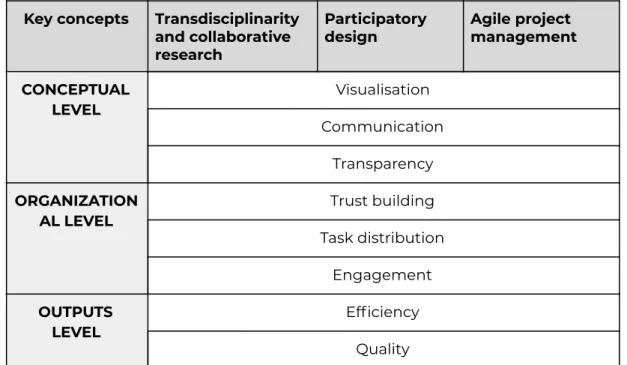
(26) Co-creation for transdisciplinarity. described in the state of the art in the second chapter of this compendium). In order to present them here, as a transversal analytical base that contributes to guiding this research, I classify and group them connected to collaboration practices at (1) the conceptual level (factors of visualization, communication, transparency), (2) the organizational level, of key aspects made possible by the previous ones (trust building, task distribution, engagement) and finally (3) aspects related to outputs of the process and its results (efficiency and quality).. Key concepts. Transdisciplinarity and collaborative research. Participatory design. Agile project management. CONCEPTUAL LEVEL Visualisation. Communication Transparency. Bennett & Gadlin, 2012. Sanders & Stappers, 2008. Cao et al., 2009. König et al., 2013. Bannon & Ehn, 2012. Hoda et al., 2013. Jeffrey, 2003. Kleinsmann & Valkenburg, 2008. West et al., 2010. ORGANIZATIONAL LEVEL Trust building. Task distribution. Engagement. Stokols et al., 2008. Björgvinsson et al., 2010. Cohen et al., 2004. Laudel, 2002; Delfanti, 2016. Cross, 2011. Hoda et al., 2013; Dybå & Dingsøyr, 2008. Cheruvelil et al., 2014; Stokols et al., 2008. Manzini & Coad, 2015. Stettina & Heijstek, 2011. OUTPUTS LEVEL Efficiency. Quality. Lee & Bozeman, 2005; Ynalvez & Shrum, 2011. Cross, 2011. Fernandez & Fernandez, 2008. Liao, 2011. Sanders & Stappers, 2008. Serrador & Pinto, 2015. Table 1: Transversal key factors for analysing adoption of co-design and agile in transdisciplinary research, derived from the literature review.. This classification is consistent, as well, with the framework elaborated by Hoegl & Gemuenden (2001) for assessing teamwork quality for successful collaboration processes. The authors establish a series of key concepts from the field of project management in organizational studies, that relate with similar terminology to equivalent factors: communication, coordination, balance of member contributions, mutual support, effort and cohesion. 25.
(27) Co-creation for transdisciplinarity. Summarising the justification and motivation for this dissertation: both participatory design and agile frameworks represent, until now, relatively unexplored principles and methods of co-creation for challenges on how transdisciplinary research collaboration takes place, between different areas of knowledge and also different levels and types of participation. The relevance of my contribution, in this respect, lies in the unique position as participant observer involved in several transdisciplinary research projects, from different academic institutions. From there, applying a deductive and inductive approach, I had the opportunity to analyse the adoption of various co-creation methods. My contribution can be considered also original in its combination of diverse theoretical perspectives from fields such as knowledge management, science and technology, organizational studies, design disciplines and sociology of science.. 1.2 Research questions and analytic process This doctoral study represents a meta-research project. That is, research about research practices, with the goal of exploring evidence-based improvements (Ioannidis et al., 2015). In this case, the analysis addresses collaboration practices in transdisciplinary research with a focus on the challenges related to the design, planning and management of projects in such context. Current studies about the benefits of collaborative teamwork in research, and the view that transdisciplinarity must address issues like social impact or responsible innovation (Ribeiro et al., 2016), are just starting to provide evidence in terms of quality of outputs, awareness or new methodological approaches. In this sense, this work has an explorative focus in order to cover a meta-research layer of analysis and potential improvements at the practical level, specifically for participative design and management of research. For that, a series of case studies allowed for experimentation and observation of circumstances and conditions under a deductive and inductive cycle. My main claim is that, from scientific teams integrating experts from different disciplines, to action research or citizen science projects involving laypeople, the current increase of diversity and additional complexity in research planning and management, in such transdisciplinary contexts, suggests the need to experiment with the principles of co-creation. This goes from the usually fuzzy and unstructured early ideation stages of research design, to the incremental and cyclic stages of project development after planning (Figure 3).. 26.
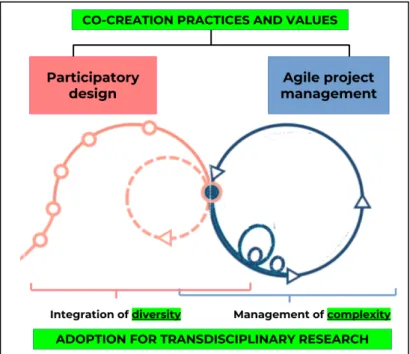
(28) Co-creation for transdisciplinarity. Figure 3: Overview of the study approach to co-creation and transdisciplinarity.. Although similar challenges can emerge in unidisciplinary contexts, or without the involvement of non-scientific knowledge and other stakeholders in research, the focus of this dissertation is specifically on transdisciplinary collaboration. It examines how this represents a paradigmatic and rich context in relation to the mentioned issues of collaboration, particularly in relation to the important concepts of diversity and complexity, and also for its parallelism with key factors and conditions for co-creation processes, as I will elaborate in detail in the following sections. Therefore, the central issue of my study is if (and how) the relevant challenges of diversity and complexity in collaboration practices in transdisciplinary research could benefit from co-creation approaches for the participative ideation, planning and development of research projects. There are three specific research questions which relate to this focus, connecting the specific and differentiated practices of co-creation through the various case studies and the academic publications that structure this compendium: 1.. How can co-design help to integrate diversity for the collaborative ideation of research processes in transdisciplinary contexts?. 2. To what extent is it possible to co-develop complex transdisciplinary projects following agile project management principles? 3. At the intersection between the ideation and the management of projects, how can both co-design and agile co-creation techniques be combined for the strategic planning of transdisciplinary research?. 27.
(29) Co-creation for transdisciplinarity. The sum of the different concepts, frameworks and elements detailed until this point configure the analytic approach of this study (reflected visually in figure 4). It considers the practices of participatory design and agile project management oriented to issues of diversity and complexity under the same conceptual umbrella of co-creation, despite their origin in different areas of knowledge and collaboration practices. Integrating the different transversal factors presented in table 1, according to the literature review, as well as the temporary perspective of Sonnenwald (2007) in figure 2 (about the stages of research collaboration), the diagram below reflects the incremental and iterative nature of co-creation applied to transdisciplinary research.. Figure 4: Concepts of co-creation applied to transdisciplinary research collaboration.. Therefore, the main contribution of the analysis of this project is: ● Firstly, to draw on the bodies of literature on research ideation and research management to develop a framework for adoption of co-design and agile management in transdisciplinary practices; ● Secondly, to illustrate the value of the framework by analysing examples of how these co-creation models could be implemented in specific projects, as well as impediments or failures during the process; ● Finally, to identify in this still unexplored approach to research collaboration the challenges to overcome and good practices to be adopted, regarding the key interrelations of diversity and complexity issues. 28.
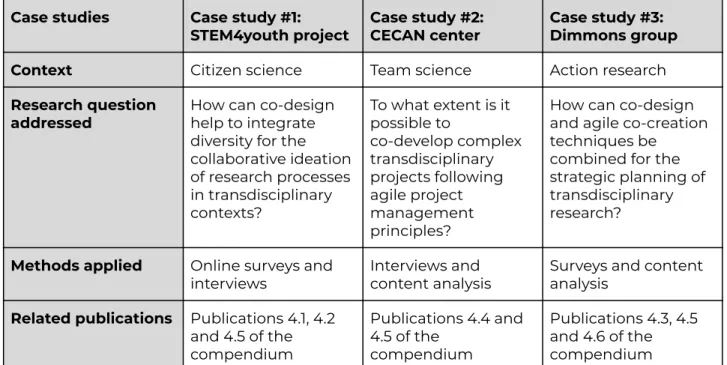
(30) Co-creation for transdisciplinarity. 1.3 Research methodology This PhD project is exploratory in nature (Babbie, 2015). It is based on three specific case studies of transdisciplinary research (see Table 2 for a summary of the overall approach). One case focuses on the co-design of research (for a citizen science project), another on agile project management for research (in the context of a distributed scientific network), and a third focuses on how to combine co-design and agile (through the strategic planning of an action research group, and some of its projects). The goal of pursuing different case studies is to understand real-life phenomena in their contextual conditions (Yin & Davis, 2007). Consequently, this exploratory research examines processes of collaborative planning and agile project management in different cases of transdisciplinary research, even if the differences in the nature of the contexts and the particularities of the institutions, teams and goals in each setting don’t allow for a complete comparative approach between them. Case studies. Case study #1: STEM4youth project. Case study #2: CECAN center. Case study #3: Dimmons group. Context. Citizen science. Team science. Action research. Research question addressed. How can co-design help to integrate diversity for the collaborative ideation of research processes in transdisciplinary contexts?. To what extent is it possible to co-develop complex transdisciplinary projects following agile project management principles?. How can co-design and agile co-creation techniques be combined for the strategic planning of transdisciplinary research?. Methods applied. Online surveys and interviews. Interviews and content analysis. Surveys and content analysis. Related publications. Publications 4.1, 4.2 and 4.5 of the compendium. Publications 4.4 and 4.5 of the compendium. Publications 4.3, 4.5 and 4.6 of the compendium. Table 2: Relation of the case studies with the corresponding research methods and questions.. 1.3.1 Research methods applied Results of the case studies have been obtained from triangulating quantitative and qualitative methods. Through such methodological pluralism I have been able to get access to diverse facets of the phenomena, adapting the use of different research techniques depending on the research questions and the specific conditions, timing, scale and participants in each of the three cases. Data collection In approaching the case studies this study combines quantitative analysis via questionnaire surveys and semi-structured interviews, and a qualitative approach based on field notes from participant observation during each case, as well as artifact 29.
(31) Co-creation for transdisciplinarity. and document content analysis. All of these sources of evidence are widely recognised in case studies (Stake, 1995; Yin, 2013). Research protocols have been created for each case study regarding the documentation, surveys and semi-structured interviews. These three methods allowed me to capture information regarding perceptions, motivations and interpretations, while through participant observation I could actually be involved in the events being studied. Recognising that there could be a bias in this process, three principles of data collection have been implemented: the use of multiple sources of data, the creation of databases for case study related materials, and the maintaining of a chain of evidence. This coincides with Yin’s (2013) suggestion that multiple sources of information and triangulation of evidence, increases the reliability and the process of gathering data. Data analysis In total, between February 2016 and February 2017, the empirical base of this study comprises 26 semi-structured interviews, 4 surveys that in total were answered by 108 participants, minutes and notes from participant observation of 21 workshops (with a total of 219 participants), and content analysis of 45 digital kanban boards and 2 Telegram group chats. Attention to gender balance has been considered both in interviews and surveys (with just a slight majority of male participants registered, representing approximately 60%), while there has been no assessment of gender balance for participants in workshops. The reliance of case studies on varied sources of evidence benefits from a previous theoretical development, as defined in section 1.2, which guides the data analysis. Data from surveys, transcription of interviews and content analysis was coded based on key concepts presented in table 1 (visualization, communication, transparency, trust building, task distribution, engagement, efficiency and quality), as well as on additional concepts depending on the case study. Among them, there were the following concepts also associated with the data analysis derived from the analytic framework: ● ● ● ● ● ● ● ● ● ● ● ● ● ● ●. Motivation Involvement Trust and credibility Coherent sequencing Facilitation roles Quality of participation Decision taking Power relations Capacity for self-organisation Flexibility Adaptivity Incremental development Need for balance Offline vs online context Types of research 30.
(32) Co-creation for transdisciplinarity. ● ●. Time and resources Institutional culture. Although not all of these derived concepts were considered for all the case studies, due to the differences in their characteristics, and the absence of a comparative approach in this study, they were present to a significant extent in each data analysis process.. 1.3.2 Selection of the case studies The rationale behind the selection of each case study was determined by identifying how they represent complementary approaches to transdisciplinarity, and also its early initial stage of development. Another factor for the selection was the extent to which the team composition and the rest of the participants in each case represented diversity of perspectives, while at the same time a perception of ambitious research goals and an interest to experiment with co-creation approaches in complex projects. Additionally, each case aligns with the following conditions for case study selection: a transdisciplinary framework and collaborative focus, at least one lead or main researcher, a predefined number of diverse participants, the intention to produce at least one academic publication as an output of the inquiry process, and to agree on engaging in research co-creation processes with the author as lead facilitator or at least participant observer. Finally, for the selection of the three cases, consideration given to success according to academic, social and economic factors has also been important. For this, in all three cases, the various institutions have (1) demonstrated solvency in publishing in relevant academic publications and affiliation with prestigious universities; (2) a high level of online visibility and connections beyond the academic contexts (with public institutions, non-governmental organizations and media); (3) a record of public funding for sustainable activity in the mid-term (from EU funded projects, to specific schemes of national research bodies); and (4) a balanced gender composition between men and women in different positions, which in parallel to the previous quantitative indicators of excellence represents an alternative measure for research quality, promoting equality and well-being (Carpintero & Ramos, 2018). Citizen science case study The first case study focuses on the adoption of co-design techniques for the planning of different citizen science experiments, in the context of the European project STEM4Youth (http://www.stem4youth.eu/), in close collaboration with OpenSystems (http://www.ub.edu/opensystems/), a team of scientists from the University of Barcelona. It took place between December 2016 and June 2017, and it consisted in a collaboration for defining the materials and methodology that could allow students from three different secondary schools in Barcelona to engage in the participatory design and planning of three experiments about human behaviour, guided by their concerns and interests in a dialogue with the scientific team. This case study represented an opportunity to address diversity in transdisciplinarity for the integration of non-experts in the co-design of research, during the foundation and 31.
(33) Co-creation for transdisciplinarity. specially the formulation stages. This was not only for the need to adopt a visual language and develop a viable methodology and materials for co-creation, paying attention to a significant high number of participants, but also for the constant dialogue and implication with the scientific team behind the initiative. As a complex project, with the goal of developing new approaches to citizen science beyond its usual contributory paradigm (where participants are usually involved only for the data collection phases), this case study allowed for the iterative development and application of different participatory design techniques. In terms of the methodology adopted, due to the total number of participants and the possibility of obtaining clear statistics about such experimental approach, I administered a broad survey covering perceptions from all the groups involved. This was afterwards contrasted with a series of interviews with the scientific team behind the initiative. Additional summary documents as evidence (pictures, completed canvas and minutes) resulting from nine co-creation sessions were also gathered and processed for this case. Team science case study The second case study analyses the adoption of agile project management in a wide distributed research center, with scientists from different disciplines self-organising for the evaluation of projects on public policy and environmental issues. In this case, thanks to a research Fellowship with CECAN, the Centre for the Evaluation of Complexity Across the Nexus (https://cecan.ac.uk/), led by the University of Surrey. CECAN is pioneering, testing and promoting innovative policy evaluation approaches and methods across Nexus domains such as food, energy, water and the environment, through a series of ‘real-life’ case study projects with co-funders (several UK government agencies). From April 2017 to March 2018, I participated in a series of CECAN activities (mainly workshops and internal meetings), had access to the different communication channels of the project and led the agile adoption of a specific research group. In this case, the transdisciplinary nature of CECAN as a research network coincides with the perspective of novel strategies for integrating diversity of disciplines and stakeholders in team science, in order to generate new approaches in front of complexity. On the other hand, this challenging research setting had already started to experiment with agile project management for its general activity. This represented not only an opportunity for participant observation (through the specific research fellowship), but also validated the approach of this dissertation as a previously existing case. It covered the additional aspect of representing a wide, novel network of experts from different academic and governmental institutions, heavily relying on ICT channels for communication and coordination processes. The methods adopted in this case were first preceded by an ethnographic approach joining the activities of CECAN, maintaining a database of observations. This was followed by adding several agile-related questions to a wide survey to its members (coordinated by other researchers). This approach allowed me to have a clear 32.
(34) Co-creation for transdisciplinarity. understanding of the context and then, considering the stage and level of complexity of the project, to develop an interview protocol and interview members of that network with different roles and perspectives. Those interviews, on how participants experienced agile project management in CECAN, were contrasted with other interviews conducted with researchers who were familiar with agile from other institutions, as well as content analysis of the main online tool used. Action research case study Finally, the third case study concentrates around the day-to-day activities of the Dimmons research group at the Internet Interdisciplinary Institute of the Universitat Oberta de Catalunya (http://dimmons.net/), for several of its projects and internal activity, where both co-design and agile management have been applied since February 2016. In this case, I could apply in a deductive-inductive process a series of co-creation principles to teamwork. Especially for the strategic planning of the research group, which emerged as a key internal project once my research was initiated, and took place in a series of co-creation activities between November 2017 and February 2018. This case study as a whole was the first one to start, taking place simultaneously to the other two ones, and it represented a long-term opportunity for participant observation from my role as Dimmons researcher and coordination manager. For this reason, the approach in this context addressed not only issues of diversity, from the perspective of action research as a paradigm of transdisciplinarity, but also the complexity of a new research group (which was constituted at the beginning of this dissertation) that develops in parallel, growing in members and projects. From the conception and refinement of co-design materials in specific research projects, to the adoption of different agile experimental approaches for the group’s management, Dimmons as a case study represented a convenient context to put co-creation in practice at the strategic level. The methods applied in this case, adapted again to the specific circumstances of the setting and its experimentation with co-creation practices, consisted mainly in the content analysis of the outputs of co-creation sessions, as well as the coordination and communication through digital channels (particularly kanban boards and Telegram group chats). Although some unstructured interviews and surveys were also used as methods at some stages during this case, as well as notes from participant observation, they were not the main source of empirical data in order to avoid potential bias derived from personal and professional relationships between the researcher and the objects of study, as colleagues in the same research group. Additional data derived from other specific Dimmons co-creation sessions and workshops (not oriented to research design or research management), as well as interviews with participants from other organisations, have also been taken into account for the study, as reflected in some of the journal publications of this compendium. This additional contribution is mainly related to Dimmons as an action research organisation with a mission-driven agenda for research, where as part of its 33.
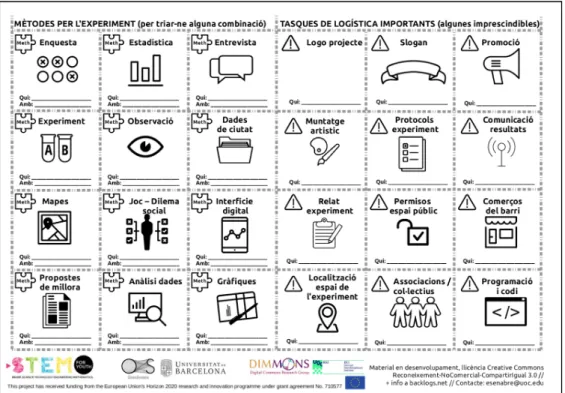
(35) Co-creation for transdisciplinarity. methodological experimentation approach I was in charge of different participative sessions, mainly for studies around areas like the platform economy or public policy innovation1.. 1.3.3 Originality of the methodological approach In this section I summarise the most relevant aspects related to the novel methodological approach of this project. First, it has to do with integrating a series of strategies for replication and dissemination, with the aim of developing useful outputs as open knowledge (Molloy, 2011). Secondly, in parallel to the triangulation of qualitative and quantitative methods, the innovative character of applying co-creation techniques to the different case studies is highlighted. Third, the whole process of this dissertation has been guided in addition by principles of action research. This represents departing from research questions that aim to inform action, and trying to apply practical solutions to specific needs and challenges beyond the gathering of data and observations. What guides me in this sense is the aim to contribute not only to academic literature and theoretical fields, but also to the projects and teams I have collaborated with (and particularly to apply these learnings to Dimmons, in my role as coordinator). With the aim of adding value in parallel to the research methodology developed for each case study, supported by the observations and notes since the beginning of the project, I developed a practical toolkit (see Annexe section) which has allowed for alternative replicability, interactions and new cases of adoption in transdisciplinary projects (Figure 5). Based on an iterative elaboration process, this “Collaborative research design toolkit” was conceived as a meta-research tool and also a “physical knowledge artifact” (Holsapple, 2013). This additional output of the research, beyond being a driver for discussions and critical for co-design in the first and third case studies, has been an important element of observations and learnings for the dissertation, in parallel to the overall analysis.. 1. Some of these other co-creation projects have been reflected in different blog posts: ● http://www.share.barcelona/sharing-toolkit/ ● http://howtowriteanacademicpaper.com/collaborative-writing.html ● http://lab.cccb.org/en/the-user-experience-in-platform-cooperativism/ ● http://www.backlogs.net/testing-new-materials-and-dynamics-for-co-created-projects/. 34.
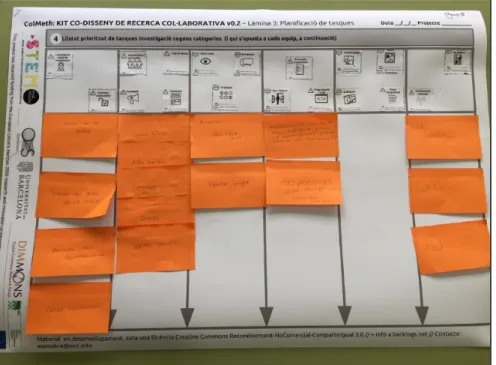
(36) Co-creation for transdisciplinarity. Figure 5: Sample of one of the canvas of the toolkit (version 2.0).. In order to achieve a wider impact under the key co-creation concepts of prototyping (Spinuzzi, 2005) and minimum viable product (Münch et al., 2013), the toolkit was early on shared online2 under a Creative Commons Attribution 4.0 International license3. This allowed other researchers to adopt and tailor it for co-creation sessions (providing afterwards feedback and suggestions for improvement) that in beyond 2017 and 2018 took place in the Tabakalera International Centre for Contemporary Culture in Donostia (https://www.tabakalera.eu/), Centro de Estudios Fundación Ceibal in Uruguay (https://fundacionceibal.edu.uy/), Bau Escola De Disseny in Barcelona (https://www.baued.es/) and the Austrian Centre for Digital Humanities in Vienna (https://www.oeaw.ac.at/acdh/). In relation to the agile project management of research, the methodology described also meant to apply an experimental approach, in this case in relation to content analysis. For this, two different open source kanban boards were adopted and tailored to the needs of the Dimmons research group. First, the Odoo agile project management platform (https://www.odoo.com/page/project-management) was adopted, followed by the Kanboard project management software (https://kanboard.org/). For this last one, several extensions for adopting the tool to the needs of the Dimmons research group were added and tested, and a novel approach to content analysis applied by combining task statistics to tags and categories for strategic planning (as described in the last publication of this compendium). Finally, as another relevant element of innovative approach to some of the methodologies adopted for this research (in this case for the third case study related to Dimmons), it is also important to mention the use of the Telegram open source group chat (https://telegram.org/). This tool was adopted since the creation of the Dimmons for regular internal communication following agile principles, as the main channel for the daily “standup” meetings of the group. In this case the novelty, related in technical 2 3. https://figshare.com/articles/Untitled_Item/5331190 https://creativecommons.org/licenses/by/4.0/. 35.
(37) Co-creation for transdisciplinarity. terms to content analysis, also had to do, in technical terms, with the possibility of dumping and extracting to plain text the full history of the chat group for 28 months of activity, and afterwards combining it for massive computer-assisted text analysis and comparative visualizations. It is also important to mention the regular dissemination effort to publish online several reflections and observations related to the PhD process, aligned with the mentioned approaches to openness and replication of the research materials and the tools derived from my methodological approach. This took place online by using a personal research blog (http://www.backlogs.net/) and the Dimmons website (http://dimmons.net/blog/) where information was regularly provided about progress with the theoretical framework of the study, as well as about co-creation workshops, publications, conferences and seminars attended. Additionally, for open documentation, the Open Science Framework platform was used to share document drafts in some areas (https://osf.io/zb9re/). For an online open access visualization of the main authors and theoretical frameworks I used the novel Onodo network mapping tool (https://onodo.org/visualizations/305/).. 36.
Figure


+7


Documento similar
