Automatic Analysis of the Acoustic
Environment of a Preterm Infant in a
Neonatal Intensive Care Unit
Author: Ganna Raboshchuk
Advisor: Dr. Climent Nadeu
Speech Processing Group TALP Research Center
Department of Signal Theory and Communications Universitat Politecnica de Catalunya
Most preterm newborns must be admitted to a Neonatal Intensive Care Unit (NICU) where they receive a specialized medical care, what, in many cases, is crucial for their survival. The acoustic environment of a typical NICU is highly diverse and may contain a large number of dierent sounds, which come either from various biomedical equipment or from human activities taking place in the unit. There exists a medical concern about the eect of that noisy acoustic environment on further growth and neurological development of preterm infants. The long-term eects of a NICU acoustic environment on a preterm infant could be revealed by the infant short-term reactions to auditory stimuli from it, which can be investigated by relating the presence of particular sounds with the preterm physiological variables. To carry out such statistical correlation study that uses the sound identities and their situation in time, big amounts of labelled audio data are required, which can hardly be obtained without using automatic detection from audio signals. Furthermore, automatic detection is also required for acoustic monitoring of the NICU environment to assist the medical sta in their work.
Abstract
A non-negligible part of the thesis work concerns the audio database acquisition and annotation. Due to the pioneering character of the application, a whole framework has been generated (in close collaboration with medical and engineering sta from the HSJD-Barcelona) for audio database produc-tion for the NICU environment, including key specicaproduc-tions like the recording setup and guidelines, and the labelling protocol. The produced database contains more than 1.5 hours of recorded audio data, and the laborious manual annotations cover roughly half of it. Finally, another contribution of this thesis work consists in an overall exploratory description of the NICU acoustic environment from the audio recordings. Unlike most previously published works, the whole content of the audio signal has been analysed, and, besides the usual measurements of sound pressure levels, the types of sounds and their spectro-temporal properties has been described. Additionally, a set of acoustic scenarios has been dened and described, and a sound taxonomy has been proposed for the NICU acoustic environment.
La majoria dels nadons prematurs han de ser ingressats a una Unitat de Cures Intensives Neonatals (UCIN), on reben l'atencio medica especialitzada que, en molts casos, es crucial per a la seva super-vivencia. L'entorn acustic d'una UCIN tpica pot contenir un gran nombre de sons diferents, que provenen dels diversos equips biomedics i de les activitats humanes que tenen lloc a la unitat. Existeix una certa preocupacio medica per l'efecte d'aquest entorn acustic sorollos en el creixement i desenvolu-pament neurologic posterior dels infants prematurs. Es probable que aquests possibles efectes a llarg termini de l'ambient acustic d'una UCIN sobre un infant prematur es manifestin en les seves reaccions a curt termini als estmuls auditius de l'entorn, els quals poden ser investigats relacionant la presencia de sons particulars amb les variables siologiques del prematur. Per dur a terme aquest estudi de correlacio estadstica que utilitza les identitats dels sons i les seves ubicacions en el temps, es requereixen grans quantitats de dades d'audio etiquetades, que difcilment poden ser obtingudes sense l'us de deteccio automatica a partir dels senyals d'audio. D'altra banda, la deteccio automatica tambe es requereix en la monitoritzacio acustica de l'entorn de la UCIN per ajudar el personal medic en el seu treball.
Resum
no son vocalitzacions. El desenvolupament de tots els sistemes de deteccio ha requerit el disseny de metriques d'avaluacio apropiades i per a aquest proposit s'ha tingut en compte l'aplicacio medica que es persegueix.
Una part no menyspreable del treball de la tesi consisteix en l'adquisicio de la base de dades d'audio i en el seu etiquetatge. A causa del caracter pioner de l'aplicacio, s'ha generat un protocol sencer (en estreta col·laboracio amb el personal medic i d'enginyeria de HSJD-Barcelona) per a la produccio de bases de dades d'audio per a l'entorn d'una UCIN, incloent especicacions claus com la conguracio de la gravacio i les directrius i el protocol d'etiquetacio. La base de dades produda conte mes de 1,5 hores de d'enregistraments d'audio, i les laborioses anotacions manuals en cobreixen aproximadament la meitat. Finalment, una altra contribucio d'aquesta tesi consisteix en la descripcio global exploratoria de l'ambient acustic de la UCIN a partir de les gravacions d'audio. A diferencia de la majoria dels treballs publicats anteriorment, s'ha analitzat tot el contingut del senyal d'audio i, a mes de les mesures usuals de nivells de pressio sonora, s'han descrit els tipus de sons i les seves propietats espectrotemporals. Per ultim, s'ha denit i descrit un conjunt d'escenaris acustics, i s'ha proposat una taxonomia de sons per a l'entorn acustic d'una UCIN.
This document marks a completion of an important period of my life that gave a lot for my professional and personal growth. I would like to thank everybody who took part, in one way or another, in this incredible experience.
Foremost, I feel extremely grateful and fortunate for having spent this time under the tutorship of my advisor, Climent Nadeu. Not only he played a crucial role in making this thesis work possible and provided an indispensable guidance, but he also constantly encouraged me along the way and gave plenty of possibilities for my professional development. I feel grateful for having an opportunity to learn from his research experience and for all the time and eort he put in this work.
I'm very grateful to Ana Riverola de Veciana and Blanca Munoz Mahamud for the helpful insights about the medical application and for their permanent enthusiasm, and to Santiago Navarro Hervas, Eva Bargallo and Cristina Borras Novell for their contributions at the beginning of this work. I want to express my deep gratitude to Peter Jancovic and Munevver Kokuer for the opportunity of our collaboration and for the stimulating research stay at the University of Birmingham. I'm grateful to Sergi Solvez, Sergi Gomez Quintana and Alex Peiro Lilja for their contributions to the thesis and for our fruitful discussions, and to Vanessa Sancho Torrents and Francisco Alarcon Sanz for their work on the database annotation.
I want to thank all the colleagues from the TALP research center, specically Omid Ghahabi, Pooyan Safari, Rupayan Chakraborty, Henrik Schulz, Lluis Formiga, Igor Jauk, Javier Hernando, Enric Monte, for the enjoyable research environment. I'm grateful to Martin Wolf for sharing his experience and giving valuable advices at the beginning of this work, and to Diego Lendoiro and Carlos Nistal for providing an excellent technical support.
I would like to express my gratitude to Taras Butko for having inspired me to pursue a PhD in another country and for being so helpful at the initial steps. I'm particularly grateful to Sergey for constantly supporting me in this decision. Thanks to all my beloved friends for being in my life and for supporting me all along this experience, and specically to Nai and Ily without whom Barcelona wouldn't feel as much home as it does.
Contents
Chapter 1. Introduction 1
1.1 Thesis motivation . . . 1
1.2 Thesis objectives . . . 4
1.3 Thesis outline . . . 5
Chapter 2. Literature review 7 2.1 Chapter overview . . . 7
2.2 Acoustic analysis of a NICU environment . . . 8
2.3 Acoustic event detection in real-world environments . . . 9
2.4 Audio feature extraction . . . 11
2.5 Classication algorithms . . . 13
2.5.1 Neural network based pre-training . . . 15
2.6 Audio enhancement and source separation . . . 16
2.6.1 Spectral subtraction and minima-controlled recursive-averaging algorithm . . . . 18
2.6.2 Non-negative matrix factorization . . . 19
2.7 Chapter summary . . . 21
Chapter 3. Database acquisition and annotation 23 3.1 Chapter overview . . . 23
3.2 Audio data acquisition: recording setup, sessions and scenarios . . . 24
3.3 Labelling protocol: list of acoustic events and criteria . . . 27
3.4 Produced annotations . . . 30
3.5 Chapter summary . . . 34
Chapter 4. Acoustic description 35 4.1 Chapter overview . . . 35
4.2 List of acoustic events . . . 36
4.3 Description of acoustic scenarios . . . 37
4.4 Sound taxonomy . . . 41
4.5 Analysis of typical types of sounds . . . 44
4.5.1 Equipment alarms . . . 44
4.5.2 Vocalizations . . . 48
4.5.3 Equipment noise . . . 48
4.6 Chapter summary . . . 51
Chapter 5. Acoustic alarm detection 53 5.1 Chapter overview . . . 53
5.2 Related work . . . 54
5.3 Evaluation setup . . . 54
5.3.1 Frame level evaluation . . . 55
5.3.2 Event level evaluation . . . 55
5.4 Development of detection systems . . . 56
5.5 Signal processing based approach . . . 57
5.5.1 Matched lter stage . . . 58
5.5.2 Morphological envelope stage . . . 58
5.5.3 Decision stage . . . 59
5.5.4 Energy overload protection stage . . . 59
5.5.5 Experimental results . . . 59
5.6 Knowledge-based approach . . . 60
5.6.1 Modelling of the alarm spectral structure . . . 61
5.6.2 Modelling of the alarm temporal structure . . . 64
5.6.3 Post-processing and decision . . . 65
5.6.4 Experimental results . . . 65
5.7 Neural network based approach . . . 70
5.7.1 Generic system . . . 71
5.7.2 Particular system . . . 72
5.7.3 Experimental results . . . 72
5.8 Chapter summary . . . 75
Chapter 6. Vocalization detection 79 6.1 Chapter overview . . . 79
6.2 Evaluation setup . . . 80
6.3 Enhancement techniques . . . 80
6.3.1 Spectral subtraction . . . 80
6.3.2 Non-negative matrix factorization . . . 81
6.3.3 Combined approach . . . 81
6.4 Detection system . . . 82
Contents
6.6 Chapter summary . . . 87
Chapter 7. Conclusions and future work 89 7.1 Summary of conclusions . . . 89
7.2 Future work . . . 92
7.2.1 Collection of a larger database . . . 92
7.2.2 Analysis of sound impacts on a preterm infant . . . 92
7.2.3 Extended acoustic description . . . 93
7.2.4 Acoustic alarm detection . . . 94
7.2.5 Vocalization detection . . . 96 Appendix A. Description of the recording sessions set 97
Appendix B. Neutral scenario database 99
Appendix C. Labelling protocol changes 101
Appendix D. Number of annotated alarm and vocalization samples 103
Publications 105
Bibliography 107
AED Acoustic Event Detection ASR Automatic Speech Recognition BSS Blind Source Separation
CPAP Continuous Positive Airway Pressure DBN Deep Belief Network
DET Detection Error Tradeo
EER Equal Error Rate
EOP Energy Overload Protection
FAR False Alarm Rate
FF-LFBE Frequency Filtered Logarithm Filter Bank Energies GMM Gaussian Mixture Model
HMM Hidden Markov Model
ICA Independent Component Analysis MCRA Minima-Controlled Recursive-Averaging ME Morphological Envelope
MF Matched Filter
MFCC Mel-Frequency Cepstral Coecients
MR Missing Rate
NICU Neonatal Intensive Care Unit NMF Non-negative Matrix Factorization
NN Neural Network
PCA Principal Component Analysis RBF Radial Basis Function
RBM Restricted Boltzmann Machine SNR Signal-to-Noise Ratio
List of gures
2.1 (a) Generative one-layer DBN structure and (b) whole NN structure used in the experi-ments. . . 15 3.1 The layout of the NICU room with the four positions of the incubators and other equipment 24 3.2 The conventional microphone positions used throughout the recording sessions . . . 26 4.1 Average logarithm lterbank energies for the scenarios in a given session. . . 39 4.2 Average logarithm lterbank energies for a given scenario in dierent recording sessions. 40 4.3 A general sound taxonomy of a typical NICU. . . 43 4.4 Graphical description of terms used to denote particular alarm properties. Only the
fundamental frequency is depicted for clarity of presentation. . . 44 4.5 Spectrogram of a neutral scenario acquired (a) outside and (b) inside the incubator with
the equipment noise marked: the narrow-band noise in red, the ventilation noise in blue and the noise studied in the reported work in black. . . 49 4.6 Spectrograms of the neutral scenario from recording sessions (a) RS11 and (b) RS13. . . 50 5.1 General scheme of the proposed detection system with four stages depicted (from left to
right): energy overload protection, matched lter, morphological envelope, decision. . . . 57 5.2 Graphical example of relevant harmonics denition (shown in blue). . . 58 5.3 An example of a spectrogram (a) of audio recording and the detected sinusoidal
compo-nents (b). . . 63 5.4 The output of the period probability estimation. Circles correspond to the estimated period
timestamps after applying a threshold and crosses are the reference period timestamps. . 65 5.5 Global SNR histogram over all labelled alarm samples from the database. . . 68 5.6 The Detection Error Tradeo (DET) graphs for dierent statistical models. Circles
cor-respond to points closest to EER. . . 69 5.7 Partially connected hidden layer for weighting in frequency. . . 72 5.8 Partially connected hidden layer for weighting in time. . . 72 6.2 Distribution of (a) 1st and (b) 4th Frequency Filtered Logarithm Filter Bank Energies
(FF-LFBE) features for vocalization and non-vocalization classes. . . 86
3.1 Information about the recording sessions included in the database . . . 25
3.2 List of labelled acoustic events and corresponding annotation criteria . . . 28
3.3 Information about the acquired scenario samples, their duration (in s) and the produced labelling . . . 31
3.4 Information about the labelling produced by each annotator . . . 31
3.5 Estimation of the produced labelling consistency in terms of metric scores (in %) for the two types of sounds annotated . . . 33
4.1 List of NICU acoustic events . . . 36
4.2 Scenario-specic acoustic events . . . 38
4.3 Detailed characteristics of the equipment alarm sounds . . . 46
4.3 Detailed characteristics of the equipment alarm sounds . . . 47
5.1 Alarm detection performance obtained by the signal processing based system . . . 60
5.2 Normalized alarm cross-correlation values . . . 61
5.3 Alarm detection performance obtained by a system modelling the spectral structure only . 66 5.4 Alarm detection performance obtained over the SNR intervals . . . 68
5.5 Alarm detection performance obtained by discarding the alarm samples below the SNR threshold . . . 69
5.6 Alarm detection performance obtained from dierent ways of post-processing . . . 70
5.7 Alarm detection performance obtained by the generic system with dierent pooling strategies 73 5.8 Alarm detection performance obtained by the generic system with partially connected hidden layers . . . 73
5.9 Alarm detection performance obtained by the particular system . . . 74
5.10 Average alarm detection performance obtained by the neural network based systems over all alarm classes . . . 74
5.11 Alarm detection performance obtained by systems following the three alternative approaches 76 6.1 Vocalization detection performance obtained by the baseline system . . . 83
List of tables
6.3 Vocalization detection performance obtained by the Support Vector Machines (SVM)-based system . . . 85 A.1 Information about all the performed recording sessions . . . 97 B.1 Information about the recording sessions of the second database . . . 100 C.1 Dierences in the list of acoustic events considered for annotation during the rst stage
of the annotation campaign . . . 101 D.1 Number of annotated alarm samples in each recording session . . . 103 D.2 Number of annotated vocalization samples in each recording session . . . 104
Introduction
1.1 Thesis motivation
Newborns delivered at a gestational age of 24-32 weeks (very low birth weight preterms) commonly have health problems and must be admitted to a Neonatal Intensive Care Unit (NICU), what, in most of the cases, is crucial for their survival. The increased survival and reduced neonatal morbidity of preterm infants in the past three decades has not always been accompanied by an improvement in their neurological development [1]. It is known that the noisy acoustic environment of the NICU may have adverse eects on the growth and neurodevelopment of the preterm infants as inadequate, loud, unex-pected sounds replace natural hearing placental stimulation [2]. The negative or stressful environmental impact of NICUs on the developing brain has been widely documented [36]. An important negative eect of noise in the NICU is the one it has on sleep, which is essential for neurosensory development, learning, memory and preservation of brain plasticity [7].
The acoustic environment of a typical NICU is highly diverse and may contain a large number of sounds coming from numerous sources, such as alarm sounds generated by dierent biomedical equipment, noisy mechanical ventilation, telephone ring sound, people conversations, etc [8,9]. Various acoustic events are usually taking place simultaneously in a NICU and the maximum sound pressure level limits recommended [10] are exceeded frequently [11], being of a great concern in the medical literature.
1.1. Thesis motivation
methods.
The acoustic environment of a preterm baby admitted into a NICU has been the object of a number of reported studies during the last two decades. These works analyse the environment placing a microphone both inside [16] and outside the incubator. Usually, sound is represented only by its intensity level and just a few works weakly analyse sound spectra [9, 17]. Moreover, to our knowledge, very little studies considered the intensity levels of specic sounds [8] or analysed specic conditions of the NICU's acoustic environment [18]. Unlike most previous works, in this work the whole content of the audio signal is used and an automatic description of the whole sound landscape is pursued.
The short term eects of a NICU acoustic environment on a preterm infant could be revealed by the infant reactions to auditory stimuli from it, which can be investigated by relating the presence of particular sounds with the preterm physiological variables. Note that in such study the sounds are not produced articially, but occur naturally in the NICU environment and are the ones actually perceived by the preterm infant. Such investigation can complement greatly the work already reported in the literature, in which only the sound pressure level is considered without taking into account the spectro-temporal properties and identity of sounds (e.g. in [19]).
To carry out a statistical correlation study that uses the sound identities, big amounts of labelled audio data are required, which can hardly be obtained without using automatic detection from audio signals. The manual annotation of audio data is usually extremely time consuming and tedious, re-quires specic skills, prone to errors and may be inconsistent when several independent annotators are involved [20]. A robust detection system may be used to overcome these limitations while keeping the human-involved labour at a minimum level.
In addition, automatic detection systems may be used for real-time or oine acoustic monitor-ing of the NICU environment. While video monitormonitor-ing provides valuable information, the automatic monitoring based on audio information has several advantages: cheaper sensors, lower computational requirements, avoiding image limitations (e.g. blind spots), etc. [21]. Specically, in the NICU envi-ronment a lot of distributed cameras would be needed.
Therefore, the major part of this thesis work is devoted to the task of Acoustic Event Detection (AED), where the main goal is to develop robust systems able to detect and identify the sounds that appear in the NICU environment. Due to the multisource nature of that environment and the fact that most sounds are simultaneous, that AED task is rather challenging. In particular, the detection of the two most represented types of sounds is targeted: equipment alarms and vocalizations.
Equipment alarms, which are extensively present in a NICU environment, are used in biomedical equipment to alert of situations requiring medical attention. The fact that a large number of sounding alarms are not clinically relevant and/or are unrelated to emergency situations [22], and also general noise and information overload may lead to unsatisfactory quality of healthcare provided by the medical sta. Intelligent alarming systems are being proposed [22, 23] in order to improve the alarm handling process in NICUs and reduce noise levels. These solutions make use of alternative alarm modalities and
usually imply development of a distributed alarm system where all or almost all the medical equipment is connected to a central monitoring system and medical sta carries personal notication devices, whereas only the most critical alarms are sounding. Unfortunately, in the majority of the NICUs smart alarming solutions are yet to be developed.
1.2. Thesis objectives
1.2 Thesis objectives
The main objective of this thesis work is the automatic analysis of the acoustic environment of a preterm infant in a Neonatal Intensive Care Unit (NICU), which can be expressed in terms of several specic objectives which are relevant for the medical application.
I. An overall description of the NICU acoustic environment: existing acoustic scenarios, sound types and their sources, sound categories, relations between sounds, etc. This is relevant for the medical application in two senses:
(a) The knowledge of the NICU acoustic environment is required to implement policies for consistently and substantially reducing the types of noise that may aect the newborns. (b) To design a NICU room with better acoustic characteristics. General principles for designing
a quiet NICU were proposed in [10, 12], yet more studies about the eects of various NICU designs on infants, parents, clinicians and the delivery of services are needed to advance the eld of design.
Apart from that, audio data description is a required initial step for any audio classication task as it helps to explore the data domain.
II. The second objective, which actually is the main one, is detection of some relevant NICU acoustic events: equipment alarms and vocalizations. The aim of the developed Acoustic Event Detection (AED) systems is to automatically label temporal regions within the input audio where a partic-ular sound is present, i.e. to specify the start and end time of each relevant sound occurrence. This can be useful for two medical application purposes:
(a) To assist the medical sta in their work and facilitate the reaction to events. For example, in [13] a sound-activated light device was implemented for alerting the sta members when the sound pressure level exceeded a predened threshold. The automatic detection system can be a part of a more sophisticated notication system allowing smart handling algorithms, which could be designed to warn about triggering of particular sounds, to take into account their clinical relevance and urgency, etc.
(b) To detect sounds that may be aecting the preterm infant. Sound description obtained from AED systems can be correlated with the preterm physiological variables in order to investigate how a preterm infant reacts to the sounds that take place in a NICU.
III. The acquisition and annotation of an audio database is required in order to meet the above mentioned objectives. The produced database, that captures the NICU environment in various conditions, is important both for performing its acoustic description and for developing automatic detection systems for the relevant types of sounds. Due to the pioneering character of this work, a general framework of the database production for the NICU environment has to be designed, which includes specifying the recording setup (equipment, conditions, timetable, guidelines, etc.), the considered acoustic scenarios and the labelling protocol.
1.3 Thesis outline
The thesis is organized as follows.
Chapter 2 starts with reviewing the work already reported in the literature about the analysis of the acoustic environment of a preterm in a NICU. It then presents a literature review for AED from a point of view of possible applications, further discussing the state of the art approaches to feature extraction, classication algorithms, audio enhancement and source separation techniques that have been used for AED so far.
Chapter 3 reports our work on the audio database acquisition and annotation, where we provide details of the recording setup, specify the selected acoustic scenarios and describe the recording sessions carried out. Also, in this chapter we outline the annotation campaign progress, dene the labelling protocol and give information about the produced annotations.
Chapter 4 contains the results of acoustic description of the NICU environment, where we provide an extensive list of acoustic events found in that environment, structure them into acoustically homo-geneous groups by building a taxonomy and present the analysis of the major types of sounds. Also, the considered acoustic scenarios are characterized.
Chapter 5 and Chapter 6 describe our work on the automatic detection systems for two types of sounds that are the most represented ones in a NICU environment: alarms and vocalizations. In Chapter 5 several systems for automatic detection of equipment alarm sounds are proposed, which deal with the problem from three dierent perspectives: a signal processing based approach, a knowledge-based approach that employs machine learning, and an approach knowledge-based on neural networks. Chapter 6 presents our work on an automatic system for detection of vocalization sounds. The focus is put on reducing the presence of irrelevant sounds prior to detection, and so several techniques for vocalizations enhancement are investigated.
Literature review
2.1 Chapter overview
In this chapter, the work done so far on the acoustic description of a Neonatal Intensive Care Unit (NICU) environment and in the area of Acoustic Event Detection (AED) is reviewed.
2.2. Acoustic analysis of a NICU environment
2.2 Acoustic analysis of a NICU environment
The acoustic environment of a NICU and its eects on preterm infants have been extensively studied during the last two decades, where the research works mainly concerned describing a NICU acoustic environment and its major sound sources, looking for possible solutions for reducing the noise levels within a NICU and evaluating their eectiveness, nding the potential adverse eects of the NICU acoustic environment on preterm babies, and studying the impact of the NICU design on well-being of neonates.
The common approach to the description of a NICU acoustic environment lies in measuring the Sound Pressure Levels (SPLs) with the microphone placed in the central location of the room [26]. In some works, like in [27], the microphone is placed inside the incubator, at some distance from the infant's ear, so as to measure what the preterm infant is perceiving. The average noise levels measured in dierent conditions (e.g. during day and night shifts) are reported and compared with the recommendations of the American Academy of Pediatrics [6]. The SPL values are usually presented in dBA units. For that purposes, the A-weighting is rst applied to modify the audio signal spectrum, modelling the spectral response of the human auditory system, as was done, for example, in [11, 17]. Such studies usually describe the typical sound sources, which could contribute to high SPL values, and propose a potential solutions for reducing the noise levels within a NICU [28].
Attempts on characterizing the sound levels of particular sound sources have been reported in the literature. For instance, in [8] the noise level increment due to the most frequent types of sounds, like phone ring, alarms, speech, baby crying, is analysed. The measurements were made with the microphones placed both inside (1 cm near the newborn's ear) and outside (at around 50cm distance) the incubator, and also the background SPLs were measured at a central location in the middle of the unit room.
To our knowledge, few works analysed the sound spectra. In [9] the spectral analysis of the noise generated by individual equipment and activities is performed, where the SPLs across the frequency spectrum are analysed. Similar work, which concentrated on investigating the major sound sources within an incubator (incubator cooling fan and ventilator), is reported in [17]. In this work, the SPLs, measured during the routine morning clinical activity close to a dummy infant's ear and at the head level outside the incubator, are analysed at dierent frequencies and their cumulative values are reported.
In [5] an overview of studies looking for potential adverse eects of the noisy NICU acoustic envi-ronment on cardiovascular, auditory, nervous systems and on long-term neurodevelopment of preterm infants is given. The problem of validity and reliability of such studies is discussed in [29], where the authors provide clear criteria for research evaluation and identify possible study design problems. In particular, the importance of measuring SPLs at the infant's ear or a specic distance from it is emphasized.
In [24] the importance of the positive early auditory experience for the development of the preterm
infants is described. The appropriate auditory input and careful protection against overstimulation while the stay of a neonate in the NICU are emphasized. Among the proposed recommendations are playing the mother's voice inside the incubator and introducing vocal music (such as lullabies). In [30] the eects of music therapy (recorded music, parent voices, sung lullabies) on physiological variables, sleep and feeding of preterm infants were explored. The study reported in [31] revealed that the controlled music stimulation appears to be a safe and eective way to ameliorate pain and stress in premature infants following heel sticks. On the other hand, the problem of feasibility and safety of producing the maternal sounds (i.e. voice, heartbeat) inside the incubator with the preterm baby was addressed in [32]. In [25] the acoustic environment of a preterm infant cared for in the NICU was explored in order to determine the inuence of the parent's speech on the number of preterm infant vocalizations over time. For that purpose, the counts of adult words, infant vocalizations and conversational turns were related.
Due to the excessive noise levels reported in the literature [11, 33], some studies concentrated on optimizing the hospital environment for preterm newborns. The main purpose of these works is to ameliorate the negative eects of noxious stimuli and to decrease unfavourable auditory stimulation to a minimum. For instance, in [22] the authors focused on investigating the ways of reducing the noise levels and the number of sounds to which the newborns are exposed by improving the alarms handling process, which could be done by introducing technological and organizational changes. In [13] the ecacy of the specically designed light-alarm device for reducing the sta-produced noise in a NICU was studied. The device was activated when the sound levels exceeded a threshold in order to notify sta of it.
Various studies have evaluated the impact of the NICU design on preterm infants. In particular, the literature review reported in [34] explores the main features of the NICU design and links a range of aspects of the physical environment of NICU to well-being of neonates, family comfort and caregiving process. The study reported recently in [35] investigates the relationship between the NICU room type and the primary outcome of neurodevelopmental performance at the age of 2 years.
Advancing methods in medical practice often require new healthcare facilities or improvements of the existing ones. The study reported in [18] compares the sound levels, sta perceptions and patient outcomes before, during and after the renovation project taking place near the NICU. In [36] the noise levels before and after the structural reconstruction within a NICU were compared. In this study, authors divide all the sound sources within a NICU into two groups: 1) operational (sta or equipment generated sounds); 2) structural (building generated sounds).
2.3 Acoustic event detection in real-world environments
2.3. Acoustic event detection in real-world environments
of their positions. Depending on the enviromnent, the types of sounds that may be encountered spread from natural ambient sounds, through sounds produced by humans and animals, to articial sounds coming from machines and equipment. The human activity in such environments is reected in a rich variety of sounds, produced by a human body or by objects handled by humans. All these sounds are connected to a wide variety of objects, actions, events, and communications, thus an acoustic environ-ment is a rich source of information on the types of activities, participants involved, and communication modes.
While speech is, obviously, the most informative sound, other kinds of sounds may also provide useful cues for context understanding. For instance, in a meeting/lecture context, we may associate a chair moving or door noise to its start or end, cup clinking to a coee break, or footsteps to somebody entering or leaving. Furthermore, some of these acoustic events are tightly coupled with human behaviors or psychological states: paper wrapping may denote tension; laughing, cheerfulness; yawning in the middle of a lecture, boredom; keyboard typing, distraction from the main activity in a meeting; and clapping during a speech, approval.
Generally, the term acoustic event or sound event refers to a label that people would use to describe a recognizable event in a region of audio [37]. More specically, as it is said in [38], it is any possible audible acoustic event which is caused by motions in the ordinary human environment; they have real events as their sources; they are meaningful, in the sense that they specify events in the environment (...). Hence, acoustic events can be used to represent an acoustic environment in a symbolic way, e.g., a busy street environment contains events of passing cars, car horns, or footsteps of people rushing.
AED is a discipline belonging to the area of the computational auditory scene analysis [39] that consists of processing acoustic signals and converting them into symbolic descriptions corresponding to a human listener's perception of the dierent sound events that are present in the signals and their sources. While acoustic event classication deals with events that have already been isolated from their temporal context, acoustic event detection aims at determining both the temporal positions and the identities of sounds in a continuous audio stream. So far, acoustic event detection and classication has been found useful in manifold applications, like surveillance [21,40], ambient assisted living [41,42], robotics [43], information indexing and retrieval [44,45], to list a few.
From a semantic point of view, AED has been addressed for recognition of generic sounds and sounds specic to a given environment or activity. For instance, in [46] the problem of detecting alarm sounds was investigated, where such alarms as phone rings, smoke alarms, sirens, car/truck horns were considered. Detection of acoustic events has been carried out in dierent environments like living environments [47,48], kitchen rooms [49], bathrooms [50], public places [51], oces [52], meeting rooms [53], industrial workplaces [54], etc. It has been showed, that AED systems can benet from the incorporation of the context-related information, like count-based event priors and context-dependent acoustic models [37].
While considerable eort has been devoted to speech and music related research, the AED task has
been far less studied. Nevertheless, there exists an increasing interest in this topic and several interna-tional eorts to evaluate systems designed to recognize acoustic events have already been conducted. In the framework of CLassication of Events, Activities and Relationships (CLEAR) campaigns in 2006 [55] and 2007 [56] the participating systems were evaluated on the set of acoustic event classes specic to a meeting-room environment. During the IEEE AASP Challenge on Detection and Classi-cation of Acoustic Scenes and Events (D-CASE) in 2013 [52] the problem of detecting acoustic events in an oce enviromnent was addressed.
2.4 Audio feature extraction
Numerous studies have been devoted to the topic of audio feature extraction, and audio features pro-posed in the literature can be roughly divided into three categories:
• Time-domain features are computed directly from the audio waveforms. Features like frame energy, zero-crossing rate,high zero-crossing rate [57] comprise this category.
• Frequency-domain features are derived from the Fourier transform of the time signal over a xed time period, e.g. frame. This category contains such features as fundamental frequency [58], spectral centroid, spectral ux [43, 59], spectral rollo [57], spectral tilt [60], lter-bank energies [61], etc.
• Time-frequency or spectro-temporal features operate in time and frequency domain jointly. Some variants of those features will be discussed later in this section.
Depending on the time span considered the features can be regarded as short-term (frame-level) or long-term (segment-level). The frame-level features are usually designed to capture the short-term characteristics of the audio signal, where the signal can be considered stationary. The concept of the audio frame comes from traditional speech signal processing, where analysis over a short time interval has been found to be appropriate. To extract the semantic content, the temporal variation or evolution of signal is observed on a longer time scale. This consideration has lead to the development of various segment-level features. The segment duration, in this case, may span up to several seconds. For example, these features can be built on top of the frame-level features and characterize how they are changing over a segment with some kind of statistics, e.g. bag-of-frames approach [62] or factor analysis [63]. It is worth mentioning that the temporal evolution of the audio signal could be captured on the model level, for instance, by Hidden Markov Models (HMMs).
In [64] the authors model the temporal context by employing convolutive Non-negative Matrix Factorization (NMF) for feature extraction. NMF is used for discovering a set of spectro-temporal patches which roughly correspond to the acoustic events considered, and the features are derived from the activations of this patches in time.
2.4. Audio feature extraction
(MFCC) features [65], Frequency Filtered Logarithm Filter Bank Energies (FF-LFBE) [66] or linear prediction coecients. Usually, these features are combined with the specic features designed for a particular application [43, 64], and in most of the cases this leads to a better recognition accuracy. The temporal evolution of the above mentioned features may be incorporated by adding duration and dynamics features. In the later case, usually the rst and the second temporal derivatives are used [67,68].
Several techniques, that have been proposed for describing the temporal dynamics of audio signal, work in a modulation frequency domain [69,70]. Generally, these techniques divide the audio signal to a set of sub-bands and derive the sub-band amplitude modulation envelopes, which are further converted to a modulation frequency domain. Conversely, in [70] the modulation features are obtained by means of a frequency-domain linear prediction, that provides an approximation of the temporal (Hilbert) envelope of the time domain signal.
In [71] authors explored the use of recurrence quantication analysis for providing additional infor-mation about the temporal evolution of audio. In particular, it was applied for the characterization of environmental sounds. The features based on that analysis do not require assumptions about linearity or stationarity of the time series, and are extracted from the frame-level spectral audio features (namely, MFCC features).
Many research works on audio feature extraction aimed at emulating human audio perception mechanism in order to achieve human-like performance. These approaches try to model functioning of the human auditory system, have similar structures as the human auditory pathway, yielding so-called perceptual psychoacoustic features.
In the Perceptual Linear Prediction (PLP) technique [72], the short-term spectrum of the speech is modied by several psychophysically based transformations, which make use of the three concepts from the psychophysics of hearing to derive an estimate of the auditory spectrum: the critical-bands spectral resolution, the equal-loudness curve, and the intensity-loudness power law. This feature extraction technique is widely used in speech recognition systems.
The author in [73] proposes an approach to feature extraction which utilizes two-dimensional spectro-temporal modulation lters (Gabor functions). The use of two-dimensional Gabor lters is motivated by their similarity to the spectro-temporal patterns of neurons in the auditory cortex of mammals, reported in physiological and psychoacoustic studies. The resultant feature vector size is relatively large (more than 2000).
In [43] the authors propose to use the matching pursuit algorithm to obtain time-frequency features. The matching pursuit based method utilizes a dictionary of spectro-temporal Gabor atoms to select features. The results showed that this approach is promising in capturing unstructured environmental sounds, while traditionally used MFCC features may fail to eectively model them.
In [74] the audio signal is passed through a pole-zero lter cascade (a time-varying lterbank) to simulate the output of the inner hair cells along the length of the cochlea. In [75] author proposes to rst
modify the signal spectrum by means of an A-weighting lter, which models the spectral response the human auditory system. In that work the use Gammatone lterbank is also explored, which provides a good approximation to experimentally determined spectral responses of the basilar membrane in cochlea.
Instead of using the Fourier transform which results in a constant time-frequency resolution, some works on feature extraction employed the wavelet transform [47, 75]. It provides better frequency resolution at low frequencies and better time localization of the transient phenomena in the time domain. In that respect it resembles the rst stage of human auditory perception and to basilar membrane excitation which exhibits similar time-frequency resolution characteristics.
Because of the large number of possible features some studies focused on elaborating feature selection techniques [76]. The feature selection is traditionally motivated by three main reasons [68]: performance improvement; general data reduction, to limit storage requirements and increase algorithm speed; and feature understanding, to gain knowledge about the process that generated the data. There are a lot of dierent feature selection algorithms reported in the literature. In [77] signicant feature space reduction was obtained by applying Principal Component Analysis (PCA) in each frequency sub-band. In [68] a fast one-pass-training technique was introduced in the context of a multimodal AED, resulting in an optimal feature subset for each acoustic event class.
2.5 Classication algorithms
Any recognition task requires a classication step, on which the features are fed to a classier that provides a label for an unseen input pattern.
One of the very rst works on audio classication used a minimum distance classication model, i.e. a simple distance-based classier with the Euclidean distance between extracted features [78]. The minimum distance classiers choose a class according to the closest training sample. A bit more complex algorithms determine k-nearest neighbors to an unknown input, and then they choose the class that is most represented by that neighbors [43]. Yet, classication becomes very complex when a lot of training data is used as one must measure a distance to all the training samples. By using clustering and storing only the centres of the clusters (class prototypes) the computational eciency can be improved. The mentioned algorithms and other related optimization steps for audio classication have been reviewed in [49,51].
2.5. Classication algorithms
Among other classication paradigms, a way to classify audio data consists in using already devel-oped and well-tested speech recognition algorithms. In ASR, usually Gaussian Mixture Models (GMMs) and Hidden Markov Models (HMMs) are used [79]. They are well suited to work with time series data, and to deal with the information included in the temporal evolution of the audio signal. A lot of audio recognition works have exploited the above-mentioned techniques. For instance, GMMs have been used in [57,65], and HMMs in [21,41,63,70]. Instead of using generative classication models, discriminative ones, like articial neural networks in [46,48] or Support Vector Machiness (SVMs) in [45,59,67], have been used in a number of works.
Recently, deep learning has been drawing a lot of interest in the pattern recognition eld [80], dramatically improving the state-of-the-art in image, audio, and speech processing areas [61, 81, 82]. For instance, the combinations of Deep Neural Networks (DNNs) and HMMs (the so-called hybrid approach) applied to speech recognition tasks are able to achieve signicantly higher accuracies than the conventional GMM-HMM classiers in [83, 84]. Among the main factors responsible for the recent emergence of DNNs are the possibility of initializing the weights sensibly, which results in a very ecient learning algorithm [85], and the dramatic improvement of computing power, which makes it feasible to train DNNs eectively. Commonly, the network weights are initialized by unsupervised generative training, then, by adding a top label layer and using a standard backpropagation algorithm, the generative network is converted to a discriminative one and, therefore, becomes appropriate for classication tasks [83] (see Section 2.5.1 for more details).
A large variety of DNN architectures have been proposed in the literature. Typically DNNs are designed as feedforward networks, but other variants like recurrent neural networks (and, in particular, Long Short-Term Memory networks (LSTMs)) [86] and Convolutional Neural Networks (CNNs) [87,88] have been successfully applied to audio and speech processing tasks. In [89] the three types of networks (namely, DNNs, LSTMs and CNNs) are combined in a unied architecture and trained jointly, thus, the complementarity in their modelling capabilities is exploited.
Deep learning requires very little engineering by hand and can easily take advantage of increases in the amount of available computational power and data [80]. The powerful learning procedures allow DNNs to handle correlations between input features, and it has been shown that for the ASR task they work signicantly better on lterbank outputs than on standard MFCC features [90]. Moreover, attempts on directly modelling a raw waveform have been reported in the literature [91], although such systems have not yet outperformed the ones employing lterbank features.
In [92] the feature extraction is integrated in a DNN, and mel-scale lterbank is replaced by the lterbank layer, which is trained jointly with the rest of the network. It is argued that the standard perceptually motivated lterbank may not be particularly optimal for the ASR task, and letting the network learn appropriate feature extraction and discrimination is much more powerful. Both feature extraction and acoustic modelling are performed jointly by a DNN in [93] for the voice activity detection task, where the standard PLP features are approximated by a neural network.
Unlike the binary classication algorithms, where the decision is taken between two classes, the multiclass classiers can deal with several classes. Some classication algorithms, like neural networks, k-nearest neighbors, HMMs, naturally permit the use of more than two classes. Yet, a combination of several binary classiers can be used to solve a given multiclass problem [94]. Among the commonly used strategies are: one-against-all, where for each class a classier which distinguishes that class from all other classes is trained; one-against-one, where the classier is trained for every pair of classes and the decision is taken by voting. In [95] a hierarchical architecture for a group of binary classiers was proposed for audio segmentation task, where each classier is responsible for detecting the class of interest and posterior classiers benet from the previous classier decision.
A post-processing (smoothing) is commonly applied to yield longer contiguous segments of classes of interest, which corresponds to de-noising the classication output. In [57] for the speech / non-speech segmentation system a post-processing of GMMs and maximum entropy classier outputs is performed by using an ergodic HMM, which has two states (speech and non-speech) and equal transition cost in either direction. There is no cost for remaining in the same state, what creates a smoothing eect by discouraging state changes. In [96] the authors employed convolutive NMF to force grouping of SVMs outputs into events. The proposed approach is reported to yield better results compared to the traditional winner-takes-all strategy, where the whole audio segment is assigned to a class to which the majority of the classier outputs in that segment belong. In [67] the hypothesized sequence is smoothed by assigning to the current decision point the label that is the most frequent in a string of ve decision points around the current one.
2.5.1 Neural network based pre-training
Deep Belief Networks (DBNs) are originally probabilistic generative models with multiple layers of stochastic hidden units above a layer of visible variables which represent an input vector (e.g., see Figure 2.1). There is an ecient greedy layer-wise algorithm for learning DBNs [85]. The algorithm treats every two adjacent layers as a Restricted Boltzmann Machine (RBM) network, which is constructed from a layer of binary stochastic hidden units and a layer of stochastic visible units. The output of each RBM is considered as the input to the next RBM.
v
h
(a)
v
h
o
(b)
2.6. Audio enhancement and source separation
Training an RBM is based on an approximated version of the contrastive divergence algorithm [82, 85] which consists of three steps. At rst, hidden states (h) are computed given visible states (v); then, using those h, v is reconstructed; and, on the third step, h is updated, given the reconstructed v. Finally, the change of connection weights is given as follows,
∆wij ≈ −α(hvihjidata− hvihjirecon), (2.1)
where α is the learning rate, wij represents the connection weight between the visible unit i and the
hidden unit j, h.idata and h.irecon denote the expectations when the hidden state values are driven respectively from the input visible data and the reconstructed data.
In fact, the training process tries to minimize the reconstruction error between the actual input data and the reconstructed one. The parameter updating process is iterated until the algorithm converges. Each iteration is called an epoch. It is possible to perform the parameter update after processing each training example, but it is often more ecient to divide the whole input data (batch) into smaller size batches (minibatch) and to do the parameter update after each minibatch. More theoretical and practical details can be found in [82, 85,97].
When the unsupervised learning is nished, it can be converted to a discriminative model by adding a label layer (o) on top of the network and doing a supervised backpropagation training. In other words, the unsupervised learning can be considered as a pre-training for the supervised stage. It has been shown [85] that this unsupervised pre-training can set the weights of the network to be closer to a good solution than random initialization and, therefore, avoids local minima when using supervised gradient descent.
In this work, a Gaussian-Bernoulli RBM [97, 98] is employed as the rst RBM. The input vectors are mean-variance normalized before being fed to the network; the mean and variance values calculated on the training data are also applied to the testing data. The training data is balanced with regards to classes by randomly selecting samples of the predominant class.
2.6 Audio enhancement and source separation
Like in other audio processing areas, acoustic event detection or classication in mismatched conditions is a very challenging task, and the recognition systems are known to deteriorate in the presence of background noise. Audio enhancement techniques deal with this problem by denoising the signal so that the extracted features are closer to the training conditions. The typical techniques include spectral subtraction (see Section 2.6.1) and Wiener ltering [99].
In rich uncontrolled multisource environments AED systems undergo the problem of temporal over-lappings between events, which makes the recognition problem more challenging. One of the possible solutions to the overlapping problem is employing source separation at the front end of the system, which allows to segregate the desired source from the other interfering sources or noise. Source
tion techniques can be broadly classied into two categories:
1. Array processing based separation that exploits the information about the positions and orien-tations of the sources and sensors [100, 101]. In [101] although the partial source separation is achieved by employing null-stearing beamformers, the signals obtained after it are used for joined classication and localization of acoustic events.
2. Blind Source Separation (BSS), which separate the signal with or without the aid of the informa-tion about the source signals or mixing process [102].
It should be mentioned that in a multi-microphone setup a channel selection technique may be applied for selecting the signal with the highest quality, which may be either the intrinsic quality of a given signal or how well it ts the acoustic models of the recognition system. Several such signal-based and decoder-based techniques have been proposed in [103] in the context of an ASR task.
Many dierent approaches of source separation have been attempted by numerous researchers using articial learning, higher order statistics, minimum mutual information, beamforming based adaptive signal separation and noise cancellations, each claiming various degrees of success. Among the most well-known BSS techniques are PCA, Independent Component Analysis (ICA), NMF, deation approach and singular value decomposition.
In particular, PCA is a second order statistical method that decorrelates the data and reduces the dimensionality of the problem, but does not achieve full independence [104]. Moreover, it generally results in variables that are hard to interpret. On the other hand, ICA [105] has the capacity to make the signals fully independent, since it is a higher order statistical method. The combination of both PCA and ICA is used for BSS in [106], where initially the dimensionality of the problem is reduced using PCA, thus making it easier for the ICA algorithm to solve it. In [107] the deation method was proposed, which consists in iteratively extracting the sources one after the other. The main advantage of this method lies in the fact that the contrast function does not present any spurious local maximum. Among the popular techniques applied in the noisy or overlapped audio recognition, NMF-based are the ones that have recently received the most interest in the literature. NMF (see Section 2.6.2) in its basic form was rst presented in [108], where it was applied for learning parts-based representation of face images and for automatic semantic indexing of encyclopedia articles by topic. Since then it has proven to be useful in many pattern recognition areas [109111], and in particular in audio processing, and various algorithm enhancements were prosoposed [112]. Both single-microphone [113] and multi-microphone versions of NMF have been widely investigated [114].
In [115] the convolutive NMF version is introduced, which takes into account the dependencies between successive columns of the input matrix. In audio spectrum analysis such dependencies across columns correspond to the time-frequency representations or patterns. Further inclusion of the sparse-ness constraint on the activation patterns [116] enables the discovery of the over-complete representa-tions.
sepa-2.6. Audio enhancement and source separation
ration front-end is described. The audio is pre-processed using an unsupervised NMF-based algorithm, which is capable of separating up to four individual streams from the overlapping events audio, where each of the streams corresponds to a combination of the physical sources present in the original signal. This work was further continued in [117], where the problem of nding the separated stream which con-tains the targeted source is solved using two iterative approaches based on the expectation-maximization algorithm.
In [118] the exemplar-based sparse representations are used for the noise robust ASR. The noisy speech is modeled by a sparse linear combination of speech and noise exemplars, which are, correspond-ingly, the examples of clean speech and noise segments spanning multiple time frames. In this work, the exemplar-based approach is used as a source separation technique in order to do missing data mask estimation and feature enhancement. The hybrid exemplar-based/HMM method called sparce classi-cation is employed, where the calculation of the likelihoods of HMM states is based on the activations of exemplars.
Probabilistic latent component analysis (PLCA), which is numerically equivalent to NMF, is pre-sented in [119] for the separation of multiple speakers from mixed single-channel recordings. Unlike NMF, the probabilistic decomposition naturally extends from matrices to tensors of arbitrary dimen-sions [120]. Due to the possibility of statistical interpretation, it can be easily extended or generalized, to allow, for example, overcomplete sparse representations, invariance to transformations, etc. The use of PLCA in several audio-related applications such as feature extraction, source recognition, source separation and denoising is described in [121].
2.6.1 Spectral subtraction and minima-controlled recursive-averaging algorithm Spectral Subtraction (SS) algorithm is the classical tool used for audio denoising where an additive model is assumed, i.e. the noise-corrupted input signal y(t) is composed of the clean signal x(t) and the additive noise signal d(t), that is y(t) =x(t) +d(t). Then, the clean signal spectrum Xˆ(t, k) can be estimated by subtracting an estimate of the noise spectrum Dˆ(t, k) from the noisy signal spectrum
ˆ
Y(t, k) as follow [122]:
|Xˆ(t, k)|γ =
|Yˆ(t, k)|γ−α|Dˆ(t, k)|γ, if |Yˆ(t, k)|γ >(α+β)|Dˆ(t, k)|γ
β|Dˆ(t, k)|γ, otherwise (2.2)
where t and k are, correspondingly, the frame and the frequency bin index, γ = 1 yields magnitude and γ = 2 yields power spectrum subtraction, α is the subtraction factor, which controls the amount
of noise to be subtracted, and 0 < β 1 is the spectral oor parameter, which controls the amount of the residual and perceived musical noise. This approach is referred to as SS using oversubtraction (because usuallyα≥1) [99].
The use of a proper noise estimate Dˆ(t, k) is crucial for the quality of the enhanced signal. Often, it is obtained once from the rst frames of the input audio. Alternatively, the noise estimate can be
obtained and updated along the input signal, taking into account the probability of speech presence. In the Minima-Controlled Recursive-Averaging (MCRA) algorithm [99], employed in this work, an estimate of the noise power spectrum is obtained recursively as follows:
|Dˆ(t, k)|γ =αd(t, k)|Dˆ(t−1, k)|γ+ (1−αd(t, k))|Yˆ(t, k)|γ, (2.3)
whereαd(t, k)is a smoothing factor dened as
αd(t, k) =α+ (1−α)p(t, k). (2.4)
Here,p(t, k)is the speech-presence probability which is calculated using the ratio of the smoothed noisy signal spectrum to its local minimum. The smoothed noisy spectrum S(t, k)is obtained as follows:
S(t, k) =αsS(t−1, k) + (1−αs) Lw
X
i=−Lw
w(i)|Yˆ(t, k−i)|γ, (2.5)
where αs is a time smoothing factor, and the second term represents smoothing over frequency with
the Hamming windowing functionw(i)and a window of length2Lw+ 1. The local minimumSmin(t, k)
is found via samplewise comparison of S(t, k) in the previous D frames. The ratio S(t, k)/Smin(t, k)
is compared to a threshold δ yielding a binary speech-presence probability estimate p¯(t, k), which is further smoothed over time with a smoothing factor αp as
p(t, k) =αpp¯(t−1, k) + (1−αp)¯p(t, k). (2.6)
After computing the smoothed speech-presence probability p(t, k), the time-frequency-dependent factor αd(t, k) is calculated using Equation 2.4, and the noise spectrum estimate is updated using
Equation 2.3.
2.6.2 Non-negative matrix factorization
Non-negative Matrix Factorization (NMF) is a linear decomposition technique that attempts to ap-proximate an input non-negative matrix V as a product of two non-negative matrices, i.e.
VF×T ≈WF×R·HR×T, (2.7)
where R ≤ F controls the rank of the approximation. In audio signal processing, NMF is typically
applied to the magnitude spectrogram of the signal, andFandTcorrespond to the number of frequency
bins and number of frames, respectively. The columns of W are usually referred to as bases, and the
rows ofH are their corresponding weights or activations in time.
The problem of minimizing the divergence between the input matrix and its approximation needs to be solved:
arg min
2.6. Audio enhancement and source separation
where D is a cost function (in this work, the Kullback-Leibler divergence), and the parameter λ≥ 0 is used to impose a sparsity constraint on the activations, thus favouring solutions with fewer bases activated at a given time.
In the supervised NMF approach the bases matrix is trained beforehand on the training data. In the general case, whenS sound sources are considered, a bases matrix is trained for each source separately
and a global bases matrix is constructed via concatenation Wtrain = [W1;...;WS]. At the source
separation step the bases matrix is xed and only the activations matrix is estimatedH= [H1;...;HS].
2.7 Chapter summary
Database acquisition and annotation
3.1 Chapter overview
3.2. Audio data acquisition: recording setup, sessions and scenarios
3.2 Audio data acquisition: recording setup, sessions and scenarios
The acoustic analysis and the experimental evaluations presented in this thesis were performed using the real-world audio recordings made in the Neonatal Intensive Care Unit (NICU) of Hospital Sant Joan de Deu. It is a level III NICU that accommodates 42 places. In particular, the recordings were carried out in a room designated for intensive care of very preterm newborns, i.e. the ones born before 32 weeks of gestation. It is a rectangular room equipped with 4 incubators (see Figure 3.1), which covers an area of 35 m2 and is attended by two nurses 24 hours a day. The room is limited on top by
a corridor for the medical sta passage with the door depicted in Figure 3.1 at the top left corner; the bottom wall isolates from the hall; the left wall is the border with another NICU room; and the right part of the room is open, adjoining the nursing station and the door for the family members entrance.
4 1
2
3
Incubator Chair Sink
Pilar Table
Door Telephone
Figure 3.1: The layout of the NICU room with the four positions of the incubators and other equipment The whole set of recordings includes 18 recording sessions that capture the NICU environment in dierent scenarios. Only 10 sessions were included in the database for consistency reasons; the other 8 sessions had either exploratory character or did not follow the recording protocol completely. The information about all the carried out recording sessions can be found in Appendix A. It should be mentioned that another database of continuous acoustic environment recordings (that also includes video recordings of the cardiorespiratory monitor screen) was recorded, but not annotated. The details of that database are given in Appendix B.
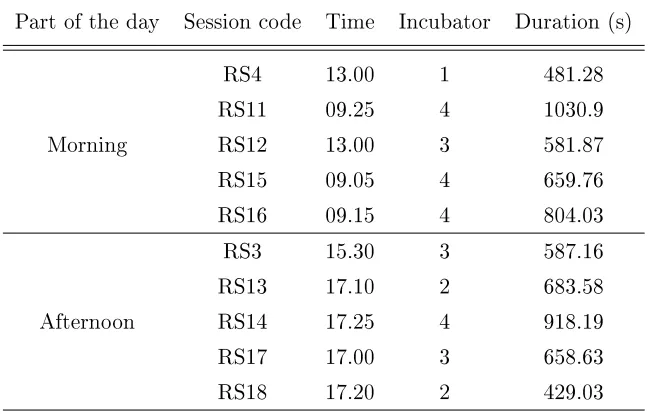
Table 3.1 provides information about the ten recording sessions included in the database used in this work, which were carried out both in the morning and in the afternoon. The overall duration of the acquired audio data is 108.7 minutes. In each recording session the incubator position was chosen
under the following conditions:
1) The preterm infant did not have any malformations at the time of birth and was at least one week old.
[image:41.612.153.477.221.428.2]2) The preterm infant was clinically stable (without infections or cardiorespiratory instability), did not need mechanical ventilation and was not given medications depressing the nervous system. 3) The consent of the preterm's parents for audio acquisition was obtained.
Table 3.1: Information about the recording sessions included in the database Part of the day Session code Time Incubator Duration (s)
Morning
RS4 13.00 1 481.28
RS11 09.25 4 1030.9
RS12 13.00 3 581.87
RS15 09.05 4 659.76
RS16 09.15 4 804.03
Afternoon
RS3 15.30 3 587.16
RS13 17.10 2 683.58
RS14 17.25 4 918.19
RS17 17.00 3 658.63
RS18 17.20 2 429.03
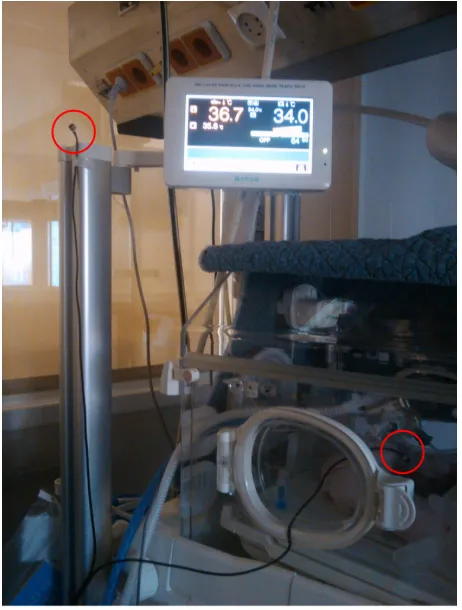
Two electret unidirectional microphones connected to the Olympus LS-5 Linear PCM Recorder were used to make recordings. One microphone was placed inside the incubator, close to the infant's ear, and the other one outside the incubator, at approximatively 50 cm distance above it, as shown in Figure 3.2. The recording protocol was created and shared with the medical sta taking part in the recording sessions, where the positions of the microphones, recording device settings and guidelines for the recordings were specied.
Obviously, the amount of activities that take place in the NICU can be very large. The list of the most common of them is given below:
• Nursery care • Visit of parents • Kangaroo care
• Visit of a specialist (paediatrician, cardiologist, etc.) • Examinations (X-ray, ultrasound, etc.)
• Preterm's entry or relocation • Preterm's death
• Surgical interventions • Music therapy
• Cleaning
3.2. Audio data acquisition: recording setup, sessions and scenarios
Figure 3.2: The conventional microphone positions used throughout the recording sessions
should be done to a preterm infant, which may vary depending on the infant's needs, and includes: changing a diaper, measuring blood pressure, changing an oxygen sensor, cleaning respiratory secretions, measuring temperature, changing temperature sensors, weighting a newborn, paediatric observation, changing medications. Each of these nursery care operations is considered as a scenario. Also, a neutral scenario was dened for including the time periods when no nursery care scenario takes place, the baby is untouched and the doors of the incubator are closed. It should be mentioned that, except for nursery care, the activities from the list above can take place during this generic neutral scenario.
Every recording session contains a subset of the dened scenarios. Each scenario was recorded to a separate audio le, and in average 8.6 recordings per scenario were acquired. Except for neutral, the possibility to make a recording of the concrete scenario during the recording session depended on preterm's individual needs. Besides, the weighting of a newborn was usually performed in the afternoon. The duration of each scenario varied from session to session, which depended on ad-hoc variations of the procedure and on the work style of a nurse performing it. The duration of the neutral scenario was controlled, and usually a 1-2 minute recording was acquired. The detailed information about the scenarios recorded in each session can be found in Table 3.3.
3.3 Labelling protocol: list of acoustic events and criteria
The audio data was manually annotated using the ELAN tool [123]. For each relevant audio event it's time boundaries and identity (label) were specied. For each scenario, a single annotation was produced, which corresponds to the audio recorded both inside and outside the incubator.
All the labelled acoustic events were grouped into several tiers of annotations: • Alarms for alarm sounds generated by various biomedical equipment.
• Vocalizations for all the sounds produced through a vocal tract, either by infant or adult. • Events for the rest of the relevant acoustic events, which are mainly the events specic to the
considered scenarios.
• CPAP, a separate tier for the Continuous Positive Airway Pressure (CPAP) noise.
• Noises for the acoustic events that were not specied in the labelling protocol, but which anno-tators considered relevant and perhaps recognized. All the events in this tier have a special label nn followed by (if recognized) a label in square brackets.
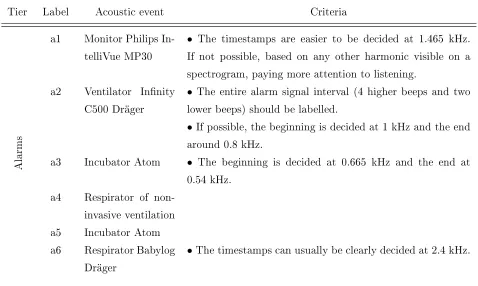
Table 3.2 contains a list of acoustic events considered for annotation, their corresponding labels and the criteria used for annotation. The annotation campaign was performed in two stages, where the rst portion of labels was obtained in an exploratory work during summer 2013 and later augmented during summer 2014, and the two annotators worked independently. The list of considered acoustic events dened for the rst stage of the annotation campaign diers from the denitive list presented in Table 3.2. These dierences are outlined in Appendix C. At the second stage, the annotation was limited to the two most relevant types of sounds (i.e. equipment alarms and vocalizations), for which the automatic detection systems were developed, and some resembling events (buttons). This was done in order to speed up the annotation process and to obtain as much annotated acoustic event samples as possible.
The general labelling guidelines shared with annotators were the following:
1. Only the dened labels (see Table 3.2) must be used for annotating the relevant acoustic events. 2. The annotation should be primarily based on the audio acquired using the microphone placed outside the incubator, since it is closer to the sound sources. The audio obtained inside the incubator should be consulted in case of ambiguity or doubt, as well as used for verication of the complete annotation.
3. The spectrogram must be checked during the annotation process.
4. It is better to label more than less, i.e. the timestamps should not be too narrow, to avoid possible cutting of an acoustic event.
5. In case of several simultaneous events belonging to one tier, an additional tier should be created with the name [{TierName}{N}], where TierName is one of the dened tier names, and N is the index number of the tier (e.g., tiers Voices1, Voices2, Voices3, etc).