Frequency of hepatitis C virus infection in
a single institution in Mexico with a
focus on birth-cohort population
Héctor Baptista-González,*,** Victor M. Noffal-Nuño,* Nahum Méndez-Sánchez*
* Liver Research Unit. Medica Sur Clinic & Foundation. Mexico City, Mexico. ** Perinatal Hematology Perinatal, National Institute of Perinatology. Mexico City, Mexico.
A B S T R A C T A B S T R A C T A B S T R A C T A B S T R A C T A B S T R A C T
Background and rationale for the study. Background and rationale for the study.Background and rationale for the study. Background and rationale for the study.
Background and rationale for the study. The generation of people born before 1965 is a high-risk group for developing chron-ic hepatitis C virus (HCV) infection. Aim.Aim.Aim.Aim.Aim. To report the experience on single institution of HCV infection under birth-cohort or baby boomers effect. Material and methods. Material and methods. Material and methods. Material and methods. Material and methods. We used a cross-sectional design of consecutive subjects older than 18 years referred for serological evaluation for anti-HCV and detection of HCV RNA. Results.Results.Results.Results. A total of 7,658 people were included. The global prev-Results. alence of HCV antibody was 4.5% (344/7658). The frequency with anti-HCV antibodies were 74 (10.9%), 158 (7.3%), and 112 (2.3%) for people born before 1945, 1945-1965, and 1966-1992, respectively (p < 0.01). The subjects HCV RNA-positive were 88.9%, 68.7%, and 44.4%, respectively (p < 0.001). The viral load was > 100,000 IU/mL in 74.4% of those positive for HCV RNA. Groups of older patients and anti-VHC, with year of birth before 1965, are more likely to show reactivity to HCV RNA and significant viral load (OR 10.0, CI 95% 4.8 to 20.1). Conclusion.Conclusion.Conclusion.Conclusion.Conclusion. We observed a high prevalence of unrecognized chronic HCV infection. The prevalence of HCV infection in people born before 1945 was twice the value of those born after 1965. Further studies are needed to determine the impact on health care services. Future work should focus on determining the appropriate model for the care of people at risk of chronic HCV.
Key words. Key words.Key words. Key words.
Key words. Hepatitis C antibodies. HCV RNA. Screening. Birth cohort. Chronic hepatitis C.
November-December, Vol. 15 No. 6, 2016: 846-852
INTRODUCTION
The hepatitis C virus (HCV) is a treatable disease, but often is an underdiagnosed condition. An estimated 130-170 million persons (~3% of the world’s population) are living with HCV infection.1 Chronic HCV infection is
as-sociated with substantial morbidity and mortality world-wide.2 In Mexico, up to 36% of chronic liver disease
is related to HCV infection.3 The burden of disease in
hepatitis C infection is highly significant, they are attrib-uted to more than 350,000 deaths each year and most of these are associated with liver cirrhosis and hepatocellu-lar carcinoma.4
In the USA, the current estimate of HCV prevalence is 1% [95% confidence interval (CI), 0.8-1.2].5 In Latin
America and the Caribbean, the prevalence is 0.7% (95% CI, 0.5-1.1), which is lower than that reported for Eastern
Europe, sub-Saharan Africa, and South Asia.6 Mexico is a
region of low prevalence of HCV infection, estimates of data from the National Health Survey 2012 indicate that the prevalence of anti-HCV antibodies is 0.3% (95% CI, 0.13 to 0 67) in the population of 20-49 years.7 However,
the prevalence of anti-HCV antibodies in the adult popula-tion of Mexican origin living in the USA is significantly higher than that reported for the population living in Mexico. For example, a study reported an HCV anti-bodies prevalence of 2.3% (95% CI, 1.2-3.4) among eco-nomically disadvantaged Mexican Americans living in South Texas, USA.8 This differences observed between
Mexican populations living inside and outside Mexico, may be related to environmental factors or differences in access to health care services between the populations.6
Epidemiological evidence shows that a wave of HCV infection occurred in Western countries particularly
The Official Journal of the Mexican Association of Hepatology, the Latin-American Association for Study of the Liver and
the Canadian Association for the Study of the Liver
Manuscript received: Manuscript received: Manuscript received: Manuscript received:
Manuscript received: February 18, 2016. Manuscript accepted:Manuscript accepted:Manuscript accepted:Manuscript accepted:Manuscript accepted: April 11, 2016.
affected people who were born in the period 1945-1965.5
The Birth cohort 1945-1965 (so-called “baby boomers”) has been the goal of the Centers for Disease Control and Prevention of Diseases for mass screening because of the high prevalence of HCV in this age group, which has been estimated at 3.3%.9 In the USA, among the non-hospitalized
civilian population, positive for HCV RNA, the preva-lence of HCV infection was 1.0% (95% CI, 0.8 to 1.2). Infected persons are most likely to be aged 40-59 years, male, and non-Hispanic black, and lower educational level and family income.5
The National Health Survey in Mexico shows that prevalence of anti-HCV antibodies in adult Mexican population aged >20 years is 1.4% (95% CI, 1.1-1.6). However, the effect of age is evident from the generation born in the years 1953 and before, with a prevalence rate of 1.1% (95% CI, 0.7 to 1.5), 1.3 % (1.9 to 5.1), for groups of 40-49 and 50-59 years old; and 3.2% (1.6 to 4.8) and 2.1% (1.3 to 3.6) for groups of 60-69, and 70 years old, respectively.10
The international consensus recommends increasing the capacity for the detection and treatment of HCV as a cornerstone in many countries. This recommendation in-cludes the assessment of cohort groups according to the year of birth as a useful tool for identifying and maximiz-ing the use of resources in at-risk populations.11
Consist-ent with this perspective, the aim of this study was to document the differences in the prevalence of HCV infec-tion in Mexico among different age groups, with a focus on birth-cohort or baby boomer population.
MATERIAL AND METHODS
Study setting, population, and measurements
We used a cross-sectional design, we included consec-utive asymptomatic subjects > 18 years of age who were referred to our clinical pathology laboratory between July 2009 to June 2014 for serological evaluation of anti-HCV antibodies, referred by their doctors on suspicion of hav-ing HCV infection. We not present the results of the eval-uation of the clinical condition of the patient or liver enzymes values. The serum samples from blood donors initially reactive to HCV and sent to the laboratory for the detection of HCV RNA were excluded.
Our hospital provides care to patients primarily mid-dle- and high-income residents of Mexico City and the metropolitan area. The patients were stratified into three groups according to the year of birth: before 1945, 1945-1965, and 1966-1992.
Serum HCV antibody level was measured using a com-mercial chemiluminescence method (ARCHITECT, Ab-bott Laboratories. AbAb-bott Park, Illinois, USA). HCV RNA
level was measured in 152 patients using AmpliPrep/COBAS kits (Roche Molecular Diagnostics. Indianapolis, USA).
The study was approved by the Human Subjects Com-mittee of the Medica Sur Clinic Foundation. Written in-formed consent was obtained from all participants before entry into the study.
Statistical analysis
Data were analyzed using IBM SPSS Version 17 statis-tical software. Standard descriptive statistics were ob-tained. The significance of comparisons between groups was assessed using a nonparametric test for K independ-ent samples (Kruskal-Wallis) with a significance level of p < 0.05.
RESULTS
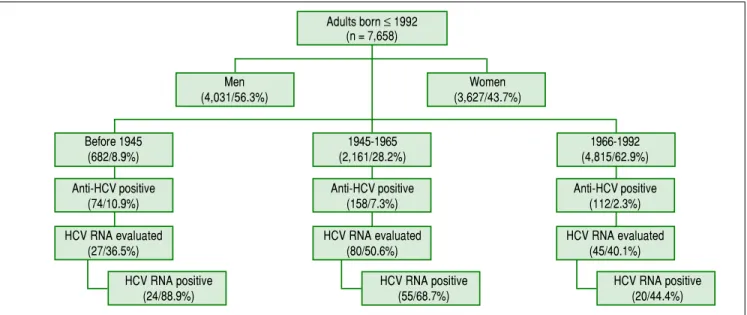
We included 7,658 subjects, 4031 cases were male (56.3%) and 3627 women (43.7%). The numbers (percent-ages) of people according to the year of birth were 682 (8.9%) for those born before 1945; 2,161 (28.2%) for those born in 1945-1965, and 4,815 cases (62.9%) for those born in 1966-1992. The global prevalence of anti-HCV antibody reactivity was 4.5% (344/7,658) (Figure 1).
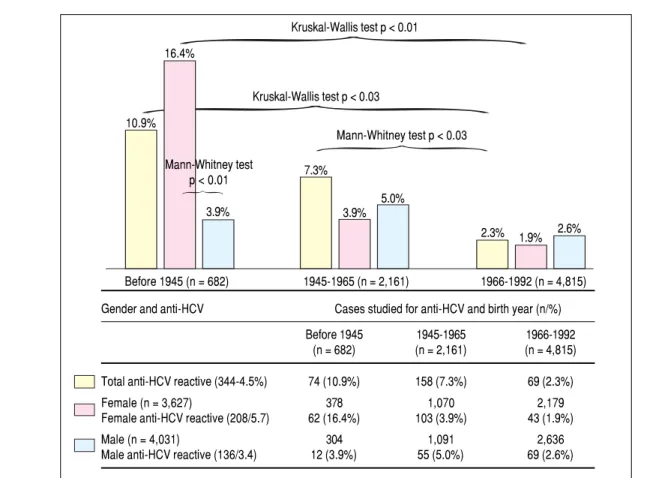
The frequencies of serological reactivity to HCV were 74 (10.9%), 158 (7.3%), and 112 cases (2.3%) (comparison between all groups, Kruskal-Wallis test p < 0.03), being more evident compared to those born between 1966-1992. The latter group had the lowest prevalence of anti-HCV reactivity (Figure 2).
The gender difference is also observed, women born before 1945, were four times more often anti-HCV than men in the same age group (16.4% vs. 3.9%. Mann-Whitney test p < 0.01). The frequency of anti-HCV in women de-creases towards the younger age groups, with statistically significant differences (16.4% vs. 3.9% and 1.9%. Kruskal-Wallis test p < 0.01) for remaining two age groups preva-lence gender is reversed, being more frequent HCV in men than in women, but these differences are not statisti-cally significant, with 1.9% for women, and 2.6% for men (Figure 2).
The HCV RNA level was quantified in 152 subjects, with 27 (36.5%), 80 (50.6%), and 45 (40.1%) patients born before 1945, 1945-1965, and 1966-1992, respectively (Fig-ure 1). The respective numbers (percentages) of 99 people positive for HCV RNA (65.1%) were 27 (88.9%), 55 (68.8%), and 20 (44.4%) for each age group, and remaining cases were negative for HCV RNA detection.
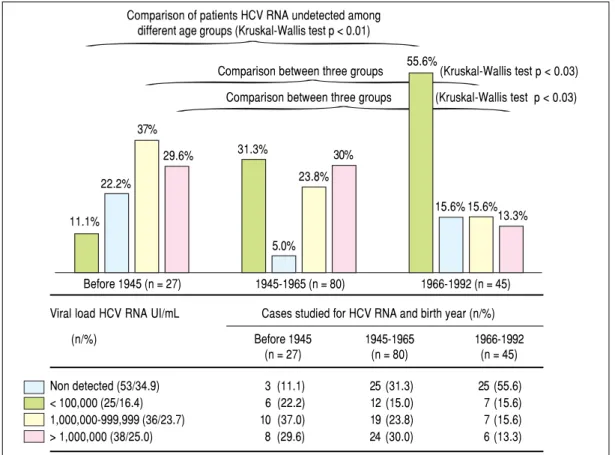
frequency of cases with high viral load (patients with more than 100,000 IU/mL HCV RNA), with statistically signifi-cant differences with the group born between the years 1966-1992 (Kruskal-Wallis p < 0.03) (Figure 3). Groups of older patients and anti-VHC, with year of birth before 1965, are more likely to show reactivity to HCV RNA and signif-icant viral load (OR 10.0, CI 95% 4.8 to 20.1)
DISCUSSION
The trend in prevalence of anti-HCV shows a similar behavior to Mexico12 and Latin American countries,6 with
minor occurrence in Bolivia and Panama (0.1%) and high-est for Puerto Rico and Argentina (2.4%) and 0.8-1.6% for Mexico.13,14 Although our country is considered as a
re-gion of low prevalence of this infection, the impact on health system is highly significant because about a million people in Mexico have HCV markers and 16-80 % of them suffer of chronic hepatitis C.15
The prevalence of HCV infection and clinical stages of the disease are distributed unevenly in most countries. Clinicians have generally focused on certain risk groups or birth cohorts, but the risk may change over time, as the population is also growing and changing. People born be-fore 1965, especially those born bebe-fore 1945, have been identified as at-risk populations along with intravenous drug users, patients undergoing hemodialysis,16 and health
workers,17,18 and mainly patients who received blood
transfusion.19
It is also affected by the year anti-HCV antibodies uni-versal screening was performed in blood donors.20 People
most at risk are those who received a blood transfusion be-fore 1992 (1993 in the case of Mexico), when health authori-ties established as a mandatory measure detecting HCV antibodies in all blood donations. In developing countries, the main risk factor is the blood transfusions, while in de-veloped countries the use of intravenous drugs in the most important means of transmission.13 In blood donors were
initially tested positive doubtful for antibodies to HCV,14
the most frequent risk factors identified were blood trans-fusion (36-42%) and < 10% of user drugs.21
Mexican blood donors older, they also have a different behavior in HCV infection. Documented an increased oc-currence of serological marker, greater intensity in the re-action in the values of S/CO, most often in the identification of the HC-RNA and significant viral load HCV increase in blood donors more age.22 A similar
be-havior was observed in the results presented in our report for patients with clinical intent of the study, which sup-ports the concept of the effects of HCV infection and birth cohort.
A “baby boomer or birth cohort effect” has been ob-served in different population groups in Latin America23
and Mexico. For example, in the state of Veracruz located on the Gulf of Mexico,24 the highest prevalence of
anti-HCV antibodies was in blood donors born before 1975 (OR 1.43, 95% CI, 1.05-1.95). In the National Survey of Health and Nutrition 2012, an effect of age was not docu-mented, but the prevalence rates of anti-HCV were 0.35% and 0.09% for those born before and after 1973, respective-ly.7 This may have been affected by bias in the selection of
subjects younger than 50 years. Figure 1.
Figure 1. Figure 1. Figure 1.
Figure 1. Overview of the cases included in the study according to the strata of birth year. Global prevalence of anti-HCV 4.5%. On 152 patients evaluated for HCV RNA, 99 cases were positive (65.1%). HCV: hepatitis C virus.
Adults born ≤ 1992 (n = 7,658)
Men Women
(4,031/56.3%) (3,627/43.7%)
Before 1945 1945-1965 1966-1992
(682/8.9%) (2,161/28.2%) (4,815/62.9%)
Anti-HCV positive Anti-HCV positive Anti-HCV positive
(74/10.9%) (158/7.3%) (112/2.3%)
HCV RNA evaluated HCV RNA evaluated HCV RNA evaluated
(27/36.5%) (80/50.6%) (45/40.1%)
HCV RNA positive HCV RNA positive HCV RNA positive
A gender gap, especially in subjects born after 1965, has been described inconsistently in the literature. In our re-port, there is a difference in the prevalence of HCV infec-tion among men and women, the prevalence is higher in women born before 1945. In the African-American popu-lation,25 anti-HCV antibodies are found more often in
men, but there is no difference between men and women when the presence of HCV is identified using molecular tests for HCV RNA.
However, we consider the possibility the effect on se-lection bias, since for blood donors, has been reported similar frequencies in the reactivity of anti-HCV with no gender difference.26
In our study, patients older than 60 years had a higher prevalence of HCV antibodies and were at high risk of chronic active hepatitis, as evidenced by the high rate of re-activity of HCV RNA (88.9%). These results support the concept that the age is an important predictor of HCV in-fection, and the risk increases with age in most clinical set-Figure 2.
Figure 2.Figure 2.
Figure 2.Figure 2. Differences in reactivity to anti-HCV according to gender and year of birth. The frequency of anti-HCV is statistically significant in the age group of patients born before 1945, being more evident compared to those born between 1966-1992 (10.0% vs. 7.3% and 2.3% Kruskal-Wallis p < 0.03). This statistical difference persists group compared 1945-1965 with the group of subjects born 1966-1992 (Mann-Whitney p < 0.03). The gender difference is also observed, women born before 1945, were four times more often anti-HCV than men in the same age group (Mann-Whitney p < 0.01). The frequency of anti-HCV in women decreases towards the younger age groups, with statistically significant differences (16.4% vs. 3.9% and 1.9%. Kruskal-Wallis p < 0.01) for remaining two age groups prevalence gender is reversed, being more frequent HCV in men than in women, but these differences are not statistically significant. HCV: hepatitis C virus.
tings. This age group also has a poor response to antiviral treatment,17,27 greater likelihood of progression to liver
dis-ease, and more severe liver fibrosis as a specific pattern of clinical presentation.28 However, the most notable
differ-ence is the presdiffer-ence of HCV RNA in subjects located in the two older age groups. That is, the older subjects with HCV, are more likely to have reactivity to HCV RNA with signifi-cant viral load (OR 10.0, 95% CI 4.8 to 20.1). These data sug-gest that it may be necessary controlled clinical trials to implement specific preventive and therapeutic measures for patients with HCV in the elderly.17
In Mexico,22 from 34.2 to 66% of people with HCV
an-tibodies were identified as positive HCV RNA.29 We
ob-serve similar figures in our report. However, there are important issues that have not been considered in our re-port, as is the diagnostic ability of commercial tests for the detection of anti-HCV and HCV RNA, as well as differ-ences between analytical platforms for detection of HCV.30,31
Gender and anti-HCV Cases studied for anti-HCV and birth year (n/%)
Before 1945 1945-1965 1966-1992 (n = 682) (n = 2,161) (n = 4,815)
Total anti-HCV reactive (344-4.5%) 74 (10.9%) 158 (7.3%) 69 (2.3%)
Female (n = 3,627) 378 1,070 2,179
Female anti-HCV reactive (208/5.7) 62 (16.4%) 103 (3.9%) 43 (1.9%)
Male (n = 4,031) 304 1,091 2,636
Male anti-HCV reactive (136/3.4) 12 (3.9%) 55 (5.0%) 69 (2.6%) 10.9%
16.4%
3.9%
7.3%
3.9% 5.0%
2.3% 1.9% 2.6% Kruskal-Wallis test p < 0.01
Kruskal-Wallis test p < 0.03
Mann-Whitney test p < 0.01
Mann-Whitney test p < 0.03
The burden of disease caused by hepatitis is high in Lat-in America and the Caribbean.21 In 47% of countries in
Latin America, offering the entire population testing hepa-titis B virus and HCV, and 26% offered only to particular risk groups. Nevertheless, none of these countries includes the birth cohort as a risk group.31 Diagnostic tests of
hepati-tis B virus and hepatihepati-tis C, are mandatory for risk groups in 15% of countries.31,32 But without doubt, blood services are
contributing the most significant number of new patients detected for HCV infection in Latin America.31
The available data suggest a wide variation in the preva-lence of chronic HCV infection between countries in Eu-rope. Countries in the south and east of the European Union have a much higher prevalence of chronic HCV in-fection (2-8%) compared with countries in northwestern Europe (< 1%).33 Among the 10 countries in Central and
Eastern Europe that responded to a survey, the common features of many surveillance systems include mandatory surveillance, passive case finding, and reporting of both acute and chronic HCV infections. In many countries there are gaps in relation to screening policy for HCV, and no included birth cohort.34
Figure 3. Figure 3. Figure 3. Figure 3.
Figure 3. Viral load of HCV RNA. Comparison of patients HCV RNA undetected among different age groups, less frequently in the case group born before 1945 (11.1% vs. 31.3 and 55.6%, respectively Kruskal-Wallis p < 0.01). Similarly, patients born before 1945, they showed higher frequency of cases with high viral load (patients with more than 100,000 IU/mL HCV RNA), with statistically significant differences with the group born between the years 1966-1992 (Kruskal-Wallis p < 0.03). HCV: hepatitis C virus.
In this report there are methodological limitations that must be taken into account for the correct interpretation and applicability of this information in the clinical setting. There is a selection bias in the inclusion of patients who do not represent the general population and over-repre-sent subjects with higher expected frequency of IgG anti-bodies against HCV by the clinical intent of the study.
The study design does not allow the application of the results to the general population, and limits the assess-ment of the possible impact the association between age group and the higher prevalence of anti-HCV, which ulti-mately is the main constraint to justify need for detection of HCV in birth cohort function. Despite these limita-tions, the data presented in this study suggest the need for future research to expand on this topic.
CONCLUSION
We observed a high prevalence of chronic HCV infec-tion unrecognized in this series of people born before 1945 and from 1945 to 1965; the prevalence was twice the population born from 1966 to 1992 period. In Mexico,
Viral load HCV RNA UI/mL Cases studied for HCV RNA and birth year (n/%)
(n/%) Before 1945 1945-1965 1966-1992
(n = 27) (n = 80) (n = 45)
Non detected (53/34.9) 3 (11.1) 25 (31.3) 25 (55.6) < 100,000 (25/16.4) 6 (22.2) 12 (15.0) 7 (15.6) 1,000,000-999,999 (36/23.7) 10 (37.0) 19 (23.8) 7 (15.6) > 1,000,000 (38/25.0) 8 (29.6) 24 (30.0) 6 (13.3)
11.1% 22.2%
37%
31.3%
5.0% 23.8%
15.6% 15.6% 13.3% Comparison of patients HCV RNA undetected among
different age groups (Kruskal-Wallis test p < 0.01)
Comparison between three groups (Kruskal-Wallis test p < 0.03)
Comparison between three groups (Kruskal-Wallis test p < 0.03)
Before 1945 (n = 27) 1945-1965 (n = 80) 1966-1992 (n = 45)
29.6% 30%
there are no HCV screening programs in groups or high-risk population in general, including baby boomers. We need to establish approaches based detection risk should be extended to cohorts specific birth to improve the capture rate of those infected with HCV and on the ba-sis of this information assess the impact on disease burden level national.
ABBREVIATIONS
• CI: confidence interval.
• HCV RNA: hepatitis C virus RNA detected. • HCV: hepatitis C virus.
REFERENCES
1. Lozano R, Naghavi M, Foreman K, Lim S, Shibuya K, Aboy-ans V, Abraham J, et al. Global and regional mortality from 235 causes of death for 20 age groups in 1990 and 2010: a systematic analysis for the Global Burden of Disease Study 2010. Lancet 2012; 380: 2095-128.
2. Mendez-Sanchez N, García-Villegas E, Merino-Zeferino B, Ochoa-Cruz S, Villa AR, Madrigal H, Kobashi-Margáin RA, et al. Liver diseases in Mexico and their associated mortality trends from 2000 to 2007: A retrospective study of the na-tion and the federal states. Ann Hepatol 2010; 9: 428-38. 3. Mendez-Sanchez N, Aguilar-Ramírez RJ, Reyes A, Dehesa
M, Juárez A, Castañeda B, Sánchez-Avila F, et al. Etiology of liver cirrhosis in Mexico. Ann Hepatol 2004; 3: 30-3. 4. Ly KN, Hughes EM, Jiles RB, Holmberg SD. Rising Mortality
Associated With Hepatitis C Virus in the United States, 2003-2013. Clin Infect Dis 2016; 62: 1287-8.
5. Denniston MM, Jiles RB, Drobeniuc J, Klevens RM, Ward JW, McQuillan GM, Holmberg SD. Chronic hepatitis C virus infec-tion in the United States, Nainfec-tional Health and Nutriinfec-tion Exami-nation Survey 2003 to 2010. Ann Intern Med 2014; 160: 293-300.
6. Greenaway C, Thu Ma A, Kloda LA, Klein M, Cnossen S, Schwarzer G, Shrier I. The seroprevalence of hepatitis C antibodies in immigrants and refugees from intermediate and high endemic countries: A systematic review and meta-anal-ysis. PLoS One 2015; 10: e0141715.
7. Gutierrez JP, Sucilla-Perez H, Conde-Gonzalez CJ, Izazola JA, Romero-Martinez M, Hernandez-Avila M. Decrease of HCV seroprevalence in Mexico: Results from the National Health and Nutrition Survey 2012. Sal Pub Mex 2016; 58: 25-32.
8. Vatcheva KP, Beretta L, Pan JJ, Fallon MB, Mccormick JB, Fisher-Hoch SP. Hepatitis C virus in Mexican Americans: a population-based study reveals relatively high prevalence and negative association with diabetes. Epidemiology & In-fection 2016; 144: 297-305.
9. Smith BD, Morgan RL, Beckett GA, Falck-Ytter Y, Holtzman D, Teo CG, Jewett A. Recommendations for the identification of chronic hepatitis C virus infection among persons born during 1945-1965. MMWR Recomm Rep 2012; 61(Rr-4): 1-32. 10. Valdespino JL, C-GlC, Olaiz-Fernaìndez G, Palma O,
Kershe-nobich D, Sepuìlveda J. Seroprevalencia de la hepatitis C en adultos de México: ¿un problema de salud pública emer-gente? Salud Pub (Mex) 2007; 49: S395-S403.
11. Alfaleh FZ, Nugrahini N, Maticic M, Tolmane I, Alzaabi M, Hajarizadeh B, Valantinas J, et al. Strategies to manage
hep-atitis C virus infection disease burden - volume 3. J Viral Hepat 2015; 22(Suppl. 4): 42-65.
12. Mendez-Sanchez, Baptista-Gonzalez H, Sanchez-Gomez RH, Bordes-Aznar J, Uribe-Esquivel M. The prevalence of hepatitis B and C in blood donors in a 3rd-level hospital of Mexico City. Sal Pub Mex 1999; 41: 475-8.
13. Mendez-Sanchez N, Gutierrez-Grobe Y, Kobashi-Margain RA. Epidemiology of HCV infection in Latin America. Ann Hepatol 2010; 9 (Suppl. 1): 27-9.
14. Vivas-Arceo C, Benavides SA, De Jesús Trujillo J, Panduro A, Rivas-Estilla AM. Hepatitis C virus: prevalence and routes of infection among blood donors of West Mexico. Hepatol Res 2003; 25: 115-23.
15. Chiquete E, Panduro A. Low prevalence of anti-hepatitis C virus antibodies in Mexico: A systematic review. Intervirolo-gy 2007; 50: 1-8.
16. Gomez GC, Chavez TNC, Ponciano RG, Uribe M, Mendez SN. Prevalence of hepatitis C virus infection among patients un-dergoing haemodialysis in Latin America. Ann Hepatol 2015; 14: 807-14.
17. Carrion AF, Martin P. Viral hepatitis in the elderly. Am J Gas-troenterol 2012; 107: 691-7.
18. Mendez-Sanchez N, Motola-Kuba D, Zamora-Valdes D, Sanchez-Lara K, Ponciano-Rodriguez G, Uribe-Ramos F, et al. Risk factors and prevalence of hepatitis virus B and C se-rum markers among nurses at a tertiary-care hospital in Mex-ico City, MexMex-ico: a descriptive study. Ann Hepatol 2006; 5: 276-80.
19. Ladron-de Guevara L, Gomez N, Vazquez-Cantarell M, Gar-cia-Mendez S, Di Silvio M. Prevalence of and risk factors for hepatitis C in blood donors. Rev Gastroenterol Mex 2002; 67: 11-6.
20. Mohd Hanafiah K, Mohd Hanafiah K, Groeger J, Flaxman AD, Wiersma ST. Global epidemiology of hepatitis C virus infec-tion: new estimates of age-specific antibody to HCV sero-prevalence. Hepatology 2013; 57: 1333-42.
21. Alonso M, Guzmán A, Mazin R, Pinzon CE, Reveiz L, Ghi-dinelli M. Hepatitis C in key populations in Latin America and the Caribbean: systematic review and meta-analysis. Int J Public Health 2015; 60: 789-98.
22. Sosa-Jurado F, Santos-López G, Guzmán-Flores B, Ruiz-Conde JI, Meléndez-Mena D, Vargas-Maldonado MT, Martínez-Laguna Y, et al. Hepatitis C virus infection in blood donors from the state of Puebla, Mexico. Virol J 2010; 7: 18-23. 23. Soza A, Riquelme A, Arrese M. Routes of transmission of
hepatitis C virus. Ann Hepatol 2010; 9(Suppl.): 33.
24. Lopez-Balderas N, Bravo E, Camara M, Hernandez-Romano P. Seroprevalence of hepatitis viruses and risk factors in blood donors of Veracruz, Mexico. J Infect Dev Ctries 2015; 9: 274-82.
25. Miller LS, Rollin F, Fluker SA, Lundberg KL, Park B, Quairoli K, Niyibizi, NK, et al. High-yield birth-cohort hepatitis C virus screening and linkage to care among underserved African Americans, Atlanta, Georgia, 2012-2013. Public Health Rep 2016; 131 (Suppl. 2): 84-90.
26. Vera de Leon L, Juarez A, Diaz GM, Bazan PJ. Epidemiologic and situational panorama of hepatitis C in Mexico. Rev Gas-troenterol Mex 2005; 70: 25-32.
27. Silva I, Carvalho Filho R, Feldner AC, Zaros I, Silva AE, Fer-raz ML. Poor response to hepatitis C treatment in elderly pa-tients. Ann Hepatol 2013; 12: 392-8.
29. Contreras AM, Ochoa-Jimenez RJ, Celis A, Mendez C, Oli-vares L, Rebolledo CE, Hernandez-Lugo I, et al, High anti-body level: an accurate serologic marker of viremia in asymptomatic people with hepatitis C infection. Transfusion 2010; 50: 1335-43.
30. Williams D, Williams D, Pitre E, Ford C, Polisena J, Weeks L. CADTH Health Technology Assessments, in Screening for Hepatitis C Virus: A Systematic Review and Metaanalysis -Project Protocol. 2015, Canadian Agency for Drugs and Technologies in Health 2015 (c) CADTH: Ottawa (ON). 31. Diez-Padrisa N, Castellanos LG. PAHO Viral hepatitis
Work-ing Group. Viral hepatitis in Latin America and the Caribbean: a public health challenge. Rev Panam Salud Publica 2013; 34: 275-81.
32. World Hepatitis Alliance. Global Community Hepatitis Policy Report. 2014.
33. Hahne SJ, Veldhuijzen IK, Wiessing L, Lim TA, Salminen M, Laar MV. Infection with hepatitis B and C virus in Europe: a
systematic review of prevalence and cost-effectiveness of screening. BMC Infect Dis 2013; 13: 181.
34. Mozalevskis, Eramova I, Safreed-Harmon K, Lazarus JV. Hep-atitis B and C surveillance and screening programmes in the non-EU/EEA Member States of the WHO European Region: sur-vey findings from 10 countries, 2012. Euro Surveill 2016; 21.
Correspondence and reprint request:
Prof. Nahum Méndez-Sánchez, M.D., MSc., Ph.D., FACG, AGAF
Medica Sur Clinic & Foundation Puente de Piedra, No. 150, Col. Toriello Guerra,
Mexico City, Mexico