UNIVERSIDAD TÉCNICA PARTICULAR DE LOJA
La Universidad Católica de Loja
ÁREA SOCIO HUMANÍSTICA
TÍTULO DE LICENCIADO EN CIENCIAS DE LA EDUCACIÓN
MENCIÓN INGLÉS
Teachers and students’
perceptions of teaching English in small classes in Ecuador
TRABAJO DE FIN DE TITULACIÓN
AUTOR: Martínez Durán, Luis Mauricio
DIRECTORA: Quiñonez Beltrán, Ana Lucía, Dra.
CENTRO UNIVERSITARIO RIOBAMBA
ii
APROBACIÓN DEL DIRECTOR DEL TRABAJO DE FIN DE TITULACIÓN
Doctora.
Ana Lucía Quiñonez Beltrán
DOCENTE DE LA TITULACIÓN
De mi consideración:
El presente trabajo de fin de titulación: “Teachers and students’ perceptions of teaching English in small classes in Ecuador” realizado por Martínez Durán Luis Mauricio, ha sido orientado y revisado durante su ejecución, por cuanto se aprueba la presentación del mismo.
Loja, mayo de 2015
iii
DECLARACIÓN DE AUTORÍA Y CESIÓN DE DERECHOS
“Yo, Martínez Durán Luis Mauricio declaro ser autor del presente trabajo de fin de
titulación: “Teachers and students’ perceptions of teaching English in small classes in Ecuador”,
de la Titulación de Licenciado Ciencias de la Educación mención Inglés, siendo Ana Lucía Quiñonez Beltrán directora del presente trabajo; y eximo expresamente a la Universidad Técnica Particular de Loja y a sus representantes legales de posibles reclamos o acciones legales.
Además certifico que las ideas, conceptos, procedimientos y resultados vertidos en el presente trabajo investigativo, son de mi exclusiva responsabilidad.
Adicionalmente, declaro conocer y aceptar la disposición del Art. 88 del Estatuto Orgánico de la Universidad Técnica Particular de Loja que en su parte pertinente textualmente dice: “Forman parte del patrimonio de la Universidad la propiedad intelectual de investigaciones,
trabajos científicos o técnicos y tesis de grado o trabajos de titulación que se realicen con el apoyo financiero, académico o institucional (operativo) de la Universidad”.
f. ...
iv DEDICATION
To God, for giving me strength and wisdom to develop this work. To my wife and my family, for their support and love; thanks for all the patience through all these years.
v CONTENTS
COVER ... i
CERTIFICACIÓN ... ii
DECLARACIÓN DE AUTORÍA Y CESIÓN DE DERECHOS ...iii
DEDICATION ... iv
CONTENTS ... v
ABSTRACT ... 1
RESUMEN ... 2
INTRODUCTION ... 3
METHOD ... 5
DISCUSSION ... 7
Literature Review ... 7
Description, analysis and interpretation of results ... 21
Conclusions ... 40
Recommendations ... 42
REFERENCES ... 43
1 ABSTRACT
The topic of this research is “Teachers and students’ perceptions of teaching English in small classes in Ecuador” and it seeks to answer the following questions: What are the benefits of
teaching and learning in small classes? What teaching strategies and resources benefit the teaching of English in small classes? How do students feel about learning English in small classes? And, Are there any limitations when teaching English in small classes?
This research was developed at a high school in the city of Riobamba, Ecuador. Five small classes were observed, and the teachers and students were interviewed. The students were between 12 and 17 years old, and their teachers are professionals in teaching English.
A qualitative and quantitative approach was used to explore, explain, describe, and analyze the results. The data was collected using techniques such as survey, note-taking, and observation. The instruments were questionnaires and observation sheets.
The most important conclusion in this study shows that small classes benefit the English teaching-learning process since teachers develop interactive activities.
2 RESUMEN
El tema de esta investigación es “Percepciones de profesores y estudiantes sobre el proceso de enseñanza del inglés en clases pequeñas”, y el propósito general es conocer los
beneficios de enseñar y aprender inglés en clases con menos de 20 alumnos, así como la actitud de los estudiantes, y las actividades y recursos utilizados por los profesores.
Esta investigación se desarrolló en un colegio en la ciudad de Riobamba, Ecuador, en el cual se observaron 5 clases, y se entrevistaron profesores y estudiantes que pertenecen a clases pequeñas.
Se utilizó un enfoque cualitativo y cuantitativo para explorar, explicar, describir, y
analizar los resultados. Las técnicas utilizadas fueron entrevistas, apuntes, y observaciones. Los instrumentos fueron cuestionarios y hojas de observación.
La conclusión más importante de este estudio permite ver que la enseñanza del inglés en clases pequeñas tiene un alto beneficio para los estudiantes. Los profesores pueden desarrollar actividades dirigidas a promover la colaboración y participación activa entre los estudiantes.
3
INTRODUCTION
In other countries like the United States of America, class size has arisen such an important debate in educational authorities that researchers have carried out investigations and many authors have provided important information on the topic. As noted by Mathison & Ross (2008), class size reduction seems to be easy to implement, but it involves many decisions such as defining the ideal number of students, selecting teaching strategies, or making budgetary decisions for implementing physical spaces. Moreover, the authors point out that debate tends to focus on the effects of class size reduction in students’ learning process.
Class size reduction has been also a relevant concern in Ecuadorian high schools and no previous studies have been done on the topic in the country. Although, the government has been taken important actions to improve the quality of the English teaching-learning process, class size is still an important challenge for educators. Therefore, the purpose of this study is to know teachers and students’ perceptions of teaching and learning English in small classes and it seeks
to answer the following research questions: What are the benefits of teaching and learning English in small classes? What teaching strategies and resources benefit the teaching of English in small classes? How do students feel about learning English in small classes? Are there any limitations when teaching English in small classes?
Through answering the research questions, this study will bring educational authorities important information of the effects of class size reduction in students’ achievement. In this
sense, it would be possible to plan important actions for improving the English teaching-learning process in Ecuador.
4
First, Biddle & Berlinger (2002) analyzed past research made on class sizes, and discusses the findings and the implications for policy. Main conclusions revealed that long term exposure to small classes is substantially beneficial for students in American schools, and the longer the time in smaller classes the larger the gains. The researchers did not find any limitation.
The second research presented here was done by Lee (2008) to investigate students’
reactions to teacher feedback, with a specific focus on the factors that might influence their reactions. The author found that student reactions to teacher factor are based not just on the feedback itself but other factors, most importantly the students themselves.
The third research was carried out by Khazaei, Zadeh, & Ketabi (2012), and it looked at the effect that class size has on students’ willingness to communicate. The researchers found that
in smaller classes the students had more time to express themselves and personalize their answers, as they are able to overcome their anxiety and feel free to initiate conversation.
The findings from the present study make several contributions to high schools teachers and authorities. They will have a clear view of the benefits that small classes have in the English teaching-learning process, and it would be possible to take actions in order to reduce the number of students in large classes. Moreover, other researchers would focus on the effects of small classes in students’ academic achievement.
Despite of the benefits of this study, there were some limitations such as the small number of teachers that were interviewed. Moreover, some of the responses were not consistent with the information gathered through the observations and it affected the accuracy of the results.
5 METHOD
Setting and participants
The data for this study was gathered in a high school in the city of Riobamba, Ecuador. The participants were 5 teachers and their students from small classes in secondary level. All teachers have worked at least 10 years at the institution, and mostly all of them have an English teaching degree. The students are teenagers whose ages ranged between 12 to 16 years old; all of them attend classes by mornings.
Procedure
This study began with the revision of literature and it consisted on looking for information related to managing learning, teacher-student and student-student interaction, class size, teaching techniques, learning environment, and previous studies; all related to small classes. The relevant data of each topic was found on books, journals, and the Internet; and, it was organized and written into charts according to the APA format and the specifications given in the didactic guide.
Turning to the design of this study, it follows qualitative and quantitative approach to explore, explain, describe, and analyze data. The techniques used in the field research were surveys, note taking, and observations. And, the instruments were questionnaires and
observation sheets. The questionnaires were applied to teachers and students, and the observation sheets were used to gather information of the English teaching-learning process.
The teachers’ questionnaire consists of 36 liker-scale items with four options (totally
6
questionnaire has the same structure, but it contains 22 questions with a focus in learning English in small classes.
The observation sheet was used to corroborate the data gathered from teachers and student’ questionnaire, it consisted on 22 items with yes-no options. In addition, each question
has its corresponding segment to write down all the details of the events observed in class. After collecting all the data the teachers and students’ answers was tabulated to calculate
the frequency and percentage of each question regarding the available options; a statistical program was used in this process in order to present the information in charts and bar diagrams.
7 DISCUSSION Literature Review
This section contains a variety of topics related to the different factors that affect the teaching and learning process in small classes such as managing learning, teacher-student
interaction, student-student interaction, class size, teaching techniques, strategies or activities for teaching English to small classes and Learning environment in small classes. Additionally, this part contains a review of five journal studies that have been done by researchers from other countries on small classes.
Managing Learning
Some authors remark that teachers’ managing learning is extremely important in the success or failure of students’ learning process. Gower, Phillips & Walter (1995, p.8) state, “for
a class to learn effectively you must be able to inspire confidence in your students. You must know when to be firm and directive, and when to be unobtrusive and leave students alone”. Also,
the authors mention that managing learning requires from teachers to consider aspects such as use of eye contact, classroom arrangement, attention spread, teacher talk and students talk in
managing learning, eliciting, giving instructions and setting up activities, monitoring, starting and finishing the lesson, establishing rapport and maintaining discipline, monolingual and multilingual classes.
Harmer (2009) and Gower et al (1995) agree on the absolute need for managing discipline.
8
classes for finding new ways of engaging students on the topic of the lesson before guiding them into the essence of academic tasks.
Another important aspect in managing learning is rapport. For Gower et al (1995) rapport
is an important part of giving feedback because it provides a relaxed learning atmosphere that benefits the students’ language learning process. The authors mention a number of ways of
establishing good rapport such as demonstrating a good teaching attitude, being positive about the activities and materials used in class, showing personal interest in the students, asking for comments on the classes, and personalizing materials and activities. Actually, as the authors mention, teachers must create the necessary conditions for students to enjoy their classes; it will improve students’ learning and discipline will be under control.
Feedback is also important in managing learning. Harmer (2009) points out that it helps teachers to make classes effective and to solve any type of difficulty that students may encounter during their learning process. Moreover, Westberg & Jason (1996) remark that feedback must be provided in a supportive and careful manner in order to avoid embarrassing students since it is more important to focus on behavior rather than in the person. These authors identify the following types of feedback: descriptive, interpretative, evaluative, or mixture. Descriptive feedback helps learners to meditate on their learning, while interpretative or evaluative feedback provides a description of an event in order to guide students to understand teachers’ point of view.
Gower et al (1995) comment that giving feedback is one of the most important
9
was taught or learnt. In this sense, the authors also consider that teachers must be clear about the difference between an error and a mistake to provide effective feedback. A mistake is simply a “slip of the tongue or pen” something small that really does not affect the student, but an error is
something much more serious that deserve to be pointed out and corrected.
Because the students do not realize they are making an error, they do not know the procedures to follow for correcting forms. Therefore, Gower et al (1995) remark that the way
teachers provide students with feedback should be sensitive, efficient and effective in order to teach students that errors are part of their learning process. The authors explain that there are three different ways of correcting students’ errors and mistakes: self-correction, student-student
correction and teacher correction. Self-correction is for the authors the best of the three options since it helps learners to become independent and monitor their learning progress.
Teacher-student and student-student interaction
Some authors state that class interaction depends on the type of activities teachers assign to students. In this sense, Allwright & Bailey (1991, p. 147) state “A closely related issue that has
been investigated in classroom research has to do with the relationship of group size to learners’ oral participation”. The authors consider that the more pupils participate in class the more they
will learn best; therefore, student-student interaction level is related to pupils’ perceptions of the best way to learn.
Also, Qiu (2014, p. 38) provides more information of classroom interaction and says, “Classroom interaction refers to the classroom teaching scenario between teachers and students,
and between students and students”. He explains that classroom interaction influences teachers and learners’ behavior and all the elements related to the teaching-learning process and the
10
In addition, Qiu (2014) mentions that interaction occurs over media and means, verbal or non-verbal, or it can be recessive or dominant. Also, the effects of interaction can be positive or negative; it shows the continuity or diversity in the classroom.
Another contribution on classroom interaction is provided by Kohler (2015, p. 137) who states “through social interaction, the students recognize the limits of their existing knowledge and sought new knowledge to address their needs”. He adds that interaction between students
generate a language output that benefit learning. In this sense, this author cites Swain (2000) who mentions that differences between what students intend to say and they want to say take place as a result of collaborative work.
About teacher-student interaction, Kohler (2015, p. 136) says, “During interaction
between teachers and learners, both draw on a range of discourse practices in the construction of meaning”. During that process instruction, explanation, questioning, and feedback are of vital
importance because those elements promote language learning as teachers modify their talk in class. For instance, the author remarks that questioning improves students’ language learning as
the questions relate to knowledge.
Specifically in foreign language contexts, Sheelagh (2003) remarks some positive effects of interaction on the dynamic of the class. Through the exchange of information students with low language level receive feedback on grammar rules or instructions which are not understood. Sometimes during the process of interaction, as Harmer (2009) points out, teachers switch to L1 too much, and it can be a problem since it restricts students’ exposure to English. The author
11
Also, using L2 is vitally important in student- student interaction in order to learn the English language. About it, Brown (2001, p.164) says, “From the very beginning of language
study, classrooms should be interactive”. The author adds that the best way students can learn to
interact is by interacting; this means that teachers must plan classes to include many opportunities for students to interact with their peers.
Harmer (2007, P. 44) makes the distinction between pair work and group work, as both of these involve student-student interaction. He says, “students interact when they are doing pairwork or groupwork activities –they talk and listen to each other, rather than the teacher”. Interaction in pair work gives students independence from the teacher, and at the same time it creates a good atmosphere in the classroom because students learn how to listen to each other and respect their ideas. About group work, the author mentions that it has the same qualities of pair work, but it is also effective as it encourages not only language skills but those of cooperation and negotiation.
In addition, Harmer (2007, p. 49) makes it clear that the teacher has an important role during the student-student interaction process that is to monitor the activity. The teacher must check that the students understand the activity, and assess if they are using the language correctly, if not they will sometimes have to correct the students or give feedback. The same author
remarks that student-student interaction can be affected by discipline problems when monitoring is not effective and constant.
Therefore, student-student interaction is something that must be well planned by the
12
Class Size
Class size is of constant interest among teachers though it is not determined by the
teachers, but by the institution. About it, Richard (2001, p.208) argues, “Sometimes class size is
outside of the control of language providers”. He considers that the general opinion among
teachers and administrators is that classes should not exceed 15 students. According to the author, there is a clear connection between class size and quality of instruction, suggesting the bigger the class the lower the quality of instruction as it is more difficult to maintain discipline, give good instructions and feedback and develop rapport with the students.
In addition, Brown (2001, p. 197) says “unfortunately, educational budgets being paltry as
they are, most language classes are significantly larger”. He considers that language classes should have no more than 12 students, because this allows the teacher to give personalized attention and opportunity to participate.
It is clear that large classes may present some sort of difficulties. About it. Brown (2001) mentions four main issues. The first being that in big classes the level of the students will vary, making it difficult for teachers to give classes that match everyone’s level. Secondly, students
receive less individual attention, and they have less opportunity to contribute in the classes. Finally, large classes mean that it is difficult for teachers to give quality feedback on written work.
In the same vein, Harmer (2007, p.177) says, “In big classes, it is difficult for the teacher
to make contact with the students at the back and it is difficult for the students to ask for and receive individual attention”. He also comments that it can be impossible to organize effective
13
is negative; for example large classes provide more opportunities for humor, drama and acting; also, they may be a warm place for students, where they can make friends and share with many different people.
Due to the difficulties that large classes present, small classes are favorable for the learning process. Bateman (2002, p. 70) states, “There is evidence that small class size can be a powerful facilitator in promoting students’ membership in the classroom by making them more
active and frequent participants in the learning process”. Additionally, the author considers that
students’ level of participation and engagement is increased in small classes because it is easy to provide individual attention to pupils. Moreover, students’ academic knowledge is reinforced
because of the ease that teachers have to plan motivational and learning activities. Finally, the author remarks that small classes promote the development of social skills and students feel as valued members in the classroom.
From a similar point of view, Finn & Wang (2002) remark the advantage of small classes as the change of focus form teachers’ concerns about learning management to teachers’ strategies for facilitating learning. In addition, the authors mention that teachers in small classes not only identify students’ learning difficulties, but they also are able to elaborate diagnostics to find out
the possible causes of those problems.
In conclusion, it is clear that smaller are easier for the teacher but the optimal size of classes can vary depending on a number of factors such as characteristics of the students, the institution and the level of the English class. As Richards (2001, p.208) states, “the optimal class
14
Teaching techniques, strategies or activities for teaching English to small classes
Teachers have a variety of options to consider on working with the students in small classes. About it, Harmer (2007, p. 407) says, “Learning takes place most effectively when language classes pull together as unified groups”, and he discusses the advantages and
disadvantages of whole class groupings. Whole group classes reinforce a sense of belonging among the members, students feel they are all in the learning experience together, and they find it easier to share emotions or amusement in a whole class setting. He makes the example that twenty people laughing is more enjoyable than 2 people laughing and says,
With whole group classes, as Harmer (2007) explains, the teacher can act as controller,
especially in situations for giving instructions and explanations, as well as for gauging the general mood of the class, if things are being well received, if the students are motivated. Regarding the disadvantages, the author finds that individuals are neglected in these settings, or they can be made to feel uncomfortable as they have to perform in front of the whole class.
Another teaching technique is group work. According to Harmer (2007, p.165) it “provoke greater involvement and participation than larger groups”. He explains that this type of teaching
15
Despite of the amount of noise that group work generates, Harmer (2007) explains that it increase the amount of speaking time, encourages student independence, and also gives teachers a chance to work with the pairs while the other pairs continue to work and learn. Conversely, teachers have to be careful about noise and ensuring that students work appropriately and they do not talk about other matters. It could happen that students do not want to interact with another learner they feel that they should be interacting with the teacher who speaks English well. More activities to work in small classes are proposed by Dee (2002). Lectures and tasks from cooperative and team-based learning also can be used to develop interactivity between students. The authors explains that teachers may lecture to students and then assign them 15 to 20 minutes to talk about the topic or find the solution of a problem. Cooperative learning also encourage learners to develop interactive exchange of information, however, it is important for teachers to consider time, group accountability, roles, and so forth. Finally, the same author mentions that activities from team-based learning that are developed around a particular theme are useful in the classroom because they motivates students to commit highly to their learning process and promotes problem-solving thinking.
16
From the point of view of Chadha (2004), teachers must be able of enrich the
development of any activity in small classes. He proposes to assign students specific tasks such as summarize ideas, defend an assertion, or write questions for discussion in order to make reading sessions more challenging to pupils. The author emphasizes that the same strategies can be applied to foster writing skills. Students can bring to the class newspaper articles, or recorded examples of various speaking to write short paragraphs and discuss about their works.
Learning environment in small classes
The environment that a teacher creates in the classroom is of crucial importance to the success of the class. For Thaher (2004, p. 1077), “teachers should keep an eye-contact with
learners from all parts of the room, move around the classroom , show good body language and vary their voice level and pitches to have a lively and interesting class”. The author adds that
much of the success comes from the manner in which the teachers behave with students, makes the point that teachers should motivate their students by using their names and involve them be telling them that there are marks or rewards for participating in class. An important factor
mentioned by the same author to ensure a good environment in the classroom is the use of topics that relate to real life situations, and inject humor into the classroom, so that students feel relaxed and identified with the classes.
Another important aspect is the physical environment of the classroom, teachers may choose from a variety of seating arrangements; orderly rows, circle and horseshoe or separate tables. As Harmer (2007, p.164) says, “The point of all these different sitting arrangements is
17
that orderly rows give teachers a clear view of all the students, and that some activities are especially suited to this format like; explaining grammar, putting on videos/DVD or a
PowerPoint. Circle and horseshoe arrangements create a feeling of equality and give the teacher a commanding position. Separate tables are particularly good for group work. Basically a teacher should be flexible in arranging seats, just as this author says,
To give support to the literature review about the topics related to this research, and to provide a better scientific background, it was necessary to include five studies that are presented next.
The first study was carried out by Biddle & Berlinger (2002) and it analyzed research made on class sizes and discusses the findings of this research, how they can be explained and the implications for policy. For the study, the authors analyzed many different past research papers, a separated the studies into different categories; Early small field experiments, surveys and econometric studies, trial programs and large field experiments. The authors looked at the results of these studies and made conclusion as to the effect of class sized based on them. This
methodology was based on the premise that one study is not enough to draw conclusions about the effects of class size.
The main conclusions revealed that long term exposure to small classes is substantially beneficial for students in American schools, and the longer the time in smaller classes the larger the gains. Real benefits are noticed when classes are reduced to less than 20 students. The gains made in early grades are maintained when students return to standard size classrooms.
18
small classes are structurally different and these difference help to create a better learning environment.
Khazaei, Zadeh, & Ketabi (2012) carried out another study to look at the effect that class size has on students’ willingness to communicate. The methodology involved researching
students from three different classes, one with five students, another with 10 and final one with 15. The authors observed classes over a six week period and estimated the amount of student talk time (STT) and participation during the classes. This data was then analyzed using descriptive statistics, specifically mean and standard deviation with respect to each students turn of talk and talk time.
The results showed that as class size increased students willingness to communicate decreased in both turn of talk and talk time. The researchers found that in smaller classes the students had more time to express themselves and personalize their answers, as they are able to overcome their anxiety and feel free to initiate conversation. The final conclusion stated that class size affect students’ participation in class discussion; therefore, teachers should use more
communicative strategies.
Lee (2008) did a study to investigate students’ reactions to teacher feedback, with a
specific focus on the factors that might influence their reactions. The participants were students from two secondary schools who were interviewed trough questionnaires, checklists and
protocols. This data collection was focused on students’ perceptions and attitudes of feedback
19
Burnett & Mandel (2010) carried out a small scale study to investigate teachers and students reactions to praise and feedback. It consisted on a case study in which 56 students and five teachers from one school were interviewed. The researchers used a questionnaire to gather information about primary students’ preferences for teacher praise and feedback as well as students’ perceptions of relationships with teachers and the classroom environment. Main
conclusions showed that non-targeted praise was most popular with teachers, and feedback may have a damaging effect after failure; for this reason, the researchers supported effort feedback. Another research was done by Blatchford et al. (2007) to investigate the effects of class size on teaching of students aged 7-11 years. The researchers carried out a longitudinal study to investigate the effects of the differences in class size and pupil/adult ratios. In addition, it was applied a sophisticated multi-level statistical modeling to determine the relationship between class size and pupil attainment.
Blatchford et al. (2007) gathered the information using systematic observation of 16 small and 26 large classes. This process was carried out during two consecutive days in blocks of 10-second time intervals and 10-10-second gaps between each one; the aim was focused in observing how children behave during covered work, procedural, social and off task activities. Also, teachers answered questionnaires to know how the number of students had influenced their teaching during the school year.
20
classes because there was enough time to provide individual feedback. Also, learning activities were more likely to be completed by students in small classes; as a result teachers perceived that learning, interaction, and teaching was better in small than in large classes.
In conclusion, Blatchford et al. (2007) considers that given the differences between small and large classes it is important to rethink teaching in order to take advantage of the benefits that class size offers to teachers. Specifically, the authors recommend paying attention to
21
Description, analysis and interpretation of results
[image:26.612.87.546.339.648.2]This section describes the results gathered from the students and teacher’s questionnaire. Those results are analyzed using a quantitative and qualitative approach, and they are interpreted using the information obtained during the observations carried out in classes. The findings are supported using the theories presented in the literature review. For a pertinent analysis, the results are presented in statistical charts that are grouped into instructional, social, and psychological effects of small classes.
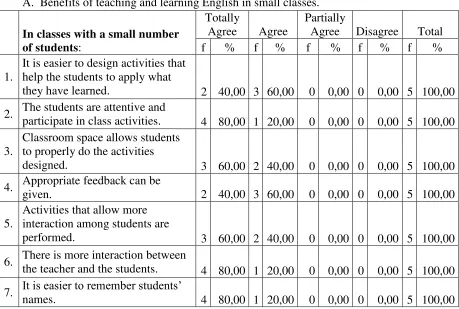
Table 1
Teachers’ perceptions
A. Benefits of teaching and learning English in small classes.
In classes with a small number of students:
Totally
Agree Agree Partially Agree Disagree Total
f % f % f % f % f %
1. It is easier to design activities that help the students to apply what
they have learned. 2 40,00 3 60,00 0 0,00 0 0,00 5 100,00 2. The students are attentive and participate in class activities.
4 80,00 1 20,00 0 0,00 0 0,00 5 100,00
3.
Classroom space allows students to properly do the activities
designed. 3 60,00 2 40,00 0 0,00 0 0,00 5 100,00
4. Appropriate feedback can be
given. 2 40,00 3 60,00 0 0,00 0 0,00 5 100,00
5.
Activities that allow more interaction among students are
performed. 3 60,00 2 40,00 0 0,00 0 0,00 5 100,00 6. There is more interaction between the teacher and the students.
4 80,00 1 20,00 0 0,00 0 0,00 5 100,00 7. It is easier to remember students’ names.
4 80,00 1 20,00 0 0,00 0 0,00 5 100,00
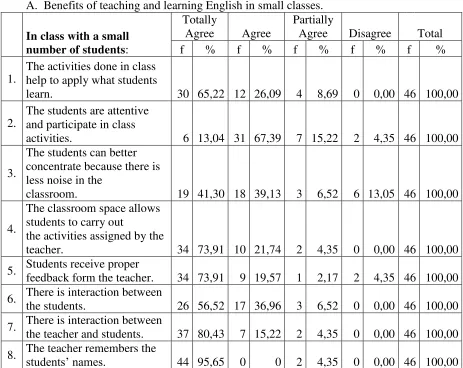
22 Table 2 Students’ perception
A. Benefits of teaching and learning English in small classes.
In class with a small number of students:
Totally
Agree Agree
Partially
Agree Disagree Total
f % f % f % f % f %
1. The activities done in class help to apply what students
learn. 30 65,22 12 26,09 4 8,69 0 0,00 46 100,00
2. The students are attentive and participate in class
activities. 6 13,04 31 67,39 7 15,22 2 4,35 46 100,00
3.
The students can better concentrate because there is less noise in the
classroom. 19 41,30 18 39,13 3 6,52 6 13,05 46 100,00
4.
The classroom space allows students to carry out
the activities assigned by the
teacher. 34 73,91 10 21,74 2 4,35 0 0,00 46 100,00 5. Students receive proper feedback form the teacher. 34 73,91 9 19,57 1 2,17 2 4,35 46 100,00 6. There is interaction between the students. 26 56,52 17 36,96 3 6,52 0 0,00 46 100,00 7. There is interaction between
the teacher and students. 37 80,43 7 15,22 2 4,35 0 0,00 46 100,00 8. The teacher remembers the
students’ names. 44 95,65 0 0 2 4,35 0 0,00 46 100,00
Author: Martínez Durán Luis Mauricio Source: Students’ questionnaire
It can be seen in table 1 that teachers’ responses show an important level of total
agreement to the statement related to the appropriateness of activities for the students’ learning process (40% of teachers totally agree and 60% of them agree).
23
among students because 91, 31% of them (65.22 % totally agree and 26.09% agree) consider that activities done in class help to apply what students learn in class.
The results in table 1 and 2 show a positive perception of the adequacy of activities for the students’ learning process in small classes. In fact, these results coincide with the observations
done in class because teachers designed controlled activities that allowed students to practice the structures and vocabulary they have learnt. Those activities were developed mainly in pairs and groups. Therefore, the observed activities corroborate the theory provided by Harmer (2007) about pair and group work; he notes the importance of student independence from the teacher and good atmosphere that student-student interaction helps to create.
Regarding the statement of the students’ level of participation in small classes 80% of teachers totally agree and 20% of them agree. Similarly, the students’ overall responses were
positive since 31 subjects (67.39%) agree with the questions and 6 of the participants (13.04%) totally agree. On the other hand, 7 students (15.22%) partially agree; and, 2 learners (4.35%) do not agree. These results show slight difference between students and teachers’ answers and it
deserves special attention though the small amounts.
The results are significant evidence of the benefit of small classes in students’
participation which is related to the information provided by Brown (2001) who explains that students in small classes participate actively. In fact, it was observed that teachers engaged pupils in the lesson through the use of motivating classes and it arises their interest and asked the teacher to take part in the activities.
About the influence of noise in students’ level of concentration, table 2 shows that
24
not high levels of noise in the classroom and both, teachers and students were able to listen to each other and the activities were developed without any inconvenient. In this sense, these results meet the description given by Bateman (2002) who argues that small classes are favorable for the learning process.
Next statement asked teachers about the suitability of the classroom space to the activities designed for the classes, the majority of responses were positive since60% of teachers totally agree and 40% of them agree. Likewise, students’ overall responses were positive because 34
pupils (73.91%) totally agree and 10 participants (21.74%) agree. On the contrary, only 2 students (4.35%) partially agree.
The results suggest that teachers and students consider appropriate the available space in class. Actually, a common factor among the observed classes was the appropriate area in each classroom that allowed teachers to organize different types of interactive activities such as group work; in those spaces students were able of moving their seats to develop the tasks.
Regarding classroom space Harmer (2007) states that teachers should decide the best seating arrangement according to the available space for making learning more enjoyable. It can thus be concluded that class space allows students to develop activities comfortably.
Turning now to feedback in small classes, the overall teachers’ responses regarding statement 4 were positive since 40% of participants totally agree and 60% of them agree. Similarly, 73.91% of students totally agree and 19.57% agree, while 2.17% of pupils partially agree and 4.35% disagree. The observations carried out in the classes corroborate the results from the questionnaires since teachers established a kind bond with students at the moment of providing feedback. They were observed looking directly at students’ eyes and listening to them
25
The way teachers provided feedback in the observed classes supports the theory provided by Gower, Phillips & Walter (1995). They define rapport as an important part of the feedback process and remarks that teaching attitude, positive approach about the activities and materials used in class, personal interest in the students and their comments, etc., are good ways for giving appropriate feedback. Therefore, these findings confirm that feedback in small classes is
effective and it has a positive effect in students’ learning process.
The next statement in tables 1 and 2 concerns with the influence of class activities in students’ level of participation, table 1 shows that 60% of teachers totally agree with the inquiry and 40% of them agree. Equally, 56.52% of the interviewed students indicate a strong level of agreement with the question, while 36.96% agree. On the other hand, only 6.52% of the participants partially agree.
The results above show that participants’ overall responses are positive and it is in
concordance with the observed events because classes were participative. The teacher promoted dialogue between students about the learnt contents. Also, pupils had opportunities to exchange their points of view respecting others thoughts.
Next question was stated to know teachers’ and students’ perception about the interaction
26
During observations, teachers were able to engage students in the learning process through making questions that lead them to discuss and think about the contents. In the same way, students demonstrate active involvement in the lessons.
The information reviewed in the theoretical framework confirms the observations and results of the interviews. Bateman (2002) mentions that small classes are favorable for the learning process because promote membership and active participation.
When teachers were asked if they remember the students’ names, the overall responses
were positive. Table 1 shows that 80% of respondents totally agree and 20% of them agree. Similarly, the trend in students’ answers was also positive since 95.65% of the participants totally agree with the question and 4.35% of learners partially agree.
The results above concur with the classes observed since the teachers called all students by their names and it promoted great confidence and respect between teachers and students. In this sense, Thaher (2004) mentions that much of class success comes from the manner in teachers behave with students. He adds that calling the students by their names increases the level of class engagement.
The results of the first group of questions show positive benefits of teaching and learning in small classes. Both, teachers and students, perceive that reduced groups facilitate the development of activities and increase the level of participation. In addition, the physical space is appropriate for the number of students and it makes possible for teachers to provide individual attention to the students.
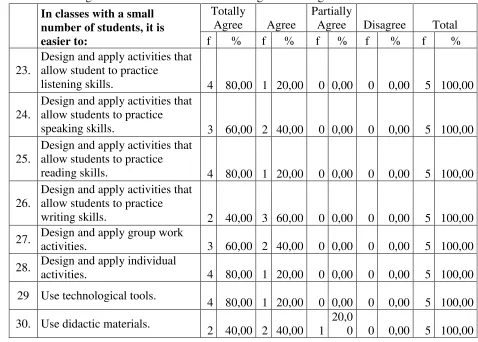
27 Table 3
B. Strategies and resources that favor the English teaching in small classes.
In classes with a small number of students, it is easier to:
Totally
Agree Agree Partially Agree Disagree Total
f % f % f % f % f %
23.
Design and apply activities that allow student to practice
listening skills. 4 80,00 1 20,00 0 0,00 0 0,00 5 100,00
24.
Design and apply activities that allow students to practice
speaking skills. 3 60,00 2 40,00 0 0,00 0 0,00 5 100,00
25. Design and apply activities that allow students to practice
reading skills. 4 80,00 1 20,00 0 0,00 0 0,00 5 100,00
26.
Design and apply activities that allow students to practice
writing skills. 2 40,00 3 60,00 0 0,00 0 0,00 5 100,00 27. Design and apply group work activities. 3 60,00 2 40,00 0 0,00 0 0,00 5 100,00 28. Design and apply individual
activities. 4 80,00 1 20,00 0 0,00 0 0,00 5 100,00 29 Use technological tools. 4 80,00 1 20,00 0 0,00 0 0,00 5 100,00 30. Use didactic materials. 2 40,00 2 40,00 1 20,00 0 0,00 5 100,00
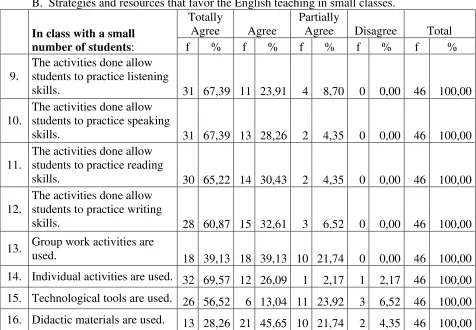
28 Table 4
B. Strategies and resources that favor the English teaching in small classes.
In class with a small number of students:
Totally
Agree Agree Partially Agree Disagree Total
f % f % f % f % f %
9.
The activities done allow students to practice listening
skills. 31 67,39 11 23,91 4 8,70 0 0,00 46 100,00
10.
The activities done allow students to practice speaking
skills. 31 67,39 13 28,26 2 4,35 0 0,00 46 100,00
11. The activities done allow students to practice reading
skills. 30 65,22 14 30,43 2 4,35 0 0,00 46 100,00
12.
The activities done allow students to practice writing
skills. 28 60,87 15 32,61 3 6,52 0 0,00 46 100,00
13. Group work activities are used.
18 39,13 18 39,13 10 21,74 0 0,00 46 100,00 14. Individual activities are used. 32 69,57 12 26,09 1 2,17 1 2,17 46 100,00 15. Technological tools are used. 26 56,52 6 13,04 11 23,92 3 6,52 46 100,00 16. Didactic materials are used. 13 28,26 21 45,65 10 21,74 2 4,35 46 100,00
Author: Martínez Durán Luis Mauricio Source: Students’ questionnaire
This set of statements shows the teachers and students’ answers regarding the strategies
and resources that promote English teaching in small classes. It can be observed in Table 4 that 80% of teachers totally agree and 20% agree on the appropriateness of activities for practicing listening skills; these results show positive opinion towards the statement.
Similarly, students’ answers were also positive in the same statement since 67.39%
29
It was observed that teachers provide students with opportunities to practice listening skills using the audio CD of the book; after students listened to the audio, teachers asked questions about the listening activities through interacting with the whole group in the class. Regarding this, Harmer (2007) remarks that whole group classes reinforce a sense of belonging among the members, students feel they are all in the learning experience together, and they find it easier to share emotions or amusement in a whole class setting. Therefore, the activities were appropriate designed for the students’ level and they allowed pupils to interact dynamically.
Next item on the questionnaire seeks to determine the effectiveness of the activities used for practicing speaking skills in small classes. Table 3 shows that 60 % of teachers totally agree and 40% of them agree. Regarding the same item, the results of students’ questionnaire shown in
table 3 let see that 67.39% of pupils totally agree; 28.26% of participants agree; and, 4.35% of students partially agree.
The results described above allow seeing that both teachers and students have positive opinion of the activities designed for practicing speaking skills in small classes. In fact, teachers and students interacted actively using the target language, and it was noted that pupils had a good English level and they demonstrated good understanding of the vocabulary taught in the
activities. Some of the activities were addressed to emphasize real communication such as shopping at a store, talking by phone, asking for directions, etc., during the classes teachers introduced new expressions that awoke students’ interest and they tried to use them in the tasks
30
It seems that the amount of teachers’ talk benefit the students’ language proficiency due to
the level of exposure they have. It was mentioned previously that the number of students facilitates interaction in the classroom; therefore, small classes and frequent use of the target language help students to practice speaking skills.
When teachers were asked about the adequacy of activities for practicing reading skills, 80% of them totally agreed and 20% of participants agreed. Similarly, the results in table 4 allow seeing that 65.22% of students totally agreed on the same question; 30.43% of pupils agreed; and, 4.35% of participants partially agreed. Therefore, participants demonstrate a positive view of the adequacy of reading activities.
The reading activities were part of the course book and they were used by teachers to improve students’ comprehension skills. In addition, the pieces of texts had words that were part
of the vocabulary studied in the lessons. Teachers encouraged students to do activities that allowed them to practice new words such as fill on the blanks or match words to meaning. Also, each of the texts had a set of pre and post reading activities that provided learners with a good amount of practice.
Next question was addressed to find out the level of adequacy of reading activities. Of the study population, 40% teachers totally agreed and 60% of them partially agreed. About the same question, table 4 allows seeing that 60.87% of students totally agreed; 32.61% partially agreed; and 6.52% of participants did not agree. An overall view of those results in table 3 and 4 let see a positive trend to the use of writing activities in the observed classes.
Participants’ positive attitude towards the writing activities used in class meet the
31
usage. Some worksheets had pictures that students used to work short paragraphs, while others had graphic organizers related to the writing process.
Nevertheless, teachers could be more creative just as Chadha (2004) suggests. For this author, students can bring newspapers articles or record examples of various speaking for writing short paragraphs about a specific theme.
Turning to the use of group work activities in small classes, table 3 reveals that percentage of teachers’ answers is grouped around positive criteria since 60 % of them totally agree with the statement and 40% of participants agree. Students’ responses follow also a similar trend because
39.13% of pupils totally agree and the same proportion agrees. On the contrary, it can be seen that 21,74 % of students partially agree.
The observations did in classes corroborate, to some extent, the information given by teachers and students regarding group work. Due to the reduced number of students in the classrooms, teachers preferred to assign students with tasks that they had to develop in pairs rather than numerous groups. It was observed that interaction between learners was appropriate and they were able of using language communicatively for exchanging information.
Communicative exchange of information is a characteristic of pair work described by Harmer (2007). It is also a feature of group work, but the author remarks that cooperation and negotiation are the advantage over pair work. Therefore, teachers should combine both types of activities in order to allow students to benefit from interaction and collaborative activities.
32
agreed; 26.09% of learners agreed; and 2.17% of participants partially agreed and the same proportion did not agree.
The previous results show a strong support to the use of individual work in the classes. In fact, it was observed that teachers guided students to develop the activities and they were able of completing all the tasks in silence. In this sense, Harmer (2007) remarks that individual work helps students to improve autonomy and self-reliance; also, this kind of work also allows teachers to restore peace in a noisy classroom.
The questionnaires also seek to determine the level of agreement towards the use of technological resources in the classroom. There was an 80% of teachers who agreed totally and 20% of them who agreed. About the same question, 56.52% of students agreed totally; 13.04% of learners agreed; 23.92% of pupils agreed partially; and, 6.52% of participants did not agree.
The percentage of responses suggests that technological resources have an important level of acceptance among participants. In fact, it was observed that teachers used computers,
projectors, CD players, in almost all classes. Those resources had positive effects in students because they demonstrate enthusiasm for learning and participated actively during the lessons.
The use of materials in small classes obtained important support from the participants, but the percentages were distributed among the four criteria. Table 3 allows seeing that 40% of teachers agreed totally; 40% of participants agreed; and, 20% of teachers agreed partially.
Similarly, there were 28.26% of students who agreed totally; 45.65% of pupils agreed; 21.74% of learners agreed partially; and, 4.35% of them did not agree.
33
that contained attractive colors and images, students did not show the same level of engagement than technological resources generated in them.
The results of the questionnaire related to the strategies and resources used with few students allow summarizing that teachers apply pair, group, and individual work in such a way that promote the practice of activities focused on developing students’ language skills, that is,
[image:38.612.85.556.311.555.2]reading, writing, listening, and speaking. In addition, the use of technological resources and materials make classes more interesting and entertaining.
Table 5
C. Students’ feelings when learning English in a small class.
In classes with a small number of students:
Totally
Agree Agree
Partially
Agree Disagree Total
f % f % f % f % f %
31. They are relaxed when speaking in front of their classmates.
1 20,00 4 80,00 0 0,00 0 0,00 5 100,00
32.
They are taken into account by the teacher because they have more opportunities to
participate in class. 4 80,00 1 20,00 0 0,00 0 0,00 5 100,00
33.
They are motivated to
participate because of the small
number students. 3 60,00 2 40,00 0 0,00 0 0,00 5 100,00
34.
They are at ease because they can healthy compete with their
classmates. 2 40,00 3 60,00 0 0,00 0 0,00 5 100,00
34 Table 6
C. Students’ feelings when learning English in a small class.
In class with a small number of students:
Totally
Agree Agree
Partially Agree
Disagre
e Total
f % f % f % f % f %
17. I am relaxed when speaking in front of my classmates.
25 54,35 16 34,78 3 6,52 2 4,35 46 100,00
18.
I am taken into account by the teacher because I have more opportunities to
participate in class. 23 50,00 16 34,78 6 13,05 1 2,17 46 100,00
19.
I am motivated to participate because of the small number
of classmates. 25 54,35 18 39,13 3 6,52 0 0,00 46 100,00
20.
I am at ease because I can healthy compete with my
classmates. 20 43,48 20 43,48 5 10,87 1 2,17 46 100,00
Author: Martínez Durán Luis Mauricio Source: Students’ questionnaire
Next section of the questionnaire is related to some social implications of teaching and learning English in small classes.
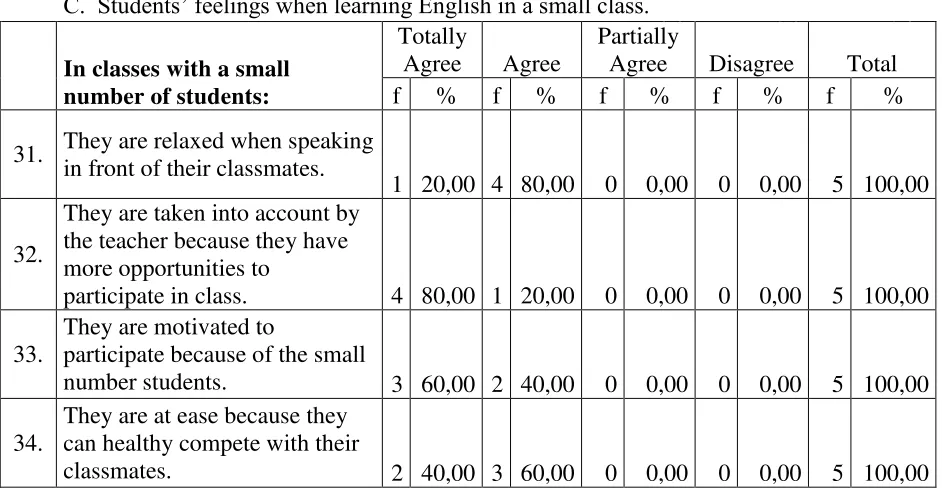
When teachers were asked about students’ attitude during oral participation in class, 20% of them agreed totally and 80% agreed; these results show a positive perception of pupils’
attitudes during speaking practices in small classes. About the same statement, students were cautious in responding since their answers were distributed on the four criteria. It can be observed in table 6 that 54.35% of learners agreed totally; 34.78% agreed; 6.52% agreed partially; and, 4.35% of students disagreed.
35
Thaher (2004) points out that much of the success comes from the manner in which the teachers behave with students, he makes the point that teachers should motivate their students by using their names. Actually, the observed teachers promoted respect and confidence since they proceed according to the authors’ description. In addition, teachers demanded from learners to pay
attention carefully to what others say during participation in class.
Following statement seek to find whether teachers take into account students and it motivate them to participate in class. Regarding this, table 5 shows that 80% of teachers agreed totally and 20% of them agreed. In the same statement, the majority of students’ answers are
concentrated around positive criteria. It can be seen that 50% of learners agreed totally; 34.78% of pupils agreed; 13.05% of participants agreed partially; and, 2.17% of students disagreed.
During the classes, students were very participative and followed some basic rules such as raising their hands to speak or answer questions, respecting others’ turns, etc. Also, it was
observed that teachers demonstrated interest on students’ comments, and guided them to behave
well in order to maintain order.
The strategies applied by the observed teachers in class meet the description given by Gower, Phillips & Walter (1995). They explain that some ways of creating conditions for students to enjoy their classes are demonstrating a good teaching attitude, being positive about the activities and materials used in class, showing personal interest in the students, asking for comments on the classes.
Regarding next statement, motivation to participate because of the small the number of students, overall teachers’ responses were positive. Table 5 shows that 60% of teachers agreed
36
agreed; and, 6.52% agreed partially. Therefore, an important group of participants consider that motivation for participating in class is related to a reduced number of students in the classroom.
The events observed during the classes corroborate the responses given by the participants because students maintained good attitude towards the activities assigned by their teachers. All learners demonstrated high level of participation and looked comfortable working in small classes.
In reviewing the literature, it can be remarked the theory provided by Harmer (2009). He points out the importance of considering feedback as a mean of managing learning successfully since it helps teachers to make classes effective and to solve any type of difficulty that students may encounter during their learning process. In fact, it was observed that teachers provided continuous feedback to students during activities and class participation. Consequently, it can be said that teachers’ support promoted high levels of participation in the observed classes.
The last statement in this section of the questionnaire seeks to investigate whether
students are competitive in small classes. Teachers agreed totally in 40 % and agreed in 60%. A similar trend was noted in pupils’ answers. There were 43.48% of learners who agreed totally
37 Table 7 D. Limitations of learning English in small classes.
In classes with a small number of students:
Totally
Agree Agree
Partially
Agree Disagree Total
f % f % f % f % f %
35.
There is anxiety among students because there is more control form the part of
the teacher. 1 20,00 2 40,00 2 40,00 0 0,00 5 100,00 36. Listening and speaking skills
are more difficult to develop. 1 20,00 0 0,00 4 80,00 0 0,00 5 100,00
Author: Martínez Durán Luis Mauricio Source: Teachers’ questionnaire
Table 8
D. Limitations of learning English in small classes.
In class with a small number of students:
Totally
Agree Agree
Partially
Agree Disagree Total
f % f % f % f % f %
21.
There is anxiety among students because there is more control on the part of
the teacher. 13 28,26 21 45,65 5 10,87 7 15,22 46 100,00
22. Listening and speaking skills are more difficult to
develop. 11 23,91 18 39,13 6 13,05 11 23,91 46 100,00
Author: Martínez Durán Luis Mauricio Source: Students’ questionnaire
The last section of the questionnaires deals with the levels of anxiety and the ease to practice language skills in small classes.
[image:42.612.91.545.377.538.2]38
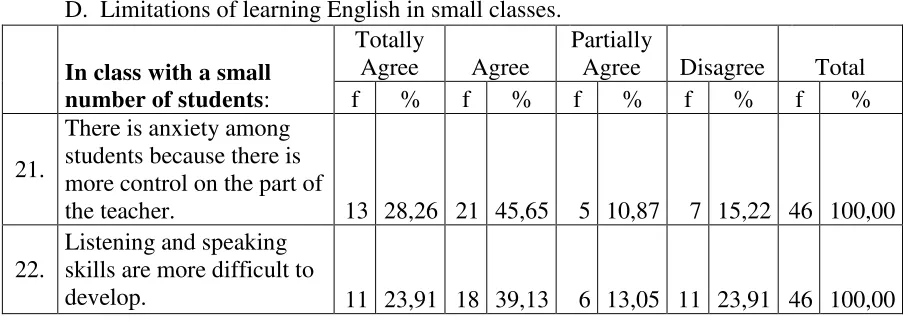
agreed; and, 40 % of participants agreed partially. These results allow seeing that teachers are not convinced of the influence they have on students’ anxiety. Nevertheless, students’ point of
view is different because 28,26% of them agreed totally on the same question; 45.65% agreed; 10.87% of students agreed partially; and, 15.22% disagreed. Regarding this, Thaher (2004) mentions that teachers in small classes supervise students from any place in the classroom. In fact, the events observed in the classes corroborate this information since teachers always controlled the activities done by the students and they demonstrated high levels of concentration during class work. Although pupils looked relaxed, their responses show that they feel anxiety of being observed by their teachers.
The next question asked to the participants seeks to find out if there is any kind of
difficulty to practice listening and speaking skills. Teachers agreed totally with this item in 20%, while 80% of them agreed partially; therefore, their responses show that they do not consider that small classes represent a problem to practice the aforementioned skills.
On the contrary, students’ answers show a different tendency because 23.91% of them
agreed totally; 39.13% agreed; 13.05% agreed partially; and 23.91% disagreed. It can be observed that a great percentage of responses is concentrated in the positive criteria; therefore, students consider that it is difficult to practice listening and speaking skills in small classes.
Nevertheless, it was observed that students listened to fragments of conversations and they completed them correctly. Also, teachers assigned learners different topics that they analyzed and debated. Therefore, those activities allowed pupils to practice listening and speaking skills.
The results obtained in the students’ questionnaire may be due to some kind of difficulty
39
40
CONCLUSIONS
It can be concluded that small classes benefit the English teaching-learning process because students participated actively in the lessons and completed the activities appropriately.
Small classes offer teachers opportunities to apply interactive activities such as group work due to the available space in the classroom.
It was easy to arrange seats according to the type of work students did in small classes, but circle arrangement was the sole type of configuration used in the observed classes. In this sense, teachers did not take advantage of the space available in the classroom to try other varieties such as semicircle, or horseshoe.
Feedback in small classes is effective and it has a positive effect in students’ learning
process because it is focused in the individual needs of pupils.
Small classes provide an appropriate environment that promotes interaction between students and teachers. Teachers were able to involve all students in discussion sessions through asking them active questions and it promotes active participation of all members in the class.
The information reviewed in the theoretical framework confirms the observations and results of the interviews. Bateman (2002) mentions that small classes are favorable for the learning process because promote membership and active participation.
It is easy for teachers to remember students’ names in small classes and it promotes confidence and respect between the members of the class.
41
Small classes develop in students a sense of community and it make them to feel relaxed and taken in mind by their teachers, motivated to participate, and competitive.
42
RECOMMENDATIONS
Since small classes offer teachers opportunities to apply interactive activities such as group work due to the available space in the classroom, teachers should increase the frequency of those activities in order to promote communicative use of the English language.
Due to the fact that small classes are favorable for the learning process, it is advisable for teachers to continue assigning students different activities to foster the communicative use of the English language. Interviews, picture dictation used in pair work, or role play, are some
examples of activities that teachers may use to develop communicative skills.
43 REFERENCES
Allwright, D. & Bailey, K. (1991). Focus on the language classroom. Cambridge University
Press.
Bateman, H. (2002). Students’ sense of community: implication for class size. In Finn, J. &
Wang, M. (Eds.), Taking small classes one step further (p. 63-72). United States:
Information Age Publishing Inc
Biddle, B.J. & Berliner, D.C. (2002). What research says about small classes and their effects.
Education Policy Reports Project, p.0-34
Black, P. & William, D. (1998). Inside the blackbox: raising standards through classroom
assessment. London: Granada Learning.
Blatchford, P., Russell, A., Bassett, P., Brown, P., & Martin, C. (2007). The effect of class size on the teaching of pupils aged 7–11 years. School Effectiveness and School Improvement,
18(2), 147-172.
Brown, H.D. (2001). Teaching by principles. New York: Addison Wesley Longman, Inc.
Burnett, P.C., & Mandel, V. (2010). Praise and Feedback in the Primary Classroom: Teachers’ and Students’ Perspectives. Australian Journal of Educational & Developmental
Psychology Vol 10, pp. 145-154
Chadha, D.S. (2004). Classroom teaching and management. New Delhi: Mittal Publications.
Dee, L (2002). Beyond small groups: harnessing the extraordinary power of learning teams. In Michaelsen, L. Bauman, A. (Eds.) Team-based learning: a transformative use of small
44
El Diario (2010). Planteles tendrán más de 40 alumnos por aula. Retrieved from
http://www.eldiario.ec/noticias-manabi-ecuador/147798-planteles-tendran-a-mas-de-40-alumnos-por-aula/
Finn, J. & Wang, M. (2002). Taking small classes one step further. Maryland: Information Age
Publishing, Inc.
Gower, R. Phillips, D. & Walter, S. (1995). Teaching practice – a handbook for teachers in
training. England: Macmillan Publishers.
Harmer, J (2007). The practice of English language teaching (4th ed.). England: Pearson
Education.
Harmer, J (2009). How to teach English. England: Pearson Education.
Khazaei, Z.M., & Zadeh, A.M. & Ketabi, S. (2012). Willingness to Communicate in Iranian EFL Learners: The Effect of Class Size. English Language Teaching; Vol. 5, No. 11, 181-187.
Kohler, M. (2015). Teachers as mediators in the foreign language classroom. London: CPI
group.
La Hora (2013). Planteles funcionan con sobrepoblación estudiantil. Retrieved from
http://www.lahora.com.ec/index.php/noticias/show/1101566809/-1/Planteles_funcionan_con_sobrepoblaci%C3%B3n_estudiantil.html
Lee, I. (2008). Student reactions to teacher feedback in two Hong Kong secondary classrooms.
Department of Curriculum and Instruction, Faculty of Education, The Chinese University
of Hong Kong, Shatin, Hong Kong, China Abstract, Journal of Second Language Writing 17, p. 144–164
45
Mathison & Ross (2008). Defending public schools: the nature and limits of standards based
educational reform and testing. Westport, CL: Greenwood Press.
Qiu, F. (2014). Study on interactions in classroom of the future. In Cheung, S., Fong, J., Kwok, L., Zhang, J. & Kwan, R. (Eds). Hybrid learning: theory and practice, pp. 36-49. New
York: Springer.
Richards, J.C. (2001). Curriculum development in language teaching. New York: Cambridge
University Press.
Thaher, M. (2004). The EFL Class Students at An-Najah National University. An-Najah Univ. J.
Res. (H.Sc.), Vol. 19 (3), 2005, 1047-1092.
Westberg, J. & Jason, H. (1996). Fostering learning in small groups. New York: Springer
ANNEXES
UNIVERSIDAD TÉCNICA PARTICULAR DE LOJA
La Universidad Católica de Loja
MODALIDAD ABIERTA Y A DISTANCIA TITULACIÓN DE INGLES
Estimado estudiante:
Este cuestionario tiene como objetivo conocer su opinión en cuanto a la enseñanza del Inglés en clases con grupos de 20 estudiantes o menos.
La información que usted brindará a continuación se utilizará únicamente con fines académicos e investigativos.
Datos Informativos:
Nombre de la institución:
Tipo de institución:
Pública ( ) Privada ( )
Escuela ( ) Colegio ( ) Instituto ( ) Ciudad:
Instrucción: Marque con una X según su criterio.
Estrategia: Luego de leer cada ítem, le rogamos contestar de acuerdo a la siguiente escala de referencia.
Muy Satisfactorio Satisfactorio Poco satisfactorio Nada satisfactorio
A. Beneficios de enseñar y aprender Inglés en clases con pocos estudiantes.
En clase con pocos estudiantes:
En clases con pocos estudiantes: Muy sa
ti sf ac tor io S ati sfa ctorio P oc o sa ti sf ac to ri o N ada sa ti sf ac to ri o
1. Las actividades que se realizan permiten practicar lo aprendido.