Using Competence Modeling to create
Knowledge Engineering Team
Aline T. Nicolini¹ , Cristina S. Santos², Hugo Cesar Hoeschl, Dr.³, Irineu Theiss, M.Sc.4, Tânia C. D. Bueno, Dr.5
¹Master Program in Engineering and Knowledge Management of the Federal University of Santa Catarina - [email protected] ² Master Program in Engineering and Knowledge Management of the
Federal University of Santa Catarina - [email protected] ³ Institute of Electronic Government, Juridical Intelligence and Systems and
WBSA Sistemas Inteligentes S.A. [email protected]
4
WBSA Sistemas Inteligentes S.A. – [email protected]
5
Institute of Electronic Government, Juridical Intelligence and Systems – [email protected]
Abstract. The present paper is about applying competence modeling for a knowledge engineer in the case of the company WBSA Sistemas Inteligentes S.A. The process was based on Lucia and Lepsinger model, by which competences are characterized through the identification of situations and behaviors considered relevant to the engineer performance. As one of the different techniques suggested by the model for collecting data, a number of individual interviews were undertaken and at the end it was defined and validated a set of eleven competence regarded as necessary for a satisfactory performance of a knowledge engineer.
Introduction
Knowledge-based systems (KBS) are computer programs that use explicitly represented knowledge to solve problems. Such systems handle knowledge and information by an intelligent manner and are used to solve problems that require a high volume of specialized knowledge [1].
To build a knowledge-based system implies to create a computational model with the objective of developing the capability of solving problems similar to the capability of a domain specialist [2].
The objective of this paper is to present the competence modeling process for the Knowledge Engineer, identifying the set of knowledge, skills, and attitudes required for a high performance of the engineer.
1
The Concept of Competence
Due to the diversity of knowledge domains where the concept of competence is applied, it is acceptable that there is no consensus about its definition. That is true even in the context of management.
According to Woodruffe [3], at the center of the debate about management a sensitive field is found where the term competence brings a different meaning when used by different people.
Ruzzarin, Amaral and Simionovisci [4] say that there is no doubt that the concept of competence is at the same time one of the concepts most commonly used and one of the most controversial one in the modern language of management.
Currie and Darby stated that the concept became popular due to Boyatzis, who defined competence as the characteristics of a person that can be observed and can be expressed in terms of motivation, skills, and aspects related to his image or role or the amount of knowledge.
Despite the historical importance of the concept presented by Boyatzis, it is considered too broad and its usage is limited to the field of organizational management. More objective definitions as the one presented by Parry [6] become more commonly used. Parry defines competence as a set of knowledge, skills, and attitudes that mostly affect a work, and keep a relation with the performance; they can be measured through some accepted tools and can be improved by training and development.
As per Cooper [7], the four criteria presented by Parry should be used when defining the profile of competence inherent to a function or a position. Given that any characteristic not included in those criteria should be excluded from the definition of a profile, from the set of factors defining a competence the author eliminates personality traces, capabilities, abilities and attitudes.
Contrary to the approach of Cooper, for Lucia and Lepsinger [8] characteristics as attitudes and capabilities are important for the success in some specific positions, although they having a more subjective character. Another relevant aspect is that even characteristics not so easily quantifiable can be measured and evaluated when translated into behaviors.
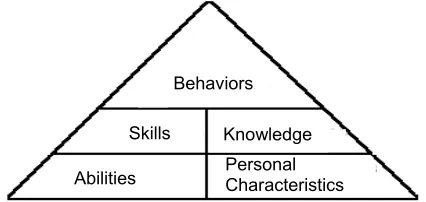
The approach based on behaviors was first developed by McClelland and shows wide acceptance by models used nowadays, because “it is only through their behaviors that human beings affect the context where they act” [9].
Personal Characteristics Abilities
Knowledge Skills
[image:3.595.195.408.73.174.2]Behaviors
Fig. 1 – Pyramid of competences - Lucia and Lepsinger (1999)
This paper is based on the concept of competence presented by Lucia and
luate those
osed by the above mentioned authors keeps
2 Competence
Modeling
As stated above, the present paper keeps coherence with the concept of
.1 The case study
.1.1 The Company
BSA Sistemas Inteligentes S.A. was created in the context of the knowledge
of the company is strongly linked to university post-graduate team
ts expertise in providing solutions based on artificial
the best intelligence resources applied to the use of information”.
Lepsinger. It is considered more adequate because it takes into account attitudes and other subjective, personal characteristics as part of competence.
Furthermore, the chosen model turns possible to measure and eva
components of competence due to the fact that it uses the approach based on behaviors to describe competences.
On the other hand, the concept prop
compatibility to the work of Parry and McClelland, which are regarded as important references in the field of management based on competences.
competence proposed by Lucia and Lepsinger. Three steps are considered when applying the model: planning, development, and finalizing and validating the model.
2
2
W
era. It is an Information Technology company in line with the worldwide avant-garde in terms of applying artificial intelligence techniques to information systems.
The origin
programs, still maintaining academic and research partnership with them. Years of research and development efforts undertaken by WBSA consolidated the excellence of its intellectual capital, which is recognized worldwide through more than fifty papers already presented and edited by international conferences.
The company developed i
intelligence techniques for knowledge management systems. In this regard WBSA is recognized by the Brazilian Software Companies Association (ABES) for having well-known specialization.
2.1.2 The Working Process
With the aim of applying the com step was to prepare the map of p
petence modeling for the company, the first rocesses undertaken by WBSA. It consists of
und he processes, detailing activities, and collecti n
abo outp gu om orkflow.
Fig. 2 – Processes in WBSA
rm escribe the whole development
s f the process a special way of
interaction between the system developer, called the knowledge engineer, and
st to translate into words
amiliar with the domain, to collect
fi e objectives and scope of the project took as reference the s ical organizational process with the aim of establishing a competence model for a relevant position in the organization.
ion of knowledge
Knowledge
Engineering Modeling Implamentation Testing Maintenance
erstanding t ut inputs and
ng informatio uts [10]. Fi re 2 shows the c pany’s w
2.1.3 The Position of Knowledge Engineer
The te Knowledge Engineering is used to d proces of knowledge-based systems. It is part o one or more specialists on the knowledge domain [11].
In the past, knowledge engineering was the process of transferring knowledge from the specialist into the system knowledge base. That approach normally caused failures because it is not possible for the speciali
all the knowledge involved in his task [12].
The objective of the knowledge engineering process is to capture the knowledge of a domain specialist, as well as his forecast and control procedures on the subject. This process involves becoming f
information, to do analysis and evaluate the effort required by the project. Furthermore, the knowledge being accumulated has to be codified and tested; the scope of work has to be defined, establishing exactly what the user requires to be efficiently retrieved; the quantity and quality of documents have to be analyzed; and the construction of the vocabulary to support the retrieving process.
2.2 Applying the model
2.2.1 Planning
The de nition of th analysi of the crit
Given the importance of the role of the knowledge engineer for the success of the system implementation phase, the knowledge engineering process was elected as a critical process for the Company. And the posit
engineer was chosen to apply the model.
2.2.2 Development
ne through individual interviews with the three professionals working as knowledge engineers in the organization, following the
ired for a knowledge engineer
rm a consensus about the internal competence
.2.3 Competence Modeling
owledge engineer
Data Gathering: was do
questionnaire proposed by Lucia and Lepsinger.
Situations and behaviors observed along the interviews and used as reference for identifying knowledge, attitudes, and skills requ
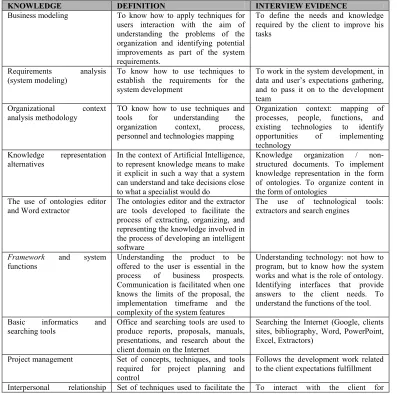
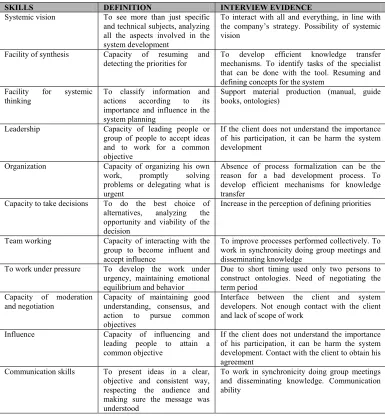
are shown on Tables 1, 2 and 3.
The three interviewers produced separate tables with their own observations, which were then evaluated to fo
model. Each one of the items included in the competence model (knowledge, skills, and attitudes) was clearly defined and the result is shown on the Tables.
[image:5.595.111.508.290.684.2]2
Table 1. Knowledge required for a kn
KNOWLEDGE DEFINITION INTERVIEW EVIDENCE
Busin
n with the aim of
o define the needs and knowledge prove his ess modeling To know how to apply techniques for T
users interactio
understanding the problems of the organization and identifying potential improvements as part of the system requirements.
required by the client to im tasks
Requirements analysis (system modeling)
To work in the system development, in data and user’s expectations gathering, To know how to use techniques to
establish the requirements for the
system development and to pass it on to the development team
Organizational context
analysis methodology rstanding the
TO know how to use techniques and tools for unde
organization context, process, personnel and technologies mapping
Organization context: mapping of processes, people, functions, and existing technologies to identify opportunities of implementing technology
Knowledge representation alternatives
In the context of Artificial Intelligence, to represent knowledge means to make it explicit in such a way that a system can understand and take decisions close to what a specialist would do
Knowledge organization / non-structured documents. To implement knowledge representation in the form of ontologies. To organize content in the form of ontologies
The use of ontologies editor and Word extractor
The ontologies editor and the extractor are tools developed to facilitate the process of extracting, organizing, and representing the knowledge involved in the process of developing an intelligent software
The use of technological tools: extractors and search engines
Framework and system functions
Understanding technology: not how to program, but to know how the system Understanding the product to be
offered to the user is essential in the process of business prospects. Communication is facilitated when one knows the limits of the proposal, the implementation timeframe and the complexity of the system features
works and what is the role of ontology. Identifying interfaces that provide answers to the client needs. To understand the functions of the tool. Basic informatics and
searching tools t,
Office and searching tools are used to produce reports, proposals, manuals, presentations, and research about the client domain on the Internet
Searching the Internet (Google, clients sites, bibliography, Word, PowerPoin Excel, Extractors)
Project management
fillment Set of concepts, techniques, and tools
required for project planning and control
Follows the development work related to the client expectations ful
KNOWLEDGE DEFINITION INTERVIEW EVIDENCE
techniques contact and communication with other establishing empathy and knowledge
people or groups exchange
Conflicts solving techniques
ation and mediation ith the subject. Absence of Techniques and methodologies
required for negoti
Ontologies delivered did not keep coherence w
knowledge sharing Interview methodology and
document analysis content extraction techniques soning
[image:6.595.115.502.72.151.2]To know interview techniques and Interview and document analysis. TO extract the clients rea
Table 2. Skills of a knowledge engineer
SKILLS DEFINITION INTERVIEW EVIDENCE
Systemic vision
bjects, analyzing
ll and everything, in line with ibility of systemic To see more than just specific To interact with a
and technical su
all the aspects involved in the system development
the company’s strategy. Poss vision
Facility of synthesis
for
velop efficient knowledge transfer mechanisms. To identify tasks of the specialist Capacity of resuming and
detecting the priorities
To de
that can be done with the tool. Resuming and defining concepts for the system
Facility for systemic thinking
To classify information and actions according to its importance and influence in the system planning
Support material production (manual, guide books, ontologies)
Leadership
o accept ideas
If the client does not understand the importance of his participation, it can be harm the system Capacity of leading people or
group of people t
and to work for a common objective
development Organization
promptly solving
rocess formalization can be the a bad development process. To Capacity of organizing his own
work,
problems or delegating what is urgent
Absence of p reason for
develop efficient mechanisms for knowledge transfer
Capacity to take decisions
ives, analyzing the To do the best choice of alternat
opportunity and viability of the decision
Increase in the perception of defining priorities
Team working
become influent and
To improve processes performed collectively. To work in synchronicity doing group meetings and Capacity of interacting with the
group to
accept influence disseminating knowledge To work under pressure
ning emotional d of negotiating the
To develop the work under urgency, maintai
equilibrium and behavior
Due to short timing used only two persons to construct ontologies. Nee
term period Capacity of moderation
and negotiation and ot enough contact with the client
Capacity of maintaining good understanding, consensus, action to pursue common objectives
Interface between the client and system developers. N
and lack of scope of work Influence
ople to attain a
rstand the importance of his participation, it can be harm the system Capacity of influencing and
leading pe common objective
If the client does not unde
development. Contact with the client to obtain his agreement
Communication skills in a clear,
objective and consistent way, inating knowledge. Communication To present ideas
respecting the audience and making sure the message was understood
To work in synchronicity doing group meetings and dissem
[image:6.595.114.499.184.601.2]ability
Table 3. Attitudes of a knowledge engineer
ATTITUDES DEFINITION INTERVIEW EVIDENCE
Patience Listen, listen, listen… keeping good capacitation of specialists who will help to define
humor the system
ATTITUDES DEFINITION INTERVIEW EVIDENCE
Researcher profile with authonomy and seeking an adequate obtain knowledge from the client way of improving knowledge
functions. To Proactivivity To start working by his own and
influencing the course of action
To work intuition / action Sociability Interact with different groups preserving
its individuality, cooperating and
d everybody. exchanging experiences with the group.
Interact with everything an
Communicability ssure a apt team for a continuous ontologies
development work. Take part actively in meetings, asking,
informing and answering.
A
Continuous sharing (basic premise)
Flexibility dapt easily to
ew situations related to the work.
munication problems. s, developers Experiment, accept and a
n
Interact and solve com
Necessity of interaction with client and commercial department.
Creativity and
innovative solutions in the development
tologies). Present new patterns, ideas
of systems.
Identify specialist’s tasks that the tool may perform.
Construction of support material (manuals, reports, on
Diplomacy present him/herself in a
manner in which the relationships are e exchange.
nderstand the Ability to
kept in a higher degree of respect, pursuing associations and consensus in difficult situations.
Interact with the client to establish a empathy process and knowledg
Make the developer understand what the client wishes and make the client u
developer. Responsibility
thers, keeping them e client is a challenge. Assure that his/her action transmits
confidence to the o tranquil.
New discussions about the process and restarting. Convince th
Determination
ing eventual difficulties.
lient and the Knowledge Engineer, giving the idea that the Keep focus to reach the defined goal,
overwhelm
Feeling of satisfaction by the c path chosen was the correct one.
Compromise the
collective results will be reached. e avoided.
Show availability, assuring that Follow the development of the systems. The lack of compromising must b
2.3 Finaliz
During this phase, the internal competence model was presented to a group of
ing and validating the model
people working in the same environment, but not in the same position, with the aim of doing an analysis of the general model and identifying those competences regarded as essential for the performance of the knowledge engineer.
Since the knowledge engineer interacts with most of the other people working in the company, it was not difficult to form the focus group to discuss and validate the model.
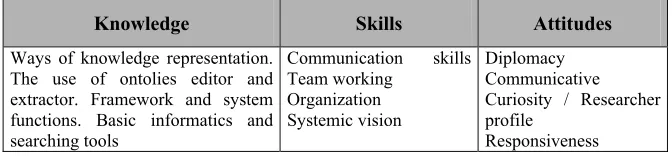
As presented on Tables 1, 2, and 3 there were identified thirty-three competences, from which eleven is the number of knowledge abilities, eleven are skills, and eleven are attitudes.
With the output of the evaluation phase, a focus group discussion was conducted with the objective of refining the model. The result presented on Table 4 shows a list of competences regarded as being essential for a satisfactory performance of a knowledge engineer in the context of the company WBSA.
able 4. Essential competences of a knowledge engineer T
Knowledge Skills Attitudes
Ways of k
The use of ontolies editor and
Communication skills Team working Diplo Communicative Researcher nowledge representation.
[image:7.595.135.471.611.689.2]was verified that, based in the studies about Competences Modelling, the best ractice is to identify 5 to 9 competences for each function. That was the goal
nces: As this model is being constructed to allow the training
etences identified by the focal group are
nowledge Engineering; the other may be worked by the
onclusions
The position of Knowledge Engineer is relatively new, beginning with the emerging of expert systems in the 80’s. With the evolution of the knowledge
SA using
f competences previously established or from a
e work. ses.
established and
ledge Engineer were established and defined. This list will be initially used in the training and development activities, and may be It
p
during this phase, but the conclusion was that, because of the complexity in performing the function, it became crucial to consider the set of competences listed in table 04.
Validate the model and determine the correlation of the competences with the best performa
and development of the Knowledge Engineers, the application of this phase in the model (a 360° evaluation) was not necessary. The evaluation made in the precedent phase was enough to identify the competences that assure the good performance of the evaluated function.
Finalizing the model: Considering the complexity of the position being analysed, it is understood that the comp
actually those that must be worked essentially in all Knowledge Engineers of the company. However, the other competences surveyed in the precedent phase (temporary model).
So, it is considered that the competences identified as essential must be searched for the position of K
company in its training processes and developments, aiming at the improvement and ideal performance of its collaborators.
C
based systems the position changed its characteristics considerably. So, the establishment of the competences was very interesting as it wasn’t a position with consolidated characteristics as opposed to a traditional position.
This research established the competences necessary to the position of Knowledge Engineer in the company WBSA Sistemas Inteligentes
Lucia’s and Lepsinger’s model.
Following the model proposed by the above mentioned authors, the competence modelling may start from a list o
new one, specifically for the position. In this work, because of the particularities of the position, the second option was adopted.
In the application of the model, some phases were not performed or were adapted, aiming a satisfactory development of th
The choice of the position was made taking as reference the mapping of processes and the concept of critical organizational proces
In this sense, interviews where made with collaborators that occupy this position in the company, and a provisory model of competences was
lately validated by a broader group. A relevant question diagnosed in the process was the difficulty in differentiate the abilities and attitudes related with the competences identified.
lately expanded for the other activities of the process of human resources management.
Beyond the benefit related with the competences modelling, other positive aspect of the application of the model was the reflection exercise made during the interviews about the role of the Knowledge Engineer in the context of the
olange Oliveira. Sistemas Inteligentes: fundamentos e aplicações. ole,2003.
company. This reflection was useful as the company had already worked in the formalization of its responsibilities.
References
1 REZENDE, S Barueri, SP: Man
2 STUDER, R. et al., Situation and Perspective of Knowledge Engineering. In: J. Cuena, et al. (eds.), Knowledge Engineering and Agent Technology. IOS Press,
msterdam, 2000. A
3 WOODRUFFE, C. Competent by any other name. Personnel Management, Vol. 23, No. 9, September 1991, pp. 30-33.
4 RUZZARIN, Ricardo. AMARAL, Augusto. SIMIONOVSCHI, Marcelo. Gestão por competências: indo além da teoria. Porto Alegre: Sebrae/RS, 2002.
5 CURRIE, Graeme. DARBY, Roger. Competence-based management development: Rhetoric and reality. Journal of European Industrial Training. Bradford: 1995. Vol.19,
um. 5; pp. 11-19. N
6 PARRY, Scott B. Just what is a competency? (And why should you care?). Training. June 1998. Vol.35. Num. 6. pp. 58-61.
7 COOPER, K. C. Efective competency modeling & reporting. New York: Amacon, 2000.
8 LUCIA, A.D.; LEPSINGER, R. The art and science of competency models. San Francisco: Jossey-Bass, 1999.
9 BECKER, Brian E. HESELID, Mark A. ULRICH, Dave. Gestão estratégica de pessoas com o scorecard: interligando pessoas, estratégia e performance. Rio de
aneiro: Campus, 2001. J
10 LGTI - Laboratório de Gestão Tecnologia e Inovação. Universidade Federal de Santa Catarina. Disponível em: http://www.lgti.ufsc.br/posgraduacao/. Acesso em: 20 de maio
e 2005 d
11 BUENO, Tania. Engenharia das Mentes. Tese (Doutorado em Engenharia de Produção) – Universidade Federal de Santa Catarina, Florianópolis. 2005.
12 SCHREIBER, Guus; et al. Knowledge Engineering and Management: The CommonKADS Methodology. Londres: MIT Press, 2002.
13 SANTOS, Armando C. O uso do método Delphi na criação de um modelo de competências. Revista da Administração. Vol. 36, No. 02, pp. 25-32, abril/junho 2001. 14 SHIPPMANN, Jeffery S. ASH, Ronald A. CARR, Linda. HESKETH, Beryl. et al.
The pratice of competency modeling. Personnel Psychology. Durham: Autumn 2000. ol. 53, Num. 3; pp. 703-740.