1
FACULTAD de FILOSOFÍA Y LETRAS
DEPARTAMENTO de FILOLOGÍA INGLESA (ESTUDIOS INGLESES)
Grado en Estudios Ingleses
TRABAJO DE FIN DE GRADO
Claudia Andaluz García
Tutor: Leonor Pérez Ruiz
2017/2018
Are Patient Information Leaflets (PILs) a New Medical
3
ABSTRACT
This dissertation provides a rhetorical, linguistic, and translation analysis of different Patient Information Leaflets (PILs) with the aid of two corpus tools: AntConc and TermoStat. In this sense, we have chosen the PILs of 10 medicines serving different purposes in order to consider as many types as possible (10 in English and 10 in Spanish). Previous studies have shown that PILs have been undervalued when they actually stand for one of the most important types of medical texts because of how potentially influential they are on patients. Our aim has been to analyse the language, to establish the genre of PILs, and to answer the hypotheses of whether they have been translated from English into Spanish and whether the popularity of PILs influences when identifying them as translations.
Keywords: Medicines, PILs, language, medical, translation, patient.
RESUMEN
En este trabajo de fin de grado, hemos llevado a cabo un análisis a nivel retórico, lingüístico y de traducción de varios prospectos médicos con la ayuda de dos herramientas de análisis del corpus: AntConc y TermoStat. De este modo, hemos seleccionado los prospectos médicos de 10 medicamentos con fines diferentes para abarcar tantos tipos como nos fuera posible. A través de estudios anteriores, hemos comprobado la escasa importancia que se ha dado a los prospectos médicos cuando en realidad representan uno de los tipos de texto más importantes del ámbito médico debido a la gran influencia que ejercen sobre el paciente. Por esta razón, hemos realizado este estudio con el objetivo de analizar el lenguaje, establecer el género del prospecto médico y responder a las hipótesis de si nuestros textos se han traducido de inglés a español y si la popularidad de los medicamentos es determinante a la hora de identificarlos como traducciones.
4
CONTENTS
1. Introduction ··· 8
2. Theoretical Background ··· 9
2.1. What is a PIL? ··· 9
2.1.1. Scientific text: medical subject field (LSP)
2.1.2. Influences on the patient’s decision: how to take a medicine
2.2. Medical language vs. language of PILs ··· 12
2.2.1. Highly-specialized language of typical medical texts, and specialized but simpler language of PILs
2.2.2. Hierarchies in the medical domain
2.3. Textual and communicative characteristics of PILs ··· 13
2.3.1. Macro-genre
2.3.2. Genre
2.3.3. Function
2.3.4. Communicative situations in the scientific/medical field
2.3.5. Communicative situations in the medical field/PILs genre
2.4.Structural, linguistic and translation features relevant for the analysis ··· 18
2.4.1. Rhetorical features
2.4.2. Linguistic features
2.4.3. Translation features
3. Methodology ··· 20
3.1.Aim of the study and types of analysis ··· 20
3.2.Corpora: types and characteristics ··· 21
5
3.3.Corpora tools ··· 22
4. Empirical analysis and results ··· 22
4.1.Rhetorical analysis ··· 22
4.1.1. Superstructure and macrostructure
4.1.2. Relevance of the sixth section
4.2.Linguistic analysis ··· 26
4.2.1. Grammar
4.2.2. Syntax
4.2.3. Semantics
4.3.Translation analysis ··· 39
4.3.1. Equivalent terms: frequency
4.3.2. Translation procedures
5. Discussion ··· 46
6. Bibliography ··· 50
6
LIST OF ACRONYMS
AdjP: Adjectival Phrase
CMS: Committee on Safety of Medicines
JRV: Journalistic Reported Version
LGP: Language for General Purposes
LSP: Language for Specific Purposes
NHS: National Health System
NP: Noun Phrase
OCU: Organización de Consumidores y Usuarios
PIL(s): Patient Information Leaflet(s)
POS: Part of Speech
PP: Prepositional Phrase
SS: Seguridad Social
UK: United Kingdom
7
LIST OF TABLES AND IMAGES
Image 1: Contexts of the word compensar ···
Table 1. Superstructure of PILs in Spanish and English ···
Table 2. Spanish and English most frequently used verbs ···
Table 3. Spanish and English most frequently used nouns ···
Table 4: Spanish and English most frequently used adjectives ···
Table 5: Spanish and English verb tenses with examples ···
Table 6: Example of the use of language in PILs ···
Table 7: Comparison of Spanish and English syntactic sentence types ···
Table 8: Most frequently used words of each POS in Spanish and English, and equivalents ···
8
1.
INTRODUCTION
In our undergraduate dissertation, we want to comment on, and analyse, the language of the proposed Patient Information Leaflets (PILs). Experts like Ghaemi and Sheibani report that researchers of the field of medicine have mostly paid attention to medical research articles, ignoring other medical genres such as PILs or medical brochures. In this way, they assert that the
analysis of PILs is relevant due to the “large number of intended audience and the importance of
their content” which makes PILs to be considered “one of the most important text types in the
field of medicine” (50-51). Moreover, we can find some examples of scientific popularized texts
–such as PILs– as those that Nwogu refers to when he claims that they are focused on their
lexicon and syntax because these are “rewritten for different audiences”, so the content is not as
scientific as the medical field generally represents (111). For this reason, our intention is to analyse the similarities and/or differences between the PILs and the medical domain and the importance of them to establish the genre of PIL.
On this basis, one of our purposes is to establish the genre of PILs by showing its main characteristics that will probably arise from this dissertation. The second purpose of this study is based on the discussion whether our PILs have been translated from one of the languages involved into the other. In this regard, we hypothesise that our English PILs have been translated from the Spanish versions, or at least some of them. Moreover, our last hypothesis is that the probability of the PIL being a translation has to do with the popularity of the medicine.
In this sense, we will use two corpora and consider them parallel and comparable in order to analyse if the texts are translations or not. To confirm or reject the hypotheses, we will establish a comparison between the PILs in both Spanish and English by carrying out a translation analysis focusing on the frequency of equivalents and translation procedures. In order to develop a more exhaustive analysis, we will carry out two further analyses. On the one hand, a linguistic analysis, focusing on three different levels: the grammatical one –Part of speech (POS) and study of frequency of lexical words– the syntactic one –types of sentences and verb tenses– and the semantic one –words of special interest regarding their meaning, ambiguity, lexical fields… On the other hand, we will propose a rhetorical analysis in order to observe how these texts are usually structured, and how the information is organized in them.
9
linguistic, and the translational one in which we will display the analyses and their results. Finally, the fourth section is dedicated to the discussion, where we will summarise and discuss the main results as well as resolve the hypotheses of the study.
2.
THEORETICAL BACKGROUND
In this section, we will define some characteristics of PILs as well as present information that we have used for the analyses. First, we have focused on the definition of the PIL. Here, we have determined the subject field and nature of the PIL, and its impact on readers. Second, we have established the similarities and differences between the ‘typical’ medical language and the language of PILs, including their characteristics, and the hierarchies in the medical domain. Third, we have focused on the textual and communicative characteristics of our PILs. Concerning the textual ones, we have discussed the macro-genre, genre, and function of PILs; and regarding the communicative ones, we have discussed the communicative situations of the scientific/medical field –more general– and then the communicative situations of the medical field/PILs genre –more specific. Finally, we have included information about some concepts necessary for each of the analyses before carrying them out.
2.1. What is a PIL(Patient Information Leaflet)
Informally speaking, we can define a Patient Information Leaflet as a piece of text which is generally included in a medicine package and contains all the information you need about the medicine and its characteristics. In words of the Committee on Safety of Medicines (1),
PILs “provide the essential information which patients need to enable them to use the
medicine safely and gain the most benefit”. This is understood in the sense that patients use
the PIL in order to know how to take a medicine and to get the most out of it without compromising their health. We can also find PILs along with other pharmaceuticals that are not necessarily medicines such as anti-aging creams. However, our project is not dedicated to the latter, but to the medicines and the PILs contained in them.
Apart from that, the Committee on Safety of Medicines asserts that the role of the PIL is to make the patients “able to access information to enable them to make informed decisions
about their health.” (8). This means that it is important for patients to know how a medicine
works and then decide if they can or cannot take it, regardless of their reason –any allergy,
too many side effects… etc. In this way, patients need to be informed because one of the most
10
Medicines are regulated differently in Europe depending on the country. For this reason, it is important to mention some ideas about the health systems in Spain and UK concerning the acquisition of pharmaceuticals. In Europe, we can establish two different models that regulate the national health systems: the Beveridge model and the Bismarck model. The OCU (Organización de Consumidores y Usuarios) states that the Beveridge model is based on the British health system and was later adopted by other countries such as Spain. Moreover, it is financed by the government through taxes, is committed to providing universal health protection, and it only includes pharmaceutical co-payment1. Finally, it regulates the price of
those medicines to facilitate patients access to them. On the other hand, the Bismarck model works in countries like Germany or France. The system is based on the payment of monthly premiums according to the age, health, and sex of the person. In other words, the first model offers an –almost– free health care while the second model does not (n.p.). As we are interested in Spain and UK, we cannot find huge differences towards the health systems in these two countries since both belong to the same health system model in Europe, that is the Beveridge model.
Besides, the Committee on Safety of Medicines claims that “unlike other sources of
information, the patient information leaflet is highly regulated.” (1). In this sense, as stated
by the European Commission, there is an EU legal framework for the pharmaceuticals which
“guarantees high standards of quality and safety.” (n.p.) This legal framework “is based on
the principle that medicinal products may be placed on the market only following a marketing authorisation granted by the competent authorities.” (n.p.) This means that the marketed medicines suffer a strict control in order to provide medicines of the highest possible quality to avoid any probable failure, since the health system's premise is the good condition of the patient.
Along these lines, we noted that the pharmaceuticals are not always defrayed by the government, but by their users in both countries. In Spain, the system of Seguridad Social (SS) is prevalent. It is the main social protection system of the nation, including the health sector, which means that the government is the body in charge of paying for the healthcare costs of those people affiliated with the SS. However, medicines are not usually included in the service provided by the SS except for exceptional cases such as severe illnesses of high cost or for lack of economic means.
1 A co-payment is a concept included in the medical domain which defines the amount of money that a person has to
11
In the UK, the institution responsible for providing a proper healthcare system is the National Health System (NHS). It works in a similar way as in Spain, so the medicines are normally paid by the patient. However, the funds allocated to the provision of health services come from the taxes collected from workers registered for these institutions, so health care costs are not directly paid by the Government. In the case of private health insurance, only those who have a pharmacy coverage included in their insurance policy can access almost-free medicines. However, these insurances involve costs that not everyone can afford.
Due to their peculiar characteristics, complicated sentences, technical expressions, and ambiguous terms are very common in this type of texts. For this reason, it is sometimes very difficult to fully understand what is written in these papers. Before starting with the analysis, we need to consider some of the peculiarities of our PILs. Once we know what is a PIL, its origin, how the healthcare systems work, and the cost of medicines in Spain and UK, it is necessary to focus our attention on the linguistic aspects of this text type.
2.1.1. Scientific text: medical subject field (LSP)
Medicines are scientific products since they have been developed in laboratories, particularly in the pharmaceutical sector. For this reason, it is assumed that the language contained in the PILs belongs to a scientific medical domain as it describes the characteristics of these medicinal products. In this way, the language of PILs belongs to the medical subject field that is studied within the Language for Specific Purposes (LSP) perspective. Thus, this perspective means that the medical domain of PILs is not only a variety of language spoken and common to experts in the area, but also it should be also adequate to the specific purpose of informing the patient.
2.1.2. Influences on the patient’s decision: how to take a medicine
The Committee on Safety of Medicines (CSM) asserts that “patients naturally want to be
involved in decisions relating to their health”. Moreover, patients feel more confident to
choose a treatment when they have been told the advantages or disadvantages of taking a medicine or not (33). This means that the more the patients are informed, the better for them. For this reason, an adequate communication between the medical doctor, supposedly the writer of the PIL2, and the patient is very important. Even if a PIL should never replace a diagnosis made by a doctor, the point of writing these documents is that patients may be able
2 Bowler states that “professional scientists were not the only authors writing for a general audience, of course. There
were still many writers who specialised in this area, often because they had some links with academic or industry-based
12
to take the medicines on their own without medical support. This is particularly important when taking non-prescription medicines. In addition, the reading of PILs contributes to avoiding, when possible, the risk of health problems when the patients make improper use of medication. The CSM defines it as “risk information”. This not only implies that the information is well presented and adequate for the patient, but also the need for trustable sources from which getting the PILs such as governments or pharmaceutical companies. (33). This is the main reason why we have selected our PILs from the Spanish and English government websites in order to get reliable texts. Even if PILs are subject to strict controls, their quality is sometimes affected particularly when they are translated.
2.2. Medical language vs. language of PILs: similarities and differences
We can establish clear differences between the medical language in general and the language we find in PILs. As we have seen before, the PIL is included in the medical domain, but this domain is too broad. What characterizes a PIL is that it is a peculiar text sample of this subject field, since it is a text addressed to laymen, when the usual communicative situation of the medical subject field is based on the relationship expert to expert. All the medical genres included in the expert to layperson communicative situation are called popularized medical
texts. In words of Nwogu (111), “the tendency for previous studies to concentrate on the syntax
and vocabulary of popularized science texts might be due to the fact that more attention tends to be paid to lexical and syntactic changes when scientific texts are being rewritten for different audiences, as evidence from the NewScientist shows.” Even if Nwogu referred to texts other
than medical, these are also representative of the scientific popularisation domain whose function is spreading knowledge to laymen in an easier language as it is the case of PILs. This would support our analysis since this type of texts contains different lexical and syntactic aspects which result from simplifying more complex medical texts for a non-expert audience, as in the case of our PILs or the NewScientist articles mentioned above.
2.2.1. Highly-specialized language of typical medical texts, and specialized but simpler language of PILs
13
In line with this, García Izquierdo asserts that unlike more specialized medical informational genres, PILs have a less conventional fixation. This is because the PIL includes characteristics that are specific to the genre of dissemination rather than to the specialized medical genre as such (Divulgación médica y traducción 13-14; my translation). This can be understood as a difference in the sense that the medical language is more scientific-oriented than the language of PILs.
Finally, one of the similarities between the language of PILs and the medical language in general is their purpose. Doval reports that the primary goal of medicine is to achieve health or cure diseases (84). In this sense, we can establish a common point since both look for the patient to overcome an illness.
2.2.2. Hierarchies in the medical domain
The relationship between the medical domain and the PIL can be understood in a hierarchical way taking into account the task carried out by each person involved. First, we find the expert-to-expert relationship, in which doctors communicate each other through a highly-specialized medical language. Regarding this communicative situation, Bowler states that scientists, in our case doctors, engage in debates about the wider implications of their work in order to create new theories, new medicines, etc. (n.p.). This idea is contrary to what we have seen with the language of PILs and the communicative situation in which they are included.
Second, once doctors have defined their specialized language, medical writers use those complex medical texts and adapt them proposing a language that is appropriate for the communicative situation of expert to layman. This is the case of the informative language we
find in the PILs called medical popularization. As reported by Arora (6), “the language of
PILs is fairly simple while avoiding medical jargon so as to ensure a comprehensive
understanding by the consumers/patients.” In this sense, the language of PILs is characterized
by its –supposedly– low technical level, so that the patient can acquire the information in an adequate and efficient way. The result of these expert-to-layman texts is what Bowler claims
by saying that “the professional scientific community remain aloof from the public and rely
on science writers to disseminate a simplified report of their research findings.” (n.p.). Once again, this means that scientific writers, in our case medical writers, provide simpler texts of
experts’ findings in order to make it possible that the public have access to it, being the PIL
a clear example of this.
14
In this section, we are going to discuss the most relevant textual and communicative characteristics present in PILs. For the textual aspects, we have considered the macro-genre, the genre, and the function of the texts; then for the communicative, we have defined the main communicative situations present in the medical domain, and particularly that of PILs.
In words of García (Traducción de textos especializados 22; my translation), the translator of medical texts has not a doctor’s level of expertise, so the translator may be more interested in the textual and communicative aspects rather than the specialized content. We disagree with the author since we think the task of the translator is concerned with both the communicative aspect and the specialized terminology because even if the translator has not the expertise level of the doctor in the medical field –expert– it is necessary for him to have a minimum level of expertise in the same field to understand those medical texts –semi-expert. Unlike other specialized domains, a peculiarity of the medical language, as it is the case of the language of PILs, is that it has characteristics in common not only with LSP, but also with the language for general purposes (LGP).
2.3.1. Macro-genre: informational and scientific/medical popularization
We have already seen that the language of PILs is included in the medical field, but different macro-genres can be found in that field depending on the characteristics of those texts and their purpose. PILs are said to belong to an informative macro-genre, but it is necessary to clarify some aspects before going ahead with further explanations.
In words of Álvarez Angulo, “the definition of the informative text often appears alongside
qualifications as expository” (15; my translation). Moreover, Álvarez Angulo claims that the
concept of information is too general and vague and that informative and expository types are overlapped, making the distinctions between them actually complex. However, according to the English classification of typology of texts, these two types are the ones we find in our PILs: expository and informative types. They are often referred to the same type because they serve to similar purposes: the expository type aims at showing information through clear examples while the informative type not only conveys information in an accurate way, but it is also concerned with the understanding of those texts. As we can see, these types do also overlap in English.
Going back to the macro-genre of PILs, García Izquierdo approaches it in a more scientific and specialized way saying that this type of texts has to be considered as divulgativo
15
everyone. In English, this term is referred to as informative once again. Álvarez Angulo supports this same idea by asserting that one of the most reliable and representative examples of informative/expository texts is scientific popularization or divulgación científica (16; my translation). One example of this is the patient information leaflet text type within the medical domain, the one we have studied in this project. Texts about divulgación científica are known in English as popularized science texts. In the same way, Nwogu defines the popularized text
in the medical domain as a “rewriting of medical research reports for lay audiences.” (113).
This means that an expert simplifies the language contained in that scientific domain to make it easier and accessible for everybody.
Furthermore, the proposed definition of divulgación perfectly suits the aim of our chosen texts: they give information about various medicines in a familiar and accessible language so that everyone is able to access that information and not only medical specialists such as doctors.
2.3.2. Genre: Patient Information Leaflet (PIL) or Prospecto Médico
The analysis of genre is very important in our dissertation. In this sense, Calvi and Mapelli reported that the concept of genre leads us to go beyond the typical classification – argumentation, description, narration, etc.– because it allows considering texts as a whole instead of something composed of different sections (37). This is the reason why genres are considered as rhetorical structures since texts contain considerable characteristics regarding the arrangement and organization of their elements. In addition, they claim that specialized knowledge is created from the various genres and serves in the task of creating a particular social reality. This means that texts can be classified in more particular ways as the great variety of text typologies demands, and each text typology is concerned with different social situations as it is the case of PILs.
According to Trosborg (6), “texts used in a particular situation for a particular purpose
16
expertise and each of them has particular standards or rules to regulate them, so it would be of great importance to analyse which are those norms that regulate the medical field.
The adapting of any scientific language into a popularize one, as the case of the language of PILs, may lead to difficulties when considering their inclusion in specialized genres and their aim for information –informative texts. Nwogu declares that “there is a tendency for information in most JRV texts to be organized according to an identifying pattern or schema” (120), being the Journalistic Reported Version –JRV– texts examples of popularized journal scientific texts. Even if Nwogu is dealing with journalistic texts, he is still talking about scientific popularization, so the same idea can be found in our PILs and, therefore, in any text included in the scientific popularization type. However, Nwogu claims that this does not mean that all popularized texts follow the same schema since the scope of this scientific field is too broad to restrict it to a single pattern (121). In this regard, our PILs follow the same
idea proposed by Nwogu in the sense that PILs’ main aim is to inform by following a specific
pattern or schema. This pattern is particularly different from that of scientific journalistic texts because the nature of this type of texts is clearly different than that of the PILs. As we can see in the rhetoric analysis section, all PILs, whatever their origin, are structured in the same way to facilitate patients their understanding. In addition, this type of texts has a specific informational objective since PILs “conform to the demands of a ‘five-W’ beginning” which
means that the first sentences of the texts are based on the relative clauses of ‘who – what –
where- when – and –why’ and need to be answered (120).
2.3.3. Function: functional and informative texts
We have said that the main objective of the PIL is informing the patient about a medicine. Pander Maat and Lentz state that the main functions are to promote “the health of the
population” as well as “educating patients about health problems” in order to make a proper
use of medicines (quoted in Bongaart 6). In this way, patients are informed in the sense that they receive an education on how to deal with health issues. Nevertheless, in words of Wright (1999:85, quoted in Divulgación médica y traducción 37), the aim is not only informing the patient and promoting health, but also influencing on his/her decision making, so the way in which the writer informs is essential for this type of texts. In this sense, the writer recommends and makes suggestions to the readers so that they are influenced by the opinion of an expert in the medical field. In this sense, Maes, Ummelen, and Hoeken (quoted in Bongaart 6) assert that patients consult PILs to “weigh up the medicine’s pros and cons and
decide if the medicine is suitable in their situation”. However, García Izquierdo claims that
doctor-17
patient communication (Divulgación médica y traducción 38). Thus, patients use the PIL if direct communication with the doctor is not possible or if they need more precise information from the one the doctor has provided to them.
2.3.4. Communicative situations in the scientific/medical field
In the LSP domain, the approach applied to the notion of medical language has been adopted from the sociolinguistic point of view instead from the functional one, which would explain that the guiding principle to define this ‘scientific English’ language is the consideration of the different communicative situations within the medical domain (Trosborg, 159).
In words of Calvi and Mapelli, there are three different types of communicative situation implying the sender and the receiver within the specialized language: the communication between the specialists, in which we can find the highest lexical density in specialized texts; the transmission of knowledge from experts to semi-experts or training experts; and the dissemination, characterised by a low-density vocabulary and highly related to LGP (37). The characteristics regarding the communicative aspects we want to consider can be seen through the communicative situations of the medical field affecting its language.
Medical language is often categorized as the expert-to-expert communicative situation, being this the reason why it can be considered as a specialized language. The genre of PIL implies the necessity of adapting the medical language to a form in which laymen are able to understand it, and the result is a non-systematic, subjective language rather than the systematicity and objectivity of the authentic medical language, which leads to actual variations in the production and interpretation of LSP.
2.3.5. Communicative situations in the medical field/PILs genre
As we have discussed, our PILs are included in the macro-genre of popularization or dissemination because they are written by medical experts, but they are presented in a familiar language so that everyone can understand them. In this way, the contents are supposed to be explained by means of definitions, reformulations, or paraphrasis oriented to the audience according to its level of expertise, which is that of laymen in our case.
18
we find the scientific writers, or medical writers in our case. They are intermediaries between the medical doctors and the audience responsible for adapting the formal, expert register into a more informal, non-expert register so that it is accessible for the public audience. At the lower rank, we find the readers or patients. They are the lay public who seek information to cure a disease.
However, the reality may be far from this because there are situations where the pharmaceutical experts are the ones who write the PILs, mainly to save costs. Groenewoud talks in his work about different non-specialized genres of the medical domain, including the
PIL. He claims that “the authors who write them [the PILs and other non-specialized genres]
[…] are generally the same specialists who work for pharmaceutical companies. It seems that institutions do not hire external staff to write the texts.” (23; my translation). Let us remember that, even if the pharmaceutical industry is concerned with people’s health, it is still a profit -oriented industry. This may be one of the reasons why PILs contain highly technical expressions that even people that have received an average education may not understand. Even if medical doctors are experts in developing a specialized medical language, they may not be skilled in transmitting those concepts in a simpler or popularized language. Those ideas may explain the lack of legibility that Calvi and Mapelli show because PILs seem more likely to be aimed at an expert audience rather than a lay audience due to their complexity (35).
2.4. Structural, linguistic and translation features relevant for the analysis
In this section, we have included information necessary for understanding some aspects relevant in the analysis section.
2.4.1. Rhetorical features: superstructure and macrostructure.
A rhetorical analysis aims at deconstructing a text in different parts to get information about the main ideas included in it regarding the author and the text itself. There are two textual characteristics to consider in a rhetorical analysis: cohesion and coherence. The idea of cohesion is very important in the rhetorical section because the ideas included in our PILs, i.e. cohesion, help us identify the different parts of the text. Moreover, this idea goes hand in hand with that of coherence because it is necessary to understand the ideas implicit in those texts.
19
represents the way information is organized in the text, i.e. the formal structure of a text”,
while the macrostructure can be defined as “the semantic structure of the text as a whole”. The medical field, among others, is characterised by basic structural models for each text type, as the case of PILs. On the one hand, the superstructure of the PILs can be defined as the order of, and the relationships between, the constituent parts of the PILs. On the other hand, the macrostructure deals with the ideas present in texts that help to transmit its content. Along these lines, the macrostructure is the subject matter of PILs, that is the semantic
approach applied to them. It provides information about PILs’ usefulness and other features
of the medicines regarding their meaning.
While the superstructure is concerned with cohesion, the macrostructure has to do with coherence. The principle of coherence is to establish a logical relationship between two or more different ideas so that they do not contradict each other. The structuring of texts such as the ones we have analysed is not likely to cause problems regarding the issue of coherence.
2.4.2. Linguistic features: syntactic and semantic types of sentences
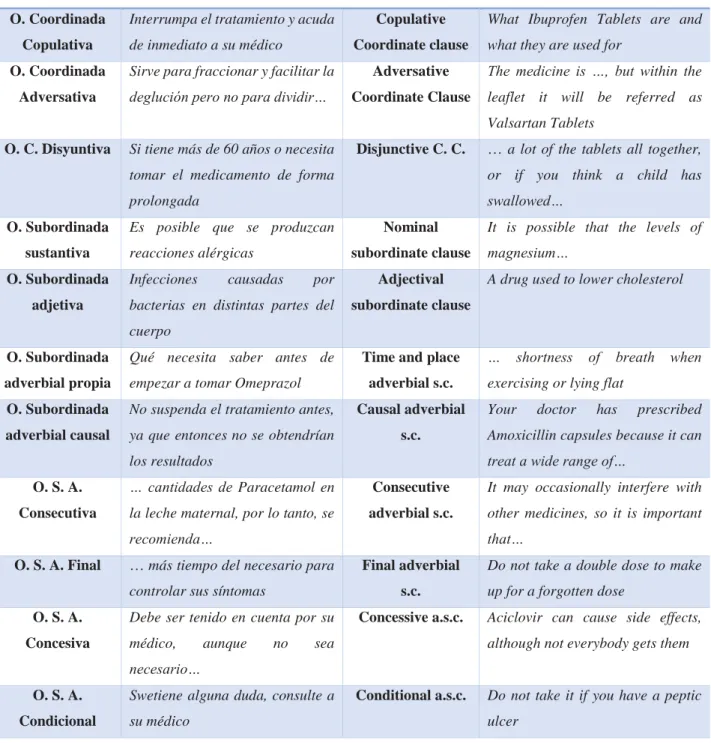
Regarding the syntactic section, we can find different types of sentences. Arroyo asserts that there is a distinction between oraciones compuestas coordinadas and oraciones compuestas subordinadas in Spanish. The first ones include oraciones copulativas, disyuntivas, distributivas, adversativas, explicativas, while the second ones contain
oraciones sustantivas, adjetivas, and adverbiales, and within the oraciones adverbiales, we can find oraciones adverbiales propias de lugar, tiempo y modo, causales, finales, concesivas, consecutivas, comparativas, y condicionales (54-55; my translation). The classification of the English sentences is very similar to the Spanish one. The English equivalent of the oracióncoordinada is the compound sentence –two independent clauses– which includes the same sub-classification that in Spanish, i.e. copulative, disjunctive, distributive, adversative, and explicative sentences, while the oración subordinada would be called complex sentence in English –one independent clause along with one or more embedded subordinate clauses. In general, there are several types of complex clauses which occur in a similar way as the Spanish classification: nominal clause, adjectival clause, and the adverbial clause. The adverbial clause includes the following types: causal –because–, comparative –such as–, concessive –although–, conditional –if–, consecutive –so–, purpose
–to, in order to, for–, result –so…that–, and place –where–, manner –as–, and time – after/before, when.
Regarding the semantic section, Lynn states that we can find four types of sentences in
20
statements”, the imperative sentence, which “makes demands or requests”, the exclamatory sentence, which is concerned with “making important or excited statements”, and the interrogative, which “asks questions” (37). On the other hand, Arroyo asserts that there are
six types of simple sentences in Spanish to which Rabuñal proposes a translation (52-53; my translation). In words of Rabuñal, we can find the statement sentence which refers to the English declarative sentence, the imperative sentence, the exclamatory, and the interrogative. We can find two more types that do not appear in the English classification: the desiderative sentence, which expresses the speaker’s wish, and the doubt sentence, which expresses the
speaker’s doubt. (n.p.)
2.4.3. Translation features: borrowings
We can comment about the origins of borrowings in English, which are very common in the medical domain. In this way, Répás states that “although medical terms have been drawn
from many languages, a large majority are from Greek and Latin”. In addition, he asserts
that “terms of Greek origin occur mainly in clinical terminology, while Latin terms make up the majority of anatomical terminology” (5). In Spanish, they are more typical because this language derives from Latin, but English does not. What many people do not know is that
“Greek medicine migrated to Rome at an early date, and many Latin terms crept into its
terminology”, as Répás claims (5), so the importance of Latin in the medical domain is because of Greek influence. Conversely, English comes primarily from the Germanic languages. Nevertheless, there is an important trace of Latin when England was under the
Roman empire. In words of Répás (5), “Latin was the language of science up to the beginning
of the 18thcentury”. For this reason, the use of Latin words in English is typical of texts with a specialized language such as the medical language.
3.
METHODOLOGY
3.1. Aim of the study and types of analysis
21
Spanish and English; and the translation analysis aims at showing the frequency of words of relevant terms and their equivalents as well as the most common translation procedures. Each analysis has been explained at the beginning of their respective section.
3.2. Corpora: types and characteristics
According to the typology and selection of the corpora, we have compiled two monolingual corpora in electronic format (pdf files), one in Spanish and another in English that have helped us to carry out the analysis. They can be considered comparable and parallel: comparable because each corpus may have been made of independent texts in each language, and parallel because we have presumed the English PILs have been translated from the Spanish ones, so they may be dependent since the Spanish PILs have been all developed by Kern Pharma.
It is important to mention that the corpora tools have not been used for all the analysis. The use of these tools only allows the formal analysis, which refers to how the genre is applied from the verbal point of view, excluding the rhetoric section. In the rhetoric analysis, texts have been analysed manually, that is to say, we have analysed them one by one without the aid of a corpus tool. For the linguistic analysis, we have considered the corpora as comparable as they are analysed independently. In the translation analysis, we considered them as parallel since we have presumed that the Spanish texts have been translated into English. Finally, the Spanish and English texts have been compared and commented in all the analyses.
3.2.1. PILs for different medicines: types and sources
To compile the corpora, we have chosen ten different medicines together with their corresponding PILs, all of them serving to a different purpose, except for the first two
medicines which we particularly selected due to their popularity (Paracetamol and
Ibuprofen). In this way, the selected texts refer to the following medicines3:
x Analgesic and antipyretic: Paracetamol e Ibuprofen (Ibuprofeno)
x Antacid and antiulcerous: Omeprazole (Omeprazol)
x Antibiotic: Amoxicillin (Amoxicilina)
x Antitussive and mucolytic: Acetylcysteine (Acetilcisteína)
3 Due to the difficulty of getting a hard copy of the selected PILs, we opted for getting them from trustworthy and
22 x Anxiolytic and anticonvulsant: Diazepam (Diazepan)
x Antiviral: Aciclovir
x Anti-inflammatory and nonsteroidal anti-rheumatic: Glucosamine (Glucosamina)
x Treatment of Alzheimer’s disease: Memantine(Memantina)
x Antihypertensive: Valsartan (Valsartán)
3.3. Corpora tools
As we mentioned before, the rhetorical analysis has been done manually on the texts since corpora tools were not useful. For this purpose, the linguistic and translation analyses have been done manually and on the basis of two different tools: TermoStat and AntConc. These corpus tools have organized our texts’ data and given us information not only concerning grammatical, syntactic, and semantic features of the terms –concordancing software: frequency of words, collocations, syntactic patterns, etc., relevant for the linguistic analysis, but also about translation aspects such as the analysis of translation procedures to identify transpositions, omissions, additions, and borrowings, among others.
Each tool has been used for different purposes. TermoStat has been used to identify the most used words and their frequency –grammatical analysis– since this tool only shows lexical words. It has also been used to look for equivalents in the other language for the most frequent lexical words –Spanish/English–, and to show some contexts of use –see Image 1: word
compensar, p. 28. Meanwhile, AntConc has been used to extract examples of use of verb tenses, sentence types –syntax and semantics– examples of the different translation procedures, and to look for contexts of use to validate the sense of a word in the account of the frequency of equivalents in Spanish and English. Finally, the types of verb tenses and sentence types along with their frequency –syntax and semantic levels– and the semantic fields have been analysed manually.
4.
EMPIRICAL ANALYSIS AND RESULTS
4.1. Rhetorical analysis
4.1.1. Superstructure and macrostructure
23
arrangement of the information of a text and from which we can see different patterns depending on the text type.
In this way, we have considered the pattern of the PIL. In Europe, the patterns of PILs are regulated by the European Commission through the European legal framework –Community Directive– in the section of Public Health (Medicinal Products): Information to Patients - Legislative Approach. Hence, the structure of PILs may be similar if not the same in Spain and Great Britain because both countries belong to the European Commission. European
Commission’s aim is to promote access to information on medicines of the highest possible
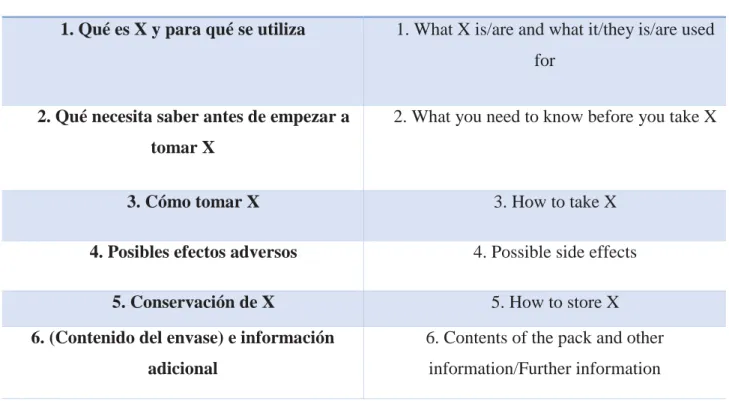
quality. The superstructure of PILs can be seen in Table 1:
Table 1. Superstructure of PILs in Spanish and English4. Source: my creation5
SPANISH ENGLISH
1. Qué es X y para qué se utiliza 1. What X is/are and what it/they is/are used
for
2. Qué necesita saber antes de empezar a
tomar X
2. What you need to know before you take X
3. Cómo tomar X 3. How to take X
4. Posibles efectos adversos 4. Possible side effects
5. Conservación de X 5. How to store X
6. (Contenido del envase) e información
adicional
6. Contents of the pack and other information/Further information
As we have said before, the sections we find in the PILs are the same in Spanish and English. This superstructure always follows the specific order indicated Table 1, which helps demonstrate cohesion all throughout the text. Cohesion is usually created by the use of discursive markers which organize the text in different sections and the ideas included in each one, but we have seen that PILs are characterised by an absence of discursive markers. Cohesion in PILs has been created not by the use of particular linguistic units, but by typographical elements and the structure itself: paragraphs, number schemes, bold type,
4 The information that is contained in round brackets appears only in some of the PILs as well as that which occurs
after the forward slash.
24
capital letters, indexation, etc. Furthermore, this type of cohesion provides readers with the information they need, so that it is easier for them as they have not to read the whole PIL.
Second, we can comment on the macrostructure we find in our PILs. It refers to the ideas contained in the PILs. In this sense, we should now consider the information contained in each section of a PIL. The title of each section briefly describes its content. In the first section, named Qué es X y para qué se utiliza in Spanish, and What X is/are and what it/they is/are used for in English, we can find data about a particular medicine and its purpose, primarily in a simple language.
The second section, called Qué necesita saber antes de empezar a tomar X in Spanish,and
What you need to know before you take X in English, is concerned with some indications and precautions that patients should follow, especially if they have any allergies, suffer from a particular disease, or are taking any medicine. Patients are warned particularly in this section in order to avoid any possible thing that endangers their health.
The third section, named Cómo tomar X in Spanish, and How to take X in English, focuses on the dosage of a medicine for each patient, which changes depending on the age of that patient, or on particular conditions such as an illness. The time of dosage taking is also specified, that is how a medicine should be distributed on a day and the alternatives if you forget to take a dose. This is one of the sections that includes the most redundancy, which can be seen in detail in the semantic section.
The fourth section, called Posibles efectos adversos in Spanish, and Possible side effects
in English, deals with the possible side effects that the patient may suffer and their level of frequency. Moreover, in each package leaflet, the contact information of an institution dedicated to dealing with matters of pharmacological nature is mentioned in case of reporting new side effects in order to make the information as accurate as possible.
The fifth section, named Conservación de X in Spanish, andHow to store X in English, concerns the conservation of the medicine, which may or may not require special storage conditions. This section is the most similar one in all the PILs since the recommendations included are recurrent in all of them, that is they appear in the same way. Some of these examples are Mantener fuera del alcance y de la vista de los niños and Keep this medicine out of the sight and reach of children; or Do not use this medicine after the expiry date and
No utilice este medicamento después de la fecha de caducidad.
25
about the ingredients –active substances and excipients–, physical appearance –e.g. colour and shape–, contents –e.g. size and number of tablets in each pack– of the medicine, and sometimes, about the flavour of the medicine if it is taken orally. Moreover, we can see information about the laboratories that are responsible for manufacturing and marketing of the medical products, sometimes two different companies. Moreover, this section provides information about the pharmaceutical laboratories responsible for the production and commercialisation of each of the medicines. This information may help us to know if our PILs are translations or not.
4.1.2. Relevance of the sixth section
In this regard, we thought that laboratories included in the sixth section would provide us with a hint to know if the texts have been translated or not. First, we have observed that most of the PILs have been developed by different laboratories, except for Omeprazole,
Memantine, and Glucosamine. Even if all the Spanish PILs have been commercialised by the Spanish laboratory Kern Pharma, the manufacturing laboratory may have been a different one. In this sense, Omeprazole has been manufactured by the same laboratory in the case of the Spanish and English PILs, which is the Spanish Laboratorios Dr. Esteve S.A., located in Barcelona. By observing these two PILs, they are structured in exactly the same way and containing each idea in the same place, something unusual for PILs that have not been translated.
Second, there are some peculiarities that we can comment about Memantine PILs. The Spanish version has been developed and commercialised by Kern Pharma, but the English PIL has been manufactured in Malta and commercialised by an Irish company. The point is that the structure of both PILs is very similar, almost the same, but it is unlikely that the texts are translations. However, we tend to think that the Spanish version has been translated from English since we have identified some calques and literal translation, e.g. su médico puede tener que ajustar la dosis del medicamento instead of es posible que su médico le ajuste la dosis del medicamento, or respiración difícil instead of dificultad para respirar. Finally, Glucosamine PILs are not likely to be translations. Even though the English PIL manufacturer is from Spain, Alcala Farma S.L., it is different from the Spanish PIL manufacturer, which is
26
To conclude, our PILs follow a clear and organized pattern –cohesion– so the ideas included in them are properly brought together and, therefore, we find an evident coherence in our texts. However, we find some inconsistencies when comparing the English and Spanish PILs, e.g. contradictions.
4.2. Linguistic analysis
In this section, we have analysed particular characteristics regarding the language of our PILs. In this way, this section is dedicated to analysing the characteristics of PILs to formalize these texts as a genre, that is, to consider the Patient Information Leaflet as a genre itself. For this aim, we have considered three main aspects in the PILs: grammar, semantics, and syntax. Moreover, we have presented the analysis together with the results.
Along these lines, we have discussed the different grammatical categories or POS making up the texts, specifically nouns, verbs, and adjectives –because they are the ones that have meaning by themselves– and their frequency of use throughout the texts. To carry out this task, we have needed the compiled corpora, so as to make comparisons between the two languages.
For the syntactic analysis, we have considered the main structures of the sentences in both languages and some syntactic elements such as the analysis of verb tenses, types of sentences
–coordination or subordination–, and their frequency in order to establish a comparison
between these features in regard to the Spanish and English PILs. Furthermore, we have used the compiled corpora and two corpora subtypes: the comparable and the parallel ones. As stated before, in this linguistic analysis, we have focused on the interpretation of corpora as comparable in order to observe the characteristics of the texts in Spanish and English as independent texts instead of translated texts.
Finally, in the semantic analysis, we have focused on sentence semantics, particularly the category of modality, and some words, particularly those related to the LSP, that is those specific of a medical domain. Thus, the different semantic fields have been investigated. Moreover, we have investigated the presence of ambiguity and redundancy, which are often related, and the consequences these may bring.
4.2.1. Grammar
27 Table 2. Spanish and English most frequently used verbs. Source: TermoStat.
SPANISH ENGLISH
Poder (273) Take (344)
Tomar (195) Use (131)
TERMS Consultar (82) Do (85)
Prospectar (79) Tell (66)
Envasar (75) Treat (63)
Total: 704 Total: 689
As we can see in Table 2, the total count of verbs differs from Spanish and English, but this difference is not very significant –704 verbs in Spanish, and 689 verbs in English. This can be seen by comparing the Spanish and English results. The variety of verbs in Spanish is higher than in English and this is why the frequency of each verb is lower. The contrary occurs in English because there is a fewer variety of verbs, thus their frequency is higher. This supports the idea that English verbs tend to be polysemic, while the Spanish are not likely to, which means that an English verb contained in the PILs has several equivalents in the Spanish patient leaflets.
By looking at the frequency of some verbs, we realised that some of them appear only 10 times in the whole corpus, which coincides with the number of medicines we have. This may mean that some verbs have been used once in each of the Spanish/English PILs. In this case, we need to remember that the corpora work independently, so we have found ten results in the Spanish corpus, and other ten results in the English one. In addition, this gives us a relevant cue for the rhetoric structure analysis because it may mean that there is a given structure that is repeated in each of the PILs. This is the case of the Spanish verb compensar. Its context reveals it is a word that appears once in each of the leaflets and is contained in the same section in all the cases, that is in the Spanish PILs –section 3: Cómo tomar X. The contexts of the verb compensar can be seen in Image 1:
28
Considering now the grammatical category of nouns, we can see the most used nouns of our Spanish and English PILs in table 3:
Table 3. Spanish and English most frequently used nouns. Source: TermoStat.
SPANISH ENGLISH
Medicamento (323) Medicine (223)
Pharma (257; ignored) Ø
TERMS Médico (228) Doctor (214)
Dosis (145) Tablet (160)
Efecto (134) Side (157)
Tratamiento (130) Effect (153)
Total: 960 Total: 907
If we take a look at Table 3, we cannot see huge differences in terms of frequency of the most frequently used nouns contained in the PILs –960 nouns in Spanish, and 907 in English. The Spanish superiority regarding the frequency of nouns may occur because these substantives appear rather as verbs instead of nouns in the English texts.
The Spanish LSP contained in this type of texts is generally characterised by an important use of nouns, while in English, we find more verbs. When translating from English into Spanish, the English verbs become nouns by a process called nominalization. When looking at the equivalents of some of the most used nouns, there is a considerable difference in terms of frequency of the results, as we can see with words such as tratamiento (130)and treatment
(35). The same occurs with other terms such as administración (22) and administration (1),
duración (11), duration (2), etc. Nevertheless, we have identified many nominalizations in both languages as well as a high number of nouns in both cases. This may support the notion that the English texts have been translated from Spanish. However, the discussion about nominalization can be seen in the translation analysis.
Finally, we are focused on the last table within this grammatical analysis in which we can see the most used adjectives of our Spanish and English PILs:
29
SPANISH ENGLISH
Posible (52) Severe (35)
Grave (49) Allergic (32)
TERMS Frecuente (37) High (26)
Raro (35) Pregnant (25)
Siguiente (30) Usual (24)
Total: 203 Total: 142
In Table 4, we can note that the English adjectives are not as frequent as the Spanish ones and tend to collocate with the same word(s), as in the case of usual, whose context reveals that it is mostly used preceding the noun dose. Moreover, the English adjectives are less varied: according to TermoStat, we have 145 different adjectives in Spanish –9% of the whole Spanish corpus–, and 71 different adjectives in English –6% of the whole English corpus.
Unlike English adjectives, the Spanish ones are both more numerous and occur more frequently in the texts. In the same way as with the English adjectives, we can see that the Spanish ones tend to collocate with given constructions such as posible, which collocates with the verb es resulting in the construction es posible que, or it is included in the NP efectos adversos, resulting in posibles efectos adversos. By observing these results, we can state that their frequency is twice that of the English adjectives, which is reflected in longer texts in Spanish than in English. The difference of frequency in adjectives may be caused by the different grammatical categories that are used in each of the languages. In this way, while the Spanish PILs use adjectives, the pre-modification of English nouns is mainly done by the past participle and -ing constructions, which are actually interpreted as verbs. These two verbal constructions tend to appear only once or twice in the PILs, so that is the reason why their frequency is particularly low: existing factors, spinning feeling, lacking energy, breathing difficulties, increased risk, blocked artery, film coated tablet, delayed serious liver damage, etc. Although there is a great variety of these, they cannot be considered as adjectives, which explains the low presence of English adjectives in the PILs.
4.2.2. Syntax
30
and their frequency in the selected PILs. This aspect has been crucial for us in the translation analysis section to confirm or reject that the English texts are actual translations.
With reference to verb tenses in Spanish, we have identified nine tenses in our corpus: periphrastic verb forms, present simple –indicative mood–, present simple –subjunctive mood–, present simple –imperative mood–, impersonal constructions, passive verbs, preterit perfect, non-inflected forms –infinitive, gerund, and participle–, and the future imperfect6.
It is relevant to define and comment on some of the Spanish tenses that appear in the PILs since they differ significantly from those from the English texts. First, the periphrastic verb form does not exist in English. It usually consists in a structure of two –or three– verbs in which the first one is inflected, while the second one –or the remaining ones– is non-inflected, particularly in infinitive form or included in a clause with the relative que. The last verb of this structure is the one which carries the meaning, e.g. debe tomar, or tener que mantener. Unlike the English language, the Spanish grammar differentiates between simple and compound tenses. A simple tense consists in one verb taking the appropriate inflections of its tense, while the compound tense consists in the inflected verb haber followed by another verb in the participle form which carries the meaning. In this way, the preterit perfect is the compound designation for the past form of verbs which indicates an action that has already finished, e.g. ha sufrido. Finally, the future imperfect refers to the simple tense designation for the future tense.
Even if some tenses do not exist in the other language, we can find clear differences when comparing the verb tenses included in the PILs between the two languages. For this reason, we have identified seven main English verb tenses in that corpus: modal verbs, passive verbs7, present simple –indicative mood–, present simple –imperative mood–, non-inflected forms, present perfect, and future.
Thus, each tense has its equivalent in the other language in these texts: the periphrastic verb forms refer to the modal verbs in English, the passive is often translated as impersonal constructions and sometimes as passive verbs in Spanish, and the future tense is expressed in Spanish as the future imperfect. The English equivalent for the preterit perfect is the present perfect, while the Spanish non-inflected verb forms –infinitive, gerund, and participle– are referred in English with the same name, but including the infinitive, -ing forms, and the past
6 The designation of the Spanish verb tenses is taken from the Spanish verbal system contained in the Gramática de la
Lengua española (RAE), quoted in Rallides (11-12).
7 We know that the passive voice is not a tense but a grammatical voice, as it is the case with other structures such as
31
participle constructions, respectively. We can also find few instances of the present continuous in English, whose Spanish equivalent is the present progressive. The most commonly used verbs of this tense are the following: are suffering, are taking, and are planning in English, and está tomando or está utilizando in the case of Spanish.
Regarding the modality of verbs, the present tense has been found in the three moods in Spanish: indicative, subjunctive, and imperative, while in English we have only found the indicative and imperative moods. As the subjunctive mood is extremely rare in English, we have not found it in the English PILs. For this reason, we have identified the indicative mood as the English equivalent for the Spanish subjunctive mood.
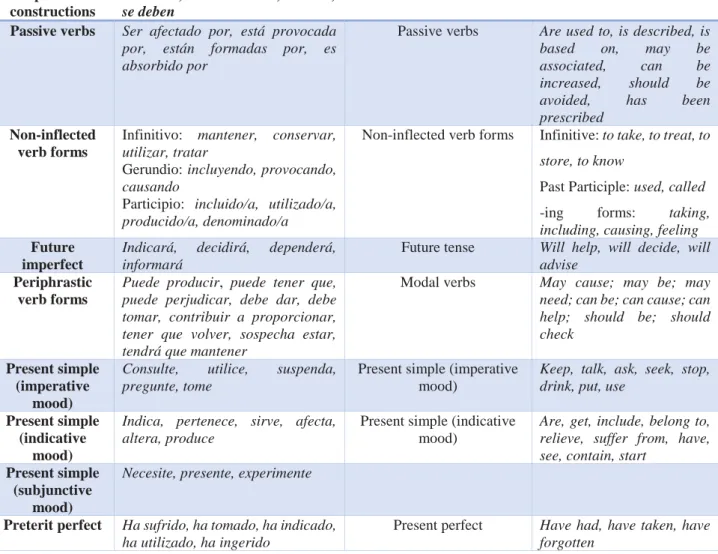
Let’s analyse now the most frequently used verb tenses in each language. Table 5 contain
information about the different verb tenses discussed above along with different examples of each tense. To this end, we have selected only the most representative examples for each tense. Moreover, each Spanish tense is aligned with its English equivalent.
Table 5: Spanish and English verb tenses with examples. Source: AntConc and my creation.
Impersonal constructions
Se utiliza, se recomienda, se trata, se deben
Passive verbs Ser afectado por, está provocada por, están formadas por, es absorbido por
Passive verbs Are used to, is described, is based on, may be associated, can be increased, should be avoided, has been prescribed
Non-inflected verb forms
Infinitivo: mantener, conservar, utilizar, tratar
Gerundio: incluyendo, provocando, causando
Participio: incluido/a, utilizado/a, producido/a, denominado/a
Non-inflected verb forms Infinitive: to take, to treat, to store, to know
Past Participle: used, called
-ing forms: taking, including, causing, feeling
Future imperfect
Indicará, decidirá, dependerá, informará
Future tense Will help, will decide, will advise
Periphrastic verb forms
Puede producir, puede tener que, puede perjudicar, debe dar, debe tomar, contribuir a proporcionar, tener que volver, sospecha estar, tendrá que mantener
Modal verbs May cause; may be; may need; can be; can cause; can help; should be; should check
Present simple (imperative
mood)
Consulte, utilice, suspenda, pregunte, tome
Present simple (imperative mood)
Keep, talk, ask, seek, stop, drink, put, use
Present simple (indicative
mood)
Indica, pertenece, sirve, afecta, altera, produce
Present simple (indicative mood)
Are, get, include, belong to, relieve, suffer from, have, see, contain, start
Present simple (subjunctive
mood)
Necesite, presente, experimente
Preterit perfect Ha sufrido, ha tomado, ha indicado, ha utilizado, ha ingerido
32
At a glance, we have seen that the most used tense in Spanish is the periphrastic verb form, while in English it is the modal verb. However, it is important to mention that some of the results are deceiving because if we do not look at the whole context, we cannot properly identify the actual tense of the results provided by AntConc. This is the case of the modal verbs may, can, and must, which collocate with the verb to be resulting in may be, can be,
and must be. When looking at the context of those constructions, we realised that they are in fact instances of passive constructions: may be associated, may be considered, can be increased, can be divided, should be swallowed, and should be avoided.
We are dealing with texts full of complex structures like the ones we have just mentioned, which make the text very dense and not only in English, but also in Spanish. In this way, we can find many diverse examples of the periphrastic verb form as it is the most repeated Spanish tense. In our corpus, this Spanish tense is used in such a variety of ways that we cannot cover all the different types included in the texts; for that reason, we have selected the most common ones: puede producir, puede tener que, puede perjudicar, debe dar, debe tomar, contribuir a proporcionar, tener que volver, etc. Furthermore, we can also observe even more complex constructions such as contribuir a proporcionar. As we have said before, this tense represents the Spanish equivalent for the modal verb since they cover a similar structure and meaning as far as both tenses express modality such as possibility, necessity, or obligation: e.g. puede producir, and its English equivalent may cause. These constructions lead to a dense, heavy language that complicates the legibility of the PIL, thus provoking a lack of interest in the reader. Another verb construction that is characteristic of the English PILs is the passive verb. Even if it is not commonly used in Spanish, we can find some instances of it in our corpus, e.g. ser afectado por, está provocada por, es absorbido por, or
están formadas por.
33
hypothesised at the beginning when we said that the English PILs were translated from Spanish. Moreover, this may be caused by the use of the specialized language, particularly the medical language, which is more likely to be literally translated. This is done to maintain the passive construction, or any other tense, even if they are not as commonly used in Spanish.
To illustrate this, we can mention the first structure that appears at the beginning of the fourth section called Possible side effects or Posibles efectos adversos. The English sentence at issue is the following: Like all medicines, this medicine can cause side effects, although not everybody gets them. This structure appears in the same position and contains exactly the same information in all the English PILs, as well as in the Spanish ones with the sentence Al igual que todos los medicamentos, este medicamento/X puede producir efectos adversos, aunque no todas las personas los sufran.
Passive verbs have another equivalent form in Spanish, which appears more frequently than the Spanish passive verb: the impersonal construction, e.g. se utiliza, se recomienda, se trata, se deben, etc. In addition, we can also find even more complex constructions such as
se ha observado, which is a tense that combines the Spanish impersonal construction and the preterit perfect. This combination of verb tenses proves once more the complexity of the language contained in these PILs.
Similarly, another typical tense that appears in both languages is the present simple in imperative mood: keep, talk, ask, seek, stop in English, and consulte, utilice, suspenda, pregunte, tome in Spanish.
34
forms, which we have already mentioned. To illustrate this, we propose the following example:
Table 6: Example of the use of language in PILs. Source: AntConc Exhortative language (present
simple: imperative mood)
Do not stop taking your medicine without talking to your
doctor first even if you feel better. / No deje de tomar el
medicamento a menos que se lo indique su médico.
Softened language
(modal verb/impersonal
construction)
If you notice any changes […] you should stop taking these
tablets immediately. / Si aparecen estos síntomas, se
recomienda interrumpir el tratamiento y acudir al médico.
In the first example of Table 6, we can see the medical professional’s attitude towards the patient in which s/he seems to obligate the patient to not stop taking the medicine in both English and Spanish. In the second case, we present an example in which the medical professional is rather advising the patient to stop taking the medicine. In this sense, we consider the second example to be the most appropriate way of addressing patients since they do not feel the authoritative phrasing of the professional and avoid the negative impact that the imperative mood of verbs may evoke, as we mentioned above. However, this negative impact is reduced in the first Spanish example due to the level of formality when addressing the patient: No deje de tomar.
Finally, the last tense that we consider as characteristic of the language of PILs is the use of the Spanish present simple tense in subjunctive mood, whose equivalent in English is the present simple in indicative mood: necesite, presente, experimente. The first thing we appreciate from the use of this tense is the high level of formality of the Spanish texts since the reader is addressed in a formal, obsolete way. In addition, this way of addressing patients has an effect of keeping a distance with them, which may make the reader feel uncomfortable.
Not only verb tenses help us identify whether the texts are translations or not, but also the other syntactic elements provide relevant information about this. We have found that PILs contain complex constructions at a verb level, and the same applies to the structure and typology of the sentences. In this sense, we can establish the analysis of sentences at two levels, semantic and syntactic.