FACULTAD de FILOSOFÍA Y LETRAS
DEPARTAMENTO de FILOLOGÍA INGLESA
Grado en Estudios Ingleses
TRABAJO DE FIN DE GRADO
A GRAMMATICAL STUDY ON HOW TYPICALLY
DEVELOPED CHILDREN AND CHILDREN WITH
SPECIFIC LANGUAGE IMPAIRMENT PRODUCE
WHAT
AND
WHEN
Mónica Montón Catalina
Tutora: Raquel Fernández Fuertes
ABSTRACT
This undergraduate dissertation presents a grammatical study on the production of what and when by English native speakers. It presents a double comparison regarding two child
groups that have been MLU-matched (i.e. typically developed children (TD) and children with specific impairment (SLI)) and two data types (i.e. narrative and spontaneous). The analysis deals with the production of what and when both as isolated words and as part of wh-questions and wh-relative clauses. The results of the study reveal that the production of when children is higher than that of what in the case of the TD children, as opposed to the
SLI children who present more instances of what. Likewise, a correlation may be set in
regards to the use of these wh-words in the two target structures: the TD children produce
more wh-relative clauses, whereas the SLI children produce more wh-questions.
KEYWORDS: what, when, wh-questions, wh-relative clauses, typically developed children,
children with specific language impairment.
RESUMEN
Este trabajo ofrece un estudio gramatical sobre la producción de what y when en datos de
niños ingleses nativos. Presenta una doble comparación en relación a dos grupos de niños que han sido agrupados teniendo en cuenta el criterio LME (i.e. niños sin trastornos asociados al lenguaje, niños con un trastorno específico del lenguaje (TEL)) y a dos tipos de datos (i.e. de narrativa y espontáneos). El análisis realizado en el presente estudio tiene que ver con la producción de las palabras what y when tanto cuando se usan por separado
como cuando forman parte de oraciones wh- y oraciones de relativo. Los resultados de este
estudio muestran que los niños que se desarrollan con normalidad producen más casos de
when que de what, frente a los niños con TEL que presentan más ejemplos de what. Así
mismo, se puede establecer una relación entre el uso de estas palabras y las estructuras gramaticales en cuestión: los sin trastornos asociados al lenguaje producen más oraciones de relativo, mientras que los niños con TEL presentan más casos de oraciones wh-.
PALABRAS CLAVE: what, when, oraciones wh-, oraciones relativas de wh-, niños sin
CONTENTS
FOREWORD: contextualization of the undergraduate dissertation ... 1
1. Introduction ... 3
2. Literature review ... 5
2.1. Wh-words ... 5
2.1.1. Wh-words: definition and classification ... 5
2.1.2. Uses and clause functions of when and what ... 7
2.1.3. Syntactic functions of when and what ... 9
2.2. Types of wh-clauses ... 10
2.2.1. Wh-clauses as independent or main clauses ... 10
2.2.2. Wh-clauses as dependent or subordinate clauses ... 12
2.3. Wh-movement ... 13
3. Previous studies ... 14
3.1. TD versus SLI acquisition and production of syntax ... 15
3.2. Acquisition and production of wh-words and wh-questions ... 16
3.3. Acquisition and production of wh-relative clauses ... 22
4. Purpose of the study and research questions ... 27
4.1. Question set 1: general performance ... 27
4.2. Question set 2: performance per wh-type ... 28
4.3. Question set 3: performance per sentence-type ... 28
5. Data methodology ... 29
5.1. Data selection ... 29
5.2. Participants' selection ... 32
5.3. Data extraction ... 34
5.4. Discarded cases ... 36
6. Results of the study ... 38
6.1. Question set 1: general performance ... 38
6.3. Question set 3: performance per sentence-type ... 43
6.4. Performance by the TD and the SLI children through MLU stages ... 47
7. Conclusions ... 49
8. Bibliography ... 52
FOREWORD: CONTEXTUALIZATION OF THE UNDERGRADUATE DISSERTATION
This undergraduate dissertation is the last formal requirement to complete the degree in English Studies at the University of Valladolid. Among all the contents of the degree, this dissertation falls under the A2 category "Scientific Description of the English Language", according to the current description of the degree (Universidad de Valladolid 2017-2018).
This dissertation deals with the study of two grammatical units (i.e. what and when). I have
selected this topic since it is a great opportunity to work on a different area of grammar and undertake a complete research study. Moreover, I find these two wh-words as an appealing
topic as they are highly frequent and consequently, research on how English speakers produce them really attracted me. Therefore, thanks to this study I will have an extensive knowledge of these grammatical units.
Furthermore, working on this area will provide me with different competences and knowledge about this topic and related grammatical issues. Firstly, I will be more familiar with different properties dealing with wh-words (i.e. functions, uses, wh-movement), and
more specifically with those of what and when. Secondly, by doing an empirical analysis I
will be able to work deeply with data (i.e. extracting, classifying, analyzing, etc.) and different software packages (i.e. CLAN). Finally, this dissertation will help me to investigate on the topic and to establish my own research questions.
Besides, in this undergraduate dissertation I have applied general and specific competences that I have acquired over these past four years. Therefore, the particular competences I have used to work on and to write this dissertation are described below in regards to what the current description of the degree establishes.
The first thing I had to do was to search for related and relevant information on the target topic. Hence a bibliographical investigation has been carried out by looking up different available resources (i.e. UVa library books, on-line articles, internet sources, etc.). Consequently, the following competences have been reinforced:
x Ability to analyze and synthesize, conceptualize and abstract.
x Ability to manage information.
x Comprehension of knowledge related to the structural and systematic properties of the English language.
x Fluency in the use of common means and technological resources.
Furthermore, apart from these competences by doing my own research analysis, which is presented in this dissertation, I have been able to develop some specific competences which include the following:
x Personal and autonomous learning.
x Creativity.
x Aptitude to solve problems.
x Maturity, discipline, and intellectual, academic and expressive thoroughness.
In addition, since this dissertation presents a grammatical study on the production of two
wh-words, and not only on a grammatical description, several competences related to this
field have been applied, too. These include the following:
x Ability to comprehend the English grammar and its description.
x Ability to control the English language in a formal and academic register, both oral and written.
INTRODUCTION
The acquisition and production of a first language have been widely studied by many linguists and other researchers that have been concerned with the different language fields (i.e. vocabulary, semantics, syntax, etc.). In order to acquire their first language, children go through different stages along the acquisition process in which different structures (e.g. grammatical and ungrammatical, simple and complex) are used in accordance to their ages and MLU (Mean Length of Utterance) values. The way children develop through the different chronological stages (age) and developmental stages (MLU) is affected by the properties of the different grammatical units that make up a language. For instance, in the case of a specific type of grammatical unit, wh-words, different issues could be taken into
account. The production of wh-words occurs gradually since some of them (i.e. who, what,
or where) are easier to acquire than others (i.e. when, which, or whose) (e.g. Bloom et al.
1982, Rowland et al. 2003). Furthermore, while children are acquiring wh-words, they need
to know how to use them properly in the different grammatical structures in which they may appear (i.e. wh-questions or wh-relative clauses). Thus, once they have acquired these
properties, something that typically occurs at the age of 5, children's production is primarily adult-like. However, non-adult like forms may persist for a little bit longer which makes the analysis of children’s production after the initial stages of acquisition an interesting field of study.
Hence, the current dissertation presents an empirical study based on the production of two
wh-words, what and when, by typically developed (TD) children and by children with
specific language impairment (SLI), all of them English native speakers. Three issues are targeted in this respect and in relation to these wh-words. Firstly, the production of what
and when is considered, separately. Secondly, the distribution of these wh-words (what and
when) across sentence types is analyzed, that is, whether these are used in wh-relative or in wh-questions. And thirdly, a parallel comparison according to the type of data (i.e.
different grammatical issues (i.e. wh-word type, sentence type, and data type),is similar for
TD and SLI children when they are MLU-matched.
This dissertation is divided into seven main sections which are in turn subdivided into different subsections. This first section, the introduction, presents a brief explanation and contextualization of the topic of the study. The second section deals with a brief grammatical review of wh-words regarding their main grammatical properties. These
include the definition and classification of wh-words, the uses and clause functions that the
target wh-words (i.e. what and when) could have in a sentence (i.e. interrogative clause
marker and relativizer), the types of clauses in which these wh-words can appear (i.e. wh
-questions and wh-relative clauses), and the type of movement that is required (i.e. wh
-movement). In the third section, some previous empirical studies dealing with the target topic are presented in order to contextualize the one that is offered in this dissertation and that is presented in the following section. Afterwards, the fourth section introduces the main research questions and objectives of the present study. The next section contains an explanation of the methodology followed in order to obtain all the necessary data to carry out this empirical study. Likewise, this section is divided into three main subsections: firstly, how the data have been selected is explained; secondly, the procedure used to extract the data is presented; and finally, how the data have been classified is illustrated. Furthermore, in the sixth section the results of this empirical study, in relation to the research questions, are presented and explained. Finally, the last section presents the conclusions reached after having analyzed the data. Additionally, a bibliography is included, where all the sources used in order to write this dissertation are included.
LITERATURE REVIEW
In any language, "the essence of grammatical units is that they are meaningful and combine with each other in systematic ways" (Biber et al. 1999:50). According to Biber et al.
(1999), these grammatical units can be divided into seven major subgroups: discourse, sentence, clause, phrase, word, morpheme, and phoneme/grapheme. Amongst these subgroups, this dissertation is concentrated on a specific word type, and on the sort of clauses in which this word type may appear: wh-words and wh-clauses. A theoretical
description of these grammatical units is provided with a focus on the two that constitute the target of this work: what and when.
Therefore, this section is divided into three main subsections. Firstly, what wh-words are
and how they are classified is explained. Next a specific analysis of uses and clause functions of what and when, is carried out. This leads to the next subsection, an account of
the types of syntactic clauses in which these two wh-words may appear. Finally, as it is
explained later, the fact that wh-words are used in wh-questions, implies the necessity of
having a wh-movement. Therefore, the last part of this section outlines what wh-movement
is and the bases of this phenomenon.
2.1. Wh-words
2.1.1. Wh-words: definition and classification
According to Biber et al. (1999:55), "to the ordinary language user, words are the basic
elements of language". Words can be divided into three major categories: lexical words, functional words, and inserts. Wh-words are functional words whose main function is to
introduce either wh-relative clauses, as in (1), or wh- interrogative clauses, as in (2).
(1) [He warned the public not to approach the men, [who are armed and
(2) [Which one do you mean?]CP1 (Biber et al., 1999:87)
This subgroup of words is composed of nine wh-words and their corresponding
compounds: "Who, whom, which, whose, what, where, when, why, and how, or their
compound in -ever: whoever, whatever, etc." (Huddleston, 1984:366). The following
examples, from (3) to (11), show an instance of each of them, either as part of an interrogative or a wh-relative clause.
(3) [Who are you talking about?]CP1 (4) [For whom would I be working?]CP1 (5) [Which photos are we going to look at?]CP1 (6) [Whose turn is it tonight?]CP1
(7) [What are they doing?]CP1
(8) [I could lead you [to the shop where I bought it]CP2]CP1
(9) [I can't think of a think [when I would be going by myself]CP2]CP1
(10)[There's no reason [why you shouldn't go out for a drink with him]CP2]CP1 (11) [How was your trip, Nick?]CP1
(Biber et al., 1999: 204, 626)
As shown in these examples, wh-words can be used in two different ways, as interrogative
markers, as in examples (3), (4), (5), (6), (7), and (11); and as relativizers, as in (8), (9), and (10).
Furthermore, Biber et al. (1999) discuss that these wh-words have an elicit function and
that they are employed in order to provide further information which is absent. In other words, the receiver is waiting for specific linguistic information, which differs depending on the wh-word used. Consequently, the use of one wh-word or another depends on the
2.1.2. Uses and clause functions of when and what
These grammatical units, can be used in different sentence types (e.g. wh-questions, as in
(12); and wh-relative clause, as in (13)) and can have different syntactic roles, accordingly
(e.g. interrogative clause marker, as in (12); and relativizer, as in (13)).
(12)[When is Mary leaving home?]CP1
(13)[The day [when she arrived]CP2 you were not in the city]CP1
In example (12), the question has been formulated in order to know the time when Mary is leaving home and, therefore, to complete a piece of information that is missing (i.e. time). Likewise, in example (13), the relative pronoun has been used as a link between the subordinate and the main clause and as a way of providing the required information. Even if when is used to supply information about time in both examples, they differ in an
important way: wh-words, in general, and when, in the examples above, can be used either
as interrogative clause markers, as in (12), or as relativizers, as in (13).
2.1.2.1. When and what as interrogative clause markers
According to Biber et al. (1999:87): "interrogative clause markers are used as pronouns
(who, whom, what, which), determiners (what, which, whose), or adverbs (how, when,
where, why)". Taken this statement as the starting point, and already focusing on the target wh-words (e.g. when and what), their different uses are illustrated in (14) to (16).
(14)[When are you leaving?]CP1
(15)[What do they want?]CP1 (Biber et al., 1999:87) (16)[What schoolchild's imagination could fail to be stimulated by such a
As example (14) shows, a wh-adverb, when, has been used in order to introduce a wh
-question, an adverbial one. Therefore, as it can be inferred, when is used as a time adverb
and, as it is explained later on, it functions as an adjunct of time. Hence, it indicates time and has the grammatical feature [+time].
On the other hand, in example (15), what has been used as a wh-pronoun and is, therefore,
the lexical head of the DP. In this sense, what is characterized by having a [-human]
grammatical feature (Huddleston, 1984). Besides, as example (16) shows, what can be used
as a determiner, too. In those cases, the wh-word could be the determiner accompanying a
[+/- human] noun: what could refer to a [+human] noun and consequently would have a [+
human] feature, as in example (17); or it could refer to a [-human] noun, having a [-human] feature, as reflected in (18).
(17)[What candidate will you vote for?]CP1
(18)[What party are you in favour of?]CP1 (Quirk et al.,1985:370)
2.1.2.2. When and what as relativizers
As previously explained, wh-words can be either used as interrogative clause markers or as
relativizers. In regard to what Biber et al. (1999:87) explain: "relativizers are used as
pronouns (who, whom, which, that), determiners (which, whose), or adverbs (when, where,
why)". In (19) an instance of one of the two target wh-words is shown.
(19)[That summer marked the time [when their carefree childhood really ended]
CP1]CP2 (Biber et al., 1999:628)
Regarding when as a relativizer, its principal function is to serve as a link between the main
(20)[He was born in another age, the age [when we played not for a million dollars
in prize money.]CP2]CP1 (Biber et al., 1999:608)
As it can be appreciated from example (20), when refers to the age when we played not for
a million dollars in prize money. Thus, the wh-relative clause (CP2) introduces an adverbial clause which functions as an adjunct and has the age as its antecedent.
Moreover, when these grammatical units introduce wh-relative clauses, as in (20), the
wh-word, apart from its linking function as complementizer, has a grammatical functionwithin the CP2, as addressed in the next subsection. The wh-word in these relative clauses can be a relative adverb, too, as in (21).
(21) But the bit [when he's finished that] (Biber et al., 1999:628)
The other target wh-word, what, is not included under this classification, due to its being
barely employed as a relativizer. Nonetheless, it can appear as such in conversational texts, as in example (22). As this use is less frequent and restricted to informal conversational contexts, it is, therefore, not analyzed under the classification of standard relativizers (Biber et al., 1999).
(22) Gotta make sure she's got the book [what I had last week] (CONV).
(Biber et al., 1999: 609)
2.1.3. Syntactic functions of when and what
Wh-words, as any other type of word, play a syntactic function within the structure they
belong to, that is, within the clause. In this respect, the previous distinction of these wh
On the one hand, the principal function of when is to be a time adjunct in the clause, as
reflected in example (23).
(23)[When did you see Mark?]CP1 (Biber et al. 1999: 204)
On the other hand, according to Huddleston (1984),when what is used as a pronoun, it can
function either as the subject of the clause, as shown in example (24), or as the direct object, as in (25). When it is used as a determiner, it functions as part of a DP, as shown in (16) above, and in this case, the DP can function either as subject or object of the clause.
(24) [What happened?]CP1 (Huddleston, 1984:369) (25)[What kind of novels do you enjoy reading?]CP1
(Quirk et al., 1985: 822)
2.2. Types of wh-clauses
Wh-words as explained in subsection 1.1 can be used as interrogative clause markers or as
relativizers. Hence, wh-clauses could be either direct interrogative clauses (independent
clauses), as shown in example (26), or wh-relative clauses (dependent clauses), as in (27).
(26) [When are you leaving?]CP1 (Biber et al., 1999:87) (27)[It occurs at a time [when abolitionist leaders hoped for improved treatment
of slaves]CP2]CP1. (Biber et al., 1999:268)
Therefore, firstly wh-clauses as independent clauses or main clauses (i.e. wh-questions) are
discussed and secondly, wh-clause as dependent or subordinate clauses (i.e. wh-relative
2.2.1. Wh-clauses as independent or main clauses
Independent clauses, as the term suggests, do not rely on another larger clause, as Biber et
al. (1999) indicate. What this means in grammatical terms is that these clauses function as
CP1, as main clauses, as shown in (25) above. Independent interrogative clauses can be classified in three different subgroups: wh-question, as in example (28); yes/no questions,
as in (29); and alternative questions, as in (30). Nevertheless, the target of this dissertation is to study wh-questions, therefore only this sort of independent clauses is studied.
(28)What do they want? [+Q] [+WH]
(29)Do you think he'll be any better? [+Q]
(30)Do you know one or two? [+Q]
(Biber et al., 1999:205-207)
Wh-main clauses are grammatically characterized by having a [+Q] and a [+WH] feature.
The [+Q] feature reflects that it is a question and not, for instance, a statement (31 versus
32). The [+WH] feature shows that it is a clause that contains a wh-word (31 versus 33).
(31)Shall we go by bus or train? [+Q] [-WH]
(32)He was driving on one side of the road. [-Q] [-WH]
(33)What side of the road was he driving on? [+Q] [+WH]
(Quirk et al., 1985:821-823)
Thus, (33) is an independent wh-question which has two grammatical features [+Q] and
[+WH]. The former indicates that this clause is a question, and the later represents that it is a wh-question as it is introduced by a wh-word: what. Besides, according to Quirk et al.
(1985:817), wh-questions, in order to be grammatically correct, are required to follow two
"The wh-element (i.e. the clause element containing the wh-word) comes
first in the sentence".
"The wh-word itself takes the first position in the wh-element".
In example (18), [what party]DP are you in favor of?, these two criteria are clearly exemplified. In this case, it can be seen that the wh-element, what party, comes first in the
clause, and within that DP, the wh-word, what, occupies the first place, the specifier
position.
2.2.2. Wh-clauses as dependent or subordinate clauses
Wh-clauses are dependent or subordinate if they are embedded in a superior structure
(Biber et al., 1999:192). In grammatical terms, these clauses are CPs2 that depend on a higher CP, normally a CP1, regardless of the type of dependency that is established (i.e. direct object of CP1, adjunct of CP1, etc.). There is a wide variety of clauses belonging to this group of subordinate sentences and, an instance of these are wh-relative clauses, as
shown in example (34).
(34)[He has born in another age, the age [when we played not for a million
dollars in prize money]CP2]CP1 (Biber et al., 1999:608)
Wh-clauses as dependent or subordinate clauses are grammatically characterized by having
a [+WH] feature which indicates that it is a relative clause introduced by a wh-word and
not, for instance, by the zero relativizer (35 versus 36).
(35)[I can't think of a time [when I would be going by myself]CP2]CP1
(36)[It's time [they paid the money back]CP2]CP1 (Biber et al., 1999:628)
Besides, the semantic relationship which can be found between the wh- relative clause and
distinction leads to distinguish between restrictive, as in (37), and non-restrictive
wh-relative clauses, as in (38), (Quirk et al., 1985).
(37)[The period[when I was in London]CP2 was the decisive one in my life]CP1 (38)[Last year,[when I was in London]CP2, was an incredible one]CP1
Hence, on the one hand, it can be said that the main difference between these types of
wh-relative clauses is that, in restrictive ones, the wh-relative clause and the antecedent are very
intensely related semantically speaking. As can be appreciated from example (37), the
wh-relative clause, when I was in London, is essential to understand the whole meaning of the
clause, otherwise it would not be clear to which period of time the speaker is referring to. Nonetheless, on the other hand, in (38), if the wh-relative clause, when I was in London, is
deleted the clause keeps its meaning, although a piece of information has been lost. Therefore, non-restrictive wh-relative clauses add extra information that the speaker wants
to highlight with respect to the whole sentence.
2.3. Wh-movement
Subsection 1.2 explains that both wh-questions and wh-relative clauses need to have the
[+WH] feature, the former in the specifier position of CP1, as in (39), whereas the latter on the specifier position of CP2, as in (40).
(39) [What are they doing?]CP1
Spec. (Biber et al., 1999:204)
(40) [That was the period [when she lived here]CP2]CP1
Spec. (Quirk et al., 1985:1254)
So, in order to satisfy that requirement, a mandatory syntactic movement has to be done, that is called wh-movement. The target of this movement is to move the wh-element to the
position of CP2, in wh-relative clauses, as in (40). Furthermore, this movement leaves a trace in the original place of the wh-element, which indicates that a movement has been
done. The trace (t) occupies the original position of the wh-element. Thus, by means of
co-indexation the trace (ti) is connected with the moved wh-element (wheni).
(41)[Whati are they doing ti?]CP1 (Biber et al., 1999:204) (42)[That was the period [wheni she lived here ti]CP2]CP1.
(Quirk et al., 1985:1254)
In (41) the original position of the wh-word what is right after the verb doing. However, it
cannot be there because the [+WH] feature is not satisfied. Therefore, a movement, in order to take the wh-element up to the specifier position of the CP, has to be done. As a
consequence, a trace t is used to fill up the empty space that the movement has left. Both
the trace and the wh-word are co-indexed (i). The same happens in example (42), but, in this case, the wh-word moves to the specifier position of CP2 as it is a subordinate clause (i.e. wh-relative clause).
PREVIOUS STUDIES
In this section of the dissertation, some previous studies dealing with the acquisition and production of wh-words, wh-questions, and wh-relative clauses, in general and in more
detail, are presented. It is divided into several subsections. The first one deals with a brief overview of the acquisition and production of syntax by TD and SLI children. In the second subsection, the order of acquisition of wh-words is explained, first in TD and then in SLI
children. Finally, in the last one, the focus is on wh-relative clauses as they are acquired by
both in TD and SLI children.
determine whether TD and SLI children show the same linguistic behavior and to observe how they use what and when in relative and interrogative clauses. However, the second
comparison has not been previously studied in SLI works and, consequently, in this section, both grammatical structures are discussed separately.
3.1. TD versus SLI acquisition and production of syntax
The acquisition and production of different grammatical structures may be regarded as problematic for SLI children. In fact, this is a fairly recent field of study, compared to that of TD children, and, consequently, there are not many investigations and conclusions reached about it and much needs to be done. Nevertheless, what seems to be clear for the researchers in the field is that language acquisition follows a slower path in SLI children, and that the grammatical structures produced by them are not equal to the ones produced by their typically developed peers. This could be the consequence of the lack of some grammatical features and abilities (Guasti, 2002:380).
Moreover, Guasti supports the idea that language acquisition can be defined as the act of attaining a language in a natural way which happens under diverse conditions, in an specific time period, spontaneously, in the same way in all languages, and by obtaining constructive support from the surrounding area. Using Guasti’s idea, the language development process undergone by children can be established. To begin with, it is important to distinguish between two stages: when children are able to identify speech (which happens from birth) and when they are capable of producing speech (which does not happen at least until they are between 6 and 8 months old). Guasti calls this first stage
babbling since they solely produce unvarying sequences such as bababa. During the next
structures when they are around 2 years old, it is not until a late stage when they use them properly. This is further illustrated in the subsections below that deal with the target structures in this dissertation, that is, wh-words, wh-questions and wh-relatives.
3.2. Acquisition and production of wh-words and wh-questions
This section on how children acquire wh-words, particularly what and when, is structured
into two subsections: firstly, how TD children acquire wh-words, based on Bloom et al.'s
(1982) and Rowland et al.'s (2003) studies; and secondly, how wh-questions are acquired
by SLI children, based on Van der Lely and Battell's (2010) study.
Additionally, as previously mentioned, the study of grammatical properties in SLI children is a fairly recent field. Consequently, in this subsection, two different issues are explained, relying on what has been previously studied. These are: how TD children acquire wh-words
and how SLI children acquire wh-questions. Although the acquisition of these two issues
would be different, by analyzing how SLI children acquire wh-questions could give an
insight about the order of acquisition of wh-words.
3.2.1. The order of acquisition of wh-words in TD children
In the same line as Guasti (2002), Yule (2006) argues that a child goes through different stages until he properly develops the adult syntax of the language he is exposed to. The last stage occurs, approximately, when the child is 5 years old, although in some cases the acquisition process can take longer than that. Additionally, as pointed out before, generally SLI children acquire language later than TD children; and even once SLI children have acquired the different linguistic properties, their productions sometimes are still ungrammatical (Schuele and Dykes, 2005).
studies are related since the latter is an attempt to prove the conclusions reached by the former.
Bloom et al. (1982) made a longitudinal study of 7 children, from 2 to 3 years old, from
New York City, in order to examine how wh-words are acquired in the formulation of
questions. They departed from the idea that once the wh-pronoun has been used at least
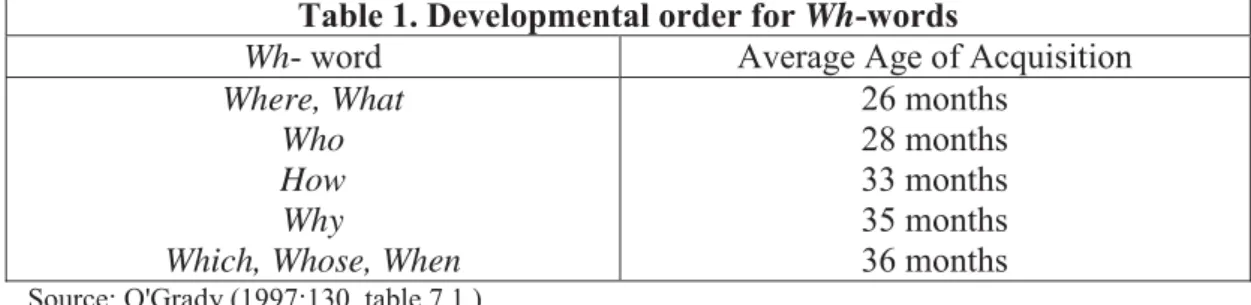
three times properly, it is considered to be acquired. Therefore, they concluded that an order of acquisition can be established, as in table 1.
Table 1. Developmental order for Wh-words
Wh- word Average Age of Acquisition
Where, What Who How Why
Which, Whose, When
26 months 28 months 33 months 35 months 36 months Source: O'Grady (1997:130, table 7.1.)
Regarding table 1, the wh-words where and what are the first ones to be acquired (at the age
of 26 months) followed by who (28 months) and by how (33 months). After these, at the
age of 35 months a child acquires the wh-word why and lastly when a child is 36 months he
produces the other three wh-words: which,whose, and when.
Besides, as Bloom et al. (1982) argue, the order of acquisition presented in table 1 could be
related to the degree of abstraction of the wh-word itself. This means that the wh-words
what and where refer to more concrete entities than, for instance, when or whose. Thus,
children acquire earlier those wh-words which refer to more concrete units, and in a later
stage those which are related to abstract ones. Consequently, in relation to the target wh
-words in this dissertation, more instances of what than when are expected to find, as
children could find more problematic the use of when at an early stage.
Furthermore, Bloom et al. (1982) subdivide wh-words into three types: wh-pronominals,
are supposed to be the easiest ones as they refer to things or places which are concrete realities for children. The second type, which includes how and when, is considered to be
more complex, as the expected answer has a greater complexity than the previous ones; for example, an instance is expected in the case of how. Lastly, the wh-adjectivals which and
whose are classified as the most difficult ones since the answer requires something which
makes reference to an object constituent (i.e. which ball?, whose dinner?).
As a follow up to Bloom et al.'s work, Rowland et al. (2003) explain the degree of
complexity that the acquisition of several grammatical structures has. They take as their departure point the fact that the order of wh-words, as in table 1, appears to be heavily
reliable. Furthermore, such order depicts that the wh-words which present simple
syntactical relations (i.e. what and where) are acquired earlier than those which portray
more abstract or complex entities or contexts (i.e. why, how, and when).
Their study examines the production of twelve children in a longitudinal way. All of them are from middle-class backgrounds, six from Manchester and six from Nottingham, England. Their ages are between 1.08;22 and 2;0.25 at the beginning of the study and from 2;9.10 to 3;0.10 at the end of it.1 Additionally, in terms of their MLUs (Mean Length of Utterance), these initially range from 1.06 to 2.22 and from 2.85 to 4.12 at the end of the study period. The procedure used is to audio-record the children playing in their homes with their mother in two different ways: half the time playing with their own toys whereas the other half is the investigator the one in charge of giving toys to them. This process takes place throughout one year, having one session every three weeks.
Furthermore, since there are a large number of structures regarding wh-questions, they
decide to base on Bloom et al.'s (1982) study and focus their research, exclusively, in those
wh-questions composed by a main or copula verb (i.e. Where've you gone?, What are you doing?). They conclude that many of the children have not acquired all the wh-words yet,
and they reassert the established order of wh-questions proposed by Bloom et al.(1982), as
in table 2.
Table 2. Order of acquisition of wh-words
Source: Rowland et al.'s (2003:618, table 3)
As table 2 shows, children are classified into five different stages (according to their MLUs). In the not acquired column it is clear that in many cases some of the wh-words
have not been acquired yet. However, what it is clearly demonstrated is the order of acquisition previously established by other researchers. Therefore, from these results, they conclude that wh-pronominals (what, where, and who) are the first ones in being produced
followed by wh-sententials (when, why and how). Wh-adjectivals (which, and whose) are,
3.2.2. Acquisition of wh-questions by SLI children
Most studies carry out about wh-questions and wh-relative clauses have had as their focus
TD children. According to Guasti (2002), the development of research dealing with SLI participants is very recent in the psycholinguistic field. This could explain, the few accounts covering the acquisition process and development of these type of participants. In fact, Van der Lely and Battell (2003) conduct a survey regarding the acquisition of wh
-questions in SLI children, and they start by acknowledging that although there are few studies dealing with wh-movement in SLI children, those are really relevant in linguistic
theory and language acquisition (e.g. Crain and Thornton 1999, de Villiers and Roeper 1995, or Rizzi 1990).
Van der Lely and Battell (2003) consider a specific subgroup of SLIs, Grammatical (G)-SLI participants. The impairment of G-(G)-SLI children comes from the syntactic computational system and, in their study, they focus on wh-questions and on how G-SLI
and TD children acquire these structures. They base their study in the Representational
Deficit for Dependent Relations (RDDR) hypothesis. According to what Van der Lely and
Battell (2003:154) point out: "the RDDR contends that the core deficit responsible for G-SLI children's grammar is in 'Movement' (Chomsky 1995), and more specifically, that whereas the basic operation/rule 'Move' in normal grammar is obligatory, in G-SLI grammar it is optional". Hence, following this hypothesis, they made two predictions. Firstly, they argue that G-SLI children would present difficulties in the production of
wh-movement and T/Q-feature wh-movement.2 And secondly, they point out that G-SLI children would experiment fewer problems in the production of wh-movement in subject questions
than in object ones. That is because object wh-questions comprise two different
movements, firstly, as explained above, the wh-element needs to move to the specifier
position of the CP1 leaving a trace in its original place; and secondly, the T/Q feature movement has to be satisfied. In the case of subject wh-questions, the last movement, T/Q
feature, does not take place, and therefore, the wh-element can move directly to the
specifier position of CP1.
The study is carried out amongst three groups of teenagers, one group of G-SLI participants, and the other two of younger control participants. They decide to use two control groups in order to conduct different tests, in regard to diverse language abilities. The G-SLI group is formed by 15 teenagers whose ages range from 11;5.0 to 18;2.0. The other two groups of TD children have 12 participants each and are selected in a random way in a school of London. Their ages range from 5;3.0 to 7;4.0 in the language ability control group 1; and from 7;4.0 to 9;1.0 in the second control group. Moreover, these three groups are matched regarding vocabulary and morphosyntactic abilities.
In order to compile the data, the method used is based on a game with the intent to elicit subject and object questions, mainly focuses on three wh-words: who, what, and which.
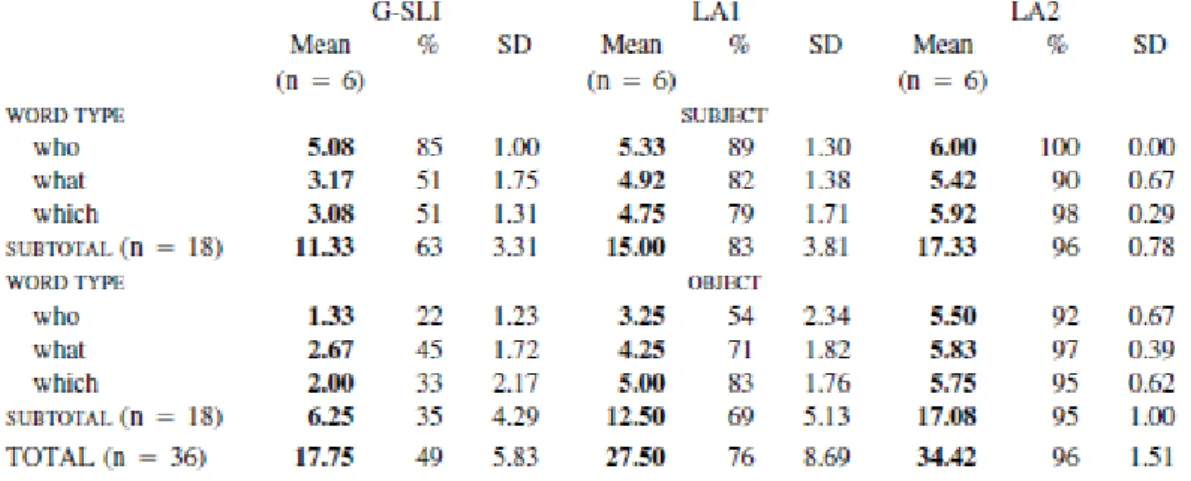
Once they have all the data collected, they observe that the TD children properly produce 70% of wh-words for subject and object questions. However, this percentage is reduced to
less than 51% in the case of SLI children with the exception of who that is properly
produced in 80% of the cases. The production of the different groups and wh-words is
represented in table 3.
Table 3. Correct production for the three participants groups
Table 3 depicts the mean average of correctness, of both subject and object wh-questions.
This table portrays the accurate production of wh-questions looking at different issues. The
results are compiled separately according to the wh-word (i.e. who, what, and which), the
child group (i.e. G-SLI, LA1, and LA2), and the type of wh-question (i.e. subject or object).
Moreover, with this study they also prove that there is a difference in the production of the two control groups, as the production of the older group is clearly better. Furthermore, Van der Lely and Battell (2010) findings lend support to the RDDR hypothesis and conclude that G-SLI participants' performance is worse than the one of the two other control groups. They fail in the proper production of wh-movement and T/Q feature movement.
Additionally, this difference in the performance is highly remarkable when it deals with the production of what and which, but it is slightly so in the case of who. This fact indicates
that G-SLI children find less problematic the use of who over the rest of words.
So far, these previous studies suggest several issues that are relevant for this dissertation: firstly, it is clear that there is an order of acquisition regarding wh-words: wh-pronominals
(what, when, and who), followed by wh-sententials (when, why and how), followed by
wh-adjectivals (which and whose). Secondly, TD and SLI children show a preference for some
wh-words over others, for instance; they prefer what over when. Lastly, and in general
terms, it is evident that SLI children start producing wh-questions later than TD children.
3.3. Acquisition and production of wh-relative clauses
Two studies are reviewed here: one on TD children (Shcuele and Dykes 2005) and one on SLI children (Sheldon 1974).
3.3.1. Acquisition of wh-relative clauses by TD children
The analysis of wh-relative clauses in the production of TD children has been previously
Lust 1980). They come to the conclusion that the first instances of wh-relative clauses
produced by children usually do not have an explicit wh-word, as in (43), or tend to
overgeneralize the use of what, as in example (44) (O'Grady 1997).
(43) Look it [ _ Mommy have on] (29 months)
(44) Look-a [what I made] (28 months) (O'Grady 1997)
Sheldon (1974) distinguishes between two types of wh-relative clauses: the self-embedded
wh-relative clauses, as in (45), and the right branching wh-relative clauses, as in (46). The
former type of wh-relative clauses seems to be harder for children since there is an
interruption of the main clause, and consequently children need to memorize part of it. Thus, as in (45), the wh-pronoun which functions as the object of CP2. However, this fact is not seen in right branching wh-relative clauses, as in (46), which in general terms are
considered the easiest ones since they do not interrupt the main clause.
(45)[I will read the memo [which Pat hopes[ that John will send you]CP3]CP2]CP1 (46)[We'll go to my parent's place [when you're ready]CP2]CP1
(Quirk et al., 1985:1038,1298)
Consequently, Sheldon remarks that if children's acquisition abilities mainly rely on short term memory, they find problematic the acquisition of wh-relative clauses as embedded
ones, since these require a longer term memory.
Additionally, Sheldon points out that in order to observe children's attitude towards these syntactic structures, information about how they understand wh-relative clauses must be
collected. Hence, his main objectives are to prove what information is needed and to demonstrate the statements established by three hypotheses (the Interruption Hypothesis,
the Word Order Hypothesis, and the Parallel Function Hypothesis) about the acquisition of
wh-relative clauses.
Sheldon explains that the first hypothesis, the Interruption Hypothesis, predicts that
than in that of object wh-relatives, as in (48). This is because in subject wh-relative clauses,
as in (47), the wh-relative clause (CP2) interrupts the main clause (CP1). Conversely, in the case of object wh-relative clauses, as in (48), this does not happen, as the wh-relative clause
appears at the end of the sentence.
(47)[The boy [who hit the girl]CP2 saw the man]CP1
(48)[The man saw the boy [who hit the girl]CP2]CP1 (Sheldon, 1974:274)
Meanwhile, the Word Order hypothesis establishes that those clauses in which the
relativized constituent is the subject DP and not the object DP are easier to acquire. Lastly, Sheldon explains that the Parallel Function Hypothesis asserts that children infer that the
relative pronoun has the same grammatical function as its antecedent. Therefore, this suggests that those wh-relative clauses in which the antecedent and the relative pronoun
share the same grammatical function are acquired more easily by children, as illustrated in examples (49) and (50).
(49)[The man saw the boy [who the girl hit]CP2]CP1
(50)[The man saw the boy [who hit the girl]CP2]CP1 (Sheldon, 1974:275)
As in (49), both the relative pronoun who and its antecedent the boy have the same
grammatical function, the object of their corresponding clauses. However, in example (50), the relative pronoun who and its co-referential DP the boy do not share the grammatical
function, as the former is the subject of CP2, whereas the latter is the object of CP1.
Sheldon's study is based on a toy-manipulation task in which different types of wh-relative
After carrying out the study, Sheldon concludes that the difference in the production of the two types of wh-relative clauses is not significant. He finds out that neither the Interruption
Hypothesis nor the Word Order Hypothesis are in line with the results. Conversely, this
study lends support to the Parallel Function Hypothesis in which the relative pronoun and
the antecedent should have the same grammatical function. The last conclusion he reaches is that for children coordinate sentences are easier than wh-relative clauses which is
expected given that subordination is syntactically more complex than coordination.
Additionally, as Guasti (2002) suggests, other studies claim that the knowledge children have about wh-relative clauses is limited and that the comprehension of these structures is
delayed until children are at least 6 years old.
3.3.2. Acquisition of wh-relative clauses by SLI children
Schuele and Dykes (2005) depart from the idea that there is not enough information about how SLI children acquire and produce complex syntactic structures. In their study, they classify as complex syntax the use of infinitive clauses, wh-relative clauses, and
subordinate clauses. However, only those issues concerned with the relative ones are explained as the others are not targeted in this dissertation.
They base their research on Leonard's (1995) study and argue that complex grammatical structures appear both in TD and SLI children when they have the same MLU rates. However, SLI children show several deficiencies in the accurate production of complex syntax that are not found in their TD MLU-matched partners.
Schuele and Dykes (2005) with their study want to support two ideas: firstly, that SLI children do acquire certain complex grammatical constructions although later than their corresponding peers; and secondly, that some requirements of wh-relative clauses seem to
Their research consists of a longitudinal study of one single SLI child. The data they use are collected from a database and they use 12 language samples from the same child aged from 3;3.0 to 7;10.0. The data are spontaneous, since the study is based on conversations between the investigator and the child and, on some occasions, on interactions between the child and the different family members. As the child gets older the topics of the conversations change accordingly to his age, which allows for more variety in his production.
According to the results, they prove that the child was 4;8.0 (MLU of 3.12) when he used the first wh-relative clause. Moreover, by analyzing the results, they find out that the
acquisition and production of wh-relative clauses vary depending on their type. They affirm
that subject wh-relative clauses, as in (51), are the first ones to appear, followed by nominal
wh-relative clauses, as in (52), while the other wh-relative clause type, for instance, adjunct wh-relative clauses, as in (53), appear the latest.
(51)[The man[ who crashed the car]CP2 is in jail]CP1 (52)[The man [who Mary invited]CP2 is here]CP1
(53)[I wrecked the car the time [when I went to the store]CP2]CP1
(Schuele and Dykes, 2005:303)
All in all, they conclude that for this child the acquisition of wh-relative clauses (seen as an
instance of complex syntax) happens late, an issue that may be linked to his language impairment. Nevertheless, this needs more research since this study is just based on one single case; although as they point out there are some other studies dealing with morphosyntactic difficulties in SLI children which reach similar conclusions (i.e. Leonard 1998).
In short, these studies basically support two issues: firstly, that both TD and SLI children experience problems in the acquisition of wh-relative clauses as they are an instance of
to be easier than others. TD children prefer right branching wh-relative clauses and those in
which the relative pronoun and the antecedent have the same grammatical function. In the case of the SLI children, they clearly prefer subject wh-relative clauses.
PURPOSE OF THE STUDY AND RESEARCH QUESTIONS
This dissertation deals with the production of what and when by TD and SLI English
children when their MLUs are similar, that is, with MLU-matched TD and SLI children. Moreover, it aims to present the distribution of these wh-words in relative and in
interrogative sentences. Furthermore, a comparison of these issues in regard to two different types of data, spontaneous and narrative, is carried out, too. Taking these targets into account as well as the review of previous works conducted in the previous section, this one presents the research questions that have guided this dissertation.
Three research question sets are formulated and the three offer a double comparison between child groups (TD versus SLI) and data type (spontaneous versus narrative).
4.1. Question set 1: general performance
This first question set has to do with the collapsed production of the two wh-words
considered in this dissertation (what and when), that is, without making a distinction
between the two of them.
4.1.1. Research question 1: production of wh-words
Are there any relevant differences in the production of wh-words by the TD and the SLI
4.1.2. Research question 2: production of wh-words per data type
In this second research question, the target is to see whether the production of what and
when varies in relation to the data type (i.e. spontaneous versus narrative data). Since
previous studies have not compared between spontaneous and narrative data, the main objective is to see what happens when the type of data is taken into account.
4.2.Question set 2: performance per wh-type
4.2.1. Research question 3: production of what and when
Regarding the studies done by Bloom et al. (1982) and Rowland et al. (2003), TD children
acquire and produce what earlier than when. Hence, is there any difference in the amount of
production of what and when by the TD children and by the SLI participants in this study as
well? Furthermore, is there any correlation between wh-word (i.e. what or when) and
participant type (i.e. TD or SLI)?
4.2.2. Research question 4: production of what and when per data type
The previous research question, studies what happens when the data are collapsed. But, is there any difference when the data are analyzed separately per type (i.e. spontaneous versus
narrative data)? Do the results differ or do similar results arise?
4.3. Question set 3: performance per sentence-type
4.3.1. Research question 5: distribution of cases across sentence-type
As previous studies (Schuele and Dykes 2005, and Leonard 1995) point out, the acquisition and production of wh-relative clauses, understood as complex syntax, seem to be harder not
So, do they produce what and when more in wh-relative clauses or in wh-questions? Is there
any specific correlation between target wh-words (i.e. what and when) and sentence type
(i.e. wh-relative clauses and interrogative questions) by the TD children and by the SLI
children? Do they present the same preference in their productions?
4.3.2. Research question 6: distribution of cases across sentence and data type
Following what has been addressed in research questions 2 and 4, this last one deals with the data separated per sentence and data types. Therefore, would the TD and the SLI children rather use these wh-words in wh-questions and wh-relative clauses and in
spontaneous and narrative data? Is there any relevant variation across sentence and data types?
DATA METHODOLOGY
This section of the dissertation, deals with the process followed in order to obtain the required data for the present study. Three main subsections are included. In the first subsection, the data selection process is explained, in relation to the corpora and participants chosen, and the MLU-matching criteria followed. The second subsection contains an explanation on how the data are extracted in regard to the Child Language Analysis (CLAN) programs used. Lastly, the criteria follow to select and classify the pertinent data for this study are presented.
5.1. Data selection
The data used for this study have been extracted from three different corpora. All of them belong to the Clinical-MOR folder which includes data of atypically developed children with specific disorders as well as typically developed ones to serve as a point of comparison. From Clinical-MOR, three corpora haven been used which include the two different groups of children to be examined: the ENNI corpus, from which 24 participants have been selected; the Conti-Ramsden 3, from which 4 children have been chosen; and another 72 children from the Conti- Ramsden 4 corpus. From the first two corpora, only SLI children have been selected, whereas from the Conti-Ramsden 4 corpus both TD (i.e. 50 children) and SLI participants (i.e. 22) have been picked.
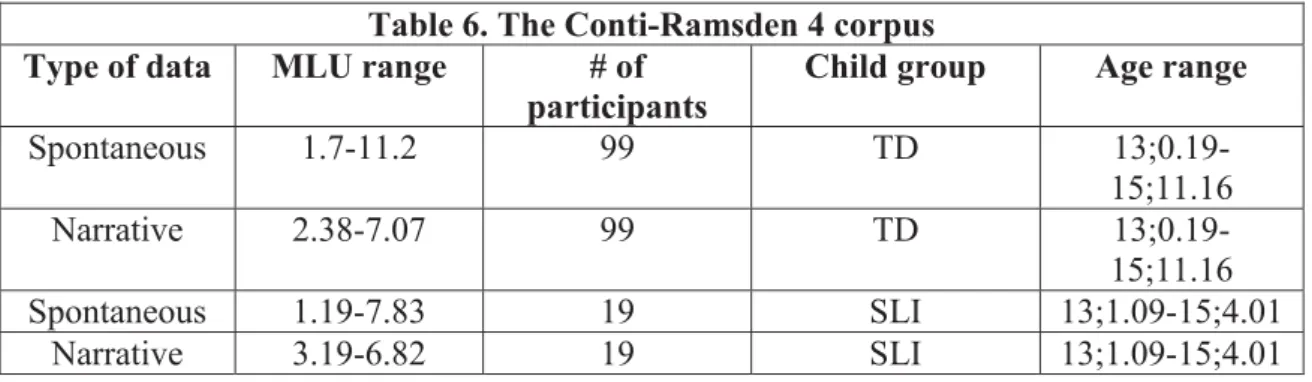
Besides, for all the corpora the selection criteria which have been taken into account are the following: the type of data (i.e. narrative and spontaneous), the number of participants, the child group (i.e. TD and SLI), the age range, and the MLU range. The relevant properties are represented in tables 4 to 6 below.
Table 4. The ENNI corpus
Type of data MLU range # of participants Child group Age range
Narrative 1.08-4.43 77 SLI 4;2.4-9;9.22
Narrative --- 300 TD 4;0.0-9;11.0
As table 4 shows, the ENNI corpus contains the narrative data of 77 impaired children and 300 control, all monolingual English speakers from Canada. From this corpus, only the impaired children has been analyzed. This group comprises 77 children aged between 4;2.4 and 9;9.22. Although biological gender is not a factor to be considered, there are 48 boys and 29 girls. Additionally, their MLU range is from 1.08 to 4.43. The data from this corpus are experimental and non-longitudinal, which means that there is just one file per participant. Consequently, the total amount of files taken out from this corpus are 77, although, as it is explained later on, not all them have been finally analyzed.
the level in each one). Once each child is assigned to a group, a different set of pictures is given to them, through which they have to tell an invented story about what they see or appreciate in the pictures.
Table 5. The Conti-Ramsden 3 corpus
Type of data MLU range # of
participants
Child group Age range
Spontaneous 1.00-4.34 4 SLI 2;6.0-5;0.0
As in table 5, the Conti-Ramsden 3 corpus contains spontaneous data from 4 children from a longitudinal study. These 4 participants are English speakers from the UK, aged between 2;6.0 and 4;0.0 with and MLU range from 1.06 to 2.85. This corpus has between 22 and 23 files per participant. However, for this dissertation, only one file has been selected from each child, according to the MLU-matched criterion.
The 4 children are examined through a period of 16 months, and during this period of time, since the beginning of the study, they are attending nursery schools. However, the study is carried out at their homes, in a silent place, while the participants are playing generally with their mothers, although at some point other relatives may appear.
Table 6. The Conti-Ramsden 4 corpus
Type of data MLU range # of
participants
Child group Age range
Spontaneous 1.7-11.2 99 TD
13;0.19-15;11.16
Narrative 2.38-7.07 99 TD
13;0.19-15;11.16
Spontaneous 1.19-7.83 19 SLI 13;1.09-15;4.01
Narrative 3.19-6.82 19 SLI 13;1.09-15;4.01
This corpus is the only one used in order to extract data from TD children, although the data from SLI participants are analyzed, too. All the participants are from the UK and their data are compiled through a storytelling method and a conversational program.
In short, these four corpora have been selected in order to satisfy the necessities of the study. As it can be observed, one corpus has been used to obtain data from TD children (i.e. Conti-Ramsden 4), whereas in order to extract SLI data three corpora have been needed (i.e. ENNIN, Conti-Ramsden 3, Conti-Ramsden 4).
5.2. Participants' selection
As briefly mentioned above, not all the children from the four corpora have been used for the analysis of this study. Thus, this subsection includes information on how the participants have been selected and the criteria used.
The first aspect that has been taken into account is their production. The four corpora used have a great number of files and participants. Therefore, the first step in the participants' selection has been to see who produces the relevant wh-words, what and when. Afterwards,
all those participants who do not present at least one instance of what or when have been
automatically discarded.
Once all the participants who produce these two wh-words have been selected, their MLUs
each TD-SLI pair, a comparison of children that are at the same developmental stage is done.
Additionally, as there are more TD children who produce either what or when or both, the
number of SLI children has been taken into account when performing the MLU-matching criterion. This means, that there are as many TD peers as SLI children who produce these
wh-words, and not the other way around.
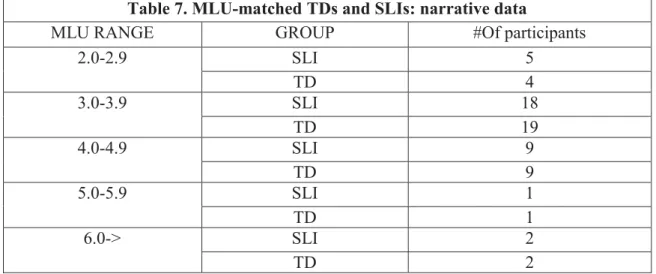
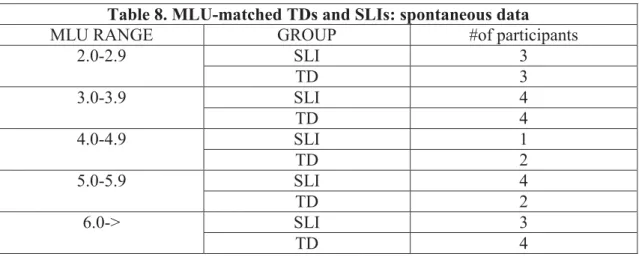
After these criteria were applied, as tables 7 and 8 show, two classifications have been done. On the one hand, and in the case of narrative data, 35 SLIs and their 35 MLU-matched TDs have been selected. On the other hand, and in the case of spontaneous data, 15 SLIs and their corresponding 15 MLU-matched TDs have been picked out. All in all, a total amount of 100 children have been analyzed.
Table 7. MLU-matched TDs and SLIs: narrative data
MLU RANGE GROUP #Of participants
2.0-2.9 SLI 5
TD 4
3.0-3.9 SLI 18
TD 19
4.0-4.9 SLI 9
TD 9
5.0-5.9 SLI 1
TD 1
6.0-> SLI 2
TD 2
Table 8. MLU-matched TDs and SLIs: spontaneous data
MLU RANGE GROUP #of participants
2.0-2.9 SLI 3
TD 3
3.0-3.9 SLI 4
TD 4
4.0-4.9 SLI 1
TD 2
5.0-5.9 SLI 4
TD 2
6.0-> SLI 3
TD 4
In this case, table 8 conveys exactly the same information as table 7, but with regards to spontaneous data. Additionally, as it can be observed in both tables (table 7 and table 8), the MLU stages cover a wide period (from MLU 2 to MLU 6 and above). This is useful to depict at the end of the analysis how their production changes when their MLUs are higher.
In short, two main points have been taken into account, firstly whether they produce what
and when or not, and, secondly from those who present some instances of these wh-words,
their MLUs have been extracted and matched between the two child groups. Hence, only those whose MLUs can be matched with a child from the opposite group have been selected for the analysis.
Additionally, place of origin has not been taken into account, that is, where they came from, as long as their mother tongue was English; considering that the property that is being studied is not affected by regional conditions. So, whether their English is British or American has no further relevance for the present analysis.
5.3. Data extraction
out different analyses of the data available in CHILDES (MacWhinney 2000). So, this subsection describes each CLAN program used: FREQ, MLU, and KWAL.
Each of the programs just mentioned has a specific function. Therefore, each one has been used in order to obtain specific information from the data. Initially, who produces the wh
-words what and when needed to be determined. Thus, in order to obtain that information,
the CLAN program FREQ has been used. This program displays the number of cases in
which the element in question appears in each file. Hence, in this case, by using FREQ the
number of what and when instances in each child’s production has been obtained.
Besides, it is important to highlight that at the beginning of the whole process, the program
FREQ was used without narrowing the search to what and when. Rather, it was used to see
all the instances of all wh-words, including how. Hence, once the number of instances of
each wh-word was obtained, to focus exclusively on the two most used, in this case, what
and when, was decided. Thereby, the rest of the analysis was restricted to just these two wh
-words. In order to run these programs, a syntax line, based on what it was expected to extract was introduced. Here, the following ones were used: <freq +t*CHI +s"what*" @>
to search for the number of what cases produced; and <freq +t*CHI +s"when*" @> for the
cases of the wh-word when.
Subsequently, in order to classify the participants according to their MLUs, these were calculated. Hence, the MLU program which provides the rate of morphemes or words that a
child produces per utterance was used. In this case, the corresponding syntax line introduced was <mlu +t*CHI @> which calculates the average number of morphemes per
utterance.
Lastly, in order to determine whether these what and when instances are relativizers or
interrogative clause markers, the context in which they appear needs to be output. Therefore, the KWAL program, which gives the context of each instance, was used.