FACULTAD de FILOSOFÍA Y LETRAS
DEPARTAMENTO de FILOLOGÍA INGLESA
Grado en Estudios Ingleses
TRABAJO DE FIN DE GRADO
Medical Translation English-Spanish. Theory, Difficulties
and Translation Proposal for a Research Article
Diego Jiménez Calvo
Tutor: Celsa Dapía Ferreiro
ABSTRACT
The current era is characterized by the exchange of information between people around the world. In this way, medical translation is one of the essential tasks in the area of Health Sciences. For this reason, the purpose of this undergraduate dissertation is to study the field of medical translation by explaining the difficulties and translation processes applied in a practical case: a research article. The project uses the previous analysis of the text as a fundamental tool for the translation of scientific texts, as well as parallel texts in English and Spanish. The result of this project provides answers to several relevant questions that must be taken into account during the translation of medical texts. Finally, it can be observed how previous analysis and translation procedures are crucial in the proposed translation of the article Surgery for Drug-Resistant Epilepsy in Children.
Keywords: Languages for Specific Purposes (LSP), research article, translation problems, specialized terminology, English/Spanish, scientific language.
RESUMEN
La época actual esta caracterizada por el intercambio de información entre personas de todo el mundo. De este modo, la traducción médica es una de las tareas más importantes en el área de las ciencias de la salud. Por este motivo, el propósito de este trabajo de fin de grado es analizar el campo de la traducción médica exponiendo las dificultades y los procesos de traducción aplicados en un caso práctico: un artículo de investigación. Este trabajo utiliza el análisis previo del texto como herramienta básica para la traducción de textos científicos, así como textos paralelos en inglés y en español. El resultado de este proyecto aporta respuestas a varias preguntas relevantes que hay que tener en cuenta durante la traducción de textos médicos. Finalmente, el lector podrá comprobar cómo los análisis previos y los procedimientos de traducción son cruciales en la propuesta de traducción del artículo Surgery for Drug-Resistant Epilepsy in Children.
TABLE OF CONTENTS
INTRODUCTION……….1
CHAPTER 1: LANGUAGES FOR SPECIFIC PURPOSES (LSP)……….………3
1.1.How to identify a specialized text………..5
1.1.1.Criteria for the classification of specialized texts………6
1.1.1.1.Jennifer Pearson’s classification………7
1.1.1.2.Susanne Göpferich’s classification………8
1.2.Medical translation……….9
1.2.1.Terminology in medical translation………….………..…11
1.2.2.The process of translating………..13
1.2.3.The difficulties in medical translation……….………..15
1.2.3.1.Differences in use………..….…..16
1.2.3.2.Terms of common language that acquire a new meaning…17 1.2.3.3.Pure terminological divergences……….….18
1.2.3.3.1.Problems with prefixes and suffixes…………18
1.2.3.3.2.Problems with synonymy………19
1.2.3.3.3.Problems with eponymy………..19
1.2.3.3.4.Problems with acronyms……….20
CHAPTER 2: PREVIOUS ANALYSIS……….……….23
2.1.Presentation of the journal’s website: NEJM….………..…23
2.2.Description of the selected text………24
2.2.1.Structure of the text……….………..25
2.2.2.Communicative situation…….………..26
2.2.3.Classifications of the text………..27
CHAPTER 3: TRANSLATION COMMENTS…………..……….29
3.1.Terminology…………..………..29
3.2.Translation procedures……..………..32
3.3.Translating problems…..….………33
CONCLUSION………..….………37
LIST OF FIGURES
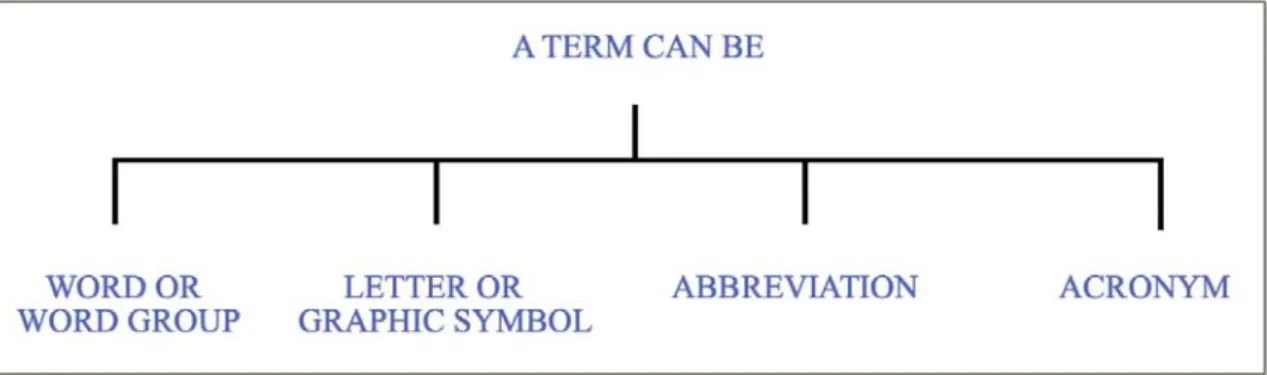
Figure 1. Classification of the different types of terms..………11
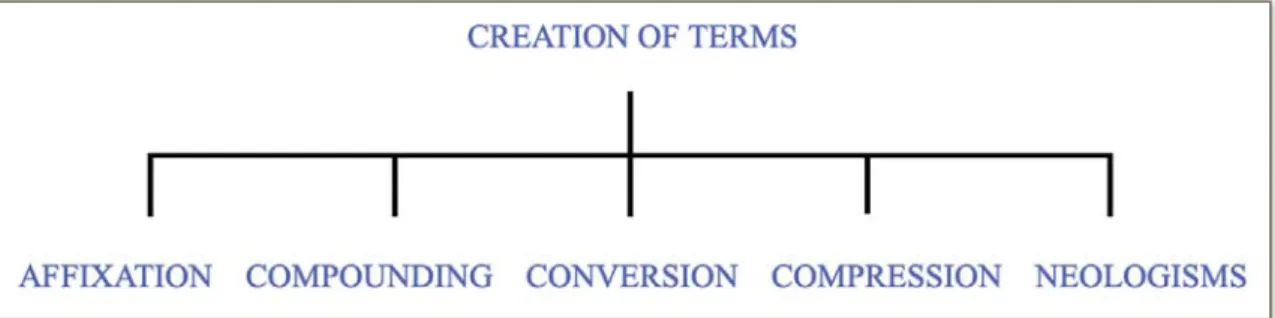
Figure 2. Ways of modification of existing sources and creation of terms………12
LIST OF TABLES Table 1. Comparison of erudite terms and popular extraction in English with its equivalent in Spanish……….………..16
Table 2. Examples of translations of adjectives………..17
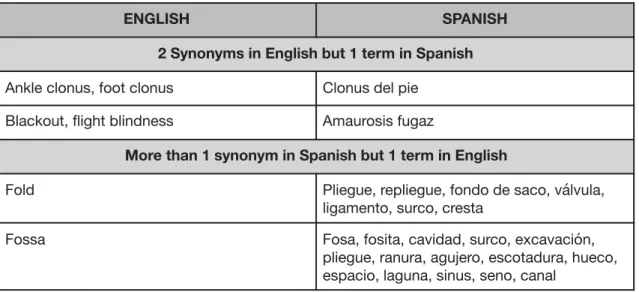
Table 3. Examples of synonyms in both English and Spanish………19
Table 4. Examples of acronyms in both English and Spanish………21
INTRODUCTION
Throughout the ages, translation has allowed the transfer of information between peoples whose languages are different. The work of the translators has been and is fundamental to carry out the task of translation. However, perhaps the necessary effort has not been made in the field of scientific and technical translations. Even so, much of the progress in medicine is thanks to the translation of scientific texts. Thanks to medical translation, many researchers and doctors can transmit their knowledge and medical research to many other professionals around the world. This whole process has contributed to the global improvement of medicine.
The constant need for significant advances in medicine that can save and improve the lives of many people around the world is the main reason that has led me to carry out this project. Medical translation is very complicated, but it can help make significant advances in medicine. Since English is the language considered as "universal" for medical research, I considered the translation of one of these texts into Spanish, which is the second most spoken language in the world.
This project aims to disclose some of the most relevant theoretical aspects of medical translation, but also to prove these aspects in an applied way. After shuffling several options, I considered that the best example of a useful and relevant medical translation should be a research article, as it can be helpful to researchers and patients in different parts of the world. The project does not only include purely theoretical aspects but also includes some of the problems that translators of medical texts can encounter when carrying out their work.
could arise in the translation process. Lastly, I decided to comment on some relevant aspects deriving from the translation.
CHAPTER 1: LANGUAGES FOR SPECIFIC PURPOSES (LSP)
According to Britt-Louise Gunnarsson, “language for special or specific purposes, LSP, is the traditional term for the various linguistic variants used in professional
settings” (105). The history of languages for specific purposes begins in the interest in the description of different sublanguages from different fields.
The difference between general language (which is the language used every day by everybody in the world) and LSP, language for specific purposes (which is the language used by the members of a particular subject field, using specific terminology and other specific linguistic means), has not an absolute borderline; they are interrelated. The main difference between them is the use of terminology, but they share syntax and grammatical structures, and also many words.
Another significant difference between general language and language for specific purposes resides on the particular circumstances in which they are used. LSPs are used in particular teaching circumstances and particular language fields.
On the one hand, LSPs make particular use of the vocabulary and use different techniques depending on the field in which it is used. Meanwhile, general language uses a more generic vocabulary adapted to more frequent applications, and it is also the joint base from which all sublanguages derive. According to Lehrberger, the following six factors may help to define a sublanguage or specialized language (19):
1. Specific theme.
2. Lexical, syntactic, and semantic restrictions.
3. "Anomalous" grammatical rules.
4. High frequency of appearance of certain constructions.
6. Use of specific symbols.
The leading manner of dividing the study of LSPs is into two differentiated branches. On the one hand, the one referred to language needs in education and the acquisition of language; the use of these sublanguages is applied for foreign language teaching and the training of specific languages for particular use in a job or field. On the other hand, the one referred to research in the variation of language along different particular fields of language; this application concentrates on its stylistic features, genres, and lexical information. This application is used to build new dictionaries and glossaries, to language education, and translation.
LSP has different approaches within it; one of them is English for specific purposes (ESP). Hutchinson and Waters define English for specific purposes (ESP) “not as any particular language product but as an approach to language teaching which is directed by specific and apparent reasons for learning” (19).
After explaining what LSP is and what approaches exist within it, it is necessary to know when does general language transform into medical language. For this business, language for specific purposes (LSP) must move to English for medical purposes (EMP). According to John Maher, “the term ‘English for Medical Purposes (EMP)’ refers to the teaching of English for doctors, nurses, and other personnel in the medical professions” (112).
1.1. How to identify a specialized text
The first question to take into account when trying to identify a specialized text is: what is a specialized text? A specialized text is a text written using specialized or specific terminology dealing with a specific purpose. It can contain non-verbal elements, images, and data.
One of the problems faced by linguists, translators, and other people in charge of working with specialized texts is the identification of these texts as such. In any text, there are always some characteristics, elements, or features that allow professionals to characterize a text as specialized.
The first elements to take into account should be the sender/s and the recipient/s. The sender is the individual who initiates a message in order to communicate something, whether in a written, spoken, or gestural manner. The recipient or audience is the other party; it is the individual or group of individuals that respond to the sender. In specialized texts, the interlocutors will probably be professionals in the field of knowledge that is being addressed in the text.
The organization and structure of the text should also be essential aspects to take into account. The structure of the text will be essential when identifying the type of text. For example, if the parts of the text are purpose, materials and methods, results, and conclusion, it will be quite clear that the text is a research article.
María Teresa Cabré states that it is essential to take into account the characteristics of specialized texts from three different points of view: textual, lexical, and functional (29). From the textual point of view, specialized texts are characterized by a standard configuration which includes everything that forms the text, both externally (e.g., issuer, receiver, communicative situation, etc.) and internally (e.g., structure, terminology, etc.), and it is used to differentiate those texts from other types of texts (e.g., journalistic, religious, literary, advertising, etc.). Besides, these texts are defined by a particular style known as scientific-technical style, which can undergo variations depending on the thematics (e.g., medicine, engineering, aeronautics, naval, etc.). The scientific-technical style possesses three fundamental qualities: impersonality, objectivity, and accuracy or precision (Cabré 29).
From the lexical point of view, specialized texts contain a dense terminology whose frequency increases and decreases depending on the degree of specialization. Much of the specialization of a text depends on its function and the receivers. Moreover, from the functional point of view, the different specialized languages have also common characteristics (Cabré 29). Specialized texts can be more or less precise, concise, systematic, objective, and impersonal depending on different variables: the theme, dominant function, recipients, field of communication, or communication strategy.
1.1.1. Criteria for the classification of specialized texts
1.1.1.1. Jennifer Pearson’s classification
The purpose of specialized texts is to communicate a message, but a problem appears from this purpose: the skill level of a person who randomly searches for information on the internet differs from that of a surgery apprentice. For this reason, to classify medical texts according to the level of sender and recipient is crucial. This classification is part of the external criteria, and according to Jennifer Pearson, it is the division which classifies the texts in different categories according to the skill level of the sender and the recipient (52).
The first category in this classification is expert to expert communicative setting: this type of texts contains a ‘highly specialized vocabulary’. Both the sender and the recipient must share the same level of expertise and common language. Each participant understands every term and phrase, and speakers agree to understand and use specific terminology. It is common to find this category among experts in academic books, research papers, laboratory reports, case reports, legal documents, and in any other paper in which an expert writes to another expert.
The second category is known as an expert to initiates. This type of communication takes place when an expert working in a particular field addresses others in the same field but with a different level of expertise, which is usually lower or just different. Generally, in these texts, the expert uses the same terminology but explaining some terms which may believe as unknown by the reader. The term density in this kind of texts tends to be lower than in the first category. The expert aims to increase the knowledge of the reader, whether it is a student or a person from the same area but outside of their specialty group.
of texts is common to popular scientific journals, newspaper sections on health, and technology reviews.
The fourth and last category is the teacher to pupil communication. It is known as a pupil to the “person who has no prior knowledge of a particular subject field but are required to acquire it for educational or professional purposes” (Pearson 38). The terminology in this category tends to be simple or adapted to the learning process of the student. Some terms are explained, and glossaries support others. The texts belonging to the fourth category are standard for medical students or some branches of science.
1.1.1.2. Susanne Göpferich’s classification
The second type of classification of texts is the internal criteria. It has to do with linguistic characteristics, topic, and style. This classification is made according to Göpferich's classification, which divides the texts into two types: primary and secondary (305-326).
Primary texts type includes juridical-normative texts: standards, patents, laws, or
specifications. The texts that aim to increase the knowledge of people (students or apprentices) belong to this category; they are known as progress-oriented actualizing texts. Other types of primary texts are the didactic-instructive texts, whether they are
theoretical texts (e.g., table of contents, internet texts, etc.), or man/technology
interaction-oriented texts, which are instructions for use, medical leaflets, or manuals.
Finally, dictionaries, glossaries, and encyclopedias are known as compilation texts, and they are included in this primary texts category.
1.2. Medical translation
Medical translation is, as the name suggests, the translation of medical texts. They
usually are complicated to translate due to the full range of types of medicine and their respective specializations. Medical translation is subject to continuous growth in recent years. Besides, medical translation is the oldest and most universal type of translation:
Medical translation may well be the most widespread and oldest form of scientific translation because of the ubiquitousness of human anatomy and physiology, [...] the long, venerable and well-documented history of medicine, and the hitherto uniform
character of the language of medicine (Fischbach 1).
As part of the scientific and technical areas, medical translation includes the interpretation of documentation and computer programs, as well as continuous training on technical issues, clinical records, or market studies, in the fields of pharmaceutical, clinical materials, and health.
The medical sciences encompass an extensive area; for that reason, they are divided into many branches. No clinician can cover them all, hence no translator, even if trained in medicine, can aspire to master all of them.
The language that medical texts use belongs to the framework of the scientific-technical language. Philologists estimate that there are more than half a million medical terms, a language that grows at the same time that science advances. In the case of medical language, the derived words arise mainly from Latin and Greek morphemes, as well as naturalized suffixes according to the target language (Newmark 143). The correctness of the scientific works depends on compliance with the current rules of writing and style, in a text with formal defects the interest of the findings may be diminished.
In the magazine of the EFE health agency; Cristina González, a lexicographer of the Medical Terminology Unit of the Royal National Academy of Medicine -an institution that monitors its proper use-, argues that “medical language has always been more rooted in the common language than other specialized languages.”
Medical language evolves due to the advances in the field of medicine, which gives rise to neologisms. The most common neologisms within a medical text are derived words, placements, eponyms, and acronyms (Congost 37-41). Among the most outstanding characteristics of scientific-technical languages, the search for clarity is crucial. In these languages, the meaning and the signifier of a word have a biunivocal correspondence (Blanco 76).
The primary function of these languages is the referential one. Therefore, the syntactic and textual resources will be focused on getting objective and depersonalized information (Cabré 155). On the one hand, these languages resort to formulas such as description, definition, classification, argumentation, enumeration, reasoning, and calculation, which demonstrate objectivity. On the other hand, it resorts to the use of elements such as verb in the present, the first person plural of courtesy, impersonal formula and noun phrases, which demonstrate impersonality. (Blanco 76).
features should be highlighted, such as its mysterious nature and the fact that users who use these languages are always specialists in the scientific and technical field.
1.2.1. Terminology in medical translation
Terminology is one of the essential aspects of the translation of health sciences but, at the same time, it is the one that can present more problems. Hence, the terminology is a crucial element in the translation of medical texts. To understand this aspect is essential to study the origin of the terms since many of them can raise problems depending on their formation due to their origin.
A term can be defined like any conventional symbol for a concept which consists of articulated sounds or their written representation; a term may be a word or a phrase (a string of words):
Figure 1. Classification of the different types of terms.
Figure 2. Ways of modification of existing sources and creation of terms.
Medical translation is one of the important types of translation since the historical beginning of translation, both because of its importance and because of its difficulty and need for use. For this reason, medical terminology has the purpose of expressing in precise terms the complex concepts and ideas of medicine, but it also aims to unify criteria. Each term must have a unique meaning accepted by the scientific community, thus facilitating the exchange of information at the international level.
Medical terms are generally composed of radicals (root), which is the central part of the term, and supplemented with prefixes and suffixes derived from the Greek and Latin languages. According to Edwin Saldaña Ambulodegui, “los principales procesos de formación de nuevas palabras son por Derivación y Composición” (2).
The terms coming from derivations can be produced by:
- Prefixes: use Greek and Latin prefixes.
- Suffixes: also called progressive, used to form nouns and verbs.
- Parasynthetic: consists in the simultaneous use in a same word of a prefix and a suffix.
The compound terms can be:
- By juxtaposition: the words are joined with or without a script, without any of them suffering any modification.
Most medical terms can be broken down into two or more parts, which are:
- Root: is the primitive nuclear element of the word that prints its meaning or central idea.
- Morpheme: is the part of the word devoid of suffixes, it can be the root itself or be linked to another element.
- Prefixes: elements or particles that precede the radical by changing its meaning. Most are prepositions or adverbs.
- Suffixes: element or particles that are postponed to the radical forming derivations of the same word. They can be nominal (nouns and adjectives) or verbal.
- Defense: elements at the end of the word indicative of a nominal inflection (gender, number) or verbal (mode, time, number, person, etc.).
1.2.2. The process of translating
Eugene A. Nida and Charles R. Taber are two recognized linguists that affirm translation consists in “reproducing in the receptor language (TL) the closest natural equivalent of the source language (SL) message, first in terms of meaning and secondly in terms of style” (12).
The process of translating specialized medical texts is complex, and it must follow some specific steps. This process needs a high precision due to the importance of medicine and the need to share this information in different languages.
1. Tuning: the process of situating the text and calculate how long it will take the translation.
2. Analysis: the step of reading and understanding the text, looking for dictionaries, encyclopedias, and parallel texts in the source language as an aid for the translation.
3. Understanding: the process of understanding the context and acquire some background knowledge about the field.
4. Terminology: use of documentation such as bilingual dictionaries, bilingual glossaries, and parallel texts to find equivalents in the target text looking for unknown terms.
5. Restructuring (drafting): production of the first draft, the first version of the translation.
6. Checking: revision of the translated text.
7. Discussion: consultation and proofreading while revising the translated text in order to find errors and correct mistakes.
Translators of any text usually follow these steps, but they are also applicable to the translation of medical texts. A good question would be: what are the most critical steps in medical translation? Well, it would not be correct to say that there some steps more critical than others, but some indeed need more attention and a more significant investment in work time.
which the translator will help is relevant to get a target text as similar as possible to the original, but in the target language.
Finally, the recommendation is to let the first version of the translation rest for a few days and then re-read it again. This process will help to correct mistakes and give it an aspect of accuracy and originality, similar to the original text.
1.2.3. The difficulties in medical translation
Medicine is a field of knowledge in continuous scientific and technological development; each year, a large number of new terms are incorporated into its lexicon. Due to the need to quickly update their knowledge, health professionals learn directly in the language of the publication and keep it in daily use, including congresses and articles. The characteristics of the texts and the technical and medical languages will define the difficulties that may appear when translating a text of these characteristics.
The independent translation professional Malcolm Marsh stated in 1999 that 1 when dealing with a medical text, for the translator the most crucial problem, after understanding the original text, lies in the technical terminology. In addition to what could be designated explicitly as medical, it will encompass terms from related disciplines such as biochemistry or microbiology, as well as devices of advanced technology, often used in laboratory experiments or hospital therapeutics.
According to Henri Van Hoof, the main problems of medical translation can be divided into three major groups according to their origin: (i) different uses in the linguistic communities involved, (ii) use of terms of the common language in the medical language by one of the two communities involved, and (iii) pure terminological divergences (147).
Marsh, M. (1999). "Algunas consideraciones sobre la traducción". Approaches to translation [online].
1
1.2.3.1. Differences in use
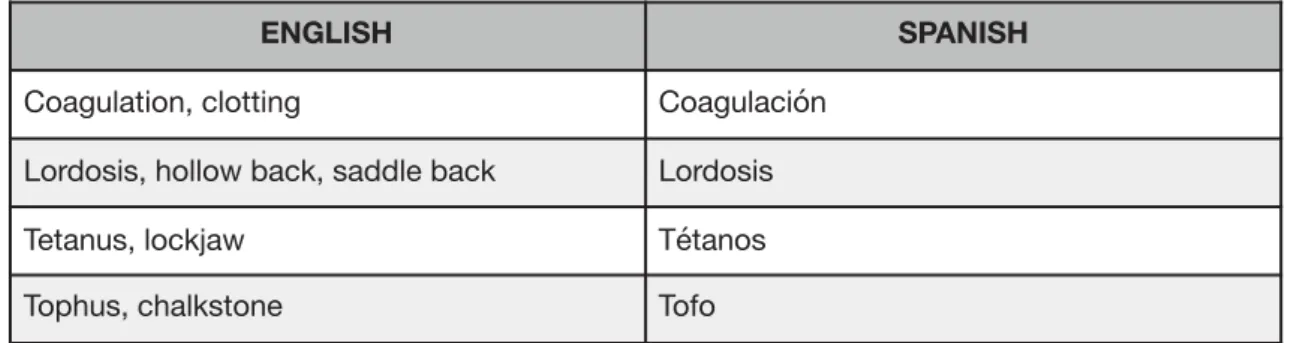
The medical language is based on an essentially erudite lexicon. However, English and Spanish do not use the same erudite lexicon. For many of the commonly used terms, English has the erudite term and a term of popular extraction, or even in some cases, it has only one popular extraction term for all cases (Van Hoof 147). The following table shows some of these examples:
Table 1. Comparison of erudite terms and popular extraction in English with its equivalent in Spanish.
Another case that may present problems for the translator is the derivation of adjectives, which is more erudite in Spanish. In English is provided with endings employing a simple adjectival of the appropriate noun. When a Spanish adjective is translated into English by another adjective, it prefers the less erudite form. Besides, another typical case involves the compound adjectives, which are frequent in medicine and are always of the erudite type in Spanish; they follow this rule less frequently in English (Van Hoof 150). In the following table appear some examples of this translation of adjectives:
ENGLISH SPANISH
Coagulation, clotting Coagulación
Lordosis, hollow back, saddle back Lordosis
Tetanus, lockjaw Tétanos
Tophus, chalkstone Tofo
ENGLISH SPANISH
Taste buds Papilas gustativas
Sweat gland Glándula sudorípara
Table 2. Examples of translations of adjectives.
However, the consequences these differences of English have concerning Spanish for its translation are extensive. When a translator faces a specialized text in medicine, he should be wary of these descriptive terms when translating them, because although Spanish has a descriptive equivalent, it will stumble upon the most erudite tone expected by the Spanish reader. (Van Hoof 151).
1.2.3.2. Terms of common language that acquire a new meaning
Henri Van Hoof states that every language offers examples of terms coming from the general language. These terms of everyday use also acquire new meanings within specialized technical languages, as in the case in question: medical language. The cause of this is the tendency of the English language to use terms of popular extraction (154).
The translation of these words is not as simple as searching it in a dictionary and using its equivalent in the other language. Some words will involve complications when looking for a translation. The difference in the translation of these words depends entirely on the existence of existing differences between one language and another because of their different way of perceiving reality. For instance, the translation of the word history is an example explained in detail below:
- The term history is known as the whole description of the patient before the visit to the doctor. This term must be translated into Spanish as anamnesis or
Bald tongue Lengua depapilada
Chalky gout Gota tofácea
Giant cell sarcoma Sarcoma gigantocelular
Blood-brain barrier Barrera hematoencefálica
antecedentes. The term in English will always be the same, but in Spanish, there will be
two possibilities depending on the context in which it is being used (Van Hoof 154). For example:
a. No hay nada en la anamnesis del paciente para concluir que hay una úlcera.
b. Un paciente con un antecedente dispéptico.
1.2.3.3. Pure terminological divergences
Problems caused by differences in pure terminology are different from those mentioned above. This section points out representative parts that Henri Van Hoof mentions in his book: prefixes and suffixes, synonyms, eponyms, and acronyms (162).
1.2.3.3.1. Problems with prefixes and suffixes
1.2.3.3.2. Problems with synonymy
Medical language can have an almost infinite number of synonyms. Many concepts can be designated employing numerous expressions that may seem equivalent, but that is different depending on the vision they are given: anatomical, historical, or descriptive (Van Hoof 207).
There are several cases in which may exist many synonyms to refer the same concept, but it is necessary to bear in mind that the correct Spanish translation will depend on the context in which they are used. The following table presents some examples of synonyms used both in English and their translation/s into Spanish:
Table 3. Examples of synonyms in both English and Spanish.
1.2.3.3.3. Problems with eponymy
Eponyms of two types exist in medical translation (Van Hoof 212); eponyms of one type are those in which the original proper name gives rise to a common name (addisonism>adisonismo). The other type is those in which the proper name is
ENGLISH SPANISH
2 Synonyms in English but 1 term in Spanish
Ankle clonus, foot clonus Clonus del pie
Blackout, flight blindness Amaurosis fugaz
More than 1 synonym in Spanish but 1 term in English
Fold Pliegue, repliegue, fondo de saco, válvula,
ligamento, surco, cresta
Fossa Fosa, fosita, cavidad, surco, excavación,
maintained (Banti's disease>Banti's disease). Although some of these eponyms have become familiar names, others do not always have an equivalent in their other language. The best way to solve that problem is by looking for valid equivalents in parallel texts.
1.2.3.3.4. Problems with acronyms
The problem of abbreviations covers almost the whole field of medical translation; there are acronyms of thousands of terms composed of two or more words. The aim of these acronyms is not to repeat long terms and to simplify their writing and reading. For instance, in English, the acronym HIV corresponds to the term Human Immunodeficiency Virus, for that reason it will be preferable to use the HIV acronym
repeatedly in a text, instead of repeating the whole term.
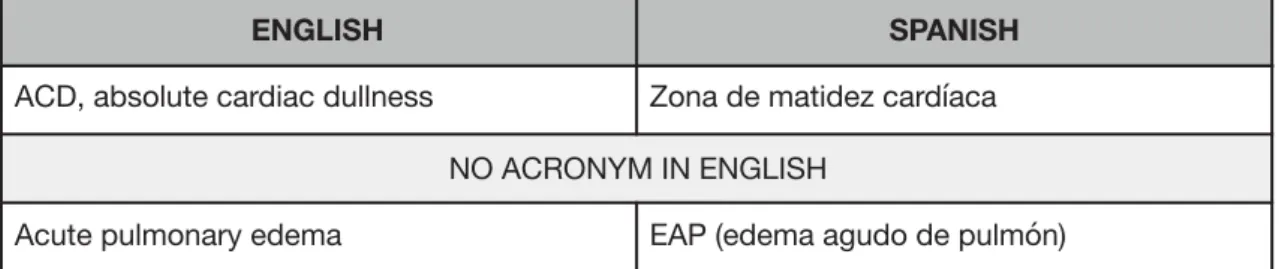
Many of acronyms are translated in the same way from English to Spanish, but many others alter the order of the letters in their acronyms or even can change some of them or entirely in some cases. There are also cases in which the motive of using acronyms is not that they coincide in both languages, but that the language from which the acronym is not original decides to use acronyms in the same way. The following table presents some examples of identical acronyms in both languages, different acronyms in the two languages, and some in which there is an absence of an acronym in one of the languages:
ENGLISH SPANISH
SAME ACRONYM
ADP, adenosi diphosphate ADP, adenosindifosfato
VD, respiratory dead space VD, espacio muerto
MORE THAN ONE ACRONYM IN SPANISH
DNA, deoxyribonucleic acid DNA, ADN, ácido desoxirribonucleico
Table 4. Examples of acronyms in both English and Spanish.
ACD, absolute cardiac dullness Zona de matidez cardíaca
NO ACRONYM IN ENGLISH
Acute pulmonary edema EAP (edema agudo de pulmón)
CHAPTER 2: PREVIOUS ANALYSIS
2.1. Presentation of the journal’s website: The New England Journal of
Medicine
The New England Journal of Medicine (N Engl J Med or NEJM) is a
peer-reviewed medical journal published by the Massachusetts Medical Society. John Collins Warren, M.D. founded this medical journal in 1812, and he would later become president of the Massachusetts Medical Society (in 1832), called The New England Journal of Medicine and Surgery and the Collateral Branches of Science. In 1828 he
joined the Medical Intelligencer (founded in 1823) and became weekly Boston Medical and Surgical Journal. Later on, the Boston Medical and Surgical Journal became the
official organ of the Massachusetts Medical Society in 1914. In 1921 the Medical Society purchased the Boston Medical and Surgical Journal for one dollar. One hundred
years after its creation (in 1928), the medical journal changed to its current name: The New England Journal of Medicine.
There are different reasons why I chose this website in order to find an appropriate text to demonstrate a practical case of medical translation. It is a website which contains a large number of medical texts, articles, research, and other medical publications.
NEJM is one of the medical journal with more readers, but also one of the most cited and influential medical journal in the world. According to the website itself, more than 600,000 people from almost every country read NEJM in printed version and online every week. This website offers free access to a large part of its files once six months have passed since its publication date.
of the original research papers achieve publication in NEJM; more than half originate outside the USA. This tremendous selection was vital when deciding to look for a text within this great database of original files. This exhaustive selection provides a certain degree of security in terms of quality of texts.
The website is very well divided into different sections facilitating the access to texts, and allows a quicker and easier searching depending on the needs of the user. The amount of texts from different authors that this website contains is immense but, thanks to this division and classification within the web, finding what the user needs is a straightforward process. Something relevant to keep in mind is the constant updating of the database and the continuous incorporation of new texts to the website. The database is in constant growth and development, and it is being completed and improved day after day thanks to the constant emergent publications.
Another reason why I extracted the text from NEJM resides on the many options and utilities that the web has for each text. In the same article, the web offers us the possibility of viewing the text online, seeing a table of contents, saving the page, sharing the article, downloading a PDF version, and several other options. All these options make it much easier to handle these texts and work with them.
2.2. Description of the selected text
As already mentioned, this paper aimed to explain the main theoretical issues of the translation of medical texts and apply them to a practical case in which they can be reflected and supported. The selected text was an original research article extracted from the NEJM database and entitled Surgery for Drug-Resistant Epilepsy in Children (2017) (Available at Appendix 1).
the text are defined. This analysis will be crucial when making decisions during the translation process since many of the characteristics will determine how the target text will appear.
Next, I will take the text chosen for the translation proposal to perform an analysis in which the structure of the text, the communicative situation, and the classification of the text will be examined.
A prior aspect that any translator should know before the translation is the genre to which the text belongs. Text genre is a type of written or spoken discourse, and texts are classified into genres based on the intent of the communicator.
2.2.1. Structure of the text
The structure of a text is the first thing the reader sees at a glance; how a text is organized and divided is essential when classifying information in different parts. Taking into account what type of structure the translator faces in a text is a great help both to translate and to divide the work.
journals and it is used in most texts in the scientific and research fields. This structure was considered ideal at the beginning of the year 1900, but it was not until 1950 that the scientific community adopted IMRaD as the conventional structure of this type of texts.
2.2.2. Communicative situation
The communicative situation is the framework in which the communication process takes place; it is a variable framework according to several aspects that may change. Every communicative situation has five essential components: the sender, the recipient, the message, the medium, and the context.
The sender is the creator of the message, in the case of the selected text are the different expert authors of the research article. The recipients are those to whom the text is intended, the chosen text is an expert to expert text, and it is assumed that the reader will also be an expert in the subject of which is investigated. The message contains the subject and the purpose, and its objective is to inform, persuade, or entertain. In the selected text, the message is how neurosurgery improves seizures in children and adolescents with drug-resistant epilepsy. The medium by which the message is transmitted is written, and the context is what surrounds the message, as well as the date on which it is placed; in this case, the publication date is October 26, 2017.
Another decisive aspect of the communicative situation that encompasses all the discourse is the tone, which is also characterized as one of the elements that determine whether it is a specialized discourse or not. As I have mentioned before, the text is a medical research article, so it could be considered as a medical material, which necessarily implies that uses a formal tone and aimed at professionals.
Neurology (RD, BR, Manjari Tripathi), Neurosurgery (PSC), Pediatrics (SS, SG), Biostatistics (MK, SND), Neuro-Radiology (AG), Nuclear Medicine (CSB, Madhavi Tripathi), Psychiatry (RS), and Pathology (CS), from the All India Institute of Medical Sciences of New Delhi, India.
The purpose of this research was to obtain additional data in different randomized trials in order to demonstrate that neurosurgical treatment may improve seizures in children and adolescents with drug-resistant epilepsy. However, the research article is addressed to other professionals in the field, so this text should be placed within a scientific context, more specifically in a research context on neurosurgery and epilepsy.
2.2.3. Classifications of the text
As mentioned in a previous section called “Criteria for classification of specialized texts” (section 1.1 of Chapter 1), there are two main different ways to classify specialized texts. The first criteria, according to Jennifer Pearson, classify the texts in different categories according to the skill level of the sender and the recipient. According to Susanne Göpferich, the second criteria has to do with linguistic characteristics, topic, and style.
According to Pearson’s classification of 1998, the text Surgery for Drug-Resistant Epilepsy in Children is carried out in an expert to expert communicative environment,
something standard to all medical research articles. It is an investigation work, and both the author and the readers share a common specialized language with highly specialized vocabulary, and they are supposed to have the same level of expertise or a very similar one.
CHAPTER 3: TRANSLATION COMMENTS
3.1. Terminology
The objective of my translation proposal, like any other translation, is to be as similar as possible to the original version of the source text. To construct an accurate and correct translation, I considered necessary to take into account two crucial factors. The first one is that the translated version must accurately reflect the literal message that the original text intends to transmit; the second of the factors considers that the text must follow a series of characteristics that are standardized to every research article text in Spanish.
As I mentioned previously, the type of text and the highly specialized terminology that it may contain implies that the translation must be more literal than other types of translations (e.g., Literary translation). For this reason, there are not too many syntactic changes, neither in form and structure, in the translated version (Available at Appendix 2).
For the translation of the text, I have made use of different dictionaries and glossaries, as well as from English and Spanish parallel texts. In order not to make the reading of this project too dull, I decided not to mention every aspect and difficulties presented during translation of the selected text. The section below presents only some striking examples of a minimum relevance in the translation.
The selected text contains a large number of specialized terms. It is not an excessively long text (research article composed of 9 pages), and the terms are quite concentrated and repeated several times in each of the different sections of the article. There is a term that stands out above the others since it is the main topic of the research: drug-resistant epilepsy. In Spanish exist two options to designate this disease, which is
I realized that both were equally valid, but I decided to use farmacorresistente since it helps to understand its meaning.
The second term I consider relevant in the translation of the research article is seizures. In this case, I also found two variants, one was the option of the Spanish term
ataques, and another was convulsiones. Finally, I decided to use the second one,
convulsiones, since I considered it more formal and adequate in the context of the
article.
In the text appear a considerable quantity of complex noun groups. I decided to mention the term long-term video EEG monitoring. Despite their length, which could imply to be more sophisticated, these groups of words have a very literal translation most of the times: monitoreo prolongado con vídeo-EEG. It was a simple task to find the equivalent in Spanish to these terms since they appear in several parallel texts easily accessible in medical texts databases.
The use of letters and graphic symbols is frequent in this type of texts. Letters like P to refer to Power, or T to refer to Teslas, use the same letter in both languages,
something understandable since they are usually part of the International System of Measures.
The tables that appear in the research article use many graphic symbols, such as †, ‡, §, ¶, or ǁ. These symbols are not usually related to a common designation in every
research article. These symbols are frequently used to indicate quotients, summations, or means. For my version of the translation, I decided to use precisely the same symbols to try to avoid unnecessary complexities.
complete form of the Spanish word (año) because it was a short word of only three letters.
The use of acronyms is very extended in the specialized language. Acronyms, as I mentioned above, present one of the difficulties that Henri Van Hoof mentions in his book. In this case, I decided to mention two examples. The first is the abbreviation FLAIR, which corresponds to fluid-attenuated inversion recovery, which in Spanish
uses precisely the same abbreviation although its name is recuperación de la inversión atenuada de fluido, which does not coincide with the initials. The second of the
examples is MRI, whose letters correspond to magnetic resonance imaging. This abbreviation suffers a change of order in Spanish and an omission of the letter I: RM, which designates resonancia magnética.
While terms themselves are essential, it is also how they are created. As mentioned in section 2.1 of Chapter 1, the modes of creating terms are affixation, compounding, conversion, compression, and neologisms. There are several terms created by conversion and compression, but they do not present relative importance in the text or in their translation, as well as the neologisms that usually appear in this type of texts.
In the case of compound terms, I decided to classify them into three types: closed, open, and hyphenated. The terms baseline and malformation would be examples of the first type. The term baseline presented some difficulties, but I considered the best option to use the most frequently repeated term in Spanish parallel texts: período inicial. Instead, the terms like malformation are translated simply and literally: malformación. In the case of the open compound terms, those that are separated by a space but that regularly appear together, I want to mention two important ones: major joints and medical therapy. Thanks to dictionaries and online translators (such as
Merriam-Webster and Linguee), it is easy to find their respective translation: articulaciones principales and tratamiento médico. The last type that I consider important are those
such as intention-to-treat and seizure-free. For the translation of these terms, I consulted parallel texts and concluded that the best options were intención de tratar, and libre de convulsiones, respectively.
Besides, I considered relevant to mention one of the most common types of creation of terms in both English and Spanish: affixation. The use of prefixes and suffixes is another problem that Henri Van Hoof mentions in his book. These prefixes and suffixes frequently have their origin in the Latin or Greek languages. For example, the prefix pre- comes from Latin, and it is used in presurgical and translated as prequirúrgica. The prefix anti-, comes from the Greek language, and means
“opposition,” it is used in antibodies, and it is translated as anticuerpos. Moreover, in the case of suffixes, one relevant suffix in this text is -tomy. It proceeds from the Greek and indicates "cut or incision,” there is an example of it in callosotomy, and I decided to translate it as callosotomía.
3.2. Translation procedures
This section contains some of the procedures followed during the translation of some issues of the text. I decided to focus on the explanation of three specific procedures: transposition, amplification, and explicitation.
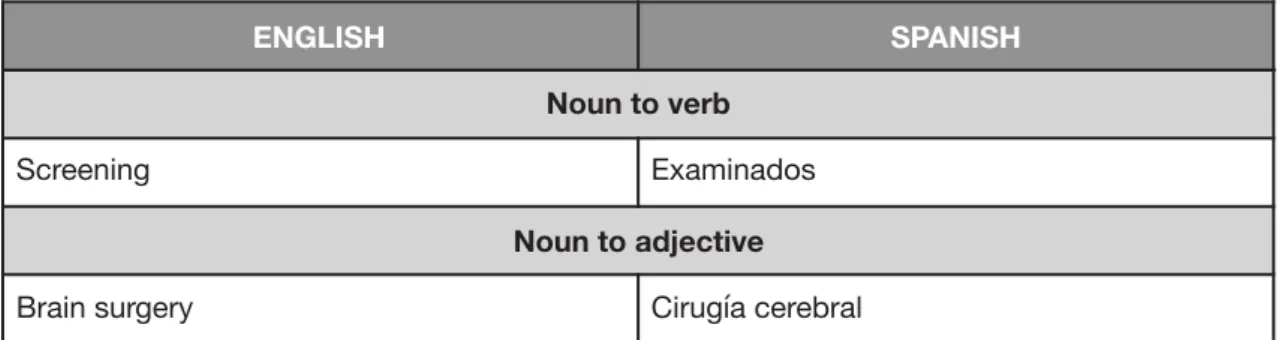
Transpositions are not a particular case of medical translation since they are used in any translation. In the following table appear some of the examples of this procedure that I considered necessary to use for my translation proposal:
ENGLISH SPANISH
Adjective to noun
Written En un escrito
Table 5. Examples of different transpositions made in the translation.
The other procedure that I used is amplification. It is a convenient method in translation, but it is not very necessary in medical texts because the translation must be very literal. Even so, there is a case in which I decided to use it, along with the abbreviation FLAIR, I decided to include the explanation of the acronym that is recuperación de la inversión atenuada de fluido. The reason why I decided to explain
this particular case is the little use of it that I have seen in parallel texts and research articles on other medical topics.
Finally, another of the procedures that are frequently used in English-Spanish translations is explicitation. In my proposal, I did not need to use this method continuously since the source text is quite precise and repetitive. However, I used it in the following example: in the original text, the authors use we reported, while in my translation proposal I decided to use se notificó en este ensayo since I considered it necessary to mention the reference to which the verb was addressed.
3.3. Translating problems
This section aims to comment on some of the difficulties that have arisen during the translation. Some of these problems are common to every medical text, but others are random and may depend on the decisions of the translator.
Noun to verb
Screening Examinados
Noun to adjective
Brain surgery Cirugía cerebral
The section 2.3 of Chapter 1 mentions different problems in medical translation. The problems can be divided into three groups according to their origin: (i) differences in use, (ii) common language terms in the medical language, and (iii) pure thermal divergences (Van Hoof 147). In my case, I considered mentioning just some remarkable things, since to mention absolutely everything would be too tedious for the reader. One of the essential issues is the case in which a word in English has two or more equivalents in Spanish or the contrary. In this particular text, two terms are frequent in medical texts: history and background; these two terms are usually translated into Spanish as antecedentes.
The problem of compound adjectives, which are very frequent in medicine, is another question that I considered relevant. To explain it, I wanted to use one significant example for the content of the text, which I have also used some lines before. The term is drug-resistant epilepsy, in which the adjective modifies the noun epilepsy. In Spanish, this term has two possibilities that I have already mentioned before: epilepsia refractaria or epilepsia farmacorresistente. It seems evident that either of the two
options in Spanish may be more complicated to understand for non-expert readers than the English term, which resembles more commonly used language.
Another frequent problem that appears in this type of translation is synonymy. The translator usually faces the situation in which a word that has two synonyms that are possible equivalents. It is the case of scores, but after reviewing parallel texts, I decided to use the Spanish equivalent puntajes, but it would have been equally valid to use puntuaciones. The same happens in the case of deficits, for which I could have used
deficits, but I decided to choose deficiencias.
A particular case that usually presents some trouble is eponymy, and it can present problems even if they seem simple. In this text, several test names that appear in the text are eponyms. Sometimes, this eponyms cannot be translated literally, but it is not the case in this text, in which eponyms are translated. For example, the eponym Kamat intelligence quotient is translated into Spanish as cociente intelectual
Binet-Kamat.
Another common problem that appears in this type of translation is the use of the passive voice. For example, in the case of are needed, I preferred to use the impersonal form in Spanish: se necesitan. Instead, I translated were assigned also in the passive voice: fueron asignados. The reason for these decisions do not follow strict rules, but it is always appropriate to resemble parallel texts in Spanish.
Prepositional verbs and the absence of articles are two questions that continuously appear in this text, but I do not consider it relevant enough to mention any specific case because they are familiar to every text. I consider mentioning one particular case since it appears in the title and can give rise to confusion. In the proposal text version, I translated Surgery for Drug-Resistant Epilepsy as Cirugía de la epilepsia farmacorresistente. On this occasion, the translator could choose para instead of de la.
Once again, I used parallel texts to make a firm decision on one of the main terms in the research article.
the same way in both parallel texts in English and Spanish. Therefore, in my version of the translation, I decided to use the same original term in Latin.
Some other different problems appeared during the translation of the text. One of the difficulties that encompass the entire translation is a large number of groups of syntactic terms and structures that are repeated continuously. To obtain a higher quality translation, I tried to give the text homogeneity. To achieve this purpose, I used the same similar structures throughout the text and those structures that are common to that type of texts in Spanish.
CONCLUSION
A few months ago, this undergraduate dissertation aimed to compile the most important theoretical aspects of medical translation and to apply them in a translation proposal. The project focuses on the process of translation of a selected specialized medical text and everything that surrounds it. After evaluating which text could be the correct, the decision was to select a research article, since they are the source of future medical advances and, therefore, necessary for Medical Sciences.
The result of a very exhaustive preliminary analysis of the text and its subsequent translation has been as expected. The text needed an almost literal translation, and many of the problems anticipated in the first theoretical section of the paper have appeared during the translation process. During the process of translation, most of the problems that appeared were related to do the specialized terminology because the syntactic structure was quite simple.
Solving every terminological problem was not as easy as expected. The primary strategy to choose the correct Spanish term was the use of parallel texts, but it was not enough. When a long text is translated, the translator acquires a certain intuition for some expressions, even though those expressions could create a complicated doubt at the beginning of the process. In some instances, it was necessary to use that intuition to choose which term matched better within the context.
Another type of strategies was required when translating the text. Some terminology required different procedures that were not anticipated before the process of translation, but that is supposed for the translation of any text. Those strategies were transposition, amplification, and explicitation. They were highly useful in some cases in which I decided to change the order of a sentence or even dividing a sentence into two new sentences in the target language.
section 3.3. These issues had to do with common problems in medical texts, and others depended more on the decisions of the translator. The names of institutions presented unexpected problems, and it was necessary to study them individually. Other cases presented fewer difficulties but needed a specific review, like the terms written in Latin, and some unusual uses of prepositions.
The assistance of parallel texts and dictionaries has been fundamental to carry out the translation proposal. As expected in a translation of this category, it was necessary to use different types of dictionaries, like bilingual medical dictionaries or glossaries. However, dictionaries based on frequent doubts in medical translation have been crucial, such as Diccionario crítico de dudas inglés-español de medicina, by Fernando Navarro. Online translators and regular dictionaries were also needed.
Internet is an excellent resource for translators, but taking into account the tight deadlines that are required, the in-depth study of parallel texts is recommended as a fundamental task in translation. Parallel texts in the source language were necessary when comparing texts and its terminology, but parallel texts in the target language have been more useful to check the frequency of use of a term and its context in doubtful sentences or structures. In some cases, a term had more than one possible equivalent in the target language, and all were equally valid, but it was necessary to choose one. Therefore, the best way of selection was to compare different parallel texts in the target language.
Connecting with the previous question, the debate of how much a translator should influence the translation of a text has been a big issue for many years. In literary texts, it is more common for the translator to have more noticeable participation, and in some texts, the translator and the author are at the same level of importance. On the other hand, medical texts must be translated logically and precisely, and the translator must influence the final version as little as possible.
REFERENCES
Aberastury, Marina et al. "Cirugía de la epilepsia en niños y adolescentes: experiencia de 43 casos." Arch Argent Pediatry, 2016. https://www.sap.org.ar/docs/ publicaciones/archivosarg/2016/v114n5a15.pdf
Aleixandre-Benavent, Rafael et al. “Utilización adecuada del lenguaje médico: principales problemas y soluciones.” Revista Clínica Española, vol. 215, no. 7, 2015, pp. 363-424. https://doi.org/10.1016/j.rce.2015.04.001
Bathgate, Ronald H. A Survey on translation theory. Holland, 1981.
Blanco-Canales, Ana. "Criterios para el análisis, la valoración y la elaboración de materiales didácticos de español como lengua extranjera/segunda lengua para niños y jóvenes.” Revista española de lingüística aplicada, vol. 23, 2010, pp. 71-92. https://dialnet.unirioja.es/servlet/articulo?codigo=3898630
Blumcke, Ingmar. “Histopathological Findings in Brain Tissue Obtained during Epilepsy Surgery.” The New England Journal of Medicine, 26 Oct. 2017. www.nejm.org/doi/full/10.1056/NEJMoa1703784
Cabré, M. Teresa, and Sager, J.C. La Terminología: teoría, metodología y aplicaciones. Barcelona: Empuries, 1993.
Congost, N. Problemas de la traducción técnica: los textos médicos en inglés. Alicante: Universidad de Alicante, 1994.
Dwivedi, Rekha et al. “Surgery for Drug-Resistant Epilepsy in Children.” The New England Journal of Medicine, 26 Oct. 2017. www.nejm.org/doi/full/10.1056/ NEJMoa1615335
Fischbach, Henry. Translation and Medicine. Amsterdam: J. Benjamins, 1998, https:// www.worldcat.org/title/translation-and-medicine/oclc/742367528
Gálová, Dita. Languages for Specific Purposes Searching for Common Solutions. Newcastle: Cambridge Scholars Publishing, 2007.
Hartshorn, Alendia, and Barbara Jobst. “Responsive Brain Stimulation in Epilepsy.” Therapeutic Advances in Chronic Disease, SAGE Publications, July 2018. www.ncbi.nlm.nih.gov/pmc/articles/PMC6009082/
Hutchinson, Tom, and Alan Waters. English for Specific Purposes: A learning-centred approach. Glasgow: Cambridge University Press, 1987.
Kittredge, Richard, and John Lehrberger. Sublanguage: studies of language in restricted semantic domains. Walter de Gruyter, 1982. Berlin, New York.
López-Pisón, J. et al. “Epilepsias Refractarias En Pediatría. Diagnóstico y Tratamiento.” Acta Pediátrica Española, 2007. www.actapediatrica.com/index.php/secciones/ revision/392-epilepsias-refractarias-en-pediatr%C3%ADa-diagn%C3%B3stico-y-tratamiento#.XNA7CpP7TfZ
Maher, John. “English for Medical Purposes.” Language Teaching, vol. 19, no. 2, 1986, pp. 112-145., https://doi.org/10.1017/S0261444800012003
Marsh, Malcom. Algunas consideraciones sobre la traducción médica. Aproximaciones a la traducción. Centro Virtual Cervantes. Instituto Cervantes, 2019. https:// cvc.cervantes.es/lengua/aproximaciones/marsh.htm
Méndez Cendón, Beatriz. "Traducción de Lenguajes Especializados II (Inglés/Español): Ciencia y Técnica." Class Notes. Valladolid: Universidad de Valladolid, 2017-2018.
M e r r i a m - We b s t e r . M e r r i a m - We b s t e r d i c t i o n a r y. 2 0 1 9 . h t t p s : / / www.merriamwebster.com/dictionary/corpus
Navarro, Fernando A. Diccionario crítico de dudas inglés-español de medicina. Madrid: MacGraw-Hill Interamericana, 2005.
Navarro, Fernando A. “Traducción y lenguaje en medicina.” Monografías Dr. Antonio Esteve. Barcelona: Ediciones Doyma, S.A., 1997.
Newmark, Peter. A Textbook of Translation. Hertfordshire: Prentice Hall, 1988.
Nida, Eugene Albert, and Charles Russell Taber. The Theory and Practice of Translation. Leiden: The United Bible Societies, 1982.
Saldaña, Edwin. "Manual de Terminología Médica.” Monografías, 2013. https:// www.monografias.com/trabajos98/manual-terminologia-medica/manual-terminologia-medica.shtml
Soteras, Ana. "Términos médicos: dudas, errores y usos del lenguaje.” EFE:Salud, 2015. https://www.efesalud.com/dudas-errores-y-usos-del-lenguaje-medico/
Van Hoof, Henri. Manual práctico de traducción médica. Trad. Emilio Ortega & Elena Echevarría. Albolote, Granada: Comares, 1999.