ABSTRACT. A 5-year retrospective study (1992-1996) to look at the situation of human tuberculosis was conducted in Querétaro, México. Also, a 6-month study to determine the frequency of gross lesions in dairy cattle at slaughter, and a short experiment to evaluate the effect of sodium borate in the survival of M. bovis in lesions were carried out. The number of cases were 114 in 1992, 211 in 1995, and 174 in 1996. Possible risk factors were: overcrowding, under-nutrition, previous cases of TB in the family, concurrent Diabetes mellitus, poor personal hygiene, smoking, and alcohol abuse. Eighty percent of the cases were pulmonary. The number of cases increase with age, from 5% in patients 10-year old or younger to 42% in patients 50-year old or older. Seventy-two percent were cured, and only 6% die. Persistent coughing was by far the most observed clinical symptom. From 112 acid-fast negative samples, 8.9% were positive by culture. From 1,201 carcasses revised at slaughter, 17% presented TB -gross lesions. Ni nety-six percent were localized lesions involving frequently a single organ, mostly retropharyngeal, mediastinal, mesenteric and mandibular lymph. From 102 lesions, 95% were TB-compatible, and 79% were positive to isolation of M. bovis. Most affected animals were female >2 years old. It was observed that keeping lesions in a 6% sodium borate solution does not affect the diagnosis of M. bovis by culture after 150 days.
Key words: Tuberculosis, Mycobacterium bovis
RESUMEN. Un estudio retrospectivo de 5 años (1992-1996) se realizó para analizar la situación de la tu-berculosis (TB) en el Estado de Querétaro, México. Al mismo tiempo se hizo un estudio de 6 meses para determinar la frecuencia de lesiones macroscópicas en ganado lechero en el rastro, y un experimento corto para evaluar el efecto del borato de sodio en la sobrevivencia de M. bovis en tejidos. El número de casos fue de 114 en 1992, 211 en 1995 y 174 en 1996. Los posibles factores de riesgo fueron: sobrepoblación de vivienda, desnutrición, historia de casos previos de TB en la familia, concurrencia de Diabetes mellitus, po-bre higiene personal, el hábito de fumar y el abuso de alcohol. Los casos de TB pulmonar alcanzaron el 80%. El número de casos se incrementó del 5% en pacientes de 10 años de edad o menores a 42% en pa-cientes de 50 años o mayores. La tos persistente fue el síntoma clínico más observado. De 112 muestras negativas a la prueba de ácido -alcohol resistente, 8.9% fueron positivas al cultivo. De 1,201 canales de bo-vino revisadas, 17% presentó lesiones macroscópicas sospechosas de TB, principalmente de tipo localizado en nódulos linfoides retrofaríngeos, mediastínicos, mesentéricos y mandibulares. El análisis histopatológi-co mostró que el 95% de las muestras histopatológi-compatibles histopatológi-con TB, y del 79% se aisló a M. bovis. Los animales afectados fueron en su mayoría mayores de 2 años de edad. Se observó que el guardar tejido con lesión en borato de sodio al 6% no afecta el diagnóstico de M. bovis por cultivo por periodos de al menos 150 días. Palabras clave: Tuberculosis, Mycobacterium bovis
Descriptive Study of Human and Bovine Tuberculosis in
Querétaro, México
F
ELICIANOM
ILIÁN,
1,2*L
UISAM. S
ÁNCHEZ,
2P
AOLAT
OLEDO,
2C
AROLINAR
AMÍREZ,
1ANDM
ARCOA.
S
ANTILLÁN1Instituto Nacional de Investigaciones Forestales, Agrícolas y Pecuarias, CENID-Fisiología, Km. 1
Carretera a Colón, Ajuchitlán, Qro.
1Facultad de Ciencias Naturales, UAQ, 16 de Septiembre No. 63
Ote. Centro, Querétaro, Qro., México, C. P. 76000.
2*Corresponding author: E-mail [email protected]
INTRODUCCIÓN
Tuberculosis (TB) is one of the main causes of death all over the world. In 1995, TB killed 3 million people, of whom 6% were less than 15 years old.7,15 In developed countries, the incidence of TB decreased until recently; however, from 1985 thorough 1993 in the United States the morbidity of TB increased 14%. The most important
HIV virus, occurrence of TB in foreign-born persons, the emergence of drug-resistance strains, and the transmission of M. tuberculosis in congregate settings such as health-care facilities, correctional facilities, drug-treatment cen-ters, and homeless shelters.10
be-by M. tuberculosis, human TB caused by M. bovis, TB in cattle caused by M. bovis, and TB in cattle caused by M. tuberculosis. In the last decade, AIDS has increased the number of individuals susceptible to infection with M. bo-vis, which currently is a serious concern.5 Pasteurization has decreased the incidence of human TB by M. bovis in developed countries; however, TB by this species remains an important veterinary disease as well as public -health problem in some parts of the world.5, 6 M. bovis is blamed
for about 7,000 cases of human TB each year in Latin America.11,15
The present study was conducted in order to look at the situation of both human and bovine tuberculosis in the State of Querétaro, including an analysis of the survival of
M. bovis in a solution commonly used to transport lesions to the laboratory, and an evaluation of the efficacy o f the acid-fast diagnostic technique used in the State.
MATERIALS AND METHODS
To evaluate the situation of human and bovine tuberc u-losis in the state of Querétaro, México, two main studies and a short experiment were conducted. The first study was a 5-year retrospective study (1992-1996) of human cases of TB in the state. The second study consisted of a 6-month prospective study for detection of gross lesions in dairy cattle at slaughter. The experiment consisted in evaluating the effect of sodium borate in the survival of M. bovis in tissue samples.
Human TB. Information about human cases of TB was obtained for a 5-year period, 1992 to 1996. Information was for all cases observed in the state, which has a popula-tion of 1.5 million. TB-cases were defined as patients with sputum positive to the presence of acid-fast Mycobacte-rium. Information obtained from case-records included in-dividual characteristics such as origin, age, sex, personal hygiene and nutritional status. We looked at social vari-ables such as housing, occupation (partially available), and number of individuals in the house, host habits, smoking and alcohol abuse, clinical variables such as case type (new or recurrent), previous cases of TB in the family, and concurrence of Diabetes mellitus and AIDS. Information about clinical symptoms (cough, fever, weight loss, and pain in thorax), presentation of the disease according to the organ affected (lung, meninges, bone, lymph node, kidney, and other), and final outcome of the case (cure, quit treat-ment, death) was also obtained.
Risk factors were defined as follows: overcrowding, when 3 or more persons lived or sleep in a single-room house; under-nutrition, when the diet was considered poor in proteins and carbohydrates; poor hygiene when persons manifest not following the basic rules of personal hygiene (more than two showers a week, washing their hands be-fore meals and after going to the toilet, changing clothes regularly); poor housing, when house building material
was cartoon, leaves of trees, grass, and the floor was pure soil; Previous TB in the family, when the cases reported other cases in the family in the past; Smoking, when the case reported smoking more than one package of cigarettes a week, and alcohol abuse, when the case reported drinking regularly, every weekend.
Crude incidence risks per year were obtained using the 1995 state population as the average population at risk. Analysis of variables is presented in frequency tables. To evaluate distribution of cases by age, this variable was categorized in six 10-year groups, the last group included patients 50 years old and older. In order to evaluate the accuracy of the routine diagnostic procedure used by labo-ratories in the state (presence of acid -fast mycobacteria), all 181 sputum samples collected between November, 1996 and June, 1997 (69 positive and 112 negative) were cultured in selective medium (Lowenstein-Jensen and Stonebrink) to facilitate the growth of both, M. tuberculo-sis and M. bovis.
Bovine TB. T B-suspicious lesions were obtained from dairy cattle by careful inspection of carcasses in slaughter-houses for a period of 6 months. Sampling was by conven-ience; all dairy animals slaughtered the day of the visit dur-ing the sampldur-ing period were included in the study. Car-casses were examined thoroughly but focus was on lymph nodes: mandibular, retropharyngeal, and parotid in the head; tracheobronchial and mediastinal in the thorax; and hepatic and mesenteric in abdomen. All lesions observed were carefully removed from the carcass and placed in plastic bags in a cooler with ice, and then frozen until pro c-essed in the laboratory. Infection of lesions was confirmed by isolation of M. bovis by culture in a selective medium (Stonebrink). Culture was performed following a standard procedure.12 Species identification of the Mycobacterium
was accomplish by growth characteristics, colony mo r-phology, and conventional biochemical tests. Epidemiol-ogical information about affected animals such as age, sex, body condition, organs affected, and type of TB (localized/ generalized) was obtained during carcass inspection, that about origin of the affected animals was obtained by info r-mal interview to cattle dealers. Data were processed by a descriptive analysis and the results presented in descriptive tables.
Survival of M. bovis. T B-suspicious lesions are us u-ally placed in a 6% sodium borate solution for shipping and storage until processing the samples in the laboratory. For many reasons tissue lesions remain in the solution for weeks or even months before processing. There are reports in the literature, however, that sodium borate reduces the viability of M. bovis.3,4 To evaluate this possibility, each
then treated samples at days 2, 4, 7, 15, 30, 60, 90, 120 and 150 post-treatment. Identification of M. bovis was per-formed by the conventional biochemical tests.
RESULTS
Human TB. The total number of cases of human TB in the 5-year period for the state of Querétaro was 799. The annual incidence from 1992 to 1996 were 114, 120, 180, 211, and 174, respectively.
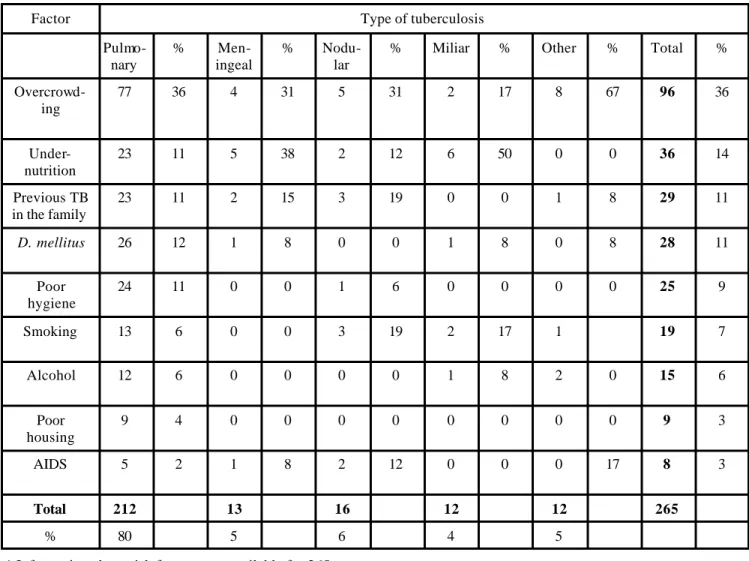
Information was not complete for all variables included in the study, therefore, totals in tables differ according to the factor involved. Pulmonary was by far the most co m-mon presentation of the disease, with 80% of a total of 265 cases (Table 1). In order of frequency, the possible risk factors were: overcrowding, under-nutrition, previous cases of TB in the family, concurrent Diabetes mellitus and poor hygiene.
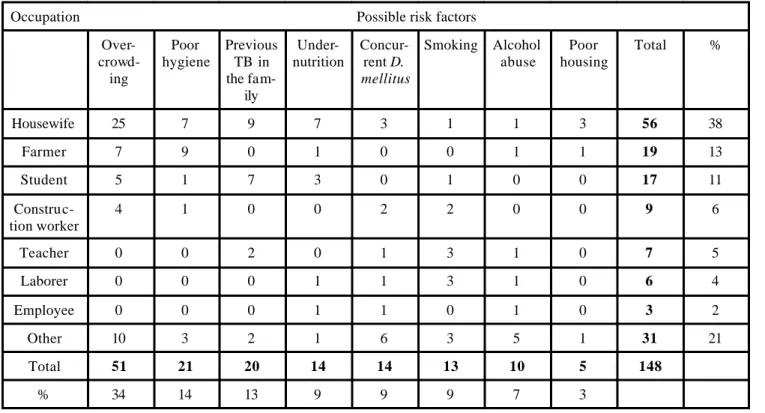
The proportion of cases increased with age (n=759), from 5% in patients 10 -years old or younger to 40% in p a-tients 50-years old or older (Fig. 1). Among cases for which information about occupation was available (n=148), housewife (38%), farmer (13%), and student (11%) were the occupations most frequently reported (Table 2). From 293 cases with ending-outcome informa-tion, 72% were cured, and only 6% ended on death (Table 3). Finally, from 674 cases, it was found that 85% were new cases, and that persistent coughing was by far the most frequent symptom observed, 51% (Table 4).
From the 181 human-sputum samples proces sed by culture to evaluate the accuracy of the acid-fast diagnostic approach followed by laboratories, 10 (8.9%) were culture-positive, from the acid-fast negative group (n=112). Su r-prisingly, from the acid-fast positive group (n=69), only 11 (15.9%) were positive by culture. At least 3 of these is o-lates were identified as M. bovis by biochemical tests. Bovine TB. Findings of the study conducted to
deter-Table 1. Distribution of cases by type of TB and possible risk factors*. A five years retrospective study, 1992 -1996, Querétaro, México.
Factor
Pulmo-nary
%
Men-ingeal
% Nodu-lar
% Miliar % Other % Total %
Overcrowd-ing
77 36 4 31 5 31 2 17 8 67 96 36
Under-nutrition
23 11 5 38 2 12 6 50 0 0 36 14
Previous TB in the family
23 11 2 15 3 19 0 0 1 8 29 11
D. mellitus 26 12 1 8 0 0 1 8 0 8 28 11
Poor hygiene
24 11 0 0 1 6 0 0 0 0 25 9
Smoking 13 6 0 0 3 19 2 17 1 19 7
Alcohol 12 6 0 0 0 0 1 8 2 0 15 6
Poor housing
9 4 0 0 0 0 0 0 0 0 9 3
AIDS 5 2 1 8 2 12 0 0 0 17 8 3
Total 212 13 16 12 12 265
% 80 5 6 4 5
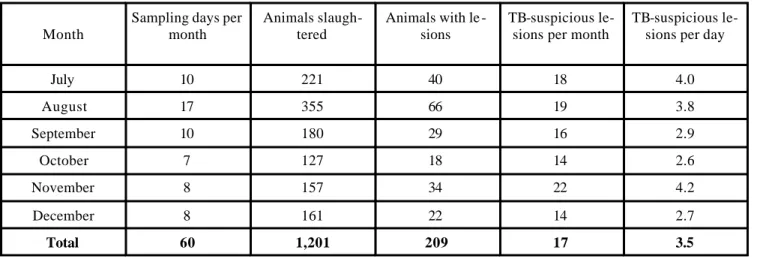
mine the frequency of dairy cattle with TB-suspicious le-sions at slaughter are summarized in Tables 5 and 6. From a total of 1,201 carcasses of dairy animals inspected in 60 days in a period of 6 months, 209 (17%) presented gross lesions suspicious of TB. The average number of lesions per day was 3.5, with a range from 2.6 to 4.2. As shown in Table 6, lymph nodes were by far the most affected organs with 171 cases (85%). From these, the retropharyngeal (35%), the mediastinal (27%), the mesenteric (10%), and the mandibular (9%) were the specific lymph nodes most frequently affected.
From the 209 TB-suspicious lesions, a random sample of 102 were selected and processed by culture for is olation of Mycobacterium, and for diagnosis by histopathology; 81 (79 %) were positive to isolation, and 97 (95 %) were posi-tive to lesions compatible with TB by histopathology. Af-fected animals were mostly female (83%), more than 2 years of age, and in fair to good body condition scores (66%). Ninety-six percent of the cases presented local le-sions affecting a single organ.
Survival of M. bovis. Diagnosis of M. bovis by culture is not affected if lesions remain in sodium borate for up to 150 days. Even though the number of colonies decreased (from 500 in the first 30 days to 10 colonies at 150 days) the diagnosis would still be positive because this is based on the presence and not on the number of colonies of
My-A g e
0 1 0 2 0 3 0 4 0 5 0 6 0 7 0
proportion of cases
0 5 1 0 1 5 2 0 2 5 3 0 3 5 4 0 4 5
Figure 1. Proportion of cases of human TB per age-group. Age in years was categorized in 10-year groups with the last group including patients 50-years old and older. A five years retrospective study, 1992-1996, Querétaro, México.
Table 2. Distribution of cases of human TB by occupation* and possible risk factors. A five years retrospective study, 1992-1996, Querétaro, México.
*148 cases had information about occupation. Occupation
Over-
crowd-ing
Poor hygiene
Previous TB in the fam-ily
Under-nutrition
Concur-rent D. mellitus
Smoking Alcohol abuse
Poor housing
Total %
Housewife 25 7 9 7 3 1 1 3 56 38
Farmer 7 9 0 1 0 0 1 1 19 13
Student 5 1 7 3 0 1 0 0 17 11
Construc-tion worker
4 1 0 0 2 2 0 0 9 6
Teacher 0 0 2 0 1 3 1 0 7 5
Laborer 0 0 0 1 1 3 1 0 6 4
Employee 0 0 0 1 1 0 1 0 3 2
Other 10 3 2 1 6 3 5 1 31 21
Total 51 21 20 14 14 13 10 5 148
% 34 14 13 9 9 9 7 3
* 674 cases had information about clinical symptoms.
Table 3. Distribution of cases of human TB by final outcome*. A five years retrospective study, 1992-1996, Querétaro, México.
Cure Death Abandoned treatment Move to another clinic Total
Freq. % Freq. % Freq. % Freq. %
197 92 15 88 20 80 84 32
16 7 2 12 5 20 16 6
213 17 25 38 293
72% 6% 8% 13%
Ending outcome
*293 cases had information about final outcome.
Table 4. Distribution of cases of human TB by type of case and the most frequently observed clinical symptom*. A five years retrospective study, 1992-1996, Querétaro, México.
Symptoms
Type of case
Coughing Fever Hemopthy-sis
Weight loss
Pain in thorax
All five Total %
Freq. % Freq. % Freq. % Freq. %
Freq. % Freq. %
New 310 54 88 15 52 9 39 7 21 4 63 11 662 85 Recurrent 32 32 10 10 22 2 2 2 4 4 31 31 101 15
Total 342 98 74 41 25 94 674
% 51 14 6 12 4 14
Table 5. General statistics of a convenience sampling of TB-suspicious lesions of dairy cattle at slaughter. July-December,1996, Querétaro, México
Month
Sampling days per month
Animals slaugh-tered
Animals with le -sions
TB-suspicious le-sions per month
TB-suspicious le-sions per day
July 10 221 40 18 4.0
August 17 355 66 19 3.8
September 10 180 29 16 2.9
October 7 127 18 14 2.6
November 8 157 34 22 4.2
December 8 161 22 14 2.7
Organs affected
Specific lymph nodes affected, alone or in com-bination
Frequency % Frequency %
Lymph node alone 171 85
Retropharyngeal 131 35
Mediastinal 101 27
Mesenteric 36 10
Mandibular 34 9
Other 68 18
Other 30 15
Generalized TB 8
Total 209 370
Frequency and Proportion of organs affected
Table 6. Frequency of organs affected with TB-suspicious lesions during carcass inspection of dairy cattle slaughtered in an abattoir in Querétaro, México.
cobacterium. Nevertheless, the recommendation that sam-ples be processed as soon as possible after collection to obtain the largest number of colonies possible, remains.
DISCUSSION
Tuberculosis in humans presented an increasing pattern in the state of Querétaro for the period of 1992 to 1996. The increasing pattern of cases seems to be a reflection of the situation of the disease in the Country, where from 1996 to 1997 the number of cases increased, in some cases 100%, in 28 out of the 32 states.8 It is possible, however,
that this trend is the result of the publicity given to TB in the last 10 years; willingness to diagnose the disease may have increased in response.
The decreas e in the number of cases in 1996 may be apparent, since no especial programs to reduce the disease had been implemented in that or in previous years. We b e-lieve this was because not all cases for that year had been collected at the time the study ended, even when we were told otherwise.
In relation to risk factors, overcrowding, under-nutrition, poor housing, and poor personal hygiene, four of the risk factors most frequently detected in case-records are indicators of poor social and economical status. This confirms that TB is a “low-class” disease. Improving living conditions has to be an important component in any pro-gram to reduce TB in the human population. Diabetes mel-litus is a disease that compromises the immune system, therefore, it is not surprising that a large proportion of indi-viduals have both Diabetes and TB. If Mycobacterium per-sist longer in the environment, as a consequence of more
infected people or animals, the number of cases are ex-pected to increase in response to a more susceptible popu-lation because of immune-compromising diseases, hereby the importance of eliminating the disease from the enviro n-ment.
Susceptibility to TB has been reported to increase with age.13 Our findings totally agree with those reports, the number of cases of TB was larger in the older group. Ho w-ever, it has also been reported that clinical disease may fo l-low soon after initial infection with Mycobacterium tuber-culosis or it might occur many years after primary infec-tion, either through endogenous reactivation or after ex-ogenous re-infection.14 Consequently, an increasing
num-ber of cases in older patients do not necessarily mean more new infections at that age. As a matter of fact, it has been mentioned that the risk of developing TB is higher for ado-lescents and adults than among children,9 but not age at infection has been clearly determined.
From the 112 acid-fast negative sputum samples cul-ture to double-check the results from the laboratories, 10 (8.9%) were positive by culture. These results are a clear indication of the weakness of this diagnostic procedure. Misdiagnosing as negative about 10% of the samples represents a serious risk for the general population. Efforts have to focus in implementing more accurate diagnostic methods to reduce as much as possible the risk of spread-ing the disease to the susceptible population because of missing cases.
the tuberculin test in the field, and our sample of animals at slaughter is not necessarily a representative sample of the general population of dairy animals in México. Neverthe-less, the closeness in the prevalence rates may be an indi-cation that sampling gross lesions at slaughter may be a useful approach to estimate the prevalence of TB in the field.
From 102 gross lesions analyzed by histopathology 95% (n=97) were compatible with TB and presented acid -fast bacilli. Seventy nine percent (n=81) were positive to isolation of M. bovis. These findings indicate that in re-gions with high prevalence, diagnosis of TB through re c-ognition of gross lesions at slaughter can be an accurate and reliable method of detecting and eliminating sources of infection. For this to work, the problem of animal identifi-cation to link affected animals to origin needs to be solved. As in many parts of the world, the number of cases of human tuberculosis in México has increased considerably in the last five years. Low social status and concurrent im-muno-compromising diseases seem to be the main risk fac-tors. The increase in the number of cases of human TB may or may not be related to the prevalence of the disease in animals. It was the authors intention to look at the rela-tionship between the prevalence rate in human and cattle in a kind of a ecological-study setting, unfortunately, there was not enough information about cattle TB to make any comparison feasible. It would have been interesting to see if regions with more cases of TB in cattle had also more human cases.
ACKNOWLEDGEMENTS
The authors would like to thank IMSS, ISSSTE, and SSA from the State of Querétaro for providing information of cases of human tuberculosis.
REFERENCES
1. Committee on bovine tuberculosis, Board of agricul-ture. 1994. National Academy Press, 2101 Constitution Avenue, N.W. Washington, D.C. 20418.
2. CONASA. 1997. Reporte Anual del Consejo Nacional de Sanidad Animal. Centro Médico Nacional. México, D. F.
3. Corner, L. A. 1994. Post mortem diagnosis of Myco-bacterium bovis infection in cattle. Vet. Microbiol.
40:53-63.
4. Corner, L. A., A. Melville, L. McCubbin, K. J. Small, B. S. McCormicks, P. R. Wood, and J. S. Rothel. 1990. Efficiency of inspection procedures for the detection of tuberculous lesions in cattle. Aust. Vet. J. 67:389-392. 5. Daborn, C. J., and J. M. Grange. 1993. HIV/AIDS and
its implications for the control of animal tuberculosis. Br. Vet. J. 149:405-417.
6. Dankner, W. M., N. J. Waecker, M. A. Essey, K. Moser, M. Thomson and C. E. Davis. 1993. Mycobac-terium bovis infections in San Diego: a clinico-epidemiologic study of 73 patients and a historical re-view of a forgotten pathogen. Medicine (Baltimore) 72:11-37.
7. Dolin, P. J., M. C. Raviglione, A. Kochi. 1994. Global tuberculosis incidence and mortality during 1990 -2000. Bull W. H. O. 72:213-220.
8. Epidemilogía. 1997. Enfermedades Respiratorias. Sis-tema único de información para la vigilancia epidemi-ológica. Semana 25, 15 al 21 de junio. México.
9. Ferebee, S. H. 1970. Controlled chemoprophylaxis studies in tuberculosis: a general review. Adv. Tuber-culosis Res. 17:28-106.
10. Morbidity and mortality weekly report. 1995. Essen-tial components of a tuberculosis prevention and con-trol program: recommendations of the advisory council for the elimination of tuberculosis. 44:1-18.
11. Panamerican Health Organization. 1991. Health con-ditions in the Americas, 1990, vol. 1. Scientific Publi-cation No. 524. Pan-American Health Organization, Washington, D.C.
12. Payeur, J. B., J. L. Jarnagi, J. J. Marquardt, L. A. Schaper, B. M Martin. 1992. Laboratory Methods in Veterinary Mycobacteriology for isolation and identifi-cation of mycobacteria. NVSL-USDA:APHIS, Ames, Iowa.
13. Sutherland, I. and P. M. Fayers. 1975. The association of the risk of infection with age. Bull. Int. Union Tu-berculosis. 50:71-81.
14. Vynnycky, E., and P. E. M. Fine. 1997. The natural history of tuberculosis: the implications of age-dependent risks of disease and the role of reinfection. Epidemiol. Infect. 119:183-201.