
Estudiantes como Autores de Audiolibros en un Ambiente de Aprendizaje Colaborativo
45
0
0
Texto completo
(2) Abstract In this report Colombian students of 11th grade take the lead and embrace their artistic abilities within a creative process that involves a pedagogical implementation, and constitute a journey in which they discover their skills as authors through the creation of a material called The Little Explorers and The Big Adventure in The Lost Island (Audiobook). Students who took part in this experience could integrate their abilities, likes and interests in order to produce this final material. The pedagogical implementation is based on Vygotsky’s learning theory about language development through social interaction and Bruner’s Discovery learning. We examined how the students dealt with authoring during the different stages that constitute the creation process itself: The recognition of literary works, writing production, drawing and plastic arts, music implementation and, finally, the recording phase where the authors recreate their original texts in an aural form. Key words. Collaborative learning, authoring, audiobooks, Socio-cultural theory, Discovering learning, innovation..
(3) Table of Content Introduction .......................................................................................................................... 6 Objectives .............................................................................................................................. 7 Justification and purpose ..................................................................................................... 7 Theoretical foundations ..................................................................................................... 10 Creative writing ................................................................................................................ 13 Audiobooks ....................................................................................................................... 15 Meaningful learning .......................................................................................................... 16 Methodology and procedure of the creation process ...................................................... 16 Pedagogical Intervention .................................................................................................. 17 Writing production. .................................................................................................... 18 Drawing production. ................................................................................................... 19 Music composition. ...................................................................................................... 19 Revision and practice. ................................................................................................. 19 Recording. .................................................................................................................... 19 Before ................................................................................................................................ 22 During ............................................................................................................................... 28 Process of creative writing. ......................................................................................... 31 Drawing Production. ................................................................................................... 31.
(4) Music Adaptation. ....................................................................................................... 34 Recording. .................................................................................................................... 35 Findings ............................................................................................................................... 38 The little explorers and the big adventure in the lost island: Illustrated experiences in the audiobook.......................................................................................................................... 38 Conclusions ....................................................................................................................... 41 Pedagogical Outliers ......................................................................................................... 42 References............................................................................................................................ 44. List of tables Table 1. Students’ role reflected by sections within each stage of the pedagogical implementation ..................................................................................................................... 21 Table 2. Activities developed in session 1 of the process (Before) ..................................... 23 Table 3 Activities developed in session 2 of the process (Before) ...................................... 24 Table 4 Activities developed in session 3 of the process (Before) ...................................... 24 Table 5 Activities developed in session 4 of the process (Before) ...................................... 24 Table 6 Activities developed in session 5 of the process (Before) ...................................... 25 Table 7 Activities developed in session 6 of the process (Before) ...................................... 26 Table 8 Activities developed in session 7 of the process (During)...................................... 29 Table 9 Activities developed in session 8 of the process (During)...................................... 29 Table 10 Activities developed in session 9 of the process (During).................................... 30.
(5) Table 11 Activities developed in sessions 10 to 17 of the process (During) ....................... 31 Table 12 Activities developed in sessions 10 to 17 of the process regarding Drawing Production (During) .............................................................................................................. 33. List of Figures Figure 1. Theoretical bases for the pedagogical implementation. ....................................... 13 Figure 2. Stages of the Pedagogical Implementation .......................................................... 18 Figure 3. Timeline of development of the Pedagogical Implementation ............................ 22 Figure 4. Test of Students’ preferences ............................................................................... 27 Figure 5 Students’ reflections .............................................................................................. 28 Figure 6. Audiobook fragment. Chapter 3. .......................................................................... 31 Figure 7. Papercraft initial material. .................................................................................... 32 Figure 8. Sample of audiobook illustration – Drawing ....................................................... 32 Figure 9. Drawing production progress ............................................................................... 34 Figure 10. Example of edition projects – Recording process .............................................. 37 Figure 11. Drafts and final cover of the audiobook. ............................................................ 41.
(6) Introduction The importance of the students’ role within the academic context, though is relevant, rarely encourages the development of a range of abilities that they have and can be applied or amplified in different areas of learning. In this case, the focus centers on a group of Colombian 11th graders, who demonstrate remarkable artistic aptitudes within their classes, widely expressing their thoughts and ideas, and evidencing high creative potential; these attitudes encouraged us to think of them as authors, capable of make contributions to their context allowing their voices to be heard. Therefore, we wondered in which way students could be more active in their learning processes, not only by changing the materials used but collaborating with teachers in the construction of an environment where they are able to make contributions to the development of the classes, the content that they are learning and its influence on who they are and where they live. But most important, given the creative potential that they have, we wondered if students would be able to recognize themselves as authors, developing their abilities in order to express their opinions and beliefs in different forms that transcend the classroom. This purpose established the course to imagine the possibility of the construction of a material that reflects the necessities and expectations of a class, besides the experiences and identity of the students, offering the space in which they would be able to develop skills different than the ones that are being put in practice within the classroom contexts. In that order of ideas, we carried out a pedagogical implementation which aimed to promote the collaborative work through the creation of a material: an audiobook called The Little Explorers and The Big Adventure in The Lost Island. The students that participated in this.
(7) experience were able to integrate their own skills, likes and interests with the idea of producing this final outcome. The pedagogical implementation was based on the sociocultural theory and language theory by Vygotsky, the theory of learning by discovery proposed by Bruner and the Students Centered Learning and Teaching Approach. We examined how students managed the concept of authoring while being involved in collaborative work during the different phases that constituted the process of creation within the pedagogical implementation. Those phases were the recognition of literary works, creative and literary production, drawing and plastic arts, musical incorporation and finally, the recording phase in which students recreate their original texts with their own voices. Objectives We aimed to engage a group of eleventh grade students in an authoring process of an audiobook through collaborative work. This goal was set with the vision of allowing students to develop their talents and abilities while expressing themselves through their creations and making decisions regarding these. Justification and purpose. The initial idea for Students as Authors of Audiobooks in a Collaborative Learning Environment is born from the context of EFL classrooms, where the development of language skills in the target language is the goal in all the resources employed. Following that idea, the use of audiobooks constitute an alternative that engages the students in enhancing of the four language skills as they are able to hear and read the stories while stimulating how they will produce an speech, in an oral and written form. In our first.
(8) experiences with the group of students involved in the creating process that we are about to describe, the reception of the usage of audiobooks within the classes had a positive impact on the learners, motivating students to be interested in the stories and encouraging the discussions around them. However, the impact of the audiobooks in the classes did not stopped there, as students were motivated to share other stories they have read and even telling experiences related with story writing. In the middle of the our dialogue with our students in each class, we became aware of the many talents they had which besides writing tales or poetry, included skills in drawing, painting, graphic design, edition and music; the imminent creative potential in the students created the bridge between the usage of audiovisual materials in EFL learning to the possibility of creating them.. Therefore, one particular motivation in this project was on the ideal of students acknowledging their capacities and talents, coping to build a comfortable environment of learning where they were capable of creating at the same time they were taking important steps on their EFL learning. In that order of ideas, it was important to engage this group of EFL students in an authoring process, due the information that the experiences and outcomes of this pedagogical innovation would provide; for example, to know how probable was that students actually became authors and how they felt about their journey in which they acknowledge that they can create, now that the environment proportionated the conditions to do so. Taking into account some of their previous experiences, the purposes of their creations were related with academic purposes in order to fulfill assignments, but they did not have a say in what they wanted to create, the message they will transmit or who will be able to read or see their creations; the relevance of these aspects within the.
(9) creative process was high, as the students’ decision making constituted the main bases for its development.. Considering the mentioned, Students as Authors of Audiobooks in a Collaborative Learning Environment finds its engine from two main purposes, the first one being from a pedagogical point of view aimed to innovate the dynamics of the learning and teaching of English as a Foreign Language with mechanisms that encourage the collaborative work inside the learning environment. One second purpose begins on a literacy perspective, in order to encourage students to develop their creative potential in the writing of stories and capitalize their abilities which in the group of participants are mainly artistic. The students who worked in this creative process were a group of thirty four students of eleventh grade from a public school in Bogotá, with whom we already have had one semester of pedagogical experience as pre-services teachers before starting this process that was in fact, inspired by them; thus, we were familiarized with their thoughts, level of proficiency on EFL, their abilities in drawing, writing, music, photography and design, but most important we heard the messages they wanted to transmit through their creations, their voices and their desire of making a statement towards what they live and watch every day.. Within the objectives established, the process of transformation of the students in authors, the extension or changing of their beliefs, perceptions and motivations constituted a concern of high relevance; therefore, we focused on the advantages and qualities that students already have, which are represented in the their talents and abilities that first encouraged the creation of this process. Adolescents had the possibility of expressing themselves and link their talents with the learning processes that they are carrying out, but they needed a space that allow them to do that, and also for them to acknowledge that they.
(10) are able to make creations that would beneficiate others, while they make their voices being heard, therefore considering the importance of these features into a path of authoring discovery, the environment proportionated for the creation process allowed the decision making and guidance of the students creators.. Now, it was our interest to see if the process that intended to guide students in a creation of the audiobook that represented themselves could be carried out when they are coping on groups in order to gather ideas and abilities. This dynamic of collaborative learning has been studied in a creative context, from which we consider remarkable a study entitled The Role of Collaborative Work in the Development of Elementary Students' Writing Skills, by Yuly Yate G, Luis Fernando Saenz, Johanna Alejandra Bermeo, and Andrés Castañeda (2013). This research was developed with students of elementary school from Ibagué (Colombia), and it intended to apply collaborative learning when identifying weaknesses in the development of foreign language skills, to find the high importance of this approach within the learning process. This research opened the path for us to see that the Collaborative learning in a creating process was viable, but our inquire went beyond, wondering how students involved in a process of authoring reacted to an environment of collaboration, considering the diversity of their abilities and perspectives.. Theoretical foundations The theories of Vygotsky and Bruner gave us the ground to build the foundation of the creative process in a collaborative learning environment, and then allowed us to consider an approach that deeply involved the students in the process, locating a great part of the decision making on them. This approach was the Students’ Centered Teaching and Learning Approach, in which the students had the opportunity of having a vow in decisions.
(11) that affected their learning process, such as the materials employed, and the activities or the methodology used in each session. In this approach, the role of the teacher leaves the figure of complete power to be a guide, to encourage the student opening spaces for them to learn in an individual form, and to be able to adopt a critical position at the time of solving problems, taking an active role in the classroom. (Collins & O’Brien, 2003). Engaging students in authoring through the immersion on a collaborative creative process where they were able to make decisions, was a high relevant focus while they developed their abilities and passions. For that purpose, we followed a series of phases (Explained in Table 1, Pedagogical Implementation) that are not the same in which the implementation was structured, because those reflect the process in which students were involved and where the introspective reflections were built; the steps that we developed since the proposal of the pedagogical implementation were grounded in the progress of the goals mediated by the theories that supports us. The sociocultural and language theory by Vygotsky states the importance of the social, historical and political context of the student, as this is of great influence within the interactions that establish the course of the development of the cognition in the students, knowing that the dynamics of the social principle determine the two levels in which an individual is able to learn (1964). Within the first theoretical foundations in this pedagogical innovation, we also find the theory of learning by discovery, proposed by Bruner who states that the problem solving skills of students should be encouraged and developed through the experiences that would set the path to discovery, and the knowledge should be adapted to the learner’s point of view, recreating how they see the world and how they can experience it making easier the solution of tasks that can come across the learning.
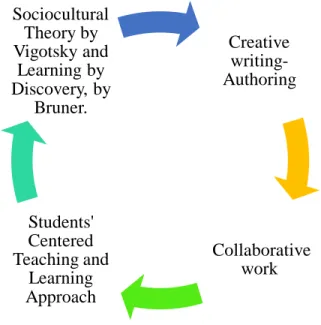
(12) process, given the fact that they have discover and understood how they can solve problems (Bruner, 1956). These two theories converge in the fact that learners have to be involved in stages of social interaction and psychological development, which carry out a process of internalization of the knowledge they were able to gain within the contact with their pairs. In our pedagogical intervention, the social interactions among students constitute a very important component, considering that they should start taking an active role in their learning process, not only considering other points of view but developing their own skills and learning by means of experience. In this pedagogical innovation, we observed how students reacted to work collaboratively while they were making determinations regarding the direction and future of their process. Therefore, the purpose in the pedagogical intervention, as result of the strategy of authoring, was the creation of the material (audiobook) being the outcome of the process; this implied a specific goal to achieve, which leaded us to consider that the collaborative learning was a path to construct knowledge in interaction, but it was not about dividing tasks considering that each student was responsible for their progress as well as their partners’ (Dooly, 2008). As the students were empowered in their own progress following a students’ centered learning approach, we observed that the collaborative work consolidated an environment where the group, while building knowledge, was able to create and be aware of what constructing a material that represent them implied. The figure 1 reflects how the pedagogical implementation is built by the theories and approaches described, in order to reach the audiobook as product that reflects the process developed. Subsequently, we have established categories in order to amplify the theoretical bases that support us in the design and implementation of the pedagogical innovation we carried out..
(13) Sociocultural Theory by Vigotsky and Learning by Discovery, by Bruner.. Creative writingAuthoring. Students' Centered Teaching and Learning Approach. Collaborative work. Figure 1. Theoretical bases for the pedagogical implementation.. Creative writing. To start with this category, is precise to highlight that the process that we carried out during the development of this research project was divided in phases that allowed students to construct their audiobook from scratch, as they were also developing language skills that enhanced their English proficiency. The first two phases of the pedagogical innovation were, first the familiarization of the students with the narratives, regarding to the structure and genre; the second phase was creating writing precisely, and is when the students started transforming their experiences or thoughts into a written form. However, the process of writing implied a lot of challenges that both students and us as teachers had to deal with, such as the feedback that not only concerned of grammar but organization of ideas, the style and the achievement of the intention of the writer (Correa, R., Martínez, M., Molina De la Barra, M., Silva, J., Torres, M., 2013). In this implementation, the development of the phase of creative writing implied, from teachers-researches a guidance within the language.
(14) learning process, providing bases on grammar, style and structures, but as the stories written were manifestations of authors, the essence of each one of them is printed in the words and is within the last detail of the audiobook that they created; thus, the feedback that we as teachers gave, was intended to build motivation to students, for them to keep expressing themselves.. The important element on the pedagogical implementation included on this study, was the collaborative work that constituted the creative environment provided for the process of the authors. When it comes of working on groups, students have the tendency of taking roles in order to develop a better task; it usually involves a student who takes the leadership of the group and commonly is outstanding for having a better language proficiency that the rest of the group (Yate González, Y., Saenz, L., Bermeo, J., Castañeda, A., 2013). However, when working collaboratively students do not limit to divide the tasks, but instead they support each other in order to understand and achieve the goals established, as the individual success relays on the group’s accomplishments. (Glinz, 2005).. In the interaction within those groups, the role of the students also may divide in readers and writers (Yate, Y., Saenz, L., Bermeo, J., Castañeda, A., 2013) which take us to the feedback of writing; is probable that students consider better to receive the feedback from their pairs, as well as from the teacher, but the relationship established with their classmates tend to contribute to comments that would be more likely for the student writer to take into account in the future. The students generally prefer an explicit feedback in order to make a more practical identification of their mistakes and so overcome them in their writing; the relationship with the agent of the comments on the exercise, whether it be.
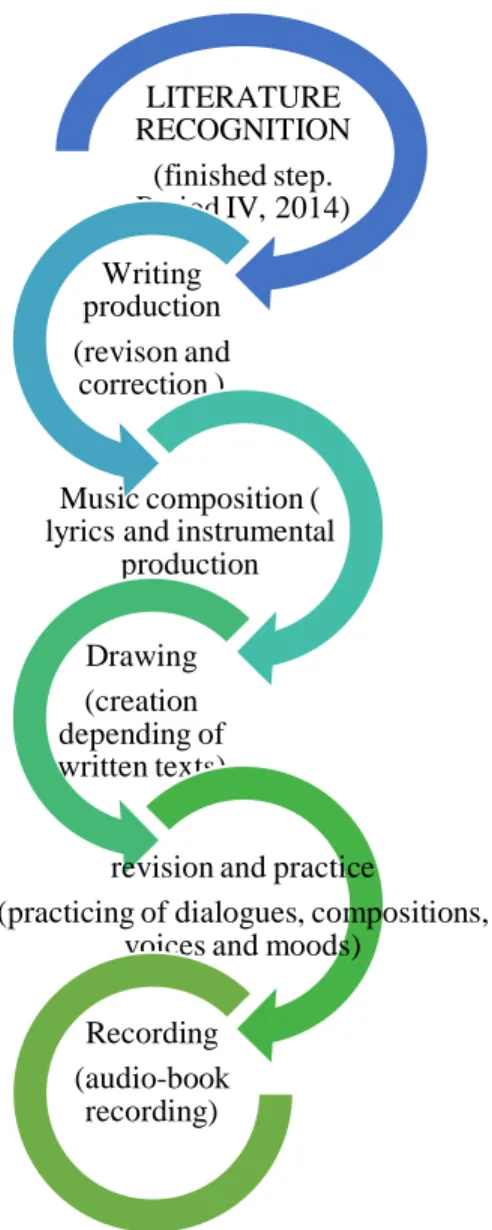
(15) teacher or classmates, is important in the motivation of the writer (Correa, R., Martínez, M., Molina De la Barra, M., Silva, J., Torres, M., 2013).. The transmission of experiences, emotions and ideas not only reaches a process of how students write, but also where the learners learn to communicate in the target language through telling the others the stories that they intend to write. When the compositions become into a spoken form, they students achieve the confidence of expressing themselves in a foreign language, avoiding the memorization of what they want to tell, but interiorizing it and comprehending what they are actually saying. (Nor Hasni Mokhtar, Michi Farida Abdul Halim & Sharifah Zurina Syed Kamarulzaman, 2010.). Audiobooks. When it comes about benefits of audiobooks, as students- teachers, we have taken the opportunity to evidence how much necessary could be this material in education. Knowing the advantages for blind people and busy persons, audiobooks act as a helper connecting literature, science, history and worlds with peoples’ minds. Also, understanding this new society that attempt to digitalize realities, new technologies have been averting printed texts to converted it in virtual, forcing civilizations to be actualized with new trends and challenges to get facilities and good life standards.. Authors as Jeff Whittingham, Stephanie Huffman, Rob Christensen and Tracy McAllister (2013) have taken interest to find out how can they implement this material to improve reading skills with students from 4th and 5th grade, finding successful results in their process of implementation. They found improvements on students reading abilities.
(16) inside of audiobooks club, something that made us feel interested to find and look for answer in this Colombian context at the Luis Carlos Galán Sarmiento School.. Audiobooks are considered for us as a combination of artistic elements that help to foster and motivate people who do not like reading in environments of entertainment and learning; imagery, atmospheres and emotions are showed easier. Everybody since childhood to old ages are able to listen and read audiobooks receiving its benefits and advantages.. Meaningful learning. In order to take this theory proposed by Ausubel, Viera (2003) proposes this concept essentially in the generation of a real and authentic change in the person, producing interaction and internal changes that would avoid the repetition and some other traditional methods of teaching and learning. The coherence of the structure of the methodology, a logical sequence of content and the recognition of student’s cognitive structures in its variety are necessary in order to achieve this Meaningful learning; aspect that are directly external and internal aspects of the student.. Methodology and procedure of the creation process This research project aimed to develop a creation process within an environment based on collaborative learning and students-centered learning approach, which gave the opportunity for students to be empowered and make decisions regarding their learning and creative process. The outcome of this journey was the audiobook made by the students, which represented them as authors and students who were aware of what they learnt and how they did it. The main concern focused on the evolution and acceptance of the group.
(17) regarding the approach centered on them and the collaborative learning; to be able to experience that environment, we applied a pedagogical intervention which was focused on the creation process that the students developed in order to achieve that outcome.. Pedagogical Intervention The Pedagogical intervention was guided by the collaborative learning method that allows the interaction, sharing and interchanging experiences, ideas, abilities and likes. Working collaboratively allowed students environments of creation, avoiding competition and individualism. Students’ artistic productions could be appreciated in a better way when there are common points of view and interests; also during the process of creation students were able to learn not only from the teacher, but from their own partners as they were good examples to follow and learn from. This pedagogical implementation was also based on Student–center Learning approach, and was first designed to be carried out in five particular stages: Writing production, Drawing production, Music Composition, Revision and practice, and Recording. The figure 2 describes the stages of the pedagogical implementation, including the phase that was being carried out at the moment of developing the initial proposal of this study, which is the Literature Recognition..
(18) LITERATURE RECOGNITION (finished step. Period IV, 2014) Writing production (revison and correction ). Music composition ( lyrics and instrumental production Drawing (creation depending of written texts). revision and practice (practicing of dialogues, compositions, voices and moods) Recording (audio-book recording). Figure 2. Stages of the Pedagogical Implementation. Writing production. The recognition of literary structures and genres carried out during the fourth academic period of 2014, was a basic step for students to be able to reach the goals proposed for this stage. Students were asked to write stories in order to develop their creativity, opening the door for fantasy and fictional genres; these stories were no longer than five pages and we as teachers monitored the creation while accompanying and correcting grammar and writing mistakes..
(19) Drawing production. Based on the stories and written creations from the first stage, students started drawing the environment of the stories; painting characters, atmospheres, scenarios, emotions etc. At this stage, students were able to recognize and know all the written compositions made by the group. Music composition. With the teachers and musicians’ help, students were expected to start composing the soundtrack and setting of each story of the audiobook; they could use their own voices and instrumental tools to compose. Each story was aimed to had, as minimum, two musical compositions. Revision and practice. Students and teachers practiced and revised the written texts that were expected to be transformed in aural forms. Dialogues and environments had big importance in order to sound real, therefore students took in practice their reading and speaking skills, showing acting abilities. Teachers assisted the process. Recording. During this process, the above-mentioned stages were mixed and worked in order to obtain the audiobook. The school monitored this process in order to confirm the how it was developed and how it reflected the knowledge acquired from the pedagogical implementation, which was one of the main interest of the school within this study. The activities included into this process were created based on students’ ideas and thoughts, being organized during the main fourth areas and steps in the instructional design. The main students’ action fields were expected to be developed on the sections of production: Writing, drawing, musical composition and recording, in which futuristic.
(20) dreams and fantastic stories were created as the content, style and mood of the different tales. Each section was divided into phases, as the following table reflects. Pre-writing. Drafts, ideas and introduction of composition. Writing creation. Creation of stories The writing section. evolving: beginning, development, and ending. Student wrote dialogues that later were converted also in spoken language. Revision and corrections. Re-writing searching for mistakes, following suggestions and correcting. Lyrics composition. For each story written by students and finally edited, learners. Music composition. would compose little songs that will talk about something related to the fantastic stories. Each song did not last more than two minutes. Students were expected to sing it. Instrumental composition and practice. Taking into account students’ musical abilities, they were expected to create music that could go with feelings, emotions and environments on the stories.
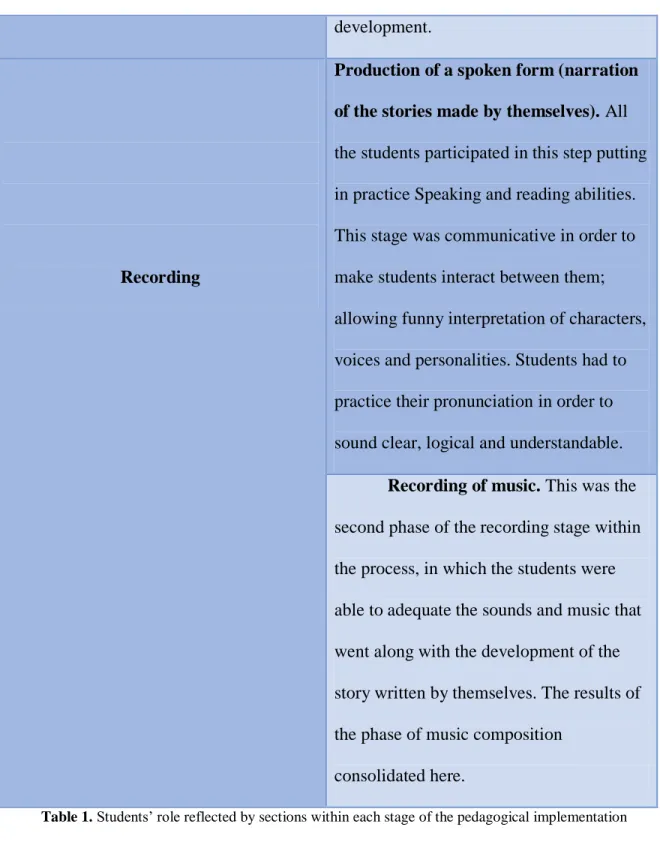
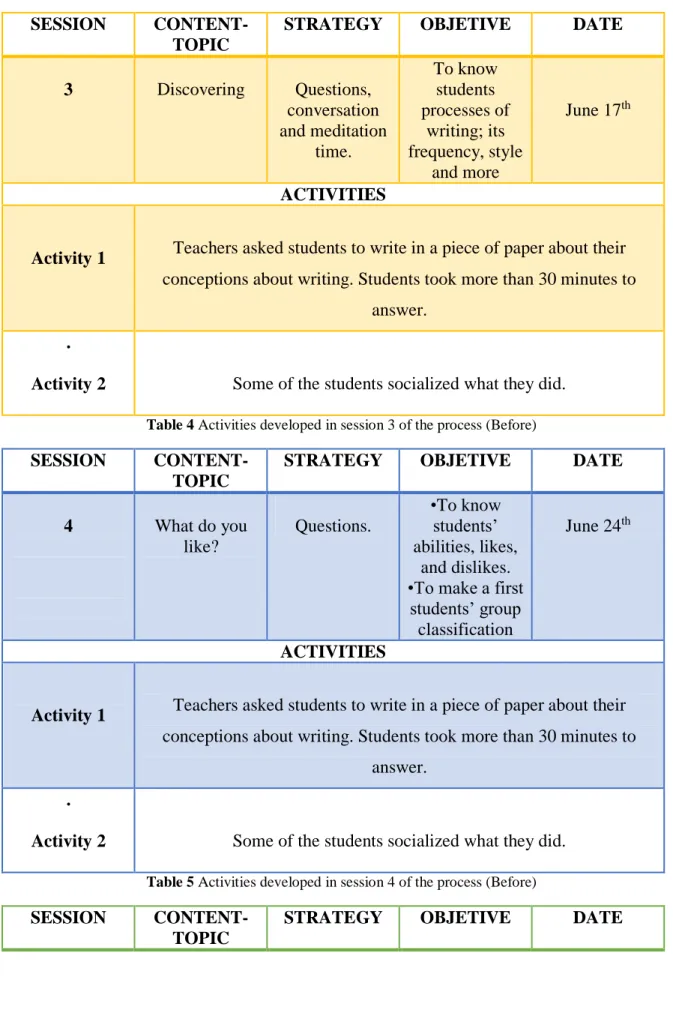
(21) development. Production of a spoken form (narration of the stories made by themselves). All the students participated in this step putting in practice Speaking and reading abilities. This stage was communicative in order to Recording. make students interact between them; allowing funny interpretation of characters, voices and personalities. Students had to practice their pronunciation in order to sound clear, logical and understandable. Recording of music. This was the second phase of the recording stage within the process, in which the students were able to adequate the sounds and music that went along with the development of the story written by themselves. The results of the phase of music composition consolidated here.. Table 1. Students’ role reflected by sections within each stage of the pedagogical implementation. We present the results that this pedagogical implementation reports within a timeline (figure 3), including our observations in how the collaborative work was.
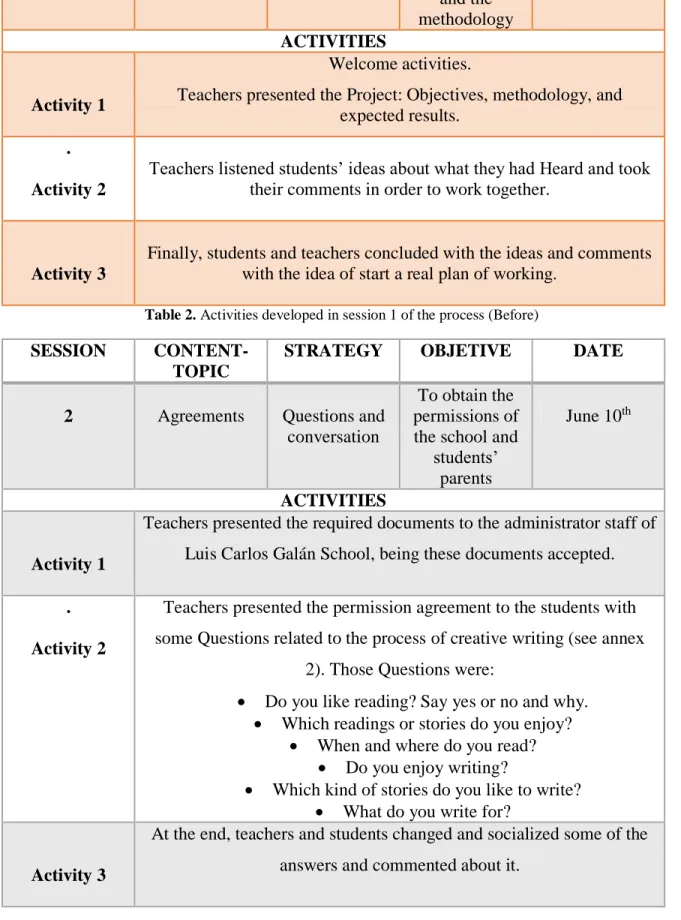
(22) influenced. We establish a before, during and after, in which we will describe how the process of creation was developed.. •Recognition of students' ideas, needs, abilities, likes and dislikes in order to help students to locate themselves in the specific groups. •Statements of individual work, in order to allow collaborative work.. Before. During. •students working together to produce the material, sharing ideas and joining everything that they had. •We could analyze what the students did locating the observation that was made in the recognition of the problem and comparing it with the results during and after the audiobook creation.. After. Figure 3. Timeline of development of the Pedagogical Implementation. Before In order to develop the stages proposed since the design of the pedagogical implementation, the first sessions of the process were focused on finding out the interest and likes of the students that were going to be authors of the audiobook and consolidate the strategies that guaranteed the environment of collaborative work in which the creation was going to be developed, and if the students were willing to made decisions regarding the achievement of the implementation. The following schedule (Tables 2 to 7) reflects each of the activities that we, as teacher-researchers implemented in the first sessions of the implementation that also motivated the participation and decision making from the students-authors. SESSION. CONTENTTOPIC. STRATEGY. OBJETIVE. DATE. 1. Presentation of the Project.. Presentation of the ideas. To share the main purpose of the Project. June 3th.
(23) and the methodology ACTIVITIES Welcome activities. Activity 1. Teachers presented the Project: Objectives, methodology, and expected results.. . Activity 2. Teachers listened students’ ideas about what they had Heard and took their comments in order to work together.. Activity 3. Finally, students and teachers concluded with the ideas and comments with the idea of start a real plan of working. Table 2. Activities developed in session 1 of the process (Before). SESSION. 2. CONTENTTOPIC Agreements. STRATEGY. Questions and conversation. OBJETIVE To obtain the permissions of the school and students’ parents. DATE. June 10th. ACTIVITIES Teachers presented the required documents to the administrator staff of Activity 1 . Activity 2. Luis Carlos Galán School, being these documents accepted. Teachers presented the permission agreement to the students with some Questions related to the process of creative writing (see annex 2). Those Questions were: . Do you like reading? Say yes or no and why. Which readings or stories do you enjoy? When and where do you read? Do you enjoy writing? Which kind of stories do you like to write? What do you write for? At the end, teachers and students changed and socialized some of the Activity 3. answers and commented about it..
(24) Table 3 Activities developed in session 2 of the process (Before). SESSION. CONTENTTOPIC. STRATEGY. OBJETIVE. 3. Discovering. Questions, conversation and meditation time.. To know students processes of writing; its frequency, style and more. DATE. June 17th. ACTIVITIES. Activity 1. Teachers asked students to write in a piece of paper about their conceptions about writing. Students took more than 30 minutes to answer.. . Activity 2. Some of the students socialized what they did. Table 4 Activities developed in session 3 of the process (Before). SESSION. CONTENTTOPIC. STRATEGY. 4. What do you like?. Questions.. OBJETIVE •To know students’ abilities, likes, and dislikes. •To make a first students’ group classification. DATE. June 24th. ACTIVITIES. Activity 1. Teachers asked students to write in a piece of paper about their conceptions about writing. Students took more than 30 minutes to answer.. . Activity 2. Some of the students socialized what they did. Table 5 Activities developed in session 4 of the process (Before). SESSION. CONTENTTOPIC. STRATEGY. OBJETIVE. DATE.
(25) To learn and 5. What do you. Questionnaires. like?. think about the real likes and dislikes of the. July 15th. students in an unconscious way. ACTIVITIES. Activity 1. Teachers gave to the students a vocational test designed by the teachers which helped the students to classify themselves in a group of the implementation, based on their likes. See the annex 3 to more information.. . Activity 2. Students counted the results and wrote if they agreed with that. Table 6 Activities developed in session 5 of the process (Before). SESSION. CONTENTTOPIC. STRATEGY. OBJETIVE. DATE. To compare the 6. Can you prove. Physical. results of the. the. activities.. test with the. July 29th. real students’. information?. interests. ACTIVITIES. Activity 1. Teachers asked students to write about the role that they wanted to play in the work.. . Activity 2. Students compare the results of the vocational tests and their previous writings and the decided where to be in.. Students conform the groups of working and share the ideas about.
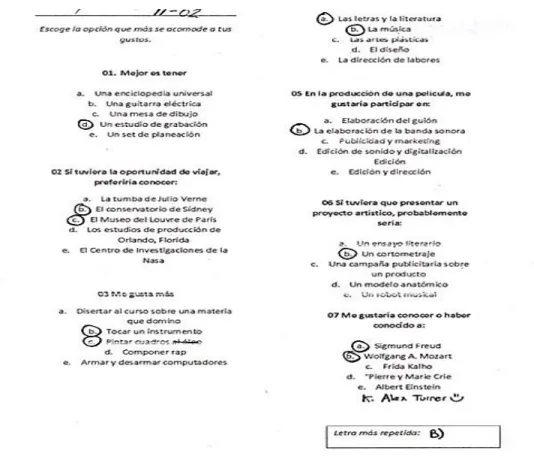
(26) their interest.. Activity 3. Table 7 Activities developed in session 6 of the process (Before). As planners of the project, we decided to divide and highlight the most important parts that we consider relevant of an audiobook; in this case we analyzed the fact of conforming working groups that would respond to the different parts of the material, those were: creative writing (that consisted on the stories and its plot), artistic representations (the visual artifacts from the students that represent the written texts), Music adaptation (Where students selected music and sounds depending of each part of the story) and recording (that provided the text could be heard). Following the fact of making the students feel the owners of their own processes of creation, we wanted to give them the possibility of choosing what to do and also the possibility of selecting the place where they could be comfortable in order to explore their abilities, sharing their ideas with their partners in an effective way and analyzing their roles as individuals in the group joined to the importance of working collaboratively. For that reason we decided to help students to select one or two of the groups to work on not just based on their abilities but also located themselves depending on what they wanted to learn, practice or discover. In this vocational tests elaborated by ourselves (see annex 3), we intended to see how students classify their likes or preferences in an informal way, as the following figure reflects..
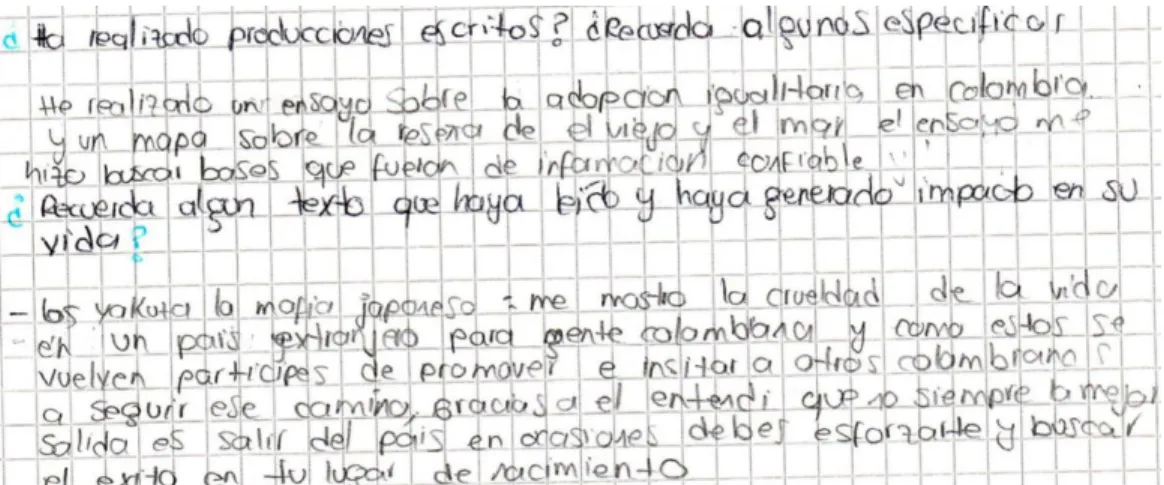
(27) Figure 4. Test of Students’ preferences. Those tests were accompanied with some processes of reflection (see annex 3) that we decided to ask the students to do in order to analyze and consider their roles in the group and also their last experiences related to literacy environments, from which one example is shown in the next figure. In here, the student highlights that the previous experiences of creation have an immediate relation with an academic context and keeps a purpose directly related with that matter, which allowed the students to look for information sources that contribute to her knowledge regarding the subject matters, but did not motivated writing or a different type of creation that genuinely reflects her thoughts and perceptions. However, in the next question is evident that the student is able to relate her own context with others, analyzing sociocultural traits that both have in common and assuming a position, a strong voice, which certainly gives a glimpse of the message she may want to transmit through her own creations..
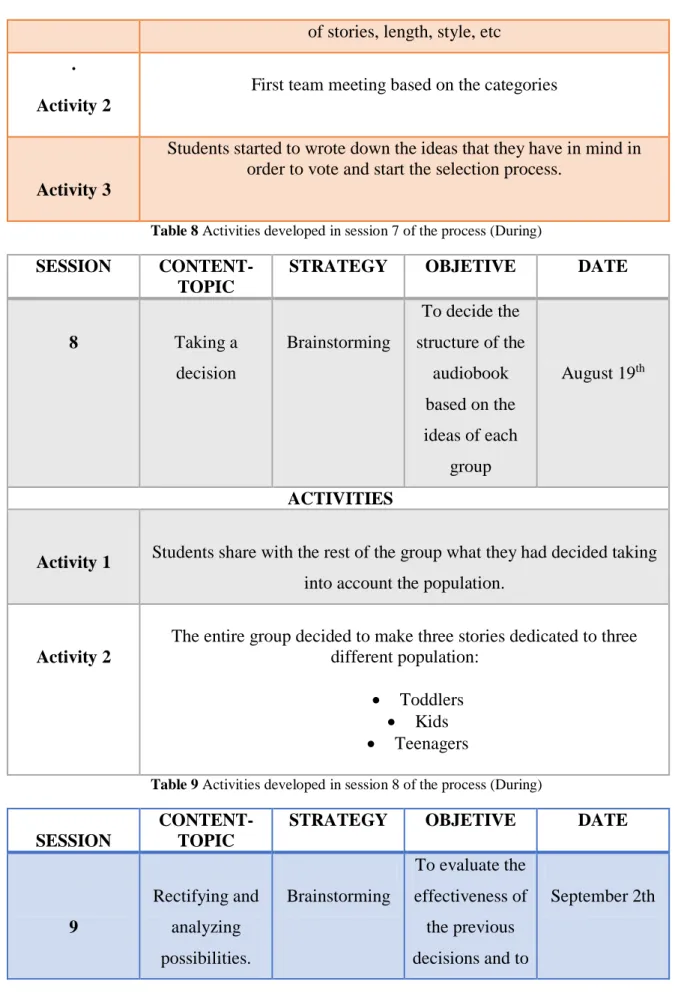
(28) Figure 5 Students’ reflections. During As a result of a large number of weeks of hard work and creation, students agreed to create just one story dedicated to little kids that they decided to call “The little explores and big adventure in the lost island” divided in nine chapters and written in a lineal way. This idea of creating a story for kids, bases the big passion for animals and nature that most of the students in this group have. With this story, students wanted to give a message of love for the first generations in terms of caring the environment and specially, the animals. The following tables display the schedule carried out during the development of the process. SESSION. CONTENTTOPIC. STRATEGY. OBJETIVE. DATE. To start 7. Planning and. Brainstorming. planning and. audiobook. getting. staff.. students’ ideas. August 11th. to create the audiobook ACTIVITIES. Activity 1. Teachers asked students to give ideas about the material: Stories, type.
(29) of stories, length, style, etc . First team meeting based on the categories Activity 2 Students started to wrote down the ideas that they have in mind in order to vote and start the selection process. Activity 3 Table 8 Activities developed in session 7 of the process (During). SESSION. CONTENTTOPIC. STRATEGY. OBJETIVE. DATE. To decide the 8. Taking a. Brainstorming. decision. structure of the audiobook. August 19th. based on the ideas of each group ACTIVITIES. Activity 1. Students share with the rest of the group what they had decided taking into account the population.. Activity 2. The entire group decided to make three stories dedicated to three different population: . Toddlers Kids Teenagers Table 9 Activities developed in session 8 of the process (During). SESSION. CONTENTTOPIC. STRATEGY. OBJETIVE. DATE. To evaluate the Rectifying and 9. Brainstorming. effectiveness of. analyzing. the previous. possibilities.. decisions and to. September 2th.
(30) correct them. ACTIVITIES. Activity 1. In this session, students analyze the length of the possible stories and the effectiveness of these.. Activity 2. Activity 3. Students reorganize the ideas and decided to create just one story that would be focused on kids, thanks to the quantity of children of this age at Luis Carlos Galán Sarmiento School In the groups students started to create possible stories and the entire group voted to: “The little explorers and the big adventure in the lost island”. Table 10 Activities developed in session 9 of the process (During). SESSION. CONTENTTOPIC. STRATEGY. OBJETIVE. DATE. 1-To start the process of creative writing 2-To continue 10-17. Let’s write!. Brainstorming. the process of. September 15th. writing. to November. 3-To share with. 10th. the rest of the groups what they are doing Activity 1. ACTIVITIES In this session, students at the group of writing started to planning and to listen ideas from the other groups.. Activity 2 Activity 3. Activity 4. Students form the different groups started to write and draw different ideas about the project By the first sessions, students from creative writing designed together the story, the quantity of chapters, the content, plot, characters and purpose. During the rest of weeks, students developed chapter by chapter of the book, writing dialogues with logical sequences..
(31) Activity 5. By the end of the writing process, students checked all the stories, correcting with the help of the teachers the form, the content and the grammar part. Table 11 Activities developed in sessions 10 to 17 of the process (During). Process of creative writing. Following the original idea of conserving the message about caring the animals, the group of writing started to put in paper their ideas centering the main notions of each chapter and also proposing special connectivity among the sections. This process was not easy for students and took the majority of the planned time having troubles in the cohesion of the story especially at the first chapters. For students (based on what they told us), it was too difficult to collect their partners’ ideas and to focus them in order to do it coherent and easy to understand, Something that made them worry about the idea of working on their own thoughts but not on based on their partners’ ones.. Figure 6. Audiobook fragment. Chapter 3.. Drawing Production. Students made a lot of designs where we could notice had the main identities of each student; in that part we collect different drawings without.
(32) finishing in order to be chosen and developed after that, something that was not ended because students decided to change the way to represent the story by taking photographs and managing a new technique called Paper Craft.. Figure 7. Papercraft initial material.. In this process, students were involved on activities of cutting and pasting, followed by activities of photographs in order to get the characters with their respective characteristics. In the other hand, students designed and painted different types of scenarios that were made by the supervision of writing students. Those posters were proposed in order to represent not just the different changes in the environments of the island but also in order to help the images to express the mood of the scene that was being exemplified.. Figure 8. Sample of audiobook illustration – Drawing.
(33) SESSIONS. CONTENTTOPIC. STRATEGY. OBJETIVE. DATE. 1-To illustrate the story in a graphic way.. 10-17. Let’s draw!. Brainstorming. 2-to explore the. September 15th. imagination. to November. and creativity. 10th. of the students by the characterization of the story.. ACTIVITIES. Activity 1. Students were connected with writing team in order to continue the graphics based on what their partners were writing. Students designed the characters and the scenarios.. Activity 2. Activity 4. Students did choose the type of illustrations to appear in the book: The started to planning the material based on paper craft technique. Students downloaded, personalized and printed the characters. Activity 5. Students cut, bend and pasted the 3D characters.. Activity 6. After that, students painted the scenarios in order to locate their characters. Students took photographs based on the story plot.. Activity 3. Activity7. Table 12 Activities developed in sessions 10 to 17 of the process regarding Drawing Production (During).
(34) Initial ideas. Creation of the charactaers based on text. Implementation of paper Craft for the characters. Collaborative work. (Cutting and pasting activities). Assemblage. Photograph and edition. Figure 9. Drawing production progress. Music Adaptation. This part was the most difficult to adapt. Although there was a consolidated group to work on Music, students did not work on composition or instrument’s playing. Most of the students were expecting to achieve the final product of writing and the images in order to start planning what to do, something that did not result effective because it had not a concrete product. As the first part, students decided to design and analyze what type of sounds are used on audiobooks and also what type of noises are made by wild animals in the jungle; students did a list of short sounds that in order to make it more realistic, they downloaded on internet. As the directors of this work we noticed a non-active participation and lacks of interest in order to innovate or create something new. In terms of collaborative work, we also did not notice a real impact on this field, thanks that the participants of this groups were working together during the planning but.
(35) they were divided during the process of creation; also they did not communicate among the rest of the groups and tried to get the information about the story by the teachers and not by the rest of their partners. Recording. The previous sections within the process helped students to be prepared and to integrate what they have learnt and made at the moment of transforming their creation into an aural form; therefore, considering that the story of the audiobook is written in a foreign language (English), the students were able to develop language skills throughout the pedagogical implementation. Following the story, the recording required twelve different voices to interpret each one of the characters including the narrator, and for that matter they had to learn how to read dramatically embodying the personalities described in the book, a task that some of the students found challenging due the difficulty of acting and modifying their voices according to what they wrote, and the lack of confidence when making themselves understood in the foreign language, which caused frustration at some point (Lightbown & Spada, 2006). Likewise at the moment of recording, students were still making contributions to the story, taking decisions as they were able to see their creation from a different perspective, in order to be coherent in the storyline at a written level and the keep the content appropriated for the population they chose in the first place. These series of choices demonstrated to us how the students were able to solve problems and make decisions in order to achieve better results in their creating process. The determinations made along the creating process changed the development plan of each stage, and the recording part was not an exception. One of the items included in this final step was the recording of the music, but as the students decided not to focus on this.
(36) kind of composition, instead they became involved in the task of finding the sound effects that would complement the audiobook the way they wanted to. The search of this material was carried out by the students as well, with technological resources including the computers in the school and internet connection in the school or their houses. Closing the recording phase, the material gathered by the students and their recorded voices were edited in order to create the audiobook. These process was developed with our help, considering the ideas and contributions of the students to finally get a material that is a representation of themselves. As for the process of recording the voices of each character, the students employed technological resources that they were able to use outside the classroom, such as recording applications for their electronic devices, which allowed them to practice in hours different from the work sessions with the whole group. Within these sessions, the students took advises from us regarding pronunciation or interpretation of the characters they were impersonating, in order to put in practice what they learn and record the material; however, as they had the opportunity of keep practicing at home, some of the students made the decision of recording themselves alone, in order to achieve a better quality of the final outcome. To be able to consolidate the recordings of the voices and the sound effects in what the audiobook would be, the students decided to edit chapter per chapter of the story, making nine independent tracks in mp3 format, also considering the facilities of reproduction and usage for the target population that will listen to the audiobook. The edition process was developed with edition programs such as Vegas Pro 13.0® and Audacity®..
(37) Figure 10. Example of edition projects – Recording process.
(38) Findings The little explorers and the big adventure in the lost island: Illustrated experiences in the audiobook.
(39) At the end of the process the students created a final audiobook that based on what they said, it finished quite different from what they had planned at the beginning. The book is full of representations of the students’ interests, likes and lives in general; something that they wanted to illustrate in every single detail. Talking about creative writing, students intended to represent their common love for nature, animals and its importance, teaching to the littlest population at Luis Carlos Galán Sarmineto School a real sense of caring and protection; humanizing animals’ feelings in order to make them understand what animal abuse means and its repercussions for human beings. During the chapters, students decided to focus the attention on giving the message of “no matter how young you are, you can always do something for someone who needs it, especially if it is an animal”. Where are they?! – Exclaimed one of the animals. - Let’s do something, now!! – Said another - ARRGHHH! – The noisy grunt of the King of The Jungle suddenly sounded; while he took they word in order to stop the chaos – We are going to look for a way of rescue them, my troops are planning the operation. For now, keep on with your activities and we will keep you informed. However, is there anyone with an idea? - Me! – Shouted Juanito. - Tell us your idea, little friend. – Said the King. The audiobook is composed by a story divided in nine short chapters that tell the adventure of 5 little explorers that decided to travel to Africa looking for fun but being involved in the jungle, they had to fight in order to rescue a big amount of animals from the.
(40) avarice and badness of a group of men. This story was created in six months and the dialogues where created for two of the groups: Writing and Recording, the students decided to work together in order to maintain a real coherence between what was written and what was said. Students wanted to be accompanied by the tutors because they felt insecure with the language use; especially with the orthography, the pronunciation and the intonation. As for our main objective, of engaging the students in the authoring process and helping them to discover themselves as such, we encountered with several implications. Starting with the process of creative writing, students were involved in an interchange where they received feedback from the teachers regarding topics like grammar or vocabulary, but they were able to make decisions and define a position about what they wrote and how they wanted to express their ideas as a group, the ones that later on they transformed into spoken form. Students also design each one of the parts that compose the audiobook, especially the ones that represent the book. Based on the observation, the design of the book was an important part for students thanks to the representation of themselves during the elaboration of this, and also for the image that they wanted to project to the readers and listeners of the audiobook. During the implementation students were re-designing the cover page, the pages in general and the way the content would be presented, as it is evident in the Figure 11. Considering each composition, drawing, voice and details within the final audiobook, the students accomplished the purpose of represent themselves in their creation, transmitting a message regarding an issue that they genuinely concern about and want to speak up. The decisions made along the process not only guided the course of the.
(41) development of the pedagogical implementation, but determined the level of commitment of students regarding the creative process, enhancing their abilities and appropriating their creations, since the first drafts of the story to the final edition and printing. The evolution within the process does not limit to the materialization of the audiobook, it also has repercussion on students’ perceptions about themselves, when they considered themselves as authors, empowered regarding the progress of their creations and voices.. Figure 11. Drafts and final cover of the audiobook.. Conclusions We could analyze that it is possible to work on students’ interests in order to maintain students motivated and active as well as elaborating a planning work based on students’.
(42) needs and interests, something that filled a big space on the work schedule but thanks to a big organization could be possible. However, even while students were empowered, making decisions, contributions to the process and enhancing their abilities and creative potential, their commitment went through points of weakness, where the teachers had to remind and encourage them to continue with the process. The interpersonal relationships among students carried out the work during the audiobook creation, therefore the students did not reject their personal difficulties during this academic process and they did not want to work with determined students. Some of the participants showed a lot of interest to collaborate in this process but they demonstrated lacks of participation and motivation when they had to share their ideas with their partners. Sometimes they showed frustration and rejection getting isolated and giving ideas directly to the uncharged teachers. As for the use of the foreign language, the students developed interest and empathy when discovering that they were able to create characters and situations using a language different than their mother tongue, even if it represented a challenge for them throughout each step of the process. However, this new appreciation of the foreign language was evident the most with the students that were involved in the process of writing and recording. But following that idea, students were able experience a process in which they created and were authors of a material that represented them. Pedagogical Outliers It was remarkable the strong influence of power relationships inside the groups and the similarities among their interest, abilities, likes and ways of working. Some students.
(43) were influenced by group leaders and the work that they developed was being affected by the decisions of just one person in the group. Some of the students did not worked in the groups that they were located in at the beginning of the process, some of the reasons were: . Lacks of interest on the decisions made by their partners. . Misunderstanding on decision making. . Misbehaviors and fights with their partners. . Difficulties to work in group. Most of the students that participated in the project were not limited by the groups in where they were working on; some of them participated in different activities that called their attention. Drawing and paper Craft activities were the most required tasks where the students wanted to participate the most..
(44) References. Bruner, Jerome. (1956) A Study of Thinking. Transaction Publishers. New Brunswick & London. Collins, Jhon & O’Brien, Nancy (2003). The Greendwood Dictionary of Education. Greenwood. Santa Barbara, California.. Correa, Roxanna; Martínez, Mariela; Molina de La Barra, María; Silva, Jessica & Torres, Mirta. (2013) The Impact of Explicit Feedback on EFL High School Students Engaged in Writing Tasks. Profile Journal, Pages 149-163. Bogotá, Colombia.. Dooly, Melinda. (2008). Telecollaborative Language Learning. A guidebook to moderating intercultural collaboration online, Constructing Knowledge Together (21-45). Petter Lang.. Glinz, Patricia. (2005) Un acercamiento al trabajo colaborativo. Revista Iberoamericana de Educación. Issue 35-2.. Lightbown, Patsy & Spada, Nina (2006). How Languages are learned. Oxford University Press.. Nor Hasni, Mokhtar; Michi Farida, Abdul Halim & Syed Kamarulzaman, Sharifah Zurina. (2010). The Effectiveness of Storytelling in Enhancing Communicative Skills. Procedia - Social and Behavioral Sciences, Volume 18, 2011, Pages 163–169..
(45) Viera, Trilce. (2003). El aprendizaje verbal significativo de Ausubel. Algunas consideraciones desde el enfoque histórico cultural. Universidades, Issue 26, Pages 37-43.. Vygotsky, Liev Semionovich. (1964). Pensamiento y lenguaje: teoría del desarrollo cultural de las funciones psíquicas. Lautaro Publisher, Buenos Aires. Whittingham, Jeff; Huffman, Stephanie; Christensen, Rob; McAllister, Tracy. (2013). Use of Audiobooks in a School Library and Positive Effects of Struggling Readers' Participation in a Library-Sponsored Audiobook Club. School Library Research, v16 2013. Yate González, Yuly Yinneth; Saenz, Luis Fernando; Bermeo, Johanna Alejandra; Castañeda Chaves, Andrés Fernando (2013) The Role of Collaborative Work in the Development of Elementary Students' Writing Skills. Profile Issues in Teachers' Professional Development. April, 11-25..
(46)
Figure

+7

Documento similar
In the preparation of this report, the Venice Commission has relied on the comments of its rapporteurs; its recently adopted Report on Respect for Democracy, Human Rights and the Rule
Astrometric and photometric star cata- logues derived from the ESA HIPPARCOS Space Astrometry Mission.
In the previous sections we have shown how astronomical alignments and solar hierophanies – with a common interest in the solstices − were substantiated in the
Díaz Soto has raised the point about banning religious garb in the ―public space.‖ He states, ―for example, in most Spanish public Universities, there is a Catholic chapel
teriza por dos factores, que vienen a determinar la especial responsabilidad que incumbe al Tribunal de Justicia en esta materia: de un lado, la inexistencia, en el
Our results here also indicate that the orders of integration are higher than 1 but smaller than 2 and thus, the standard approach of taking first differences does not lead to
In the “big picture” perspective of the recent years that we have described in Brazil, Spain, Portugal and Puerto Rico there are some similarities and important differences,
Abstract: Transepidermal water-loss (TEWL), stratum-corneum hydration (SCH), erythema, elas- ticity, pH and melanin, are parameters of the epidermal barrier function and
