
Pathogen-insect interaction candidate
molecules for transmission-blocking
control strategies of vector borne diseases
Federico Alonso Zumaya-Estrada, MSc,
(1)María Carmen Rodríguez, PhD,
(1)Mario Henry Rodríguez, MD, PhD.
(1)(1) Centro de Investigación sobre Enfermedades Infecciosas, Instituto Nacional de Salud Pública. Cuernavaca, Morelos, México.
Received on: August 18, 2016 • Accepted on: February 24, 2017
Corresponding author: Dr. Mario Henry Rodríguez. Centro de Investigación sobre Enfermedades Infecciosas, Instituto Nacional de Salud Pública. Av. Universidad 655 col. Santa María Ahuacatitlán. 62100 Cuernavaca, Morelos, México.
E-mail: [email protected]
Zumaya-Estrada FA, Rodríguez MC, Rodríguez MH. Pathogen-insect interaction candidate molecules for transmission-blocking control strategies of vector borne diseases. Salud Publica Mex 2018;60:77-85. https://doi.org/10.21149/8140
Abstract
Objective. To analyze the current knowledge of
pathogen-insect interactions amenable for the design of
molecular-based control strategies of vector-borne diseases.
Materials
and methods. We examined malaria, dengue, and Chagas
disease pathogens and insect molecules that participate in
interactions during their vectors infection.
Results. Pathogen
molecules that participate in the insect intestine invasion
and induced vector immune molecules are presented, and
their inclusion in transmission blocking vaccines (TBV) and
in genetically modify insect (GMI) vectors or symbiotic
bac-teria are discussed.
Conclusion. Disruption of processes
by blocking vector-pathogen interactions provides several
candidates for molecular control strategies, but TBV and GMI
efficacies are still limited and other secondary effects of GMI
(improving transmission of other pathogens, affectation of
other organisms) should be discarded.
Keywords:
immunity; arthropods; vector control; transmission
Zumaya-Estrada FA, Rodríguez MC, Rodríguez MH. Moléculas candidatas para el control de enfermedades transmitidas por vector mediante el bloqueo
de interacciones patógeno-insecto. Salud Publica Mex 2018;60:77-85. https://doi.org/10.21149/8140
Resumen
Objetivo. Analizar el conocimiento actual de las
interac-ciones patógeno-insecto susceptibles a incluirse en el diseño
de estrategias moleculares para el control de enfermedades
transmitidas por vectores.
Material y métodos. Se
examinaron los agentes causales de la malaria, el dengue y
la enfermedad de Chagas, y las moléculas de insectos que
participan en interacciones durante la infección de sus
vec-tores.
Resultados. Se presentan moléculas de patógenos
que participan en la invasión del intestino del insecto y
moléculas inmunes inducidas en los vectores. Se discute su
inclusión en vacunas bloqueadoras de transmisión (VBT) y
en la modificación genética de vectores (MGI) o de sus
bac-terias simbióticas.
Conclusión. La interrupción de procesos
mediante el bloqueo de las interacciones patógeno-vector
proporciona varios candidatos para las estrategias de control
molecular, pero la eficacia de VBT y MGI es aún limitada y los
efectos secundarios de MGI (aumento de la transmisión de
otros patógenos y afectación de otros organismos) deben
descartase.
V
ector-borne diseases (VBD) cause more than one
million deaths every year and represent over 17%
of all infectious diseases.
1For viral infections, only
symptomatic treatment is available and some drugs
are effective to treat malaria, but drug resistance is
increasing and no effective vaccines are available.
2The
traditional chemical control of insect vectors faces
insec-ticide resistance and high adaptability of the vectors to
different climatic and environmental conditions.
3,4The
recent worldwide dispersion of Zika
5and Chikungunya
6highlight the inefficiency of current control strategies.
New molecular control strategies aimed at blocking
pathogen transmission have been proposed, but a
bet-ter understanding of pathogen-vector inbet-teractions is
required.
7We conducted a search in PubMed, Science Direct,
and Google Scholar databases for published studies
concerning the interaction of the etiological agents of
dengue, malaria, and Chagas disease with their
respec-tive insect vectors. We compiled a collection of articles
from which we selected studies focused on the pathogen
molecules involved in the insect invasion, their
conse-quential immune responses, and the current knowledge
of control strategies based in the pathogen
transmission-blocking. We discuss here the most promising molecule
candidates on the base of these interactions, using three
examples of epidemiological relevance:
Plasmodium
– the
causative agent of malaria – transmitted by
Anopheles
mosquitoes,
Trypanosoma cruzi
– the causative agent
of Chagas disease – transmitted by reduviid bugs and
Dengue virus [DENV] – the causative agent of dengue
fever – transmitted by
Aedes
mosquitoes.
8-10All vector-borne pathogens ought to invade,
mul-tiply and produce infective forms that reach the organ
that delivers them to the vertebrate hosts. Pathogens
development is intrinsically associated with the insect
vectors’ need of blood for growing, molting and egg
production. Pathogens ingested with a blood meal,
after completion of their life cycle, are transmitted in
subsequent blood meals (figure 1, table I) or in the feces.
Vectors oppose microorganism with structural
barriers – such as the peritrophic matrix formed in
mosquitoes’ midgut
11and the perimicrovillar membrane
formed in triatomines after a blood meal.
12Constitutive
prophenol oxidase cascades (PPO) leading to
melani-zation, and the induction of reactive oxygen species
(ROS) are the next line of defense and are active in the
insect midgut lumen and the hemolymph that fills the
haemocel cavity surrounding the insect organs.
13Insects
lack the components of adaptive immunity, but
pos-sess sophisticated innate immunity responses.
13These
responses are induced and active, since pathogens are
detected in the midgut lumen, but exert their main
ac-tivity when pathogens reach the hemolymph.
13In the
haemocel, the fat body liberates lytic anti-microbial
pep-tides (AMPs) and specialized cells in the hemolymph
(hemocytes) participate in the production of PPO and
ROS, as well AMPs.
13Three hemocyte types have been
described in mosquitoes; plasmatocytes are involved
in phagocytic removal and encapsulation of large
particles whilst oxidation reactions and intermediary
melanization molecules are mediated by oenocytoids.
14In triatomines seven types of hemocytes have been
de-scribed, but their functions are not yet fully elucidated.
15Detection of invaders is mediated by pathogen pattern
recognition receptors (PRRs) that bind to conserved
motifs on microorganisms.
13This recognition induces
proteolytic cascades that activate the main signal
path-ways (IMD, Toll, and JAK-STAT) which culminate in
the translocation of transcription activators (Relish,
Dorsal, and STAT) to the nucleus and their binding to
gene promoters of AMPs and other effector molecules.
13Discussion
Malaria parasites
. In the blood meal bolus, parasites
en-counter a hostile environment composed by a complex
microbiota and the insect digestive enzymes.
16The
bacterial population increases hundreds of times and
may stimulate the mosquito’s immune response, which
includes the production of AMP, ROS and nitric oxide
(NO).
16Plasmodium
gametocytes transform to gametes
and fertilization produces mobile ookinetes that interact
with the insect midgut molecules, invade, and establish
the infection on the midgut outer surface
17(figure 1).
The interacting parasite and midgut molecules are the
basis for transmission blocking vaccines (TBV), which
aim at inducing host antibodies against molecules
critical for parasite development and vector-parasite
interactions. These antibodies would be ingested with
the infected blood meal and interrupt the infection of
mosquitoes.
18Candidate molecules include the surface
gamete proteins P45/48, and P230 that participate in
parasite fertilization
19and the ookinete surface family of
proteins P25-P28 that participate in midgut invasion.
20A
vaccine against Pvs25, which blocks
P. vivax
, is currently
the leading molecule for a TBV. Candidate midgut
mol-ecules from
Anopheles
include carboxipeptidase (CPB),
whose activity is triggered by
P. falciparum
.
21Other
candidates include calreticulin that binds to Pvs25,
22the transmembrane protein Croquemort SCRBQ2,
23myosin,
24and aminopeptidase 1 (APN1);
25all these
A) Development of Plasmodium, Dengue virus and Trypanosoma cruzi in their insect vectors
P) Plasmodium: mosquitoes ingest gametocytes that transform into male and female gametes (P1). Gametes fuse and produce zygotes (P2). Zygotes develop
into motile ookinetes that cross the perithophic matrix, invade the midgut and develop into oocysts, forming thousands of sporozoites (P3). Sporozoites
released in the hemolymph invade the salivary glands (P4) where they are delivered to human hosts (P5). D) Dengue viruses ingested by the mosquito during
a blood meal (D1) infect the midgut, produce viral particles (D2 and D3), that are released in the hemolymph (D4), and reach the salivary glands where they
will be injected to new human hosts (D5). C) Triatomines ingest trypomastigotes (C1), they differentiate into epimastigotes (C2), and multiply in the midgut
(C3). After transformation into epimastigotes, they multiply and differentiate into infective trypomastigotes in the hindgut where they are excreted with
the feces (C4).
B) Immune responses raised in vectors against Plasmodium, DENV and T. cruzi
Immune responses in mosquito and triatomine vectors include AMPs synthesized by hemocytes, the fat body, the midgut epithelium, and other tissues to combat DENV, Plasmodium, and T. cruzi infection. ROS/NOS are produced in both the mosquito midgut and salivary glands, which affect the Plasmodium ookinete and sporozoite invasion, respectively. These molecules are also produced in the midgut of triatomines infected with T. cruzi. Mosquito responses against parasites include melanization in the mosquito midgut to inhibit Plasmodium invasion and differentiation, and the expression of complement-like molecules TEP1 that block Plasmodium ookinete invasion and differentiation into oocysts. The main immune response against DENV is mediated by RNAi mechanism to inhibit replication in midgut and other mosquito´s tissues
Table I
e
xamPlesoFPathogensdeveloPmentininsectvectorsandinducedimmuneresPonsesInsect vectors Pathogens Disease Transmission Development in the vector Key immune response
Mosqui-toes Aedes spp. Dengue virus Dengue fever Injection of infec-tious saliva during blood feeding.
Infection by a viremic blood meal. Replication in the mosquito midgut. Migration to the salivary glands.
• AMPs • Caspases • Lysozymes • RNAi
• Toll and JAK-STAT signaling pathways
Chikungun-ya virus Chikun-gunya • RNAi
Yellow
fever virus Yellow fever • Toll and JAK-STAT signaling pathways?
Anopheles
spp. Plasmodiumspp. Malaria Ingestion of malaria gametocytes during an infected blood meal. Gamete maturation and formation of zygotes in the midgut. Asexual reproduction of haploid cells and formation of sporozooites that migrate to the salivary glands.
• Antimicrobial peptides • Melanization • Reactive oxygen species • TEP1-LRIM1-APL1C complex • Toll, IMD and JAK STAT
signa-ling pathways
Culex spp. Wuchereria bancrofti, Brugia ma-layi and B.
timori
Lymphatic
filariasis Ingestion of microfilariae with an infected blood meal. Migration of the microfilariae to the thoracic muscles and develop into third-stage infective larvae. Larvae migration to the mosquito’s proboscis.
• Toll and IMD signaling pathways
• Antimicrobial peptides • Thioester-containing proteins • Melanization
• Encapsulation West Nile
virus West Nile fever Infection with a viremic blood meal. Replica-tion in the mosquito midgut. Migration to the salivary glands.
• Antimicrobial peptides • Antiviral gene: Vago • RNAi
• Toll signaling pathway? Triatomine
bugs Subfamily Triatominae Trypanosoma cruzi Chagas disease Contact between infected vector feces and open skin wounds.
Ingestion of trypomastigotes with an infected blood meal. Differentiation of the trypo-mastigote to atrypo-mastigote and subsequently to epimastigote in the midgut. Epimastigote multiplication and transformation into infec-tive metacyclic trypomastigotes in the hindgut.
• Antimicrobial peptides • Digestive enzymes and
diges-tive by products • Lysozymes
• Reactive oxygen species • Trypanosome-binding lectins Sandflies Phlebotomine
spp. Leishmaniaspp. Leishma-niasis Inoculation during blood feeding. Ingestion of Leishmania with an infected blood meal. Transformation of amastigotes to pro-mastigotes in the gut. Promastigote multiplica-tion and transformamultiplica-tion to metacyclic pro-mastigote. Migration to the pharyngeal valve.
• Antimicrobial peptides • Digestive enzymes and
diges-tive by products • Lectins/hemagglutinins • Reactive oxygen species Ticks Ixodes spp. Borrelia
burg-dorferi s. l. Lyme disease Inoculation du-ring blood fee-ding.
Ingestion of bacteria during an infected blood meal. Increased population in the midgut. Mi-gration to the salivary glands and other tissues.
• Antimicrobial peptides • Lectins/hemagglutinins • Lysozymes
• Phagocytosis • Reactive oxygen species
Rickettsia spp. Rickettsial
diseases Inoculation dur-ing blood feeding. Contact between infected vector feces and open skin wounds. Tsetse
flies Glossina spp. Trypanosoma brucei African trypanoso-miasis
Inoculation during
blood feeding. Ingestion of trypomastigotes with an infected blood meal. Transformation of trypomasti-gotes to procyclic trypomastitrypomasti-gotes, multiply by binary fission. Procyclic trypomastigotes transform into epimastigotes and multiply in salivary gland. Differentiation of the epimasti-gote into infective metacyclic trypomastiepimasti-gotes.
• Antimicrobial peptides • Parasite inhibitory
peptidogly-can recognition protein LB • Reactive oxygen species • Trypanosome-binding lectins
Fleas Xenopsylla
cheopsis Yersinia pestis Plague Contact between infected regurgi-tated midgut con-tents and open skin wounds.
Ingestion of bacteria with an infected blood meal. Bacteria colonize and multiply within the midgut and proventriculus. Occlusion of the flea proventriculus due bacteria multiplication. Reflux of infected blood from the midgut to the mouthparts.
• Antimicrobial peptides? • Digestive enzymes and
not TBV completely blocks transmission and as they do
not directly protect humans, their use in public health
programs is still controversial.
Evidence of the participation of the IMD pathway
in the mosquito immune response to
Plasmodium
is
sup-ported by the prevention of the parasite development
after silencing its negative regulator
Caspar
.
26Toll
medi-ates the production of AMPs like attacin, cecropin,
gam-bicin, and other defensins.
27Lysozymes are expressed in
lower quantities than AMP, but they activate the phenol
oxidase (PO) cascade and some exhibit anti-
Plasmodium
activity.
28The thioester containing protein (TEP1) is
part of the complement-like mosquito system and part
of the main system limiting
Plasmodium
infection. The
midgut lesion produced by invading ookinetes, results
in nitrosilation of the midgut outer surface, attracting
and inducing apoptosis of hemocytes. These release
microvesicles with, yet unknown, components that
promote the activation of TEP1. TEP1 bound to the
parasites surface participate in the parasite lysis.
29TEP1
also facilitates the elimination of many sporozoites in
the hemolymph (figure 1) by granulocytes, which also
participate in their melanization.
30Attempts to increase mosquito resistance to
Plas-modium
by inducing the overexpression of immune
molecules have shown variable success. The induction
of NF-kB Rel2 transcription factor (IMD pathway) in
midgut and fat body of
An. stephensi
resulted in an
incremented but not complete resistance to
Plasmodium
infection.
31Also, transgenic mosquitoes overexpressing
TEP1 had reduced parasite numbers.
32A memory-like
response phenomenon (reduction in the intensity of
infection after a previous infection) has been described
in anophelines re-exposed to
Plasmodium.
33However,
al-though this opens the possibility for transgenic
construc-tion of resistant mosquitoes, no specific mechanisms and
molecules have been identified.
Although no direct effect of induced AMP on
para-sites has been documented, a synthetic cecropin-like
peptide (Shiva 3) proved to be toxic to the sexual forms
of
P. berghei
.
34Meanwhile, transgenic mosquitoes
ex-pressing scorpine, a cecropine-defensin hybrid were less
susceptible to this parasite.
35These studies indicate the
need for improving the efficacy of the effector molecule
expression; for instance, the simultaneous expression of
cecropin and defensin A completely blocked infection.
36Dengue
. From an infected blood meal, DENV invade
and multiply within the mosquito midgut epithelial
cells, to later disseminate to other organs, reaching the
salivary glands, from where they are inoculated to new
human hosts in subsequent blood meals
37(figure1). The
virus envelope protein E (Ep) (antigenically different
in the four DENV serotypes) interacts with several
epithelium surface molecules. Three midgut molecules
whose expression increases with the blood meal interact
with Ep and are candidates of TBV;
7C-type lectins as
mosGCLTL-3, carboxipeptidase B1 (CPB1) and the
puta-tive cysteine rich venom protein (CRVP379). CRVP379
interacts with prohibitin, a putative receptor for DENV,
and antibodies against CRVP379 or silencing its coding
gene blocks the mosquito infection. However,
anti-dengue TBV encounters the same shortcoming as those
against malaria; furthermore, these vaccines ought to be
effective against the four DENV serotypes.
Several molecules are candidates for genetic
manipulation of
Aedes
mosquitos. Although NO
ex-pressed in the mosquito midgut could inhibit DENV
replication,
38this is insufficient to impede infection and
no attempts for engineering mosquitos to increase its
production have been made. Toll activation by DENV
culminate in defensins and cecropine synthesis,
39but
this is insufficient to control infection. On the other hand,
recombinant scorpine inhibits DENV-2 replication, thus
making it a candidate for transgenic resistant
mosqui-toes.
35The inhibition of JAK-STAT results in increased
DENV replication; and genetically modified
Ae. aegypti
overexpressing
Dome
or
Hop,
upon blood feeding,
ac-tivate JAK/STAT in the fat body and salivary glands
inhibiting DENV infection. However, this inhibition is
far from complete.
40RNA interference (RNAi) gene silencing is an
im-portant antiviral mechanism in
Ae. aegypti
.
41Silencing
components of the RNAi pathway increases DENV
replication.
42Consequently, transgenic
Ae. aegypti
ex-pressing in the midgut and salivary glands inverted
RNA coding for a region of the pre-membrane viral
protein depicted lower susceptibility to DENV.
43, 44Trypanosoma cruzi
. Trypomastigotes ingested in the
blood meal remain for few days in the anterior part of
the insect midgut; most of them transform into
epimas-tigotes, and move to the posterior part of the midgut.
The attachment of epimastigotes to the perimicrovillar
membrane (PMM) seems to be essential for parasite
multiplication. Reaching the rectum, they transform
into metacyclic trypomastigotes. These are discharged
with the feces, usually during blood feeding.
45Parasite-PMM interactions are mediated through glycoinositol
phospholipid molecules on the epimastigote plasma
membrane.
46The surface of epimastigotes are covered
mechanisms involved in vector-parasite interactions
may provide more candidates for TBV.
The increase in bacteria population within the
mid-gut after each blood meal has no effect on the parasites,
but
Serratia marcescens
produces prodigiosin, a pigment
with trypanolytic activity.
48Within the blood meal bolus,
trypomastigotes agglutinated by lectins successfully
develop and are highly infective, while those not
ag-glutinated are lysed.
49The transformation of
epimas-tigotes seems to be mediated by
α
D-globin, present in
hemoglobin. This interacts with an epimastigote surface
receptor, stimulates the parasites adenylyl cyclase and
initiates their transformation into metacyclic
trypomas-tigotes,
50providing an interesting transmission-blocking
candidate based on halting the parasite cycle.
The information on triatomine immune defenses
against
T. cruzi
is scarce; some components of Toll
pathway have been identified in
R. prolixus
, but they
lack canonical components of IMD and JAK-STAT.
51In
the intestinal track, digestive enzymes have no effect
on parasite survival
50and NOS expression does not
eliminate infection.
52Defensins in triatomines are mostly
involved in the regulation of bacterial symbionts, but it
has been suggested a potential function of intestinal
de-fensin 1 in the
T. cruzi
population control.
53Combination
of AMPs from other insects like apidaecin, cecropin A,
magainin II, and melittin, had
in vitro
additive toxicity
for
T. cruzi.
54These AMPs have been used to transform
(paratransgenesis)
Rhodococcus rhodnii
, a symbiotic
ac-tinomycete in the lumen of triatomines.
55Triatomines
carrying the transformed bacteria more effectively
controlled the parasite infection.
56In this transmission
blocking strategy, the parasite-toxic bacteria are
trans-mitted to the offspring via the coprophagic behavior of
the immature bug.
57Engineering strategies for genetic transformation
. The
over-all objective of the molecular strategies to control VBD
is to re-program vector genomes. The gene constructs
generate alterations in the genome (gene additions
or deletions) to affect the vector’s ability to transmit
pathogens.
58These strategies seek the introduction of
Table II
c
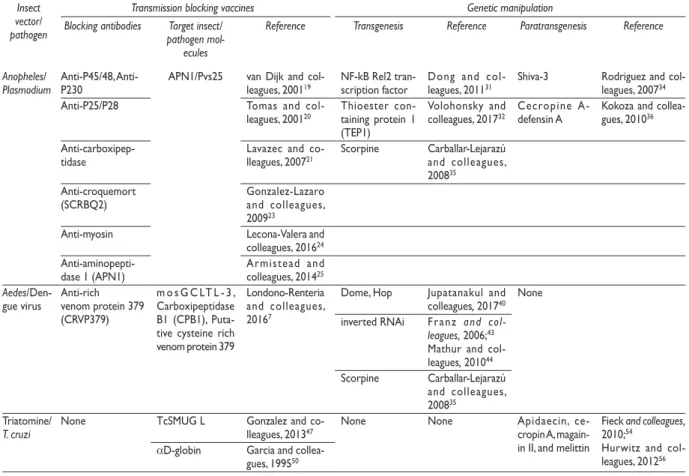
andidatemoleculesFortransmissionblockingvaccinesandvectorgeneticmaniPulationInsect vector/ pathogen
Transmission blocking vaccines Genetic manipulation
Blocking antibodies Target insect/ pathogen
mol-ecules
Reference Transgenesis Reference Paratransgenesis Reference
Anopheles/
Plasmodium Anti-P45/48, Anti-P230 APN1/Pvs25 van Dijk and col-leagues, 200119 NF-kB Rel2 tran-scription factor Dong and col-leagues, 201131 Shiva-3 Rodriguez and col-leagues, 200734
Anti-P25/P28 Tomas and
col-leagues, 200120 Thioester con-taining protein 1
(TEP1)
Volohonsky and
colleagues, 201732 Cecropine A- defensin A Kokoza and collea-gues, 201036
Anti-carboxipep-tidase Lavazec and co-lleagues, 200721 Scorpine Carballar-Lejarazú and colleagues,
200835
Anti-croquemort
(SCRBQ2) Gonzalez-Lazaro and colleagues, 200923
Anti-myosin Lecona-Valera and colleagues, 201624
Anti-aminopepti-dase 1 (APN1) Armistead and colleagues, 201425
Aedes
/Den-gue virus Anti-rich venom protein 379 (CRVP379)
m o s G C LT L - 3 , Carboxipeptidase B1 (CPB1), Puta-tive cysteine rich venom protein 379
Londono-Renteria and colleagues, 20167
Dome, Hop Jupatanakul and colleagues, 201740 None
inverted RNAi Franz and
col-leagues, 2006;43
Mathur and col-leagues, 201044
Scorpine Carballar-Lejarazú and colleagues, 200835
Triatomine/
T. cruzi None TcSMUG L Gonzalez and co-lleagues, 201347 None None Apidaecin, ce-cropin A,
magain-in II, and melittmagain-in
Fieck and colleagues, 2010;54
Hurwitz and col-leagues, 201256
heritable modified genes into the genome of wild target
vector populations. A shortcoming of these strategies is
that methods which modify only one allele (one chain)
of the desired gene (
e.g
. transposon-mediated
transfor-mation), would spread the desired trait only to half of
the offspring, and it would eventually be eliminated
in the wild population. Alternative approaches use
endonuclease genes capable of copying themselves to
both gene alleles, which are inherited to all offspring,
thus spreading more efficiently through a wild
popula-tion.
58One such method uses CRISPR nuclease Cas9 to
cut sequences specified by guiding RNA molecules.
59Endonuclease gene drives spread through populations
cutting homologous chromosomes lacking the
altera-tion, inducing the cell to copy the endonuclease and
surrounding genes into the chromosome.
60In spite of the extensive advances in identifying key
candidate genes for engineering resistant insect vectors,
strict methodological controls to maintain the stability of
the gene construct in the insect genome and to guarantee
that the gene modification will not introduce alterations
to the organism as a whole (pleiotropy), or produce
secondary undesirable effects on the insect fitness,
reproduction or capacity to transmit other pathogens.
The efficacy of these strategies to control VBD depends
on not yet satisfactory gene drives capable of
spread-ing efficiently through wild populations,
61but that will
not spread to non-target species. Safety considerations
should guaranty that the gene product will not harm
other organisms, including humans.
61Conclusions
Approaches based in the use of antibodies or genetic
manipulation against critical molecules provide several
candidates for VBD control (table II). These methods are
mainly focused on disrupting specific vector-pathogen
interactions. Successful transgenic manipulation of
mos-quitoes has been achieved, but their negative relative
fitness in relation to wild populations is an important
limitation for their large-scale use. Despite successes of
altered vectors symbionts, it remains to be seen if
trans-formed bacteria can replace non-transtrans-formed bacteria
in natural insect populations. Evidently, these novel
approaches involving engineered insects and bacteria
raise several ethical, legal and social implications that
must be addressed before they are considered as part
of integrated VBD control strategies.
Declaration of conflict of interests. The authors declare that they have no conflict of interests.
References
1. World Health Organization. Vector-borne diseases. Geneva: WHO 2016. Available from: http://www.who.int/mediacentre/factsheets/fs387/en/ 2. White N. Antimalarial drug resistance and mortality in falciparum mala-ria. Trop Med Int Health 1999;4(7):469-470. https://doi.org/10.1046/j.1365-3156.1999.00435.x
3. Kelly-Hope L, Ranson H, Hemingway J. Lessons from the past: managing insecticide resistance in malaria control and eradication programmes. Lancet Infect Dis 2008;8(6):387-389. https://doi.org/10.1016/S1473-3099(08)70045-8
4. Mougabure-Cueto G, Picollo MI. Insecticide resistance in vector Chagas disease: evolution, mechanisms and management. Acta Trop 2015;149:70-85. https://doi.org/10.1016/j.actatropica.2015.05.014
5. Gyawali N, Bradbury RS, Taylor-Robinson AW. The global spread of Zika virus: is public and media concern justified in regions currently unaffected? Infect Dis Poverty 2016;5:37. https://doi.org/10.1186/s40249-016-0132-y 6. Nsoesie EO, Kraemer MU, Golding N, Pigott DM, Brady OJ, Moyes CL,
et al. Global distribution and environmental suitability for chikungunya virus, 1952 to 2015. Euro Surveill 2016;21(20):pii=30234. https://doi. org/10.2807/1560-7917.es.2016.21.20.30234
7. Londono-Renteria B, Troupin A, Colpitts TM. Arbovirosis and potential transmission blocking vaccines. Parasit Vectors 2016;9:516. https://doi. org/10.1186/s13071-016-1802-0
8. World Health Organization . World Malaria Report 2015. Geneva: WHO 2015 Available from: http://www.who.int/malaria/publications/world-malaria-report-2015/report/en/
9. Bhatt S, Gething PW, Brady OJ, Messina JP, Farlow AW, Moyes CL,
et al. The global distribution and burden of dengue. Nature 2013;496(7446):504-507. https://doi.org/10.1038/nature12060
10. World Health Organization . Chagas disease (American trypanosomia-sis). Geneva: WHO, 2016 Available from: http://www.who.int/mediacentre/ factsheets/fs340/en/
11. Lehane MJ. Peritrophic matrix structure and function. Annu Rev Ento-mol 1997;42:525-550. https://doi.org/10.1146/annurev.ento.42.1.525 12. Gutierrez-Cabrera AE, Cordoba-Aguilar A, Zenteno E, Lowenberger C, Espinoza B. Origin, evolution and function of the hemipteran perimi-crovillar membrane with emphasis on Reduviidae that transmit Chagas disease. Bull Entomol Res 2016;106(3):279-291. https://doi.org/10.1017/ S0007485315000929
13. Lemaitre B, Hoffmann J. The host defense of Drosophila melanogaster. Annu Rev Immunol 2007;25:697-743. https://doi.org/10.1146/annurev. immunol.25.022106.141615
14. Hernandez-Martinez S, Lanz H, Rodriguez MH, Gonzalez-Ceron L, Tsutsumi V. Cellular-mediated reactions to foreign organisms inoculated into the hemocoel of Anopheles albimanus (Diptera: Culicidae). J Med Entomol 2002;39(1):61-69. https://doi.org/10.1603/0022-2585-39.1.61 15. de Azambuja P, Garcia ES, Ratcliffe NA. Aspects of classification of Hemiptera hemocytes from six triatomine species. Mem Inst Oswaldo Cruz 1991;86(1):1-10. https://doi.org/10.1590/S0074-02761991000100002
16. Clayton AM, Dong Y, Dimopoulos G. The Anopheles innate im-mune system in the defense against malaria infection. J Innate Immun 2014;6:169-181. https://doi.org/10.1159/000353602
17. Sinden RE. The cell biology of malaria infection of mosquito: advances and opportunities. Cell Microbiol 2015;17(4):451-466. https://doi. org/10.1111/cmi.12413
vaccine. Immunol Lett 1990;25(1-3):83-86. https://doi.org/10.1016/0165-2478(90)90096-9
19. van Dijk MR, Janse CJ, Thompson J, Waters AP, Braks JA, Dodemont HJ, et al. A central role for P48/45 in malaria parasite male gamete fertility. Cell 2001;104(1):153-164. https://doi.org/10.1016/S0092-8674(01)00199-4 20. Tomas AM, Margos G, Dimopoulos G, van Lin LH, de Koning-Ward TF, Sinha R, et al. P25 and P28 proteins of the malaria ookinete surface have multiple and partially redundant functions. EMBO J 2001;20(15):3975-3983. https://doi.org/10.1093/emboj/20.15.3975
21. Lavazec C, Boudin C, Lacroix R, Bonnet S, Diop A, Thiberge S, et al. Carboxypeptidases B of Anopheles gambiae as targets for a Plasmodium falciparum transmission-blocking vaccine. Infect Immun 2007;75:1635-1642. https://doi.org/10.1128/IAI.00864-06
22. Rodriguez M del C, Martinez-Barnetche J, Alvarado-Delgado A, Batista C, Argotte-Ramos RS, Hernandez-Martinez S, et al. The surface protein Pvs25 of Plasmodium vivax ookinetes interacts with calreticulin on the midgut apical surface of the malaria vector Anopheles albimanus. Mol Biochem Parasitol 2007;153(2):167-177. https://doi.org/10.1016/j. molbiopara.2007.03.002
23. Gonzalez-Lazaro M, Dinglasan RR, Hernandez-Hernandez F de L, Ro-driguez MH, Laclaustra M, Jacobs-Lorena M, et al. Anopheles gambiae Cro-quemort SCRBQ2, expression profile in the mosquito and its potential interaction with the malaria parasite Plasmodium berghei. Insect Biochem Mol Biol 2009;39(5-6):395-402. https://doi.org/10.1016/j.ibmb.2009.03.008 24. Lecona-Valera AN, Tao D, Rodriguez MH, Lopez T, Dinglasan RR, Rodriguez MC. An antibody against an Anopheles albimanus midgut myosin reduces Plasmodium berghei oocyst development. Parasit Vectors 2016;9(2):274. https://doi.org/10.1186/s13071-016-1548-8
25. Armistead JS, Morlais I, Mathias DK, Jardim JG, Joy J, Fridman A, et al. Antibodies to a single, conserved epitope in Anopheles APN1 inhibit universal transmission of Plasmodium falciparum and Plasmodium vivax malaria. Infect Immun 2014;82(2):818-829. https://doi.org/10.1128/ IAI.01222-13
26. Garver LS, Dong Y, Dimopoulos G. Caspar controls resistance to Plasmodium falciparum in diverse anopheline species. PLoS Pathog 2009;5(3):e1000335. https://doi.org/10.1371/journal.ppat.1000335 27. Dimopoulos G, Richman A, Muller HM, Kafatos FC. Molecular immune responses of the mosquito Anopheles gambiae to bacteria and malaria parasites. Proc Natl Acad Sci U S A 1997;94(21):11508-11513. https://doi. org/10.1073/pnas.94.21.11508
28. Rao XJ, Ling E, Yu XQ. The role of lysozyme in the prophenoloxidase activation system of Manduca sexta: an in vitro approach. Dev Comp Immunol 2010;34(3):264-271. https://doi.org/10.1016/j.dci.2009.10.004 29. Castillo JC, Ferreira ABB, Trisnadi N, Barillas-Mury C. Activation of mosquito complement antiplasmodial response requires cellular immunity. Science Immunology 2017;2(7):eaal1505. https://doi.org/10.1126/sciimmu-nol.aal1505
30. Hillyer JF, Schmidt SL, Christensen BM. Rapid phagocytosis and melanization of bacteria and Plasmodium sporozoites by hemocytes of the mosquito Aedes aegypti. J Parasitol 2003;89(1):62-69. https://doi. org/10.1645/0022-3395(2003)089[0062:RPAMOB]2.0.CO;2
31. Dong Y, Das S, Cirimotich C, Souza-Neto JA, McLean KJ, Dimopoulos G. Engineered anopheles immunity to Plasmodium infection. PLoS Pathog 2011;7(12):e1002458. https://doi.org/10.1371/journal.ppat.1002458 32. Volohonsky G, Hopp AK, Saenger M, Soichot J, Scholze H, Boch J, et
al. Transgenic Expression of the Anti-parasitic Factor TEP1 in the Malaria Mosquito Anopheles gambiae. PLoS Pathog 2017;13(1):e1006113. https:// doi.org/10.1371/journal.ppat.1006113
33. Rodrigues J, Brayner FA, Alves LC, Dixit R, Barillas-Mury C. Hemocyte differentiation mediates innate immune memory in Anopheles gambiae mosquitoes. Science 2010;329(5997):1353-1355. https://doi.org/10.1126/ science.1190689
34. Rodriguez MC, Zamudio F, Torres JA, Gonzalez-Ceron L, Possani LD, Rodriguez MH. Effect of a cecropin-like synthetic peptide (Shiva-3)
on the sporogonic development of Plasmodium berghei. Exp Parasitol 1995;80(4):596-604. https://doi.org/10.1006/expr.1995.1075
35. Carballar-Lejarazu R, Rodriguez MH, de la Cruz Hernandez-Hernandez F, Ramos-Castaneda J, Possani LD, Zurita-Ortega M, et al. Recombinant scorpine: a multifunctional antimicrobial peptide with activity against different pathogens. Cell Mol Life Sci 2008;65(19):3081-3092. https://doi. org/10.1007/s00018-008-8250-8
36. Kokoza V, Ahmed A, Woon Shin S, Okafor N, Zou Z, Raikhel AS. Blocking of Plasmodium transmission by cooperative action of Cecropin A and Defensin A in transgenic Aedes aegypti mosquitoes. Proc Natl Acad Sci U S A 2010;107(18):8111-8116. https://doi.org/10.1073/ pnas.1003056107
37. Salazar MI, Richardson JH, Sanchez-Vargas I, Olson KE, Beaty BJ. Dengue virus type 2: replication and tropisms in orally infected Aedes aegypti mos-quitoes. BMC Microbiol 2007;7:9. https://doi.org/10.1186/1471-2180-7-9 38. Takhampunya R, Padmanabhan R, Ubol S. Antiviral action of nitric oxide on dengue virus type 2 replication. J Gen Virol 2006;87:3003-3011. https:// doi.org/10.1099/vir.0.81880-0
39. Xi Z, Ramirez JL, Dimopoulos G. The Aedes aegypti toll pathway con-trols dengue virus infection. PLoS Pathog 2008;4(7):e1000098. https://doi. org/10.1371/journal.ppat.1000098
40. Jupatanakul N, Sim S, Anglero-Rodriguez YI, Souza-Neto J, Das S, Poti KE, et al. Engineered Aedes aegypti JAK/STAT Pathway-Mediated Immunity to Dengue Virus. PLoS Negl Trop Dis 2017;11(1):e0005187. https://doi. org/10.1371/journal.pntd.0005187
41. Blair CD. Mosquito RNAi is the major innate immune pathway contro-lling arbovirus infection and transmission. Future Microbiol 2011;6(3):265-277. https://doi.org/10.2217/fmb.11.11
42. Sanchez-Vargas I, Scott JC, Poole-Smith BK, Franz AW, Barbosa-Solomieu V, Wilusz J, et al. Dengue virus type 2 infections of Aedes aegypti are modulated by the mosquito’s RNA interference pathway. PLoS Pathog 2009;5(2):e1000299. https://doi.org/10.1371/journal.ppat.1000299 43. Franz AW, Sanchez-Vargas I, Adelman ZN, Blair CD, Beaty BJ, James AA, et al. Engineering RNA interference-based resistance to dengue virus type 2 in genetically modified Aedes aegypti. Proc Natl Acad Sci U S A 2006;103(11):4198-4203. https://doi.org/10.1073/pnas.0600479103 44. Mathur G, Sanchez-Vargas I, Alvarez D, Olson KE, Marinotti O, James AA. Transgene-mediated suppression of dengue viruses in the salivary glands of the yellow fever mosquito, Aedes aegypti. Insect Mol Biol 2010;19(6):753-763. https://doi.org/10.1111/j.1365-2583.2010.01032.x 45. Kollien AH, Schaub GA. The development of Trypanosoma cruzi in triatominae. Parasitol Today 2000;16(9):381-387. https://doi.org/10.1016/ S0169-4758(00)01724-5
46. Garcia E, Gonzalez M, Azambuja P. Biological factors involving
Trypano-soma cruzi life cycle in the invertebrate vector, Rhodnius prolixus. Mem Inst Oswaldo Cruz 1999;94(suppl 1):213-216. https://doi.org/10.1590/S0074-02761999000700033
47. Gonzalez MS, Souza MS, Garcia ES, Nogueira NF, Mello CB, Canepa GE,
et al. Trypanosoma cruzi TcSMUG L-surface mucins promote development and infectivity in the triatomine vector Rhodnius prolixus. PLoS Negl Trop Dis 2013;7(11):e2552. https://doi.org/10.1371/journal.pntd.0002552 48. Azambuja P, Feder D, Garcia ES. Isolation of Serratia marcescens in the midgut of Rhodnius prolixus: impact on the establishment of the parasite
Trypanosoma cruzi in the vector. Exp Parasitol 2004;107(1-2):89-96. https:// doi.org/10.1016/j.exppara.2004.04.007
49. Mello CB, Garcia ES, Ratcliffe NA, Azambuja P. Trypanosoma cruzi and Trypanosoma rangeli: interplay with hemolymph components of Rhodnius
prolixus. J Invertebr Pathol 1995;65(3):261-268. https://doi.org/10.1006/ jipa.1995.1040
51. Mesquita RD, Vionette-Amaral RJ, Lowenberger C, Rivera-Pomar R, Monteiro FA, Minx P, et al. Genome of Rhodnius prolixus, an insect vector of Chagas disease, reveals unique adaptations to hematophagy and parasite infection. Proc Natl Acad Sci U S A 2015;112(48):14936-14941. https://doi. org/10.1073/pnas.1506226112
52. Whitten MM, Mello CB, Gomes SA, Nigam Y, Azambuja P, Garcia ES,
et al. Role of superoxide and reactive nitrogen intermediates in Rhodnius
prolixus (Reduviidae)/Trypanosoma rangeli interactions. Exp Parasitol 2001;98(1):44-57. https://doi.org/10.1006/expr.2001.4615
53. Waniek PJ, Jansen AM, Araujo CA. Trypanosoma cruzi infection modula-tes the expression of Triatoma brasiliensis def1 in the midgut. Vector Borne Zoonotic Dis 2011;11(7):845-847. https://doi.org/10.1089/vbz.2010.0020 54. Fieck A, Hurwitz I, Kang AS, Durvasula R. Trypanosoma cruzi: synergis-tic cytotoxicity of multiple amphipathic anti-microbial peptides to T. cruzi and potential bacterial hosts. Exp Parasitol 2010;125(4):342-347. https:// doi.org/10.1016/j.exppara.2010.02.016
55. Baines S. The role of the symbiotic bacteria in the nutrition of Rhodnius
prolixus. J Exp Biol 1956;33:533–541.
56. Hurwitz I, Fieck A, Durvasula R. Antimicrobial peptide delivery strategies: use of recombinant antimicrobial peptides in paratransgenic
control systems. Curr Drug Targets 2012;13(16):1173-1180. https://doi. org/10.2174/138945012802002366
57. Durvasula RV, Gumbs A, Panackal A, Kruglov O, Aksoy S, Merrifield RB, et al. Prevention of insect-borne disease: an approach using transge-nic symbiotic bacteria. Proc Natl Acad Sci U S A 1997;94(7):3274-3278. https://doi.org/10.1073/pnas.94.7.3274
58. Burt A. Site-specific selfish genes as tools for the control and genetic engineering of natural populations. Proc Biol Sci 2003;270(1518):921-928. https://doi.org/10.1098/rspb.2002.2319
59. Mali P, Esvelt KM, Church GM. Cas9 as a versatile tool for enginee-ring biology. Nat Methods 2013;10:957-963. https://doi.org/10.1038/ nmeth.2649
60. Esvelt KM, Smidler AL, Catteruccia F, Church GM. Concerning RNA-guided gene drives for the alteration of wild populations. Elife 2014;3:e03401. https://doi.org/10.7554/eLife.03401
![Es Posible ser feliz en el trabajo? [Is it possible to be happy at work?]](data:image/gif;base64,R0lGODlhAQABAIAAAP///wAAACH5BAEAAAAALAAAAAABAAEAAAICRAEAOw==)