Prevalence in vulnerable population of
liver fibrosis identified by transient elastography
Norberto Chávez-Tapia,* Jorge Torres-Sánchez,* Juan Romero-Flores,* Paulina Álvarez-Quiroz,* Sandra Ramírez-Álvarez,* Eva Juárez-Hernández,*José Pérez-Jáuregui,** Nahum Méndez-Sánchez,*** Misael Uribe***
* Obesity and Digestive Diseases Unit. ** Clinical Laboratory. *** Liver Unit. Medica Sur Clinic & Foundation. Mexico City.
ABSTRACT
Background. Transient elastography (TE) is a useful tool for the assessment of hepatic fibrosis as an alter-native to liver biopsy, but it has not been validated as a screening procedure in apparently healthy peo-ple. Aim. To determine the prevalence of advanced liver fibrosis diagnosed by TE in a socioeconomically challenged rural population. Material and methods. We enrolled 299 participants aged over 18 years old from a vulnerable population in Mexico who responded to an open invitation. All participants had their his-tory recorded and underwent a general clinical examination and a liver stiffness measurement, performed by a single operator according to international standards. Results. Overall, 7.35% participants were found to be at high risk for cirrhosis. Three variables correlated with a risk for a TE measure ≥ 9 kPa and signifi-cant fibrosis: history of alcohol intake [7.95 vs. 92.04%, odds ratio (OR) 4.47, 95% confidence interval (CI) 1.45-13.78, P = 0.0167], body mass index (BMI) ≥ 30 kg/m2 (30.87 vs. 69.12%, OR 4.25, 95%CI 1.04-6.10, P
= 0.049), and history of diabetes mellitus (14.87 vs. 85.12%, OR 2.76, 95%CI 1.002-7.63, P = 0.0419). In the multivariate analyses BMI ≥ 30 kg/m2 was the only significant risk factor for advanced liver fibrosis or
cirrhosis (OR 2.54, 95%CI 1.02-6.3, P = 0.0460). Conclusion. TE could be useful as a screening process to iden-tify advanced liver fibrosis in the general and apparently healthy population.
Key words. Liver cirrhosis. Body mass index. Developing country. Risk factors. Morbidity.
CCorrespondence and reprint request: Norberto Chavez-Tapia, M.D., Ph.D.
Obesity and Digestive Diseases Unit, Medica Sur Clinic & Foundation. Puente de Piedra 150, Col. Toriello Guerra, C.P. 14050, Mexico City, Mexico. Tel.: 5424-6850
E-mail: [email protected]
Manuscript received: November 26, 2014. Manuscript accepted: December 15, 2015.
INTRODUCTION
Chronic liver diseases represent an important cause of morbidity and mortality in the Western world, affecting approximately 360 per 100 000 per-sons each year, and ranking as the twelfth leading overall cause of mortality, with about 800,000 deaths per year attributable to cirrhosis.1-3 Alcohol
abuse, viruses and metabolic diseases are the most common causes of liver cirrhosis.4-6
Although the exact prevalence of cirrhosis world-wide is unknown, it is accepted that approximately 1% of the general population has histological cirrho-sis.4 In Mexico, liver cirrhosis is the third highest
cause of mortality in men and the seventh in women aged between 23 and 64 years. It is estimated that in Mexico there are 1.2 million people with hepatitis C (1.4% of the general population), 400,000-600,000 people with hepatitis B and three million alcohol ad-dicts, all of whom have an increased risk of develop-ing cirrhosis.5,7-9
Mexico is believed to have about 100,000 to 200,000 patients with cirrhosis, which is equivalent to 0.04-0.09% of the population,10 a seemingly low
prevalence compared with that reported in other countries including the United States of Ameri-ca.11,12 These data could be an underestimation, as
the high prevalence of undiagnosed cirrhosis in alco-holic and nonalcoalco-holic steatohepatitis and hepatitis C infection is recognized. A similar prevalence has been reported in Europe, and numbers are even higher in most Asian and African countries where chronic viral hepatitis B or C are common.4 In
Most patients with chronic liver disease remain asymptomatic for a long period. Liver biopsy is con-sidered an imperfect gold standard. Although it re-mains the best way to diagnose cirrhosis, it is by far too invasive and not acceptable for large-scale screening of populations.13 This is the rationale for
developing noninvasive screening methods to detect advanced fibrosis or liver cirrhosis in the general population.
Currently there are two different approaches to assess fibrosis noninvasively: first, a biological ap-proach based on the levels of serum biomarkers of fibrosis; and second, a physical approach based on liver stiffness measurement (LSM) using transient elastography (TE) (FibroScan®; Echosens, Paris, France). LSM has been correlated with the stages of hepatic fibrosis and has a good diagnostic accuracy for cirrhosis.14-17 Several studies have shown its
utility in evaluating a general and apparently healthy population. Roulot, et al. demonstrated that in all individuals with LSM > 8 kPa, a cause of liver disease could be identified, conferring a positive pre-dictive value for TE of 100% for cirrhosis diagnosed in 0.7% of the studied population.18
However, most of the studies screening for ad-vanced fibrosis and cirrhosis have been performed in Caucasian populations in health-related facilities, and there is no information about vulnerable or in-digenous populations in Latin America with a high risk of developing liver cirrhosis.19 The aim of this
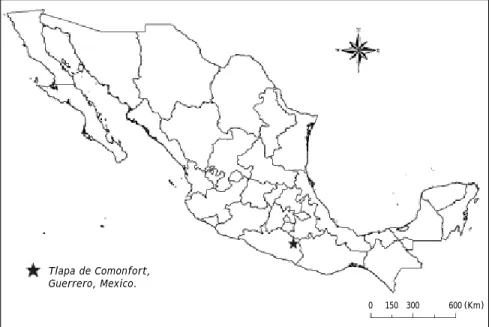
study was to determine the prevalence of advanced liver fibrosis diagnosed by TE in socioeconomically challenged rural population of Tlapa de Comonfort
Guerrero, Mexico which is a municipality in the southern of the state of Guerrero (Figure 1) that is characterized for vulnerable socioeconomic condi-tions. According to the last census of Mexican popu-lation realized in 2010, Tlapa de Comonfort recorded 65763 habitants of whom 31224 are men and 34539 women. It is a predominantly young population with a 53% of habitants under 20 years. The 48.5% of the population are indigenous, principally Na-huatl, Mixtec and Tlapanec.20
MATERIAL AND METHODS
Through an open invitation to the adult popula-tion of Tlapa de Comonfort, 299 subjects were iden-tified and underwent TE (FibroScan®; Echosens). Data were collected for clinical history, anthropome-try, general physical examination and LSM. An in-terpreter explained the characteristics of the study to participants who did not speak Spanish. This study had been carried out in accordance with the Declaration of Helsinki (2008) of the World Medical Association, and has been approved by the Ethics Committee. All the participants accepted and gave written informed consent. Subjects with a previous diagnosis of cirrhosis or known chronic liver dis-ease were excluded from this study.
The following data were collected: ethnicity (as-sessed by self-report and by the dialect recognized by the physicians and interpreter making the evalua-tion), age, sex, level of education (illiterate, elemen-tary school, junior high school, high school, professional), occupation, history of blood transfusions,
Figure 1. Tlapa de Comonfort, Guer-rero, Mexico (*).
Tlapa de Comonfort, Guerrero, Mexico.
daily alcohol intake (numbers of glasses of alcohol per week) or previous history of excessive alcohol con-sumption for more than 10 years, tobacco use(number of cigarettes per day in a period of years) or history of wood smoke exposure (years of exposure), medical history (self-reported) or medi-cation for hypertension, diabetes, coronary artery disease or dyslipidemia, type and duration of antidi-abetic and antihypertensive treatments. The physi-cal evaluation included vital signs, pulse rate, breath rate, systolic and diastolic blood pressure, body temperature, height, weight, body mass index (BMI) and hip and waist circumferences.
TE measurements are expressed in kilopascals (kPa), corresponding to the median value of 10 vali-dated measurements, and range from 2.5 to 75 kPa.21 Based on previous data, participants were
di-vided into three groups: low risk (< 7 kPa), inter-mediate risk (7-8.9 kPa) and high risk (≥ 9 kPa) for cirrhosis.18,22 LSM was performed with medium or
extra-large sized probes, depending on the anthropo-metric characteristics of the subject, to obtain the best measurement. The measurements obtained were evaluated by interquartile range (IQR) and IQR/me-dian (M) ratio. We categorized the results as “very reliable” (IQR/M ≤ 0.10), “reliable” (0.10 < IQR/M ≤ 0.30, or IQR/M > 0.30 with LSE median < 7.1 kPa) and “poorly reliable” (IQR/M > 0.30 with LSE median ≥ 7.1 kPa).22
Continuous variables were described as mean and standard deviations; differences between means were analyzed using Student’s t test or the Mann-Whit-ney U test. Categorical variables are described as numbers and percentages; differences between pro-portions were analyzed using the χ2 test or Fisher’s
exact test. To identify risk factors associated with advanced fibrosis, multivariate unconditional logis-tic regression analyses were conducted. Mullogis-ticolline- Multicolline-arity in the adjusted models was tested by deriving the covariance matrix. A P-value < 0.05 was consid-ered significant. All statistical analyses were con-ducted using the statistics program SPSS (version 12.0; IBM SPSS, Armonk, NY, USA).
RESULTS
At the end of the call for participants, 299 people had been evaluated. Their mean age was 44 ± 17 years, the majority were women (62.5%). More than half (56.8%) were not indigenous; Nahuatl (19.1%) and Mixtec (16.3%) were the two most frequent eth-nicities followed by Tlapanec (7.6%). With respect to educational level, 18.7% were illiterate, elementary
school was the most frequent educational level (24.4%) and high school and professional levels were the second and third in frequency with 20.4% and 21.4%, respectively. The main occupations were housewife (29.4%), general employee (14.4%) and farmer (13.4%), with only 3.01% of participants re-porting being unemployed. A history of cigarette smoking was reported by 20.73%, but only 3.01% re-ported smoking more than 10 cigarettes per day. A history of wood smoke inhalation was reported by 69.9%. A history of blood transfusion history was reported by 6.3% of the population. Alcohol intake was reported by 11.70 and 5.68% reported alcohol consumption for more than 10 years (Table 1).
The prevalence of diabetes mellitus was 15%, but only one person reported disease duration of more than 10 years. High blood pressure was observed in 50 participants (16.7%), a history of coronary ar-tery disease identified as acute myocardial infarc-tion was present in 2.67%, dyslipidemia in 17.1% and retinopathy in only one person. According to the World Health Organization BMI categories, our participant population was distributed as under-weight, two participants (0.7%), normal under-weight, 102 participants (34.1%), overweight, 138 participants (46.2%) and obese, 63 participants (21.1%).Of the obese participants, 50 (16.7%) were classified with grade 1 obesity, 11 (3.7%) as grade 2 obesity, and only two (0.7%) with grade 3 obesity.
The mean BMI of participants was 27.34 ± 4.41 kg/m2, the mean waist/hip index was 0.89 ± 0.05
and the mean waist/height index was 0.6 ± 0.0773. The mean systolic blood pressure was 112.7 ± 20.3 mmHg and the mean diastolic blood pressure was 72.8 ± 11.8 mmHg (Table 1). For TE, a medium probe was used in 162 subjects and an extra-large probe in 127 subjects, 54.2% and 42.5%, respective-ly. Measurement failed in 10 subjects, representing 3.34% of the studied population (Table 2).
The majority of the participants (81.27%, 243 participants) were in the low-risk group for cirrho-sis; the intermediate-risk group included 24 partici-pants (8.02%) and the high-risk group included 22 participants (7.35%), including 11 males and 11 fe-males. The quality of the LSM was “reliable” (172 subjects, 57.52%) or “very reliable” (63 subjects, 21.07%) in most participants, and only 19.06% (57 participants) had “poorly reliable” results (Table 2). Ten (3.34%) participants with measurement failure were excluded from statistical analyses.
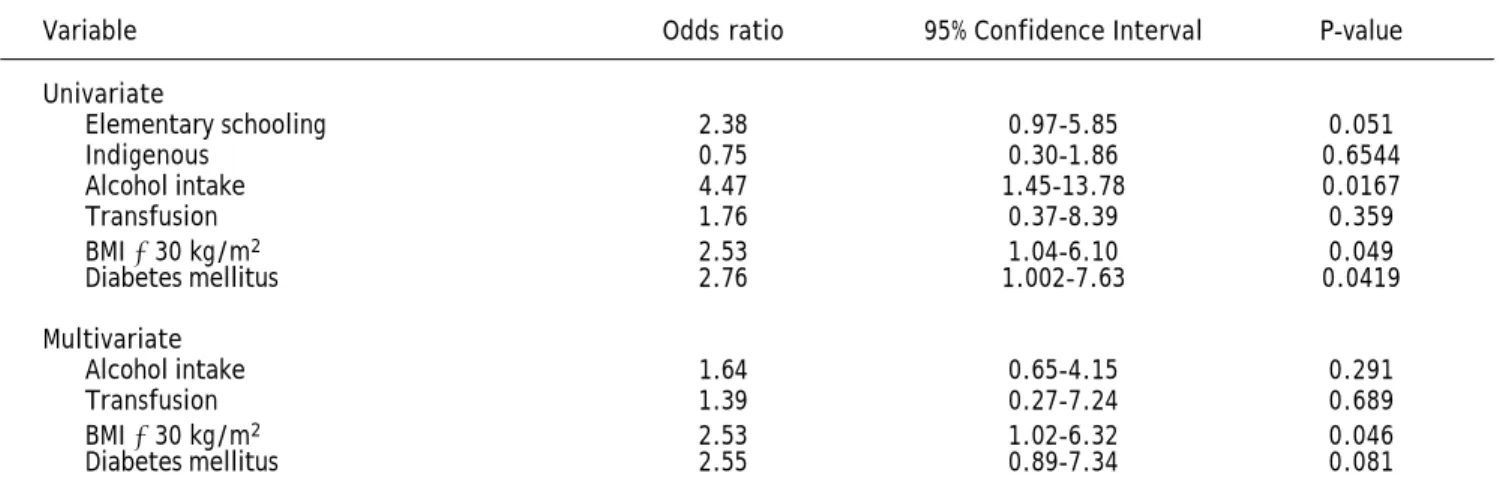
BMI ≥ 30 kg/m2 (OR 4.25, 95% CI 1.04-6.10,
P = 0.049), and history of diabetes mellitus (OR 2.76, 95% CI 1.002-7.63, P = 0.0419) (Table 3).
In the multivariate analyses adjusted for history of alcohol intake, history of diabetes mellitus, BMI ≥ 30 kg/m2, transfusion history and educational level,
BMI ≥ 30 kg/m2 was the only significant risk factor
for advanced liver fibrosis (OR 2.54, 95% CI 1.02-6.33, P = 0.0460) (Table 3).
DISCUSSION
Liver cirrhosis is the twelfth leading cause of death in the Western world, accounting for more
than 800,000 deaths per year. In developing coun-tries such as Mexico, many programs designed to de-tect disease do not operate in areas with limited accessibility because their geographical location makes it difficult for their inhabitants to access health care systems. We considered it necessary to make an assessment of this type of population in Tla-pa de Comonfort, Guerrero, Mexico, in a population that is almost half (48.56%) of indigenous origin and young (53.3% aged less than 20 years old), using a noninvasive and simple procedure such as TE.
We studied 299 subjects (just 0.45% of the popula-tion of the town) and found a prevalence of cirrhosis of 7.35% with no sex predominance. The main risk Table 1. Main clinical characteristics of the population.
Characteristic Mean (SD) or number (%)
Age (y) 44.61 (17.1261)
Female 187 (62.54%)
Ethnicity
Mixtec 49 (16.3%)
Tlapanec 23 (7.69%)
Nahuatl 57 (19.06%)
Mexican 170 (56.85%)
Education
Illiterate 56 (18.72%)
Elementary school 73 (24.41%)
Junior high school 45 (15.05%)
High school 61 (20.40%)
Professional 64 (21.40%)
Smoking history (IT) 62 (20.73%)
More than 10 cigarettes per day 9 (3.01%) History of wood smoke inhalation 209 (69.89%)
Blood transfusion 19 (6.35%)
Alcohol intake 35 (11.70%)
More than 10 years 17 (5.68%)
History of diabetes mellitus 45 (15.05%)
More than 10 years 1 (0.33%)
History of high blood pressure 50 (16.72%) History of coronary artery disease 8 (2.67%)
Dyslipidemia 51 (17.05%)
Weight (kg) 64.61 (12.9409)
Height (m) 1.53 (0.0887)
BMI (kg/m2) 27.44 (4.4080))
Waist (cm) 90.24 (10.4335)
Hip (cm) 100.46 (9.0504)
Waist/hip index 0.89 (0.0589)
Waist/height index 0.6 (0.0773)
factor for advanced fibrosis in the adjusted multi-variate analysis was BMI ≥ 30 kg/m2, which is
con-sistent with the current trend of increasing nonalcoholic steatohepatitis as a major cause of chronic liver disease.23 The mean BMI in our
popula-tion was higher (27.44 kg/m2) compared with other
studied populations. For example, Liu, et al. in 2010 described a study in women in the UK from 1996 to 2001, in which a BMI of 22.5 kg/m2 or above was
as-sociated with an increased incidence of liver cirrho-sis. In that study, the adjusted relative risk of liver cirrhosis increased by 28% (relative risk 1.28, 95% CI 1.19-1.38, P < 0.001) for every 5-unit increase in BMI.24 The level of education (mainly elementary
school) or ethnicity was not considered in this Brit-ish population.25,26
We found a prevalence for TE results compatible with cirrhosis of 7.35%, which is similar to that found in other studies such as that performed by
Roulot, et al. in Bobigny, France, which found a prevalence of cirrhosis of 8%.
We obtained better performance with the LSM procedure compared with other series,18 with only
10 participants in whom measurement failed (3.34%). However, unreliable LSM results were ob-tained in 19.1% of participants (n = 57), which is higher than the 7.1% reported by Roulot, et al.
Chronic diseases and poverty are related. Poor people are more vulnerable for several reasons, in-cluding greater exposure to risks inin-cluding use of tobacco products, consumption of energy-dense and high-fat food, being physically inactive and over-weight or obese, and decreased access to health services. In all countries, poor people are more like-ly to die after developing a chronic disease. In mid-dle- and high-income countries, the poor tend to be more obese than the wealthy, which has been viewed as something of a paradox.27 In Latin America,
espe-Table 3. Risk factors for liver cirrhosis (transitory elastography ≥ 9 kPa).
Variable Odds ratio 95% Confidence Interval P-value Univariate
Elementary schooling 2.38 0.97-5.85 0.051
Indigenous 0.75 0.30-1.86 0.6544
Alcohol intake 4.47 1.45-13.78 0.0167
Transfusion 1.76 0.37-8.39 0.359
BMI ≥ 30 kg/m2 2.53 1.04-6.10 0.049
Diabetes mellitus 2.76 1.002-7.63 0.0419 Multivariate
Alcohol intake 1.64 0.65-4.15 0.291
Transfusion 1.39 0.27-7.24 0.689
BMI ≥ 30 kg/m2 2.53 1.02-6.32 0.046
Diabetes mellitus 2.55 0.89-7.34 0.081
Table 2. Transitory elastography characteristics.
Characteristic Mean (SD) or number (%)
Probe size
M 162 (54.18%)
XL 127 (42.47%)
Transitory elastography measurement
Mean TE (kPa) 5.53 (2.09)
< 7 kPa (low risk) 243 (81.27%)
7 to 9 kPa (intermediate risk) 24 (8.02%)
> 9 kPa (high risk) 22 (7.35%)
IQR/kPA ratio 0.230 (0.2047)
Poorly reliable 57 (19.06%)
Reliable 172 (57.52%)
Very reliable 63 (21.07%)
cially in low- and middle-income countries like Mexi-co, the mean population BMI is 27 kg/m2,
over-weight and obesity (BMI ≥ 25) is observed in 65% of the population and 26% of the Mexican population is obese (BMI ≥ 30).27
It is projected that the number of deaths world-wide in 2030 because of non-communicable diseases in lower-middle income countries will increase from 13 million in 2005 to nearly 19 million,28 so
cirrho-sis will be one of the most preventable diseases caus-ing death around the globe.
The main limitations of the present study are the missing blood laboratory results because of the diffi-culty of access to the study location, difficulties maintaining all the samples in good condition for processing in an established laboratory, and that only those subjects who answered the invitation to participate were evaluated.
In conclusion, the assessment of advanced fibrosis by TE in a population with a socioeconomic profile different from the general or health-system-related population shows a higher prevalence of advanced fi-brosis than is evident in the available data from Mex-ico. Obesity is considered an independent risk factor for advanced fibrosis in this population. Further re-search is needed to establish preventive measures in this vulnerable population.
ABBREVIATIONS
• BMI: body mass index. • IQR: interquartile range. • kPa: kilopascals.
• LSM: liver stiffness measurement. • M: median.
• TE: transient elastography.
GRANTS
None.
ACKNOWLEDGMENTS
The authors would like to thank the Medicine & Social Assistance Foundation for use of their facili-ties for patient evaluation.
REFERENCES
1. Kim WR, Brown RS Jr., Terrault NA, El-Serag H. Burden of liver disease in the United States: summary of a work-shop. Hepatology 2002; 36: 227-42.
2. Browning JD, Szczepaniak LS, Dobbins R, Nuremberg P, Horton JD, Cohen JC, Grundy SM, et al. Prevalence of
hepatic steatosis in an urban population in the United States: impact of ethnicity. Hepatology 2004; 40: 1387-95.
3. Adams LA, Lymp JF, St Sauver J, Sanderson SO, Lindor KD, Feldstein A, Angulo P. The natural history of nonalcoholic fatty liver disease: a population-based cohort study.
Gas-troenterology 2005; 129: 113-21.
4. Schuppan D, Afdhal NH. Liver cirrhosis. Lancet 2008; 371: 838-51.
5. Hepatitis C as a public health problem in Mexico. Sal Pub
Mex 2011; 53(Suppl. 1): S61-S67.
6. Abenavoli L, Beaugrand M. Transient elastography in non-alcoholic fatty liver disease. Ann Hepatol 2012; 11: 172-8. 7. SINAIS SNdIeS. Base de datos de defunciones generales
1979-2007. In: SUIVE SUdIplVE, editor. México 2007. 8. INEGI. Principales causas de mortalidad por sexo en
Méxi-co In: Salud Sd, editor. MéxiMéxi-co INEGI 2006.
9. Lozano RS. Indicadores de Salud para el monitoreo de políticas públicas. In: Lozano R (ed.). VII Encuentro Inter-nacional de Estadísticas de género para políticas públicas México: SEP; 2007.
10. Cruces-Girón RG-P, ME Rangel-Jiménez, AM Sandoval-Mex, AM Tratamiento de la Insuficiencia Hepática Crónica Méxi-co: Secretaría de Salud 2008.
11. Diseases NIoDaDaK. Digestive diseases in the United States: epidemiology and impact. Bethesda, MD, 1994. 12. Statistics NCfH. Health, United States, 2005 With
Chart-book in Trends in the Health of Americans. Hyattsville, Maryland; 2005.
13. Bravo AA, Sheth SG, Chopra S. Liver biopsy. N Eng J Med 2001; 344: 495-500.
14. Friedrich-Rust M, Ong MF, Martens S, Sarrazin C, Bojunga J, Zeuzem S, Herrmann E. Performance of transient elas-tography for the staging of liver fibrosis: a meta-analysis.
Gastroenterology 2008; 134: 960-74.
15. Tsochatzis EA, Gurusamy KS, Ntaoula S, Cholongitas E, Dav-idson BR, Burroughs AK. Elastography for the diagnosis of severity of fibrosis in chronic liver disease: a meta-analysis of diagnostic accuracy. J Hepatol 2011; 54: 650-9. 16. Jung KS, Kim SU. Clinical applications of transient
elas-tography. Clinical and molecular hepatology 2012; 18: 163-73.
17. Parkes J, Guha IN, Harris S, Rosenberg WM, Roderick PJ. Systematic review of the diagnostic performance of serum markers of liver fibrosis in alcoholic liver disease.
Com-parative hepatology 2012; 11: 5.
18. Roulot D, Costes JL, Buyck JF, Warzocha U, Gambier N, Czernichow S, Le Clesiau H, et al. Transient elastography as a screening tool for liver fibrosis and cirrhosis in a com-munity-based population aged over 45 years. Gut 2011; 60: 977-84.
19. Ahern J, Galea S, Hubbard A, Karpati A. Population vulnera-bilities and capacities related to health: a test of a model.
Social science & medicine 2008; 66: 691-703.
20. INEGI. Censo de Población y Vivienda 2010. México; 2014. 21. Sandrin L, Fourquet B, Hasquenoph JM, Yon S, Fournier C,
Mal F, Christidis C, et al. Transient elastography: a new noninvasive method for assessment of hepatic fibrosis.
Ul-trasound in medicine & biology 2003; 29: 1705-13.
22. Juárez-Hernández E, Uribe-Ramos MH, Ramos-Ostos MH, López-Ramírez AY, Ornelas-Arroyo S, Romero-Flores JL, Méndez-Sánchez N, et al. Factors Associated with the Quality of Transient Elastography. Dig Dis Sci 2015; Mar 11. DOI 10.1007/s10620-015-3611-2.
et al. Liver diseases in Mexico and their associated mor-tality trends from 2000 to 2007: A retrospective study of the nation and the federal states. Ann Hepatol 2010; 9: 428-38.
24. Liu B, Balkwill A, Reeves G, Beral V. Body mass index and risk of liver cirrhosis in middle aged UK women: prospec-tive study. BMJ 2010; 340: c912.
25. Dreyer G, Hull S, Mathur R, Chesser A, Yaqoob MM. Progres-sion of chronic kidney disease in a multi-ethnic community cohort of patients with diabetes mellitus. Diabetic
medi-cine: a journal of the British Diabetic Association 2013.
26. Frierson GM, Howard EN, DeFina LE, Powell-Wiley TM, Willis BL. Effect of race and socioeconomic status on cardiovascular risk factor burden: the Cooper Cent-er Longitudinal Study. Ethnicity & disease 2013; 23: 35-42.
27. Organization WH. Global health risks: mortality and bur-den of disease attributable to selected major risks, 2009.
28. Nugent R. Chronic diseases in developing countries: health and economic burdens. Annals of the New York Academy