Northeast Document
Conservation Center
100 Brickstone Square Andover, MA 01810-1494 http://www.nedcc.org/ Tel: (978) 470-1010 Fax: (978) 475-6021
TECHNICAL
LEAFLET
THE
ENVIRONMENT
Section 2, Leaflet 4
PROTECTION FROM LIGHT DAMAGE
by Beth Lindblom Patkus Preservation Consultant
Walpole, MA
INTRODUCTION
Light is a common cause of damage to library and archival collections. Paper, bindings, and media (inks, photographic emulsions, dyes, and pigments, and many other materials used to create words and images) are particularly sensitive to light. Light damage manifests itself in many ways. Light can cause paper to bleach, yellow, or darken, and it can weaken and embrittle the cellulose fibers that make up paper. It can cause media and dyes used in documents, photographs, and art works to fade or change color. Most of us recognize fading as a form of light damage, but this is only a superficial indication of deterioration that extends to the physical and chemical structure of collections. Light provides energy to fuel the chemical reactions that produce deterioration. While most people know that
ultraviolet (UV) light is destructive, it is important to remember that all light causes damage. Light damage is cumulative and irreversible.
THE NATURE OF LIGHT
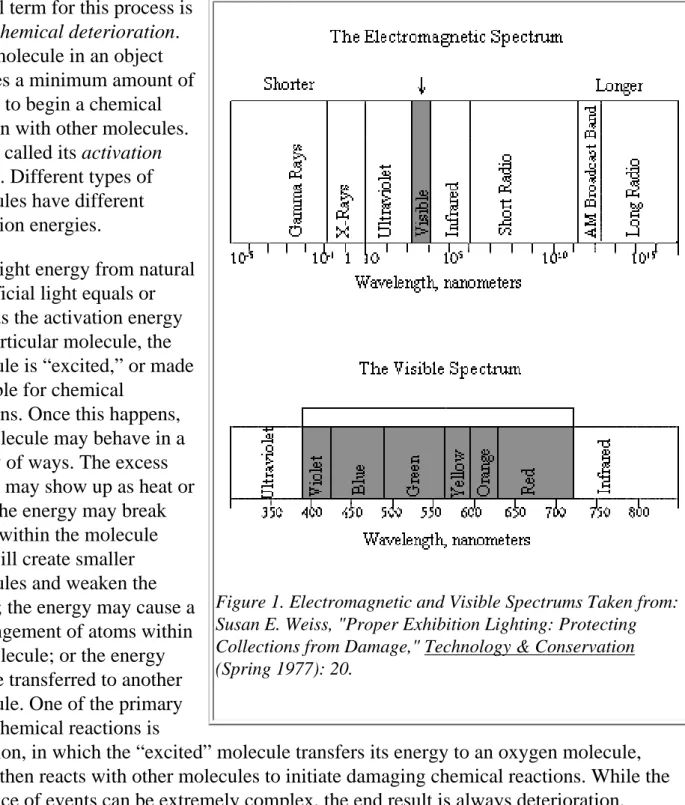
Light is a form of electromagnetic energy called radiation. The radiation that we know from medicine and nuclear science is energy at wavelengths far shorter than the light spectrum; radio waves are much longer wavelengths. Visible light, the form of radiation that we can see, falls near the center of the electromagnetic spectrum.
The visible spectrum runs from about 400 nanometers (nm, the measurement applied to radiation) to about 700 nm. Ultraviolet wavelengths lie just below the short end of the visible spectrum (below 400 nm). The wavelengths of infrared light lie just above the long end but our eyes cannot see them. This type of light also damages collections.
HOW DOES LIGHT DO ITS DAMAGE?
Figure 1. Electromagnetic and Visible Spectrums Taken from: Susan E. Weiss, "Proper Exhibition Lighting: Protecting Collections from Damage," Technology & Conservation (Spring 1977): 20.
general term for this process is photochemical deterioration. Each molecule in an object requires a minimum amount of energy to begin a chemical reaction with other molecules. This is called its activation energy. Different types of molecules have different activation energies.
If the light energy from natural or artificial light equals or exceeds the activation energy of a particular molecule, the molecule is “excited,” or made available for chemical
reactions. Once this happens, the molecule may behave in a variety of ways. The excess energy may show up as heat or light; the energy may break bonds within the molecule (this will create smaller molecules and weaken the paper); the energy may cause a rearrangement of atoms within the molecule; or the energy may be transferred to another molecule. One of the primary photochemical reactions is
oxidation, in which the “excited” molecule transfers its energy to an oxygen molecule, which then reacts with other molecules to initiate damaging chemical reactions. While the sequence of events can be extremely complex, the end result is always deterioration. Shorter wavelengths of light (UV light) have a greater frequency (that is, they occur closer together) as well as more energy than longer wavelengths. This means that they bombard an object with more energy in a shorter time, and that their energy is likely to meet or exceed the required activation energy for many different types of molecules. Thus they cause photochemical deterioration to happen more quickly, and they are extremely damaging. As wavelengths become longer, toward the red end of the spectrum, they have less energy, less frequency, and reduced capacity to “excite” molecules.
ULTRAVIOLET LIGHT VS. VISIBLE LIGHT
Since UV radiation is the most energetic and destructive form of light, we might assume that if UV light is eliminated, visible light is of minimal concern. This is not true; all wavelengths of light do significant damage.
In practical terms, UV light can be easily eliminated from exhibit, reading, and storage areas, since our eyes do not perceive it and will not miss it. Visible light is far more problematic, but it should be eliminated from storage areas as much as possible and carefully controlled in other areas.
SOURCES OF LIGHT
Light has two sources: natural and artificial. Libraries and archives should avoid natural light. Sunlight has a high percentage of ultraviolet. Daylight is also brighter and more intense, and therefore causes more damage, than most artificial light.
The two primary artificial light sources currently in use in libraries, museums, and archives are incandescent and fluorescentlamps. (The term "lamp" is used by architects and
engineers to refer to the various types of light bulbs, rather than to the fixtures containing the bulbs.) Driven by the need for energy conservation and cost savings, manufacturers continue to refine lamp technologies to produce longer-lived lamps that consume less energy and provide better light. Compact fluorescent, tungsten-halogen, high intensity discharge (HID), and electrodeless lamps have all been developed in response to these concerns.
Conventional incandescent lamps produce light when an electric current is passed through a tungsten filament, heating it to about 2700 degrees Celsius. Incandescent lamps convert only a small percentage of this electricity into light; the rest becomes heat.
Conventional incandescent lamps emit very little ultraviolet light and do not require UV filtering. Examples of conventional incandescent lamps include the ordinary household light bulb and a variety of lamps used for exhibition lighting, such as the Reflectorized (R), Ellipsoidal Reflectorized (ER), and Parabolic Aluminized Reflector (PAR) lamps.
Tungsten-halogen lamps (also called quartz lamps) are a variation on the traditional incandescent lamp; they contain halogen gas inside a quartz bulb, which allows the light to burn brighter and longer. These lamps emit significant UV light and do require filtering. Filters can be expensive and special housings designed to accept the UV filters may be necessary. Tungsten-halogen lamps are also used in exhibition lighting; examples include the Halogen PAR and the Mirrored-Reflector (MR) lamp. Fluorescent lampscontain mercury vapor inside a glass lamp whose inside surface is painted with white fluorescent powder. When electricity is passed through the lamp (via a filament), the mercury vapor emits UV radiation which is absorbed by the fluorescent powder and re-emitted as visible light. Some UV light passes through most fluorescent lamps, however, so they are more damaging than incandescent lamps. The newest type of fluorescent is the compact fluorescent lamp; these are smaller, last longer, and have a more pleasant color than
Like fluorescents, high intensity discharge (HID) lamps contain a vapor inside a glass lamp coated with a fluorescent powder, but they are much more intense than normal fluorescents. There are two types. Mercury or metal halide HID lamps should not be used, since they have a dangerously strong UV output and filtering can be difficult. High-pressure sodium HID lamps are too intense for direct lighting (and do not provide good color
rendering), but they can be used for indirect lighting (i.e., bouncing light off the ceiling) in large storage spaces with high ceilings. Sodium HID lamps have very low UV emissions, which can be further reduced by painting the ceiling with white titanium dioxide paint, a UV-absorber. Sodium HID lamps generate little heat, are efficient, and have low operating costs.1
Fiber optic lighting is an energy-efficient means of providing display lighting, particularly in exhibition cases. In a fiber optic system, light is transmitted from a light source through glass or acrylic fibers. The fibers do not conduct infrared or ultraviolet light, and unlike fluorescent lamps, fiber optic lighting does not cause buildup of heat within the case (provided the light source is mounted outside the case).
The electrodeless lamp is the newest type of light source. A normal incandescent lamp is subject to the eventual failure ("burn out") of its electrode, which is a piece of metal
(usually tungsten) that is heated until it produces light. Electrodeless lamps produce light in other ways, including the use of radio frequencies to excite a coil or microwave energy directed at the element sulfur to produce visible light. Electrodeless lamps produce a lot of illumination, so thus far they have only been used as sources of ambient light (the light produced by one electrodeless sulfur lamp equals more than 250 standard 100 watt incandescent lamps). They are more energy efficient than HID lamps, and they provide excellent color rendition, low infrared and ultraviolet light, and long life. It is expected that this technology will eventually be miniaturized for use in smaller exhibit spaces and in exhibit cases.2
HOW MUCH LIGHT IS TOO MUCH?
Do we have to eliminate all UV light? Since all visible light cannot be eliminated, particularly in exhibition areas, how low should the levels be?
Control of ultraviolet light is relatively straightforward. The standard limit for UV for preservation is 75 µW/l (see below). Any light source with a higher UV emission must be filtered. Control of visible light is obviously more problematic. It is essential to understand that light damage is cumulative, and that lower levels of illumination will mean less
damage over the long term. Another important concept in controlling visible light is the law of reciprocity. This says that limited exposure to a high-intensity light will produce the same amount of damage as long exposure to a low-intensity light. For example, exposure to 100 lux for 5 hours would cause the same amount of damage as exposure to 50 lux for 10 hours.
have argued the importance of aesthetic concerns: older visitors need more light to see exhibited objects well, and any visitor will find that more fine detail is apparent and colors appear brighter as light levels increase. In addition, the assumption that all paper objects are equally sensitive to light has been challenged.3 Scientists at the Canadian Conservation Institute (CCI) and others have begun to gather data on rates of light fading for specific media and colors in an effort to begin developing more specific guidelines based on the International Standards Organization (ISO) Blue Wool light fading standards (see "Practical Tips for Estimating Light Damage," below).
In the absence of universal guidelines, it is recommended that each institution establish its own limits on exhibition for its collections. Factors to consider include: the amount of time the lights are turned on in the exhibit space (this may be more than first thought, since lights are often turned on for housekeeping or other purposes when the exhibit is closed to the public); the sensitivity of the items or groups of items being exhibited; the desired lifespan of these items or groups of items; and the importance of aesthetic concerns in exhibition. Ultimately, every institution should decide on an acceptable upper limit of exposure (i.e., a certain number of lux hours per year), which may differ for different parts of an institution's collection. Publications by CCI and the exhibition policy developed by the Montreal
Museum of Fine Arts for works of art on paper may be helpful in estimating the sensitivity of various types of paper-based collections.4
Using the law of reciprocity, an exhibition limit can be achieved in different ways; for example, a limit of 50,000 lux hours per year could be achieved by keeping the lights on for 10 hours per day, either at 100 lux for 50 days or at 50 lux for 100 days. It is important to remember that even with such guidelines, some fading will occur. The goal is to achieve a workable compromise between exhibition and preservation.
HOW DO YOU MEASURE LIGHT LEVELS?
Visible light levels are measured in lux ("lumens per square meter") or footcandles. One footcandle equals about 11 lux. A light meter measures the level of visible light. The meter should be placed at the spot where you want to take a reading (for example, close to the surface of an object being exhibited). The meter should face the light just as the object does in order for it to get an accurate reading.
If you do not have access to a light meter, you can measure the approximate lux level using a 35 mm single-lens reflex camera with a built-in light meter, using the following
procedure.
● Place a sheet of white board measuring 30 cm x 40 cm at the position where the light
level is to be measured and at the same angle as the artifacts.
● Set the camera ASA/ISO rating at 800. Set the shutter speed at 1/60 second.
● Aim the camera at the white board and position it just close enough so that the field
of view is filled by the board. Be sure not to cast a shadow on the board.
● Adjust the aperture until the light meter indicates a correct exposure, and note the
F4 F5.6 F8 F11 F16
represents represents represents represents represents
50 lx 100 lx 200 lx 400 lx 800 lx5
A light meter measures only the level of illumination; a UV meter must be used to measure the UV component of light. UV light is measured in microwatts per lumen (SYMBOL -µW/ l). The most common UV meter is the Crawford monitor, but all UV meters will measure the proportion of ultraviolet in visible light. Again, this should not exceed 75 µW/l. A word of caution regarding UV meters: some older UV meters (costing from $500 to $1500) may not be adequately sensitive to UV light; they may indicate that levels are safe when in reality they are not. Newer more expensive ($3000 to $5000) meters are designed to measure UV levels more accurately.6
PRACTICAL TIPS FOR ESTIMATING LIGHT DAMAGE
It is possible to estimate the damage that might result to an artifact from particular intensities of light and lengths of exposure. This can be done using the ISO’s Blue Wool standards cards, available from TALAS, and the light-damage slide rule, available from the Canadian Conservation Institute (CCI).
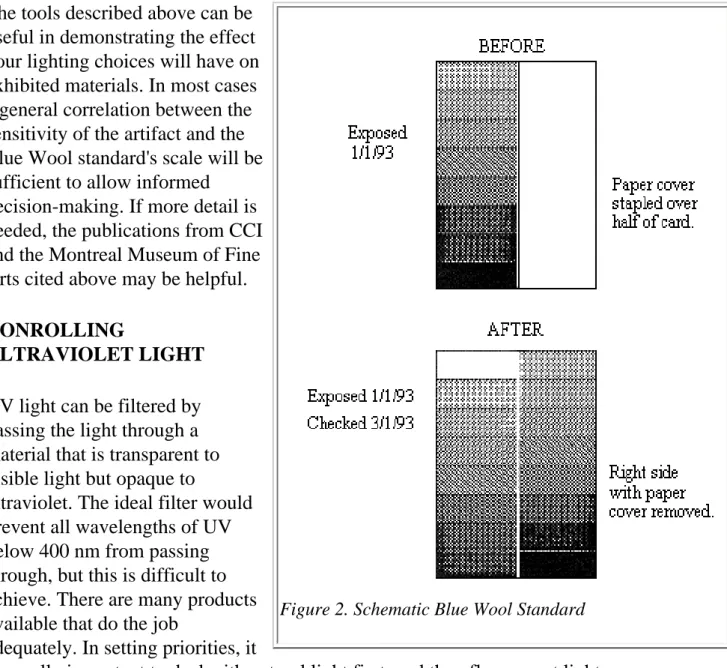
The Blue Wool standards can clearly demonstrate the destructive powers of light. These cards provide a standard against which subsequent fading can be judged, and therefore can be used to convince skeptics that light really is a problem. Each Blue Wool standard
contains eight samples of blue-dyed wool. Sample 1 is extremely light sensitive, while sample 8 is the most stable dye available (although not permanent). Sample 2 takes twice as long to fade as sample 1, sample 3 takes twice as long as sample 2, and so forth.
To demonstrate the degree of fading caused by the intensity of light in a particular location, cover half of the card with a light-blocking material to protect it completely from light damage. Write the date on the card, and set it out in the desired location. Check the card periodically (every couple of weeks) to determine how long it takes for the various samples to fade. Since the sensitivity of the first few samples on the card corresponds to light
sensitive materials such as paper and textiles, the results will give you a general idea of the amount of damage you might expect if materials were exhibited for the same period of time at the current light level in that location.
unfiltered light.
Figure 2. Schematic Blue Wool Standard
The tools described above can be useful in demonstrating the effect your lighting choices will have on exhibited materials. In most cases a general correlation between the sensitivity of the artifact and the Blue Wool standard's scale will be sufficient to allow informed
decision-making. If more detail is needed, the publications from CCI and the Montreal Museum of Fine Arts cited above may be helpful.
CONROLLING
ULTRAVIOLET LIGHT
UV light can be filtered by passing the light through a material that is transparent to visible light but opaque to
ultraviolet. The ideal filter would prevent all wavelengths of UV below 400 nm from passing through, but this is difficult to achieve. There are many products available that do the job
adequately. In setting priorities, it
is usually important to deal with natural light first, and then fluorescent light.
Ultraviolet-filtering plastic is available to cover windows and skylights. It must cover the surface completely so that all light passes through it. This plastic is available either in self-supporting sheets of acrylic or in thin film (usually acetate) that is cut to shape with a knife or scissors and adhered to the glass. The acrylic panels can be used in place of window glass (if fire regulations allow), mounted as secondary glazing on existing windows, or hung inside the window from hooks (the panel must be cut larger than the window glass, so that all light passes through it). Tinted panels are also available, to reduce overall light. Varnishes that absorb ultraviolet light are also available. A supplier applies these coatings on window glass with a special tool. Currently, varnish is not recommended; it is very difficult to apply uniformly, and it deteriorates over time. Plastic is more convenient, lasts longer, and does the job better.
extend the length of a single sleeve. Whatever type of filter is used, maintenance staff must be trained to transfer the filter when they change lamps.
If the fluorescent lights are housed in recesses that are completely covered by a plastic shield, however, UV light levels should be tested before an institution spends money on UV-filtering sleeves. Experience has shown that these plastic shields often provide UV filtering, reducing UV levels to 10-20 µW/l.
Some fluorescent lamps produce significantly less UV than others. To insure maximum protection, one suggestion is to use lamps that produce relatively low UV in combination with UV filters. This will further reduce UV levels, reduce damage caused by improper installation or failure to replace filters, and extend the lives of the filters themselves.7 Some manufacturers now make fluorescent lamps with UV-filtering glass, but these can be much more expensive than standard lamps. Replacements must be kept on hand, and care must be taken not to replace a custom UV-filtering lamp with an ordinary one.
Another option available for protecting against UV light is the use of white paint containing titanium dioxide. While this method is not as effective, it will cut down on UV light
significantly. Titanium dioxide paint absorbs ultraviolet light, and can be painted directly on windows or skylights, if they do not provide the only source of light.
HOW LONG DO UV FILTERS LAST?
At this time there is no definitive data to indicate how long UV filtering products retain their effectiveness. In a CCI Note published in 1984, the Canadian Conservation Institute reported that both soft plastic filtering sleeves and hard plastic filtering tubes retain their UV-absorbing properties for at least 10 years. UV-filtering window films may also have limited life-spans; some manufacturers quote a life of 5-15 years for these films.8 In climates with intense sunlight these filters may not last as long.
The only conclusive way to determine the continued effectiveness of UV-filtering products is to measure the UV levels emitted using a UV monitor (see cautions on UV monitor accuracy given above). Since these monitors are expensive, smaller institutions should make arrangements to borrow one every few years from a nearby large museum or other institution.
CONTROLLING VISIBLE LIGHT
can also be installed that turn off lights when no movement is sensed in the area. Lighting should be incandescent (tungsten) rather than fluorescent wherever possible.
Many situations are not ideal and space is often at a premium. If you cannot keep an object out of the light, keep the light from reaching the object. Boxes from archival suppliers made by professional box-makers to fit the exact dimensions of individual objects are useful. While boxes will prevent damage from direct light exposure, it is uncertain whether they will protect objects from the fluctuations in temperature and humidity that may be caused by solar heating.
The specifics of determining guidelines for exhibition lighting of objects have been discussed above. All windows in exhibit areas should be covered with drapes, shades, or blinds, in addition to being filtered for UV. Skylights should be covered to block the sun. Light levels should be low, and materials should never be exposed to direct sunlight. Never display objects permanently unless they are expendable.
Exceptionally fragile and vulnerable objects should not be displayed, and research use should be limited. If materials must be exhibited, great care must be taken to minimize damage. Books that are opened for display should have the pages turned weekly so that one page is not constantly exposed. Photographic and photocopy facsimiles of objects should be used whenever possible for display and research.
Spotlights should never be trained directly on an object. Indirect and low lighting will spare the object, and it will also require less adjustment of the eye from areas of intense light to those of relative darkness, allowing the use of lamps with a lower wattage throughout exhibit spaces. A gradual diminution of light levels through a series of rooms may accustom viewers' eyes to lower exhibition light levels. Strategic placement of labels explaining the reason for low light levels can be used to educate patrons.
SUMMARY
All light contributes to the deterioration of library and archival collections by providing energy to fuel destructive chemical reactions within the paper. Light also damages bindings, photographic emulsions, and other media, including the inks, dyes, and pigments used in many library and archival materials. Institutions should follow the guidelines given above for measurement of light levels and control of light exposure. All sources of ultraviolet light illuminating collections should be filtered, and the exposure of collections to visible light should be strictly controlled.
NOTES
1William P. Lull, with the assistance of Paul N. Banks, Conservation Environment Guidelines for
Libraries and Archives (Ottawa, ON: Canadian Council of Archives, 1995), pp. 44-45.
2See Frank Florentine, "The Next Generation of Lights: Electrodeless," in WAAC Newsletter 17:3
(September 1995), for more information and details on the use of electrodeless lamps at the Smithsonian Institution's Air and Space Museum.
Lighting - Beyond Edison: Lighting for the Next Century," a workshop presented by the National Park Service and the Washington Conservation Guild, March 6-8, 1996.
4See Stefan Michalski, "Towards Specific Lighting Guidelines"; "A Light Damage Slide Rule,"
CCI Notes 2/6, Canadian Conservation Institute, Ottawa (1989); and Karen M. Colby, "A
Suggested Exhibition/Exposure Policy for Works of Art on Paper" (available at The Lighting Resource website: http://www.lightresource.com/).
5 Taken from "Using a Camera to Measure Light Levels," CCI Notes 2/5, (Ottawa: Canadian
Conservation Institute, 1992).
6Lull, p. 19.
7 Lull, p. 44.
8Abbey Newsletter 16.7-8 (December 1992): 114.
SUGGESTED FURTHER READING
Anson, Gordon. "The Light Solution." Museum News (September/October 1993): 27.
Canadian Conservation Institute. A Light Damage Slide Rule. CCI Note No. 2/6. Ottawa: Canadian Conservation Institute, December 1988, 10 pp.
Canadian Conservation Institute. Ultraviolet Filters for Fluorescent Lamps. CCI Note No. 2/1. Ottawa: Canadian Conservation Institute, June 1983, 1 p.
Canadian Conservation Institute. Using a Camera to Measure Light Levels. CCI Note No. 2/5. Ottawa: Canadian Conservation Institute, 1992, 1 p.
Colby, Karen M. "Suggested Exhibition/Exposure Policy for Works of Art on Paper." July 1993. Available at The Lighting Resource web site: http://www.webcom.com/~lightsrc/ Feller, Robert L. The Deteriorating Effect of Light on Museum Objects. Museum News Technical Supplement No. 3. Washington, DC: American Association of Museums, June 1964, 8 pp.
Florentine, Frank. "The Next Generation of Lights: Electrodeless," in WAAC Newsletter 17:3 (September 1995).
Lull, William P, with the assistance of Paul N. Banks. Conservation Environment Guidelines for Libraries and Archives. Ottawa, ON: Canadian Council of Archives, 1995. 102 pp.
Museum Exhibit Lighting, An Interdisciplinary Approach: Conservation, Design, and Technology. Proceedings of a workshop presented by the National Park Service and the American Institute for Conservation at the 1997 AIC Annual Meeting. Available from AIC, 1717 K St., NW, Suite 301, Washington, DC 20006; 202-452-9545.
Thomson, Garry. The Museum Environment. 2nd edition. London and Boston:
Butterworth in association with The International Institute for Conservation of Historic and Artistic Works, 1986, 308 pp.
SOURCES OF SUPPLIES
This list is not exhaustive, nor does it constitute an endorsement of the suppliers listed. We suggest that you obtain information from a number of vendors so that you can make
comparisons of cost and assess the full range of available products.
A more complete list of suppliers is available from NEDCC. Consult the Technical Leaflets section of NEDCC's website at http://www.nedcc.org/or contact NEDCC for the most up-to-date version in print.
3M Product Information Center 3M Center, Building 304-1-01 St. Paul, MN 55144-1000 U.S.A.
Toll Free: (800) 3M HELPS or (800) 364-3577 Telephone: (651) 737-6501
Fax: (800) 713-6329 or (651) 737-7117 E-mail: [email protected]
http://www.mmm.com/
UV-filtering window film (call for local distributor)
Canadian Conservation Institute (CCI) 1030 Innes Road
Ottawa, Ontario K1A 0M5 Canada
Telephone: (613) 998-3721 Fax: (613) 998-4721
E-mail: [email protected] http://www.cci-icc.gc.ca/
Light-damage slide rule, CCI Notes and Technical Bulletins
Cole-Parmer Instrument Company 625 East Bunker Court
Vernon Hills, IL 60061 Toll Free: (800)323-4340 Fax: (847)247-2929
E-mail: [email protected] http://www.coleparmer.com/ Light meters - regular
Fax: (248) 276-8825
E-mail: [email protected] http://www.cookecorp.com/ Light meters - regular
Gaylord Brothers Box 4901
Syracuse, NY 13221-4901 Toll Free: (800) 448-6160 Fax: (800) 272-3412
E-mail: [email protected] http://www.gaylord.com/
UV filters, light meter - regular, light damage, slide rule
Light Impressions P.O. Box 787
Brea, CA 92822-0787 Toll Free: (800) 828-6216
Telephone: (714) 441-4539 (outside U.S.) Toll Free Fax: (800) 828-5539
Fax: (714) 441-4564 (outside U.S.) E-mail: [email protected] http://www.lightimpressionsdirect.com/ UV filters
Littlemore Scientific Engineering Co. - ELSEC Railway Lane
Littlemore, Oxford OX4 4PZ UK
Telephone: 01865 747437 Fax: 01865 747780
E-mail: [email protected] http://www.elsec.co.uk/ UV meters
Rohm and Haas
100 Independence Mall West Philadelphia, PA 19106-2399 Telephone: (215) 592-3000 Fax: (215) 592-3377
http://www.rohmhaas.com/ UV-filtering Plexiglas
Solar-Screen Company 53-11 105th Street Corona, NY 11368
Fax: (718) 271-0891
E-mail: [email protected] http://www.solar-screen.com/ UV-filtering products
Talas
20 West 20th Street New York, NY 10011 Telephone: (212) 219-0770 Fax: (212) 219-0735
Email: [email protected]
http://talasonline.com/ Blue Wool standard cards
Thermoplastic Processes, Inc.
57 Stirling Road Warren, NJ 07059
Toll Free: (888) 554-6400 Telephone: (908) 561-3000 Fax: (908) 753-6749
E-mail: [email protected]
http://www.thermoplasticprocesses.com/ Arm-a-Lite UV-filtering tubes (hard plastic)
University Products 517 Main Street P. O. Box 101
Holyoke, MA 01041 Toll Free: (800) 628-1912 Telephone: (413) 532-3372 Toll Free Fax: (800) 532-9281 Fax: (413) 432-9281
E-mail: [email protected] http://www.universityproducts.com UV filters, light meters - regular and UV
Updated: August 18, 2004 2/99
Search ~The Environment