«ﺖﻌﻴﺒﻃ ىاﺮﺑ ،مدﺮﻣ ىاﺮﺑ ،ﺎﻫ بﻻﺎﺗ ﻆﻔﺣ»
ﻊﻣﺎﺟ ﺖﻳﺮﻳﺪﻣ ﻪﻣﺎﻧﺮﺑ
ﻊﻣﺎﺟ ﺖﻳﺮﻳﺪﻣ ﻪﻣﺎﻧﺮﺑ
نﺎﺸﻳﺮﭘ بﻻﺎﺗ
نﺎﺸﻳﺮﭘ بﻻﺎﺗ
ﯽﻠﺤﻣ ﻊﻣاﻮﺟ و ﺎﻫ نﺎﻣزﺎﺳ یرﺎﮑﻤﻫ ﺎﺑ ہﺪﺷ ﻪﯿﻬﺗ
نﺎﺸﯾﺮﭘ بﻻﺎﺗ
١٣٨٩ دادﺮﺧ
ﺖﺴﻳز ﻂﻴﺤﻣ ﺖﻇﺎﻔﺣ ﻞﻛ ہرادا
سرﺎﻓ نﺎﺘﺳا
ناﺮﻳا ىﺎﻫ بﻻﺎﺗ زا ﺖﻇﺎﻔﺣ ﻰﻠﻠﳌا ينﺑ حﺮﻃ
“Saving Wetlands, for People, for Nature”
Department of Environment
UNDP/GEF
Approved Version May 2010
Lake Parishan
Lake Parishan
Management Plan
Management Plan
Fars DOE Conservation of Iranian
Wetlands project
ﻰ
ﺘﺴﻳز ع
ﻮﻨ
ﺗ
لﺎ
ﺳ
رد
ت
ﺎﻴﺣ
ﻪﻨﻴﺠ
ﻨ
ﮔ ز
ا
ى
ر
ا
ﺪ
ﺳ
ﺎﭘ
ى
اﺮ
ﺑ
ﻒﻋ
ﺎ
ﻀﻣ
ﺖﻤ
ﻫ
نﺎﺸﻳ
ﺮﭘ ب
ﻻﺎﺗ
ﻊﻣ
ﺎﺟ ﺖﻳ
ﺮﻳﺪﻣ
ﻪﻣ
ﺎﻧﺮﺑ
Lake P
a
rishan M
ﻥﺎﺸﻳﺮﭘ
ﺏﻻﺎﺗ
ﻯﺍﺮﺑ
ﻪﻟﺎﺳ
25
ﺯﺍﺪﻧﺍ
ﻢﺸﭼ
ﻭ
ﺎﺒﻳﺯ
ﻰﻌﻴﺒﻃ
ﺮﻇﺎﻨﻣ
،ﻰﻨﻏ
ﻰﺘﺴﻳﺯ
ﻉﻮﻨﺗ
ﻯﺍﺭﺍﺩ
ﻥﺎﺸﻳﺮﭘ
ﺏﻻﺎﺗ
،ﻩﺪﻨﻳﺁ
ﻝﺎﺳ
25
ﺭﺩ
.
ﺪﺷﺎﺑ
ﻰﻠﺤﻣ
ﻊﻣﺍﻮﺟ
ﻩﺎﻓﺭ
ﻭ
ﺖﺸﻴﻌﻣ
،ﺖﻣﻼﺳ
ﺖﻣﺪﺧ
ﺭﺩ
ﺪﻧﺍﻮﺘﺑ
ﻭ
ﻩﺩﻮﺑ
ﻢﻟﺎﺳ
ﺏﺁ
ﻰﻠﻛ
ﻑﺪﻫ
ﺏﻻﺎﺗ
ﻯﺯﺎﺳﺭﺍﺪﻳﺎﭘ
ﻭ
ﺎﻴﺣﺍ
ﻯﺍﺮﺑ
ﻰﻤﺘﺴﻴﺳﻮﻛﺍ
ﺩﺮﻜﻳﻭﺭ
ﺩﺮﺑﺭﺎﻛ
ﻩﺪﻨﻳﺁ
ﻯﺎﻫ
ﻞﺴﻧ
ﻭ
ﻰﻧﻮﻨﻛ
ﻊﻣﺍﻮﺟ
ﻩﺩﺎﻔﺘﺳﺍ
ﻯﺍﺮﺑ
ﻥﺎﺸﻳﺮﭘ
ﻩ
ﺪﺷ ﺐﯾﻮﺼﺗ ﻪﺨﺴﻧ
١٣٨٩
ﻩﺎﻣ دادﺮﺧ
UNDP/GEF
ناﺮﻳا یﺎﻫ بﻻﺎﺗ زا ﺖﻇﺎﻔﺣ حﺮﻃ
یرﺎﻜﻤﻫ ﺎﺑ
LAKE PARISHAN
INTEGRATED
MANAGEMENT PLAN
UNDP/GEF Conservation of Iranian Wetlands Project
In cooperation with
Lake Parishan Organizations and Local Communities
Version: May 2010
GOAL
To apply an ecosystem based approach for restoring and sustaining Lake Parishan for the benefit of the present and future generations
VISION
Table of Contents
:...
1. INTRODUCTION AND PURPOSE
...1.1. Background / 5
2. METHODOLOGY
...3. THE PROCESS OF DEVE LOPING THE PLAN
...4. SITE DESCRIPTION AND EVALUATION
...4.1. Physical characteristics / 7 4.2. Natural environment / 9
4.3. Human environment and administrative structure / 10 4.4. Values / 10
4.5. Threats / 12
5. STAKEHOLDER ANALYSIS
...6. MANAGEMENT PLAN
...6.1. Approach / 14 6.2. Road Map / 15
6.3. Vision, Goal and Strategic objectives / 15 6.3.1. A 25 year Vision for Lake Parishan / 15 6.3.2. Overall Management Goal / 15
6.3.3. Strategic Objectives / 17
7. GOVERNANCE AND IMPLEMENTATION MECHANISMS
...7.1. Interـsectoral coordination / 26
7.2. Ensuring decisionـmaker support for implementation of the plan / 26 7.3. Financial resources / 27
7.4. Monitoring and evaluation / 27
8. FURTHER STEPS
...ANNEXES
...Annex 1: Lake Parishan Monitoring Plan / 31
Annex 2: TOR for Lake Parishan Local Management
Committee, Provincial Coordination Committee and Secretariate / 43 Annex 3: Zoning map and table of biodiversity
sensitive zones of lake Parishan / 46
...
5 5
6
6
13
14
26
29
INTEGRATED MANAGEMENT PLAN FOR LAKE PARISHAN
Cover note
The UNDP/GEF/DOE Conservation of Iranian Wetlands Project is working with the province of Fars to develop an integrated management plan for Lake Parishan, based upon international best practice. The project’s approach is that:
“Decisionـmakers and local communities will support sustainable management of wetlands if they are aware of val-ues and functions of these sites and if they are involved in desgning and implementing their management plans”
The plan aims to help provincial and national agencies to address the current critical ecological situation of the Lake, as required by Article 67 of the 4th National Development Plan.
Three participatory workshops have so far been held for the development of this management plan. The first was held in Shiraz in February 2007 to initiate preparation of a first draft of the management plan, which was distributed among all the participants and stakeholders including Lake Parishan local communities and NGOs, provincial organizations and technical committees and project steering and technical committees; A second workshop was then arranged on May 2007 in Parishan to review the first draft, the Vision, Goal and objectives. After finalizing the first draft, the third workshop was held on 1112ـ November in Kazeroun to identify targets and priority actions to be undertaken and responsible sectors. In each of the workshops, more than 50 participants from local and provincial organizations and representatives of local communities actively participated in the discussions. Diverse informa-tion and views on the attributes, values and threats of the lake were shared by the different stakeholders during the first and second workshops, while the third workshop mainly focused on required actions.
According to the discussions of the third workshop and received comments, the management plan of Lake Paris-han has been finalized. Three working groups have been established on “Biodiversity”, “Sustainable management of Land and Water resources” and “public awareness” to plan the details and implementation of activities based on the management plan structure.
This Final version is a result of cooperation and discussions of the project steering committee, provincial coordina-tion committee, organizacoordina-tions at nacoordina-tional, provincial and local level at Fars and Kazeroun and also local communi-ties and NGOs and has been approved by government on 30th of April 2009. A Monitoring Plan and Zoning plan for human activities for Lake are also added to the management plan as new annexes.Please note that this document will be open to revision based on comments of stakeholders.
The Conservation of Iranian Wetlands Project thanks all the stakeholders who have eagerly attended our work-shops and have supported this project by participating in the discussions and giving useful comments for the management plan. We hope that implementation of this management plan would be a great step towards Article 67 of national program and application of ecosystem approach and sustainable and wise use of environmental resources in Lake Parishan basin.
M
Management PPlan for LLake PParishan
May 2010
May 2009
INTEGRATED MANAGEMENT
PLAN FOR
LAKE PARISHAN
1. INTRODUCTION AND PURPOSE 1.1. Background
Lake Parishan, an Iranian Ramsar Site in Fars Province, is one of the two demonstration sites for the UNDP/GEF Conservation of Iranian Wetlands Project. It lies to the east of Kazeroun City and is part of the ArjanـParishan Protected Area and is recognized by UNESCO as a Biosphere Reserve.
The project aims to demonstrate reduction of the major threats to the internationally important biodiversity of this wetland protected area through promoting ecosystemـbased, integrated man-agement. Such an approach is required because rapidly increasing development pressures are leading to a degradation of the Lake’s resources. The existing regulatory approach to manage-ment is not adequately addressing the needs of local people, nor the damaging activities which are arising outside the protected area.
This Management Plan is intended to provide a longـterm shared vision and approach for achiev-ing the sustainable management of the wetland and its valuable ecosystem services. Specifically, it aims to support the engagement of local people towards a wise use of the wetland’s resources, to encourage interـsectoral cooperation to achieve agreed objectives, and to raise awareness of the importance of Lake Parishan.
This management plan has been developed mainly based on the outcomes of three workshop sessions held in Shiraz and Kazeroun during February to November 2007, involving representa-tives of the key stakeholder groups for the wetland. Additional inputs from local communities have been provided through participatory rural appraisal (PRA) sessions. The plan has been submitted for final consultation by all stakeholders and enhanced through their constructive comments. It is intended that this participatory approach will ensure a more active involvement of all stakehold-ers in the wetland management. This vstakehold-ersion of the management plan will be submitted to higher level provincial and national authorities for formal approval.
2. Methodology
stakehold-ers ensures inclusion of the views, knowledge and interests of the involved parties in the planning. This aims to enhance the sustainability of the plan and increases the likelihood that stakeholders will support and participate in its implementation, particularly the local communities who are most directly dependent on the wetland. The management planning process requires identification of the values of, and threats to, the wetland, as well as the capacities of the main stakeholders. It then uses a participatory process to define a longـterm vision for the Lake which can be supported by all stakeـholders. The stakeholders then work to identify the main management objectives and actions that will deliver their common vision. This is the approach recommended by the Ramsar Convention for preparing a management plan for a wetland.
3. The process of developing the plan
A two day workshop session was first held in Shiraz in February 2007 to introduce the program for CIWP, and to share views and knowledge from different stakeholders, for the purpose of prepar-ing the first draft of the management plan for Lake Parishan. This workshop was followed by a supplementary one in Kazeroun in May 2007 with strong contribution from the local communities around the wetland.
More than 50 participants from local and provincial organizations and representatives of local communities attended each of the workshops and actively participated in the discussions. Despite the lack of comprehensive documented information on the attributes of the wetland, this process provided a good source of diverse information of the values, threats and capacities, which have been included in the management plan.
The first draft management plan was widely distributed in June 2007 among all the stakeholders for their comments.
The comments received from different stakeholders on the first draft plan were carefully reviewed and used for preparing the second draft of the management plan which was shared with the stakeholders for review and comments in a second workshop session held in Kazeroun in No-vember 2007. Based on the outcomes of the latter workshop, this version of the management plan was drafted for a final review and comments by the stakeholders. Upon receiving these comments, the final version of the management plan was prepared for approval and issue by the relevant provincial and national higher level authorities.
This strategic Management Plan will be supported by a 5ـyear Action Plan, describing the priority activities and responsibilities of each stakeholder group.
M
Management PPlan for LLake PParishan
May 2010
The general characteristics of Lake Parishan are summarized in Table 1 and are complemented by additional information in the subsequent sections.
4.1. Physical characteristics
The Lake is located about 15 km east of Kazeroun in a valley at the southern toe of the mountains locally known as Div kan. It is more or less a topographical depression which forms an elongated pan in between the shallow ridges in its eastern, southern and western sides. The area is located in the semiـarid part of Iran with short mildـtemperate winters and long hot and dry summers. Pre-cipitation regime of the area follows that of Mediterranean and major part of prePre-cipitation occurs during fall up to spring months. Summer months are generally dry.
The catchment area of the Lake is about 270,000 ha. The surface area of the water body changes seasonally according to the hydrological condition and generally varies between more than 2500 ha to almost 5000 ha but historical documents show that in some severe drought periods (1987) the entire lake has dried out. The average annual precipitation of the area is around 450 mm rang-ing in between 700220ـ mm/yr. The evaporation capacity in the area is high (on average 2470 mm per year) and ranges in between 16003350ـ mm/yr.
Attributes Description
Name and alternatives Lake Parishan, Famour Lake
Location 29,30 N 51,47 E, 15 kms east of Kazeroon City
Area of the lake varies between 25-52 sq km, wetland has dried out in some dry years Area of the Catchment 270 sq km
Elevation 820 m. amsl
Administration status Administrated by Kazeroon Environmental Conservation Office under jurisdiction of Fars Provincial Office of Environmental Conservation
Conservation status Protected since 1972 (No hunting area)
International designations Ramsar site, UNESCO Biosphere Reserve, Land tenure State owned
Land use Water body / wetland, grazing lands, cultivated lands.
Main sources of water Ground water from karstic sources + surface runoffs from the catchment area Ramsar wetland Types Riverine, Lacustrine , Palustrine,
Main ecological values Diverse wetland habitats, internationally important populations of wintering waterbirds (records of 120,000 birds visited in 197080ـs), Considerable numbers of breeding pairs of globally threatened Pelecanus crispus, Marmaronetta angustirostris, Phalacrocorax pygmaeus, 1 endemic fish species.
Products Fish, waterbirds for hunting, reeds, fodder, medical herbs, aromatic and decorative flowers. Functions Biodiversity support, landscape, climatic moderation, pollutant removal and retention, Services Ecoـtourism, recreation, education, training, research, cultural values, grazing yards, Main vegetation types Phragmites australis, Typha latifolia, Nasturtium officinale, Lemna marina, Lemna minor,
Ceratophyllum demersum, Potamogeton pectinatus, Scirpus sp
Significant fauna species Pelecanus crispus, Marmaronetta angustirostris, Phalacrocorax pygmaeus Grus grus, Francolinus francolinus, Cyprinion tenuiradius (Endemic), Testudo graeca zarudmyi, Mauremys caspica ventrimaculata
Main ecological changes The area of the water body is fluctuating, but remained largely unchanged. Marginal lands around the water body have been partly encroached by farmers and are subject to land use conversion. Increasing ground water uptake in nearby wells is extracting wetland water resources and thus affecting its water balance. Wetland water quality is affected by contaminants from surrounding agricultural as well as settlement areas. Over harvesting fish resources has seriously affected the fish reserves of the wetland. Introduction of exotic fish species has caused domination of Carp species and probably has resulted in extinction of one native species.
Table 1. Summary Characteristics of Lake Parishan
The Lake is generally a shallow water body with more or less impervious bed. When fully inun-dated, the depth of water in its deepest part is less than 5 meters. At low water level conditions, the depth of water in the lake is generally less than 2 meters.
M
Management PPlan for LLake PParishan
May 2010
diversion channel in the southwestern part of the lake has been blocked by DOE.
4.2. Natural environment
Almost in all directions, the wetland is surrounded by agricultural farms, however further on the northern elevations there exists a semiـdry type of forest cover consisting mainly of scattered oak trees. Higher on the elevations, the coverage is more dense.
In the northwest and east of the Lake, considerable areas are covered by reed beds mainly consisting of Phragmites australis, and in south eastern part of the lake, a very restricted area is covered by Typha. Also scattered patches of reeds are existing in the southـeastern flats, and nar-row stretches of reeds exist along the northern and southern boundaries of the Lake. All around the wetland boundaries in the south western flat, as well as in the eastern boundaries of the Lake, where the flats are only temporarily or intermittently inundated by the Lake’s water, halophytes (consisting of mainly Tamarix, Salicornia, Aeluropus) replace the reed beds. In the deeper part of the Lake, where permanent inundation occurs, the wetland bed is covered by submerged Najas marina.
The water body of the Lake as well as different patterns of vegetation cover around and inside the lake provides diverse habitats which supports the rich biodiversity of the wetland. The Lake hosts significant number of migratory waterbirds which use it for wintering, feeding, breeding and stationing. The higher records of water birds population in the Lake exceed 120,000 (1970s and 1980s). In 7 out of 17 years of accessible records since 1990, the annual counts of water birds in Lake Parishan exceed the 20,000 Ramsar threshold for internationally important wetlands. Also Podiceps cristatus, Great Crested Grebe, Phalacrocorax pygmaeus Pygmy Cormorant, Anser anser, Greylag Goose, Oxyura leucocephala Whiteـheaded Duck, Larus ridibundus Blackـ Headed Gull,Tadorna ferruginea Ruddy Shelduck have been recorded in numbers which exceed 1% of their bioـgeographical population.
At least five threatened species are usually present in the lake, and occasionally in noticeable population. These are Pelecanus crispus, Marmaronetta angustirostris, Aythya nyroca, Oxyura leucocephala, and Aquila heliaca.
In addition to the water birds, fishes in the lake are an important constituent of the food chain on which water birds and quite a number of local people survive. Several fish species are using the wetland. An endemic species “Cyprinion tenuiradius” is only rarely observed.
A species of Otter Lutra lutra is still present in the Lake, however its population seems to be very low.
4.3. Human environment and administrative structure
Eighteen villages with a total population of 2500 households (2006 census) are located around the wetland. Most of these rural households are farmer families and depend, for their survival, on their crop production. There are about 5000 hectares of agricultural lands around the wetland. Farming practices include production of winter cereals (wheat and barley), and summer crops (sunflower, corn, melons, small vegetables, etc). An increasing trend is observed towards crop production under plastic covers for preـmatured cash vegetables (cucumber, tomato, melons, …). This is particularly true for the farming practices in the northern villages of the Lake. Production of leaf vegetable is also a common practice in several villages around the wetland.
All of the summer crops and major part of winter cereals are produced in irrigated farms, while rain ـfed wheat and barley is produced in dryـfarming areas around the wetland. Water for irrigation is supplied from spring flows or groundwater wells. These are at the same time the main sources of water supply to the wetland. This reveals that a very strong and growing competition potentially exists between the wetland’s sustainability and survival of the rural population which calls for a very careful management.
Fishing, grazing and reed harvesting are other reasons for interactions between the rural popula-tion and the wetland. Particularly tradipopula-tional fishing practices has already imposed a heavy pres-sure on the fish resources of the Lake.
The wetland is designated, since 1976, as a Ramsar site and a UNESCO Biosphere Reserve. Parishan is part of the ArjanـParishan Protected Area since 1974. Within this context, the entire catchment of the Parishan Lake is considered as a protected area. The Environmental Conserva-tion Office of Kazeroun, under the direcConserva-tion of Fars Provincial Environmental ConservaConserva-tion Direc-torate Office is responsible for protection of the Parishan Lake and its catchment area, as well as the protected areas of ArjanـParishan which is beyond the Parishan Lake catchment area but is located within the political boundaries of Kazeroun city. An environmental protection station in the western corner of the Lake with very limited manـpower capacities, disused equipment and poor instrumental facilities is assigned to undertake the protection observations/commitments.
4.4. Values
M
Management PPlan for LLake PParishan
May 2010
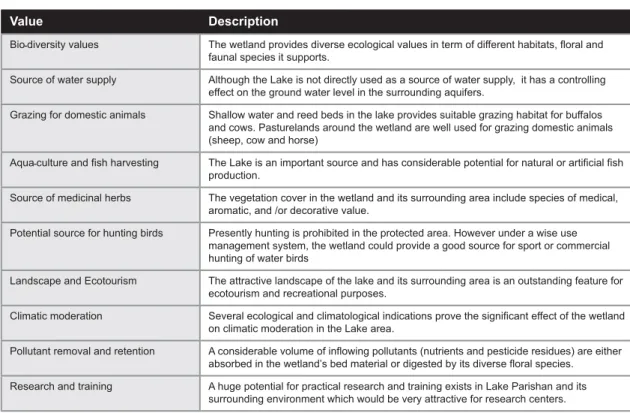
Value Description
Bioـdiversity values The wetland provides diverse ecological values in term of different habitats, floral and faunal species it supports.
Source of water supply Although the Lake is not directly used as a source of water supply, it has a controlling effect on the ground water level in the surrounding aquifers.
Grazing for domestic animals Shallow water and reed beds in the lake provides suitable grazing habitat for buffalos and cows. Pasturelands around the wetland are well used for grazing domestic animals (sheep, cow and horse)
Aquaـculture and fish harvesting The Lake is an important source and has considerable potential for natural or artificial fish production.
Source of medicinal herbs The vegetation cover in the wetland and its surrounding area include species of medical, aromatic, and /or decorative value.
Potential source for hunting birds Presently hunting is prohibited in the protected area. However under a wise use management system, the wetland could provide a good source for sport or commercial hunting of water birds
Landscape and Ecotourism The attractive landscape of the lake and its surrounding area is an outstanding feature for ecotourism and recreational purposes.
Climatic moderation Several ecological and climatological indications prove the significant effect of the wetland on climatic moderation in the Lake area.
Pollutant removal and retention A considerable volume of inflowing pollutants (nutrients and pesticide residues) are either absorbed in the wetland’s bed material or digested by its diverse floral species.
Research and training A huge potential for practical research and training exists in Lake Parishan and its surrounding environment which would be very attractive for research centers.
Threats Description External
Pollution of the Lake by agricultural activities (chemical fertilizers, pesticides, etc.)
The lake is surrounded by agricultural lands for which considerable amount of chemicals (fertilizers and pesticides/herbicides are used annually. The residual chemicals inflowing into the Lake through runoff and/or seepage flows is a significant source of pollution of the Lake. Pollution of the Lake by residential
communities (sewerages, garbages, etc…)
Eighteen villages are located within short distances around the lake. Sewage is collected in unprotected septic holes and garbage is not well managed and left in open spaces. Both are sources of pollution of the Lake through seepage, surface runoff or displacement by wind. Farmer’s competition with wetland in
use of spring flows and ground water resources
Irrigated agriculture is the main user of spring flows and ground water resources which are the main sources of water supply to the Lake. Irrigation uses are increasing, resulting in a reduced supply to the Lake.
Underـplastic cultivation around the wetland
Cultivation under plastic cover is increasingly expanding to produce offـseason vegetables. Following the harvest of the crops, the farmers carelessly leave the used plastics on the farm which causes several environmental impacts.
Conversion of habitats immediately adjacent to the wetland
In several instances, pasture lands around the wetland which used to be grazing habitat for geese are converted into farmlands.
Contamination and disturbance by visitors to the wetland
In certain occasions, considerable numbers of local people visit the wetland and its surroundings for recreation. They usually leave their garbage in place and cause serious contamination.
Overـgrazing in the watershed Watershed vegetation is usually overgrazed by nomads and local herders. This accelerates erosion inflows into the Lake.
Climatic change (global) Temperature is gradually rising due to greenhouse process. This causes increasing evaporation and transpiration and imposes more pressure on the Lake’s water resources.
Internal
Agricultural encroachment into the wetland area
In the southـwestern and southern parts of the wetland farmers have converted lands for farming. This is one of the main disputes between DOE and local people that needs to be solved in a reasonable way.
Over harvesting of fish The Lake is under a great pressure due to overـharvesting of fish which has dramatically reduced its diversity and reserves.
Nonـsustainable waterbird hunting Despite being prohibited, hunting of water birds in their breeding season occurs which is an unsustainable practice.
Introduction of exotic species (fish) To support fish reserves of the Lake, Shilat has introduced Carp larvae and this seems to have affected its species diversity.
Disturbance of wildlife by motorـboat
traffic (Noise, fuel leaks, etc.) Motor boats are frequently used by local people for transport, fishing and for recreation, and by DOE guards for protection purposes. During the breeding season this is a threat to breeding birds, and is a major source of disturbance throughout the year. Leakage of fuel and oil causes water pollution.
Burning reeds Local hunters occasionally burn the reeds to force the birds to fly. Sometimes local people put fire to reed beds just to show their dissatisfaction of the controlling procedures of DOE.
Table 3. Main threats to the Lake Parishan
4.5. Threats
M
Management PPlan for LLake PParishan
May 2010
Table 4. Main Stakeholders in Lake Parishan Management
Organization Areas of influence / impacts Local level
1 Kazeroon Office of Governor Interـsectoral coordination at local level; Strong inclination to conserve the Lake 2 Kazeroon EC Office Wetland management (protection);
Management of the protected areas around the Lake; Support local NGOs
3 Kazeroon JA Office Rationing for agroـchemicals;
Rural services for agricultural extension; Rural services for animal husbandry. 4 Kazeroon Natural Resource
Office
Rangeland management at local level, Management of government owned lands 5 Kazeroon Nomad Affairs Office Nomads’ affair management at local level.
6 Kazeroon Veterinary Office Control of animal diseases including poultry and birds
7 Kazeroon water resources office Controls and monitors water resources issues (spring flows and water well operations). 8 Kazeroon office of Cultural
Heritage, Tourism and Handicrafts
Benefits from the ecoـtourism services of the wetland;
Has incentive and potential to support the wetlands tourism services; Has potential to support handicraft industry development at rural level. 9 Farmers Benefit from microـclimate effects and rich soils;
Casual encroachment into the wetland area (conflicts);
Use of chemicals at farm level (release of residuals into the wetland); Conversion of terrestrial feeding/grazing areas for water birds; Diversion of spring flows for irrigation and other uses;
Over extracting ground water from the wells around the wetland; Contaminating wetlands’ surrounding areas by plastic–covered farms. 10 Local communities, settlements Main beneficiaries from the ecosystem services provided by the wetland;
Main supporting groups for sustaining the lake; Discharging sewage and wastes into the wetland;
Rural physical development (affecting naturalness around the wetland); Influence on political sources.
11 Fishers Beneficiaries from fishing; Overـharvesting fish from the Lake.
12 Boat users Beneficiaries from water transport and recreational facilities; Disturb the wetland tranquility and, oil contamination. 13 Buffalo herders Grazing buffalo in the wetland, harvesting reeds. 14 Hunters Hunting water birds.
15 Visitors Beneficiaries from the landscape and biodiversity values Waste residues around the wetland.
16 Local universities Benefit from the wetland for research.
17 Kazeroon H&S Office Health services to rural people through Health Houses at villages
5. STAKEHOLDER ANALYSIS
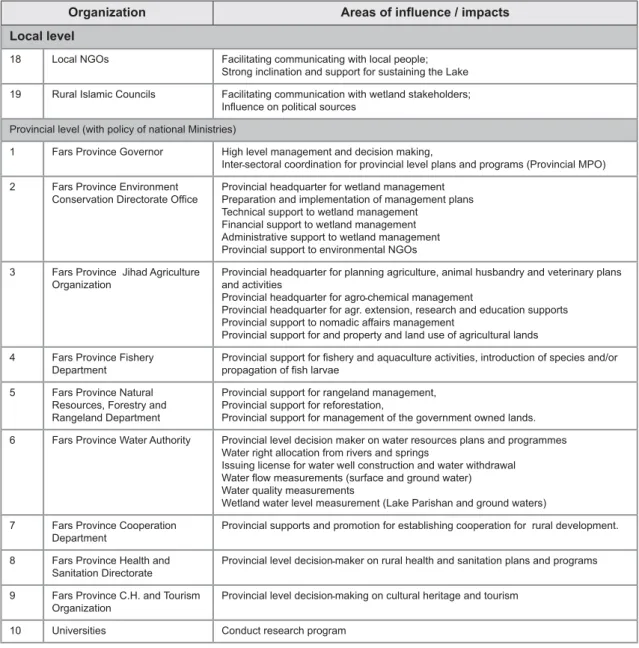
Several national, provincial and local governmental and nonـgovernmental organizations as well as local communities have influences on the management of Lake Parishan and thus are consid-ered as its stakeholders. The following table indicates the organizations and communities which are identified as main stakeholders to Lake Parishan. The table also indicates the nature of the impacts each stakeholder has on the wetland.
Organization Areas of influence / impacts Local level
18 Local NGOs Facilitating communicating with local people; Strong inclination and support for sustaining the Lake 19 Rural Islamic Councils Facilitating communication with wetland stakeholders;
Influence on political sources Provincial level (with policy of national Ministries)
1 Fars Province Governor High level management and decision making,
Interـsectoral coordination for provincial level plans and programs (Provincial MPO) 2 Fars Province Environment
Conservation Directorate Office
Provincial headquarter for wetland management Preparation and implementation of management plans Technical support to wetland management
Financial support to wetland management Administrative support to wetland management Provincial support to environmental NGOs 3 Fars Province Jihad Agriculture
Organization Provincial headquarter for planning agriculture, animal husbandry and veterinary plans and activities Provincial headquarter for agroـchemical management
Provincial headquarter for agr. extension, research and education supports Provincial support to nomadic affairs management
Provincial support for and property and land use of agricultural lands 4 Fars Province Fishery
Department
Provincial support for fishery and aquaculture activities, introduction of species and/or propagation of fish larvae
5 Fars Province Natural Resources, Forestry and Rangeland Department
Provincial support for rangeland management, Provincial support for reforestation,
Provincial support for management of the government owned lands. 6 Fars Province Water Authority Provincial level decision maker on water resources plans and programmes
Water right allocation from rivers and springs
Issuing license for water well construction and water withdrawal Water flow measurements (surface and ground water) Water quality measurements
Wetland water level measurement (Lake Parishan and ground waters) 7 Fars Province Cooperation
Department Provincial supports and promotion for establishing cooperation for rural development. 8 Fars Province Health and
Sanitation Directorate Provincial level decisionـmaker on rural health and sanitation plans and programs 9 Fars Province C.H. and Tourism
Organization
Provincial level decisionـmaking on cultural heritage and tourism 10 Universities Conduct research program
Table 4.(cont,d) Main Stakeholders in Lake Parishan Management
6. MANAGEMENT PLAN 6.1. Approach
A participatory strategic approach is being used to prepare this ecosystem based management plan. It is based on existing studies and seeks to achieve the common Vision through the engage-ment, consultation and collaboration of key stakeholders.
M
Management PPlan for LLake PParishan
May 2010
Biological Diversity and comprises 12 principles. All around the world, the ecosystem approach is increasingly being adopted as a framework for the management of protected areas.
6.2. Road Map
The Road Map for preparing the management plan is indicated in the Figure 1. It depicts the struc-ture which has been followed for preparing the plan. As indicated the present document referred to as “Management Plan” will focus on developing a higher level strategy for the management of Lake Parishan and would include Vision, Goal, Strategic objectives and the list of priority Actions. Upon finalization and ratification of this Management Plan, a 5ـyear operational Action Plan will be launched, detailing the individual projects to be undertaken by relevant stakeholder groups. The key elements of the Management Plan are a shared Vision for what Lake Parishan should be like in 25 years time, a common Goal for achieving that vision and a number of Objectives (with measureable Targets) that can be implemented through action of the key stakeholders.
6.3. Vision, Goal and Strategic objectives
6.3.1. A 25 year Vision for Lake Parishan
A very important outcome of the workshops was the strong wish expressed by all the participants (without exception) to sustain the wetland as a natural heritage for the benefit of local and na-tional communities (current and future generations). They insisted on the necessity to protect the wetland against any threat or misـmanagement which might result in its degradation. The different aspirations of the stakeholders were combined to derive the following long term Vision
6.3.2. Overall Management Goal
Participants at the first interـsectoral workshop session in Shiraz (Feb. 2007), suggested the fol-lowing overـarching Goal for the management plan. This Goal was confirmed in the second work-shop of November 2007 without significant change:
25
ـ
Year Vision for Lake Parishan
In 25 years, Lake Parishan will have a rich biodiversity, beautiful landscape and high water quality, so that it can support a healthy and prosperous local community
GOAL
Funding arrangements / Budget
Zoning Plan (Annex)
Monitoring Plan (Annex)
Objective 2 Projects Objective 1
Projects
Objective 3 Projects
Objective 4 Projects
Objective 5 Projects
Governance arrangements
Targets List of action
Targets List of action
Targets List of action
Targets List of action
Targets List of action
Management Plan
(Strategic document)
Vision
Goal
Strategic Objectives
Objective 1 Objective 2 Objective 3 Objective 4 Objective 5
Action Plan
(Operational document)
M
Management PPlan for LLake PParishan
May 2010
Application of the ecosystem approach to the management of Lake Parishan involves the follow-ing main considerations:
The management objectives should be set for the long
• ـterm, but must recognize that change is inevitable (particular attention must be given to the issues of climate change). People should be at the heart of setting the objectives.
The Lake should be managed in the context of its catchment, since upstream activities •
throughout the basin will have impacts on the Lake. The impacts of management activities on adjacent ecosystems must also be carefully considered.
Management should be decentralized to the lowest appropriate level. Management must in-•
volve all key stakeholder groups, particularly local communities, both at planning and imple-mentation stages.
The conservation of ecosystem structure and functioning to maintain the ecosystem services •
(Values) provided by the Lake should be a top priority. An appropriate balance needs to be set between the conservation and sustainable use of the Lake’s natural resources, based upon the capacity of the system.
Management should take account of the economic context
• ـ reducing market distortions that might damage ecosystem functioning, and supporting activities for sustainable use and bio-diversity conservation.
Management should be evidence
• ـbased (including traditional local knowledge).
Management will not succeed unless people are aware of the values provided by the Lake, •
and the threats to it. Raising public awareness must therefore be given high priority. Similarly, those responsible for management will need to develop the required capacity to carry out their work.
6.3.3. Strategic Objectives
The following were identified as the high level strategic objectives for the management of Lake Parishan, derived through the workshop discussions:
1ـ To restore, improve and conserve the biodiversity values of the Lake
conservation of the wider biodiversity values of the Lake. To achieve these, the threatening fac-tors need to be identified and appropriately mitigated so that degradation of the Lake’s sensitive habitats and over exploitation of its resources is stopped. Mapping of the Lake and zoning its different habitats along with raising awareness among stakeholders and enforcing more effective conservation measures are crucial for this purpose.
2ـ To enhance the supply and improve the quality of water in the Lake to safe-guard its values
The existence of the Lake as well as its hydrological and ecological functioning depends primarily on the availability and quality of water. While certain changes in the water level as well as in its chemical properties due to rainfall and evaporation) are natural phenomena, both attributes are subject to increasing impacts due to human activities. Careful management of water supply to the Lake as well as cautious control in the use of agricultural chemicals and sewage flows would be among the most important requirements of the Lake’s management.
3ـ To improve land use in and around the Lake
Workshops discussions revealed that there are disputes between some local farmers and KECO on the boundary between agricultural lands and the Wetland. This has substantially affected the sustainability of the wetland management and calls for rapid resolution. The process would require a review of the existing documents on land use and land ownership, and an exercise on identification, mapping and marking of the natural boundaries of the wetland.
In order to improve water quality, landscape and visitor satisfaction, there is also a need to estab-lish and maintain appropriate buffer areas around the lake. Such an area should be defined and appropriate activities zoned. Issues such as access for ecotourism and recreation and the use of agrochemicals should be carefully considered. Furthermore, the condition of the Lake depends greatly on the condition of the watershed, since this affects water quality and quantity. Measures to control overgrazing and erosion should be implemented.
4ـ To enhance resources and promote wise use of the Lake to improve villager’s livelihoods;
Some of the Lakes’ resources (eg the fishery) have already been seriously affected by overـ har-vesting by the local communities and inadequate managerial procedures / facilities to conserve them. Experiences worldwide indicate that sustainability of the wetlands depends primarily on the extent the local communities are active in its management.
M
Management PPlan for LLake PParishan
May 2010
the Lake so that its natural functions and resources provide sustainable benefits to the local communities. Consequently, local communities also need to be careful in not overـharvesting the resources. This would require a change in the present approach of the management system towards enabling and supporting wise use of the wetland’s resources by the communities.
5ـ To raise public awareness and enhance opportunities provided by the Lake for education and research;
An effective tool for sustaining the Lake is to raise public awareness on the values of and threats to the wetland, including the significant role it plays for livelihood of the local communities, and the way human activities can sustain or otherwise adversely affect its functionality. Public aware-ness can also effectively introduce the wetland to the national and international communities and decisionـmakers and thus invite new grounds and resources for enhancing its management. This can also act as a resource for additional economical benefits to the local people and improve their sensitivity in better sustaining the wetland.
The tables below present the priority management issues that are required to be addressed in order to meet the overall Goal for Lake Parishan. The tables are arranged according to the main objectives resulting from the workshop discussions. For each priority issue, the 25 year (longـ term) and 5 Year (shortـterm) Targets are defined, and a series of priority actions are identified along with the lead agencies to take responsibilities for undertaking the actions specified. The following keys refer to the responsible organizations:
AgB Agricultural Bank
DOE Department of Environmental Conservation of Iran; FCD Fars Province Department of Cooperatives
FCHT Fars Provincial Cultural Heritage and Tourism Organization; FCO Fars Province Climatological Organization
FECO Fars Province Environmental Conservation Office; FFD Fars Province Fishery Department;
FGO Fars Province Governmental Office; FHF Fars Province Housing Foundation FHO Fars Provincial Health Organization;
FJAO Fars Province Jihad Agriculture Organization; FM Fars Province Media
FNRD Fars Province Natural Resource Department; FRTO Fars Province Road and Transportation Department FRWA Fars Regional Water Authority;
FIMO Fars Industry and Mine Organization JS Judiciary System
Priority Issues Targets Priority actions Responsible agent (R) Partner agent (P)
Globally important water birds (Pelecanus crispus, Phalacrocorax pygmaeus, Marmaronetta angustirostris, Oxyura leucocephala, Aythya nyroca) 25 years: Birds population increases to level of mid 1970s. In the past: 2000 white headed duck including 200 breading 5 years: Keep the breeding population equal to or above 200005ـ
average….
1.1 Zoning of the wetland in terms of different habitats/ human activities
1.2 Protecting the breeding habitats (including grazing exclosure trials)
1.3 Prevent illegal shooting
1.4 Reduce disturbance by motor boats
1.5 Enhance monitoring programs (waterfowl counts and ringing)
1.6 Identify further threats to be addressed for mitigation
1.7 Raise awareness of the local communities of the sensitivity of the species, and prepare species management guidelines
1.8 Enhance enforcement of legislation 1.9 Establish monitoring the habitats
R: - FECO (KECO) P:
ـ LC (Fishermen, Hunters, Reed harvesters,etc)
ـ NGOs
ـ Universities
ـ FCHT
ـ Media,
ـ JS
Endemic fish Barbus luteus Cyprinion tenuiradius
25 years: Fish population increases to level of 1976 (to be determined) 5 years: Keep the stock equal or above 200005ـ (To be quantified)
2.1 Assess status of endemic fishes 2.2 Control fish harvesting (particularly in the breeding seasons) and introduce selective fishing methods
2.3 Control introduction of exotic fish species 2.4 Design and implement a restoration plan 2.5 Restrict fish harvesting for certain period for restoring fish stock
2.6 Identify alternative livelihood for fishermen 2.7 Investigate biology of endemic species and their interـrelation with exotic species
2.8 Investigate the impacts from water quality, water depth, motorboats, etc on fish stocks, growth and reproduction.
2.9 Establish a Gene Bank 2.10 Establish a Data Bank
2.11 Raise awareness of the local fishermen on sensitivities of the Lake’s fish species. 2.12 Enhance and enforce legislations
R: - FFD P:
ـ LC (Fishers)
ـ NGOs
ـ Universities
ـ FM,
ـ JS
Otter population Lutra
lutra 25 years: Restore population to level of 1990 (To be determined) 5 years:
Keep the population equal or above 200005ـ average (to be determined)
3.1 Investigate the present status of the otter population
3.2 Investigate further threats to otters to be addressed for mitigation
3.3 Prevent/reduce trapping in fishing nets 3.4 Promote research and an action plan for sustaining the otter population
3.5 Raise awareness of the local communities for taking care of otters
3.6 Enhance and enforce legislation
R: - FECO - KECO P: - LC - NGOs - Universities
ـ FCHT
ـ FFDFM,
ـ JS
Objective 1: To restore, improve and conserve the biodiversity values of Lake Parishan
KECO Kazeroon Environmental Conservation Office; KGO Kazeroon Government Office;
KHO Kazeroun Office of Health and Sanitation KJAMO Kazeroon Jihad Agriculture Management Office; KNRO Kazeroon Natural Resources Office;
KOC Kazeroon Office of Cooperatives KWA Kazeroun Office of Water Affairs KVO Kazeroun Veterinary Office LC Local Communities
M
Management PPlan for LLake PParishan
May 2010
Priority Issues Targets Priority actions Responsible agent
Wetland’s Water Balance
25 years: Water level (10 year average) not less than 19952005ـ
average 5 years:
No increase in water abstraction from ground or surface water resources compared to 2007 levels.
1.1 Determine water inflow required for sustaining the wetland
1.2 Prevent unauthorized abstraction from water resources
1.3 Monitor water flows into the wetland
1.4 Improve monitoring facilities and instruments and enhance accuracy in monitoring water level fluctuation of the Lake
1.5 Control volume of water withdrawn from water wells
1.6 Train the farmers for enhancing onـfarm water management and improve irrigation efficiency 1.7 Periodically examine the status of the Lake’s water balance
1.8 Stop installation of new wells until additional source of water is assured.
1.9 Improve the instruments in Parishan climatological station and enhance the accuracy of observations
1.10 Investigate possibilities for importing (diverting) water from adjacent basins
R: - FRWA P:
- FECO - FJAO (KJAO) - FCO - KGO - LC - Universities - JS Wetland’s Water Quality 25 years: Water quality is within the DOE thresholds 5 years: No increase in chemical concentration in water compared to 2007 levels
2.1 Control the use of agroـchemicals in the farms around the wetland
2.2 Regularly monitor water quality of the Lake 2.3 Regularly monitor water quality of the springs and wells
2.4 Determine thresholds for Lake’s water quality 2.5 Assign a buffer zone for agricultural lands around the Lake
2.6 Control motor boats for fuel leakages 2.7 Raise farmers awareness of the impacts of agrochemicals on Lake’s water quality
2.8 Investigate the impacts from rural sewages in Lake’s water quality
R: - FECO P: - FJAO(KJAO) - FRWA(KWA) - LCNGOs - Universities - FM - KGO - FIMO - JS
Objective 2: To Enhance the supply and improve the quality of water in Lake Parishan to safeguard its values
Objective 1: (cont,d) To restore, improve and conserve the biodiversity values of Lake Parishan
Priority Issues Targets Priority actions Responsible agent (R) Partner agent (P)
Reed beds 25 years:
Restore natural reed beds to the level of 1990s
5 years: Prevent degradation of existing reed beds
4.1 Define and protect the wetland boundaries 4.2 Investigate and map the present reed beds of the Lake and historical changes
4.3 Investigate the interـrelations of water level and reed growth/density
4.4 Control overـharvesting / overgrazing of reeds 4.5 Enhance and enforce the legislation
4.6 Raise awareness of local communities of reedbed management, including the effects of burning 4.7 Investigate possibilities for expanding Typha beds
R: FECO, KECO P: ـ FNRD
ـ FRWA
ـ KGO
ـ NGOs
ـ LC (Graziers)
ـ Universities
ـ FCHT
ـ FM
ـ JS Landscapes 25 years:
Improvement in landscape quality 5 years: No further degradation of landscape quality
5.1 Prepare a Master Zoning Plan for new developments around the wetland
5.2 Establish waste and garbage management in villages around the wetland, and by visitors 5.3 Restore forest and rangelands around the wetland
5.4 Teach farmers for proper use of plastics in their farming practices
5.5 Control inappropriate changes to land use around the wetland through application of EIA and SEIA to all major developments
R: - FECO - KECO P: ـ FNRD
ـ FJAO
ـ KGO
ـ LCFCHTO
ـ FRTD
ـ FM
Priority Issues Targets Priority actions Responsible agent
Disputes on encroachment into the Lake’s boundaries
25 years: Boundaries are respected and no encroachment occurs
5 years: Disputes are resolved, boundaries are mapped, marked and protected
1.1 Investigate and map the boundaries of the Lake, 1.2 Mark the boundaries of the Lake;
1.3 Prepare the cadastral map of the lands around the wetland
1.4 Discuss and resolve the claims from the local communities
1.5 Control land use conversion of national lands in and around the wetland
R:
ـ FECO(KECO) P:
- FNRD - FJAO - LC
- Claimant Farmers - KGO
- JS
Catchment management
25 years: Catchment management plans are implemented successfully 5 years: Plans and designs for catchment management are prepared and one demonstration project established for watershed management
2.1 Conduct studies for preparing a plan for protecting the Lake’s catchment against erosion 2.2 Implement pilot programs for protecting the catchment
R:
ـ FNRD(KNRO) P:
- FRWA (KWA) - FECO - LC - Universities
M
Management PPlan for LLake PParishan
May 2010
Priority Issues Targets Priority actions Responsible agent
Local management by rural communities to be more participatory
5 years: The establishment of an equitably represented local management committee.
1.1 Hold joint sessions of VICs of all villages and determine the need for committee(s) (with project representation)
1.2 Encourage local leaders, educated people and rural women to join committees.
1.3 Compile Terms of Reference(s) for Local Committee(s)
1.4 Keep local people aware of the Lake’s condition and all activities related to the project.
1.5 Finally, establish a local management committee for 18 villages.
R: VICs P: - KECO - FFD - KGONGOs - LC - Universities - FCD - Local Committees Provide infrastructures for pollution control and environmental improvement (Rural sanitation) 25 years: All villages have waste management and sewage collection system
5 years: An agreed plan is developed for each village for environmental management.
2.1 Prepare joint village plans and implement programs for garbage control.
2.2 Prepare plan and implement program for waste water management at villages around the wetland. 2.3 Agree and control water systems to provide clean domestic water.
2.4 Provide access to gas pipe (to reduce use of other fuels).
2.5 Revise and in future make village development plans that respond to local knowledge and control polluting activities.
R: ـ KGO
ـ Shiraz University of Medical Science) P: ـ KECO
ـ KWA
ـ LV(VICs)
ـ LC
ـ Gas Office
ـ NGOs
ـ Universities
ـ KVO
ـ Local Committees
ـ FHF Establish a
sustainable fishery
25 years:
Restore the fish harvest to a sustainable level of at least 250 tons per annum
5 years: Establish fishery cooperative, no-take zones and codes of practice
3.1 Establish a fishery Cooperative and certification scheme
3.2 Establish a plan to restore the fishery, agreed by the Cooperative
3.3 Establish noـtake zones and codes of practice 3.4 Annual monitoring and reporting of fish stocks and catch
3.5 Training programmes for fishermen
R: ـ FFD P: ـ KECO
ـ LC
ـ Universities
ـ KVO
ـ VIC
ـ FCD
Improve efficiency of
animal husbandry 25 years:Develop capacity for sustainable animal husbandry 5 years: prepare and start implementing plans for developing efficient animal husbandry
3.1 Investigate potentials and feasibility for animal husbandry development around the wetland including forage crop production and if feasible prepare a plan 3.2 Change husbandry system to be more ecoـfriendly 3.3 Visit demonstration successful and ecoـfriendly animal husbandry compounds in comparable regions 3.4 Support water buffalo husbandry in appropriate parts of the wetland
3.5 Training for pasture and rangeland management with integrated systems.
3.6. Seek DOE and Natural Resources agreement on giving loan to villagers’ activities.
R:
ـ KJAO
ـ Local Committees P: ـ KECO
- FNRD - LC - KVO - VIC - FCD
ـ Banks
Objective 4 (Cont’d): To enhance resources and promote wise use of the Lake to improve villager’s livelihoods
Priority Issues Targets Priority actions Responsible agent
Organic agriculture 25 years:
Organic local produce sold in market. 5 years: Environmental packaging/branding for local products.
4.1 FFS & IPM site visit for local farmers; 4.2 Extension and Training;
4.3 Study new ways for cultivation (Livestock fertilizers, biological ways to face with pests) and training (IPM) ;
4.4 Investigate and train efficient farm practices; 4.5 Improve processing and packaging of offـseason vegetable products;
4.6 Facilitate training and encourage organic crop production in and around the Lake;
4.7 Facilitate funds to farmers for utilizing more organic systems.
R:
ـ FJAO (KJAO)
ـ FECO (KECO)
ـ Local Committees P:
ـ LC
ـ NGOs
ـ Universities
ـ FCD
ـ Banks
Alternative livelihood
projects 25 years:10% of rural houses in 5 selected villages are equipped as guesthouses 5 years:
5 alternative projects are piloted
5.1 Encourage ecoـTourism 5.2 Train rural youth as tourist leaders 5.3 Tourism permission for villages
5.4 Improve conditions of access roads to provide easy access to villages
5.5 Equip rural houses as guesthouses 5.6 Parking and rural tourist equipment 5.7 Identify 5 alternative income projects within 2 years.
R: ـ KGO
ـ FCHT(KCHT)
ـ LC P:
ـ KECO
ـ FFD
ـ KNRO
ـ KJAMO
ـ FCHT
ـ LC
ـ NGOs
ـ Universities
ـ VIC
ـ FCD
ـ KOC
ـ Banks Conservation &
restoration of existing resources
25 years:
-All villages are covered by priority protective infrastructure facilities (i.e. fire station),
ـ Each village has a community resources management plan 5 years:
Priority protective plans prepared;
ـ One village selected and prepared as a demonstration village for sound environmental management.
6.1 Prepare community based plans for protective rural infrastructure facilities (i.e. fire station, …) 6.2 Improve local fire control / management. 6.3 Improved water system management. 6.4 Work with local Environment and Natural Resources Aids
6.5 Train local people as above
6.6 Give rangelands, watershed management and reforestation plans to local community
R:
ـ KGO
ـ Local Committees P:
ـ NGOs
ـ KECO
ـ FFD
ـ KNRD
ـ KWA
ـ FCD (KOC)
ـ VICFHF
ـ KOC
M
Management PPlan for LLake PParishan
May 2010
Priority Issues Targets Priority actions Responsible agent
Improve awareness of
local rural population 25 years: More than 50% of the rural population are aware of the wetlands’ sensitivities and basic requirement 5 years:
ـ Publishing 3000 Bruchures to be distributed in related ceremonies
ـ At least 5 movies, publications, media events per year about wetland values, threats, and management, etc.
ـ Preparing Reports on wetland needs and related projects
1.1 Assess awareness levels and gaps of local people knowledge of the values and threats and attributes of Lake Parishan wetland.
1.2 Prepare and implement plan for raising local awareness
1.3 Hold annual Festivals to celebrate the Lake 1.4 Provide media with awareness materials and filming opportunities on:
ـ wetland attributes, and requirements;
ـ threats, their origins and impacts
ـ instructions for remediation and protection
ـ Environmentally friendly farming practices and rural management
ـ Rural sustainable livelihood
ـ Etc
1.5 Prepare simple brochures ,bulletins, booklets and films
1.6 Awareness workshops in schools, and other local target audiences.
1.7 Conduct needs assessment for the above.
R:
ـ KECO
ـ Village Committees P: ـ FECO
ـ FFD
ـ FNRD
ـ KJAMO
ـ KOC
ـ KCHT
ـ NGOs
ـ LCs
ـ Media
ـ Fars Education Organiztions
ـ VIC’s
ـ CIWP
Raise awareness of local and provincial officials 25 years: Responsible officials implementing required management actions with support of their superiors 5 years
ـ workshops or training courses for responsibles from environment, water, agriculture and fisheries sectors
ـ Key Provincial officials have at least had one site visit to the Lake
2.1 Assess awareness levels and gaps of the government experts and decision maker’s knowledge of the values and threats and attributes of Lake Parishan wetland
2.2 Prepare a plan for raising awareness among these audiences including :
ـ Prepare and distribute reports, booklets and bulletins to introduce the Wetland, its key attributes, values, threats and management needs.
ـ Organize workshops to discuss and to introduce the Lake and management responsibilities to the key technicians from different relevant organizations including universities
ـ On occasions (Festivals, Wetland days, Workshops), invite key provincial technicians, managers, decisions makers and academicians for a short introductory visit to the site;
ـ Organize a web site and provide as much information as possible on the wetland, its physical attributes, functions, values, threats, management needs, etc. 2.3 Invite and support university students (MSc and PhD) for conducting research works on different attributes of the wetland
R: - KECO P: ـ FECO
- FFD - FNRD - KJAMO - Fars Governors - Universities
ـ NGOs
ـ KCHT
ـ LCs
ـ Media
ـ CIWP
Raise awareness of general publics
3.1 Prepare a plan and adopt a wide range advertisement of the Lakes attributes to attract ecoـ
tourists
3.2 Prepare brochures and signboards about the Lake
3.3 Send posters about the Lake to hotels in nearby towns and cities
3.4 Improve visitor and interpretation facilities at the Lake.
R: - FECO P: - FCHT - Media
- Fars Education - Organization - Universities - NGOs - VICs - CIWP
7. GOVERNANCE AND IMPLEMENTATION MECHANISMS
The following provisions are considered to be essential for finalization, enforcement and imple-mentation of the present Management Plan.
1. Interـsectoral coordination of key stakeholders, and strong engagement of local communities; 2. Strong support for implementation from decisionـmakers;
3. Provide financial resources.
4. Supervise the implementation of the Plan through a management committee (see paragraph 44ـ4ـ) and provide monitoring and evaluation system
7.1. Interـsectoral coordination
The adaptive participatory approach (through series of workshop sessions) was determined to be an appropriate approach for developing the management plan. To facilitate better involvement of the stakeholders in continuing participation in the detailed planning and implementation pro-cesses, three working groups were organized to address the following issues:
ـ Biodiversity working group;
ـ Water management and land use working group ـ Public participation and livelihoods working group.
These working groups will have an interـsectoral structure and representatives of different stake-holders (provincial and local level) as well as representatives from relevant local communities and NGOs will be among their formal members. The working groups will report to the provincial Local Management Committee, which is itself interـsectoral.
The main operational document for Implementation will be the 5ـYear Action Plan. This will com-prise a portfolio of the projects described in the previous section of this management plan, includ-ing timelines, responsibilities and budgets.
7.2. Ensuring decisionـmaker support for implementation of the plan
M
Management PPlan for LLake PParishan
May 2010
followed for obtaining approval of the plan.
7.3. Financial resources
Three different processes were discussed for the provision of financial resources for implementa-tion of the management plan as follows:
A. One particular national budget to be allocated to provincial organizations; B. One particular provincial budget to be allocated to provincial organizations;
Governance process for approval and enforcement of the plan for implementation
Management planning workshops Working groups
1. Biodiversity
2. Water resources and land use 3. Livelihood and public participation Local Management
com-mittee
(+ 2 local community rep. + 1 local NGO rep.)
Provincial coordination committee (Agriculture
and water WGs)
Province plan-ning council
Fars governor: Submission to all stakeholders for implementation
Signing by:
ـ Fars Governor
ـ Head of DOE
ـ MOE
ـ MOJA PSC
C. To provide new budgetary source to be directly allocate to each organization.
Discussion in the group led to proposing alternative “B” as the most appropriate approach since it better fits with the general governmental political inclinations towards allowing more power for making decisions to the Provincial Government Offices.
The budget for the management plan will be defined for the 5 Year Action Plan. Each activity in the portfolio of projects will have a defined budget and lead organization. When combined, these will result in an overall annual and 5 year budget.
7.4. Monitoring and evaluation
plan should meet the following characteristics.
ـ To be familiar with development process and objectives of the plan ـ To be able to control implementation and its results at local level ـ To have access to information of different stakeholders
ـ To be authorized for formal announcement of the results of M & E
ـ To have the capacity to provide technical recommendations and amendments to the plan
The provincial technical committee was proposed to be the main body for M&E process. How-ever, local communities, Kazeroun Town Committee, and working groups should also be able to comment on the outcomes of the plan. These would act as subـgroups of the technical committee as indicated below.
Process of M & E of LP management plan Local
communities 3 working groups Local Management
committee Provincial agriculture
and water WG CIWP
City executive committee
Based on this process, in addition to the technical committee at provincial level, 3 other provin-cial and local groups will be fully involved monitoring and evaluation of the MP. Regarding the results of M&E, the identified tasks will be prioritized and categorized. The issues that need to be technically revised will be sent to PCO of CIWP and the other executive issues will be revised by provincial working groups in order to prevent any overlaps.
M
Management PPlan for LLake PParishan
May 2010
8. FURTHER STEPS
The next steps to develop and finalize the management plan and launch its implementation are: To distribute, as soon as possible, this draft plan among all the key stakeholders including mem-bers of Technical Committee asking for their comments / proposals for finalizing the plan;
To Review the plan against comments received and incorporate the results of baseline studies of the Lake, and developing zonation plans.
To Send the final plan for approval by coordination committee and formal issue and enforcement by a high level provincial (i.e. Provincial Governor) and national authorities (DOE, MOJA, MOE) for signing off (see diagram above).
At the same time as the Management Plan is being finalised and approved, the 5 Year Action Plan (portfolio of projects) will also be finalised by the Working Groups for signـoff by the technical committee.
Department of Environment
Annexes
Annexes
Table of contents
Annex 1
: Lake Parishan Monitoring Plan………...… 3
Annex 2
: TOR for Local management Committee………..…...…… 3
Annex 3
: Zoning map and table of biodiversity sensitive zones of
lake Parishan ………...……… 3
M
Management PPlan for LLake PParishan
May 2010
I. Introduction to Wetland Monitoring
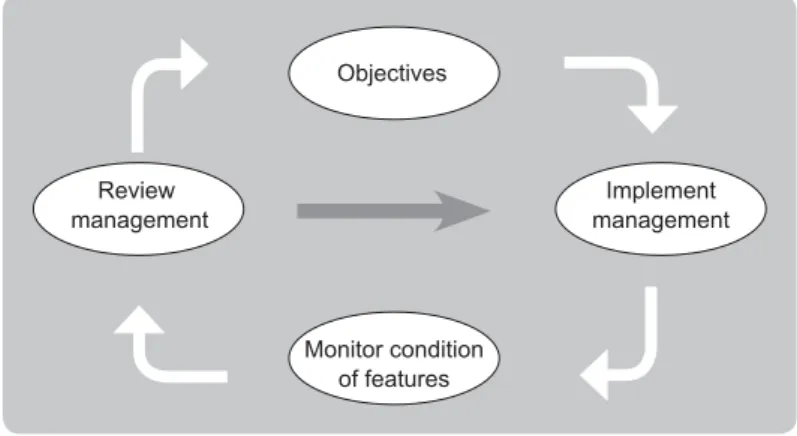
Wetland management in Iran has received more and more attention in recent years. In many instances this effort is being held back by a lack of relevant information on the nature of issues facing management, the cause of the problem and the effectiveness of management procedures and actions in resolving the problem. Effective monitoring programmes can help overcome such shortcomings. Monitoring is the systematic collection of data or information over time in order to ascertain the extent of compliance with a predetermined standard or position. An effective monitoring programme is not necessarily complex or expensive. Effectiveness is gauged by the relevance and timeliness of the data or information collected. Simple approaches to monitoring can be effective if they are well designed. However, even a well designed monitoring programme could have little value if the information that is collected is not utilized or does not influence the management process for that locality or site. Ideally, the locality or site will be subject to an inter-active and holistic management plan that provides the means of responding to the information ob-tained from the monitoring programme. This can be termed an “adaptable management cycle” .
Figure 1: The adaptable management cycle
Objectives
Implement management Review
management
Monitor condition of features
Essentially, monitoring provides the means of measuring the output of the management proce-dure ـ that is, it provides the means of measuring the (observed) state of the environment and the extent to which it may have been altered. Ideally, a monitoring programme should be established before a particular management activity is implemented, or at a minimum, baseline information should be available. If monitoring is conducted before a particular management decision is taken it is essential that the information collected is then used to influence the management activities. The key to a useful monitoring programme is good design. Monitoring programmes that are data