Development of tomatillo (
Physalis ixocarpa
Brot.) autotetraploids and their
chromosome and phenotypic characterization
Valentín Robledo-Torres1), Francisca Ramírez-Godina2), Rahim Foroughbakhch-Pournavab3), Adalberto Benavides-Mendoza1), Gustavo Hernández-Guzmán4) and M. Humberto Reyes-Valdés*2)
1) Department of Horticulture, Universidad Autónoma Agraria Antonio Narro, Calzada Antonio Narro 1923, C.P. 25315 Saltillo,
Coahuila, México
2) Department of Plant Breeding, Universidad Autónoma Agraria Antonio Narro, Calzada Antonio Narro 1923, C.P. 25315 Saltillo,
Coahuila, México
3) Facultad de Ciencias Biológicas, Universidad Autónoma de Nuevo León, Ciudad Universitaria, C.P. 66451, San Nicolás de los Garza,
Nuevo León, México
4) Laboratorio Nacional de Genómica para la Biodiversidad (Langebio), Cinvestav, Campus Guanajuato, Apartado Postal 629, C.P.
36500 Irapuato, Guanajuato, México
The tomatillo, Physalis ixocarpa Brot. (2n=2x=24), is an important crop in Mexico, and it is becoming ap-preciated in other countries. Polyploidy induction is expected to increase its breeding potential. The objective of this work was to develop and characterize tomatillo autotetraploids through colchicine-based induction. Young seedlings of the Rendidora cultivar were treated for 24 h with colchicine in concentrations ranging from 0.04% to 0.20%, and ploidy levels were tested by cytological and flow cytometry techniques. Auto-tetraploidy was induced with colchicine concentrations of 0.12% and 0.16%, with success rates of 67% and 65%, respectively. Presence of univalents, bivalents and multivalents was observed in prophase I and metaphase I. The basic genome size was not altered in the third generation progeny from treated plants. Autotetraploid plants were fertile and productive, but their pollen development was lower than their diploid counterpart. The polyploid plants showed higher values for life cycle length, plant height, fruit weight and equatorial diameter, fruits per plant, and soluble solid concentration. This is the first report of an autopoly-ploid cultivated tomatillo. Its genome duplication is readily induced with production of fertile plants, and may be valuable to introduce genetic plasticity in this crop.
Key Words: husk tomato, autopolyploid, fertility, meiotic pairing, pollen viability, plant size.
Introduction
The cultivated tomatillo (Physalis ixocarpa Brot.) is a mem-ber of the Solanaceae family, and it is also referred as green or husk tomato. It was well known by Mayans and Aztecs before the arrival of Spaniards to Mexico, which is consid-ered its putative domestication center. It produces a fruit that constitutes an important component of the Mesoamerican cuisine, and is employed in a similar manner to tomatoes
(Solanum lycopersicum L.), but it has a slight acidic flavor.
It is a source of vitamins A and C, and it has been suggested that chemicals present in tomatillos, e.g. ixocarpalactone A, may have cancer chemopreventive properties (Choi et al.
2006).
The husk tomato is an annual species, with a height from
1 to 1.5 m, adapted to humid tropical and subtropical con-ditions. The fruit is enclosed in a husk that usually breaks because of fruit expansion and has to be removed before consumption (Escobar et al. 2009). Flower budding occurs approximately 42 days after sowing, whereas flowering takes place at 48 days. Fruit development starts one week af-ter flowering, and harvesting is carried out between 70 and 100 days after sowing (Mulato et al. 1987).
Both, the cultivated and most wild types of tomatillo, are diploid 2n=2x=24, although some other species of the same genus are polyploids (Menzel 1951, Peña et al. 2002, Santiaguillo et al. 1994). It is an obligated outcrossing spe-cies that shows gametophytic self-incompatibility, which prevents the inbred line formation through self-pollination to obtain hybrids (Sahagún et al. 1999).
This species is native to Mexico and Central America, and it is presently one of the most important crops in Mexico (Cantwell et al. 1992), being the fourth vegetable in produc-tion surface with an area of 47,473 ha in 2009 (SIAP-SAGARPA 2010). This is due to its high consumption
Communicated by Donghe Xu
Received March 30, 2011. Accepted June 29, 2011. *Corresponding author
nationwide of 3.5 kg per capita, as well as its exportation to the United States of America and Canada. It is also cultivat-ed in India, Australia and South Africa, as well as in the South Eastern United States of America. A wild species of tomatillo (P. philadelphica) has been adapted to some areas outside of its original range, including the South Eastern California (Peña et al. 2002). The average yield of tomatillo
(P. ixocarpa) in Mexico is 13.933 t ha−1, a low quantity if we
consider its potential yield estimated of 40 t ha−1 (Peña and Santiaguillo 1999). Nonetheless, wide genetic variation ex-ists in wild and cultivated tomatillos, which can be used for breeding purposes (Santiaguillo et al. 2004).
Autopolyploidy is an inducible biological state character-ized by genomic redundancy, which can be capitalcharacter-ized by plant breeders. This characteristic increases the effective population size due to tetrasomic inheritance and enhances genome flexibility, thus facilitating the handling of selec-tion. Also, genetic redundancy can potentially allow adap-tive divergence of duplicated genes (Parisod et al. 2010). It has been demonstrated that autopolyploids are able to under-go rapid genomic changes, e.g. diploidization, showing high genomic plasticity (Doyle et al. 2008, Leitch and Leitch 2008). A possible drawback is fertility reduction; however, newly developed autopolyploids are highly variable for this characteristic, and often the reduction in fertility is very low (Ramsey and Schemske 2002). It is known that genome dou-bling is generally followed by changes in phenotypic traits like increase in cell size and modifications in ecological tol-erance, although no consistent adaptive benefit is obvious (Parisod et al. 2010). Tomatillo is self-incompatible and that prevents inbred line formation to exploit hybrid vigor, poly-ploid induction may be an alternative to generate more vig-orous plants without resorting to classical hybridization (Pandey 1957). Development of fertile autopolyploids in tomatillo would open the possibility of starting a new breed-ing strategy for this species, allowbreed-ing the manipulation of yield and quality-related traits, as well as overcoming the drawbacks of its self-incompatibility.
The main objective of this work was to develop autopoly-ploid tomatillo plants from a high yielding cultivar, through chemical manipulation, as well as to perform cytological and phenotypic characterization of the products and their proge-nies.
Materials and Methods
The parental material was the Rendidora cultivar, released in 1976 after four selection cycles from 49 local landraces from the State of Morelos in Mexico. It is an outstanding, high yielding cultivar, which still shows variation in growth hab-it, fruit color and size, among other traits. On average, it takes 90 days to reach maturity and the first flowers appear 28 to 30 days after sowing. Around 35% of its fruits show a diameter greater than 4.5 cm, and most of them completely fill the husk and show a firmness suited to commercializa-tion. Fruits have an acrid-sweet flavor, appreciated for sauce
preparation (Saray and Loya 1977).
Polyploidy induction was carried out through the applica-tion of colchicine at concentraapplica-tions of 0.04%, 0.08%, 0.12%, 016% and 0.20% on seeds harvested from four plants select-ed from the Rendidora cultivar basselect-ed on yield and fruit size (Fig. 1). For each of the 20 treatments, 50 seeds were germi-nated in Petri dishes with 12 cm filter paper soaked with dis-tilled water for 48 h at a temperature range of 23–26°C. Colchicine was applied when the seeds started to break their coats. After 24 h, the seeds were sown in 200-well polysty-rene trays with peat moss. The developed plantlets were maintained on the trays until an approximate height of 12 cm, before being transplanted to an experimental field lo-cated in General Cepeda, in the State of Coahuila, Mexico.
At the beginning of the flowering stage, plants with leaves rounder, darker and bigger than the Rendidora type were chosen as polyploid candidates to evaluate the effect of colchicine through meiotic analysis. Considering the results of the first set of concentrations, the experiment was repeat-ed with the best colchicine concentrations, being 0.12% and 0.16%. The newly obtained plants were grown in green-house conditions, and polyploid plants were identified through meiotic analysis. Afterwards, all of them were sub-jected to manual pollination to obtain the next generation consisting of 1800 plants, which were grown in an isolated plot. From this population, polyploid, high-yielding plants were selected and their progeny was established in the field, along the Rendidora cultivar, for replicated phenotypic eval-uation (Fig. 1).
Planting of progenies across generations was carried out on 200-well polystyrene trays, filled with a 1 : 1 proportion of Canadian Sphagnum peat moss and perlite. Once the plant-lets reached a height of 12 cm, with two pairs of true leaves, they were transplanted to the experimental field in rows separated by 1.80 m with an inter-plant distance of 60 cm. Nutrients were applied three times per week, with daily wa-tering. N, P, K, Ca and Mg, in amounts of 2.40, 1.44, 1.47, 0.39 and 0.37 kg ha−1, composed the first solution respective-ly. From the 9th to the 15th week, the solution was changed to 1.90, 1.85, 2.75, 0.37 and 0.47 kg ha−1, respectively.
For meiotic analyses, flower buds were collected and fixed in a solution of 3 : 1 ethanol-glacial acetic acid for 24 h. Afterwards, the fixed flower buds were put on Petri dishes with distilled water to extract the anthers, which were set on a microscope slide with a drop of acetocarmine stain. Anthers were cut in halves with a dissection needle to liber-ate microsporocytes. After eliminating debris and allowing 2 min for staining, a cover slip was collocated and the slide was heated with alcohol flame and manually pressed.
solution at 37°C for 50 min. For microscopic observation, meristems were dispersed with a curved needle on a slide and washed with the fixer solution 3 : 1 ethanol-glacial ace-tic acid. The cell material was stained with acetocarmine solution for microscopic observation. Both, meiotic and mi-totic chromosomes, were analyzed on a compound micro-scope (Carl Zeiss, Heidenhem, Germany) and recorded by a digital camera (Pixera Viewfinder, New York) with the 100X objective lens. Around 15 cells were analyzed from each plant, to verify its ploidy level.
A flow cytometry check for polyploidy was done on a sample of 25 plants, developed from seeds harvested from five third-generation plants grown in the experimental field of General Cepeda (last part of Fig. 1). The cultivar
Rendidora was used as control. Approximately 50 mg of tissue material from young fresh leaves were placed on a Petri dish. Afterwards, 0.5 ml of stain (CyStain UV ploidy, Münster, Germany) was added to the tissue and this was chopped with a sharp blade. An additional amount of 1.5 ml of the same stain was added and incubated at room temper-ature for 5 minutes. The sample was filtered through a dis-posable filter (Partec 50µm CellTrics, Münster, Germany). Finally, the cell suspension was analyzed in a flow cytometer (Partec PAII, Münster, Germany) using UV excitation and blue acquisition. Data was analyzed with the FloMax soft-ware (Partec, Münster, Germany), and peak analysis reports were generated for each sample.
Pollen development was checked on the 15 second-generation selected polyploid plants and the Rendidora cul-tivar. Flowers were collected in the early morning previous to anthesis and placed on paper bags. Pollen grains were ex-tracted in the laboratory, placed on glass slides and stained with acetocarmine 1%. Well-stained and round grains were considered fully developed, whereas those with poor staining and shrinkage were regarded as underdeveloped (Barcelos-Cardoso et al. 2004, Soares et al. 2008).
The progenies harvested from each of the 15 selected plants and the diploid Rendidora were comparatively char-acterized in a random complete block design with four repli-cations and ten plants per plot. The following traits were evaluated: days to flowering, days to harvest maturity, plant height, stem diameter, fruit yield per plant, fruit size, soluble solid, and number of fruits per plant. Harvesting was carried out five times with 8-day intervals. Soluble solids in Brix de-grees were measured with a precision refractometer (Carl Zeiss, Heidenhem, Germany). Comparisons between the group of autotetraploid progenies and the Rendidora cultivar were conducted for each evaluated trait through orthogonal contrasts in the language and environment for statistical analysis R within the analysis of variance procedure (R Development Core Team 2009).
Results
The 35 plants resulting from the first set of colchicine treat-ments and selected by phenotype, were composed by 14 diploid and 21 tetraploid individuals, revealed by meiotic analysis. The colchicine concentration of 0.04% gave a rate of success of 30%, whereas concentrations of 0.08% and 0.20% resulted in a rate of 50%. The greater efficiency in chromosome duplication was found with concentrations of 0.12% and 0.16%, giving success rates of 67% and 65%, re-spectively. With the next assay, using the two most efficient colchicine concentrations, 38 polyploid plants were ob-tained. From their bulked progeny of 1800 plants, 15 out-standing polyploids were selected (Fig. 1).
Meiotic analysis in diakinesis and metaphase I showed bivalent pairing for the Rendidora cultivar (Fig. 2A), while the autotetraploid plants exhibited pairing irregularities, with the presence univalents, bivalents, trivalents and
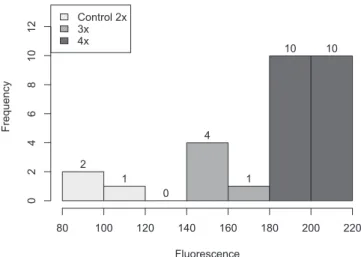
quadrivalents (Fig. 2B). Mitotic analysis of the progenies of the 15 second-generation selected plants, grown in field conditions, confirmed their tetraploid status, showing in all cases chromosome complements with 2n=4x=48 (Fig. 2C). Furthermore, flow cytometry was applied to 25 progenies of five random plants cytologically identified as tetraploids. From them, 20 plants were found to be tetraploid, whereas five plants showed peaks indicating a triploid condition. In the three tested plants, the control cultivar Rendidora showed profiles indicating a diploid condition. The distribu-tion of the main fluorescence peak for flow cytometry in the 25 experimental plants and the diploid control group showed a clear-cut distinction among materials with 2x, 3x and 4x conditions (Fig. 3).
Pollen development in the tetraploid progenies had a val-ue of 61.85%, whereas Rendidora showed an estimate of 82.52% (Table 1), and the difference was statistically signif-icant.
Tetraploid plants showed significantly greater values of days to flowering, days to harvesting, fruit equatorial diam-eter, fruits per plant, plant height and soluble solid concen-tration, as compared with the Rendidora cultivar. The life cycle traits days to flowering and days to harvest were
in-deed significantly longer in the tetraploid plants than in their diploid counterpart. However, fruit yield per plant was not significantly different (Table 1). Polyploid plants were easi-ly identifiable by their greater leaf and flower sizes (Fig. 4).
Discussion
The use of colchicine for polyploid induction in tomatillo was very effective within the range of concentrations form 0.12 to 0.16%, applied to young seedlings during 24 h, with an approximate rate of success of 66%. Although meiotic ir-regularities were found, the reduction in pollen development did not hinder plants from producing fruits and viable seeds. There is an expected increase of bivalent pairing through generations, as it was observed in Arabidopsis (Santos et al.
2003). In fact, established autotetraploids show remarkable genome reorganization, like functional diploidization and significant decrease in chromosome length, as compared with newly synthesized ones (Parisod et al. 2010). For pol-len viability, it was already mentioned that this trait might not be strongly affected by autopolyploidy (Ramsey and Schemske 2002). Flow cytometry did not show DNA reduc-tion in third-generareduc-tion polyploid plants (Fig. 2). However,
Fig.2. Chromosomesof P.ixocarpa. A. Diakinesis ofdiploid tomatillofrom theRendidoracultivar, showing 12bivalent configurations. B.Diakinesisofacolchicine-inducedtetraploidoftomatilloshowingsevenunivalents,11bivalents,fivetrivalentsandaputativetetravalent. An example of each type of configuration is marked on the photograph. C. Mitotic metaphase of a colchicine-induced tetraploid of tomatillo showing a chromosome number 2n=4x=48.
Fig.3. Distribution of the main peak of relative fluorescence for con-trol plants (Rendidora) and progenies of tetraploid plants of P. ixocarpa.
Table1. Comparative traits between the Rendidora cultivar (2n=2x=24) and tetraploid plants (2n=4x=48) of P. ixocarpa
Trait Rendidora Tetraploid
Days to flowering 44.15 52.85***
Days to harvesting 80.25 89.75***
Fruits per plant 62.64 53.07***
Fruit polar diameter (mm) 35.27 34.06NS
Fruit equatorial diameter (mm) 42.13 48.60***
Fruit weight (g) 33.67 38.14**
Soluble solids (ºBrix) 6.06 6.78*
Pollen viability (%) 82.52 61.49**
Stem diameter (cm) 2.36 2.50NS
Yield per plant (kg) 1.65 2.055NS
Plant height (cm) 82.19 90.62*
*, **, *** Significant at the 0.05, 0.01 and 0.001 probability levels, respectively.
this phenomenon has been observed in advanced generations of duplicated genomes, as a part of its reorganization (Rivero-Guerra 2008), and it is likely that it will occur later on in the progeny of these tomatillo polyploids.
The appearance of some triploid plants among the seeds harvested from second-generation plants in the experimental field in General Cepeda, a rural area in the south of Coahuila, could have been caused by exogenous pollen contamination. In fact, we have recently detected the presence of wild plants
of P. ixocarpa in the same area, which may have donated the
pollen that gave raise to triploid plants. Another possibility is the production of some gametes with the basic chromo-some number from the tetraploid plants. However, pollen contamination did not affect previous generations, since they were handled in isolated plots.
Phenotype differences between diploid and tetraploid plants, allowed identification by their visual appearance at early stages, because the leaves of polyploids looked mark-edly larger. Later on, flowers in polyploid plants also showed a greater size. Also, the results indicate a longer life cycle than their diploid counterparts. The fact that soluble solids and fruit equatorial diameter showed significantly higher values in tetraploids, is a promising result in terms of breeding potential, even though fruit yield was not signifi-cantly different between tetraploid and diploid plants.
The successful induction of tomatillo (P. ixocarpa) auto-tetraploids through induction by colchicine in this work, is the first case reported in the literature. Their easy produc-tion, new traits and fertility, indicate that use of autopoly-ploidy in P. ixocarpa can serve as a basis of a novel tomatillo breeding program.
Literature Cited
Barcelos,C.M., E.Kaltchuk, E.C.deMundstock and M.H.Bodanese (2004) Initial segmentation patterns of microspores and pollen vi-ability in soybean cultured anthers: indication of chromosome doubling. Braz. Arch. Biol. Techn. 47: 703–712.
Cantwell,M., J.Flores and A.Trejo (1992) Developmental changes and postharvest physiology of tomatillo fruits (Physalis ixocarpa
Brot.). Sci. Hortic-Amsterdam 50: 59–70.
Choi, J.K., G. Murillo, B. Su, J.M. Pezzuto, A.D. Kinghorn and R.J.Mehta (2006) Ixocarpalactone A isolated from the Mexican tomatillo shows potent antiproliferative and apoptotic activity in colon cancer cells. FEBS Journal 273: 5714–5723.
Doyle, J.J., L.E. Flagel, A.H. Paterson, R.A. Rapp, D.E. Soltis, P.S. Soltis and J.F.Wendel (2008) Evolutionary genetics of genome merger and doubling in plants. Annu. Rev. Genet. 42: 443–461.
Escobar,R.E., F.Hernández, O.Martínez and N.Ochoa (2009) In vitro embryo formation and plant regeneration from anther culture of different cultivars of Mexican husk tomato (Physalis ixocarpa
Brot.). Plant Cell Tiss. Organ Cult. 96: 181–189.
Jewell,D.C and M.N.Islam (1994) A technique for somatic chromo-some preparation and C-banding of maize. In: Freeling, M. and
V.Walbot (eds.) The Maize Handbook, Springer-Verlag, New York, pp. 484–493.
Leitch,A.R and J.I.Leitch (2008) Genomic plasticity and the diversity of polyploid plants. Science 320: 481–483.
Menzel,Y.M. (1951) The cytotaxonomy and genetics of Physalis. Proc. Amer. Philos. Soc. 95: 132–183.
Mulato,J. and A.Peña (2007) Germplasm evaluation of tomatillo
(Physalis ixocarpa Brot.) cropped under Ontario, Canada and
Chapingo, Mexico environmental conditions. VCRB 66: 117–127. Pandey, K.K. (1957) Genetics of self-incompatibility in Physalis
ixocarpa Brot. A new system. Am. J. Bot. 44: 879–887.
Parisod, C., R. Holderegger and C. Brochmann (2010) Evolutionary consequences of autopolyploidy. New. Phytol. 186: 5–17. Peña, L.A., J.D. Molina, F. Márquez, J. Sahagún, J. Ortiz and T.
Cervantes (2002) Respuestas estimadas y observadas de tres métodos de selección en tomate de cáscara (Physalis ixocarpa
Brot.). Rev. Fitotec. Mex. 25: 171–178.
Peña, L.A and J.F. Santiaguillo (1999) Variabilidad genética de tomate de cáscara en México. Inf. Rep. 2. Departamento de Fitotecnia. Universidad Autónoma Chapingo. Chapingo, Mexico.
R Development Core Team (2009) R: a language and environment for statistical computing. Release 2.9.2. Vienna, Austria.
Ramsey,J. and W.D.Schemske (2002) Neopolyploidy in flowering plants. Annu. Rev. Ecol. and Syst. 33: 589–639.
Rivero,G.A.O. (2008) Cytogenetics, geographical distribution, and pollen fertility of diploid and tetraploid cytotypes of Santolina pectinata Lag. (Asteraceae: Anthemideae). Bot. J. Linn. Soc. 156: 657–667.
Sahagún,J., F.Gómez and A.Peña (1999) Efectos de aptitud combina-toria en poblaciones de tomate de cáscara (Physalis ixocarpa
Brot.). Rev. Chapingo. Ser. Hort. 5: 23–27.
Santiaguillo, J.F., T. Cervantes and A. Peña (2004) Selección para rendimiento y calidad de fruto de cruzas planta×planta entre variedades de tomate de cáscara. Rev. Fitotec. Mex. 27: 85–91. Santiaguillo,J.F., R.López, A.Peña, J.A.Cuevas and J.Sahagún (1994)
Distribución, colecta y conservación de germoplasma de tomate de cáscara (Physalis ixocarpa Brot.). Rev. Chapingo. Ser. Hort. 2: 125–129.
Santos,J.L., D.Alfaro, E.Sánchez, S.J.Armstrong, F.C.H.Franklin and Fig.4. Comparative phenotypes oftetraploid and diploid plants of
P. ixocarpa. A. Colchicine-induced tetraploid. B. Diploid control
G.H.Jones (2003) Partial diploidization of meiosis in autotetra-ploid Arabidopsis thaliana. 165: 1533–1540.
Saray,M.C.R. and J.L.Loya (1977) El cultivo de Tomate de Cáscara. Inf. Rep. 57. INIA-CIAMEC-. Zacatepec, Morelos, Chapingo México.
SIAP-SAGARPA (2010) Servicio de información y estadística
agro-alimentaria y pesquera. http: //www.siap.sagarpa.gob.mx/. Access-ed 30 September 2010.