Computer Science & Technology Series
Computer Science & Technology Series
XV ARGENTINE CONGRESS OF COMPUTER SCIENCE
SELECTED PAPERS
G
UILLERMOS
IMARI| P
ATRICIAP
ESADO| J
OSÉP
AGANINIComputer Science & Technology Series
XV ARGENTINE CONGRESSOF COMPUTER SCIENCE
SELECTED PAPERS
Diagramación: Andrea López Osornio
Editorial de la Universidad Nacional de La Plata
Calle 47 Nº 380 - La Plata (1900) - Buenos Aires - Argentina Tel/Fax: 54-221-4273992
e-mail: [email protected] www.unlp.edu.ar/editorial
La EDULP integra la Red de Editoriales Universitarias (REUN)
1º edición - 2010
ISBN Nº 978-950-34-0684-7
Queda hecho el depósito que marca la ley 11.723 © 2010 - EDULP
Impreso en Argentina
De Giusti, Armando
Computer Science & Technology Series: XV Argentine Congress of Computer Science - Selected Papers.-1a ed. - La Plata: Universidad Nacional de La Plata, 2010.
260 p.; 24x16 cm. ISBN 978-950-34-0684-7
1. Informática. 2. Ciencias de la Computación. I. Título CDD 005.3
T
OPICSX Intelligent Agents and Systems Workshop
Chairs Guillermo Simari (UNSur) Guillermo Leguizamón (UNSL) Laura Lanzarini (UNLP)
IX Distributed and Parallel Processing Workshop
Chairs Armando De Giusti (UNLP) Marcela Printista (UNSL) Jorge Ardenghi (UNSur)
VIII Information Technology Applied to Education Workshop
Chairs Cristina Madoz (UNLP) Miguel Fernández (UNER) María Eugenia Márquez (UNPA)VII Graphic Computation, Imagery and Visualization Workshop
Chairs Silvia Castro (UNSur) Claudia Russo (UNLP-UNNOBA) Oscar Bría (INVAP)VI Software Engineering Workshop
Chairs Patricia Pesado (UNLP) Elsa Estévez (UNSur) Alejandra Cechich (UNCOMA)
VI Database and Data Mining Workshop
Chairs Olinda Gagliardi (UNSL) Hugo Alfonso (UNLPam) Viviana Quincoces (UNJu)
IV Architecture, Nets and Operating Systems Workshop
Chairs Javier Diaz (UNLP) Antonio Castro Lechtaller (UTN) Hugo Padovani (UNMorón)I Innovation in Software Systems Workshop
Abásolo María José (Spain) Acero Alex (USA) Acosta Nelson (Argentina) Aguilar Castro José (Venezuela) Alba Torres Enrique (Spain) Alfonso Hugo (Argentina) Ardenghi Jorge (Argentina) Astudillo Hernán (Chile) Baldassarri, Sandra (Spain) Bertogna Leandro (Argentina) Bertone Rodolfo (Argentina) Bevilacqua Roberto (Argentina) Bria Oscar (Argentina) Brisaboa Nieves (Spain) Buccella Agustina (Argentina) Cabero Julio (Spain) Cancela Héctor (Uruguay)
Castro Lechtaler Antonio Ricardo (Argentina) Castro Silvia (Argentina)
Cechich Alejandra (Argentina) Coello Coello Carlos A. (Mexico)
Collazos Ordóñez, César Alberto (Colombia) Cukierman Uriel (Argentina)
De Alfonso Laguna Carlos (Spain) De Giusti Armando (Argentina) De Pablo Pons Juan (Spain) De Petris Beatriz (Argentina) Díaz Javier (Argentina) Doallo Ramón (Spain) Dosch Walter (Germany) Dujmovic Jozo (USA) Echaiz Javier (Argentina) El Saddik Abed (Canada) Errecalde Marcelo (Argentina) Escarza Sebastián (Argentina) Esquivel Susana (Argentina) Estayno Marcelo (Argentina) Estévez Elsa (Argentina) Fabero Juan C. (Spain)
Fariña Antonio (Spain) Feierherd Guillermo (Argentina) Fernandez Miguel E. R. (Argentina) Fillottrani Pablo (Argentina) Finochietto Jorge (Italy) Foti Antonio (Argentina) Fusario Rubén Jorge (Argentina) Gagliardi Olinda (Argentina) García Garino Carlos (Argentina) García Guibout Jorge (Argentina) George Chris (United Nations) Godo Luis (Spain)
González María Paula (Argentina) Gorga Gladys (Argentina) Gröller, Eduard (Austria) Guerrero, Roberto (Argentina) Gutierrez Claudio (Chile)
Hernández Peñalver Gregorio (Spain) Iyad Rahwan (Dubay)
Janowski Tomasz (United Nations) Jordan Mario (Argentina) Juergen Dix (Germany) Lanzarini Laura (Argentina) Larrea Martín (Argentina) Lecumberry Federico (Uruguay) Leguizamon Guillermo (Argentina) Luaces Miguel (Spain)
Lucero Margarita (Argentina) Luque Emilio (Spain) Luque Mónica (RITLA) Madoz Cristina (Argentina) Maguitman Ana (Argentina) Malbrán María (Argentina) Marcelo Carlos (Spain) Margaleff Tomás (Spain) Marín Mauricio (Chile)
Marquez María Eugenia (Argentina) Marrone Luís (Argentina)
Martín María J. (Spain) Mercado Gustavo (Argentina) Merelo Juan Julián (Spain) Motz Regina (Uruguay) Naiouf Marcelo (Argentina) Obac Roda Valentín (Brazil) Otero Rita (Argentina) Padovani Hugo (Argentina) Paldao Carlos (RITLA) Palomar Manuel (Spain) Paolo Rosso (Spain) Pardo Alvaro (Uruguay) Pérez Carlos (Argentina) Pesado Patricia (Argentina) Pessaq Raúl (Argentina) Piccoli María F. (Argentina) Pina Alfredo (Spain) Ponzoni Ignacio (Argentina) Printista Marcela (Argentina) Quincoces Viviana (Argentina) Ramón Hugo (Argentina) Rautek Peter (Austria) Rexachs Dolores (Spain) Riesco Daniel (Argentina) Ripoll Ana (Spain)
Rodriguez de Souza Josemar (Brazil) Rodriguez León Casiano (Spain) Ronald Prescott Loui (USA) Rossi Gustavo (Argentina) Rosso Paolo (Spain) Russo Claudia (Argentina) Sanz Cecilia (Argentina) Serón Arbeoloa Francisco (Spain) Sierra Carles (Spain)
Simari Guillermo (Argentina) Simari Patricio (Canada) Sousa Pinto Jorge (Portugal) Steinmetz Ralf (Germany)
P
ROGRAMC
OMMITEE(
CONT.)
Tarouco Liane (Brazil) Tartaglia Angelo (Italy) Tinetti Fernando (Argentina) Tirado Francisco (Spain) Touriño Juan (Spain) Vechietti Aldo (Argentina) Vénere Marcelo (Argentina) Verrastro Claudio (Argentina) Vilanovai Bartroli, Ana (Holland) Viola Ivan (Norway)
Vitturini Mercedes (Argentina) Vizcaino Aurora (Spain) Zamarro José Miguel (Spain) Zbigniew Michalewicz (Australia)
President
Paganini José Humberto
Coordinators Laserre Cecilia Maria
Collaborators Quincoces Viviana Galvez Díaz Pilar Ayusa Cristina Aparicio Maria C. Figueroa Sebastián Marcos Méndez Sandra
O
RGANIZINGC
OMMITEEUNIVERSIDAD NACIONALDE JUJUY -FACULTADDE INGENIERÍA
P
REFACECACIC Congress
CACIC is an annual Congress dedicated to the promotion and advancement of all aspects of Computer Science. The major topics can be divided into the broad categories included as Workshops (Intelligent Agents and Systems, Distributed and Parallel Processing, Software Engineering, Architecture, Nets and Operating Systems, Graphic Computation, Imagery and Visualization, Information Technology applied to Education, Databases and Data Mining, Innovation in Software Systems, Theory, Models and Optimization).
The objective of CACIC is to provide a forum within which to promote the development of Computer Science as an academic discipline with industrial applications, trying to extend the frontier of both the state of the art and the state of the practice.
The main audience for, and participants in, CACIC are seen as researchers in academic departments, laboratories and industrial software organizations.
CACIC started in 1995 as a Congress organized by the Network of National Universities with courses of study in Computer Science (RedUNCI), and each year it is hosted by one of these Universities. RedUNCI has a permanent Web site where its history and organization are described: http:// redunci.info.unlp.edu.ar.
CACIC 2009 in Jujuy
CACIC'09 was the fifteenth Congress in the CACIC series. It was organized by the School of Engineering of the National University of Jujuy.
The Congress included 9 Workshops with 130 accepted papers, 1 main Conference, 4 invited tutorials, different meetings related with Computer Science Education (Professors, PhD students, Curricula) and an International School with 5 courses. (http://www.cacic2009.fi.unju.edu.ar/cacic2009ing)
Research. Each topic was supervised by a committee of three chairs of different Universities.
The call for papers attracted a total of 267 submissions. An average of 2.7 review reports were collected for each paper, for a grand total of 720 review reports that involved about 300 different reviewers.
A total of 130 full papers were accepted and 20 of them were selected for this book.
Acknowledgments
CACIC 2009 was made possible due to the support of many individuals and organizations. The School of Engineering of the National University of Jujuy, RedUNCI, the Secretary of University Policies, and the National Agency of Scientific and Technological Advancement were the main institutional sponsors. This book is a very careful selection of best qualified papers. Special thanks are due to the authors, the members of the workshop committees, and all reviewers, for their contributions to the success of this book.
ING. ARMANDO DE GIUSTI
DR. GUILLERMO SIMARI
T
ABLEOFC
ONTENTSX Intelligent Agents and Systems Workshop
An argumentation framework with uncertainty management designed for dynamic environments
Marcela Capobianco, Guillermo R. Simari
An Immune Artificial Algorithm for Dynamic Optimization Problems: A Case of Study
Victoria S. Aragón, Susana C. Esquivel, Carlos A. Coello Coello GA and PSO Applied toWind Energy Optimization
Martín Bilbao, Enrique Alba
Approximations on Minimum Weight Pseudo-Triangulations using Ant Colony Optimization etaheuristic
Edilma Olinda Gagliardi, Maria Gisela Dorzán, Mario Guillermo Leguizamón, Gregorio Hernández Peñalver
IX Distributed and Parallel Processing Workshop
A Network Failure-Tolerant P2P-VoD System
Javier Balladini, Eduardo Grosclaude, Remo Suppi, Emilio Luque Dynamic Scheduling in Heterogeneous Multiprocessor Architectures. Efficiency Analysis.
Laura C. De Giusti, Marcelo Naiouf, Franco Chichizola, Emilio Luque, Armando E. De Giusti
A Multipath Routing Method for Tolerating Permanent and Non-Permanent Faults?
Gonzalo Zarza, Diego Lugones, Daniel Franco, Emilio Luque
Could be improved the efficiency of SPMD applications in heterogeneous environments?*
Ronal Muresano, Dolores Rexachs, Emilio Luque
VIII Information Technology Applied to Education Workshop
Problem Based Learning and Software Simulation Tools: A Case of Study in Computer Science First Year Students
Javier Giacomantone, Tatiana Tarutina
A two LOM Aplication Profiles: for Learning Objects and for Information
15
71
ZinjaI: An Integrated Development Environment for a first programming course with C++
Pablo Novara, Horacio Loyarte
Virtual characters as study guides. Evolution towards a virtual collaborative learning environment
Gonzalez Alejandro, Madoz Cristina, Gorga Gladys, De Giusti Armando
VII Graphic Computation, Imagery and Visualization Workshop
Coastal Monitoring and Feature Estimation with Small Format Cameras: Application to the Shoreline of Monte Hermoso, Argentina
Natalia Revollo, Claudio Delrieux, Gerardo Perillo, Marina Cipolletti
VI Software Engineering Workshop
Assessing e-Governance Maturity through Municipal Websites– Measurement Framework and Survey Results
Rocío Rodríguez, Elsa Estevez, Daniel Giulianelli, Pablo Vera
Facing Communication Challenges In Global Software Development
Gabriela N. Aranda, Aurora Vizcaíno, Mario Piattini
Towards Scaling Up DynAlloy Analysis using Predicate Abstraction
Rodrigo Ariño, Renzo Degiovanni, Raul Fervari, Pablo Ponzio, Nazareno Aguirre
VI Database and Data Mining Workshop
Dynamic Selection of Suitable Pivots for Similarity Search in Metric Spaces
Claudia Deco, Mariano Salvetti, Nora Reyes, Cristina Bender
IV Architecture, Nets and Operating Systems Workshop
Quality of Service and Availability in a Full Mesh WAN using IP/MPLS. Case Study: The Network at the Department of Justice in Argentina
Antonio Castro Lechtaler, Patricia Crotti, Rubén Jorge Fusario, Carlos García Garino, Jorge García Guibout.
A CIM Framework for Standard-Based System Monitoring Using Nagios Plug-ins
Marcelo Lorenzati, Miriam Estela, Rodolfo Kohn
I Innovation in Software Systems Workshop
Biometric identification in electronic voting systems
Eduardo Ibañez, Nicolás Galdámez, Cesar Estrebou, Ariel Pasini, Franco Chichizola, Ismael Rodríguez, Patricia Pesado
163
175
213
227
X
An argumentation framework with uncertainty
management designed for dynamic environments
MARCELA CAPOBIANCO1,2,GUILLERMO R.SIMARI1
1 Artificial Intelligence Research and Development Laboratory
Department of Computer Science and Engineering - Universidad Nacional del Sur Av. Alem 1253, (8000) Bahía Blanca, Argentina.
2 Consejo Nacional de Investigaciones Científicas y Técnicas, Argentina.
{mc,grs}@cs.uns.edu.ar
Abstract. Nowadays, data intensive applications are in constant demand and there is need of computing environments with better intelligent capabilities than those present in today's Database Management Systems (DBMS). To build such systems we need formalisms that can perform complicate inferences, obtain the appropriate conclusions, and explain the results. Research in argumentation could provide results in this direction, providing means to build interactive systems able to reason with large databases and/or different data sources.
In this paper we propose an argumentation system able to deal with explicit uncertainty, a vital capability in modern applications. We have also provided the system with the ability to seamlessly incorporate un-certain and/or contradictory information into its knowledge base, using a modular upgrading and revision procedure.
1. Introduction and motivations
Nowadays, data intensive applications are in constant demand and there is need of computing environments with better intelligent capabilities than those present in today's Database Management Systems (DBMS). Recently, there has been progress in developing efficient techniques to store and retrieve data, and many satisfactory solutions have been found for the associated problems. However, the problem of how to understand and interpret a large amount of information remains open, particularly when this information is uncertain, imprecise, and/or inconsistent. To do this we need formalisms that can perform complicate inferences, obtain the appropriate conclusions, and explain the results.
Research in argumentation could provide results in this direction, providing means to build interactive systems able to reason with large databases and/or different data sources, given that argumentation has been successfully used to develop tools for common sense reasoning [8, 4, 14].
capability in modern applications. Here, we propose an argumentation-based system that addresses this problem, incorporating possibilistic uncertainty into the framework following the approach in [9]. We have also provided the system with the ability to seamlessly incorporate uncertain and/or contradictory information into its knowledge base, using a modular upgrading and revision procedure.
This paper is organized as follows. First, we present the formal definition of our argumentation framework showing its fundamental properties. Next, we propose an architectural software pattern useful for applications adopting our reasoning system. Finally, we state the conclusions of our work.
2. The OP-DeLP programming language: fundamentals
Possibilistic Defeasible Logic Programming (P-DeLP) [1, 2] is an important ex-tension of DeLP in which the elements of the language have the form (ϕ,α), where ϕ is a DeLP clause or fact. Below, we will introduce the elements of the language necessary in this presentation. Observation based P-DeLP (OP-P-DeLP) is an optimization of P-P-DeLP that allows the computation of warranted arguments in a more efficient way, by means of a pre-compiled knowledge component. It also permits a seamless incorporation of new perceived facts into the program codifying the knowledge base of the system. Therefore the resulting system can be used to implement practical applications with performance requirements. The idea of extending the applicability of DeLP in a dynamic setting, incorporating perception and pre-compiled knowledge, was originally conceived in [5]. Thus the OP-DeLP system incorporates elements from two different variants of the DeLP system, O-DeLP [5] and P-DeLP [9]. In what follows we present the formal definition of the resulting system.
The concepts of signature, functions and predicates are defined in the usual way. The alphabet of OP-DeLP programs generated from a given signature
Σ
is composed by the members ofΣ
, the symbol “~” denoting strong negation [11] and the symbols “(”, “)”, “.” and “,”. Terms, Atoms and Literals are defined in the usual way. A certainty weighted literal, or simply a weighted literal, is a pair (L,α) where L is a literal and α∈[0,1] expresses a lower bound for the certainty of ϕ in terms of a necessity measure.OP-DeLP programs are composed by a set of observations and a set of de-feasible rules. Observations are weighted literals and thus have an associated certainty degree. In real world applications, observations model perceived facts. Defeasible rules provide a way of performing tentative reasoning as in other argumentation formalisms.
Definition 1. Adefeasible rulehas the form(L0 L1, L2,.., Lk ,α) whereL0is a
literal, L1, L2,.., Lk is a non-empty finite set of literals, α∈[0,1] expresses a lower
Intuitively a defeasible rule L0 L1, L2,.., Lk can be read as L1, L2,.., Lk
provide tentative reasons to believe in L0 [15]. In OP-DeLP these rules also
have a certainty degree, that quantifies how strong the connection between the premises and the conclusion is. A defeasible rule with a certainty degree 1 models a strong rule.
Figure 1: an OP-DeLP program for email filtering
A set of weighted literals Γ will be deemed as contradictory, denoted as Γ ⊥, iff Γ (l,α) and Γ (¬l,β) with α and β > 0. In a given OP-DeLP program we can distinguish certain from uncertain information. A clause (γ,α) will be deemed as certain if α=1, otherwise it will be uncertain.
Definition 2. [OP-DeLP Program]AnOP-DeLP programP is a pair(Ψ,Δ),where Ψ is a non-contradictory finite set of observations and Δ is a finite set of defeasible rules.
Example 1. Fig.1 shows a program for basic email filtering. Observations describe different characteristics of email messages. Thus, virus(X) stands for “message X has a virus”; local(X) indicates that “message X is from the local host”; filters(X) specifies that “message X should be filtered” redirecting it to a particular folder; black_list(X) indicates that “message X is considered dangerous” because of the server it comes from; and contacts(X) indicates that “the sender of message X is in the contact list of the user”.
The first rule expresses that if the email does not match with any user-defined filter then it usually should be moved to the inbox folder. The second rule indicates that unfiltered messages in the junk folder usually should not be moved to the inbox. According to the third rule, messages to be filtered should not be moved to the inbox. The following two rules establish that a message should be moved to the junk folder if it is marked as spam or it contains viruses. Finally there are three rules for spam classification: a message is usually labeled as spam if it comes from a server that is in the blacklist. Nevertheless, even if an email comes from a server in the blacklist it is not labeled as spam when the sender is in the contact list of the user. Besides, a message from the local host is usually not classified as spam.
Ψ are the basis case of the derivation sequence, for every literal Q in Ψ with a certainty degree α it holds that (Q,α) can be derived from P=(Ψ,Δ).
Given an OP-DeLP program P, a query posed to P corresponds to a ground literal Q which must be supported by an argument [5,10].
Definition 3. [Argument – Subargument] Let P=(Ψ,Δ) be a program A ⊆ Δ is an argument for a goal Q with necessity degreeα>0, denoted as〈A,Q, α〉, iff (1) Ψ∪A
(Q,α); (2) Ψ∪A is not contradictory; and (3) there is not A1 ⊆ Δ such that
Ψ∪A 1 (Q,β), β>0. An argument 〈A,Q, α〉is a subargument of〈B,R, β〉iffA⊆ B.
As in most argumentation frameworks, arguments in O-DeLP can attack each other. An argument 〈A
1,Q1,α〉 counter-argues an argument 〈A2,Q2,β〉 at a literal Q if and only if there is a sub-argument 〈A,Q,γ〉 of 〈A
2,Q2,β〉, (called disagreement subargument), such that Q
1 and Q are complementary literals. Defeat among arguments is defined combining the counterargument relation and a preference criterion “ ”. This criterion is defined on the basis of the necessity measures associated with arguments.
Definition 4. [Preference criterion ] [9]Let〈A1,Q1, α1〉, be a counterargumentfor
〈A2, Q2, α2〉. We will say that 〈A1,Q1, α1〉 is preferred over 〈A2, Q2, α2〉 (denoted
〈A2,Q2, α2〉 〈A1,Q1, α1〉. If it is the case that α1 > α2, then we will say that 〈A1, Q1, α1〉 is strictly preferred over 〈A2, Q2, α2〉, denoted 〈A2, Q2, α2〉 〈A1, Q1, α1〉.
Otherwise, if α1 = α2 we will say that both arguments are equi-preferred, denoted 〈A2,
Q2,α2〉 〈A1,Q1, α1〉.
Definition 5. [Defeat][9]Let〈A1,Q1, α1〉and〈A 2, Q2,α2〉 be two arguments built
from a program P. Then 〈A1, Q1, α1〉 defeats 〈A2, Q2, α2〉 iff (1) 〈A1, Q1, α1〉
counterargues 〈A 2,Q2, α2〉 with disagreement subargument 〈A,Q, α〉and (2) Either it
is true that 〈A,Q,α〉 〈A 1,Q1, α1〉 in which case 〈A 1,Q1, α1〉is a proper defeater for
〈A2, Q2, α2〉or 〈A, Q, α〉 〈A1, Q1, α1〉, in which case 〈A, Q1, α1〉is a blocking
defeater for〈A2,Q2, α2〉.
As in most argumentation systems [7], OP-DeLP relies on an exhaustive dialectical analysis which allows determining if a given argument is ultimately undefeated (or warranted) wrt a program P. An argumentation line starting in an argument 〈A
0,Q0,α0〉 is a sequence [〈A0,Q0,α0〉, 〈A1,Q1,α1〉, …,
〈A
n,Qn,αn〉, …] that can be thought of as an exchange of arguments between
1. Non-contradiction: given an argumentation line, the set of arguments of the proponent (resp. opponent) should be non-contradictory wrt P.
2. No circular argumentation: no argument 〈Aj, Qj, αj〉 in the
argumentation line is a sub-argument of an argument 〈Ai,Qi, αi〉 such
that i < j.
3. Progressive argumentation: every blocking defeater 〈Ai, Qi, αi〉 in
the argumentation line is defeated by a proper defeater 〈Ai+1, Qi+1, αi+1〉 in this line.
An argumentation line satisfying the above restrictions is called acceptable, and can be proved to be finite. Given a program P and an argument
〈A
0,Q0,α0〉, the set of all acceptable argumentation lines starting in 〈A0,Q0,α0〉 accounts for a whole dialectical analysis for 〈A
0,Q0,α0〉 (i.e. all possible dialogs rooted in 〈A
0,Q0,α0〉, formalized as a dialectical tree, denoted
T 〈A
0,Q0,α0〉
. Nodes in a dialectical tree T 〈A
0,Q0,α0〉
can be marked as
undefeated and defeated nodes (U-nodes and D-nodes, resp.). A dialectical tree will be marked as an AND-OR tree: all leaves in T
〈A
0,Q0,α0〉 will be marked U-nodes (as they have no defeaters), and every inner node is to be marked as D-node iff it has at least one U-node as a child, and as U-node otherwise. An argument 〈A
0,Q0,α0〉 is ultimately accepted as valid (or warranted) iff the root of T〈
A
0,Q0,α0〉
is labeled as U-node.
Definition 6. [Warrant][9]Given a program P, and a literal Q, Q is warranted wrt P iff there exists a warranted argument 〈A,Q, α〉 than can be built from P.
To answer a query for a given literal we should see if there exists a warranted argument supporting this literal. Nevertheless, in OP-DeLP there may be different arguments with different certainty degrees supporting a given query. This fact was not considered in [9], but we are clearly interested in finding the warranted argument with the highest certainty degree.
Definition 7.[Strongest Warrant]Given a programP, and a literalQ, we will saythat is the strongest warrant degree of Q iff (1) there exists a warranted argument 〈A, Q, α〉 than can be built from P, and (2) no warranted argument 〈B,Q, β 〉 such that β>α can built from P.
ones, see if it is a warrant for Q, and so on, until a warranted argument is found or there are no more arguments supporting Q.
Example 2. Consider the program shown in Example 1 and let move_ inbox(d) be a query wrt this program. The search for a warrant for move_inbox(d) will result in an argument 〈A , move_ inbox(d), 0.6〉, with A = {(move_ inbox(d) ~filters(d), 0.6)} allowing to conclude that message d should be moved to the folder Inbox, as it has no associated filter with a certainty degree of 0.6. However, there exists a defeater for 〈A,
move_ inbox(d), 0.6〉, namely 〈B, ~move_ inbox(d), 0.7〉, as there are reasons to believe that message d is spam:
B = {(~move_ inbox(d) move_ junk(d), 0.8), (move_junk(d) spam(d), 1), (spam(d) black list(d), 0.7)}
Using the preference criterion, B is a proper defeater for A. However, two counterarguments can be found for B since message d comes from the local host, and the sender is in the user’s contacts list:
–〈C, ~spam(d), 0.6〉 , where C = {(~spam(d) contacts(d), 0.6)}. – 〈D, ~spam(d), 0.9〉 , where D = {(~spam(d) local(d), 0.9)}.
B defeats C but is defeated by D. There are no more arguments to consider, and the resulting dialectical tree has only one argumentation line: A is defeated by B who is in turn defeated by D. Hence, the marking procedure determines that the root node A, is a U-node and the original query is warranted.
3. Dialectical graphs and pre-compiled knowledge
To obtain faster query processing in the OP-DeLP system we integrate pre-compiled knowledge to avoid the construction of arguments which were already computed before. The approach follows the proposal presented in [5] where the pre-compiled knowledge component is required to: (1) minimize the number of stored arguments in the pre-compiled base of arguments (for instance, using one structure to represent the set of arguments that use the same defeasible rules); and (2) maintain independence from the observations that may change with new perceptions, to avoid modifying also the pre-compiled knowledge when new observations are incorporated.
Potential arguments have been devised to sum-up arguments that are obtained using different instances of the same defeasible rules. Recording every generated argument could result in storing many arguments which are structurally identical, only differing on the constants being used to build the corresponding derivations. Thus, a potential argument stands for several arguments which use the same defeasible rules. Attack relations among potential arguments can be also captured, and in some cases even defeat can be pre-compiled. In what follows we introduce the formal definitions, adapted from [5] to t the OP-DeLP system.
Definition 8. [Weighted Potential argument] Let Δ be a set of defeasible rules. A subset A of Δ is a potential argument for a literal Q with an upper bound γfor its certainty degree, noted as 〈〈Α,Q, γ〉〉 if there exists a non-contradictory set of literals φ and an instance A that is obtained finding an instance for every rule in A, such that 〈Α,
Q,α〉 is an argument wrt (φ,Δ) (α≤γ) and there is no instance〈B, Q, β〉 of A such that β>γ.
The nodes of the dialectical graph are the potential arguments. The arcs of our graph are obtained calculating the counterargument relation among the nodes previously obtained. To do this, we extend the concept of counterargument for potential arguments. A potential argument 〈〈A1,Q
1,α〉〉 counter-argues 〈〈A2,Q
2,β〉〉 at a literal Q if and only if there is a non-empty potential sub-argument 〈〈A,Q,γ〉〉 of 〈〈A2,Q
2,β〉〉 such that Q1 and Q are contradictory literals.1 Note that potential counter-arguments may or may not
result in a real conflict between the instances (arguments) associated with the corresponding potential arguments. In some cases instances of these arguments cannot co-exist in any scenario (e.g., consider two potential arguments based on contradictory observations). Now we can finally define the concept of dialectical graph:
Definition 9. [Dialectical Graph] Let P=(Ψ,Δ) be an OP-DeLP program. The
dialectical graph of Δ, denoted as GΔ, is a pair (PotArg(Δ), C) such that: (1) PotArg(Δ)
is the of all the potential arguments that can be built from Δ; (2) C is the counterargument relation over the elements of PotArg(Δ).
We have devised a set of algorithms to use the dialectical graph for improving the inference process. For space reasons these algorithms are not detailed in this work, the interested reader may consult [6] for a more detailed treatment of this subject. We have also compared the obtained algorithms theoretically with standard argument-based inference techniques (such as those used in P-DeLP).
At the inference process, we have found out that complexity is lowered from:
4. A proposed architecture for OP-DeLP applications
Applications that use the OP-DeLP system will be be engineered for contexts where: (1) information is uncertain and heterogeneous, (2) handling of great volume of data ows is needed, and (3) data may be incomplete, vague or contradictory. In this section we present an architectural pattern that can be used in these applications.
Previous to proposing a pattern we started analyzing the characteristics of OP-DeLP applications. First, we found that data will generally be obtained from multiple sources. Nowadays the availability of information trough the Inter-net has shifted the issue of information from quantitative stakes to qualitative ones [3]. For this reason, new information systems also need to provide assistance for judging and examining the quality of the information they receive.
For our pattern, we have chosen to use a multi-source perspective into the characterization of data quality [3]. In this case the quality of data can be evaluated by comparison with the quality of other homologous data (i.e. data from different information sources which represent the same reality but may have contradictory values). The approaches usually adopted to reconcile heterogeneity between values of data are: (1) to prefer the values of the most reliable sources, (2) to mention the source ID for each value, or (3) to store quality meta-data with the data. We have chosen to use the second approach. In multi-source databases, each attribute of a multiple source element has multiple values with the ID of their source and their associated quality expertise. Quality expertise is represented as meta-data associated with each value. We have simplified this model for an easy and practical integration with the OP-DeLP system. In our case, data sources are assigned a unique certainty degree. For simplicity sake, we assume that different sources have different values. All data from a given source will have the same certainty degree. This degree may be obtained weighting the plausibility of the data value, its accuracy, the credibility of its source and the freshness of the data. OP-DeLP programs basically have a set of observations and a set of rules. The set of rules is chosen by the knowledge engineer and remains fixed. The observation set may change according with new perceptions received from the multiple data sources. Nevertheless, inside the observation set we will distinguish a special kind of perceptions, those with certainty degree 1. Those perceptions are also codified by the knowledge engineer and cannot be modified in the future by the perception mechanism. To assure this, we assume that every data source has a certainty value such that 0 < γ < 1.
certainty degree of 1. The same applies for contacts(X). The algorithm that decides whether to filter a given message is another data source with a degree of 0.9, the filter that classifies a message as a virus is another data source with a degree of 0.7, and the algorithm that checks if the message came from some server in the blacklist is a different source that has a degree of 0.75. Note that we could have different virus filters with different associated certainty degrees if we wanted to build higher trust on this filter mechanism.
[image:25.439.153.311.311.455.2]The scenario just described requires an updating criterion different to the one presented in [5], given that the situation regarding perceptions in OP-DeLP is much more complex. To solve this, we have devised Algorithm 1, that summarizes different situations in two conditions. The first one acts when the complement of the literal Q is already present in the set. Three different cases can be analyzed in this setting: (1) If both certainty degrees are equal it means that both Q and its complement proceed from the same data source. Then the only reason for the conflict is a change in the state of affairs, thus an update is needed and the new literal is added. (2) If α > β it means that the data sources are different, Thus we choose to add (Q, α) since it has the higher certainty degree. (3) If α < β we keep (comp(Q), β) (the complement of Q wrt strong negation). Note that (1) is an update operation [12] while (2) and (3) are revisions over. The difference between updating and revision is fundamental. Updating consists in bringing the knowledge base up to date when the world changes. Revision allows us to obtain new information about a static scenario [12].
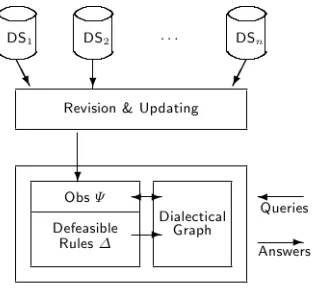
Figure 2: Architecture for applications using OP-DeLP as underlying framework
The second condition in Algorithm 1 considers the case when Q was in with a different certainty degree. Then it chooses the weighted literal with the highest degree possible. Note that the observations initially codified that have a certainty degree of 1 cannot be deleted or modified by algorithm 1.
Algorithm 1. UpdateObservationSet
Input:P=(Ψ,Δ) , (Q, α)
delete((comp(Q), β )) add((Q, α ))
If there exists a weighted literal (Q, β ) in Ψ such that α≤βThen delete(Q, β ))
add((Q, α ))
Finally, fig. 2 summarizes the main elements of the O-DeLP-based architecture. Knowledge is represented by an OP-DeLP program P. Perceptions from multiple sources may result in changes in the set of observations in P, handled by the updating mechanism defined in algorithm 1. To solve queries the OP-DeLP inference engine is used. This engine is assisted by the dialectical graph (Def. 9) to speed-up the argumentation process. The final answer to a given query Q will be yes, with the particular certainty degree of the warranted argument supporting Q, or no if the system could not find a warrant for Q from P.
5. Conclusions
In this work we have defined an argumentation-based formalism that integrates uncertainty management. This system was also provided with an optimization mechanism based on pre-compiled knowledge. Using this, the argumentation system can comply with real time requirements needed to administer data and model reasoning over this data in dynamic environments. Another contribution is the architectural model to integrate OP-DeLP in practical applications to ad-minister and reason with data from multiple sources.
As future work, we are developing a prototype based on the proposed architecture to extend the theoretical complexity analysis with empirical results and to test the integration of the OP-DeLP reasoning system in real world applications. We are also working on the integration of OP-DeLP and database management systems by means of a strongly-coupled approach.
References
1. Alsinet, T., Chesñevar, C. I., Godo, L., Sandri, S. and Simari, G. R., Formalizing argumentative reasoning in a possibilistic logic programming setting with fuzzy uni cation, International Journal of Approximate Reasoning, 48 (3), 2008.
2. Alsinet, T., Chesñevar, C. I., Godo, L., Sandri, S. and Simari, G. R., A logic programming framework for possibilistic argumentation: Formalization and logical properties, Fuzzy Sets and Systems, 159 (10), 2008.
4. Bryant and Krause, An implementation of a lightweight argumentation engine for agent applications, Lecture Notes in Computer Science, 4160 (1), 2006. 5. Capobianco, M., Chesñevar, C. I. and Simari, G. R., Argumentation and
the dynamics of warranted beliefs in changing environments, Journal of Autonomous Agents and Multiagent Systems, 11, 2005.
6. Capobianco, M. and Simari, G., A proposal for making argumentation computationally capable of handling large repositories of uncertain data, in Proceedings of the third international conference on scalable uncertainty management, 2009.
7. Chesñevar, C. I., Maguitman, A. G. and Loui, R. P., Logical Models of Argument, ACM Computing Surveys, 32 (4), 2000.
8. Chesñevar, C. I., Maguitman, A. G. and Loui, R. P., Argument-based critics and recommenders: A qualitative perspective on user support systems. Data & Knowledge Engineering, 59(2):293-319, 2006.
9. Chesñevar, C. I., Simari, G. R., Alsinet, T. and Godo, L., A logic programming frame-work for possibilistic argumentation with vague knowledge, in Proc. of Uncertainty in Artificial Intelligence Conference (UAI 2004), Ban, Canada, 2004.
10. García, A. and Simari, G., Defeasible Logic Programming: An Argumentative Approach, Theory and Practice of Logic Programming, 4 (1), 2004.
11. Gelfond, M. and Lifschitz, V., Classical negation in logic programs and disjunctive databases, New Generation Computing, 1991.
12. Katsuno, H. and Mendelzon, A., On the difference between updating a knowledge base and revising it, in P. Gardenfors (editor), Belief Revision, Cambridge University Press, 1992.
13. Prakken, H. and Vreeswijk, G., Logical systems for defeasible argumentation, in Handbook of Philosophical Logic, volume 4, 2002. 14. Rahwan, I., Ramchurn, S. D., Jennings, N. R., McBurney, P., Parsons, S.
and Sonenberg, L., Argumentation-based negotiation, The Knowledge Engineering Review, 18 (4), 2003.
An Immune Artificial Algorithm for Dynamic
Optimization Problems: A Case of Study
VICTORIA S.ARAGÓN,SUSANA C.ESQUIVEL1, CARLOS A.COELLO COELLO2
1 Laboratorio de Investigación y Desarrollo en Inteligencia Computacional*
Universidad Nacional de San Luis
Ejército de los Andes 950 (5700) San Luis, ARGENTINA {vsaragon, esquivel}@unsl.edu.ar
2 CINVESTAV-IPN (Evolutionary Computation Group)†
Departamento de Computación
Av. IPN No. 2508, Col. San Pedro Zacatenco México D.F. 07300, MÉXICO
Abstract. In this paper, we present an algorithm inspired on the T-Cell model of the immune system, i.e., an artificial immune system (AIS). The proposed approach (called DTC) is intented to solve dynamic optimization problems. We realize a first study and we validate our algorithm using dynamic functions taken from the specialized literature. Results are promising when we compare them with respect to the results obtained by five AIS representative of the state of the art in this field.
Keywords: Artificial immune systems, dynamic optimization, heuristics optimization.
1. Introduction
In general, the conditions of an optimization problem changes by one of the following reasons or a combination of both [1]: 1) The objective function changes itself, 2) The constraints change. In this paper the firts problematic is addressed.
In recent years, a bio-inspired metaheuristic known as the “artificial immune system” (AIS) has gained popularity in a wide variety of tasks [12]. The AIS is inspired on our natural immune system, which has a number of very interesting features, from a computational point of view, that make it a very good candidate to be modelled in a computer. For example, it is a distributed system, it is fault- tolerant, it has memory, it is able to distinguish between its own components and those which are foreign, and it learns by experience. AISs have been used for solving dynamic optimization problems (see for
example [16, 7, 13]), but in most cases, it has been applied only to global optimization problems. In this paper, we precisely focus on solving dynamic optimization problems with an AIS that we have proposed, and which we believe that can be a viable alternative for solving these kind of problems. The remainder of the paper is organized as follows. In Section 2, we describe the benchmark used to generate the dynamic functions. Section 3 describes the existing AIS for dynamic optimization. In Section 4, we describe our AIS, which is based on the T-Cell Model. In Section 5, we present our experimental setup, our results and we discuss them. Finally, in Section 6, we present our conclusions and some possible paths for continuing with this research line.
2.
Moving Peaks Benchmark (MPB)
Moving Peaks Benchmark was proposed in [2]. MPB defines a dynamically changing fitness landscape f : X × T —→ Ը, where T stands for the (discrete) time, and X = x1, . . . , x5 is the set of admissible solutions. The landscape is build of a set of peaks (scenario 1) or cones (scenario 2). Every ith peak or cone has its height hi, width wi, and the coordinates of its maximum cmaxi. All the parameters characterizing each peak are generated randomly from the corresponding interval. The fitness function for ith peak is evaluated as follows:
∏
=−
+
=
5 1 2 5 1])
max[
(
1
)
,...,
(
j j i i ij
c
x
w
h
x
x
f
while the ecuation for an ith cone is:
∏
=−
−
=
5 1 2 51
,...,
)
(
max[
])
(
j j i
i
i
x
x
h
w
x
c
j
f
Then the value of the overall fitness function f(x1, . . . , x5) is computed as: f(x1, . . . , x5) = maxi=1,...,N fi(x1, . . . , x5), where N is a number of peaks or cones defined in the scenario. For such a fitness landscape, all the three features of each peak or cone can be modified to perform landscape changes [16].
3.
Previous Related Work
antigen specified by a binary bits long string. Then, it applies at each generation three operators: Evaluation, Clonal Selection and Recruitment (elimination of undesirable B-cells). Sais was validated with pattern tracking problem.
Trojanowski K. in [14] analyze the efficiency of two mutation operators applied in a clonal selection based optimization algorithm (AIIA) for non-stationary tasks. Both operators use a α-stable random number generator. The author argues that appropriate tuning of the α parameter allows to outperform the results of algorithms with the traditional operators. The algorithms were tested with six environments generated with two test-benchmarks: a Test Case Generator and a Moving Peaks Benchmark.
Nanas et. al [10] compared Evolutionary Algorithms and Artificial Immune Systems under Multimodal Dynamic Optimization. They review the basic evolutionary and immune-inspired approaches to multimodal dynamic optimization and they identify correspondences and differences and point out essential computational elements.
Trojanowski K. in [13] analyze the efficiency of the B-Cell algorithm applied to Moving Peaks Benchmark. The algorithm starts with a population of solutions randomly generated and performs the process of iterated improvement of the solutions by the repetition of: 1) affinity evaluation and 2) clonal selection and expansion.
Trojanowski K. et. al compared in [16] five instances of AISs: 1) Artificial Im- mune Iterated Algorithm (AIIA) [15], 2) B-Cell Algorithm (BCA) [8], 3) Clonal Selection Algorithm (CLONALG) [4], 4) opt-Ainet algorithm [11], and a Simple Artificial Immune System (Sais) [7]. All of them implement non-deterministic iterated process of search and all of them work with a population of antibodies or B-cells. These represent candidate solutions to the problem. The coordinates of these points are represented by real numbers or can be coded as bit strings. Each algorithm starts with a population of randomly generated tentative solutions which are iteratively improvement. The authors tested those approaches with seven types of mutations. M1 to M7 (see [16] for details). The algorithms were tested with six environments generated with two test-benchmarks: a Simple Test Case Generator and a Moving Peaks Benchmark.
4.
T Cell Theory
T cells belong to a group of white blood cells known as lymphocytes. They play a central role in cell-mediated immunity. They present a special receptor on their cell surface called T cell receptors (TCR3).
T cells can be classified in different populations according to the antigen receptor they express, TCR-1 or TCR-2. Additionally, TCR-2 cells express CD4 or CD84.
Also, T cells can be divided into three groups according to their maturation or development level (phylogenies of the T cells [5]). Virgin cells are those which had never been activated (i.e., they did not suffer proliferation or differentiation). At the beginning, these cells do not express CD4 nor CD8. However, later on, they develop and express both marks, CD4 and CD8. Finally, virgin cells mature and express only one mark, either CD4 or CD8. Before these cells release the thymus, they are subject to both positive selection [6] and negative selection [6]. Positive selection guarantees that the only survivors are the cells with TCRs that present a moderate affinity with respect to the self MHC. Negative selection eliminates the cells with TCRs that recognize self components unrelated to the MHC.
Effector cells are a type of cells that express only one mark, CD4 or CD8. They can be activated by co-stimulating signals plus their ability to recognize an antigen [3, 9]. The immune cells interact through the secretion of cytokines5. Cytokines allow cellular communication. Thus, an immune cell ci influences the activities (proliferation and differentiation) of another cell ci by the secretion of cytokines, modulating the production and secretion of cytokines by ci [5]. In order to activate an effector cell, a co-stimulated signal is necessary. Such signal corresponds to the cytokines secreted from another effector cell. The activation of an effector cell implies that it will be proliferated and differentiated. The proliferation process has as its goal to replicate the cells and the differentiation process changes the clones in order to they acquire specialized functional properties.
Finally, the memory cells are cells that persist into the host even when the infection or danger have been overtaken, so that in the future, they are able to get stimulated by the same or by a similar antigen. It is worth noting that, although the effector and memory cells are proliferated, they are not subject to somatic hypermutation. For the effector cells, the differentiation process is subject to the cytokines released by another effector cell. In our model, the differentiation process of the memory cells relies on their own cytokines.
3
TCRs are responsible for recognizing antigens bound to major histocompatibility complex (MHC) molecules.
4
Lymphocytes express a large number of surface molecules that can be used to mark different cellular populations. CD means Cluster Denomination and indicates the group to which lymphocytes belong.
5
4.1 Our Proposed Algorithm Based on TCELL
DTC (Dynamic T-Cell) is an algorithm inspired on our TCELL model, which we propose to solve dynamic optimization problems. DTC operates on four populations, corresponding to the groups in which the T-cells are divided: (1) Virgin Cells (VC), (2) Effector Cells with cluster denomination CD4 (CD4), (3) Effector Cells with cluster denomination CD8 (CD8) and (4) Memory Cells (MC). Each population is composed by a set of T-cells whose characteristics are subject to the population to which they belong.
Virgin Cells (VC) do not suffer the activation process. They have to provide diversity.Virgin cells are represented by 1) a TCR (TCR b): represented by a bitstring using Gray coding and 2) a TCR (TCR r): represented by a vector of real numbers.
Effector Cells are composed by 1) a TCR b or TCR r, if belongs to CD4 or CD8, respectively, 2) a proliferation level and 3) a differentiation level. The goal of this type of cell is to explore in a global way the search space.
The goal of memory cells is to explore the neighborhood of the best found solutions. These cells are represented by the same components that CD8. For our propose the TCR identifies the decision variables of the problem, independently of the TCR representation. The proliferation level indicates the number of clones that will be assigned to a cell and the differentiation level indicates the number of bits or decision variables (according with the TCR representation) that will be changed, when the differentiation process is applied.
The activation of an effector cell, cei, implies the random selection of a set of potential activator (or stimulating) cells. The closer one to cei, using Hamming or Euclidean distance according to the TCR, in the set is chosen to become the stimulating cell, say cei. Then, cei proliferates and differentiates. At the beginning, the proliferation level of each stimulated cell, cei, is given by a random value between [1, 5], but then it is determined taking into account the proliferation level of its stimulating cell (cei). If the cei is better than cei, then cei keeps its own proliferation level; otherwise, cei receive a level which is 10% lower than level of cei.
Memory cells proliferate and differentiate according to their proliferation level (random between 1 and the size of MC) and differentiation level (random between 1 and the 90% of the number of decision variables), respectively. Both levels are independent from the others memory cells. Each type of cell has its own differentiation process, which is blind to their representation and population.
Differentiation for CD8: the differentiation level from each cell is related to its stimulating cell (cei). If cei is better than the stimulated cell cei, then the level (for cei) is a random between [1, |dv|]; otherwise is a random between [1, |dv|/2], where |dv| is the number of decision variables of the problem.
Each variable to be change is chosen in a random way and it is modified according to the following expression: x’ = x ± U (0, lu - ll)U (0,1), where x and x’ are the original and the mutated decision variables, respectively. lu and ll are the upper and lower bounds of x, respectively. At the moment of the differentiation of a cell (cei), the value of the objective function of its stimulating cell (cei) is taken into account. In order to determinate if r = U (0, lu - ll)U (0,1), will be added or subtracted to x, the following criteria are considered: 1) if cei is better than cei and the decision variable value of cei is less than the value of cei, or if cei is better than cei and the decision variable value of cei is less than the value of cei, then r is subtracted to x; otherwise r is added to x. Both criteria are motivated by our aim to guide the search towards the best solutions found so far. Differentiation for MC: Each variable to be change is chosen in a random
way and it is modified according to the following expression: x’ = x ± (U(0, lu-ll)/100iter)U(0,1), where x and x’ are the original and the mutated decision variables, respectively. lu and ll are the upper and lower bounds of x. iter indicates the number of iterations until reach the amount maximum of evaluations for a change. In a random way, we decide if r = (U(0, lu-ll)/100iter)U(0,1) will be added or subtracted to x.
In both differentiation processes U(0,w) refers to a random number with a uniform distribution in the range (0,w).
The general structure of our proposed algorithm for dynamic optimization problems is given in Algorithm 1.
Algorithm 1 DTC Algorithm
1: Initialize Function(); 2: Initialize-Evaluate VC(); 3: Assign Proliferation(); 4: Divide CDs();
5: Positive Selection CD4 CD8(); //eliminate the cells in CD4 and CD8 with worst objective function value
6: Negative Selection CD4 CD8(); //eliminate the most similar cells in CD4 and CD8
7: while Repeat a predetermined number of change do 8: while Repeat a predetermined number of evaluations do 9: Active CD4();
10: Sort CD4(); 11: Active CD8(); 12: Sort CD8();
13: Insert CDs en MC();
14: while Repeat a predetermined number of times (repM C ) do
16: end while 17: Sort CM(); 18: end while 19: Statistics(); 20: Change Function(); 21: Re-evaluate Populations(); 22: end while
The algorithm works in the following way. At the beginning TCR b and TCR r from virgin cells are initialized in a random way. Then, they are evaluated. The negative and positive selections are applied, the first eliminates the similar cells (keeping the best cells) and second eliminate a 10% of the worst cells. Next, the best virgins cells are divided in order to compose the populations CD4 (TCR b) and CD8 (TCR r).
Once the CD4 and CD8 populations have been activated (proliferation and differentiation) the best solutions from these populations are inserted or replace the worst solutions in MC (if MC is empty or not, respectively). When a cell from CD4 has to be inserted into MC, the cell first has to be converted in its real-value vector through the application of the following equation: dvj = llj + (∑i=0Lj2Lj-idv’ ij(luj -llj))/(2jL-1) where dvj is the jth decision variable with j = 1, . . . , number of decision variables of the problem, Lj is the number of bits for the jth decision variable, luj and llj are the upper and lower limits for the decision variable dvj and dv’ij is the ith -bit of the binary string that represents dvj.
Next, the cells from MC are activated a predefined number of times (rep MC).
The algorithm finishes when a predefined number of evaluations for each change is reached. We assume that the algorithm knows when the environment has changed, in order to re-evaluate the populations.
5.
Numerical Experiments
In order to evaluate the performance of the algorithm we use the measure [16] Offline error (oe), it represents the average deviation of the best individual evaluated since the last change from the optimum. It is defined by:
(
)
∑
∑
= =⎟⎟
⎠
⎞
⎜⎜
⎝
⎛
−
=
Nc j j Ne i ji if
f
j
Ne
oe
1 ) ( 1 * *)
(
1
Nc
1
To validate DTC, we use two fitness landscapes created with MPB. Each landscape consist of a number of peaks, changing in a random way their height, width and location. The two environments were used according to standard settings given in the web page6: scenarios 1 (5 dimensions - 5 peaks) and 2 (5 dimensions - 50 peaks, see the web page for details). For each scenario the function changes every 5000 evaluations of the objective function.
The required parameters for DTC are: size of VC, CD4, CD8 and MC; number of repetitions MC (rep MC); percentage of replacement for MC; Probability of mutation probmutC D4. For the experiments, we adopted the following parameters, which were empirically derived alter numerous experiments, we used a population size, for VC, of 100 cells. For CD4 and CD8 we adopted a population size of 50 and 70 cells, for scenario 1 and 2 respectively. For MC 5 cells. The mutation probability probmut was 0.07. rep MC was set to 10 and 100, for scenario 1and 2 respectively. Finally, 50% replacement was adopted for replacing from CDs to MC. 50 independents runs and 110 change of the objective function were performed for each scenario. For both scenarios we use a binary Gray code (for VC and CD4) with 40 bits for each decision variable.
Our results were compared respect to the results obtained for the best combination AIS-mutation operator presented in [16] for each scenario, they are: AIIA-M6-α=2.0, CLONALG-M2, Sais-M3 and opt-Ainet -M2 for scenario 1 and AIIA-M5 - α = 1.5, CLONALGM3, SaisM2 and optAinet -M1 for scenario 2. BCA- M5- α = 1.75, for scenario 1 and - α = 2.0 for scenario 2.
5.1 Analysis of Results
Comparing our proposed DTC with respect to the AIS presented in [16] (see Table 1), our approach obtained better results in scenario 1and competitive results for scenario 2.
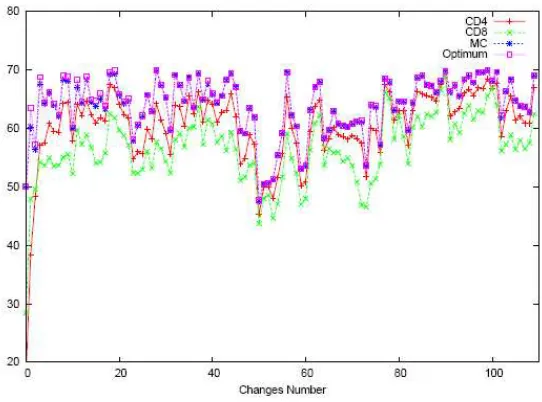
Fig. 1a shows the average of the best found solutions, of each population (CD4, CD8 and MC) and the optimum before the objective function change, for scenario 1. Here, we can see that the solutions found by CD4 are better than the solutions found by CD8. MC performs a good local search for the solutions provide by CD4. The performance of DTC does not deteriorate in the presence of a change. While for scenario 2 (see Fig. 1b), we can observe that both populations, CD4 and CD8, provide good solutions in order to MC find solutions near the optimum and its performance is affected. This fact makes us think that scenario 2 requires more diversity due to the number of peaks, fifty peaks while scenario 1 has only five peaks.
Fig. 1c shows the average of the offline error, over the 50 runs, for both scenarios. The presence of a change affects the performance of DTC worst in scenario 2 than scenario 1.
6
Table 1: Offline Error obtained for each Approach.
6.
Conclusions and Future Work
We have presented an artificial immune system based on the T-Cell model, which has been proposed to solve dynamic optimization problems. The proposed approach is inspired on the processes suffered by the T-Cells within our immune system. In this first study, the proposed approach has been tested with two scenarios generated by a generator of dynamic functions (MPB). The results obtained by our proposed approach are promising, resulting better in one of the cases to those generated by the other algorithms with respect to which it was compared. This fact encourages us, as future work, to deep this study over different kind of dynamic environments.
References
1. How to Solve It: Modern Heuristics, Springer, December, 2004.
2. Branke, J., “Memory enhanced evolutionary algorithms for changing optimization problems”, in Congress on Evolutionary Computation CEC99, IEEE, 1999.
3. Bretscher, P. and M. Cohn, A theory of self-nonself discrimination, Science, 169, 1970.
4. Nunes De Castro, L. and Von Zuben, F. J., The clonal selection algorithm with engineering applications. In GECCO 2002 - Workshop Proceedings, Morgan Kaufmann.
5. Dasgupta, D. and Nino, F., Immunological Computation: Theory and Applications, Auerbach Publications, Boston, MA, USA, 2008.
6. David, B. and Roth, D. M., Brostoff, J. and Roitt, I., Inmunologia, Else-vier Science Health Science div, Madrid, 7a edition, Harcourt Brace, 1997. 7. Alessio, G. and Collard, P., From gas to artificial immune systems:
Improving adaptation in time dependent optimization. In Proceedings of the Congress on Evolutionary Computation, IEEE Press, 1999.
8. Kelsey, J. and Timmis, J., Immune inspired somatic contiguous hypermutation for function optimisation, In E. Cantu-Paz, J. A. Foster, K.
Approach Scenario 1 Scenario 2 AIIA 0.71 3.44 CLONALG 11.71 10.53
Sais 12.40 11.57
BCA 0.39 2.69
opt-Ainet 2.39 4.76
S. W. Wilson, M. Har- man, J. Wegener, D. Dasgupta, M. A. Potter, A. C. Schultz, K. A. Dowsland, N. Jonoska, and J. F. Miller, editors, Genetic and Evolutionary Computation- GECCO 2003, Genetic and Evolutionary Computation Conference, Chicago, Illinois, USA, July 2003. Springer. Lecture Notes in Computer Science Vol. 2723.
9. Matzinger, P., Tolerance, danger and the extend family. Annual Review of Immunology, 12, April 1994.
10.Nanas, N. and De Roeck, A. N., Multimodal dynamic optimization: From evolutionary algorithms to artificial immune systems, in ICARIS, 2007. 11.Nunes de Castro, L. and Timmis, J., An artificial immune network for
multimodal function optimization, in Proccedings of the 2002 Congress on Evolutionary Computation (CEC’2002), volume 1, Honolulu, Hawaii, May 2002.
12.Nunes de Castro, L. and Timmis, J., Artificial Immune Systems: A New Computational Intelligence Approach, Springer-Verlag, New York, 2002. 13.Trojanowski, K., B-cell algorithm as a parallel approach to optimization of
moving peaks benchmark tasks. Computer Information Systems and Industrial Management Applications, International Conference on, 0, 2007. 14.Trojanowski, K., Clonal selection approach with mutations based on
symmetric alpha stable distributions for non-stationary optimization tasks, in ICAN-NGA ‘07: Proceedings of the 8th international conference on Adaptive and Natural Computing Algorithms, Part I, Berlin, Heidelberg, Springer-Verlag, 2007.
15.Trojanowski, T. and Wierzchon, S. T., Studying properties of multipopulation heuristic approach to non-stationary optimisation tasks, in IIS, 2003.
Figure: Optimum, Best Solutions and Offline Errors for DTC.
a. Optimum and Best Solutions Before a Change Found by CD4, CD8 and MC for Scenario 1
GA and PSO Applied to Wind Energy Optimization
MARTIN BILBAO1,ENRIQUE ALBA2
1 Universidad Nacional de la Patagonia Austral, Caleta Olivia, Argentina
2 Universidad de Málaga, España
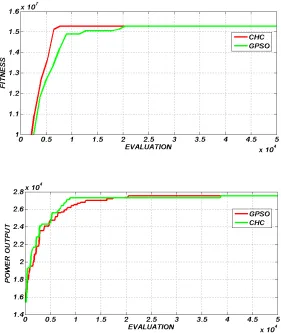
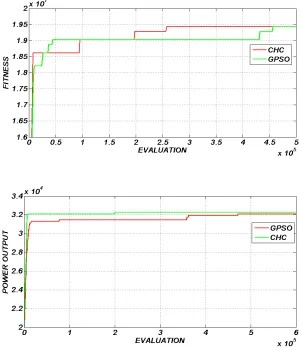
Abstract. In this article we analyze two kinds of metaheuristic algorithms applied to wind farm optimization. The basic idea is to utilize CHC (a sort of GA) and GPSO (a sort of PSO) algorithms to obtain an acceptable configuration of wind turbines in the wind farm that maximizes the total output energy and minimize the number of wind turbines used. The energy produced depends of the farm geometry, wind conditions and the terrain where it is settled. In this work we will analyze three study farm scenarios with different wind speeds and we will apply both algorithms to analyze the performance of the algorithms and the behavior of the computed wind farm designs.
Keywords: CHC, Geometric Particle Swarm Optimization, Optimization, Wind Energy, Metaheuristics.
1.
Introduction
Nowadays, using renewable energies is an increasing area of research and development in all the world, because they are important alternatives to generate free and clean power. The raise of this energy is clear in Europe and America, being a strategic part of development for many countries like Argentina and Spain. A capital interest resides in combining a maximum of energy generation at the same time as reducing the total cost of the wind farm. A farm is a set of wind turbines, every one being costly, whose position is a strategic decision in orden to maximize the produced energy. One of the most important aspects of wind farm design is to obtain an optimal location of the wind turbines, because they recieve lower wind speed and less energy captures if e.g. they are located behind each other. This effect is called the
wake effect [1]. The wake effect can be reduced by optimizing the geometry
of the wind farm. Then, obtaining a maximum annual profit means taking into account the number of wind turbines and their proper positioning simultaneously. Therefore, an effective algorithm is necessary to get an optimal solution by using a mathematical model of the wind farm as close as possible to a real world complex problem.
RND (Radio Network Design) that share some points in common to our work [4] and Geometric Particle Swarm Optimization (GPSO) [5] will be applied and analyzed here, showing also that they can provide new state of the art solutions to optimal wind farm design applications.
The rest of the article is structured as follows: Section
2
we will explain the wake model, the power model and the cost model used. Section3
will detail CHC and GPSO the proposed algorithms. In section4
we will show the experimental studies and discuss on the results obtained and in Section5
the conclusions and future work.2.
Wind Farm Modelling
In this section we describe the mentioned inter-turbine wake effect model, the power model, and the cost model for our further mathematical manipulations. This are the basic components to deal with a realistic farm design, and they are combine together for the needed guidance offered to the design algorithms in their quest for an optimal farm configuration.
2.1 Wake Effect Model
The used model in this work is similar to the wake decay model developed by Katic [6]. Depending of the farm geometry, the wind turbine that is upwind of other wind turbine results in lower wind speeds than the one downwind, as shown in Fig. 1. The velocity deficit measures this effect [6]:
,
)
2
1
(
1
1
=
=
2 0 0D
kX
C
U
U
U
dV
t t+
−
−
−
(1)
where
U
0 is the initial free stream velocity,U
t is the velocity in the wake at a distance X downstream of the upwind turbine,C
t is the thrust coefficient of the turbine, D is the diameter of the upwind turbine, and k is the wakedecay constant. This model assumes that the kinetic energy deficit of interacting wakes is equal to the sum of the energy deficits of the individual wakes. Thus, the velocity deficit at the intersection of several wakes is:
,
)
(1
1
=
2 0 1 = 0⎥
⎥
⎦
⎤
⎢
⎢
⎣
⎡
−
−
∑
U
U
U
U
i N iwhere
U
i is the free strem velocity of the individual wake, and N is thenumber of wind turbines in the wind farm.
Figure 1: Wake model for interaction between two wind turbines
2.2 Power Model
The wake model directly defines the power model, that is to be maximized. The power curve for the wind turbine under consideration in our work follows here:
⎪
⎪
⎪
⎩
⎪⎪
⎪
⎨
⎧
≤
≤
≤
x x x x x is
m
s
m
s
m
s
m
s
m
s
m
kW
U
<
/
25
for
0
,
/
25
U
/
13
for
750
,
/
13
<
U
/
3
for
U
0.3
,
/
3
<
forU
0
=
)
(
P
3(3)
where
Ux
is the wind speed on the wind turbine.the total power generation for all the wind turbines in the wind farm is: