PROGRAMA DE DOCTORADO EN INGENIERÍA INDUSTRIAL
TESIS DOCTORAL:
A Framework to Study the Resilience of
Organizations: A Case Study of a Nuclear
Emergency Plan
Presentada por Cristina Ruiz Martín para optar al
grado de
Doctor/a por la Universidad de Valladolid
Dirigida por:
A Framework to Study the Resilience of Organizations:
A Case Study of a Nuclear Emergency Plan
by
Cristina Ruiz Martín
Thesis Supervisors
Dr. Gabriel A. Wainer / Dr. Adolfo López Paredes
A thesis submitted to the Faculty of Graduate Studies and Research
In partial fulfillment of the requirements of the degree of
Doctor of Philosophy in Electrical and Computer Engineering
Ottawa-Carleton Institute for Electrical and Computer Engineering
Department of Systems and Computer Engineering
Carleton University
Ottawa, Ontario
Canada
January 2018
i
Abstract
Nowadays, building resilience is a key topic in many research fields such as Management, Engineering, Psychology or Ecology. The frequency increase of natural and anthropogenic disasters and the consciousness about their effects are among the reasons why resilience has gained importance and Governments are investing money in boosting the resilience of organizations, infrastructure, cities, individuals, etc.
However, there is not much research on specific methodologies to design resilient organizations. A main goal of our research is to improve this aspect providing a framework to design resilient organizations. We explain how to design resilient organizations based on the Viable System Model principles. Then, we focus on an important aspect for being resilient: the communications. We use as a case study a Nuclear Emergency Plan from Spain to show the applicability of our framework.
iii
Resumen
El desarrollo de la resiliencia es un campo de investigación importante en ámbitos como el Management, la Ingeniería, la Psicología o la Ecología. La importancia del estudio de la resiliencia se ha visto desarrollada por el aumento tanto de desastres naturales como antropogénicos, así como por el desarrollo de conciencia acerca de sus efectos. Estas razones de peso han influido en que los Gobiernos estén invirtiendo recursos en la mejora de la resiliencia de organizaciones, infraestructuras, ciudades, individuos, etc.
Sin embargo, a pesar de su importancia, el número de trabajos de investigación que se centran en el desarrollo de metodologías específicas para el diseño de organizaciones resilientes es reducido. El principal objetivo de esta investigación es mejorar este aspecto introduciendo un marco para el diseño de organizaciones resilientes. Para alcanzar este objetivo, se explica cómo emplear el Modelo de Sistemas Viables para el diseño de estas organizaciones. Nos hemos centrado en uno de los aspectos clave de la resiliencia: las comunicaciones. Para ello, se ha usado el caso de estudio del plan de emergencia de una central nuclear en España.
v
Acknowledgements
I want to express my gratitude to:
My thesis supervisors Dr. Adolfo López Paredes and Dr. Gabriel Wainer for being a guide during these years. Thanks for sharing your knowledge, expertise and give me the opportunity to do my PhD. in an international environment. Without your support and guidelines, this thesis would have not exit.
My colleagues in INSISOC and ARS-Lab. Thanks a lot for all your feedback and support. I also want to express my gratitude for making the work environment a wonderful place.
My mum and family for always being there.
vii
Table of Contents
ABSTRACT ... I
RESUMEN ... III
ACKNOWLEDGEMENTS ... V
TABLE OF CONTENTS ... VII
LIST OF TABLES ... X
LIST OF FIGURES ... XI
INTRODUCTION ...1
CHAPTER 1. 1.1. RESEARCH GOALS AND CONTRIBUTIONS ... 2
1.2. RESEARCH ENVIRONMENT ... 2
1.3. RELATED PUBLICATIONS ... 3
1.4. STRUCTURE OF THE THESIS ... 6
BACKGROUND ...9
CHAPTER 2. 2.1. DESCRIPTION OF THE PROBLEM ... 9
2.1.1. Examples of recent disasters and their consequences ... 10
2.1.2. Previous research on resilience and emergency management ... 11
2.2. ORGANIZATIONAL RESILIENCE ... 13
2.2.1. How is resilience conceptualized at the organizational level? ... 15
2.2.2. Open issues in resilience conceptualization ... 17
2.2.3. Resilience and related concepts: fragile, robust and antifragile ... 18
2.2.4. Organizational resilience and its attributes ... 19
2.2.5. How is resilience assessed in practice at the organizational level? ... 20
2.3. VIABLE ORGANIZATIONS AND THE VIABLE SYSTEM MODEL ... 23
2.3.1. Organizational Pathologies according to the VSM ... 25
METHODOLOGIES USED FOR THE ARCHITECTURE DESIGN ... 27
CHAPTER 3. 3.1. NETWORK THEORY ... 27
3.1.1. Network Metrics ... 28
3.1.2. Applications of Network Theory ... 29
3.2. AGENT BASED MODELING ... 30
3.2.1. Applications of Agent Based Modeling ... 30
3.3. DISCRETE EVENT SYSTEM SPECIFICATION (DEVS) ... 30
3.3.1. DEVS Simulators ... 31
3.3.2. Advantages of DEVS ... 33
VIABLE AND RESILIENT ORGANIZATIONS. THE APPLICATION OF CHAPTER 4. THE VIABLE SYSTEM MODEL ... 35
4.1. DISCUSSION ABOUT ORGANIZATIONAL RESILIENCE ... 35
4.1.1. Discussion about organizational resilience conceptualization ... 35
4.1.2. Discussion about organizational resilience assessment ... 36
4.1.3. Further discussion about organizational resilience ... 37
4.2. RELATIONSHIP BETWEEN VIABLE AND RESILIENT ORGANIZATIONS ... 37
viii
AN ARCHITECTURE TO STUDY DIFFUSION PROCESSES IN CHAPTER 5.
MULTIPLEX DYNAMIC NETWORKS: PRELIMINARIES ... 41
5.1. THE STUDY OF DIFFUSION PROCESSES IN MULTIPLEX NETWORKS ... 41
5.2. ASERVER-PROXY HYBRID ARCHITECTURE TO MODEL INFORMATION DIFFUSION PROCESSES ... 43
5.3. PROXY-SERVER HYBRID ARCHITECTURE APPLIED TO THE NUCLEAR EMERGENCY PLAN ... 45
5.4. SIMULATION RESULTS... 49
5.5. DRAWBACKS OF THE SERVER-PROXY ARCHITECTURE TO THE STUDY OF COMMUNICATIONS INSIDE THE NEP ... 51
ARCHITECTURE TO SIMULATE DIFFUSION PROCESSES IN CHAPTER 6. MULTIPLEX NETWORKS ... 53
6.1. ARCHITECTURE FOR MULTIPLEX DYNAMIC NETWORKS ... 53
6.1.1. Diffusion experiment data collection ... 54
6.1.2. Network model ... 55
6.1.3. Agent Based model ... 55
6.1.4. Diffusion Abstract model ... 56
6.1.5. Diffusion computerized model (DCM) ... 59
6.1.6. Results analysis ... 60
6.2. M&SDEVELOPMENT PROCESS FOR MULTIPLEX DYNAMIC NETWORKS ... 60
6.2.1. Step 1 – System/problem requirement gathering ... 60
6.2.2. Step 2 – Network & Agent Based models development ... 61
6.2.3. Step 3 – Abstract Diffusion model development ... 62
6.2.4. Step 4 – Diffusion computerized model development ... 62
6.2.5. Step 5 – Analysis of simulation results ... 63
6.3. DIFFUSION ABSTRACT MODEL:GENERAL DEFINITION AND IMPLEMENTATION USING DEVS ... 63
6.3.1. Node ... 63
6.3.2. Indirect Link ... 66
6.3.3. Link Connectors ... 67
6.3.4. Direct Link ... 67
6.3.5. Diffusion Element Generator ... 68
6.3.6. Updaters ... 68
6.3.7. Diffusion Abstract model implementation ... 68
CASE STUDY: DATA EXPERIMENT COLLECTION, NETWORK AND CHAPTER 7. AGENT BASED MODELS FOR THE NUCLEAR EMERGENCY PLAN ... 71
7.1. DATA EXPERIMENT COLLECTION ... 71
7.1.1. NEP Organizational structure ... 71
7.1.2. Communication systems ... 73
7.1.3. Communication Rules ... 74
7.2. NETWORK MODEL DEFINITION ... 77
7.3. AGENT BASED MODEL ... 80
CASE STUDY. DIFFUSION ABSTRACT MODEL OF THE NUCLEAR CHAPTER 8. EMERGENCY PLAN USING DEVS ... 87
8.1. DIFFUSION ABSTRACT MODEL FOR THE NUCLEAR EMERGENCY PLAN ... 87
8.1.1. Person model instantiation ... 89
8.1.2. Devices Coupled model instantiation ... 92
8.1.3. Networks Coupled model instantiation ... 92
ix
CASE STUDY: A COLLAPSE IN THE COMMUNICATIONS ... 101
CHAPTER 9. 9.1. ASSUMPTIONS ... 101
9.2. DOWNFALL IN PHONE COMMUNICATION CHANNEL... 102
9.2.1. Scenario 1 ... 103
9.2.2. Scenario 2 ... 105
9.2.3. Discussion ... 106
9.3. DOWNFALL IN THE FAX COMMUNICATION CHANNEL ... 107
9.4. DOWNFALL IN THE INTERNET COMMUNICATION CHANNEL ... 109
9.5. DOWNFALL IN RADIO COMMUNICATION CHANNEL ... 109
9.6. DOWNFALL IN SATELLITE COMMUNICATION CHANNEL ... 109
9.7. JOINT DOWNFALL IN PHONE, FAX AND INTERNET CHANNELS ... 110
9.8. DISCUSSION ... 110
CASE STUDY. RESULTS ANALYSIS FROM THE NEP DIFFUSION CHAPTER 10. ABSTRACT MODEL ... 113
10.1. TESTING INDIVIDUAL COMPONENTS... 113
10.1.1. Command Generator, Devices State & Networks State ... 113
10.1.2. Behavior Rules ... 116
10.2. NEPDAM:HEAD OF THE NEP ... 119
10.3. NEPDAM:RADIOLOGICAL GROUP ... 122
10.4. NEPDAM:HEALTH GROUP ... 125
CONCLUSIONS AND FUTURE WORK ... 131
CHAPTER 11. 11.1. CONCLUSIONS ... 131
11.2. FUTURE WORK ... 133
BIBLIOGRAPHY ... 135
APPENDIX A. DIFFUSION ABSTRACT MODEL. FORMAL DEFINITION USING DEVS ... 149
APPENDIX B. GENERATOR FILTER. FORMAL DEFINITION USING DEVS ... 151
APPENDIX C. INDIRECT LINKS. FORMAL DEFINITION USING DEVS ... 152
APPENDIX D. GENERATOR FILTER. IMPLEMENTATION IN CDBOOST ... 154
x
List of Tables
Table 1. Organizational resilience conceptualization as capacity, ability or capability ... 16
Table 2. Most cited attributes that contribute to resilience ... 19
Table 3. Summary of the commands to be handled in case of emergency ... 74
Table 4. “Tell people to stay at home” command ... 76
Table 5. “Tell people to stay at home” acknowledgment reception ... 76
Table 6. “Tell people to stay at home” actions ... 77
Table 7. Nodes Ids and labels ... 79
Table 8. Network connections ... 79
Table 9. Characteristics of the computer ... 113
Table 10 Communication Relations ... 117
xi
List of Figures
Figure 1. Relations between resilience concepts and organizational resilience. The arrows indicate the
direction of the relations. ... 14
Figure 2. Viable System Model, adapted from Beer, 1981 (Pérez Ríos 2012). Used with permission of the author. ... 24
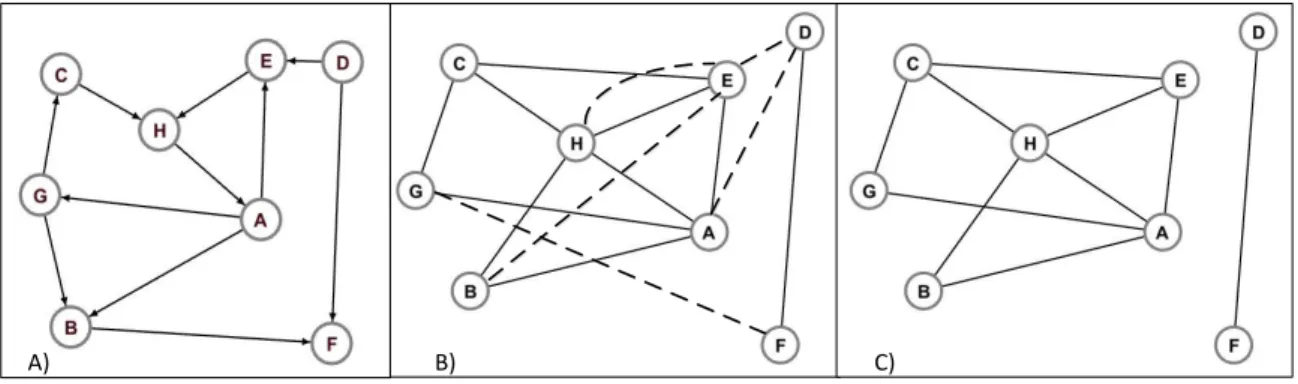
Figure 3 Examples of networks: a) Simplex directed network with eight nodes. b) Multiplex bidirectional network with one component. The different types of lines represent the different layers. c) This network represents the resultant network when the dot-line layer in figure b fails or disappears. After the failure, we get a simplex bidirectional network with two components. ... 27
Figure 4. DEVS atomic model implementation using CDBoost. ... 32
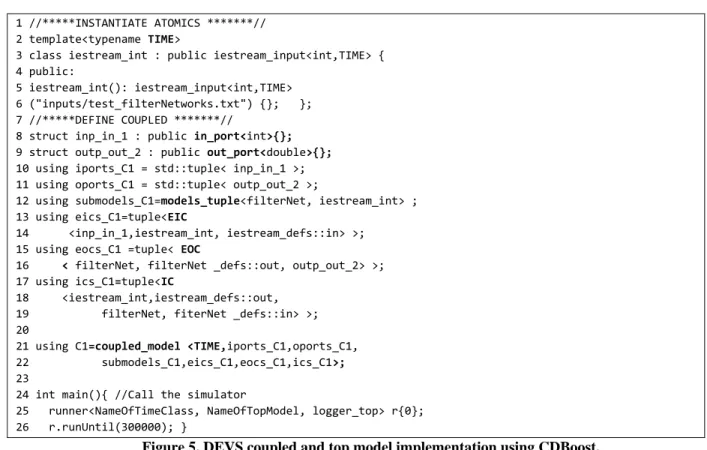
Figure 5. DEVS coupled and top model implementation using CDBoost. ... 33
Figure 6. Example of DEVS coupled model defined in figure 2 ... 33
Figure 7 Formalism Transformation Graph. Adapted from (Vangheluwe 2000) ... 34
Figure 8 Four-level Maturity Model for Organizational Resilience (MMOR) ... 35
Figure 9. Shared characteristics between resilient and viable organizations ... 38
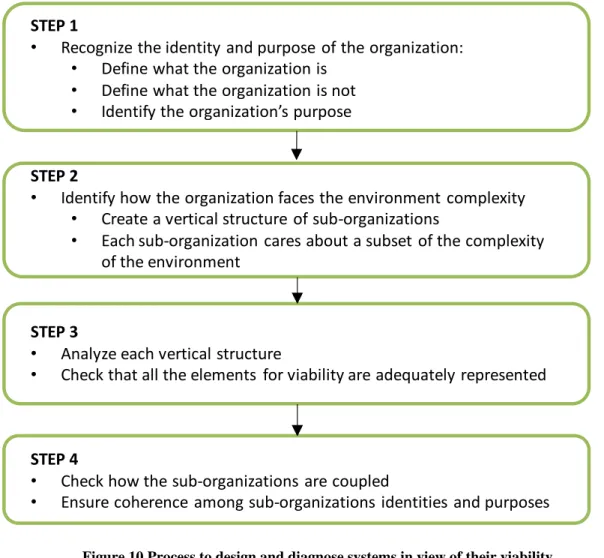
Figure 10 Process to design and diagnose systems in view of their viability ... 39
Figure 11: Hybrid architecture for modeling information diffusion processes ... 43
Figure 12 Detailed description of the simulation and post-simulation presented in Figure 11 ... 44
Figure 13 Sketch of the DEVS model architecture for a network with four nodes and three layers. .... 45
Figure 14: Higher abstraction level of the NEP model. ... 46
Figure 15 Second level of abstraction: crew executives ... 47
Figure 16 Second level of abstraction: crew ... 47
Figure 17 Third level of abstraction: radiological group crew. ... 48
Figure 18: Graph representation of three different models of the NEP and description of link labels. . 48
Figure 19 Simulation Results of information dissemination in NEP. ... 49
Figure 20 Number of active agent depending on communication channels. ... 50
Figure 21. An architecture to simulate diffusion processes in multiplex dynamic networks ... 53
Figure 22. Example of the agent’s definition using XML. ... 56
Figure 23. Diffusion Abstract model architecture ... 57
Figure 24 Node Coupled model ... 64
Figure 25. IndirectLink Coupled model ... 66
Figure 26. Link Connectors Coupled model ... 67
Figure 27. Scheme of the DCM implementation. ... 69
xii
Figure 29. NEP network at the beginning of the emergency (Ruiz-Martin, Ramírez Ferrero, et al.
2015). ... 78
Figure 30. Example of the agent’s definition using XML. ... 82
Figure 31. Diagram of the Mobile states using DEVS-Diagram notation. ... 84
Figure 32. Schema of the NEPDiffusionAbstract model definition for the NEP. ... 87
Figure 33. Coupled model definition of a Node and its translation to a Person model for the NEP. .... 89
Figure 34. Coupled model definition of Behavior Rules ... 90
Figure 35. Example of Sending Behavior using Devices coupled model instantiated for a person with mobile and fax ... 91
Figure 36. Example of Devices coupled model instantiated for a person that has a mobile, a fax and a satellite phone. ... 92
Figure 37. Computerized model of the Switch Atomic model ... 94
Figure 38 Generating the DEVS computerized model of coupled models e-mail, beeper, and fax ... 96
Figure 39. Output of the function explained in Figure 38 ... 96
Figure 40. Code snippet of the program that generates the top model ... 97
Figure 41 Code snippet of the output in the program defined in Figure 40 ... 98
Figure 42. Collapse in the phone communication channel. Scenario 1. Case 1. ... 103
Figure 43. Collapse in the phone communication channel. Scenario 1. Case 2. ... 104
Figure 44. Collapse in the phone communication channel. Scenario 2. Case 2. Not possible to distinguish the groups due to in-situ communications ... 106
Figure 45. Connection of the three components of a network with two links. Building redundancies adding three more links. ... 107
Figure 46. NEP network after a collapse in the fax communication channel. Scenario 2. Case 1. Not possible to distinguish groups due to in situ communications. ... 108
Figure 47 Input file for the model Devices State ... 114
Figure 48 Devices State log file when simulated with the input file in Figure 47 ... 114
Figure 49. Input file for the model Command Generator ... 115
Figure 50. Command Generator log file when simulated with the input file in Figure 49. ... 115
Figure 51. Input file for the model Networks State ... 115
Figure 52. Networks State log file when simulated with the input file in Figure 51 ... 116
Figure 53 Inputs for the model Behavior Rules ... 117
Figure 54 Behavior Rules log file when simulated with the input file in Figure 53. ... 118
Figure 55 Input files for the NEP Diffusion Abstract model ... 120
Figure 56. NEP Diffusion Abstract model log file when simulated with the input file in Figure 55 ... 121
xiii
1
Introduction
Chapter 1.
This thesis started as a research collaboration with the Civil Protection Agency in Castilla y León with the objective of analyzing emergency plans. The start of this collaboration came at the same time as the nuclear accident at TEPCO’s Fukushima NPP. Since different studies pointed out that the emergency plan was not resilient (Langlois 2013), we decided to ask ourselves: How can we design resilient emergency plans?
To answer this question, since emergency plans can be considered a virtual organization, we started reviewing the concept of organizational resilience and how to measure it. We found a close relationship between resilient and viable organizations. Taking into account this relation, we proposed to apply the methodology to design viable organizations, introduced by Pérez Rios (2010), to the design of resilient organizations. This methodology, based on the Viable System Model (VSM), highlights the importance of the communications for the well-functioning of the organization.
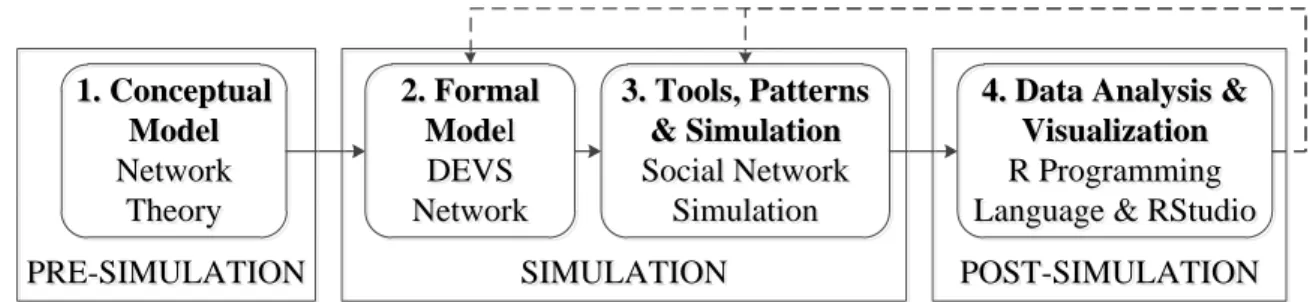
Due to the importance of the communications, we have focused on their study. The communications inside organizations can be studied as a diffusion process in multiplex networks. In the Laboratoire de l'Intégration du Matériau au Système (IMS) at University of Bordeaux, Bouanan et al. (2016) developed an architecture to simulate information diffusion processes in social networks. Through a collaboration with IMS, we studied the applicability of their architecture to study resilience of communications inside organizations. We used the case study provided by the Civil Protection Agency: “Study a Nuclear Emergency Plan (NEP) from Spain”. We found that their architecture was not suitable to include all the attributes specified in plan as detail in Chapter 4. As a result, we developed a new architecture that fulfills our requirements. We used the same modeling and simulation methodologies proposed in Bouanan et al. (2016): Agent Based Modeling (ABM), Network Theory and Discrete Event System Specification (DEVS).
We built the architecture using a bottom-up approach. First, based on the above-mentioned methodologies and their associated tools, we designed a model to study the communications inside emergency plans using the case study proposed by the Civil Protection Agency. Then, we extrapolated the development process and the specific model to provide a general architecture to study diffusion processes in multiplex dynamic networks, being the study of the communications inside organizations a particular case. Although we followed a bottom up approach to design the architecture, in the thesis, we first explain the general architecture and development process, and then how to apply it to the case study.
The application of the methodology introduced by Perez Rios (2010) and the architecture and the development process we propose in this thesis to study diffusion process in multiplex networks constitute a framework to study the resilience inside organizations. We understand as framework a standard set of practices and methodologies that allows us to study a specific problem and similar problems to the original one.
2
to design resilient emergency plans, we came up with a framework to design resilient organizations using formal methods.
1.1.
Research goals and Contributions
The final goal of this thesis is to provide a framework to design resilient organizations using formal methods.
To achieve this goal, we define the following objectives:
- Define resilient organizations, identify what are the characteristics that contribute to their development and understand how organizational resilience is measured.
- Identify a methodology to design resilient organizations
- Establish an architecture and a development process to study the resilience of communications inside organizations.
The contributions of this thesis are as follows:
- A conceptualization of organizational resilience and the identification of the main characteristics that contribute to their development.
- A four level maturity model for organizational resilience.
- The identification of two streams to measure organizational resilience: before and after the disruptive event occurs.
- The relationship between resilient and viable organizations that set the justification for the application of the VSM to the design of resilient organization.
- The identification of the communications inside organizations as a key element for their resilience.
- A general architecture and a development process to simulate diffusion processes in multiplex networks based on formal modeling and simulation methodologies.
- An instantiation of the architecture to simulate diffusion processes in multiplex networks using DEVS as formal modeling and simulation methodology.
- A customizable model to simulate information diffusion processes inside organizations taking into account the social aspect (i.e. the behavior of the people that carry the diffusion process) to study the resilience of the communications.
- The application of DEVS to provide rigor to study the resilience of communications inside organizations
- A framework to design resilient organizations based on the methodology introduced by Perez Rios (2010) and an architecture to simulate diffusion processes in multiplex networks.
- The application of the framework to study the resilience of a Spanish NEP
1.2.
Research Environment
3
INSISOC is a research group (Excellence Research Group of Castilla y León) integrated by researchers and professors from Universidad de Valladolid and Universidad de Burgos. Nowadays, the group has fifteen researchers.
INSISOC was born in 1998 when Professor Cesáreo Hernández supervised the thesis of Professor Adolfo Lopez Paredes entitled “Analysis and Engineering the Economic Institutions. An Agent Based Methodology” (“Análisis e Ingeniería de las Instituciones Económicas. Una metodología basada en agentes”). The initial milestone of the group is the article entitle “The Social Dimension of Economics and Multiagent Systems” written by Professor López-Paredes and Professor del Olmo in 1998.
INSISOC is focused on the study of complex systems. We model and study the behavior of complex social systems defining the behavior of the components. Our aim is to explore and develop methodologies to study this type of systems and problems.
ARS-Lab was funded by Professor Gabriel Wainer once he joined Carleton University. Nowadays, the laboratory has eleven researchers, most of them Ph.D. students. Additionally, every year, we have visitor researchers and professor from different labs all over the world (France, Argentina, Brazil, etc.). The research in the laboratory is based on DEVS formalism. The aim is to augment previous work with new theory, methodology, and supporting development tools, including the integration of 3D visualization facilities.
In this thesis, we have taken advantage of the background and expertise in both groups: the study of complex systems using Agent Based Modeling (ABM) techniques and the expertise in formal methodologies (DEVS in the case of this thesis). Combining their expertise, we have been able to provide a framework to study the resilience of organizations.
1.3.
Related Publications
We published some of the obtained results in different conference proceedings, journals and a book chapter. At the time of writing this thesis, we have two journal papers that we are waiting for them to be published.
The list of the related publication to this thesis is classified by type and listed based on the date of publication in a ascending order.
Journal articles
Cristina Ruiz-Martin, Mario Ramirez-Ferrero, José Luis González Álvarez, Adolfo Lopez-Paredes. “Modeling of a Nuclear Emergency Plan: Communication Management”. Human and Ecological Risk Assessment: An International Journal, 21(5), 1152-1168. (2015). https://doi.org/10.1080/10807039.2014.955383
4
Cristina Ruiz-Martin, David J. Poza Garcia. “Project Configuration by means of Network
Theory”. International Journal of Project Management. 33 - 8, pp. 1755 - 1767. 2015. https://doi.org/10.1016/j.ijproman.2015.07.010
Summary: We proposed to determine an appropriate sequence to develop the components of a Project Management Plan using Network Theory. Although our approach is compatible with any project management standard, we used the Project Management Body of Knowledge (PMBOK) to illustrate how to apply this methodology due to the complex interdependence among its processes. We built the Network Model of the PMBOK as we did with the NEP.
Manuel Morales Allende, Cristina Ruiz-Martin, Adolfo Lopez-Paredes, José Manuel Perez Ríos. “Aligning Organizational Pathologies and Organizational Resilience Indicators”. International Journal of Production Management and Engineering, 5(2), 107-116. (July 2017). https://doi.org/10.4995/raet.2017.7423
Summary: In this article, based on the discussion presented in the book chapter “The Application
of the Viable System Model to Enhance Organizational Resilience” we proposed to identify the organizational pathologies defined applying the VSM using resilience indicators. We concluded that an organization with any organizational pathology is not likely to be resilient because it does not fulfill the requirements of viable organizations.
Cristina Ruiz-Martin, Adolfo Lopez-Paredes, Gabriel Wainer. “What we Know and Do Not
Know about Organizational Resilience”. International Journal of Production Management and Engineering. (Accepted. In Press).
Summary: We presented a literature review about organizational resilience. The main contributions of this review are a conceptualization of organizational resilience, a four-level Maturity Model for Organizational Resilience (MMOR) based on the development of the abilities or capacities the organization has to deal with disruptive events and the identification of two streams to measure organizational resilience.
Cristina Ruiz-Martin, Gabriel Wainer, Adolfo Lopez-Paredes. “Discrete-Event Simulation of
Diffusion Processes in Dynamic Multiplex Networks”. Simulation Modelling Practice and Theory. (Revisions Submitted).
Summary: We defined an architecture and a development process to study diffusion processes in multiplex dynamic networks based Network Theory, Agent-Based Modeling and formal M&S. We detailed the development process and the architecture using DEVS as the formal M&S methodology, and presented a case study based on the NEP.
Cristina Ruiz-Martin, Adolfo Lopez-Paredes, Gabriel Wainer. “Assessment of Organizational
Resilience through Network Theory”. Dirección y Organización. (Submitted)
5
Eduardo Agenjo, Natalia Martín-Cruz, Cristina Ruiz-Martin, Adolfo Lopez-Paredes. “Does
CMMI Implementation affect the Performance of the Firm? An Evaluation from a Dynamic Capabilities Approach”. International Journal of Production Management and Engineering (Submitted)
Summary: We studied the impact of the Capability Maturity Model Integration (CMMI) on firm performance both during and after its implementation. We used Spanish firms in the Information and Technology (IT) sector. Doing statistical analysis we found a negative relationship between the use of CMMI and profitability in the firms during the analyzed period and sector.
Book Chapters
Cristina Ruiz-Martin, Jose Manuel Pérez Rios, Gabriel Wainer, Javier Pajares, Cesareo Hernandez, Adolfo Lopez-Paredes. “The Application of the Viable System Model to Enhance
Organizational Resilience”. In Advances in Management Engineering. Springer 2017. ISBN: 978-3-319-55888-2. https://doi.org/10.1007/978-3-319-55889-9_5
Summary: In this book chapter, we identified a relationship between viable and resilient organizations. We argued that the application of the principles of the Viable System Model (VSM) improves organizational resilience. We also argued that the VSM constitutes a valid framework to design resilient organizations.
Conferences
Cristina Ruiz-Martin, Adolfo Lopez-Paredes, Gabriel Wainer. “Applying Complex Network
Theory to the Assessment of Organizational Resilience”. INCOM 2015. IFAC-PapersOnLine 48-3 p.
1224–1229. Ottawa, Canada. May 2015. (Best Paper Award)
https://doi.org/10.1016/j.ifacol.2015.06.251.
Cristina Ruiz-Martin, Gabriel Wainer, Adolfo Lopez-Paredes. “Modeling the Communications
in an Emergency Plan with P – DEVS” Winter Simulation Conference (WSC). Ph.D. Colloquium. IEEE Press, p. 3086-3087 Huntington Beach, US. December 2015. https://doi.org/10.1109/WSC.2015.7408412
Cristina Ruiz-Martin, Gabriel Wainer, José Manuel Pérez Ríos, Javier Pajares, Cesáreo Hernández, Adolfo Lopez-Paredes. “Organizational Resilience in Practice: the Viable System Model” International Joint Conference (IJC2016). San Sebastián, País Vasco, España. July 2016. (Poster)
Gabriel Wainer, Cristina Ruiz-Martin, Adolfo Lopez-Paredes. “Cellular Models for Emerging
Traffic Behaviour” Second International Symposium on Cellular Automata Modeling for Urban and Spatial Systems (CAMUSS 2016) Quebec City, Canada. September 2016.
6
Eduardo Agenjo, Natalia Martín-Cruz, Cristina Ruiz-Martin, Adolfo Lopez-Paredes. “The
Impact of CMMI Implementation on the Firm Performance. An Evaluation from a Dynamic Capabilities Approach”. International Joint Conference - ICIEOM-ADINGOR-IISE-AIM-ASEM (IJC 2017) Valencia, Spain, July 2017. (Best Paper Award)
Cristina Ruiz-Martin, Felix Villafañez, Adolfo Lopez-Paredes, Gabriel Wainer. “Impact of
Business Intelligence in Organizational Resilience” 2017 INFORMS Annual Meeting, Houston. USA. October 2017 (Abstract)
Cristina Ruiz-Martin, Gabriel Wainer, Adolfo Lopez-Paredes. “An Architecture to Simulate
Diffusion Processes in Multiplex Dynamic Networks”. Winter Simulation Conference (WSC). Ph.D. Colloquium. Las Vegas, US. December 2017.
Cristina Ruiz-Martin, Gabriel Wainer, Adolfo Lopez-Paredes. “Formal Abstract Modeling of
Dynamic Multiplex Networks”. SIGSIM-PADS18. Rome, Italy. May 2018 (Submitted)
1.4.
Structure of the Thesis
The rest of this thesis is organized as follows:
In Chapter 2, we present the background related to this thesis. First, we present the problem we address in this thesis. We discuss recent works in emergency management and we review the concept of organizational resilience. We also review the concept of viable organizations and the VSM.
In Chapter 3, we explain the three methodologies we use to develop our architecture to simulate diffusion processes in multiplex networks: Network Theory, ABM and DEVS.
In Chapter 4, we propose a definition of organizational resilience that integrates the ones presented in the review provided in Chapter 2 and discuss the measurement of organizational resilience. We also relate viable and resilient organizations and we defend the application of the VSM to design resilient organizations.
In Chapter 5, we present the preliminary work for the architecture proposed in this thesis to simulate diffusion processes in multiplex networks.
In Chapter 6, we detail the proposed architecture and development process to simulate diffusion processes in multiplex networks using formal modeling and simulation methodologies. We also explain how to instantiate the architecture when we use DEVS as formal modeling and simulation methodology.
In Chapter 7, we detail how to use the Data Experiment Collection component of the architecture and the Step 1 of the development process using as a case study a NEP from Spain. We also explain how to obtain the Network model and Agent-Based model components of our architecture using the Step 2 of the development process. This case study is also used in the rest of the chapters to explain the other components of the architecture and the other steps of the development process.
7
In Chapter 9, we present some results of analyzing the Network model.
In Chapter 10, we explain how to analyze the simulation results obtained using the NEP Diffusion Abstract model and provide relevant information for decision-makers.
9
Background
Chapter 2.
In this chapter, we first describe the problem we aim to address in this thesis: the design of resilient organizations. Since we aim to design resilient organizations, we will provide a review about organizational resilience (how it is understood and measure) and the concept of viable organizations and the VSM.
After the review of organizational resilience, in Chapter 4, we define resilience at the organizational level, as the measurable combination of characteristics, abilities, capacities or capabilities that allows an organization to withstand known and unknown disturbances and still survive. Since resilience is mentioned several times along this chapter, we introduce the definition here.
2.1.
Description of the Problem
Nowadays, building resilience is a key topic in many research fields such as Management, Engineering, Psychology or Ecology. Governments are investing resources to develop resilient institutions, communities, organizations, and individuals.
Since 2010, the US Department of Homeland Security has evolved from discussing what resilience means to set three principles to develop resilience: (1) adaptability, (2) withstanding and (3) rapidly recovering. The European Commision (2017) has also identified resilience among the top five European Union’s priorities. The European Union Action Plan for Resilience (European Commission 2016) outlines three priorities in the area of resilience: (1) support the development and implementation of national resilience capacity, (2) promote innovation and learning capacities to advocate resilience and (3) develop tools and methodologies to improve and measure resilience.
The Government of Canada is also focused on resilience, especially on climate resilience since climate change is strongly affecting Canada (Goverment of Canada 2014). They propose to build climate change resilience based on the following actions: (1) translating scientific information and traditional knowledge into action, (2) building resilient infrastructure, (3) protecting and improving human health and well-being, (4) supporting vulnerable regions and (5) reducing the hazards related to climate change and risk of disaster.
Although there are differences about how to build on resilience, there is no doubt that the frequency increase of natural and anthropogenic disasters and the consciousness about their effects are among the reasons why this topic has gained importance and Governments are investing money in improving the resilience of their country, including organizations, infrastructure, cities, individuals, etc.
10
Earthquake and Tsunami in Japan in 2011 (MacKenzie et al. 2012), the Darfield Earthquake in New Zealand in 2010 (Whitman et al. 2014; Kachali et al. 2012), and Hurricane Katrina in 2005 (Garnett & Kouzmin 2007). Likewise, anthropogenic disaster has occurred such as the accident at TEPCO's Fukushima Nuclear Power Plant (NPP) in 2011 (Omoto 2013; Langlois 2013) or the World Trade Centre attack in September 2001 (Kendra & Wachtendorf 2003; Mendonça & Wallace 2015).
To overcome the above-mentioned situations, Emergency Plans are designated. However, the traditional approaches to design them are based on top-down perspectives that aim for the compliance of a set of laws, regulations, and directives. These traditional approaches usually focus on a hierarchical structure similar to a military command chain giving a small margin to adaptation to unforeseen circumstances not identified in the plan.
Emergency plans can be considered a virtual organization, where members from different organizations get organized according to the definitions in the emergency plan with a specific purpose: solve the emergency.
We have chosen emergency plans as the organizations to test our framework because they are complex organizations where the communication between the people involved is a key element for the coordination and well function. This is important in any type of organization, but especially, in Emergency Plans, where having up to date information and data is critical. Moreover, the literature remarks the importance of improving emergency plans and we have access to data of a real NEP provided by the Civil Protection Agency.
2.1.1.
Examples of recent disasters and their consequences
After the accident at TEPCO’s Fukushima NPP, several problems in the emergency plan and crisis management were identified, including the loss of functionality at the off-site emergency management center. One of the causes was the lack of availability of the communication systems. The emergency plan was not well implemented in terms of warning the population, evacuation, distribution of iodine tablets, etc. The responsibilities were not well defined. There were a poor communication and information management. The analysis of the above issues suggested, among other actions, the review of the communication and management systems in the emergency plans (Omoto 2013). Doing a similar analysis, the International Atomic Energy Agency (IAEA) suggested the need for improvements. These improvements included strengthening management systems, response arrangements, transparency, and effectiveness of communications mechanisms (Langlois 2013).
Following the Darfield earthquake on September 2010, in (Whitman et al. 2014), the authors carried out a survey among New Zealand’s organizations. They used this survey to find the most helpful factors in mitigating the disruption in the operations after the earthquake. These factors are well-designed and well-built buildings, the relationship with staff and the capability to restore critical services quickly or not to get them interrupted.
11
organizations used ICTS to improve their connection, coordination and share the evolution of the emergency with both external and internal stakeholders.
After the World Trade Centre attack in September 2001, the New York City departments lost their primary emergency operation center. In (Kendra & Wachtendorf 2003), the authors examined how organizational resilience was exhibited in the recovering activities. They concluded that anticipation is a key dimension of resilience. This anticipation lays in the design of the organization, training, and preparation. However, they pointed out that creative thinking, flexibility, and ability to improvise in new emergent situations are also important. The analysis of these crises showed that organizations have to improve their capacity to adapt and reorganize when unforeseen events occur. They also pointed out the importance of the communication systems.
2.1.2.
Previous research on resilience and emergency management
Following these examples provided in the previous section, we consider that a resilient communication system contributes to improving the emergency management, which lays on emergency plans.
The importance of the communication mechanisms in emergency plans is also remarked by the principles of resilient systems and resilient organizations (Longstaff & Yang 2008) since emergency plans can be considered a virtual organization.
Although the previous examples remark the importance of improving the resilience of the communications inside emergency plans (a type of organization), there are not many tools or methodologies that allow us to test and improve the communications in organizations. This number is fewer if we include the social aspect (i.e. the behavior of the people that handle these communications).
12
However, these authors do not propose any tool to evaluate how resilient is an organization. Lee et al. (2013) worked in this direction introducing a survey tool to measure the resilience of organizations. They measured organizational resilience based on two factors: adaptive capacity and planning. To analyze how the organization performs based on these factors, they defined several indicators (eight for adaptive capacity and five for planning). For each of them, they identified their strengths and weakness and this is used as a measure of the resilience. However, this does not provide a systematic method to analyze the resilience of the organization in terms of communications and information management.
Several works have specifically focused on improving the resilience of emergency plans from different perspectives. Some of them focused on identifying the factors that improve the resilience. For example, Zhou et al. (2011) proposed five critical success factors for emergency management. These top factors include the organizational structure, a clear definition of responsibilities and the effectiveness of the information system to ensure the transference of information.
Others aimed to improve the organizational resilience through the development of processes. For instance, in (Turoff et al. 2004), the authors proposed eight design principles to build a flexible, robust and dynamic information management system for emergency response. These principles highlight the importance of up-to-date data, well-defined roles, information sharing across the organization, etc.
There is also research focused on improving the resilience in emergencies through the evacuation performance. For example, in (Lv et al. 2013), the authors introduced a new method for evacuation management support. They used interval-parameter programming within joint-probabilistic constrained programming and integer linear programming (optimization technique that deals with uncertainty) to calculate the optimal evacuation route. They applied the model to calculate the evacuation route in different scenarios. Applying this model, they also evaluated the robustness of the system analyzing what is the influence when the constraints for the evacuation problem are modified. Simonovic & Ahmad (2005) developed a simulation model based on system dynamics for understanding human behavior during flood evacuations. Their aim was to simulate the effect of different evacuation policies. They applied this model to emergency planning in the Red River Basin. Chen et al. (2006) applied agent-based simulation to identify the time it takes to evacuate the Florida Keys in case of a hurricane. They also studied what is the effect of a landfall in the evacuation route. They identified the most congested roads and the bottlenecks. They also got the average speed of the vehicles. In (Hammond & Bier 2015) the authors aimed to identify alternative evacuation strategies for nuclear emergencies. They studied different strategies based on the predicted radiation plumes. They compared them in terms of the size of the evacuation area and the adequacy of the protection measures and chose three. They compared these three to the existing ones and they conclude that there are methods that perform better than the ones currently applied.
13
implementation of the plan. Their objective was to improve the robustness of the emergency plans. Gomes et al. (2014) analyzed a nuclear emergency plan exercise. They studied a real simulacrum with real people to analyze the messages passed and to find sources of resilience and weakness. Their aim was to identify sources of improvement for future simulacrums to increase the resilience of the emergency plan.
Other research works focused on improving resilience improving the decision support systems. For example, in (De Maio et al. 2011), the authors proposed a knowledge-based system that includes the information from social, software and web technologies to support emergency management. The decision support system uses Fuzzy Cognitive Maps to deal with the complexity of this information (a Fuzzy Cognitive Map is a type of representation in which the relations between the elements can be used to calculate how important the impact of each element is). With this tool, they assisted the emergency manager during the crisis. In (Espinosa-Paredes et al. 2008), the authors applied Fuzzy Cognitive Maps to represent the decision-making process during abnormal situations in a NPP. Their case study considers the loss of coolant in a boiling water reactor, and they simulated different scenarios to test their approach. They presented a way to predict the effects and causes in a complex system such as an NPP. They also provided a tool that helps in the decision-making during emergencies in nuclear power plants.
Mendonça et al. (2006) applied gaming simulation to evaluate decision support systems for emergency response and to train the people involved using virtual environments. These virtual environments provide data (e.g. activity record, log of the communications, data recorded by observers, etc.) that can be used to evaluate the system.
Other authors focused on improving resilience through anticipation. For example, Chang et al. (2006) analyzed where to reallocate off-site monitoring installations using both simulation and optimization techniques. Their goal was to reduce the current monitoring network without affecting its monitoring capacity. In (Park & Jung 2007), the authors proposed a measure to quantify the complexity of tasks in emergency procedures in an NPP. This measure is calculated using five factors: the amount of information to be managed, the logic in the sequence of actions to be performed, the number of actions to the person has to do, the amount of knowledge needed to recognize what to do, and the need of resources needed to establish a decision criteria. They also found that this measure is correlated with the time to develop the tasks. Akbar et al. (2013) presented a simulation tool to forecast hurricanes and water surges in the Gulf of Mexico. Their aim was to aid in decision-making and first response preparation. To validate their tool, they used the Hurricane Katrina as a case study.
Although these are useful methods and tools, none of them tackles how to improve the organizational resilience from the communications and structure point of view. We focus on filling this gap suggesting the use of a methodology to design resilient organizations (the VSM) and providing an architecture and development process to study the resilience of communications using as a case study a real NEP from Spain.
2.2.
Organizational Resilience
14
importance due to the speed of changes in the economy, society, and technology. Because of the speed of changes, survival is now considered a critical aspect; being resilient is important for survival in such a changing environment.
Although there is increasing interest in the topic, there is no agreement about where it was first introduced. Some authors say that it was in Psychology (see e.g. Coutu, 2002). Others say that the concept was popularized after Holling (1973), “Resilience and Stability of Ecological Systems” (see e.g. Henry & Ramirez-Marquez, 2010; Annarelli & Nonino, 2016).
Today, research on resilience is important in many different fields such as Management, Ecology, Psychology, Disaster Management, Organization Management, Sociology, and Engineering. As research in resilience has been attacked in many areas, there is no a widely accepted definition, even in the same area (Bergström et al. 2015).
At first sight, one may think that there is no relation among the different research areas on resilience. For instance, one could believe that resilience against disasters is not related to build resilient systems, organizations or individuals. However, several authors have already identified relationships between the different fields. For example, we need resilient individuals to build resilient organizations (Mallak 1997; Biggs et al. 2012; Doe 1994). Resilient organizations also need resilient supply chains (Sheffi 2007) or resilient infrastructure (Bell 2002; Erol et al. 2009). Resilient organizations contribute to create resilient communities (Kendra & Wachtendorf 2003; Lee et al. 2013) or societies (Beermann 2011) and to develop resilient territories (Gilly et al. 2014). Resilience engineering principles affects the resilience of organizations (Righi et al. 2015).
Figure 1 represents the relationship among these areas centered on their relation to organizational resilience. Organizational Resilience influences the resilience research areas painted in grey color, and it is influenced by research areas depicted in white color. Organizational resilience is influenced by resilient individuals, resilience engineering, infrastructure resilience, cyber resilience, system resilience, supply chain resilience and business resilience. Organizational resilience influences community resilience, societal resilience, economic resilience, city or urban resilience, territory resilience and socio-ecological resilience.
15
In this review of the concept of resilience, we focus on resilience at the organizational level since we are interested in the study of organizations in general and emergency plans in particular. Remember, that as we have stated in Section 2.1, emergency plans are a virtual organization designated to solve the emergency. More specifically, we analyze how organizational resilience is conceptualized and how it is measured.
At the organizational level, resilience has simultaneously emerged from different fields such us Enterprise Risk Management, Business Continuity Management, Emergency Management, Crisis Management, Physical Security, and Cyber-Security (Braes & Brooks 2011; Braes & Brooks 2010; Gibson & Tarrant 2010). In these fields, researchers and practitioners have studied how to protect the organizations against disruptive events.
Louisot (2015) considers resilience as a main issue of Risk Management, and Jackson, Firtko and Edenborough (2007) view resilience as a new way of thinking about risk. As systems and organizations cannot be designed to anticipate all possible risks (Fiksel 2003), we need resilient organizations to deal with high consequence and low probability risks events (Dalziell & Mcmanus 2004; Ambulkar et al. 2015) or when policies, procedures, practices, and tools fail during an emergency response (Kendra & Wachtendorf 2003).
Although there are several reviews about resilience at the organizational level (Bhamra et al. 2011; Annarelli & Nonino 2016; Linnenluecke 2017; Bhamra et al. 2015) the research questions we discussed earlier are not yet answered. Bhamra et al. (2011) introduced a general review about resilience based on 74 papers published before 2011. They identified five perspectives for resilience studies (ecological, individual, socio-ecological or community, organizational and supply chain). They focused on the conceptualization of resilience based on these perspectives. However, only three of the definitions they presented were in the context of resilience of organizations. Bhamra et al. (2015) presented an updated version of Bhamra et al. (2011) including 100 articles and five definitions valid for organizations. Annarelli & Nonino (2016) investigated the research domains of organizational resilience based on a literature review and co-citation analysis. They aimed to understand the actual state of development of organizational resilience and the future research directions in this area. They also reviewed several definitions of resilience and organizational resilience, and proposed a new one. However, they did not analyze what are the differences in the conceptualization of organizational resilience. Linnenluecke (2017) focused on the evolution of organizational resilience theory. She acknowledged that there is no unified theory and proposed several future research questions such as “What capacities bring about resilience really?” or “How resilience can/should be operationalized?”
Although these reviews have dealt with many important issues, there are still many open questions regarding the conceptualization and elements that contribute to resilience and how it is assessed.
In the rest of the section, we summarize the review of the conceptualization and assessment of organizational resilience. This review and the discussion about organization resilience presented in Chapter 4 has been published in (Ruiz-Martin et al. 2018).
2.2.1.
How is resilience conceptualized at the organizational level?
16
understanding about what organizational resilience means, there are relevant issues to be discussed as we explain below.
There are three main streams in the conceptualization of resilience: (1) resilience as a feature of an organization (i.e., something that an organization has), (2) resilience as an outcome of the organization’s activities (i.e., something that an organization does); and (3) resilience as a measure of the disturbances that an organization can tolerate.
We found that all of them have the same basic meaning: they have an emphasis either on the organization survival, or in dealing with jolts, risks or changes. However, there is no consensus about the following issues: (1) if the risks are only related to threats or also to opportunities, (2) what survival means, (3) if the risks are already known by the organization or not, and (4) if resilience is always a desirable property.
Resilience as a characteristic or set of characteristics from an organization
As we show in Table 1, most authors understand organizational resilience as an ability to deal with internal and external changes, risks or jolts. Others define it as a capacity to deal with them. Finally, some others define it as a capability to deal with these issues. Ability, capacity, and capability have different connotations; however, the authors of these papers do not clarify why they choose one term or the other. Likewise, they do not define ability, capability or capacity. These three words are sometimes used as synonyms to refer to the power to perform an action or a task. Therefore, we will assume that these terms are interchangeable in the definitions.
Table 1. Organizational resilience conceptualization as capacity, ability or capability
Approach Authors
Resilience as an ability to deal with internal and external changes, risks or jolts
(Horne III 1997; Mallak 1997; Mallak 1998; Hamel & Valikangas 2003; Freeman et al. 2003; Starr et al. 2003; Sheffi & Rice Jr. 2005; Jackson 2007; Grøtan & Asbjørnslett 2007; Bhamidipaty et al. 2007; Milanzi & Weeks 2014; Mafabi et al. 2015; Alblas & Jayaram 2015; Chand & Loosemore 2016; Hu et al. 2008; Tillement et al. 2009; Danes et al. 2009; Hollnagel 2010; Ates & Bititci 2011; Lengnick-Hall et al. 2011; Demmer et al. 2011; Acquaah et al. 2011; Bauernhansl et al. 2012; Tse et al. 2012; Winston 2014; Jaaron & Backhouse 2014; Lengnick-Hall & Beck 2005)
Resilience as a capacity to deal with internal and external changes, risks or jolts
(Tierney 2003; Fiksel 2006; Manyena 2006; Stewart & O’Donnell 2007; Powley 2009; Dewald & Bowen 2010; Proper & Pienaar 2011; Linnenluecke et al. 2012; Gilly et al. 2014; Ortiz-de-Mandojana & Bansal 2015; Alexiou 2014)
Resilience as a capability to deal with internal and external changes, risks or jolts
(Bell 2002; Reinmoeller & Van Baardwijk 2005; Zhang & Van Luttervelt 2011; Kamalahmadi & Parast 2016; Annarelli & Nonino 2016; Robb 2000)
17
latent capacity. Gilly et al. (2014) state that the resilience of an organization is both an active and a reactive capacity. Resilience can be also considered something dynamic (Alexiou 2014; Kamalahmadi & Parast 2016) or incremental (Ortiz-de-Mandojana & Bansal 2015).
A small group of authors (Hilton et al. 2012; Burnard & Bhamra 2011) considers resilience as an emergent property the organization exhibits when it encounters setbacks. Others consider resilience as a process to recover from a disruption (van Breda 2016). Horne III & Orr (1998) understand resilience as a quality to respond to significant change. Other researchers (McManus et al. 2008; Erol et al. 2009; Gunasekaran et al. 2011) define organizational resilience as a function of specific capabilities or abilities. For instance, (McManus et al. 2008) define resilience as a function of three abilities or capabilities: adaptive capacity, situation awareness, and management of keystone vulnerabilities. Erol et al. (2009) include enterprise flexibility, adaptability, agility, and efficiency as attributes for enterprise resilience. Gunasekaran et al. (2011) include adaptability, responsiveness, sustainability, and competitiveness. The essence behind these capabilities is the same: dealing with change, environmental jolts or risks. Defining resilience as a function of characteristics indicates that resilience is a complex concept.
Resilience as an outcome of an organization
Other authors, instead of defining resilience with the focus on what a resilient organization has, define resilience with the focus on what a resilient organization does. For instance, resilience is defined as “the maintenance of positive adjustment under challenging conditions such that the
organization emerges from those conditions strengthened and more resourceful” (Sutcliffe & Vogus 2003; Vogus & Sutcliffe 2007). A resilient organization can return to its performance level after a disruption (Sheffi 2007). It is able to achieve its objectives and realized opportunities in face of predicted or unpredicted disruptive events (Whitehorn 2010; Hilton et al. 2012; Wright et al. 2012).
Resilience as a measure of the disturbance that an organization can tolerate
A small group of authors defines resilience as a magnitude. Under this view, resilience is the amount of disturbance an organization can tolerate and still survive (Linnenluecke & Griffiths 2010; Mamouni Limnios et al. 2014)
2.2.2.
Open issues in resilience conceptualization
18
Regarding the discussion about what is the meaning of “surviving” in the context of resilience, some conceptualizations state that an organization is resilient if it bounces back to a prior point of stability (Freeman et al. 2003; Sheffi 2007). Others acknowledge that an organization is resilient if it returns to the same point or if it achieves another state of stability (i.e., it changes, while minimizing the effects due to changes and hazards) (Burnard & Bhamra 2011; Acquaah et al. 2011; Demmer et al. 2011). Some authors consider that a resilient organization can also bounce forward, grow or become stronger (Bell 2002; Fiksel 2006; Vogus & Sutcliffe 2007). Woods (2015) identifies four meanings of resilience that bring four interpretations of “surviving”. These four streams are using resilience as rebound (i.e. returning to previous or normal activities after a disruption), robustness (i.e. absorbing disturbances), graceful extensibility (i.e. how to extend adaptive capacity in the face of disruptions) and sustaining adaptability (i.e. the ability to adapt to future disruptions as the conditions change and evolve). These four meanings can be understood as different forms of survival.
Many authors do not define the type of disruptions that resilient organizations are prepared to deal with. Others state that the disruption or change is turbulent (i.e. it happens very quickly compared to the normal adaptation time) (Fiksel 2006; Ates & Bititci 2011; Burnard & Bhamra 2011; Bauernhansl et al. 2012). Others consider that resilience refers to both expected and unexpected events (Hollnagel 2010; Hilton et al. 2012; Wright et al. 2012).
In most of the research works, resilience is considered as a desirable ability or capability for the organizations. Although this is not specifically stated in the definitions, it can be inferred. However, a few of them consider that resilience is not always desirable, depending on the state of the system or organization (Mamouni Limnios 2011; Mamouni Limnios et al. 2014). For example, in a Cournot duopoly (an economic model where the companies compete on the amount they produce and the production decision is made independently of each other and at the same time), after an increase in the production cost for both firms in the same amount, companies are not willing to exhibit resilience (understood as bouncing back to the previous state of cost) (Lambertini & Marattin 2016). The reason is that the new equilibrium in the market may satisfy both companies and they will not be willing to invest money to return to the previous level of costs.
2.2.3.
Resilience and related concepts: fragile, robust and antifragile
To clarify the divergences we presented in section 2.2.2, we need to analyze the concepts related to resilience. Resilience is related to fragility, robustness, and antifragility. The concept fragility is related to how a system is broken or damaged in case of variability (Taleb 2012; Taleb & Douady 2013). Robustness is the capacity of a system to absorb disturbances (Woods 2015). Antifragility is a new concept introduced by Taleb (2012), which is defined as the property of a system that, when facing challenges such as failures or volatility, it improves. He differentiates fragile, robust/resilient and antifragile entities, although he uses indistinctly the words resilient and robust.
19
is more resilient as it is able to recover easier from bigger disturbances (i.e., the sycamore tree will probably break).
By focusing on the type of disruption that the resilient organizations are prepared to face, these organizations should be able to survive to both known and unknown disturbances. A robust organization is designed to cope and absorb a set of known disturbances. Therefore, a resilient organization is more prepared to survive than a robust one. Following this view of resilience, we consider it as a desirable property in any organization although in section 2.2.2., we show an example (Cournot duopoly) where an organization is not willing to exhibit resilience.
Being resilient is not only related to bouncing back to the same previous point of stability; being resilient is also achieving another desirable point of stability. If this new point is better than the previous one, and the organization is stronger, we consider that this organization is not only resilient but also antifragile. The distinction between resilient and antifragile organizations clarifies the open question about if resilient organization responds just to threats or also to opportunities. If the organization is able to recover or survive to threats, it is resilient. If this same organization takes advantage of the threats and opportunities to become stronger, it is resilient and antifragile.
2.2.4.
Organizational resilience and its attributes
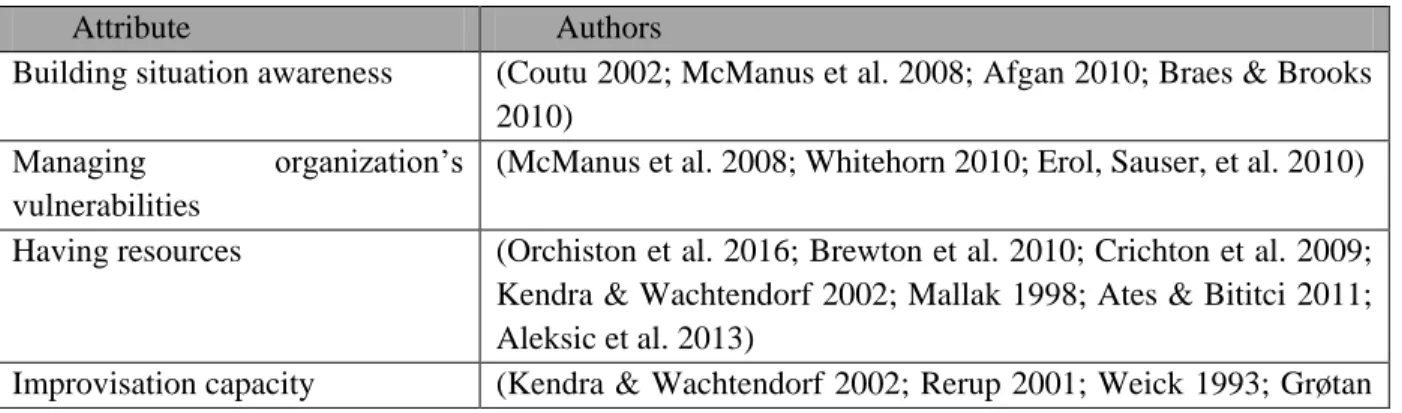
As discussed in section.2.2.1, resilience is a complex and dynamic concept. Complex concepts are characterized by different elements or attributes (Suddaby 2010). To identify these elements, we analyzed over 110 works that tackle the different models and frameworks proposed to build or improve organizational resilience. This review revealed that there is a great variety regarding to the factors and mechanisms that contribute to resilience. Sometimes, the authors refer to the same concept with different words. For instance, improvisation (Coutu 2002; Kendra & Wachtendorf 2002), creativity and innovation (Dervitsiotis 2004) are used to refer to bricolage skills; face down reality (Coutu 2002) is used to refer to situation awareness. Despite the different terminology, we also found some common and repeated characteristics or factors that contribute to enhance resilience.
The most cited attributes or elements of a resilient organization are presented Table 2 identifying the authors that defend them. It is necessary to remark that other proposed elements may also be important attributes for organizational resilience. A resilient organization includes a mix of several capabilities and actions to be performed. It is this mix what makes an organization resilient (Gibson & Tarrant 2010).
Table 2. Most cited attributes that contribute to resilience
Attribute Authors
Building situation awareness (Coutu 2002; McManus et al. 2008; Afgan 2010; Braes & Brooks 2010)
Managing organization’s vulnerabilities
(McManus et al. 2008; Whitehorn 2010; Erol, Sauser, et al. 2010) Having resources (Orchiston et al. 2016; Brewton et al. 2010; Crichton et al. 2009;
Kendra & Wachtendorf 2002; Mallak 1998; Ates & Bititci 2011; Aleksic et al. 2013)
20
et al. 2008; Coutu 2002; Mallak 1997)
Ability to anticipate events (Berman 2009; Rerup 2001; Hardy 2014; Apneseth et al. 2013; Wright et al. 2012)
Agility (Ismail et al. 2011; Gibson & Tarrant 2010; Starr et al. 2003; Thomas et al. 2016; Megele 2014)
Learning capacity (Hilton et al. 2012; Zhang & Van Luttervelt 2011; Burnard & Bhamra 2011; Aguirre et al. 2005; Robb 2000)
Collaboration (Boza & Poler 2013; Winston 2014; Proper & Pienaar 2011; Alonso & Bressan 2015)
Resilient individuals (Doe 1994; Mallak 1997; Riolli & Savicki 2003)
Flexibility (Berman 2009; Kendra & Wachtendorf 2002; Proper & Pienaar 2011; Megele 2014; Pal et al. 2014)
Robustness (Jackson 2007; Pal et al. 2014; Heinicke 2014; Kendra & Wachtendorf 2002; Tierney 2003; Tompkins 2007)
Redundancy (Chopra & Khanna 2014; Johnsen & Veen 2012; Powley 2009; Tierney 2003; Winston 2014; Hu et al. 2008)
2.2.5.
How is resilience assessed in practice at the organizational
level?
In this section, we focus on the assessment of organizational resilience, and we study how it can be measured in practice. With this purpose, we reviewed over 30 works that propose tools or methods to assess organizational resilience. The number of articles reviewed is fewer than those reviewed for organizational resilience conceptualization because there are fewer works in the literature in this area. The review of these works indicates a lack of consensus about how to measure organizational resilience.
We can classify these works in the same three streams discussed in section 2.2.1: those assessed using the features of the organization, those assessed on the organizational outcomes, and those based on how the organization recovers from failure.
A)
Measurement based on the organizational characteristics
To study how organizational resilience is measured based on the organizational characteristics, we classify the works based on how the problem is assessed: using indicators or other techniques such as Fuzzy Cognitive Maps (FCMs) or assessment of organizational processes.