E
C
O
N
O
M
ÍA
SERIE DOCUMENTOS
B
BBOOORRRRRRAAADDDOOORRREEESSS
D
DDEEE
I
IINNNVVVEEESSSTTTIIIGGGAAACCCIIIÓÓÓNNN
ON THE DYNAMICS OF LENDING AND DEPOSIT
INTEREST RATES IN EMERGING MARKETS:
A NON-LINEAR APPROACH
Ana María Iregui Costas Milas Jesús Otero
U
NIVE RSIDAD DE LR
OSARIONo. 17 Noviembre 2001
Ana María Iregui♣ [email protected]
Costas Milas♣♣ [email protected]
Jesus Otero♣♣♣ [email protected]
ABSTRACT
This paper studies the dynamics of lending and deposit rates in four emerging markets in Latin America: Argentina, Chile, Colombia and Mexico. The dynamics of interest rates exhibit a regime-switching behavior, where the transition from one regime to the other is controlled by the interest rate spread difference. The first regime, which is characterized by negative deviations of the interest rate spread relative to an estimated threshold, occurs during periods of financial liberalization. The second regime, which is characterized by positive deviations of the interest rate spread relative to the estimated threshold, occurs during periods of financial inefficiency and increasing government intervention. By capturing changing policy regimes from government intervention to a more financially liberalized environment and vice versa, the non-linear specification proves superior to the linear one.
RESUMEN
Este trabajo estudia el comportamiento dinámico de las tasas de interés de captación y colocación en cuatro mercados emergentes en Latinoamérica: Argentina, Chile, Colombia y México. La dinámica de las tasas de interés muestra un comportamiento de cambio de régimen, donde la transición de un régimen a otro, es controlada por el diferencial entre las tasas. El primer régimen, caracterizado por desviaciones negativas del diferencial entre las tasas con respecto a un umbral estimado, ocurre durante periodos de liberalización financiera. El segundo, caracterizado por desviaciones positivas, ocurre durante periodos de ineficiencia financiera y creciente intervención. La especificación no lineal resulta mejor que la lineal en la medida en que permite capturar cambios de régimen.
Keywords: Interest rates; Spreads; Emerging markets, Non-linear models, Regimes
JEL classification: C32; C51; C52; E43; O54
♦
The views expressed in this paper are those of the authors and do not represent those of the Board of Directors of the Banco de la República (Central Bank of Colombia), or other members of its staff.
♣
Estudios Económicos. Banco de la República. Bogotá, Colombia.
♣♣
Department of Economics. University of Sheffield. Sheffield, UK.
1. Introduction
The financial sector plays a crucial role in the operation of most economies, as it provides intermediation between borrowers and lenders of funds. To the extent that financial intermediaries are efficient institutions for channeling funds from savers to borrowers, they can affect economic growth. The behavior of lending rates, deposit rates and their difference or
spread are key issues in the financial sector because they reflect the cost of intermediation. High spreads are generally viewed as impediments to the development of the financial sector, since they discourage potential savers with low returns on their deposits, and reduce the gross return of potential investors.
The analysis of the main determinants of bank interest margins and profitability have been topics of dynamic research in recent years; see for example Demirgüç-Kunt and Huizinga (1999), the collection of case studies for a sample of Latin American countries in Brock and Rojas-Suárez (2000), and the references therein. To our knowledge, however, less effort has been put on the study of the determinants of the short- and long-run behavior of lending and deposit interest rates. Understanding the dynamics of bank interest rates can help policymakers design measures to overcome possible sources of inefficiency in financial markets and gain insight to the effects of their policy measures.
An interesting question that arises is that of the type of adjustment back to equilibrium, and in particular the possibility of linear versus non-linear type of adjustments. Indeed, it is not at all clear that interest rates respond symmetrically to positive and negative shocks, or to small and large shocks. Interest rates, like other prices in the economy, may exhibit a tendency to increase rapidly and reduce more gradually following a shock to the economy. A number of reasons could potentially explain non-linear behavior in interest rates in emerging countries, including government regulations in the form of interest rate controls, and non competitive environments where strong banks may be more willing to increase rather than reduce their interest rates due to their market power.
In this paper we aim to test for and model non-linearities in the lending and deposit interest rates in four Latin American emerging markets: Argentina, Chile, Colombia, and Mexico. In particular, we characterize the behavior of the interest rates using the Smooth Transition Autoregressive (thereafter STAR) methodology. STAR models were originally introduced by Teräsvirta and Anderson (1992) in order to examine non-linearities over the business cycle, and their statistical properties were discussed in Granger and Teräsvirta (1993) and Teräsvirta (1994), among others. In a recent survey of the STAR methodology and its applications, van Dijk et al. (2000) point out that this form of non-linear models has mainly been applied to macroeconomic time series and only recently to interest rate models in developed countries (see e.g. Anderson, 1997 for the US;van Dijk and Franses, 2000 for the Netherlands). To our knowledge, however, the STAR methodology has not been applied so far to interest rate models in emerging market economies.
deposit interest rates in Latin America within the STAR context can be motivated by the fact that the last decade has witnessed a transition period from repressed to more liberalized financial environments. Assuming that the transition mechanism is controlled by the interest rate spread, we can differentiate between the impact of the spread on lending and deposit interest rates during periods of considerable impediment to the development of financial intermediation (when the spread is too high), and its impact on lending and deposit rates during periods of increasing competition (when the spread is low). Furthermore, we can identify threshold levels for the spread rate that mark the transition from one regime to the other, as well as the speed at which this transition takes place.
The outline of the paper is as follows. Section 2 provides a historical background to the behavior of interest rates in Latin America. Section 3 introduces the theoretical aspects of non-linear models in the context of the STAR methodology. Section 4 estimates non-linear and non-non-linear models for the lending and deposit rates in Latin America. Section 5 presents a discussion of our findings and section 6 provides some concluding remarks.
2. Historical context
the latter consists of the operation of non-price mechanisms of credit allocation in the form of directed lending to specific productive sectors (Agénor and Montiel, 1996).
During the second half of the 1970s, the Southern cone economies of Argentina, Chile and Uruguay implemented market-oriented reforms in an attempt to improve resource allocation within a more financially liberalized environment. As indicated by Corbo et al. (1986), liberalization measures in these countries included the removal of interest rate controls. However, this policy measure proved to be unsuccessful mainly due to the fact that governments, either explicitly or implicitly, provided deposit insurance at no cost. As a result, central banks and the rest of the public sector had to intervene to rescue institutions facing financial difficulties. For instance, Chile faced a banking crisis in the early 1980s, which, during the restructuring process, required financial aid to the banking system of around 20 percent of the country’s GDP (see e.g. Rojas-Suárez and Wiesbrod, 1996). According to Corbo et al. (1986), governments could have avoided moral hazard problems by refusing to provide free deposit insurance to failed intermediaries and by creating an effective system of regulation and supervision of the loan portfolios of financial intermediaries.
intermediaries were not properly supervised and regulated by the authorities. 1
During the 1990s, Latin American economies adopted policy reforms aimed at providing a transition to a more liberalized domestic financial sector. As indicated by Brock and Suárez-Rojas (2000), the liberalization process was tested in two occasions. The first one during the Mexican financial turmoil of 1995 and the second one during the eruption of the severe financial crisis that hit the Asian economies in mid 1997 followed by global economic uncertainties in response to the Russian moratorium in mid 1998. As Brock and Suárez-Rojas (2000) point out, Latin American authorities responded to the financial crises of the 1990s by intensifying their efforts for deeper reforms, rather than turning back to government intervention policies that followed the failure of liberalization measures in the second half of the 1970s.
The discussion so far points to changing policy regimes from government intervention to a more financially liberalized environment in the banking industry of the Latin American economies. The next section of the paper discusses the theory of regime-switching models in the context of the STAR methodology that will be empirically tested on the behavior of lending and deposit interest rates in the Latin American economies.
3. Specification of STAR models
The STAR model of order k for a univariate time series yt is written as:
1
In Colombia, banks were also subject to high rates of financial taxation, which provided an additional factor of financial repression. A description of the institutional background in the Colombian financial sector can be found in
Barajas et al. (1999, 2000).
, ,..., 1 , ) ( ))
( 1 (
1 , 2 2
1 , 1
1 y G s y G s t T
y t d t
k
j
j t j d
t k
j
j t j
t +ε =
β + µ + −
β + µ
= −
= −
−
= −
∑
where µ1 and µ1 are intercept terms and εt ~ iid (0, σ2). G(st−d) is the transition function, which is assumed to be continuous and bounded between zero and one, and d is the delay parameter. The STAR model (1) can be considered as a regime-switching model which allows for two regimes,
G(st−d) = 0 and G(st−d) = 1, respectively, where the transition from one to the other regime occurs in a smooth way. The regime that occurs at time t is determined by the transition variable st−d and the corresponding value of G(st−d). Different functional forms of G(st−d) allow for different types of regime-switching behavior. In particular, asymmetric adjustment to positive and negative deviations of st−d relative to a parameter c, can be obtained by setting G(st−d) equal to the ‘logistic’ function:
(2a)
where σ(st−d) is the sample standard deviation of st−d. The parameter c is the threshold between the two regimes, in the sense that G(st−d) changes monotonically from 0 to 1 as st−d increases, while G(st−d) = 0.5. The parameter γ determines the smoothness of the change in the value of the logistic function and thus the speed of the transition from one regime to the other. When γ→0, the ‘logistic’ function equals a constant (i.e. 0.5), and when γ→∞, the transition from
G(st−d) = 0 to G(st−d) = 1 is almost instantaneous at st−d = c.
Another type of regime-switching behavior, which describes asymmetric adjustment to small and large absolute values of st−d, is obtained by setting G(st−d) equal to the ‘exponential’ function:
A possible drawback of the ‘exponential’ function is that the model becomes linear if either 0
→
γ or γ→∞. To overcome this drawback, Jansen and Teräsvirta (1996) suggest specifying ,
0 , )]} ( / ) (
exp[ 1 { ) , ;
(st−d γ c = + −γ st−d −c σ st−d −1 γ> G
. 0 )}, ( / ) (
exp{ 1
) , ;
(st−d γ c = − −γ st−d −c 2 σ2 st−d γ>
G(st−d) as the ‘quadratic logistic’ function:
In this case, if γ→0, the model becomes linear, whereas if γ→∞, G(st−d) is equal to 1 for
st−d < c1 and st−d > c2, and equal to 0 in between.
The estimation of STAR models consists of three steps:
Step 1: Specify a linear autoregressive (AR) model as the base one. The model can be extended to allow for other exogenous variables as additional regressors. This is discussed in the next section.
Step 2: Select the transition variable st−d and test linearity, for different values of the delay parameter d, against STAR models using the linear model specified in Step 1 as the null hypothesis. To carry out the test, estimate the auxiliary regression:
where vt are the residuals of the linear model of Step 1. The null hypothesis of linearity is H0 : φ1,j = φ2,j = φ3,j = 0, for j = 1,…, k. This is a standard Lagrange Multiplier (LM) type test. To specify the value of the delay parameter d, model (3) is estimated for a number of different values of d, say d = 1,…, D. In cases where linearity is rejected for more than one values of d, the decision rule is to select d based on the lowest p-value of the linearity test.
Step 3: Proceed by selecting the appropriate form of the transition function G(st−d), that is, select between the ‘logistic’ function (2a) and the ‘quadratic logistic’ function (2b). This is done by running a sequence of LM tests nested within the non-linear model (3) of Step 2, namely:
. 0 , )]} ( / ) )( ( exp[ 1 { ) , , ;
(st−d γ c1 c2 = + −γ st−d −c1 st−d −c2 σ2 st−d −1 γ >
G (2b)
, 1 1 3 , 3 2 , 2 1 , 1 1 , 0
0
∑
∑
∑
∑
= − − = − − = − − = − + φ + φ + φ + φ + µ = k j t k j d t j t j d t j t j k j d t j t j k j j t j
t y y s y s y s e
. 0 |
0 :
, 0 |
0 :
, 0 :
, 2 , 3 ,
1 01
, 3 ,
2 02
, 3 03
= φ = φ = φ Η
= φ = φ Η
= φ Η
j j j
j j
j
(4)
In this case, the decision rule is to select the ‘quadratic logistic’ function (2b) if the p-value associated with the Η02 hypothesis is the smallest one, otherwise select the ‘logistic’ function
(2a). Having done that, proceed by estimating the STAR model (1), with the transition function
G(st−d) specified based on the sequence of tests in (4).
4. Empirical results
4.1 The data
We use monthly data on the lending and deposit interest rates for four emerging markets in Latin America. The countries are Argentina, Chile, Colombia and Mexico. The data set is obtained from the IMF International Financial Statistics database. Data for Argentina is from 1993:M4 to 2000:M3. Data for Chile is from 1977:M1 to 2000:M3. Colombian data is from 1986:M1 to 2000:M3 and Mexican data is from 1993:M1 to 2000:M3. The sample choice is dictated by the availability of data in the IMF database.
Figure 1 plots the levels of the interest rates for the four emerging market economies. We also plot the interest rate spreads constructed as the difference between the lending and the deposit interest rates for each of the four emerging markets.
of the series. ADF tests are also reported for the interest rate spreads. The results suggest that Colombian and Mexican interest rates are non-stationary (i.e. I(1)) in levels, whereas the interest rates for Argentina and Chile are stationary (i.e. I(0)) in levels. The spreads are found to be stationary for all countries. Based on the results of the unit root tests, linear and non-linear models are estimated for the levels of the interest rates in Argentina and Chile and for the first differences of the interest rates in Colombia and Mexico. 2
In the remaining of the paper we adopt the following notation for the interest rate series in the four emerging markets: lending, deposit and spread rates in Argentina are denoted by ARG_l,
ARG_d and ARG_s, respectively. CHI_l, CHI_d and CHI_s refer to the corresponding series in Chile. COL_l, COL_d and COL_s refer to the corresponding series in Colombia and MEX_l,
MEX_d and MEX_s refer to the corresponding series in Mexico.
4.2 Testing for linearity and STAR model selection
As discussed in section 3, the first step in deriving STAR models involves the estimation of linear interest rate models. These are reported in Table 2 (all estimations are done in PcGive, see Hendry and Doornik, 1997). In deriving parsimonious linear models we apply the general-to-specific approach starting with k = 12 lags on the lending and deposit rates and deleting all insignificant variables. Our results suggest a feedback from deposit rates on lending rates and vice versa. We also find significant lagged interest rate spread effects.
In the case of Colombia and Mexico (see Table 2E and Table 2F, respectively), the interest rate equations can be interpreted as error correction models; lending interest rate changes react to the disequilibrium error given by the lagged interest rate spread. 3 The coefficient on the lagged
2
Phillips-Perron tests give similar unit root results and are available by the authors on request. 3
spread is estimated at –0.394 for Colombia and at –0.126 for Mexico.
Notice also that no deposit rate equations are reported for Colombia and Mexico. The reason is that we were unable to find any significant effect from the lending rates or the lagged interest rate spreads in the deposit rate equations. This result points to weak exogeneity of the deposit rates. A possible economic explanation for this finding is that at least in Colombia and Mexico, financial liberalization has given domestic residents the opportunity to rebalance their portfolios internationally, achieving a convergence of domestic deposit rates (adjusted for expectations of exchange rate changes) towards international rates. On the other hand, convergence of domestic and international lending rates is less likely to occur due to information costs associated with monitoring domestic borrowers. As a result, international capital markets do not lend directly to companies, rather, foreign lending is intermediated by domestic banks.4
The diagnostic tests of the linear models in Table 2 show some weak evidence (at the 5 percent level of statistical significance) of autocorrelation of up to order 12 for the deposit rate in Argentina (see Table 2B) and the two interest rate models in Chile (see Table 2C and Table 2D, respectively). ARCH effects of order 12 are reported for the lending rate in Colombia (see Table 2E), and the two interest rate models in Chile (see Table 2C and Table 2D, respectively). All interest rate models fail normality. The failure of the diagnostic tests in the linear models provides a further motivation for considering the possibility that the interest rates in the four emerging economies might be better characterized by a non-linear type of behavior rather than the linear one discussed above.
Having estimated the base linear models, we move on to Step 2 of our methodology which
4
involves testing for the existence of non-linear dynamics in the lending and deposit interest rate models for the four Latin American economies selecting the interest rate spread as a possible transition variable st-d.
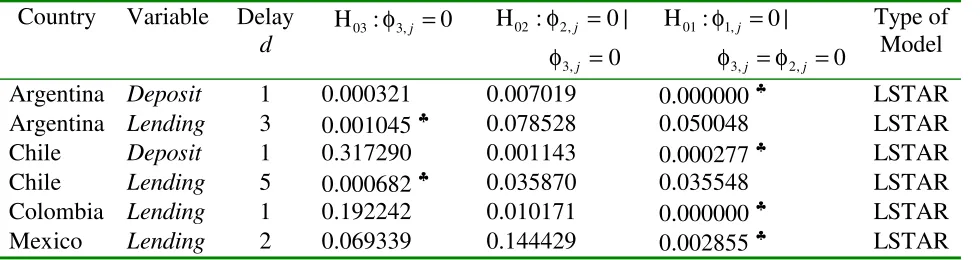
The empirical results of the LM-type tests for linearity (Steps 2 and 3 of section 3) are reported in Table 3. We set d equal to 1 through 6 (although the results are not affected even if we go up to
12
=
d ). Using 0.01 as a threshold p-value, one can notice from Table 3A that the null hypothesis of linearity, (that is, H0) is rejected for all models. The H0 hypothesis is rejected most strongly at
d = 1 for Colombia and the deposit rate models in Argentina and Chile, respectively. The results also suggest a choice of d = 2 for Mexico, d = 3 for the lending rate in Argentina, and d = 5 for the lending rate in Chile. Given the above choices, one can notice from Table 3B that the sequence of tests (H03, H02, and H01, respectively) favor the ‘logistic’ model (2a) as the
appropriate transition function.
4.3 Estimates of the non-linear models
We estimate the STAR model (1) using the ‘logistic’ model (2a) by non-linear least squares (NLS). Granger and Teräsvirta (1993) and Teräsvirta (1994) stress particular problems like slow convergence or overestimation associated with estimates of the γ parameter. For this reason, we follow their suggestions in standardizing the exponent of the ‘logistic’ function (2a) by dividing it by the standard deviation of the transition variable, σ(st−d) so that γ becomes a scale-free parameter. Based on this scaling, we use γ = 1 as the starting value and the mean of st−d as the starting value for the parameter c. The estimates of the parsimonious linear interest rate equations in Table 2 are used as starting values for the other parameters in the STAR model (1).
models for the interest rates in Argentina based on the ‘logistic’ model (2a) resulted in insignificant estimates. For this reason, we report non-linear models based on the ‘quadratic logistic’ function (2b) which was found to work much better than the ‘logistic’ one. 5
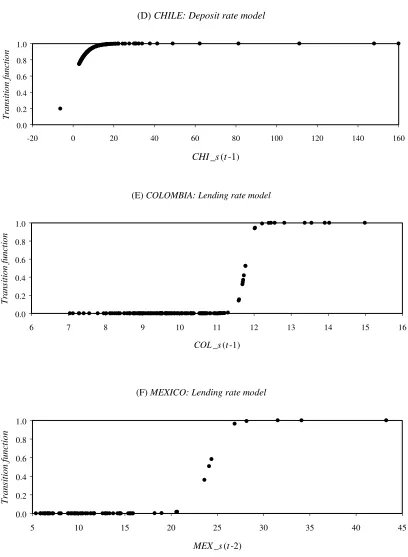
The main parameters of interest in the STAR models are the estimated values of the threshold level, c, and the speed of adjustment, γ. The c estimates reported in Tables 4 to 9 are statistically significant in all models except for the deposit rate model in Chile (see Table 7), whereas the estimates of the γ parameter are rather high for all models indicating that the speed of the transition from G(st-d; γ, c) = 0 to G(st-d; γ, c) = 1 is rapid at the estimated threshold c. Notice,
however, the rather high standard error of the γ estimates. Teräsvirta (1994) and van Dijk et al. (2000) point out that this should not be interpreted as evidence of weak non-linearity. Accurate estimation of γ might be difficult as it requires many observations in the immediate neighborhood of the threshold c. Further, large changes in γ have only a small effect on the shape of the transition function implying that high accuracy in estimating γ is not necessary (see the discussion in van Dijk et al., 2000).
From Tables 4 to 9 one can see that the error variance ratio of the non-linear relative to the linear models (i.e. s2NL/s2L) is less than one, indicating that the non-linear models have a better fit. In particular, the s2NL/s2L ratio shows a reduction in the residual variances of the non-linear compared to the linear models which ranges from around 3 percent for the lending rate in Chile (i.e. the CHI_lt model in Table 6) to 52 percent for the deposit rate in Argentina (i.e. the ARG_dt model in Table 5). In addition, the non-linear specification captures the autocorrelation effects that are present in the linear specification of the deposit rate in Argentina and the two interest rate
5
In the empirical results below, we estimate the ‘quadratic logistic’ model for the lending rate in Argentina using
d = 1 rather than d = 3. This is done because the empirical model is found to work better for d = 1. We do not see this
as a serious deviation from choosing d values based on the lowest p-value of the H0 hypothesis; one can see from
models in Chile. It also captures the ARCH effects that are present in the linear interest rate model for Colombia, and some of the ARCH effects in the two linear interest rate models for Chile. There is also a considerable improvement in the test for normality although the test still fails for all models.
5. Interpretation of results
Our research identified the existence of non-linear dynamics in the behavior of the lending and deposit interest rates for four emerging markets in Latin America. Moreover, these interest rates exhibit a regime-switching behavior according to the variation of the interest rate spread. The result confirms the importance of the spread rate as a factor affecting the evolution of the lending and deposit rates. Furthermore, the regimes we identify have a plausible economic interpretation. The first regime (i.e. G(st-d; γ, c) = 0), which is defined by negative values of the interest rate
spread relative to a threshold, is usually identified with periods of financial liberalization and modernization of the banking system which promotes competition within the banking sector. Conversely, the second regime (i.e. G(st-d; γ, c) = 1), which is defined by positive values of the
interest rate spread relative to the threshold, is usually identified with periods of inefficiency in banking activities which in turn adversely affect domestic savings and investments.
Our estimates in Tables 4-9 allow for the behavior of the interest rate spread to vary across regimes for the four emerging market economies. Tables 4 and 5 report the non-linear estimates for the lending and deposit rates in Argentina, respectively. One can notice that the threshold estimates are roughly the same for both interest rate equations. Use of the ‘quadratic logistic’ function allows for the two regimes to be defined as follows; the first one (i.e. G(st-d; γ, c1,
c2) = 0) in terms of small values of the interest rate spread and the second one (i.e. G(st-d; γ, c1,
fluctuates between 6 percent and 14 percent, both the lending and the deposit rate increase. Nevertheless, the increase in the lending rate is large (i.e. the estimated coefficient β1,1 equals
11.986; see Table 4), whereas the increase in the deposit rate is much smaller (i.e. the estimated coefficient β1,2 equals 6.825; see Table 5). When the spread rate exceeds the band of thresholds,
the lending rate rises slightly (i.e. the estimated coefficient β2,2 equals 0.781; see Table 4). At the
same time, the deposit rate also rises slightly (i.e. the estimated coefficient β2,3 equals 0.661; see
Table 5). Therefore, our estimates imply that banks in Argentina raise both the lending and deposit rate irrespective of whether the spread difference is large or small. Further, the increase in the lending rate is faster when the spread difference fluctuates within a band. Our result suggest the existence of a highly inefficient financial system in Argentina as discussed in Ahumada et al. (2000) who point out that spreads in Argentina are persistently higher than spreads in industrial economies. They also point out that spread differences are mainly due to lending rate increases (e.g. the lending rate in Argentina is approximately 12 percentage points higher than that of the industrial economies) reflecting heavy administrative costs faced by banks in Argentina.
Consider now the case of Chile. Our estimates in Tables 6 and 7 suggest that during periods of increasing competition associated with falling spreads, banks respond by raising the lending rate (i.e. the estimated coefficient β1,2 equals 0.716; see Table 6) but not the deposit one. On the other
hand, during periods of rising spreads, banks respond by lowering the loan rate (i.e. the estimated coefficient β2,5 equals –0.242; see Table 6) as well as the deposit rate (i.e. the estimated
coefficient β2,5 equals –0.225; see Table 7). Moreover, the lending rate falls by more than the
deposit one possibly due to the fact that the banks are willing to compensate partly for their policy of not adjusting the deposit rate during periods of falling spread differences.
regimes (i.e. the coefficients β1,3 and β2,3, respectively; see Table 8) we see that during periods of
banking competition (when the lagged spread is below the threshold level of 11.8 percent), the lending interest rate adjusts slowly (i.e. the estimated coefficient β1,3 equals –0.304). On the other
hand, during periods of banking inefficiency (when the lagged spread is above 11.8 percent), the lending interest rate adjusts much faster (i.e. the estimated coefficient β2,3 equals –0.624). The
results for Mexico in Table 9 point to a fast adjustment of the lending interest rate during periods of banking inefficiency when the Mexican spread (i.e. MEX_st-2) is above 24 percent (i.e. the
estimated coefficient β2,4 equals –1.738). On the other hand, the lending interest rate does not
respond to spread values below its equilibrium level.
Our estimates for Colombia and Mexico suggest that a spread increase above its equilibrium level is followed by temporary market share losses. To regain their market shares, banks have the option of either lowering loan rates and/or raising deposit rates. Nevertheless, taking into account that domestic deposit rates are somewhat outside the banks’ control in the sense that they move in line with international deposit rates, it is not surprising that banks respond by lowering lending rates rapidly in order to restore market shares.
Figure 3 plots the estimated transition functions against time in order to illustrate the succession of the regimes over the sample period. In the case of Argentina, the estimated transition function classifies most of the sample period into the second regime, which points to the existence of a highly inefficient financial system. Our findings are in line with the results obtained by Ahumada et al. (2000), in the sense that the Argentine financial system is characterized by persistently high lending interest rates resulting from high administrative costs.
In the case of Chile, the plots of the estimated transition functions for both the lending and deposit rate models suggest that intermediate regimes are predominant most of the time. The estimated transition functions against time classify the 1982-1983 financial crisis into the second regime of financial inefficiency and government intervention aiming at disinflation policies in the form of a prolonged exchange rate overvaluation and high interest rates (see e.g. the discussion in Gavin and Hausmann, 1996).
declaration of moratorium of its foreign debt. Thus, Colombia not only suffered from an income reduction due to adverse international conditions, but also from a reduction in the availability of resources in foreign markets as well as an increase in the cost of its foreign debt and a reduction in foreign investment.
In the case of Mexico, classification of the beginning of 1995 into the second regime reflects the profound financial crisis of that period. Classification of late 1998 and early 1999 into the second regime probably reflects the economic downturn in South East Asia as well as the financial instability following the Russian crisis, and the subsequent collapse of the Long Term Capital Management (LTCM) hedge fund. Financial and economic instability had an adverse effect on the expectations of foreign investors resulting in a reduction of capital flows towards Mexico and other Latin American economies.
into account regime-switching behavior.
6. Conclusions
In this paper we model the dynamic behavior of lending and deposit interest rates in four Latin American emerging markets using the smooth transition regime-switching framework. This specification seems to work well both in statistical and economic terms. In statistical terms, it captures most of the diagnostic test failures of the linear models. In economic terms, it provides a plausible economic explanation of the alternative regimes. According to our results, the dynamics of interest rates exhibit a regime-switching behavior, where the transition from one regime to the other is controlled by the interest rate spread. The first regime, which is characterized by negative values of the interest rate spread relative to a threshold, occurs during periods of financial liberalization and modernization of the banking system. The second regime, which is characterized by positive values of the interest rate spread relative to the threshold, occurs during periods of inefficiency in banking activities and increasing government regulations.
deposit rate (irrespective of whether the spread difference is large or small) but also that the increase in the lending rate is larger than that of the deposit one.
References
Agénor, P.R. and P.J. Montiel, 1996. Development Macroeconomics. Princeton University Press, Princeton.
Ahumada, H., T. Burdisso, J.P. Nicolini, and A. Powell, 2000. Spreads in the Argentine financial system, in P.L. Brock and L. Suárez-Rojas (Eds.), Why so high? Understanding interest rate spreads in Latin America. Inter-American Development Bank, Washington, 39-65.
Anderson, H.M., 1997. Transaction costs and nonlinear adjustment towards equilibrium in the US Treasury Bill market, Oxford Bulletin of Economics and Statistics 59, 465-484.
Barajas, A., R. Steiner, and N. Salazar, 1999. Interest spreads in banking in Colombia, 1974-1996, IMF Staff Papers 46, 196-224.
Barajas, A., R. Steiner, and N. Salazar, 2000. The impact of liberalization and foreign investment in Colombia's financial sector, Journal of Development Economics 63, 157-196.
Brock, P.L. and L. Rojas-Suárez, 2000, Interest rate spreads in Latin America: Facts, theories, and policy recommendations, in P.L. Brock and L. Suárez-Rojas (Eds.),Why so high? Understanding interest rate spreads in Latin America. Inter-American Development Bank, Washington.
Corbo, V., J. De Melo, and J. Tybout, 1986. What went wrong with the recent reforms in the Southern cone, Economic Development and Cultural Change 34, 607-640.
Demirgüç-Kunt, A. and H. Huizinga, 1999. Determinants of commercial banks interest margins and profitability: Some international evidence, The World Bank Economic Review 13, 379-408.
Gavin, M. and R. Hausmann, 1996. The roots of banking crises: the macroeconomic context, Inter-American Development Bank, Washington, Working paper No. 318.
Hendry, D.F. and J.A. Doornik, 1997. Modelling Dynamic Systems Using PcFiml 9.0 for Windows, London: International Thomson Business Press.
Jansen, E.S. and T. Teräsvirta, 1996. Testing parameter constancy and super exogeneity in econometric equations, Oxford Bulletin of Economics and Statistics 58, 735-768.
Levine, R., 1997. Financial development and economic growth, Journal of Economic Literature 35, 688-726.
Montenegro, A., 1983. La crisis del sector financiero Colombiano, Ensayos Sobre Política Económica 4, 51-89.
Rojas-Suárez, L. and S. Wiesbrod, 1996. Building stability in Latin American financial markets, Inter-American Development Bank, Washington, Working paper No. 320.
Saunders, A. and L. Schumacher, 2000. The determinants of bank interest rate margins in Mexico's postprivatisation period (1992-95), in P.L. Brock and L. Suárez-Rojas (Eds.), Why so high? Understanding interest rate spreads in Latin America. Inter-American Development Bank, Washington, 181-209.
Teräsvirta, T., 1994. Specification, estimation, and evaluation of smooth transition autoregressive models, Journal of the American Statistical Association 89, 208-218.
Teräsvirta, T. and H.M. Anderson, 1992. Characterizing nonlinearities in business cycles using smooth transition autoregressive models, Journal of Applied Econometrics 7, S119-S136. van Dijk, D., and P.H. Franses, 2000. Nonlinear error-correction models for interest rates in the
Netherlands, in W.A. Barnett, D.F. Hendry, S. Hylleberg, T. Teräsvirta, D. Tjøstheim and A. Würtz (Eds.), Nonlinear econometric modelling in time series analysis, Cambridge University Press, Cambridge, 203-227.
Table 1
Dickey and Fuller unit root test for deposit and lending interest rates
Country Variable Lags τC,T τC Order of
Integration Argentina Deposit rate 1 -3.779 ♣♣ -3.580 ♣♣ ~I
( )
0Lending rate 1 -3.300 ♣ -3.255 ♣♣ ~I
( )
0Chile Deposit rate 2 -4.596 ♣♣ -3.406 ♣♣ ~I
( )
0Lending rate 2 -6.253 ♣♣ -4.541 ♣♣ ~I
( )
0Colombia Deposit rate 1 -1.772 -1.158 ~ I
( )
1Lending rate 0 -1.336 -0.879 ~ I
( )
1Mexico Deposit rate 1 -1.653 -1.455 ~ I
( )
1Lending rate 1 -1.617 -1.590 ~ I
( )
1T C,
τ indicates that the Dickey-Fuller regression contains a constant and a trend. C
τ indicates that the Dickey-Fuller regression contains a constant.
Table 2
Estimated linear models Panel A: Lending rate for Argentina, 1993M5-2000M3:
ARG_lt = 4.488 +0.383 ARG_dt-2 +1.237 ARG_st-1
(1.079) (0.132) (0.149)
sL = 2.620, AR(12) = 1.29[0.246], ARCH(12) = 0.11[0.999], NORM(2) = 109[0.000]
Panel B: Deposit rate for Argentina, 1993M6-2000M3:
ARG_dt = 2.977 +0.859 ARG_dt-2 −0.360 ARG_lt-2 +0.753 ARG_st-1
(0.675) (0.202) (0.136) (0.118)
sL = 1.500, AR(12) = 2.05[0.033], ARCH(12) = 0.34[0.977], NORM(2) = 34.84[0.000]
Panel C: Lending rate for Chile, 1978M1-2000M3:
CHI_lt = 2.824 +0.950 CHI_lt-1 +0.667 CHI_lt-9 −0.246 CHI_dt-2
(1.040) (0.057) (0.165) (0.063)
−0.622 CHI_dt-9 −0.242 CHI_st-12 (0.182) (0.073)
sL = 7.866, AR(12) = 2.09[0.018], ARCH(12) = 3.44[0.000], NORM(2) = 31.37[0.000]
Panel D: Deposit rate for Chile, 1978M1-2000M3:
CHI_dt = 2.974 +0.824 CHI_dt-1 −0.168 CHI_dt-2 −0.706 CHI_dt-9
(0.824) (0.059) (0.060) (0.190)
+0.754 CHI_lt-9 −0.257 CHI_st-12 (0.171) (0.077)
sL = 8.250, AR(12) = 1.85[0.042], ARCH(12) = 7.77[0.000], NORM(2) = 78.16[0.000]
Panel E: Lending rate for Colombia, 1986M6-2000M3:
∆COL_lt = 3.939 +0.171 ∆COL_lt-3 +0.145 ∆COL_lt-4 +0.754 ∆COL_dt
(0.594) (0.051) (0.071) (0.054)
−0.217 ∆COL_dt-4 −0.394 COL_st-1 (0.082) (0.059)
sL = 1.010, AR(12) = 0.75[0.695], ARCH(12) = 6.65[0.000], NORM(2) = 200.51[0.000]
Panel F: Lending rate for Mexico, 1993M3-2000M3:
∆MEX_lt = 1.659 +1.745 ∆MEX_dt −0.624 ∆MEX_dt-1 +0.200 ∆MEX_lt-1
(0.586) (0.084) (0.176) (0.100)
−0.126 MEX_st-1 (0.042)
sL = 2.226, AR(12) = 0.47[0.922], ARCH(12) = 0.611[0.824], NORM(2) = 16.49[0.000]
Notes: Standard errors in parentheses below the estimates. sL: regression standard error. AR(12): F-test for up
Table 3
Test for linearity and STAR model selection
Panel A: Linearity tests
Delay Argentina Chile Colombia Mexico
d Deposit Lending Deposit Lending Lending Lending
1 4.06×E-10 ♣ 0.000554 0.000016 ♣ 0.003732 0.000000 ♣ 0.015232 2 1.55×E-8 0.056415 0.053136 0.003493 0.000039 0.001822 ♣ 3 0.000005 0.000341 ♣ 0.045327 0.003781 0.002850 0.026204
4 0.002972 0.024783 0.005045 0.000598 0.022575 0.016823
5 0.026150 0.262562 0.001479 0.000065 ♣ 0.065426 0.386472
6 0.002132 0.157710 0.003137 0.000878 0.060362 0.025680
Panel B: STAR model selection
Country Variable Delay
d
0 : 3, 03 φ =
Η j
0
| 0 :
, 3
, 2 02
= φ
= φ Η
j j
0
| 0 :
, 2 , 3 , 1 01
= φ = φ
= φ Η
j j
j Type of
Model
Argentina Deposit 1 0.000321 0.007019 0.000000 ♣ LSTAR
Argentina Lending 3 0.001045 ♣ 0.078528 0.050048 LSTAR
Chile Deposit 1 0.317290 0.001143 0.000277 ♣ LSTAR
Chile Lending 5 0.000682 ♣ 0.035870 0.035548 LSTAR
Colombia Lending 1 0.192242 0.010171 0.000000 ♣ LSTAR
Mexico Lending 2 0.069339 0.144429 0.002855 ♣ LSTAR
Notes: The Table reports the p-values of the linearity tests developed in section 3. Panel A reports the H0 test for linearity. ♣ denotes the minimum probability value of the H0 test over the interval
6
1≤d ≤ . Panel B reports the p-values of the nested H03, H02 and H01 tests for selecting between
Table 4
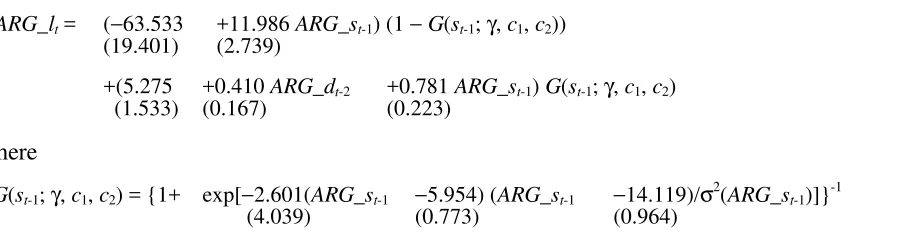
Estimated non-linear model: lending rate for Argentina
The Table reports the NLS estimates of the following STAR model:
) , , ; ( ) _ _ ( )) , , ; ( 1 )( _ ( _ 2 1 1 1 2 , 2 2 1 , 2 2 2 1 1 1 1 , 1 1 c c s G s ARG d ARG c c s G s ARG l ARG t t t t t t γ β + β + µ + γ − β + µ = − − − − −
where G(st-1; γ, c1, c2) = {1 + exp[−γ (ARG_st-1−c1) (ARG_st-1−c2)/ σ2(ARG_st-1)]}-1,
is the ‘quadratic logistic’ transition function, with ARG_st-1 as the transition variable. Values of 0 and 1 of the
transition function are associated with the two alternative regimes. The ARG_lt dynamics in the first regime, when
G(st-1; γ, c1, c2) = 0, are: ARG_lt =µ1+β1,1ARG_st−1. In the second regime, when G(st-1; γ, c1, c2) = 1, its dynamics are: ARG_lt =µ2 +β2,1ARG_dt−2+β2,2ARG_st−1. For intermediate values of G(st-1; γ, c1, c2), i.e. 0 < G(st-1; γ, c1, c2) < 1, ARG_lt dynamics are a weighted average of the two equations. The speed of transition
between the two regimes is determined by the parameter γ.
ARG_lt = (−63.533 +11.986 ARG_st-1) (1 −G(st-1; γ, c1, c2))
(19.401) (2.739)
+(5.275 +0.410 ARG_dt-2 +0.781 ARG_st-1) G(st-1; γ, c1, c2) (1.533) (0.167) (0.223)
where
G(st-1; γ, c1, c2) = {1+ exp[−2.601(ARG_st-1 −5.954) (ARG_st-1 −14.119)/σ 2
(ARG_st-1)]} -1 (4.039) (0.773) (0.964)
sNL = 2.121, s 2
NL/s
2
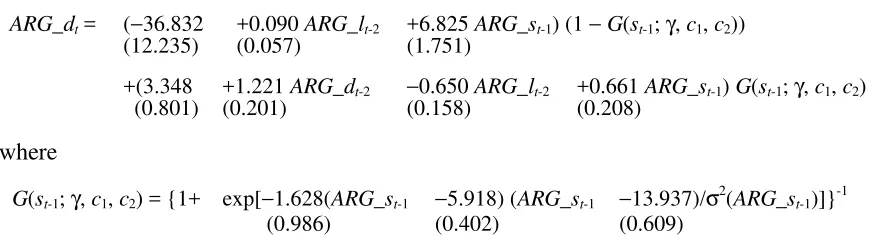
Table 5
Estimated non-linear model: deposit rate for Argentina
The Table reports the NLS estimates of the following STAR model:
) , , ; ( ) _ _ _ ( )) , , ; ( 1 )( _ _ ( _ 2 1 1 1 3 , 2 2 2 , 2 2 1 , 2 2 2 1 1 1 2 , 1 2 1 , 1 1 c c s G s ARG l ARG d ARG c c s G s ARG l ARG d ARG t t t t t t t t γ β + β + β + µ + γ − β + β + µ = − − − − − − −
where G(st-1; γ, c1, c2) = {1 + exp[−γ (ARG_st-1−c1) (ARG_st-1−c2)/ σ2(ARG_st-1)]}-1,
is the ‘quadratic logistic’ transition function , with ARG_st-1 as the transition variable. Values of 0 and 1 of the
transition function are associated with the two alternative regimes. The ARG_dt dynamics in the first regime, when
G(st-1; γ, c1, c2) = 0, are: ARG_dt =µ1+β1,1ARG_lt−2+β1,2ARG_st−1. In the second regime, when G(st-1; γ, c1,
c2) = 1, its dynamics are: ARG_dt =µ2+β2,1ARG_dt−2+β2,2ARG_lt−2+β2,3ARG_st−1. For intermediate
values of G(st-1; γ, c1, c2), i.e. 0 < G(st-1; γ, c1, c2) < 1, ARG_dt dynamics are a weighted average of the two
equations. The speed of transition between the two regimes is determined by the parameter γ.
ARG_dt = (−36.832 +0.090 ARG_lt-2 +6.825 ARG_st-1) (1 −G(st-1; γ, c1, c2))
(12.235) (0.057) (1.751)
+(3.348 +1.221 ARG_dt-2 −0.650 ARG_lt-2 +0.661 ARG_st-1) G(st-1; γ, c1, c2) (0.801) (0.201) (0.158) (0.208)
where
G(st-1; γ, c1, c2) = {1+ exp[−1.628(ARG_st-1 −5.918) (ARG_st-1 −13.937)/σ2(ARG_st-1)]}-1 (0.986) (0.402) (0.609)
sNL = 1.039, s 2
NL/s
2
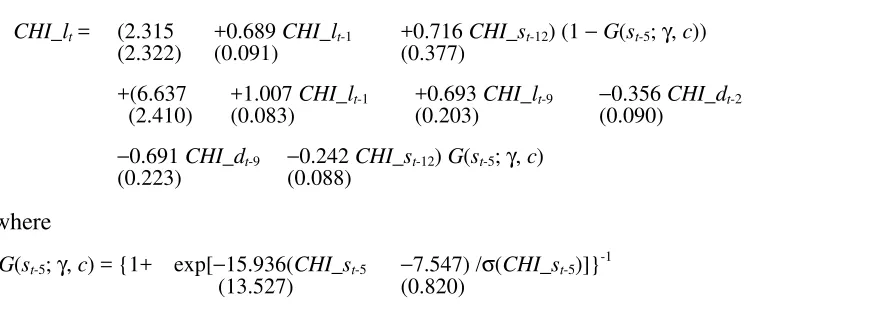
Table 6
Estimated non-linear model: lending rate for Chile
The Table reports the NLS estimates of the following STAR model:
) , ; ( ) _ _ _ _ _ ( )) , ; ( 1 )( _ _ ( _ 5 12 5 , 2 9 4 , 2 2 3 , 2 9 2 , 2 1 1 , 2 2 5 12 2 , 1 1 1 , 1 1 c s G s CHI d CHI d CHI l CHI l CHI c s G s CHI l CHI l CHI t t t t t t t t t t γ β + β + β + β + β + µ + γ − β + β + µ = − − − − − − − − −
where G(st-5; γ, c) = {1 + exp[−γ (CHI_st-5−c)/ σ(CHI_st-5)]}-1,
is the ‘logistic’ transition function, with CHI_st-5 as the transition variable. Values of 0 and 1 of the transition
function are associated with the two alternative regimes. The CHI_lt dynamics in the first regime, when G(st-5; γ,
c) = 0, are: CHI_lt =µ1+β1,1CHI_lt−1+β1,2CHI_st−12. In the second regime, when G(st-5; γ, c) = 1, its dynamics are: CHI_lt =µ2 +β2,1CHI_lt−1+β2,2CHI_lt−9 +β2,3CHI_dt−2 +β2,4CHI_dt−9+β2,5CHI_st−12. For
intermediate values of G(st-5; γ, c), i.e. 0 < G(st-5; γ, c) < 1, CHI_lt dynamics are a weighted average of the two
equations. The speed of transition between the two regimes is determined by the parameter γ.
CHI_lt = (2.315 +0.689 CHI_lt-1 +0.716 CHI_st-12) (1 −G(st-5; γ, c))
(2.322) (0.091) (0.377)
+(6.637 +1.007 CHI_lt-1 +0.693 CHI_lt-9 −0.356 CHI_dt-2 (2.410) (0.083) (0.203) (0.090)
−0.691 CHI_dt-9 −0.242 CHI_st-12) G(st-5; γ, c)
(0.223) (0.088)
where
G(st-5; γ, c) = {1+ exp[−15.936(CHI_st-5 −7.547) /σ(CHI_st-5)]} -1 (13.527) (0.820)
sNL = 7.761, s 2
NL/s
2
Table 7
Estimated non-linear model: deposit rate for Chile
The Table reports the NLS estimates of the following STAR model:
) , ; ( ) _ _ _ _ _ ( )) , ; ( 1 )( _ ( _ 1 12 5 , 2 9 4 , 2 9 3 , 2 2 2 , 2 1 1 , 2 2 1 2 1 , 1 1 c s G s CHI l CHI d CHI d CHI d CHI c s G d CHI d CHI t t t t t t t t t γ β + β + β + β + β + µ + γ − β + µ = − − − − − − − −
where G(st-1; γ, c) = {1 + exp[−γ (CHI_st-1−c)/ σ(CHI_st-1)]}-1,
is the ‘logistic’ transition function, with CHI_st-1 as the transition variable. Values of 0 and 1 of the transition
function are associated with the two alternative regimes. The CHI_dt dynamics in the first regime, when G(st-1; γ,
c) = 0, are: CHI_dt =µ1+β1,1CHI_dt−2. In the second regime, when G(st-1; γ, c) = 1, its dynamics are:
12 5 , 2 9 4 , 2 9 3 , 2 2 2 , 2 1 1 , 2
2 _ _ _ _ _
_dt =µ +β CHI dt− +β CHI dt− +β CHI dt− +β CHI lt− +β CHI st−
CHI . For intermediate
values of G(st-1; γ, c), i.e. 0 < G(st-1; γ, c) < 1, CHI_dt dynamics are a weighted average of the two equations. The
speed of transition between the two regimes is determined by the parameter γ.
CHI_dt = (-16.000 +1.081 CHI_dt-2) (1 −G(st-1; γ, c))
(25.768) (0.404)
+(6.851 +0.971 CHI_dt-1 −0.327 CHI_dt-2 −0.729 CHI_dt-9 (3.102) (0.087) (0.099) (0.211)
+0.724 CHI_lt-9 −0.225 CHI_st-12) G(st-1; γ, c)
(0.191) (0.085)
where
G(st-1; γ, c) = {1+ exp[−4.361(CHI_st-1 +1.039) /σ(CHI_st-1)]} -1 (1.967) (4.589)
sNL = 7.904, s 2
NL/s
2
Table 8
Estimated non-linear model: lending rate for Colombia
The Table reports the NLS estimates of the following STAR model:
) , ; ( ) _ _ _ ( )) , ; ( 1 )( _ _ _ ( _ 1 1 3 , 2 2 , 2 3 1 , 2 2 1 1 3 , 1 2 , 1 3 1 , 1 1 c s G s COL d COL l COL c s G s COL d COL l COL l COL t t t t t t t t t γ β + ∆ β + ∆ β + µ + γ − β + ∆ β + ∆ β + µ = ∆ − − − − − −
where G(st-1; γ, c) = {1 + exp[−γ (COL_st-1−c)/ σ(COL_st-1)]} -1
,
is the ‘logistic’ transition function, with COL_st-1 as the transition variable. Values of 0 and 1 of the transition
function are associated with the two alternative regimes. The ∆COL_lt dynamics in the first regime, when G(st-1; γ,
c) = 0, are: ∆COL_lt=µ1+β1,1∆COL_lt−3+β1,2∆COL_dt+β1,3COL_st−1. In the second regime, when G(st-1; γ,
c) = 1, its dynamics are: ∆COL_lt =µ2+β2,1∆COL_lt−3+β2,2∆COL_dt+β2,3COL_st−1. For intermediate values
of G(st-1; γ, c), i.e. 0 < G(st-1; γ, c) < 1, ∆COL_lt dynamics are a weighted average of the two equations. The speed of
transition between the two regimes is determined by the parameter γ.
∆COL_lt = (3.061 +0.255 ∆COL_lt-3 +0.740 ∆COL_dt −0.304 COL_st-1) (1 −G(st-1; γ, c))
(0.724) (0.048) (0.051) (0.074)
+(6.874 −1.040 ∆COL_lt-3 +1.060 ∆COL_dt −0.624 COL_st-1) G(st-1; γ, c) (3.665) (0.181) (0.182) (0.285)
where
G(st-1; γ, c) = {1+ exp[−14.270(COL_st-1 −11.761) /σ(COL_st-1)]} -1 (12.817) (0.121)
sNL = 0.896, s 2
NL/s
2
Table 9
Estimated non-linear model: lending rate for Mexico
The Table reports the NLS estimates of the following STAR model:
) , ; ( ) _ _ _ _ ( )) , ; ( 1 )( _ _ ( _ 2 1 4 , 2 1 3 , 2 2 , 2 1 1 , 2 2 2 1 2 , 1 1 , 1 1 c s G s MEX d MEX d MEX l MEX c s G d MEX d MEX l MEX t t t t t t t t t γ β + ∆ β + ∆ β + ∆ β + µ + γ − ∆ β + ∆ β + µ = ∆ − − − − − −
where G(st-2; γ, c) = {1 + exp[−γ (MEX_st-2−c)/ σ(MEX_st-2)]}-1,
is the ‘logistic’ transition function, with MEX_st-2 as the transition variable. Values of 0 and 1 of the transition
function are associated with the two alternative regimes. The ∆MEX_lt dynamics in the first regime, when G(st-2; γ,
c) = 0, are: ∆MEX_lt =µ1+β1,1∆MEX_dt +β1,2∆MEX_dt−1. In the second regime, when G(st-2; γ, c) = 1, its dynamics are: ∆MEX_lt =µ2 +β2,1∆MEX_lt−1+β2,2∆MEX_dt +β2,3∆MEX_dt−1+β2,4MEX_st−1. For
intermediate values of G(st-2; γ, c), i.e. 0 < G(st-2; γ, c) < 1, ∆MEX_lt dynamics are a weighted average of the two
equations. The speed of transition between the two regimes is determined by the parameter γ.
∆MEX_lt = (0.439 +1.771 ∆MEX_dt −0.140 ∆MEX_dt-1) (1 −G(st-2; γ, c))
(0.231) (0.096) (0.094)
+(39.010 −0.730 ∆MEX_lt-1 +2.344 ∆MEX_dt +2.110 ∆MEX_dt-1 (19.227) (0.403) (0.248) (1.260)
−1.738 MEX_st-1) G(st-2; γ, c) (0.785)
where
G(st-2; γ, c) = {1+ exp[−8.073(MEX_st-2 −24.095) /σ(MEX_st-2)]} -1 (17.035) (1.482)
sNL = 2.004, s 2
NL/s
2
Figure 1: Deposit rates, lending rates and spread differences
5 10 15 20 25 30 35
94 95 96 97 98 99 00
deposit lending ARGENTINA:
-4 0 4 8 12 16
1994 1995 1996 1997 1998 1999 2000
spread ARGENTINA:
0 100 200 300 400
78 80 82 84 86 88 90 92 94 96 98 00
deposit lending CHILE:
-50 0 50 100 150 200
78 80 82 84 86 88 90 92 94 96 98 00
spread CHILE:
0 10 20 30 40 50 60
86 87 88 89 90 91 92 93 94 95 96 97 98 99 00
deposit lending COLOMBIA:
6 8 10 12 14 16
86 87 88 89 90 91 92 93 94 95 96 97 98 99 00
spread COLOMBIA:
0 20 40 60 80 100
93 94 95 96 97 98 99 00
deposit lending MEXICO:
0 10 20 30 40 50
93 94 95 96 97 98 99 00
Figure 2: Estimated transition functions against spreads (A) ARGENTINA: Lending rate model
0.0 0.2 0.4 0.6 0.8 1.0
-2 0 2 4 6 8 10 12 14 16
ARG_s(t-1)
Transition function
(B) ARGENTINA: Deposit rate model
0.0 0.2 0.4 0.6 0.8 1.0
-2 0 2 4 6 8 10 12 14 16
ARG_s(t-1)
Transition function
(C) CHILE: Lending rate model
0.0 0.2 0.4 0.6 0.8 1.0
-20 0 20 40 60 80 100 120 140 160
CHI_s(t-5)
Figure 2 (continued): Estimated transition functions against spreads
(D) CHILE: Deposit rate model
0.0 0.2 0.4 0.6 0.8 1.0
-20 0 20 40 60 80 100 120 140 160
CHI_s(t-1)
Transition function
(E) COLOMBIA: Lending rate model
0.0 0.2 0.4 0.6 0.8 1.0
6 7 8 9 10 11 12 13 14 15 16
COL_s(t-1)
Transition function
(F) MEXICO: Lending rate model
0.0 0.2 0.4 0.6 0.8 1.0
5 10 15 20 25 30 35 40 45
MEX_s(t-2)
Transition function
Notes: Estimated transition functions from the corresponding STAR models (see Tables 4-9) (A) G(st-1; γ, c1, c2) = {1 + exp[−2.601(ARG_st-1− 5.954) (ARG_st-1− 14.119)/ σ
2
(ARG_st-1)]} -1
(B) G(st-1; γ, c1, c2) = {1 + exp[−1.628(ARG_st-1− 5.918) (ARG_st-1− 13.937)/ σ2(ARG_st-1)]}-1 (C) G(st-5; γ, c) = {1 + exp[−15.936(CHI_st-5− 7.547) /σ(CHI_st-5)]}
-1 (D) G(st-1; γ, c) = {1 + exp[−4.361(CHI_st-1 + 1.039) /σ(CHI_st-1)]}
-1 (E) G(st-1; γ, c) = {1 + exp[−14.270(COL_st-1− 11.761) /σ(COL_st-1)]}
-1 (F) G(st-2; γ, c) = {1 + exp[−8.073(MEX_st-2− 24.095) /σ(MEX_st-2)]}
Figure 3: Estimated transition functions against time
0.0 0.2 0.4 0.6 0.8 1.0
93 94 95 96 97 98 99 00
Lending rate model ARGENTINA:
0.0 0.2 0.4 0.6 0.8 1.0
93 94 95 96 97 98 99 00
Deposit rate model ARGENTINA:
0.0 0.2 0.4 0.6 0.8 1.0
78 80 82 84 86 88 90 92 94 96 98 00
Lending rate model CHILE:
0.0 0.2 0.4 0.6 0.8 1.0
78 80 82 84 86 88 90 92 94 96 98 00
Deposit rate model CHILE:
0.0 0.2 0.4 0.6 0.8 1.0
86 87 88 89 90 91 92 93 94 95 96 97 98 99 00
Lending rate model COLOMBIA:
0.0 0.2 0.4 0.6 0.8 1.0
93 94 95 96 97 98 99 00
Lending rate model MEXICO:
Notes:
Figure 4: Parameter constancy tests for Argentina
(A) Lending rate models
Linear model
1995 1996 1997 1998 1999 2000
-5 0 5
Res1Step
1995 1996 1997 1998 1999 2000
5 10 15
1% Nup CHOWs
Non-linear model
1995 1996 1997 1998 1999 2000
-5 0 5
Res1Step
1995 1996 1997 1998 1999 2000
1 2
3 1% Nup CHOWs
(B) Deposit rate models
Linear model
1995 1996 1997 1998 1999 2000
2.5 0 2.5
Res1Step
1995 1996 1997 1998 1999 2000
1 2 3
1% Nup CHOWs
Non-linear model
1995 1996 1997 1998 1999 2000
-2 0 2
Res1Step
1995 1996 1997 1998 1999 2000
.25 .5 .75 1
1% Nup CHOWs
Notes:
Figure 5: Parameter constancy tests for Chile
(A) Lending rate models
Linear model
1980 1985 1990 1995 2000
-20 0 20
Res1Step
1980 1985 1990 1995 2000
.25 .5 .75 1
1% Nup CHOWs
Non-linear model
1980 1985 1990 1995 2000
-20 0 20
Res1Step
1980 1985 1990 1995 2000
.25 .5 .75 1
1% Nup CHOWs
(B) Deposit rate models
Linear model
1985 1990 1995 2000
-20 0 20
Res1Step
1985 1990 1995 2000
1 2 3
4 1% Nup CHOWs
Non-linear model
1985 1990 1995 2000
-20 0 20
Res1Step
1985 1990 1995 2000
.5 1 1.5 2 2.5
1% Nup CHOWs
Notes:
Figure 6: Parameter constancy tests for Colombia
Lending rate linear model
1988 1989 1990 1991 1992 1993 1994 1995 1996 1997 1998 1999 2000 2.5
0 2.5
5 Res1Step
1988 1989 1990 1991 1992 1993 1994 1995 1996 1997 1998 1999 2000 2
4
1% Nup CHOWs
Lending rate non-linear model
1988 1989 1990 1991 1992 1993 1994 1995 1996 1997 1998 1999 2000 0
2.5
5 Res1Step
1988 1989 1990 1991 1992 1993 1994 1995 1996 1997 1998 1999 2000 .5
1 1.5
[image:39.595.70.503.370.642.2]1% Nup CHOWs
Figure 7: Parameter constancy tests for Mexico
Lending rate linear model
1995 1996 1997 1998 1999 2000
-5 0 5
Res1Step
1995 1996 1997 1998 1999 2000
2.5 5 7.5
10 1%
Nup CHOWs
Lending rate non-linear model
1996 1997 1998 1999 2000
0 5
Res1Step
1996 1997 1998 1999 2000
.25 .5 .75 1
1% Nup CHOWs
Notes: