
The role of picture book storytelling used with Realia in the EFL YLs´ vocabulary acquisition
114
0
0
Texto completo
(2) Running head: THE ROLE OF PICTURE BOOK STORYTELLING USED WITH REALIA IN THE VOCABULARY ACQUISITION. The role of Picture book storytelling used with Realia in the EFL YLs´ Vocabulary acquisition. Juan Pablo Fuertes Prado. Research Report submitted in partial fulfillment of the requirements for the degree of Master in English Language Teaching for Self-Directed Learning. Directed by Jermaine Mcdougald Department of Foreign Languages and Cultures Universidad de La Sabana Chía, Colombia August 2015.
(3) THE ROLE OF PICTURE BOOK STORYTELLING USED WITH REALIA IN THE VOCABULARY ACQUISITION 1 Declaration. I hereby declare that my research report entitled: THE ROLE OF PICTURE STORYBOOK TELLING USED WITH REALIA IN THE EFL PRESCHOOLER´S ENGLISH VOCABULARY ACQUISITION . is the result of my own work and includes nothing which is the outcome of work done in collaboration except as declared and specified in the text;. . is neither substantially the same as nor contains substantial portions of any similar work submitted or that is being concurrently submitted for any degree or diploma or other qualification at the Universidad de La Sabana or any other university or similar institution except as declared and specified in the text;. . complies with the word limits and other requirements stipulated by the Research Subcommittee of the Department of Foreign Languages and Cultures;. . has been submitted by or on the required submission date.. Date: August 3 2015 Full Name:. Signature:. Juan Pablo Fuertes Prado.
(4) THE ROLE OF PICTURE BOOK STORYTELLING USED WITH REALIA IN THE VOCABULARY ACQUISITION 2 Acknowledgements. Special acknowledgments go to the 4 year old Pre-K Students for both their insatiable hunger to learn and the smiles and hugs I received from them while I was writing the report. I am also grateful to the Universidad de La Sabana for providing me with the research time needed and editorial help..
(5) THE ROLE OF PICTURE BOOK STORYTELLING USED WITH REALIA IN THE VOCABULARY ACQUISITION 3 Abstract. This article reports on a study developed in order to help a group of 12 EFL young learners increase their vocabulary range by using Picture Book Storytelling with Realia, a teaching strategy that brings actual objects and items into a classroom as examples or aids to be talked or written about. The investigation lasted 8 weeks and was carried out at the private school “Fundacion Educativa Rochester” located in Chia (Cundinamarca) a suburb of Bogota, the capital city in Colombia. The following instruments were implemented in order to measure the impact of this investigation: an English Language proficiency test applied before and after the application treatment, a teacher`s journal and four observational checklists used during the application treatment. Data were analyzed using cross tabulation and coding of the data collected. The results revealed that Picture book Storytelling used with Realia can have a positive impact on EFL young learners with very limited language proficiency. Furthermore, it was found that allowing YLs to make choices over several features of the activities performed within the EFL classroom, promoted Autonomous learning since it was evident how the participants took charge of their own learning process..
(6) THE ROLE OF PICTURE BOOK STORYTELLING USED WITH REALIA IN THE VOCABULARY ACQUISITION 4. Resumen. En este artículo se reporta un estudio desarrollado para ayudar a un grupo de 12 niños estudiantes de Inglés como Lengua Extranjera a incrementar su rango de vocabulario, a través de la lectura de Pictolibros acompañados con “Realia”, una estrategia de enseñanza en donde objetos reales son traídos al salón de clases como ejemplos o como ayudas para hablar o escribir. Esta investigación tuvo una duración de 8 semanas y fue realizada en la escuela privada “Fundación Educativa Rochester” ubicada en Chía (Cundinamarca), a las afueras de Bogotá, la ciudad capital de Colombia. Los siguientes instrumentos fueron implementados con el fin de medir el impacto de esta investigación: un único examen aplicado al inicio y al final del tratamiento, diarios de campo y cuatro listas de chequeo utilizadas durante el tratamiento. Se emplearon tabulación cruzada y codificación para el análisis de datos. Los resultados revelaron que el uso de Pictolibros acompañados con “Realia”, puede tener un impacto positivo en niños estudiantes de inglés como Lengua Extranjera con habilidades lingüísticas limitadas. Adicionalmente, se encontró que permitir a los niños tomar decisiones sobre algunos elementos de las actividades propuestas para la clase de inglés como lengua extranjera, promueve aprendizaje autónomo, ya que fue evidente como los participantes se apropiaron de su propio proceso de aprendizaje..
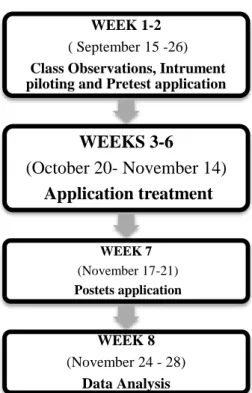
(7) THE ROLE OF PICTURE BOOK STORYTELLING USED WITH REALIA IN THE VOCABULARY ACQUISITION 5 Table of Contents Acknowledgements ............................................................................................................. 2 Abstract ............................................................................................................................... 3 Resumen .............................................................................................................................. 4 List of tables ........................................................................................................................ 9 Glossary ............................................................................................................................ 10 Chapter 1. INTRODUCTION ........................................................................................... 11 1.1. Statement of the problem .................................................................................... 14. 1.2. Research question................................................................................................... 16 1.2.1 Main Question .................................................................................................. 16 1.3. Objectives ............................................................................................................... 16 1.4 Rationale ................................................................................................................. 16 Chapter 2. THEORETICAL FRAMEWORK................................................................... 19 2.1. Theoretical Framework .......................................................................................... 19 2.1.1. Listening Comprehension ............................................................................... 19 2.1.2. Vocabulary Acquisition .................................................................................. 23 2.1.3. Autonomous Learning..................................................................................... 26 2.1.4. Schema theory and the teaching of vocabulary............................................... 29 2.1.5. Picture Book Storytelling used with Realia .................................................... 30 2.2 State of the Art ........................................................................................................ 34.
(8) THE ROLE OF PICTURE BOOK STORYTELLING USED WITH REALIA IN THE VOCABULARY ACQUISITION 6 Chapter 3. RESEARCH DESIGN .................................................................................... 39 3.1 Introduction ............................................................................................................. 39 3.2 Type of Study .......................................................................................................... 39 3.3 Context .................................................................................................................... 42 3.3.1 Participants ....................................................................................................... 42 3.3.2 Researcher’s role .............................................................................................. 42 3.3.3. Ethical Considerations .................................................................................... 43 3.3.4. Timeline .......................................................................................................... 43 3.4. Data collection instruments .................................................................................... 44 3.4.1 Description ....................................................................................................... 45 3.4.2. Validation and piloting.................................................................................... 47 Chapter 4. PEDAGOGICAL INTERVENTION AND IMPLEMENTATION ................ 49 4.1. Introduction ............................................................................................................ 49 4.2. Visions of language, learning, and curriculum ...................................................... 49 4.2.1. Vision of Language ......................................................................................... 49 4.2.2. Vision of Learning .......................................................................................... 50 4.2.3. Vision of Curriculum ...................................................................................... 51 4.3. Instructional design ................................................................................................ 52 4.3.1. Lesson planning .............................................................................................. 52.
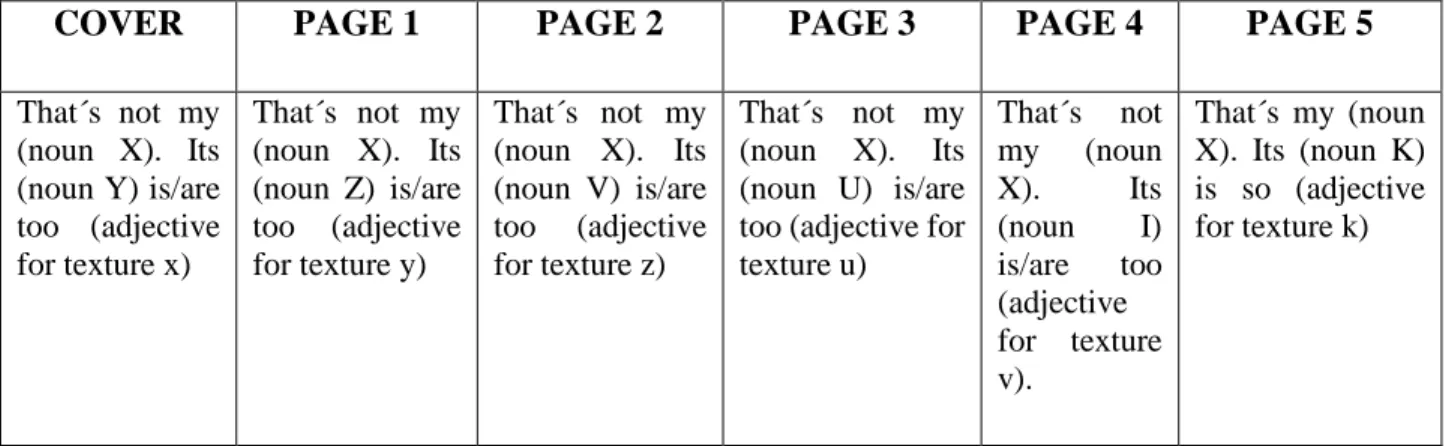
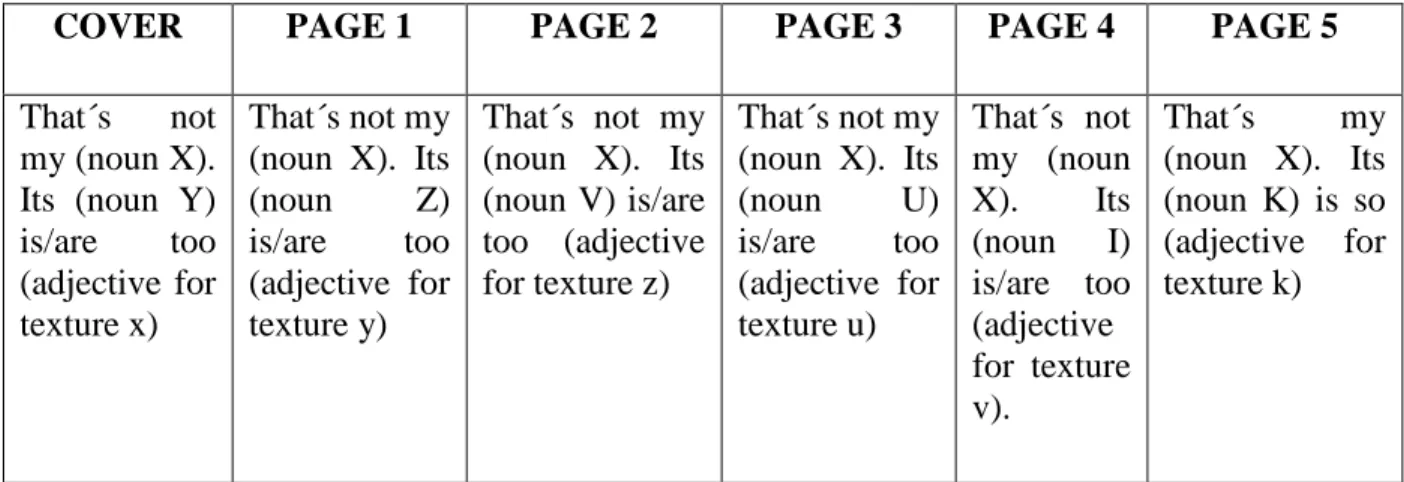
(9) THE ROLE OF PICTURE BOOK STORYTELLING USED WITH REALIA IN THE VOCABULARY ACQUISITION 7 4.3.2. Picture book description.................................................................................. 55 4.3.2. Implementation ............................................................................................... 57 4. 4. Conclusion ............................................................................................................ 58 Chapter 5. RESULTS AND DATA ANALYSIS ............................................................ 59 5.1. Introduction ............................................................................................................ 59 5.2. Data management procedures ................................................................................ 59 5.2.1. Validation ........................................................................................................ 59 5.2.2 Data analysis methodology .............................................................................. 60 5.3. Quantitative Results ............................................................................................... 60 5.3.1. Pretest Results ................................................................................................. 60 5.3.2. Posttest Results ............................................................................................... 62 5.3.3. Teacher´s Journal Analysis ............................................................................. 63 5.3.4. Observational Checklists Analysis .................................................................. 65 5.4. Qualitative Results ................................................................................................. 66 5.4.1. Pre-K vision test, observational checklists and teacher´s journal ................... 66 5.4.2.2. Teachers ‘journal vs Observational checklists ............................................. 71 5.5 Conclusion .............................................................................................................. 76 Chapter 6. CONCLUSIONS AND PEDAGOGICAL IMPLICATIONS ......................... 77 6.1. Introduction ............................................................................................................ 77.
(10) THE ROLE OF PICTURE BOOK STORYTELLING USED WITH REALIA IN THE VOCABULARY ACQUISITION 8 6.2. Significance of the results ...................................................................................... 77 6.3. Limitations of the present study ............................................................................. 79 6.5. Further research ...................................................................................................... 80 6.6 Conclusion .............................................................................................................. 80 References ......................................................................................................................... 82 Appendix A: Picture book coding ..................................................................................... 92 Appendix B: Pre-k Vision Test ......................................................................................... 93 Appendix C: Action research timeline .............................................................................. 95 Appendix D: Parent Consent Form ................................................................................... 96 Appendix E: Pre-K Vision Pretest and Posttest ‘Results .................................................. 98 Appendix F: Teacher´s Journal Tally sheet analysis ........................................................ 99 Appendix G: Teacher`s journal analysis ......................................................................... 100 Appendix H: Observational Checklist (Week 1) ............................................................ 101 Appendix I: Observational Checklist (Week 2) .............................................................. 102 Appendix J: Observational Checklist (Week 3) .............................................................. 103 Appendix K: Observational Checklist (Week 4) ............................................................ 104 Appendix L: Observational checklists` bar graphs ......................................................... 105 Appendix M: Percentage analysis ................................................................................... 107 Appendix N: YLs` Choices made in Step 4 during Week 1 ........................................... 108.
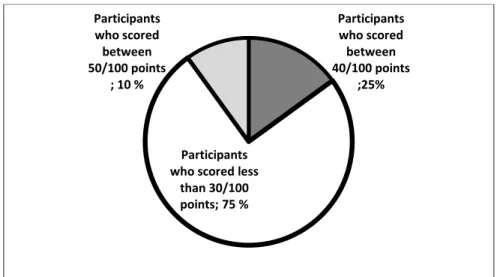
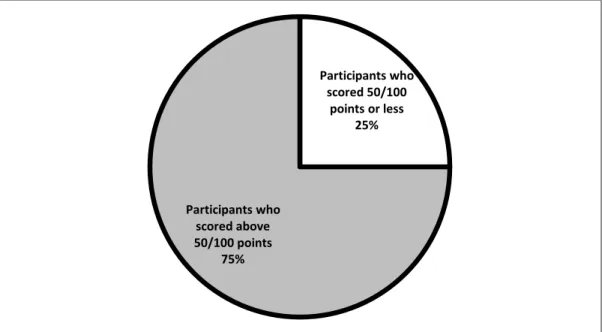
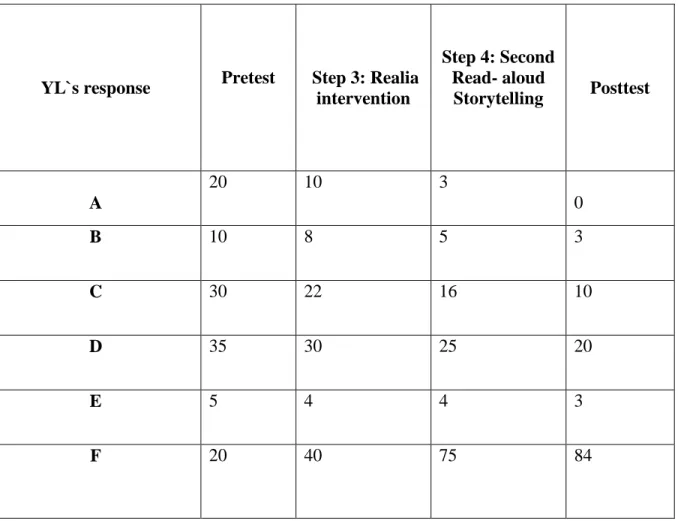
(11) THE ROLE OF PICTURE BOOK STORYTELLING USED WITH REALIA IN THE VOCABULARY ACQUISITION 9 Appendix O: YLs` Choices made in Step 4 during Week 2 ........................................... 109 Appendix P: YLs` Choices made in Step 4 during Week 3 ............................................ 110 Appendix Q: YLs` Choices made in Step 4 during Week 4 ........................................... 111 Appendix R: Variety of Places and IPads provided as options to the YLs ..................... 112. List of tables. Table 1: Research design summary................................................................................... 39 Table 2: Picture books ` sentence structure...................................................................... 53 Table 3: YL´s Responses .................................................................................................. 67 Table 4: YL`s Responses along the Standardize Picture book Storytelling process......... 68 Table 5: Names selected by the YLs during Week 1 and Week 4 .................................... 76. Table of Figures Figure 1: Timeline overview ............................................................................................. 44 Figure 2: Standardize Picture book Storytelling process .................................................. 52 Figure 3: Picture Books..................................................................................................... 55 Figure 4: Pre-K Vision pretest analysis ............................................................................ 61 Figure 5: Pre-K vision posttest analysis ............................................................................ 62 Figure 6: YLs´ responses A, B and F ................................................................................ 69 Figure 7: YLs´ responses C, D and E ................................................................................ 71.
(12) THE ROLE OF PICTURE BOOK STORYTELLING USED WITH REALIA IN THE VOCABULARY ACQUISITION 10 Figure 8: Total number of times the participants played the digital versions of the Picture book during Step 4 ........................................................................................................................ 73 Figure 9: Spots chosen by the YLs during Step 4 ............................................................. 75. Glossary YLs: Young Learners EFL: English as a foreign language L2: Second language L1: First language TPR: Total physical response Pre-K: Pre kinder garden.
(13) THE ROLE OF PICTURE BOOK STORYTELLING USED WITH REALIA IN THE VOCABULARY ACQUISITION 11 Chapter 1. INTRODUCTION. Colombia has had a long tradition of including foreign languages in the school curriculum. Languages such as French, German, Italian, and English have been added to school educational programs in the past years in which the latest has become a breakeven point in the program “COLOMBIA very well” (2015-2025). This plan is a long term strategy which has as its goal that Colombian students use English Language as a tool to communicate with the rest of the world increasing their work opportunities (Mineducacion, 2014).. One of the most striking features of learning English as a Foreign Language (EFL) is the fact that exposure to different languages is beneficial for Young Learners (YL)' development since they become more aware of different cultures, other people and other points of view, resulting in faster language learning as well as improved mother tongue skills. Furthermore, bilingual YLs seem to be more adept and quicker than monolinguals in applying certain kinds of mental activities not directly related to language. An example of this is given by Bahattacharjee, 2012. In this research study some bilingual and monolingual YLs were asked to sort blue circles and red squares presented on a computer screen into two digital bins. They were also asked to sort by shape, which was more challenging because it required placing the images in a bin marked with a conflicting color, and according to the findings the bilinguals were quicker than monolinguals at performing this task. This might be one of the reasons for which nowadays a lot of schools offer bilingual education having EFL even from their very first levels..
(14) THE ROLE OF PICTURE BOOK STORYTELLING USED WITH REALIA IN THE VOCABULARY ACQUISITION 12 Despite the fact that children attending bilingual schools have a better chance in developing higher communicative and cognitive skills, faster than the ones who do not during their very first years of school, it is still a challenge for both teachers and students to set a scenario were English language can be fully used. At the private bilingual School “Fundacion Educativa Rochester”, located in Chia, Cundinamarca, Colombia, EFL teachers, face a number of active four year old students with a very short attention span who need to learn English with the type of instruction in which the target language is used an without translation. After the initial formal EFL classes, some YLs become frustrated by their inability to express their thoughts in the second language (L2). Others want to speak as quickly in the L2 as they would in their Native Language (L1). Even when the school has carried out many efforts to create an English as a Second Language (ESL) environment within the school in a country with EFL, the 4 year old YLs attending Rochester School find themselves in a strange context of an almost total immersion to new sounds, phonemes and words that at certain point have no meaning to them even though they are natural language acquirers. Such phenomenon has been observed by this researcher year after year of teaching EFL to young learners.. Children need to be provided with the right type of experiences in the EFL classroom with fun and interesting class sessions; by combining real objects and language YLs create a mental image called notion, which enables them to match words with meanings. For instance the notion a child has of the word “shoe” combines the word itself with the real object, which produces a mental picture (notion) in the YL´s mind allowing him/her to show understanding of the word “shoe”. As a result, activities in the EFL classroom that are backed up by real objects help understanding and increase general interest in YLs by making the learning experience more.
(15) THE ROLE OF PICTURE BOOK STORYTELLING USED WITH REALIA IN THE VOCABULARY ACQUISITION 13 memorable for the learner (Budden, 2011). Moreover, activities in the EFL classroom need to be linked to everyday events close to the YLs´ context; sharing a picture book, saying a rhyme in the L2 or even having an ‘English’ snack, capture and trigger the YLs´ interests making them aware and involving them a lot more in their own learning process. One of the activities young learners enjoy the most is Picture Book Storytelling. Books that feature interactive elements like cloth, pop up characters and a variety of textures and reliefs to be touched, provide YLs with a sensorial experience, that support them in the use of logical thought and operations in their present stage of cognitive development (Piaget, 1954).. Early picture book story telling is a bridge to build safe communication grounds with YLs and providing a sensorial experience definitely enables YLs to construct logic relationships where reality and sounds are combined to build L2 comprehension. Taking this into account a set of four pictures books were read to a group of twelve 4 year old EFL learners, following a Standardize Storytelling Process (which comprises strategies that actively engaged EFL YLs in their own learning process). Such process aims to research how does picture book story telling when used with Realia increase the acquisition of nouns and adjectives amongst 4 year old EFL learners at a private Bilingual school located in Chia, Cundinamarca. The results have important implications for classroom practice, including the methods used to teach new vocabulary in the L2, strategies to evaluate the comprehension of aural texts and methods to involve YLs in their own EFL learning process. The present research report is organized into 6 chapters. The first chapter includes a brief introduction to the entire report where the focus of the research is clarified; in addition to that a problem statement is set including the research question and its general and specific objectives..
(16) THE ROLE OF PICTURE BOOK STORYTELLING USED WITH REALIA IN THE VOCABULARY ACQUISITION 14 The second chapter presents a balanced and objective analysis of previous research including the state of the art as exemplified in other similar or relevant research that has been carried out either locally and internationally considering the constructs included in the study. The third chapter focuses on the research design describing the researchers’ role, context, data, participants, and type of study collection instruments, procedures, instruments validation and ethical issues. In the fourth chapter the pedagogical intervention and implementation is explained. In chapter 5 the data analysis and findings are described and finally Chapter 6 displays the observations and conclusions in regards to the research question, as well as any limitations or problems encountered during the research process.. 1.1 Statement of the problem. “Fundacion Educativa Rochester” known here as Rochester School, is a private institution located in Chia (Cundinamarca) outlying Bogota, the capital city in Colombia. Rochester School offers a mixed bilingual education in English-Spanish from Pre-K to Eleventh Grade. At Rochester School, EFL Teachers are expected to increase the L2 vocabulary range of YLs in the Pre-k level. The YLs enrolled in Pre-K have a very short attention span, they are not exposed to the L2 at home on a regular basis (so they do not understand any type of aural text in the L2) and if this was not enough, they are just starting to attend a new school with teachers that speak English all the time; the L2 is the main communication channel even during snack time. All adults and even children from higher levels speak English to the YLs and expect them to understand and use the language outside the classroom. With all these school requirements some children show themselves reluctant to listen to the people who use the L2 indicating to their parents that they don’t want to go to school.
(17) THE ROLE OF PICTURE BOOK STORYTELLING USED WITH REALIA IN THE VOCABULARY ACQUISITION 15 anymore. This is basically because they do not have the sufficient vocabulary range to understand what is being said to them.. At Rochester School the acquisition of vocabulary in the L2 is compulsory since Math and Science are instructed totally in the L2; during the science class, children need to describe plants and elements present in natural environments so they need to know at least certain adjectives related to colors and textures of plants and flowers in order to understand key points in the instructions and input given by the science teacher. In math, children need to learn classroom items (nouns such as pencils, toys, table, etc.) in order to put into practice the skills of counting and grouping those elements by their external characteristics. The development of such skills requires a certain amount of vocabulary range in the L2 making the EFL classes a cornerstone that supports and feeds the comprehension and progress young learners accomplish in the entire Pre-k Curriculum.. Early picture book story telling is a bridge to build safe communication grounds with children and if it is accompanied with a proper methodology, YLs can be actively engaged in their own learning process through Autonomous Learning. In addition to that YLs need to have a sensory experience to construct logical relationships where textures, shapes and sounds are combined to build the comprehension of nouns and adjectives. For that reason picture book story telling when used with Realia can provide a remarkable experience amongst young learners helping them to build new meanings out of aural words and descriptions..
(18) THE ROLE OF PICTURE BOOK STORYTELLING USED WITH REALIA IN THE VOCABULARY ACQUISITION 16 1.2. Research question 1.2.1 Main Question How does picture book storytelling when used with Realia increase the acquisition of nouns and adjectives amongst 4 year old EFL young learners at a private Bilingual school located in Chia, Cundinamarca?. 1.3. Objectives . To assess the impact that picture book story telling when used with Realia has on the vocabulary acquisition in EFL 4 year old Young Learners at a private Bilingual school located in Chia, Cundinamarca. . To determine how picture book story telling when used with Realia help YLs to increase the range of nouns and adjectives they understand aurally in the L2.. . To assess the comprehension of the vocabulary in the stories.. . To determine the effects of allowing YLs to make choices over some features of the activities proposed within the EFL classroom without the Teacher´s intervention.. . To assess the effects of allowing YLs perform activities within the EFL classroom without the teacher´s intervention.. 1.4 Rationale The English Language is not only the third most widely spoken native language in the world and the official language of almost 60 sovereign states; it is also the first choice as a second.
(19) THE ROLE OF PICTURE BOOK STORYTELLING USED WITH REALIA IN THE VOCABULARY ACQUISITION 17 language around the world. Therefore, when YLs (even during their very first years) develop communicative skills in EFL, they become capable of interacting with hundreds of others speakers all over the world. Such capability is an open door so they can eventually become more sensitive towards the social, cultural and economic backgrounds of other nations. Furthermore, it is essential for YLs at Rochester School to learn and master communicative skills in English Language, in order to become systemic and competent citizens of the world.. Storytelling is considered a significant source of vocabulary, intonation, grammatical structures, and patterns in real settings (Ahern et al., 2008). For the teacher researcher conducting the present research study, picture book storytelling used with Realia within the EFL classroom, has a positive impact not only in the acquisition and listening comprehension of new words in the L2; it also offers the proper conditions for setting up an EFL teaching environment, where YLs take charge of their own learning process. Acknowledging the significance of vocabulary for communication purposes through Picture book Storytelling used with Realia, the present study offers both teachers and learners the possibility to enjoy Storytelling through the use of real objects brought into the classroom and digital resources. Additionally, it is a source of information on EFL teaching classroom strategies that stimulate autonomous learning in YLs at the age of four years old.. The present project might have implications not only for the learners involved but also for educators, who may broaden their understanding of the knowledge regarding the use of Storytelling for teaching vocabulary. Firstly, the use of Storytelling used with Realia may be more motivating and engaging for learners since the characters and elements that appear along the.
(20) THE ROLE OF PICTURE BOOK STORYTELLING USED WITH REALIA IN THE VOCABULARY ACQUISITION 18 picture books stories, become materialized providing YLs with a remarkable sensory experience that supports understanding of new words in the L2. Secondly, Storytelling activities with the use of real objects (Realia) and digital resources support learners in their acquisition and implementation of vocabulary learning strategies, just by matching the aural descriptions that come from a multimedia device with real objects all framed in a meaningful context.. Thirdly, the present study might enrich the teaching vocabulary practices through Storytelling activities used with Realia. Through the use of Storytelling and Realia teachers may improve vocabulary teaching and learning by taking advantage of innovative strategies to be applied in the EFL classroom, enhancing their teaching practices and fostering learners’ acquisition of vocabulary. Finally, this research study will open up the possibility to conduct future research to explore in depth the relationship between sensory experiences in the EFL classroom and the acquisition of new words in the L2, considering the impact of learning a wide range of vocabulary on the future performance of any young language learner..
(21) THE ROLE OF PICTURE BOOK STORYTELLING USED WITH REALIA IN THE VOCABULARY ACQUISITION 19 Chapter 2. THEORETICAL FRAMEWORK. This chapter presents the constructs and definitions that correspond to the main focus of this study. First, the constructs are presented starting from a general review of Listening Comprehension, Vocabulary Acquisition, Autonomous Learning and Schema theory After that, the teaching strategies of using Picture Book Storytelling with Realia within in the EFL context, is conceptualized and described. Finally, related research studies that have applied Picture Book Storytelling, in the development of communicative skills of a Second Language are described in detail and the contribution of this study to this set of studies is outlined.. 2.1. Theoretical Framework 2.1.1. Listening Comprehension. Listening comprehension is a crucial communicative skill involved in every spoken language, and with it, aural messages and expressions can be interpreted and assigned a meaning. In the 21st century, exposure to spoken English is very great due to the impact of the Internet and Cable. As a matter of fact recent studies suggest that people spend 55% of their day listening (Emanuel, et al., 2008). However, years back listening comprehension used to be seen as a passive process where the learner´s ears received a certain amount of aural information, and all he or she had to do with it was to passively retain the message. Years back, listening comprehension was given with the title of the ‘Cinderella skill’ of L2 acquisition research (Vandergrift, 1999), since very little used to be studied in this field; still, despite the critical importance of listening.
(22) THE ROLE OF PICTURE BOOK STORYTELLING USED WITH REALIA IN THE VOCABULARY ACQUISITION 20 comprehension for L2 learning much remains to be explored. (Albeeva & Stranks, 2013). Several definitions of listening comprehension (relevant for this research study) coming from different perspectives have emerged. Buck (2001) described listening comprehension as an active process in which by applying knowledge to the received sounds, meanings are constructed. Rost (2002) stated that Listening Comprehension is an inferential process; according to him linguistic knowledge and world information interact, as listeners create a mental representation of what they hear applying bottom up and top down processes, which finally result in comprehension. In other words, according to Rost, listening comprehension is the process of receiving what the speaker actually says, creating and representing meaning, negotiating meaning with the speaker and responding, through involvement, imagination and empathy.. For this study, listening comprehension is understood as an ability that “encompasses the multiple processes involved in understanding and making sense of spoken language” (Nadig, p. 1743, 2013). Young EFL learners need to be able to recognize speech sounds, have a clear understanding of the meanings of individual words, and understand the syntax of sentences in which they are presented. Having said that, listening comprehension can be approached from two different perspectives: listening as comprehension and listening as acquisition (Richards, 2009, p 52). Listening as comprehension refers to the traditional way of thinking about the nature of listening, based on the theory that the main purpose of listening in the L2 learning is to facilitate the understanding of spoken discourse. Therefore, the characteristics of spoken discourse and the problems they present to the listeners, must be considered in order to understand the nature of listening processes (Richards, 2009). Nevertheless, not everything that is understood at the message level automatically contributes to the learner’s language development, meaning that not.
(23) THE ROLE OF PICTURE BOOK STORYTELLING USED WITH REALIA IN THE VOCABULARY ACQUISITION 21 all input becomes intake. According to VanPatten (1996), only a very small subsection of input ever becomes intake with a permanent effect on the learners’ acquisition of the L2. However, comprehension is a prerequisite to acquisition. According to VanPatten (1994) in the early stages of acquiring a language, children´s main objective is to establish meaning at all costs. Until YLs feel at ease with their capability to comprehend the message that is being communicated, they will not be prepared to pay attention to, and to learn from, the language that is used to put the message across. The two views of listening lead in different directions for classroom pedagogy (Richards, 2005).. Learning to listen involves enhancing comprehension abilities in understanding the language process. On the other hand, listening to learn involves creating new meaning and form linking and then repeating the meaning and linking form, which helps the learners to be ready for paying more attention to the syntax and lexis of the language through listening Rost (2001). As Rost (2001) mentions, “the optimal goal of L2 listening development is to allow for the L2 to be acquired through listening, not only to allow the learner to understand spoken messages in the L2” (p. 91). In the present study, a group of twelve 4 year-old YLs are to understand descriptions of real objects and pictures that come from storytelling activities; because of that, the lexicon of such descriptions has been carefully selected and presented to the YLs, by the use of a variety of steps and resources that support and facilitate the understanding of the spoken discourse (books and objects used for providing input to the YLs are covered with colors, textures and relieves).. On the other hand aural descriptions coming from picture book storytelling activities can be scripted or authentic. Authentic listening involves listening in real situations and scripted listening refers to scripted version of listening that is typically used for situational dialogues in.
(24) THE ROLE OF PICTURE BOOK STORYTELLING USED WITH REALIA IN THE VOCABULARY ACQUISITION 22 course books (Wilson, 2008). Consequently, in order to help YLs comprehend the meanings of nouns and adjectives (contained in a set of 4 picture books), as well as the sequence that each book follows, the scripted type of listening has been chosen for the present study. Exposing repetitively YLs to the same rhetorical structure page after page and book after book, is essential for achieving substantial L2 learning (Horst‘s, 2005; Replicating Webb‘s, 2007; Chen & Truscott, 2010). Furthermore, even when the YLs participating in the present study do not have any competence in the L2, it is very important to set the language structures contained in the books (during the Storytelling activities) a bit beyond their level of proficiency (Brown, 2007).. In a research study conducted by Graham (2006), students struggled with the understanding and identification of specific word. According to the participants, this was due to the speed of the aural texts and their low proficiency in listening comprehension. Consequently, it is crucial to stimulate young EFL learners with the appropriate type of input, so that even from their very early years, the development of strong listening comprehension skills in the L2 can be achieved. In conclusion, listening comprehension is a crucial communicative skill that every EFL learner needs to acquire in order to become proficient in any L2. The way students used to be exposed to listening materials in the past, was by listening to long recordings where they only had to listen and absorb information. Nowadays, the approach is quite different since L2 learners are seen as active participants with the role of improving, monitoring and evaluating their own learning (Richards, 2009); consequently during the application of the present research study, a group of twelve 4-year old YLs are able and allowed to interact with the listening materials used within the EFL classroom during picture book storytelling activities..
(25) THE ROLE OF PICTURE BOOK STORYTELLING USED WITH REALIA IN THE VOCABULARY ACQUISITION 23 2.1.2. Vocabulary Acquisition. Vocabulary is an indispensable part of any language and very little can be communicated from one person to another if there is no knowledge of vocabulary. Consequently, the role of vocabulary in the acquisition of EFL has been studied recently by many authors and according to them there is a strong influence of vocabulary learning in the acquisition of the L2, and that is why it needs to be promoted within the EFL classroom (Amiryousefi & Ketabi, 2011; Mokhtar et al., 2009; Oya, Manalo, & Greenwood, 2009). As a matter of fact, many research studies state that the higher the vocabulary range acquired by a learner the more skillful he/she is expected to be in the L2 (Janulevičienė & Kavaliauskienė, 2007; Schmitt, 2000; Alemi & Tayebi, 2011) and actually if L2 students know sufficient words to maintain a dialogue or contribution, they can progress in their fluency (Oya et al., 2009). Storing useful vocabulary is very important for EFL young learners since they are starting to acquire and put into practice basic skills in order to be able to communicate with others in the L2 (Pikulski & Tempton, 2004; Thornbury, 2007). This can be done by using picture books filled with real reliefs (the projection of figures or forms from a flat background in a painting or drawing) and multiple textures (the appearance and feel of a surface), as well as, by the use of real objects brought into the classroom, providing YLs with an outstanding experience.. But how can EFL teaching input be so effective to the point in which YLs can expand their range of vocabulary and memorize new words day after day? Vocabulary is stored in the learner´s mind in a system called “mental lexicon”. It is very organized and looks like a web placing and.
(26) THE ROLE OF PICTURE BOOK STORYTELLING USED WITH REALIA IN THE VOCABULARY ACQUISITION 24 interconnecting words in many different ways considering their characteristics. Consequently teachers working with YLs need to use a variety of strategies to introduce and reinforce new words within the EFL classroom; which means creating different contexts using diverse resources Thornbury (2007, p 92). Multisensory instruction refers to any learning activity that comprises the use of two or more sensory modalities at the same time to take in or express information (Birsch 1999: 1). The sensory modalities include visual (sight), auditory (hearing), tactile (touch) and kinesthetic (movement). Using a multisensory teaching approach means helping students learn through more than one of the senses. Multisensory techniques that stimulate visual reasoning and learning are called visual techniques. Those techniques that focus on sound and stimulate verbal reasoning are called auditory techniques. Multisensory techniques that involve using body movement are called Kinesthetic Methods (Logsdon 2009).. Felder and Henriques (1995:28) claimed that students retain ten percent of what they read, twenty six percent of what they hear, thirty percent of what they see, fifty percent of what they see and hear, seventy percent of what they say, and ninety percent of what they say as they do 15 something. For instance, in order to introduce the word rough to YLs, the teacher could use a variety of textures present in many everyday objects used by the learner on a regular basis. Bringing real objects with rough textures are very useful to provide the learner with a meaning for the word rough without using the L1. This would eventually lead the learner to make connections with some other words previously learned such as shoe, which would eventually turn into the more precise expression rough shoe. To change the context, YLs could also go around school in a looking for rough stuff tour in order to take pictures of school rough items, and then a picture story.
(27) THE ROLE OF PICTURE BOOK STORYTELLING USED WITH REALIA IN THE VOCABULARY ACQUISITION 25 could be built with the photos. By doing these frequent encounters with the new words Apthorp (2006) affirms that deeper levels of comprehension can be accomplished.. Furthermore, learners store words in their long term memory when the new words learned are in activities that help students to put words to use, especially in an interesting way. Selecting decision-making tasks such as: matching, sorting, ranking, sequencing, and identifying, help learners integrate new words into their existing knowledge Thornbury (2007, p. 25). Recycling vocabulary, using appropriate material addressing students’ learning styles, and setting meaningful context in which vocabulary is embedded, are strategies that help EFL teachers foster students’ vocabulary development (Morales, 2012). Learning any particular word is a cumulative process where knowledge is built up over a series of varied meetings with the word (Nation, 2005, p. 52). According to Nation (2005), part of effective vocabulary teaching involves working out what needs to be taught about a word; such word needs to relate to first language knowledge and already existing knowledge of the second language and or other known languages.; based on that, it is necessary to consider the meaning, form and use of a word.. During the implementation of this study, YLs were active participants in activities within the EFL classroom such as sorting objects by textures and colors, picking up things by following aural instruction, and even playing freely with real objects and books (filled with reliefs) that represent new words. Another insight highlighted by Thornbury (2007, p. 25) was the importance of personalizing words for learners, who are able to relate words to their previous experiences and interests. Therefore, the language (nouns and adjectives) used during the implementation of the present study was very basic and was attached to objects the YLs have previously seen and.
(28) THE ROLE OF PICTURE BOOK STORYTELLING USED WITH REALIA IN THE VOCABULARY ACQUISITION 26 touched. In addition, in order to promote the unconscious process in which the vocabulary acquisition takes place, the grammatical structures contained in the four books that were used in the research design were the same ones, and learners were exposed to language of each book more than four times a week. Another aspect that needed to be considered when selecting the language for teaching purposes was the level of knowledge required from the students to use it. Such language must address the specific requirements of the students in terms of their present knowledge and cognitive development (Gairns & Redman, 2006, p 35). In the Pre-k level, students need to be able to understand instructions and descriptions that contain vocabulary related to animals, school items, textures and toys, which was the specific language to be taught and evaluated in the implementation of this study. Furthermore, using digital materials in the implementation of the present research study can help learners improve vocabulary knowledge not only in form but also in meaning (Nation 2001; Raigón & Gómez, 2005; Horst, Cobb & Nicolae, 2005; García & Ferreira, 2013; Moreno, 2013). 2.1.3. Autonomous Learning. It has been stated not all the information implying word knowledge can be taught through direct instruction; it can be improved when learners carry out independent study (Nation, 2005, p167-181). Exploring picture books with textures and words on them, is a way to promote independent study and Autonomy with YLs in the EFL classroom; it requires a minimum level of teacher´s intervention and it provides learners with the permission of analyzing the things that caught their attention the most.. It is important to determine what autonomy is. According to.
(29) THE ROLE OF PICTURE BOOK STORYTELLING USED WITH REALIA IN THE VOCABULARY ACQUISITION 27 various authors autonomy is the way that students take charge of their learning. Autonomous Learners share the following behaviors (Benson, 2001; Brown, 2007; Dornyei, 2006; Harmer, 2007): 1- Select different aspects of the learning process (Material, activities, topics, assignments, etc.) 2- Cooperate with the learning process of peers 3- Self-assess progress of learning 4- Define clear learning goals 5- Organize his/her learning process. Autonomous Learners in the 21st century are expected to continuously learn and adjust throughout their lives as technology and information develop rapidly. Years back, teachers were sceptical about teaching learners to become more autonomous, especially at a young age (underestimating the potential for self-regulation in children) (Cameron, 2001, p. 14-18); Therefore, in this research, it was crucial for the teacher-researcher to reformulate the way in which YLs are taught in order to incorporate practices that lead to autonomy development by planning classes that provide learners with the necessary tools to become more independent and take charge of their own learning.. According to Dornyei (2006, p. 153-174), there are different strategies that teachers can adopt in order to promote Autonomous Learning: 1- Allow learners real choices about as many aspects of the learning process as possible. 2- Hand over functions to the learners for cooperative work..
(30) THE ROLE OF PICTURE BOOK STORYTELLING USED WITH REALIA IN THE VOCABULARY ACQUISITION 28 3- Adopt the role of facilitator.. The YLs participating in the present research study are involved in several activities, where initial steps towards Autonomous Learning began to take place. An EFL classroom in which YLs are allowed to select the people they want to work with, the place for performing a specific activity and even the number of times to perform such activity, is a powerful way for promoting Autonomy in the EFL classroom. In this way, the explicit instructions provided by the teacher-researcher are supported by the student`s ability to take charge of their own learning (McCarten, 2007).. A study conducted by Griva, Kamaroudis and Geladari (2010) found that effective vocabulary development is a complex process, which requires a combination of instruction and encouragement of learning strategies. Thus, it is necessary to implement cycles of strategy practice to encourage learners to become skillful and become effective while using them. Such cycles of strategy practice is actually the main reason why the same independent practice was repeated during each of the four weeks where the Picture book Storytelling intervention took place. In addition, the research study conducted by Atay & Ozbulgan (2007, 39-51) concluded that strategy instruction for vocabulary acquisition in a computer-assisted environment helps learners become more effective by individualizing the language learning experience and raising awareness of the strategies learners can use to learn on their own after they leave the language classroom; YLs are expected to listen to the stories outside the classroom anytime they want..
(31) THE ROLE OF PICTURE BOOK STORYTELLING USED WITH REALIA IN THE VOCABULARY ACQUISITION 29 2.1.4. Schema theory and the teaching of vocabulary. Schema theory is a term that appeared in the middle of 1970s and its main representatives put forward the idea that “Schemata are higher-level, complicated and accumulated knowledge structures”. Modern schema theory considers that a schema can mean: “(1) a mental picture of some area of experience; (2) a collection of organized and interrelated ideas, concepts and prior knowledge structures that are abstract representations of objects, events and relationship in the real world” (Jing-tao, 2012). Schema theory basically states that past experiences lead to the creation of mental frameworks that allow us understand new experiences. Schema has a cognitive characteristic that allows us to relate incoming new information to already known information (Cook, 1989, p. 69; Widdowson, 1983, p. 34). Such information can be general knowledge of the world, from everyday knowledge to very specialized data. Children are exposed to thousands of mental schemata, from taking a shower in the morning, to play with sand in the playground, to tie their shoes. Schemata are active, self-activating, and self-revising. Schemata plays a critical role in cognitive processing. Schemata help us to focus our attention, to comprehend, to interpret, to remember, to make inferences, to set goals and expectations, to reason, and to solve problems (Jing-tao, 2012, p. 915). The teaching of vocabulary should stress the context of the words including pronunciation, spelling, meaning, usage, and its pragmatic rules. For instance, the incomplete mapping between the word and its meaning makes the role of schema theory more important in clarify the meaning of the vocabulary. All of these relationships are called context that is the schema of the word. The learner can distinguish or predict the meaning of the words in light on the context, which can help store the words in the long term memory. To improve vocabulary identification skills, it is worth.
(32) THE ROLE OF PICTURE BOOK STORYTELLING USED WITH REALIA IN THE VOCABULARY ACQUISITION 30 giving special attention to easily prepared rapid word-recognition exercises. For instance, reading words aloud that are flashed for a few seconds, or having students quickly identify identical words from a string of similarly spelled ones, trains students in the fast visual recognition of words and phrases. Key words from a passage that students will read may be selected for this type of exercise. The same can be done with phrases to train students to read in meaningful chunks or segments, and with synonyms and antonyms for more advanced students (Jing-tao, 2012, p. 919). What is important is that “Learning vocabulary is also learning the conceptual knowledge associated with that word” (Carrell, 1988, p. 242); thus, by enlarging vocabulary we can also build schemata in a parallel way. 2.1.5. Picture Book Storytelling used with Realia. In the present research study the development of listening comprehension, vocabulary acquisition and autonomous learning, took place in an EFL classroom setting, where four specific stories were read aloud to a group of twelve EFL YLs. Storytelling is considered a significant source of vocabulary, intonation, grammatical structures, and patterns in real settings (Ahern et al., 2008). The classroom scenery, types of activities and stories were selected with the purpose of exposing YLs to a significant amount of new words and expressions, in a way in which their interests and previous knowledge could be captured. Such stories came from picture books, which contained a significant number of pictures, colors and textures to be explored by the L2 young learners. When YLs listen to stories read outloud from picture books (storytelling), a significant number of words is introduced in a meaningful context; the meaningfulness of this context was.
(33) THE ROLE OF PICTURE BOOK STORYTELLING USED WITH REALIA IN THE VOCABULARY ACQUISITION 31 demonstrated by the strong interest students showed in the stories indicated by the quality and length of attention they showed whenever the word story was pronounced. In addition to that, when listening to stories, YLs had the opportunity to activate their critical thinking in areas such as conflict resolution, problem solving and cause and effect. A story, with its elements of humor, conflict and surprise, provides a powerful indirect explanation of how and when to use a variety of words and expression in different places and situations. By the use of storytelling activities, important components that are part of literacy (Vocabulary knowledge) and comprehension skills such as grammar, syntax, and semantics can be developed (Duff, Fieldsend, Bowyer, Hulme, Smith, Gibbs, and Snowling, 2008). Collins (2005) notes that detailed explanation of new vocabulary while reading storybooks can result in significant improvement in second language YLs´ new vocabulary acquisition. Furthermore, according to Bas (2008), storytelling has an immediate benefit for students “Storytelling helps children to link fantasy with the real world. Additionally, most YLs are familiar with most of the stories, so they work with familiar contexts when they work with stories” (p. 197).. In the present study the meanings of new words and expressions contained in the picture book stories, are understood by YLs in two ways: during elaborated explanations and through incidental understanding (Justice, Meier, & Walpole 2005). During elaborated explanations the teacher reads stories outloud, and by the use of gestures and objects he recreates the meanings of the words and expressions contained in the picture books. It is extremely beneficial; recent studies demonstrate that children’s vocabulary improves when they are exposed to elaborated teacher’s activities such as storybook reading time, guided play settings as mealtimes and other recreations that provide rich intake informal environments. A language and literacy intervention was.
(34) THE ROLE OF PICTURE BOOK STORYTELLING USED WITH REALIA IN THE VOCABULARY ACQUISITION 32 implemented in 10 Head Start classrooms. Teachers were trained in specific book reading and conversation strategies. The focus of the intervention was to train teachers how to increase opportunities for language and vocabulary development in young children. At the end of the year, children in the intervention classrooms performed significantly better than children in the control classrooms on the Peabody Picture Vocabulary Test-III and the Expressive One-Word Vocabulary Test (3rd ed.). In addition, teachers in the intervention classrooms used strategies that promoted language development during book reading and other classroom activities. Head Start teachers can be trained to implement strategies that have positive effects on children's language and literacy development. (Wasik, Bond & Hindman, 2006).. Incidental understanding takes place when individually each YL explores and plays with the material used during the storytelling activities, and by touching the textures and pictures that appear the books, he/she links words to visual and (or) sensory meanings. Connecting storybook telling to guided play, offers YLs an opportunity to enjoy learning, while teachers can successfully improve their students’ vocabulary and comprehensive language. Roskos and Christie (2011) confirm that the connection that exists between the learning process that occurs during early literacy and playing is becoming more clearly defined, and the cognitive effects on young learners continue to be analyzed.. On the other hand, there are two influential tools used alongside the story telling activities planned in the present research study: Digital materials and Realia. Many researchers have studied the impact of sound animation and motion video on language learning process (Kayaoglu, Dag Akbas & Özturk, 2011; Bekleyen & Yilmaz, 2012; Naraghizadeh & Barimani 2013). They all agree that exposing learners to different modalities of presentation triggers the connections.
(35) THE ROLE OF PICTURE BOOK STORYTELLING USED WITH REALIA IN THE VOCABULARY ACQUISITION 33 between the verbal and visual system, which ultimately results in an improved memorization of words. Moreover, Korat (2008) found that YLs respond well to devices or any technology brought into the classroom, making them more engaged and motivated in their learning process. For the purposes of this research study, “Realia consists of actual objects or items or facsimiles thereof, which are used in the classroom to illustrate and teach vocabulary or to serve as an aid to facilitate language acquisition and production” (Chiarantano, 2011, p. 1). Supporting picture books with real objects full of textures help YLs join what they are learning in the L2 (through Storytelling) with what they already know in the L1, allowing them to make new connections between reality and new words, increasing their vocabulary range through sensorial experiences. Using Realia within the classroom provides a strong support for EFL teachers when instructing new vocabulary, since it allows YLs not only to see but also to touch, smell and even taste new words. Hill and Flynn (2006, p. 36) claimed, “knowledge that is presented nonlinguistically is stored in the form of mental pictures or physical sensations such as sight, sound, smell, touch, taste, and movement”. All in all, Storytelling used with Realia within the EFL classroom is a powerful tool, with the potential of not only helping YLs in the acquisition of their first words in the L2, but also with the inherent power of enhancing their listening comprehension skills. Consequently, the present study intends to make an efficient use of Storybooks and Realia within the EFL classroom, in order to help YLs increase the listening comprehension of nouns and adjectives, during several Storytelling sessions..
(36) THE ROLE OF PICTURE BOOK STORYTELLING USED WITH REALIA IN THE VOCABULARY ACQUISITION 34 2.2 State of the Art. An action research project carried out by Gomez (2013) with a group of 17 YLs (twelve boys and five girls) during a period of 6 weeks at a public school in Bogotá, Colombia, used EFL Storytelling with the purpose of examining ways students reflect upon their own social context. After the implementation period researchers found that it was very valuable to foster the creation of reading environments in schools that may encourage and motivate students to read in the L2. According to these researchers, using different reading formats during Storytelling activities, such as Big Books, allowed children to develop reading skills and increased their vocabulary range, which in the long run it is thought will help them to develop other communicative skills in the L2. In addition, the study suggests that using readings of different styles within the EFL classroom, allows children to freely express their thoughts, since they are allowed to use the format they like the most.. Finally, the results show how valuable the inclusion of ICTs (information and. communications technologies) is into the Storytelling activities. According to the researchers, such technique not only puts students in contact with the narration from a visual perspective, which makes Storytelling more interesting for EFL YLs; it is also a great way to promote values and an alternative to make better teaching practices within an EFL environment that fits student´s needs.. Another study carried out by Bernal (2010) in Bogota, Colombia with a group of 20 EFL YLs and adults, reports the partial findings of an on-going research project. Such study was aimed to prove the positive impact of Total Physical Response- Storytelling in the EFL learner’s oral production and fluency. During the implementation period, researchers set environments with real elements taken from storybooks (including objects and images), made story telling anticipation.
(37) THE ROLE OF PICTURE BOOK STORYTELLING USED WITH REALIA IN THE VOCABULARY ACQUISITION 35 activities (in which several words and sentences were used to introduce the main topics of the stories), group-peer and individual Storytelling performances and telling new stories. Based on the findings of this study it can be said that by using story telling in the EFL classroom there are numerous advantages that promote the acquisition of new vocabulary. First of all, during Storytelling activities students need to recall the words and use them in context, which eventually will lead them to use the language in everyday contexts. Second, while in traditional instruction learners might be likely to forget what was taught within the classroom, the events, characters and words to retell a certain story tend to be easily remembered by the learner (Bernal, 2010, p. 151).. In Pereira, Colombia, there was a research study carried out with a group of 37 YLs (18 boys and 19 boys) at a public school whose purpose was to provide evidence of the impact of Storytelling activities on the students´ listening comprehension. During the implementation phase YLs were exposed to a variety of picture books that contained simple and repetitive sentence patterns. In addition, the storytelling sessions were full of visual aids, gestures, body language and TPR (Total Physical Response) was also included. The researcher found that by using big predictable books with short repetitive sentences, the student´s attention span and their participation frequency along class sessions dramatically increased. In the books used in this specific research study, the story builds on a pattern; it starts with one person, place, thing, or event and each time a new person, place, thing, or event is shown, all the previous ones are repeated. In addition, students were able to memorize and retell the stories told during the implementation using the appropriate target language during the lessons previously instructed by the teacher (Londoño, 2012)..
(38) THE ROLE OF PICTURE BOOK STORYTELLING USED WITH REALIA IN THE VOCABULARY ACQUISITION 36 In Mexico, a group of 67 YLs between the ages of 5 to 7 years old, participated in a fourmonth research study that aimed to discover the best strategies to enhance EFL vocabulary acquisition in YLs (Trujillo 2011). They provided the EFL students with an important measure of vocabulary using a variety of strategies that included Realia, storytelling, teachers´ and students ‘interviews, pictures and songs. It is important to note, that the learners participating during this research study did not know how to read and write in their mother tongue Spanish. Very interesting findings were stated at the end of a 5-month implementation period. When using Realia with objects related to animals, the researchers identified negative effects in terms of classroom management; even when at the very beginning of a lesson children looked interested, later, the attention span of the whole group decreased, since children wanted to touch and play with the objects. Consequently, some of the activities planned could not be totally completed.. On the other hand, in activities where real school supplies and objects were used (whiteboard, markers, eraser, door, etc.), children were very engaged when using the language, since apparently it was essential for them to do so to accomplish the activity and play the games. The topic family and days of the week, were taught by the use of storytelling. According to the researchers, the students were not only able to pay close attention during every single session but also to recall the language of the story by answering short questions after every single reading; this occurred because every single storytelling session was supported by visual aids (puppets and pictures) and the storytellers modulated their voices according to the characters of each scene. Based on the findings of this research study it can be said that story telling is not only a powerful strategy for presenting and revising vocabulary but also a strong instrument teacher can use in order to foster listening comprehension skills in EFL YL..
(39) THE ROLE OF PICTURE BOOK STORYTELLING USED WITH REALIA IN THE VOCABULARY ACQUISITION 37 An action research project was also carried out by Porras (2010). Results indicated that that YLs showed high motivation when the stories were told or read and the use of stories that considered the students´ interests increased their comprehension of the stories and the acquisition of new words. The study concluded that stories made YLs´ learning EFL were more interesting, amusing and memorable since stories have the capability of offering a learning environment that is both familiar and fun.. Finally, a group of forty parents and their preschoolers participated in a 7 week- research study at a private preschool in Turkey; it aimed to assess the impact of parents' dialogical storybook reading on their children's receptive vocabulary and reading attitudes (Kotaman, H., 2013). The study consisted of a pretest-posttest control-group design with random assignment of parents to dialogic reading and control groups. It is important to note that parents did not receive any kind of training in dialogical storybook reading therefore there was no intervention in the control group children during the seven-week control phase. The study used an experimental and a control group. The experimental group was composed by 20 children, nine girls (45%) and 11 boys (55%). The control group included 12 girls (60%) and eight boys (40%) boys and the experimental group.
(40) THE ROLE OF PICTURE BOOK STORYTELLING USED WITH REALIA IN THE VOCABULARY ACQUISITION 38 ranged in ages from 3.3 to 4.9 years. The Peabody Picture Vocabulary Test (PPVT) scores for the experimental group increased considerably more than those in the control group. Experimental group children showed significant increases in receptive vocabulary and reading attitude scores.. Such overwhelming evidence corroborates the notion that children`s vocabulary acquisition increases when they become active participants in storybook telling; that is exactly what happens when picture book storytelling is used with Realia in the EFL classroom, since it provides children the possibility to interact with the reading material during outloud reading activities. The research studies mentioned above presented several strategies that aimed to increase the vocabulary range in EFL YLs by means of storytelling, pictures and TPR activities within the EFL classroom; however, none of them materialized (replaced pictures by 3D real shapes) the characters and objects that appeared along the stories. Besides, in none of the studies mentioned above were the L2 learners allowed to make choices about the main features of the activities proposed within the EFL classroom; none of them worked without the teacher´s intervention, and that is why the current research study aims to fill such gap. There is a need for more student centered approaches that improve the autonomous language retention and usage beyond rote memorization,.
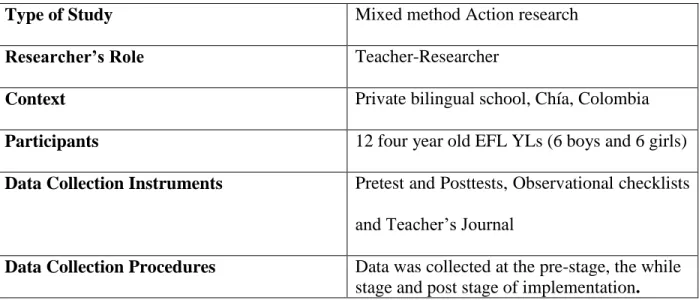
(41) THE ROLE OF PICTURE BOOK STORYTELLING USED WITH REALIA IN THE VOCABULARY ACQUISITION 39 Chapter 3. RESEARCH DESIGN. 3.1 Introduction. The present chapter describes the design used to carry out this mixed method action research study. First, the type of study and research strategy used are defined, then the characteristics of the context and its participants are described, as well as the researcher’s role in the study. Finally, the data collection instruments, the data collection procedures, the design and validation of the instruments and procedures used and the ethical considerations of the study are specified in detail. Table 1 summarizes the information described in this chapter: Type of Study. Mixed method Action research. Researcher’s Role. Teacher-Researcher. Context. Private bilingual school, Chía, Colombia. Participants. 12 four year old EFL YLs (6 boys and 6 girls). Data Collection Instruments. Pretest and Posttests, Observational checklists and Teacher’s Journal. Data Collection Procedures. Data was collected at the pre-stage, the while stage and post stage of implementation. Table 1: Research design summary. 3.2 Type of Study As mentioned in previous chapters, the present study aims to identify and evaluate the main contributions of picture book Storytelling used with Realia to the listening comprehension and acquisition of vocabulary of YLs in the EFL classroom setting. It is a mixed methods type of.
(42) THE ROLE OF PICTURE BOOK STORYTELLING USED WITH REALIA IN THE VOCABULARY ACQUISITION 40 Action Research study which involves combining techniques, methods, approaches and language of both quantitative and qualitative traditions (Johnson and Onwuegbuzie, 2004). A careful reading of the literature suggests that the term mixed methods means the use of more than one kind of data (Barkaoui, 2010). Such method was selected since it allows for investigating more complex problems from different perspectives, asking more questions and finding more complex answers (Greene et al. 1989, Johnson and Onwuegbuzie 2004, Gelo et al. 2008). In addition to that, mixed method research allows for a presentation of more divergent views, and simultaneously answers exploratory and confirmatory questions (Schulenberg 2007). It is also an action plan since the individual conducting the study explores his own teaching context in a self-reflective, critical and systematic way (Burns, 2010). Such an approach towards research allows teachers to reflect on their own teaching skills and at the same time gain more understanding of their classroom’s setting and their students. The teacher-researcher conducting this study identified several elements and strategies that according to him should be including the EFL classroom setting on a regular basis when working with YLs. Through such a reflective process he was able to identify problematic situations and find solutions that might improve the students learning process and his own teaching practice as well. First, the researcher observed and collected data from English, Math and Science class sessions, considering both vocabulary acquisition and teacher´s type of instruction. The intention of such decision was to gather information about the number of nouns and adjectives students showed comprehension of and the characteristics of the input given by teacher during the classes oriented in the L2. In addition to that the students´ vocabulary range was tested using the Pre-K Vision Test (For the test, see Appendix B)..
(43) THE ROLE OF PICTURE BOOK STORYTELLING USED WITH REALIA IN THE VOCABULARY ACQUISITION 41 Then, the researcher read about picture book storytelling within the EFL classroom with YLs and selected interactive Read-Aloud strategies and Realia for the implementation of the study. Such activities were chosen by the researcher since they had the potential of engaging learners in their own learning process in collaboration with the teacher. After that, a structured activity in which the theory and practice of picture book storytelling used along with Realia and YLs was designed and applied. In addition to that, information was gathered from the students’ performance during a 4-week intervention using a Teacher´s Journal and at the end of the storytelling of each book; such journal is a log written primarily by the teacher after a class session, in which the student´s attitudes, language use and the events that occur along the class sessions are registered. This document is based on observations made during class (see Bailey, 1990; Bartlett, 1990). Such journal, provides a written document of the expected and unexpected events that occur along the 5 steps; furthermore, the student´s comprehension of nouns and adjectives was registered by the use of observational checklists (Appendixes H, I, J and K). It is important to mention that the PreK vision test had already been applied and validated at school, with a different population that shared the participants’ age and language proficiency level.. Finally, the researcher analyzed the data collected from the Teacher´s journal, the observational checklist and the scores that students obtained in the Pre-K Vision Test before and after the intervention. The decision of using such instruments in order to gather data, including the way they were analyzed, followed an investigation previously carried out in which the impact and effectiveness that storyboards had on reading comprehension skills were determine (Molina, 2013)..
Figure

+7


Documento similar
Instrument Stability is a Key Challenge to measuring the Largest Angular Scales. White noise of photon limited detector
Through picture books we can work with Co- yle’s (2005) 4 C’s: The C of content, because the images incite the use of vocabulary; the C for communication, as there is an interaction
When it comes to the specificity of its features, a recent study in a cohort of patients with positive serological tests for CD found that the combination of a clinical picture
Finally, with regard to research question 2, a factor analysis was applied in order to identify a likely combination of the on-line creative strategies used by the
The broad “WHO-ICF” perspective on HrWB provided at Figure 1 has a significant implication also for HRQoL. The develop- ment of ICF and its conceptual approach has challenged to
In order to answer research question number 5, that is to say, to what extent students with higher productive vocabulary knowledge acquire more vocabulary than those with
In answering the aforementioned question, this paper aims to investigate the financial channels used by micro and small businesses in sustaining their business activities, and
Even though the 1920s offered new employment opportunities in industries previously closed to women, often the women who took these jobs found themselves exploited.. No matter
