
Parents participating in the adolescent students' learning process : a text messages' intervention in a math class context
215
0
0
Texto completo
(2) PONTIFICIA UNIVERSIDAD CATOLICA DE CHILE SCHOOL OF ENGINEERING. PARENTS PARTICIPATING IN THE ADOLESCENT STUDENTS’ LEARNING PROCESS: A TEXT MESSAGES` INTERVENTION IN A MATH CLASS CONTEXT. MACARENA PAZ SANTANA SEPÚLVEDA. Members of the Committee: MIGUEL NUSSBAUM SUSANA CLARO VERÓNICA CABEZAS FRANCISCO CLARO SUSANNA LOEB JUAN DE DIOS ORTUZAR Thesis submitted to the Office of Graduate Studies in partial fulfilment of the requirements for the Degree of Doctor in Engineering Sciences. Santiago, Chile, January, 2019.
(3) To every child or student who had once had a learning experience leaded or framed by an adult.. ii.
(4) ACKNOWLEDGEMENTS. I would like to thank my tutor and advisor Miguel Nussbaum for his immense support, guidance, and knowledge. He played a key role during these years in designing and writing this thesis. Miguel, thanks for your humour and for your “cachipún” moments. It will always be on my mind and it will forever be a part of the way I teach and learn. I would like to express my sincere gratitude to my parents and family, who have always supported my passion for education. To Clara, my mom, for her unconditional affection, endless patience, and warm love. I learned from her the deep desire to create social impact. To Fernando, my dad, for our long conversations during all of those delicious meals and especially for his encouraging words. To Diego and Fernando, my siblings, whose steps have always leaded my way. My special appreciation goes to Michelle, who was always unconditionally by my side, helped me cope with the frustration and anxiety. She walked me through all of my challenges with great understanding and strength. My sincere thanks also go to Dr. Verónica Cabezas and Dr. Susana Claro, for their insightful comments and encouragement, but also for being amazing role models to follow; and to Dr. Susanna Loeb, who provided me with an unforgettable opportunity to join their team at Stanford as an intern. Without their precious support it would not be possible to conduct this research. I would like to thank the rest of my thesis committee, Dr. Francisco Claro and Dr. Juan de Dios Ortuzar for their valuable guidance and hard questions. I would also like to thank my colleagues and partners. From the Computer Science Department: Camila, María Fernanda, Matías and Leonardo, for their friendship, honesty, companionship, and support. To Victoria, as a friend, teammate, and associate, for striving to become us in social entrepreneurs. To Enseña Chile, for providing me with one of the most important experiences of my life, teaching math for two years, and for allowing me to be a part of a powerful and meaningful network. Finally, I would like to thank all of my friends, and especially to those who through either soccer or music, make me feel grateful every day and remind me how beautiful life is.. iii.
(5) GENERAL INDEX PAGE DEDICATION ................................................................................................................................... ii ACKNOWLEDGEMENTS ........................................................................................ iii GENERAL INDEX ..................................................................................................... iv INDICE DE TABLES ............................................................................................... viii Members of the Doctoral Thesis Committee: .................................................... xi 1.. INTRODUCTION ............................................................................................ 12 1.1. The problem ............................................................................................. 12 1.2. The general proposal ................................................................................ 14 1.2.1. Why the Mathematics Subject? ..................................................... 14 1.2.2. Intervention Design ........................................................................ 15 1.2.3. Thesis Analytical Approach ........................................................... 16 1.3. Research hypotheses................................................................................. 18 1.4. Research questions ................................................................................... 19 1.5. 1.6. 1.7. 1.8.. 2.. Objectives ................................................................................................. 20 Results ...................................................................................................... 20 Theses outline ........................................................................................... 21 Thesis structure......................................................................................... 23. HAVING FUN DOING MATH: TEXT MESSAGES PROMOTING PARENT INVOLVEMENT INCREASED STUDENT LEARNING ............................. 28 2.1. Background .............................................................................................. 28 2.2. Method...................................................................................................... 33 2.2.1. Participants ..................................................................................... 33 2.2.2. 2.2.3. 2.2.4. 2.2.5.. Measurements ................................................................................ 34 Intervention .................................................................................... 37 Protocol .......................................................................................... 42 Interviews ....................................................................................... 45. 2.2.6. Analytic Strategy ........................................................................... 47 2.3. Results ...................................................................................................... 49. iv.
(6) 2.3.1. What is the Effect on Achievement in Mathematics when Low-Income Parents are Sent Text Messages Encouraging them to Complete Short and Simple Non-Academic Math Activities with their Children? ........ 49 2.3.2. What Type of Parent-Student Exchanges are Fostered when a Teacher Encourages Low-Income Parents to Work with their Adolescent Children Completing Short, Non-Academic Activities Delivered via Text Message? 53 2.4. Discussion, limitations and future work ................................................... 55 2.5. Conclusion ................................................................................................ 62 3.. LET’S SPEND TIME TOGETHER: TEXT MESSAGING PARENTS IMPROVED PERFORMANCE OF HIGH ANXIOUS STUDENTS ................................... 63 3.1. Introduction .............................................................................................. 63 3.2. Methods .................................................................................................... 69 3.2.1. 3.2.2. 3.2.3. 3.2.4 3.2.4.. Experimental design....................................................................... 69 Data and Sample ............................................................................ 73 Measures ........................................................................................ 78 Analytical Strategy......................................................................... 80 Balance Check and Attrition Analysis ........................................... 82. 3.3. Results ...................................................................................................... 86 3.4. Discussion and conclusions ...................................................................... 94 3.5. Limitations and future work ..................................................................... 96 4.. FOSTERING. PARENT-STUDENT. RELATIONSHIP. THROUGH. MATH. ACTIVITIES .................................................................................................... 99 4.1. Introduction .............................................................................................. 99 4.1.1. Parent-Adolescent Relationship ..................................................... 99 4.1.2. Parent-School Relationship .......................................................... 102 4.1.3. Potential Benefits of Parents and Adolescents Spending Time Together 103 4.2. Methodology .......................................................................................... 105 4.2.1. Present Study ............................................................................... 105 4.2.2. Procedure ..................................................................................... 107 4.2.3. Sample.......................................................................................... 111 4.3. Results .................................................................................................... 112 v.
(7) 4.3.1. In terms of the Relationship with their Child and the School, how do Parents Perceive the Experience of Working with their Child on NonAcademic Math Assignments? .................................................... 112 4.3.2. What Sort of Behavior is Fostered among Parents by School-Driven, NonAcademic Activities? ................................................................... 117 4.3.3. Given this Kind of Activity, What are the Conditions that Can Promote Changes in the Parent-Adolescent Relationship? ........................ 119 4.4. Discussion .............................................................................................. 121 4.5. Conclusions ............................................................................................ 125 4.6. Limitations and future work ................................................................... 127 5.. CONCLUSIONS AND DISCUSSION .......................................................... 129. 6.. THESIS CONTRIBUTION ............................................................................ 132. 7.. LIMITATIONS AND FUTURE WORK ....................................................... 133. 8.. REFERENCES ............................................................................................... 135. 9.. APPENDIXES ................................................................................................ 148 9.1. Appendix 1. Curricular Content Areas Study ........................................ 148 9.1.1. Introduction .................................................................................. 148 9.1.2. Literature Review......................................................................... 150 9.1.3. Chilean context ............................................................................ 153 9.1.4. Methodology ................................................................................ 155 9.1.5. Results .......................................................................................... 165 9.1.6. Discussion .................................................................................... 172 9.1.7. Conclusions, Future Work and Limitations ................................. 175 9.2. Appendix 2. Supplementary Material in “Having Fun Doing. Math…” 177 9.2.1 9.2.2. 9.2.3. 9.2.4.. Appendix 2—A Balance Check ................................................... 177 Appendix 2—B Text Messages Treatment Group....................... 179 Appendix 2—C Text Messages Control Group ........................... 181 Appendix 2—D Tables ................................................................ 182. 9.2.5. Appendix 2—E Figures ............................................................... 187 9.3. Appendix 3. Supplementary Material in “Let’s Spend Time Together …”188 9.3.1. Appendix 3—A Messages by teacher and grade ......................... 188 9.3.2. Appendix 3—B Students’ and Teachers’ Handout ...................... 198 vi.
(8) 9.3.3. Appendix 3—C Tables ................................................................ 201 9.3.4. Appendix 3—D Figures ............................................................... 207 9.3.5. Appendix 3—E Methods ............................................................. 208 9.4. Appendix 4. Supplementary Material in “Fostering…” ......................... 211 9.4.1. Appendix 4—A Text Messages, Class Material and Teacher Support Material ........................................................................................ 211 9.5. Appendix 5. Exploring further on Math Anxiety ................................... 213 9.5.1. Level of math anxiety of participant students in study “Having Fun Doing Math:…” compared to students in study “Let’s Spend Time Together”. 213 9.5.2. Gender differences in students’ math anxiety .............................. 213 9.5.3. Treatment effect by gender .......................................................... 214. vii.
(9) TABLES INDEX PAGE. Table 2—1 Summary of the iterative process. .................................................................... 39 Table 2—2 Breakdown of students involved in the intervention........................................ 43 Table 2—3 Effects of Non-Academic Tasks on Academic Achievement in Math for Spring 2016 and Fall 2017 .............................................................................................................. 51 Table 9.1.4—1. Descriptive Statistics of the Standardized Co-Variables per Sub-Sample ........................................................................................................................................... 160 Table 9.1.5—1 HLM Models of 8th grade Mathematics Score per Test Format .............. 166 Table 9.1.5—2 HLM Models of 8th grade Mathematics Score per Test Format and per Type of School Funding. ................................................................................................... 171. viii.
(10) PONTIFICIA UNIVERSIDAD CATOLICA DE CHILE ESCUELA DE INGENIERIA PARENTS PARTICIPATING IN THE ADOLESCENT STUDENTS’ LEARNING PROCESS: A TEXT MESSAGES INTERVENTION IN THE MATH CLASS CONTEXT. Thesis submitted to the Office of Research and Graduate Studies in partial fulfilment of the requirements for the Degree of Doctor in Engineering Sciences by. MACARENA PAZ SANTANA SEPÚLVEDA. ABSTRACT There is a consensus that parents’ involvement in student’s school life is key to academic achievement, but it can be very challenging for parents to participate. Even when parents have the time required to support their children’s education, they can increase their children’s anxiety about school when they try to help, especially if parents feel ill equipped to do so. The purpose of this thesis is to develop a teacher-driven intervention to involve parents from low-income communities in the student’s learning process and evaluate its impact on achievement in mathematics among adolescent children. To this aim, quantitative and qualitative evidence of a series of intervention studies and field experiments is provided. To help parents feel at ease and limit the amount of stress they may feel, non-technical parental involvement was promoted using activities for the parents to complete with the adolescent student that did not include any formal curricular content and that were designed to be short, simple and playful. The teacher then connected these activities to the curricular content in class to make the activities useful and, hopefully, meaningful for both parents and students. Through the design-based research method, our research team explored whether developing a meeting space outside the school environment between parents and the adolescent student would increase the child's subsequent academic performance in mathematics. Successive small and medium scale studies were conducted (between 21 and 422 students per iteration). This work includes: (i) Two intervention studies to improve the ix.
(11) wording and readability of the messages and to explore initial reactions to the intervention of both parents and students and (ii) Two field experiments to assess the effect of the intervention on students’ academic achievement and to explore whether the effect of parental involvement in simple and playful activities would be moderated by the students’ negative emotions around the subject, i.e. math anxiety, prior to the intervention. It also explored parents’ perceptions about completing activities that were designed to be simple and playful. Based on these studies, this thesis comprises several findings. The first field experiment revealed that for a small group of Chilean students (treatment=28; control=28) the 5-weeks text-messaging intervention increased their math GPA by 0.488 standard deviations (p<0.05) more than students whose parents only received test and homework reminders. This effect remained over time, extending into the following school year. This thesis later confirmed that these students suffered from elevated levels of math anxiety at the outset of the intervention. The second field experiment explored whether math anxiety moderated the relationship between being assigned to the treatment and the student’s post-intervention performance. To this aim, our research team conducted a field experiment with parents of 422 Chilean students in 9th and 10th grade to receive text messages over the course of 12 weeks. Half of the participating parents received weekly assignments for non-academic activities to complete with their children; the other half received text messages informing them of their children’s upcoming math tests. The study found that students whose parents were assigned to do non-academic homework with their children performed significantly better on their math tests, and that the subset of students in that group who suffered from higher levels of math anxiety at the outset of the study demonstrated decreased math anxiety after treatment. The overall effect of the activities was positive, but not significant. Semi-structured phone interviews with parents from low-income schools explored their view of the relationship with their child and the school, two weeks after the intervention. Half of the interviewed parents found the activities were an opportunity to spend time with their child, an opportunity that was valued from two different perspectives. As an opportunity to strengthen their relationship with their child and to become more. x.
(12) involved in their child’s school life Many parents appreciated the opportunity to communicate, approach, empathize with and get to know their adolescent child better. The contribution of this thesis is showing teachers can use simple and low-cost technology to improve the performance of students that have math anxiety, students that represent a relevant sample of the worldwide population. These findings highlight the importance of offering parents accessible ways to involve themselves in their children’s school lives and also highlight the power of behavioral nudges that encourage positive parent-student exchanges. Future studies should explore further in the role of parents’ math anxiety and develop new ways to engage parents in positive ways into the student’s learning process. Keywords: Parental involvement; Parent-teacher collaboration; Mathematics; Math anxiety; Mathematics teaching; Adolescence; SMS; Text message. Members of the Doctoral Thesis Committee: MIGUEL NUSSBAUM SUSANA CLARO VERÓNICA CABEZAS FRANCISCO CLARO SUSANNA LOEB JUAN DE DIOS ORTUZAR. Santiago, March, January, 2019. xi.
(13) 12 1. INTRODUCTION. 1.1. The problem The performance of Chilean adolescent students in reading and mathematics literacy has not changed or improved significantly for more than 10 years, shown in both national and international assessments (Ministry of Education, 2018; Rivas & Scasso, 2017). The results in Mathematics SIMCE test in 10th grade (see Figure 1, Ministry of Education, 2018), corresponding to the national assessment system, acknowledge there is a need to make deep changes in the educational system gears, such as school’s educational projects, teachers teaching strategies or students’ individual learning process.. Figure 1—1. Mathematics SIMCE test results in 10th grade (yearly). Adapted from Ministry of Education (2018). Available in: https://goo.gl/wKfkqi. These trends are overall very difficult to modify, however, in low-income backgrounds, the situation is even more challenging. Chilean low-income schools, on.
(14) 13 average, have consistently performed poorly according to national standards (Libertad y Desarrollo, 2016; Ministry of Education, 2018). In Chile, school SES is highly correlated with individual socioeconomic level (for details see section 9.1.3. Chilean Context, Appendix 1—A). More than 70% of the Chilean students belonging to the lowest socio-economic levels who applied to college could not be admitted in a recent selection process, due to their insufficient academic performance (BBCL Educación superior, 2015). Developing solutions for adolescent students who belong to low socioeconomic status (SES) schools is especially necessary because most of their families do not have the resources to help their child bridge the gap between what they know and what they should know (Crouter & Booth, 2014). To explore further the Chilean mathematics achievement gap, see La Tercera (2014). Adolescent learning outcomes and development are a result of several factors. From a bioecological theoretical perspective, human development is the result of a series of interactions between themselves and the very different environments surrounding them, e.g. classroom experience, school environment, family environment, non-familial expieriences outside of schools, among others (Bronfenbrenner & Morris, 1998). Therefore, it is crucial to try new strategies and different approaches related to the interactions that occur around the student’s learning process. It is widely accepted that parents’ socioeconomic level and their parenting practices play a crucial role for the students’ developmental and learning process (e.g. Blums, Belsky, Grimm, & Chen, 2016; Epstein & Sanders, 2002; Hill & Tyson, 2009; Jeynes, 2005; Sirin, 2005), however, it is challenging for parents to participate in the adolescent students’ school life (for details see Chapter 3). Even with available time, parents may.
(15) 14 have difficulty communicating with teens, as many parents lack the skills required for positive and productive interactions with their children (Cabus & Ariës, 2017; Dumont, Trautwein, & Nagy, 2012; Wilder, 2014). During a casual conversation a friend of mine, the principal of a low-income school in Santiago, Chile, pointed out: “We all know it’s important to engage parents in the adolescent learning process, but none of us have a clear idea of how to do this”. Despite of its importance, the schools have not yet found a way to make parents play a clear and fruitful role in their child’s learning process. In fact, UNICEF (2018) recently pointed that “fathers are one of the best, yet most underutilized child development resources”. 1.2. The general proposal Considering the opportunity that parents’ engagement represent for the student, the general research question for this thesis is the following: “Can fruitful parent-student interactions be fostered by the school institution?” Consequently, the aim for this study is to design an intervention that allows improving academic performance of adolescent students in a simple, binding and scalable way in schools from low socioeconomic context.. 1.2.1. Why the Mathematics Subject? As described in further Chapter 2 and 3, the math subject was the focus of this work because we identified three main opportunities for developing fruitful parentstudent interactions around this subject. Firstly, the mathematics subject is often taught by a subject teacher who is often more distant to parents compared to the head teacher. Parents of middle school students often lack of a clear point of contact with the school.
(16) 15 as the number of teachers and subjects increases, therefore, their level of communication with subject teachers decreases (Eccles & Harold, 1993; Hill & Tyson, 2009; Simons-Morton & Crump, 2003). This decrease may lead to conflict between parents and students by the lack of clarity that parents have when it comes to the effort made by their children in school (Bergman, 2015). Secondly, the complexity of the subject often leads students and their parents to perceive math as difficult and, consequently, to avoid it or have negative attitudes towards it (Ashcraft & Krause, 2007; Ashcraft & Moore, 2009; Dowker, Sarkar & Looi, 2016). The adverse emotional reactions to math or the prospect of doing math are known as math anxiety (Maloney & Beilock, 2012). Thirdly, parents often feel unprepared to help students complete their math schoolwork, conditions under which parental involvement could negatively impact students’ learning process (Maloney, Ramirez, Gunderson, Levine, & Beilock, 2015; Mellon & Moutavelis, 2011; Vukovic, Roberts, & Green Wright, 2013).. 1.2.2. Intervention Design As described in Chapter 3, interactions between teenagers and their parents may be particularly hard for parents and detrimental for students especially if parents are not confident in their own abilities. To limit the potential of anxiety, the activities included in this work were defined as non-academic, because despite they were related to the math curriculum, they did not require any math knowledge to be completed. These activities were short in duration, considering parents’ time constraints (see Chapter 3). Parents also received recommendations about how to engage in this activities and how to motivate the student at school. In this work, parents’ participation was defined as.
(17) 16 non-technical parental involvement, as non-technical skills were required to complete any of the suggested tasks. Consequently, the math teacher invited parents to complete short, non-academic activities delivered via text message. As described in Chapter 2, this work includes textmessages as the channel to communicate with parents, because text-messages interventions are increasing in popularity due to their low-cost and scalability. It may be the case that these activities open a meeting space to talk about schoolrelated issues which may, in turn, increase the student’s mathematics performance. It has been shown that students whose parents monitor their performance in school have higher academic achievement than their unsupervised peers (Coley & Hoffman, 1996; Fulton & Turner, 2008; Hill & Wang, 2015). Considering that the preparedness parents feel to face a challenge related to their child influences the way they communicate with them, it is important to explore the type of parent-student exchanges that are fostered when a teacher encourages lowincome parents to work with their adolescent children. 1.2.3. Thesis Analytical Approach In order to understand the complexities of the implementation of the program in the educational context, we used Design-Based Research. This methodology allows to have a much more finished understanding of the problem through a series of iterations in the investigative process (Anderson & Shattuck, 2012, Barab & Squire, 2004). At every iteration we sought to have a wider understanding of the agents participating in.
(18) 17 the intervention, i.e. parents, teachers and students and re-design the intervention accordingly. We summarize this process in two main stages: First stage: A series of three small scale studies were conducted, re-designing the intervention at every iteration. As described in Chapter 2, in the first two study interventions (2015) we tested the content of the text messages and consequently rewrote them, we tested extrinsic incentives for have parents replying text messages and we assessed the overall reactions of the students through informal class observation, parents text messages responses and informal interviews. The third study, a small-scale (n=56) field experiment conducted in 2016, showed positive effects of the intervention on students’ mathematics performance. Results from phone interviews showed that the parents perceived the moment where they completed the activities with their student was fun. However, we needed to generalize whether this intervention would work for a broader population of parents and students and, therefore, to explore further the mechanisms that drive the effect that was found. Second stage: as described in Chapter 3, a middle scale field study (12 teachers in 8 schools, involving aa students) was conducted in 2017 and we evaluated whether the effect of the intervention varied depending on the students’ initial level of math anxiety. Participant parents of the study were interviewed by phone with aim to explore their perceptions and behaviours during the intervention for several reasons. Firstly, their perceptions and behaviours may influence the student’s emotions around the subject. As pointed out in Chapter 4, a potential treatment for students’ math anxiety is to change how adults in their lives frame the subject (Dowker, Sarkar, & Looi, 2016). Secondly, parents’ behaviors may or may not allow the creation of a space where the parent and.
(19) 18 the student can share a warmth moment (e.g. laugh together). Parental warmth has been widely shown to be a key factor for the child’s development and academic performance (e.g. Kim & Rohner, 2002). Thirdly, the type of parent-student exchanges nudged by the intervention may or may not strengthen the relationship between them. Considering that many students suffer an important emotional deprivation in the infantile period due to a lack of a parent-child relationship or a serious break in the parent-child relationship (Bender, 1947), it is important to explore whether the intervention can bridge the communication between the parents and their child. The quality of the relationship between the child and their parent contributes significantly to the commitment with the school, in low income contexts (Murray, 2009).. 1.3. Research hypotheses The following hypotheses were used to frame the work carried out for this thesis: H1. The development of a meeting space outside the school environment between parents and the adolescent student, consisting of simple and playful activities, will increase the child's subsequent academic performance. H2. The effect of parental involvement in simple and playful activities will be moderated by the students’ level of mathematics anxiety, prior to the intervention. H3. Parents can have several perceptions about the experience of completing activities that were designed to be simple and playful with their adolescent student..
(20) 19 1.4. Research questions The research questions that guided the work that was carried out for this thesis are the following: Q1. What effect does this intervention have on the students’ academic performance in mathematics? Q2. What type of parent-student exchanges are fostered when a teacher encourages low-income parents to work with their adolescent children on completing short, nonacademic activities delivered via text message? Q3. Do text messages encouraging parental involvement in school-related work affect students’ mathematics performance? Q4. Does the impact of these text messages vary depending on the initial level of student’s mathematical anxiety? Q5. Can the intervention support students with high math anxiety by reducing their anxiety? Q6. In terms of the relationship with their child and the school, how do parents perceive the experience of working with their child on non-academic math assignments? Q7. What sort of behavior is fostered among parents by school-driven, non-academic activities? Q8. Given this kind of activity, what are the conditions that can promote changes in the parent-adolescent relationship?.
(21) 20 1.5.Objectives The objectives of this thesis are the following: O1. Explore the impact that completing these activities has on the students’ achievement in mathematics (as measured by their GPA in math). O2. Explore the type of parent-student interaction promoted the activities (as perceived by the parents) O3. Generalize the impact that completing these activities has on the students’ achievement in mathematics (as measured by their GPA in math). O4. Analyze whether students’ mathematics anxiety moderates the relationship between being assigned to treatment and post-intervention mathematics performance. O5. Study the parents’ perception of working with their children math homework that exclude formal content of the subject and explore the impact that completing these tasks has on parent-student relationships (as perceived by the parents). 1.6. Results The studies from this thesis have produced a series of results that are described below: R1. The intervention improved the students’ mathematics achievement for a small group of students in a low-income school in Santiago, Chile. R2. The intervention promoted positive and inclusive interactions, as perceived by the parents..
(22) 21 R3. The intervention effect on average was positive but not significant in a larger sample of teachers and schools in Santiago, Chile. R4. The intervention improved the students’ mathematics performance for students who suffer from high levels of math anxiety. R5. The subset of students in that group who suffered from higher levels of math anxiety at the outset of the study demonstrated decreased math anxiety after treatment. R5. Half of the interviewed parents found the activities were an opportunity to spend time with their child, an opportunity that was valued from two different perspectives. As an opportunity to strengthen their relationship with their child and to become more involved in their child’s school life R6. Three groups of behavioral patterns were found based on 1) the parent’s level of commitment to the intervention, 2) the level of communication between the parent and their child, and 3) the time they spent together (degree of encounter). R7. To change the nature of the parent-student relationship, we saw that it is necessary that both the parent and the child (or at least the parent) show an interest in getting to know one another. This includes trying to motivate the child to participate in the activities or asking questions that go beyond the minimum requirements of the activity. 1.7. Theses outline This thesis is based on studies that were carried out in order to meet the objectives detailed above. These studies constitute different research papers which are all.
(23) 22 currently at different stages of publication. Some have already been published, others have been accepted, while others have been submitted and are awaiting a response from the respective journals’ referees. Below is a description for each chapter of its constituting paper, the topic that is addressed, the title of the paper, the authors, and the corresponding journal. Chapter 2: The title of the paper included in this chapter is Having Fun Doing Math: Text Messages Promoting Parent Involvement Increased Student Learning, by the authors Santana, M., Nussbaum, M., Carmona, R. & Claro, S. from 2018. This paper, paper 1 (P1), has been accepted for publication by the Journal of Research for Educational Effectiveness (Impact Factor of 1.410), in Press. This study explores whether the intervention can have a positive effect on the students’ mathematics performance. As this paper constitutes an exploratory work, it is a small-scale field study (n=56) and summarizes the two intervention studies conducted prior to developing the activities, including parents’ reactions to the activities. Chapter 3: The constituting paper for this chapter is titled Let’s Spend Time Together: Text Messaging Parents Improved Performance of High Anxious Students, by the authors Santana, M., Nussbaum, M., Claro, S. & Loeb, S., from 2018. This paper, paper 2 (P2) has been sent to the Journal for Research in Mathematics Education. (Impact Factor of 2.5) and it is currently in the review process. This study aims to generalize thee effects of non-academic assignments parents complete with their teenage children and assessed whether student’s math anxiety moderated the relationship between been assigned to the intervention and the students’ performance.
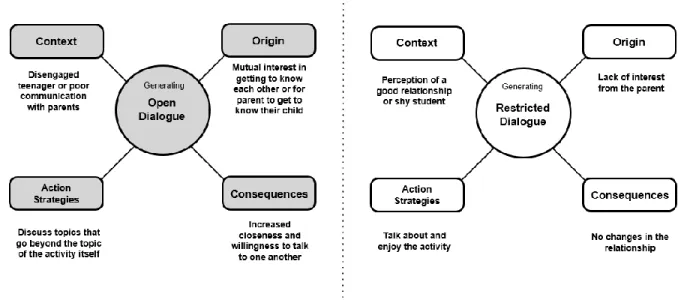
(24) 23 in mathematics. Twelve math teachers (from 8 schools) invited the parents of 422 Chilean students in 9th and 10th grade to receive text messages over the course of 12 weeks. As the positive and significant effect on the students’ mathematics achievement was confirmed for high-anxious students, but not for low-anxious students. This results highlights the importance of offering parents accessible ways to involve themselves in their children’s school lives and that feel non-threatening to their children. Chapter 4: This chapter includes the study Fostering Parent-Adolescent and ParentSchool Relationships through Math Activities, by the authors Santana, M., Nussbaum, B., Piza, S., Imbarack, P., Perez, M., Alarcón, J., from 2018. This paper, paper 3 (P3), has been sent to the Journal Family and Marriage (Impact Factor of 1.2) and is currently in the review process. This paper explores the view that parents have of text messaging intervention. The main objective of the study is to explore the impact of the activities and suggestions sent to parents and whether it can potentially modify the relationship parents have with the school or with the student. The findings from this study reveal that many parents appreciated the opportunity to communicate, approach, empathize with and get to know their adolescent child better. Providing a space for family interaction that avoids conflicts, can lead to changes in how parents and adolescents interpret their relationship. 1.8. Thesis structure The structure of this thesis is based on the hypotheses, research objectives and questions mentioned in section 1.3, 1.4 and 1.5. Figure 1—4 provides a model which shows the connections between each of these components..
(25) 24 Hypothesis 1 (H1) “The development of a meeting space outside the school environment between parents and the adolescent student, consisting of simple and playful activities, will increase the child's subsequent academic performance” relates to question 1 (Q1) “What effect does this intervention have on the students’ academic performance in mathematics? and to objective 1 (O1) “Explore the impact that completing these activities has on the students’ achievement in mathematics (as measured by their GPA in math)”. This question and objective are addressed in paper 1 (P1), upon which this thesis is based, “Having Fun Doing Math: Text Messages Promoting Parent Involvement Increased Student Learning”. The first result of this paper is “The intervention improved the students’ mathematics achievement for a small group of students in a low-income school in Santiago, Chile” (R1). R1 leads to the formulation of the third objective, “Generalize the impact that completing these activities has on the students’ achievement in mathematics (as measured by their GPA in math)” (O3) which in turn leads to question 4 (Q4) “What effect does this intervention have on the students’ academic performance in mathematics?”, both described in paper 2 (P2) contained in this thesis, “Let’s Spend Time Together: Text Messaging Parents Improved Performance of High Anxious Students”. Results of this paper suggests that “The intervention effect on average was positive but not significant in a larger sample of teachers and schools in Santiago, Chile” (R3). Hypothesis 2 (H2) “The effect of parental involvement in simple and playful activities will be moderated by the students’ level of mathematics anxiety, prior to the.
(26) 25 intervention”, is made up of objective 4 “Analyze whether students’ mathematics anxiety moderates the relationship between being assigned to treatment and postintervention mathematics performance” (O4) which leaded to question 4 “Does the impact of these text messages vary depending on the initial level of student’s mathematical anxiety?” (Q4) and question 5 “Can the intervention support students with high math anxiety by reducing their anxiety?” (Q5). This study showed that “the intervention improved the students’ mathematics performance for students who suffer from high levels of math anxiety” (R4) and “The subset of students in that group who suffered from higher levels of math anxiety at the outset of the study demonstrated decreased math anxiety after treatment” (R5). Finally, Hypothesis 3 (H3) “Parents can have several perceptions about the experience of completing activities that were designed to be simple and playful with their adolescent student” is made up of the objectives 2 and 5 (O2 and O5). Regarding objective 2 "Explore the type of parent-student interaction promoted the activities (as perceived by the parents)” (O2), it leads into question 2 “What type of parent-student exchanges are fostered when a teacher encourages low-income parents to work with their adolescent children on completing short, non-academic activities delivered via text message?” (Q2), which is covered by paper 1 (P1). This study suggested that “The intervention promoted positive and inclusive interaction, as perceived by the parents” (R2). This positive perception that included perceiving the activities as fun, also leaded to the objective 4 (O4), related to the student’s math anxiety moderating effect. In relation to objective 5 “Study the parents’ perception of working with their children math homework that exclude formal content of the subject and explore the.
(27) 26 impact that completing these tasks has on parent-student relationships (as perceived by the parents)”(O5), it leads into three different questions: “In terms of the relationship with their child and the school, how do parents perceive the experience of working with their child on non-academic math assignments?” (Q6), “What sort of behavior is fostered among parents by school-driven, non-academic activities?” (Q7) and “Given this kind of activity, what are the conditions that can promote changes in the parent-adolescent relationship?” (Q8), covered by the third paper “Fostering Parent-Adolescent and Parent-School Relationships through Math Activities”. The results from this paper suggests that “half of the interviewed parents found the activities were an opportunity to spend time with their child, an opportunity that was valued from two different perspectives. As an opportunity to strengthen their relationship with their child and to become more involved in their child’s school life” (R6), “Three groups of behavioral patterns were found based on 1) the parent’s level of commitment to the intervention, 2) the level of communication between the parent and their child, and 3) the time they spent together (degree of encounter)” (R7) and “to change the nature of the parent-student relationship, we saw that it is necessary that both the parent and the child (or at least the parent) show an interest in getting to know one another. This includes trying to motivate the child to participate in the activities or asking questions that go beyond the minimum requirements of the activity” (R8)..
(28) 27. Figure 1—2 Connections between the hypotheses, research questions, objectives, papers and results..
(29) 28 2. HAVING FUN DOING MATH: TEXT MESSAGES PROMOTING PARENT INVOLVEMENT INCREASED STUDENT LEARNING. 2.1. Background International evidence reveals that a large percentage of the population does not achieve competency in mathematics, especially among lower socioeconomic groups (Duncan & Magnuson, 2013; Hanushek & Rivkin, 2006). At home, parents can help their children significantly improve their academic results by interacting with them and talking about school-related issues (Castro et al., 2015; Hattie, 2009; Jeynes, 2003, 2005). However, parental involvement in schoolwork is not consistently linked to a student’s academic achievements (Castro et al., 2015; Hill & Tyson, 2009; Jeynes, 2005; Patall, Cooper & Robinson, 2008). When parents try to help with conventional math homework, which are typically problem/question sets from textbooks or worksheets (Zhu, 2015), they often end up confusing the child even more (Balli, Demo & Wedman, 1998). In order to help with math homework, parents require a set of skills that can adapt to the student’s needs (Ariës & Cabus, 2015; Doctoroff & Arnold, 2017; Pressman et al., 2015). However, Wilder (2014) explains that parents often fail to master the necessary concepts or are not familiar with the appropriate teaching methods. The scenario is complicated even further when adding factors such as the de-contextualization and complexity of the assignments and assessments (Lyons, 2006; Nitko, 1996). Given the possible lack of knowledge and skills among parents, it has been proposed that homework assignments.
(30) 29 set by the teacher should not require any knowledge of the subject (Vukovic, Roberts & Green Wright, 2013). For instance, parents could be asked to work with the student and count how many cars of different colors pass by in five minutes. This experience could then be used in the classroom to work on formal mathematical concepts, such as range and frequency. It is also suggested that such assignments should be written in a language that is accessible to the parents (Bull, Brooking & Campbell, 2008). Furthermore, assignments should be designed to explicitly involve the parents (Tam & Chan, 2016) and be structured in such a way that the parents can act as a source of support, rather than as instructors (Donaldson-Pressman, Jackson & Pressman, 2014; Pressman et al., 2015). There are a huge number of factors that can influence the impact of conventional math assignments on the learning process (Zhu, 2015). The design and effectiveness of such assignments has therefore been a constant source of debate. The time taken and interest shown by students in this type of homework assignment have been positively associated with academic achievement (Singh, Granville & Dika, 2002; Xu, Yuan, Xu & Xu, 2016). However, conventional homework assignments are also one of the main sources of conflict between parents and students (Bernedo, Fuentes & Fernández, 2005; Bosma et al., 1996; Del Valle, 1994). The support offered by parents to their children is not always perceived as such (Moroni, Dumont, Trautwein, Niggli & Baeriswyl, 2015). When students feel that their parents are interfering with their homework, or when the homework leads to a conflict, this can result in poorer academic performance (Dumont et al., 2012). During early adolescence, children start to question their parents’ authority. Parent-student conflict therefore tends to increase.
(31) 30 during this time (McGue, Elkins, Walden & Iacono, 2005), as roles and expectations are realigned (Hill & Tyson, 2009). It is not only the students and parents who are responsible for conflicts over school assignments; it also depends on the input provided by teachers to promote exchanges between the two. In addition to conventional homework assignments, parents also receive information from the teacher on other school-related issues, such as behavior (Oinas, Vainikainen & Hotulainen, 2017) and attendance (Bodén, 2017), among others. This information can often damage the relationship between the student and their parents as it can trigger supervisory and controlling practices (Doctoroff & Arnold, 2017; Itkin, 1955). This is particularly relevant in difficult contexts, where the parent-student relationship is often highly negative (Hagan, Roubinov, Adler, Boyce & Bush, 2016; Suldo, 2009). Therefore, conventional math homework often has a negative connotation as it acts as a source of conflict between the student and their parents. For many low-income parents, getting involved in the learning process at home is hard. Some of the most frequent challenges include their schedule at work and workload (Crouter & Booth, 2014; Gracia & Kalmijn, 2016; Tubbs, Roy & Burton, 2005). Homework assignments should therefore be short enough to increase the likelihood of parents and students finding the necessary time to work together. However, it has been shown that simply finding the time to get involved is not enough. Cabus and Ariës (2017) reveal that even with the same level of parental involvement (i.e. helping with homework and talking about school-related issues), students from low-income families.
(32) 31 performed worse than the average student. The researchers explain that this situation may be due to the “the differential effectiveness of parents teaching or helping strategies” (Ariës & Cabus, 2015), while another study suggests it may be linked to “parental competence to help with homework” (Dumont et al., 2012). It is therefore important to ensure that homework assignments are kept simple, i.e. that they do not require the sort of knowledge or skills that may be lacking among low-income parents. Considering the above, if the math teacher at a low-income school provides parents with quick, simple tasks that do not involve any formal curricular mathematics content (i.e. are non-academic), it may lead to positive parent-student exchanges. Furthermore, by using examples in class that are related to the homework assignment, the teacher may enrich the students’ learning experience and, consequently, improve their achievement in math. To the best of our knowledge, there are only a few examples in the literature of studies that examine the effects of encouraging parents to complete activities with their children at home. However, none of these studies describe the interactions that are fostered by these activities, nor the possible effects that they may have on the parentstudent relationship. Furthermore, the homework activities in these studies have been designed for early childhood education or elementary education. Berkowitz et al. (2015, 2016) use tablets to allow parents and first graders to read a story together that focuses on number problems. Using the same technology, they then answer questions on topics such as counting, geometry, arithmetic, fractions and probability. This is particularly beneficial for students with higher levels of anxiety in mathematics..
(33) 32 Mayer, Kalil, Oreopoulos and Gallegos (2015) use tablets and text message reminders to increase how much parents read to their children. Positive effects have also been observed on reading habits when text messages are sent to parents encouraging them to complete early literacy activities with their young children (Doss, Fahle, Loeb & York, 2018; York, Loeb & Doss, 2018). Overall, contacting parents via text message (SMS) without the need for an internet connection has been shown to be cost-efficient and has become increasingly popular for parent interventions (Bergman, 2015; Berlinski, Busso, Dinkelman & Martinez, 2016; Castleman & Page, 2015; Maloney, Converse, Gibbs, Levine & Beilock, 2015). Given this, our first research question is therefore the following: •. What type of parent-student exchanges are fostered when a teacher encourages lowincome parents to work with their adolescent children on completing short, nonacademic activities delivered via text message? We present an intervention in which parents receive non-academic activities via text message that are to be completed before the following math class. Parents also receive a reminder and a suggestion of how to encourage the student. Consequently, our second research question asks:. •. What effect does this intervention have on the students’ academic performance in mathematics?.
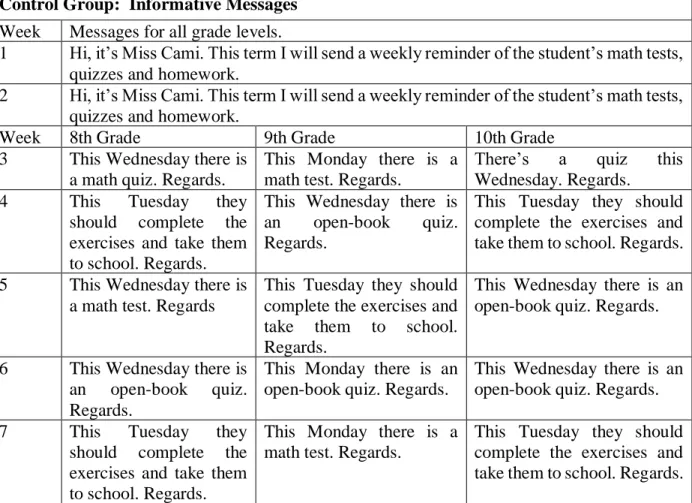
(34) 33 2.2. Method This research is based on a field experiment in which parents were chosen at random to receive a set of text messages encouraging them to complete short and simple nonacademic activities with their adolescent children. We use a mixed-methods approach for data collection and analysis. The study combines quantitative and qualitative data (Creswell & Clark, 2007) to gain a better understanding of the impact that completing these activities has on parent-student relationships (as perceived by the parents) and the students’ achievement in mathematics (as measured by their GPA in math). 2.2.1. Participants The field experiment was conducted at a Chilean school in a low-socioeconomic neighborhood and ran from the end of June to the beginning of August, 2016 (i.e. the Winter and beginning of the Spring term). Fifty percent of students at this school came from families whose household income was considered to be lower than the cost of covering the families’ basic needs. The school has high levels of absenteeism and dropouts, while its academic results are below average even when adjusting for socioeconomic factors (Agencia de Calidad de la Educación, 2016). The adults who participated in this study were parents and guardians, i.e. the people who are responsible for ensuring that the students fulfill their duties at school. In Chile, while the guardians are often the parents, this role is sometimes played by other relatives. Therefore, for simplicity’s sake, guardians and parents are hereby referred to as parents throughout the paper. Participating students were from three different.
(35) 34 grades: 8th, 9th and 10th grades. All 56 parent-student dyads from these courses agreed to participate in the study. Of the 56 parents involved in the study, 55.8% had graduated from high school, with only 4.2% having gone on to higher education. The study involved students aged between 14 and 16 years old. The participating classes had 23 students (14 girls and 9 boys), 17 students (10 girls and 7 boys) and 16 students (9 girls and 7 boys), respectively. All math lessons in these three grades were taught by the same teacher during 2016 (the year of the intervention), while another teacher taught and assessed the students the following year (2017). The sample size was determined by feasibility. We decided to work with just one teacher and 28 students in the treatment group and 28 students in the control group. This meets the “12 per group” rule of thumb for fist-time trials (Julious, 2005). Billingham, Whitehead & Julious (2013) state that for pilot-trials “a formal sample size calculation may not be appropriate”, since a larger sample size may entail exposing participants to unnecessary risks. Moreover, our analyses include 11 controlling variables. Results from their Monte Carlo simulation suggest that two subjects per variable allows for a reasonable estimation of the regression coefficients, standard errors and confidence intervals (Austin & Steyerberg, 2015). 2.2.2. Measurements End-of-term grade point average in mathematics: To answer the research question regarding the effect of the intervention on academic achievement, our main variable of interest was academic performance in mathematics. This was measured on two occasions in order to monitor the impact over time. The first measurement corresponds.
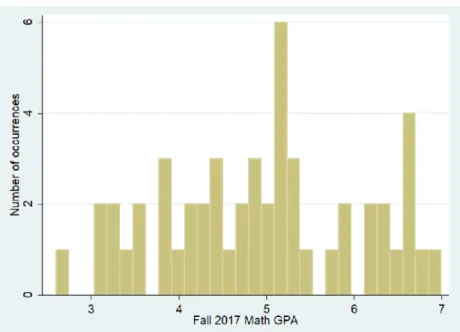
(36) 35 to the end-of-term math GPA during the year of the intervention (i.e., 2016 Spring term). This Spring 2016 Math GPA corresponds to the average grade achieved by a student on the four tests that were given during the three months of the Spring term. Grades can range from 1 (the lowest grade possible in Chile) to 7 (the highest grade). The Spring 2016 Math GPA was collected for all 56 students (M=5.60, SD=0.82). To help interpret the regression coefficients, this outcome was standardized within the sample to have a mean of 0 and standard deviation of 1. The second measurement is the Fall 2017 Math GPA, which corresponds to the endof-term math GPA collected the following academic year. This represents the average grade on the four tests that were given during the 3 months of the Fall 2017 term (M= 4.96, SD=1.26). This measurement is available for the 51 students (91% of participants) who continued at the school. The students who did not continue were distributed evenly across the two conditions (i.e. 2 students from the treatment group and 3 students from the control group). As with the previous outcome, this variable was also standardized within the sample to have a mean of 0 and a standard deviation of 1. The Chilean grading system allows each test to be graded to 1 decimal place. Therefore, an example grade would be a 5.4. As a result, the Spring 2016 and Fall 2017 Math GPA outcomes include 27 and 32 distinct decimal values, respectively (see Figures Appendix 2—E1 and Appendix 2—E2, Appendix 2—E). Given the number of different values for each of the outcomes, we modelled these as continuous variables..
(37) 36. Previous performance: The students’ performance in mathematics during the period leading up to the intervention (Fall 2016) was considered, as well as their overall performance at school and their performance in mathematics in previous years (2013, 2014 and 2015). This information was collected from school records or from the Chilean Department of Education (Ministerio de Educacion, 2016). The Fall 2016 Math GPA corresponds to the average grade achieved by each student on the four tests that were given during the three months of the Fall term (M=4.94; SD=1.13). The Overall Grade Point Average corresponds to the average grade achieved by the student across all subjects in 2013 (M=5.55, SD=0.54), 2014 (M=5.58, SD=0.63), and 2015 (M=5.39, SD=0.60). The Math Grade Point Average corresponds to the average grade achieved by a student in mathematics by the end of the year in 2013 (M=4.72, SD=0.85), 2014 (M=4.84, SD=0.99), and 2015 (M=4.86, SD=0.10). Each variable was standardized to have a mean of 0 and standard deviation of 1. Multiple imputation (Rubin, 2004) was used for 6 cases in which the school records were not available. This calculation was made using the Fall 2016 GPA, as well as the student’s class and gender. Imputation does not change the results of the analysis (when students with missing records are not included in the analysis the estimated effect size is larger). Gender: All of the students were classified as male (1) or female (0). There was no missing information for this variable, while 41% of the students were male..
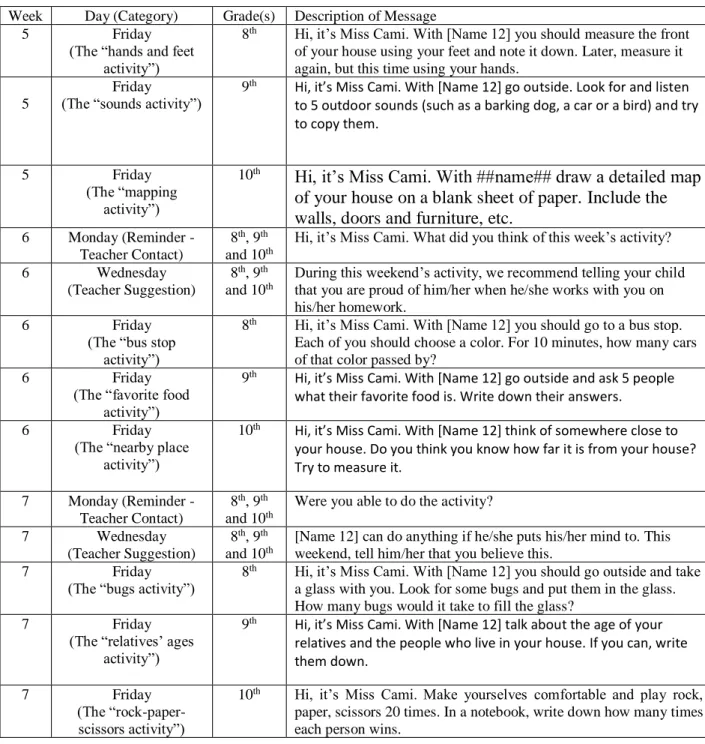
(38) 37. 2.2.3. Intervention To determine the effect of engaging parents in non-academic activities with their children, two groups were randomly assigned as the control group and treatment group. Parents in the treatment group were encouraged via text message to participate in non-academic activities, while parents in the control group were assigned to receive only receive administrative information, e.g. test dates. A description of the design of the activities that were included in the intervention can be found below (for a list of the text messages included sent to the control group, see Appendix 2—C). In order to foster parent-student exchanges through non-academic activities, a series of text messages (SMS) was designed using the Design Thinking approach (Brown, 2008). The Design Thinking approach has been shown to be useful when looking to solve problems creatively (Tschimmel, 2012). This approach has also been used to develop instructional material and psychological interventions (Yeager et al., 2016). This process consists of three stages: inspiration, which involves understanding the problem and its context; ideation, which is the process of synthetizing what was observed in the field and developing and testing competing ideas; and implementation, which is the development of the solution with real end-users (in this case, students, parents and teachers) (Howard & Davis, 2011). Therefore, the “final” design of the.
(39) 38 intervention was the result of an iterative process, which is described briefly in Table 2—1..
(40) 39 Table 2—1 Summary of the iterative process. Phase N°: Design. Participants. Phase Description. Phase 2: Ideation. Research team. Phase 3: Implementation a. 16 students (8th grade). Phase 4: Ideation. Research team. Phase 5: Inspiration. 4 parents. Phase 6: Ideation Phase 7: Implementation a. Research team 44 students (9th grade). Phase 8: Ideation:. Research team. As a result of discussing several ideas, we thought of involving parents through short and understandable activities (i.e. avoid complex vocabulary and formal knowledge of mathematics). We developed the first set of activities. We tested our first set of activities in a real-life setting with parents and students, before then testing them in a classroom. Students who completed the activities with their parents showed enthusiasm and willingness to participate in class activities related to the homework. It was difficult to track whether parents were receiving the text messages as only a few of them answered our messages. We re-evaluated our proposition. We decided to include extrinsic motivators in the next implementation phase (Phase 7) in order for parents to answer our messages. This resulted in adding phone credit if they answered our messages. Starting as early as early childhood, there are significant differences in vocabulary based on socioeconomic status (Hart & Risley, 2003). Therefore, to avoid problems with reading, the content and phrasing of the messages was piloted with parents of students from a similar sociocultural background to those involved in the study. We learnt that even when using what we considered as simple vocabulary, parents could relate a word with a different meaning than what was intended (e.g. a “cube” was understood as a typical Chilean ice-cream instead of the geometrical figure). The understandability of the text messages should always be tested if possible. The messages were rewritten and checked by three members of the research team based on the parents’ feedback. We decided to test our new set of messages for a second time in real-life classroom conditions. However, this time we included extrinsic motivators. At the end of the intervention, some parents expressed feeling a little bit lost about why they were receiving the activities. Adding phone credit increased the response rate for those parents who do not have a phone plan. However, we realized that just because the parents answered more messages, it did not necessarily mean that they completed more activities. Based on the results of Phase 7, we decided to include a brief introduction to the series of activities (see Appendix 2—B, Table Appendix 2—B1) and to drop the extrinsic motivators. We redefined our solution and decided to include a text message suggesting that the parents encourage their child. We decided to measure the impact of the intervention on the students’ achievement. Present study intervention.. Thinking Scope. Phase 9: Implementation Note. aThe design process also included informal conversations with students and parents in order to get feedback during the first two implementation phases..
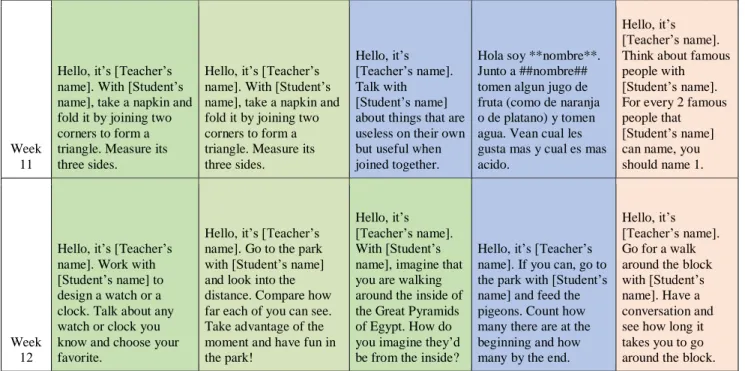
(41) 40. The activities did not include formal curricular mathematics content, nor did they require any previous knowledge. Therefore, how these activities related to mathematics was not evident to the students or their parents. Nevertheless, the activities were aligned to the objectives defined in the national curriculum for highschool math. These simple tasks drew on aspects of the students’ daily life, were written in simple language and required only basic knowledge of mathematics (e.g. counting). They were also designed to be completed in 5 to 15 minutes. In the classroom, the math teacher then indirectly connected these activities to the learning objectives by referring to the same topics (Hindin & Mueller, 2016). All students could participate in the classroom activities as they did not require the homework assignments to have been completed. Parents were encouraged to complete the activities with their child through two introductory text messages (See Table Appendix 2—B1, Appendix 2—B). To show how the non-academic homework was connected to the learning objectives in the following class (usually on the Tuesday), we will analyze one of these activities (see Table Appendix 2—B2, Appendix 2—B), namely the “container activity”. This activity required parents to talk with their children about the largest container in which they had stored water or any other liquid. In the same text message, they were also invited to discuss how much liquid they thought there was in said container. The message was as follows: “Hi, It’s Miss Cami. Talk about the largest container, pot, or jar that you have ever filled with water or any other liquid. How.
(42) 41 much liquid did it hold?” Later, in class, the teacher started the session with the following question: “What’s the largest container you have ever filled with any liquid?” This question was for all 10th grade students, regardless of whether or not their parents had received the text message or they had done the activity. The teacher then used the students’ answers to this question in order to create exercises in which the students had to calculate the dimensions of different bodies of water (e.g., a swimming pool filled with 10,000 liters of water).. Weekly activities were sent to. the parents via text message over a period of five weeks. Each week, the parents received three messages: 1. Friday: The first message of the cycle described the activity that was to be completed with the student (e.g., the “container activity”). 2. Monday: The second message was a reminder, asking the parents whether they had completed the task and how it had gone. 3. Wednesday: The third message included a suggestion of what the parent could say to the student to encourage them. For example, these suggestions included communicating high expectations to the child (Hattie, 2009; Hill & Tyson, 2009), or fostering a growth mindset (Dweck, 2008). In the latter case, this suggestion was made because recent studies show that a growth mindset was particularly lacking among lowincome students in Chile when compared to high-income students (Claro, Paunesku & Dweck, 2016). Furthermore, a growth mindset has also been shown to be important for achievement in mathematics (Dweck, 2008). An example of such a message is the following: “During this weekend’s activity, we recommend telling your child that you.
(43) 42 are proud of her when she tries to get better at math and that you value her effort” (see Table Appendix 2—B2, Appendix 2—B). The teacher did not mention this message to the students in the classroom. The Monday and Wednesday messages were the same for all three grades. However, the activities were different for each grade depending on the math topics covered that week. The full list of text messages that were sent to the three groups are listed in Table B2, Appendix 2—B. 2.2.4. Protocol Within each class, parents of each student were invited to attend a parent-teacher conference, where they signed an informed consent form. The parents who did not attend the meeting were later contacted by telephone and agreed to participate in the study. None of the parents or students refused to participate in the study. After this, the students from each class were randomly assigned to the control and treatment groups (randomized within class). Table 2—2 shows that there was an even distribution between the treatment and control groups. There were no significant differences in terms of the percentage of boys assigned to each group for the three classes (8th, 9th and 10th grade). There were also no significant differences in terms of their previous achievement in Fall 2016. This was also the case with their GPAs for 2015, 2014, and 2013, as well as their Math GPAs for 2015 and 2014. The only exception to this was achievement in math for 2013 (three years before the intervention). This was also true for the 51 students for whom there was information.
(44) 43 available on their achievement the following academic year, as reported in Table Appendix 2—A1 (Appendix 2—A). Baseline differences were assessed using a fixed effects model with robust standard errors in order to compare the mean scores between the treatment and control groups and ensure that they were comparable (Table 2—2). Furthermore, two independent sample t-tests were also carried out (Williams, Grajales & Kurkiewicz, 2013), with the results leading to the same conclusion. Table 2—2 Breakdown of students involved in the intervention Control. Treatment. Sig. diff. pa. Robust SE. .46. 0.42. 0.133. 28. .29. 0.78. 0.125. .32. 28. .25. 0.56. 0.123. 28. .32. 28. .50. 0.20. 0.136. 2013 Math GPA. 23. 4.60. 0.94. 27. 4.82. 0.79. 0.04*. 0.195. 2013 Overall GPA. 23. 5.50. 0.53. 27. 5.60. 0.55. 0.25. 0.176. 2014 Math GPA. 23. 4.89. 0.93. 27. 4.80. 1.06. 0.79. 0.166. 2014 Overall GPA. 23. 5.56. 0.63. 27. 5.60. 0.64. 0.43. 0.166. 2015 Math GPA. 23. 4.89. 0.93. 27. 4.80. 1.06. 0.98. 0.161. 2015 Overall GPA. 23. 5.56. 0.63. 27. 5.60. 0.64. 0.69. 0.124. Variable. N. Grade. 28. 8th. 28. .36. 28. 9th. 28. .32. 10th. 28. Male. Mean. SD. N. Mean. SD. 28. Previous academic achievementb,c.
(45) 44 Fall 2016 Math GPA. 28. 4.96. 1.40. 28. 4.96. 1.15. 0.85. 0.256. Notes. a The p-value is estimated using robust standard errors b The p-value is estimated using group fixed effects in addition to robust standard errors, i.e. using 8 th, 9th and 10th grades as group dummies. * p<0.05. c. The GPA means reported here correspond to the average using available GPAs of students from all the. three grades.. This study was the first time that this particular set of messages had been tested in a real-life setting with parents and students (and subsequently in a classroom). As double-blind studies are not always the best for evaluating new treatments (Büller, Halperin, Bounameaux & Prins, 2008), the teacher was made aware of each student’s study condition (i.e. control or treatment). This information allowed the teacher to detect whether the treatment had prompted any undesired behavior from the parents. For instance, one hypothetical case could have been a student telling the teacher that their parents had forced them to spend time with them when they did not want to. However, the treatment condition was not shared with the students themselves. Notwithstanding the above, the new math teacher (who taught the students during 2017, the year after the intervention) was completely unaware of whether the students had been in the control or treatment group in 2016. Two weeks before the intervention began, two text messages were sent to the parents introducing the objective and characteristics of the activities (for the treatment group) or information (for the control group), as well as highlighting the importance of their participation (see Tables B1 and C1). From the week after this, the parents then.
(46) 45 received 3 weekly messages (treatment) or 1 weekly message (control) over a period of five weeks. At the end of the five weeks, the spring term then proceeded as usual. 2.2.5. Interviews Interviews were used to explore the parents’ perceptions of the effectiveness of the intervention and the characteristics of the parent-student exchanges that were triggered by the text messages. This approach is particularly valuable when addressing issues in complex educational contexts (Teddlie & Tashakkori, 2009). The following questions were used to guide the interview: “What was your perception of the activities and their implementation?” and “What prompted you to do the activities (or not do them)?” The aim of these questions was to understand 1) whether the text messages led to any parent-student exchanges, 2) the perception of the level of pleasure or displeasure produced by the activities, and 3) the obstacles faced when doing the activities (e.g. problems understanding the messages). These semi-structured interviews were conducted by the school teacher over the phone with twelve randomly-selected parents from the treatment group. Parents were told that the information they gave would not be shared with students, other parents or anyone else at the school. Each parent was contacted once during the course of study. The interviews lasted for approximately ten minutes and were conducted by the students’ math teacher, in a friendly and informal tone. The participation by the classroom teacher as researcher in this study allowed for a wider and more integral view of the whole process (Marshall, 1996). As the teacher was part of the classroom dynamic, she had ample information on the students’ behavior in class and a strong relationship with each parent. While we are aware that.
(47) 46 this relationship may have led the parents to try to please the teacher, the same relationship also has the potential for a deeper and more transparent conversation than would have taken place with an external researcher. The information held by the teacher, as well as the relationship she had with the parents, were both important factors when it came to examining the possible effects of this exploratory intervention. To answer the research question regarding the quality of parent-student exchanges, the interview responses were analyzed qualitatively. A “concept map” was made in order to show the perceptions and actions of the subjects of the study, without developing any specific theory (Corbin & Strauss, 2014; Strauss & Corbin, 2002; Whittemore & Knafl, 2005). Doing so allowed us to answer whether well-perceived parent-student exchanges can be encouraged by the math teacher sending text messages to the parents. To study whether certain feelings, expectations or behaviors were fostered by the intervention, the parents’ responses were described textually. This includes any feelings, expectations or behaviors that can in theory constitute a relationship between two people (Sudhakar & Nellaiyapen, 2016). Following this, different descriptive categories were then generated (Peña, 2006). In order to integrate different pieces of data and give them meaning, some of the techniques listed by Miles and Huberman (1984) were adopted. The first approach was to “count” data segments containing similar information in order to get a sense of what was in the data (Morgan, 1993). This was followed by “noting patterns or themes” (by systematically searching for topics that are repeated), “seeing plausibility” (by checking whether conclusions make sense) and “clustering” (by assigning a word or phrase to represent an object, such as processes or events with similar characteristics) (Miles, Huberman & Saldana, 2014)..
Figure

+7



Documento similar
Can complete their academic load with courses from their curriculum, in accordance with the campus’s Academic Support Program regulations and process their partial withdrawal
Abstract: What are the fundamental features that characterize a research framework in mathematics education? What types of questions are important to ask in order to contrast and
In this context, the Parking Slot Assignment Problem is the math- ematical problem that finds assignments of carriers to parking places that satisfy their time windows requests..
classON 3 (in-Class Live Analytics for aSSessment and orchestratiON) is a system aimed at supporting teachers in face-to-face activities in the computer lab. Based on learning
The expansionary monetary policy measures have had a negative impact on net interest margins both via the reduction in interest rates and –less powerfully- the flattening of the
The objectives of this study were, first, to develop a questionnaire allowing, first, to assess the kind of messages through which students self-regulate their learning on the
To delete mail messages, select the folder in which the messages are stored in, and in the top right display panel where the list of messages are displayed, select
For the states in the upper set, above the (2.7) curve, the wage of the low-skilled workers is suffciently high to induce the high-skilled parents to invest little in their
