molecules
Article
Triorganoindium Reagents in Rh-Catalyzed C–H
Activation/C–C Cross-Coupling Reactions
of 2-Arylpyridines
Ricardo RiveirosID, Rubén Tato, JoséPérez Sestelo *ID and Luis A. Sarandeses *ID
Centro de Investigaciones Científicas Avanzadas (CICA) and Departamento de Química, Universidade da Coruña, E-15071 A Coruña, Spain; [email protected] (R.R.); [email protected] (R.T.)
* Correspondence: [email protected] (J.P.S.); [email protected] (L.A.S.); Tel.: +34-881-012-041 (J.P.S.); +34-881-012-174 (L.A.S.)
Received: 24 May 2018; Accepted: 26 June 2018; Published: 29 June 2018
Abstract: The activation of C–H bonds through catalytic reactions using transition metals is an important challenge in organic chemistry in which the intermediates are related to those produced in the classical cross-coupling reactions. As part of our research program devoted to the development of metal-catalyzed reactions using indium organometallics, a protocol for the C–H activation and C–C coupling of 2-arylpyridines with triorganoindium reagents under Rh(I) catalysis is reported. Under the optimized conditions, we found that Me3In and Ar3In reagents reacted with 2-arylpyridines and
related compounds in the presence of Rh(PPh3)3Cl, in PhCl/THF (9:1), at 120◦C for 48 h, to afford
theortho-coupling products in moderate to good yields. The nitrogen atom in the pyridine ring acts as a directing group to assist the functionalization at theorthoposition of the aryl group forming a new C–C bond at this position.
Keywords:C–H activation; cross-coupling reactions; rhodium-catalyzed; indium organometallics
1. Introduction
Since our discovery [1,2], the palladium catalyzed cross-coupling reaction of indium(III) organometallics has been established as a useful tool in organic synthesis [3,4]. In this reaction, triorganoindium reagents (R3In) can efficiently couple with a variety of organic electrophiles under
palladium catalysis with high atom economy [5–8]. The process can be extended to other organoindium reagents [9–13] and transition metals in catalysis [14–17].
The formation of C–C bonds by C–H activation and cross-coupling with organometallics and related nucleophiles under transition metal catalysis constitutes a methodology of great interest due to the atom economy of the process and the challenge that represent the selective functionalization of one C–H bond [18,19]. Usually, a heteroatom acts as directing group for the C–H activation through coordination with the metal center to form a metallacycle that reacts with the organometallic to afford the coupling product (Scheme1) [20,21]. In this field, Oi et al. reported the Rh(I)-catalyzed
ortho-arylation of 2-phenylpyridines with organotin compounds [22], a catalytic system also used in related reactions using boronic acids [23]. In 2003, Murai et al. reported the Ru(II)-catalyzed
ortho-arylation of aryl ketones with boronates [24]. After these pioneering contributions, some coupling reactions of organometallic species with C–H bonds under different transition metal catalysis (Pd, Rh, Ru, Fe, Ir) have been reported [25–30]. Among them, the C–H activation of 2-phenylpyridines with organometallic reagents and related nucleophiles constitutes an interesting topic, developed under palladium [31,32] and iron catalysis [33]. Despite the novelty of this methodology, and to the best of our knowledge, organoindium compounds have not been applied as carbon nucleophiles
Molecules2018,23, 1582 2 of 12
in transition metal catalyzed C–H functionalization. Herein, we report the first examples of C–H activation/cross-coupling reaction of R3In with 2-arylpyridines and related compounds under
Rh catalysis.
Molecules 2018, 23, x FOR PEER REVIEW 2 of 12
applied as carbon nucleophiles in transition metal catalyzed C–H functionalization. Herein, we report the first examples of C–H activation/cross-coupling reaction of R3In with 2-arylpyridines and
related compounds under Rh catalysis.
Scheme 1. C–H activation/C–C cross coupling reactions.
2. Results and Discussion
Our research started by testing the reaction of triorganoindium reagents with 2-(p-tolyl)pyridine (1) under Rh(I) catalysis as a model. In this reaction, the nitrogen atom should serve as a directing group to activate a C–H bond forming a metallacycle, which, by a transmetallation and reductive elimination process, should afford the C–H activation/C–C cross-coupling product. At the outset, we found that the reaction of Me3In (100 mol %) with 1 in the
presence of Rh(PPh3)3Cl (10 mol %) at 120 °C in THF gave methylated compound 2a in a low 16%
yield after 48 h and most of the starting 2-(p-tolyl)pyridine recovered (Table 1, entry 1). Analogously, the reaction using Ph3In (100 mol %) gave 2b in 17% yield along with important amounts of
1,1′-biphenyl, formed by reductive dimerization of the organoindium in the reaction media (entry 2). Using other Rh(I) complexes such as Rh(cod)(acac), Rh(nbd)(acac) or [Rh(cod)Cl]2 combined with
phosphines did not improve the yields (entries 3–6). The influence of the solvent was also studied and, considering that R3In are prepared as THF solutions, various solvent mixtures were used. Using
toluene/THF (9:1) the reaction with Ph3In (100 mol %) and Rh(PPh3)3Cl (10 mol %) at 120 °C for 48 h
gave 2b in a similar 18% yield (entry 7). Considering that polar non-protic chlorinated solvents have been successfully used in Rh(I)-catalyzed C–H activation reactions [22,34,35] 1,1,2,2-tetrachloroethane/THF (9:1) was tested as solvent, obtaining a 27% yield of 2b and a 4% of the o,o′-disubstituted product 2bb (entry 8). Considering that some of the starting 2-(p-tolyl)pyridine is recovered and part of the Ph3In is consumed with the formation of 1,1′-biphenyl, we decided to carry
out the reaction using 150 mol % of Ph3In. Under these conditions, the yield of 2b increased up to
42% (along with a 16% of 2bb; entry 9). Analogously, the reaction using 150 mol % of Me3In also
gave a satisfactory 60% yield of 2a (entry 10). Finally, we found that using chlorobenzene as cosolvent the reaction results in a good 80% yield of 2a using Me3In, and in 47% yield of 2b in the
reaction with Ph3In (entries 11 and 12). Recently, Li et al. reported the arylation of arylpyridines
under rhodium catalysis using chlorobenzene as solvent [35]. Interestingly, we observed that the use of chlorobenzene diminishes the formation of the o,o′-disubstituted product and that the conversion of the starting material is not complete under the reaction conditions.
Table 1. Reaction of indium organometallics with 2-(p-tolyl)pyridine under rhodium catalysis 1.
Entry R (mol % of R3In) Catalyst Solvent Yield (%) 2
1 Me (100) Rh(PPh3)3Cl THF 16
2 Ph (100) Rh(PPh3)3Cl THF 17
+
RDG
DG = directing group
M = B, Sn, Mg
M’cat = Pd, Rh, Ru, Fe, Ir
M’cat H
DG
R M
solvent 120 ºC, 48 h Rh(I) cat. (10%)
N N
R3In
+
R
Me Me
1 2a, R = Me
2b, R = Ph
N
R
Me
2aa, R = Me
2bb, R = Ph
+
R
Scheme 1.C–H activation/C–C cross coupling reactions.
2. Results and Discussion
Our research started by testing the reaction of triorganoindium reagents with 2-(p-tolyl)pyridine (1) under Rh(I) catalysis as a model. In this reaction, the nitrogen atom should serve as a directing group to activate a C–H bond forming a metallacycle, which, by a transmetallation and reductive elimination process, should afford the C–H activation/C–C cross-coupling product. At the outset, we found that the reaction of Me3In (100 mol %) with1in the presence of Rh(PPh3)3Cl (10 mol %) at
120◦C in THF gave methylated compound2ain a low 16% yield after 48 h and most of the starting 2-(p-tolyl)pyridine recovered (Table1, entry 1). Analogously, the reaction using Ph3In (100 mol %) gave
2bin 17% yield along with important amounts of 1,10-biphenyl, formed by reductive dimerization of the organoindium in the reaction media (entry 2). Using other Rh(I) complexes such as Rh(cod)(acac), Rh(nbd)(acac) or [Rh(cod)Cl]2combined with phosphines did not improve the yields (entries 3–6).
The influence of the solvent was also studied and, considering that R3In are prepared as THF solutions,
various solvent mixtures were used. Using toluene/THF (9:1) the reaction with Ph3In (100 mol %) and
Rh(PPh3)3Cl (10 mol %) at 120◦C for 48 h gave2bin a similar 18% yield (entry 7). Considering that
polar non-protic chlorinated solvents have been successfully used in Rh(I)-catalyzed C–H activation reactions [22,34,35] 1,1,2,2-tetrachloroethane/THF (9:1) was tested as solvent, obtaining a 27% yield of2band a 4% of theo,o0-disubstituted product2bb(entry 8). Considering that some of the starting 2-(p-tolyl)pyridine is recovered and part of the Ph3In is consumed with the formation of 1,10-biphenyl,
we decided to carry out the reaction using 150 mol % of Ph3In. Under these conditions, the yield of2b
increased up to 42% (along with a 16% of2bb; entry 9). Analogously, the reaction using 150 mol % of Me3In also gave a satisfactory 60% yield of2a(entry 10). Finally, we found that using chlorobenzene
as cosolvent the reaction results in a good 80% yield of2ausing Me3In, and in 47% yield of2bin
the reaction with Ph3In (entries 11 and 12). Recently, Li et al. reported the arylation of arylpyridines
Molecules2018,23, 1582 3 of 12
Table 1.Reaction of indium organometallics with 2-(p-tolyl)pyridine under rhodium catalysis1.
Molecules 2018, 23, x FOR PEER REVIEW 2 of 12
applied as carbon nucleophiles in transition metal catalyzed C–H functionalization. Herein, we report the first examples of C–H activation/cross-coupling reaction of R3In with 2-arylpyridines and
related compounds under Rh catalysis.
Scheme 1. C–H activation/C–C cross coupling reactions.
2. Results and Discussion
Our research started by testing the reaction of triorganoindium reagents with 2-(p-tolyl)pyridine (1) under Rh(I) catalysis as a model. In this reaction, the nitrogen atom should serve as a directing group to activate a C–H bond forming a metallacycle, which, by a transmetallation and reductive elimination process, should afford the C–H activation/C–C cross-coupling product. At the outset, we found that the reaction of Me3In (100 mol %) with 1 in the
presence of Rh(PPh3)3Cl (10 mol %) at 120 °C in THF gave methylated compound 2a in a low 16%
yield after 48 h and most of the starting 2-(p-tolyl)pyridine recovered (Table 1, entry 1). Analogously, the reaction using Ph3In (100 mol %) gave 2b in 17% yield along with important amounts of
1,1′-biphenyl, formed by reductive dimerization of the organoindium in the reaction media (entry 2). Using other Rh(I) complexes such as Rh(cod)(acac), Rh(nbd)(acac) or [Rh(cod)Cl]2 combined with
phosphines did not improve the yields (entries 3–6). The influence of the solvent was also studied and, considering that R3In are prepared as THF solutions, various solvent mixtures were used. Using
toluene/THF (9:1) the reaction with Ph3In (100 mol %) and Rh(PPh3)3Cl (10 mol %) at 120 °C for 48 h
gave 2b in a similar 18% yield (entry 7). Considering that polar non-protic chlorinated solvents have been successfully used in Rh(I)-catalyzed C–H activation reactions [22,34,35] 1,1,2,2-tetrachloroethane/THF (9:1) was tested as solvent, obtaining a 27% yield of 2b and a 4% of the o,o′-disubstituted product 2bb (entry 8). Considering that some of the starting 2-(p-tolyl)pyridine is recovered and part of the Ph3In is consumed with the formation of 1,1′-biphenyl, we decided to carry
out the reaction using 150 mol % of Ph3In. Under these conditions, the yield of 2b increased up to
42% (along with a 16% of 2bb; entry 9). Analogously, the reaction using 150 mol % of Me3In also
gave a satisfactory 60% yield of 2a (entry 10). Finally, we found that using chlorobenzene as cosolvent the reaction results in a good 80% yield of 2a using Me3In, and in 47% yield of 2b in the
reaction with Ph3In (entries 11 and 12). Recently, Li et al. reported the arylation of arylpyridines
under rhodium catalysis using chlorobenzene as solvent [35]. Interestingly, we observed that the use of chlorobenzene diminishes the formation of the o,o′-disubstituted product and that the conversion of the starting material is not complete under the reaction conditions.
Table 1. Reaction of indium organometallics with 2-(p-tolyl)pyridine under rhodium catalysis 1.
Entry R (mol % of R3In) Catalyst Solvent Yield (%) 2
3 Me (100) Rh(cod)(acac) THF 14
4 Me (100) Rh(nbd)(acac) THF 15
53 Me (100) [Rh(cod)Cl]2, Ph3P THF 14
1Reactions performed in a Schlenk tube using 10 mol % of the rhodium complex at 120◦C for 48 h.2In parentheses,
yield of theo,o0-dicoupling product (2aa, 2bb) obtained. 3 5 mol % of rhodium complex and 20 mol % of phosphine used.
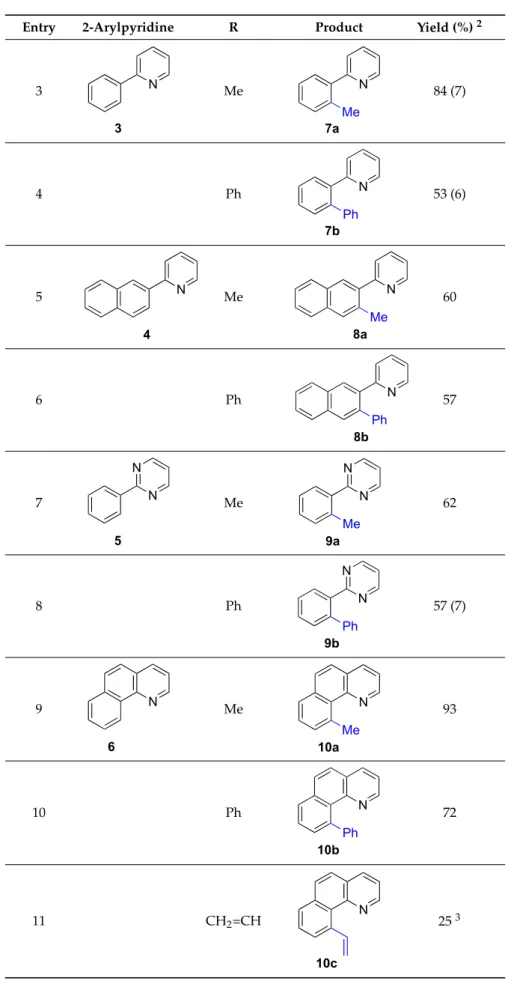
With the optimized conditions in hand, we explored the versatility of the reaction using various 2-arylpyridines. The reaction of Me3In with 2-phenylpyridine (3) yielded the methylated compound
7ain a good 84% yield (and a 7% of theo,o0-dicoupled product7aa, Table2, entry 3). Alternatively, the reaction of Ph3In with 2-phenylpyridine (3) afforded7bin 53% yield (6% of the disubstituted
compound7bb, entry 4).
Table 2.Reaction of R3In with 2-arylpyridines under rhodium catalysis1.
Molecules 2018, 23, x FOR PEER REVIEW 3 of 12
1 Reactions performed in a Schlenk tube using 10 mol % of the rhodium complex at 120 °C for 48 h. 2
In parentheses, yield of the o,o′-dicoupling product (2aa, 2bb) obtained. 3 5 mol % of rhodium complex and 20 mol % of phosphine used.
With the optimized conditions in hand, we explored the versatility of the reaction using various 2-arylpyridines. The reaction of Me3In with 2-phenylpyridine (3) yielded the methylated compound 7a in a good 84% yield (and a 7% of the o,o′-dicoupled product 7aa, Table 2, entry 3). Alternatively, the reaction of Ph3In with 2-phenylpyridine (3) afforded 7b in 53% yield (6% of the disubstituted
compound 7bb, entry 4).
Table 2. Reaction of R3In with 2-arylpyridines under rhodium catalysis 1.
Entry 2-Arylpyridine R Product Yield (%) 2
Entry 2-Arylpyridine R Product Yield (%)2
1
1 Reactions performed in a Schlenk tube using 10 mol % of the rhodium complex at 120 °C for 48 h. 2
In parentheses, yield of the o,o′-dicoupling product (2aa, 2bb) obtained. 3 5 mol % of rhodium complex and 20 mol % of phosphine used.
With the optimized conditions in hand, we explored the versatility of the reaction using various 2-arylpyridines. The reaction of Me3In with 2-phenylpyridine (3) yielded the methylated compound 7a in a good 84% yield (and a 7% of the o,o′-dicoupled product 7aa, Table 2, entry 3). Alternatively, the reaction of Ph3In with 2-phenylpyridine (3) afforded 7b in 53% yield (6% of the disubstituted
compound 7bb, entry 4).
Table 2. Reaction of R3In with 2-arylpyridines under rhodium catalysis 1.
Entry 2-Arylpyridine R Product Yield (%) 2
1 Reactions performed in a Schlenk tube using 10 mol % of the rhodium complex at 120 °C for 48 h. 2
In parentheses, yield of the o,o′-dicoupling product (2aa, 2bb) obtained. 3 5 mol % of rhodium complex and 20 mol % of phosphine used.
With the optimized conditions in hand, we explored the versatility of the reaction using various 2-arylpyridines. The reaction of Me3In with 2-phenylpyridine (3) yielded the methylated compound 7a in a good 84% yield (and a 7% of the o,o′-dicoupled product 7aa, Table 2, entry 3). Alternatively, the reaction of Ph3In with 2-phenylpyridine (3) afforded 7b in 53% yield (6% of the disubstituted
compound 7bb, entry 4).
Table 2. Reaction of R3In with 2-arylpyridines under rhodium catalysis 1.
Entry 2-Arylpyridine R Product Yield (%) 2
1 Reactions performed in a Schlenk tube using 10 mol % of the rhodium complex at 120 °C for 48 h. 2
In parentheses, yield of the o,o′-dicoupling product (2aa, 2bb) obtained. 3 5 mol % of rhodium complex and 20 mol % of phosphine used.
With the optimized conditions in hand, we explored the versatility of the reaction using various 2-arylpyridines. The reaction of Me3In with 2-phenylpyridine (3) yielded the methylated compound 7a in a good 84% yield (and a 7% of the o,o′-dicoupled product 7aa, Table 2, entry 3). Alternatively, the reaction of Ph3In with 2-phenylpyridine (3) afforded 7b in 53% yield (6% of the disubstituted
compound 7bb, entry 4).
Table 2. Reaction of R3In with 2-arylpyridines under rhodium catalysis 1.
Molecules2018,23, 1582 4 of 12
Table 2.Cont.
Entry 2-Arylpyridine R Product Yield (%)2
3
1 Reactions performed in a Schlenk tube using 10 mol % of the rhodium complex at 120 °C for 48 h. 2
In parentheses, yield of the o,o′-dicoupling product (2aa, 2bb) obtained. 3 5 mol % of rhodium complex and 20 mol % of phosphine used.
With the optimized conditions in hand, we explored the versatility of the reaction using various 2-arylpyridines. The reaction of Me3In with 2-phenylpyridine (3) yielded the methylated compound 7a in a good 84% yield (and a 7% of the o,o′-dicoupled product 7aa, Table 2, entry 3). Alternatively, the reaction of Ph3In with 2-phenylpyridine (3) afforded 7b in 53% yield (6% of the disubstituted
compound 7bb, entry 4).
Table 2. Reaction of R3In with 2-arylpyridines under rhodium catalysis 1.
Entry 2-Arylpyridine R Product Yield (%) 2
1 Reactions performed in a Schlenk tube using 10 mol % of the rhodium complex at 120 °C for 48 h. 2
In parentheses, yield of the o,o′-dicoupling product (2aa, 2bb) obtained. 3 5 mol % of rhodium complex and 20 mol % of phosphine used.
With the optimized conditions in hand, we explored the versatility of the reaction using various 2-arylpyridines. The reaction of Me3In with 2-phenylpyridine (3) yielded the methylated compound 7a in a good 84% yield (and a 7% of the o,o′-dicoupled product 7aa, Table 2, entry 3). Alternatively, the reaction of Ph3In with 2-phenylpyridine (3) afforded 7b in 53% yield (6% of the disubstituted
compound 7bb, entry 4).
Table 2. Reaction of R3In with 2-arylpyridines under rhodium catalysis 1.
Entry 2-Arylpyridine R Product Yield (%) 2
1 Reactions performed in a Schlenk tube using 10 mol % of the rhodium complex at 120 °C for 48 h. 2
In parentheses, yield of the o,o′-dicoupling product (2aa, 2bb) obtained. 3 5 mol % of rhodium complex and 20 mol % of phosphine used.
With the optimized conditions in hand, we explored the versatility of the reaction using various 2-arylpyridines. The reaction of Me3In with 2-phenylpyridine (3) yielded the methylated compound 7a in a good 84% yield (and a 7% of the o,o′-dicoupled product 7aa, Table 2, entry 3). Alternatively, the reaction of Ph3In with 2-phenylpyridine (3) afforded 7b in 53% yield (6% of the disubstituted
compound 7bb, entry 4).
Table 2. Reaction of R3In with 2-arylpyridines under rhodium catalysis 1.
Entry 2-Arylpyridine R Product Yield (%) 2
1 Reactions performed in a Schlenk tube using 10 mol % of the rhodium complex at 120 °C for 48 h. 2
In parentheses, yield of the o,o′-dicoupling product (2aa, 2bb) obtained. 3 5 mol % of rhodium complex and 20 mol % of phosphine used.
With the optimized conditions in hand, we explored the versatility of the reaction using various 2-arylpyridines. The reaction of Me3In with 2-phenylpyridine (3) yielded the methylated compound 7a in a good 84% yield (and a 7% of the o,o′-dicoupled product 7aa, Table 2, entry 3). Alternatively, the reaction of Ph3In with 2-phenylpyridine (3) afforded 7b in 53% yield (6% of the disubstituted
compound 7bb, entry 4).
Table 2. Reaction of R3In with 2-arylpyridines under rhodium catalysis 1.
Entry 2-Arylpyridine R Product Yield (%) 2
1 Reactions performed in a Schlenk tube using 10 mol % of the rhodium complex at 120 °C for 48 h. 2
In parentheses, yield of the o,o′-dicoupling product (2aa, 2bb) obtained. 3 5 mol % of rhodium complex and 20 mol % of phosphine used.
With the optimized conditions in hand, we explored the versatility of the reaction using various 2-arylpyridines. The reaction of Me3In with 2-phenylpyridine (3) yielded the methylated compound 7a in a good 84% yield (and a 7% of the o,o′-dicoupled product 7aa, Table 2, entry 3). Alternatively, the reaction of Ph3In with 2-phenylpyridine (3) afforded 7b in 53% yield (6% of the disubstituted
compound 7bb, entry 4).
Table 2. Reaction of R3In with 2-arylpyridines under rhodium catalysis 1.
Entry 2-Arylpyridine R Product Yield (%) 2
1 Reactions performed in a Schlenk tube using 10 mol % of the rhodium complex at 120 °C for 48 h. 2
In parentheses, yield of the o,o′-dicoupling product obtained. 3 Cl2CHCHCl2/THF (9:1) was used as solvent.
The reaction was also tested with 2-(2-naphthyl)pyridine (4), a compound with two nonsymmetrical o-positions of the aryl group. Under the optimized conditions, the reaction of 4 with Me3In and Ph3In allowed the synthesis of 8a and 8b in 60% and 57% yields, respectively (entries 5
and 6) without isolation of the double coupling products. The selectivity for the first C–H activation N
1 Reactions performed in a Schlenk tube using 10 mol % of the rhodium complex at 120 °C for 48 h. 2
In parentheses, yield of the o,o′-dicoupling product obtained. 3 Cl2CHCHCl2/THF (9:1) was used as solvent.
The reaction was also tested with 2-(2-naphthyl)pyridine (4), a compound with two nonsymmetrical o-positions of the aryl group. Under the optimized conditions, the reaction of 4 with Me3In and Ph3In allowed the synthesis of 8a and 8b in 60% and 57% yields, respectively (entries 5
and 6) without isolation of the double coupling products. The selectivity for the first C–H activation N
1 Reactions performed in a Schlenk tube using 10 mol % of the rhodium complex at 120 °C for 48 h. 2
In parentheses, yield of the o,o′-dicoupling product obtained. 3 Cl2CHCHCl2/THF (9:1) was used as solvent.
The reaction was also tested with 2-(2-naphthyl)pyridine (4), a compound with two nonsymmetrical o-positions of the aryl group. Under the optimized conditions, the reaction of 4 with Me3In and Ph3In allowed the synthesis of 8a and 8b in 60% and 57% yields, respectively (entries 5
and 6) without isolation of the double coupling products. The selectivity for the first C–H activation N
1 Reactions performed in a Schlenk tube using 10 mol % of the rhodium complex at 120 °C for 48 h. 2
In parentheses, yield of the o,o′-dicoupling product obtained. 3 Cl2CHCHCl2/THF (9:1) was used as solvent.
The reaction was also tested with 2-(2-naphthyl)pyridine (4), a compound with two nonsymmetrical o-positions of the aryl group. Under the optimized conditions, the reaction of 4 with Me3In and Ph3In allowed the synthesis of 8a and 8b in 60% and 57% yields, respectively (entries 5
and 6) without isolation of the double coupling products. The selectivity for the first C–H activation N
1 Reactions performed in a Schlenk tube using 10 mol % of the rhodium complex at 120 °C for 48 h. 2
In parentheses, yield of the o,o′-dicoupling product obtained. 3 Cl2CHCHCl2/THF (9:1) was used as solvent.
The reaction was also tested with 2-(2-naphthyl)pyridine (4), a compound with two nonsymmetrical o-positions of the aryl group. Under the optimized conditions, the reaction of 4 with Me3In and Ph3In allowed the synthesis of 8a and 8b in 60% and 57% yields, respectively (entries 5
and 6) without isolation of the double coupling products. The selectivity for the first C–H activation N
1 Reactions performed in a Schlenk tube using 10 mol % of the rhodium complex at 120 °C for 48 h. 2
In parentheses, yield of the o,o′-dicoupling product obtained. 3 Cl2CHCHCl2/THF (9:1) was used as solvent.
The reaction was also tested with 2-(2-naphthyl)pyridine (4), a compound with two nonsymmetrical o-positions of the aryl group. Under the optimized conditions, the reaction of 4 with Me3In and Ph3In allowed the synthesis of 8a and 8b in 60% and 57% yields, respectively (entries 5
and 6) without isolation of the double coupling products. The selectivity for the first C–H activation N
1 Reactions performed in a Schlenk tube using 10 mol % of the rhodium complex at 120 °C for 48 h. 2
In parentheses, yield of the o,o′-dicoupling product obtained. 3 Cl2CHCHCl2/THF (9:1) was used as solvent.
The reaction was also tested with 2-(2-naphthyl)pyridine (4), a compound with two nonsymmetrical o-positions of the aryl group. Under the optimized conditions, the reaction of 4 with Me3In and Ph3In allowed the synthesis of 8a and 8b in 60% and 57% yields, respectively (entries 5
and 6) without isolation of the double coupling products. The selectivity for the first C–H activation N
1 Reactions performed in a Schlenk tube using 10 mol % of the rhodium complex at 120 °C for 48 h. 2
In parentheses, yield of the o,o′-dicoupling product obtained. 3 Cl2CHCHCl2/THF (9:1) was used as solvent.
The reaction was also tested with 2-(2-naphthyl)pyridine (4), a compound with two nonsymmetrical o-positions of the aryl group. Under the optimized conditions, the reaction of 4 with Me3In and Ph3In allowed the synthesis of 8a and 8b in 60% and 57% yields, respectively (entries 5
Molecules2018,23, 1582 5 of 12
Table 2.Cont.
Entry 2-Arylpyridine R Product Yield (%)2
12 4-CF3C6H4
1 Reactions performed in a Schlenk tube using 10 mol % of the rhodium complex at 120 °C for 48 h. 2
In parentheses, yield of the o,o′-dicoupling product obtained. 3 Cl2CHCHCl2/THF (9:1) was used as solvent.
The reaction was also tested with 2-(2-naphthyl)pyridine (4), a compound with two nonsymmetrical o-positions of the aryl group. Under the optimized conditions, the reaction of 4 with Me3In and Ph3In allowed the synthesis of 8a and 8b in 60% and 57% yields, respectively (entries 5
and 6) without isolation of the double coupling products. The selectivity for the first C–H activation N
1 Reactions performed in a Schlenk tube using 10 mol % of the rhodium complex at 120 °C for 48 h. 2
In parentheses, yield of the o,o′-dicoupling product obtained. 3 Cl2CHCHCl2/THF (9:1) was used as solvent.
The reaction was also tested with 2-(2-naphthyl)pyridine (4), a compound with two nonsymmetrical o-positions of the aryl group. Under the optimized conditions, the reaction of 4 with Me3In and Ph3In allowed the synthesis of 8a and 8b in 60% and 57% yields, respectively (entries 5
and 6) without isolation of the double coupling products. The selectivity for the first C–H activation N
1 Reactions performed in a Schlenk tube using 10 mol % of the rhodium complex at 120 °C for 48 h. 2
In parentheses, yield of the o,o′-dicoupling product obtained. 3 Cl2CHCHCl2/THF (9:1) was used as solvent.
The reaction was also tested with 2-(2-naphthyl)pyridine (4), a compound with two nonsymmetrical o-positions of the aryl group. Under the optimized conditions, the reaction of 4 with Me3In and Ph3In allowed the synthesis of 8a and 8b in 60% and 57% yields, respectively (entries 5
and 6) without isolation of the double coupling products. The selectivity for the first C–H activation N
1Reactions performed in a Schlenk tube using 10 mol % of the rhodium complex at 120◦C for 48 h.2In parentheses,
yield of theo,o0-dicoupling product obtained.3Cl
2CHCHCl2/THF (9:1) was used as solvent.
The reaction was also tested with 2-(2-naphthyl)pyridine (4), a compound with two nonsymmetricalo-positions of the aryl group. Under the optimized conditions, the reaction of 4 with Me3In and Ph3In allowed the synthesis of8aand8bin 60% and 57% yields, respectively (entries 5
and 6) without isolation of the double coupling products. The selectivity for the first C–H activation in a substrate where the twoorthopositions are different in terms of electron density and steric hindrance is remarkable.
Additionally, we also tested the reactivity of 2-phenylpyrimidine (5), a substrate possessing two nitrogen atoms. The reaction with Me3In under the optimized conditions, afforded9ain 62% yield as
the only product (entry 7). Using Ph3In, the monoarylated compound9bwas obtained in 57% yield,
accompanied by the formation of a 7% yield of the disubstituted product9bb(entry 8).
To improve the selectivity of the process, we used a rigid substrate such as benzo[h]quinoline (6) as starting material. In this case, the reaction of6with Me3In afforded10aas the only reaction product
in an excellent 93% yield (entry 9). Furthermore, the reaction of6with Ph3In afforded compound10b
in a 72% yield (entry 10). In these set of experiments, we demonstrated the efficiency of organoindium reagents in the transfer of methyl and phenyl groups in C–H coupling reactions with 2-arylpyridines.
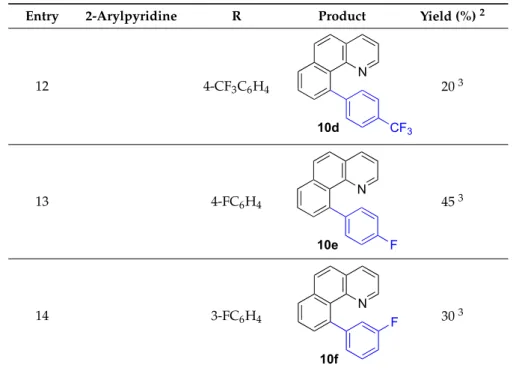
At this point we also decided to test the versatility of the process using other triorganoindium reagents under the same reaction condition and using 1,1,2,2-tetrachloroethane as solvent. The reaction of trivinylindium with6afforded10cin a modest 25% yield (entry 11). Alternatively, the reaction of6with other triarylindium species such as tris[4-(trifluoromethyl)phenyl]indium, tris(4-fluorophenyl)indium and tris(3-fluorophenyl)indium, under the usual conditions, led to the compounds10d–fin moderated yields (20–45%; entries 12–14). Although the isolated yields of these last reactions might not be optimal, overall, these results represent the first examples of application of triorganoindium reagents in the Rh-catalyzed C–H activation and C–C cross-coupling with 2-arylpyridines and analogs and constitute a new entry in the reactivity of these compounds.
Molecules2018,23, 1582 6 of 12
elimination to give the coupling product and a Rh(I)H species. Finally, the chlorinated solvent could participate in the regeneration of the active catalytic Rh(I) species by hydrogen/chloride exchange or HCl elimination. As for the proposal of Oi et al. [22], trichloroethylene was detected by1H NMR of the reaction crude when 1,1,2,2-tetrachloroethane was used as solvent.
3. Materials and Methods
3.1. Materials and Reagents
All reactions were carried out in flamed dried glassware, under argon atmosphere, using standard gastight syringes, cannulas, and septa. Reaction temperatures refer to external bath temperatures. Anhydrous THF was obtained by distillation from the sodium ketyl of benzophenone. Chlorobenzene and 1,1,2,2-tetrachloroethane were dried and stored over microwave-activated 4 Å molecular sieves. All other commercially available reagents were used as received. Organolithium reagents (phenyllithium and methyllithium) were titrated prior to use. Organic extracts were dried over anhydrous MgSO4, filtered,
and concentrated by using a rotary evaporator at aspirator pressure. Reactions were monitored by TLC using pre-coated silica gel plates (Alugram Xtra SIL G/UV254, 0.20 mm thick), UV light as the visualizing
agent and ethanolic phosphomolybdic acid as the developing agent. Flash column chromatography was performed on silica gel (230–400 mesh).1H and13C NMR were recorded in CDCl3at 300 MHz for1H
and 75 MHz for13C, at 300 K, and calibrated to the solvent peak. DEPT data were used to assign carbon
types (see Supplementary Materials). Mass spectra were obtained with EI ionization at 70 eV. IR spectra were recorded on a FT-IR spectrometer with an ATR (Attenuated Total Reflectance) accessory.
3.2. Preparation of Triorganoindium Reagents
Triorganoindium compounds were prepared according to previously published methods [36] by treatment of the corresponding organolithium reagent (3 equiv, ~0.5 M in THF) with a solution of InCl3
(1 equiv, 0.45 M in THF) at−78◦C and warming to room temperature. Organolithium reagents derived from 1-bromo-4-(trifluoromethyl)benzene, 1-bromo-4-fluorobenzene, 1-bromo-3-fluorobenzene and vinyl bromide were prepared by metal-halogen exchange reaction witht-BuLi (2 equiv) at−78◦C.
3.3. Preparation of Compounds4and5
2-(2-Naphthyl)pyridine(4) [37]. To a solution of 2-bromopyridine (0.96 mL, 10.0 mmol) and Pd(dppf)Cl2
(408 mg, 0.5 mmol) in THF (50 mL), tri(2-naphthyl)indium (10.0 mmol, ~0.3 M in THF) was added. The mixture was stirred at 80◦C during 20 h, and the reaction was quenched by addition of drops of MeOH. The solvent was evaporated and EtOAc (25 mL) was added. The organic phase was washed with HCl (5%, 15 mL), satd. NH4Cl (15 mL) and brine (15 mL), dried, filtered, and concentrated.
The crude was purified by flash chromatography (10% EtOAc/hexane), affording, after concentration and drying,9(1.05 g, 5.12 mmol, 51%) as a yellow solid. M.p. 69–70◦C (lit. [37], 77–78◦C);1H NMR (CDCl3, 300 MHz)δ7.27 (ddd,J= 7.2, 4.9, 1.0 Hz, 1 H), 7.50–7.55 (m, 2 H), 7.80 (td,J= 7.7, 1.8 Hz, 1 H), 7.87–7.97 (m, 4 H), 8.16 (dd,J = 8.6, 1.8 Hz, 1 H), 8.50 (d,J = 1.5 Hz, 1 H), 8.77 (ddd,J= 4.9, 1.5, 1.0 Hz, 1 H) ppm;13C NMR (CDCl
3, 75 MHz)δ120.8 (CH), 122.1 (CH), 124.5 (CH), 126.3 (CH), 126.3 (CH), 126.5 (CH), 127.6 (CH), 128.4 (CH), 128.7 (CH), 133.5 (C), 133.6 (C), 136.6 (C), 136.8 (CH), 149.7 (CH), 157.3 (C) ppm; IR (ATR) 3053, 3010, 2919, 2849 cm−1; MS (EI) m/z(%) 205 (M+, 100), 204 ([M−H]+, 75); HRMS (EI)m/zcalcd for C15H11N 205.0886, found 205.0881.
2-Phenylpyrimidine(5) [38]. To a solution of 2-chloropyrimidine (1.21 g, 10.0 mmol) and Pd(dppf)Cl2
(408 mg, 0.5 mmol) in THF (50 mL), triphenylindium (4.0 mmol, ~0.3 M en THF) was added. The mixture was stirred at 80◦C for 4 h and the reaction quenched by addition of drops of MeOH. The solvent was evaporated and EtOAc (25 mL) was added. The organic phase was washed with HCl (5%, 15 mL), satd. NH4Cl (15 mL) and brine (15 mL), dried, filtered, and concentrated. The crude
Molecules2018,23, 1582 7 of 12
300 MHz)δ6.95 (t,J= 4.9 Hz, 1 H), 7.42–7.49 (m, 3 H), 8.47–8.50 (m, 2 H), 8.66 (d,J= 4.9 Hz, 2 H) ppm;
13C NMR (CDCl
3, 75 MHz)δ119.0 (CH), 128.2 (2×CH), 128.6 (2×CH), 130.8 (CH), 137.5 (C), 157.1 (2×CH), 164.5 (C) ppm; IR (ATR) 3087, 3066, 3039 cm−1; MS (EI)m/z(%) 156 (M+, 92), 103 (100); HRMS (EI)m/zcalcd for C10H8N2156.0682, found 156.0683.
3.4. General Procedure C–H Activation/C–C Cross-Coupling with Indium(III) Organometallics under Rhodium Catalysis
In a Schlenk tube, a solution of R3In (0.375 mmol, ~0.3 M en THF) and the arylpyridine (0.25 mmol)
were successively added to a solution of Rh(PPh3)3Cl (24 mg, 0.025 mmol) in chlorobenzene (20 mL).
The mixture was stirred at 120 ◦C during 48 h, and the reaction quenched by addition of drops of MeOH. The solvent was evaporated and CHCl3 (25 mL) was added. The organic phase was
washed with aq. NH3(5%, 15 mL), dried, filtered, and concentrated. The crude was purified by flash
chromatography (Et2O/hexane) affording, after concentration and drying, the cross-coupling products.
2-(2,4-Dimethylphenyl)pyridine(2a) [39]. Colorless oil (37 mg, 0.200 mmol, 80%). 1H NMR (CDCl 3,
300 MHz)δ2.35 (s, 3 H), 2.38 (s, 3 H), 7.10 (d,J= 7.7 Hz, 2 H), 7.23 (ddd,J= 7.5, 4.9, 1.0 Hz, 1 H), 7.31 (d,J= 7.5 Hz, 1 H), 7.39 (dt,J= 7.9, 1.0 Hz, 1 H), 7.73 (td,J= 7.7, 1.8 Hz, 1 H), 8.69 (ddd,J= 4.9, 1.8, 1.0 Hz, 1 H) ppm;13C NMR (CDCl3, 75 MHz)δ20.2 (CH3), 21.1 (CH3), 121.3 (CH), 124.0 (CH), 126.5
(CH), 129.6 (CH), 131.4 (CH), 135.5 (C), 135.9 (CH), 137.6 (C), 137.9 (C), 149.1 (CH), 160.1 (C) ppm; IR (ATR) 2954, 2922, 2853, 2360 cm−1; MS (EI)m/z(%) 183 (M+, 44), 182 ([M−H]+, 100); HRMS (EI)
m/zcalcd for C13H13N 183.1043, found 183.1027.
2-(2,4,6-trimethylphenyl)pyridine(2aa) [40]. Colorless oil (6 mg, 0.030 mmol, 12%)1H NMR (CDCl3,
300 MHz)δ2.03 (s, 6 H), 2.33 (s, 3 H), 6.94 (s, 2 H), 7.24–7.30 (m, 2 H), 7.18 (td,J= 7.7, 1.6 Hz, 1 H), 8.72–8.74 (m, 1 H) ppm;13C NMR (CDCl3, 75 MHz)δ20.0 (2×CH3), 21.0 (CH3), 121.6 (CH), 124.8
(CH), 128.3 (2×CH), 135.2 (C), 135.6 (2×C), 136.5 (CH), 137.5 (C), 149.2 (CH), 159.7 (C) ppm; IR (ATR) 2952, 2921, 2855, 2358 cm−1; MS (EI)m/z(%) 197 (M+, 34), 196 ([M−H]+, 100); HRMS (EI)m/zcalcd for C14H15N 197.1199, found 197.1181.
2-(5-Methyl[1,10-biphenyl]-2-yl)pyridine (2b) [41]. White solid (29 mg, 0.118 mmol, 47%). 1H NMR (CDCl3, 300 MHz)δ2.46 (s, 3 H), 6.86 (dt,J= 7.9, 1.0 Hz, 1 H), 7.08 (ddd,J= 7.5, 4.9, 1.0 Hz, 1 H), 7.14–7.19 (m, 2 H), 7.21–7.31 (m, 5 H), 7.36 (td,J= 7.7, 1.8 Hz, 1 H), 7.63 (d,J= 7.7 Hz, 1 H), 8.63 (ddd,
J= 4.9, 1.8, 1.0 Hz, 1 H) ppm;13C NMR (CDCl3, 75 MHz)δ21.2 (CH3), 121.0 (CH), 125.3 (CH), 126.6
(CH), 128.0 (2×CH), 128.3 (CH), 129.6 (2×CH), 130.4 (CH), 131.2 (CH), 135.0 (CH), 136.7 (C), 138.3 (C), 140.4 (C), 141.5 (C), 149.3 (CH), 159.2 (C) ppm; IR (ATR) 3025, 2921, 2852 cm−1; MS (EI)m/z(%) 245 (M+, 32), 244 ([M−H]+, 100); HRMS (ESI)m/zcalcd for C18H16N ([M + H]+) 246.1277, found 246.1275.
2-(50-Methyl[1,10:30,10’-terphenyl]-20-yl)pyridine(2bb) [42]. White solid. (5 mg, 0.015 mmol, 6%)1H NMR (CDCl3, 300 MHz)δ2.49 (s, 3 H), 6.85–6.92 (m, 2 H), 7.09–7.18 (m, 10 H), 7.26–7.32 (m, 3 H), 8.31 (ddd,J= 4.9, 1.6, 1.0 Hz, 1 H) ppm;13C NMR (CDCl3, 75 MHz)δ21.2 (CH3), 120.6 (CH), 126.1
(2×CH), 126.8 (CH), 127.5 (4×CH), 129.6 (4×CH), 130.1 (2×CH), 134.7 (CH), 135.8 (C), 137.7 (C), 141.7 (2×C), 141.7 (2×C), 148.4 (CH), 159.0 (C) ppm; IR (ATR) 3054, 3026, 2955, 2922, 2852 cm−1; MS (EI)m/z(%) 321 (M+, 52), 320 ([M−H]+, 100); HRMS (ESI)m/zcalcd for C24H20N ([M + H]+) 322.1590,
found 322.1589.
2-(2-Methylphenyl)pyridine(7a) [43]. Colorless oil (36 mg, 0.210 mmol, 84%).1H NMR (CDCl
3, 300 MHz)
δ2.38 (s, 3 H), 7.23–7.32 (m, 4 H), 7.39–7.43 (m, 2 H), 7.75 (td,J= 7.7, 1.9 Hz, 1 H), 8.71 (ddd,J= 4.9, 1.9, 1.0 Hz, 1 H) ppm;13C NMR (CDCl3, 75 MHz)δ20.2 (CH3), 121.5 (CH), 124.0 (CH), 125.8 (CH), 128.2
(CH), 129.6 (CH), 130.7 (CH), 135.7 (C), 136.0 (CH), 140.4 (C), 149.2 (CH), 160.0 (C) ppm; IR (ATR) 3059, 2924, 2359 cm−1; MS (EI)m/z(%) 169 (M+, 34), 168 ([M−H]++, 100); HRMS (EI)m/zcalcd for C
12H10N
([M−H]+) 168.0808, found 168.0814.
2-(2,6-dimethylphenyl)pyridine (7aa) [39]. Colorless oil (3 mg, 0.016 mmol, 7%) 1H NMR (CDCl3,
Molecules2018,23, 1582 8 of 12
J= 4.9, 1.9, 1.0 Hz, 1 H) ppm;13C NMR (CDCl3, 75 MHz)δ20.1 (2×CH3), 121.6 (CH), 124.4 (CH),
127.5 (2×CH), 127.8 (CH), 135.7 (2×C), 136.2 (CH), 140.4 (C), 149.7 (CH), 159.9 (C) ppm; IR (ATR) 2924, 2854, 2360, 2214 cm−1; MS (EI)m/z(%) 183 (M+, 35), 182 ([M−H]+, 100); HRMS (EI)m/zcalcd for C13H12N ([M−H]+) 182.0964, found 182.0963.
2-[1,10-Biphenyl]-2-yl-pyridine(7b) [44]. White solid (31 mg, 0.132 mmol, 53%). M.p. 86–87◦C (lit. [44], 86.5–87.5◦C);1H NMR (CDCl
3, 300 MHz)δ6.89 (dt,J= 7.9, 1.0 Hz, 1 H), 7.10 (ddd,J= 7.5, 4.9, 1.0 Hz, 1 H), 7.15–7.19 (m, 2 H), 7.22–7.25 (m, 3 H), 7.39 (td,J= 7.7, 1.8 Hz, 1 H), 7.41–7.51 (m, 3 H), 7.69–7.74 (m, 1 H), 8.64 (ddd,J= 4.9, 1.8, 1.0 Hz, 1 H) ppm;13C NMR (CDCl3, 75 MHz)δ121.3 (CH), 125.3 (CH), 126.6 (CH), 127.6 (CH), 128.0 (2×CH), 128.5 (CH), 129.7 (2×CH), 130.4 (2×CH), 135.1 (CH), 139.4 (C), 140.6 (C), 141.3 (C), 149.4 (CH), 159.2 (C) ppm; IR (ATR) 3052, 3018, 2919, 2850 cm−1; MS (EI)
m/z(%) 231 (M+, 26), 230 ([M−H]+, 100); HRMS (ESI)m/zcalcd for C17H14N ([M + H]+) 232.1120,
found 232.1123.
2-[1,10:30,10’-terphenyl]-20-yl-pyridine(7bb) [44]. White solid (4 mg, 0.013 mmol, 6%) M.p. 123–124◦C (lit. [44], 118–119.5◦C);1H NMR (CDCl
3, 300 MHz)δ6.88–6.94 (m, 2 H), 7.10–7.18 (m, 10 H), 7.30 (td,J= 7.7, 1.8 Hz, 1 H), 7.45–7.48 (m, 2 H), 7.52–7.57 (m, 1 H), 8.33 (ddd,J= 4.8, 1.8, 1.0 Hz, 1 H) ppm;
13C NMR (CDCl
3, 75 MHz)δ120.8 (CH), 126.2 (2×CH), 126.7 (CH), 127.6 (4×CH), 128.1 (CH), 129.4 (2×CH), 129.6 (4×CH), 134.8 (CH), 138.5 (C), 141.6 (2×C), 141.8 (2×C), 148.5 (CH), 158.9 (C); IR (ATR) 3056, 2923 cm−1; MS (EI)m/z(%) 307 (M+, 51), 306 ([M−H]+, 100); HRMS (ESI)m/zcalcd for C23H18N ([M + H]+) 308.1433, found 308.1429.
2-(3-Methyl-2-naphthyl)pyridine (8a) [39]. White solid (33 mg, 0.150 mmol, 60%). M.p. 79–80 ◦C;
1H NMR (CDCl
3, 300 MHz)δ2.53 (s, 3 H), 7.29 (ddd,J= 8.2, 5.2, 1.5 Hz, 1 H), 7.42–7.53 (m, 3 H), 7.75–7.87 (m, 4 H), 7.89 (s, 1 H), 8.76 (ddd,J= 4.9, 1.8, 1.0 Hz, 1 H) ppm;13C NMR (CDCl3, 75 MHz)
δ20.8 (CH3), 121.7 (CH), 124.2 (CH), 125.4 (CH), 126.3 (CH), 126.9 (CH), 127.9 (CH), 128.7 (CH), 128.8
(CH), 131.9 (C), 133.4 (C), 133.8 (C), 136.2 (CH), 139.4 (C), 149.2 (CH), 160.0 (C) ppm; IR (ATR) 3052, 3007, 2958, 2920, 2849 cm−1; MS (EI)m/z(%) 219 (M+, 57), 218 ([M−H]+, 100); HRMS (EI)m/zcalcd for C16H13N 219.1043, found 219.1035.
2-(3-Phenyl-2-naphthyl)pyridine(8b) [44]. Brown solid (40 mg, 0.142 mmol, 57%). M.p. 107–108◦C (lit. [44], 103.5–106◦C);1H NMR (CDCl3, 300 MHz)δ6.98 (dt,J= 7.9, 1.0 Hz, 1 H), 7.14 (ddd,J= 7.5, 4.9, 1.0 Hz, 1 H), 7.28 (s, 5 H), 7.43 (td,J= 7.7, 1.8 Hz, 1 H), 7.52–7.55 (m, 2 H), 7.89–7.97 (m, 3 H), 8.22 (s, 1 H), 8.68 (ddd,J= 4.9, 1.8, 1.0 Hz, 1 H) ppm;13C NMR (CDCl3, 75 MHz)δ121.4 (CH), 125.5 (CH), 126.3 (CH), 126.7 (CH), 126.7 (CH), 127.7 (CH), 128.0 (2×CH), 128.2 (CH), 129.5 (CH), 129.8 (2×CH), 130.1 (CH), 132.6 (C), 133.2 (C), 135.1 (CH), 137.8 (C), 138.5 (C), 141.3 (C), 149.4 (CH), 159.1 (C) ppm; IR (ATR) 3054, 2923, 2853 cm−1; MS (EI)m/z(%) 281 (M+, 47), 280 ([M−H]+, 100); HRMS (EI)m/z
calcd for C21H14N ([M−H]+) 280.1121, found 280.1126.
2-(2-Methylphenyl)pyrimidine(9a) [45]. Pale yellow oil (26 mg, 0.155 mmol, 62%). 1H NMR (CDCl3,
300 MHz)δ2.56 (s, 3 H), 7.22 (t,J= 4.9 Hz, 1 H), 7.27–7.36 (m, 3 H), 7.80–7.83 (m, 1 H), 8.85 (d,J= 4.9 Hz, 2 H) ppm;13C NMR (CDCl
3, 75 MHz)δ20.9 (CH3), 118.4 (CH), 125.8 (CH), 129.4 (CH), 130.3 (CH),
131.2 (CH), 137.1 (C), 138.1 (C), 156.8 (2×CH), 167.7 (C) ppm; IR (ATR) 3034, 2924, 2853 cm−1; MS (EI)
m/z(%) 170 (M+, 73), 169 ([M−H]+, 100); HRMS (EI)m/zcalcd for C11H10N2170.0838, found 170.0830.
2-[1,10-Biphenyl]-2-yl-pyrimidine(9b) [46]. White solid (33 mg, 0.142 mmol, 57%). M.p. 100–102◦C (lit. [46], 102–103◦C);1H NMR (CDCl
3, 300 MHz)δ7.10 (t,J= 4.9 Hz, 1 H), 7.14–7.18 (m, 2 H), 7.21–7.27 (m, 3 H), 7.46–7.56 (m, 3 H), 7.80–7.83 (m, 1 H), 8.64 (d, J= 4.9 Hz, 2 H) ppm; 13C NMR (CDCl3,
75 MHz)δ118.4 (CH), 126.4 (CH), 127.3 (CH), 127.9 (2×CH), 129.1 (2×CH), 129.3 (CH), 130.4 (CH), 130.7 (CH), 138.2 (C), 141.4 (C), 141.6 (C), 156.7 (2×CH), 168.1 (C) ppm; IR (ATR) 3057, 3024, 2922, 2852, 2326 cm−1; MS (EI)m/z(%) 232 (M+, 25), 231 ([M−H]+, 100); HRMS (EI)m/zcalcd for C16H11N2
Molecules2018,23, 1582 9 of 12
2-[1,10:30,10’-terphenyl]-20-yl-pyrimidine(9bb) [46]. White solid (5 mg, 0.016 mmol, 7%) M.p. 145–146◦C (lit. [46], 146–148◦C);1H NMR (CDCl3, 300 MHz)δ6.92 (t,J= 4.9 Hz, 1 H), 7.12–7.20 (m, 10 H), 7.48 (dd,J= 7.5, 1.0 Hz, 2 H), 7.57 (dd,J= 8.7, 6.4 Hz, 1 H), 8.46 (d,J= 4.9 Hz, 2 H) ppm;13C NMR (CDCl3,
75 MHz)δ118.0 (CH), 126.4 (2×CH), 127.8 (4×CH), 128.6 (CH), 129.1 (4×CH), 129.2 (2×CH), 137.6 (C), 141.3 (2×C), 141.4 (2×C), 155.9 (2×CH), 168.1 (C) ppm; IR (ATR) 3058, 2918, 2850, 2324 cm−1; MS (EI)m/z(%) 308 (M+, 76), 307 ([M−H]+, 100); HRMS (EI)m/zcalcd for C
22H15N2 ([M−H]+)
307.1230, found 307.1231.
10-Methylbenzo[h]quinoline(10a) [38]. White solid (45 mg, 0.232 mmol, 93%). M.p. 70–71◦C;1H NMR (CDCl3, 300 MHz)δ3.40 (s, 3 H), 7.49 (dd,J= 8.0, 4.3 Hz, 1 H), 7.57–7.60 (m, 2 H), 7.66 (d,J= 8.8 Hz, 1 H), 7.80–7.83 (m, 2 H), 8.16 (dd,J= 8.0, 1.9 Hz, 1 H), 9.06 (dd,J= 4.3, 1.9 Hz, 1 H) ppm;13C NMR
(CDCl3, 75 MHz)δ27.2 (CH3), 120.5 (CH), 125.4 (CH), 126.7 (CH), 127.2 (CH), 127.4 (C), 128.8 (CH),
129.9 (C), 131.1 (CH), 135.1 (C), 135.2 (CH), 138.7 (C), 147.1 (CH), 149.0 (C) ppm; IR (ATR) 3046, 2960, 2922, 2851, 2740 cm−1; MS (EI)m/z(%) 193 (M+, 100), 192 ([M−H]+, 66); HRMS (ESI)m/zcalcd for C14H12N ([M + H]+) 194.0964, found 194.0961.
10-Phenylbenzo[h]quinoline(10b) [44]. Yellow oil (46 mg, 0.180 mmol, 72%).1H NMR (CDCl3, 300 MHz)
δ7.33 (dd,J= 8.0, 4.3 Hz, 1 H), 7.36–7.42 (m, 5 H), 7.56 (dd,J= 7.3, 1.4 Hz, 1 H), 7.67–7.72 (m, 2 H), 7.87 (d,J= 8.8 Hz, 1 H), 7.94 (dd,J= 8.0, 1.4 Hz, 1 H), 8.09 (dd,J= 8.0, 1.9 Hz, 1 H), 8.44 (dd,J= 4.3, 1.9 Hz, 1 H) ppm;13C NMR (CDCl3, 75 MHz)δ121.0 (CH), 125.6 (CH), 125.9 (CH), 127.0 (CH), 127.2 (C), 127.3 (2×CH), 127.9 (CH), 128.2 (CH), 128.7 (2×CH), 129.0 (C), 131.4 (CH), 134.9 (C), 135.1 (CH), 141.7 (C), 146.4 (C), 146.8 (C), 146.8 (CH) ppm; IR (ATR) 3049, 3028, 2923 cm−1; MS (EI)m/z(%) 255 (M+, 27), 254 ([M−H]+, 100); HRMS (ESI)m/zcalcd for C19H14N ([M + H]+) 256.1120, found 256.1113.
10-Ethenylbenzo[h]quinoline (10c) [47]. Yellow oil (13 mg, 0.0625 mmol, 25%). 1H NMR (CDCl3,
300 MHz)δ5.41 (dd,J= 10.8, 1.9 Hz, 1 H), 5.63 (dd,J= 17.3, 1.9 Hz, 1 H), 7.51 (dd,J= 8.0, 4.3 Hz, 1 H), 7.65–7.70 (m, 2 H), 7.80–7.84 (m, 2 H), 7.89 (dd,J= 8.0, 1.3 Hz, 1 H), 8.18 (dd,J= 8.0, 1.9 Hz, 1 H), 8.61 (dd,J= 17.3, 10.8 Hz, 1 H), 9.06 (dd,J= 4.3, 1.9 Hz, 1 H) ppm;13C NMR (CDCl3, 75 MHz)δ112.5 (CH2), 120.9 (CH), 125.6 (CH), 127.6 (CH), 128.3 (CH), 128.54 (CH), 128.55 (CH), 134.7 (2×C), 135.6
(CH), 139.2 (2×C), 142.4 (CH), 147.6 (CH), 148.1 (C) ppm; IR (ATR) 3047, 2923, 2852, 2359 cm−1; MS (EI)m/z(%) 205 (M+, 27), 204 ([M−H]+, 100); HRMS (EI)m/zcalcd for C15H10N ([M−H]+) 204.0808,
found 204.0807.
10-[4-(Trifluoromethyl)phenyl]benzo[h]quinoline (10d) [48]. Yellow oil (16 mg, 0.0495 mmol, 20%).
1H NMR (CDCl
3, 300 MHz)δ7.35 (dd,J= 8.0, 4.3 Hz, 1 H), 7.46 (d,J= 8.0 Hz, 2 H), 7.51 (dd,J= 7.3, 1.1 Hz, 1 H), 7.66 (d,J= 8.0 Hz, 2 H), 7.71 (t,J= 7.3 Hz, 1 H), 7.72 (d,J= 8.8 Hz, 1 H), 7.89 (d,J= 8.8 Hz, 1 H), 7.98 (dd,J= 8.0, 1.4 Hz, 1 H), 8.11 (dd,J= 8.0, 1.8 Hz, 1 H), 8.40 (dd,J= 4.3, 1.8 Hz, 1 H) ppm;13C
NMR (CDCl3, 75 MHz)δ121.3 (CH), 124.3 (q,3JCF= 3.8 Hz, 2×CH), 124.7 (q,1JCF= 271.7 Hz, CF3),
126.1 (CH), 127.1 (CH), 127.3 (C), 127.7 (q,2JCF= 31.7 Hz, C), 128.2 (CH), 128.5 (CH), 128.8 (C), 128.9
(2×CH), 131.1 (CH), 134.9 (C), 135.3 (CH), 140.2 (C), 146.4 (C), 146.9 (CH), 150.2 (C) ppm; IR (ATR) 2928 cm−1; MS (EI)m/z(%) 323 (M+, 30), 322 ([M−H]+, 100); HRMS (ESI)m/zcalcd for C
20H13NF3
([M + H]+) 324.0994, found 324.0993.
10-[4-(Fluorophenyl)benzo[h]quinoline(10e) [48]. Yellow oil (31 mg, 0.113 mmol, 45%).1H NMR (CDCl3,
300 MHz)δ7.07–7.13 (m, 2 H), 7.27–7.37 (m, 3 H), 7.53 (dd,J= 7.3, 1.4 Hz, 1 H), 7.69 (t,J= 7.6 Hz, 1 H), 7.71 (d,J= 9.1 Hz, 1 H), 7.87 (d,J= 8.8 Hz, 1 H), 7.94 (dd,J= 8.0, 1.4 Hz, 1 H), 8.10 (dd,J= 8.0, 1.9 Hz, 1 H), 8.46 (dd,J= 4.3, 1.9 Hz, 1 H) ppm;13C NMR (CDCl3, 75 MHz)δ114.1 (d,2JCF= 21.3 Hz, 2×CH),
121.1 (CH), 126.0 (CH), 127.0 (CH), 127.2 (C), 128.1 (CH), 128.3 (CH), 129.0 (C), 130.1 (d,3JCF= 7.8 Hz,
2×CH), 131.5 (CH), 135.0 (C), 135.3 (CH), 140.6 (C), 142.2 (d,4JCF= 3.5 Hz, C), 146.7 (C), 146.8 (CH),
161.5 (d,1JCF= 243.1 Hz, CF) ppm; IR (ATR) 3049, 2926, 2870 cm−1; MS (EI)m/z(%) 273 (M+, 28), 272
([M−H]+, 100); HRMS (ESI)m/zcalcd for C19H13NF ([M + H]+) 274.1026, found 274.1022.
10-[3-(Fluorophenyl)benzo[h]quinoline(10f). Yellow oil (21 mg, 0.075 mmol, 30%). 1H NMR (CDCl3,
Molecules2018,23, 1582 10 of 12
7.70 (t,J= 7.6 Hz, 1 H), 7.72 (d,J= 8.8 Hz, 1 H), 7.87 (d,J= 8.8 Hz, 1 H), 7.96 (dd,J= 8.0, 1.4 Hz, 1 H), 8.11 (dd,J= 8.0, 1.9 Hz, 1 H), 8.46 (dd,J= 4.3, 1.9 Hz, 1 H) ppm;13C NMR (CDCl3, 75 MHz)δ112.4 (d,2JCF= 21.1 Hz, CH), 115.8 (d,2JCF= 21.5 Hz, CH), 121.2 (CH), 124.4 (d,4JCF= 2.7 Hz, CH), 126.1
(CH), 127.0 (CH), 127.2 (C), 128.2 (CH), 128.3 (CH), 128.7 (d,3JCF= 8.5 Hz, CH), 128.9 (C), 131.1 (CH),
134.9 (C), 135.2 (CH), 140.3 (d,4JCF= 2.0 Hz, C), 146.5 (C), 147.0 (CH), 148.6 (d,3JCF= 8.3 Hz, C), 162.4
(d,1J
CF= 243.3 Hz, CF) ppm; IR (ATR) 3048, 2955, 2924, 2854 cm−1; MS (EI)m/z(%) 273 (M+, 30), 272
([M−H]+, 100); HRMS (ESI)m/zcalcd for C19H13NF ([M + H]+) 274.1026, found 274.1023.
4. Conclusions
In summary, we report a novel protocol for the C–H activation and C–C coupling of 2-arylpyridines with triorganoindium reagents under rhodium catalysis. Reactions proceeded regioselectively to the orthoposition of the aryl group with methyl- and phenylindium reagents in moderate to good yields. The use of chlorobenzene as solvent is useful to minimize the
o,o0-disubstituted products. This contribution represents a new entry about the reactivity of organoindium reagents and could help to develop further studies on C–H activation reactions. Additionally, the reactions reported represent a new example for the transmetallation of organic groups from indium to rhodium.
Supplementary Materials:The following are available online athttp://www.mdpi.com/1420-3049/23/7/1582/ s1: Copies of1H NMR and13C NMR spectra of the compounds2,4,5and7–10.
Author Contributions: L.A.S., J.P.S. and R.R. conceived and designed the experiments; R.T. performed the experiments and analyzed the data; L.A.S., J.P.S. and R.R. wrote the paper.
Funding:We gratefully acknowledge the Spanish Ministerio de Economía y Competitividad (CTQ2015-68369-P), Xunta de Galicia (GRC2014/042) and EDRF funds for financial support.
Conflicts of Interest:The authors declare no conflict of interest.
References
1. Pérez, I.; Pérez Sestelo, J.; Sarandeses, L.A. Palladium-catalyzed cross-coupling reactions of triorganoindium compounds with vinyl and aryl triflates or iodides.Org. Lett.1999,1, 1267–1269. [CrossRef]
2. Pérez, I.; Pérez Sestelo, J.; Sarandeses, L.A. Atom-efficient metal-catalyzed cross-coupling reaction of indium organometallics with organic electrophiles.J. Am. Chem. Soc.2001,123, 4155–4160. [CrossRef] [PubMed] 3. Shen, Z.-L.; Wang, S.-Y.; Chok, Y.-K.; Xu, Y.-H.; Loh, T.-P. Organoindium reagents: The preparation and
application in organic synthesis.Chem. Rev.2013,113, 271–401. [CrossRef] [PubMed]
4. Zhao, K.; Shen, L.; Shen, Z.-L.; Loh, T.-P. Transition metal-catalyzed cross-coupling reactions using organoindium reagents.Chem. Soc. Rev.2017,46, 586–602. [CrossRef] [PubMed]
5. Riveiros, R.; Rodríguez, D.; Pérez Sestelo, J.; Sarandeses, L.A. Palladium-catalyzed cross-coupling reaction of triorganoindium reagents with propargylic esters.Org. Lett.2006,8, 1403–1406. [CrossRef] [PubMed] 6. Martínez, M.M.; Peña-López, M.; Pérez Sestelo, J.; Sarandeses, L.A. Synthesis of functionalized thiophenes
and oligothiophenes by selective and iterative cross-coupling reactions using indium organometallics.
Org. Biomol. Chem.2012,10, 3892–3898. [CrossRef] [PubMed]
7. Pérez-Caaveiro, C.; Pérez Sestelo, J.; Martínez, M.M.; Sarandeses, L.A. Triorganoindium reagents in selective palladium-catalyzed cross-coupling with iodoimidazoles: Synthesis of neurodazine.J. Org. Chem.2014,79, 9586–9593. [CrossRef] [PubMed]
8. Mosquera,Á.; Fernández, M.I.; Canle López, M.; Pérez Sestelo, J.; Sarandeses, L.A. Nonsymmetrical 3,4-dithienylmaleimides by cross-coupling reactions with indium organometallics: Synthesis and photochemical studies.Chem. Eur. J.2014,20, 14524–14530. [CrossRef] [PubMed]
9. Lee, K.; Lee, J.; Lee, P.H. Highly efficient allyl cross-coupling reactions of allylindiums with organic electrophiles.J. Org. Chem.2002,67, 8265–8268. [CrossRef] [PubMed]
Molecules2018,23, 1582 11 of 12
11. Chen, Y.-H.; Knochel, P. Preparation of aryl and heteroaryl indium (III) reagents by the direct insertion of indium in the presence of LiCl.Angew. Chem. Int. Ed.2008,47, 7648–7651. [CrossRef] [PubMed]
12. Adak, L.; Yoshikai, N. Cobalt-catalyzed preparation of arylindium reagents from aryl and heteroaryl bromides.J. Org. Chem.2011,76, 7563–7568. [CrossRef] [PubMed]
13. Shen, Z.-L.; Knochel, P. Stereoselective preparation of polyfunctional alkenylindium (III) halides and their cross-coupling with unsaturated halides.Chem. Eur. J.2015,21, 7061–7065. [CrossRef] [PubMed]
14. Caeiro, J.; Pérez Sestelo, J.; Sarandeses, L.A. Enantioselective nickel-catalyzed cross-coupling reactions of trialkynylindium reagents with racemic secondary benzyl bromides. Chem. Eur. J.2008,14, 741–746. [CrossRef] [PubMed]
15. Riveiros, R.; Tato, R.; Pérez Sestelo, J.; Sarandeses, L.A. Rhodium-catalyzed allylic substitution reactions with indium (III) organometallics.Eur. J. Org. Chem.2012,2012, 3018–3023. [CrossRef]
16. Tato, R.; Riveiros, R.; Pérez Sestelo, J.; Sarandeses, L.A. Rhodium-catalyzed conjugate addition of arylindium reagents toα,β-unsaturated carbonyl compounds.Tetrahedron2012,68, 1606–1611. [CrossRef]
17. Thapa, S.; Gurung, S.K.; Dickie, D.A.; Giri, R. Copper-catalyzed coupling of triaryl- and trialkylindium reagents with aryl iodides and bromides through consecutive transmetalations.Angew. Chem. Int. Ed.2014,
53, 11620–11624. [CrossRef] [PubMed]
18. Dyker, G. (Ed.)Handbook of C–H Transformations; Wiley-VCH: Weinheim, Germany, 2005.
19. Yu, J.-Q.; Shi, Z. (Eds.)C–H Activation; Topics in Current Chemistry 292; Springer: Heidelberg, Germany, 2010. 20. Nareddy, P.; Jordan, F.; Szostak, M. Recent developments in ruthenium-catalyzed C–H arylation: Array of
mechanistic manifolds.ACS Catal.2017,7, 5721–5745. [CrossRef]
21. Davies, D.L.; Macgregor, S.A.; McMullin, C.L. Computational studies of carboxylate-assisted C–H activation and functionalization at group 8–10 transition metal centers.Chem. Rev.2017,117, 8649–8709. [CrossRef] [PubMed]
22. Oi, S.; Fukita, S.; Inoue, Y. Rhodium-catalysed directorthoarylation of 2-arylpyridines with arylstannanes via C–H activation.Chem. Commun.1998, 2439–2440. [CrossRef]
23. Vogler, T.; Studer, A. Oxidative coupling of arylboronic acids with arenes via Rh-catalyzed direct C−H arylation.Org. Lett.2008,10, 129–131. [CrossRef] [PubMed]
24. Kakiuchi, F.; Kan, S.; Igi, K.; Chatani, N.; Murai, S. A Ruthenium-catalyzed reaction of aromatic ketones with arylboronates: A new method for the arylation of aromatic compounds via C−H bond cleavage.J. Am. Chem. Soc.2003,125, 1698–1699. [CrossRef] [PubMed]
25. Ackermann, L.; Vicente, R.; Kapdi, A.R. Transition-metal-catalyzed direct arylation of (Hetero)Arenes by C–H bond cleavage.Angew. Chem. Int. Ed.2009,48, 9792–9826. [CrossRef] [PubMed]
26. Giri, R.; Thapa, S.; Kafle, A. Palladium-catalysed, directed C–H coupling with organometallics.Adv. Synth. Catal.
2014,356, 1395–1411. [CrossRef]
27. Zhu, R.-Y.; Farmer, M.E.; Chen, Y.-Q.; Yu, J.-Q. A simple and versatile amide directing group for C−H functionalizations.Angew. Chem. Int. Ed.2016,55, 10578–10599. [CrossRef] [PubMed]
28. Chen, Z.; Wang, B.; Zhang, J.; Yu, W.; Liu, Z.; Zhang, Y. Transition metal-catalyzed C–H bond functionalizations by the use of diverse directing groups.Org. Chem. Front.2015,2, 1107–1295. [CrossRef] 29. Shang, R.; Ilies, L.; Nakamura, E. Iron-catalyzed C–H bond activation. Chem. Rev. 2017,117, 9086–9139.
[CrossRef] [PubMed]
30. Pototschnig, G.; Maulide, N.; Schnürch, M. Direct functionalization of C−H bonds by iron, nickel, and cobalt catalysis.Chem. Eur. J.2017,23, 9206–9232. [CrossRef] [PubMed]
31. Kalyani, D.; Deprez, N.R.; Desai, L.V.; Sanford, M.S. Oxidative C–H activation/C–C bond forming reactions: Synthetic scope and mechanistic insights.J. Am. Chem. Soc.2005,127, 7330–7331. [CrossRef] [PubMed] 32. Li, W.; Yin, Z.; Jiang, X.; Sun, P. Palladium-catalyzed directorthoC–H arylation of 2-arylpyridine derivatives
with aryltrimethoxysilane.J. Org. Chem.2011,76, 8543–8548. [CrossRef] [PubMed]
33. Yoshikai, N.; Asako, S.; Yamakawa, T.; Ilies, L.; Nakamura, E. Iron-catalyzed C–H bond activation for the
ortho-arylation of aryl pyridines and imines with Grignard reagents. Chem. Asian J.2011,6, 3059–3065. [CrossRef] [PubMed]
Molecules2018,23, 1582 12 of 12
35. Shuai, Q.; Yang, L.; Guo, X.; Baslé, O.; Li, C.-J. Rhodium-catalyzed oxidative C–H arylation of 2-arylpyridine derivatives via decarbonylation of aromatic aldehydes.J. Am. Chem. Soc.2010,132, 12212–12213. [CrossRef] [PubMed]
36. Pena, M.A.; Pérez Sestelo, J.; Sarandeses, L.A. Palladium-catalyzed aryl–aryl cross-coupling reaction using
ortho-substituted arylindium reagents.J. Org. Chem.2007,72, 1271–1275. [CrossRef] [PubMed]
37. Núñez, A.; Sánchez, A.; Burgos, C.; Alvarez-Builla, J. Synthesis of carbo- and heterobiaryls by intermolecular radical addition of aryl bromides onto aromatic solvents.Tetrahedron2004,60, 6217–6224. [CrossRef] 38. Zheng, X.; Song, B.; Bin, X. Palladium-catalyzed regioselective C–H bond ortho-acetoxylation of
arylpyrimidines.Eur. J. Org. Chem.2010,2010, 4376–4380. [CrossRef]
39. Chen, X.; Goodhue, C.E.; Yu, J.-Q. Palladium-catalyzed alkylation of sp2 and sp3 C–H bonds with
methylboroxine and alkylboronic acids: Two distinct C–H activation pathways.J. Am. Chem. Soc.2006,128, 12634–12635. [CrossRef] [PubMed]
40. Zhang, Y.; Feng, J.; Li, C.-J. Palladium-catalyzed methylation of aryl C–H bonds by using peroxides.J. Am. Chem. Soc.2008,130, 2900–2901. [CrossRef] [PubMed]
41. Yu, W.-Y.; Sit, W.N.; Zhou, Z.; Chan, A.S.C. Palladium-catalyzed decarboxylative arylation of C–H bonds by aryl acylperoxides.Org. Lett.2009,11, 3174–3177. [CrossRef] [PubMed]
42. Zhao, X.; Yu, Z. Rhodium-catalyzed regioselective C–H functionalization via decarbonylation of acid chlorides and C–H bond activation under phosphine-free conditions.J. Am. Chem. Soc.2008,130, 8136–8137. [CrossRef] [PubMed]
43. So, C.M.; Lau, C.P.; Kwong, F.Y. Easily accessible and highly tunable indolyl phosphine ligands for Suzuki–Miyaura coupling of aryl chlorides.Org. Lett.2007,9, 2795–2798. [CrossRef] [PubMed]
44. Oi, S.; Fukita, S.; Hirata, N.; Watanuki, N.; Miyano, S.; Inoue, Y. Ruthenium complex-catalyzed directortho
arylation and alkenylation of 2-arylpyridines with organic halides.Org. Lett.2001,3, 2579–2581. [CrossRef] [PubMed]
45. Xi, Z.; Liu, B.; Chen, W. Room-temperature Kumada cross-coupling of unactivated aryl chlorides catalyzed byN-heterocylic carbene-based nickel (II) complexes.J. Org. Chem.2008,73, 3954–3957. [CrossRef] [PubMed] 46. Norinder, J.; Matsumoto, A.; Yoshikai, N.; Nakamura, E. Iron-catalyzed direct arylation through directed
C–H bond activation.J. Am. Chem. Soc.2008,130, 5858–5859. [CrossRef] [PubMed]
47. Szadkowska, A.; Gstrein, X.; Burtscher, D.; Jarzembska, K.; Wo´zniak, K.; Slugovc, C.; Grela, K. Latent thermo-switchable olefin metathesis initiators bearing a pyridyl-functionalized chelating carbene: Influence of the leaving group’s rigidity on the catalyst’s performance.Organometallics2010,29, 117–124. [CrossRef] 48. Kim, M.; Kwak, J.; Chang, S. Rhodium/N-heterocyclic carbene catalyzed direct intermolecular arylation of
sp2and sp3C–H bonds with chelation assistance.Angew. Chem. Int. Ed.2009,48, 8935–8939. [CrossRef] [PubMed]
Sample Availability: Samples of the compounds2a, 2b, 7a, 7b, 8a, 8b, 9a, 9b, 10a, 10bare available from the authors.