English: a Learner Corpus-Based Study
Araceli García Fuentes
Universidade de Santiago de Compostela
Abstract
This paper is based on a research project by the same author, in which the acquisition of the English negation system is investigated. This is a preliminary account and it is corpus-based. Two learner corpora were used: the International Corpus of Learner English (ICLE) Spanish subcorpus and the Santiago University Learner of English Corpus (SULEC). The former is a sample corpus –it is finished– and it contains written argumentative essays of Spanish speakers. The latter contains both spoken and written data –oral interviews and argumentative texts– and it is a monitor corpus, new data are continuously being added. The Spanish subcorpus of ICLE contains over 125.000 words; whereas SULEC contained over 350.000 words at the moment of the research. A native English corpus was also used in order to contrast the learner and the native use of English negation.
1.
General Introduction
316
to analyse their interlanguage and see the difficulties they encounter
when dealing with negation.
2.
General Framework Used
As this study follows a corpus-based methodology, it is
necessary to account for its major traits.
Corpus linguistics (CL) can be
defined as the study of language based on bodies of texts (corpora). In
turn, a corpus can be defined nowadays as a large collection of texts
stored on computer. CL studies the language as used by its speakers
and writers. Its goal is to identify and analyse the grammatical and
lexical patterns that speakers and writers use, and not what is
grammatically correct in the language.
In the last few years, attention has been paid to CL in the field
of language acquisition. This fact also helps the appearance of
learner
corpora, linguistic material from second language learners. They are
usually compiled for language teaching and learning research (course
programming, curricular design, acquisition stages, learning difficulties,
etc.) There is a great amount of learner corpora but I will present only
three of the most important ones. ICLE is the most ambitious and
relevant of all of them. It has been compiled at Louvain University
under the direction of Sylviane Granger. It contains data
(argumentative essays) from advanced learners of 19 different language
backgrounds. ICLE also contains a control corpus of argumentative
essays from British and American university students, with similar
characteristics: the Louvain Corpus of English Essays (LOCNESS) which
allows comparative or contrastive studies between linguistic forms used
by native speakers and those typical of learners. The
Hungarian EFL
Learner Corpus carried out since 1992 by Professor József Horváth at
Janus Pannonius University is also limited to written samples of learner
language. The
Cambridge Learner Corpus
(CLC) is also important. It
contains more than 15 million words of written essays from EFL
learners of 180 different countries. New data are constantly being
added. It contributes to the elaboration of didactic material.
In the elaboration of this research project I took into account
SLA theories such as
Selinker’s theory of the Interlanguage. Selinker
(1972) defines IL as “a separate linguistic system based on observable
output which results from a learner’s attempted production of a target
language norm”. This idea is based on the assumption that a second
language learner uses a language system which is neither the L1 nor the
L2 in his/her learning process. It is a third language with its own
grammar, lexicon and so on. We, as teachers, need to understand the
learner’s language as a system of its own right.
I have focused on the use of negation in English, thus, it is
important to introduce at this point the various negation types
submitted to discussion. I have selected three negation types from the
different existing classifications (Quirk et al., 1985; Biber et al., 1999;
Huddleston and Pullum, 2002):
a.
Clausal negation: The negative element affects the whole
clause as in He never drinks coffee.
b.
Subclausal negation: Only one constituent of the clause is
negated, e.g. He saw Jane not a long time ago.
c.
Affixal negation: Negating a word by means of adding
negative prefixes (un-,
in-,
dis-) and suffixes (-less and
–out,
which only occurs in without), e.g. It is unfair.
3.
Literature review on the acquisition of negation in English
Negation has been analysed from many different perspectives
including the field of SLA. Most of these studies were conducted in the
1970s and 1980s. The vast majority of studies on negation in the area of
language acquisition concentrate on the acquisition of English negatives
by second language learners –such as immigrants– or on the acquisition
of negation in English as a first language (L1), as is the case of Klima
and Bellugi (1966). These authors identified three stages in the
acquisition of negation in English as a L1 (stage 1: the negative particle
is sentence-external; stage 2: the negative is placed within the sentence
and don’t and can’t appear; stage 3: full realisation of the auxiliary).
318
focus on the identification of acquisition stages, contrasting their
findings with those of Klima and Bellugi (1966). Some of these studies
read as follows:
Milon (1974) analysed the speech of a seven-year-old Japanese
boy learning English in Hawaii. He found strong similarities between
Ken’s speech and native speakers’ speech. He discovered a
developmental pattern similar to that described by Klima and Bellugi
(1966).
Cancino, Rosansky and Schumann (1978) questioned Milon’s
findings regarding the existence of the first stage in the acquisition of
negation in English as a Second Language (ESL) by studying the speech
of six Latin-American Spanish speakers. They found a clear
developmental pattern for the negative and interrogative structures:
stage 1
no V; stage 2
don’t
V; stage 3
auxiliary-negation; stage 4
analysed don’t, disappearance of no V.
Wode (1981) identified five stages in the acquisition of English
negatives by his own German-speaking children: stage 1
anaphoric
sentence external; stage 2
non-anaphoric sentence external; stage 3
copula
be; stage 4
full verbs and imperatives with
don’t; stage 5
do
forms.
There are some other studies on this topic which are worth
mentioning but for reasons of space, I will not deal with them in detail
here. These are: Cazden, Cancino, Rosansky and Schumann (1975);
Butterworth and Hatch (1978); Collin and Holec (1985) and Alonso
(2005) among others.
4.
The study
4.1.
Objectives
Using the theoretical background briefly presented above, and
with a special interest in describing the actual use of negation by
Spanish learners of English, I aim at analysing their IL paying attention
to their use of the three negation types already mentioned.
I will calculate the frequency of the negative forms and the
different uses that the Spanish learners make of them and the
difficulties they have to overcome for a correct use of the FL. I will also
analyse their IL focusing on its particular features. I will do a qualitative
analysis of the data in order to see the extent to which negation plays an
important role in the students’ IL.
I expect to contribute to the identification and better
understanding of the weaknesses and difficulties found by students
when dealing with negation in English.
My hypotheses for this study are the following:
1.
The negation types used by non native and native
speakers do not always coincide (i.e. frequency).
2.
The main differences between native and non-native
speakers’ data may be due to two different factors: a)
language transfer, b) limited knowledge of the FL.
3.
There exists an IL system in the non-native use of
negation.
4.2.
Method
In order to conduct this study, I extracted data from
argumentative texts taken from two learner corpora: SULEC
(University of Santiago de Compostela)
and the Spanish subcorpus of
ICLE (Louvain University). The former contained over 350.000 words
of written and oral data from Spanish students of EFL at the moment
of the elaboration of this study. The latter contains 2 million written
words produced by learners of 19 different language backgrounds. The
Spanish subcorpus contains 125,550 words. I also used LOCNESS as a
control corpus to draw comparisons. It consists of 324,134 words of
native speakers’ argumentative essays.
4.3.
Data analysis
320
following:
No sé cómo se llama esta parte (SUL.SP-543).
1To classify the
examples into the different negation types, a close analysis of the data
was required.
Corpora data have been analysed from two perspectives:
quantitatively (using analytical software and statistic calculation) and
qualitatively (manually, identifying particular features of the learners’ IL
contrasting them with native data).
5.
Results and discussion
This section deals with the data extracted from the learner
corpora and classified into three negation types: clausal, subclausal and
affixal negation. For reasons of space, I will focus mainly on the use of
no and
not as negative markers in clausal negation as it is the most
frequent type. I will also mention some other especial uses of them,
such as *no- and *not- as prefixes.
This section is divided into four main parts: part 1 deals with
the quantitative analysis of the data (frequency); part 2 deals with the
difficulties learners encountered when using negation in English; parts
3 and 4 show some special uses of
no and
not as negative
markers/prefixes.
5.1.
Frequency of the negation types studied:
Regarding the distribution of the different negation types,
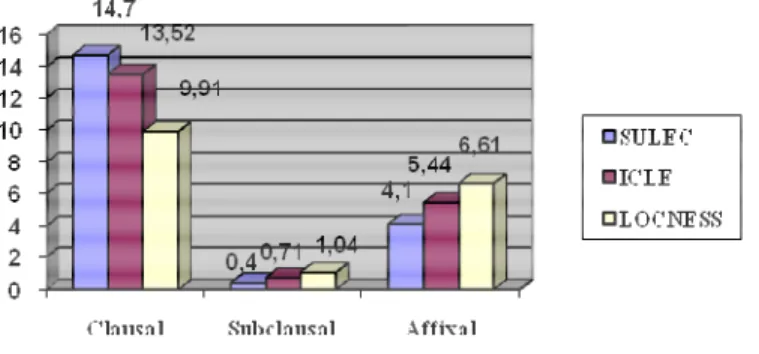
clausal negation is the most recurrent type in the corpora, as figure 1
shows:
1 An identification code is used to refer to each of the examples included in this work.
Figure 1. Distribution of negation types across the three corpora
analysed.
Both SULEC and ICLE data share high frequencies in clausal
negation. This result was expected as clausal negation is usually the
most frequent negation type used in speaking and writing. The
following table shows the distribution of the studied negation types
across the three corpora:
Table 1. Distribution of clausal, subclausal and affixal negation in
SULEC, ICLE and LOCNESS
SULEC NEGATION
TYPE WRITTEN SPOKEN TOTAL
ICLE LOCNESS
CLAUSAL 16.64 9.65 14.7 13.52 9.91
SUBCLAUSAL 0.58 0.09 0.4 0.71 1.04
AFFIXAL 5.61 1.02 4.1 5.44 6.61
In table 1, a higher frequency of
clausal negation in non-native
than native speakers’ data, can be appreciated. Learners seem to
approach the negation system used by native speakers when using
clausal negation, although they tend to make an almost excessive use of
it (as table 1 shows, clausal negation is not so frequent in the native
corpus). This could be regarded as a case of overuse of clausal negation
by learners.
322
could be regarded as an underuse of this negation type by learners and
it may be due to the learner’s limited knowledge of the FL. In fact,
learners may not feel sure about its use and prefer to avoid it using
another structure instead (clausal or affixal negation).
Regarding affixal negation, I have also noticed certain tendency
to avoid the use of negative prefixes, using the structure Not+Adjective
instead. This could be regarded as a case of underuse of affixal negation
due to the learner’s limited knowledge of the FL.
5.2.
Difficulties learners had to overcome for a correct use of negation in English:
I have identified several problems faced by students regarding
different aspects:
a)
The distinction between No and Not: Learners seem to use
them indistinctively on some occasions. This may be due
to linguistic transfer as in Spanish (their L1) such
distinction does not exist.
b)
The use of auxiliary verbs to form negative structures:
Learners have problems with the use of auxiliary verbs
in the negative form. Sometimes, they omit them as in
*the people that not smoke have the right to... (SUL.WT-32).
This may also be due to the interference from the L1
over the FL, as in Spanish & Galician no auxiliary verb
is needed to form negative structures.
c)
The use of polarity sensitive items: Learners encounter
difficulties in the use of items such as any or either since
they seem to forget about their sensitivity to polarity and
use them in any context. This fact leads students to
produce instances of double negation such as
*There is
not nothing to do. This could be regarded as a case of
interference from Spanish/Galician as in these languages
these structures are quite common (e.g. No hay nada).
d)
The use of negative prefixes: I have identified some problems
also identified some problems with negative prefixes
coming from Latin, such as
in-, e.g. *inconsciously. This
may be due to the influence of the L1 over the FL since
this prefix is very productive in Spanish/Galician (it is
the most recurrent negative prefix in the learner
corpora).
5.3.
Special uses of no and not as negative markers:
I found that EFL learners use the different negative markers
(no, not …) in different situations. I will focus on the use of no and not.
Regarding
no, there are some uses which can be regarded as
special or particular because they are not typical of native language use.
I consider them characteristic features of the students’ IL and they are
mentioned below:
I.
To answer yes/no questions: Learners tend to simplify
language. In this case they reduced a whole sentence,
such as No, I didn’t to the minimum by just saying No
in order to express rejections and refusals, as in (1):
(1)
<B>
2but are you in any team? <A> No . no . just
running (SUL.SP-540).
This could be due to interference from the L1, as in
Spanish/Galician there is not an auxiliary system like
the English one and it is not necessary to repeat the
auxiliary verb in short answers.
II.
No? as a whole question in oral speech, meaning Really? or
something similar to it, as in:
(2)
<A> No I think it’s not difficult <B> no?
(SUL.SP-557).
This use of no is ungrammatical but it is very frequent
in spoken language. It is not only used by students, but
also by teachers. This may be related to the fact that
teachers tend to simplify their speech in order to
ensure learners’ comprehension. This phenomenon
2 The letter between <> refers to the speaker. In our examples, <A> stands for the
324
could then be considered as a feature of
teacher’s talk
(Ellis, 1994: 582-3).
III.
No? as a question tag as in (3), due to language transfer
because the Spanish and Galician languages have a
simpler way to express this kind of questions (i.e.
¿No?, ¿Verdad?):
(3)
<B>… you said you liked drawing . no?
(SUL.SP-559).
IV.
No instead of using not:
(4)
…on their own probably they will no be using
English. (SUL.SP-514).
(5)
...
to have money is very good, why not, but no very
much because... (ICLE-SP-UCM-0037.3).
These examples may show interference from the
L1 as in Spanish and Galician there is only one
negative marker.
Regarding the use of
not
as a negative marker in the learners’
IL, I found some characteristic features that are worth mentioning:
V.
Not followed by polarity sensitive items as in:
(6)
*But not someone gives better advice (SUL.SP-637).
This example shows the difficulties learners have
regarding polarity sensitive items.
VI.
Not in the wrong word order as in:
(7)
*There will be not children... (SUL.WT-1132).
The learner seems to be trying to reproduce the
V+No+noun structure so typical of spoken English. It
seems to be an intralingual feature, due to the limited
knowledge of the FL.
These are intralingual features that can be justified by the
learners’ limited knowledge of the FL. They do not have a good
command of the use of these negative markers and their order in the
sentence.
5.4.
Special uses of no and not as negative prefixes:
VII.
*No- as a prefix
used instead of non-:
VIII.
*Not- as a prefix:
(9)
Despite, if they can smoke we can have our
not-smoke-places (SUL.WT-976).
On the one hand, these instances of IL seem to be due to
interference from the L1 over the L2, as in Spanish/Galician the word
no/non is also commonly used to form opposites, e.g. no fumador.
On the other hand, they can also be regarded as intralingual
features, due to limited knowledge of the FL, since in English, the
prefix non- is also used. By analogy to this prefix, students expand the
use of no and not to that of negative prefixes.
6.
Conclusions and Suggestions for Further Research
Regarding the conclusions derived from this study, the analysis
of the data seems to show the existence of a non-native IL negation
system. In general, native and L2 learner data follow similar tendencies
in the use of negation. However, despite the similarities, native and
non-native speakers still differ in the use of negation. There are an
important number of particular features of the learners’ IL that are
worth mentioning. Some of these uses are due to the influence of the
L1 over the L2 (cases of interference). Another group of uses are due to
the learners’ limited knowledge of the L2 (intralingual features).
Regarding the distribution of negation, from a quantitative
point of view, I found that the frequency of the different negation types
in the learner corpora was slightly different from that in the native data.
Clausal negation was the most frequent negation type in the three
corpora; subclausal negation was the least common. The latter showed
similar percentages across the three corpora analysed with a slightly
higher percentage in the native corpus. Affixal negation is also less
frequent in the learner corpora than in the control corpus. It occurs
more frequently in written than in spoken language. A qualitative
interpretation of the data shows some relevant features such as overuse
of clausal negation, underuse and even avoidance of subclausal and
affixal negation.
326
problems in the use of auxiliaries –omission; and also problems in
affixal negation –confusion of negative prefixes influenced by the L1.
Sometimes they use *no- and *not- as negative prefixes. I also found that
learners have problems with the use of negative polarity items which
occur in negative contexts but are not negative in themselves (e.g. any
and its compounds, either).
These results may contribute to SLA theory by providing
answers to some unresolved issues concerning the exact role of
transfer.
With the limitations of this study in mind, I recommend that
future research on the role of transfer consider the exposure to the L2
and a comparison of data from learners with different L1s.
The findings of my study may have, in my view, relevant
implications for the teaching of English. Firstly, I identified different
problems and difficulties Spanish learners encounter when dealing with
negation in English. These data illustrate the learning process and are
helpful for teachers as they should know the difficulties their students
have in order to be able to anticipate them in their explanations and
carry out an effective programming. Secondly, this research may also
help to develop new pedagogical tools and classroom practices to deal
with the particular needs and difficulties of Spanish learners of English.
References
Alonso Vázquez, M. C. 2005. “Transfer and Linguistic Context in the Learning Process of English Negative Structures”. Miscelánea: A Journal of English and American Studies 31. 25-42.
Biber, D., S. Johansson, G. Leech, S. Conrad and E. Finegan. 1999. The Longman Grammar of Spoken and Written English. Essex, England: Longman. Butterworth, G. and E. M. Hatch. 1978. A Spanish-Speaking Adolescent’s Acquisition of English Syntax. E.M. Hatch. Ed. 231-245. M.A.: Newbury House.
Cancino, H., E. Rosansky and. J. H. Schumann 1978. The Acquisition of English Negatives and Interrogatives by Native Spanish Speakers. E. M. Hatch. Ed. 207-230. M.A.: Newbury House.
Colin, A. and H. Holec. 1985. Foreign Language Acquisition Processes in a Secondary School Setting: Negation. P. Riley. Ed. 135-153. London: Longman.
Ellis, R. 1994. The Study of Second Language Acquisition. Oxford: OUP.
Hatch, E. M. Ed. 1978. Second Language Acquisition. A Book of Readings. Massachusetts: Newbury House.
Huddleston, R. and G. K. Pullum. 2002. The Cambridge Grammar of the English Language. Cambridge: CUP.
Klima, E. and U. Bellugi. 1966. Syntactic Regularities in the Speech of Children. J. Lyons and R. J. Wales. Eds. 183-208. Edinburgh: Edinburgh University Press.
Milon, J. 1974. “The Development of Negation in English by a Second Language Learner.” TESOL Quarterly 8. 137-43.
Quirk, R., S. Greenbaum and G. Leech. 1985. A Comprehensive Grammar of the English Language. London: Longman.
Riley, P. Ed. 1985. Discourse and Learning. London: Longman.
Selinker, L. 1972. “Interlanguage”. International Review of Applied Linguistics 3. 209-31.