SELF-EFFICACY BELIEFS IN PRE-SERVICE CHILEAN ENGLISH TEACHERS
Seminario para optar al título de Profesor de Inglés para la Enseñanza Básica y Media y al grado académico de Licenciado en Educación
Profesor Guía: Prof. Patricia Sánchez Valentina Alvear Concha
Karen Iturrieta Riffo Samantha Mera Betancour
Karla Olivares Valdivia María Belén Valdivia Farías
Santiago, Chile Julio, 2015
1
ACKNOWLEDGEMENTS
We would like to express our sincere thanks to the English Teacher Training Programme at Universidad Nacional Andrés Bello for allowing us to conduct this study, especially to the Programme’s director: Professor Patricia Sánchez. We also place on record our gratitude to the Programme’s teachers for their help and advice. Additionally, our sincere thanks go to Professor Carmen Gloria Ducaud for allowing us to have access to her classes. We are also very grateful to the pre-service teachers’ from the previously mentioned institution for voluntarily accepting to participate in our study, in the questionnaire’s conduction and interviews. Last, but not least, we would like to take this opportunity to express our gratitude to our families for their unceasing encouragement and support provided in the elaboration of this study.
2 ABSTRACT
This research study investigated Chilean pre-service teachers of English. A mixed-method research design was employed to obtain relevant data in this study. The quantitative instrument selected was an adapted version of the questionnaire developed by Tschannen-Moran & Hoy called “Teachers’ Sense of Self-Efficacy Scale” (1998). This version of the questionnaire was applied to 39 participants who were the total number of students going through their last semester at the English Teaching Training Programme at Universidad Nacional Andrés Bello. The qualitative instrument employed was an interview developed by the researchers. After having conducted the questionnaire, 10 participants were randomly chosen to implement a one-on-one interview, in order to explore more in depth in the questionnaire results. Therefore, the results were divided into two sections: quantitative and qualitative. An analysis of the questionnaire was made in the quantitative results section likewise, for the interview in the qualitative results section. Finally, in the conclusion, a thorough analysis was provided so that self-efficacy beliefs of pre-service teachers were described. The findings in this research exhibited that in general the levels of self-efficacy of pre-service teachers are high.
Keywords: Chilean pre-service teachers, Self-efficacy beliefs, English Teacher Training Programme, Mixed-method,, Tschannen-Moran & Hoy, Teachers’ Sense of Self-efficacy Scale.
3 RESUMEN
Este estudio investigó las nociones de autoeficacia de los profesores chilenos en formación. El método mixto fue empleado para obtener información relevante en este estudio. El instrumento cuantitativo seleccionado fue una versión adaptada de la cuestionario desarrollado por Tschannen-Moran & Hoy llamada “Teachers’ Sense of Self-efficacy Scale” (1998). Esta versión del cuestionario fue aplicada a 39 participantes quienes constituyen la totalidad de alumnos cursando el último semestre del Programa de Formación de Profesores de Inglés de la Universidad Nacional Andrés Bello. El instrumento cualitativo seleccionado fue una entrevista creada por los investigadores. Después de haber realizado la encuesta, 10 participantes fueron aleatoriamente seleccionados para llevar a cabo entrevistas personales con la finalidad de explorar más a fondo los resultados de la encuesta. Por consiguiente, los resultados están divididos en dos secciones: cuantitativos y cualitativos. Un análisis de la encuesta fue realizado en la sección de resultados cuantitativos y de igual manera, de la entrevista en la sección de resultados cualitativos. Finalmente, en la conclusión un exhaustivo análisis fue proporcionado de modo que las percepciones de autoeficacia de los profesores en formación fueron retratadas. Los hallazgos en esta investigación mostraron que en general los niveles de autoeficacia de los profesores en formación son altos.
Palabras Clave: Profesores Chilenos en formación, percepciones de autoeficacia, Programa de Formación de Profesores de Inglés, Método Mixto, Tschannen-Moran & Hoy, Teachers’ Sense of Self-efficacy Scale.
4 TABLE OF CONTENTS
ACKNOWLEDGEMENTS ... 1
ABSTRACT ... 2
RESUMEN ... 3
1. Introduction ... 6
2. Literature Review... 9
2.1 Definition of Quality ... 9
2.2 Self-efficacy ... 10
2.2.1. Teachers’ self-efficacy. ... 15
2.2.2. Factors affecting self-efficacy. ... 15
2.2.2.1. Preparation years as a factor influencing self-efficacy 20 2.2.3. Positive and negative self-efficacy. ... 22
2.2.4. Teachers with high and low levels of self-efficacy ... 26
2.2.5. Teachers’ self-efficacy effect on students.. ... 28
2.2.6. Teachers’ self-efficacy measurements. ... 29
2.2.6.1. First line of measurements ... 29
3. Statement of the Problem ... 33
4. Purpose and Approach ... 33
5. Research Questions ... 33
6. Methodology ... 35
6.1 Objective ... 35
6.2 Research Design ... 35
6.3 Participants ... 35
6.4 Method ... 36
6.4.1. Quantitative data.. ... 37
6.4.1.1. Quantitative data collection instruments ... 38
6.4.2. Qualitative data ... 38
6.4.2.1. Qualitative data collection instruments ... 39
6.5 Procedures ... 40
5
6.5.2. Interview ... 41
7. Data Analysis and Findings ... 43
7.1 Quantitative Results ... 43
7.1.1 Questionnaire ... 43
7.2 Qualitative Results ... 53
7.2.1. Categorization of patterns found in the interview ... 53
8. Conclusions ... 61
REFERENCES ... 63
APPENDIX A: LETTER OF CONSENT ... 68
APPENDIX B: QUESTIONNAIRE ... 69
APPENDIX C: INTERVIEW ... 71
APPENDIX D: INTERVIEW TRANSCRIPTIONS ... 72
APPENDIX E: UNIVERSITIES CURRICULA ... 110
6 1. Introduction
Chilean society has long been striving for quality in education. As this is an issue that needs to be tackled from many angles, different actions have been taken. One major challenge, in this regard, is to improve the preparation of future teachers in all subject areas and English is not the exception. The definition of guiding standards for English Teacher Training Programmes in 2014 is an evidence of the efforts made to improve the quality of new teachers. These standards are measured through the Inicia Test, which indirectly provides information about the quality of programmes.
The Inicia Test is an examination whose main objective is to identify pedagogical and disciplinary knowledge acquired and learned by recently graduated teachers from different educational programs. The purpose of this assessment is to provide information about the initial training of new teachers in their specific field and in pedagogy itself. The test is divided into two main segments: One part is related to knowledge about the disciplinary field; the other, is connected to the knowledge of pedagogical tools and didactics used in general, and in the specific field as well (MINEDUC, 2014. Our translation).
According to the Inicia Test, the standards a graduated English teacher needs to meet are the following:
1. Capacity for oral and written communication in an appropriate, consistent and correct manner, in various professional contexts.
2. Ability to communicate in a second language in oral and written form in an appropriate, coherent and correct manner, in various professional contexts.
3. Capacity to learn and continue learning, demonstrating interest in global culture, the processes of change and experience at the workplace.
7
5. A strong capacity for abstraction, analysis and synthesis. The teacher is able to work with abstract constructs of analysis and synthesis processes.
6. Knowledge of quantitative analysis that allow them to read, analyze and interpret different types of data.
7. Skills in the use of ICT’s (Information and Communications Technology) and information management, which will allow them to access new knowledge and use productivity tools.
8. Ethical commitment in their job in accordance with principles and values such as responsibility, commitment, perseverance and pro-activity. (MINEDUC, 2014. Our translation)
The standards provided by the Inicia Test are a necessary and useful reference for Teacher Training Programmes, since they set the skills and the expected knowledge that students need to develop and acquire through the years. Also, they serve as a reference for future teachers to monitor themselves in their actual performance. Furthermore, this evaluation is useful for all English Teaching Training Programmes in the sense that it can help them to assess to what extent their expected learning outcomes have been acquired providing them with the opportunities to take actions if necessary.
In order to ensure an organized and progressive transition to the new structure of Chilean education, the Ministry of Education has proposed a new educational law project that is currently being debated at the congress: “Nueva Política Nacional Docente”.
The general objectives of this new educational law project are:
● To motivate high performance school students to enter teaching and preschool programmes at universities.
● To ensure quality of initial Teacher Training Programmes.
● To establish a system in which principals and mentor teachers accompany pre-service teachers to the system.
8
● To propose different alternatives to retain teachers of all levels and subjects and help them to develop their careers in the educational field.
In order to accomplish these objectives several requirements have to be met. Firstly, the admission requirements to enter a Teacher Training Programmes at national universities, including school rankings and PSU (Prueba de Selección Universitaria) scores. Secondly, the Inicia Test is going to be applied in the middle of the teaching programmes and it will be considered as a tool to improve university Teacher Training Programmes not as a graduate teacher test. Thirdly, an induction period for pre-service teachers is going to be implemented for two years before entering a specific Teacher Training Programme. Apart from the feedback that programmes can receive from Inicia Test results, it is advisable to obtain more information from the own pre-service teachers’ point of view in order to introduce, if necessary, adjustments to the programme that could help them to become more prepared to face the demands of education in Chile.
For the reasons mentioned above, and since teachers’ preparation and performance are essential for the quality of education, the present researchers agreed to investigate about how prepared pre-service English teachers feel to teach while going through their last semester at the Teacher Training Programme.
9
2. Literature Review
Given the importance of achieving quality in education, it is advisable to examine the concept of quality before exploring the literature referred to self-efficacy. 2.1 Definition of Quality
10
Being a teacher can be considered as one of the most significant professions in our society. It is well known that teachers’ quality is a major factor in students’ learning process. For example, proficient teachers who care about their students can have a profound effect on them, and can be considered as a role model or motivator for the students.
Teachers should exhibit a series of skills and aptitudes in order to be able to shape the lives of children and teenagers. Given the importance of teachers and quality in education in the students’ learning processes in Chile, it is important to obtain information about how prepared Chilean pre-service teachers feel to teach before assuming their role as formal teachers, and how proficient they think they are, in this case as English teachers.
Chilean experts in education and citizens along the country are currently debating and discussing the New National Teaching Policy. Many people, even those who do not have profound knowledge on the subject, are indeed extremely interested because any educational reform implemented will have a radical effect on the Chilean society. Considering their demands for better education and the need for well-prepared teachers implied in the current reform, the present researchers decided to conduct a research about teachers’ preparation.
2.2 Self-efficacy
Self- efficacy seems to be an interesting topic in the teaching area since it has been thought that self-efficacy directly affects a teacher's effectiveness in the classroom. The reasons and facts that explain the relationship between self-efficacy in teachers and their performance in the classroom will be presented in the following paragraphs.
11
In the same line of thought, the concept of self-efficacy or perceived self-efficacy was introduced in Stanford, California by the psychologist Albert Bandura, who has been the leading exponent of the concept. While developing the Social-Cognitive Theory, he discovered that efficacy plays a key role as part of individual’s self-system. Bandura defined self-efficacy as “People’s beliefs about their capabilities to produce designated levels of performance that exercise influence over events that affect their lives” (Bandura, 1993, p. 118). The previous quotation was the new focus that Bandura brought to concern, and the term of self-efficacy was first used according to the result made by the combination between Bandura’s Socio-Cognitive Theory and Rotter’s Social Learning Theory of Personality (Prieto, 2002).
The Social Learning Theory of Personality, also referred to Locus of Control, is defined as “the extent to which people believe they have power over events in their lives” (Fournier, 2010). Locus of Control is an important factor inside Rotter's Theory and it has two components: Internal Locus of Control and External Locus of Control.
“When someone has Internal Locus of Control, the person tends to believe that he/she can influence events and their results. Opposed to this idea, when someone has an External Locus of Control he/she tends to blame outside forces for almost every event” (Dewey, 2007).
The difference between these two premises is that Rotter’s Theory is focused on teachers’ beliefs in their personal capacity to control the effect of their own actions whereas Bandura’s Theory is focused on self-efficacy as a cognitive mediator between knowledge and teacher action.
12
The more successful experience a teacher candidate has working with diverse groups of students, the higher the confidence level of the teacher, which in turn, positively influences self-efficacy. This, if the environment is conducive to positively growth and provides the novice teacher with opportunities for success then the likelihood is that his/her self-efficacy will increase. On the other hand, if the novice teacher experiences little success early or while student-teaching, judgements of low efficacy may determine how long the teacher will persist in developing a strong teaching repertoire. (Deniz, 2013, p. 668)
In 1993, Bandura stated four sources of information that according to him contributed to the origin of self-efficacy beliefs: mastery experiences, vicarious experiences, verbal persuasion and psychological and affective states.
Mastery experiences work as indicators of capability. It means that when an individual performs a task successfully, the execution of that task strengthens people’s sense of self-efficacy. On the contrary, if an individual fails to perform a task or a challenge, it may negatively affect self-efficacy.
Vicarious experiences take place when an individual witnesses someone performing a task or handling a challenge successfully. According to Bandura, when an individual sees someone similar to him or her performing successfully a task, it influences him or her to think that he or she can also perform the same task successfully.
Verbal persuasion takes place when someone says something positive, encourages an individual performing a task or gives positive feedback in order for the individual to keep moving on. That helps people to overcome their doubts and make them do their best efforts in the task.
13
if a person succeeds or not, is not a determinant when affecting negatively or positively self-efficacy since it is also necessary to take into consideration the way that the individual interprets the situations. (Dimopoulou, 2012)
From these four sources, the concept of mastery experiences is the most important as “they allow one to connect actual experiences to possible outcomes” (Jamil, Downer & Pianta, 2012, p. 121). An individual’s own performance offers the most reliable guide for assessing self-efficacy. “Successes raises efficacy and failure lowers it, but once a strong sense of efficacy is developed, a failure may not have much impact” (Bandura 1986 as cited in Schunk, 1991, p. 208).
Based on the researchers’ experiences; internships or practicum are the richest source of mastery experiences for pre-service teachers, as they play an important role in modelling the perceptions of self-efficacy that pre-service teachers will have. Nevertheless, the researchers can assert that not all the individuals that study to become English teachers, have the same access to schools to do their internships. Also, it can be affirmed that sometimes the time provided for internships may not be enough for future teachers to develop a positive sense of self-efficacy.
To guarantee the validity of the previous statement, a universe of 14 English Teacher Training Programmes (5 of them in public universities and the other 9 in private universities of Chile) were examined through their official websites in order to know their curriculum and see how many internship experiences the students in the different programmes have.
Due to this, it is possible to state that the curricula seem to vary along with the university’s objectives for the students, whether it is to prepare teachers to teach at elementary, high-school or both levels.
From all the curricula examined, 28% of the students start internship in the fourth semester of the programmes. Likewise, in most internships, the initial objective is to learn and understand the educational system1 in different contexts. It means that the first
1 Educational system: In the context of this research, students that start internships in
14
courses are, above all, theoretical. As a consequence, students start going to the schools between the 6th and 10th semester of their programmes. Depending on whether the preparation is for elementary (and or preschool in some cases), high school and/or homeroom teacher, the number of practicum subjects they have in the curricula may be different.
The final step before becoming a graduated teacher is to complete an internship that places the pre-service teacher in a school for around twenty hours a week for one semester. Having this kind of internship at the end of a Teaching Programme can be appropriate for pre-service teachers who have high levels of self-efficacy, being as a consequence detrimental for pre-service teachers with lower self-efficacy levels, due to the fact that they were not able to develop positive self-efficacy levels in their instructional years. For those reasons, the researchers can infer that the time provided for teaching internships may not be enough to develop confidence or positive beliefs regarding an individual’s own performance. In fact, “Teachers’ experiences from the induction years are very important because they may determine the long-term development of teachers’ self-efficacy competence which is strongly connected to instructional effectiveness” (Bandura 1997 as cited in Bikos, Tsigilis & Grammatikopoulos, 2011, p. 39). This statement affords great importance to the development of this study which tries to get well rounded views of pre-service teachers’ self-efficacy beliefs.
15 2.2.1. Teachers’ self-efficacy.
Now that the key concept of this research, self-efficacy, has been defined, a more in depth exploration on research found regarding teacher self-efficacy beliefs will be presented. As teachers play an essential role in society, and considering the demands for quality education in Chile, the topic of self-efficacy becomes relevant to be studied. This is clearly reaffirmed by the following quote, “The higher the sense of efficacy, the bigger the effort, persistence and resilience” (Pajares, 1996 as cited in Deniz, 2013, p. 1). As it can be seen in the previous quote, self-efficacy is of vital importance in the quality of education since teachers with high sense of self-efficacy will carry out greater efforts, preparing more engaging, entertaining and meaningful lessons. They will be more persistent in what they do; working hard to accomplish what they want and they will have the necessary resilience to overcome any hardships they may find in their way.
What is more, Tschannen-Moran, Woolfolk Hoy and Hoy (1998) defined the term of self-efficacy as “teacher’s beliefs in his or her ability to complete the steps required accomplishing a particular teaching task in a given context” (Tschannen-Moran, Woolfolk Hoy & Hoy, 1998). From this previous definition, it can be said that self-efficacy notions and perceptions are able to determine how people feel, think, behave and motivate themselves. If they succeed, in this case, teachers, in completing a teaching task (for example, giving instructions, introducing contents, preparing activities, etc.) teachers will feel satisfied with themselves. Moreover, being able to cope with these demands will make the teacher feel motivated with the job and will keep positive beliefs regarding his or her teaching performance. On the contrary, if they do not complete a specific task successfully, they would probably feel disappointed, angry or hesitant and they may tend to be negative as well as the beliefs and perceptions they have in relation to their teaching performance.
2.2.2. Factors affecting self-efficacy.
16
which a teacher is involved, working or living, are important factors when it is time to shape teachers’ self-efficacy beliefs and perceptions. Likewise, there are other crucial agents that may affect teachers’ self-efficacy notions and perceptions. These factors are related to issues most schools present and that somehow make teachers find their job stressful and feeling incapable of managing situations in the working field successfully.
Bandura suggested that people with a low sense of self-efficacy in a given situation fall easy victims to stress and depression because they take difficult tasks and their perceived inability to deal with them personally (Bandura, 1993). In contrast, people with high self-efficacy treat difficult tasks as an opportunity for mastery attributing failure to a lack of effort or skills, both of which are in their hands to correct.
17
limitations and students’ misbehaviour, also have to cope with students who have special needs and requirements, making the necessary adaptation of contents and lessons necessary in order that weaker students achieve the same goals than the average students. This can be reaffirmed by the following quotation:
Concerns have to do with an excessive number of students, overload of teachers’ activities and lack of resources and time. Finally, concerns appear for the specific students’ needs, understanding their strengths and weaknesses in intellectual, social and emotive level. Adaptations of contents begin according to specific students’ needs, even though frustration impact with teacher’s enthusiasm due to inadequation of material or lack of support of families and school” (Eirín, García & Montero, 2011, p. 105. Our translation).
Moreover, the number of students per class in most of the schools make the process of adequation to students needs somewhat difficult due to the fact that “schools of middle and higher level tend to be bigger and impersonal and with a higher number of students. These conditions make teachers to have more difficulties to know and adapt to students’ academic needs” (Prieto, 2002, p. 14. Our translation). As a consequence, trying to manage all these factors, can lead to low feelings of self-efficacy in teaching. “The more threatening teachers perceive the instructive situation, the less capable they feel to handle it” (Prieto, 2002, p. 15. Our translation).
Berg and Smith (2014) developed a research in New Zealand in which their participants’ expressed that the following factors may change teachers’ self-efficacy beliefs: Natural Ability, Academic Learning and Concerns about Teaching.
18
Academic Learning means how participants perceive the relationship between their academic studies and their teacher efficacy beliefs. This is an essential point for pre-service teachers due to the fact that students need to correlate if what was taught in their programmes was useful for them, or concretely, in the case of this research work, if the Teacher Training Programme was enough to produce positive self-efficacy beliefs in pre-service English teachers.
Concerns about teaching cover others sub-factors that may change teachers’ self-efficacy beliefs. Within this area the participants of the study developed by Berg and Smith identified: Parents, Classroom Management, Subject Knowledge, Status of the Teacher, Policy, False Accusations, Theory/Practice, and Support. Regarding Parents, teachers sometimes have conflicts with them because parents feel that teachers do not meet parental expectations because on an everyday basis those expectations are high. Pre-service teachers, and teachers with more experience in the field as well, have expressed that in New Zealand there have been changes in the traditional teacher/parent relationship. In addition to the conflicts that not meeting these demands may bring, teachers have to face everyday demanding parents, and teacher/parent conferences. The teachers who participated in the previously mentioned study expressed that there is an escalating aggression from parents to schools. It is important to mention that some of the descriptions included here may vary from one educational context to another.
If we examine the points identified within the area of Classroom Management, it can be expressed that teachers have to face contextual difficulties such as large classes that may vary in some contexts from 30 to 50 students per class, especially in public schools. Additionally, it is important to mention that there is limited time with some classes. Teachers, in the research conducted by Berg and Smith (2014), expressed that it is very difficult to apply classroom management techniques or to try to control a class with which you only teach two hours a week.
19
successfully. It could be a problem if a teacher does not teach a specific content because he or she does not have the necessary knowledge about it.
Status of Teachers is an issue that these professionals have to face every day and it is one of the points that commonly affect teachers’ self-efficacy beliefs. Comments such as those related to the fact that being a teacher is an easy profession or not a well-paid profession, tend to lower teacher self-efficacy beliefs or may make teachers feel doubtful about their future in the profession. It is related to the status of teachers in society. The main concern with regard to this topic is the value that people place on teaching. Common individuals tend to perceive teaching as an easy job and those statements may affect the self-efficacy beliefs and perceptions of teachers. Additionally, teachers may tend to feel diminished by this kind of opinions.
Policy has to do with the concerns about government and school policy. This means a government intervention at schools, such as national curriculum assessments, among others depending on the context of the education.
False accusations from students or allegations of physical abuse are other factors that are important to mention. In some cases, only an unconscious action may make a student feel assaulted. Being wrongfully accused of an improper action towards children are also actions that may lessen teachers’ self-efficacy beliefs.
Theory/Practice takes place when educators teach pre-service teachers and emphasize theory over practice. Sometimes teachers introduce too much theory and too little practice in participants’ degree programmes. Pre-service teachers in the study already mentioned expressed that they required more time to spend at schools. This point is addressed later on.
20
The previously mentioned areas, as factors affecting self-efficacy beliefs and perceptions, are all circumstances resulting from previous experiences in the teaching environment or situations in which the pre-service teachers developed or performed qualities commonly seen in teachers, e.g., leadership. Past experiences are a rich source of efficacy beliefs. In the research conducted by Berg and Smith (2014), the self-efficacy beliefs of the participants revealed that many of their previous beliefs changed from the experiences they had. These experiences included the ones they had at practicum, when they were being trained as future teachers, and prior experiences that the participants had previously to becoming a teacher (Berg & Smith, 2014). This means for example the development of some key abilities that are needed inside a classroom such as leadership, since it is very difficult to organise a class and to do what was planned for it if there is not classroom management, and also the development of the ability to explain to others who need help. This helps both, students and teachers, since it is easier to achieve goals or objectives when the students understand clearly what was misunderstood.
2.2.2.1. Preparation years as a factor influencing self-efficacy.
21
which more experienced teachers demonstrate higher expectations of teacher efficacy" (Prieto, 2002, p. 13. Our translation)
“Novice teachers with a higher sense of self-efficacy are more likely to persist and stay in the profession” (Knobloch & Whittington, 2002 as cited in Jamil et al., 2012, p. 119). This main reason made Jamil et al. to consider that self-efficacy can be seen as a target of growth during teacher preparation, but little is known about how self-efficacy develops in those who are just starting their careers. This statement suggests that every person preparing to become a teacher should develop a certain level of self-efficacy: positive or negative, depending on how confident the teacher feels after finishing the Teacher Training Programme. “Keeping this model in mind, we can establish the importance of equipping pre-service teachers with a high-sense of efficacy, so that they can persist through the challenges of the induction year” (Jamil et al., 2012, p. 120).
Following the same line of thought, the relation between self-efficacy and teachers’ capacity can be seen in the following statement “An adequate preparation can affect the teacher’s self-efficacy decreasing his/her uncertainty about his/her own capacity to carry out specific scholastic behaviour required to teach about a specific subject” (Prieto, 2002, p. 13 Our translation).
22
It was also found, in a study conducted in Greece, that “Teachers who completed the first phase of the Training Programme felt more competent in managing their classrooms, keeping the discipline and handling disruptive behaviours” (Bikos et al., 2011, p. 39). For any individual, it is important to believe that they are capable of performing and carrying out given activities, and even more if you are a teacher. Our own experience has shown that through immersion in schools during the practicum have influenced the way self-efficacy is perceived. As it was mentioned before, the finding in the study conducted in Greece showed that teachers who completed the first stage of a Teacher Training Program, which is a cognitive process, raised their beliefs regarding their competence (Bikos et al., 2011, p. 39) Furthermore, as Bandura stated, “It has now been amply documented that cognitive processes play prominent role in the acquisition and retention of new behaviour patterns” (Bandura, 1977, p. 196)
A recent study conducted in Turkey based on novice teachers’ self-efficacy beliefs and their performance in the classroom sought to get knowledgeable in what were the self-efficacy levels of novice teachers that had been working for a year. In this study by Hasan Ozder (2011) it was found that there were many aspects in which teachers’ self-efficacy played a key role. The results were that novice teachers perceived themselves to be very adequate in teaching, besides these novice teachers perceived they were more adequate in classroom management and using instructional strategies in class than in ensuring students engagement in class. Finally, the research proved that the training they obtained in pre-service period in the classroom allowed them to implement all the knowledge they had gained in their Teacher Training Programme at ATTA (Atatürk Teacher Training Academy), these results could be seen in classroom management, special teaching methods and in using instructional strategies.
2.2.3. Positive and negative self-efficacy.
23
With regards to the notions of higher and lower self-efficacy, it is important to mention that in the case of the positive factor or higher self-efficacy, also referred as extraversion, this takes places when the teacher succeeds in his or her tasks. Thus, the teacher feels secure and trustful. On the contrary, the negative factor takes place when the teacher is not successful in his or her role or more specifically, when a teacher does not feel confident about what he or she is doing. This insecurity may lead to develop what is recognized as neuroticism, known as the side effect of low sense of self-efficacy (Jamil, et al. 2012).
Teachers tend to form extraversion effects when they have had enough exposure to the teaching context, for example, their first teaching year or also when they have had early and enough exposure to teaching experiences when they were pre-service teachers. These early experiences allow the teacher to be aware of the teaching environment and invite him or her to interact with real students. This interaction is crucial because it contributes to the development of teaching confidence that along his or her teaching education program will higher their levels of perceived self-efficacy. This confidence has its roots to those instances when the teacher helps the students with tasks, is successful with students, or helps the students beyond the academic achievement.
The actions that teachers take, lead them to succeed in the process of students learning, since “efficacy expectations determine how much effort people will expend and how they will persist in the face of obstacles and aversive experiences” (Baumeister, 1999, p. 287) The more teachers believe in what they are doing, the more likely they tend to persist when facing obstacles “The strength of people’s convictions in their own effectiveness is likely to affect whether they will even try to cope with the given situations” (Baumeister, 1999, p. 287). These statements illustrate how important it is for teachers to believe in what they do and the behaviour they have inside the class. Teachers’ most important aim is to make their students learn, therefore teachers need to believe and trust in what they do for their students.
24
finishing their programme because it is important to acknowledge in what aspects future teachers believe they are strong and in which areas they feel they are weaker so that, in a near future, institutions may introduce changes and make adaptations in their curricula in order to compensate those areas that these future teachers reported to feel weaker about and not ready to perform successfully. "Feelings of not being a good teacher and not being able to understand the cause is common among novices, and might stem from affective abilities that are developing more slowly than cognitive abilities" (Onafowora, 2004, p. 40). To overcome this, a study carried out by Berg and Smith (2014) suggested that “those responsible for the preparation and education of pre-service teachers should explore teacher concerns, as this construct is important on the development of new teachers” (Berg and Smith, 2014, p. 22). On the one hand, cognitive abilities are highly developed in novice teachers through the different English Teacher Programmes at universities. On the other hand, effectiveness is highly promoted through the same programmes. Novice teachers are exposed to develop their effectiveness through practicum and internships; however, sometimes the time aimed to do so is not enough. As a consequence novice teachers are sent to the real world without the necessary abilities developed. “Among new teachers who have spent little time in the classroom, self-efficacy is likely driven by a combination of factors, including experiences and skills in the classroom, knowledge of content and pedagogy, attitudes, and personal dispositions” (Bandura, 1977; Gist & Mitchell, 1992; Woolfolk & Hoy, 1990 as cited in Jamil et. al, 2012, p. 120). Berg and Smith, (2014) expressed that more practicum experience would result in enhanced teacher efficacy beliefs (Berg and Smith, 2014).
25
the professional career of a teacher” (Eirín et al., 2009, p. 102. Our translation). That is one of the reasons why many novice teachers tend to abandon their jobs. This is exemplified in the following statement made by Graziano, 2014 about what occurs with novice teachers in the U.S:
Every year U.S. schools hire more than 200,000 new teachers for that first day of class. By the time summer rolls around, at least 22,000 have quit. Even those who make it beyond the trying first year are not likely to stay long: about 30 percent of new teachers flee the profession after just three years, and more than 45 percent leave after five (Graziano, 2014).
Knowing about pre-service teachers’ self-efficacy is an important concern due to the fact that teachers, who are in their first year working at schools, tend to leave their jobs, as it was previously mentioned, but very little research has been done to know if the preparation they had at universities was enough to cope with all the demands that a teacher has as a professional, as an instructor and as an employee. “Retention efforts are especially important on novice teachers, those who are in the first year of their teaching career, because they leave the profession at higher rates than their more experienced counterparts” (Jamil et al., 2012, p.119). According to the research made by Jamil et al., evidence has shown that teachers who do not feel confident with their performance tend to abandon the teaching field, while teachers that feel well-prepared and skilled are able to handle difficulties and are likely to be successful in their job.
26
to make future teachers acquire skills and high levels of knowledge in all areas that will really make a positive impact in students’ learning. To achieve this goal, the Chilean educational system needs well prepared teachers with a high level of self-efficacy that will create positively self-efficacy levels on students’ learning.
In Chile, there has been some progress in providing initial teacher education with certain levels of quality. In order to be able to teach in public schools, new teachers must have been prepared by Teacher Training Programmes that have certified their quality through official accreditation processes. Teacher practicum experiences are an important part of curricula. Even though, accreditation is mandatory for pedagogy programmes, it has not been entirely effective when controlling teacher education programme quality (Brandt, 2010. p. 12). English Teacher Training Programmes in Chile vary from one university to another. Some programmes might aim for a perfect grasp of the English language, and others focus on the implementation of new teaching techniques and overall classroom management.
2.2.4. Teachers with high and low levels of self-efficacy.
Gibson and Dembo (1984) found that teachers who demonstrate a high sense of self-efficacy devote more class time to academic activities and focus less on discipline as a prerequisite to student learning. Teachers, who have a high-sense of self-efficacy, when creating the adequate environment for students create more motivating conditions to encourage students’ achievement. Therefore, teachers with a dominant sense of self-efficacy focus their time and efforts on issues more connected to instructions rather than discipline.
27
Hence, it can be said that teachers who have positive beliefs about their self-efficacy promote mastery experience for their students, while teachers with negative self-efficacy notions construct classroom environments that tend to undermine students’ sense of efficacy and cognitive development and consequently they affect their motivation in class.
In 1984, Gibson and Dembo, proposed other characteristics that can help us to identify teachers who have high and low sense of self-efficacy. The difference between these types of teachers is concrete: On the one hand, teachers with high sense of self-efficacy use more time in the class to perform academic activities, use more complex instructive methods, provide help and orientation for students who find difficulties to reach learning outcomes and praise students’ achievements. On the other hand, teachers with low sense of self-efficacy dedicate more time to non-academic tasks, tend to ignore students when they do not reach goals and criticize errors they make (Prieto, 2002, p. 17. Our translation). Thus, it can be said that self-efficacy beliefs and feelings are directly linked with the degree to which teachers are engaged with the profession.
How well teachers do their job can also influence his or her satisfaction and also their self-efficacy beliefs, this works similarly to a cycle if a teacher does his or her job effectively then, his or her self-efficacy beliefs will be high, and if this happens, then the teacher will do his or her job well. That will also lead to job satisfaction and this can be exemplified in the Model of Teacher's Perceived Efficacy, which was adapted by Benjamin G. Swan, Kattlyn J. Wolf, Jamie Cano from “Instructional Leadership: A Research Based Guide to Learning in Schools” by A. Woolfolk Hoy and W. Hoy (2009)
This idea was also explained and presented in the study conducted in 2007 by Tschannen-Moran and Hoy in Ohio, U.S.A. It mentioned that the satisfaction derived from classroom performance is positively correlated with teaching self-efficacy beliefs.
28
clearly explained in an example developed by Leonor Prieto, a teacher from Universidad Pontificia de Comillas and researcher in Madrid: “(…) Students that trust more in their studying capacity expect to have better results in an exam whereas those who have more doubts regarding their learning capacity, expect lower results even before trying” (Prieto, 2002, p. 9 Our translation). The same occurs with future and novice teachers in the early years of work, this specific topic will be further developed in this chapter. Bandura (1993) also referred to something similar, but regarding the skills that an individual has: “Personal accomplishments require not only skills, but self-beliefs of efficacy to use them well” (p. 119). According to people’s activities, individuals can have enough skills to perform specific tasks, but the amount of skills they have do not mean they present high efficacy levels. For this to be so, it is required that individuals have beliefs of efficacy to use those skills appropriately.
2.2.5. Teachers’ self-efficacy effect on students.
Self-efficacy beliefs can influence different areas, not just teachers-wise matters but also their students’ achievements, motivation and self-efficacy beliefs. “Studies assert that teachers’ positive and high self-efficacy beliefs have impact on students’ achievements and motivations” (Midgley et. al as cited in Ozder, 2011, p. 2). “Teachers’ self-efficacy may also contribute to promote students’ sense of efficacy, fostering their involvement in class activities and their efforts in facing difficulties” (Ross, 1998, as cited in Ozder 2011, p. 2). In the educational field, teachers’ self-efficacy seems to have a direct impact on students’ motivation. “Teacher efficacy is believed to be strongly linked to teaching practices and learning outcomes” (Eslami & Fatahi, 2008, p. 2). Other factors involving teacher’s self-efficacy influencing students’ sense of efficacy can be seen in the following statement made by Sara Winstead Fry:
29
The following quotation describes how important the influence of teachers’ self-efficacy in education is, as it will shape the students attitudes towards learning, therefore it will make education better.
There are many factors that may influence students learning and one of them is attitude. One area where attitude is particularly important is teachers’ self-efficacy. When teachers create a learning environment in which students feel comfortable and confident, it will enhance positive attitudes towards school. The creation of a positive learning environment impacts both of students’ learning and attitudes (Al-Alwan & Mahasneh, 2014, p. 172).
The previously mentioned factors are also reasons that motivate the present researchers to explore more in depth this area of research. As teachers’ self-efficacy may also affect students’ self-efficacy it can be stated that when a teacher is truthful and confident about his or her job, the teacher is able to transfer those positive feelings and perceptions to them, making them feel proficient and confident in the tasks they are performing. In the case of learning English as a Foreign Language, it can be possible that students engage in the class and the barrier they have at the moment of learning the new language disappears gradually. The more goals they reach, the more motivated students and teachers will feel along the teaching process. This is also proved in the following statement: “Self-efficacy is substantiated as learners observe goal progress, which conveys they are becoming skilful” (Elliot & Dweck, 1988 as cited in Schunk, 1991, p. 213).
2.2.6. Teachers’ self-efficacy measurements.
There have been several studies that have addressed teachers’ self-efficacy beliefs and, as it has been previously explained, James Rotter and Albert Bandura were the pioneers in this concept.
2.2.6.1. First Lines of Measurements.
30
Cambridge, United Kingdom. This organization based its research on Rotter’s Theory, which measured self-efficacy by summing scores of items that were related to student’s motivation from two different points of views. The first item can be identified as motivation as a result of students environment, which is explained in the following quote: “When it comes right down to it, a teacher really can’t do much because most of a student’s motivation and performance depends on his or her home environment” (Armor, Conry-Oseguera, Cox, King, Mcdonnel, Pascal, Pauly, Zelman, 1976; Berman, Mclaughlin, Bas, Pauly, Zelman, 1977. p, 23.) and the second item can be identified as motivation as a result of teacher’s effort, which Armor et al. explained in the following quote “If I really try hard, I can get through to even the most difficult or unmotivated students” (1977. p, 23.). There were several studies that used these items to measure self-efficacy, through themthe RAND organization aimed “to reveal the extent to which a teacher believed that the consequences of teaching-- student motivation and learning--were in the hands of the teacher, that is, internally controlled” (Tschannen-Moran, Hoy & Hoy, 1998, p. 205). Thanks to these two items, the researchers came with two categories that defined different types of self-efficacy; these are General Teaching Efficacy (GTE) and Personal Teaching Efficacy (PTE).
31
of teacher efficacy while maintaining a narrow conceptualization of the construct; they used a forced-choice format with items matched for social appeal.
In the year 1977, Bandura created the first instrument to measure self-efficacy which was called “Teachers Self-Efficacy Scale” (TSES). This instrument has seven sections: “Efficacy to Influence Decision making”, “Efficacy to Influence School Resources”, “Instructional Self-Efficacy”, “Disciplinary Self-Efficacy”, “Efficacy to Enlist Parental Involvement”, “Efficacy to Enlist Community Involvement” and “Efficacy to Create a Positive School Climate”. Each item is measured in a 9-point scale interconnected with the notations that range from “nothing”, “very little”, “some influence”, and “quite a bit”, to a “great deal”. This system attempts to provide a versatile picture of teachers’ efficacy beliefs without becoming too narrow or specific. Bandura’s self-efficacy scale was redesigned by other researchers working with the topic of self-efficacy. This is how, in 1998, Tschannen-Moran and Hoy improved Bandura’s instrument creating the “Teachers’ Sense of Efficacy Scale” which was designed to discover what creates the most common difficulties teachers encounter in daily school activities. These improvements made to Bandura’s Scale were done in the areas of Student Engagement, Instructional Practices, and Classroom Management.
In 2011 the “Teachers' Self-Efficacy Beliefs Survey: Literature” was modified by Nicole A. Mills in her study “Teaching Assistants’ Self-efficacy in Teaching Literature: Sources, Personal Assessments, and Consequences”. Most importantly in the year 2006 Albert Bandura himself created a guide for constructing self-efficacy scales, pointing different guidelines to create not only self but also collective-efficacy. In this guidebook Bandura offers different templates to measure self-efficacy in varied areas such as Pain Management Self-Efficacy, Children's Self-Efficacy, Parental Self-Efficacy and of course the one that concern us the most, Teacher Self-Efficacy.
32
33
3. Statement of the Problem
Considering the urgent demand for improving quality of education in Chile and the efficacy levels that teachers should reach, a new educational reform to accomplish the society’s demands, is being developed. As it has been explained through the literature review, teacher' ’performance in classes can be affected by their levels of self-efficacy. Throughout this investigation, the researchers thought for background information that made reference to how self-efficacy in pre-service teachers was measured. Scarce investigation has been done globally, but in the Chilean context in which the researchers are immersed, there is none.
4. Purpose and Approach
The purpose of this study is to get well-rounded views of pre-service teachers in an 8-semester English Teacher Training Programme at Universidad Nacional Andrés Bello in Chile, with regard to their self-efficacy beliefs about becoming efficient teachers. The research employed a mixed-method approach to gather quantitative and qualitative data. The instrument used to collect quantitative data is an adapted version of the questionnaire made by Tschannen-Moran and Hoy called Teachers’ Sense of Efficacy Scale (1998), while the instrument used to collect qualitative data is an interview,whose questions were based on the results of the quantitative instrument.
5. Research Questions
Given the research problem, the researchers have arrived at the following research questions:
- How prepared do pre-service teachers feel when they are finishing their training programme?
- Did the English Teacher Training Programme at Universidad Nacional Andrés Bello contribute to build up self-efficacy beliefs in pre-service teachers?
Given these questions, the general objectives are the ones that follow:
34
35 6. Methodology
In this chapter, the purpose of this study is reminded, the research design is described, participants are classified in different categories, an explanation of the quantitative and qualitative instruments applied is provided. Finally, a description of the procedures used in this study to gather the information collected, through a questionnaire, are described.
6.1. Objective
The purpose of this research, as it has been previously stated, is to obtain information about self-efficacy beliefs that pre-service teachers of the English Teacher Training Programme at Universidad Nacional Andrés Bello have as it has been stated. 6.2. Research Design
This research adopted a mixed-method research design, which applied quantitative and qualitative methods to gather information. “A mixed methods research design is a procedure for collecting, analyzing, and “mixing” both quantitative and qualitative methods in a single study or a series of studies to understand a research problem” (Creswell, Plano Clark, 2011 as cited in Creswell, 2011, p. 535). Using both methods in a research provides a better understanding of the research problem and questions than either method by itself, therefore the explanatory sequential method design was used for the present research. “An explanatory sequential mixed-methods design (also called a two-phase model; Creswell & Plano Clark, 2011) consists of first collecting quantitative data and then collecting qualitative data to help explain or elaborate on the quantitative results. The rationale of this approach is that the quantitative data and results provide a general picture of the research problem; more analysis, specifically through qualitative data collection, is needed to refine, extend, or explain the general picture” (Creswell, 2011, p. 542).
6.3 Participants
36
the sampling frame were all the students who were going through the last semester of the English Teacher Training Programme at Universidad Nacional Andrés Bello, between the second semester of 2014 and the first semester of 2015. Finally, the sample is the same of the sampling frame with the exception of the researchers of this study due to the fact that they cannot intervene in the research’s results.
The participants of this research are 39 pre-service teachers, who were going through their last semester of an English Teacher Training Programme at Universidad Nacional Andrés Bello, being the programme previously mentioned the unit of analysis of this research work.
A convenience type of sampling was used in which the “researcher selects participants because they are willing and available to be studied. In this case, the researcher cannot say with confidence that the individuals are representative of the population. However, the sample can provide useful information for answering questions and hypotheses” (Creswell, 2011, p. 145). This type of sampling was the most suitable for our research, because, as it has already been mentioned, the sample consisted of students who were finishing their programme, and teaching internships, considered a relevant factor to obtain a meaningful data for the present study due to the fact that at that point the students clearly know in which areas they were proficient and in which areas they needed improvement. Despite Creswell’s statement, in this research it can be said with determination that the individuals were completely representative of the population since most of the students experiencing the last semester in the program (2014-2015) were part of the questionnaire.
6.4 Method
37
Once the questionnaire was applied and the information tabulated, the qualitative instrument was created and applied seeking to obtain more detailed information about the beliefs of the students with regards to their sense of self efficacy, since this is the aim of this educational research. This interview was composed of six questions taken from the questionnaire already applied.
6.4.1. Quantitative data.
“Quantitative data, such as scores on instruments, yield specific numbers that can be statistically analysed, can produce results to assess the frequency and magnitude of trends, and can provide useful information if you need to describe trends about a large number of people” (Creswell, 2011, p. 535).
Before starting the collection of quantitative data, the researchers obtained the participants’ permission to be studied, identified the types of measures that would answer the research questions, and defined which instruments to use.
After completing the process described above, a cross-sectional survey design was employed. This type of research is commonly used in the field of education. “The researcher collects data at one point in time (...) this design has the advantage of measuring current attitudes or practices. It also provides information in a short amount of time, such as the time required for administering the survey and collecting the information” (Creswell, 2011, p. 377).
As Creswell stated, a cross-sectional survey helps researchers to examine current attitudes, beliefs, opinions or practices; compare two or more educational groups in terms of attitudes, beliefs, opinions or practice; assess community needs for educational services; be used to evaluate programmes.
38
terms of whether this programme had provided the students with the skills required to become a teacher.
6.4.1.1. Quantitative data collection instruments.
The instrument used to collect quantitative data was an adapted version of the questionnaire made by Tschannen-Moran and Hoy called Teachers’ Sense of Efficacy Scale (1998), as it seemed to be adequate to reach the required information to give proper answers to the research problem questions. The adapted version was described in the section self-efficacy scales, in the literature review chapter. This scale provided the necessary information with regard to pre-service teachers while other scales had a focus on more experienced teachers. The questionnaire elaborated by the previously mentioned authors has two versions: a short and a long form. The short version consists of 12 questions whereas the long form contains 24, the long version being the one which was considered in this study. Some adjustments were made to this questionnaire in relation to the Likert Scale this instrument had. On the one hand, the original questionnaire had a scale oscillating from 1 to 9, being number one the lowest score indicating “none at all” and number 9 being the highest indicating “a great deal”. In this scale only odd numbers had an associated meaning such as “none at all” and “a great deal”, whereas pair numbers were in between with no concept attached. On the other hand, the adapted version of Tschannen-Moran and Hoy’s questionnaire, applied in this research, contains a Likert Scale that only considers numbers from 1 to 5 as scores, being 1 “none at all”, 2 “very little”, 3 “some degree”, 4 “quite a bit”, and 5 “a great deal". The reason behind the change made to the Likert scale was to obtain succinct results.
6.4.2. Qualitative data.
39
researchers ask one or more participants general, open-ended questions and record their answers. The researcher then transcribes and types the data into a computer file for analysis” (Creswell, 2011, p. 217).
6.4.2.1. Qualitative data collection instruments.
Interviews were a useful tool for providing words of people involved in the study. They were able to voice their experiences and also feel free to declare what they thought and felt. Moreover, “Qualitative data, such as open-ended interviews that provide actual words of people in the study, offer many different perspectives on the study topic and provide a complex picture of a situation” (Creswell, 2011, p. 535).
Originally, the open-ended questions selected for the interview were taken from the questionnaire previously applied to the participants. The researchers analysed the quantitative results question per question and tabulated their results. Once the researchers had the average of each question, they selected the questions that obtained the highest and lowest scores and decided to use them as interview questions, in order to expand in those areas.
The interview contained 10 questions and each of them included 3 sub-questions, but then the researchers made the decision of reformulating and reducing the number of questions. The purpose of this adjustment was to make the questions clearer, more specific and easier to understand for the interviewees, and reducing the chance of getting redundant answers. With the modifications to the questions done, the interview was finally built with 6 main questions that may provide information and evidence about the participants’ perceptions and feelings about their preparation in an English Teacher Training Program, as well as information that also could be relevant for this research. In some cases, the questions had 1 sub-question that the interviewer could use if it was necessary.
40
Even though the interview questions were modified in benefit of the participants’ general understanding, they still can be classified as open-ended questions. “In qualitative research, you ask open-ended questions so that the participants can best voice their experiences unconstrained by any perspectives of the researcher or past research findings” (Creswell, 2011, p. 218).
6.5 Procedures
The first step taken to gather participants for our research was to make contact with the teacher of the subject Integración Laboral VI. The researchers’ thesis supervisor contacted with the teacher via e-mail in order to have access to the participants. Once the teacher agreed, the researchers began to schedule the visits to the classrooms. The teacher of Integración Laboral VI was present in all the visits the researchers made.
Previous to the application of the questionnaire and interview, the participants signed a letter of consent in which they voluntarily accepted to participate in this research and authorized the researchers to use the information provided by them to draw conclusions about the topic being researched. It is important to specify that when this information was used and analysed, the participants’ names were not mentioned.
6.5.1. Questionnaire.
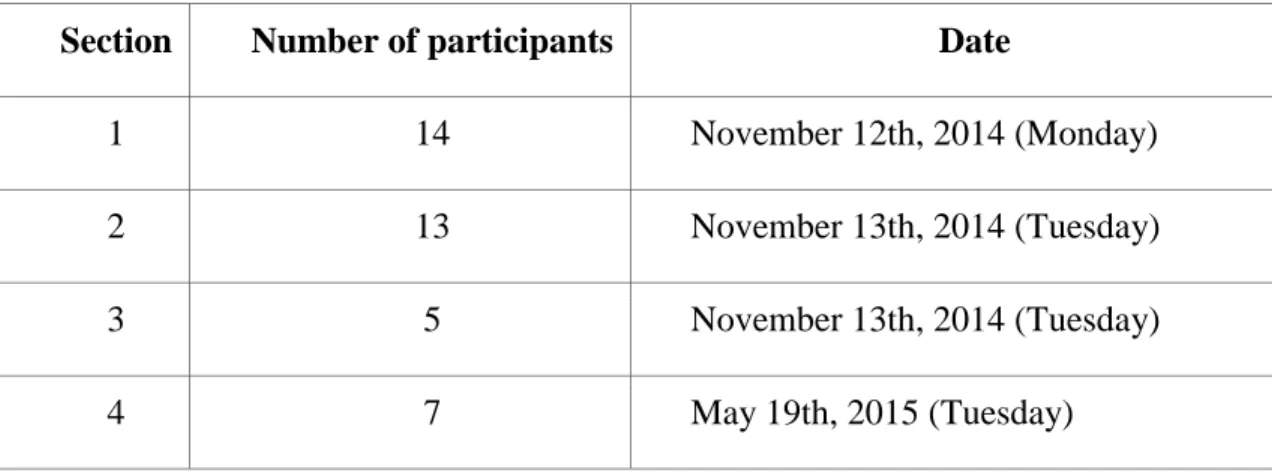
41
Figure 1: Questionnaires Application Dates
Section Number of participants Date
1 14 November 12th, 2014 (Monday)
2 13 November 13th, 2014 (Tuesday)
3 5 November 13th, 2014 (Tuesday)
4 7 May 19th, 2015 (Tuesday)
Once the questionnaire was conducted and the results analysed, a personal interview (one-to-one) was conducted to 10 subjects in order to obtain more detailed information with regard to their perceptions; referring to their performance in their internships based on the competencies they have acquired through the English Teacher Training Programme.
6.5.2. Interview.
As it was already mentioned, it was decided that the most accurate data collection instrument to obtain qualitative data was to use a one-on-one interview. In order to formulate this interview, the results from the questionnaire previously applied were taken into consideration. From the results of this questionnaire 3 questions with the highest and 3 with the lowest scores were chosen, in order to elicit information of aspects that could be relevant for our research. Besides this, prompt questions were included in the moment of the interview if the subject did not understand the question or needed additional information.
42
43
7. Data Analysis and Findings
In this chapter, the researchers present and analyse the data obtained from both instruments applied to gather information regarding self-efficacy beliefs that pre-service teachers at the English Teacher Training Program at Universidad Nacional Andrés Bello have while going through their last semester.
7.1 Quantitative Results 7.1.1. Questionnaire.
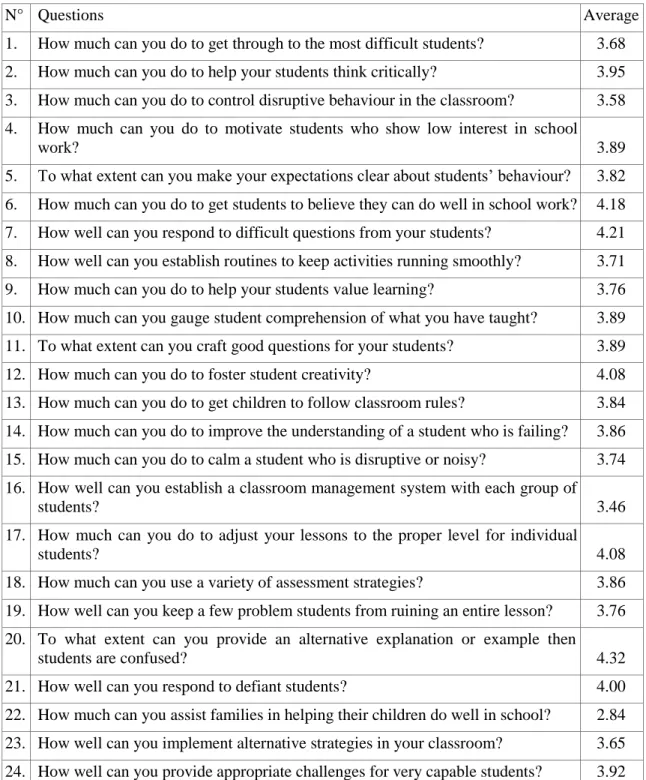
As it has been previously mentioned, the scores obtained in each question in the questionnaire were averaged in order to obtain more precise information in the questions that scored the highest and the lowest. The average of each question can be seen in the following figure (2).
44
Figure 2: Quantitative Instruments Results Questionnaire Results
N° Questions Average
1. How much can you do to get through to the most difficult students? 3.68
2. How much can you do to help your students think critically? 3.95
3. How much can you do to control disruptive behaviour in the classroom? 3.58
4. How much can you do to motivate students who show low interest in school
work? 3.89
5. To what extent can you make your expectations clear about students’ behaviour? 3.82
6. How much can you do to get students to believe they can do well in school work? 4.18
7. How well can you respond to difficult questions from your students? 4.21
8. How well can you establish routines to keep activities running smoothly? 3.71
9. How much can you do to help your students value learning? 3.76
10. How much can you gauge student comprehension of what you have taught? 3.89
11. To what extent can you craft good questions for your students? 3.89
12. How much can you do to foster student creativity? 4.08
13. How much can you do to get children to follow classroom rules? 3.84
14. How much can you do to improve the understanding of a student who is failing? 3.86
15. How much can you do to calm a student who is disruptive or noisy? 3.74
16. How well can you establish a classroom management system with each group of
students? 3.46
17. How much can you do to adjust your lessons to the proper level for individual
students? 4.08
18. How much can you use a variety of assessment strategies? 3.86
19. How well can you keep a few problem students from ruining an entire lesson? 3.76
20. To what extent can you provide an alternative explanation or example then
students are confused? 4.32
21. How well can you respond to defiant students? 4.00
22. How much can you assist families in helping their children do well in school? 2.84
23. How well can you implement alternative strategies in your classroom? 3.65
45
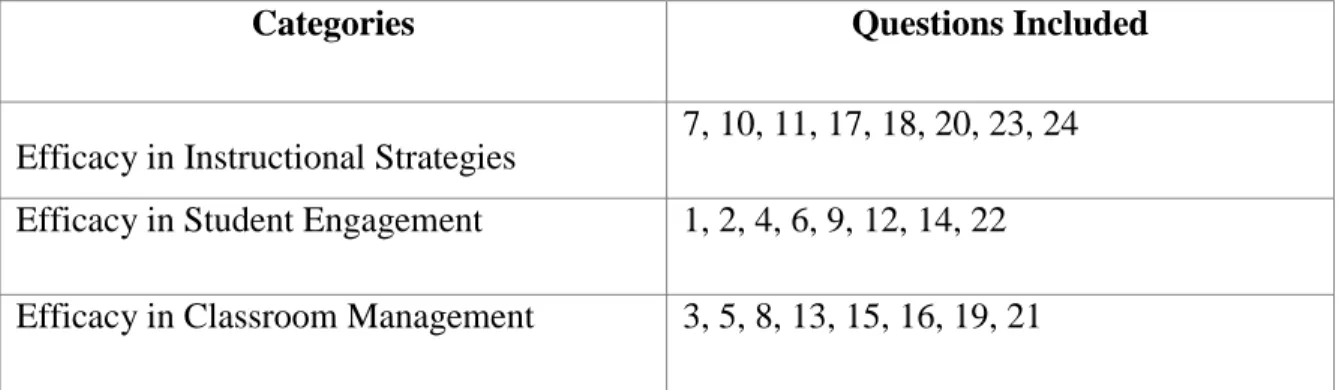
In order to conduct the analysis, the researchers used the three dimensions stated by Tschannen-Moran and Hoy in their scale:
i) Efficacy in Instructional Strategies ii) Efficacy in Student Engagement iii) Efficacy in Classroom Management.
The questions that each dimension includes are presented in figure 3.
Figure 3: Questions per dimension
Categories Questions Included
Efficacy in Instructional Strategies
7, 10, 11, 17, 18, 20, 23, 24 Efficacy in Student Engagement 1, 2, 4, 6, 9, 12, 14, 22 Efficacy in Classroom Management 3, 5, 8, 13, 15, 16, 19, 21