
Strengthening of listening and social skills through cognitive strategies
93
0
0
Texto completo
(2) STRENGTHENING OF LISTENING AND SOCIAL SKILLS THROUGH COGNITIVE STRATEGIES. GLORIA DEL CARMEN ROMERO GARZÓN. Pedagogical Research Project Presented to qualify for a Bachelor’s degree in Spanish and Foreign Languages Research Advisor Professor Zulma Buitrago. UNIVERSIDAD PEDAGÓGICA NACIONAL FACULTAD DE HUMANIDADES DEPARTAMENTO DE LENGUAS LICENCIATURA EN ESPAÑOL Y LENGUAS EXTRANJERAS BOGOTÁ D.C., 2017. 2.
(3) ABSTRACT. STRENGTHENING OF LISTENING AND SOCIAL SKILLS THROUGH COGNITIVE STRATEGIES. This project shows the pedagogical research carried out between February 2015 and April 2016 at Prado Veraniego School with a group of second graders in 2015 and third graders in 2016. The main objective was to create an effective communicative environment to improve listening and social skills through cognitive strategies, according to the learning gaps of third graders. One important characteristic of this action research project and pedagogical proposal is the importance of visual resources, such as videos and images. The approach used in this project was the one proposed by Jack Richards (2006): Using the Communicative Approach. On the other hand, according to O’Malley and Chamot (1990) activities were prepared to strengthen cognitive strategies in students’ language learning process. KEY WORDS: Cognitive strategies, effective communication, communicative skills, imagery, vocabulary, context.. 3.
(4) RESUMEN. FORTALECIMIENTO DE LAS HABILIDADES SOCIALES Y DE ESCUCHA A TRAVÉS DE LAS ESTRATEGIAS COGNITIVAS. Este proyecto muestra la investigación pedagógica realizada entre febrero de 2015 y abril de 2016 en la I.E.D. Prado Veraniego correspondiente a segundo grado en 2015 y tercer grado en el año 2016, con el objetivo de crear un entorno comunicativo eficaz para mejorar las habilidades sociales y de escucha a través de las estrategias cognitivas, a partir de las dificultades para el aprendizaje de la lengua inglesa, de los alumnos de tercer grado. Una característica importante de este proyecto de investigación acción y propuesta pedagógica es la importancia de los recursos visuales, tales como videos e imágenes. El enfoque utilizado en este proyecto es el propuesto por Jack Richards (2006): implementación del Enfoque Comunicativo. Por otra parte, se prepararon actividades para fortalecer las estrategias cognitivas en el proceso de aprendizaje de la lengua a partir de la propuesta de O'Malley y Chamot (1990). PALABRAS CLAVE: Estrategias cognitivas, comunicación efectiva, habilidades comunicativas, imágenes, vocabulario, contexto.. 4.
(5) INTRODUCTION. This action research study describes, analyses, and offers an account for the influence of cognitive strategies on the EFL learning process of a group of third graders at Prado Veraniego School. Taking the aforementioned into account, this research project proposes different stages to develop the study. One of the most important ones is the methodology stage, in which some pedagogical learning strategies are proposed to fill the learning gaps in the process of this specific group. In order to fill the learning gaps, the methodology is based on cognitive strategies such as: Imagery, association, elaboration, memorization, and repetition. These cognitive strategies are used to improve listening skills, in this case, not only as a learning language skill but also as an important social aspect to improve besides social skills, and the classroom environment. Finally, these components promote the communicative environment, the improvement of listening skills, contextualized learning of vocabulary, and progress of social skills.. 5.
(6) RESUMEN ANALITICO EN EDUCACIÓN - RAE 1. Información General Tipo de documento. Trabajo de Grado. Acceso al documento. Autor(es). Universidad Pedagógica Nacional. Biblioteca Central Strengthening of listening and social skills through cognitive strategies (Fortalecimiento de las habilidades sociales y de escucha a través de las estrategias cognitivas) Romero Garzón, Gloria del Carmen. Director. Buitrago Escobar, Zulma Rocío. Publicación. Bogotá, Universidad Pedagógica Nacional 2017. 94 páginas. Unidad Patrocinante. Universidad Pedagógica Nacional COGNITIVE STRATEGIES, EFFECTIVE COMMUNICATION, COMMUNICATIVE SKILLS, IMAGERY, VOCABULARY, CONTEXT.. Titulo del documento. Palabras Claves. 2. Descripción El presente proyecto de investigación tiene como propósito determinar la manera en la que las estrategias cognitivas pueden llegar a fortalecer o influenciar las habilidades comunicativas y las habilidades sociales en un contexto de aprendizaje del inglés como lengua extranjera, a través del vocabulario contextualizado en el grado tercero (304) en Colegio Prado Veraniego de la ciudad de Bogotá. Por esta razón, a partir de las estrategias cognitivas, la etapa de desarrollo cognitivo de los estudiantes y los recursos dentro de un contexto comunicativo se ha hecho uso del video, las imágenes y ejercicios que involucran procesos mentales en lengua extranjera. Las actividades se realizan a partir de un vocabulario dado que se contextualiza y permite a los estudiantes crear variados campos semánticos contextualizados para mejorar sus habilidades de escucha y habla.. 3. Fuentes 1. Anvari & Atiyaye D. M. (2014). Determinants of Effective Communication among Undergraduate Students. International Education Studies, 7(9), 112–122. http://doi.org/10.5539/ies.v7n9p112 2. Askell-Williams Helen, J. Lawson Michael, Skrzypiec Grace. (29 July 2011) Scaffolding cognitive and metacognitive strategy instruction in regular class lessons. Springer Science Business Media.. 3. Caspersz, D. (2015). Can we teach effective listening? An exploratory study, 12(4). 4. Cohen, C.; Flage, D. E. (2007). Essentials of Logic. (Second ed.). Upper Saddle River, NJ: Pearson Education.. 6.
(7) 5. Herbert Ginsburg and Sylvia Opper (1979), Piaget's Theory of Intellectual Development, Prentice Hall, p. 152.. 6. Luna Blanco, Rafaela. (2000) Un análisis sobre la relevancia de las interacciones entre estrategias cognitivas y modalidades de procesamiento. Servicio de Publicaciones de la Universidad de (España). ISSN: 0212-9728 7. Maturano, Carla Inés, Soliveres, María Amalia y Macías (2002). Ascensión estrategias cognitivas y metacognitivas en la comprensión. Humanidades y Artes. Universidad Nacional de San Juan Av. J.I. de La Roza, 230 oeste. 5400, San Juan, Argentina. 8. Richards Jack, (2006). Communicative language teaching today. Cambridge University. 9. Rezaei, A., & Hashim, F. (2013). Impact of awareness rising about listening micro-skills on the listening comprehension enhancement. An exploration of the listening micro-skills in English as a foreign language (EFL) classes. Australian Journal of Teacher Education, 38(8), 1–16. http://doi.org/10.14221/ajte.2013v38n8.4 10. Sammy P. Pitoy (January 2012) Information and language for effective communication. Camarines Norte State College, Region 5, Philippines TEFLIN Journal. Volume 23, Number 1, 11. Strauss, A., & Juliet, C. (1994)). Grounded Theory Methodology: An Overview. In N. Denzin & Y. Lincoln Handbook of Qualitative Research. 1st ed. (pp. 273–284). 12. Tudor, I. (2001) The dynamics of the language classroom. Cambridge. Cambridge University Press.. 13. Vandergrift, L. (2004). Listening to learn or learning to listen? Annual Review of Applied Linguistics. http://doi.org/10.1017/S0267190504000017. 14. Wolvin, A. (2013). Understanding the listening process: Rethinking the one size fits all models. International Journal of Listening, vol. 27, no. 2, pp. 104-106. http://dx.doi.org/10.1080/10904018.2013. 4. Contenidos El documento está compuesto por seis capítulos que reúnen la observación, análisis, teoría y propuesta metodológica, dirigidos al mejoramiento de los procesos de aprendizaje de vocabulario del idioma extranjero, dentro de contextos comunicativos del grado tercero (304) del Colegio Prado Veraniego.. 7.
(8) Capítulo 1: El primer capítulo presenta el contexto general, diagnóstico de habilidades, pregunta problema, objetivo general, objetivos específicos y justificación. Capítulo 2: Estado del arte, bases teóricas que soporten la propuesta investigativa. Capítulo 3: Tipo de proyecto, etapas de investigación-acción, instrumentos de recopilación de datos, unidades de análisis. Capítulo 4: Soporte pedagógico teórico, objetivos pedagógicos, descripción de la propuesta pedagógica, malla curricular, lecciones de clase y diarios de campo. Capítulo 5: Categorías de análisis, subcategorías de análisis y teorización. Capítulo 6: Conclusiones, limitaciones, consideraciones pedagógicas y futuras investigaciones.. 5. Metodología El estudio está enmarcado dentro de la metodología de investigación acción cualitativa, en el colegio Prado Veraniego de la ciudad de Bogotá con un grupo de estudiantes de grado segundo que posteriormente pasaron al grado tercero, con edades entre los 7 y 9 años. Estos estudiantes presentaban la necesidad básica de empezar su contacto y proceso de aprendizaje de lengua extranjera en inglés. Los 35 estudiantes empezaron el proceso con un nivel casi nulo de conocimiento de la lengua de acuerdo al diagnóstico. Tomando en cuenta su desarrollo cognitivo, las estrategias cognitivas que se adaptan a su edad y las herramientas posibles para usar dentro del aula, los estudiantes empezaron un proceso de aprendizaje de varios campos semánticos (vocabulario) en un contexto real a partir de videos e imágenes, lo que contribuye a la construcción de habilidades comunicativas y no solo la adquisición de palabras separadas; así, durante el proceso será evidente el impacto de las estrategias cognitivas, el vocabulario contextualizado y los recursos audio visuales (imágenes, videos) sobre el desarrollo de las habilidades comunicativas efectivas.. 6. Conclusiones Se determinó que las estrategias cognitivas fueron las tácticas o herramientas de aprendizaje más propicias y eficaces para este grupo de estudiantes de inglés como lengua extranjera. La fase de INPUT fue fundamental y determinante para el proceso de aprendizaje como una herramienta que permitió a los estudiantes comenzar a comunicarse de manera sencilla pero eficiente. La metodología que fue propuesta, no solo ayudo a mejorar las habilidades de escucha como una destreza propia del aprendizaje de una segunda lengua, sino también como una habilidad social que permitió mejorar la armonía en el aula de clase y entre los estudiantes.. Elaborado por: Revisado por:. Gloria del Carmen Romero Garzón Zulma Rocío Buitrago Escobar. Fecha de elaboración del Resumen:. 20. 05. 2017. 8.
(9) TABLE OF CONTENTS STRENGTHENING OF LISTENING AND SOCIAL SKILLS THROUGH COGNITIVE STRATEGIES ............................................................................................................................... 1 Chapter 1: Characterization ........................................................................................................ 1 Characterization ........................................................................................................................ 1 Population .................................................................................................................................. 2 Diagnosis .................................................................................................................................... 5 Rationale of the study ............................................................................................................. 12 Problem Statement .................................................................................................................. 15 Research question(s) and objective(s) ................................................................................... 16 Chapter 2: Literature Review .................................................................................................... 17 State of the Art......................................................................................................................... 17 Theoretical Framework .......................................................................................................... 19 Cognitive Strategies................................................................................................................. 20 Effective communication ........................................................................................................ 21 Listening skills ......................................................................................................................... 22 The Communicative Approach .............................................................................................. 24 Chapter 3: Methodology............................................................................................................. 25 Type of Study ........................................................................................................................... 25 Data management procedures and data analysis methodology .......................................... 27 Units of analysis ....................................................................................................................... 28 Chapter 4: Pedagogical Proposal .............................................................................................. 29 Pedagogical Framework ......................................................................................................... 30 Pedagogical Objectives ........................................................................................................... 32 Pedagogical proposal and design ........................................................................................... 32 Chapter 5: Results and analysis................................................................................................. 43 Process of observation and analysis of results ...................................................................... 43 Analysis of categories .............................................................................................................. 46 Theorizing ................................................................................................................................ 61 Chapter 6: Conclusions and recommendations ....................................................................... 63 9.
(10) Conclusions .............................................................................................................................. 63 Pedagogical implications......................................................................................................... 65 Limitations ............................................................................................................................... 66 Further Research..................................................................................................................... 67 REFERENCES ............................................................................................................................ 68 ANNEXES ................................................................................................................................... 70. 10.
(11) Chapter 1: Characterization This chapter describes the context of the School I.E.D Prado Veraniego, in Bogotá, Colombia in terms of the local community which surrounds the school setting. Immediately afterwards, there is a description in general terms about the institution having as a reference point its Proyecto Educativo Institucional (P.E.I). Then, this chapter makes reference to the target where the teacher focused the research, which is third grade, in the afternoon shift. Subsequently, the researcher focuses the description on the cognitive, social-affective, cultural, and linguistic characteristics of the population. Characterization To start with the cultural setting of the group, it is crucial to mention the characteristics of the local setting at I.E.D Prado Veraniego. It is a public school for boys and girls located in a neighbourhood in the locality of Suba in Bogotá Colombia. According to a Reseña Básica Barrial prepared by the members of the Junta de Acción Comunal (Community Action Board), most of the people in the neighbourhood are classified in the third stratum, which means a medium-low socioeconomic level. Most houses around the school are completely built. In many of them there are little stores in the lower level which indicates that locally, there is a significant amount of commercial activity. Another important field to build the characterization is the education background. The school also has a vision in which it evidences the kind of students the school aims to have; thus, in order to enrich the school context characterization, it is important to mention a few aspects about the P.E.I of the school as follows. The name of the school’s Proyecto Educativo Institucional (P.E.I) is “Quality communication towards human development.” This aspect is related to the Mission in 1.
(12) which communication plays a very important role. According to the vision, they intend to be an institution that prepares students to be engaged with human development to lead processes which increase social change; therefore, their institutional emphasis is on communication and values. On the other hand, the pedagogical model is the Social-cognitive model. Prado Veraniego School takes Piaget, Makarenko, Vygotsky, and Freire as their lead exponents of this model (Manual de Convivencia, 2015). Population. With the purpose of properly characterizing the population of this study, observations and a survey were applied aiming at showing general issues in children such as age, likes and dislikes, and the place of abode. The observations were done during math classes because the English class was used to work arts as there was no English teacher at that moment; this information was collected in the field notes. Thus, it was concluded that group 204 in the afternoon shift, at the beginning of the research, and 304 in the second part of the study, was a class of 31 students with ages ranging from seven to nine; there was only one student who was nine. Since students were in the same age range, they shared hobbies and preferences, and this was why they were always trying to talk or play with each other, using toys or elements they brought from home. This behavior during class made the classroom environment hard to manage because whenever the children were asked to listen to and follow directions to complete or develop an activity, their attention went to other activities that were not related to the class. The aforesaid also explains the process they had when they tried to complete any task or exercise. The noisy and stressful environment of the class did not favor the learning process.. 2.
(13) Thus, it was also evident the lack of concentration on the tasks proposed by the mentor teacher; besides, when they were supposed to be in one activity, they were distracted by objects in the classroom and by their other classmates; this situation not only led to a difficult classroom environment but it also limited the communication among the individuals of the classroom. This previous observation was important because it could be contrasted with the Institution’s P.E.I, which emphasizes communication skills in society. It expresses the immense impact these have in and after school as well as in professional life. On the other hand, this points out the relevance of the skills concerning the school´s context also the classroom environment; which were the immediate surroundings. (Manual de Convivencia, 2015). Nevertheless, the students participated actively in mathematics class; they did not like the Spanish or English class because they felt very insecure about their skills, as it is shown in the survey applied. (See annex 2). However, they seemed to enjoy sharing their opinion with their classmates about certain topics. Regarding English classes, it is important to describe the situation in which the researcher carried out the observation project with the students of second grade (204) at Prado Veraniego School, from August to September of 2015. The school at that time could not have an assigned English teacher even though the school was interested in maintaining this class in the curriculum, and it was impossible to have an intern from the University, the mentor teacher decided to use this class to work arts and crafts activities. Sometimes she got the students’ attention by using commands only in Spanish such as “up, down” repeatedly until the students were quiet. In terms of English knowledge, it is observed that students’ vocabulary was reduced to the numbers from one to ten, and they recognized some basic verbs or words in the classroom such as “listen” “silence” “write” and “read.” Here, it is important to say that students had had a previous contact 3.
(14) with English but it looked as if they had only approached it in terms of separate vocabulary and word commands. They recognized separate words but not language chunks or complete ideas expressed in English. Some of them had problems writing or copying what was written on the board because they did not separate words. Therefore, a significant part of the students did not have any interest in the process of learning English and some of them had expressed that it was boring. (See annex 2) In terms of cognitive development, the group of students was between seven and nine years old, such ages belong to stage one in Piaget's theory of cognitive development (Ginsburg and Opper 1979): The concrete operational stage, this stage allows the students to develop different cognitive operations. One of the most important characteristics of this stage is the beginning of the proper use of logic in order to solve problems; in terms of theory, the main cognitive operation in this stage is the conservation. This cognitive operation describes the capacity of the child to conserve the properties of an object despite of some changes at the circumstances; a famous example of this operation is when a child understands that an ice cube even in a solid state is water, the child understands that the states of matter change but it is still being water. (Davidson 1993). The second important cognitive operation is inductive reasoning which is a specific ability of thinking that allows the child to elaborate groups of characteristics or elements in a specific field with similar aspects to make a generalization. (Cohen, Flage 2007) The social-affective characterization of this population belongs to the industry vs. inferiority stage which is developing at school between 5 and 12 years old, according to Erickson’s personality stages (Erikson, Erik H.1997). This stage was particularly important to the teacher because she had to raise student’s self-esteem, as they started to compare themselves with their partners and wanted to share their abilities, not to feel inferior. Self-esteem is fragile at this age 4.
(15) according to Erickson´s personality stages, the communicative and social skills allow the student to learn how to cooperate thus, understanding his spot and important participation in a group. According to Richards (Richards, 2006 p. 4), within Communicative Language Teaching (CLT), which is a closer approach to reach teaching-learning goals in terms of creation or negotiation of meanings, paying attention to the input vocabulary that students hear along their learning process and to different ways to express themselves, help them to feel comfortable with the communication process, not only with the teacher as a model, but also with their peers. (Richards, 2006 p.8) Diagnosis As the general characterization of the population was settled by the observation process and field notes taken at specific moments, I will now present the results of the application of the data-collection instruments to build and come up with a diagnosis of the students’ English level, to establish the necessities and characteristics of the population regarding specifically English learning. There are three main steps of this diagnostic test. The first one is a survey that asked the students about their opinion and relationship with English. The second step was a diagnostic test to determine the students’ language level in the four skills. Finally, the third step was the implementation of a brief explanation of a topic using images. In the first step of the diagnosis process, which is a survey; the teacher proposed several questions to the students in order to determine their opinion and relation with English. (See annex 2). 5.
(16) The survey applied pointed out several characteristics related to their interests and expectations in relation to the English class, due to the fact that the observation process related to the characterization was developed in the mathematics class and also because at that point there was no English class. According to the survey, 72.4% of the students liked English, besides that, 69% of the students considered reading the most difficult skill in English. Nevertheless, the skill they considered the “easiest” was listening because only 3.4% of students marked it as difficult; 3.4% of the students expressed that the activity that they would not like to do in the English class was “dialogues,” compared to watching videos that had an 83 % of the results. Finally, a positive aspect in the survey, is that 100% of the students gave a reason to the question, Why do you think English is useful for? Some of those reasons were: “Because you can go to another country or the United States” or “To be a good professional;” it is an important aspect in relation to motivation, because it shows the real use of English learning in a context out of school and related to professional life experience. (See annex 2) The second step of the diagnosis process was based on several activities directed to determine the abilities and weaknesses of each skill regarding EFL. Consequently, the teacher decided to have a brainstorming session with the students as a diagnosis activity in order to determine the real vocabulary the students already knew. The first activity consisted in giving the students some commands in English which they had to follow with their body in order to determine their listening and comprehension basic skills. The second activity consisted in asking the students a question in English to be answered in English too and which would allow me to determine their basic speaking skills. The third activity to determine their writing skill was a brainstorming session, in which the students had to write and participate with words they knew how to write. 6.
(17) The last activity was a little story first presented as a little text and then as a sequence with images. This activity had two main functions, the first one was to determine the reading comprehension skill level; the second, was to establish the viability of the use of images in a simple and short activity. In the first activity referred to commands (listening comprehension), the students were able to follow two commands out of ten. The second activity referred to the questions, (speaking) the students were able to understand one out of five questions and the one they understood was answered in Spanish. The third activity referred to the brainstorming, (writing) the students participated actively writing separate words in English; however, there were many spelling mistakes. On the last activity concerning the story (reading comprehension), students were not able to understand the story as a complete text, only a few separate words; nevertheless, after showing the same story with a sequence of images, the students understood the story and the main idea. The last step of the diagnosis process was the implementation of a topic using images as the main tool to approach students to an EFL context and present a learning environment using the foreign language. The implementation class began with a presentation based on the agreements the teacher wanted to settle in the classroom using a big poster with images. Each image on the poster represented each agreement. Using this tool, the teacher introduced and explained the methodology of the class in English even though students did not fully understand. However, the most important aspect of this implementation is the fact that students were able to recognize and establish concepts from images or visual representations. After the explanation, the teacher asked students to draw the most important agreement for themselves in class. 7.
(18) In order to provide and build a complete diagnosis process, the analysis of every diagnostic step is presented based on the field notes, observation-procedure, and survey. Taking into account the results provided in the last paragraphs based on the field notes, surveys, and diagnosis test , the student-teacher determined that students had a very low level of English regarding skills; therefore, it was evident throughout the information collected in the surveys and diagnosis test that regarding English, children only responded to commands in Spanish, also they were not able to communicate actively because they were not aware of the importance of the development of the communicative skills. Most of the time, students were not able to communicate actively as they had no vocabulary to understand or express their ideas inside the classroom. (See annexes 1 and 2) According to the “Estándares Básicos de Competencias en Lengua Extranjera: Inglés”, the students from second grade; now in third grade in the current year at Prado Veraniego School, belong to A1 level.. This level corresponds to the first level in the Common European. Framework of Reference for Languages in which the learners should be able to use familiar and basic expressions, introduce her/him and interact in a simple way. This level A1 for beginners is the same for students of first, second, and third grade; nevertheless, students lacked many of the features and characteristics of the level. Some of the missing characteristics according to the diagnosis test were: In terms of listening skills: Students did not understand songs, instructions or games in English because all these activities were in Spanish only.. 8.
(19) Students did not recognize or know simple vocabulary therefore they were not able to understand simple questions such as: How are you? What is your name? What is this? Did you finish? There was not a proper vocabulary learning context; thus, students did not understand sequences related to habits and routines because every single routine in the classroom was in Spanish. 1.3.2 In terms of speaking skills: Students were not able to express their feelings, because they did not know emotive vocabulary. Students were not able to express basic needs in the classroom such as: May I go to the bathroom please? Can you repeat teacher? Wait a moment teacher, since every command in the classroom was in Spanish. Students were confused with greetings and did not understand the difference between “Good afternoon” or “See you tomorrow.” Greetings in class were always in Spanish. 1.3.3 In terms of writing skills: Students did not write the names of many objects or places in their school. context such as supplies or parts of the classroom. Students did not show evidence of structure knowledge in terms of basic grammar constructions. Students did not write basic answers when it came to writing an answer about where or when, referring to family, friends or school. 1.3.4 In terms of reading skills: 9.
(20) Students were not able to use diagrams to organize a tale structure. Students were not able to read a complete title and give ideas about the topic. After the second step of the diagnosis test, it was necessary to use images in a brief explanation of agreements in class in order to discover if students could pay attention or be motivated by the use of images in their learning process. The teacher brought to class a group of allusive images and at the same time explained the idea of arrangements in English. Taking the aforementioned into account, a specific function of the mental processes related to perceptions called imagery was found. According to O’Malley, imagery is a mental process that proposes the use of visual images in order to understand verbal information (O’Malley and Chamot, 1990). The main characteristic of this process is that the student is able to realize a mechanical relation between the word and the picture that allows the student to remember and relate the word easily to the concept. A vital aspect of the analysis of the implementation found in the field notes is the fact that every time the students did not understand, the teacher used images to solve questions. Next to this explanation with the images or drawings, students understood the idea almost immediately. With the field notes analysis, it is pertinent then to reflect upon the influence of the image in the learning processes in this specific stage of cognitive development. As a result of the observation, five important issues were stablished: Attention span, listening, learning environment, communication, and habits. In relation to attention span, students had difficulties to focus on the tasks or exercises the mentor-teacher asked them to do in every single class, no matter what subject it was. As a result, the teacher hit the board or started using commands in order to regain control of the class. 10.
(21) Talking about listening, most of the time, the teacher had to explain the directions of the exercise two or three times because students did not pay attention. As soon as the teacher started to explain something using the board, students started talking or playing with each other; as a result, the learning environment of the class was extremely noisy and difficult to handle. This fact slowed down their comprehension and it did not allow them to have healthy communication processes inside the classroom. Therefore, lack of communication was an important characteristic because the students wanted to be heard but they did not want to listen to their classmates or to the mentor-teacher. Concerning the learning environment context, the relevance of including listening skills is that students were not aware of how their attention affected the class and also their own personal learning process. Since their motivation or attention was not focused on the task or class activities, on the contrary, students felt that most of the time the activities were not useful or they were just senseless. Therefore, the consideration of learning vocabulary in a real context was important. Every lesson had a connection with the development of communication inside the classroom; thus, the students were able to understand the real use and sense of the language. The last important issue to take into account is habits; most of the students had established a routine regarding classes at school. This means they behaved, worked, and acted in a specific way inside the classroom. It was necessary to provide a new routine and learning environment to students in order to enhance the practices inside the classroom. Finally, the main conclusion of this diagnosis test is the evident lack of development of listening skills and the need of a positive influence of a proper EFL learning environment. However, the main advantages of this group are their cognitive development stage and also their interest in different useful resources such as images and videos. 11.
(22) Rationale of the study This project points out the use of cognitive strategies because these are crucial to improve listening and social skills, on the other hand, the effective communication inside the classroom, in order to build a proper communicative learning context. It is also crucial to take into account the specific stages of cognitive development of the third graders at Prado Veraniego School. With the aim of building the rational, some articles and research projects were taken into account. These served as initial references in order to focus this research project on the lack of a meaningful environment for the learning of English, specifically listening skills. It is necessary to provide input for the students to understand commands, participate in activities and possibly follow the process to be able to express opinions. The aforementioned shows there is a lack of effective communication as a procedure and social ability to exchange information through speech and body gestures (Anvari & Atiyaye, 2014). Inside the classroom, due to the lack of development and improvement of listening skills, the teacher proposed the implementation of cognitive learning strategies due to the cognitive stage development in which the third graders were and the needs exposed in the diagnosis test and the imagery process. Then, cognitive strategies and listening skills were the most appropriate features to consider in the methodology to improve the learning process in the EFL classroom. In this cognitive phase the students were able to work on five specific cognitive strategies: Imagery, Memory, Repetition, Association, and Elaboration to improve listening and social skills in the English class. Bearing in mind effective communication, there has not been extensive research on effective communication in the classroom or in language teaching. However, some authors (Anvari & Atiyaye, 2014) have developed the concept in other disciplines different from language learning and they propose some ideas that enlighten its importance for this project. Anvari & Atiyaye. 12.
(23) (2014), for instance, define it as “the procedure for exchanging information. Information is transferred through terms, speech, as well as body gestures” (p.113) and they also say that it is a social ability which helps people to have better relationships with each other. They also point out that there are several other abilities, which are important to have in order to communicate effectively, as follows, “These abilities consist of great hearing abilities, as well as having the ability to adapt to various circumstances as well as situations. Interaction on its own consists of speech, clearness, actions, body gestures as well as facial expression.” With regards to Cognitive Strategies, the main important concept is cognition which is the name of all processes of knowledge, understanding, and learning through experiences, senses, and thoughts as mental actions. The aforementioned is the bases for understanding cognitive strategies. Cognitive strategies are tactics and tools which facilitate students’ solving learning problems or tasks in an easier manner (Bereiter & Scardamalia, 1987). As cognitive strategies facilitate the internal mental procedures even though they are easy or complex for their cognitive stage, strategies also provide a structure in the learning process which allows the student to improve his/her mental processes inside a correct learning environment, which in this case is the classroom (Rosenshine, 1997). The target group of students was between seven and nine years old. Such ages belong to stage one in Piaget's theory of cognitive development: The concrete operational stage. This stage takes place between seven and twelve years of age, there are three important mental processes the young learners are able to do in this stage, which can be connected with the English learning process. Such processes are: a. Classification, which is the ability the learner has to classify objects taking into account the similarities b. Conservation, which is the understanding of the. 13.
(24) specific changes or aspects c. Transitivity, which refers to the capacity to order different things mentally and recognize its relations to each other (Ginsburg and Opper, 1979). The relevance of this research project will be described in the next section of the study. It will be developed in four main aspects that are related to the theoretical relevance and the importance of the project at the national, institutional, and local level. There are not many research studies on effective communication in young learners; therefore, this research project aimed at enriching and contributing to the theoretical framework in this specific study area, taking into account that there have been other studies whished enrich the present project, but at the same time make evident a gap in the study of these topics in relation to young learners. In terms of the teaching of English, this project explored different teaching strategies to develop listening skills (Kaur, 2014). It is also a necessity in the pedagogical field because most of the literature that was reviewed focused on activities for improving the listening process in adults rather than on understanding the way listening works in young children. In order to see the importance of this project at a national level, it is important to see the “Estándares básicos de Competencias en Lenguas Extranjeras: Inglés”. According to the Estándares (Ministerio de Educación Nacional, 2006) children who are in second and third grade should be classified in the A1 level, according to the Common European Framework of Reference for Languages. This can be evaluated through three types of competences which are: Linguistic, sociolinguistic, and pragmatic and each skill has specific standards which are related to the three competences. In relation to listening and speaking skills, it is a key element that children communicate either by understanding or producing short conversations. In this context, helping children to bring English to their lives as a tool for communicating with others became important in order to develop the competences required by the MEN in Colombia. It is crucial to 14.
(25) see the Proyecto Educativo Institucional (P.E.I) as a reference in order to highlight the importance of this project at an institutional level. According to the P.E.I. Which is named “Quality communication towards human development,” the school aims at preparing students to be engaged in human development and leading processes which promote a social change. Therefore, their institutional emphasis is on communication and values and it was found that these aspects were not properly enhanced in students of group 204. These aspects could be dealt with in the classroom through the use of cognitive strategies and listening activities in order to improve listening skills within an effective communicative context and in that order of ideas, to achieve some of the goals stated by the school in their P.E.I. Problem Statement During the observation held in the classroom and through the analysis of the field notes, it was found that one of the biggest problems concerning the environment of the English class was that children were not proper at listening or expressing ideas to the teacher or each other because they did not have the vocabulary to understand or produce messages. As a result, whenever the teacher or a classmate was talking to them, they were talking with each other until it was impossible to listen over the noise, so the teacher had to get their attention and they were only quiet when the teacher started using commands such as “stand up, sit down” over and over again. In the previous description, it is evident that there was a big problem in terms of listening, not only as a proper habit but because it has not been developed as a skill. In this case, it was only a behaviour issue and not a tool or strategy to improve the learning process. This problem was not only evident in the English subject but also in the other classes, it prevented them from learning what they were supposed to learn in any subject and it also made the classroom environment 15.
(26) hard to manage. However, it was evident throughout all the observations that regarding English, children only responded to commands and the most important concern and problem of the learning process was the fact that they were not able to communicate actively because they were not conscious of the importance of the development of communicative skills. As it has been stated, there were some ideas which were related to the nature of the problem. The first one was the lack of listening skills development; the second one was the low English level which prevented children from understanding what they were listening to. The last important idea is the lack of cognitive strategy use, which could have helped them to improve their learning process. Research question(s) and objective(s) The problem that has been previously described allowed the researcher to have a specific idea of the main problem which was to be solved during the implementation of the present research project and it attempted to answer the following question: How does the use of cognitive strategies influence on the development of listening and social skills in English in a group of third graders at Prado Veraniego School? General objective To determine the way in which cognitive strategies could influence on the development of listening and social skills in English in a group of third graders at Prado Veraniego School. Specific objectives: To identify the relevance of using cognitive strategies within communicative environments in order to develop students’ listening skills.. 16.
(27) To describe in which ways cognitive strategies help to develop social skills when promoting an effective communication in an EFL class. To set the relevance of applying an input vocabulary phase supported by the imagery process and EFL videos.. Chapter 2: Literature Review In this chapter, different research studies related to this specific field are taken into account in order to build the state of the art. This allows understanding the positive background results and also the gaps in the specific filed of knowledge. On the other hand, with the aim of building the rational, some articles and research projects were taken into account and they served as references in order to focus this research project on foreign language learning. Each one of the references is related to the main conceptions which help to set the bases to the development of this project; such conceptions are cognitive strategies, listening skills, and effective communication. State of the Art In order to have a closer look into this field of knowledge, different studies have been referred to. The following is an account of them. “Cognitive strategies in a communicative environment to improve vocabulary in EFL sixth graders at Prado Veraniego” In terms of cognitive strategies, it is important to point out that the main objective was related to the interpretation and analysis of the outcome of using cognitive strategies to reinforce the learning of vocabulary in English among sixth graders. The results of the development of a. 17.
(28) communicative process supported by different mental aspects which originated a conscious use of certain learning cognitive strategies allowed the students to fulfill their EFL needs (Jauregui, 2015). However, it is necessary to mention that the process in this research work was developed with sixth graders who were in a different cognitive stage of development. “Image reading through children’s literature to strengthen basic listening and speaking skills” In terms of listening skills, it is important to point out the exposure of different methods of image reading through literature as a resource inside the classroom environment to strengthen basic abilities of listening and speaking in EFL with second graders (Diaz 2015). One of the most significant results of this study was the strengthening of speaking and listening, basic abilities, trough image reading. This is due to the fact that it provided students with a communicative environment, supported by contextualization with specific images related to the vocabulary. Another important conclusion of this study is the relevance of the teacher’s role in communicative contexts as it is the teacher who controls the language management during the class. Thus, students increased their ability to listen as an essential basis for oral production. “The use of vocabulary learning strategies in context-based activities aimed at teenagers B2 upper intermediate students in EFL” In terms of contextualized acquisition of vocabulary, this study attempts to mark the importance of different activities to develop listening and speaking skills (González 2013); the relevance of this project is the immersion of a real context inside the classroom. As a result, the students’ roles changed from passive to active and it generated motivation. The contextualization of the language was an important factor for students to realize the actual usage of language. It. 18.
(29) was also important to understand the close relationship between speaking as production and listening as comprehension. Teaching Listening Skills to Young Learners through “Listen and Do” Songs In terms of teaching listening skills to young learners this study provides several statements. These statements are relevant as they present important information related to the first listening skills teaching stage, in this case, through songs and total physical respond TPR. (Mustafa S¸ evik, 2012) This study proposes a lesson plan to teach through songs and TPR. The lesson plan considers four listening stages and follows up listening comprehension activities. According to the author, songs provide meaningful and enjoyable EFL practice to develop the learning process. Besides this, the repetition of the vocabulary helps the acquisition process and the rhythmic practice through different melodies help to associate the content. There are two main conclusions for this study. The first conclusion points out the relevance of using a considerable amount of songs as this help young learners to increase their vocabulary and develop their listening skills. The second important conclusion emphasizes the effectiveness of the songs when young learners have to combine listening skills with TPR, which means it involves games with movements. Theoretical Framework. According to the question which is guiding the research, How does the use of cognitive strategies influence on the development of listening and social skills in English in a group of third graders at Prado Veraniego School?, it is necessary to establish the different constructs which are going to enrich the process. Such concepts are: Cognitive strategies, the Communicative approach, Listening skills, and Social skills in effective communication. Those 19.
(30) constructs are going to be presented in the following chapter targeting understanding the way in which they are interrelated. Cognitive Strategies With regard to Cognitive Strategies, the main concept is cognition, which is the name of all processes of knowledge, understanding, and learning through experiences, senses, and thoughts as mental actions. The aforementioned serves as a basis for understanding. Cognitive strategies are tactics and tools which help students to solve learning problems or tasks in an easier manner (Bereiter & Scardamalia, 1987). As cognitive strategies facilitate the internal mental procedures even though they are easy or complex for their cognitive stage, the strategies also provide a structure in the learning process. This allows the student to improve his mental processes within a correct learning environment which in this case is the classroom. (Rosenshine, 1997) According to Gellatly (Gellatly, 1997) cognition refers to all the activities related with knowing, in other words, it is based on three actions: Picking, organizing, and using the knowledge. In terms of learning strategies, there are two types, cognitive and metacognitive strategies, in this case the project is centered on the cognitive strategies. Cognitive strategies involve four main mental processes, such as rehearsal, elaboration, organization, and critical thinking skills. These are the major cognitive procedures students are able to use in the learning process. In addition to the aforementioned, cognitive strategies are usually used by learners or students who are able to regulate their learning process themselves. This helps them to also construct, re think knowledge, and to be aware of it. There are big categories in which cognitive strategies are classified, such categories are: Repetition, 20.
(31) elaboration, regulating, and critical thinking. On the other hand, metacognitive strategies are classified as planning, monitoring, and regulating. (Education and Science, 2005) It is important to specify for this project the use of five cognitive strategies: Imagery, which refers to the mental process the students use to learn new vocabulary using images and acquire knowledge. Repetition, which is the cognitive strategy used to practice the pronunciation, memorization, used to remember the structures and the meaning of words in Spanish. On the other hand, elaboration is used to apply the acquired knowledge in different production exercises. Finally, association is the strategy used to elaborate different connections between concepts and its uses to communicate. In this case, understanding cognitive strategies as a tool to strengthen listening skills and effective communication is the result of the work of both strategies listening-speaking within a communicative context. It results in effective communication and strength in social abilities and social harmony. Effective communication There has not been extensive research on effective communication in the classroom or in language teaching. However, some authors (Anvari & Atiyaye, 2014) have developed the concept in other disciplines apart from language learning and they propose some ideas on active communication that enlightened its importance for this project. Anvari & Atiyaye (2014), for instance define it as “the procedure for exchanging information. Information is transferred through terms, speech, as well as body gestures” (p.113) and they also say that it is a social ability which helps people to hold better relationships amongst each other. They also point out that there are several other abilities which are important to have in order to 21.
(32) communicate effectively. These are as follows, “these abilities consist of great hearing abilities, as well as having the ability to adjust to various circumstances as well as situations. Interaction on its own consists of speech, clearness, actions, body gestures, as well as facial expression” (Anvari & Atiyaye, 2014, p.113). These implications are important because for this study, communication is a complex process in which many factors have to occur in order to achieve effective communication. One of the most remarkable abilities that are common to the process of learning English and to the communication process, is the ability to listen in order to interact with others. This is not only in a verbal way but also using non-verbal communication in order to send a clear message to the recipient. On the other hand, Grover (2004) mentions some variables, which affect effective communication such as, hierarchy, trust, self-disclosure, empathy, and mutuality. Teaching children how to communicate effectively will not only help them in the process of learning English but it will also improve the classroom environment and it will provide them with the opportunity to have better relationships among each other. Still, it is important to note that communication is a very wide construct and this project aims at using it as a means to improve the listening skills in English because it is considered that there cannot be an effective communication if in the beginning there is not an active listening process. Listening skills The last concept that will be developed in this theoretical framework is the concept of listening. This part will be seen from two perspectives. On the first hand, it will be assumed within the concept of effective listening, which has to do with the conception of communication that has been previously described. Secondly, listening will be seen as a skill in the English. 22.
(33) learning process which can be developed through the use of metacognitive strategies. In the following section, two perspectives are described to point out important elements of each perspective that serve the purposes of the present research project. To begin with, the concept of effective listening is discussed and it is known, hearing is the physiological faculty of perceiving sounds. Thus, listening corresponds to the conscious and active mental process of listening to the messages that others try to transmit intentionally (Caspersz, 2015). Nevertheless, effective listening is a specific concept, which involves a conscious process but it also proposes to achieve specific goals related to a listening event (Wolvin, 2013). The goals of a listening event are established mainly by the context and shared objectives of the listeners, due to the fact that listening is an individual and shared process. In that way, there are several types of listening, but in order to achieve an effective listening skill, it is necessary to implement the collaborative or bidirectional listening which is described by Vandergrift (2004) as the only dimension of listening that is worth teaching. Furthermore, he affirms that the listener has to undergo several processes in order to listen, such as processing the input in real time, clarifying information, evaluating what is heard and responding. Vandergrift (2004) is also an important reference in terms of effective listening because he recognizes the importance of the sociolinguistic dimensions of listening. Carrier (1999) discusses how the social context of listening also influences comprehension; she points out how status relationships between interlocutors affect language behavior and the amount of negotiation in face-to-face interactions. This can help or hinder comprehension. Teachers need to help students understand this dynamics and provide strategies that are helpful to negotiate meaning, in spite of the unequal status of the interlocutors” (Vandergrift, 2004, p. 17) As the author mentions, comprehension is a very important element of listening and there are several social factors which might influence the. 23.
(34) development of that skill. Another important aspect is that listening is not only based on sounds or words from the speaker but also the non-verbal and contextualized aspects (Halone et Pecchioni 2001). Alternatively, listening is an important skill to be developed when learning an L2 and it requires very complex cognitive processes. Vandergrift (2004) proposes two kinds of processes which will be taken into account in this study. Those are bottom-up and top-down processes, which help students become aware of using the strategies that better fit their necessities and in that way they can improve their listening skill. Vandergrift (2004) also asserts that some of the difficulties for the listening skills are the limitations on memory and also the difficulties to recognize the prosodic features in speakers. These limitations could be even more noticeable since the present project is supposed to be developed with second graders and most of the research advanced in this field has been applied among teenagers or adults. In this chapter, the teacher has developed the constructs of cognitive strategies, effective communication, and listening skills. It can be concluded that in order to enhance listening skills, effective communication must be present in the classroom. One way to achieve this is by getting students to be aware of the existence of cognitive strategies which help them to learn. The Communicative Approach The last important concept to take into account during this project work is the communicative approach, this is the teaching method selected to be the basis of the methodology. “The communicative approach is based on the idea that learning language successfully comes through having to communicate real meaning. When learners are involved in real communication, their natural strategies for language acquisition will be used, and this will allow them to learn to use the language.” (British council, 2006). 24.
(35) As the approach considers the learners to be involved in communicative environments, this aspect is fundamental to teach different vocabulary in real contexts with significant meaning to the students. Also, as the natural learning strategies appear during the process, this becomes the most suitable basis to introduce different cognitive strategies. Taking the aforementioned into account, this approach will help to fulfill the pedagogical gaps found during the diagnosis test and also to improve the EFL learning process. To conclude, this chapter allowed the confirmation that there is not extensive research on cognitive strategies regarding listening skills in young learners. For that reason, this project will attempt to fill that gap that has been described throughout chapters 1 and 2. In the next chapter, the researcher will present the methodology chosen for the present research.. Chapter 3: Methodology Type of Study This study was carried out within the frame of the Action Research approach (Phillips and Carr 2010. It is important to point out the characteristics of this work to establish it belongs to the action research approach. The first aspect is the problem description as this study intends to describe a problem inside a specific context or situation. Another characteristic is the population which was not chosen randomly; on the contrary, it is a complete class of third graders. Also, this work uses qualitative data collection instruments such as surveys, field notes, artifact analysis, and observation instead of using only digits and numbers to present quantitative numerical results. Stages of qualitative research development. 25.
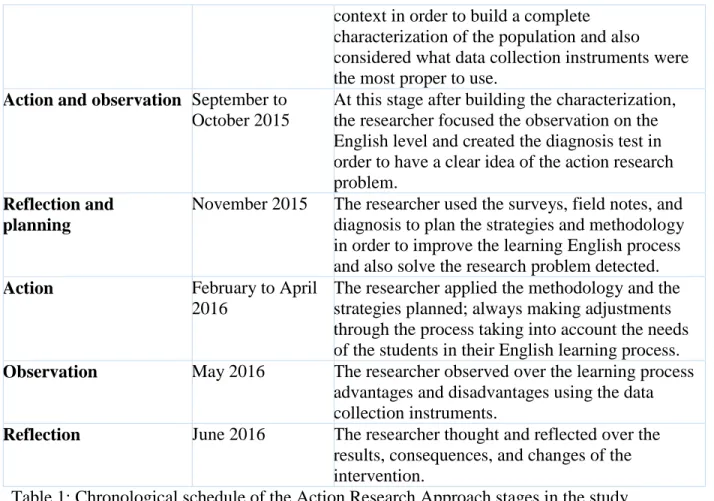
(36) According to Phillips and Carr (2010) it is a self-reflective process. Phillips and Carr mention that AR is a spiral of several stages that are Planning, Acting, Observing, and Reflecting and which work as a cycle because the researcher can re-think any of the stages guided by his reflection on the process. The first stage is planning, which is the one where the researcher has to look for all the information or important aspects inside the context and population in order to create a well-designed data base. The second stage is acting, where the researcher has to design and apply strategies or lessons with the students inside the learning context always thinking about the improvement of the English level of the students. The third stage is the observation stage in which the researcher has to look for the results of stage number two, which also means collect new results and information related with the English students’ level that allows analyzing the effects of the strategies and lesson planning proposed. The last stage proposed is reflecting, that involves a process of thinking over the results, feelings, beliefs, and introspective experiences related tothe complete process through all stages, therefore will be developed the possibility to start all over again the cycle process considering the possibility of the improvement of the learning process at the learning context. In this study, the researcher develops the observation stage from August to November 2015. According to the proceeded to develop a planning-reflecting process, which is leading to the pedagogical proposal that will be described in the next chapter and that will fulfill the phase of Action, to later reflect once again on the process. As it is important to establish the stages of the cycle in this action research project, the researcher will present the schedule in which the chronological order was displayed and developed. Stage Observation and Planning. Date August 2015. Description At this stage the researcher collected the information of the social, cultural and learning 26.
(37) context in order to build a complete characterization of the population and also considered what data collection instruments were the most proper to use. At this stage after building the characterization, Action and observation September to October 2015 the researcher focused the observation on the English level and created the diagnosis test in order to have a clear idea of the action research problem. November 2015 The researcher used the surveys, field notes, and Reflection and diagnosis to plan the strategies and methodology planning in order to improve the learning English process and also solve the research problem detected. February to April The researcher applied the methodology and the Action 2016 strategies planned; always making adjustments through the process taking into account the needs of the students in their English learning process. May 2016 The researcher observed over the learning process Observation advantages and disadvantages using the data collection instruments. June 2016 The researcher thought and reflected over the Reflection results, consequences, and changes of the intervention. Table 1: Chronological schedule of the Action Research Approach stages in the study. Data management procedures and data analysis methodology Instruments to collect data As there are many tools and strategies related to data collection, in this case the researcher describes three specific instruments that helped to organize and compile the required information related to the students’ process. Field notes, which according to Richard Thorpe (2008), are taken inside the environment of the research context, in order to collect information in a natural setting. As a result, field notes will allow the researcher to collect specific information in order to identify the cognitive strategies that the students use at the moment of practicing their listening skills and how those processes affect their development.. 27.
(38) Artifacts are the second instrument, this one is the students’ work in the classroom taking into account the learning process, the artifacts are the way in which the students can demonstrate or represent their knowledge; artifacts can be different resources such as paintings, drawings or even a sculpture, the important characteristic of artifacts is the materialization of knowledge or ideas which allow the teacher to visualize the learning result. (Norman, Donald 1991). Along the implementation, the teacher proposed through the methodology the use of drawings and different craft activities as the demonstration and representation of the students’ knowledge of English. The last data collecting instrument is surveys. According to Groves et al. (2004, p. 4) "The survey is a systematic method for gathering information from (a sample of) entities for the purpose of constructing quantitative descriptors of the attributes of the larger population of which the entities are members." In this project, the surveys helped to determine the process the students developed their relation with English, their personal opinions and the significant changes related to the learning process in the motivation field. Units of analysis According to what the researcher has stated throughout this project, some units of analysis were chosen which helped the researcher as a basis for the data collection and analysis process. Each of these units corresponds to the constructs that have been explained in the theoretical framework being these: Cognitive strategies, listening skills, and effective communication. Some of the units taken from this research were discovered throughout the process with students because only by working with them, the researcher was able to establish what was most important for this specific population. However, in the following chart the researcher will present some important aspects when evaluating these units in the students.. 28.
(39) UNITS OF ANALYSIS Use of cognitive strategies to develop listening skills in an EFL learning process (Input Stage) Social skills. Improve listening. Cognitive strategies. Agreements. Production of interaction with others Practices effective learning. Practices effective learning Output stage Table 2: Units of analysis. To conclude, it is important to say that following the definition of Action Research, the tools and the analysis of information underwent reflection and that the process with students helped the teacher to develop in a wider way the proposed units to build the major categories of analysis at the end of the process. Consent Form On the next page is the consent form file, which was sent to every parent of students in 304 group at Prado Veraniego School. Such consent form was signed by every parent or tutor; however, in order to respect the privacy of the data, here is the original example of the file. (See annex 5). Chapter 4: Pedagogical Proposal This project is developed following the action research approach in which it is necessary to fill the investigation and pedagogical gaps; therefore, this chapter proposes a relationship between the pedagogical framework and all its implications in order to possibly solve the research problem identified at Prado Veraniego School in group 304. Taking the research and pedagogical aspects into account, some important elements related to the construction of the 29.
(40) pedagogical proposal are presented. Those topics in this chapter are the pedagogical framework, pedagogical objectives, pedagogical design and proposal, curricular chart, and lesson planning. Pedagogical Framework In order to build a solid pedagogical framework, the first important academic consideration is under the Communicative Language Approach. According to Richards (Richards, Jack 2006, P. 2), this approach is a “set of principles” that refer to the specific learning process the students go through, the teaching language goals and also it considers the students and teachers’ role-placed inside the classroom. Taking these aspects into account, it is important to examine every feature related to the learning and teaching objectives in the Communicative Language Approach. There are significant features in the Communicative Language Approach to bear in mind, such as the learning goals. The first important learning goal is the knowledge any student can acquire in order to be able to use a varied vocabulary to fulfil different communicative needs or purposes. (Richards, Jack 2006 P.6) The second important communicative objective is the ability a learner can have to keep the communicative process even though there are some limitations related to the language knowledge or code. (Richards, Jack 2006 P.6) Regarding the students’ learning process, according to the Communicative Language Approach, there have been some points that influence and are an essential part of the learning process. The main aspects considered in this pedagogical proposal are: The collaborative meaning building in which students and the teacher can settle certain rules in the classroom in regards to the language use. The second important aspect in the proposal is the feedback learners get when they use the language, this allows the students to reinforce their proper knowledge and reflect upon their mistakes. Another vital feature related to the learning process, is the incorporation of input 30.
(41) through listening and afterwards to the communicative competence. Anvari & Atiyaye (2014) for instance, define it as “the procedure for exchanging information, information is transferred through terms, speech, as well as body gestures,” (p.113) they also say it is a social ability which helps people to hold better relationships amongst each other and which points out the importance of the input stage in the communicative development and how it is related to the proposal, because listening skills are fundamental to a right communicative acquisition process. The relationship between the input phase and the listening skills is the most important feature in the pedagogical proposal, as the students get to acquire and develop the listening skills through different learning strategies as in this case cognitive strategies; in addition to it, the students can improve the social abilities and finally be able to practice the knowledge and vocabulary they have learnt. The last significant aspect in this approach is the learners and teachers’ role. The teacher’s role change as it is no more that of a judge or a corrector model; instead of this idea, the teacher becomes a facilitator of the knowledge and also monitors the interacting process. In terms of the student’s role, the approach proposes them to be able to interact, to listen to and to participate in the learning process with their partners; listening and being involved in the activities proposed. (Richards, Jack 2006 P.5) Finally, as it is essential to take into account all the main aspects in this pedagogical proposal, there is an important concept to consider: Meaningful learning. According to Ausubel (Ausubel, 2000) meaningful learning refers to the way in which new knowledge is acquired, in other words, when something is fully understood, it is directly related to other stored knowledge in the brain despite of being a fact, an experience or a memory.. 31.
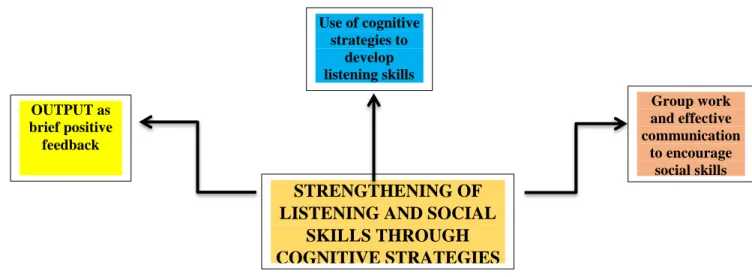
(42) Pedagogical Objectives 1. To provide students an EFL environment having in mind the use of cognitive strategies within communicative contexts in order to improve listening skills. 2.. To offer students an appropriate environment of learning in order to strengthen students’ social skills development.. 3.. To involve students in an input vocabulary phase supported by some cognitive strategies such as imagery, repetition, memory, elaboration, and association to facilitate students’ listening skills development and basic communication.. Pedagogical proposal and design This pedagogical proposal intended to respond and fill the gaps related to the English learning process; which in this case was mainly related to the non-development of listening skills; to achieve this, the proposal considered the general objective of the project: To provide students with an EFL environment having in mind the use of cognitive strategies inside communicative contexts in order to improve listening skills. The aforementioned was the basis of the pedagogical proposal which was developed in 4 general stages during all the teaching-learning process and 7 specific stages in every class of EFL inside the 304 class at Prado Veraniego School. General Stages The general stages refer to the complete process, during its entire application in the teaching-learning process. These general stages allowed the proposal to have a structure not only as a pedagogical development but also as an investigative action-research approach. First stage: English as Foreign Language awareness 32.
Figure
Documento similar
The aim of this study was to clarify the relationship between insomnia and treatment related variables, sociodemographic data, health related fitness, pain, anxiety, and depression
Public archives are well-established through the work of the national archive services, local authority-run record offices, local studies libraries, universities and further
This thesis related to the internship completed in the European Parliament aims to develop a workshop design concerning whistleblowing of illicit financial flows related to
More particularly, the aim of this study was to survey the effect of instruction of a pedagogical proposal based on conceptual metaphors of the domain of emotions
The main objective of the conference, which took place in Madrid in September 2018, was to promote service-learning as a tool of high pedagogical and social value that not only
My main concern in this paper is to reflect on the pedagogical possibilities that technology may offer to autonomous language teaching-learning procedures, that is: in which ways
In both analysis, two exploratory methodologies based on studies related to social media analysis and health (in the case of pain-related institutions) and articles linked to
Government policy varies between nations and this guidance sets out the need for balanced decision-making about ways of working, and the ongoing safety considerations
