Francisca Matthews. Facultad de Odontología,
Uni-versidad Andrés Bello, Chile.
Francisca Matthews. Colón 427-1 Chiguayante, Chile. Phone: (56-9) 79624654. E-mail: [email protected]
Objective: To determine the utilization, attitudes and perceptions about removable orthodontic appliances (ROA) among a sample of Chilean orthodontists. Materials and methods: Data collection was performed using semi-structured interviews with 10 orthodontists from diverse professional bac-kgrounds. The analysis was performed using the “Grounded Theory” methodo-logy, using Atlas.ti v.6.0.15. Results: We interviewed four men and six women (31 to 75 years old), with 7 to 53 years of experience as dentists, and 1 to 10 years of experience as orthodontists. All orthodontists have experience in pri-vate practice, five in public service, and one in a military institution. One-hun-dred and thirty-three codes were grouped into seven categories identified as fo-llows: perception of orthodontists, control over treatment, ROA characteristics, ROA indications and contraindications, patients’ attitude to ROA, selection of treatment, and ROA utilization. Conclusion: In the selection of ROA, different factors are involved, including the characteristics of the dentist, of the patient, and the social context. The key factor in the utilization of ROA is the percep-tion of control over treatment.
removable orthodontic appliances, perceptions, attitude, qualitative analysis, grounded theory, control over treatment.
Technology has allowed a continual revolution of orthodontic applian-ces (OA), resulting in a large variety of deviapplian-ces, each with specific uses and indications. From this arsenal, the most appropriate OA should be carefully selected for each clinical situation. The treatment choice must be supported by irrefutable evidence, because an improper selection can worsen the malocclusion. However, the decision-making process regar-ding dental treatments is complex.
It is important to understand the decision-making process and the selection of treatments because of the impact they have on patient care and satisfaction. There are many factors related to the dentist that influence this process, such as: initial and continuing education, practical skills, experience, indivi-dual characteristics, beliefs and personal values, and sociodemographic cha-racteristics (sex and age).
There are also factors associated with the patient, like clinical condi-tions; psychological profile, and their ability to make decisions. Other sociological factors involved are the dentists’ interaction with their envi-ronment and health system, and the dentist-patient relationship.
In recent decades the use of removable OA (ROA) has clearly decreased in favor of fixed OA (FOA). Currently there are no studies on the perceptions of orthodontists about ROA and how these perceptions are influencing the None.
The study was approved by the Ethics Committee of the Universidad Andrés Bello. Santiago, Chile.
None.
FM performed the en-tire study.
None.
Matthews F. A qualitative analysis of per-ceptions of orthodontists in Concepción about re-movable orthodontic appliances. J Oral Res 2017; 6(6):154-159.
prescription of ROA and their use. The aim of this study is to determine the utilization, attitudes towards and perceptions of removable orthodontic appliances (ROA) of a sample of Chi-lean orthodontists.
This is a qualitative study, based on “Grounded Theory” methodology. The principles of grounded theory are: 1) Openness, 2) Immediate analysis, 3) Coding and comparing, 4) Memo-writing (diagrams), 5) Theoretical sampling, 6) Theoretical saturation, and 6) Production of a substantive theory. All these components, included in the different phases of the study, finally allow the construction of a theory based on the gathered data and not from a prior theoretical framework, allowing a better understanding of the research situation.
The target group was or-thodontists of the city of Concepción (Chile). The inclusion criterion was to be practicing the specialty within the city,
and there are not exclusion criteria. The data collection was conducted through semi-structured interviews (Table 1). All respondents were interviewed after the research aim had been explained and they had voluntarily signed the informed con-sent. The number of respondents was determined under the concept of “theoretical saturation,” corresponding to the point at which respondents no longer provide new data and the res-ponses begin to be repetitive.
The mechanism of analysis was based on assigning codes to segments of information obtained in the interviews, a process called “open coding.” Then, these codes were sorted into different categories according to their charac-teristics/properties and dimensions (a range over the proper-ty can vary), resulting in a series of representative categories. Finally, these categories were connected based on causality, interaction, intervention, and consequences, a process called “axial coding”. The final product is a diagram showing the relationship between the categories, around a central category, which represents the center of the research situation.
. Interview’s script.
Perception and attitude 1. How do you assess the effectiveness of removable appliances?
2. What do you think are the advantages and disadvantages of removable appliances?
3. What do you think is the attitude of patients toward these devices?
4. How do you think patients respond to treatment with removable appliances?
Prescription 1. Do you use removable appliances in your patients? If so, in what proportion?
2. Do you believe that there are differences in the amount of use and indication between the public and private system? If so, what do you think are the main causes?
3. When comparing patients in the public and private systems, do they express a preference for some kind of treatment? Do they respond better to one of them? What do you think are the main differences?
Type of patient and 1. In which clinical situations do you prefer the use of removable appliances?
clinical situation 2. What contraindications do you consider for the use of removable appliances?
3. What is the ideal time for the use of removable orthodontics?
Method of use 1. Do you consider them a stand-alone treatment or a previous/complementary treatment to the definitive treatment ? Why?
Attitude of orthodontists 1. What do you think is the attitude of other orthodontists towards removable appliances?
to removable appliances 2. How effective do you think removable appliances are?
3. How do you consider the results obtained in your patients treated with removable appliances?
Ten active orthodontists were interviewed, four men and six women; the age range varied between 31 and 75 years old with a mean of 44.8 years. The professionals have from 7 to 53 years of experience as dentists with a mean of 21.4 years of
mecha-nisms. All respondents worked in their private practice, with five also working in the public system, and only one in a mil-itary institution.
The result of the “open coding” analysis was a list of 133 codes grouped into seven categories (9 to 37 codes per category). The “axial coding” connected these 7 categories in causality, interaction, intervention, and consequences groups. The properties and dimensions of each category along with some quotations are detailed below.
Three properties were identified:
-Attitude of the patient and the parents: From “very good attitude” to “very bad attitude.” This aspect was described 22 times as positive and 12 as negative for the patients, and 4 and 5 times respectively for the parents.
-Patient preference: From “removable preference” to “fixed preference.” This revealed that patients generally prefer to use FOA, regardless of the health system to which they belong (private, public or military).
-Differences in patients according to the health system to which they belong: Evaluated according to the above two pa-rameters and cataloged from “very similar” to “very different.” Some responses regarding a patient attitude were: “...the pa-tient in the public system will be more cooperative using an ROA, because they have no other chance...” Male, 65 years old, private system; “... In the public system I would say that children do not collaborate very well, and not all parents are very committed ...” Female, 33 years old, private and public system.
Five properties were identified:
-ROA classification: From “strictly removable” to “mixed use.”
-Economic terms: From “very economical” to “very expen-sive.” On six occasions the respondents mentioned the low cost of the ROA as a clear advantage, but one of the partici-pants mentioned that ROA provides little economic gain.
-Patient comfort: From “comfortable” to “uncomfort-able.” Four respondents described the ROA as uncomfortable, marking this as a disadvantage, while one patient pointed out the advantage of the ROA as being less invasive than the FOA.
-Effectiveness: From “limited effectiveness” to “very ef-fective.” Positive references about the effectiveness of ROA were mentioned 11 times, five times it was considered poor and five times it was described as fair.
-Other: From “other benefits” to “other drawbacks.” The advantages of ROA included that they are cheaper, they al-low better hygiene, are comfortable for the patient, can be removed at will, are less invasive, and provide a therapeutic diversity; the disadvantages were: the short life of the device, they become odorous, uncomfortableness, their limited effec-tiveness, and they only provide simple movements and just tooth movements.
Seven properties were identified:
-Clinical situation: From “extremely simple situations” to “complex situations.” ROA were mostly indicated in simple situations.
-Patient commitment: From “uncooperative patient” to “committed patient.” ROA were indicated in patients with high commitment to treatment.
-Age: From “2 years” to “20 years.”
-General development: From “early childhood” to “adulthood.”
-Type of dentition: From “temporary” to “permanent.” -Type of treatment: From “only treatment to “complemen-tary” (to FOA).
-Other: From “other indications” to “other contraindica-tions.” The indications for ROA were: Simple anomalies, class II, class III, simple crossbite, need for orthopedics, interceptive orthodontics, teeth inclination, simple rotation, no need to mobilize roots, periodontal patients with vestibular inclined teeth, mixed dentition, primary dentition, during the peak of growth, children and adolescents between 6 and 14 years old (some reduce the range to 8 to 12 years old), complementary use to FOA (as a first stage of treatment), and as orthodontic contention. The contraindications for ROA were: Severe ab-normalities in adult patients, permanent dentition, uncooper-ative patients, careless patients, patients with impaired motor skills, patients with poor hygiene.
Four properties were identified:
-Orthodontists’ attitude to ROA: From “good attitude” to “very bad attitude.” Nine respondents evaluated themselves as having a negative attitude towards ROA, while the tenth considered themself as having a regular attitude.
treatment. One of those interviewed preferred ROA because of their simplicity.
-Professional/personal background: From “training” to “individual preferences.” In this regard, age is a determin-ing factor: “...there are colleagues who are older and who were trained with this technique...” Female, 36 years old, private system. Experience is another relevant factor: “...I don’t have the expertise to leave a patient with a perfect smile using ROA…” Male, 43 years old, private and public system. The same applies to specialist training: “...They have no experience with ROA because they are trained in universities that just train them in FOA...” Female, 75 years old, private and public sys-tem. Only one of the respondents said she uses ROA as the first choice of treatment: “...I always use them first, when it is easy, when it’s something minor, my first choice is to use ROA...” Female, 47 years old, private and public system.
-Perception of effectiveness and results obtained with ROA: From “very good” to “very bad.” Effectiveness was evaluated as good if the patient and parents collaborate. Effectiveness was mentioned 20 times as good, 5 as bad, and 5 as fair. Ex-plaining the importance of the treatment and its implications for patients and their parents was highlighted; also it was em-phasized that the prognosis of each case will depend on the characteristics of each patient: “...It really depends on the pa-tient, their growth, their jaw relationships, how the teeth erupt...” Male, 35 years old, private and public system.
Seven properties were identified:
-Patient participation: From “the patient decides” to “the patient does not decide.” It is noted that usually patients are not consulted about their preferences, either because the case does not provide alternatives, because the health system does not have other options, or because they believe that the patient does not have the knowledge or skills necessary to make the decision.
-Treatment options: From “only FOA” to “only ROA.” It is noted that there are cases that can only be treated with a cer-tain appliance and others where there is a choice between us-ing ROA or FOA. In these circumstances the choice is mainly based on personal (dentist) preference.
-Fashion: From “influence” to “no influence.” Fashion stands out here as being a factor that influences both the pa-tient and the clinician: “...if the kids at school have their four best friends using braces, they too will want to use braces...” Male, 43
years old, private and public system.
-Money earned: from “influence” to “no influence.” This is pointed out as a reason why use of ROA is low: “...the ROA do not make much money...” Female, 40 years old, military and private system.
The next three properties refer mainly to the type of health system, public or private.
-Difference in resource availability: From “no differenc-es” to “great differences.” It is noted that there are no major differences between the private and public health systems: “...today I understand that public services are well supplied with materials. There are FOA available for use, not like be-fore, when resources were scarce... But, nowadays, if you are an orthodontist in a public hospital and you work with FOA and request the materials needed, they are going to give them to you...” Male, 65 years old, private system.
-Opportunity of care: From “public system overload” to “greater opportunity for treatment in the private system.” Respondents agree that there is an overload on the public system that does not allow long treatments or treatments with a higher requirement of clinical hours: “...In the public system the demand is so big that you have to try to quickly solve the patient’s need and then discharge them...” Male, 35 years old, public and private system.
-Indications variability: From “only used in the public system” to “there are no big differences.” Participants be-lieve that the greater use of ROA in the public system is the consequence of seeing younger patients referred to pediatric dentists who are devoted to interceptive orthodontics, unlike the private system, where patients are older (adolescents) and generally prefer FOA.
Two properties were identified:
-Adherence to treatment: From “good compliance” to “very poor adherence.” Participants cataloged the treatment adher-ence from low to very low, because based on the participants’ experience, the patients and their parents do not comply with the instructions, which decreases the control over treatment: “...it’s something you cannot control as an orthodontist because it depends on a third part, that is to say, the patient...” Female, 31 years old, private system.
Axial codification.
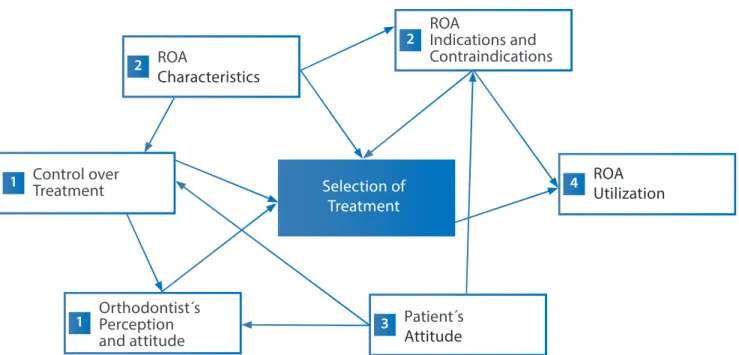
ROA: Removable orthodontic appliance; 1: Causal conditions; 2: Contextual conditions; 3: Intervention conditions; 4: Consequences. Selection of
Treatment
Orthodontist´s Perception and attitude 1
Control over Treatment 1
ROA
Characteristics
2
ROA
Indications and Contraindications 2
Patient´s
Attitude
3
ROA Utilization
4
“...braces are the only appliances that can control the three-di-mensional position of the tooth...” Male, 43 years old, private system.
Two properties were identified:
-Utilization by orthodontists: From “do not use” to “fre-quently use.” One interviewee relates making a greater use of ROA: “...I use them in all patients under 10 who come with a overbite or vis-à-vis and have a retruded maxilla...” Female, 40 years old, military and private system. The rest of the par-ticipants said they use ROA scarcely, stating that: “...FOA won the battle over ROA a long time ago..” Male, 65 years old, private system.
-ROA utilization according to specialty: From “no specialty required” to “exclusive use by orthodontists.” It is noted that pediatric dentists are the main users of ROA, especially in in-terceptive orthodontics programs in the public system: “... you do not necessarily need to be an orthodontist to use it; pediatric dentists use a lot of ROA...” Female, 31 years old, private system.
The axial coding determined that “selection of treatment” is the central category because it connects all categories that determine the use of ROA as the final consequence of the re-search situation (Figure 1). Orthodontists’ opinions regarding the control over treatment and their perceptions and attitudes regarding OA are the main causal factors that determine the selection of treatment, but they are not the only ones.
The analysis of the interviews has provided valuable information about the factors influencing the selection of treatment regarding the utilization of ROA in the contem-porary orthodontics practice in the city of Concepción.
These results are supported by the theory of planned be-havior, which states that the attitude, perceived behavior-al control, and socibehavior-al norms are the main determinants of human behavior. Because the participants perceive these conditions as negative in relation to ROA, the low utiliza-tion of ROA is an expected result.
Other influencing factors were: the age of orthodontists, individual preferences, training background, experience and perception of complexity, the availability of or access to treatment, and the attitude of patients and their parents. These factors have also been determined by previous stud-ies in relation to different areas of dentistry and medicine. A previous study found that there are significant differenc-es in the clinical decision-making among the different age ranges and that young people generally have a tendency to choose options that represent less risk, while older people consider a wider range of alternatives. In this context it has been determined that those orthodontists who have no ex-perience in dealing with ROA, or who have had negative experiences with ROA, use them less frequently.
this allows them to have greater control over treatment. Small noted that dentists are looking to work in a “com-fort zone” and stay within it, so the dentist who is uncom-fortable with a procedure should refer the patient to be treated by specialists.
Another aspect involved in the selection of treatment is the type of health system (public or private); there is a significant difference between the two systems in ROA uti-lization, which is used more widely in the public system. This situation could be influenced by the age of patients, and because the pediatric dentists dedicated to interceptive orthodontics in the public system used ROA more. Some participants suggested that the difference in the availability of financial resources is the main cause of this disparity. But some respondents have indicated that public services deliver all the elements necessary to perform the various treatments, including FOA.
This study has a geographical limitation, since it only considered orthodontists from the city of Concepción (Chile). Moreover, the lack of experience on the part of the professionals in both health systems makes it difficult to make objective comparisons. Therefore, it is proposed that further studies focus on a national survey based on these results, to extend this study to other decisions in ortho-dontics practice, to evaluate how individual preferences are formed in dental schools, and to explore the attitudes and perceptions of patients and their parents regarding the dif-ferent types of treatments.
Different factors are involved in the selection of ROA, including the characteristics of the dentist, the patient and the social context. The key factor in the utilization of ROA is the perception of control over treatment.
Philippe J, Guédon P. [Evolution of orthodontic appliances from 1728 to 2007. Inaugural Conference of the 79th Scientific Meeting of the SFODF at Versailles, 31 May 2007]. Orthod Fr. 2007;78(4):295–302. Henry W, Fields Jr, David M, Proffit WR. Contemporary or-thodontics. 4th Ed. Philadelphia, PA, USA: Mosby, Elsevier Health Sciences; 2007.
Roberts-Harry D, Sandy J. Orthodontics. Part 5: Appliance choices. Br Dent J. 2004;196(1):9–18.
McGregor CA, Paton C, Thomson C, Chandratilake M, Scott H. Preparing medical students for clinical decision making: a pilot study exploring how students make decisions and the perceived im-pact of a clinical decision making teaching intervention. Med Teach. 2012;34(7):e508–17.
Matthews F, Cartes-Velázquez R. Factores que influyen las decisio-nes terapéuticas en Ortodoncia: Revisión de la literatura. Odontoestoma-tología. 2017:[Epub ahead of print].
Su H, Liao HF, Fiorellini JP, Kim S, Korostoff J. Factors affecting treatment planning decisions for compromised anterior teeth. Int J Perio-dontics Restorative Dent. 2014;34(3):389–98.
Small BW. Decision-making in full-arch restorative dentistry: part 2. Gen Dent. 2010;58(1):10–3.
Alani A, Bishop K, Djemal S. The influence of specialty training, experience, discussion and reflection on decision making in modern res-torative treatment planning. Br Dent J. 2011;210(4):E4.
Tuvblad C, Gao Y, Wang P, Raine A, Botwick T, Baker LA. The genetic and environmental etiology of decision-making: a longitudinal twin study. J Adolesc. 2013;36(2):245–55.
Sánchez-Medina AJ, Romero-Quintero L, Sosa-Cabrera S. En-vironmental management in small and medium-sized companies: an analysis from the perspective of the theory of planned behavior. PLoS One. 2014;9(2):e88504.
Laegreid T, Gjerdet NR, Johansson A, Johansson AK. Clini-cal decision making on extensive molar restorations. Oper Dent. 2014;39(6):E231–40.
Sergl HG. Fixed appliances in orthodontics with special conside-ration of the Edgewise technique; Foundations, materials, technology, clinical aspects. München, Alemania: Hanser; 1990.
Simón-Lorda P. La capacidad de los pacientes para tomar de-cisiones: una tarea todavía pendiente. Rev Asoc Esp Neuropsiq. 2008;28(2):325–48.
Hernández-Torres F, Aguirre-Gas H, Santacruz-Varela J, Gó-mez-Bernal E, García-Saisó S, Durán-Fontes LR. Calidad efectiva de los servicios de salud. Rev Conamed. 2013;18(3):129–38.
Eisenberg JM. Sociologic influences on decision-making by clini-cians. Ann Intern Med. 1979;90(6):957–64.
Hamid Zafarmand A, Mahdi Zafarmand M. Removable orthodon-tic appliances: new perspectives on capabilities and efficiency. Eur J Paediatr Dent. 2013;14(2):160–5.
Sbaraini A, Carter SM, Evans RW, Blinkhorn A. How to do a grounded theory study: a worked example of a study of dental practices. BMC Med Res Methodol. 2011;11:128.