Removal of hydrogen sulphide by immobilized
Thiobacillus thioparus
in a biofilter packed with
polyurethane foam
M. Ramirez, J.M Gómez, and D. Cantero
Department of Chemical Engineering, Food Technology and
Environmental Technologies, Faculty of Sciences, University of Cádiz,
11510 Puerto Real (Cádiz), Spain
ABSTRACT. In this work, a laboratory scale biofilter was design for removal of hydrogen sulphide packed with Thiobacillus thioparus immobilized in polyurethane foam particles (the initial immobilized biomass was 1.6×10¹¹ cel g-1 of solid support). Three empty bed residence
times (EBRT) were studied (100, 70 and 30 second) and the initial H2S concentration, ranging
from 25 to 750 ppmv, in the inlet gas stream were varied from low to high values in order to determine maximum biofilter efficiency. In these conditions, the biofilter reached efficiency >95% for 300, 150 and 100 ppmv of H2S concentration at 100, 70 and 30 second (EBRT)
respectively, but when increasing the inlet concentration of the hydrogen sulphide, the removal efficiencies of H2S decreased.
1 INTRODUCTION
Recently, people in many countries have encountered numerous air pollution problems, especially those associated with bad odour. It is well known that more than three hundred substances can cause this problem, but hydrogen sulphide is the ones that often exist in our surroundings. Large amounts of H2S is generated and released from industrial processes, such as wastewater treatment, petrochemical refining, etc. Excess of these substances have to be removed for the sake of safety and health and also for the reduction of environmental impacts, so a growing awareness and concern for air quality is driving a search for economical and efficient abatement technology to reduce the impact of the industry in the environment.
Usually, the concentrations of these odorous compounds in the gas emissions are so dilute, traditional air pollution control technologies such as incineration, adsorption or chemical scrubbing tend to be costly and are associated with their own pollution problems. So, based on the cost for the equipment and operation, biological treatment is believed to be the most economical option for treating ammonia and hydrogen sulphide. Ammonia is colourless, but irritant and smelly, while hydrogen sulphide is corrosive, extremely toxic, and also smelly.
Hartikainenet al., 2001; Oyarzún et al., 2003), but a wide variety of other materials has been used, ca-alginate (Chung et al., 1996; Chung et al., 1998; Park et al., 2002), polypropylene Pall rings (Cox et al., 2001; Wu et al., 2001), porous lava (Cho et al., 2000), wood bark (Van et al., 1986), and polyurethane foam (Gabriel et al., 2004). Literature contains few accounts of the use of polyurethane foam for removal of malodorous gases with biofilters.
Many microorganisms has been used for the removal of hydrogen sulphide, principally bacteria. The most active biomass in a biofilter are the heterotrophic and chemoorganotrophic groups. Thiobacillus is most prevalent species involved in H2S removal. Literature have reported the use of different Thiobacillus species (thioparus, thiobacilli, denitricans, thiooxidans, ferroxidans) and other microorganisms (chlorobiaciae, xanthomonas) (Jensen et al., 1995) converting the H2S into reduced sulphur compounds.
In this work, the removal of hydrogen suphide with Thiobacillus thioparus immobilized in polyurethane foam particles was studied. From experimental data obtained, it is possible to determine H2S removal kinetics at various loading rates.
2 MATERIALS AND METHODS
2.1 Organism cultivation and medium preparation
The original pure-culture strain of autotrophic Thiobacillus thioparus ATCC 23645 was obtained from the American Type Culture Collection. T. thioparus is motile, gram-negative and short-rod. This stock culture was grown using a rotary shaker at optimal temperature (30ºC) and pH 7. The mineral medium was the ATCC Medium (#290 Broth: S6 Medium of Thiobacilli). The S6 medium (in grams of litre), including Na2HPO4 1.2 g, KH2PO4 1.8 g, MgSO4 · 7H2O 0.1 g, (NH4)2SO4 0.1 g, CaCl2 0.03 g, FeCl3 0.02 g, MnSO4 0.02 g, Na2S2O3 10g.
The strain was maintained on a thiosulphate-agar slant (1.5% w/v of agar) and transferred to fresh slants every two months.
2.2 Packing material
Polyurethane foam (PUF) cubes of 1 cm3 were used as filter packed bed. This packing material has a surface area of approximately 600 m2/m3 and a density of 20 kg/m3 (Devinny et al., 1999). It is an inert material with low density, large porosity (near 96%), good scaling-up possibilities and very low commercial cost (McNevina et al., 2000; Moe et al., 2000). Low density provides advantage in construction and minimizes problems of compaction of packing material. High porosity permits uniform gas flow distribution needed for maximum contact between the gas stream and biofilm biomass. The total weigh of PUF in the biofilter was 10 grams.
2.3 Immobilization method
Three erlenmeyer flask of 1L were used. Each flask contains 500 ml of medium, 100 ml of inoculum and 3,5 g of PUF. The culture was incubate at 150 rpm and 30ºC. The evolution of substrate was followed and before it was exhausted, the medium was drained and replaced with 600 mL of fresh medium without inoculation.
2.4 Experimental set-up
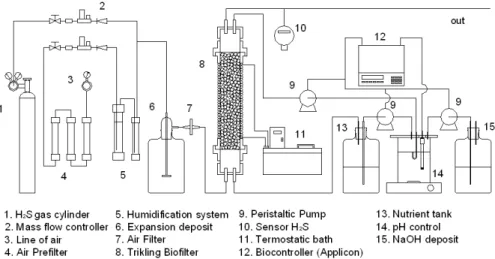
The experimental set up is shown in Figure 1. A PVC column (63 mm of diameter) was used to build-up the biofilter with a working volume of 0.8 L. The air supply used was compressed air available in the building. Pressure regulation and filtering were achieved by having four filters: silica gel, active carbon, wool glass and Millipore Filter SLG05010 (0.45 m). Air was humidified using fine bubble diffusion. Flow rates were controlled with Flow controller (Bronkhorst, Model F-201C).
A solution whose composition was similar to the liquid culture medium without thiosulphate, the energy source, was added to supplement nutrients (0.19 l/h flow rate). The pH of medium was controller at 7.0 with Bio controller ADI 1030 (Applikon) and the temperature of experiment was maintained at 30ºC.
Figure 1. Diagram of the experimental setup
2.3 Analytical techniques 2.3.1 Gas
Hydrogen sulphide was analysed using a specific sensor of Crowcon (Model GASFLAG, TXGARD-IS)
2.3.2 Substrate and product concentration
Sulfate in the medium was measure using a modification of Classic Turbidimetric Method (Clesceri et al., 1989) and thiosulphate was measure using an iodometric method (Rodier, 1998).
2.3.3 Immobilized biomass
Immobilized biomass concentration was measured by counting of total biomass in a Neubauer chamber. A unit of carrier is removed from the reactor and squeezed lightly in order to remove the interstitial liquid. Then, it is submerged in an erlenmeyer flask containing 25 ml of sodium phosphate buffer solution (pH 7.0). In a second step, the flask is placed in an ultrasonic bath at room temperature for 15 min. These conditions led to the total desorption of adhered cells. In the last stage, the Neubauer chamber re-count method for the submerged cells is carried out on the liquid phase. The carrier was subsequently removed from the flask and dried in an oven at 80 °C during 24 h. It was then possible to calculate the number of immobilized cells per milligram of carrier (Ory
2.3.4 Electron microscopy
Scanning electron microscopy (SEM) was used for examination of immobilized bacterial in PUF, with a microscope FEI QUANTA 200 (Philips) of 2.5 nm of resolution. Fixation with glutaraldehyde (2.5%) at 4 °C for 1 h, cacodylate salt (0.1 M, pH 7.0) for 30 min, dehydration with acetone and drying, and metallization with gold.
3 RESULTS AND DISCUSSION
3.1 Immobilized biomass
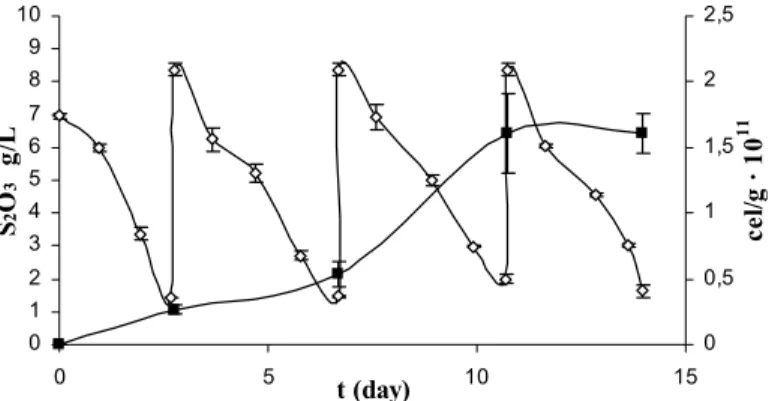
The total immobilized biomass at the end of batches was of 1.6×10¹¹ cel g-1 of solid support. The duration of the experiment was of 335 hours. In Figure 2 the different cycles of colonisation, with the consecutive charging and discharging of the medium, can be observed.
Figure 2. Evolution of thiosulfate and immobilized biomass as a function of time during repeated-batch cultivation.
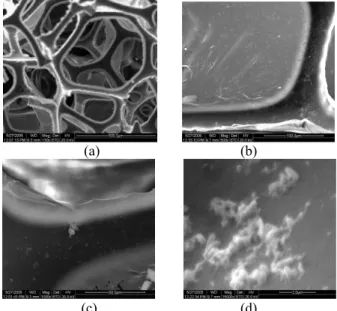
Figure 3 are microphotographs sequence of colonised PUF for T. thioparus in various sizes. In the figure 3 (d) we can see the bacteria of T. thioparus immobilized on the surface of PUF. The previous microphotographs show the high amount of bacteria immobilized.
3.2 Removal of hydrogen sulphide
The biofilter operated in continuous mode during 118 days. Three EBRT (empty bed residence time) was studied (100,70 and 30 second) with H2S concentrations, ranging from 25 to 750 ppmv, in order to determine removal capacity of the biofilter.
Several authors have studied biofilters to predict a mathematical models (Ottengraf, et al., 1983; Devinny et al., 1991; Shareefdeen et al., 1993; Deshusses et al., 1995; Zarook
(a) (b)
(c) (d)
Figure 3. Scanning electron micrographs of biomass support particles removed during immobilization process.Magnification: (a) x130; (b) x500; (c) x1000; (d) x15000
0 5 10 15 20 25 30
0 150 300 450 600 750
Cin (ppmv)
EC
(
gS
m
-3 h -1 )
Figure 4. Evolution of elimination capacity versus inlet concentration at differents EBRT: (U) 30 s, () 70 s, () 100 s
ln ln max
C K
C V EC
m+
= (1)
The elimination capacity is EC=[(Co-Ce) x Q/V x ], where, Q is the air flow (m3 h-1), Co, the concentration of H2S at the inlet (ppmv); Ce, the concentration of H2S a the outlet; V, is the volumen of the biofilter (m3) and is a factor of conversion:
=[(M x 10-3)/{22,4 x (273+T)/273}], where M is pollutant molecular weight and T the operating temperature (ºC).
The linealization of the equation 1:
max
The kinetics parameters Vmax and km were estimated of equation 2. Values for the Vmax and Km are summarized in the Table 1.
Table 1. Reaction rate parameters.
EBRT Km Vmax
100 101,76 29,98
70 56,31 24,67
30 44,56 26,60
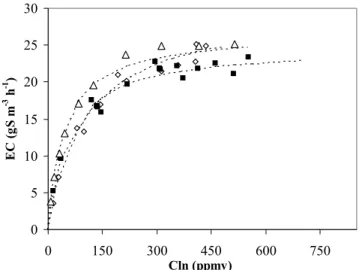
Figure 5 and 6 shows experimental data obtained and values predicted by model. The application of this model allows obtaining elimination capacity for any value of EBRT and inlet concentration. The removal capacity is >95% in a wide range of concentrations for the different time residence studied.
0
Figure 5. Evolution of elimination capacity versus the log mean concentration at differents EBRT: (U) 30 s, () 70 s, () 100 s
0 20 40 60 80 100 120
0 150 300 450 600 750
Cin (ppmv)
R (
%
)
Figure 6. Evolution of removal capacity versus the inlet concentration at differents EBRT: (U) 30 s, () 70 s, () 100 s
4 CONCLUSIONS
The maximum biomass immobilized in PUF was 1.6 1011 cel g-1 in four cycles. It was possible to reach a high removal of hydrogen sulphide using polyurethane foam as solid support for Thiobacillus thioparus immobilization. The removal capacity is >95% for the next concentration: 300, 150 and 100 ppmv for 100, 70 and 30 second (EBRT). The sulfate is a toxic compound and its concentration must be smaller of 5 g/l. It was possible to predict the performance of the biofilter using a simple model based on the Michaelis-Menten equation.
5 ACKNOWLEDGEMENTS
Authors wish express sincere gratitude to Spanish Government for financial support of this work throught Project PPQ2002-0217.
6 REFERENCES
Cho, K.S., Hirai, M. and Shoda, M. (1992) Enhanced removal efficiency of malodorous gases in a pilot-scale peat biofilter inoculated with Thiobacillus thioparus DW44. J. Ferment. Bioeng. 73(1): 46-50.
Cho, K.S., Ryu, H.W. and Lee, N.Y. (2000) Biological deodorization of hydrogen sulfide using porous lava as a carrier of Thiobacillus thioxidans.J. Biosci. Bioeng. 90(1): 25-31.
Cho, K.S., Zhang, L., Hirai, M. and Shoda, M. (1991) Removal characteristics of hydrogen sulphide and methanethiol by Thiobacillus sp. isolated from peat in biological deodorization. J. Ferment. Bioeng. 71(1): 44-49
Chung, Y.C., Huang, C., Pan, J.R. and Tseng, C.P. (1998) Comparison of autotrophic and mixotrophic biofilters for H2S removal. J. Environ. Eng. 124(4): 362-367.
Chung, Y.C., Huang, C. and Tseng, C.P. (2001) Biological elimination of H2S and NH3 from
wastegases by biofilter packed with immobilized heterotrophic bacteria. Chemosphere. 43(8): 1043-1050.
Clesceri, L.S., Greengerg, A.E. and Trusell, R.R. (1989) Standards Methods for the Examination of water and wastewater. APHA/AWWA/WPCF. Washington, USA. 17 ed. Cox, H.H.J and Deshusses, M.A. (2001) Co-treatment of H2S and toluene in a biotrickling filter.
Chem. Eng. J. 87(1): 101–110.
Deshusses, M.A., Hammer, G. and Dunn, I.J. (1995) Behavior of biofilters for waste air biotreatment 1. dynamic model development. Environ. Sci. Technol. 29 (4): 1048-1058. Devinny, J.S., Deshusses, M.A. and Webster, T.S. (1999) Biofiltration for air pollution control,
Ed. Lewis, Boca Raton, Fla. New York.
Devinny, J.S., Medina, V.F. and Hodge, D.S (1991) Treatment of hydrocarbon fuel vapors in biofilters.Environ. Technol. 12: 1045.
Gabriel, D., Cox, H.H.J. and Deshusses, M.A. (2004) Conversion of full-scale wet scrubbers to biotrickling filters for H2S control at publicly owned treatment works. J. Environ. Eng.
130(10): 1110-1117.
Gómez, J.M; Cantero, D. and Webb, C. (2000). Immobilization of Thiobacillus ferrooxidans cells on nickel alloy fibre for ferrous sulphate oxidation. Appl. Microbiol. Biotechnol. 54: 335-340.
Jensen, A.B. and Webb, C. (1995) Treatment of H2S-containing gases: A review of
microbiological alternatives. Enzyme Microb. Technol. 17: 2-10.
Hartikainen T., Ruuskanen, J. and Martikainen, P.J. (2001) Carbon disulfide and hydrogen sulfide removal with a peat biofilter. J. Air Waste Manage. Assoc. 51: 387-392.
Hirai, M., Ohtake, M. and Shoda, M. (1990) Removal kinetics of hydrogen sulfide, methanethiol and dimethyl sulfide by peat biofilters. J. Ferment. Bioeng. 70(5): 334-339. McNevina, D. and Barford, J. (2000) Biofiltration as an odour abatement strategy. Biochem.
Eng. J. 5(3): 231-242.
Moe, W.M. and Irvine, R.L. (2000) Polyurethane foam medium for biofiltration. I: characterization. J. Environ. Eng. 126(9): 815-825.
Ottengraf, S. P. P. and Van den Oever, A. H. C. (1983) Kinetics of organic compound removal from waste gases with a biological filter. Biotechnol. Bioeng. 25(12): 3089-3102.
Ory, I., Romero, L.E and Cantero, D. (2004) Optimization of immobilization conditions for vinegar production. siran, wood chips and polyurethane foam as carriers for Acetobacter aceti.Proc. Biochem. 39(5): 547-555.
Oyarzún, P., Arancibia, F., Canales, C. and Aroca, G. (2003) Biofiltration of high concentration of hydrogen sulphide using Thiobacillus thioparus.Proc. Biochem. 39(2): 165-170. Park, D.H., Cha, J.M, Ryu, H.W, Lee, G.W., Yu, E.Y., Rhee, J., Park, J.J, Kim, S.W., Lee, I.W.,
Joe, Y., Ryu, Y.W, Hur, B.K., Park, J.K. and Park, K. (2002) Hydrogen sulfide removal utilizing immobilized Thiobacillus sp. IW with Ca-alginate bead. Biochem. Eng. J. 11: 167–173.
Park, S.J., Cho, K.S., Hirai, M. and Shoda, M. (1993) Removability of malodorour gases from a night soil treatment plant by a pilot-scale peat biofilter inoculated with Thiobacillus thioparus DW44. J. Ferment. Bioeng. 76(1): 55-99.
Rodier, J. (1998) Análisis de las aguas. Ed. Omega, D.L, Barcelona.
Shareefdeen, Z., Baltzis, B.C., Oh, Y.S. and Bartha, R. (1993) Biofiltration of methanol vapour. Biotechnol. Bioeng. 41(5): 512-524.
Van L.H., Wuyts, E. and Schamp, N. (1986) Elimination of hydrogen sulfide from odorous air by a wood bark biofilter. Water Res. 20(12): 1471-1476.
Wani, A.H, Lau, A.K. and Branion, R.M.R. (1999) Biofiltration control of pulping odors - hydrogen sulfide: performance, macrokinetics and coexistence effects of organo-sulfur species.J. Chem. Technol. Biotechnol. 74: 9-16.
Wu, L., Loo, Y.Y. and Koe, L.C.C. (2001) A pilot study of a biotrickling filter for the treatment of odorous sewage air. Water Sci. Technol. 44(9): 295–299.
Yang, Y.A. and Allen, E.R., (1994) Biofiltration control of hydrogen sulfide: Design and operational parameters. J. Air Waste Manage. Assoc. 44: 863-868.