
Métodos sensitivos para la determinación espectrofotométrica de los compuestos antineoplásicos
13
0
0
Texto completo
(2) 122. NAGARAJA P, VASANTHA R.A., YATHIRAJAN H.S.. INTRODUCCIÓN. INTRODUCTION. La vinblastina y la vincristina forman parte de un tipo de alcaloides bis indólicos que contienen un núcleo de indol en la mitad superior de la estructura de la vinblastina y un núcleo de indol dihidro en la mitad inferior de la estructura de la molécula ((Neuss et al., 1964). Tanto el VBS como el VCS se utilizan en el tratamiento de la enfermedad de Hodgkin, el linfoma linfocítico, el linfoma histiocítico, el cáncer de testículos en estado avanzado, el cáncer de mama en estado avanzado, el sarcoma de Kaposi y la enfermedad de Letterer-Wise (Hesse, 1981; Goodman et al., 1990). Dado que las enfermedades neoplásicas de los seres humanos representan un reto para los científicos de todo el mundo, resulta de gran importancia desarrollar métodos sensitivos y precisos para determinar estos fármacos antineoplásicos VBS y VCS en varias aplicaciones biológicas y clínicas. Entre los métodos desarrollados hasta ahora para la determinación de estos compuestos se incluyen cromatografías líquidas de alto rendimiento, (Van Tellingen et al., 1991; Volkov et al., 1994; Volkov, 1996; Embree et al., 1997; Chu et al., 1997), polarografías (Kovbuz et al., 1995), radioinmunoensayos (Langone et al., 1979; Sethi et al., 1980; Huhtikangas et al., 1987), métodos electroanalíticos, (Rusling et al., 1984; Temizer, 1986; Kamau et al., 1994; Chu et al., 1996), cromatografía de capa fina (Horvath et al., 1982; Kaleagasioglu, 1992) y espectrofotometría ultravioleta (Sapunova et al., 1982). El sulfato de vinblastina y el sulfato de vincristina son oficiales en la farmacopea británica (B.P., 1998), farmacopea europea (E. P., 2002), farmacopea india (I.P., 1996) y la farmacopea de Estados Unidos (U.S.P., 2000). La 4-nitroanilina se ha utilizado en varias investigaciones espectrofotométricas (Rajeswari et al., 1984; Rahim et al., 1986; Ernst, 1990; Raju et al., 1992; Wei et al., 1997; Nagarja et al., 2001). 2,4,6,-tris(2-piridil)-1,3,5-triazina se utiliza en la determinación de varios compuestos (Tabacco et al., 1980; Sastry et al., 1992; Benzie, 1996). Un estudio de la bibliografía revela que no se han desarrollado reactivos cromogénicos para la determinación de estos fármacos. Volviendo a nuestro trabajo sobre la determinación espectrofotométrica de los compuestos orgánicos de actividad biológica e importancia farmacéutica. Vinblastine and vincristine are representatives of a class of bisindole alkaloids containing indole nucleus at the upper half of the vinblastine structure and dihydro indole nucleus at lower half of the structure of the molecule (Neuss et al., 1964). VBS and VCS are used for treating hodgkin’s disease, lymphocytic lymphoma, histiocytic lymphoma, advanced testicular cancer, advanced breast cancer, kaposi’s sarcoma and letterersiwe disease (Hesse, 1981; Goodman et al., 1990). Since, the neoplastic disorders in human beings are posing challenge to the scientists of the world, it is of great importance to develop sensitive and precise methods to determine these antineoplastic drugs VBS and VCS in various clinical and biological applications. The methods that have been developed for the determination of these compounds include high performance liquid chromatography (Van Tellingen et al., 1991; Volkov et al., 1994; Volkov, 1996; Embree et al., 1997; Chu et al., 1997), Polarography (Kovbuz et al., 1995), radio-immuno assay (Langone et al., 1979; Sethi et al., 1980; Huhtikangas et al., 1987), electroanalytical methods (Rusling et al., 1984; Temizer, 1986; Kamau et al., 1994; Chu et al., 1996), Thin-layer chromatography (Horvath et al., 1982; Kaleagasioglu, 1992) and uv spectrophotometry (Sapunova et al., 1982). VBS and VCS are official in British Pharmacopoeia (B.P., 1998), European pharmacopoeia (E. P., 2002), Indian Pharmacopoeia (I.P., 1996) and United States Pharmacopoeia (U.S.P., 2000). 4Nitroaniline has been used in various spectrophotometric investigations (Rajeswari et al., 1984; Rahim et al., 1986; Ernst, 1990; Raju et al., 1992; Wei et al., 1997; Nagarja et al., 2001). 2,4,6,tri(2-pyridyl)-1,3,5-triazine is used for the determination of several compounds (Tabacco et al., 1980; Sastry et al., 1992; Benzie, 1996). The literature survey reveals that there are no chromogenic reagents developed for the determination of these drugs. In continuation of our work on the spectrophotometric determination of organic compounds of biological activity and pharmaceutical importance (Nagaraja et al., 1996; 2000; 2001; 2002), the present paper describes for the first time, two new spectrophotometric methods for the determination of VBS and VCS. The first method involves azo coupling reaction of diazotised 4-nitroaniline with VBS and. Ars Pharmaceutica, 43:3-4; 121-133, 2002.
(3) SENSITIVE METHODS FOR THE SPECTROPHOTOMETRIC DETERMINATION OF ANTINEOPLASTIC COMPOUNDS. (Nagaraja et al., 1996; 2000; 2001; 2002), el presente artículo describe por primera vez dos nuevos métodos espectrofotométricos para la determinación del VBS y VCS. El primer método implica la reacción de los componentes azoicos de la 4-nitroanilina diazotizada con VBS y VCS. El segundo método muestra que la reacción del VBS y VCS reduce el hierro III a hierro II y éste se combina con 2,4,6-tris (2-piridil)-1,3,5-triazina en un medio neutro. Ambos métodos resultan muy sensitivos, rápidos, se pueden reproducir con facilidad y requieren reacciones simples. Además, con los dos se obtienen reacciones de colores positivas para la detección del VBS y VCS del material disecado y pulverizado de la planta vinca rosea (Chu et al., 1997). Ninguna de estas reacciones requiere extracción y no interfieren ni desestabilizan las especies de colores.. 123. VCS. The second method reports the reaction of VBS and VCS which reduces iron (III) to iron (II) and this complexes with 2,4,6-tri(2-pyridyl)1,3,5-triazine in neutral medium. Both the methods are highly sensitive, rapid, reproducible and involves simple reactions. Further, both the methods gave positive colour reactions for the detection of VBS and VCS from the dried powdered vinca rosea plant material (Chu et al., 1997). Both the reactions does not require extraction and free from the disadvantages of interference and instability of the coloured species.. MATERIALS AND METHODS Instrument A Jasco Model UVIDEC-610 UV-VIS spectrophotometer with 1.0 cm matched cells was used for all electronic spectral measurements.. MATERIALES Y MÉTODOS Instrumentos. Reagents. Para todas las mediciones espectrales electrónicas se ha utilizado un espectrofotómetro UVVIS Jasco modelo UVIDEC-610 con células de 1 cm.. Vinblastine sulphate and vincristine sulphate (gift sample from Cipla Limited, India), 4-nitroaniline (E-Merck, Germany), 2,4,6-tri(2-pyridyl)-1,3,5-triazine (E-Merck, Germany), sodium nitrite (E-Merck, Germany), sulphamic acid (Sigma, USA), ferric chloride (Sigma, USA) and hydrochloric acid (AR) were used. Deionised water was used throughout the experiment and commercial dosage forms were purchased from local sources.. Reactivos Se han utilizado sulfato de vinblastina y sulfato de vincristina (muestras cedidas por Cipla Limited, India), 4-nitroanilina (E-Merck, Alemania), 2,4,6-tris (2-piridil)-1,3,5-triazina (E-Merck, Alemania), nitrito de sodio (E-Merck, Alemania), ácido sulfámico (Sigma, Estados Unidos), cloruro férrico (Sigma, Estados Unidos) y ácido clorhídrico (AR). Durante el experimento se utilizó agua desionizada y se adquirieron varios tipos de dosis comerciales en establecimientos locales. Disoluciones Se prepararon soluciones concentradas de VBS y VBC mediante la disolución de 100 mg de cada uno en 100 ml de agua en presencia de 2 ml de ácido clorhídrico de 5 moles dm -3 para. Solutions Stock solutions of VBS and VCS were prepared by dissolving 100 mg each in 100 ml water in presence of 2 ml of 5 mol dm-3 hydrochloric acid to dissolve the samples and made upto the mark with water. Working standards were prepared by suitable dilution. Solutions of 0.5% sodium nitrite and 5% sulphamic acid were prepared in water. A 0.2 g of 2,4,6-tri(2-pyridyl)1,3,5-triazine was first dissolved in 2 ml of 1 mol dm -3 hydrochloric acid and made upto 100 ml in a standard flask with water to get 0.2% colourless solution. A 0.1% of 4-nitroaniline was prepared by dissolving the sample in 2 ml of 5 Ars Pharmaceutica, 43:3-4; 121-133, 2002.
(4) 124. disolver las muestras y la disolución se completó con agua hasta la marca. Los estándares de trabajo se prepararon mediante la dilución adecuada. Se prepararon en agua soluciones del 0,5% de nitrito de sodio y 5% de ácido sulfámico. En primer lugar se disolvieron 0,2 g de 2,4,6-tris (2piridil)-1,3,5-triazina en 2 ml de ácido clorhídrico de 1 mol/dm-3 y se completó con agua hasta los 100 ml en una matraz estándar para obtener una solución incolora del 0,2%. También se preparó un 0,1% de 4-nitroanilina al disolver la muestra en 2 ml de ácido clorhídrico de 5 mol/ dm-3 y a continuación diluir en agua. Se preparó una disolución de 0,01 mol/dm-3 de hierro III al disolver cloruro de hierro III en agua en la presencia de algunas gotas de ácido clorhídrico concentrado. Procedimiento recomendado Método del 4-nitroanilino: Se añadieron 3 ml de 4-nitroanilina de 0,1% a una serie de matraces estándar de 25 ml; a continuación, las matraces se enfriaron mediante un baño en hielo y posteriormente se añadieron 0,5 ml de nitrito de sodio de 0,5%. Las matraces se enfriaron durante 5 minutos. Se añadieron 0,5 ml de ácido sulfámico y se dejó enfriar durante 5 minutos en los que la mezcla de reacción se agitó ocasionalmente. Después se agregaron partes alícuotas de soluciones estándar de (1.25 – 450 mg) y VCS (1.25 – 250 mg) a las matraces y se sumergieron en agua caliente durante 10 minutos. A continuación se dejó enfriar las matraces y se diluyó con agua destilada hasta completar la marca. La absorbencia del producto azoico amarillo resultante del VCS y VBS obtenida fue de 440 nm y 430 nm respectivamente, en comparación con la absorbencia nula de los reactivos incoloros. Se construyeron gráficos de calibración. Método de TPT: Se transfirieron partes alícuotas de soluciones estándar de VBS (5-100 mg) y VCS (5-125 mg) a una serie de matraces calibradas de 25 ml. Se añadieron 0,5 ml de 0,01 mol/dm-3 de hierro III y 2 ml de 0,2% de TPT y se sumergieron en agua hirviendo durante 5 minutos. El contenido de las matraces se dejó en enfriar y se completó con agua destilada. La absorbencia de los productos púrpuras resultantes de VBS y VCS fue de 590 nm, en contraste Ars Pharmaceutica, 43:3-4; 121-133, 2002. NAGARAJA P, VASANTHA R.A., YATHIRAJAN H.S.. mol dm-3 hydrochloric acid and then diluted with water. A 0.01 mol dm-3 iron(III) solution was prepared by dissolving iron(III)chloride in water in presence of few drops of concentrated hydrochloric acid. Recommended Procedure 4-Nitroaniline method : To a series of 25 ml standard flasks, 3 ml of 0.1% 4-nitro aniline was added and the flasks were cooled in an ice bath, followed by the addition of 0.5 ml of 0.5% sodium nitrite. The flasks were cooled for 5 min. A 0.5 ml of 5% sulphamic acid was added and cooled for 5 min with occasional shaking of the reaction mixture. Now aliquots of standard solutions of VBS (1.25 – 450 mg) and VCS (1.25 – 250 mg) were added to the flasks and heated in a boiling water bath for 10 min. The flasks were cooled and diluted with distilled water upto the mark. The absorbance of the resulting yellow coloured azo product of VBS and VCS were measured at 440 nm and 430 nm respectively against the colourless reagent blanks. Calibration graphs were constructed. TPT method : Aliquots of standard solutions of VBS (5-100 mg) and VCS (5-125 mg) were transferred into a series of 25 ml calibrated flasks. 0.5 ml of 0.01 mol dm-3 iron(III) and 2 ml of 0.2% TPT were added, heated in a boiling water bath for 5 min. Contents of the flasks were cooled and made upto the mark with distilled water. The absorbance of the resulting purple coloured products of VBS and VCS were measured at 590 nm against corresponding reagent blanks (without VBS and VCS) which have no absorption at this wavelength. Calibration graphs were constructed. Procedure for the assay in commercial samples 10 ml vial containing 10 mg of VBS and 1.0 ml vial containing 1 mg of VCS were transferred into two separate 100 ml volumetric flasks and diluted upto the mark with deionized water. Working standards were prepared by suitable dilution and the recommended procedures were used for both VBS and VCS for their determination..
(5) MÉTODOS SENSITIVOS PARA LA DETERMINACIÓN ESPECTROFOTOMÉTRICA DE LOS COMPUESTOS.... con los valores nulos de los reactivos correspondientes (sin VBS y VCS), que en dicha longitud de onda no presentaban absorción. Se construyeron gráficos de calibración. Procedimiento para el ensayo en muestras comerciales Se transfirieron una ampolla de 10 ml con 10 mg de VBS y una ampolla de 1,0 ml con 1 mg de VCS en dos matraces volumétricas distintas de 100 ml y se diluyeron con agua desionizada. Los estándares de trabajo se prepararon mediante la dilución adecuada y se utilizaron los procedimientos recomendados para la determinación del VBS y del VCS.. RESULTADOS Y DISCUSIÓN En el método de la 4-nitroanilinta se unen 4nitronailina diazotizada con VBS o VCS para formar los productos azoicos de color amarillo. El método de TPT requiere la reducción del hierro III mediante el VBS o VCS para formar hierro II, que consecuentemente reaccionará con TPT para formar un complejo de color púrpura. Los factores que influyen en el desarrollo del color, la reproducibilidad, la sensitividad y el cumplimiento de la ley de Beer se han investigado para ambos métodos. Características espectrales El producto de color amarillo formado cuando el VBS puede reaccionar con la 4-nitroanilina diazotizada presenta una absorción máxima de 440 nm y el complejo de color púrpura formado por la reacción con el hierro III y TPT presenta una absorción máxima de 590 mm. El reactivo incoloro no presenta absorción en estas longitudes de onda. Los espectros de absorción de estos dos métodos se muestran en la figura 1 tomando el VBS como compuesto modelo, ya que el VCS tiene un comportamiento muy similar.. 125. RESULTS AND DISCUSSION In the 4-nitroaniline method, diazotised 4-nitroaniline was coupled with either VBS or VCS to form the yellow coloured azo products. The TPT method involves the reduction of iron(III) by VBS or VCS to form iron(II) which subsequently reacts with TPT to form purple coloured complex. The factors affecting the colour development, reproducibility, sensitivity and adherence to Beer’s law were investigated for both the methods. Spectral characteristics The yellow coloured product formed when VBS was allowed to react with diazotised 4-nitroaniline has the absorption maximum at 440 nm and the purple coloured complex formed by its reaction with iron(III) and TPT has the absorption maximum at 590 nm. The colourless reagent blanks have no absorption at these wavelengths. The absorption spectra of these two methods are shown in Fig.1 by taking VBS as the model compound, since VCS behaves similar to it. Optimization of reaction conditions For 4-nitroaniline method, it was found that 0.1% of 4-nitroaniline in the range of 1.0-4.0 ml, 0.5% sodium nitrite in the range of 0.25-2.0 ml and 5% sulphamic acid in the range of 0.53.0 ml were necessary to achieve maximum colour intensity and stability for both VBS and VCS. At low temperature, 4-nitroaniline undergoes diazotization reaction with sodium nitrite in acidic medium forming diazonium cation. The excess of nitrite if present in the reaction mixture, interferes with the coupling reaction. Therefore, the excess of nitrite is removed by the addition of sulphamic acid. An excess of sulphamic acid has no effect on the colour intensity of the reaction product. For TPT method, 0.2% TPT in the range of 0.25-4.0 ml and 0.01 ml dm -3 iron(III) in the range of 0.1-0.7 ml were required for the maximum stability and colour intensity for both VBS and VCS.. Ars Pharmaceutica, 43:3-4; 121-133, 2002.
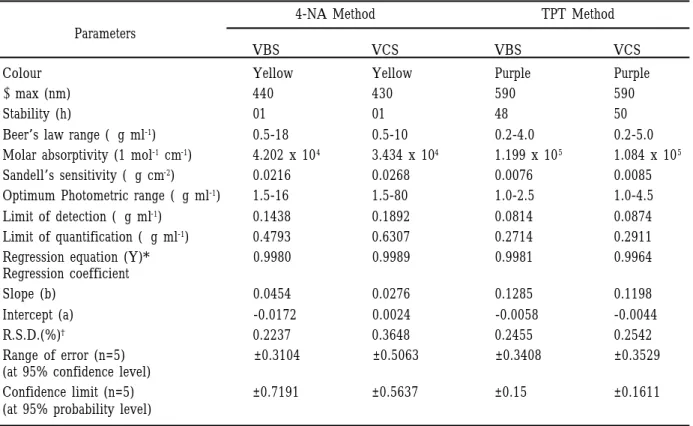
(6) 126. NAGARAJA P, VASANTHA R.A., YATHIRAJAN H.S.. FIGURA I. Espectro de absorción del VBS; La concentración final de VBS es de 10 µg ml-1 (Método a, 4-NA) y 2 µg ml-1 (Método b, TPT). Fig. 1. Absorption spectra of VBS; Final concentration of VBS is 10 µg ml-1 (4-NA Method-a) and 2 µg ml-1 (TPT Method-b.. 0,5 B. 0,45 0,4. Absorbance. 0,35 0,3 0,25 0,2 0,15 0,1. 840. 820. 800. 780. 760. 740. 720. 700. 680. 660. 640. 620. 600. 580. 560. 540. 520. 500. 480. 460. 440. 420. 0. 400. 0,05. Wavelength (nm). Optimización de las condiciones de reacción En el método de 4-nitroanilina, se descubrió la necesidad de añadir el 0,1% de 4-nitroanilina en el intervalo de 1,0 a 4,0 ml, el 0,5% de nitrito de sodio en el intervalo de 0,25 a 2,0 ml y el 5% de ácido sulfámico en el intervalo de 0,5 a 3,0 ml para conseguir estabilidad e intensidad de color máximas para el VBS y el VCS. A temperaturas bajas, la 4-nitroanilina sufre una reacción de diazotación con el nitrito de sodio en un medio ácido formando un catión de diazonio. En el caso de que exista una presencia excesiva de nitrito en la mezcla de reacción, éste interferirá en la reacción de copulación. Por lo tanto, es necesario eliminar el exceso de nitrito mediante la adición del ácido sulfámico. Un exceso de ácido sulfámico no afecta a la intensidad del color del producto de la reacción. Ars Pharmaceutica, 43:3-4; 121-133, 2002. Hence required volumes of all reagent solutions were used as mentioned in the recommended procedure. Quantification Beer’s law was obeyed in the range of 0.51.8 mg ml-1 for VBS and 0.5-10 mg ml-1 for VCS by 4-nitroaniline method and 0.2-4.0 mg ml-1 for VBS and 0.2-5.0 mg ml -1 for VCS by TPT method. The details of optical parameters and precision data for both the methods are presented in Table 1..
(7) 127. SENSITIVE METHODS FOR THE SPECTROPHOTOMETRIC DETERMINATION OF ANTINEOPLASTIC COMPOUNDS. En el método TPT, es necesario un 0,2% de TPT en el intervalo de 0,25 a 4,0 ml y 0,01 mol/ dm -3 de hierro III en el intervalo de 0,1-0,7 ml para obtener una intensidad de color y estabilidad máximas para el VBS y el VCS. Por lo tanto, se utilizaron los volúmenes necesarios de todas las soluciones reactivas tal y como se mencionan en el procedimiento recomendado. Cuantificación La ley de Beer se cumple en el intervalo de 0,5 a 1,8 mg ml -1 en el VBS y de 0,5 a 10 mg ml -1 en el VCS en el caso del método de 4-nitroanilina y en el intervalo de 0,2 a 4,0 mg ml1 en el VBS y de 0,2 a 5,0 mg ml -1 en el VCS en el caso del método de TPT. Los detalles relativos a los datos de precisión y parámetros ópticos pertenecientes a ambos métodos se muestran el la Tabla 1.. TABLA I. Datos de precisión y características ópticas del VBS y VCS. Parámetros. Método de 4-NA. Color λ máx (nm) Estabilidad (h) Intervalo de la ley de Beer (µg ml-1). Método de TPT. VBS. VCS. VBS. VCS. Amarillo 440. Amarillo 430. Púrpura 590. Púrpura 590. 01. 01. 48. 50. 0.5-18 4,202 x 10 4 0.0216. 0.5-10 3,434 x 10 4 0.0268. 0.2-4.0 1,199 x 10 5 0.0076. 0.2-5.0 1,084 x 10 5 0.0085. Intervalo fotométrico óptimo (mg ml-1). 1.5-16. 1.5-80. 1.0-2.5. 1.0-4.5. Límite de detección (µg ml-1) Límite de quantificación (µg ml-1) Ecuación de regresión (Y)* Coeficiente de regresión Pendiente (b) Ordenada en el origen (a). 0.1438 0.4793 0.9980. 0.1892 0.6307 0.9989. 0.0814 0.2714 0.9981. 0.0874 0.2911 0.9964. 0.0454 -0.0172. 0.0276 0.0024. 0.1285 -0.0058. 0.1198 -0.0044. R.S.D.(%)† Margen de error (n=5) (con un 95% de nivel de confianza) Límite de confianza (n=5) (con un 95% de nivel probabilidad). 0.2237 ±0.3104. 0.3648 ±0.5063. 0.2455 ±0.3408. 0.2542 ±0.3529. ±0.7191. ±0.5637. ±0.15. ±0.1611. -1. -1. Absortividad molar (1 mol cm ) Sensibilidad deSandell (µg cm-2). * Y=bx+a, donde x es la concentración expresada en µg ml -1 cinco réplicas. †. Ars Pharmaceutica, 43:3-4; 121-133, 2002.
(8) 128. NAGARAJA P, VASANTHA R.A., YATHIRAJAN H.S.. TABLE I. Optical Characteristics and precision data for VBS and VCS. 4-NA Method. TPT Method. Parameters VBS. VCS. VBS. VCS. Colour λ max (nm) Stability (h). Yellow 440 01. Yellow 430 01. Purple 590 48. Purple 590 50. Beer’s law range (µg ml-1). 0.5-18 4.202 x 10 4 0.0216 1.5-16. 0.5-10 3.434 x 10⁴ 0.0268 1.5-80. 0.2-4.0 1.199 x 10 5 0.0076 1.0-2.5. 0.2-5.0 1.084 x 10 5 0.0085 1.0-4.5. Limit of detection (µg ml-1) Limit of quantification (µg ml-1) Regression equation (Y)* Regression coefficient Slope (b). 0.1438 0.4793 0.9980. 0.1892 0.6307 0.9989. 0.0814 0.2714 0.9981. 0.0874 0.2911 0.9964. 0.0454. 0.0276. 0.1285. 0.1198. Intercept (a) R.S.D.(%)† Range of error (n=5) (at 95% confidence level) Confidence limit (n=5) (at 95% probability level). -0.0172 0.2237 ±0.3104. 0.0024 0.3648 ±0.5063. -0.0058 0.2455 ±0.3408. -0.0044 0.2542 ±0.3529. ±0.7191. ±0.5637. ±0.15. ±0.1611. Molar absorptivity (1 mol-1 cm-1) Sandell’s sensitivity (µg cm-2) Optimum Photometric range (µg ml-1). * Y=bx+a, where x is the concentration in µg ml -1 † five replicates. Secuencia de reacciones. Reaction sequence. El método de la 4-nitroanilina está basado en la reacción de copulación de los componentes azoicos de la 4-nitroanilina diazotizada con el grupo indol del VBS o el VCS, mediante la cual se obtiene el producto azoico amarillo. El método de TPT implica la reducción del hierro III a hierro II mediante el VBS y el VCS y a continuación el hierro II se combina con el TPT para producir el color púrpura o violeta, que es una reacción muy conocida.. 4-Nitroaniline method is based on the azo coupling reaction of diazotised 4-nitroaniline with the indole moiety of VBS or VCS producing the yellow azo coupled product. TPT method involves the reduction of iron(III) to iron(II) by VBS and VCS and then iron(II) complexes with TPT, producing purple or violet colour which is a well known reaction. Stability. Estabilidad Se descubrió que los productos amarillos del VBS y VCS obtenidos mediante el método de la 4-nitroanilina permanecían estables durante 1 hora. Se descubrió que los complejos de color púrpura del VBS y VCS obtenidos mediante el método de TPT permanecían estables durante 48 horas. También se observó que al sumergir el producto, durante 10 minutos en agua hirviendo en el caso del método de la 4-nitroanilina y durante 5 minutos en el método de TPT, se obtenían colores de máxima intensidad y estabilidad. Sin embarArs Pharmaceutica, 43:3-4; 121-133, 2002. The yellow products of VBS and VCS by 4nitroaniline method were found to be stable for 1h. The purple coloured complexes of VBS and VCS by TPT method were found to be stable for 48h. It was found that heating for 10 min in a boiling water bath for 4-nitroaniline method and 5 min for TPT method was sufficient to produce colours of maximum intensity and stability. However, heating for more than 10 min in both the cases produced turbid solutions. This may be due to the decomposition of the reaction product and the decomposed product is less soluble in.
(9) MÉTODOS SENSITIVOS PARA LA DETERMINACIÓN ESPECTROFOTOMÉTRICA DE LOS COMPUESTOS.... go, en ambos casos, al calentar el producto durante más de 10 minutos se producían soluciones turbias. Esto puede deberse a la descomposición del producto de reacción, ya que el producto descompuesto es menos soluble en agua. Al calentar el producto durante menos de 5 minutos se obtenían valores de absorción inferiores. Interferencias Se realizó un estudio detallado de la interferencias producidas por diversos aniones, cationes y determinadas sustancias concomitantes que suelen estar presentes en las formulaciones farmacéuticas. En el método de 4-nitroanilina, se utilizaron 10 mg ml-1 de VBS y una cantidad conocida de sustancia interferente para comprobar las interferencias producidas. Se descubrió que el tartrato, la vitamina C, el hierro II y el hierro III interferían gravemente en el método. En el método TPT, se utilizaron 2 mg ml-1 de VBS y cantidades conocidas de sustancias interferentes para probar las interferencias. De nuevo, se observó que la vitamina C y el tartrato provocaban interferencias en el análisis. El tartrato, un agente de reducción, interfiere fuertemente con el método de TPT, una parte del hierro III se reduce a hierro II, y con el método de 4-NA, el catión de diazonio formado reacciona con el tartrato. De este modo, se advierte la interferencia del tartrato. De forma similar, la interferencia de la glucosa en el método del TPT se puede explicar de la siguiente forma. La glucosa reduce el hierro III, pero no con la misma intensidad que el tartrato. Igualmente, en el método de la 4-NA, la interferencia de la glucosa con el catión de diazonio es menor y por este motivo el límite de tolerancia es de 2000 ppm. Esto significa que, en ambos métodos, incluso en presencia de excipientes comunes, es posible determinar el VNS y VCS. Los detalles de los efectos provocados por diversas sustancias concomitantes que se prueban se muestran en la Tabla 2.. 129. water. Heating for less than 5 min gave lower absorption values. Interference A detailed study for the interference of various anions, cations and some concomitant substances usually present in pharmaceutical formulations was made. In 4-nitroaniline method, 10 mg ml-1 of VBS and a known amount of interfering substance was used to check the interference. It was found that tartarate, vitamin-C, iron(II) and iron(III) seriously interfere in this method. For TPT method, a 2 mg ml-1 VBS and known amounts of interfering substances were used to test the interference. Again, vitamin-C and tartarate were found to interfere in the analysis. Tartarate being a reducing agent, it interferes strongly in the TPT method (part of the iron(III) reduces to iron(II)) and in the 4-NA method, the diazonium cation formed reacts with tartarate, there by the interference of tartarate is noticed. Similarly, glucose interference in TPT method can be explained in the following way. Glucose reduces iron(III), but not to an extent of tartarate. Similarly, in the 4-NA method, the interference of glucose with the diazonium cation is lower and hence the tolerance limit is 2000 ppm. This means that in both the methods, VBS and VCS can be determined even in presence of common excipients. The details of the effect of various concomitant substances that are tested are given in Table 2.. Ars Pharmaceutica, 43:3-4; 121-133, 2002.
(10) 130. NAGARAJA P, VASANTHA R.A., YATHIRAJAN H.S.. TABLA II. Efecto dediversos ionesy excipientes en la determinación del sulfato de vinblastina*.. Iones/compuestos añadidos. Límite de tolerancia (PPM) Método de 4-NA (10 µg ml-1)*. Método de TPT (2 µg ml-1)*. Cloruro. 10000. 5000. Fosfato. 1000. 1000. Sulfato. 5000. 4000. Acetato. 395. 375. Tartrato. 25. 40. Carbonato. 400. 400. Nitrato. 400. 400. Sodio. 10000. 10000. Hierro III. 20. -. Hierro II. 10. -. Vitamina C. 10. 10. Glucosa. 2000. 400. Lactosa. 1000. 390. Sacarosa. 2000. 380. TABLE II. Effect of diverse ions and excipients on the determination of vinblastine sulphate*.. Ions/Compounds added. Tolerance limit (PPM) 4-NA Method (10 µg ml-1)*. TPT Method (2 µg ml-1)*. Chloride. 10000. 5000. Phosphate. 1000. 1000. Sulphate. 5000. 4000. Acetate. 395. 375. Tartarate. 25. 40. Carbonate. 400. 400. Nitrate. 400. 400. Sodium. 10000. 10000. Iron(III). 20. -. Iron(II). 10. -. Vitamin-C. 10. 10. Glucose. 2000. 400. Lactose. 1000. 390. Sucrose. 2000. 380. Ars Pharmaceutica, 43:3-4; 121-133, 2002.
(11) 131. SENSITIVE METHODS FOR THE SPECTROPHOTOMETRIC DETERMINATION OF ANTINEOPLASTIC COMPOUNDS. Aplicación. Application. Se examinó la posibilidad de aplicación de los métodos en el ensayo de formulación farmacéutica. Se realizaron comprobaciones cruzadas de los resultados mediante el método oficial (B.P, 1998) y, tal y como se muestra en la Tabla 2, los resultados coincidieron positivamente. Se comprobó la reproducibilidad de los métodos en cinco determinaciones de réplicas utilizando 10 mg ml -1 de VBS para el método 4-nitroanilina y 2 mg ml-1 de VBS para el método de TPT. Los valores RSD (%) obtenidos se sitúan entre 0,22 y 0,25.. The applicability of the methods to the assay pharmaceutical formulations were examined. The results were cross checked by the official method (B.P, 1998) and the values agreed favourably with one another which is shown in Table 2. The reproducibility of the methods were checked by five replicate determinations using 10 mg ml -1 of VBS for 4-nitroaniline method and 2 mg ml -1 of VBS for TPT method. It was found that RSD (%) values lie between 0.22-0.25.. TABLA III. Determinación del VBS y VCS en preparaciones farmacéuticas.. Muestra. Cantidad de fármaco encontrada en mg*. Indicación de la etiqueta. Método de 4-NA. Método de TPT. Método BP. 10 mg/ml. 9.98±0.60. 9.99±0.40. 10.5±0.80. 1,0 mg/ml. 0.97±0.60. 1.01±0.55. 0.96±0.60. 1,0 mg/ml. 0.97±0.70. 0.99±0.35. 1.02±0.45. 1.0 mg/ml. 0.98±0.70. 0.98±0.75. 0.97±0.80. Inyección a. Cytoblastin (VBS) b. Cytocristin (VCS) c. Oncocristin (VCS) d. Vincristine (VCS). TABLE III. Determination of VBS and VCS in pharmaceutical preparations.. Sample. Label Claim. Amount of drug found in mg* 4-NA Method. TPT Method. BP Method. Injection Cytoblastina (VBS). 10 mg/ml. 9.98±0.60. 9.99±0.40. 10.5±0.80. Cytocristinb (VCS). 1.0 mg/ml. 0.97±0.60. 1.01±0.55. 0.96±0.60. Oncocristinc (VCS). 1.0 mg/ml. 0.97±0.70. 0.99±0.35. 1.02±0.45. Vincristined (VCS). 1.0 mg/ml. 0.98±0.70. 0.98±0.75. 0.97±0.80. CONCLUSIÓN. CONCLUSION. Los métodos propuestos son los primeros de su clase en la bibliografía de las determinaciones espectrofotométricas de estos fármacos anticancerígenos. Los dos métodos son simples, rápidos, poseen una gran sensibilidad y resultan más económicos en comparación con los métodos instrumentales presentados. Por tanto, estos métodos son los más adecuados para el ensayo. The proposed methods are found to be first of their kind in the literature survey of spectrophotometric determinations of these anti cancer drugs. The two methods are simple, rapid, highly sensitive and economical compared to already reported instrumental methods. Hence, these methods are best suited for the assay of these drugs to assure high standard of quality control. Ars Pharmaceutica, 43:3-4; 121-133, 2002.
(12) 132. NAGARAJA P, VASANTHA R.A., YATHIRAJAN H.S.. de estos fármacos, con el fin de garantizar un elevado estándar de control de calidad.. AGRADECIMIENTOS. ACKNOWLEDGEMENT One of the authors (R.A.V.) thank the Mysore University and U.G.C., New Delhi, for the support of research work.. Uno de los autores (R.A.V.) agradece a la Universidad de Mysore y a U.G.C., Nueva Delhi, el apoyo recibido durante el trabajo de investigación.. BIBLIOGRAFÍA / BIBLIOGRAPHY Benzie, I.F.F. (1996). An automated specific spectrophotometric method for measuring ascorbic acid in plasma. Clin. Bicochem., 29: 111-116. British Pharmacopoeia. (1998). HM Stationary Office. London. Vol. 2, p.1147-1148. Chu, I., Bodnar, J.A., White, E.L., Bowman, R.N. (1996). Quantification of vincristine and vinblastine in catharanthus roseus plants by capillary zone electrophoresis. J. Chromatogr. A., 755(2) : 281-288. Chu, I.H., Bodnar, J.A., Bowman, R.N., White, E.L. (1997). Determination of vincristine and vinblastine in catharanthus roseus plants by HPLC – electrospray ionization mass spectrometry. J. Liq. Chromatogr. Related Technol., 20(8) : 1159-1174. Embree, L., Gelmon, K.A., Tolcher, A.W., Hudon, N.J., Heggie, J.R., Dedhar, C., Webb, M.S., Bally, M.B., Mayer, L.D. (1997). Validation of a high-performance liquid chromatographic assay method for the quantification of total vincristine sulphate in human plasma following administration of vincristine sulphate liposome injection. J. Pharm. Biomed. Anal., 16(4) : 675-687. Ernst, M. (1990). Spectrophotometric determination of phenol in wort and Beer. Lebensmittelindustrie, 37: 206-208. European Pharmacopoeia 4th edition. (2002). EDQM. Council of Europe. France. P. 2117-2118. Goodman, Sanford, L., Gilman, A., Gilman, A.G. (1990). The Pharmacological basis of Therapeutics, 8th ed., Pergamon press, New York. Hesse, M. (1981). Alkaloid Chemistry, Wiley, New York. Horvath, P., Ivanyi, G. (1982). Quantitative analysis of natural drugs. III. Densitometric determination of vinblastine and other alkaloids of catharanthus roseus. Acta Pharm.Hung., 52(4) : 150-157. Huhtikangas, A., Lehtola, T., Lapinjoki, S., Lounasmaa, M. (1987). Specific radio-immunoassay for vincristine. Planta Med., 53(1) : 85-87. Indian Pharmacopocia. (1996). Controller of publications. Delhi. Vol. 2, p. 799-801. Kaleagasioglu, F. (1992). Identification of antineoplastic agents by Thin-layer chromatography. Acta pharm. Turc., 34(4) : 115-119. Kamau, G.N., Rusling, J.F. (1994). Resolution of ascorbic acid or catecholamine and indole alkaloid mixtures by pulse voltammetry at highly polished glassy carbon. Electronal., 6(6) : 445-450. Kovbuz, M.O., Felitsin, N.M., Khimyak, Y., Ziminkovskii, B.S. (1995). Polarographic determination of some anticancer drugs. Farm. Zh(Kiev)., 2 : 60-63. Langone, J.J., D’Onofrio, M.R., Van-Vunakis, H. (1979). Radio-immunoassays for the vinca alkaloids vinblastine and vincristine. Anal. Biochem., 95(1) : 214-221. Nagaraja, P., Arunkumar, H.R., Vasantha, R.A., Yathirajan, H.S. (2002). Novel reagents for the sensitive spectrometric determination of flutamide, an anticancer drug in pharmaceutical preparations. Int. J. Pharm., 235 : 113-120. Nagaraja, P., Srinivasa Murthy, K.C., Yathirajan, H.S. (1996). Spectrophotometric determination of isoniazid with sodium 1,2-naphthoquinone-4-sulphonate and cetyltrimethylammoniumbromide. Talanta, 43 : 1075-1080. Nagaraja, P., Sunitha, K.R., Silwadi, M.F. (2000). New spectrophotometric method for the determination of flutamide in pharmaceutical preparations. J. pharm. Biomed. Anal., 23 : 617-622. Nagaraja, P., Sunitha, K.R., Vasantha, R.A., Yathirajan, H.S. (2002). Iminodibenzyl as a novel coupling agent for the spectrophotometric determination of sulfonamide derivatives. Eur. J. Pharm. Biopharm., 53: 187-192. Nagaraja, P., Vasantha, R.A., Sunitha, K.R. (2001). A new sensitive and selective spectrophotometric method for the determination of catechol derivatives and its pharmaceutical preparations. J. pharm. Biomed. Anal., 25 : 417-424. Nagaraja, P., Vasantha, R.A., Yathirajan, H.S. (2002). Spectrophotometric methods for the rapid determination of menadione and menadione sodium bisulphite and their application in pharmaceutical preparations. J. Pharm. Biomed. Anal., 28(1-2): 161-168. Nagarja, P., Sunitha, K.R., Vasantha, R.A., Yathirajan, H.S. (2002). Spectrophotometric determination of metronidazole and tinidazole in pharmaceutical preparations. J. Pharm. Biomed. Anal., 28(3-4) : 527-535. Neuss, N., Gorman, M., Hargrove, W., Cone, N.J., Biemann, K., Buchi, G., Manning, R.E. (1964). Vinca alkaloids : XXI. The structures of the oncolytic alkaloids vinblastine and vincristine. J. Am. Chem. Soc., 86: 1440-1442. Ars Pharmaceutica, 43:3-4; 121-133, 2002.
(13) MÉTODOS SENSITIVOS PARA LA DETERMINACIÓN ESPECTROFOTOMÉTRICA DE LOS COMPUESTOS.... 133. Rahim, S.A., Ismail, N.D., Bashir, W.A. (1986) Spectrophotometric determination of aniline in aqueous solution by azodye formation with diazotized p-nitroaniline. Mikrochim. Acta, III(5-6): 417-423. Rajeswari, C.V., Naidu, A.V., Naidu, P.R. (1984). Simple colorimetric method for the determination of carbofuran and bendiocarb in formulations. Curr. Sci., 53: 800-801. Raju, J., Shivahare, P., Gupta, V.K. (1992). Rapid and sensitive screening method for the determination of carbaryl and propoxur using p-nitroaniline. Int. J. Environ. Anal. Chem., 49(3) : 111-115. Rusling, J.F., Scheer, B.J., Haque, I.U. (1984). Voltammetric oxidation of vinblastine and related compounds. Anal. Chim. Acta, 158(1) : 23-32. Sapunova, L.A., Gaevskii, A.V., Maslova, G.A., Grodnitskaya, E.I. (1982). Determination of vinblastine and leurosine in the above ground parts of catharanthus roseus Donn. Khim. Farm. Zh., 16(6) : 708-715. Sastry, C.S.P., Rao, S.G., Sastry, B.S. (1992). Spectrophotometric determination of butylated hydroxyanisole in oils. J. Food Sci. Technol., 29: 101-102. Sethi, V.S., Burton, S.S., Jackson, D.V. (1980). Sensitive radio-immunoassay for vincristine and vinblastine. Cancer chemother. Pharmacol., 4(3) : 183-187. Tabacco, A., Bardelli, F., Meiattini, F., Tarli, P. (1980). A simplified Kinetic method for the determination of uric acid in serum with a single Fe(III)-2,4,6-triyridyl-1,3,5-triazine reagent. Clin. Chim. Acta, 104: 405-407. Temizer, A. (1986). Electroanalytical determination of vinca alkaloids used in cancer chemotherapy. Talanta, 33(10) : 791794. United States Pharmacopoeia XXIV. (2000). USP convention Inc. Rockville. MD 20852, p. 1744-1746. Van Tellingen, O., Beijnen, J.H., Baurain, R., Tenbokkel Huinink, W.W., Vanderwonde, H.R., Nooyen, W.J. (1991). Highperformance liquid chromatographic determination of vinblastine, 4-0-deacetylvinblastine and the potential metabolite 4-0-deacetylvinblastine-3-oic acid in biological fluids. J. chromatogr., 553(1) : 47-53. Volkov, S.K. (1996). Determination of vinblastine and vincristine by HPLC. Khim. Farm. Zh., 30(3) : 58-62. Volkov, S.K., Grodmitskaya, E.I. (1994). Application of HPLC to the determination of vinblastine in cantharus roseus. J. chromatogr. B. Biomed. Appl., 660(2) : 405-408. Wei, Y., Pei, D. (1997). Continuous spectrophotometric assay of peptide deformylase. Anal. Biochem., 250: 29-34.. Ars Pharmaceutica, 43:3-4; 121-133, 2002.
(14)
Figure



+2

Documento similar
Los métodos seguidos para la obtencidn de este tipo de compuestos, se basan en la condensacidn de ciclohexanona o sus derivados «('-sustituidos con formaldehido.. y una amina pri-
3.3.2.1. Estudio de infrarrojos. Es una técnica de utilidad en la identificación de todo tipo de compuestos orgánicos e inorgánicos, en la determinación de grupos
If certification of devices under the MDR has not been finalised before expiry of the Directive’s certificate, and where the device does not present an unacceptable risk to health
In addition to the requirements set out in Chapter VII MDR, also other MDR requirements should apply to ‘legacy devices’, provided that those requirements
The notified body that issued the AIMDD or MDD certificate may confirm in writing (after having reviewed manufacturer’s description of the (proposed) change) that the
La campaña ha consistido en la revisión del etiquetado e instrucciones de uso de todos los ter- mómetros digitales comunicados, así como de la documentación técnica adicional de
Utilizamos teléfono, fax y correo electrónico para comunicarnos con los clientes [¿Cómo utiliza su empresa / las pymes las TICs en su relación con los clientes?]. Disponemos de
Lo que se pierde en extensión se gana en profundidad, se nos dice. Ello es verdad si se admite que esta profundidad es limitada incluso desde el punto de vista funcional. ¿Por qué se
