
Measurement of the production cross section of jets in association with a Z boson in pp collisions at vs=7 TeV with the ATLAS detector
57
0
0
Texto completo
(2) Prepared for submission to JHEP. Measurement of the production cross section of jets in association with a Z boson in pp collisions √ at s = 7TeV with the ATLAS detector. Abstract: Measurements of the production of jets of particles in association with a Z bo√ son in pp collisions at s = 7 TeV are presented, using data corresponding to an integrated luminosity of 4.6 fb−1 collected by the ATLAS experiment at the Large Hadron Collider. Inclusive and differential jet cross sections in Z events, with Z decaying into electron or muon pairs, are measured for jets with transverse momentum pT > 30 GeV and rapidity |y| < 4.4. The results are compared to next-to-leading-order perturbative QCD calculations, and to predictions from different Monte Carlo generators based on leading-order and next-to-leading-order matrix elements supplemented by parton showers..
(3) Contents 1 Introduction. 1. 2 Experimental setup. 2. 3 Monte Carlo simulation. 4. 4 Event selection. 5. 5 Background estimation. 6. 6 Detector-level results. 7. 7 Correction for detector effects and combination of channels. 8. 8 Systematic uncertainties. 11. 9 Theoretical predictions. 12. 10 Results and discussion 10.1 Jet multiplicities 10.2 Jet transverse momentum 10.3 Angular distributions 10.4 Distributions after VBF preselection 10.5 Inclusive quantities. 13 14 16 19 20 21. 11 Conclusions. 23. 12 Acknowledgements. 26. 1. Introduction. The production of jets of particles in association with a Z boson1 at hadron colliders provides an important test of perturbative quantum chromodynamics (pQCD). Such events also constitute a non-negligible background for studies of the Higgs boson candidate [1, 2] and searches for new phenomena. In these searches, the multiplicity and kinematics of jets in Z + jets events are exploited to achieve a separation of signal from background. This procedure often introduces scales larger than the mass of the Z boson, resulting in large logarithmic contributions in the calculation of higher-order QCD corrections to the predicted Z + jets cross section [3, 4]. The measured Z + jets cross section can be compared 1. The notation Z refers to the complete Z/γ ∗ interference.. –1–.
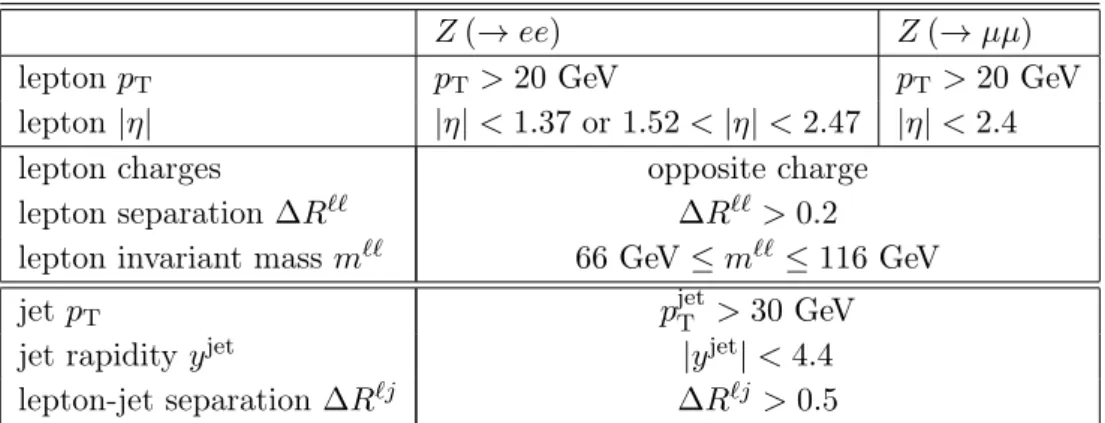
(4) directly to fixed-order predictions at next-to-leading-order (NLO) in pQCD [5–7] and to Monte Carlo (MC) generators based on next-to-leading-order or leading-order (LO) matrix elements supplemented by parton showers [8–10]. The simulations based on LO matrix elements are affected by large uncertainties in the factorization and renormalization scales and need to be tuned and validated using data. Measurements of the Z + jets cross section have been reported for lower jet energies and lower jet multiplicities in proton–antiproton collisions at a center-of-mass energy of √ s = 1.96 TeV [11–13] and in proton–proton collisions based on a data set of 0.036 fb−1 √ collected at s = 7 TeV [14, 15]. This article extends these measurements, using 4.6 fb−1 √ of proton–proton collision data collected by the ATLAS experiment in 2011 at s = 7 TeV. The large data set allows cross sections to be measured for the production of up to seven jets in association with a Z boson. Differential jet cross sections are accessible for large jet multiplicities and for energy regimes up to 1 TeV, which allows the modelling of the Z + jets process to be probed for typical phase-space regimes expected from new phenomena and from Higgs boson production, for example via vector-boson-fusion (VBF). Selected events contain a Z boson decaying into a pair of electrons or muons. Associated jets are identified in a rapidity (y jet ) range of |y jet | < 4.4 and with transverse jet momentum (pjet T ) of pT > 30 GeV. The measurements comprise inclusive and exclusive jet multiplicities for different phase-space constraints and differential jet cross sections as a function of the transverse momentum and the rapidity of the four jets with the largest transverse momentum (‘leading jets’). Cross sections for events with at least two jets in the final state are measured as a function of the invariant mass (mjj ) and the angular separation of the two leading jets. Differential cross sections in events with at least one jet are measured as a function of the scalar pT sum of the jets (ST ), of the scalar pT sum of the leptons and jets (HT ), and the transverse momentum of the Z boson candidate (p`` T ). The results of the measurements are unfolded for detector effects and quoted at the particle (hadron) level, where they are compared to predictions from fixed-order NLO pQCD programs and from several MC generators. The paper is organized as follows. The detector and the data sample are described in the next section. Section 3 provides details of the simulations used in the measurements, while section 4 describes the lepton and jet reconstruction and the event selection. The estimation of background contributions is described in section 5 and selected uncorrected distributions are presented in section 6. The procedures used to unfold the measurements for detector effects and to combine electron and muon channels are detailed in section 7. Systematic uncertainties are discussed in section 8. The NLO pQCD predictions are described in section 9. Measured cross sections are presented in section 10 and compared to generator and NLO pQCD predictions. Finally, section 11 provides a summary.. 2. Experimental setup. The ATLAS detector [16] at the LHC covers nearly the entire solid angle around the collision point. It consists of an inner tracking detector surrounded by a thin superconducting solenoid, followed by electromagnetic and hadronic calorimeters and a muon spectrometer. –2–.
(5) incorporating three large superconducting toroid magnets (each with eight coils). The inner detector (ID) is immersed in a 2 T axial magnetic field and provides charged-particle tracking in the pseudorapidity2 range |η| < 2.5. The high-granularity silicon pixel detector covers the vertex region and typically provides three measurements per track, the first hit being normally in the innermost layer. It is followed by the silicon microstrip tracker, which provides typically eight measurements (four space-points) per track. These silicon detectors are complemented by the transition radiation tracker, which covers a region up to |η| = 2.0. The transition radiation tracker also provides electron identification information based on the fraction of hits above a high energy-deposit threshold corresponding to transition radiation. The calorimeter system covers the pseudorapidity range |η| < 4.9. Within the region |η| < 3.2, electromagnetic calorimetry is provided by barrel and endcap high-granularity lead/liquid-argon (LAr) calorimeters. An additional thin LAr presampler covers |η| < 1.8 to correct for energy loss in material upstream of the calorimeters. Hadronic calorimetry is provided by a steel/scintillating-tile calorimeter, segmented radially into three barrel structures within |η| < 1.7, and two copper/LAr hadronic endcap calorimeters, that cover the region 1.5 < |η| < 3.2. The solid angle coverage is completed in the region of 3.1 < |η| < 4.9 with forward copper/LAr and tungsten/LAr calorimeter modules optimized for electromagnetic and hadronic measurements respectively. The muon spectrometer (MS) comprises separate trigger and high-precision tracking chambers measuring the deflection of muons in a magnetic field generated by superconducting air-core toroids. The precision chamber system covers the region |η| < 2.7 with three layers of monitored drift tubes, complemented by cathode strip chambers in the forward region, where the background is highest. The muon trigger system covers the range |η| < 2.4 with resistive plate chambers in the barrel, and thin gap chambers in the endcap regions. A three-level trigger system is used to select interesting events. The Level-1 trigger is implemented in hardware and uses a subset of detector information to reduce the event rate to a design value of at most 75 kHz. This is followed by two software-based trigger levels which together reduce the event rate to about 400 Hz. √ The analysis is based on a sample of proton–proton collisions at s = 7 TeV, collected in 2011 during periods of stable beam operation. Di-electron final states are selected with a trigger requiring at least two electrons of pT > 12 GeV, using an electron identification similar to the one used in offline selection. Di-muon final states are selected with a trigger requiring at least one muon of pT > 18 GeV, using a higher-level trigger algorithm similar to the one used in the offline selection. The integrated luminosity used in both channels is 4.64±0.08 fb−1 [17].. 2. ATLAS uses a right-handed coordinate system with its origin at the nominal interaction point (IP) in the centre of the detector and the z-axis along the beam pipe. The x-axis points from the IP to the centre of the LHC ring, and the y-axis points upward. Cylindrical coordinates (r, φ) are used in the transverse plane, φ being the azimuthal angle around the beam pipe. The pseudorapidity is defined in terms of the polar angle θ as η = − ln tan(θ/2).. –3–.
(6) 3. Monte Carlo simulation. Monte Carlo event samples are used to determine background contributions, correct the measurements for detector effects, correct the theory calculations for non-perturbative effects, calculate acceptance corrections, and estimate systematic uncertainties on the final results. Signal events (Z (→ µµ) + jets and Z (→ ee) + jets) are generated using ALPGEN v2.13 [8] interfaced to HERWIG v6.520 [18] for parton shower and fragmentation and to JIMMY v4.31 [19] for modelling interactions of the proton remnants, referred to as ‘underlying event’ in the following, using the AUET2-CTEQ61L tune [20]. In the following sections, the expression ‘ALPGEN’ refers to this version unless stated otherwise. Similar samples are produced with ALPGEN v2.14 interfaced to PYTHIA v6.425 [21] using the PERUGIA2011C [22] tune. For both ALPGEN samples, CTEQ61L [23] parton distribution functions (PDFs) are employed. Signal samples are also generated with SHERPA v1.4.1 using the MEnloPS approach [10] and with MC@NLO v4.01 [24], interfaced to HERWIG, both using the CT10 [25] PDF set. The program PHOTOS [26] is used to simulate QED final state radiation (FSR) in the ALPGEN samples. QED-FSR simulation in SHERPA is based on the YFS method [27]. ALPGEN and SHERPA matrix elements are generated for up to five partons. The signal samples do not include Z + jets events produced via VBF. Based on generator-level studies, the expected contribution of these events to the measured cross sections is at the per-mille to per-cent level for the selections and kinematic ranges explored in this paper and always significantly below the statistical and systematic precision of the measurement. Background samples from W + jets and Z (→ τ τ ) + jets final states are generated similarly to the signal samples, using ALPGEN interfaced to HERWIG. The W + jets and Z + jets samples are normalized globally to next-to-next-to-leading-order (NNLO) pQCD inclusive Drell–Yan predictions as determined by the FEWZ [28] program using the MSTW2008NNLO PDF set [29]. The uncertainties of about 5% are taken from an envelope of predictions using different PDF sets and factorization and renormalization scales, as described in ref. [30]. Single-top-quark events are produced with AcerMC [31], interfaced to PYTHIA, using CTEQ61L PDFs. Diboson processes (W W , W Z and ZZ) are simulated with HERWIG using the AUET2-LO* tune [20]. Reference cross sections for single-top-quark and diboson processes are calculated using the MC@NLO generator with the MSTW2008 PDF set [29]. The tt̄ samples used for the relative normalization of final states in top-quark pair-production are generated with MC@NLO interfaced to HERWIG and with POWHEG [32, 33] interfaced to PYTHIA, both using the CT10 PDF set. All samples are processed through the GEANT4-based simulation [34, 35] of the ATLAS detector. The simulation includes the modelling of additional pp interactions in the same and neighbouring bunch crossings (pile-up), with an average of nine interactions per crossing, that matches the distribution of interactions per crossing measured in data.. –4–.
(7) 4. Event selection. Table 1 summarizes the kinematic regions in which Z bosons and jets are selected. They are defined to provide a good experimental coverage for the reconstruction of electrons, muons and jets in the event. Events with less than three tracks associated to the hard scattering vertex, defined as the vertex with the highest pT sum of its associated tracks, are discarded. Electrons are reconstructed from clusters of energy in the electromagnetic calorimeter matched to inner detector tracks. The electron candidates must have pT > 20 GeV and |η| < 2.47, excluding the transition region 1.37 < |η| < 1.52 between barrel and endcap electromagnetic calorimeter sections, and pass the ‘medium’ identification criteria described in ref. [36], re-optimized for 2011 conditions. No additional isolation requirement is applied, since non-isolated electron candidates are already suppressed by the identification criteria. Muon candidates are identified as tracks in the inner detector matched and combined with track segments in the muon spectrometer [37]. They are required to have pT > 20 GeV and |η| < 2.4. In order to achieve a sufficient rejection of multi-jet events, muons are required to be isolated: the scalar sum of the transverse momenta of tracks within a cone p of ∆R ≡ (∆φ)2 + (∆η)2 = 0.2 around the muon candidate must be less than 10% of the transverse momentum of the muon. All lepton pairs are required to have a separation of ∆R`` > 0.2. The Z candidates are selected by requiring exactly two oppositely charged leptons of the same flavour. Their invariant mass (m`` ) must be within the range 66 GeV ≤ m`` ≤ 116 GeV. With this selection, 1228767 Z (→ ee) and 1678500 Z (→ µµ) candidate events are identified. Jets are reconstructed using the anti-kt algorithm [38] with a distance parameter R = 0.4. The inputs to the jet algorithm are topological clusters of energy in the calorimeter [39]. The energies and directions of reconstructed jets in data and simulated events are corrected for the presence of additional proton–proton interactions, the position of the primary interaction vertex, the measurement biases induced by calorimeter non-compensation, additional dead material, and out-of-cone effects, using detector simulation and a combination of in-situ methods [39, 40]. Jets are required to have a transverse momentum above 30 GeV and a rapidity of |y jet | < 4.4. Jets closer than 0.5 in ∆R to a selected lepton are removed. In order to reject jets from additional proton–proton interactions, the ‘jet vertex fraction’ is used. This is defined as the pT sum of the tracks associated to the jet which are consistent with originating from the primary vertex divided by the pT sum of all tracks associated to the jet. The jet vertex fraction is required to be greater than 0.75 for jets with |η| < 2.4. The residual impact of additional proton–proton interactions on the distribution of the jet observables has been checked to be correctly simulated such that the unfolded cross sections are expected to be independent of the number of additional interactions. With this definition, 191566 Z (→ ee) and 257169 Z (→ µµ) candidate events are selected with at least one jet in the final state.. –5–.
(8) lepton lepton lepton lepton lepton. pT |η| charges separation ∆R`` invariant mass m``. Z (→ ee) pT > 20 GeV |η| < 1.37 or 1.52 < |η| < 2.47 opposite charge ∆R`` > 0.2 66 GeV ≤ m`` ≤ 116. Z (→ µµ) pT > 20 GeV |η| < 2.4. GeV. pjet T. jet pT jet rapidity y jet lepton-jet separation ∆R`j. > 30 GeV < 4.4 `j ∆R > 0.5 |y jet |. Table 1. Summary of Z (→ ``) and jet selection criteria.. 5. Background estimation. The selected data sample is expected to contain background events with two isolated leptons (tt̄, diboson and Z (→ τ τ ) events), with one isolated lepton (W → eν, W → µν and single-top-quark production) and without isolated leptons (multi-jet events). The total expected background fraction increases with the jet multiplicity (Njet ) from 2% (Njet ≥ 1) to 20% (Njet ≥ 6). It is dominated by multi-jet processes, tt̄ and diboson events for Z (+ ≤ 1 jet) and by tt̄ for larger jet multiplicities. The background is estimated using simulated samples, with the exception of the multi-jet and tt̄ background contributions, which are derived from data. For these data-driven background estimates, the shape of the background contribution to each of the measured distributions is derived from a dedicated background-enriched sample in data. The background-enriched samples have been selected and normalized as described below. The multi-jet background contribution in the Z (→ ee) + jets channel is estimated using a multi-jet enriched data template with two electron candidates which both pass a ‘loose’ selection but fail to pass the medium identification requirements [36]. The dedicated trigger used for the selection of this sample requires two clusters of energy in the electromagnetic calorimeter with pT > 20 GeV. This sample is dominated by jets misidentified as electrons in the final state. The normalization of this sample to the multi-jet background expected with medium requirements is extracted from a template fit in the invariant mass distribution for medium electrons (mee ) as follows: A single combined fit is performed of the multi-jet template and the standard simulated signal and non-multi-jet background templates to the measured spectrum of the invariant mass for medium electrons in the extended mass range 50 GeV < mee < 150 GeV in the inclusive selection. Systematic uncertainties are assessed by varying the mass range and the binning in the fit, by using a different generator (SHERPA instead of ALPGEN) for the signal template, by varying the electron energy scale and resolution in the simulation and by allowing for a modification of the shape of the mass distribution in the multi-jet enriched sample. The multi-jet background to the measured inclusive jet multiplicities varies between (0.65 ± 0.23)% for Njet ≥ 1 and (1.20 ± 0.44)% for Njet ≥ 6. In the Z (→ µµ) + jets channel, heavy flavour production (with muons originating from. –6–.
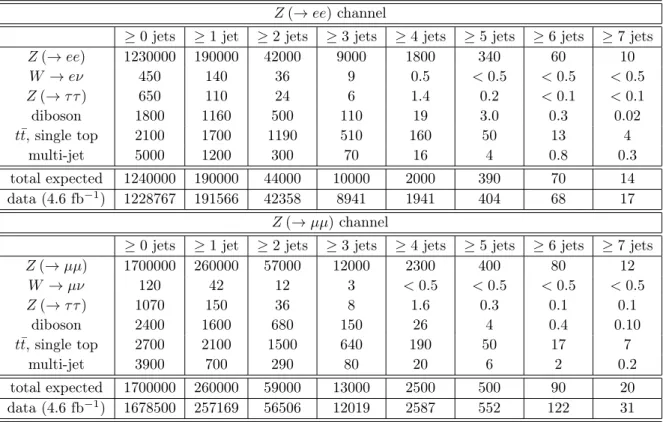
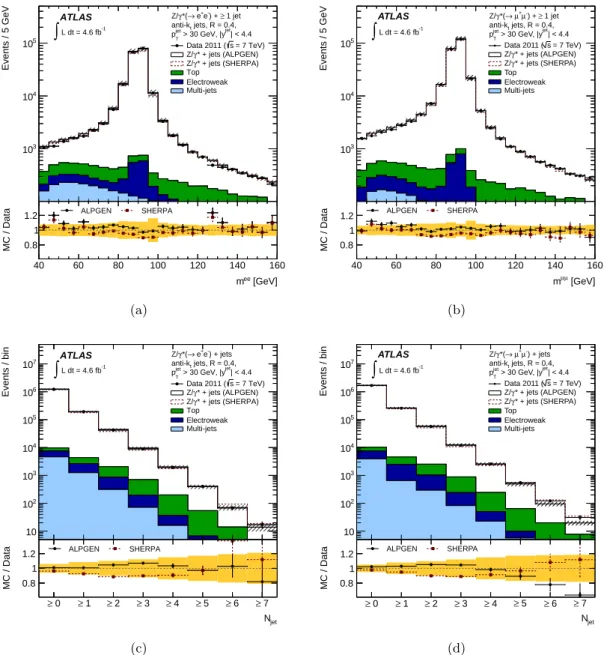
(9) b- and c-quark decays) and decays-in-flight of pions and kaons are the primary source of the multi-jet background, which is highly suppressed by the isolation requirement applied to the muon candidates. The multi-jet template is derived from a data sample where both muons fail the isolation requirement. The normalization factor is obtained by fitting the multi-jet template together with a template composed of the simulated signal and the nonmultijet background events that pass the signal selection to the spectrum of the invariant mass of isolated muons (mµµ ) measured in data in the range 40 GeV < mµµ < 150 GeV. In contrast to the Z (→ ee) + jets channel, the creation of the template and the normalization is performed separately for Njet ≥ 0, Njet ≥ 1 and Njet ≥ 2. The normalization factor derived for Njet ≥ 2 is used for all higher jet multiplicities. The systematic uncertainty is assessed by replacing the multi-jet template with one formed from muons passing a loose isolation cut but failing the tight cut used to select signal muons. Multi-jet fractions vary between (0.25 ± 0.04)% for Njet ≥ 1 and (2.2 ± 2.2)% for Njet ≥ 6. The tt̄ background contributions in the Z (→ ``) + jets samples are dominated by events where both W bosons decay leptonically. Since the kinematic properties of the jets in the final state are independent of the flavours of the two leptons, final states with one electron and one muon can be used to model the tt̄ background contributions to Z (→ ee) and Z (→ µµ) selections. The tt̄-enriched sample is selected from data in the e± µ∓ final state with kinematic requirements analogous to the Z (→ ``) + jets selection. The dedicated trigger used for the selection of this sample requires an electron with pT > 10 GeV and a muon with pT > 6 GeV. For each of the observables, the number of W + jets, Z + jets and diboson events expected from simulation in the tt̄-enriched sample is subtracted. The normalization from the e± µ∓ to the e+ e− and µ+ µ− final states is calculated from tt̄ samples generated with MC@NLO+HERWIG and with POWHEG+PYTHIA, separately for each jet multiplicity. Systematic uncertainties on the normalization arise from the choice of the generator, uncertainty on the lepton trigger, reconstruction and identification efficiency (see section 8) and on the electroweak background subtraction. The tt̄ fractions vary between (0.80 ± 0.05)% for Z (→ ee) + ≥ 1 jet and (18.6 ± 7.0)% for Z (→ ee) + ≥ 6 jets and between (0.74 ± 0.03)% for Z (→ µµ) + ≥ 1 jet and (18.1 ± 5.3)% for Z (→ µµ) + ≥ 6 jets.. 6. Detector-level results. Measured and expected distributions of the jet observables have been compared at the reconstruction level, separately in the electron and muon channels. As an example, figure 1 shows the dilepton invariant mass in events with at least one jet in the final state, as well as the inclusive jet multiplicity. For the signal, both ALPGEN and SHERPA expectations are shown. In this figure, W → eν, Z (→ τ τ ) and diboson processes are summarized as ‘electroweak’ background and tt̄ and single-top processes are referred to as ‘top’ background. For figures 1(a) and 1(b), the selection has exceptionally been extended beyond the fiducial invariant mass range, in order to demonstrate in addition the reasonable agreement between data and expectations for dilepton mass sideband regimes with larger background fractions. Table 2 shows, for the electron and muon channels separately, the observed number of events for the different jet multiplicities in the final state compared to expectations. –7–.
(10) Z (→ ee) channel Z (→ ee) W → eν Z (→ τ τ ) diboson tt̄, single top multi-jet. ≥ 0 jets 1230000 450 650 1800 2100 5000. ≥ 1 jet 190000 140 110 1160 1700 1200. ≥ 2 jets 42000 36 24 500 1190 300. ≥ 3 jets 9000 9 6 110 510 70. ≥ 4 jets 1800 0.5 1.4 19 160 16. ≥ 5 jets 340 < 0.5 0.2 3.0 50 4. ≥ 6 jets 60 < 0.5 < 0.1 0.3 13 0.8. ≥ 7 jets 10 < 0.5 < 0.1 0.02 4 0.3. total expected data (4.6 fb−1 ). 1240000 1228767. 190000 191566. 44000 42358. 10000 8941. 2000 1941. 390 404. 70 68. 14 17. Z (→ µµ) channel Z (→ µµ) W → µν Z (→ τ τ ) diboson tt̄, single top multi-jet. ≥ 0 jets 1700000 120 1070 2400 2700 3900. ≥ 1 jet 260000 42 150 1600 2100 700. ≥ 2 jets 57000 12 36 680 1500 290. ≥ 3 jets 12000 3 8 150 640 80. ≥ 4 jets 2300 < 0.5 1.6 26 190 20. ≥ 5 jets 400 < 0.5 0.3 4 50 6. ≥ 6 jets 80 < 0.5 0.1 0.4 17 2. ≥ 7 jets 12 < 0.5 0.1 0.10 7 0.2. total expected data (4.6 fb−1 ). 1700000 1678500. 260000 257169. 59000 56506. 13000 12019. 2500 2587. 500 552. 90 122. 20 31. Table 2. Numbers of events expected and observed in data that pass the Z (→ ee) + jets and Z (→ µµ) + jets selections as a function of the inclusive jet multiplicity. The expected numbers are rounded according to the combined statistical and systematic uncertainty. ALPGEN has been used to simulate the signal events.. for signal (ALPGEN) and background processes. The combined statistical and systematic uncertainties on the total expectation increases from 6% to 30% with increasing jet multiplicity. The data are consistent with predictions by the generators ALPGEN and SHERPA, which gives confidence that the simulated samples, which are used in the unfolding, provide a reasonable description of the event kinematics and of the detector response.. 7. Correction for detector effects and combination of channels. The cross sections in this article are quoted at the particle level, which corresponds to ‘dressed’ muons and electrons, calculated using final-state leptons from the Z decay for which collinear radiation in a cone of ∆R < 0.1 is added to the lepton four-momentum. Particle jets are clustered from all final-state particles (decay length cτ > 10 mm) excluding the dressed Z decay products. The phase-space requirements are the same as in the selection at reconstruction level (see table 1). After subtracting the expected background contributions, the data distributions in each channel are unfolded to the particle level using an iterative technique [41]. Response matrices are calculated for each observable, using Z + jets samples generated with ALPGEN. Before entering the iterative process, the data are corrected for the fraction of reconstructed events in the ALPGEN sample which do not match to a particle-level equivalent. The. –8–.
(11) ∫ L dt = 4.6 fb. -1. 105. Events / 5 GeV. Events / 5 GeV. Z/γ *(→ e+e-) + ≥ 1 jet anti-kt jets, R = 0.4, jet jet p > 30 GeV, |y | < 4.4 T Data 2011 ( s = 7 TeV) Z/γ * + jets (ALPGEN) Z/γ * + jets (SHERPA) Top Electroweak Multi-jets. ATLAS. 104. ∫ L dt = 4.6 fb. -1. 105. 104. 103. 40 1.2. 60ALPGEN 80. 100 SHERPA. 120. 140. 160. mee [GeV]. 1 0.8 40. 60. 80. 100. 120. 140. MC / Data. 103. MC / Data. +. Z/γ *(→ µ µ-) + ≥ 1 jet anti-kt jets, R = 0.4, jet pjet > 30 GeV, |y | < 4.4 T Data 2011 ( s = 7 TeV) Z/γ * + jets (ALPGEN) Z/γ * + jets (SHERPA) Top Electroweak Multi-jets. ATLAS. 160. 40 1.2. 60 ALPGEN. 80. 100 SHERPA. 120. 1 0.8 40. 60. 80. 100. 120. Events / bin. Events / bin. ∫. 106 105. 107. ∫. +. Z/γ *(→ µ µ-) + jets anti-kt jets, R = 0.4, jet pjet > 30 GeV, |y | < 4.4 T Data 2011 ( s = 7 TeV) Z/γ * + jets (ALPGEN) Z/γ * + jets (SHERPA) Top Electroweak Multi-jets. ATLAS -1. L dt = 4.6 fb. 106 105. 104. 104. 103. 103. 102. 102. 10. 10 ≥0. 1.2. ≥1. ALPGEN. ≥2. ≥3. SHERPA. ≥4. ≥5. ≥6. ≥7. MC / Data. MC / Data. 160. (b) Z/γ *(→ e+e-) + jets anti-kt jets, R = 0.4, jet jet p > 30 GeV, |y | < 4.4 T Data 2011 ( s = 7 TeV) Z/γ * + jets (ALPGEN) Z/γ * + jets (SHERPA) Top Electroweak Multi-jets. -1. L dt = 4.6 fb. 140. mµµ [GeV]. (a). ATLAS. 160. mµµ [GeV]. mee [GeV]. 107. 140. ≥ Njet. 1 0.8 ≥0. ≥1. ≥2. ≥3. ≥4. ≥5. ≥6. ≥7. ≥0. 1.2. ≥1. ALPGEN. ≥2. ≥3. SHERPA. ≥4. ≥5. ≥6. ≥7. Njet. 1 0.8 ≥0. ≥1. ≥2. ≥3. Njet. ≥4. ≥5. ≥6. ≥7 Njet. (c). (d). Figure 1. Numbers of events observed in data and predicted in simulation that pass the Z (→ ee) + jets and Z (→ µµ) + jets selection as a function of the invariant mass of the Z canjet didate, (a) mee and (b) mµµ , for events with at least one jet with pjet T > 30 GeV and |y | < 4.4, and as a function of the inclusive jet multiplicity, Njet , in (c) di-electron and (d) di-muon events. The individual contributions of the various backgrounds are also shown, as detailed in the legend. The hatched band corresponds to the combined statistical and systematic uncertainty on the prediction, obtained using ALPGEN to model the Z + jets process. The error bars on each data point show the statistical uncertainty. The bottom panel shows the corresponding MC/data ratio. The shaded band corresponds to the total systematic uncertainty and the error bars to the statistical uncertainty on the MC/data ratio.. number of iterations, typically two or three, is optimized for each observable using a χ2 comparison of generated and unfolded reconstructed Z + jets events from the generators. –9–.
(12) SHERPA and MC@NLO. The uncertainties from the limited number of events in data are propagated into the particle-level cross sections using a Monte Carlo method. One thousand pseudoexperimental spectra are generated by fluctuating the content of each bin according to the statistical uncertainty. The unfolding procedure is applied to each pseudo-experiment, and the r.m.s. of the results is taken as the statistical uncertainty. Systematic uncertainties arising from the unfolding procedure are estimated by comparing with an iterative unfolding based on response matrices and corrections derived from SHERPA. The statistical uncertainties of the response matrices are propagated into systematic uncertainties on the unfolded cross sections using pseudo-experiments. The cross sections measured in the electron and muon channels are extrapolated to a common phase-space region, derived from table 1 by extending the η range of the leptons to |η lep | < 2.5, using global acceptance corrections derived from ALPGEN Z + jets Monte Carlo samples, reweighted to the CT10 PDF set. The corrections are of the order of 14% and 5% for the electron and muon channel, respectively. Systematic uncertainties are estimated by comparing with corrections obtained using the corresponding SHERPA Z + jets sample and the original ALPGEN sample. Total uncertainties on the corrections are calculated as the quadratic sum of the statistical and systematic uncertainties and amount to 0.2–0.3%. The extrapolated cross sections measured in the electron and muon channels are in agreement. For each observable, the extrapolated cross sections are combined using the averaging procedure introduced in ref. [42], which accounts for systematic uncertainties (bin-to-bin correlated and uncorrelated) proportional to the central values of the respective cross sections. The weights of the individual cross-section measurements (µik ) in channel k (ee or µµ) and bin i in the combined cross sections (mi ) are derived by minimizing the following χ2 function [42]: P i X X mi bj − µik ]2 [mi − j γj,k 2 P χ (m, b) = + b2j , (7.1) i i i i (δstat,k )2 µk (mi − j γj,k mi bj ) + (δuncor,k mi )2 j k,i. where bj denote the shift introduced by a correlated systematic error source j normalized to its respective standard deviation. The relative statistical and uncorrelated systematic i quantifies the i i and the variable γj,k and δuncor,k uncertainties on µik are denoted by δstat,k influence of the correlated systematic error source j on the measurement i in the channel k. The following bin-to-bin correlated systematic sources are taken into account: normalization of the multi-jet background, lepton energy scale and resolution, lepton reconstruction, identification and trigger efficiencies and normalization of tt̄, electroweak and single-top background contributions, the latter three treated as correlated between the channels. Bin-to-bin correlated systematic sources which have the same impact in both channels do not enter in the combination procedure. These are the individual components of the jet energy scale, the jet energy resolution, the luminosity, the unfolding procedure, and the extrapolation factor. The uncertainties from these sources on the combined result are taken as the weighted average of the corresponding uncertainties on the electron and muon measurements.. – 10 –.
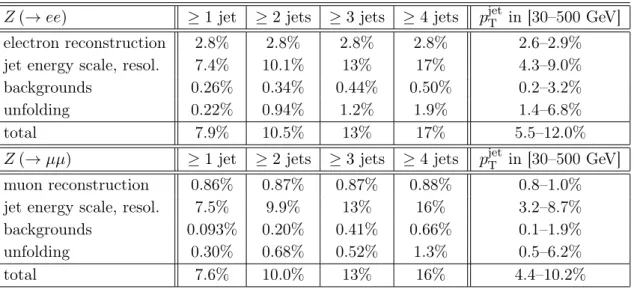
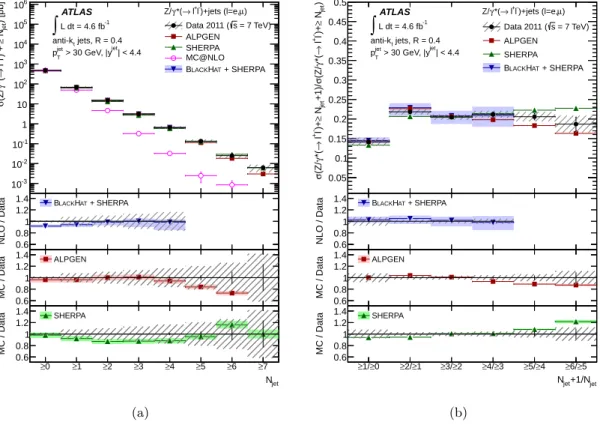
(13) 8. Systematic uncertainties. The kinematic ranges and the binning are chosen such that the statistical uncertainty of the measurement is comparable to or smaller than the systematic uncertainty. The relative systematic uncertainties on the cross sections measured in each channel are derived for each observable by propagating systematic shifts from a set of independent sources through the response matrices and the subtracted background contributions into the unfolded data. The resulting systematic uncertainties for each source in each channel are symmetrized in order to mitigate the impact of statistical fluctuations and are combined in the averaging procedure. The uncertainty on the jet energy scale (JES), determined from the combination of methods based on MC and in-situ techniques used to determine the scale, constitutes the dominant component of the total systematic uncertainty. It is propagated through the analysis using 14 independent components fully correlated in pjet T [39, 40]. They account for uncertainties on the different in-situ measurements which enter the jet calibration, on the jet flavour and on the impact of pile-up and close-by jets. The uncertainty on the jet energy resolution, derived from a comparison of the resolution obtained in data and in simulated dijet events, is propagated into the final cross section by varying the energy resolution of the simulated jets. Uncertainties on the normalization of the background expectations, for simulated and data-driven background contributions respectively, are treated as correlated between bins and are propagated to the measured cross sections by unfolding the data distributions after the subtraction of the systematically shifted background. The statistical uncertainties of the background contributions are added quadratically to the statistical uncertainties of the data. The uncertainty from the unfolding process is derived from the different components discussed in section 7, which are considered to be uncorrelated. Systematic uncertainties on electron and muon trigger efficiencies, energy scale, resolution, reconstruction and identification efficiencies are derived from the comparison of tag-andprobe results in data and simulated events [36, 37]. Table 3 summarizes the systematic uncertainties on the Z + jets cross sections as a function of the inclusive jet multiplicity and of pjet T of the leading jet separately for the electron and muon channels. The uncertainty on the integrated luminosity of 1.8% translates into comparable uncertainties on the measured cross sections. The total uncertainties on the inclusive jet cross sections range from 8% for Njet ≥ 1 to 16–17% for Njet ≥ 4, dominated by the JES uncertainty. The uncertainty on cross-section ratios, R≥(n+1)/≥n 3 , for successive jet multiplicities n is significantly reduced due to the strong correlations between the lepton and jet reconstruction and calibration uncertainties in neighbouring jet bins and amounts to a total of 3–4% for R≥2/≥1 and higher multiplicities, which are of interest in this article, dominated by the residual JES uncertainty. The large JES uncertainties in the forward region propagate into uncertainties on the unfolded cross sections at the level of 20% (30%) for jet rapidities of |y jet | = 3.0 (4.0). This is reflected in large jet energy scale uncertainties on the cross section 3. For simplicity, n is used in the subscript instead of Njet. – 11 –.
(14) Z (→ ee). ≥ 1 jet. ≥ 2 jets. ≥ 3 jets. ≥ 4 jets. pjet T in [30–500 GeV]. electron reconstruction jet energy scale, resol. backgrounds unfolding total. 2.8% 7.4% 0.26% 0.22% 7.9%. 2.8% 10.1% 0.34% 0.94% 10.5%. 2.8% 13% 0.44% 1.2% 13%. 2.8% 17% 0.50% 1.9% 17%. 2.6–2.9% 4.3–9.0% 0.2–3.2% 1.4–6.8% 5.5–12.0%. Z (→ µµ). ≥ 1 jet. ≥ 2 jets. ≥ 3 jets. ≥ 4 jets. pjet T in [30–500 GeV]. muon reconstruction jet energy scale, resol. backgrounds unfolding total. 0.86% 7.5% 0.093% 0.30% 7.6%. 0.87% 9.9% 0.20% 0.68% 10.0%. 0.87% 13% 0.41% 0.52% 13%. 0.88% 16% 0.66% 1.3% 16%. 0.8–1.0% 3.2–8.7% 0.1–1.9% 0.5–6.2% 4.4–10.2%. Table 3. Systematic uncertainties on the cross sections for Z (→ ee) + jets and Z (→ µµ) + jets as a function of the inclusive jet multiplicity and as a function of the transverse momentum, pjet T , of the jet leading jet for events with at least one jet with pjet > 30 GeV and |y | < 4.4. The rows labelled T ‘electron reconstruction’ and ‘muon reconstruction’ include uncertainties on trigger, reconstruction and identification, energy scale and resolution.. for events with large rapidity distance (|∆y jj |) between the leading jets, which combine with the unfolding uncertainties to total uncertainties of 20% (50%) for |∆y jj | = 3.0 (4.0).. 9. Theoretical predictions. Fixed-order calculations at NLO pQCD for the production of Z (+ ≥ 1 jet) up to Z (+ ≥ 4 jets) are computed using the BlackHat+SHERPA program [5–7]. CT10 PDFs [25] are employed and renormalization and factorization scales are set to HT /2, where HT is defined event-by-event as the scalar sum of the pT of all stable particles/partons. The anti-kt algorithm with R = 0.4 is used to reconstruct jets at the parton level. Systematic uncertainties on the predictions related to PDF uncertainties are computed from the 52 CT10 eigenvectors at 68% confidence level [25]. The uncertainties on the cross sections increase from 1% for (Njet ≥ 1) to 3% for (Njet ≥ 4) and from 1% to 5% with pjet T of the leading jet between 30 GeV and 500 GeV. Additional changes in the PDFs due to the variation of the input value for the strong coupling constant αs at the Z-boson mass scale by ±0.001 around its nominal value αs (mZ ) = 0.118 introduce uncertainties on the predicted cross sections in the range of 1% to 3% for Z (+ (1 − 4) jets). These are added in quadrature to the PDF uncertainties. Scale uncertainties are estimated by variations of the renormalization and factorization scales to one half and two times the nominal scale. The scale uncertainties for different parton multiplicities are assumed to be uncorrelated. For inclusive calculations, the scale variations translate into variations of the cross section by 4% to 13% as Njet increases and by 2% to 18% with increasing pjet T of the leading jet. For exclusive final states, the scale uncertainties are calculated using the prescription of ref. [43]. For comparison, the theory/data ratios presented in section 10 also show the scale uncertainty resulting from a. – 12 –.
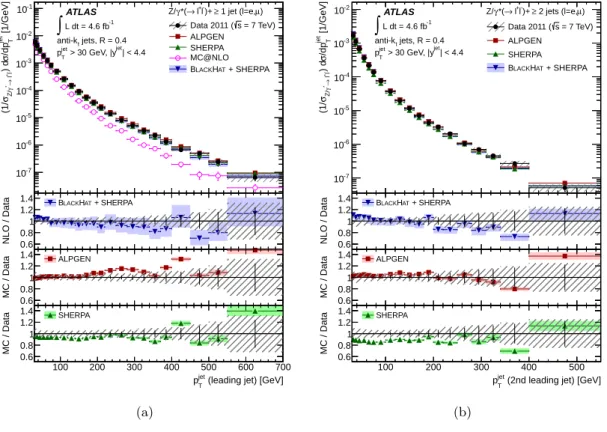
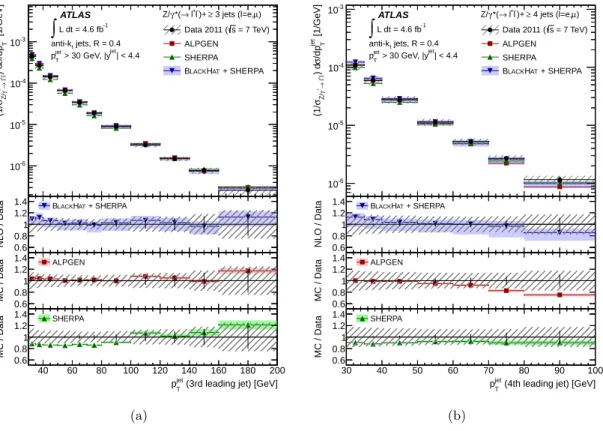
(15) simple variation of the renormalization and factorization scales by a factor of two, assuming the uncertainties to be correlated for different parton multiplicities. The scale uncertainties constitute the dominant uncertainties in most kinematic regions. The NLO fixed-order calculations at the parton level are corrected to the particle level for the underlying event and for effects of fragmentation and of QED final-state radiation (QED-FSR). Parton-to-hadron correction factors (δ had ) approximately account for nonperturbative contributions from the underlying event and fragmentation into particles. For each observable, the correction factor is estimated using simulated Z + jets samples, produced with ALPGEN with the HERWIG cluster fragmentation in which JIMMY models the underlying event using the AUET2-CTEQ61L [20] tune. It is calculated as the bin-bybin ratio of the nominal distribution at the particle level to the one obtained by turning off both the interactions between proton remnants and the fragmentation in the simulated samples. The non-perturbative corrections are also computed using ALPGEN samples, this time interfaced to PYTHIA, where the correction corresponds to the combined effect of string fragmentation and of the underlying event predicted by the PERUGIA2011C [22] tune. The difference is taken as a systematic uncertainty. The combined nominal correction jet is 7% in the low pjet T region and decreases with increasing pT towards zero. The correction factors for the inclusive Njet distributions are about 3–4%. Nonperturbative corrections for quantities calculated with several jets include implicitly the corrections for all jets. The statistical and the symmetrized systematic uncertainties on δ had are added in quadrature to the total uncertainty from the BlackHat+SHERPA calculation. The QED-FSR correction factors (δ QED ) are determined using Z + jets samples produced with the ALPGEN generator, interfaced to PHOTOS [26], by calculating the expected cross sections both with the lepton four-momentum before final-state photon radiation (‘Born level’), and with dressed leptons. The correction factors are about 2% for the electron and muon channels. They do not show a significant Njet dependence and are stable with respect to the jet rapidity and for large jet transverse momentum. Systematic uncertainties are derived by comparing with δ QED obtained using a Z + jets sample produced with the SHERPA generator [9] which generates QED-FSR using the YSF method [27]. The differences between the two predictions are usually at the per-mille level.. 10. Results and discussion. For each observable, the spectrum measured in data is unfolded to the particle level. After extrapolation and combination of electron and muon channels, the results are compared with calculations from BlackHat+SHERPA, corrected to the particle level, and with predictions by ALPGEN, SHERPA and MC@NLO. Both ALPGEN and SHERPA employ matrix elements for up to five partons. Higher multiplicities are generated by the parton shower. In contrast, MC@NLO generates the Drell–Yan process at NLO precision, which includes the real emission of one additional parton. All higher parton multiplicities are generated by the parton shower. Inclusive and differential cross sections for Z (→ ``) + ≥ n jets are compared with BlackHat+SHERPA fixed-order pQCD calculations for Z + ≥ n partons, which provide a NLO estimate for the respective parton multi-. – 13 –.
(16) plicity, including the real emission of one additional parton. Measured cross sections as a function of the jet multiplicity and their ratios are detailed in table 4. Tabulated values of all observed results are available in the Durham HEP database [44]. 10.1. Jet multiplicities. Figure 2(a) presents the absolute cross sections for inclusive jet multiplicities for up to seven hadronic jets in the final state. The ratios R≥(n+1)/≥n of cross sections for two successive multiplicities, presented in figure 2(b), provide a more precise measurement of the QCD process, due to the cancellation of part of the systematic uncertainty. The data are consistent with BlackHat+SHERPA calculations and with predictions of the generators ALPGEN and SHERPA. The MC@NLO parton shower underestimates the observed rate for additional jet emission by a factor of two, which leads to large offsets to the data for higher jet multiplicities. For this reason, in subsequent figures the MC@NLO predictions are only shown for Z (→ ``) + ≥ 1 jet selections, where the parton corresponding to the NLO real emission can be expected to yield a reasonable description of the kinematics. Exclusive jet multiplicities at the LHC are expected to be described by means of two benchmark patterns, ‘staircase scaling’ with R(n+1)/n constant and ‘Poisson scaling’ with R(n+1)/n inversely proportional to n [3, 45], which provide limiting cases for certain kinematic conditions. While for high multiplicities a flat exclusive jet multiplicity ratio is derived from the non-abelian nature of QCD FSR, at low multiplicity the jet multiplicity ratio is flat due to the combined effect of a Poisson-distributed multiplicity distribution and parton density suppression [3]. The emission of the first parton should be suppressed more strongly than the subsequent parton emissions. The underlying Poisson scaling is expected to emerge after introducing large scale differences between the core process (Z (+1 jet)) and the pjet T of the second leading jet. Two selections are chosen to test the two benchmark scenarios: (a) the standard Z + jets selection and (b) events where the leading jet has a transverse momentum in excess of 150 GeV. Figure 3(a) presents the ratios R(n+1)/n of cross sections for two successive exclusive multiplicities for the standard Z + jets selection. The comparitatively large scale uncertainties on the pQCD predictions result from the prescription of ref. [43], assuming the scale variations to be uncorrelated across the jet multiplicities. For comparison, the total uncertainty calculated using a naive scale variation, and a reduced uncertainty that does not include any scale uncertainty are also shown. The data are consistent with the central values of the BlackHat+SHERPA calculations and with predictions by the generators ALPGEN and SHERPA. The cross-section ratios show an approximately linear dependence on the jet multiplicity with a small slope. A linear fit R(n+1)/n = R0 + dR dn · n of the observed multiplicity ratio starting with R2/1 yields R0 = 0.232 ± 0.009 and dR/dn = −0.011 ± 0.003. The uncertainties include a systematic contribution, derived from a series of fits to systematic variations of the multiplicity ratio. The flat staircase pattern provides an acceptable approximation of the observed scaling behaviour for the standard Z + jets selection. The observation is consistent with results presented in [15] on the smaller data set collected in 2010.. – 14 –.
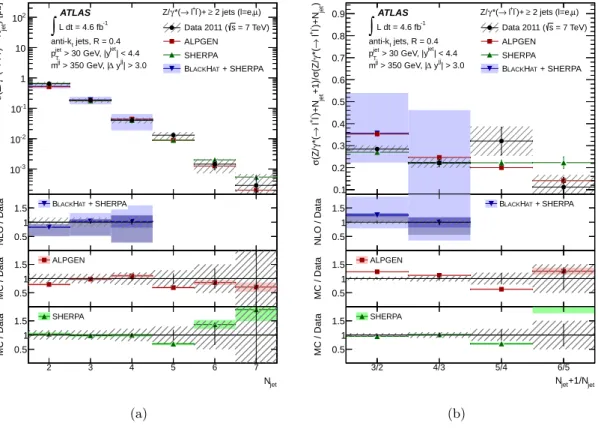
(17) -1. Data 2011 ( s = 7 TeV) ALPGEN SHERPA MC@NLO BLACKHAT + SHERPA. anti-k t jets, R = 0.4 jet jet pT > 30 GeV, |y | < 4.4. 104 3. 10. 102 10. +-. 1 10-1 10-2. MC / Data. NLO / Data. BLACKHAT + SHERPA. ≥0. ≥0. ≥0. ≥1. ≥2. ≥3. ≥4. ≥5. ≥6. ≥7. ≥1. ≥2. ≥3. ≥4. ≥5. ≥6. ≥7. ≥1. ≥2. ≥3. ≥4. ≥5. ≥6. ≥7. ALPGEN. SHERPA. MC / Data. MC / Data. NLO / Data. -3. 10 1.4 1.2 1 0.8 0.6 1.4 1.2 1 0.8 0.6 1.4 1.2 1 0.8 0.6. +-. +-. Z/ γ *(→ l l )+jets (l=e,µ). ATLAS L dt = 4.6 fb. σ(Z/γ *(→ l l )+≥ Njet +1)/ σ(Z/γ *(→ l l )+≥ Njet ). ∫. 105. MC / Data. +-. σ(Z/γ *(→ l l ) + ≥ Njet ) [pb]. 106. 0.5 0.45 0.4 0.35. ∫. +-. Z/ γ *(→ l l )+jets (l=e,µ). ATLAS -1. L dt = 4.6 fb. Data 2011 ( s = 7 TeV). anti-k t jets, R = 0.4 jet jet pT > 30 GeV, |y | < 4.4. ALPGEN SHERPA BLACKHAT + SHERPA. 0.3 0.25 0.2 0.15 0.1 0.05 1.4 BLACKHAT + SHERPA 1.2 1 0.8 0.6 -1 ≥1/≥0 ≥2/≥1 1.4 ≥0/≥ALPGEN 1.2 1 0.8 0.6 0 ≥2/≥1 ≥3/≥2 1.4 ≥1/≥SHERPA 1.2 1 0.8 0.6 ≥1/≥0. ≥2/≥1. ≥3/≥2. ≥3/≥2. ≥4/≥3. ≥5/≥4. ≥4/≥3. ≥5/≥4. ≥6/≥5. ≥4/≥3. ≥5/≥4. ≥6/≥5. Njet +1/Njet. Njet. (a). (b). Figure 2. (a) Measured cross section for Z (→ ``) + jets as a function of the inclusive jet multiplicity, Njet , and (b) ratio of cross sections for successive inclusive jet multiplicities. The data are compared to NLO pQCD predictions from BlackHat+SHERPA corrected to the particle level, and the ALPGEN, SHERPA and MC@NLO event generators (see legend for details). The error bars indicate the statistical uncertainty on the data, and the hatched (shaded) bands the statistical and systematic uncertainties on data (prediction) added in quadrature.. Figure 3(b) presents the exclusive jet multiplicity ratio for events where the leading jet has a transverse momentum in excess of 150 GeV. The observed ratio R(n+1)/n is now steeply increasing towards low jet multiplicities, a pattern described by the central values of the BlackHat+SHERPA calculations, by the generator ALPGEN and approximately also by SHERPA. The observed cross-section ratios have been fitted with a pattern expected from a Poisson-distributed jet multiplicity with the expectation value n̄, R(n+1)/n = n̄n . The Poisson scaling provides a good overall description of the jet multiplicity observed in data for the selected kinematic regime, with n̄ = 1.02 ± 0.04, where the uncertainty includes statistical and systematic components. The scaling pattern is also investigated for a preselection typically employed in the selection of particles produced via vector boson fusion (VBF). Figure 4 presents the absolute cross section as a function of the exclusive jet multiplicity and R(n+1)/n after requiring two jets with mjj > 350 GeV and |∆y jj | > 3.0, in the following referred to as ‘VBF preselection’. The data are consistent with the BlackHat+SHERPA prediction. SHERPA describes the multiplicity well whereas ALPGEN overestimates R3/2 .. – 15 –.
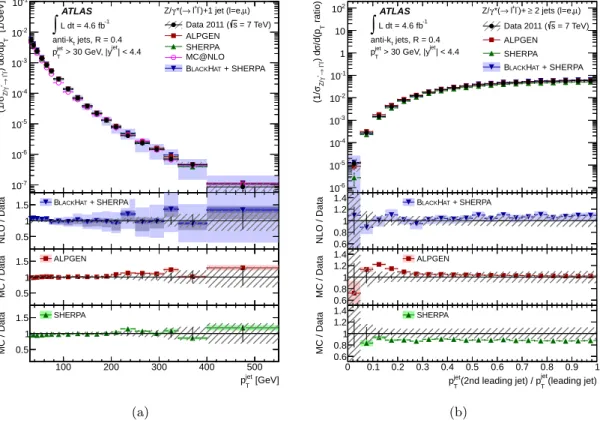
(18) 0.35. -1. Data 2011 ( s = 7 TeV) ALPGEN SHERPA BLACKHAT + SHERPA. anti-k t jets, R = 0.4 jet jet pT > 30 GeV, |y | < 4.4. 0.3. +-. +-. 0.25. +-. ∫. +-. Z/ γ *(→ l l )+jets (l=e,µ). ATLAS L dt = 4.6 fb. σ(Z/γ *(→ l l )+Njet +1)/ σ(Z/γ *(→ l l )+Njet ). +-. σ(Z/γ *(→ l l )+Njet +1)/ σ(Z/γ *(→ l l )+Njet ). 0.4. 0.2 0.15. 2 1.8 1.6. ∫. +-. Z/ γ *(→ l l )+ ≥ 1 jet (l=e,µ) anti-k t jets, R = 0.4 jet jet pT > 30 GeV, |y | < 4.4 jet pT (leading jet) > 150 GeV. ATLAS -1. L dt = 4.6 fb. 1.4. Data 2011 ( s = 7 TeV) ALPGEN SHERPA BLACKHAT + SHERPA. 1.2 1 0.8 0.6 0.4. 1.5. 0/-1. 1/0. ALPGEN. 2/1. 3/2. 4/3. 5/4. 1 0.5 1/0. SHERPA. 2/1. 3/2. 4/3. 5/4. 6/5. 1 0.5 1/0. 2/1. 3/2. 4/3. 5/4. NLO / Data. 1.5. MC / Data. MC / Data. 0.5. 1.5. 1.5. MC / Data. BLACKHAT + SHERPA. 1. MC / Data. NLO / Data. 0.2 0.1 1.5. 1.5. 6/5. BLACKHAT + SHERPA. 1 0.5 0/-1. 1/0. 2/1. 3/2. 4/3. 2/1. 3/2. 4/3. 5/4. 6/5. 2/1. 3/2. 4/3. 5/4. ALPGEN. 1 0.5 SHERPA. 1 0.5. Njet +1/Njet. 6/5. Njet +1/Njet. (a). (b). Figure 3. (a) Ratio of cross sections for successive exclusive jet multiplicities, Njet , in events selected with the standard selection and (b) in events with at least one jet with pjet T > 150 GeV and |y jet | < 4.4. The data are compared to NLO pQCD predictions from BlackHat+SHERPA corrected to the particle level, and the ALPGEN, SHERPA and MC@NLO event generators (see legend for details). The error bars indicate the statistical uncertainty on the data, and the hatched (shaded) bands the statistical and systematic uncertainties on data (prediction) added in quadrature. The shaded bands on the theory calculations show the systematic uncertainty excluding the scale uncertainty (dark shaded) and the total systematic uncertainties using the naive approach (medium shaded) and the nominal approach (light shaded) to derive the scale uncertainty (see section 9). The figures include (a) a linear fit R(n+1)/n = Ro + dR dn · n in the range R2/1 < R(n+1)/n < R5/4 and (b) a Poisson fit R(n+1)/n = nn̄ to the data points, with the free parameters Ro , dR dn and n̄.. 10.2. Jet transverse momentum. Differential cross sections with respect to the jet transverse momentum, pjet T , provide a test jet of pQCD over a large kinematic range. In particular, when pT exceeds the scale given by the gauge boson mass, NLO/LO K-factors can be large due to the presence of QCD corrections of the order of αs ln2 (pjet T /mZ ) [4]. In addition, higher-order electroweak corrections are expected to reduce the cross section with increasing transverse momentum of the Z boson candidate, by 5–20% for 100 GeV < p`` T < 500 GeV [46]. Figures 5 and 6 show the cross section as a function of pjet T of the first, the second, the jet third and the fourth leading jet (in descending order of pT ) for events with at least one, two, three and four jets in the final state, respectively. The cross sections are normalized to. – 16 –.
(19) 10. -1. Data 2011 ( s = 7 TeV). anti-k t jets, R = 0.4 jet jet pT > 30 GeV, |y | < 4.4 jj jj m > 350 GeV, |∆ y | > 3.0. ALPGEN SHERPA BLACKHAT + SHERPA. 1. +-. 10-1. +-. ∫. +-. Z/ γ *(→ l l )+ ≥ 2 jets (l=e,µ). ATLAS L dt = 4.6 fb. σ(Z/γ *(→ l l )+Njet +1)/ σ(Z/γ *(→ l l )+Njet ). +-. σ(Z/γ *(→ l l ) + Njet ) [pb]. 102. 10-2 10-3. 0.9 0.8 0.7. ∫. +-. Z/ γ *(→ l l )+ ≥ 2 jets (l=e,µ). ATLAS -1. L dt = 4.6 fb. Data 2011 ( s = 7 TeV). anti-k t jets, R = 0.4 jet jet pT > 30 GeV, |y | < 4.4 jj jj m > 350 GeV, |∆ y | > 3.0. ALPGEN SHERPA BLACKHAT + SHERPA. 0.6 0.5 0.4 0.3 0.2. 1.5. ALPGEN. 1. NLO / Data 2. 3. 4. 5. 1 0.5 2. SHERPA. 3. 4. 5. 6. 7. 1 0.5 2. 3. 4. 5. 6. 1 0.5. MC / Data. MC / Data. 0. 1.5. 1.5. 1.5. 7. BLACKHAT + SHERPA. 1.5. MC / Data. 1 0.5. MC / Data. NLO / Data. 0.1 BLACKHAT + SHERPA. 1.5. 0/-1. 1/0. 2/1. 3/2. 3/2. 4/3. 5/4. 6/5. 3/2. 4/3. 5/4. ALPGEN. 1 0.5 SHERPA. 1 0.5 6/5. Njet +1/Njet. Njet. (a). (b). Figure 4. (a) Measured cross section for Z (→ ``) + jets as a function of the exclusive jet multiplicity, Njet , and (b) ratio of the cross sections for two successive multiplicities, in events passing jet jj the VBF preselection (at least two jets with pjet > 350 GeV and T > 30 GeV and |y | < 4.4 and m jj |∆y | > 3.0 for the two leading jets). The other details are as in Figure 3.. the inclusive Z (→ ``) cross section, which reduces the systematic uncertainties connected to lepton identification and integrated luminosity. The fixed-order NLO predictions by BlackHat+SHERPA are consistent with the data for all jet multiplicities. For the leading jet, the precision of the measurement exceeds the precision of the theory prediction. While ALPGEN predictions for the pjet T spectrum of the second to fourth leading jet jet are consistent with the data, the pT spectrum of the leading jet is predicted to be too hard for larger values of pjet T . SHERPA is characterized by offsets to the data at the level of 5–15%, consistent with the observations presented in figure 2(a) for the inclusive jet cross section. MC@NLO predicts a too soft pjet T spectrum, resulting in a discrepancy with the data by one order of magnitude for large pjet T . This is attributed to the fact that the fraction of events with a second resolved jet, which in MC@NLO is modelled via the parton shower, increases considerably with pjet T of the leading jet (see figures 3(a) and 3(b) for small and jet larger pT (leading jet)). A too soft pjet T spectrum of the parton shower will hence result in an increasing discrepancy between the MC@NLO prediction and the data. Figure 7(a) shows the cross section as a function of pjet T of the leading jet, normalized to the inclusive Z (→ ``) cross section, when a veto on a second jet is applied. A better. – 17 –.
(20) -3. ∫. +-. Z/ γ *(→ l l )+ ≥ 1 jet (l=e,µ). ATLAS -1. Data 2011 ( s = 7 TeV) ALPGEN SHERPA MC@NLO BLACKHAT + SHERPA. L dt = 4.6 fb. anti-k t jets, R = 0.4 jet jet pT > 30 GeV, |y | < 4.4. 10. jet. 10-2. (1/σZ/γ *→ l+l-) dσ/dpT [1/GeV]. jet. (1/σZ/γ *→ l+l-) dσ/dpT [1/GeV]. 10-1. 10-4 10-5. ∫. -1. Data 2011 ( s = 7 TeV). anti-k t jets, R = 0.4 jet jet pT > 30 GeV, |y | < 4.4. ALPGEN SHERPA BLACKHAT + SHERPA. -4. 10. 10-5. BLACKHAT + SHERPA. 100 200 ALPGEN. 300. 400. 500. 600. 700. 100 200 SHERPA. 300. 400. 500. 600. 700. 100. 300. 400. 200. MC / Data. NLO / Data. 10-7. MC / Data. MC / Data. NLO / Data. 10-7. MC / Data. 10-3. +-. Z/ γ *(→ l l )+ ≥ 2 jets (l=e,µ). ATLAS L dt = 4.6 fb. 10-6. 10-6. 1.4 1.2 1 0.8 0.6 1.4 1.2 1 0.8 0.6 1.4 1.2 1 0.8 0.6. 10-2. 500 600 700 pjet (leading jet) [GeV]. 1.4 1.2 1 0.8 0.6 1.4 1.2 1 0.8 0.6 1.4 1.2 1 0.8 0.6. BLACKHAT + SHERPA. 100. 200. 300. 400. 500. 100. 200. 300. 400. 500. 100. 200. 300. ALPGEN. SHERPA. T. (a). 400 500 pjet (2nd leading jet) [GeV] T. (b). Figure 5. (a) Measured cross section for Z (→ ``) + jets as a function of the transverse momentum, jet jet pjet T , of the leading jet for events with at least one jet with pT > 30 GeV and |y | < 4.4 in the jet final state and (b) as a function of pT of the second leading jet for events with at least two jets. The cross sections are normalized to the inclusive Z (→ ``) cross section. The other details are as in Figure 2.. agreement between the predicted and observed cross-sections is observed. For events with at least two jets, figure 7(b) shows cross section as a function of the pjet T ratio of the two leading jets, normalized to the inclusive Z (→ ``) cross section. ALPGEN overestimates the cross section for events with a pjet T ratio of the leading jets in the range of 0.1–0.2. SHERPA underestimates the cross section as a function of the pjet T ratio by ≈15%, consistent with the results presented in figure 2(a). In a complementary approach, the cross section is measured as a function of the pT of the recoiling Z boson, reconstructed from the momenta of the two leptons. The results are presented in figure 8 for both the inclusive and the exclusive Z (+1 jet) selection, normalized to the inclusive Z (→ ``) cross section. Both ALPGEN and SHERPA predict a too hard p`` T spectrum, in particular in the inclusive case. The discrepancy with the data is comparable to the expected higher-order electroweak corrections [46] although higher-order QCD corrections could equally account for this. The BlackHat+SHERPA Z (+ ≥ 1 jet) fixed-order calculation for the inclusive final state is too soft whereas for the exclusive final state the central predictions are closer to the observed spectrum. This result is attributed to missing higher jet multiplicities in the fixed-order calculation and will be discussed in more. – 18 –.
(21) (1/σZ/γ *→ l+l-) dσ/dpT [1/GeV]. -1. Data 2011 ( s = 7 TeV). anti-k t jets, R = 0.4 jet jet pT > 30 GeV, |y | < 4.4. 10-3. ∫. jet. jet. (1/σZ/γ *→ l+l-) dσ/dpT [1/GeV]. ∫. 10-3. +-. Z/ γ *(→ l l )+ ≥ 3 jets (l=e,µ). ATLAS L dt = 4.6 fb. ALPGEN SHERPA BLACKHAT + SHERPA. 10-4. 10-5. -4. +-. Z/ γ *(→ l l )+ ≥ 4 jets (l=e,µ). ATLAS -1. L dt = 4.6 fb. Data 2011 ( s = 7 TeV). anti-k t jets, R = 0.4 jet jet pT > 30 GeV, |y | < 4.4. ALPGEN SHERPA. 10. BLACKHAT + SHERPA. 10-5. 10-6. NLO / Data. 40 ALPGEN 60. 80. 100. 120. 140. 160. 180. 200. 40 SHERPA 60. 80. 100. 120. 140. 160. 180. 200. 40. 80. 100. 120. 60. MC / Data. BLACKHAT + SHERPA. MC / Data. MC / Data. MC / Data. NLO / Data. 10-6 1.4 1.2 1 0.8 0.6 1.4 1.2 1 0.8 0.6 1.4 1.2 1 0.8 0.6. 140 160 180 200 pjet (3rd leading jet) [GeV]. 1.4 1.2 1 0.8 0.6 1.430 1.2 1 0.8 0.6 1.430 1.2 1 0.8 0.6 30. BLACKHAT + SHERPA. 40. 50. 60. 70. 80. 90. 100. 40. 50. 60. 70. 80. 90. 100. 40. 50. 60. 70 80 90 100 pjet (4th leading jet) [GeV]. ALPGEN. SHERPA. T. (a). T. (b). Figure 6. (a) Measured cross section for Z (→ ``) + jets as a function of the transverse momentum, jet jet pjet T , of the third leading jet for events with at least three jets with pT > 30 GeV and |y | < 4.4 jet in the final state and (b) as a function of pT of the fourth leading jet for events with at least four jets. The cross sections are normalized to the inclusive Z (→ ``) cross section. The other details are as in Figure 2.. detail in section 10.5. The comparison with BlackHat+SHERPA yields no indication for missing higher-order electroweak corrections in the large-p`` T region. Consistent with the spectrum of the leading jet, MC@NLO describes the exclusive results presented for the pjet T Z (+1 jet) final state better than the corresponding inclusive final state. 10.3. Angular distributions. Figures 9 and 10 show the rapidity spectrum of the four leading jets, normalized to the inclusive Z (→ ``) cross section. Both BlackHat+SHERPA and SHERPA predict rapidity spectra for the leading jet that are somewhat wider than observed in the data. ALPGEN predictions are compatible with the measurements. Figure 11 presents the separation in rapidity, |∆y jj |, and the invariant mass, mjj , of the two leading jets, normalized to the inclusive Z (→ ``) cross section. The predictions by BlackHat+SHERPA and ALPGEN are consistent with the data. SHERPA overestimates the cross section for large |∆y jj |, consistent with the too wide rapidity spectra. Differential jet cross sections as a function of angular distances (∆φjj and ∆Rjj ) between the two leading jets are presented in figures 12(a) and 12(b), respectively, normal-. – 19 –.
(22) -3. ∫. -1. Data 2011 ( s = 7 TeV) ALPGEN SHERPA MC@NLO BLACKHAT + SHERPA. anti-k t jets, R = 0.4 jet jet pT > 30 GeV, |y | < 4.4. 10. 10-4. 102. T. 10-2. +-. Z/ γ *(→ l l )+1 jet (l=e,µ). ATLAS L dt = 4.6 fb. (1/σZ/γ *→ l+l-) dσ/d(p ratio). jet. (1/σZ/γ *→ l+l-) dσ/dpT [1/GeV]. 10-1. 10 1. ∫. +-. Z/ γ *(→ l l )+ ≥ 2 jets (l=e,µ). ATLAS -1. L dt = 4.6 fb. Data 2011 ( s = 7 TeV). anti-k t jets, R = 0.4 jet jet pT > 30 GeV, |y | < 4.4. ALPGEN SHERPA BLACKHAT + SHERPA. -1. 10. 10-2 10-3. 10-5. 10-4 10-6. 10-5. NLO / Data. 1.5. 1 0.5 100. 200. 300. 400. 500. 100. 200. 300. 400. 500. 100. 200. 300. 400. ALPGEN. 1 0.5 SHERPA. 1 0.5. MC / Data. MC / Data. 1.5. BLACKHAT + SHERPA. MC / Data. NLO / Data. 1.5. MC / Data. 10-7. 500 pjet [GeV]. 10-6 1.4 1.2 1 0.8 0.6 1.40 1.2 1 0.8 0.6 1.40 1.2 1 0.8 0.6 0. T. BLACKHAT + SHERPA. 0.1. 0.2. 0.3 0.4 ALPGEN. 0.5. 0.6. 0.7. 0.8. 0.9. 1. 0.1. 0.2. 0.3 0.4 SHERPA. 0.5. 0.6. 0.7. 0.8. 0.9. 1. 0.1. 0.2. 0.3. 0.4 0.5 0.6 0.7 0.8 0.9 1 jet pjet (2nd leading jet) / p (leading jet) T. (a). T. (b). Figure 7. (a) Measured cross section for Z (→ ``) + jets as a function of the jet transverse momenjet jet tum, pjet T , for events with exactly one jet with pT > 30 GeV and |y | < 4.4 in the final state and jet jet (b) as a function of the ratio of pT of the second leading jet to pT of the leading jet for events with at least two jets. The cross sections are normalized to the inclusive Z (→ ``) cross section. The other details are as in Figure 3.. ized to the inclusive Z (→ ``) cross section. The azimuthal distance is well modelled by ALPGEN and by BlackHat+SHERPA. The tendencies observed in the modelling of the distance in φ and in rapidity are reflected in the measurement of the ∆R spectrum of the leading jets. SHERPA models a too flat spectrum for both ∆φ and ∆R. The offset of 15% of the SHERPA prediction from the observed cross section in the bulk of the data in figures 11 and 12 is consistent with the results presented in figure 2(a) for the inclusive Z (→ ``) + ≥ 2 jets cross section. 10.4. Distributions after VBF preselection. A veto on a third jet is used to reject Z + jets background in selections of Higgs boson candidates produced by VBF. Figure 13 shows the transverse momentum and rapidity distributions of the third jet after the VBF preselection, as defined in section 10.1, normalized to the inclusive Z (→ ``) cross section. The predictions by BlackHat+SHERPA, ALPGEN and SHERPA are consistent with the measurements. Figure 14 shows the fraction of events which have fulfilled the requirements of a VBF preselection that pass in addition a veto on a third jet in the central region (|η| < 2.4) as a function of the minimum trans-. – 20 –.
(23) -2. 10. -1. Data 2011 ( s = 7 TeV) ALPGEN SHERPA MC@NLO BLACKHAT + SHERPA. anti-k t jets, R = 0.4 jet jet pT > 30 GeV, |y | < 4.4. 10-3 10-4. Data 2011 ( s = 7 TeV) ALPGEN SHERPA MC@NLO BLACKHAT + SHERPA. anti-k t jets, R = 0.4 jet jet pT > 30 GeV, |y | < 4.4. 10-3 10-4. BLACKHAT + SHERPA. 50 100 ALPGEN. 50 100 SHERPA. 50. 100. 150. 150. 150. 200. 200. 200. 250. 250. 250. 300. 300. 300. 350. 350. 350. 400. 450. 400. 450. MC / Data. NLO / Data. 10-7. MC / Data. NLO / Data MC / Data. 10. ∫. -1. 10-6. 10-6. MC / Data. -2. +-. Z/ γ *(→ l l )+1 jet (l=e,µ). ATLAS L dt = 4.6 fb. 10-5. 10-5. 10-7 1.4 1.2 1 0.8 0.6 1.40 1.2 1 0.8 0.6 1.40 1.2 1 0.8 0.6 0. 10-1. T. ∫. +-. Z/ γ *(→ l l )+ ≥ 1 jet (l=e,µ). ATLAS L dt = 4.6 fb. (1/σZ/γ *→ l+l-) dσ/dpll [1/GeV]. T. (1/σZ/γ *→ l+l-) dσ/dpll [1/GeV]. 10-1. 400 450 pll [GeV]. 1.5. BLACKHAT + SHERPA. 1 0.5 0 1.5. 50 100 ALPGEN. 150. 200. 250. 300. 350. 400. 450. 50 100 SHERPA. 150. 200. 250. 300. 350. 400. 450. 50. 150. 200. 250. 300. 350. 400 450 pll [GeV]. 1 0.5 0 1.5 1 0.5 0. 100. T. T. (a). (b). Figure 8. (a) Measured cross section for Z (→ ``) + jets as a function of the transverse momentum jet jet of the Z candidate, p`` T , in events with at least one jet with pT > 30 GeV and |y | < 4.4 in the final `` state and (b) as a function of pT in events with exactly one jet. The cross sections are normalized to the inclusive Z (→ ``) cross section. The other details are as in Figure 3.. verse momentum of the veto jet, referred to as ‘jet veto efficiency’ in the following. The results are shown at detector level, separately for the Z → ee and the Z → µµ channel. The overestimate of R3/2 in ALPGEN (see figure 4) leads to an underestimate of the veto efficiency, particularly for the low-pjet T regime. SHERPA predicts the veto efficiencies better.. 10.5. Inclusive quantities. Quantities based on inclusive pT sums of final-state objects, such as HT or ST , are often employed in searches in order to enrich final states resulting from the decay of heavy particles. Reference [47] reports a discrepancy between fixed-order pQCD calculations and data for moderate energy regimes in W + jets events which can be mitigated by including higher jet multiplicities in the theoretical calculations by means of ‘exclusive sums’ [48]. Differential cross sections of Z (+ ≥ 1 jet) events as a function of HT and ST , normalized to the inclusive Z (→ ``) cross section, are presented in figure 15. ALPGEN predicts slightly too hard spectra for both variables in line with the too hard spectrum for pjet T . SHERPA predictions show an offset of 10–15% to the data. The softer spectra from BlackHat+SHERPA, based on a Z (+ ≥ 1 jet) fixed-order NLO calculation, deviate. – 21 –.
(24) ∫. -1. Data 2011 ( s = 7 TeV) ALPGEN SHERPA MC@NLO BLACKHAT + SHERPA. anti-k t jets, R = 0.4 jet jet pT > 30 GeV, |y | < 4.4. 10-1. jet. +-. Z/ γ *(→ l l )+ ≥ 1 jet (l=e,µ). ATLAS L dt = 4.6 fb. (1/σZ/γ *→ l+l-) dσ/d|y |. jet. (1/σZ/γ *→ l+l-) dσ/d|y |. 1. 10-1. ∫. +-. Z/ γ *(→ l l )+ ≥ 2 jets (l=e,µ). ATLAS -1. L dt = 4.6 fb. Data 2011 ( s = 7 TeV). anti-k t jets, R = 0.4 jet jet pT > 30 GeV, |y | < 4.4. ALPGEN SHERPA BLACKHAT + SHERPA. 10-2. 10-2. 10-3. NLO / Data. BLACKHAT + SHERPA. 0.5 1 ALPGEN. 1.5. 2. 2.5. 3. 3.5. 4. 0.5 1 SHERPA. 1.5. 2. 2.5. 3. 3.5. 4. 0.5. 1.5. 2. 2.5. 3. 3.5. 4. 1. MC / Data. 1.4 1.2 1 0.8 0.6 1.40 1.2 1 0.8 0.6 1.40 1.2 1 0.8 0.6 0. MC / Data. MC / Data. MC / Data. NLO / Data. 10-3 1.4 1.2 1 0.8 0.6 1.40 1.2 1 0.8 0.6 1.40 1.2 1 0.8 0.6 0. BLACKHAT + SHERPA. 0.5 1 ALPGEN. 1.5. 2. 2.5. 3. 3.5. 4. 0.5 1 SHERPA. 1.5. 2. 2.5. 3. 3.5. 4. 0.5. 1.5. 2. 2.5. 3. 3.5. 4. 1. jet. jet. |y | (leading jet). |y | (2nd leading jet). (a). (b). Figure 9. (a) Measured cross section for Z (→ ``) + jets as a function of the absolute value of the jet rapidity, |y jet |, of the leading jet for events with at least one jet with pjet T > 30 GeV and |y | < 4.4 jet in the final state and (b) as a function of |y | of the second leading jet for events with at least two jets. The cross sections are normalized to the inclusive Z (→ ``) cross section. The other details are as in Figure 2.. increasingly from the data for larger values of HT and ST , which confirms and extends the results in reference [47] to a higher energy regime. The discrepancy is attributed to missing higher jet multiplicities in the fixed-order calculation. This interpretation is investigated further in what follows. Figure 16(a) shows, at reconstruction level, the average jet multiplicity as a function of HT for the Z → ee channel. Compatible results have been obtained in the muon channel. Predictions by ALPGEN and SHERPA are consistent with the data. For values of HT ≈ 350 GeV, where data and NLO calculation start to deviate significantly, the average jet multiplicity exceeds two. A similar measurement is performed as a function of the p`` T in the Z → µµ channel and shown in figure 16(b). Compatible results have been obtained in the electron channel. For values of p`` T ≈ 200 GeV, where the NLO predictions underestimate the measured cross section (see figure 8), on average two jets are resolved, typically one hard jet that carries most of the Z recoil, accompanied by a soft jet. In both cases, the kinematic regions where the NLO fixed-order calculations perform poorly are characterized by average jet multiplicities in excess of the fixed order used in the NLO calculation. Figures 17(a) and 17(b) replace the fixed-order BlackHat+SHERPA estimate for HT. – 22 –.
(25) ∫. -1. Data 2011 ( s = 7 TeV). anti-k t jets, R = 0.4 jet jet pT > 30 GeV, |y | < 4.4. ALPGEN SHERPA BLACKHAT + SHERPA. jet. (1/σZ/γ *→ l+l-) dσ/d|y |. jet. (1/σZ/γ *→ l+l-) dσ/d|y |. 10-2. +-. Z/ γ *(→ l l )+ ≥ 3 jets (l=e,µ). ATLAS L dt = 4.6 fb. ∫ 10-3. +-. Z/ γ *(→ l l )+ ≥ 4 jets (l=e,µ). ATLAS -1. L dt = 4.6 fb. Data 2011 ( s = 7 TeV). anti-k t jets, R = 0.4 jet jet pT > 30 GeV, |y | < 4.4. ALPGEN SHERPA BLACKHAT + SHERPA. 10-3 10-4. NLO / Data. BLACKHAT + SHERPA. 0.5 1 ALPGEN. 1.5. 2. 2.5. 3. 3.5. 4. 0.5 1 SHERPA. 1.5. 2. 2.5. 3. 3.5. 4. 0.5. 1.5. 2. 2.5. 3. 3.5. 4. 1. MC / Data. 1.4 1.2 1 0.8 0.6 1.40 1.2 1 0.8 0.6 1.40 1.2 1 0.8 0.6 0. MC / Data. MC / Data. MC / Data. NLO / Data. 10-4 1.4 1.2 1 0.8 0.6 1.40 1.2 1 0.8 0.6 1.40 1.2 1 0.8 0.6 0. BLACKHAT + SHERPA. 0.5 1 ALPGEN. 1.5. 2. 2.5. 3. 3.5. 4. 0.5 1 SHERPA. 1.5. 2. 2.5. 3. 3.5. 4. 0.5. 1.5. 2. 2.5. 3.5. 4. 1. jet. 3 jet. |y | (3rd leading jet). |y | (4th leading jet). (a). (b). Figure 10. (a) Measured cross section for Z (→ ``) + jets as a function of the absolute value of the jet rapidity, |y jet |, of the third jet for events with at least three jets with pjet T > 30 GeV and |y | < 4.4 jet in the final state and (b) as a function of |y | of the fourth jet for events with at least four jets. The cross sections are normalized to the inclusive Z (→ ``) cross section. The other details are as in Figure 2.. and p`` T in figures 15 and 8 with the ‘exclusive sum’ of the cross sections for the first two jets: (Z (+1 jet)) + (Z (+ ≥ 2 jets)). The exclusive sum is consistent with the observed HT and p`` T spectra in the phase space considered. These results support the interpretation of the poor performance of the fixed-order calculation for inclusive quantities like HT , ST and p`` T as a sign of missing higher jet multiplicities. Agreement with the data can be restored by adding explicitly higher jet multiplicities via exclusive sums.. 11. Conclusions. Cross sections for jets produced in association with a Z boson have been measured in √ proton–proton collisions at s = 7 TeV with 4.6 fb−1 of data observed with the ATLAS detector at the LHC, using electron and muon decay modes of the Z boson. The data have been unfolded to the particle level and compared with predictions from the SHERPA generator, from MC@NLO interfaced with HERWIG, from the ALPGEN generator, interfaced with HERWIG, and with fixed-order calculations from BlackHat+SHERPA. The cross sections are quoted with respect to a phase-space region defined by Z candidates. – 23 –.
(26) Data 2011 ( s = 7 TeV). anti-k t jets, R = 0.4 jet jet pT > 30 GeV, |y | < 4.4. jj. ∫. -1. ALPGEN SHERPA BLACKHAT + SHERPA. -2. (1/σZ/γ *→ l+l-) dσ/dm [1/GeV]. jj. (1/σZ/γ *→ l+l-) dσ/d|∆ y |. 10-1. +-. Z/ γ *(→ l l )+ ≥ 2 jets (l=e,µ). ATLAS L dt = 4.6 fb. 10. 10-3. ∫. +-. Z/ γ *(→ l l )+ ≥ 2 jets (l=e,µ). ATLAS -1. L dt = 4.6 fb. Data 2011 ( s = 7 TeV). anti-k t jets, R = 0.4 jet jet pT > 30 GeV, |y | < 4.4. ALPGEN SHERPA BLACKHAT + SHERPA. 10-4. 10-3 10-5. 10-4 NLO / Data. 1. 2. 3. 4. 5. 6. 1. 2. 3. 4. 5. 6. 1. 2. 4. 5. 6. ALPGEN. SHERPA. 3. MC / Data. BLACKHAT + SHERPA. MC / Data. MC / Data. MC / Data. NLO / Data. 10-6 1.4 1.2 1 0.8 0.6 1.40 1.2 1 0.8 0.6 1.40 1.2 1 0.8 0.6 0. jj. |∆ y | (leading jet, 2nd leading jet). (a). 1.4 1.2 1 0.8 0.6 1.40 1.2 1 0.8 0.6 1.40 1.2 1 0.8 0.6 0. BLACKHAT + SHERPA. 100 200 300 400 500 ALPGEN. 600 700 800 900 1000. 100 200 300 400 500 SHERPA. 600 700 800 900 1000. 100. 200 300 400 500 600 700 800 900 1000 mjj (leading jet, 2nd leading jet) [GeV]. (b). Figure 11. (a) Measured cross section for Z (→ ``) + jets as a function of the separation in rapidity, |∆y jj |, between the two leading jets and (b) as a function of the invariant mass of the two leading jet jets, mjj , for events with at least two jets with pjet T > 30 GeV and |y | < 4.4 in the final state. The cross sections are normalized to the inclusive Z (→ ``) cross section. The other details are as in Figure 2.. constructed from opposite-sign leptons with pT > 20 GeV, |η| < 2.5, ∆R`` > 0.2 and jet `j 66 GeV ≤ m`` ≤ 116 GeV and for jets with pjet T > 30 GeV, |y | < 4.4 and ∆R > 0.5. Cross sections as a function of the inclusive and exclusive jet multiplicities and their ratios have been compared, as well as differential cross sections as a function of transverse momenta and rapidity of the jets, angular separation between the leading jets and the inclusive variables HT and ST . Compared with previous publications, the sensitivity has been extended to regimes with larger jet multiplicities and larger jet transverse momenta. In addition, the sample has been compared to theory in specific kinematic regions governed by large logarithmic corrections. In general, the predictions of the matrix element plus parton shower generators and the fixed-order calculations are consistent with the measured values over a large kinematic range. MC@NLO fails to model not only higher jet multiplicities but also the transverse momentum of the leading jet. The transition from staircase to Poisson scaling of the exclusive jet multiplicity ratio, expected from theory when introducing a large scale difference, is observed in the data. In events where two jets have passed a VBF preselection, the cross sections for higher. – 24 –.
Figure
+7

Documento similar
Physics Department, Brookhaven National Laboratory, Upton, New York, USA National Institute of Physics and Nuclear Engineering, Bucharest, Romania 25b University Politehnica
Atomic Energy Authority, Ankara, Turkey 5 LAPP, CNRS/IN2P3 and Université de Savoie, Annecy-le-Vieux, France 6 High Energy Physics Division, Argonne National Laboratory, Argonne
LAPP, CNRS/IN2P3 and Université de Savoie, Annecy-le-Vieux, France High Energy Physics Division, Argonne National Laboratory, Argonne, Illinois, USA 7 Department of Physics,
Also at CPPM, Aix-Marseille Université and CNRS/IN2P3, Marseille, France Also at Università di Napoli Parthenope, Napoli, Italy Also at Institute of Particle Physics IPP, Canada
Also at Department of Physics, The University of Texas at Austin, Austin TX, United States of America p Also at Institute of Theoretical Physics, Ilia State University, Tbilisi,
Physics Division, Lawrence Berkeley National Laboratory and University of California, Berkeley CA, United States of America Department of Physics, Humboldt University, Berlin,
II Physikalisches Institut, Georg-August-Universität, Göttingen, Germany Laboratoire de Physique Subatomique et de Cosmologie, Université Grenoble-Alpes, CNRS/IN2P3, Grenoble, France
II Physikalisches Institut, Georg-August-Universität, Göttingen, Germany Laboratoire de Physique Subatomique et de Cosmologie, Université Grenoble-Alpes, CNRS/IN2P3, Grenoble, France
