
Regeneration niche of three epiphytic species of Gesneriaceae from Chilean rainforests: implications for the evolution of growth habits in Coronanthereae
15
0
0
Texto completo
(2) 80. F. SALINAS and J. J. ARMESTO. Table 1. Number of species, geographical distribution and growth habit of the nine genera in the tribe Coronanthereae (Gesneriaceae)*. Genus. Species number. Geographical distribution. Growth habit. Depanthus S.Moore Mitraria Cav. Sarmienta Ruiz & Pav. Asteranthera Hansl. Coronanthera Vieill. ex C.B.Clarke Lenbrassia G.W.Gillett Negria F.Muell. Fieldia A.Cunn. Rhabdothamnus A.Cunn.. 2 1 1 1 11 1 1 1 1. New Caledonia Chile and adjacent Argentina Chile Chile and adjacent Argentina New Caledonia, Solomon Islands Australia, Queensland Lord Howe Island Australia, New South Wales and Victoria New Zealand, North Island. Tree Secondary hemiepiphyte Holoepiphyte Secondary hemiepiphyte Tree Tree Tree Secondary hemiepiphyte Shrub. *Modified from Wiehler (1983).. relationship to alternative scenarios for the evolution of the epiphytic growth habit have not received much attention in the botanical literature. As physical and biotic conditions in tree canopies vary greatly from those in the forest understorey (Nadkarni, 1984; Lüttge, 1989; TerSteege & Cornelissen, 1989; Bohlman, Matelson & Nadkarni, 1995; Parker, 1995; Freiberg, 1997), differences in the regeneration niche (sensu Grubb, 1977) are expected in lineages that include both terrestrial and epiphytic species, as seed germination and the establishment of holoepiphytes and primary hemiepiphytes should occur predominantly in the tree canopy. For seed plant lineages in which epiphytes that germinate on the tree canopy are present, viable seed production, seed dispersal mode, substrate and light requirements for germination, seedling establishment and later development into the mature adult stage should vary among species, depending on their use of the vertical profile of the rainforest. In Gesneriaceae, nearly 600 species (20% of the total) are epiphytes (Gentry & Dodson, 1987). Considering the nine genera and 20 species in Coronanthereae (Gesnerioideae), with a disjunct South Pacific distribution (Burtt, 1963, 1998; Wiehler, 1983; Weber, 2004), growth habits vary from terrestrial to holoepiphytic (Table 1). In the temperate rainforests of southern South America, we find three endemic and monotypic genera of Coronanthereae: Mitraria coccinea Cav. and Asteranthera ovata Hanst. are secondary hemiepiphytic lianas rooted on the forest floor, whereas Sarmienta repens Ruiz & Pav. is the only holoepiphytic vine in Coronanthereae (Table 1; Salinas et al., 2010). Salinas et al. (2010) suggested that, in Coronanthereae, the tree habit was ancestral to both the shrub and secondary hemiepiphytic habit, and only the latter would give rise to the holoepiphytic growth habit found in S. repens.. In this article, we investigate the regeneration niches of three epiphytic gesneriads in Chilean temperate rainforests, testing the following hypotheses: (1) species with divergent growth habits occur at different heights in the vertical profile of the rainforests; (2) the regeneration niches of these three related species differ in terms of the suitable sites for seed germination and seedling establishment, and in correspondence with the divergent habitats used by adults in the forest; and (3) regeneration niche differentiation among epiphytic species is a key process in the evolution of the epiphytic growth habit in Coronanthereae.. MATERIAL AND METHODS STUDY SPECIES Asteranthera ovata is a secondary hemiepiphytic liana which climbs on trees using adventitious roots sprouting from stem nodes. It also grows frequently as a creeper on the forest ground, stumps and logs (Salinas et al., 2010). In southern Chilean forests, flowering occurs mainly in the austral summer (January to February), and fruiting takes place during the austral autumn (March to April). The fruit is a round fleshy berry, 10 mm in diameter, green with purple spots, containing about 180 small seeds, the lightest among the Chilean gesneriads (0.09 ± 0.021 mg, dry weight). Asteranthera Hansl. is endemic to the southern South American temperate forests, present in Chile from Concepción (37 °S) to the Patagonian Archipielagos. Mitraria coccinea is a secondary hemiepiphytic liana that climbs on trees through adventitious roots. It also occurs on the forest floor as small erect plants connected by buried stems (Salinas et al., 2010). In Chilean rainforests, it flowers during the austral. © 2012 The Linnean Society of London, Botanical Journal of the Linnean Society, 2012, 170, 79–92.
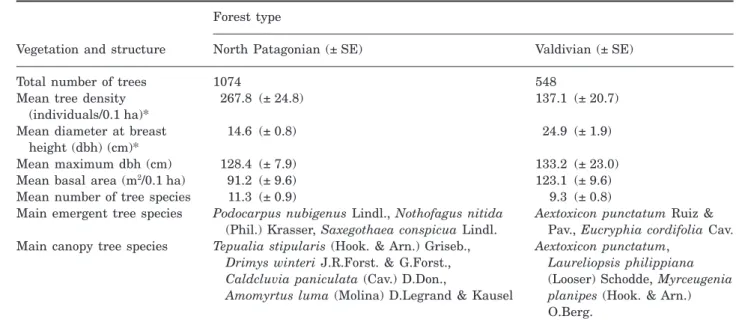
(3) REGENERATION NICHE OF EPIPHYTIC GESNERIADS spring and summer (October to February), fruiting in the autumn (March to April). The fruit is a round and fleshy, yellowish-green berry, 15 mm in diameter, with the red style persisting when ripe, containing about 100 small brown seeds (0.20 ± 0.06 mg, dry weight). Mitraria Cav. is endemic to southern South America, distributed discontinuously in Chile from Fray Jorge (30 °S) and from the Maule River (35 °S) to the Patagonian Archipielagos. Sarmienta repens is a holoepiphytic vine, which grows exclusively on living and dead trees of Chilean temperate rainforests (Salinas et al., 2010). It attaches to tree trunks and branches by means of adventitious roots sprouting at the stem nodes. It flowers during the austral spring and summer (September to February) and its fruits ripen during the autumn (March to April). The fruit is a whitish green, pyriform berry, 7 mm wide, with the red style of the flower persistent when ripe, and containing about 40 small seeds, the heaviest among the three Chilean gesneriads (0.22 ± 0.009 mg, dry weight). Sarmienta Ruiz & Pav. is endemic to Chilean temperate rainforests, distributed mainly in coastal forests (Reiche, 1938), with a disjunction between Fray Jorge (30 °S) and the Maule River (35 °S) to the latitude of Chiloé Island (43 °S).. STUDY. SITES. We sampled four old-growth stands, two representative of North Patagonian (Fundo Cisnes and Senda Darwin) and two of Valdivian (Guabún and Ahuenco) rainforests (sensu Veblen et al., 1995) located in the lowlands of northern Chiloé Island, Chile (Fig. 1). The prevalent climate of northern Chiloé Island is cool and wet, with a strong oceanic influence (Di Castri & Hajek, 1976). Meteorological records (1996–2004) at Senda Darwin Biological Station (SDBS) indicate a mean annual rainfall of 2124 mm falling throughout the year, and a mean annual temperature of 8.7 °C. A mixture of evergreen broad-leaved trees and narrowleaved conifers dominates the North Patagonian forests, whereas Valdivian rainforests are dominated exclusively by evergreen broad-leaved angiosperms (Table 2). Additional information on the structure and dynamics of these two forest types is provided in Gutiérrez, Armesto & Aravena (2004) and Gutiérrez et al. (2009). Air temperature, solar radiation and rainfall were recorded every hour during the entire period of the study (March 2005 to May 2007) by the SDBS meteorological station (Campbell Scientific Inc., North Logan, UT, USA). During the first year of the field experiments (March 2005 to February 2006), the total rainfall was 2585 mm. The four months during the austral autumn and winter (May to August 2005). 81. concentrated 58% of the total annual rainfall, and the four months from the austral early spring and summer (September to December 2005) accumulated only 15% of the total annual rainfall (Fig. 2). December 2005 was the driest month in the study period, with < 50 mm rainfall and maximum solar radiation. Maximum (> 25 °C) and mean monthly maximum temperatures were recorded from December 2005 to February 2006, and average minimum temperatures occurred between June 2005 and September 2006 (Fig. 2), with 38 days reporting temperatures of less than 0 °C during the first year of the experiment.. VERTICAL DISTRIBUTION OF GESNERIACEAE IN SOUTH AMERICAN TEMPERATE RAINFORESTS To characterize the frequency of each species of Gesneriaceae in the forest vertical profile, we set up two 50 ¥ 20-m2 plots in each forest stand. Plots sampled were located at least 200 m away from forest edges and were free of signs of recent human disturbances, such as fire or logging. The total basal area per plot was calculated as S{p ¥ [diameter at breast height (dbh)]2}/4 per tree. The North Patagonian forest stands had higher tree densities and lower tree dbh than stands of the Valdivian forest type (Kolgomorov–Smirnov test, P < 0.05). We found no differences in mean maximum dbh, mean total basal area or mean number of tree species between forest types (Kolgomorov–Smirnov test, P > 0.1 for all cases; Table 2). In each plot, we recorded the presence or absence of each species of Gesneriaceae in four height ranges (0 to < 0.3 m; ⱖ 0.3 to < 1.5 m; ⱖ 1.5 to < 3.0 m; ⱖ 3.0 m) on all trees ⱖ 5 cm dbh (modified from Fischer & Araujo, 1995) using Pentax binoculars 12.5 ¥ 50 DCF SP (Tokyo, Japan) when required. Totals of 1074 and 548 trees ⱖ 5 cm dbh were surveyed in old-growth North Patagonian and Valdivian forests, respectively. The effect of forest type and height of trees on the presence or absence of each epiphytic species was evaluated by performing a fixed effects analysis of variance (ANOVA). Fisher’s least significant difference (LSD) test was used to assess significant differences between treatments, considering the interactions between two levels of forest type, four height ranges and three epiphytic species when the null hypothesis of equal means had been rejected by ANOVA.. REGENERATION NICHE SOUTH AMERICAN. OF EPIPHYTIC GESNERIADS IN TEMPERATE RAINFORESTS. Experimental design The regeneration study of epiphytes was conducted in SDBS, northern Chiloé Island (41 °S, 73 °W), in a remnant patch of old-growth North Patagonian. © 2012 The Linnean Society of London, Botanical Journal of the Linnean Society, 2012, 170, 79–92.
(4) 82. F. SALINAS and J. J. ARMESTO. Figure 1. Geographical localization of study sites in northern Chiloé Island. Arrow in the inset shows Chiloé Island in southern South America. Stars indicate study sites of North Patagonian forest types and circles indicate localities of Valdivian forest types. Two 50 ¥ 20-m2 plots were sampled in each locality.. rainforest and an adjacent shrubland (Fig. 1). We compared seed germination and subsequent seedling survival in the field of the three species of Gesneriaceae sown on two substrates and under two contrasting light regimes. Because we evaluated seedling mortality in response to treatment effects, mortality caused by transplant manipulation and alteration of environmental conditions was avoided. The experimental design estimated the effects of different microenvironments during the early life-cycle stages for the three epiphytic gesneriads, considering both seed germination and seedling survival.. The response variables were the cumulative number of seeds germinated in each field treatment combination and the number of seedlings remaining alive in the survival experiment. A factorial design was used to assess possible mixed effects of light and substrate treatments on seed germination and seedling survival. Light and substrate were included in the analysis as fixed experimental factors and species as a random classification factor. Light treatment levels simulated conditions at two opposite ends of the forest height gradient: on the forest floor under closed forest canopy and under light levels. © 2012 The Linnean Society of London, Botanical Journal of the Linnean Society, 2012, 170, 79–92.
(5) REGENERATION NICHE OF EPIPHYTIC GESNERIADS. 83. Table 2. Structure and composition of four 50 ¥ 20-m2 plots in North Patagonian and Valdivian forests in which the vertical distribution patterns of epiphytes were studied. Significant differences between forest types are marked with asterisks (Kolgomorov–Smirnov tests, P < 0.05 in each case) Forest type Vegetation and structure. North Patagonian (± SE). Valdivian (± SE). Total number of trees Mean tree density (individuals/0.1 ha)* Mean diameter at breast height (dbh) (cm)* Mean maximum dbh (cm) Mean basal area (m2/0.1 ha) Mean number of tree species Main emergent tree species. 1074 267.8 (± 24.8). 548 137.1 (± 20.7). 14.6 (± 0.8). 24.9 (± 1.9). Main canopy tree species. 128.4 (± 7.9) 91.2 (± 9.6) 11.3 (± 0.9) Podocarpus nubigenus Lindl., Nothofagus nitida (Phil.) Krasser, Saxegothaea conspicua Lindl. Tepualia stipularis (Hook. & Arn.) Griseb., Drimys winteri J.R.Forst. & G.Forst., Caldcluvia paniculata (Cav.) D.Don., Amomyrtus luma (Molina) D.Legrand & Kausel. 133.2 (± 23.0) 123.1 (± 9.6) 9.3 (± 0.8) Aextoxicon punctatum Ruiz & Pav., Eucryphia cordifolia Cav. Aextoxicon punctatum, Laureliopsis philippiana (Looser) Schodde, Myrceugenia planipes (Hook. & Arn.) O.Berg.. treatment levels were: (1) soil taken from the forest stand studied and (2) tree bark, for which we used a 10 ¥ 10-cm2, 7-mm-thick, nearly square piece of fresh bark of Nothofagus nitida (Phil.) Krasser. (Nothofagaceae) taken from a recently fallen tree, without removing the cryptogamic cover of mainly bryophytes, hepatophytes and filmy ferns from the bark. Nothofagus nitida bark was selected as substrate for the assay because of its dominance in the canopy of North Patagonian forests and because it has a rough and thick bark, which may facilitate the retention of epiphyte seeds (Benzing & Clements, 1991). In addition, two species of Chilean rainforest gesneriads, M. coccinea and S. repens, are known to occur frequently on N. nitida (Muñoz et al., 2003). Figure 2. Mean monthly maximum (T ° max) and mean monthly minimum (T ° min) temperatures and monthly precipitation during the first year of the experiment when seed germination and seedling survival were monitored for three epiphytic gesneriads in Senda Darwin Biological Station rainforest, Chiloé Island (42 °30’S).. measured in the upper canopy. For the first treatment level, pots with seeds were placed on the forest floor under the closed canopy, with a mean canopy openness of 1% (Chacón & Armesto, 2005); for the second treatment level, pots with seeds were placed in an open scrubland, adjacent to the forest edge, with a canopy openness of 90%. Substrate. Seed germination assay To evaluate seed germination, ripe fruits were collected from five to eight adult plants of each species of Gesneriaceae present in North Patagonian rainforests at SDBS during March 2004. Seeds were separated from the pulp, air dried for 3–5 days in Petri dishes and grouped by species to avoid maternal effects (Figueroa, 2003). For each substrate and light treatment, 18 undamaged seeds of one species were placed in a plastic pot of 10 cm in diameter and 8 cm in height with perforations at the base to drain rainwater, with 10 pots for each species. This design considered the interactions between two levels of light, two substrates and three epiphytic species (12 treatment combinations in total). To prevent the. © 2012 The Linnean Society of London, Botanical Journal of the Linnean Society, 2012, 170, 79–92.
(6) 84. F. SALINAS and J. J. ARMESTO. removal of seeds and seedlings by rodents and birds, pots were enclosed within a wire mesh box of 1 cm2 mesh size (Figueroa, 2003). Seeds were sown in March 2005, during the same period in which most seeds of these epiphytes are dispersed. The number of seeds germinated (radicle emerged or cotyledon stage) was recorded every week to every 4 weeks for 321 days following sowing. Overall, 720 seeds per species, and 2160 seeds in total, were used in the experiment. To assess the seed germination over time, a Kaplan–Meier survival analysis was performed (SigmaStat 3.1, Systat Software, Inc.), which included both the time to seed germination and the number of seeds that did not germinate during the period of the study. As data on seed germination times were more accurate for the first 3 months than later, the Gehan– Breslow survival test (SigmaStat 3.1, Systat Software, Inc.) was performed to determine whether curves of seed germination vs. time differed significantly among species and treatments. This nonparametric test uses a chi-squared statistic to test the null hypothesis that the germination curves come from the same population. If the Gehan–Breslow statistic for the survival curves was greater than expected by chance, the Holm–Sidak multiple comparison procedure (SigmaStat 3.1, Systat Software, Inc.) was used to assess the group or groups that differed from the others. Seedling survival assay We monitored the survival of all seedlings grown from the previously described seed germination assay. Because of differences in seed germination, different numbers of seedlings were assessed for each species (A. ovata, N = 14 seedlings; M. coccinea, N = 203 seedlings; S. repens, N = 369 seedlings), under the same experimental conditions as the germination assay, by recording the number of plants dead and alive every week to every 4 weeks during the first year after sowing. A final record of seedling survival was taken 23 months after initiation of the experiment. We were able to identify the main causes of mortality, such as desiccation, freezing and herbivory, for the majority of dead seedlings. Molluskicide (Toximol, ANASAC) and beer bait were applied to reduce the impact of introduced gastropod grazing on seedling survival. As a result of sample size constraints, we were able to assess the effects of light, substrate and species on seedling survival for M. coccinea and S. repens only. We used a Kaplan–Meier survival analysis selecting the Gehan–Breslow survival statistic (SigmaStat 3.1, Systat Software, Inc.) to compare species responses to different substrates and light levels. As a result of the small numbers of seedlings for A. ovata, the effects of light environment and substrate on seed-. ling survival were analysed using a distance-based permutational ANOVA (Anderson, 2001; McArdle & Anderson, 2001). The analysis was performed using software written in FORTRAN in DISTLM v. 5 (Anderson, 2004). We used the Euclidian distance as our distance measure and 999 permutations to calculate the pseudo-F statistic.. ANCESTRAL. RECONSTRUCTION OF GROWTH HABITS. AND REGENERATION NICHES. To investigate the evolutionary association between changes in growth habit and regeneration patterns, we used the Coronanthereae included in the maximum likelihood tree published by Woo et al. (2011, fig. 2), which is based on the nuclear ribosomal DNA internal transcribed spacer (ITS) region and four plastid DNA sequences. This tree includes representatives of all nine genera of the tribe, with sampling among species and populations. Leaving one accession per species, we mapped the growth form on the tree for Coronanthereae, coding this as a qualitative character with four states (tree, shrub, secondary hemiepiphyte and holoepiphyte, according to Salinas et al., 2010). We also mapped the regeneration niche on the tree, coding this as a binary character with two states concerning light level and substrate: shaded soil and illuminated canopy. Regeneration niche requirements for A. ovata, M. coccinea and S. repens were inferred from the field experiment of seed germination and seedling survival presented in this study. Because no experimental information is available for the remaining species of Coronanthereae, regeneration niche requirements for other species were based on observations of regeneration in the field (F. Salinas, personal observation) or were treated as ambiguous. At least two of the tree species, Coronanthera sericea C.B.Clarke, Salinas 776 (AK, CONC, NOU), from Mont Koghi, Nouméa, and Coronanthera clarkeana Schltr., Salinas 782 (AK, CONC, NOU), from Plateau de Dogny, Dogny, New Caledonia, and the only shrub species in the tribe, Rhabdothamnus solandrii A.Cunn., Salinas 759 (AK, CONC), from Wenderholm Region Park, Auckland, New Zealand, regenerate from seedlings established in gullies, steep slopes or river banks, under the shade of the rainforest canopy. The secondary hemiepiphyte Fieldia australis A.Cunn., Salinas 756 (CONC, MEL), from Gembrook, Eastern Highlands, Victoria, Australia, also spreads vegetatively by buried stems under the shade of the forest canopy (see Appendix for further voucher information). Finally, ancestral states were reconstructed using parsimony, treating characters as unordered in Mesquite 2.71 (Maddison & Maddison, 2009).. © 2012 The Linnean Society of London, Botanical Journal of the Linnean Society, 2012, 170, 79–92.
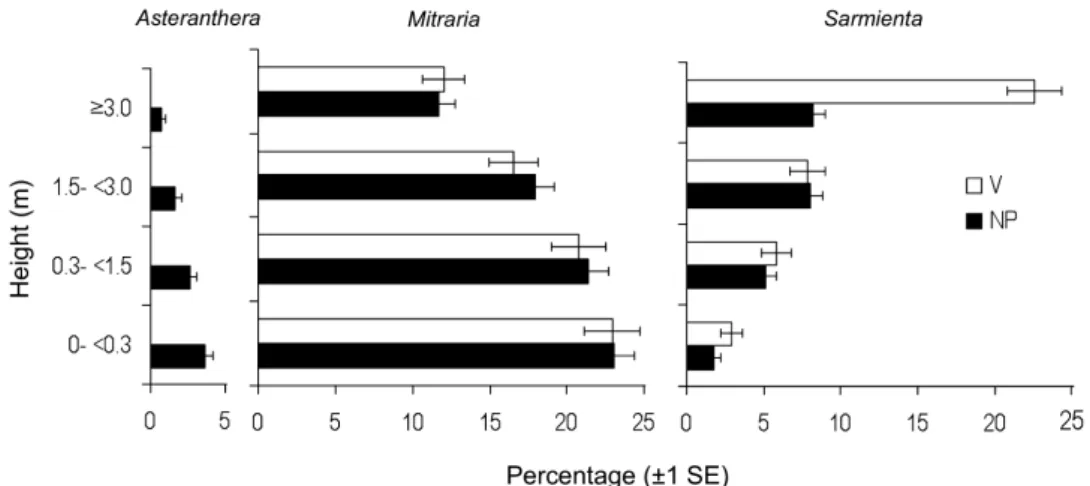
(7) REGENERATION NICHE OF EPIPHYTIC GESNERIADS. RESULTS VERTICAL DISTRIBUTION OF GESNERIACEAE SOUTH AMERICAN FORESTS. IN. The three species of Gesneriaceae differed in their vertical distribution patterns in both forest types studied (ANOVA, F6,19440 = 53.3, P < 0.000001). The occurrence of A. ovata and M. coccinea decreased with tree height, whereas S. repens exhibited the opposite distribution in the vertical profile, increasing in frequency closer to the tree crown. Asteranthera ovata was more frequent below 3 m (LSD test, MS = 0.75, d.f. = 19 440, P < 0.05), whereas M. coccinea was more frequent below 1.5 m (LSD test, MS = 0.75, d.f. = 19 440, P < 0.05). We also found differences between the two forest types (ANOVA, F6,19440 = 6.5, P < 0.00001), as S. repens was frequent above 1.5 m on trees from the North Patagonian forests (LSD test, MS = 0.75, d.f. = 19 440, P < 0.05), whereas, in the Valdivian rainforests, its frequency was greatest on trees above 3.0 m height (LSD test, MS = 0.75, d.f. = 19 440, P < 0.00001; Fig. 3). In addition, A. ovata was entirely absent from the Valdivian rainforest (Fig. 3).. REGENERATION NICHE OF GESNERIADS IN SOUTH AMERICAN TEMPERATE RAINFORESTS Seed germination patterns We found marked differences in the final percentages of seed germination and the rates of seed germination over time among the three epiphytic gesneriads depending on light environment and substrate (Gehan–Breslow11 = 916.3; P < 0.001; Fig. 4). Asteranthera ovata had the lowest final germination percentage (3.3%), and seed germination was higher for M. coccinea (31.5%) and S. repens (58.5%; pairwise. 85. multiple comparison Holm–Sidak; P < 0.001; Fig. 4). Only the holoepiphyte S. repens responded differently to germination light environment and substrate, and showed a significant interaction between treatments (pairwise multiple comparison Holm–Sidak; P < 0.01; Fig. 4). The responses of the other two species did not differ among light and substrate treatments (pairwise multiple comparison Holm–Sidak; P = NS; Fig. 4). The mean time needed to reach 50% of the final germination percentage was 142 days for A. ovata and 113 days for M. coccinea in all treatments (Fig. 4). In contrast, S. repens showed higher seed germination percentages on tree bark substrate under both light conditions, and under open canopy for both substrate types (Fig. 4). The seed germination percentage of S. repens under an open canopy was 65.3% and 71 days were required to reach 50% of the final germination percentage (Fig. 4A, B). Sarmienta repens reached its highest germination percentage (69%) and had the fastest rate of germination (35 days to reach 50% of the total) under closed canopy and on tree bark (pairwise multiple comparison Holm–Sidak; P < 0.01; Fig. 4C). In contrast, in soil under closed canopy, the seed germination of S. repens was only 34.4% and it needed 42 days to reach 50% of the final germination percentage, resembling the seed germination pattern of M. coccinea (pairwise multiple comparison Holm–Sidak; P = NS; Fig. 4D). Seedling survival patterns The main causes of seedling mortality among seedlings were freezing damage, herbivory and desiccation during drought events in spring and summer. Seedling survival differed significantly between M. coccinea and S. repens depending on light and substrate. Figure 3. Habitat niche and vertical distribution percentage of frequency of epiphytic gesneriads in height ranges on trees of North Patagonian (NP, N = 1074 trees) and Valdivian (V, N = 548 trees) forests. Error of proportion bars are shown (± 1SE). © 2012 The Linnean Society of London, Botanical Journal of the Linnean Society, 2012, 170, 79–92.
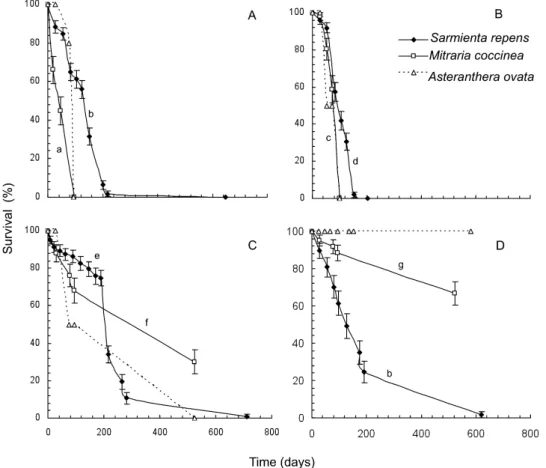
(8) 86. F. SALINAS and J. J. ARMESTO. Figure 4. Cumulative distributions of seed germination (radicle or cotyledons emerged) for three epiphytic species of Gesneriaceae from Chilean rainforests during a field experiment under four light and substrate treatments: A, open canopy, tree bark; B, open canopy, forest soil; C, closed canopy, tree bark; D, closed canopy, forest soil. Different lowercase letters near distributions indicate significant differences between curves (multiple pair-comparison Holm–Sidak, P < 0.05). Standard error bars are shown. Arrows indicate the median germination time for Sarmienta repens in each treatment.. treatments (Gehan–Breslow7 = 300.7, P < 0.001; Fig. 5A–D). No seedlings of either species survived under open canopy 660 days after the beginning of the assay (Fig. 5A, B). However, seedlings of S. repens survived longer under open canopy than those of M. coccinea on both substrates, and the former survived longer in light when growing on tree bark (139 days) compared with soil (94 days; pairwise multiple comparison Holm–Sidak; P < 0.01). However, M. coccinea survived longer in soil (85 days) than on tree bark (33 days; pairwise multiple comparison Holm–Sidak; P < 0.05; Fig. 5A, B) when growing under an open canopy environment. This species showed the highest survival under closed canopy, persisting for > 660 days in the field experiments, and had the highest survival in forest soil, where 67% of seedlings survived until the end of the experiment. When established on tree bark, 30% of the initial seedlings survived to the end of the experiment, with a mean survival time of 309 days (Fig. 5C, D). In contrast, only 1–2% of seedlings of S. repens survived under a closed canopy; however, survival was twofold longer when seedlings were growing on tree bark. than on forest soil (202 vs. 112 days, respectively; pairwise multiple comparison Holm–Sidak; P < 0.05; Fig. 5C, D). Seedlings of A. ovata survived longer under closed canopy than under open canopy light treatment (pseudo-F1,12 = 17.59, permutation P < 0.01; Fig. 5A, B).. ANCESTRAL. CHARACTER STATE RECONSTRUCTION. OF GROWTH HABITS AND REGENERATION NICHES WITHIN. CORONANTHEREAE. Parsimony analyses suggest that the tree form is ancestral in Coronanthereae (Fig. 6). Rhabdothamnus solandri A.Cunn., from New Zealand, represents the single origin of the shrub habit, derived from the tree growth form. The soil-rooted M. coccinea, the Australian F. australis and A. ovata represent an additional single origin of the secondary hemiepiphytic habit, also derived from the tree growth form (Fig. 6). The unique holoepiphytic habit of S. repens would be a trait derived from the secondary hemiepiphytic habit (Fig. 6).. © 2012 The Linnean Society of London, Botanical Journal of the Linnean Society, 2012, 170, 79–92.
(9) REGENERATION NICHE OF EPIPHYTIC GESNERIADS. 87. Figure 5. Seedling survival of three epiphytic species of Gesneriaceae in a Chilean temperate rainforest over time under four light and substrate treatments: A, open canopy, tree bark; B, open canopy, forest soil; C, closed canopy, tree bark; D, closed canopy, forest soil. Different lowercase letters indicate significant differences between curves of Mitraria coccinea and Sarmienta repens (multiple pair-comparison Holm–Sidak, P < 0.05). Standard error bars are shown. For Asteranthera ovata, differences in survival times are significant among light treatments (distance-based permutational ANOVA, permutation P < 0.01).. In our analysis, the shrub R. solandri, two tree species of Coronanthera and the secondary hemiepiphytes M. coccinea, F. australis and A. ovata are able to regenerate on soil under the shade of the forest canopy. Only the holoepiphyte S. repens regenerated in the illuminated canopy of forest trees. Preference for open environments and tree bark substrate would then be a derived character state in the tribe, associated exclusively with the holoepiphytic habit of S. repens (Fig. 6).. VERTICAL. DISCUSSION GESNERIACEAE. DISTRIBUTION OF. Differences in the vertical distribution patterns of epiphytes have been attributed exclusively to the pronounced vertical gradients of light and humidity in rainforests (Johansson, 1974; Kelly, 1985; Catling, Brownell & Lefkovitch, 1986; TerSteege & Cornelissen, 1989; Zimmerman & Olmsted, 1992). Here, we. show that vertical distribution patterns of southern South American Gesneriaceae are also related to divergence among epiphytic habits of species of Coronanthereae (Fig. 3) and their regeneration requirements (Figs 4, 5). The absence of differences in the vertical distribution of M. coccinea between Valdivian and North Patagonian forest types (Fig. 3) suggests that the ecological niche of this species remains unaffected by changes in forest structure and tree species composition between the two forest types. In contrast, the vertical distribution pattern of S. repens differed between Valdivian and North Patagonian forests (Fig. 3), which could be attributed to the higher frequency of large emergent canopy trees in the Valdivian rainforest (Table 2; see Gutiérrez et al., 2009). Such trees have large limbs over 3 m in height and a rough bark in which seeds can be retained and germinate, consistent with the regeneration niche requirements of this species.. © 2012 The Linnean Society of London, Botanical Journal of the Linnean Society, 2012, 170, 79–92.
(10) 88. F. SALINAS and J. J. ARMESTO. Figure 6. Reconstruction of the evolution of life growth habits and regeneration niche on the phylogenetic hypothesis for 13 species of Coronanthereae based on Woo et al. (2011) using parsimony inference. For simplicity, outgroup taxa were removed from the tree. Tips of branches are coloured according to life growth habit and regeneration niche of species, and are not shown when the regeneration niche was coded as ambiguous. Branches and nodes were coloured according to the parsimony reconstruction for each character. In life growth habit, colours are white for tree, light grey for shrub, dark grey for secondary hemiepiphyte and black for holoepiphyte. In regeneration niche reconstruction, colours are white for shaded soil and black for illuminated canopy.. SEED GERMINATION We studied the regeneration niche of three closely related monospecific genera of Gesneriaceae that inhabit temperate Chilean rainforests, but which differ in their epiphytic growth habits. Seeds were germinated and seedlings were grown under environmental conditions similar to those found in the vertical profile of temperate rainforests (Salinas, 2008; Salinas et al., 2010). As expected from its growth habit, the holoepiphyte S. repens showed the highest percentages of seed germination on tree bark under both light environments, and under open canopy conditions on both substrates (Fig. 4A– D). Accordingly, the regeneration niche of the holoepiphyte differed drastically from that of the two related secondary hemiepiphytes, which supports the argument that differentiation in seed germination requirements among species has contributed to both the divergence in the growth habit of epiphytic species and their microhabitat segregation along the vertical profile of the forest. Primary hemiepiphytic figs in Neotropical forests require high substrate moisture and full exposure to light for seed germination (Ramírez, 1976; Titus,. Holbrook & Putz, 1990; Laman, 1995). Such combination of light and substrate conditions to stimulate seed germination in epiphytes can be viewed as factors that enhance survival in subsequent growth stages. For epiphytic bromeliads, the presence of bryophytes and lichens on tree bark has positive effects on seed germination, relative to exposed bark (Cascante-Marín et al., 2008), suggesting that cryptogamic cover increases the retention of moisture and nutrients by the substrate (Nadkarni, 2000). Because germination from dispersed seeds is the main propagation mechanism of the holoepiphyte S. repens, regeneration depends critically on plant fecundity, biotic seed dispersal and seed germination across the forest canopy. In contrast, the two secondary hemiepiphytic species, A. ovata and M. coccinea, often spread vegetatively over the forest floor, so that one individual may climb different host trees (F. Salinas, personal observation). The unresponsiveness of seed germination of A. ovata and M. coccinea to contrasting light and substrate conditions (Fig. 4A–D) suggests that, in these species, seed germination requirements do not match their particular microenvironment as adults in the forest.. © 2012 The Linnean Society of London, Botanical Journal of the Linnean Society, 2012, 170, 79–92.
(11) REGENERATION NICHE OF EPIPHYTIC GESNERIADS The rapid seed germination of the holoepiphyte S. repens (Fig. 4A-D), compared with the two related secondary hemiepiphytes, minimizes the chances that its small seeds, lacking sticky substances, will be blown away by the wind or washed off the tree by the rain. Our field assay indicates that seeds that fall to the forest floor will have a lower probability of germinating on the soil and in the shade. In the case of S. repens, the rapid emergence of the radicle to establish a mechanical holdfast to the host tree seems to be critical. Faster seed germination of S. repens under a closed canopy on tree bark substrate that maintained its natural cryptogamic cover could be favoured by higher moisture supply of the substrate, as rapid seed germination has been reported for epiphytic bromeliads when placed in humid and protected sites in the forest canopy (Winkler, Hulber & Hietz, 2005). In contrast, the comparatively slower seed germination of the other two secondary hemiepiphytic gesneriads may increase their own chances to be dispersed across the forest floor.. SEEDLING. SURVIVAL. The holoepiphyte S. repens survived longer than the liana M. coccinea in full light, regardless of the substrate type. Mitraria coccinea, in turn, survived longer than S. repens under a closed canopy, regardless of the substrate in which it was grown (Fig. 5). Likewise, A. ovata survived longer under a closed canopy than under an open canopy environment. Moreover, under both light treatments, the holoepiphyte S. repens survived longer when established on bark than on soil, whereas M. coccinea survived longer on soil than on bark (Fig. 5). The significant effects of light, substrate and light ¥ substrate interaction detected for the seedling survival patterns of these species emphasize the differences among the epiphytic growth habits for the seedling stage. Although the holoepiphyte S. repens can be characterized as shade intolerant at the seedling stage using bark substrate for establishment, the two secondary hemiepiphytes, M. coccinea and A. ovata, can be characterized as shade tolerant at the seedling stage becoming established in the soil (Fig. 5). Accordingly, the environmental setting in which seedling survival was higher for each species matched the light and substrate conditions best suited for the growth of adults in the forest (Fig. 3). Likewise, Kelly (1985) found that, in a Jamaican rainforest, seedling establishment of holoepiphytes occurred above 2 m on more illuminated tree canopies, whereas seedlings of vines and climbers became established in the shade, frequently near the tree base (Kelly, 1985). Differences in the regeneration niche of epiphytes documented here for species with contrasting growth. 89. habits explain the dissimilar vertical distribution of adults in the forest and are potentially important for understanding the evolution of the epiphytic habit in the Coronanthereae lineage. Specifically, the key attribute of the regeneration niche recognized in this context is the survival at the seedling stage, as seed germination has broader and less distinctive requirements across species. These results therefore contradict the predictions of Parrish & Bazzaz (1985), who proposed more specialized niche breadth during seed germination and broader regeneration niche requirements for seedlings and adults. In conclusion, the vertical distribution of epiphytic species of Gesneriaceae in the Valdivian and North Patagonian rainforests is related to vertical gradients of light and humidity and to differences in the growth habit and regeneration niche of the species. The secondary hemiepiphytes, A. ovata and M. coccinea, regenerate in the shaded and humid forest floor, and later ascend the tree trunks, and hence are more abundant in the lower strata of the forest (Figs 3–5). The holoepiphyte S. repens, in turn, becomes established in the tree canopy, where it is more exposed to desiccation and light (Figs 3–5).. IMPLICATIONS. OF REGENERATION NICHE DIVERGENCE IN. CORONANTHEREAE. The holoepiphytic habit of S. repens remains unique among Coronanthereae, and it is shown here to be associated with a different regeneration niche. We hypothesize that the acquisition of the physiological traits necessary to germinate and survive in the upper canopy environment, such as in the Chilean holoepiphyte S. repens, could be a consequence of maternal effects in an ancestral secondary hemiepiphytic liana, when subjected to increasing water stress in the upper canopy, especially during fertilization and seed development. As initial seedling growth depends on minerals, photosynthates and phytohormones provided by the maternal parent (Roach & Wulff, 1987; Sultan, 1996), differences in seed provisioning could affect subsequent development (Sultan, 1996) and progeny traits, such as seed size and seed germination requirements (ElKeblawy & Lovett-Doust, 1998; Johnsen et al., 2005). On the basis of our results, we suggest that regeneration niche divergence should be critical for the origin and evolution of the epiphytic growth habit in Coronanthereae and other lineages, and that such differentiation might be expected in closely related species when terrestrial and epiphytic habits are present. Potential examples are the genus Columnea L. and tribe Episcieae (Gesneriaceae), both with holoepiphytes and lianas (Smith. © 2012 The Linnean Society of London, Botanical Journal of the Linnean Society, 2012, 170, 79–92.
(12) 90. F. SALINAS and J. J. ARMESTO. & Sytsma, 1994; Smith & Carroll, 1997), and Bromeliaceae and Orchidaceae, in which the holoepiphytic growth habit has been shown to derive from terrestrial ancestors (Crayn et al., 2004; Gravendeel et al., 2004).. ACKNOWLEDGEMENTS We thank Dolores Zegers, Juan Vidal and Tomás Abud for field assistance; Marcela Bustamante and Wara Marcelo for statistical advice; Fernanda Pérez for advice regarding phylogenetic and ancestral state reconstruction analyses; Andrés Charrier and Juan L. Celis for assistance with figures; and Rocío Jaña, M. Bustamante, Michael F. Fay and two anonymous referees for critical comments on previous versions of the manuscript. This is part of the Doctoral Dissertation submitted by FS to the Facultad de Ciencias, Universidad de Chile, and is a contribution to the Research Program of Senda Darwin Biological Station, Ancud, Chiloé. This work was supported by Fondo de Financiamiento de Centros de Excelencia en Investigación – Fondo Nacional de Desarrollo Científico y Tecnológico (1501-0001) to the Center for Advanced Studies in Ecology and Biodiversity, Pontificia Universidad Católica de Chile; Iniciativa Científica Milenio (Ministerio de Planificación y Cooperación) (P05-002); Comisión Nacional Científica y Tecnológica [PFB 23 to the Institute of Ecology and Biodiversity (IEB), AT-4050069 to FS]; Departamento de Postgrado y Postítulo, Universidad de Chile (MFS); and a grant from Programa de Mejoramiento de la Equidad y Calidad de la Educación Superior (Universidad de Chile) that allowed FS to visit MEL, AK and NOU herbaria and field sites in Australia, New Zealand and New Caledonia.. REFERENCES Anderson MJ. 2001. A new method for non-parametric multivariate analysis of variance. Austral Ecology 26: 32–46. Anderson MJ. 2004. DISTLM v.5: a FORTRAN computer program to calculate a distance-based multivariate analysis for a linear model. Auckland: Department of Statistics, University of Auckland. Benzing DH. 1987. Vascular epiphytism – taxonomic participation and adaptive diversity. Annals of the Missouri Botanical Garden 74: 183–204. Benzing DH, Atwood JT. 1984. Orchidaceae – ancestral habitats and current status in forest canopies. Systematic Botany 9: 155–165. Benzing DH, Clements MA. 1991. Dispersal of the orchid Dendrobium insigne by the ant Iridomyrmex cordatus in Papua-New-Guinea. Biotropica 23: 604–607. Bews JW. 1927. Studies in the ecological evolution of the angiosperms. New Phytologist 26: 65–84.. Bohlman SA, Matelson TJ, Nadkarni NM. 1995. Moisture and temperature patterns of canopy humus and forest floor soil of a montane cloud forest, Costa Rica. Biotropica 27: 13–19. Burtt BL. 1963. Studies in the Gesneriaceae of the Old World. XXIV. Tentative keys to the tribes and genera. Notes from the Royal Botanic Garden Edinburgh 24: 205– 220. Burtt BL. 1998. Climatic accommodation and phytogeography of the Gesneriaceae of the Old World. In: Mathew P, Sivadasan M, eds. Diversity and taxonomy of tropical flowering plants. Calicut: Mentor Books, 1–27. Cascante-Marín AM, Wolf JHD, Oostermeijer JGB, den Nijs J. 2008. Establishment of epiphytic bromeliads in successional tropical premontane forests in Costa Rica. Biotropica 40: 441–448. Catling PM, Brownell VR, Lefkovitch LP. 1986. Epiphytic orchids in a Belizean grapefruit orchard: distribution, colonization and association. Lindleyana 1: 194–202. Chacón P, Armesto JJ. 2005. Effect of canopy openness on growth, specific leaf area, and survival of tree seedlings in a temperate rainforest of Chiloé Island, Chile. New Zealand Journal of Botany 43: 71–81. Crayn DM, Winter K, Smith JAC. 2004. Multiple origins of crassulacean acid metabolism and the epiphytic habit in the Neotropical family Bromeliaceae. Proceedings of the National Academy of Sciences of the United States of America 101: 3703–3708. Di Castri F, Hajek ER. 1976. Bioclimatología de Chile. Santiago: Vicerrectoría de Comunicaciones, Pontificia Universidad Católica de Chile. El-Keblawy A, Lovett-Doust J. 1998. Persistent, non-seedsize maternal effects on life-history traits in the progeny generation in squash, Cucurbita pepo. New Phytologist 140: 655–665. Figueroa JA. 2003. Seed germination in temperate rainforest species of southern Chile: chilling and gap-dependency germination. Plant Ecology 166: 227–240. Fischer EA, Araujo AC. 1995. Spatial organization of a bromeliad community in the Atlantic rainforest, southeastern Brazil. Journal of Tropical Ecology 11: 559–567. Freiberg M. 1997. Spatial and temporal pattern of temperature and humidity of a tropical premontane rainforest tree in Costa Rica. Selbyana 18: 77–84. Gentry AH, Dodson CH. 1987. Diversity and biogeography of Neotropical vascular epiphytes. Annals of the Missouri Botanical Garden 74: 205–233. Gravendeel B, Smithson A, Slik FJW, Schuiteman A. 2004. Epiphytism and pollinator specialization: drivers for orchid diversity? Philosophical Transactions of the Royal Society of London 359: 1523–1535. Grubb P. 1977. The maintenance of species-richness in plant communities: the importance of the regeneration niche. Biological Reviews 52: 107–145. Gutiérrez AG, Armesto JJ, Aravena JC. 2004. Disturbance and regeneration dynamics of an old-growth North Patagonian rainforest in Chiloé Island, Chile. Journal of Ecology 92: 598–608.. © 2012 The Linnean Society of London, Botanical Journal of the Linnean Society, 2012, 170, 79–92.
(13) REGENERATION NICHE OF EPIPHYTIC GESNERIADS Gutiérrez AG, Armesto JJ, Aravena JC, Carmona MR, Carrasco NV, Christie DA, Peña MP, Pérez CA, Huth A. 2009. Structural and environmental characterization of old growth temperate rainforests of northern Chiloé Island, Chile: regional and global relevance. Forest Ecology and Management 258: 376–388. Johansson DR. 1974. Ecology of vascular epiphytes in West African rainforests. Acta Phytogeographica Suecica 59: 1–136. Johnsen Ø, Dæhlen OG, Østreng G, Skrøppa T. 2005. Daylength and temperature during seed production interactively affect adaptive performance of Picea abies progenies. New Phytologist 168: 589–596. Kelly DL. 1985. Epiphytes and climbers of Jamaican rainforests: vertical distribution, life-forms and life-histories. Journal of Biogeography 12: 223–241. Kremer P, VanAndel J. 1995. Evolutionary aspects of life forms in angiosperm families. Acta Botanica Neerlandica 44: 469–479. Laman TG. 1995. Ficus stupenda germination and seedling establishment in a Bornean rainforest canopy. Ecology 76: 2617–2626. Lüttge U. 1989. Vascular epiphytes: setting the scene. In: Luttge U, ed. Vascular plants as epiphytes. Evolution and ecophysiology. Berlin: Springer-Verlag, 1–14. Maddison WP, Maddison DR. 2009. Mesquite: a modular system for evolutionary analysis. Version 1.11 http:// mesquiteproject.org. Accessed 14 April 2012. McArdle BH, Anderson MJ. 2001. Fitting multivariate models to community data: a comment on distance based redundancy analysis. Ecology 82: 290–297. Muñoz AA, Chacón P, Pérez F, Barnert ES, Armesto JJ. 2003. Diversity and host tree preferences of vascular epiphytes and vines in a temperate rainforest in southern Chile. Australian Journal of Botany 51: 381–391. Nadkarni NM. 1984. Epiphyte biomass and nutrient capital of neotropical elfin forest. Biotropica 16: 249–256. Nadkarni NM. 2000. Colonization of stripped branch surfaces by epiphytes in a lower montane cloud forest, Monteverde, Costa Rica. Biotropica 32: 358–363. Parker G. 1995. Structure and microclimate of forest canopies. In: Lowman M, Nadkarni NM, eds. Forest canopies. San Diego, CA: Academic Press, 73–106. Parrish JAD, Bazzaz FA. 1985. Nutrient content of Abutilon theophrasti seeds and the competitive ability of the resulting plants. Oecologia 65: 247–251. Pittendrigh CS. 1948. The bromeliad–Anopheles–malaria complex in Trinidad. 1. The bromeliad flora. Evolution 2: 58–89. Ramírez W. 1976. Germination of seeds of New World Urostigma (Ficus) and of Morus rubra L. (Moraceae). Revista de Biología Tropical 24: 1–6.. 91. Reiche K. 1938. Geografía Botánica de Chile. Santiago de Chile: Imprenta Universitaria. Roach DA, Wulff RD. 1987. Maternal effects in plants. Annual Review of Ecology and Systematics 18: 209–235. Salinas F. 2008. Diferenciación de nichos ecológicos de tres especies de Gesneriáceas epífitas del bosque templado del sur de Chile. DPhil Thesis, Universidad de Chile, Santiago. Salinas F, Arroyo MTK, Armesto JJ. 2010. Epiphytic growth habits of Chilean Gesneriaceae and the evolution of epiphytes within the tribe Coronanthereae. Annals of the Missouri Botanical Garden 97: 117–127. Smith JF, Carroll CL. 1997. A cladistic analysis of the tribe Episcieae (Gesneriaceae) based on ndhF sequences: origin of morphological characters. Systematic Botany 22: 713– 725. Smith JF, Sytsma KJ. 1994. Evolution in the Andean epiphytic genus Columnea (Gesneriaceae). 1. Morphological variation. Systematic Botany 19: 220–235. Sultan SE. 1996. Phenotypic plasticity for offspring traits in Polygonum persicaria. Ecology 77: 1791–1807. TerSteege H, Cornelissen JHC. 1989. Distribution and ecology of vascular epiphytes in lowland rainforest of Guyana. Biotropica 21: 331–339. Titus JH, Holbrook NM, Putz FE. 1990. Seed germination and seedling distribution of Ficus pertusa and F. tuerckheimii: are strangler figs autotoxic? Biotropica 22: 425–428. Veblen TT, Burns BR, Kitzberger T, Lara A, Villalba R. 1995. The ecology of the conifers of southern South America. In: Enright NJ, Hill RS, eds. Ecology of the southern conifers. Melbourne: Melbourne University Press, 120–155. Weber A. 2004. Gesneriaceae. In: Kubitzki K, ed. The families and genera of vascular plants, Vol. VII. Flowering plants – dicotyledons. Lamiales (except Acanthaceae including Avicenniaceae). Berlin: Springer, 63–158. Wiehler H. 1983. A synopsis of the neotropical Gesneriaceae. Selbyana 6: 1–219. Williams-Linera G, Lawton RO. 1995. The ecology of hemiepiphytes in forest canopies. In: Lowman M, Nadkarni NM, eds. Forest canopies. San Diego, CA: Academic Press, 255–281. Winkler M, Hulber K, Hietz P. 2005. Effect of canopy position on germination and seedling survival of epiphytic bromeliads in a Mexican humid montane forest. Annals of Botany 95: 1039–1047. Woo VL, Funke MM, Smith JF, Lockhart PJ, GarnockJones PJ. 2011. New World origins of southwest Pacific Gesneriaceae: multiple movements across and within the South Pacific. International Journal of Plant Sciences 172: 434–457. Zimmerman JK, Olmsted IC. 1992. Host tree utilization by vascular epiphytes in a seasonally inundated forest (Tintal) in Mexico. Biotropica 24: 402–407.. © 2012 The Linnean Society of London, Botanical Journal of the Linnean Society, 2012, 170, 79–92.
(14) 92. F. SALINAS and J. J. ARMESTO. APPENDIX Voucher specimens for the two study sites from old-growth stands of North Patagonian rainforest located in the lowlands of northern Chiloé Island, Chile: Fundo Cisnes (FC, 41 °50’S, 73 °36′W), Caulín, and Senda Darwin Biological Station (SD, 41 °52’S, 73 °40′W), El Quilar. Voucher specimens are given for other Coronanthereae from the coastal temperate rainforest of Wenderholm (WE, 36 °32’S, 174 °42′E), Waiwera, Auckland, New Zealand, the temperate rainforest located at the head of Bunyip Valley Rd (BU, 37 °54’S, 145 °41′E), Gembrook, Eastern Highlands, Victoria, Australia, and two tropical rainforests in the South Provence, New Caledonia: Mt. Koghis (KO, 22 °11’S, 166 °30′E), main trail to Pic Malaoui, 20 km NE from Nouméa’ and main trail to Plateau de Dogny (DO, 21 °37’S, 165 °52′E), Dogny. Taxa with an epiphytic habit are given in bold type. Species name with author attribution. Site. Collector number (herbarium). Asteranthera ovata (Cav.) Hanst. Asteranthera ovata (Cav.) Hanst. Mitraria coccinea Cav. Mitraria coccinea Cav. Sarmienta repens Ruiz & Pav. Sarmienta repens Ruiz & Pav. Coronanthera sericea C.B.Clarke Coronanthera clarkeana Schltr. Rhabdothamnus solandri A.Cunn Fieldia australis A.Cunn. FC SD FC SD FC SD KO DO WE BU. Salinas Salinas Salinas Salinas Salinas Salinas Salinas Salinas Salinas Salinas. 823 816 824 815 822 814 776 782 759 756. (CONC) (CONC) (CONC) (CONC) (CONC) (CONC) (CONC, NOU, AK) (CONC, NOU, AK) (CONC, AK) (CONC, MEL). © 2012 The Linnean Society of London, Botanical Journal of the Linnean Society, 2012, 170, 79–92.
(15) Copyright of Botanical Journal of the Linnean Society is the property of Wiley-Blackwell and its content may not be copied or emailed to multiple sites or posted to a listserv without the copyright holder's express written permission. However, users may print, download, or email articles for individual use..
(16)
Figure

+2

Documento similar
8 Secondary structure of Lupin’s flour for three different species using FTIR ...45 5.3 Ultrasound (US) Effect in lupin protein extraction and in the properties of
The interplay of poverty and climate change from the perspective of environmental justice and international governance.. We propose that development not merely be thought of as
In the preparation of this report, the Venice Commission has relied on the comments of its rapporteurs; its recently adopted Report on Respect for Democracy, Human Rights and the Rule
The draft amendments do not operate any more a distinction between different states of emergency; they repeal articles 120, 121and 122 and make it possible for the President to
No obstante, como esta enfermedad afecta a cada persona de manera diferente, no todas las opciones de cuidado y tratamiento pueden ser apropiadas para cada individuo.. La forma
In this work, three out of four species (S. palmetto) showed significantly higher contents of phenolic compounds than all other analyzed species, and differences in the
The textbooks for the subject of History, Geography, and Social Sciences, used from 2008 to 2021, and which address the topic of the Chilean occupation of the Araucanía region
The Dwellers in the Garden of Allah 109... The Dwellers in the Garden of Allah
