UNIVERSIDAD TÉCNICA DE AMBATO
DIRECCIÓN DE POSGRADO
MAESTRÍA EN LA ENSEÑANZA DEL IDIOMA INGLÉS COMO
LENGUA EXTRANJERA
__________________________________________________________
Tema: “QUIZLET APP AND THE ENGLISH LANGUAGE
VOCABULARY LEARNING”
___________________________________________________________
Trabajo de Investigación, previo a la obtención del Grado Académico de Magíster en la Enseñanza del Idioma Inglés como Lengua Extranjera
Autora: Lic. Zambrano Acosta Elizabeth Jaqueline
Director: Lic. Edgar Guadia Encalada Trujillo Magíster
Portada
Ambato – Ecuador 2018
. . .
__-.: .,.
;.?
DnL Sara tsid'hya Camacbo F.sl™i• M& Miembro del Tribunal Lda. Lorena Monserrath Meléndez Escobar \lg.
Miembro del Tribunal Dr. Htctor Femando 06mcl o Pres· el Tribunal
~
.
r.<9
..
.
ii
A la Unidad de Titulación de la Universidad Técnica de Ambato:
El tribunal receptor del Trabajo de Investigación presidido por el Doctor Héctor Fernando Gómez Alvarado, Presidente de Tribunal e integrado por las señoras: Licenciada Lorena Monserrath Meléndez Escobar Magíster; Doctora Sara Nidhya Camacho Estrada Magíster, Miembros del Tribunal designadas por la Unidad de Titulación de la Universidad Técnica de Ambato, para receptar el Trabajo de Investigación con el tema: “QUIZLET APP AND THE ENGLISH LANGUAGE
VOCABULARY LEARNING” elaborado y presentado por la señora Licenciada
Elizabeth Jaqueline Zambrano Acosta, para optar por el Grado Académico de Magíster en la Enseñanza del Idioma Inglés como Lengua Extranjera; una vez escuchada la defensa oral del Trabajo de Titulación el Tribunal aprueba y remite el trabajo para uso y custodia en las bibliotecas de la UTA.
………
Dr. Héctor Fernando Gómez Alvarado Presidente del Tribunal
………
Lda. Lorena Monserrath Meléndez Escobar Mg. Miembro del Tribunal
………
Dra. Sara Nidhya Camacho Estrada Mg. Miembro del Tribunal
I
.• !
~~
-·~···
·
·
····
···
Líe, Edgar Guadia Eru:a\ada Trujillo Mg. C.C.050182417-1
DIRECTOR
Lda. Elizabe Jaqueline Zambrano Acosta e.e. oso26S323-t
AUTORA
iii
AUTORÍA DEL TRABAJO DE TITULACIÓN
La responsabilidad de las opiniones, comentarios y críticas emitidas en el Trabajo de Investigación presentado con el tema: “QUIZLET APP AND THE ENGLISH LANGUAGE VOCABULARY LEARNING” le corresponde exclusivamente a: Elizabeth Jaqueline Zambrano Acosta, Autora bajo la Dirección del Licenciado Edgar Guadia Encalada Trujillo Magíster, Di rector del Trabajo de Investigación; y el patrimonio intelectual a la Universidad Técnica de Ambato.
……… Lda. Elizabeth Jaqueline Zambrano Acosta
C.C. 050265323-1 AUTORA
……… Lic. Edgar Guadia Encalada Trujillo Mg.
C.C.050182417-1 DIRECTOR
Lda. Elizabeth Jaqueline Zambrano Acosta CC: 050265323-1
AUTORA
_
__
______
;:1lff#-
_
, iv DERECHOS DE AUTORAutorizo a la Universidad Técnica de Ambato, para que el Trabajo de Investigación, sirva como un documento disponible para su lectura, consulta y procesos de investigación, según las normas de la institución.
Cedo los derechos de mi Trabajo de Investigación, con fines de difusión pública, además apruebo la reproducción de este, dentro de las regulaciones de la Universidad.
--- Lda. Elizabeth Jaqueline Zambrano Acosta
CC: 050265323-1 AUTORA
v
ÍNDICE GENERAL
PORTADA ... i
A LA UNIDAD DE TITULACIÓN DE LA UNIVERSIDAD TÉCNICA DE AMBATO: ... ii
AUTORÍA DEL TRABAJO DE TITULACIÓN ... iii
DERECHOS DE AUTOR ... iv
ÍNDICE GENERAL ...v
ÍNDICE DE CUADROS ... vii
ÍNDICE DE FIGURAS ... ix
AGRADECIMIENTO ...x
DEDICATORIA ... xi
RESUMEN EJECUTIVO ... xii
EXECUTIVE SUMMARY ... xiii
INTRODUCTION ...1
CHAPTER I ...3
PROBLEMSTATEMENT ...3
1.1 Theme of the Problem ... 3
1.2 Problem Statement ...3
1.3 Contextualization ...3
1.3.1. Critical Analysis ...7
1.3.2 Prognosis ...9
1.3.3 Setting of the problem ...10
1.3.4 Research Questions ...10
1.3.5. Delimitation of the Problem ...10
1.4.JUSTIFICATION ...11 1.5OBJECTIVES ...13 1.5.1 General Objective ...13 1.5.2 Specific Objectives ...13 CHAPTER II ...14 THEORETICALFRAMEWORK ...14 2.1 Research background. ...14
vi 2.2 Philosophical foundations...16 2.3 Legal Bases ...17 2.4Main Categories ...19 2.5. Hypothesis ...22 2.6. Signaling Hypothesis ...22
2.7. Theoretical Foundation of the Independent Variable. ...22
2.8 Theoretical Foundation of the Dependent Variable. ...37
CHAPTER III ...46
METHODOLOGY ...46
3.1. Approach ...46
3.2. Basic research methods ...47
3.3. Level or type of research ...47
3.4. Population and sample ...49
3.5 Variable Operationalization ...51
3.6. Data Collection Plan ...55
3.7 Analysis and Interpretation Plan ...56
CHAPTER IV ...57
ANALYSYSANDINTERPRETATION ...57
4.1. Analysis and Interpretation ...57
4.2. Verification of Hypothesis ...84
4.2.1. Logic Model ...84
4.2.2. Statistical Specifications ...84
4.2.3. Significance Level ...85
4.2.4. Data collection and statistical calculations. ...87
CHAPTER V ...91
CONCLUSIONSANDRECOMENDATIONS ...91
5.1. Conclusions ...91 5.2. Recommendations ...92 CHAPTER VI ...94 THEPROPOSAL ...94 ANNEXES ...99 BIBLIOGRAPHY ...133
vii
ÍNDICE DE CUADROS
Table1: Population ... 49
Table2: Independent Variable Operationalization ... 51
Table3: Dependent Variable Operationalization ... 53
Table4: Basic Questions ... 55
Table 5: Understanding nouns while reading in the pre-test ... 58
Table 6: Understanding verbs while reading in the pre-test ... 58
Table 7: Understanding adjectives while reading in the pre-test ... 59
Table 8: Understanding adverbs while reading in the pre-test ... 59
Table 9: Understanding nouns while listening in the pre-test ... 60
Table 10: Understanding verbs while reading in the pre-test ... 60
Table 11: Understanding adjectives while reading in the pre-test ... 61
Table 12: Understanding adverbs while reading in the pre-test ... 61
Table 13: Understanding prepositions while reading in the pre-test ... 62
Table 14: Understanding nouns while reading in the post-test ... 62
Table 15: Understanding verbs while reading in the post-test ... 63
Table 16: Understanding adjectives while reading in the post-test ... 63
Table 17: Understanding adverbs while reading in the post-test ... 64
Table 18: Understanding nouns while listening in the post-test ... 65
Table 19: Understanding verbs while listening in the post-test ... 65
Table 20: Understanding adjectives while listening in the post-test ... 66
Table 21: Understanding adverbs while listening in the post-test ... 66
Table 22: Understanding prepositions while listening in the post-test ... 67
Table 23: Correct answers comparison in the control group ... 67
Table 24: Pre-test and Post-test grades per student. ... 69
Table 25: I know what ICTs are. ... 70
Table 26: The ICTs promote learning ... 71
Table 27: I like to work with applications ... 72
Table 28: Teacher's use applications to teach vocabulary ... 73
Table 29: Use of applications to evaluate students. ... 74
viii
Table 31: I have internet access at home ... 76
Table 32: The teacher uses motivating activities to teach vocabulary. ... 77
Table 33: Interesting material and tools to teach vocabulary ... 78
Table34: Appropriate classroom atmosphere ... 79
Table35: Students' active participation. ... 80
Table 36: Vocabulary learning ... 81
Table 37: Memorizing words and their meaning ... 82
Table38: Students' proficiency level ... 83
Table 39: Distribution of Chi ... 86
Table40: Observed Frequencies ... 87
Table41: Expected Frequencies ... 88
Table42: Calculation of Chi2 ... 89
ix
ÍNDICE DE FIGURAS
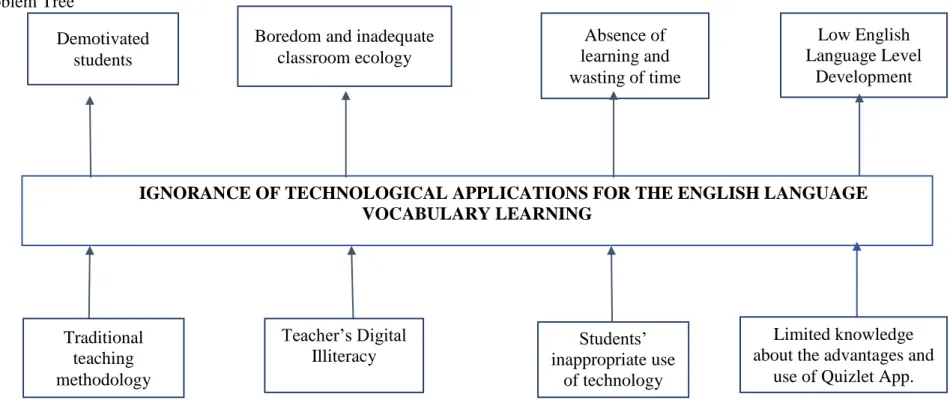
Figure 1: Problem Tree ... 6
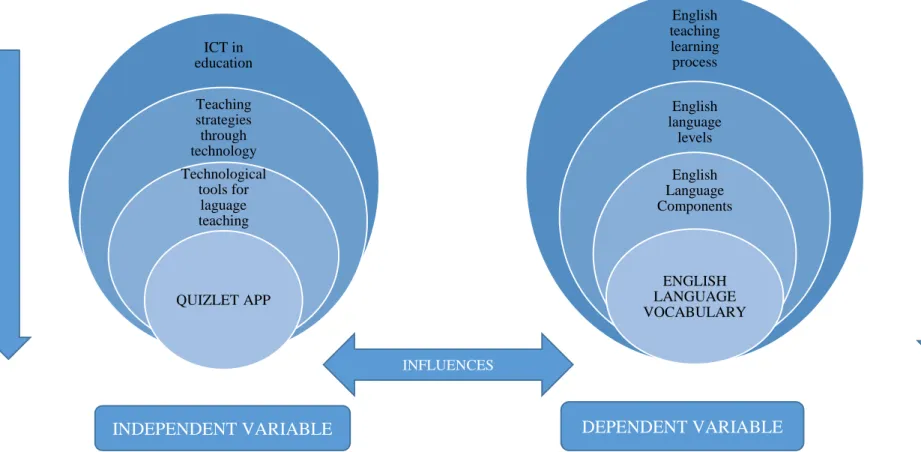
Figure 2: Main Categories ... 19
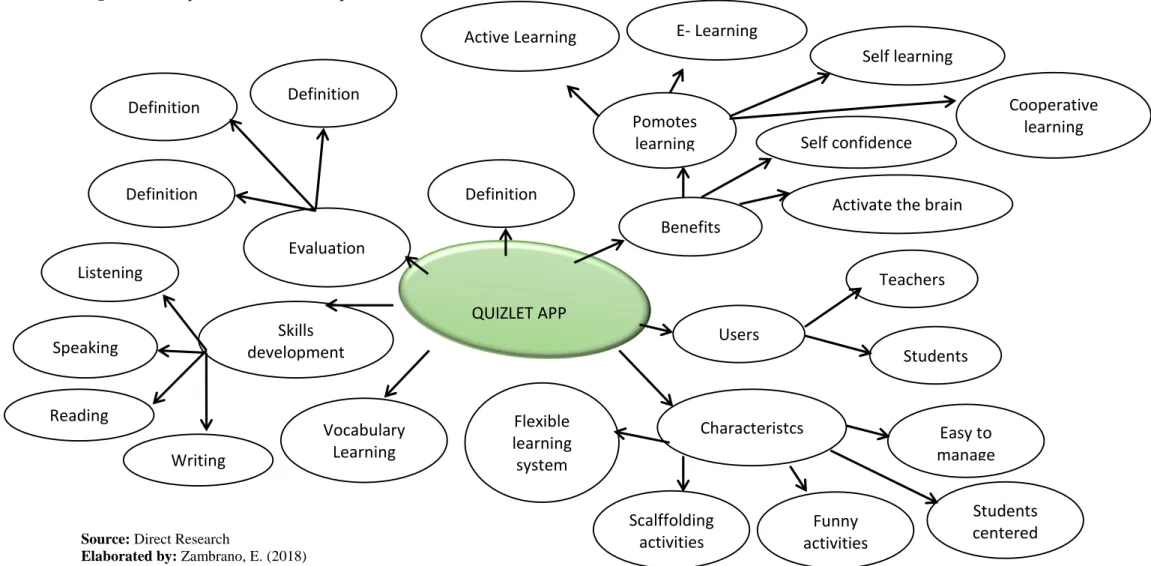
Figure 3: Independent Variable Map ... 20
Figure 4: Dependent Variable Mind Map ... 20
Figure 5: An experiential Learning Cycle ... 38
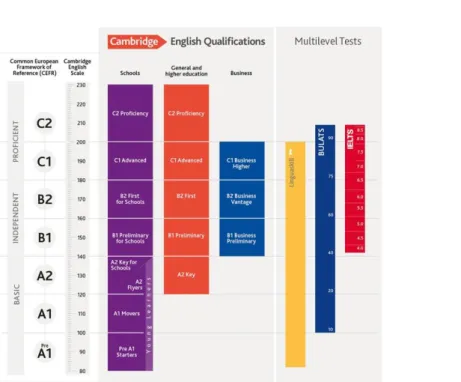
Figure 6: Cambridge English Scale ... 41
Figure 7: Components of English Language ... 42
Figure 8: Pre-test and Post-test correct answers’ representation ... 68
Figure 9: I know what ICTs are. ... 70
Figure 10: The ICTs promote learning ... 71
Figure 11: I like to work with applications ... 72
Figure 12: Teacher's use applications to teach vocabulary ... 73
Figure 13: Use of applications to evaluate students. ... 74
Figure 14: I use an application or platform to learn English ... 75
Figure 15: I have internet access at home ... 76
Figure 16: The teacher uses motivating activities to teach vocabulary. ... 77
Figure 17: Interesting material and tools to teach vocabulary ... 78
Figure 18: Appropriate classroom atmosphere... 79
Figure 19: Students' active participation ... 80
Figure 20: Vocabulary learning ... 81
Figure 21: Memorizing words and their meaning ... 82
Figure 22: Students' proficiency level ... 83
x
AGRADECIMIENTO
Empezaré agradeciendo a Dios porque sin Él nada habría sido posible.
Al Mg. Edgar Encalada Trujillo por toda la paciencia brindada y por haber compartido conmigo todos sus conocimientos durante el desarrollo de este trabajo investigativo.
A mi cuñado Cristian por haberme brindado su apoyo en todo momento y estar siempre dispuesto a disipar mis dudas sin importar cuan complejas fueran.
A Mentor y Carina, gracias por haber estado siempre pendientes del progreso de mi trabajo y por haber creído en mí.
xi
DEDICATORIA
Este trabajo lo dedico en primer lugar a mi hijo Adrián Alejandro quien desde el primer día de clases me acompañó y compartió todos los momentos buenos y malos mientras crecía en mi vientre. A mi amado esposo Milton Escobar quien fue mi pilar fundamental en este logro adquirido, ya que con amor y paciencia supo apoyarme en todo momento. A mis queridos padres por haberme enseñado a ser perseverante y nunca desmayar ante las adversidades que se pudieran presentar y por haberme apoyado siempre en y en todo momento. A mis suegros por su ayuda incondicional y desinteresada y por compartir conmigo cada momento de esta etapa de mi vida. Finalmente, a mi amiga y confidente Lore porque juntas empezamos este sueño, lo vivimos día a día y ahora gracias a Dios y al apoyo mutuo hemos conseguido nuestro propósito.
xii
UNIVERSIDAD TÉCNICA DE AMBATO DIRECCIÓN DE POSGRADOS
MAESTRÍA EN LA ENSEÑANZA DEL IDIOMA INGLÉS COMO LENGUA EXTRANERA
TEMA: “QUIZLET APP AND THE ENGLISH LANGUAGE
VOCABULARYLEARNING”
AUTORA: Lic. Elizabeth Jaqueline Zambrano Acosta
TUTOR: Lic. Edgar Guadia Encalada Trujillo Mg. FECHA: 16 de octubre del 2018
RESUMEN EJECUTIVO
El presente trabajo de investigación se enfocó en el vocabulario como factor principal para el aprendizaje y producción del Idioma Inglés como lengua extranjera aplicado a los estudiantes de Segundo y Tercer Año de Bachillerato General Unificado de la Unidad Educativa Cusubamba durante el año lectivo 2017 – 2018. El marco teórico se centra en la aplicación Quizlet, estrategias y herramientas tecnológicas para la enseñanza del idioma Inglés, las TICs (Tecnologías de la Información y Comunicación) en la educación, vocabulario en el idioma Inglés, niveles y componentes del idioma Inglés y proceso de enseñanza- aprendizaje del Inglés. El trabajo investigativo se desarrolló mediante una investigación bibliográfica-documental con un punto de vista descriptivo, basado en el paradigma cuasi- experimental, cuali- cuantitativo, ya que se empleó una prueba inicial y una prueba final a dos grupos de estudiantes, uno de control y uno experimental. Como resultado se pudo obtener un nivel deficiente del vocabulario en los estudiantes. Sin embargo, luego de aplicar la herramienta tecnológica Quizlet al grupo experimental y evaluarlos por segunda vez se pudo apreciar que los estudiantes incrementaron representativamente su nivel de vocabulario. Mientras que, el grupo de control quienes continuaron con los métodos tradicionales se mantuvieron en el mismo nivel bajo de conocimientos. Por lo tanto, se puede concluir que, la integración de la herramienta tecnológica Quizlet en el aprendizaje del vocabulario mejoró significativamente el nivel de vocabulario en los estudiantes y por lo tanto mejoró también se desempeñó en el idioma.
DESCRIPTORES: Componentes, Desempeño en el idioma, Estrategias, Habilidades
del idioma, Herramientas Tecnológicas, Niveles del Idioma Inglés, Proceso de Enseñanza – Aprendizaje, Quizlet, Tecnologías de la Información y Comunicación, Vocabulario.
xiii
UNIVERSIDAD TÉCNICA DE AMBATO DIRECCIÓN DE POSGRADOS
MAESTRÍA EN LA ENSEÑANZA DEL IDIOMA INGLÉS COMO LENGUA EXTRANERA
TOPIC: “QUIZLET APP AND THE ENGLISH LANGUAGE VOCABULARY
LEARNING”
AUTHOR: Elizabeth Jaqueline Zambrano Acosta
TUTOR: Lic. Edgar Guadia Encalada Trujillo Mg. DATE: October 16th, 2018
EXECUTIVE SUMMARY
This research work focused on the vocabulary as the main factor for the English as foreign language learning and production applied to the twelfth and thirteenth BGU levels at Unidad Educativa Cusubamba during the academic year 2017 – 2018. The theoretical framework was centered on Quizlet Application, English teaching technology strategies and tools, ICTs (Information and communication Technologies) in education, English vocabulary, English language levels and components, English language teaching, and learning process. The investigative work was developed through a documentary – bibliographic investigation with a descriptive point of view, based on the quasi-experimental, quali-quantitative paradigm on which a pre-test and post-test were applied to two groups of students. One group was considered the control group and the other the experimental group. As a result, it was possible to identify the students’ deficient English vocabulary level. However, after applying the Quizlet technology tool to the experimental group and evaluating them for the second time, it was possible to appreciate that they undoubtedly developed their English vocabulary level. On the other hand, the students from the control group who continued working with the traditional methods stayed in the same level. Consequently, it was possible to conclude that the integration of Quizlet technology tool in vocabulary learning significantly increased the students’ lexicon level as well as their English language performance.
KEY WORDS: Components, English Language Levels, Information and
Communication Technologies, Language Performance, Language Skills, Quizlet, Teaching, Learning Process, Strategies, Technological tools, and Vocabulary.
1
INTRODUCTION
Currently, learning a new language especially English is a necessity for people all over the world due to globalization. It influences in all of the society fields such as business, economy, politics and education.
Firstly, talking about business, most of people have been asked to study English as a foreign language in order to be hired in a job or to have a better position and to get a better salary. It happens because of the globalization which demands people to know a language that is common around the world so that, business relationships should be established all around the world.
Secondly, education in Ecuador has included English as a mandatory subject in the new curriculum in all of their levels. Learning a new language is a very complex process. It involves many fundamental language elements such as word formation, morphology, grammar, syntax, semantics, pragmatics, and discourse analysis. To learn a language, it is important to possess a considerable amount of words which serves as the foundations for developing the four main skills (listening, reading, speaking, and writing) which are required in order to communicate effectively in the new language.
Nevertheless, the most common problem in students when learning English at schools is the lack of vocabulary. Consequently, even they feel motivated and desire to learn the language; it turns very difficult to accomplish their goals since they possess enough vocabulary. The present research work aims to help the twelfth and thirteenth BGU levels at Unidad Educativa Cusubamba to enhance their English language performance, by providing them a technological tool called Quizlet which supports the vocabulary learning through funny activities and games.
2
This investigative work is divided into six chapters. Each chapter explains one step of the process followed in order to fulfill the objectives.
Chapter I. This chapter contains the problem statement, its contextualization where the
macro, meso, and micro levels were considered, the critical analysis of the problem, and the prognosis. Additionally, it includes an explanation about why this investigation should be carried out through the justification and the objectives to be accomplished.
Chapter II. In this section there is information about the similar works existing which
supported this investigation, the philosophical foundations and the legal basis. It also includes the hypothesis and the variables stated in the investigation.
Chapter III. This chapter encloses all the methodology that is going to be used, such as
the approach, the research methods, the level and type of research. Moreover, it includes the population and sample, the variables operationalization, the data collection plan, and the data analysis.
Chapter IV. This section covers the analysis and interpretation of the results obtained
through the survey which allows verifying the hypothesis using the Chi Square formula.
Chapter V. In this chapter the conclusions and recommendations are developed based
on the findings obtained in chapter IV.
Chapter VI. It describes the proposal and all of the elements it evolves such as the
topic, the background of the proposal, the justification, the objectives, the feasible analysis, the foundations, the methodology, the operating model, its application and the findings.
3
CHAPTER I
PROBLEM STATEMENT 1.1 Theme of the problem
Quizlet App and the English Language Vocabulary Learning
1.2 Problem statement 1.3 Contextualization
English constitutes the dominant language around the world. English is also known as a global language, not exactly because it is spoken by the majority of people but because it is widely spread and distributed all over the world. It is also considered global due to the important role it plays in the society where English is taken as a tool to reduce language and cultural barriers among individuals. However, it is not easy for all of the people to accomplish the goal of learning it. It is mainly because they possess a very low level of English Language knowledge. The main reason that causes this problem is the limit or poor vocabulary they have, as shown by (Pickering, Building Academic Vocabulary Teacher's Manual, 2005) in their research presented in “Building Background Knowledge for Academic Achievement” where the authors found out that the 50% of English learners who did not have received any vocabulary instruction has failed in tests. On the other hand, the 83% of students who has been provided with direct vocabulary instruction in the words related to contents have successfully achieved the goals of the subject.
Additionally, According to (Quora, 2018)“Lack of vocabulary results in too many pauses, and hence poor spoken English. By the other side, as speakers’ vocabulary swells, they pause less and less and their fluency improves” Thus, investigators concluded that proficiency in vocabulary is very important for effective communication in the foreign language.
4
According to (Marzano Robert J., 2005), “One of the key indicators of students' success in school, on standardized tests, and indeed, in life, is their vocabulary. The reason for this is simply that the knowledge anyone has about a topic is based on the vocabulary of that information”
Consequently, when people do not have the sufficient vocabulary needed in order to communicate, they are not able to understand what the other people are talking about and either to express their ideas, feelings and emotions. This is because language is based on vocabulary which is the most important component in communication and language production.
According to (English First, 2007) which is the entity responsible of evaluating the English language level around the world; the Latin American countries have a very low level of English. It is because Latin Americans do not have the opportunity to be exposed to the language apart from the teachers who most of the time use the language just inside the classroom. So that, new words and vocabulary is not assimilated by learners.
Ecuador is one of the Latin American countries which resulted very low in the English language domain. Taking this into account, the Ecuadorian Education Ministry decided to reinforce the study of English as a foreign language in the three levels which are primary school, middle school and university. English is considered a mandatory subject in both private and public schools where books are provided to students. However, books also represent a serious problem for students to overcome. It is due to their level of difficulty but especially because students are not able to understand their content because of the low vocabulary level they have.
Additionally, there are many causes why students are not able to succeed in the foreign language learning process, such as the insufficient vocabulary which is necessary to construct ideas, and the missuses of the technology not only by students but also by teachers. On the one hand, English teachers in most of the public institutions tend to use their native language (Spanish or kichwa) in order to translate isolated
5
words, explain the grammar structures and the use of the language which turns into a bored process of memorizing terminology that is not effective at last. On the other hand, most of people use technology only for social networks but not for academic purposes.
The limited knowledge about the existence of some technological applications which could help teachers, students and people in general also represents a barrier which does not allow learners to gain insights concerned to vocabulary in an easy an meaningful way. It leads students to fail in the English language learning process.
Students at Unidad Educativa Cusubamba also study English as Foreign Language since it is considered a mandatory subject which is required in order to go to the next level. However, they have to face the problem of feeling desperate because they do understand neither the books nor the teacher who tries to speak in English at least the most basic things inside the class. Sometimes it is not possible to accomplish because of the fact that the vocabulary they have is not enough to decode everything they listen or read.
Even though students have the possibilities to use the internet with educational purposes, teenagers do not dedicate the necessary time for doing homework or learning new contents. It is because they spend too much time in the social networks. So, learners tend to forget their responsibilities as students and prefer being in front of the computers until they lose the time notion which ends in a total wasting of time.
D
1 1·~
.4~..
)
D
.4~ .41. J .. .4 ~ •ll 6 PROBLEM TREE Figure 1: Problem TreeSource: Direct Research
Elaborated by: Zambrano, E. (2018)
IGNORANCE OF TECHNOLOGICAL APPLICATIONS FOR THE ENGLISH LANGUAGE VOCABULARY LEARNING
Effect
Problem
Boredom and inadequate classroom ecology Demotivated students Low English Language Level Development Absence of learning and wasting of time
Cause Teacher’s Digital
Illiteracy Traditional
teaching methodology
Limited knowledge about the advantages and
use of Quizlet App. Students’
inappropriate use of technology
7
1.3.1. Critical Analysis
Every year, a great number of students in most of the educational institutions have to face very serious problems when fishing the school period. It is due to the fact that they do not get the necessary grades to go to the next level. So, they are required to go through a stressing process that seems will never end, and leads them to feel anxious and frustrated.
The traditional teaching methodology used by teachers, the teacher’s digital illiteracy, the students’ inappropriate use of technology, and the limited knowledge about the existence of the different technological application like Quizlet, Edmodo, Kahoot, Scratch and more have caused the students’ failure when learning English as foreign language.
Firstly, even though teachers are specialized in the subject, most of the time they tend to use the traditional methods in order to teach or transfer the knowledge to students like the grammar translation, the suggestopedia or the audio-lingual method between others, which are not according to the students’’ current interests, needs and requirements. Considering that these methods are teacher centered, students do not have the opportunity to be active and either to construct their own knowledge. Students are asked to repeat isolated words many times, write sentences following patterns which most of the time turn into a mechanic process since they are not motivated to think, analyze and understand why the sentences are structured in that specific form. So, learners are just memorizing grammatical structures which are not meaningful for them, because they are not useful in the real life. As a result of this, students start getting bored, demotivated and began to hate the subject. Then, they start to consider English as a language very difficult if not impossible to learn.
Secondly, some teachers suffer from digital illiteracy since they are not used to use the new technology. Actually, some of them even reject to use it because they feel scared of damaging devices. Teachers, specially the older ones think that they are not able to handle electronic devices. They consider that technology is not their strengths;
8
on the contrary, it represents a weakness in their professional life which does not allow them to be efficient enough in their teaching work.
Consequently, teachers do not integrate the technology in their English classes. Some educators are used to work just using the traditional resources which are the book and the notebook. Furthermore, most of the teachers are used to arrive to the classroom and ask students to open their books in a certain page and complete the activities, or just copy the exercises they provide them and write sentences following patterns and grammar structures. To tell the truth, traditional teachers do not care about the students’ expectations, interests and preferences as long as learners keep quiet and follow instructions.
In this sense, the students’ role is to be simple receptors and listeners who do not enjoy their learning time at all. Accordingly, due to the absence of technology used and all of the advantages it offers teachers and students, school classroom ecology is not the adequate for learning a new language since they turn into an uncomfortable and undesirable place to stay six hours a day.
Thirdly, not only teachers but also students play a very important role in the learning process. Nowadays, students are very familiar with all of the technological advances. In fact, they are fans and experts at using all types of digital devices. Unfortunately, most of them do not take advantages of the technological resources and tools for their learning development. By the way of contrast, cellphones, I-phones, I- pads, tablets, computers, digital watches and other electronic devices represents a strong distractor in their educational activities. To put it in another way, almost all of the students from the high schools use their devices into the classroom however, it is not for academic purposes. Learners use their cellphones for social networks. So, they are used to chat, text, and listen to music or even watch videos during the classes. This actions cause very difficult conflicts between the students, teachers and authorities.
Finally, the limited knowledge of the existence of useful and interesting WebQuests, applications or platforms which are available in the web limits the students` English
9
language learning and performance. A high percentage of people think that technology is only a communicational tool. However, what they do not know is that technology integrates thousands of programs, activities and games which support and scaffold the students` learning process. In this sense, since students do not know about the existence of the Quizlet App as a vocabulary learning resource, they cannot take the benefits of getting new input in an active way. Therefore, their English language vocabulary level is very low. Simultaneously, poor vocabulary knowledge reduces the ability of learning a new language and blocks the possibility to communicate by using the foreign language.
All of the factors previously explained lead students to have a poor or nonacademic performance which results in bad scores. As a consequence, students tend to get demotivated until they take the wrong decision to give up or even dropout the schools.
1.3.2 Prognosis
If the problem of low vocabulary level remains unattended and teachers do not take actions towards finding alternatives to solve it, then student will continue to being unable to communicate in the new language. Furthermore, if Quizlet App is not integrated in the teaching and learning process, students will not be provided with interesting activities, to learn vocabulary in a funny and interesting way, and avoiding memorization and boredom. Traditional and obsolete methodology will continue being used by teachers. Hence, students will continue being forced to memorize isolated vocabulary in English language just because it is a requirement in the new curriculum.
Under those circumstances, the teaching and learning process will fail. Thus, students will not accomplish their goals successfully, and teachers will be disappointed and frustrated because of wasting of time.
As a result of this, students may continue to have problems with the English language learning which will provoke students to lose motivation for learning the language because of the use of inappropriate material.
10
1.3.3 Setting of the problem
Which technological applications promote the English language vocabulary learning?
1.3.4 Research Questions
What is the twelfth and thirteenth students’ English language vocabulary level at Unidad Educativa Cusubamba during the current academic year 2017 – 2018?
Will students feel confident and comfortable while working with Quizlet App?
How effective is Quizlet App in the student’s English language vocabulary learning development?
What are the main elements that the Quizlet App uses for English vocabulary learning?
1.3.5. Delimitation of the Problem Field: Education
Area: Foreign language
Aspect: English Language vocabulary learning
1.3.5.1. Temporal Delimitation Spatial Delimitation
Unidad Educativa Cusubamba
Temporal Delimitation
September 2017 – June 2018
Methodology
11
Observation Unit
Students
1.4. Justification
The application of Quizlet App in the English language vocabulary learning is very
important for students to improve their language vocabulary because it promotes
authentic and significant learning. Teens of today are more kinesthetic, more visual; they love discovering and creating things by themselves on the web.
Besides, the integration of this technological tool in students learning process significantly benefits the twelfth and thirteenth levels at Unidad Educativa Cusubamba since they do not like to learn a language by memorizing or repeating words for many times or just by writing isolated sentences. Instead, Quizlet App fulfills all of their expectations by offering them lots of funny activities and also puts them in a scenario where they are able to express their feelings and emotions freely. Not to mention this, Quizlet App is an interesting tool that helps students learn English in an interactive way, by doing what they really like the most, which is using many different electronic devices and the internet.
Furthermore, including the use of Quizlet website in the English vocabulary learning is a very innovative strategy not only for students but also for teachers. On the one hand, teachers are challenged to be updated through the use of the new technological items and the programs they offer for the purpose of carrying out the teaching process in an easier and funnier way. Furthermore, by using the technology in the classrooms, teachers get away from the traditional classes filled of boredom; apathy and hopelessness giving students the opportunity to discover new ways of learning which encompasses the new digital era.
On the other hand, students are exposed to a different learning environment where they do it by trying new, unusual and creative learning strategies different from those
12
used in the traditional classes. Quizlet App offers novel activities, games and test which easily get the students attention and interest.
Subsequently, the execution of this research work is also totally valid be applied based on the different perspectives.
Firstly, this investigative work is feasible since the new Ecuadorian English curriculum integrates the use of language in the application of the methodologies, techniques and strategies with the students. It has also been approved and authorized by the high school Principal, and it is supported by the students and their parents.
The main purpose of this application is to improve the teaching and learning process in order to obtain cognitive, social and communicative results since Quizlet application encourages students to share not only knowledge but also their cultural background with their peers.
Secondly, this research work is valid since it contributes to accomplish the requirements that the new English curriculum policies demands, not only to teachers but also to students. This is in order to improve the educational process development and simultaneously, to have better students’ outcomes at the end of the school study period.
Thirdly, the present work is valid due to the fact that students and teachers have access to many useful applications through the different electronic devices such as Quizlet, Edmodo, Moodle, Schoology and so on. Furthermore, it is important to mention that working with applications leads students and teachers to be updated according to the new digital era.
The use of technology in the English language learning and teaching process plays an essential role in the students and teachers success. Nowadays, there are too many applications which are highly qualified and recommended tools that support the teachers and students vocabulary development. These technological resources help teachers to
13
make vocabulary teaching and students’ learning and practice easier and more motivating.
Therefore, the purpose of this research is to implement the Quizlet App with students who will succeed in increasing their English language vocabulary level which later on will allow them to accomplish their goals and aims. In fact, their scores will be notably better than before and they will feel happy and pleased to acquire the new language.
1.5Objectives
1.5.1 General Objective
To analyze the effectiveness of Quizlet App in the development of the English language Vocabulary learning in the 12th and 13thlevels at Unidad Educativa Cusubamba during the Academic Year 2017- 2018.
1.5.2Specific Objectives
To diagnose the students’ current English vocabulary level.
To apply Quizlet App in the students’ English vocabulary learning.
To evaluate the students’ progress after using Quizlet App.
To propose the Quizlet App main elements for the English language vocabulary learning.
14
CHAPTER II THEORETICAL FRAMEWORK
2.1 Research background.
After doing a deep analysis of the previous research works existing, it could be found that, (Prado Luis, 2017) in their work entitled “Recurso didáctico tecnológico Quizlet en el aprendizaje del léxico del idioma ingles en el primer año de bachillerato general unificado en la Unidad Educativa Municipal Oswaldo Lombeyda del Distrito Metropolitano de Quito, octubre - diciembre 2016”.Explains that his investigative work is addressed to those students whose English lexical level is deficient. This is a quasi- experimental, field didactic, correlational research, done under the positivism epistemology and based on the philosophical scientific paradigms. This work was directed to 74 students from the First year B.G.U at Unidad Educativa Municipal Oswaldo Lombeyda del Distrito Metropolitano de Quito. He has proposed the combination of the technology and the English language learning through motivating activities which develop the students’ vocabulary improvement.
At the end of the application of this new methodology, the researcher found that the use of Quizlet App as a technological tool has generated a significant positive change in the English language vocabulary learning in students. It has helped them to enrich their English language vocabulary which is fundamental for managing the language and also to establish a real communication in the foreign language.
Furthermore, there is a research work developed at Escuela Superior Politécnica de Chimborazo where (Rodriguez, 2015) in her work entitled “Diseño de una metodología M-Learning para el aprendizaje del idioma Inglés. Escuela Superior Politécnica de Chimborazo”. explains how effective is applying the use of technology through the different electronic devices, specially the cellphones in the students’ English language learning. Rodriguez also mentioned that “the use of technology in classrooms promotes the students’ concentration, interest, and the collaborative work”. This is a descriptive, quasi-experimental research. The proposal is based on the theories of constructivism,
15
connectivism, and collaborative learning with a sociological, psychological and pedagogical approach. This research work was applied to 40 students at Unidad Educativa Nuestra Señora de Fatima located in Riobamba city.
As a result of their research work application, the researcher found out that students improved their communication skills in a 56%, the 62% got a higher level of understanding, and the 56% of them were able to develop more than one skill at the same time. Finally, students seemed to gain a significant level of reaction and reflection.
Moreover, it was possible to find a previous research work done by (Clark, 2013). In her work called "The Use of Technology to Support Vocabulary Development of English Language Learners", she states that results in students learning in the traditional way are totally different from those who used the technology (i-Pad). This research work is experimental, quantitative – qualitative, based on the positivism epistemology and the critical – proposal paradigm. It was directed to 5 ELL students of Education at Ralph C. Wilson, Jr. School in New York City. Three students worked on paper based activities and the other two students were provided with i-Pads assignments.
At the end of the application process, the researcher could notice that apart from the academic outcomes, students who used the technology had better behavioral attitudes thanks to the incorporation of visual and audios.
Additionally, there is a research paper entitled “Application of Multimedia Technology in Vocabulary Learning for Engineering Students”. It was written by (Shi, 2017) who says that applying the different technological tools and aids when teaching English vocabulary help teachers and students to actively participate in constructing their own knowledge. This is a descriptive research work which implies the constructivist methodology applied to students from class one and class four in the School of Engineering at Luoyang Institute of Science and Technology, China.
Once the researcher have finished her work application, she concluded that by using this new methodology, the learning process turns into more significant and allows
16
students to storage a great number of words in their long- term memory easier and faster than just repeating and trying to memorize them.
Finally, there is an international research work entitled “Quizlet in the EFL Classroom: Enhancing Academic Vocabulary Acquisition of Japanese University Students” (Dizon, 2016) states that, students have positively improved their English vocabulary level by using the Quizle Application. This is a quasi-experimental, descriptive work addressed to 9 second – year students who were studying at the Faculty of Foreign Studies at University in Japan during the spring semester of 2015. At the very final point of the investigation, the researcher realized that students have changed their learning behavioral attention and acceptance to the appliance of this on line resource.
To conclude, all of the investigative works mentioned before show that there have already existed some studies and investigations about the same topic or similar topics. It means that they will support the present investigative work thanks to the theory, experiences, and the results obtained at the end of the investigation. The different but interesting points of view and opinions set about the problem which are very useful to develop the present investigation about the problem taken as a case study at Unidad Educativa Cusubamba.
2.2 Philosophical foundations
This research work was focused on the proposal-oriented and critical-
perspective approach. It is primarily because this approach helped the investigator to
interpret and comprehend the social phenomenon in a holistic manner. (Aguilar, 2011) in her research paper entitled “Critical paradigm and contributions of participatory action research the transformation of social reality: an analysis from social sciences” states that “this paradigm framework focuses on the people’s necessity to be immersed and integrated as active actors who are able to think by themselves in order to generate significant changes in the participative investigation. It becomes an innovative methodological alternative capable to generate deep changes in the social environment”
17
The investigative work is critical since it allows the investigator to critically reflect and state an opinion about the facts presented during the investigation. On the other hand, it is proposal- oriented because it enables to find and propose a possible solution to the problem stated in the research work.
The proposal- oriented and critical perspective approach is based on the
constructivism which is a theory developed by Jean Piaget and Lev Vigotsky who
believe that learning is possible when the learner is able to use the prior knowledge to understand and support the new knowledge. This theory encourages human beings to be ready to interact in the real life situations. Taking this theory in mind, people are able to construct their own knowledge based on the experiences they have gone through. So, they use these experiences as reference in order to find solutions for the presented problems.
2.3 Legal Bases
According to, La Constitución de la República del Ecuador, sección 5 , Art.
27.-“La educación se centrará en el ser humano y garantizará su desarrollo holístico, en
el marco del respeto a los derechos humanos, al medio ambiente sustentable y a la democracia; será participativa, obligatoria, intercultural, democrática, incluyente y diversa, de calidad y calidez; impulsará la equidad de género, la justicia, la solidaridad y la paz; estimulará el sentido crítico, el arte y la cultura física, la iniciativa individual y comunitaria, y el desarrollo de competencias y capacidades para crear y trabajar.
La educación es indispensable para el conocimiento, el ejercicio de los derechos y la construcción de un país soberano, y constituye un eje estratégico para el desarrollo nacional.”
Moreover, El Régimen del Buen Vivir, sección primera, Educación, artículo 343 states that “El sistema nacional de educación tendrá como finalidad el desarrollo de capacidades y potencialidades individuales y colectivas de la población, que posibiliten el aprendizaje, y la generación y utilización de conocimientos, técnicas, saberes, artes y cultura. El sistema tendrá como centro al sujeto que aprende, y funcionará de manera
18
flexible y dinámica, incluyente, eficaz y eficiente. El sistema nacional de educación integrará una visión intercultural acorde con la diversidad geográfica, cultura”
Additionally, as stated in La Ley Orgánica de Educación Intercultural Título II
Derechos y Obligaciones, Capítulo segundo Art. 6 Obligaciones, literal j: El Estado
tiene las siguientes obligaciones adicionales “Garantizar la alfabetización digital y el uso de las tecnologías de la información y comunicación en el proceso educativo, y propiciar el enlace de la enseñanza con las actividades productivas o sociales”.
Finally, in El Registro Oficial Nº 22, Acuerdo Nº 0052-14. Considerando
que, en el informe técnico contenido en el memorando Nº. MINEDUC-SFE-2014-0034-M antes mencionado, se identifica como problema que “la Lengua Extranjera se
estudie únicamente en la Básica Superior y no desde los primeros grados de la Educación General Básica. En función de las actuales demandas de la sociedad del conocimiento, el manejo del idioma inglés es fundamental y necesario como herramienta general de comunicación y de acceso a la información científica y tecnológica actualizada; en esa medida, es imprescindible el abordaje de la enseñanza de este idioma desde edades tempranas, razón por la cual se requiere ubicar una carga horaria de Inglés a partir del segundo Año del EGB. ”
So that, in El Acuerdo Ministerial Nº 041-14. Art. 1. DISPONER. “Que la enseñanza de Inglés, a partir del año lectivo 2016 – 2017, régimen Sierra y 2017 – 2018 régimen Costa sea obligatoria desde segundo grado de Educación General Básica hasta tercer curso de Bachillerato para todas las instituciones públicas, fisco misionales y particulares del país.”
19
2. 4 Main Categories Figure 2: Main Categories
Source: Direct Research
Elaborated by: Zambrano, E. (2018) INDEPENDENT VARIABLE ICT in education Teaching strategies through technology Technological tools for laguage teaching QUIZLET APP English teaching learning process English language levels English Language Components ENGLISH LANGUAGE VOCABULARY INFLUENCES DEPENDENT VARIABLE INDEPENDENT VARIABLE
20
Figure 3: Independent Variable Map
Source: Direct Research
Elaborated by: Zambrano, E. (2018)
Figure 4: Dependent Variable Mind Map
QUIZLET APP Evaluation Skills development Vocabulary Learning Users Benefits Definition Characteristcs Reading Speaking Listening Writing Students Teachers Activate the brain Self confidence Self learning Pomotes learning Active Learning Easy to manage Students centered Funny activities Scalffolding activities E- Learning Flexible learning system Definition Definition Definition Cooperative learning
21
Source: Direct Research
Elaborated by: Zambrano, E. (2018)
ENGLISH LANGUAGE VOCABULARY Word Class Type Function Level Words Non- standard Standard ESP English Definition Meaning Context use Spelling Pronunciation Non- academic Verb Adjective Noun General English Intonation Adverb
22
2.5. Hypothesis
Quizlet App applied in the 12thand 13thlevels at “Unidad Educativa Cusubamba” enhances the English language vocabulary level.
2.6. Signaling Hypothesis
The variables of the research are:
Independent Variable: Quizlet App.
Dependent variable: English Language Vocabulary Learning.
2.7. Theoretical Foundation of the Independent Variable. 2.7.1. ICTs in Education
Since the past, technology has been introduced in the education according to their different levels of evolution. Along the time, every single new invention has represented a great contribution to the educational development. Technology has significantly affected and changed the educational system all over the world. It has provided more opportunities and facilities not only to students but also to teachers in the teaching and learning process.
According to (Parson, 2017) “The introduction of the modern library and the pencil in the mid-1600s marked the beginning of the use of technology in education. In the latter part of the 1970s, the very first computer was integrated into schools. By the early 1980s when IBM created the first PC, nearly twenty percent of schools in the UK and the US had computers in use. By the year 2005, more than 50% of public schools included laptops for students in their technology budget. It was at this same time; more than 90% of schools had access to the Internet. By 2011, many schools were including tablet PCs for students and teachers in their technology budget.”
All the time, authorities from the Educational Minister have been worried about being updated and including the use all of the innovative discoveries in the curriculum. The only purpose of integrating these inventions is to help students to be successful in their academic life, and enjoy the time they stay at school rather than being forced to attend to classes.
23
It is also important to highlight that the priority of integrating the ICTs in the schools is not to teach students to deeply use of the different electronic devices and all of their programs and applications itself but, to know how to use technology in order to support and scaffold their learning through the different activities, games, songs, applications or platforms of study which are available for students and teachers in the web.
By integrating the technology in education, it is expected that teachers should accomplish their aims, objectives, desires and expectations of having a pleasant class, full of motivation and a good classroom environment where students are happy and comfortable. So that, they could enjoy learning something new, increase their performance and have better outcomes at the end of a period of time.
What are ICTs?
The acronym ICTs stands for “Information and Communication Technologies”. ICTs, refers to a collection of technological devices, programs, applications and tools which are used in order to search, collect, share, and store information. (Afriyie)in her book entitled “Concise ICT Fundamentals” defines ICT as “A diverse of sets of technological tools and resources used to communicate, and to create, disseminate, store and manage information. These technologies include computers, the internet, broadcasting technologies (radio, television), and the telephony. ”
In addition to this, ICTs are used as a medium of communication between people. In this sense, ICTs allow people to communicate by using the different types of language such as written, spoken, mimics or sign language. ICTs break any kind of communication barriers like long distance, or time.
The Role of ICTs in Education
The main role of ICTs in education is to support the students’ learning in a holistic way. In this sense, Information and Communication Technologies encourages
24
students to learn cross-cultural contents freely, taking into account the different students’ needs and individual differences.
On the one hand, the main role of ICTs is to scaffold the students’ learning in a cross curriculum way. It means that students learn Science, Mathematics, Language, English, Social Studies and any other subject by using the technological devices and the interesting and motivating activities it offers to its users.
(Bansal, Benefits of ICT in Education, 2016) states that “Educational policy regarding ICT hardware and software in schools has not primarily aimed to teach children how to use technologies, valuable though such skills are. (Hobbs, 2007). Rather, the ambition is that ICT use will improve educational outcomes across the curriculum, as revealed in exam grades and other standardized measures of assessment.”
On the other hand, individualized learning is possible since the different applications and platforms are specially designed according to the students’ individual differences. So that, they could attend each students’ necessities, as stated by (Friedrich Scheuermann F. P., Assessing the eff ects of ICT in education, 2009), “ICT is considered as a tool for the support of personalization strategies in teaching and learning, ICT can also be used to increase visualization and variation in many subjects”, and also by (Friedrich Scheuermann F. P., 2009), who states that “The role of ICT in education must also be linked to educational needs.”
Benefits of ICTs in Education
The use of Information and Communication Technologies provides students and teachers of any subjects in any language significant benefits in order to enhance the teaching and learning process. For teachers, ICTs constitute very important tools which are according to new age and digital era. Thus, their teaching work will be more attractive for students and more pleasant. Additionally, for students ICTs represent an important innovation which enables them to gain more meaningful insights which will last for longer by having fun and doing what they really love to do. The use of ICTs is
25
vital in the learning and teaching process since it overcomes even the most difficult barriers such as the learning difficulties.
According to (Tinio, 2017) “ICTs can enhance the quality of education in several ways: by increasing learner motivation and engagement, by facilitating the acquisition of basic skills, and by enhancing teacher training”
Furthermore, ICTs give students and teachers the opportunity to be immersed in the teaching and learning instruction at any time. It is possible due to the fact that applications and platforms are available the 24 hours a day and the seven days of the week as long as internet access is available. It means that students and teachers are allowed to choose the time they prefer or feel more comfortable to complete their assignments or activities.
Moreover, the place where people are is not an obstacle which stops their learning and teaching process. Students and teachers are free to travel or move on anywhere they want without neglecting their school activities. It is possible thanks to the internet accessibility even in the farthest places of the world.
On the contrary, ICTs are not always beneficial for students or teachers. Currently, even when we are facing the new digital era, there are too many people who do not have access not only to internet but also to an electronic device due to many factors like the low economic status or the technological illiteracy.
According to (Friedrich Scheuermann F. P., Assessing the eff ects of ICT in education , 2009) “Our educational systems should bear in mind that ICT should be an integral part of learning, in order to provide learners from families with a low socio-economic status with necessary digital skills for learning, work and life in order to avoid digital divides.”
2.7.2. Teaching Strategies through Technology
(Live Tiles, 2016) pointed out that “When we think of the digital classroom, we tend to focus on the technology. But we are not yet at the point where technology can replace the teacher, and we most likely will never get there”. Taking this in mind, teachers are
26
the ones who study, analyze and plan where, when and how to integrate the use of the different technological resources in the classroom.
Due to the technology advances and changes, educational has suffered very significant changes as well. The New Ecuadorian Curriculum demands the implementation of the technology in the classroom. As a result of this teachers from the different subjects are asked to take into account the technology as an interdisciplinary resource.
Currently, there are a lot of teaching strategies by implementing the use of technology and the mass media for example: power point presentations, social network, WebQuests, learning platforms, and e-mail exchanges.
Multimedia Presentations
(Snead, 2002) argues that “Multimedia combines media objects such as text, graphics, video, animation, and sound to represent and convey information, in the course of designing, planning and producing a multimedia product, students can acquire new knowledge and skills through a method of teaching and learning that often is project-based”. So, encouraging students to use the media in order to do oral presentations promotes the language production development. Power point and Prezzy are two excellent programs which allow students to show their language abilities while using the technology.
Social Media
Social networks constitute a powerful resource when learning a new language. It is mainly because students especially teenagers adore to be in contact with their friends and family through the use of the different social network like Facebook, Twitter, or WhatsApp. When being appropriately used, these social channels support the people’s
27
learning by encouraging them to speak, write, read and listen for information that the other people are emitting.
Under those circumstances, teachers should take an advantage of these extraordinary technology tools in order to adapt and create activities for students to learn like debates, discussions or a collaborative document based on a specific topic. So, students are encouraged to use the social media to comment, answer questions or give opinions using the new language.
WebQuests
According to (Salehi, 2018) “Web-quests are internet-based technology applications in which groups of students follow a specific set of steps toward the completion of a final project on a specific subject or a multi-disciplinary subject.”
The use of are very useful instruments in order to develop the students’ language learning while they enjoy using the technology. Teachers are able to search on the internet in order to find the most adequate WebQuest for accomplishing their teaching and learning objectives. It is the teachers’ responsibility to inquire and analyze whether the application or program they have chosen fulfill their necessities or not.
By using the WebQuests, teachers are allowed to create their own study sets and share with their students so that, they can learn, practice and be evaluated through interactive activities, games, songs, and more. These activities lead students feel motivated and in a positive attitude in front of the learning process.
Educative Platforms
Using educative platforms in the teaching and learning process is a wonderful idea because it enhances the students’ daily school work as well as the teachers’’. (Mc Graw Hill Education, 2015) “From childhood through career, digital teaching and learning platforms will play a crucial role in the technology-driven future of education.”
28
Learning platforms help teachers to organize their class in a better way. They also provide teachers with a great number of activities which results very attractive and motivating for students. Thank to these funny activities, students do not consider that learning a language or any subject is difficult or even impossible anymore.
2.7.3. Technology Tools for Language Teaching
Focusing on the educational field, there are many technological tools which has been created by in order to promote learning in students and also to support their learning process so that they can successfully learn something that they need to learn. The most important aim of these technological learning tools is to make students happy at gaining insights, so that they enjoy being a learner. (SIEFERT, 2017) claims that “technology can provide meaningful adaptations to support content instruction and language development for ELs.”
Each educational technological tool has specific purposes in order to attend the learners’ necessities, difficulties and priorities. It means that they include activities where learners can develop and enhance their listening, speaking, reading, writing skills, pronunciation, and vocabulary.
Technological tools for Listening Skill
Technology is a crucial tool for developing the listening skill. (Hegelheimer, 2007) States that, “Podcasting has the potential to not only act as a rich source of input and instruction for students in the language classroom but also to transform instruction. ”For that reason, very interesting programs have been designed in order to develop the listening skill when learning a new language. Some of the greatest programs are Spotify, Grooveshark, Songza andYouTube.
Spotify
Spotify is a free or paid application that people can upload to their electronic devices so that; they have access to thousands of listening resources. Thus, they are able
29
to enhance their listening skills by listening to songs, rhymes, and other kind of audios previously shared. In addition to this, students are also able to create their audios, upload, and share with the other people.
Grooveshark
It is an excellent on line program which provides students with a great variety of songs and authentic audios which allow students to listen to them in order to gain vocabulary, pronunciation, intonation and more.
Songza
Songza is a free application offered to all of the people who want to learn by listening. It contains an unlimited number of songs and audios which rather than being just a collection of common songs are songs which has been carefully selected by experts. They primarily take the culture and language into account for choosing the audios to be included.
YouTube
It is a free video-hosting website that allows students to watch videos which has been previously uploaded by others. It also gives learners the possibility to record and up load their own videos. In addition to this, learners are able to comment the other people postings. It contains all kind of videos like movies, films, news, songs, manuals, tutorials, games, chants and so on.
Technological tools for Speaking Skill
There is nothing better for developing speaking skill than video conferences and video calls. (Guinan, 2017) said that “Videoconferencing students can see each other’s body language, such as gestures or facial expressions, which facilitates communication. Thus, students could learn the techniques of how to initiate, respond and take turns
30
during their discussions, which they later applied in their face-to-face class discussions.”
Zoom
This is a web based platform which invites students to have real interaction with other people via on line. This platform presents participants topics, readings or questions about what are they going to talk about. So that, debate and great conversations are developed by the participants. It helps students to enhance their speaking skill without feeling scared of ashamed of making mistakes.
Skype
Skype is a free video calling application which enables users to interact with people from all over the world. It is a wonderful opportunity for them to practice the language with native speakers and increase their vocabulary level, pronunciation, intonation, idioms and other aspects of the language.
Google Hangout
Google Hangout is a web based application which allows users to interact with more than one person simultaneously. It means that users can state a selected topic over which all of the participants can state opinions and ideas. It helps them to scaffold learning by supporting one to another.
Speech Recognition Software
(Parveen, 2016) states that “This software helps the student to improve speaking skills, which convert spoken form to machine-readable input. It recognizes the accuracy of the learner and provides feedback and encourages the learner to practice again till they get proficiency.” After recording a speech or any oral exercise, this program immediately scores their performance.