
Socioeconomic status and academic goals integration : the mediating role of individualistic and collectivistic orientations
48
0
0
Texto completo
(2) Table of Contents 1. Introduction. 2. 2. Theoretical and empirical background. 7. 2.1 The Self-determination theory perspective on life goals and aspirations. 7. 2.2 Goal integration and self-concordance. 9. 2.3 Socioeconomic and cultural differences in self-construal and goal pursuit. 11. 3. Research objectives and main hypotheses. 13. 4. Main hypotheses. 14. 5. Methods. 15. 5.1 Design and participants. 15. 5.2 Ethical considerations. 15. 5.3 Measures. 16. 5.4 Data-analytic strategy. 18. 6. Results 6.1 The role of SES on academic goal integration through self-construal. 19. 6.2 The role of SES on academic goal integration through financial-related expected outcomes of academic goals pursuit. 22. 7. Discussion. 24. 8. References. 29. 9. Appendices. 35. 1.
(3) 1. Introduction. Goal pursuit and life aspirations are fundamental parts of what constitutes an individual and his or her trajectory during life. Understanding the factors that lead an individual to pursue specific goals has been a complex task for psychology. However, our task does not end there, since it is also important to understand the psychological mechanisms and external factors that might influence the drive to pursue different goals as well as their relationship to well-being. Self-determination theory has made a great contribution with goal-content theory when it comes to predicting subjective well-being in individuals based on their life goals and aspirations, as well as differentiating types of goals and their content, providing a theoretical and empirical approach to what the authors of the theory call the ‘what’ and the ‘why’ of goal pursuits (Deci & Ryan, 2000). Their approach is based on the idea of three basic psychological needs, namely autonomy, competence and relatedness which, when satisfied, promote the pursuit of goals that have a positive effect on psychological well-being (intrinsic goals), and when thwarted, might lead to the pursuit of goals that have the opposite or no effect on it (extrinsic goals) (Deci & Ryan, 2000). At the same time, a specific goal can be pursued with different levels of goal integration, which is defined as the extent to which goals and strivings are pursued for autonomous versus controlled reasons and express and individuals’ enduring interests and values (Sheldon & Elliot, 1999). Autonomous reasons include enjoyment (similar to intrinsic motivation), the importance of the goal (identified), the reflection of one’s own values in the pursuit of a particular goal (integrated), and controlled reasons include shame, guilt or internal pressure such as contingent self-worth (introjection) or because someone else wants it or there are concrete gains or losses associated with the outcome (external motivation). Nonetheless, little attention has been given to contextual differences, especially the ones deriving from socioeconomic status, in the understanding of goal pursuit. This has been, in my view, mainly because of the homogeneity of the samples used in research on this 2.
(4) and many topics in psychology, which are composed mainly of undergraduate students or middle-class citizens. However, in countries like Chile, that are highly stratified in terms of socioeconomic status (SES from here onwards), it is interesting and even necessary to study life goals and aspirations from a contextual perspective because a commonly shared system of values seems to fall short in order to account for possible differences in the individuals’ pursuit of goals and the motivational dispositions that underlie such processes. It is to be expected that most people, academic and non-academic alike, would agree on that it would not be plausible to assert that all members of a given society could be equally inclined to pursue the same life path; be that because of different personal preferences or personality traits of the individuals, or because of contextual limitations that circumscribe their options on what goals they can and cannot pursue. Moreover, different contexts might also have an influence on the value that individuals attach to different goals, reflecting what is most important for them in their own context. Cultural psychology research has provided valuable insights that have shown how various cultures differ in this regard according to their economic development, especially in terms of self-construal, meaning the individuals’ collectivistic or individualistic orientations (Diener & Diener, 1995), which in turn may shape goal pursuit as a whole. However, the majority of the research in this topic only differentiates between countries, and only in terms of their overall socioeconomic development, and little to no research has been done that attempts to understand these differences within a specific culture or country, which is especially relevant for countries like Chile for the reasons mentioned earlier. It is important to explore this phenomenon on an intra-cultural level, not only because a common system of values seems to be too broad to account for these differences, but also because most policies are aimed at countries as a whole. It has been suggested that extrinsic life goals might uphold a different value on collectivistic versus individualistic cultures, as some studies suggest that the main idea that extrinsically oriented aspirations do not contribute or are even detrimental to psychological well-being, does not hold in 3.
(5) contexts where economic resources are scarce, which are in general more collectivistic, though this has not been thoroughly studied yet (Rijavec et al., 2005; Ryan et al., 1999; Lekes et al., 2009). These differences could also exist within the same culture or country, and could define different patterns of goal self-concordance depending on collectivistic or individualistic orientations, which could be partly explained by differences in SES. Even if the above could apply to any kind of goal or aspiration, academic goals in particular become highly relevant to understand in relation to SES given that pursuing a tertiary education degree is often a pathway for social mobility in lower SES individuals, or a means to maintain and further increase social status in those of higher SES. In fact, perceptions of social mobility have been found to moderate the link between SES and well-being (Huang, Hou, Sun, Dou, Liu & Zhang, 2017), and the relation between SES and academic motivation and persistence (Browman, Destin, Carswell & Svoboda, 2017), meaning that individuals who believe that social mobility is possible in their society, are more likely to have stronger desires to persist on an educational path, but this effect only holds for low SES individuals, highlighting the potential differences in motivational processes between both groups. Furthermore, it is possible that this process of social mobility through education can be understood as an individualistic goal, meaning that individuals may pursue academic goals for their own benefit, or a collectivistic one, representing a way to be able to help others of importance such as family members. In some countries like Chile, the institutional priority of tertiary education institutions is primarily academic achievement, which can be viewed as an individualistic approach to academic goals. However, it is possible that such a way of understanding academic motivation does not account for the values and motivational drivers of students across all of the socioeconomic spectrum. One example is a study conducted in the U.S., highlighted that the home-school value conflict between collectivistic values of first-generation Latino students from immigrant families and the individualistic framework that universities tend to have, had a negative effect on their academic achievement and sense of well-being (Vasquez-Salgado, Greenfield, & 4.
(6) Burgos-Cienfuegos, 2015), which is especially important if one considers that Latino students in the U.S. tend to have a lower SES than their American counterparts. Given the above, it is possible to expect that individuals might have different patterns of academic goal integration depending on their collectivistic or individualistic orientation, which could in turn be related to SES. Even though helping others around oneself is a noble endeavor, in terms of motivation during the studies themselves, it is an extrinsic driver, which could be detrimental to well-being in the long run, or even have a negative impact on students’ performance and persistence during their studies. However, even if there is an extrinsic motivational driver behind a specific goal, this goal can be pursued by autonomous or controlled reasons, and as suggested by the literature regarding contexts where economic resources are scarce, the current theoretical and empirical findings might not be enough to account for differences at different ends of the socioeconomic spectrum, especially the more disadvantaged individuals. This study attempts to explore life goals and aspirations in terms of socioeconomic status, drawing from self-determination theory (SDT) to provide a theoretical background to the understanding of life goals, and from cultural psychology research in order to provide an empirical framework for the possible effects of SES. With this background, the main goal of this research is to be able to provide insights as to whether cultural differences can be replicated within a specific country, questioning the assumption that a shared system of values can account for the value attached to specific goals, in this case academic goals, in a given society and the current conceptualization of the effects of their pursuit on wellbeing. Both life goals and aspirations, as well as goal integration are ultimately related to well-being, which is the most important consequence to consider from an SDT perspective. Specifically, the present study aims to examine the relationship between SES and individualistic and collectivistic orientations in Chilean students, and subsequently, to determine whether these orientations mediate the relationship between SES and academic. 5.
(7) goal integration. Lastly, the relation between self-construal and well-being will be examined. As such, the first objective of this research project is to test whether these cultural patterns can be reproduced within the Chilean internal socioeconomic structure, meaning that higher SES should be associated to higher individualism and lower SES to higher collectivism. Consequently, it is important to understand whether individualistic and collectivistic orientations, both in terms of the overall self-construal of the individuals and as specific financial-related expected outcomes of academic goal pursuit, have an effect on the individuals’ academic goal integration, meaning if they pursue them for autonomous or controlled reasons. In this regard, it was expected that collectivism would lead to more controlled goal integration, and individualism to more autonomous goal integration. Next, the link between goal integration and life satisfaction is explored, and it was predicted that autonomous goal integration would lead to higher levels of life satisfaction, and controlled goal integration would have a negative or no effect on it. It is important to study the link between the previously mentioned concepts and life satisfaction, because even controlled goal integration or extrinsic goals such as wealth, could contribute to well-being if pursued for collectivistic reasons when we take SES into account, and as mentioned before, it is ultimately the most important outcome to consider when studying life goals and aspirations. An example of this would be an individual from lower SES that pursues an academic degree in an effort to obtain a better job position and an increased salary to help his family have better life conditions, in contrast to an individual from higher SES that pursues this goal for personal growth and development. The results of this study could be an important contribution not only to our current understanding of life goals and aspirations, but would also allow us to further explore the current conceptualization of extrinsic versus intrinsic aspirations in SDT and the impact of contextual factors such as SES on goal setting and the relationship between life goals and well-being. These results could also lead to generate important knowledge on social cohesion because we could begin to understand how people from different contexts 6.
(8) differentiate themselves from others in terms of their own views on what they expect from themselves and others and what they consider to be important for their own lives. Lastly, these results can provide important insights on how individualistic and collectivistic orientations operate within a culture, with a more in-depth understanding of a topic that has mostly been studied on a broader level.. 2. Theoretical and empirical background. 2.1. The Self-determination Theory Perspective on Life Goals and Aspirations In the domain of motivational theories, goals and aspirations are a primary focus of interest in the sense that they provide a structure and meaning to our lives as a whole. Not only do they affect what we do ‘right now’ in terms of decision making, but also how we perceive ourselves in terms of identity, becoming part of our personality (Emmons, 1986; Sheldon & Kasser, 1995) and our overall well-being when considering the attainment (or the possibility thereof) of such goals (Deci & Ryan, 2000). With a basis on self-determination theory, Goal-Content Theory (Kasser & Ryan, 1996) conceptualizes life goals and aspirations as being either intrinsic or extrinsic. While they assert that these categories might not be the most intuitive way of conceptualizing goals and aspirations, they prefer them because of the similarity to intrinsically motivated behavior (Deci & Ryan, 2000). Intrinsic aspirations are inherently gratifying when attained, such as emotional intimacy with others, personal growth, autonomy and contributions to society (Kasser, 2002). As individuals pursue and attain these kinds of aspirations, they tend to satisfy their basic psychological needs, which is why this is positively related to well-being and autonomous functioning (Kasser & Ryan, 1996; Sheldon, Arndt & Houser-Marko, 2003). On the other hand, extrinsic goals and aspirations such as popularity, financial resources, physical attractiveness or image in general, are conceptualized as a medium to obtain a goal, and not as a goal in themselves, 7.
(9) which is similar to what is experienced during extrinsically motivated behavior. It has been studied that pursuing such goals is correlated negatively with well-being and a more heteronomous functioning in individuals. However, from the theory perspective, the relationship between goal pursuit and wellbeing is bidirectional, meaning that while attaining intrinsic goals promotes the satisfaction of basic psychological needs, individuals need to have their basic psychological needs satisfied in order to pursue such goals. When basic needs are thwarted, individuals generate compensatory motives that often take the form of extrinsic goals (Deci & Ryan, 2000). From a personality point of view, people tend to set more important goals the ‘happier’ they are, and they are also more confident in their abilities to attain them (Emmons, 1996; 1986). Having an optimistic belief about one’s goals and aspirations contributes to well-being in the long term (Carver & Scheier, 2001). Even though there are individual differences in the domains in which people place their sources of satisfaction, which in turn leads to the emphasizing of different types of goals and aspirations, well-being will only become an issue when the extrinsic goals become too important in what individuals consider relevant for themselves and their own system of values (Sheldon & Kasser, 2008). For example, research has shown that attaching a greater value to extrinsic goals in comparison to intrinsic goals has an impact on wellbeing through measures of self-esteem, life satisfaction and positive affect, and also ‘illbeing’ indicators such as depression, anxiety and negative affect (Kasser, 2002; Vansteenkiste, Soenens & Duriez., 2008). Moreover, it also predicted worse performance in academics (Tabachnick, Miller& Relyea, 2008; Vansteenkiste, Lens & Deci, 2006), less persistence in physical excercising (Sebire, Standage & Vansteenkiste, 2009) and higher tendency for bulimic symptoms (Verstuyf, Vansteenkiste & Soenens, 2012). These results have been found across different cultures and age groups, finding a consisten pattern of prediction for this phenomenon. For intrinsic goals, it has been shown through studies in multiple countries such as Germany, Russia, South Korea and Croatia (Kim, Kasser & Lee, 2003; Rijavec et al., 8.
(10) 2006; Ryan et al.,1999) that investment in those goals promotes well-being in terms of higher life satisfaction, happiness, self-actualization, vitality, self-esteem and mind openness, while at the same time they decrease the experiences of depression, anxiety and health problems in general (Kasser & Ryan, 1994, 1996; Sheldon & Kasser, 1995). 2.2. Goal integration and self-concordance Even if classifying goals and aspirations as being either intrinsic or extrinsic can be useful to understand their impact on well-being on a broader scale, it is important to understand that the ultimate goal itself is not necessarily related to the activity by which it is pursued. In this sense, it is important to understand, in any given activity or domain of activities, the underlying reasons for achieving a specific goal. For example, one might pursue a different job because of an interest in self-development, or because one needs more income to support a growing family even if the new position might not satisfy one’s interests or psychological needs. This understanding can be attained through the concept of goal self-concordance, which is defined as the extent to which goals and strivings are pursued for autonomous (e.g. enjoyment, relevance to one’s own core values) versus controlled reasons (external pressure, guilt, avoidance of negative consequences) and express and individuals’ enduring interests, having an impact on well-being (Sheldon & Elliot, 1999). According to a study (Sheldon & Elliot, 2000), self-concordance is specific for a given domain, meaning that people can experience high levels of self-concordance in one domain, but low levels in another (Milyavskaya et al., 2009; Milyavskaya & Koestner, 2011). Milyavskaya, Naldony & Koestner (2014) found that self-concordance in a specific domain depended on the need satisfaction that individuals experience in that domain, where goals pursued in a domain with high need satisfaction were perceived as more self-concordant than ones in low need satisfaction domains. Academic goals tend to have lower need satisfaction when compared to other goals, which makes them specially interesting to study (Sheldon & Elliot, 2000).. 9.
(11) Education is a good example of this. In the case of Chile, it seems that the most accepted or natural trajectory for an individual is to go to school and then pursue an academic degree. However, this particular goal might not represent the same for people of different SES. While a high SES individual might consider it highly self-concordant and in line with his or her desired life path and the values of his or her immediate context, an individual from low SES might consider it self-discordant in relation to his own life history and the values endorsed by his or her context when one considers what has been familiar for individuals throughout their lives. High SES individuals might be more exposed to family members or adults with academic degrees which make it a desirable life path in order to continue having the same kind of life that they are accustomed to, at the same time that their families and schools might expect them to pursue one, and failure to do so might have social consequences for the young individuals. Low SES individuals in contrast, might not have the same amount of knowledge or pressure from their contexts, making the pursuit of an academic degree somewhat alien to them, be it for lack of interest or lack of confidence in their ability to do so. 2.3. Socioeconomic and cultural differences in self-construal and goal pursuit Even though self-determination perspective have produced a significant amount of knowledge and have offered valuable insights into this topic, the distinction between extrinsic and intrinsic goals and their consequent relationship with well-being seems rather simple to be able to account for more specific differences among individuals or cultures in this regard, given that at least to some extent, people’s life goals and aspirations reflect their own culture in terms of the values that members of their society endorse, the economic conditions in which they live, among other cultural influences. Some suggest that the generalizability of the effect of goals on well-being as described by SDT could have some problems when taking the above factors into account (Ingrid, Majda & Dubravka, 2009). It is to be expected that individuals’ living in more developed countries that have access to more financial resources have a wider spectrum of alternatives on how they wish to 10.
(12) live their own lives. This might explain that people living in high-income countries tend to have much higher subjective well-being when compared to people from low-income countries (Ingleheart, Foa, Peterson & Welzel, 2008). From an evolutionary perspective, it could be argued that the pursuing of financial resources might be a mechanism to reduce anxiety providing a safe and secure basis for an individual’s life (Kasser et al., 2004). This goes in accord with the hierarchy of needs proposed by Maslow (1971), where the lower parts of his pyramid include physiological and safety needs, for which financial resources are fundamental in most societies. It seems fairly evident that in order to be able to buy food, afford health care and to some extent, a safe environment with basic services, you need at least some amount of financial resources. In poorer cultures, the pursuit of financial resources is less associated with hedonism and closer to safety and physical health goals, which is understandable since it is probably closer to the need for survival than in wealthier cultures when it is mostly associated with status and power, which are, arguably, non-essential for well-being (Wong & Ahuvia, 1998). In fact, some research has suggested that pursuing extrinsic goals does not correlate negatively with well-being in poorer countries (Rijavec et al., 2005; Ryan et al., 1999; Lekes et al., 2009), however, SDT highlights that even if extrinsic goals do not necessarily have a negative association with well-being by themselves, placing a relatively higher value on extrinsic values compared to intrinsic ones is what has a negative impact on with well-being. The SDT authors note that this holds true only once one is above poverty level without going into further details about this particular assertion, though it can be interpreted as meaning that below poverty level extrinsic goals are a form of survival. It could be argued though that being above poverty level does not necessarily provide a context in which intrinsic goals stop being a ‘luxury’, and it would be important to show if there is in fact a dividing line after which the SDT assumptions hold true, or if it is a gradual process. At the same time, research has suggested that in poorer countries, the pursuit of financial resources is more strongly linked to affiliation in terms of ensuring the well-being and 11.
(13) basic welfare of others like one’s family or close ones (Grouzet et al., 2005). This more collectivistic approach to one’s goals and aspirations is concordant with what has been studied in collectivistic cultures where personal goals are less important than collective ones, which means that individualistic well-being is also less important for individuals. In fact, individualistic cultures have higher levels of individual well-being (Diener & Diener, 1995). It is also interesting that poorer nations tend toward collectivism, while richer and more developed nations tend, in general, towards individualism (Diener & Diener, 1995; Oishi, Diener, Suh & Lucas, 1999; Veenhoven, 1999; Luria, Cnaan & Boehm, 2014). However, this distinction is only valid in western cultures, given that it does not work the same way in eastern ones where richer countries tend to be more collectivistic overall. However, SDT also highlights that extrinsic goals can be pursued for different reasons as defined by goal self-concordance. For example, pursuing financial resources for autonomous reasons such as being able to provide a better quality of life for one’s family, is positively related to self-actualization in contrast with pursuing the same goal for controlled (external) reasons such as social status or power (Deci & Ryan, 2000). This is especially relevant if one takes contextual differences into account, because it would be possible to think that placing a greater value on intrinsic goals is only possible for individuals who can, very literally, afford to do so. In general, Chile has been considered as having a collectivistic culture similarly to many other Latin American countries (Dávila & Elvira, 2005), where individuals’ place high importance on their families and loyalty becomes a core value. Nonetheless, there are ways in which Chile could be considered individualistic as well, especially with regards to its labor culture, which is highly competitive and promotes conflict through a meritocratic system of values that goes against teamwork and interdependence, primarily fostered by the administration system (Abarca, Majluf y Rodríguez, 1998). Even if all of the above is interesting on its own, it is important to notice that most of the research in this topic has mostly characterized nations as a whole, and that most studies 12.
(14) in life goals and aspirations consider the homogeneity of their samples to be one of their limitations, involving mostly undergraduate students. Even if a variety of studies use SES as a controlling variable for various research purposes, very few have actually explored differences in this regard with samples that include a good representation of the socioeconomic diversity in a given country. If the previously documented evidence on cultural differences can be reproduced at an intra-cultural level, in this case, across the socioeconomic diversity of Chile, meaning the individualistic versus collectivistic distinction, it could have important implications to the understanding of life goals and aspirations, and ultimately, the well-being of individuals within a given society, since the attainment of well-being might be a deeper issue than just the provision of a context that ensures basic quality of life for lower SES individuals, and instead be more related to providing a context in which they can afford to pursue goals that promote their own wellbeing without having to sacrifice what is important for them in their own context for some externally dictated criteria of what should or should not improve their well-being and quality of life.. 3. Objectives. General objective: Examine whether a mediation effect exists between SES and academic goal integration through individualistic and collectivistic orientations.. Specific objective 1: Examine whether a mediation effect exists between SES and academic goal integration through general individualistic and collectivistic orientations.. Specific objective 2: Examine whether a mediation effect exists between SES and academic goal integration through individualistic and collectivistic financial-related expected outcomes of academic goals. 13.
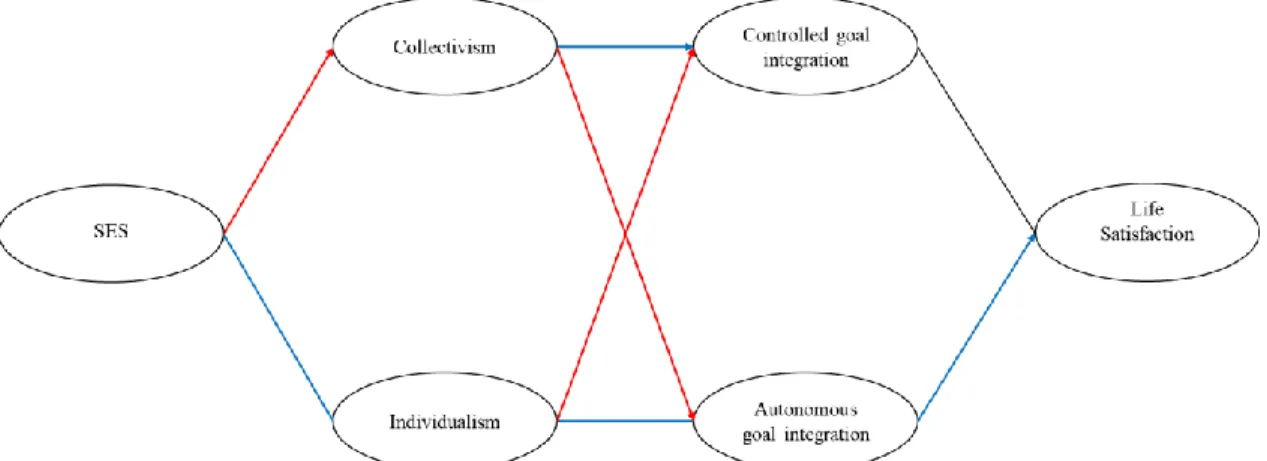
(15) Specific objective 3: Examine whether a serial mediation effect exists between SES and life satisfaction through both individualistic and collectivistic orientations and goal integration.. 4. Hypotheses. For the general objective, it was hypothesized that SES would positively predict individualistic orientation and negatively predict collectivistic orientation. In turn, individualistic orientation would be positively associated with autonomous goal integration and negatively associated with controlled goal integration. Collectivistic orientation would follow the opposite pattern, being negatively associated with autonomous goal integration, and positively with controlled goal integration. Lastly, autonomous goal integration will positively predict life satisfaction and controlled goal integration will have no effect on life satisfaction. A negative indirect effect from SES to controlled goal integration through collectivistic orientation is predicted, as well as a positive indirect effect from SES to autonomous goal integration through individualistic orientation.. Figure 1. Main hypotheses. Red paths are expected to be negative, blue paths are expected to be positive.. 14.
(16) 5. Method. Design and participants A total of 495 students (59.2% female) aged between 18 and 30 years (M = 21.39; SD = 2.69) completed the online survey. Survey distribution was done through Facebook and Instagram advertisements that targeted Chilean individuals between 18 and 24 years old that were currently enrolled in a higher education institution, and also through Facebook posts in various student related groups. Participants were offered participation in a drawing for gift cards as incentives for their participation. The survey required agreement to the informed consent letter at the beginning, but no personal information or signature was collected or required, unless the participants wanted to enter an email address for the incentives’ drawing. Data collection took place between November 2018 and January 2019. Ethical considerations This study was approved by the Comité Científico de Ciencias Sociales, Artes y Humanidades of the Pontificia Universidad Católica de Chile (ID: 171107004) on June 13th 2018. This study was deemed to pose no risks of any kind to participants. An informed consent letter was presented to all participants at the beginning of the survey, and those who did not agree to said letter, were not given the opportunity to continue answering the survey. However, given the nature of the study, no signature or personal information of any kind required or collected, except for an email address in case participants wished to take part in the drawing for the incentives. However, all email addresses were kept separately from the respondents’ data, and destroyed after the drawing was finalized.. 15.
(17) Measures Socioeconomic Status: SES was assessed by monthly income during secondary education in intervals according to the income distribution in Chile, and by the highest educational level achieved by the individuals’ parents. Individualistic and collectivistic orientations: In order to measure individualistic and collectivistic orientations, the original short 10-item version of the self-construal scale (D’Amico & Scrima, 2016) was included, which uses a 5 point Likert-type scale where participants have to rate their agreement to different statements. For this original scale, model fit was adequate (χ2 (34) = 82.88, p < .001; χ2/df = 2.43; RMSEA = .05, p = .31; CFI = .89; TLI = .86; SRMR = .05), however, item 9, which belongs in the collectivism scale had a very poor factor loading of .13, which makes sense given that the statement does not reflect collectivism directly (“I would stay in a group if they need me, even if I am not happy in the group”). The model was re-specified without item 9, and model fit was deemed acceptable (χ2 (26) = 67.46, p < .001; χ2/df = 2.59; RMSEA = .06, p = .23; CFI = .90; TLI = .87; SRMR = .05). Even though good model fit indicates no crossloading issues, the individualism measure has very low factor loadings. The above was expected given that most of the items in the original scale are more related to authenticity as a characteristic of individualism rather than individualism in general (e.g. “I act the same way in every situation”, “I do my own thing without worrying what others think”). Consequently, and considering the purpose of the study and theoretical aspects of the measurement itself, the aforementioned individualism scale was replaced for a happiness related individualism subscale of 3 items in the same format created specifically for this purpose, which is in line with the original collectivism subscale, and the model was assessed for model fit. The individualism scale had good reliability (α = .75), as well as the original collectivism scale without item 9 (α = .73). With the two factors, meaning the original collectivism scale and the new individualistic happiness scale, model fit was excellent (χ2 (13) = 11.34, p = .58; RMSEA = .00, p = .98; 16.
(18) CFI = 1.000; TLI = 1.000; SRMR = .018). All factor loadings were above .60. Factor correlations between the two latent variables was low and negative (r = -.12), highlighting the relative independence of the two dimensions and the bifactor structure. This was considered good enough measure for collectivistic and individualistic orientations for the purposes of this study, and it was decided to move forward with this model to the next step. In order to understand if the instrument maintains the same structure across different socioeconomic levels, invariance testing was carried out. In order to classify the participants by SES, dividing the sample by the median in terms of reported household income during their secondary education. This corresponded to the third category (starting from the lowest) of seven in terms of income. The initial model fit for the unconstrained model was, as expected, excellent (χ2(31) = 26.34, p = .70; RMSEA = .00, p = .99; CFI = 1.000; TLI = 1.000; SRMR = .03). The model fit for the constrained model with all factor loadings and factor correlations constrained to equality between both groups was very good (χ2(36) = 35.49, p = .54; RMSEA = .00, p = .98; CFI = .1.000; TLI = 1.000; SRMR = .06). Differential testing for both models showed no significant differences between them (χ2(5) = 9.15, p = .10), giving evidence of configurational invariance across SES for the self-construal measurement, without further model specification necessary. Goal integration: This measure consisted of a set of items where participants were presented with reasons to pursue academic goals and to rate on a scale from 1 to 5 how much they agreed to each statement in terms of their own reasons to pursue them. This is an adaptation of the self-concordance measurement by Milyavskaya, Naldony and Koestner (2014), but specifying the goal as the pursuit of an undergraduate degree. There were 8 items in total, 4 leaning towards the controlled pole (external and introjected) and 4 leaning towards the autonomous pole (identified, intrinsic). Reliability for the autonomous goal integration items was good (α = .70), and for the controlled goal integration items was very good (α = .83). 17.
(19) Well-being: In order to measure well-being, Diener’s Satisfaction with Life Scale (2006) was used, which consists of 5 items in a 5-point Likert format. Reliability for this scale was excellent (α = .85). Expected financial-related outcomes of academic goals: This measure had participants rate on a scale of 1 to 5, how important to them were the two following statements as outcomes of pursuing a degree: an individualistic outcome: “Having money to enjoy myself and live well”; and a more collectivistic outcome: “Having money to help my family (parents, siblings, grandparents, etc.)”. This is an adaptation of the selfconcordance measurement by Milyavskaya, Naldony and Koestner (2014) but with items asking for expected outcome instead of goal integration. These were included asking specifically for monetary outcomes given the relationship of pursuing academic goals and social mobility. Data-Analytic Strategy The hypothesized structural models were tested through structural equation modeling after fitting measurement models for each with all variables as latent constructs. All analyses were carried out using a weighted least squares mean and variance adjusted estimator (WLSMV) which is robust and does not assume normally distributed variables, providing the best option for modelling categorical or ordered data (Brown, 2006), as is the case with the Likert type questions in this study.. 6. Results. Descriptive Statistics Zero-order correlations among all latent variables in the study, as well as means and standard deviations are presented in Table 1.. 18.
(20) Table 1. Zero-order correlations and descriptive statistics 1.. 2.. 3.. 1. -0.15** 0.16** 1. Household income 1. -0.37** 2. Individualistic orientation 1. 3. Collectivistic orientation 4. Individualistic expected outcome 5. Collectivistic expected outcome 6. Controlled goal integration 7. Autonomous goal integration 8. Life satisfaction 3.83 3.74 3.04 Mean 1.85 0.79 0.61 SD 1-7 1-5 1-5 Range * Significant at the .05 level; ** significant at the .001 level. 4.. 5.. 6.. 7.. 8.. 0.04. -0.20**. 0.12*. -0.09. 0.05. 0.19**. 0.11*. -0.12*. 0.18*. 0.19**. -0.14**. 0.08. 0.18. -0.06. -0.03. 1.. 0.17**. 0.05. -0.01. -0.04. 1.. -0.04. 0.14**. 0.07. 1.. -0.53**. -0.23**. 1.. 0.30** 1.. 4.19. 4.22. 2.01. 4.06. 3.26. 0.83. 0.82. 1.05. 0.84. 0.88. 1-5. 1-5. 1-5. 1-5. 1-5. The sample showed good variability in terms of household income, which was a fundamental requirement for the study. The mean of this variable was near the middle point of the scale, with a large enough standard deviation to ensure a good representation of the socioeconomic spectrum. All the variables showed significant correlations in the direction that was hypothesized, with exception of household income, which showed a negative correlation with individualistic orientation, and a positive one with collectivistic orientation. The role of SES on academic goal integration through self-construal In order to test the first hypothesized model which hypothesizes that tests the mediation from SES to well-being through self-construal and academic goal integration, a measurement model needed to be fitted first. SES was measured by two observed indicators: father’s education and household income during secondary education. Selfconstrual was measured as described above, by two latent factors, one for individualism and one for collectivism. Academic goal integration was divided in factors with 3 indicators for autonomous goal integration and 4 indicators for controlled goal integration, showing an excellent model fit (χ2 (5) = 20.31, p = .001; RMSEA = .07, p = .08; CFI = .98; TLI = .96; WRMR = .92). Lastly, well-being was measured as a single construct with 5 19.
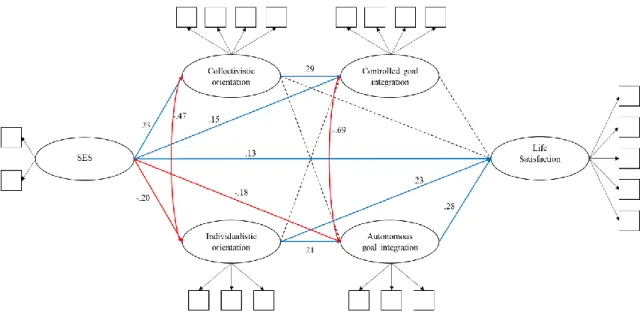
(21) indicators, corresponding to the 5 items of Diener’s life satisfaction scale. This latent variable specification showed very good fit to the data (χ2 (5) = 20.31, p = .001; RMSEA = .07, p = .08; CFI = .98; TLI = .96; WRMR = .94). The full measurement model, including all latent variables and their covariances showed excellent model fit (χ2 (137) = 237.672, p = < .001; RMSEA = .04, p = .99; CFI = 95; TLI = 94; WRMR = .94). The final model is shown in figure 2. The final assessment of model fit with all structural paths specified was excellent (χ2 (174) = 336.084, p = < .001; χ2/df = 1.93; RMSEA = .04, p = .94; CFI = 97; TLI = 97; WRMR = .93).. Figure 2. First structural model. Standardized coefficients shown. Fit statistics: χ2 (174) = 336.084, p = < .001; χ2/df = 1.93; RMSEA = .04, p = .94; CFI = 97; TLI = 97; WRMR = .93 As predicted, life satisfaction was positively predicted by autonomous goal integration (β = .27, p < .001), but was not significantly predicted in either direction by controlled goal integration (β = -.12, p = .15). In turn, autonomous goal integration was not significantly predicted by collectivistic orientation (β = -.001, p = .99) but positively predicted by individualistic orientation (β = .21, p < .001). Controlled goal integration was positively 20.
(22) predicted by collectivistic orientation (β = .29, p < .001), but not by individualistic orientation (β = .03, p = .65). However, contrary to what was expected, collectivistic orientation was positively predicted by SES (β = .23, p < .001), while individualistic orientation was predicted in the opposite direction (β = -.20, p < .001). When analyzing direct and indirect effects, SES showed a negative indirect effect on life satisfaction through individualistic orientation (β = -.05, p < .001; 95%CI [-.08, -.01]) and through autonomous goal integration (β = -.05, p < .001; 95%CI [-.09, -.01]). A negative indirect effect from SES to life satisfaction through both individualistic orientation and autonomous goal integration was also significant (β = -.01, p < .001; 95%CI [-.02, -.001]). Lastly, positive direct effect from SES to life satisfaction was also significant (β = .13, p < .001; 95%CI [.03, .23]). No indirect or direct effects were found from collectivistic orientation to life satisfaction. However, from individualistic orientation, there was a positive indirect effect through autonomous goal integration (β = .06, p < .001; 95%CI [.01, .10]), as well as a positive direct effect (β = .23, p < .001; 95%CI [.11, .34). Regarding autonomous goal integration, there was a significant negative indirect effect from SES through individualistic orientation (β = -.04, p < .001; 95%CI [-.07, -.01]), as well as a significant negative direct effect from SES (β = -.18, p < .001; 95%CI [-.28, .07]). For controlled goal integration, a significant positive indirect effect from SES was found through collectivistic orientation (β = .07, p < .001; 95%CI [.02, .11]), and a positive direct effect was also found (β = .15, p < .001; 95%CI [.04, .26]).. 21.
(23) The role of SES on academic goal integration through financial-related expected outcomes of academic goals pursuit To further understand the effects of SES on academic motivation and life satisfaction, instead of using the self-construal measures, two indicators of expected financial-related outcomes of goals were included in a separate model. These two indicators asked about the importance of financial resources as an outcome of pursuing an academic degree for themselves (“Having money to enjoy myself and live well”) and their family (“Having money to help my family (parents, siblings, grandparents, etc.)”), mirroring the individualistic and collectivistic orientations approach, but in the specific domain of financial resources, which has been described in the literature as being especially relevant in relation to intrinsic and extrinsic motivation. Model fit for the measurement model including all latent variables and their covariances was very good (χ2 (83) = 209.99, p = < .001; χ2/df = 2.53; RMSEA = .05, p = .16; CFI = 95; TLI = 94; WRMR = .94). After specifying the structural paths, model fit was excellent (χ2 (94) = 247.82, p = < .001; χ2/df = 2.63; RMSEA = .05, p = .08; CFI = 97; TLI = 96; WRMR = .95). Favorably to what was hypothesized, life satisfaction was again positively predicted by autonomous goal integration (β = .33, p < .001). As in the previous model, controlled goal integration did not show a significant prediction to life satisfaction. Contrary to what was hypothesized, the individualistic expected financial-related outcome of academic goals did not have a significant effect on autonomous goal integration. Instead, the collectivistic outcome expectation showed a positive association to it (β = .27, p < .001), and a negative effect on controlled goal integration (β = -.14, p < .001). Nonetheless, as predicted, SES had a negative effect on the collectivistic financial-oriented expected outcome (β = -.39, p < .001), but no relation between SES and the individualistic outcome was found.. 22.
(24) Figure 3. Second structural model. Standardized coefficients shown. Fit statistics: χ2 (94) = 247.82, p = < .001; χ2/df = 2.63; RMSEA = .05, p = .08; CFI = 97; TLI = 96; WRMR = .09 When analyzing direct and indirect effects in the model, a significant negative indirect effect from SES to life satisfaction through both the collectivistic financial related expected outcome and autonomous goal integration was found (β = -.03, p < .001; 95%CI [-.05, -.02]). No other indirect or direct effect from SES to life satisfaction was significant. A positive indirect effect was also significant from the collectivistic financial related expected outcome to life satisfaction through autonomous goal integration (β = .10, p < .001; 95%CI [.04, .14]). No significant indirect or direct effects were found from the individualistic financial expected outcome to life satisfaction. However, a negative indirect effect from SES to autonomous goal integration was found through the collectivistic financial related expected outcome (β = -.10, p < .001; 95%CI [-.14, -.06]), as well as a positive indirect effect from SES to controlled goal integration through the collectivistic financial related expected outcome (β = .06, p < .001; 95%CI [.02, 09]).. 23.
(25) 7. Discussion. The findings of this study highlight many interesting phenomena. First, as was hypothesized for this study and as has been found in many studies regarding human motivation and well-being (Deci & Ryan, 2000), autonomous goal integration in the academic domain had a positive effect on life satisfaction, which further highlights the importance of understanding the motives behind goal pursuit. Controlled integration did not predict life satisfaction, which goes in line with what has been studied as well. In terms of the relation between self-construal and goal integration, the results show that being more individualistic leads to having more autonomous academic goal integration, which makes sense when taking into consideration that the primary discourse related to academic goals in Chile tends to be individualistic in nature, since they are related to the future labor conditions of individuals and the Chilean culture tends to promote individualistic values in this domain (Abarca, Majluf y Rodríguez, 1998). At the same time, having a collectivistic orientation leads to a more controlled goal integration, as was predicted for this study, however this only happened with the overall orientation, and not the expected collectivistic financial-related outcome. However, and also in line with what has been described in the literature (Deci & Ryan, 2000) the individualistic financialrelated expected outcome did not predict autonomous goal orientation, meaning that expecting money for oneself, is probably more related to an extrinsic goal, and in fact, it positively predicted controlled goal integration as well. The most interesting finding was the inverse association between SES and individualism. This goes against what was expected based on the literature regarding cultural differences and socioeconomic status, nonetheless, there is a possibility that the relation might work that way due to the fact meritocracy beliefs are highly prevalent in Chile when it comes to social mobility, and such beliefs can even predict academic success in lower SES individuals (Ochoa & Orbeta, 2017). This creates an ‘every man for himself’ cultural environment that is highly competitive, where one’s own effort and merits are what is 24.
(26) most important. In fact, in this regard some studies have shown that lower SES individuals view academic degrees as a way to compensate their lack of social networks, so they have a somewhat ‘blind faith’ in them as a promise to achieve better quality of life and social mobility (Araujo & Martuccelli, 2015). The fact that the sample consisted of students that had already been enrolled in a university program, could mean that an individualistic mindset is what was necessary to overcome the barriers that SES, through meritocratic beliefs, impose on social mobility in Chile, meaning that lower SES individuals with more collectivistic orientations might be at a disadvantage to even make it to the university. If this finding can be attributed to this system of beliefs in Chile, then these beliefs might be counterproductive for processes of social mobility of the lower sector as a whole because of the lack of cooperation that is implied in this mindset, further enhancing social injustice. This poses an important question to policy makers about the kind of society that we want to build: Do we really want to live in a society where it is ‘everyone for themselves’? However, when analyzing the specific financial-related outcome expected from pursuing a university degree, the negative association between SES and the collectivistic financialrelated outcome shows that low SES individuals are more likely to expect to be able to support their families through acquiring financial resources, whereas high SES individuals showed no tendency towards either of the financial-related outcomes. This could mean that even though an overall individualistic system of values is more likely to be present in lower SES individuals, there is still a collectivistic approach to their individual pursuits, and this could indicate that self-construal might operate on two different and independent levels. In fact, a study from social identity theorists found that individualism and collectivism can be considered as orthogonal to autonomous and relational social orientations, and as such created a taxonomy that classified individuals in four categories defined by the mixture of the above variables (Brown, Hinkle, Ely, FoxCardamone, Maras & Taylor, 1992). These mechanisms might be what is at play in these results as well, because even though low SES predicted higher levels of individualism, 25.
(27) the fact that individuals still pursue academic goals with a relational oriented goal could be an effect from those with relational orientations, which in turn could be the intermediate mechanism that defines its relation with goal integration, and ultimately, well-being. In fact, the collectivistic financial-related expected outcome of academic pursuit predicted higher levels of autonomous goal integration, and in turn, higher levels of life satisfaction, which could indicate that when lower SES individuals pursue financial resources for collectivistic reasons, this can revert the expected negative impact of SES on well-being through a cooperative mindset, as opposed to the current competitive and meritocratic system that prevails as the dominant discourse in Chile. As was mentioned earlier, it is very likely that lower SES individuals have not built their lives around pursuing an academic degree to the same extent that high SES individuals might have given their relative distance to other professionals, their family history, and their own context expectations for them; whereas for high SES individuals, pursuing an academic degree is more or less the norm, and what is expected of them. However, given that some lower SES individuals are able to overcome some barriers in order to pursue an academic degree, their goal integration is fostered when they can make sense of that pursuit through a collectivistic goal (which could mean an individualistic/relational orientation), which in turn has a positive impact on their life satisfaction, even if, overall, SES has a negative relation to it. For higher SES individuals’, financial-related outcomes appear to not be relevant to their goal integration, which also makes sense, considering that financial resources are presumably not a primary concern for them. The above is extremely interesting when one thinks about the social identity mechanics that might be at play when it comes to socioeconomic status. On one hand, if socioeconomic status can be understood as a group identity, a paradoxical relation between belonging to a lower SES and identifying with the group arises. The goal of social mobility, is in itself, a way to move from one group to another, which implies a certain degree of rejection of one’s own group identity. How can individuals identify themselves 26.
(28) with a group in which they wished they didn’t belong? In fact, some studies have found that lower SES individuals are less likely to define themselves in terms of their socioeconomic status, when compared to middle or high SES individuals, which could be why most people identify themselves as ‘middle-class’ when asked about their socioeconomic status (Manstead, 2018). Because of this, one could think that for lower SES individuals, academic goals, which are presented by the institutions as highly individualistic, are a way to become part of a more advantaged group, while leaving behind one’s own, less advantaged group of origin, by means of internalizing the independent cultural ideals and meritocratic beliefs. However, these beliefs no only promote social inequalities and widen the divisions between social classes, but put lower SES individuals up for failure given that most academic contexts promote norms and values that are more familiar to middle-class and upper-class individuals, who end up outperforming their lower SES peers, further reproducing class differences (Manstead, 2018). The results were also interesting for high SES individuals. It was found that they tend to have a more collectivistic orientation, which is difficult to understand at first given that this does not reflect the independent cultural ideals that higher SES is supposed to represent. However, this might have to do with the fact that they place more importance on their families in terms of interdependence because of a need to maintain and further increase their advantageous status before achieving financial independence. While lower SES individuals might be forced to acquire an ‘I have to make it on my own’ mindset, higher SES individuals’ might be more reliant on their families, in terms of economic resources to do and facilitate the process, but also in terms of peer pressure to adhere to certain values and specific life paths, preserving the group status. This is highlighted by the fact that collectivistic orientation is positively associated with controlled academic goal integration, and could mean that collectivistic values do not represent a tendency towards interdependence in a relational way, but more as a requirement for maintaining certain standards of living and complying with expectations. In fact, the expectations of high SES parents regarding their child earning at least a Bachelor’s degree, even if their 27.
(29) child is low-achieving in the academic domain, are higher than those from parents of highachieving low SES children (Stull, 2013), and these expectations can translate into pressure that thwart the autonomy of individuals’. It is important to note that this study considered participants from all parts of the country, and it is a possibility that the dynamics for the present findings might be further comprehended if one took into account the possible intra-cultural differences between big cities like the capital, and smaller cities in other regions. If those cultural differences exist in terms of self-construal, it could further enhance the study findings and the understanding of intra-cultural differences in academic goals. To conclude, the most relevant conclusion that one could take from these results, is that even if lower SES has a negative effect on the quality of life of individuals overall, having an individualistic orientation can buffer these negative effects by promoting a more autonomous goal integration, as evidenced by the indirect effects from SES to life satisfaction through both variables as mediators. However, the fact low SES individuals tend to have a more individualistic orientation in general, is very detrimental to social mobility, given that lower SES individuals actively think they should stay away from what would be the best scenario for them as a group, meaning one that involves collaboration and a feeling of belonging. At the same time, for higher SES individuals, the opposite is true, where their own group seems to be more important than their own autonomy, having a negative impact on their life satisfaction. This poses an important question, to both policy makers and social theorists in general, about the current conceptions of academic goals present in western societies, and who are they really benefiting in terms of wellbeing, or if they are just maintaining a status quo in terms of social change. In this regard, it would be especially important that further studies could dive deeper into this phenomenon, to understand if there are contexts where these mechanisms work in a way that actually can contribute to well-being and social mobility, to maybe shed some light into how western societies could move towards equity and the promotion of wellbeing among its members. 28.
(30) 7. References Abarca, N., Majluf, N., & Rodríguez, D. (1998). Identifying management in Chile. International Studies of Management & Organization, 28(2), 18-37. doi: 10.1080/00208825.1998.11656732 Araujo, Kathya, & Martuccelli, Danilo. (2015). La escuela y la cuestión del mérito: reflexiones desde la experiencia chilena. Educação e Pesquisa, 41(spe), 1503-1520. https://dx.doi.org/10.1590/S1517-9702201508141653 Brown, T. (2006). Confirmatory factor analysis for applied research. New York: Guildford. Carver, C. S., & Scheier, M. F. (2000). Autonomy and self-regulation. Psychological Inquiry, 11, 284–290. Chen, B., Vansteenkiste, M., Beyers, W., Boone, L., Deci, E. L., Van der Kaap-Deeder, J.,…Verstuyf, J. (2015). Basic Psychological Need Satisfaction, Need Frustration and Need Strength across Four Cultures. Motivation and Emotion, 39, 216-326. D'Amico, A., Scrima, F., & Scrima, F. (2016). The Italian Validation of Singelis’s SelfConstrual Scale (SCS): a Short 10-Item Version Shows Improved Psychometric Properties. Current Psychology, 35, 159-168. Deci, E. L., & Ryan, R. M. (2000). The “what” and “why” of goal pursuits: Human needs and the self-determination of behavior. Psychological Inquiry, 11, 227-268. Diener, E. (2006). Understanding Scores on the Satisfaction with Life Scale. Retrieved from: http://internal.psychology.illinois.edu/~ediener/SWLS.html Diener, E., & Diener, M. (1995). Cross-cultural correlates of life satisfaction and selfesteem. Journal of Personality and Social Psychology, 68, 653-663.. 29.
(31) Emmons, R. A. (1996). Striving and feeling: Personal goals and subjective well-being. P.M. Gollwitzer & J.A. Bargh (Eds.), The psychology of Action: Linking Cognition and Motivation to Behavior (pp. 313-337). New York: Guilford Press. Emmons, R.A. (1986). Personal strivings: An approach to personality and subjective wellbeing.. Journal of Personality and Social Psychology, 51, 1058-1068.. Grouzet, F., Kasser, T., Ahuvia, A., Dols, J., Kim, Y., Lau, S., Ryan, R., Saunders, S., Schmuck, P., & K.M. Sheldon. (2005). The structure of goal contents across 15 cultures. Journal of Personality & Social Psychology, 89, (5), 800-816. Hitokoto, H., & Uchida, Y. (2015). Interdependent Happiness: Theoretical importance and measurement validity. Journal of Happiness Studies, 16, 211-239. Inglehart, R., Foa, R., Peterson, C., & Welzel, C. (2008). Development, freedom, and rising happiness: A global perspective (1981-2007). Perspectives on Psychological Science, 3(4), 264-285. Ingrid, B., Majda, R., & Dubravka, M. (2009). Life goals and well-being: Are extrinsic aspirations always determinatal to well-being? Psihologijske Teme, 18(2), 317-334. Kasser, T. (2002). Sketches for a self-determination theory of values. In E. L. Deci & R. M. Ryan (Eds.), Handbook of self-determination research (pp. 123–140). Rochester, NY: University of Rochester Press. Kasser, T. (2002). Sketches for a self-determination theory of values. In E. L. Deci & R. M. Ryan (eds.), Handbook of self-determination research (pp. 123-140). Rochester, NY: University Press. Kasser, T., & Ryan, R. M. (1996). Further examining the American dream: Differential correlates of intrinsic and extrinsic goals. Personality and Social Psychology Bulletin, 22, 80–87.. 30.
(32) Kasser, T., Ryan, R.M., Couchman, C.E., & Sheldon, K.M. (2004). Materialistic values: Their causes and consequences. In T. Kasser and A.D. Kanner (Eds.), Psychology and consumer culture. The struggle for a good life in a materialistic world (pp. 1128). Washington, DC: American Psychological Association. Kim, Y., Kasser, T., & Lee, H. (2003). Self-concept, aspirations, and well-being in South Korea and the United States. Journal of Social Psychology, 143, 277-290. Lekes, N., Gingras, I., Philippe, F.L., Koestner, R., & Fang, J. (2010). Parental autonomysupport, intrinsic life goals and well-being among adolescents in China and North America. Journal of Youth and Adolescence, 39(8), 858-869. Luria, G., Cnaan, R.A., & Boehm, A. (2014). National culture and prosocial behaviors: Results from 66 countries. Nonprofit and Voluntary Sector Quarterly. Advance online publication. doi:10.1177/0899764014554456 Lyubomirsky, S., & Lepper, H. S. (1999). A Measure of Subjective Happiness: Preliminary Reliability and Construct Validation. Social Indicators Research, 46(2), 137-155. Manstead, A. S. R. (2018). The psychology of social class: How socioeconomic status impacts thought, feelings, and behavior. British Journal of Social Psychology. 57(2), 267-291. DOI: 10.1111/bjso.12251 Maslow, A. (1971). The farther reaches of human nature. New York: Viking Press. Milyavskaya, M., & Koestner, R. (2011). Psychological needs, self-concordance and well-being: Test of self-determination theory across multiple domains. Personality and Individual Differences, 50, 387-391. Milyavskaya, M., Gingras, I., Mageau, G., Koestner, R., Gagnon, H., Fang, J., & Boiche, J. (2009). Balance across contexts: The importance of balanced need satisfaction. 31.
(33) across various life domains in adolescence. Personality and Social Psychology Bulletin, 35, 1035-1045. Milyavskaya, M., Nadolny, D. & Koestner, R. (2014). Where do self-concordant goals come from? The role of domain-specific psychological need satisfaction. Personality and Social Psychology Bulletin, 40(6), 700-711. Ochoa, Mónica Peña, & Orbeta, Camila Toledo. (2017). Discursos sobre clase social y meritocracia de escolares vulnerables en Chile. Cuadernos de Pesquisa, 47(164), 496-518. https://dx.doi.org/10.1590/198053143752 Oishi, S., Diener, E., Suh, E., & Lucas, R.E. (1999). Values as a moderator in subjective well-being. Journal of Personality, 67, 157-184. Rijavec, M., Brdar, I., & Miljkovic, D. (2005). What makes us happy? Intrinsic/extrinsic life goals and well-being. 7th Alps-Adria Conference in Psychology, Zadar, Book of Abstracts, p.60. Rijavec, M., Brdar, I., & Miljkovic, D. (2006). Extrinsic vs. Intrinsic life goals, psychological needs, and well-being. In A. Delle Fave (Ed.), Dimensions of wellbeing: Research and interventions Ryan, R.M., Chirkov, V.I., Little, T.D., Sheldon, K.M., Timoshina, E., & Deci, E.L. (1999). The American dream in Russia: Extrinsic aspirations and well-being in two cultures. Personality and Social Psychology Bulletin, 25, 1509-1524. Sebire, S. J., Standage, M., & Vansteenkiste, M. (2009). Examining goal content in the exercise domain: Intrinsic versus extrinsic goals: cognitive, affective and behavioral outcomes; and psychological need satisfaction. Journal of Sport and Exercise Psychology, 31, 1-24.. 32.
(34) Sheldon, K. M., & Elliot, A. J. (1999). Goal striving, need-satisfaction and longitudinal well-being: The self-concordance model. Journal of Personality and Social Psychology, 76, 482-497. Sheldon, K. M., & Elliot, A. J. (2000). Personal goals in social roles: Divergences and convergences across roles and levels of analysis. Journal of Personality, 68, 51-84. Sheldon, K. M., Arndt, J., & Houser-Marko, L. (2003). In search of the organismic valuing process: The human tendency to move towards beneficial goal choices. Journal of Personality, 71, 835–869. Sheldon, K.M. & Kasser, T. (2008). Psychological threat and extrinsic goal striving. Motivation and Emotion, 32, 37-45. Stull, J. C. (2013). Family Socioeconomic Status, Parent Expectations, and a Child’s Achievement. Research. in. Education, 90(1),. 53–. 67. https://doi.org/10.7227/RIE.90.1.4 Tabachnick, S. E., Miller, R. B., & Relyea, G. E. (2008). The relationships among students' future-oriented goals and subgoals, perceived task instrumentality and task-oriented self-regulation strategies in an academic environment. Journal of Educational Psychology, 100, 629-642. Vansteenkiste, M., Lens, W., & Deci, E. L. (2006). Intrinsic vs. extrinsic goal contents in self-determination theory: Another look at the quality of academic motivation. Educational Psychologist, 41, 19-31. Vansteenkiste, M., Soenens, B., & Duriez, B. (2008). Presenting a positive alternative to strivings for material success and the thin-ideal: Understanding the effects of extrinsic relative to intrinsic goal pursuits. In S. J. Lopez (Ed.). Positive psychology: Exploring the best in people (Vol. 4, pp.57-86). Westport, CT: Praeger.. 33.
(35) Veenhoven, R. (1999). Quality-of-life in individualistic society: A comparison of 43 nations in the early 1990’s. Social Indicators Research, 48, 157-186. Verstuyf, J., Vansteenkiste, M., & Soenens, B. (2012). Is eating regulation always related to bulimic symptoms? The differential correlates of health-focused and appearancefocused eating regulation. Body Image: An International Journal of Research, 9, 108-117. Wong, N. Y. & Ahuvia, A.C. (1998). Personal taste and family face: Luxury consumption in Confucian and western societies. Psychology & Marketing, 15(5), 423-441.. 34.
(36) Appendix 1 - Survey Cuestionario Para comenzar, por favor cuéntanos un poco sobre ti para poder contextualizar tus respuestas en la encuesta:. 1. ¿Qué carrera estudias? _______________________________________ 2. ¿En qué institución estudias? _______________________________________ 3. ¿En qué año de tu carrera estás? _______________________________________ 4. ¿Cuántos años tienes? _______________________________________ 5. ¿Con qué género te identificas? ❒ Femenino ❒ Masculino ❒ Mi género se ve mejor representado por el término: __________. 6. Pensando en tu vida en general, marca qué tan de acuerdo estás con las siguientes afirmaciones: Hago mis propias cosas sin importarme lo que piense el resto. Totalmente en desacuerdo. 1 2 3 4 5 6 7 Totalmente de acuerdo. Estoy dispuesto a sacrificar mis intereses personales por el beneficio de personas importantes para mí. Totalmente en desacuerdo. 1 2 3 4 5 6 7. Prefiero decir que “no” directamente, que arriesgarme a tener un mal entendido. Totalmente en desacuerdo. 1 2 3 4 5 6 7 Totalmente de acuerdo. Totalmente de acuerdo. 35.
(37) Prefiero ser directo y explícito con personas que Totalmente en desacuerdo recién conozco. 1 2 3 4 5 6 7 Totalmente de acuerdo. Si alguien importante para mí falla o fracasa, me Totalmente en desacuerdo siento responsable. 1 2 3 4 5 6 7 Totalmente de acuerdo. Frecuentemente tengo la sensación de que mi relación con mis seres queridos es más importante que mis propios logros. Totalmente en desacuerdo. 1 2 3 4 5 6 7. Totalmente de acuerdo. Actúo de la misma manera, sin importar con quien o quienes esté. Totalmente en desacuerdo. 1 2 3 4 5 6 7. Totalmente de acuerdo. Mi felicidad depende de la felicidad de quienes me rodean. Totalmente en desacuerdo. 1 2 3 4 5 6 7 Totalmente de acuerdo. Me quedaría en un grupo si me necesitaran, aun Totalmente en desacuerdo cuando no esté contento estando en el grupo. 1 2 3 4 5 6 7 Totalmente de acuerdo. Actúo de la misma forma en mi casa que en la universidad o el trabajo. Totalmente en desacuerdo. 1 2 3 4 5 6 7 Totalmente de acuerdo. La felicidad de cada quien no depende de la felicidad de los demás.. Totalmente en desacuerdo. 1 2 3 4 5 6 7 Totalmente de acuerdo. Cada quien tiene que poner su propio bienestar como prioridad.. Totalmente en desacuerdo. 1 2 3 4 5 6 7 Totalmente de acuerdo. Cada quien es responsable de su propia felicidad.. Totalmente en desacuerdo. 1 2 3 4 5 6 7 Totalmente de acuerdo. Cada quien debería enfocarse en sus propias metas y objetivos.. Totalmente en desacuerdo. 1 2 3 4 5 6 7 Totalmente de acuerdo. No podría ser feliz si las personas a mi alrededor Totalmente en desacuerdo no están felices también.. 1 2 3 4 5 6 7 Totalmente de acuerdo. A veces prefiero sacrificar mi propio bienestar por el bien de quienes me rodean.. Totalmente en desacuerdo. 1 2 3 4 5 6 7 Totalmente de acuerdo. Mi éxito personal, tanto material como no material, es para compartirlo con quienes son importantes paraen mí.mis propios logros y metas, Debo enfocarme. Totalmente en desacuerdo. 1 2 3 4 5 6 7 Totalmente de acuerdo. no en los de mi familia.. Totalmente en desacuerdo. 1 2 3 4 5 6 7 Totalmente de acuerdo. Si otros miembros de mi familia no logran lo mismo que yo, es porque se esfuerzan menos.. Totalmente en desacuerdo. 1 2 3 4 5 6 7 Totalmente de acuerdo. 36.
(38) Sería injusto que mi familia se beneficie de mi propio esfuerzo y logros.. Totalmente en desacuerdo. 1 2 3 4 5 6 7 Totalmente de acuerdo. 7. Pensando en tu experiencia en la educación media, marca qué tan de acuerdo estás con las siguientes afirmaciones: Siento que tuve libertad para elegir las cosas que hacía y aprendía en el colegio. Totalmente en desacuerdo. 1. 2. 3. 4. 5. 7. Totalmente de acuerdo. 7. Totalmente de acuerdo. 6. 7. Totalmente de acuerdo. 6. 7. Totalmente de acuerdo. 7. Totalmente de acuerdo. 6. Siento que mis acciones y decisiones reflejaron lo que realmente quería. Totalmente en desacuerdo. 1. 2. 3. 4. 5. 6. Siento que mis acciones y decisiones expresaron quien yo realmente era. Totalmente en desacuerdo. 1. 2. 3. 4. 5. Siento que hacía cosas que realmente me interesaban. Totalmente en desacuerdo. 1. 2. 3. 4. 5. La mayoría de las cosas que hacía, las hacía porque ‘tenía que hacerlas’. Totalmente en desacuerdo. 1. 2. 3. 4. 5. 6. Me sentía forzado a hacer muchas cosas que no quería hacer. 37.
(39) Totalmente en desacuerdo. 1. 2. 3. 4. 5. 6. 7. Totalmente de acuerdo. 5. 6. 7. Totalmente de acuerdo. 7. Totalmente de acuerdo. Me sentía presionado a hacer las cosas que hacía. Totalmente en desacuerdo. 1. 2. 3. 4. Mis actividades diarias se sentían como una cadena de obligaciones. Totalmente en desacuerdo. 1. 2. 3. 4. 5. 6. 8. Pensando en tus habilidades académicas en general, marca qué tan de acuerdo estás con las siguientes afirmaciones: Me siento confiado(a) en que puedo hacer las cosas bien académicamente. Totalmente en desacuerdo. 1. 2. 3. 4. 5. 6. 7. Totalmente de acuerdo. 4. 5. 6. 7. Totalmente de acuerdo. 6. 7. Totalmente de acuerdo. 6. 7. Totalmente de acuerdo. Me siento académicamente capaz. Totalmente en desacuerdo. 1. 2. 3. Me siento competente para lograr mis metas académicas. Totalmente en desacuerdo. 1. 2. 3. 4. 5. Siento que puedo lograr con éxito tareas académicas difíciles. Totalmente en desacuerdo. 1. 2. 3. 4. 5. 38.
(40) Tengo serias dudas sobre si puedo realmente hacer las cosas bien en el ámbito académico. Totalmente en desacuerdo. 1. 2. 3. 4. 6. 7. Totalmente de acuerdo. 5. 6. 7. Totalmente de acuerdo. 5. 6. 7. Totalmente de acuerdo. 5. Me siento decepcionado(a) con mi rendimiento académico. Totalmente en desacuerdo. 1. 2. 3. 4. Me siento inseguro(a) de mis habilidades académicas. Totalmente en desacuerdo. 1. 2. 3. 4. Me siento un fracaso por los errores que he cometido en el ámbito académico. Totalmente en desacuerdo. 1. 2. 3. 4. 5. 6. 7. Totalmente de acuerdo. 9. Pensando en tu carrera actual y tu motivación para querer terminarla, indica cuánta importancia le das a cada una de las siguientes razones para terminar tu carrera (Si no quieres terminar tu carrera actual o te cambiarás de carrera, entonces responde pensando en una carrera que sí te motive terminar). Realizarte como persona dedicándote a algo que realmente te gusta. Muy poco importante. 1 2 3 4 5 6 7 Muy importante. Ayudar a tu familia económicamente (padres, hermanos, abuelos). Muy poco importante. 1 2 3 4 5 6 7. Tener dinero para vivir bien y darte gustos. Muy poco importante. 1 2 3 4 5 6 7 Muy importante. Hacer que tu familia se sienta orgullosa de ti. Muy poco importante. 1 2 3 4 5 6 7 Muy importante. Muy importante. 39.
(41) 10. En el caso de que te fuera mal en la carrera, ¿Qué tanto te preocuparía lo siguiente? Si me va mal en mi carrera, siento que decepcionaría a mi familia o a otras personas importantes para mí.. Me No me 1 2 3 4 5 6 7 preocuparía preocuparía mucho. Si me va mal en mi carrera, podría perder beneficios estudiantiles (becas, créditos). No me Me 1 2 3 4 5 6 7 preocuparía preocuparía mucho Me No me 1 2 3 4 5 6 7 preocuparía preocuparía mucho. Si me va mal en mi carrera, perdería la oportunidad de dedicarme a lo que me apasiona.. 11. ¿Cuán identificado te sientes con las siguientes razones para estudiar tu carrera?. Te sientes obligado y sólo estudias porque otras personas quieren que lo hagas.. Para nada 1 2 3 4 5 6 7 Totalmente. Estudias porque podrás obtener beneficios al hacerlo (dinero, un buen trabajo), pero si tuvieras que elegir, preferirías no estudiar.. Para nada 1 2 3 4 5 6 7 Totalmente. Estudias porque hacerlo es un deber.. Para nada 1 2 3 4 5 6 7 Totalmente. Estudias porque te sentirías culpable si no lo hicieras o decepcionarías a alguien.. Para nada 1 2 3 4 5 6 7 Totalmente. Estudias porque crees que hacerlo es algo importante.. Para nada 1 2 3 4 5 6 7 Totalmente. Estudias porque crees que es algo bueno para ti.. Para nada 1 2 3 4 5 6 7 Totalmente. Estudias porque lo disfrutas y te gusta aprender.. Para nada 1 2 3 4 5 6 7 Totalmente. 40.
Figure
Documento similar
Since such powers frequently exist outside the institutional framework, and/or exercise their influence through channels exempt (or simply out of reach) from any political
Of special concern for this work are outbreaks formed by the benthic dinoflagellate Ostreopsis (Schmidt), including several species producers of palytoxin (PLTX)-like compounds,
In the previous sections we have shown how astronomical alignments and solar hierophanies – with a common interest in the solstices − were substantiated in the
While Russian nostalgia for the late-socialism of the Brezhnev era began only after the clear-cut rupture of 1991, nostalgia for the 1970s seems to have emerged in Algeria
Logistic regression analyses were conducted to analyze the predictive role of academic goals, academic self-concept, academic self-attributions, tobacco and alcohol abuse, sex,
The Dwellers in the Garden of Allah 109... The Dwellers in the Garden of Allah
Safety and performance of the drug-eluting absorbable metal scaffold (DREAMS) in patients with de-novo coronary lesions: 12 month results of the prospective, multicentre,
Ferrimagnetism - Magnetic behavior obtained when ions in a material have their magnetic moments aligned in an antiparallel arrangement such that the moments do not
