
Business models in the sector of the distribution
42
0
0
Texto completo
(2) INDEX. 1.. INTRODUCTION ....................................................................................................... 4. 2.. THEORETICAL REVIEW .......................................................................................... 5. 3.. CANVAS MODEL .................................................................................................... 10. 4.. PRACTICAL REPRESENTATION OF MERCADONA AND DIA ........................... 12. 4.1.. SECTOR OF ACTIVITY................................................................................... 13. 4.2.. CANVAS MODEL OF MERCADONA ............................................................. 14. 4.3.. CANVAS MODEL OF DIA ............................................................................... 26. 5.. CONCLUSION AND RECOMMENDATIONS ......................................................... 39. 6.. REFERENCES ........................................................................................................ 41.
(3) INDEX OF FIGURES. Figure 1: Evolution of business model ............................................................................. 5 Figure 2: Business model of Magretta ............................................................................. 7 Figure 3: Definition business model ................................................................................. 9 Figure 4: Business Model of Canvas ............................................................................. 12 Figure 5: ( % market share great Consumption Sector) ................................................ 13 Figure 6: Total Quality Model of Mercadona .................................................................. 15 Figure 7: Channels of Mercadona .................................................................................. 17 Figure 8: Network of logistical blocks of Mercadona ..................................................... 19 Figure 9: Channels of Mercadona .................................................................................. 19 Figure 10: Comparison of the figures of Mercadona of 2012 and 2013 ........................ 21 Figure 11: Ranking reputation ........................................................................................ 22 Figure 12: Channel 2 of DIA ........................................................................................... 30 Figure 13: Channel 3 of DIA ........................................................................................... 30 Figure 14: Comparison of the figures of DIA of 2012 and 2013 .................................... 31 Figure 15: Number of warehouses and floor area in each country ............................... 36 Figure 16: Main costs of DIA .......................................................................................... 38.
(4) 1. INTRODUCTION At present the concept of business model is very abstract, it does not have a clear definition, but there are multiple and various definitions of this concept. There are several researchers who have tried to define it, but have not come to an agreement among them. We can say that a business model attempts to explain how a company "does business", that is, all the activities of the company and in this way it tries to explain how to create value. Today all the companies have a business model to develop their activities, in spite of the difficult situation by many companies, it remains sadly usual to discover companies and executives who do not respond and implement a dangerous business philosophy, which takes them to the bankruptcy of their companies. All businesses have a business model, but every leader has a different opinion about what a business model is and how to apply it in their company. But it can be defined that a business model is the way in which a company creates value for their customers, such as that value is delivered to customers and how the proceeds are captured by the company. In recent years research theories on business models have increased. In 1995 there were only published about 50 articles, while in 2009 there were already 1203 articles. Some researchers say that this is due to the increased use of the Internet. The technology now enables companies to create, give and capture value in various forms. That it was not possible before, customers are now more receptive to new business models than to create a market for innovation. The business models are generally used to try to explain three phenomena: -E-commerce and the use of information technology in organizations. -Strategic Issues, such as creation of value, competitive advantage and performance of the company - Innovation and technology management These three phenomena are essential, for a company to have a good business model and to withstand the competitive pressures of the turbulent market in the world of business. So we'll try to study the different definitions and concepts that entail the business model of the researchers. The concept of business model raised a lot of interest from the emergence of the internet, more specifically since the irruption of the e-commerce as we said before, but their literature has just culminated in a theoretical subject. It is for this reason, that the objective of this paper is to review the different definitions of the business model, that is make a theoretical review, to extract the concepts that are best they are valued at the 4.
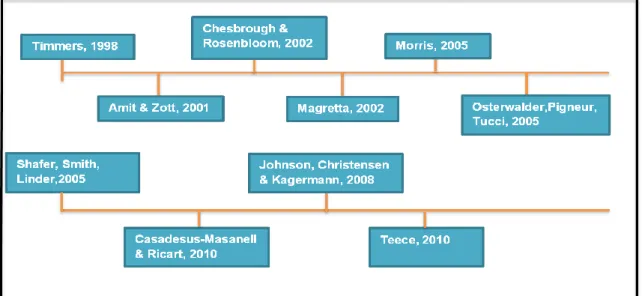
(5) time of making a model of business in different companies and also will allow to apply the concepts that define a business model from different perspectives. Another objective is to analyze two different business models in the same sector to understand how these components integrate into each in one company. To do this a methodology has been used, this has been the revision of specialized articles, manuals by the various authors and the data query to perform part of analysis of the companies it has been carried out by accessing their annual reports, in portals websites, etc.. 2. THEORETICAL REVIEW ¿Why is not there a clear definition of business model? The term of business model has grown in importance in recent years very fast, more specifically in the communities of the investors in people or entrepreneurs. Therefore, the majority of executives, investors or even entrepreneurs recognize the importance of the provision of a good business model. Without a good business model, the proposals of new products or the proposal of a new technology can be left as a very good idea that it will never become value by the inventors or by investors or by society as a whole. The term "business models" has flourished in the managerial activities since the late 1990s, especially in the wake of the emergence of the Internet era and of its mass adoption by part of the trade. That’s why now it will be described and compared the different proposals that have been given to the business model in the past few years. We can see in the graphic below the different authors that talk about the business model. Figure 1: Evolution of business model. Source: (Own preparation, 2014). 5.
(6) We look back to 1998, according to Timmers who defined the business model as " an architecture of the product, of services and information flows, including a description of the various business actors and their roles, a description of the potential benefits for the different business actors and a description of the sources of income". According to Amit & Zott (2001), the business model is a system with activities interrelated factors that considered the internal and external environment. They propose to design a business model that should look at elements of design and schema elements. The elements of the design represent: -The content: consists of activities that must be developed, the called "roles" of Timmers (1998). -The structure: It consists of how it activities should be linked, its importance, which are important and which ones are secondary, that is refers to create a value chain. -The government: Consists of who should carry out these activities and where. In other words, refers to the "actors" who appoints Timmers (1998). The elements of diagrams: -New: It is to adopt the innovation in the design elements, that is to say, in the content, structure or the government. - Lock-In: It is to keep third parties as part of the model -Complementary: It is that the activities generated all together produce greater value than the activities separately. -Efficiency: It consists of the reorganization of the activities to reduce transaction costs. In 2002, Chesbrough & Rosenbloom, proposed a business model of six stages in which, at each stage, it is possible to generate value to the company itself. The business model in an evolutionary process and dynamic, and leaders must be pending of improving it constantly. By what is defined as a trend and do not as a rigid architecture that it considered Timmers (1998). The business Models are proposed: Type 1: A company with a business model of undifferentiated (Act on the basis of price and product availability) Type 2: A company with some differentiation in their business model (acting on a differentiated segment) Type 3: A company that develops its business model segmented (operate in more than one segment at a time) Type 4: A company with a conscious business model of the external environment (Operate considering new ideas and technological changes) Type 5: Company that integrates its innovation model of the business model (acting together to their suppliers and customers to redefine the business model) 6.
(7) Type 6: The company's business model is a platform adaptive (Act in conjunction with the means to redefine its model and invest to generate alternative models) Regardless of the stage at which a company is found, the key factor to produce the change is that the executives have the leadership that is needed to carry out its objectives. Many companies do not make any changes, because the current model has worked well, and their executives lack the authority and capacity to carry out these changes, with the result that it is a disadvantage for the company itself, because the environment of the business is very dynamic and turbulent. On the other hand Magretta (2002) explains that the business models are like a story, for the story is good, you must overcome two tests. The first is a test of narrative, that is if the story makes sense, and the second is the test of the numbers, so if the history generates utility. That’s why Magretta define it as "stories that explain how the companies function". A good business model must respond to questions raised by Peter Drucker: Who is the customer? And what is the value for the customer? It also responds to the fundamental questions of each manager must ask: How can we make money in this business? What is the economic logic behind that explains how we deliver value to customers in an appropriate cost? Figure 2: Business model of Magretta. Test of narrative. Test of the numbers. Success. Source: (own elaboration, 2014) Morris (2005) sees the business model as a concise representation of how addresses an interrelated set of decision variables in the areas of risk strategy, architecture and the economy to create sustainable competitive advantage in the markets defined. It has six key components: the value proposition, customers, internal processes and competences, external positioning, economic model and the personal factors and investors. These components are related to the design elements and schema explained by Amit & Zott (2001). The study of Osterwalder, Pigneur, & Tucci, in their article of 2005, displays a diagram, which shows in a clear and simple way, the description of the components that make up a business model, from the internal environment of the company. These authors are based on this definition: "The business model is a conceptual tool that contains a series of elements and their relationships that allow you to show the logic of a specific company. It is the description of the value that a company offers to one or different customer segments and includes the architecture of a company and its network of partners for the creation, marketing and delivery of that value and the relational capital, to generate income flows stable and sustainable. It consists of nine fundamental elements, from which, any company can design its value chain. The partners, the activities and the key resources, as well as the value proposition and cost structure would refer to the internal elements and more central to 7.
(8) the company through which it would generate the value for the customer segment, that has a need and with the value proposition, would be satisfied. Following the definition, the value should be provided to customers through the distribution channels and establishing relationships among them. This tool is known as a model of canvas that I will be explained in more detail below and it will also be a practical model of study. In this study, it was already starting to see more concepts used by other researchers, such as the architecture of Timmers (1998), the create value of Chesbrough & Rosenbloom (2002) or the source of income that appoints Timmers (1998). And it also appoints the majority of the fundamental components of the business model of Morris (2005), as the value proposition, customers, economic model (cost structure), internal competences (key resources). For its part Shafer, Smith & Linder (2005) analyzed 12 published definitions between 1989 and 2002 and developed a chart to identify the four categories common to all the definitions: strategic choices, value creation, capture value and value network. In the final analysis, a business model should include strategic choices, often associated with a network of collaborating organizations that explain the creation and capture value. You can see how it has been changing and evolving the concept of business model and the component More important that define it as we have seen published in the article of Shafer, Smith and Linder (2005), but we're going to go further and see more definitions as now Johnson , Christensen, & Kagermann in 2008 that define it as the composition of four elements: a value proposition to the customer, a formula to get the profit, the key resources (people, technology, information, etc. ) and the key processes (design, manufacturing, marketing, standards, procedures, etc. ). Looking at the elements we see that the first two correspond to the part of definition of a business model and also help to understand the current model and be able to be in a position to reinvent it, taking into account that aim is to create value for the company while it is being delivered value to the customer. The other two elements relate to how to deliver the mentioned value to customers, finding an innovative way that adequately meets the needs identified previously, that is to say these last two items refer to those mentioned by Shafer, Smith and Linder (2005) the creation of value and value network. In 2010, Casadesus-Masanell & Ricart, published an article where defined the business model as a set of elections and a set of consequences resulting from these elections. We see the evolution that has taken the definition of business model since Timmers (1998) is defined as architecture and these authors define it as an effect of cause-result, it has more to do with the article of Chesbrough & Rosenbloom (2002), since it must be overcome stage by stage, and go forward. As we have said Casadesus-Masanell & Ricart (2010) defined the business model as the set of elections of the company and its consequences. The elections may be the policy of operation, the physical assets where decides to invest and the structures of government that creates to implement policies and govern the assets. These elections shape the way to operate the company. In addition, these elections have consequences. For example, thanks to a consistent advertising the firm can increase the brand value. These consequences may be of two types, rigid and flexible. The rigid consequences accumulate over time and have a tendency to persist, such as the value of the brand, reputation, or the installed base. The consequences are flexible workflows 8.
(9) that may vary each period as the cost, the income or the volume of sales. The elections and their consequences are the business model. Identify the consequences of this is important because they allow us and sustain many elections. For example, the high volumes allow exploiting economies of scale. There are three types of elections: policies (indicate how they should do things), asset management (indicates how the money should be invested), and the government (indicates the conditions legal, contractual and organizational for the control of policies and assets). And to end of this review we are going to talk about the academic Teece (2010), where the majority of items that appoints are already defined by other researchers, such as can be the value proposition, value creation, clients, etc. Thus, it defines what the business model, articulates the logic, data and other evidence that support the value proposition that is offered to the consumer, and also a viable structure of costs and benefits for the company that carries that value to their consumers. Figure 3: Definition Business Model AUTHOR. DEFINITION. Timmers (1998). Architecture. Chesbrough & Rosenbloom (2002) Shafer, Smith y Linder (2005). A representation. Morris (2005) Casadesus-Masanell & Ricart (2010) Amit & Zott (2001) Johnson , Christensen ,& Kagermann (2008). A structural template (system). Magretta (2002). A history. Osterwalder, Pigneur, y Tucci (2005) A tool or conceptual model Teece (2010). Source: (own preparation, 2014) All of these authors, as we have seen, define the business model in a different way, but all of them are according to a business model that describes how an organization creates, deliver and capture value, and moreover, coincide in the following points: -The business model has become a new unit of analysis. -The business models explain how the firm can do business. -The company's activities play an important role in the various conceptualizations of the business models that have been proposed. 9.
(10) -The business models attempt to explain how to create value, not only the way in which it is captured.. 3. CANVAS MODEL As we have already seen there has been a great evolution of business model, but today the Canvas Model, developed by Alexander Osterwalder, is a tool that it used by a lot of companies to define their business models and that studies the majority of the concepts that are nominated by other authors, so that we will go into detail and they will be our study guide. Trying to make the process of developing a new business model takes into account all the key aspects that the future organization has to take into account watching them in an integrated manner in a graph, such as the one found below. To do this, the model is divided into 9 basic sections or modules that reflect the logic that a company follows to generate revenue and covering the main areas of a business: customers, supply, infrastructure and economic viability. It is a tool designed by experts, based on the development of business strategy, it allow to describe in a logical manner the way in which a business is run or just begun creates, delivery and capture value. The process of designing the business model is part of the business strategy of being the canvas a tool for strategic planning, so it is important to establish this type of resources to gain insight into how a company operates to know what the strengths and weaknesses are. The Canvas Model is divided in the following blocks: . Customer segments. This block defines the various groups of people or companies at which the activity of the company it is going to directed, the segment or market segments to which will be offered the company’s products or services. . Value Proposition. Basically, it is to define what will make a client chooses us and that will be a mixture of different qualitative and quantitative elements that cater for the needs of that segment. Aspects of a product or service that can generate value can be the design, the price, the accessibility, the speed of service, the brand, the functionalities, the possibility of customization, etc. . Distribution channels. This block is one of the key aspects of a business model. It should reflect the way in which it is intended to publicize the product or service, distribute it or sell it, that is, the way to deliver it. Describe the channels that the company intends to communicate the target customers and how they will be supplied by their products or services.. 10.
(11) . Relationship with customers. It describes the types of relationships that the company will set up with the different segments, it is a very critical aspect, which may vary from personal level to automated and even contemplate the creation of communities of users or the creation of content, as is the creation of web sites (Youtube, Facebook, etc). . Sources of income. This is a very critical block. It should describe how you intend to secure the income to justify the existence of the company, these sources of income can be different for different groups of customers: payment of fees, licenses for use, aftermarket services, sale of products or services, loans, subscription, advertising etc. . Key resources.. In this block it must be defined the necessary resources, as well as the amount and intensity. All this so that the business will generate the expected value and will be able to survive in the market. These resources can be: physical, human and financial. . Key activities.. It is important within the company, as they are the ones that define the actions that are carried out to ensure that the business model work. These activities help to deliver the different types of clients the value proposition. . Key Partnerships.. In this block the necessary alliances will be collected that will enable the business functions, for example, agreements with suppliers or distributors, agreements with competitors or non-competitors. . Cost structure.. It is a fundamental part to develop all the blocks described above with guarantees. Where there are to know all those cost more important.. 11.
(12) Figure 4: Business Model of Canvas. Source: (Canvas, 2005). 4. PRACTICAL REPRESENTATION OF MERCADONA AND DIA . Mercadona. It is a distribution company, integrated within the segment of supermarkets, created in 1977 and 100% Spanish capital. Its executive president is Juan Roig. It is in 47 provinces of 16 Autonomous Communities with 1.491 supermarkets, with an average of between 1.300 and 1.500 square feet of sales floor, represent a market share over the entire surface of food in Spain of the 13.5 % and contribute to the dynamism of the commercial environment in which they are located and has a market share of 21 %. Currently it provides employment to more than 70.000 people, all of them with fixed contracts, develop his professional life in the company with the same goal: to meet the needs for food, household cleaning, hygiene and food for domestic animals, of the more than 4.8 million households that are carried out daily your purchase in Mercadona. . DIA. It is a distribution group of Spanish origin. The company was created in 1979 and today is headed by Ana Maria Llopis, remain one of the greatest Spanish company headed by a woman. DIA is one of the leaders of the power distribution to worldwide specializing in the discount segment, with a market share of 7.9 %. It has a presence in six countries: Spain, Portugal, France, Brazil, Argentina, and China. It has 44,000 employees spread between different countries and where it operates with 7,000 stores throughout the world through several formats: DIA Market, DIA Maxi, DIA Fresh and Schlecker throughout Spain.. 12.
(13) 4.1. SECTOR OF ACTIVITY. The sector that operates Mercadona is the distribution to the final consumer of food products, perfumes, drugstore and home. Within the retail stores, Mercadona competes with the similar establishments, supermarkets covered between 400 and 2499 square meters. Our sector of activity, large supermarkets, dealing with the 38% of the entire surface of the self-service retail and were 3172 shops in all of Spain during the 2012, an increase of 3.7 % compared to 2011, and represent 33.2 % of the sales of packaged foods. The company also operates in the sector of distribution to the final consumer of food products, perfumes, drugstore and refills telephone. Within the self-service establishments, operates in the sector of discount stores, which have a surface area of 250 to 600 square meters. There are currently more than 3.000 discount stores in Spain. In the next figure we can observe that Mercadona represents a market share of 21% in 2012, and the market share of the Valencian chain rubs that Carrefour Group jointly reach 7.1 %, DAY 7.9 %, 3.4 % Group Eroski and Alcampo 3.0 %. And is that these four players adds the 21.9% of the 100 per cent of that market share, only a 0.9% more than Mercadona solo.. Figure 5: ( % market share great Consumption Sector). Source: (Kantar Wordlpanel, 2013) 13.
(14) 4.2. CANVAS MODEL OF MERCADONA . Mercadona. Mercadona to develop its business model is based on solid pillars as having employees motivated, excellence in the processes to deliver the highest quality at the lowest price, satisfied customers, society satisfied and generating value for the shareholder, all with a mentality on the long term. By what Mercadona presents its Total Quality Model: "The Boss", "The worker", "The Supplier", "The Society" and "The Capital". The Total Quality Model introduces in the management of the company that, "in order to be satisfied, you must first satisfy the other". This commitment to Mercadona has become one of the leading companies in reference in the distribution sector, with a clearly defined mission: to be the "prescribers of the solutions necessary to ensure that 'The Boss' is fabricate your Purchase Total", through a different management and differential of the fresh products and the dried. The search for the total satisfaction of the workers and workers, which Mercadona considers one of its most valuable assets, is constant. For this reason, and with the goal of becoming the best company that treats its staff, the model of Human Resources of Mercadona is based on leadership and the effort and commitment to the personal satisfaction, permanent employment, continuous training, internal promotion, the equality of conditions and the reconciliation of family and professional life of all the people within the company, which makes it possible for anyone who has to satisfy "The Boss" this, in turn, satisfied. The Total Quality Model sets with the third component of the company, the supplier, a joint working relationship with the same goal: the satisfaction of "The Boss". For the achievement of this goal, Mercadona sets with their suppliers about close links, by means of a stable relationship that leads, in many instances, the signing of agreements of indefinite duration and to the creation of synergies that, ultimately, always for the benefit of "Heads" that made daily by your purchase in the supermarkets of the company. In addition, Mercadona, aware of the importance of the primary sector, has embarked on the road, together with their suppliers, to promote sustainable agri-food chain. It is equally important to Mercadona the satisfaction of the fourth component, the Society. For this purpose, with its shops contributes to modernize the trade of the urban neighborhoods in which it is present, that are in their supermarkets commercial dynamism that provide the 4.7 million families who place their trust in Mercadona. In fact, by focusing only on the sale of food products, drinks, household cleaning, personal hygiene and food for pets, the company encourages synergies with the trade of proximity through greater involvement in its development. From 2007, with the start of the recession, this model has intensified the perception of the customer as the central focus of all its decisions and has been experiencing significant innovations that have allowed the company to continue to increase its market share. In this case it describes the main features of the business model and the 14.
(15) most relevant measures that have been put in place to cope with the recession. With this, we intend to expose a real case of a company that has managed to continue moving forward, even in years of recession, notably thanks to the policies of cost reduction that has been accompanied by other measures related to employees, processes, suppliers and shareholders. Figure 6: Total Quality Model of Mercadona. Source: (Annual Report, 2013) Once seen the keys elements of the Total Quality model, we are going to analyze the business model Canvas within of Mercadona: CUSTOMER SEGMENT: The type of customers that is directed are residents in Spain, with a purchasing power medium-low. These customers appreciate the quality and price. But there is to say that the customer segment of Mercadona varies a lot, as it adapts its product offerings depending on the area in which the establishment is located. That is to say, do not offer the same variety or the same division of lots in a Mercadona close to the universities, that a Mercadona where the majority of those living near are families. Because those establishments that are located near the university living students, which they buy for themselves for the week or even for the day and do not buy large lots but individual units. In contrast, a Mercadona where living near families buying for the whole week family plots. All this, it is because Mercadona account with an efficient assortment that allows you to offer products for all types of customers such as the gluten-free products, in fact, Mercadona work together since 2000 with the Spanish Federation of Associations of Celiacs (FACE). VALUE PROPOSITION: In Mercadona there are different aspects that give value to the company, for example, the product. In Mercadona we find the products grouped into different sections: food, snacks, beverages, meats, sausages, home accessories, frozen, drugstore, fruits and 15.
(16) vegetables, oven and baked goods, dairy products, pets, perfumery and fishmonger. The intention of Mercadona is to show the product with the best value in the market. In constant adaptation to the needs of customers, Mercadona performs all the years an important work to innovate and develop new products, incorporating them with the assortment whenever you add value. From 2009, Mercadona has reintroduced in their supermarkets fruit in bulk, the ham to the court, the assortment of frozen meat and in bulk, and the fish in tray, which completes the offer at the front desk. Mercadona works together with the celiac associations since 2000 to be able to offer a wide assortment consisting of gluten-free products. Mercadona, account with its white brand in each of the sections that are in their supermarkets, these are Hacendado, Bosque Verde, Deliplus, Compy. The products may offer lower prices because they do not have any cost in R+D. That is a brand invests a lot of money in R+D and when they get the product to the market you'll get a price which includes: the cost of the product, the cost of the research, the cost of the employees, the logistics and the profit margin. If the product works, Mercadona does not take long to take advantage by launching one similar, with the difference that the research and development has left them free. Another element that gives value to the business, and as a result people buy, is the price. When we talk about the price in Mercadona highlight your mentality of “Always Low Prices”, is that it allows the customer a greater savings in the total amount of the purchase as it pays less for each product that puts in your cart. Mercadona can afford to do this since it buys the products directly at the source. Because it establishes long-term agreements with the manufacturers and can offer our customers high quality products at prices lower and more stable. We can see the example in the case of the milk, the pack of 6 units of 1 liter Hacendado brand has a price of 3.66 €, a price of 0.61e/u and in the case of milk Pascual the same pack has a price of 5.76 € that’s why the unit would have a price of 0.96 €. Food safety is a value present in all processes and decisions of the company. Therefore, any initiative that is being done, both in the assortment as in process optimization, is submitted prior to a comprehensive study. As a result, it certifies, before incorporating it and validates it, the compliance of the Golden Rule of Mercadona, which ensures, in that order, any product in its assortment you first need to ensure food security; after the quality, then the warmth; fourthly, offer service; in fifth, be competitive in price; and finally, creates a profit. To provide the maximum guarantees to the consumer, the company has a System of Quality Management and Food Security that pervades the entire supply chain: from its origin up to the final consumer.. 16.
(17) Mercadona says that in 2013 has devoted significant efforts to increase the range of products without lactose. We should also add that the company has maintained for more than a decade, a close relationship with the various associations of Spanish celiac, collaboration that falls in both the national and regional. In 2013, and thanks to this sustained commitment at the time, has expanded the number of references without gluten: 850 at the close of 2013, and all of them, like the rest of products that are part of the assortment of the company and are of the highest quality and with total guarantees food and nutritional support. On the other hand, another aspect of value proposition to Mercadona is innovation in shops. Mercadona has continued expanding and improving its network of shops, as it is its objective, to offer its customers the best buying experience possible. For this reason, in 2013 it has continued betting on your model of store environments, a model of eco-efficient store that took precedence in the criteria as differentiated spaces for business, energy efficiency, the productivity of the media or the comfort of use. The construction of the new supermarkets or the adaptation of existing ones to this store model requires a complex effort on the part of the company. This effort, in the case of the 61 new supermarkets open and the 53 reforms carried out in 2013, translates into a significant investment of resources both financial and personal: more than 250 million euros and an average of 60 suppliers that employ more than 110 people during the stage of labor in each store, to what you need to add all the technical equipment of the company for approximately 12 months working in the recruitment and preparation of the draft design and execution of works. With the opening and reform of these new stores, Mercadona consolidates its expansion and continues to reach out to the many "Boss" each year requested that the company's presence in the neighborhoods in which they reside, as evidenced, for example, by the more than 2.000 requests for deployment of a new supermarket that throughout 2013 has received the Customer Service of the company. CHANNEL OF DISTRIBUITION According to the destination of the products marketed the channel of Mercadona will be the corresponding to channel 2, as it can be seen in the image. First of all, the intersuppliers manufactured for Mercadona, which in this case is considered retailer and then the goods manufactured by the intersuppliers would become the final consumer. All this taking into account that the manufacturer to Mercadona the product go to logistics platforms, property of Mercadona, and hence trucks are sent to distribute the products to all its stores. Figure 7: Channels of Mercadona. MANUFACTURER. RETAILER (MERCADONA). CONSUMER. Source: (own elaboration, 2014). 17.
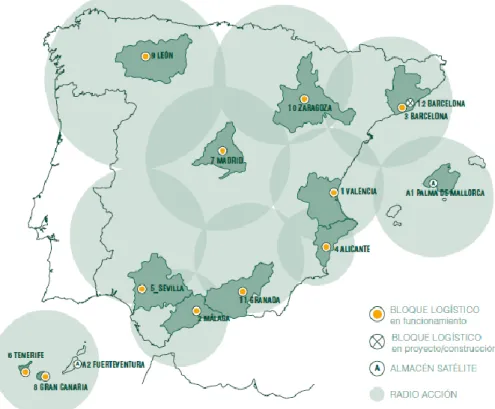
(18) The activities of the intersuppliers is the manufacture of the products in accordance with the conditions of Mercadona, after Mercadona transports the products to their logistics platform, because it has a fleet of trucks to make their transport, and hence the transports to the establishments. In regard to the logistical blocks, Mercadona has 12 logistical blocks throughout Spain, which supply to all supermarkets. This logistics network is to carry products with fewer resources. And for 2014 it is scheduled to open a new logistical block in Abrera (Barcelona). Their logistical blocks are located in: 1. RIBA-ROJA DE TÚRIA, Valencia 2. ANTEQUERA, Málaga 3. SANT SADURNÍ D'ANOIA, Barcelona 4. SAN ISIDRO, Alicante 5. HUÉVAR, Sevilla 6. GRANADILLA DE ABONA, Tenerife (Santa Cruz de Tenerife) 7. CIEMPOZUELOS, Madrid 8. INGENIO, Gran Canaria (Las Palmas) 9. VILLADANGOS DEL PÁRAMO, León 10. ZARAGOZA, Zaragoza 11. GUADIX, Granada 12. ABRERA, Barcelona A1. MERCAPALMA, Palma de Mallorca (Illes Balears) A2. FUERTEVENTURA (Las Palmas). 18.
(19) Figure 8: Network of logistical blocks of Mercadona. Source: (Memory enviroment, 2013). The intersuppliers of Mercadona used an exclusive distribution to Mercadona, since the products of the white mark of Mercadona cannot find in any other establishment that is not Mercadona. Finally, as to the classics suppliers, Mercadona works with more than 1.500 suppliers. Its distribution channel would be multi-channel, because for each one of its suppliers uses a different channel. Although primarily would be channel 2 where the manufacturer would deliver the products to the retailer establishment, in this case Mercadona, and from there to the final consumer.. Figure 9: Channels of Mercadona. MANUFACTURER. RETAILER (MERCADONA). CONSUMER. Source: (Own elaboration, 2014). 19.
(20) The activities of the suppliers would be the production of the products, but without the conditions of Mercadona, because each product is unique to the manufacturer. From production, it is transported to the logistics platform of Mercadona, and then the products are transported to the establishments RELATIONSHIP WITH THE CUSTOMER Mercadona maintains with its customers a close relationship based on trust and transparency. Therefore, it promotes an open attitude in which dialog is key, a constant dialog in which involve all those who form part of the company, and that is approached from very different areas. In this work of listening, the work done by the more than 200 people working in the Department of Prescription of the company has become to be especially relevant in 2013, because not only has enabled him to grasp and observe the preferences of the "Boss", but to understand your needs and convey them to the company adequately to be able to give correct answers. In addition to this work that is done "on foot of shop", Mercadona has strengthened its partnership in 2013 with the usual different associations representing consumers and ensure their interests, with those who have had meetings with the aim of promoting the training and information to the consumer. Mercadona has a Customer Service Center (CSC) that channels all the concerns raised by your customers via email or the toll-free number that the company has designed exclusively for this activity. Thanks to this channel that Mercadona permanently kept open with their "Boss", the company can listen to their views and clarify their doubts with greater agility and rightly. In 2013, people in the Customer Service Center of Mercadona received a total of 340,000 different queries and suggestions. The company also has official profiles in social networks Facebook, Twitter and Youtube, communication platforms for which it has a multidisciplinary team and trained to answer questions and suggestions of the customers in this area. All of these channels, as a whole, have helped to identify points for improvement, as is your goal, be the company that offers them the best solutions through an assortment of an efficient and positive shopping experience with the best service. In fact, through all of them not only provides information on the company but they are handled and resolved the doubts that the "Boss" have on the products and service that offers Mercadona. In 2013, a study on online purchases made by the OCU stressed to Mercadona as the food distribution company that greater timeliness offered, to meet in all the cases analyzed the deadlines involved. REVENUE STREAMS Mercadona earns revenues through the sale or on-line of their products to their customers, for it offers to its customer’s loyalty, trust, quality, good treatment and low prices, to try to gain their trust and be able to sell their products. 20.
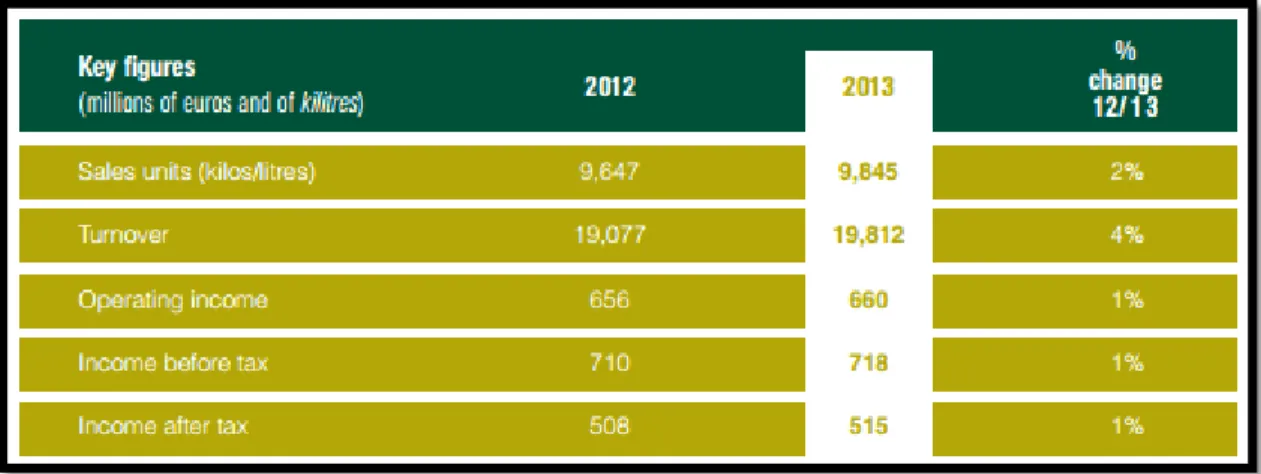
(21) Also supports the payment in cash, bank cards and credit or debit cards in Mercadona in their establishments. We can say that all of this was thanks to the satisfaction of the rest of the components of the business model that has been reflected in the economic data on the company and, therefore, has made it possible to achieve the satisfaction of the fifth component, the Capital. In the following table we can see the main figures in Mercadona, by what we see: Figure 10: Comparison of the figures of Mercadona of 2012 and 2013. Source: (Annual Report, 2013) - At the end of the year, the company reached a figure of 9,845 million kilitres sold, 2% more than the 9.647 of 2012. The company is satisfied with this figure, as it demonstrates the confidence of the 4.8 million households along these twelve months. -Mercadona has reached in 2013 a turnover of 19.812 million euros, up 4% more than in 2012 as a result of the confidence of the "Boss", the opening of 61 stores (5 closures), the reforms undertaken in 53 supermarkets and the firm commitment to prescribe the assortment with the best relation quality-price. -The profit before tax has been located in 718 million euros in 2013, compared to 710 million euros from the previous year, which represents an increase of 1 %. For its part, the after-tax profit in 2013 was 515 million euros, a 1% more than in 2012, the year that Mercadona obtained a net result of 508 million euros. -Mercadona, as we have already discussed, account with a total of 1.467 supermarkets, distributed in 47 provinces of 16 Autonomous Communities, and continues its implantation in the Spanish territory. During the year 2013, Mercadona has done, among others, investment of 650 million, aimed, primarily, to the construction of 61 new stores, to the reform of 53 supermarkets to suit the latest standards of comfort in the chain and the implementation of new models of sections of butcher and fishmonger, oven and fruit and vegetables.. 21.
(22) -At the close of fiscal year 2013, the figure of own resources amount to 3.438 million euros. It should be noted the continuing evolution of the ratio of own resources with regard to the total assets, which has risen from 48% in 2012 to 53% in 2013. KEY RESOURCES . Physical Resources. -The model of trade in Mercadona is considered urban proximity, since all of the supermarkets are located in the urban core. And many of them have their own parking. -Has 1467 stores located throughout Spain, with 1.500 square meters of average of sales room. -Also have elements of transport for their merchandise, as the fleet of trucks, and for the transport service of the home purchase, the vans. -In their supermarkets they also have forklifts for transporting pallets by the supermarket. -It has 10 logistical blocks in operation, Leon, Madrid, Zaragoza, Barcelona, Valencia, Alicante, Malaga, Sevilla, Tenerife, Gran Canaria. Also it has 2 Blocks in project/construction, in Barcelona and Granada. And 2 satellite stores in Palma de Mallorca and Fuerteventura. . Organizational resource. In terms of the organizational resources we can talk about reputation. Mercadona has a great reputation and we can check by the Merco survey 2013, where Mercadona is for the second consecutive year in second place behind Inditex. Therefore, in the food sector it would be in the first place. Figure 11: Ranking reputation. Source: (Merco, 2013) Mercadona also has organizational resource as the loyalty of their customers, as the large goal is to satisfy their needs. It is one of their best weapons since, Mercadona does not use a loyalty card (the card that only serves as a payment), or special promotions, but it wants to make them loyal to the shops, the given service, the products, prices, etc. 22.
(23) On the other hand, we can also say that Mercadona has trademarks, that is another organizational resource. The brands it owns Mercadona are: . Bosque Verde: drugstore and cleaning Compy: products for pets Deliplus: hygiene and health Hacendado: food and beverage Solcare: sun protection. In regard to the marketing system, Mercadona makes it possible that the products are spare parts quickly and efficiently so that clients can consume them. . Technological Resources. In terms of the technological resources, one of them could be the on-line purchasing service, in which “the Boss" may order the purchase over the internet and go to pick it up or that the workers bring it them home. Other technological resources can be cash registers, the scales of the grocery, butcher and pastries, cold rooms. Another could be the patent which has its own brands. •. Human Resources. Mercadona considers the human capital as the second goal, and therefore it is very important for the company. Invested in training 600 € on average per employee in 2012, that is 44 million euros. In the first place, Mercadona form the worker with the reception plan, and after the employee receives a continuous training, both individually and collectively. And therefore, they have increased the capabilities and skills of all staff of Mercadona. On the other hand, Mercadona has also encouraged the internal promotion. Mercadona has a good internal communication, based on transparency, trust and motivation of the staff. We can also say that the culture of Mercadona is based on the effort and work. Mercadona is also highlighted by making possible the work-life balance. Finally, spreads its benefits with remunerations variables with employees from over a year old. KEY ACTIVITIES One of the key activities that make Mercadona get the best distribution company is the training of workers: talent development The worker is one of the pillars of the company and ensures that the whole of the template is involved one hundred percent on the evolution and development of the draft Mercadona is a challenge that is approached from the motto, "in order to be satisfied, you must first satisfy the other". For this reason, they are making significant efforts at the Human Resources management, a management that promotes indispensable values and essential for the people, as is the creation of quality jobs from which are being promoted, among others, 23.
(24) the personal and professional development, stability, training, leadership, respect, fairness and demanding. Throughout 2013 the company has devoted significant resources to the training and development of the talents of workers. In fact, the recovery in Mercadona of trades such as el baker, orchard, fishmonger, butcher has meant an investment very relevant economic as well as the human, 3 million of euros and more than 60.000 hours of training reversed. As a result of this effort, the company shares the responsibility of being "shopkeepers" and has been able to adapt to the new methods of work arising from the incorporation of the new model of sales of fresh. In addition to this, and thanks to the training they received, ovenbirds, orchard, fishmongers, butchers and specialist butchers of Mercadona know in depth the characteristics of the products with which they work, which not only allows to inform customers with greater effectiveness, but tranquillizers the best solution them for your specific needs. It should be pointed out that one of the major milestones achieved by the company in 2013 has been the signing of the new Company Agreement and Plan of equality with the representatives of the Union General de Trabajadores (UGT) and of the Comisiones Obreras (CC.OO.). By means of this convention, which has a duration of five years, Mercadona reinforces its commitment to the creation of stable employment, specifically 1.000 new jobs until 2018, as well as with continuous training and with the promotion of measures to help to reconcile between their workers work and family life. Another key activity available to the company is the health and safety at work of their employees. The company has a Plan for Prevention and a Program of Health whose effectiveness is proven periodically by statutory audits of the system of management of occupational hazards, which allows you, as is its goal, which its preventive policy will be effective and is adapted to the different activities that are performed. Ensure the health and safety at work is a commitment that Mercadona maintains and develops through its preventive policy that affects each and every one of the productive processes and jobs. To protect and maintain the health of the people that make up your template, Mercadona has a team of specialists consisting of 95 professionals, 25 of them toplevel technical expertise in safety, hygiene, psychosociology and 70 health care professionals. In 2013, the company has earmarked 12.6 million euros to enter different precautionary improvements.. 24.
(25) ALLIANCE KEY One of the key partnerships of Mercadona is with the suppliers, mainly in the primary sector. This makes Mercadona create strong links with their suppliers and generate synergies where the two parties have benefits. By Mercadona is good to have a good relationship with their suppliers, as it is through this can reduce costs and have a good quality of their products according to their indications, as well as make new innovative products to stay ahead of the competition. Mercadona distinguishes its suppliers in three types: -classics: whose relationship with them is only contract. -Intermediaries: the agents between the supplier and Mercadona, which can increase the final cost of the product, in the case of Mercadona would be in the fruit, the fishermen and the brotherhoods. -Intersuppliers: are manufacturers that supplied exclusively to Mercadona products that design. Maintain a relationship in the very long term, and that makes them have mutual benefits. And to have a long-term relationship with their intersuppliers makes its bargaining power increase and it can impose further conditions. In the primary sector, Mercadona has stable agreements with 80 brotherhoods, 8.000 fishermen, 3.600 ranchers, 5.600 farmers. - The brotherhoods and fishermen, fish for the fish and the auctioned in the market for both Mercadona as other buyers will have the opportunity to purchase fresh fish. - Farmers buy seed, planted, irrigated crop, they collect the products and sell them in auction of the day, and there are intermediaries that negotiate the price of the product in exchange for a commission. Although many farmers have agreements with Mercadona, that’s why they purchase most of their production. - The ranchers buy animals, give them to eat. On the other hand, Mercadona emphasizes, in addition, the figure of the intersuppliers that through the requirement, effort, responsibility and the productivity, persecuted, as well as the company, meet the client ("the boss"). It has a vertical integration with their managed intersuppliers since, even though it is not a contractual commitment between them, Mercadona has the most influence on their intersuppliers. That is to say, Mercadona is dictated by the conditions of production and design, both the product and the packaging. Mercadona also requires its intersuppliers a continuous investment on their facilities to be able to adapt to the pace of expansion that Mercadona is following without any problem. Mercadona has been doing it for 15 years, an annual meeting with their intersuppliers in order to transmit all the transparency that the company is required with all its components. In this act it is analyzed all the work done over the years, share experiences and in the case of 2013 was also reinforced the joint commitment to the development of sustainable agri-food chain. Equally, and with a view to value the primary sector through the facts, the company invited to different suppliers in this 25.
(26) sector, ranchers, farmers and fishermen whose comments and suggestions are helping to develop the new model. COST STRUCTURE Mercadona has many costs, after an analysis of the profit and loss account of the last few years, we see that one of the biggest expenses are the personal cost along with the provisioning. As we already know Mercadona has 72.000 employees, with a few higher salaries to the media that is about 1200 euros per person monthly salary. And on the other hand the cost of provisioning Mercadona distributes its own white markings allied with their intersuppliers. In the case of a sector such as distribution, in which the margin is very reduced, cost management becomes a key element to ensure profitability. And in this sense, one of the struggles of the enterprises in these moments is to reduce costs. In the case of Mercadona, that pressure to reduce costs has been moved to their suppliers, which should do the same exercise that has done Mercadona. It ultimately generates a culture of cost management throughout the chain, a track that in this environment of reduction or containment of income seems essential. By what it takes on great importance to the economy of scale, since the size of Mercadona with more than 1.500 shops and a market share of 21% gives a great bargaining power with suppliers that allows you to buy in larger quantities and therefore at lower prices than its competitors. Another of the advantages of having more than 1.500 supermarkets is to be able to distribute their products more economically because they have a large network of supermarkets in nearby areas allowing you get the most out to reduce transportation costs. Let us take as an example very simple that is seen as reflecting the economies of scale in a product, for example, a bag of dog food. Given the benefits explained, suppose Mercadona you can purchase this product at a price of 4 euros while another shop get the same product for 5 €. To Mercadona costs €3 you bring this product to their shopping and pay overhead costs, when the other shops the same costs you 5 €. Mercadona can sell this product for a price from 7 €, while the other has to sell the product from 10 € euros to make it profitable.. 4.3. CANVAS MODEL OF DIA. The business model of DIA is based on six strategic pillars that have led the group to be a world leader in the distribution sector with regard to the discount stores, these are: the proximity, the franchises, the quality, own brand, logistics and sustainability. The first element that defines DIA is the proximity, because it accounts with shops type Market, Maxi or Fresh and gives it a proximity to the customer, both geographically and in the coverage of their daily needs. Another aspect of vicinity toward their customers is a loyalty card and the bet by the perishable products. 26.
(27) The second important component of business model are the franchises, represent a model of expansion with the that DIA said maintaining a commitment to the entrepreneurs and the creation of employment and that the chain takes as an advantage because it allows to obtain more knowledge about the environment through the franchisee. Another important component that appoints is the quality. The company says the quality controls in their own products and manufacturers allow offering a good value for money. DIA has been a pioneer in offering the own-brand in several countries, which allowed differentiating and doing it, according to the company, offering quality. The own-brand is considered one of the components of DIA. Logistics is the fifth pillar of DIA, the evolution and constant development in the whole process of supply allow the group to obtain the highest levels of efficiency in all the countries in which it is present. And finally, the sustainability as an inherent part of the strategy and its vocation of company committed to the service to its customers and society. Once seen the key elements of the business model of DIA, we are going to analyze the business Model Canvas inside it: SEGMENT OF CUSTOMERS To define the segment of customers that the store of discount DIA is directed, it must be born in mind one of the basic pillars of the business model of DIA and that element is the proximity, so that it can be assumed that this type of customer are the people in the neighborhood, but that varies depending on the type of establishment: -DIA Market, DIA fresh and the acquisition of Schlecker, believes that its customer segments are persons located in the urban areas, that is to say great proximity to the shops and with a low purchasing power. They are the families that demand all kinds of products at low prices and perishable products to consume a day. -DIA Maxi cannot longer be considered within the element that defines DIA, since it is not an establishment of proximity, but that is outside of urban areas and is aimed at people who want to buy in large volumes and less frequently, that is weekly shopping. VALUE PROPOSITION DIA has two day business formats, which correspond to two types of acts of purchase differentiated between if. One is the format of proximity, with a radius of targeting customers up to eight minutes on foot, which involves a frequent purchase low-to medium volume, and the other is the format of attraction, which has a radius of customer acquisition of much broader, which can be accessed by car, with a lower frequency of visit but of greater volume. Both have evolved in recent years toward a modern profile, competitive and next to the customer, with a clear commitment and strong by the perishable product, engine of the 27.
(28) frequency of visit by the customer. In 2012, the launch of the stores DIA Fresh and the acquisition of Schlecker reinforced the approach of DIA toward the proximity. In the past five years it has embarked on the conversion of the entire park shops converting all the shops of the proximity model format DIA market and the format of the attraction model DIA Maxi. This change is aimed to meet more efficiently the needs of the customer and to carry it out, it has been necessary to make a great economic effort and professional. It has also provided the final push of the fresh product. The bet by meat, fish, fruits and vegetables -key elements in the daily purchase of clients- gives them a high priority, both in the distribution of sales space as in the logistical organization. Another value proposition of DIA and very important is the own brand. DIA was the first distribution company to launch its own brand in Spain almost 30 years ago and since then it has been successfully exported to the countries in which has been expanded, being one of the basic tenets of its business strategy. That is why DIA cares for rigorous the evolution and distribution of the products that carry your brand to offer a value proposition. DIA has a commitment to offer products of good quality-price. They made a great effort to contain the significant increase that has suffered from the raw materials and prevent the increase of costs affect the customer. The concern for the client in the mark DIA has also been translated in the momentum range of innovative products tailored to the needs of customers, such as products for pets - with 30 new references-, products for baby and infant products or formatted family -50 references that allow for greater savings - to the buyer for the shopping DIA Maxi. There have also been place for innovation in health with the development of a range of products BIO and the reduction in the levels of sugar and salt in certain foods of the mark of DIA as drinks and bread. The commitment of the brand of DIA with their customers is reflected in the same way in the bet by the range of perishable, which with the new models of store -DIA Market, DIA Maxi and especially DIA Fresh- takes on increased importance in the assortment of available references. To all this, we must add the logistical effort and quality control to provide customers meat, fish, fruits and vegetables in the best conditions and at competitive prices. To finish, another proposal of DIA value is the company's commitment to quality and safety of the products, both branded as DIA of manufacturer, continues through the guaranteed program of integrated quality management. DIA applies continuous audits of approvals to suppliers during the development of each product, with a standardized process in the seven countries in which it operates that guarantees the proper functioning of each of the factories. In parallel, to ensure the quality in all the characteristics of the products, the company also performs measurements in external laboratories of recognized prestige and consumer testing that valued each one of the aspects of the product. The results of these tests are. 28.
(29) essential for the incorporation of the product to the assortment, and it is discarded if it does not reach the levels set. Thanks to the special attention to the quality of its own brand name and the unification of the standards for all countries in which it has presence, DIA has been able to offer an optimal quality-price, articulating an assortment that satisfies the defendants of a global consumer and with a few signs of identity clear and defined. . Quality control and regulatory compliance. The company has launched a series of audits hygienic-sanitary for department stores and shops in the seven countries in which it operates. This initiative is linked to the process of remodeling that has been done in the shops in the last few years, but it is, above all, a sample more of the company's concern for achieving the highest levels of quality. In these audits are measured aspects ranging from the order and cleaning up to the maintenance of the furniture of cold and the rotation of the perishable products. It has reformed the methodology in the reception and sampling to further ensure the quality and freshness of the products, especially in the control of the fresh products, and as part of the strategy of promotion of this kind of product, it has been renovated the methodology in the reception and sampling to further ensure its quality and freshness. This action adds to the representation of DIA in the Technical Committee of International Food Standard (IFS), food safety standard international that makes it easier for resellers to control quality and compliance with the laws in force on the foodstuffs. Faced with the challenge of the new European legislation on labelling and nutrition information, DIA has already begun working with a system for validating texts that ensures the adequacy of its labelled or . Products for food allergies and intolerances. As part of their commitment to improving the quality of their products and the satisfaction of the consumer, in 2012 it has worked on the development of specific products for people with food allergies. The fruit of this effort has been the incorporation of a hundred such references in the Spanish market, with plans to extend this project to other countries of the group. The following will be France and Portugal, where this range of products in this initial phase. In addition, this year, the products of DIA have become part of the book of the Spanish Federation of Associations of gluten free (CFE), which annually draws up a list of foods suitable for gluten free in which are reflected brands and products, from those manufacturers that have reported the absence of gluten in the same order to facilitate your choice to the consumer. . Range bio. Another bet outstanding quality is the BIO of DIA range, which are products from organic agriculture that follow a very precise specifications. There are currently more than half a hundred organic products that consumers can find in stores DIA. In total,. 29.
(30) were introduced in 2012 more than 150 varieties of fruits and vegetables with prices 20% lower than in other hypermarkets. CHANNELS OF DISTRIBUITION DIA uses two types of channels according to the destination of the marketed products. In the first place the channel number 2, where the factories manufactured the products, distributes them to the logistics platform of DIA and the DIA finally provides the final consumer. Figure 12: Channel 2 of DIA. MANUFACTURER. RETAILER (DIA). CONSUMER. Source: (Own elaboration, 2014) On the other hand, DIA uses a vertical integration contract, specifically franchised chains, which is a strategy to grow even more. DIA has 4.024 own shops and 2.890 franchises. DAY franchise, DIA market, DIA maxi, DIA Fresh and Schlecker, and so as to meet multiple needs that are required by the consumers. The number of franchises is 2.890, of which 1.310 are in Spain. But on the other hand, DAI is also considered a wholesaler, that is to say would have a channel 3, where the manufacturer would give the products a DIA and this to its franchisees, which eventually will provide the products to the final consumer. Figure 13: Channel 3 of DIA MANUFACTU RER. WHOLESALE. RETAILER. CONSUMER. Source: (Own elaboration, 2014). RELATIONSHIP WITH THE CUSTOMER DIA has as one of its corporate values the permanent quest for customer satisfaction. A satisfaction that goes from offering the best model shops, hence the interest in undertaking the renovation of the commercial network toward the format DIA market, and the creation of new proposals as DIA Fresh, and that is by maintaining a level of maximum demand in the quality of the products, both as own brands of manufacturer and local suppliers, as well as facilitate the act of buying a pleasant, healthy and as economical as possible. In 2012 DIA has sought to expand and bring the company to customers, in order to understand and address their needs. This has led to the creation of corporate profiles 30.
(31) and pages in the main social networks: Facebook, and to a lesser extent Twitter and YouTube. These new platforms of relationship with customers has had a tremendous growth in less than a year especially in Portugal where www.facebook.com/minipreco has more than 100.000 fans, followed by DIA Argentina (www.facebook.com/DIAArgentina) with more than 100.000 fans or DIA Spain (www.facebook.com/DIAEspana) that already has more than 40.000 followers. This powerful communication channel has been used by different countries to communicate all the supply and the new features of the DIA stores, but also to raise awareness about the best eating habits, the activities of the company outside of the distribution sector or also as an enriching forum in which customers and followers have shared recipes, tips for housewives, care of the environment, healthy living, decoration, natural beauty, among others. DIA also publishes a magazine called Club DIA, to foster the relationship with the customer, a publication with information of interest which has a circulation of 700.000 copies and it is sent to a selection of the best customers DIA. Another shape that has DIA to strengthen their relationship with their customers is through the Club DIA Card that lets you enhance and strengthen the relationship. REVENUE STREAMS The principal income from DIA derived from the direct sale of their products from their stores to their customers. But since the end of 2013 DIA is trying to earn revenue through the e-commerce, where gradually is offering its online store at different municipalities. DIA will not miss this opportunity to sell online, but it can be a way to get many benefits. But this channel is not new in the sector, there are many companies in their competitive environment, such as for example Mercadona. Figure 14: Comparison of the figures of DIA of 2012 and 2013 MAIN FIGURES. 2012. 2013. Sales. 9.707.554. 9.844.338. Results from operating activities. 308.137. 325.620. Profit before tax from 283.281 continuing operations. 286.424. Net profit. 196.058. 146.386. Source: (Own elaboration, 2014) DIA sales a total of 9.844.338 euros in 2013, which means that sold 1.3 % more than in 2012.. 31.
(32) The profit before tax has been located in 286.424 euros in 2013, compared to 283.281 euros from the previous year, which represents an increase of 1 % .On the other hand, the net profit in 2013 has been of 196.058 euros, a 25% more than in 2012, which won a net profit of 146.386 euros. KEY RESOURCES . Physical Resources. -The business model of DIA depends on the variety and range of their products and can therefore be: o. DIA MARKET. The remodeling of the classic DIA stores to DIA Market has made possible to update and modernize the park shops. In 2007 started a drastic transformation, both a commercial and an image that resulted in go to have the network of shops near more modern. Many of the shops DIA almost unchanged retained their original appearance after nearly three decades of implementation in some territories. In the new shops DIA Market provides a more attractive exterior facade with a large glass window that shows the route to the view of the customers and invites you to visit. Inwardly, has opted for the use of new materials in floors and ceilings, lighting of last generation and new elements of more eye-catching graphics. In the commercial aspect strongly has been chosen by the perishable. This course has devoted more meters for the implementation of this family of products. For example, has nearly tripled the surface in store for the marketing of fruits and duplicate for chicken and meat. In addition, all the shops DIA Market have a hot spot. The new stores DIA Market improve in imagine and management and increase their competitiveness. With this change, the shops DIA market not only improve the image and management, but also increase its competitiveness to gain market share compared to other supermarkets of proximity. o. DIA FRESH. The shops DIA Fresh pose a whole new business model that allows to DIA advance and adapt to the new requirements of the market where the savings in time and money traveling has become a key issue for consumers. DIA Fresh is a new business model designed to meet the needs of daily purchases of customers (proximity). So the DIA Fresh shops are designed to be placed in urban centers, close to the citizens. With a sales area less than the model of the DIA market, offer more than a thousand references to products and have specialized personnel in the handling of fresh products.. 32.
(33) These new stores have a modern image, fresh and cozy that favors a pleasant buying experience. The characteristic red color of DIA has been added the green to DIA Fresh, reflection of fresh and natural power. o. DIA MAXI. This types of stores during 2012 have continued the process of transformation to add significant changes, both on a commercial level, such as imaging and deployment, in a manner similar that experienced by the stores DIA Market. DIA Maxi is model oriented an homes with purchases less frequent but with more volume. The success of this model has helped to accelerate the process of change and it is expected to reach 100% of the park of establishments in 2013. This model is focused on homes, usually families who make purchases less frequent but larger volumes. That is why account with large-format products and specialties with less presence in other shops DIA such as textiles and products of bazaar. o. SCHLECKER. In 2012 took a step further to complement its proximity with the purchase of the Schlecker chain in Spain and Portugal, which was approved by the National Competition Commission on 27 december 2012. Schlecker is a specialist in discount in the sector of home, health and beauty whose integration into the network of commercial DIA represents a contribution of 1.127 establishments in Spain and 41 in Portugal, as well as four distribution centers. The operation, carried out by an amount of 69,3 million euros, was completed on 1 February 2013 with the acquisition of 100% of the company. This purchase marked a unique opportunity to grow and to strengthen the leadership of DIA in the formats of proximity, in addition to add to the group a specialized channel of distribution with which complement the commercial offer to consumers. The acquisition of Schelcker exposes to DIA an important weight of own-brand products at drugstore, since it is specialized in that area. -DIA owns 8.000 establishments, this is an amount of own shops and franchises. These establishments are located in France, Brazil, Argentina, Turkey, China, Portugal and Spain. In Spain there are 1.127 establishments. -DIA accounts with a fleet of vans for the shipment of orders to domicile and trucks for transport of the platforms to the establishments. -In their establishments they account with forklifts, for transporting pallets by the supermarket. -Two distribution centers in Spain and one in Portugal. -Also it owns logistical blocks of which 21 are in Spain, 4 in Portugal, 9 in France, 4 in Argentina, 5 in Brazil and 1 in China, in total 44.. 33.
(34) . Organizational Resources. -DIA has an organizational resource that is the loyalty of their customers through their loyalty card (card partner). This card is used for obtaining discount coupons that are printed in store, up to 50 %, which to redeem you must have the membership card. Another advantage of the card is that for the partners of the clubDIA there are special prices. -DIA also has its own trademark, which uses in all its products. -In regard to the marketing system, DIA also makes it possible that the products are spare parts quickly and efficiently so that customer can consume them. . Technological Resources. -DIA has technological resources, one of them is the on-line purchasing service, to go to pick it up or that could lead to home. -The cash registers and the scales of the grocery, butcher and bakery goods. -The cold storages. -Another could be the patent which has its own trademark. . Human Resources. -DIA invests on continuous training to its employees. To promote their skills, participation and team work. They also offer specific training. -DIA makes courses throughout the year, 12 persons for week. The courses are among others, operational training, management skills and risk prevention. -In regard to the remuneration, DIA promotes and ensures equal pay between men and women. -DIA also makes possible the work-life balance. -DIA attempts to have an internal communication by spreading the corporate culture, which promotes the joint participation and equal opportunities. KEY ACTIVITY The sustainability is one of the key activities, where DIA works under the respect for the environment and the commitment of DIA with the society. It is aware of the need to respond to the great challenges of today's society and to collaborate with the environment in which the company operates. The company advances to development and implement projects that aim to ensure the safety of the processes and the sustainability of all its activities, always taking into account the quality and commitment to customers. To DIA it is of capital importance affect policies and strategies that taking care of the environment in which it carries out its activities. At the time of establishing the lines of 34.
Figure


+7




Documento similar
The main purpose to carry out the strategic analysis of Starbucks coffee company is to determine the strong and weak business strategies of the company and to
In the preparation of this report, the Venice Commission has relied on the comments of its rapporteurs; its recently adopted Report on Respect for Democracy, Human Rights and the Rule
First of all, we will describe the main points of the business models related to revenue and content; secondly, we will analyse the evolution of the number
The above analysis leads to an experimental scenario characterized by precise mea-.. Figure 4: The allowed region of Soffer determined from the experimental data at 4GeV 2 ,
On the other hand at Alalakh Level VII and at Mari, which are the sites in the Semitic world with the closest affinities to Minoan Crete, the language used was Old Babylonian,
The movements analysed in the report date from 2004 to 2020, in which we can observe different types of acquisitions in which several aspects have been analysed: the price of
What is perhaps most striking from a historical point of view is the university’s lengthy history as an exclusively male community.. The question of gender obviously has a major role
The supply chain of the company comprises the on-growing farm, the processing plant, the logistics including warehousing of fish in cold store with
