i UNIVERSIDAD LAICA VICENTE ROCAFUERTE DE GUAYAQUIL
FACULTAD DE CIENCIAS DE LA EDUCACIÒN ESCUELA DE LENGUAS - INGLÉS
RESEARCH PROJECT:
“TEACHING STRATEGIES TO OPTIMIZE L2 GRAMMAR PROFICIENCY IN SIXTH-GRADE STUDENTS AT UNIDAD EDUCATIVA BÁSICA
INVESCIENCIAS DURING THE SCHOOL YEAR 2013-2014”
PREVIO A LA OBTENCIÓN DEL TÍTULO DE: LICENCIADA EN LENGUA INGLESA
ESPECIALIZACIÓN LINGÜÍSTICA Y LITERATURA
AUTHORS:
MARÍA VERÓNICA MEJÍA RAMÍREZ REINA YADYRA CHASI CANSING
TUTOR:
MSC. CRISTINA VIZCAÍNO DE FERNÁNDEZ
GUAYAQUIL – ECUADOR
ii
ABSTRACT
This research project started taking into consideration the information provided by several classroom observations to sixth graders at Unidad Educativa Básica Invesciencias. These observations showed some of the problems that the students had: lack of attention and interest in the activities implemented by the teacher, excessive use of L1 in the classroom and low proficiency in the use of the English basic grammatical structures. The purpose of this research is to determine the factors that caused these problems. In order to obtain the essential information the following measurement instruments were applied: a) Two surveys to sixth grade students in order to evaluate the teaching process and its main components in general, b) A questionnaire and a survey to the English teachers, to determine their academic preparation c) Four classrooms observations, A pre- test to confirm the existence of the problem and its characteristics and a post- test to define the impact of the application of the teaching strategies based on games and fun activities. After arriving to some conclusions, some recommendations have been provided to improve the teaching of grammar at the above mentioned institution.
iii
DEDICATION
This research project is dedicated to my son, Eduardo David. Hoping he will see this achievement as a role model of perseverance, determination and effort.
My mother is also part of this dedication, I am totally sure that without her endless love support and encouragement, the completion of this process could not be possible.
iv
DEDICATION
I dedicate this research project to my family in especial to my father, who have supported me throughout the process. To my mother, who taught me that even the largest task can be accomplished.
Finally, I dedicate this work to my wonderful daughter, Katiuska, for being patient and walking with me throughout the entire program. They have been my best cheerleaders.
v
ACKNOWLEDGEMENT
I thank Almighty God because only with his infinite love and mercy the completion of this research project was possible. At the same time, I want to show my gratitude to all the people who gave me their love, support and guidance during the development of this process.
The unconditional love and encouragement that I received from my parents, my older sister, my brothers, especially to my son, who is the pillar to do not give up on time of difficulties.
I am grateful to my partner, María Verónica Mejía for sharing her knowledge, ideas, support, time and her effort through the development of this work.
Special thanks to my supervisor Msc. Cristina Vizcaino de Fernández for her guidance and constant tolerance. I really appreciate her sage advice and patient encouragement.
vi
ACKNOWLEDGEMENT
First and foremost, I like to thank God for his blessings, because of Him; I was able to finish this project, facing all the obstacles. I thank him for the gift of life, health, and opportunities.
I would also like to express a deep sense of gratitude to Msc. Cristina Vizcaíno de Fernández, for her cordial support, valuable information, exemplary guidance, and constant encouragement.
Special thanks should be given to my professors at Universidad Laica Vicente Rocafuerte de Guayaquil for their patience, dedication, and professionalism.
I am indebted to the Principals, teachers, and students at Unidad Educativa Básica Invesciencias, for their support and help.
I cannot find words to express my gratitude to my parents and daughter for their confidence, support, interest, encouragement and endless love.
vii
1.1. BACKGROUND OF THE PROBLEM... 2
1.1.1. THE ENGLISH DEPARTMENT ... 4
1.1.2. MISSION ... 4
1.1.3. VISION ... 4
1.1.4. DESCRIPTION OF THE REGULAR ENGLISH PROGRAM ... 5
1.1.5. THE TEXT BOOK ... 7
1.2. STATEMENT OF THE PROBLEM ... 9
1.3. OBJECTIVES ... 9
1.3.1. GENERAL OBJECTIVE ... 9
1.3.2. SPECIFIC OBJECTIVES: ... 10
1.4. RATIONALE OF THE STUDY ... 10
1.5. SCOPE AND DELIMITATIONS OF THE STUDY ... 11
CHAPTER II ... 12
2. LITERATURE REVIEW ... 12
2.1. THEORETICAL REVIEW ... 13
2.1.1. EDUCATIONAL PARADIGMS ... 14
2.1.2. EVOLUTION AND DEVELOPMENT OF ENGLISH GRAMMAR TEACHING THROUGH THE YEARS ... 18
2.1.3. IMPLICATION IN L2 GRAMMAR TEACHING ... 23
viii
2.1.4.1. STUDENTS’ FACTORS ... 27
2.1.4.2. TEACHERS’ FACTORS ... 29
2.1.4.3. SOCIAL FACTORS ... 32
2.1.4.4. ORGANIZATIONAL FACTORS... 33
2.2. CONCEPTUAL FRAMEWORK ... 34
2.2.1. TEACHING GRAMMAR TO YOUNG LEARNERS ... 34
2.3. RESEARCH QUESTIONS ... 41
2.4. HYPOTHESIS ... 41
2.5. VARIABLES AND INDICATORS ... 41
2.6. DEFINITION OF TERMS ... 43
CHAPTER III ... 44
3. RESEARCH METHODOLOGY AND FINDINGS ... 44
3.1. TYPE OF RESEARCH ... 44
3.2. STUDY DESIGN ... 46
3.3. METHODS AND TECHNIQUES ... 46
3.4. RESEARCH POPULATION AND SAMPLE ... 47
3.5. RESEARCH INSTRUMENTS ... 47
3.6. RESULTS / FINDINGS AND ANALYSIS ... 48
3.6.1. STATISTICAL RESULTS OF THE INTERVIEW TO ENGLISH TEACHERS 51 3.6.2. STATISTICAL RESULTS OF THE SURVEY TO ENGLISH TEACHERS.... 61
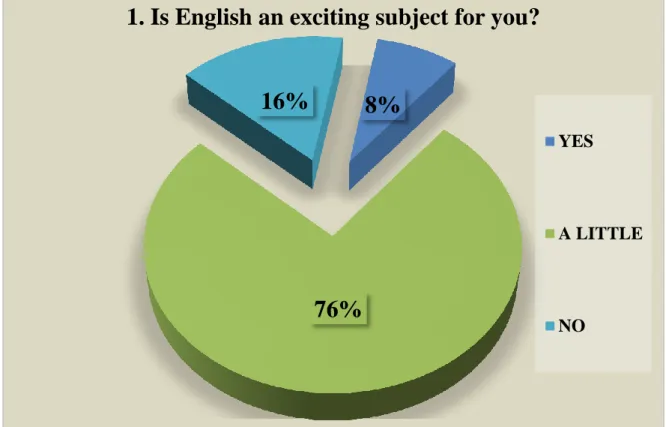
3.6.3. STATISTICAL RESULTS OF THE SURVEY # 1 TO STUDENTS ... 71
CHAPTER IV... 94
4. FINAL CONCLUSIONS ... 94
4.1. CONCLUSIONS ... 94
4.2. PROBLEMS AND LIMITATIONS ... 96
4.3. RECOMMENDATIONS ... 97
4.3.1. RECOMMENDATIONS FOR SCHOOL AUTHORITIES ... 98
4.3.2. RECOMMENDATIONS FOR THE SIXTH GRADE ENGLISH TEACHER .. 98
ix LIST OF TABLES
1. Young learners cognitive and affective needs ... 41
2. Taxonomy of Grammar learning activities for multiple intelligences ... 41
3. Variables ... 45
4. Study design ... 49
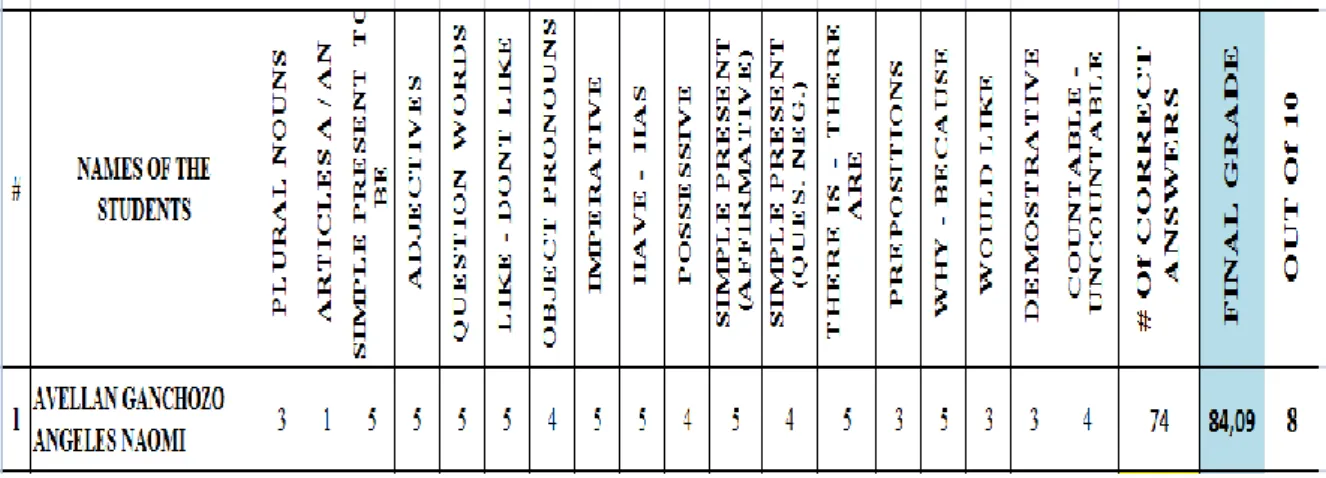
5. Pre-test formula 1 ... 84
6. Pre-test content ... 84
7. Pre-test formula 2 ... 85
8. Pre-test Results ... 85
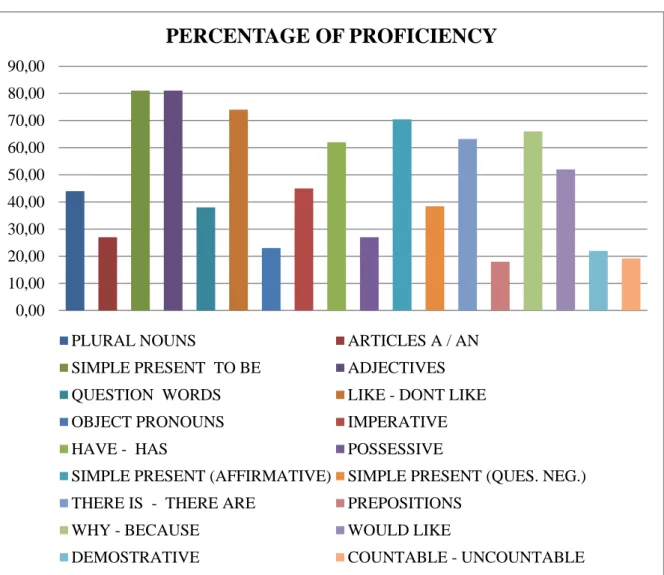
9. Pre-test Grammar Proficiency percentage formula ... 86
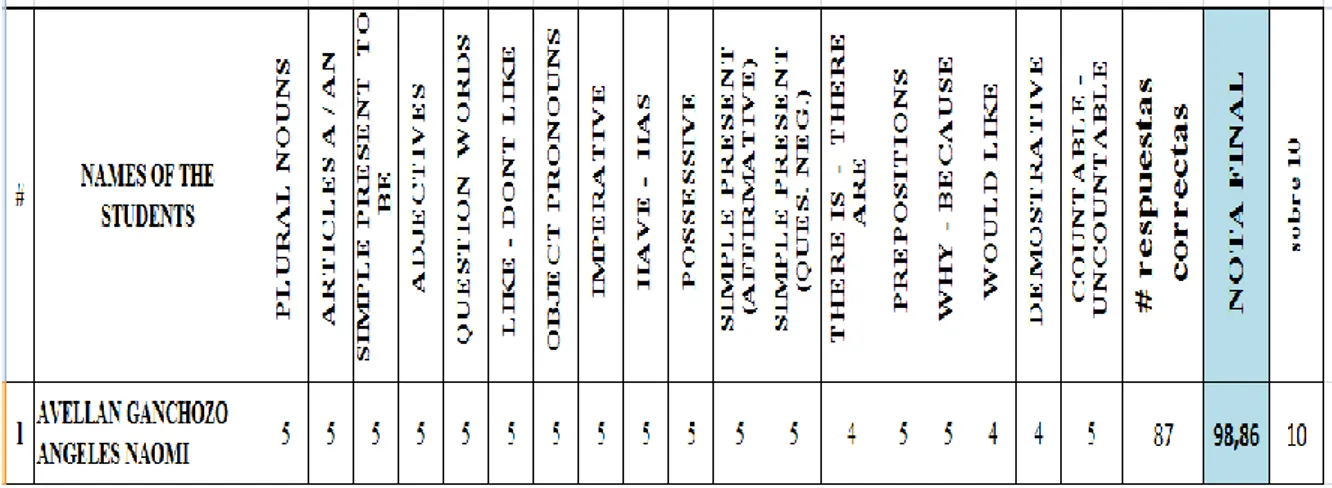
10.Post-test formula 1 ... 88
11.Post-test content ... 88
12.Post-test formula 1 ... 89
13.Bar chart of post test result ... 90
14.Post-test Grammar Proficiency percentage formula ... 92
15.Pie Chart of Pre-test and Post -test comparison ... 93
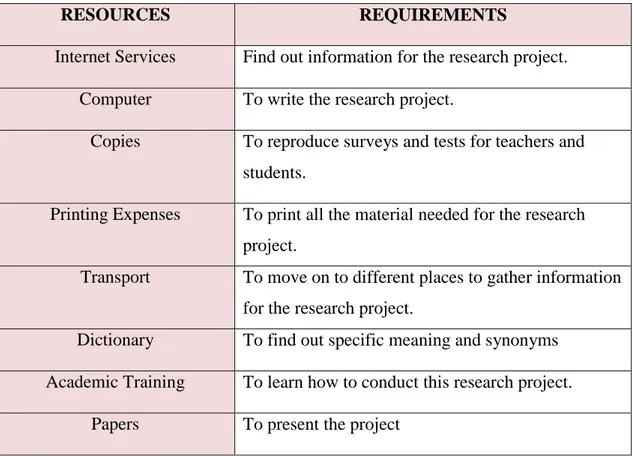
16.Resources ... 94
17.Timeline ... 95
x LIST OF FIGURES
1. Unidad Educativa Básica Invesciencias ... 3 2. Sixth grade students in the classroom ... 6 3. Pie chart of question Where did you learn how to speak English? ... 54 4. Pie chart of question Where did you get your professional
qualification in English language teaching? ... 55 5. Pie chart of question Have you ever been to an English speaking
country? ... 56 6. Pie chart of question what experience do you have in teaching sixth
graders? ... 57 7. Pie chart of question How long have you been working in this school? ... 58 8. Pie chart of question What English teaching method do you use to
teach children grammar? ... 59 9. Pie chart of question Do you update on the latest methods, techniques
and approaches in E.L.T? ... 60 10. Pie chart of question How do you update on the latest methods,
techniques and approaches to teach children? ... 61 11. Pie chart of question Have you ever taken an international language
proficiency exam to check your level of English? ... 62 12. Pie chart of question If the previous answer was affirmative, when did you
Take the last language proficiency exam? ... 63 13. Pie chart of question, You are provided with all the materials that
xi classroom allow you to develop your students’ grammar
Proficiency in a successful way. ... 65 15. pie chart of the question, There are enough technological resources
in the classrooms to teach L2 grammar successfully. ... 66 16. Pie chart of the question, You submit your lesson plans on time ... 67 17. Pie chart of the question, During the teaching process, you present
the structural items in a contextual way ... 68 18. Pie chart of the question, The language of instruction and
communication in your class is English ... 69 19. Pie chart of the question, You implement creative activities. such as
songs, games, role plays, etc to promote English grammar learning in
the classroom. ... 70 20. Pie chart of the question, You praise your students when they use
Grammar to communicate in a correct way... 71 21. Pie chart of the question, You tell your students about the importance
of learning grammar to communicate well in L2 ... 72 22. Pie chart of the question, You receive in-service – teacher training,
to be updated on the latest TEFL, techniques to teach grammar ... 73 23. Pie chart of the question, Is English an exciting subject for you? ... 74 24. Pie chart of the question, Is your English book interesting? ... 75 25. Pie chart of the question, Do you usually pay attention to your English
teacher? ... 76 26. Pie chart of the question, Do you feel happy when you play
xii English? ... 78 28. Pie chart of the question, Can you ask and answer questions in
English? ... 79 29. Pie chart of the question, Can you write short sentences correctly in
English? ... 80 30. Pie chart of the question, Do you like to participate in the activities in
your English class? ... 81 31. Pie chart of the question, Do you like to sing songs in English? ... 82 32. Pie chart of the question, Do you usually speak Spanish in your
1
TEACHING STRATEGIES TO OPTIMIZE L2 GRAMMAR
PROFICIENCY IN SIXTH GRADE STUDENTS AT UNIDAD
EDUCATIVA BASICA INVESCIENCIAS DURING THE SCHOOL
YEAR 2013-2014
CHAPTER 1
1.
INTRODUCTION
Learning English as a Foreign or as a Second Language is an essential thing to do in a globalized society. This language is the official language in 70 countries approximately. Most of the world correspondence is written in English and a high percentage of the information people can find in the internet is also written in English.
English is the language for most published books, or most books are translated into this language. English can also be found in international newspapers. The official language used at airports and at an air traffic control tower is also English. Multinational Businesses are made in this language. And many English songs are heard and enjoyed all over the world.
That is why schools in Ecuador have included this language as a formal subject in their study plans so that students can communicate in this foreign language in an efficient way and also take the opportunity to travel to foreign countries to take higher education courses.
2 students in the classroom, i.e., forty or fifty. In some cases English has even been considered as a puerile subject which is used to fill in the gaps in the class schedule.
Teachers are usually professionals in other areas, they speak English but they have not had the corresponding academic preparation to develop their teaching skills. The teaching methods that they implement in the classroom are old-fashioned and most of the time, not relevant to the students’ interests and intelligences. There is no systematization in the process, as a result of lack of planning and coordination.
Teachers and students do not use the target language, which affects the teaching-process because of L1 interference. The fundamental purpose of teaching English as a foreign language is in most cases learning lexical items and grammar paradigms, the language skills are not developed or reinforced, so communication does not take place.
All of these problems affect students adversely. As a result, they obtain low grades, they do not care about the subject anymore, they do not get involved in the class activities, disruptive behavior appears and at the end of the teaching process, students cannot communicate at all which constitutes a waste of time and money. Consequently, authorities and teachers may feel frustrated and disappointed.
It is imperative then, to find out solutions to these problems, otherwise students will not be able to meet the challenges that this globalized society has to offer.
1.1. BACKGROUND OF THE PROBLEM
This research project was conducted at "Unidad Educativa Básica Invesciencias”, a coeducational school, which is located in “Guayacanes” block 126,
3 The mission of Unidad Educativa Básica Invesciencias is to provide comprehensive and high quality education in order to form students who are critic, reflexive, innovating, creative, capable of managing their self–directed development in an environment of culture, values and peace; and that at the end of the tenth year, they can stand out in bilingual schools, due to their efficient communication in English, academic preparation and personality.
Figure 1, Unidad Educativa Invesciencias
Additionally, the vision of the school is to turn into a model bilingual institution that has as a main goal, an educational action based on culture and spirituality, with comprehensive instruction supported by self-cognition and empathy.
4 There are two principals, an administrative and teaching staff, three area directors and coordinators.
1.1.1. THE ENGLISH DEPARTMENT
There are 6 English teachers who work 30 teaching periods a week and 10 periods in other activities such as planning, preparing material, checking homework, quiz correction and others.
Students were organized according to the level of knowledge and had to attend classes 12 hours a week. Classes were about Conversation, History, Reading, Grammar and Audio. They started activities at 7:10 am and ended at 2:25 pm.
1.1.2. MISSION
The English area is committed to the serious effort of coping with the great challenges set out by the Ecuadorian society, which expects, students who are critic, analytical, responsible, ethical and with moral values, with sufficient expertise to solve problems, competent enough to assume both their role in the development of the country, as well as integrating to the international community by means of using the English language.
1.1.3. VISION
5 suitable methodology, considering not only the academic but also the affective needs of students giving them the opportunity to practice and strengthen the language skills at first and then applying them in a real and efficient communicative process. All of this with the support of a professional teaching staff with high expectations and committed themselves to reach the academic goals successfully.
The school English Department offers two programs to the students: a) A regular program to students from pre-kindergarten through sixth grade and b)An intensive program to students from seventh to tenth year.
1.1.4. DESCRIPTION OF THE REGULAR ENGLISH PROGRAM
This program starts from pre-kindergarten to sixth grade of basic education, and is divided into two stages: The first starts from pre-kindergarten to second grade of elementary school, and the name of the subject is English.
6 The second stage of the regular program starts from third to sixth grade, the name of the subject is Integrated Language Skills (ILS) which is also complemented with extra hours of Reading and aims to develop the four language skills: listening comprehension, oral production, reading comprehension and writing all of them .in a harmonious and integrated manner.
Figure 2, Sixth Grade Students in the Classroom.
Additional the students are given the components of these skills such as Grammar, Vocabulary, Phonology, Spelling, focusing on a student-centered, constructivist criteria. Teachers use a kind of eclectic methodology where the best techniques are selected according to the needs of the students.
7 Their great and positive attitude towards learning is one of the reasons that motivated the authors to conduct this research.
1.1.5. THE TEXT BOOK
The text book that is used in sixth grade is English in Mind Started A from Cambridge University Press by Herbert Puchta and Jeff Stranks. This book contains eight units with the corresponding workbook material grouped into two modules with clear learning objectives at the beginning of each module, plus 'Check your Progress' sections at the end, which help students and teachers plan learning more effectively.
The textbook is complemented with Audio CDs/CD-ROMs combining an interactive CD-ROM and audio material, a teacher’s book, a teacher’s resource pack which includes: Extra photocopiable materials and Diagnostic and progress tests and a web support. Finally, the English in Mind Combos can be used with mixed-ability classes. Combo Starter A is for complete beginners.
This research paper focuses on the influence of the teaching strategies on the L2 Grammar proficiency, and in order to perform an accurate diagnosis of the strengths and weaknesses of sixth-graders at Unidad Educativa Básica Invesciencias, the authors conducted three classroom observations in different days.
With the information obtained from these observations, it was established that three types of factors affected the teaching-learning process of Grammar. They were: teacher, student and organizational factors.
8 which caused constant interference in the L2 teaching process. The incorrect order of activities implemented by the teacher and lack of time control evidenced poor planning.
The grammatical structures were not presented in a proper context. In addition, the teacher placed emphasis only on the form, ignoring the use and meaning of the tense.
The revision of support materials showed that the workbooks were not checked, and in most cases, they were incomplete. The apathy and lack of motivation of the students in the class showed that the implemented activities were not relevant to their ages and interests. The appropriate teaching materials were not used. Finally the deficiency in the use of pedagogical methods, techniques and strategies demonstrated the lack of teacher’s academic preparation.
With the regard to the students, the misuse of grammatical structures in different contexts confirmed that they did not know about the basic grammatical concepts such as the parts of speech.
Referring to the organizational factors, there were an excessive number of students and the noise affected the development of the class. The seating arrangement did not facilitate the implementation of group activities.
All of these factors, in one way or another contributed to indiscipline and lack of motivation, resulting in low grades in some students, causing concerns in authorities, teachers and parents.
9 perception that the assignments are not checked. The learning objectives of the students will not be achieved in this area.
Grammar is one of the fundamental components of the language skills. If the students have problems with the structures, meaning and use of the tenses, they will be unable to communicate effectively in English, resulting in more indiscipline and low scores with the corresponding consequences at the end of the school year, affecting the prestige of the institution.
We can then say, If the pedagogical strategies for Grammar teaching to sixth-graders at Unidad Educativa Básica Invesciencias of Guayaquil are innovating, meaningful, relevant to their ages, learning styles, and interests, i.e. favoring a quality education, based on the principles of modern didactic, then it is likely that their impact is positive in the achievement of learning objectives in 2013 ".
1.2. STATEMENT OF THE PROBLEM
Will the application of effective teaching strategies improve the performance in grammar of the sixth grade students at Unidad Educativa Básica Invesciencias?
1.3. OBJECTIVES
1.3.1. GENERAL OBJECTIVE
10
1.3.2. SPECIFIC OBJECTIVES:
To identify the students’ academic strengths and weaknesses to establish
technical guidelines and norms that can contribute to the correct application of the teaching strategies.
To determine suitable strategies to cope with student’s detected needs,
taking into account the didactic components applied in this research project.
To adapt appropriate teaching strategies to satisfy students’ needs.
1.4. RATIONALE OF THE STUDY
After having obtained the grades of the first “quimestre” corresponding to the first, second and third partials, in ELT2 in which grammar is one of the basic components, in sixth-grade students at Unidad Básica Educativa Invesciencias, approximately 40% of them have got poor marks. The purpose of this research is to discover the academic, social and personal factors that caused this problem. As a result the pupils’ grammar proficiency in English is not satisfactory.
11 It is necessary to emphasize that the educational standards at Unidad Educativa Básica Invesciencias require that sixth-grade students reach the A1 level, according to the Common European Framework, at the end of the school year. For this reason, we are facing the reality that the poor marks that the students have, do not contribute to achieve the academic objectives of Unidad Educativa Básica Invesciencias.
At the same time, it provokes the professional frustration in teachers who do not get satisfactory results in their work. Students lack motivation and interest in the subject due to their low grades. Consequently, our proposal is to design and provide guidelines on how to implement teaching strategies to develop L2 grammar proficiency in order to help the students to improve their English and in that way to reach one of the academic objectives at Unidad Educativa Básica Invesciencias.
1.5. SCOPE AND DELIMITATIONS OF THE STUDY
12
CHAPTER II
2.
LITERATURE REVIEW
Human beings have not only shown desire to learn how to speak foreign languages but often their curiosity led them to discover how to do this in the best possible way. Since ancient times, every civilized society has developed and adopted ideas about the nature of the L2 teaching and learning processes.
For a long time there have been different concepts of paradigms, learning theories and teaching methods that have been part of syllabuses at schools. Teachers have adapted their teaching strategies to the learning theory of their preferences. Two sciences have contributed enormously to the development of them: Linguistics and Psychology.
Linguistics deals with language form, meaning and context and Psychology deals with the process of language acquisition.
It is thought that the didactic strategies can handle everything and a good method, implemented by a good teacher, can guarantee that the students learn effectively and permanently. Nowadays, schools are interested in who learns, how they learn and how the students respond.
Experts in ELT agree that the main purpose of language is communication. The present research project focuses on one of the most important components of language: Grammar, and the best ways to teach it to sixth grade students.
13 Writing are the language skills, that are used to send messages; Listening and Reading conversely, are the decoding skills, which are used to decipher either oral or written messages.
We can observe that, since Grammar is involved in all the language skills, it plays a decisive role in the communicative process.
Next, the authors will provide a critical review of knowledge and studies related to the evolution and development of English grammar teaching through the years: a theoretical background to the study based on the existing theories and a brief description of teaching grammar to young learners.
2.1. THEORETICAL REVIEW
The term “paradigm” appeared for the first time in Linguistics, in the “theory of the linguistic sign” created by Ferdinand de Saussure, in which he related the sign with
the group of elements that constitute language.
According to the Merriam Webster Dictionary “A paradigm is a philosophical and theoretical framework of a scientific school or discipline within which theories, laws, and generalizations and the experiments performed in support of them are formulated; broadly: a philosophical or theoretical framework of any kind.”
14
2.1.1. EDUCATIONAL PARADIGMS
A learning paradigm is a model that is used in education. Innovative paradigms are a pedagogical practice which results in a critical learning and causes a real change in the student.
A paradigm that is used by a teacher has a big impact on the student, often determining if the student will or will not learn the content of learning which is approached.
The way of learning of younger generations is different from the way of learning of previous generations, and therefore a conservative paradigm will not have much of a positive effect.
For many years, up to the present time, psychologists have conducted research in order to explain the different ways that people learn. It can be said that there are five different learning paradigms:
Behaviorism, Cognitivism, Constructivism, Design based and Humanism.
15 The main purpose of this project is to find out a theory or theories that may provide an effective guide in the development of learning strategies to optimize the teaching process of English grammar.
For behaviorists, learning the grammar of a language is a process of habit formation, which includes the relatively permanent change that occurs in the behavioral repertoire of an organism as a result of experience. It is worth mentioning that the Audio-lingual Approach is based on Behaviorism.
Some of the behaviorist Learning Theories that could be applied to teach the English Grammar are:
1. Connectionism (Edward Lee Thorndike): this theory states that learning is a formation of a connection between stimulus and response.
2. Response Theory of Psychology (John B. Watson, the father of Behaviorism): this theory postulates a type of psychological conditioning known as reinforcement.
3. Operant Conditioning or Learning Theory (Burrhus Skinner): this theory describes how rewards shape and maintain behavior.
The Cognitivism paradigm essentially argues that the “black box” of the mind should be opened and understood. The learner is viewed as an information processor, like a computer. Cognitivism focuses on the inner mental activities – opening the “black box” of the human mind is valuable and necessary for understanding how people learn.
16 Learning is defined as change in a learner’s schemata. That means that learning L2 grammar is not mechanical, it is the result of a conscious process.
The principal Learning Theories in Cognitivism that could be applied to teach L2 Grammar are the following:
1. Instructional theory (Robert Gagne): this is a hierarchical theory that postulates that some types of learning are prerequisites to other kinds of learning.
2. Multiple Intelligences (Howard Gardner): this theory has identified seven distinct intelligences. According to recent cognitive research, students possess different kinds of minds and therefore learn, remember, perform, and understand in different ways.
3. Bloom's Taxonomy of Learning Domains (Benjamin Bloom): This theory identifies three domains of educational activities or learning:
Cognitive: mental skills (Knowledge)
Affective: growth in feelings or emotional areas (Attitude or self) Psychomotor: manual or physical skills (Skills)
Constructivism is basically a theory - based on observation and scientific study about how people learn. It says that people construct their own understanding and knowledge of the world, through experiencing things and reflecting on those experiences.
17 In any case, we are active creators of our own knowledge. To do this, we must ask questions, explore, and assess what we know.
According to this theory learning grammar of a new language begins from student’s prior-knowledge, and then they link the new information to it. Learners actively construct or create their own subjective representations of objective reality.
The principal Learning Theories in Constructivism that could be applied to teach L2 Grammar are the following:
1. Theory of Development (Jean Piaget): this theory says that intellectual ability is qualitatively different at different ages and that children need interaction with the environment to gain intellectual competency.
2. Operational Conditioning Learning Theory (Jerome Bruner): this theory says that cognitive structure is necessary in learning, because it gives meaning and organization to experiences and let the learner go further than the information.
3. Social Development Theory (Lev Vygotsky): this theory argues that social interaction precedes development; consciousness and cognition is the end product of socialization and social behavior.
18
2.1.2. EVOLUTION AND DEVELOPMENT OF ENGLISH GRAMMAR
TEACHING THROUGH THE YEARS
English Grammar Teaching is closely related to the different pedagogical methods that appeared through the years as a result of psychological and linguistic research.
The first method was The Grammar Translation which was first known in USA as the Prussian Method (A book by B. Sears, An American classics teacher, published in 1845 was titled The Ciceronian or the Prussian Method of Teaching the Elements of the Latin Language. Cited by Kelly 1969)
According to this method, grammar was taught deductively - that is, first the grammar rules were presented and studied, and then they were practiced through translation exercises. The grammar points were taught in a sequenced way through a text and there was an attempt to teach grammar in an organized and systematic fashion.
Toward the mid-nineteenth century several factors contributed to a questioning and rejection of the Grammar-Translation Method. There was a great demand in Europe for oral proficiency en foreign languages.
New approaches to language teaching were developed by specialists, such as C. Marcel, T. Prendergast, and F. Gouin.
After a few years, the Direct Method appeared as a reaction against The Grammar Translation. The main characteristic of the Direct Method was the use of the target language as a medium of instruction and communication in the classroom.
19 explanation of grammar rules in the teaching process. Grammar was taught inductively in the target language. New teaching points were introduced orally.
In 1920 the Situational Language Teaching approach arose in Great Britain it was developed by British applied linguists from the 1930s to 1960s. The impact of the Oral Approach lasted for a long time and it has shaped the design of many widely-used English as a Foreign Language/ English as a Second Language textbooks and courses.
Items of grammar are graded, the simple forms are taught before complex ones. New structures are presented and practiced in context. The basic grammatical patterns of the language were taught in an oral fashion. Grammar was perceived as the underlying sentence patterns of the spoken language.
Palmer, Hornby, and other British applied linguists analyzed and classified the major grammatical structures into sentence patterns (later called “substitution tables”),
facilitating the learning of the rules of English sentence structure.
By 1942 the United States of America entered into War World II, this fact had a significant effect on language teaching in America. Interpreters, code-room assistants, translators, were necessary to start a special language training program. The government requested American universities to develop foreign language programs for military personnel.
20 The following types of drills are used to internalize grammatical patterns of the language: Repetition, Inflection, Replacement, Restatement, Completion, Transposition, Expansion, Contraction, Transformation, Integration, Rejoinder and Restoration.
In 1960s, Dr. James J. Asher a professor in psychology at San Jose State University, proposed the Total Physical Response. Asher perceived successful adult second language learning as a parallel process to child first language acquisition.
As stated in this method: Grammar was taught through actions. Imperatives play an important role. Multi-word chunks, single-word chunks are used with imperatives. The teacher uses his/her creativity to introduce various grammatical patterns with the accompaniment of imperatives.
In 1970s, Caleb Gattegno devised the Silent Way. The main characteristic is that the learner should be encouraged to produce as much L2 as possible, and the teacher should be silent as much as possible.
The structures of the foreign language are emphasized although explicit grammar rules are never given by the teacher.
Afterwards, Sugestopedia was originally developed in the 1970s by the Bulgarian educator Georgi Lozanov. It lasted 30 years and consisted of ten units of study. Classes were held 4 hours a day, 6 days a week.
The central dialogue consists of 1200 words or so, with an accompanying vocabulary list and grammatical commentary. Grammar is taught explicitly but minimally. Explicit grammar rules are provided in L1.
21 combined statement of the principles and practices of the Natural Approach which appeared in their book The Natural Approach in 1983. This method rejects the formal grammatical organization of language as a prerequisite to teaching.
Newmark and Reibel hold that “an adult can effectively be taught by grammatically and unordered materials”, and that such an approach is indeed, “the only learning process which we know for certain will produce mastery of the language at a native level”
As we have seen, all of this research concerning to English Grammar Teaching has the following limitations:
a) They are centered in adults’ students.
b) These studies are for European and North American learners who may have different learning styles.
c) It is observed that there are not guidelines for teaching grammar to kids.
Considering the learning theories that have been mentioned above, there is a conclusion that the best proposal for the development of English grammar in Sixth Grade students is the use of Cognitivism and Constructivism paradigms, based on the psychological basics of Jean Piaget and Howard Gardner’s
Jean Piaget was a Swiss developmental biologist who devoted most of his life to studying the main features of intellectual abilities of infants, children and adolescents.
22 According to Jean Piaget there are 4 stages of Cognitive Development:
Sensory Motor Period (0 – 24 months) The Preoperational Period (2-7 years) Period of Concrete Operations (7-12 years)
Period of Formal Operations (12 years and onwards).
It is worth mentioning that each period has its specific characteristics, which means that children have different abilities and learn in different ways, according to their ages. This is an important consideration in education in general when the teacher has to plan and implement pedagogical activities in the classroom.
For this reason, it is important that teachers know what to expect from their students as they develop and to be sure that the expectations they may have for them at a given age are realistic.
The students, who are the subjects of this research, are between 8 and 9 years old, according to Jean Piaget, they are in the Period of Concrete Operations.
Piaget states that, the period of concrete operations is a major turning point in the child's cognitive development, because it marks the beginning of logical or operational thought.
This period has the following characteristics:
Children are able to use logical thought or operations i.e. rules, but they can only
apply logic to physical objects.
Children become less egocentric and better at conservation tasks. This means
23 Children in the stage of concrete operation, gain the abilities of conservation
(number, area, volume, orientation) and reversibility.
Their thinking is more organized and rational. They can solve logical problems,
but are not able to think abstractly or hypothetically.
2.1.3. IMPLICATION IN L2 GRAMMAR TEACHING
Children, adolescents and adults are biologically different; they also have different interests, and motivation.
Students construct their knowledge in different ways, therefore for the selection of pedagogical materials, teaching techniques, strategies, and methods; teachers should consider their ages.
Students can internalize the use of certain basic grammatical structures of a foreign language, because their thinking is more organized and rational.
Students can solve problems related to the use of grammar in a logical manner. However, they should not be involved in abstract or hypothetical analysis, because they have not developed the ability at this age.
This is why games, songs, contests, English clubs, movies, role playing, and other recreational activities play an important role in L2 grammar teaching.
24 He conducted research with two very different groups, normal and gifted children and brain-damaged adults. Later on he began developing a theory that synthesized his investigation.
As a result of this study, in 1983, he published Frames of Mind which outlined his theory of multiple intelligences in which he stated that people have many different ways of learning.
He has identified and described eight different kinds of intelligence:
1. Visual-spatial intelligence: This intelligence represents the knowledge that occurs through the shapes, images, patterns, designs, and textureswe see with our external eyes, but also includes all of the pictures we are able to imagine in our minds.
2. Linguistic-verbal intelligence: This intelligence involves the knowledge that comes through language, reading, writing, and speaking. It involves understanding the order and meaning of words in both, speech and writing, and how to properly use the language. It involves understanding the socio-cultural differences of a language, including idioms, plays on words, and linguistically-based humor.
3. Mathematical intelligence: This intelligence uses numbers, math, and logic to find and understand the various patterns that occur in our lives: thought, number, visual, color patterns, and so on. It begins with concrete patterns in the real world but gets increasingly abstract as we try to understand relationships of the patterns we have seen.
25 “knows” many things that are not necessarily known by the conscious, logical mind, such as how to ride a bike, how to parallel park a car, dance the waltz, catch a thrown object, and so on.
5. Musical intelligence: This is the cognizance that happens through sound and vibration. In the original research on the theory of multiple intelligences this intelligence was called musical-rhythmic intelligence.
6. Interpersonal intelligence: It is the knowledge that happens when we work with and relate to other people, often as part of a team. This way of knowing also asks use to develop a whole range of social skills that are needed for effective person-to-person communication and relating.
7. Intrapersonal intelligence: This is the introspective intelligence. It involves our uniquely human propensity to look for the meaning, purpose, and significance of things. It involves our awareness of the inner world of the self, emotions, values, beliefs, and our various quests for genuine spirituality. 8. Naturalistic intelligence: The naturalist intelligence involves the full range
of knowledge that occurs in and through our encounters with the natural world including our recognition, appreciation, and understanding of the natural environment.
Gardner hypothesizes that these eight intelligences usually work together, and rarely operate independently.
The intelligences, he says, are used simultaneously, usually complementing one other as we develop skills or solve problems.
26 1. Linguistic Intelligence: the ability to use language in special and creative
ways.
2. Interpersonal Intelligence: the ability to be able to work well with students. 3. Intrapersonal Intelligence: the ability to understand oneself and apply one’s
talent successfully, which leads to happy and well-adjusted people in all areas of life.
4. Bodily-Kinesthetic intelligence: having a well-coordinated body, something found in athletes and craftspersons.
5. Logical/Mathematical Intelligence: the ability to think rationally.
2.1.4. COMPLICATIONS OF REAL ENGLISH GRAMMAR TEACHING
SITUATIONS
The teaching and learning processes of L2 Grammar occur through the interactions among people whose characteristics and behaviours are different.
Each student is different. There are certain factors that are crucial in the formation and therefore in the students’ learning process.
27 When complications in teaching L2 Grammar arise four different factors have to be considered: students’ factors, teachers’ factors, social factors, and organizational
factors.
2.1.4.1.STUDENTS’ FACTORS
The student’s factors to be considered are: a) the students’ age, b) students’ intelligence and learning styles, c) students’ aptitude and previous learning experiences, and, d) students’ attitude and motivation.
a) Students’ age
One of the main students’ factors that cause problems in the teaching of L2 Grammar is their age. Age plays an essential role; adults, teenagers and children learn in different ways, that’s why English teachers have to be careful in the selection of methods, techniques and approaches that he or she is going to implement in the classroom.
They have to be selected according to the students’ needs, learning styles, and intelligences.
Additionally, they should be relevant to the students’ interest, and promote meaningful and communicative learning.
b) Students’ intelligence and learning styles
28 Interpersonal and Intrapersonal, and according to the learning style theories, students learn in different ways.
Learning Style Analysis reveals flexibilities, preferences and non-preferences in 49 different areas, which can significantly contribute to a student’s success or failure in learning.
If the teacher doesn’t consider these facts when planning the Grammar activities; complications in the classroom may appear.
c) Students’ aptitude and previous learning experiences
These are important factors that are related to the students’ previous knowledge, if the students are not placed in appropriate levels according to what they know or what they have learned previously, complications may come forth, for this purpose,aptitude for learning and placement tests are used in prestigious educational institution.
d) Students’ attitude and motivation
The students’ attitude towards the teacher, the methods, and activities is another factor that has to be considered, positive attitudes favour good teaching and learning.
Negative attitudes, conversely, may affect enormously the development of Grammar teaching in L2 classrooms.
Additionally, motivation, which has been a prominent area for research in psychology and education for many years, is the most important factor in educational success in general. There are two types of motivation: intrinsic and extrinsic motivation.
29 2.1.4.2.TEACHERS’ FACTORS
The teacher’s factors to be considered are: a) native or non-native, b) negative attitude c) learning, d) teaching, e) curriculum, and, academic preparation.
a) Is the teacher a native speaker?
There is another factor that may affect the normal development of the L2 classroom activities, especially when English native speakers are hired to work as teachers, but, they don’t know about methods, techniques, strategies or they have a poor class management.
The most suitable circumstance would be a native-speaking teacher who has finished his university studies on that field.
b) Teachers’ Negative Attitude
The teachers’ negative attitude may affect how he or she thinks and acts about their environment. Because people's ideas and beliefs influence their behavior, their internal values may reveal themselves in the way they act.
If a teacher has a negative attitude towards education, his/her job or his/her students, it may affect his performance as an educator. A teacher´s negative attitude may have a negative effect on Learning, Teaching and Curriculum:
c) Learning
30 Some students are especially motivated towards or away from English Grammar by their teachers, more so than by their parents or peers.
According to Dr. Michael Papadimitriou, "Students described situations in which the personality traits of their teachers were more powerful and influential than course content or instructional strategies with respect to their opinions of their experiences."
d) Teaching
A teacher has a great influence on his/her students, especially if they are kids. If a teacher shows lack of care about Grammar teaching -- or his/her students -- then he/she will be unable to promote the growth of a supportive learning environment.
A teacher's personal belief systems may be more evident to the student than what the teacher realizes.
In addition, a teacher with a negative attitude may not be as approachable as a teacher with positive attitude.
A student may avoid asking questions about Grammar or any other subject.
e) Curriculum
Attitude could also affect how well a teacher prepares for lessons. Teachers who have positive attitudes towards teaching Grammar work harder on that subject.
31 f) Experience and Academic Preparation
Helen F. Ladd, Sanford School, Duke University on her article about “Why experienced teachers are important – and what can be done to develop them” states that: Experienced teachers are on average more effective in improving student achievement than their less experienced colleagues.
In the research she conducted with colleagues on teacher performance in North Carolina, she noticed that the greater effectiveness of experienced teachers in enhancing student achievement was evident for elementary, middle, and high schools students. She also proved the following facts:
Teachers do better as they gain experience.
Experienced teachers also strengthen education in other ways beyond
improving test scores. For example, they reduce student absences and encourage students to read for recreational purposes outside of the classroom. More experienced teachers often guide young teachers and help to create and
maintain a strong school community.
In the article “What makes a teacher effective” from National Council for Accreditation of Teacher Education, research indicates that teacher academic preparation is a leading factor in teacher effectiveness.
The article states that there are four key findings from the existing research on teacher preparation:
1. Teacher preparation helps them to develop the professional competences and skill they need in the classroom.
32 3. Skilled teachers boost higher student achievement.
4. Well prepared teachers outperform those who are not prepared.
In a general sense it can be stated that the idea of a high quality teacher training is essential.
In conclusion, if a teacher has sufficient experience and academic preparation he/she will be able to efficiently solve problems that arise in the classroom.
2.1.4.3. SOCIAL FACTORS
The social factors to be considered are: a) Cultural differences among students, b) Size of groups, c) Type of social atmosphere
a) Cultural differences among students
Sometimes cultural differences in customs, practices, standards and rules of behaviour, clothing, and belief systems may lead to discrimination among the students. Some discrimination consequences of school are: dropping out, the psychological and physiological disorders, depressions, stuttering, and psychosomatic disorders, and learning disabilities, among others.
b) Size of Groups
33 Conversely, big groups of students make the teachers work harder because he/she has to manage the classroom discipline, to keep the students’ attention and
implement interesting activities at the same time.
Additionally, when the number of students is high, the class participation is poor, unless the teacher implements appropriate techniques to work with big groups.
c) Type of Social Atmosphere
Complications in the classroom may arise when a student who has a low social status attends classes in a school for upper class students; this situation may provokesocial segregation in the classroom, affecting the process of L2 learning.
2.1.4.4.ORGANIZATIONAL FACTORS
The organizational factors to be considered are: a) Relationship between teachers and authorities, b) Command structure of the school, c) Lack of facilities and comfort in the classroom, d) Lack of regulations on an established policy, and, e) Provision and quality of educational aids.
a) Relationship between teachers and authorities
34 b) Command structure of the school.
An adequate hierarchical organization inside the institutions saves time when making decisions as where to turn and who to talk in case of specific needs.
c) Lack of facilities and comfort in the classroom
Lighting, space, number of students, proper didactic material and others contribute to an adequate environment where to develop the language teaching process.
d) Lack of regulations on an established policy.
The institutions must establish a set of regulations based on the mission and the vision and they have to be followed by their members to ensure a better organization.
A lack of regulations or a failure to compile with them will result in chaos.
2.2. CONCEPTUAL FRAMEWORK
2.2.1. TEACHING GRAMMAR TO YOUNG LEARNERS
For the successful development of the language skills in the target language in students, first of all, it is necessary for the teacher to understand the essential role of grammar in communication.
David Crystal, “in Word and Deed, " TES Teacher, April 30, (2004) says that
“Grammar is the structural basis of how we express ourselves. The more we realize how
it works, the more you can control the direction and effectiveness of how we and others
use language, grammar helps to promote accuracy, to detect ambiguity, and to exploit
35 Secondly, teaching grammar to young learners is one of the most challenging issues that English teachers have to face, due to the fact that it is necessary to take into account many different factors such as characteristics, interests, multiple intelligences, and pedagogical needs, because this will play a fundamental role in how the teacher plans his or her lessons, how he or she can make sure that the young learners are fully involved in the learning process, how he or she achieves the pedagogical objectives of a lesson, and how they construct their knowledge.
a) Young learner’s characteristics
Sixth graders at Unidad Educativa Invesciencias are around 9 years old and they adjust to the psychological profiles that many researchers have determined for these ages.
According to the studies that were conducted by Jean Piaget the student’s who are participating in this research are in the stage of concrete operations (age 7 to 11 years). “During these years, the child develops the ability to apply logical thought to concrete problems. Hands-on, concrete experiences help children understand new concepts and ideas. Using language to exchange information becomes much more important than in earlier stages, as children become more social and less egocentric”.
They also share the following features:
They are very active and naturally, curious.
Their attention span is very short and they are easily distracted. They respond pretty well to positive reinforcement. It is very important to
support their enthusiasm from the beginning of the learning process.
They construct their knowledge in many different ways.36
They are imaginative and creative. They learn by mimics, using gestures and body movements. The physical
world is very important and dominant at all times.
In some cases it is really difficult for them to understand the world of adults.
The teacher needs to use the directions appropriately and use the language and phrases in such a way, that the children can easily understand the message.
They love to play games and learning itself can be effective only in case
they are enjoying themselves.
They learn faster through meaningful practice.
They learn in a variety of ways, for example, by watching, by listening, by
imitating, by doing things.
They are not able to understand complicated grammatical rules and
extensive explanations about language.
They can generally imitate the sounds they hear quite accurately and copy
the way adults speak.
They enjoy varied, challenging activities. b) Young learner’s Interests
Students are interested in learning as long as the activities presented by the teacher are relevant, meaningful and dynamic.
Their interests are:
To communicate with kids from other countries To understand movies
37 To play games in English
To participate in grammar competitions To read interesting stories
d) Young learner’s Multiple Intelligences
Howard Gardner of Harvard has identified eight distinct intelligences. He says that students possess different kinds of minds and therefore learn, remember, perform, and understand in different ways.
e) Young Learner’s Pedagogical Needs
To detect the educational needs of students in the area of English grammar, it is necessary to establish a system of continuous assessment.
This will allow us to have sufficient evidence to make the best decisions aimed at optimizing the processes of teaching and learning.
These evaluations are: diagnostic, formative and summative.
Diagnostic (initial) Evaluation - The evaluation is done during the formation of educational objectives. It is used to decide the entry behaviors of the learner in a particular instructional course. It takes place at the beginning of the school year.
Formative Evaluation - Evaluation within or during the development of a course. It is used in improving the performance of the teacher, the student and curriculum developer. It is used in determining the mastery level of the learner and the remedy to make. It is a quality control evaluation.
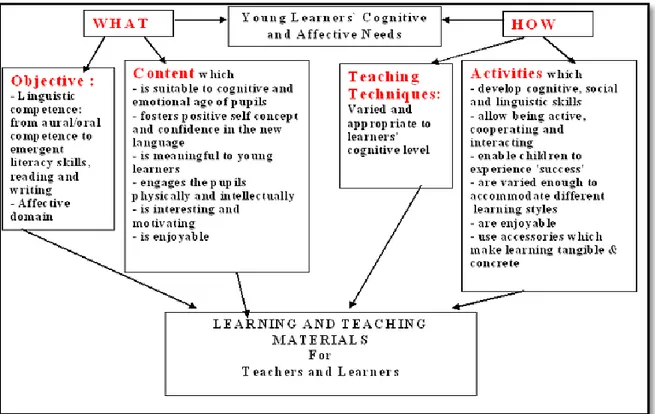
38 f) Young learner’s Cognitive and Affective needs
Knowledge of cognitive and affective needs of students allows us to design the curriculum in the most appropriate way; in this process the following questions are answered:
a) What to teach?
This question refers to the objectives and content of the curriculum.
b) How to teach?
This question establishes the teaching method, techniques and activities to be implemented in the classroom.
c) and finally the materials to be used .
A Model for EFL Program Design for Young Learners
39 This information allows us to draw the following conclusions about the ideal characteristics of the processes of teaching and learning of the English grammar to young learners.
The activities should be simple enough for students to understand what the
teacher expects of them.
The presentation of structural items should be in a context.
When teaching a grammar tense, the teacher must refer not only to the form
i.e. the structure, but also the meaning and use of it in real-life situations.
The grammar tasks should be amusing and within children’s abilities, so that
the learners can easily reach their goals.
The grammar tasks should be stimulating and motivating for learners to feel
satisfied with their work.
Written activities should be used only in a small amount.
Mostly the speaking activities should prevail – indeed, with very young children listening activities will take up a large proportion of class time. (It’s necessary to mention that grammar is a component of those skills).
Classroom management must be efficient.
Lessons should be planned and centered on the students.
The language of instruction and communication in the classroom must be
English.
Teachers need to be trained in the use of technological resources: Internet,
Tablets, smart-board, etc.
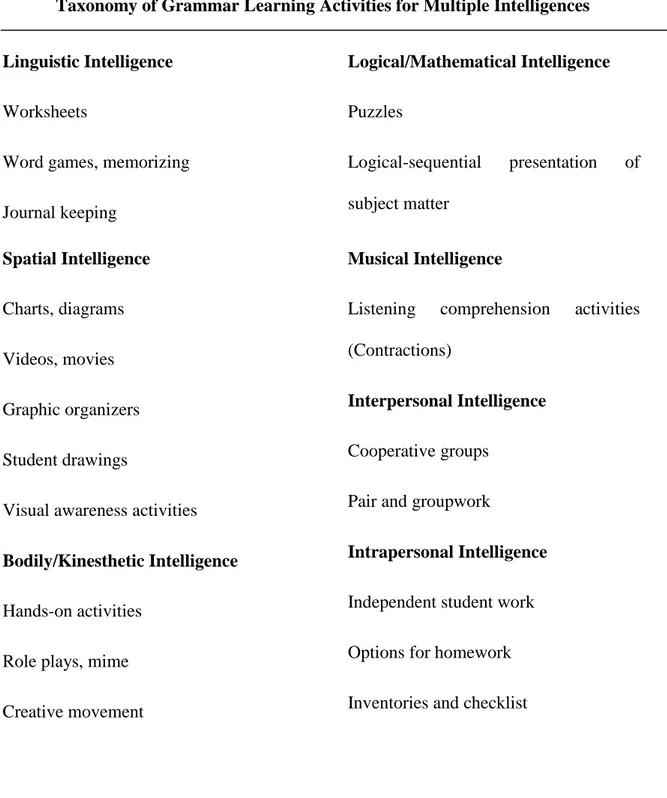
40 Taxonomy of Grammar Learning Activities for Multiple Intelligences
Linguistic Intelligence
Logical-sequential presentation of subject matter
Listening comprehension activities (Contractions)
41
2.3. RESEARCH QUESTIONS
In order to establish technical guidelines and norms that can contribute to the correct application of the teaching strategies.
What are the students’ academic strengths and weaknesses?
How can we determine the most suitable strategies to cope with the student’s needs?
How can we demonstrate that the use of the proposed teaching strategies to optimize L2 grammar proficiency is appropriate to the students’ needs?
How much did the students’ proficiency increase, comparing the results of the pre-test and the results of post test, after the teaching strategies were applied?
2.4. HYPOTHESIS
If appropriate teaching strategies are designed and implemented, there will be a better outcome in the English grammar proficiency in sixth graders at Unidad Educativa Básica Invesciencias.
2.5. VARIABLES AND INDICATORS
Independent Variable: Teaching Strategies
42 Table 3. Variables
Variables Conceptual Indicator Instruments
D
It can be defined as the knowledge of structure, principals and rules that regulates the use of language in a communicative process.
Academic proficiency Identification of grammar structures.
Construction of sentences with complete sense and syntactic autonomy. Mastery of a specific behaviour
or skill demonstrated by consistently superior performance, measured against established or popular standards. method that is characterized by the creative, pedagogical and consistent use of techniques, exercises and games created specifically to generate meaningful learning.
Teachers’ academic preparation
Setting of the educational goals.
Planning and implementation of activities according to the academic goals.
Selection of activities according to the level, interest and needs of the students.
Application of teaching methods, techniques and approaches.
Use of technological resources in classroom atmosphere.
Motivation.
43
2.6. DEFINITION OF TERMS
Grammar
The study of the way that the sentences or words of a language are constructed, esp. the study of morphology and syntax. [Uncountable] these features or constructions themselves, characteristic of a given language: English grammar
The whole system and structure of a language or of languages in general, usually taken as consisting of syntax and morphology (including inflections) and sometimes also phonology and semantics.
Proficiency
A high degree of skill; expertise
Strategies
A plan of action designed to achieve a long-term or overall aim
Teaching-Learning Process
It is a process of engaging with others in coming to know.
Young Learners
44
CHAPTER III
3. RESEARCH METHODOLOGY AND FINDINGS
3.1. TYPE OF RESEARCH
This research project, depending on the prior knowledge that is used in research is Scientific, because it uses the theoretical framework derived from science.
Depending on the nature of the subject matter, it is Formal due to the fact that; the rational phenomena are interpreted through the reason or demonstration of facts of reality.
Considering the type of questions that are asked in the problem, this is a Descriptive Research: It states how reality is, it becomes the first systematic approach to understand the phenomena. It tries to establish the relationship between “Teaching Strategies” as the independent variable and“L2 Grammar proficiency” as the dependent variable.
Additionally, the authors´ objective is to gather data and information on those who are involved in the development of grammar, i.e. students who are responsible for their knowledge construction and teachers as those who are responsible for teaching the subject in sixth grade at Unidad Educativa Básica Invesciencias.
In accordance with the method of verification of the hypothesis, this is a From-Cause to- Effect Research, given that; the causes are manipulated or activated in order to establish the effects that they produce.
45 intervention of the researchers, after this, by applying a Post- Test, the effect of the intervention was determined and the validation of the hypothesis was confirmed.
It is also a type of Quasi-Experimental Research because this is applied to a specific sample group.
Conforming to the study method of the research variables, this project is Quantitative: the research problem requires external investigation, the objectives include two variables, it raises statistical hypothesis, the population needs to be controlled, and fieldwork will useclass observation, performance tests, and class work.
Furthermore, the influence of the independent variable, on the dependent variable can be measured quantitatively, before and after the researchers’ intervention
and it is possible to present the results in numerical values.
In agreement with the environment where it is performed, it is a Bibliographic and a Field Research. Bibliographic, since it was conducted through the analysis and interpretation of data found in bibliographies and websites, and a Field Research because it was performed in the classroom or in the school, in order to collect primary data, using methods such as interviews, surveys, and direct observation.
Depending on the type of data produced, it is a Secondary Research, as this work is based on theories provided by other researchers.
In proportion to the dominant utilitarian approach, it is a Theoretical Research because it is related to the analysis, reflection and production of theories.
46 The research project is Explanatory because it looks for reasons or causes that origin certain phenomena. This type of study involves the researcher’s effort and a great
capacity of analysis, synthesis and interpretation.
3.2. STUDY DESIGN
On the authority of the external validity, this is a Pre-Experimental Design because it followed this schema:
A pretest was provided to a specific group of students (sixth graders) to determine the scope of the problem after this, “a treatment” (the researchers’ intervention), was applied and finally a post – test was given in order to obtain the results of the “intervention”.
The design representation was obtained in the following graph:
Groups
The methods that were used in this project can be classified into three categories: data collection, statistical techniques which were used for establishing the relationship between data and the unknowns, and methods to evaluate the accuracy of the results obtained.
47 On field research, the authors conducted three class observations and applied personal interviews with open-ended and close-ended questions, and surveys.
3.4. RESEARCH POPULATION AND SAMPLE
This research was conducted at Unidad Educativa Básica Invesciencias. The school has a total of 17 classrooms, 30 teachers and 400 students in 4 sub-levels: Preparatoria, Básica Elemental, Básica Media, and Básica superior.
The Research Population or Sample Universe is:
One classroom with 35, 10-year-old students from 6thBásica Superior who
constitute the 6,25% of the total number of students in the school Three English teachers.
3.5. RESEARCH INSTRUMENTS
The research instruments used in this project are: surveys, human facts analysis,
interviews, testing, and observation.
Three class observations were applied; the first one was to detect a problem in
the classroom, the second one was to determine exactly what the problem was and the
last one to provide the teacher with some suggestions to improve the classes.
An interview was conducted with the teacher to evaluate the academic
performance and a survey was applied to know under what conditions teachers work