This document is confidential and is proprietary to the American Chemical Society and its authors. Do not copy or disclose without written permission. If you have received this item in error, notify the sender and delete all copies.
LIQUID-LIQUID EQUILIBRIA FOR SYSTEMS CONTAINING 4-PHENYLBUTAN-2-ONE OR BENZYL ETHANOATE AND
SELECTED ALKANES
Journal: Journal of Chemical & Engineering Data
Manuscript ID je-2016-00803z.R4
Manuscript Type: Article
Date Submitted by the Author: 24-Jan-2017
Complete List of Authors: Alonso-Tristán, Cristina; UNIVERSITY OF BURGOS, INGENIERÍA ELECTROMECÁNICA
Gonzalez, Juan; University of Valladolid, Física Aplicada Hevia, Luis; Universidad de Valladolid, Fisica Aplicada
García de la Fuente, Isaias; UNiveridad de Valladolid, Física Aplicada Cobos, Jose; Universidad de Valladolid, Fisica Aplicada
LIQUID-LIQUID EQUILIBRIA FOR SYSTEMS CONTAINING 4-PHENYLBUTAN-2-ONE OR BENZYL ETHANOATE AND SELECTED
ALKANES
CRISTINA ALONSO TRISTÁN(1), JUAN ANTONIO GONZÁLEZ*(2), FERNANDO
HEVIA,(2) , ISAÍAS GARCÍA DE LA FUENTE(2) AND JOSÉ CARLOS COBOS(2)
(1)
Dpto. Ingeniería Electromecánica. Escuela Politécnica Superior. Avda. Cantabria s/n.
09006 Burgos, (Spain)
(2)
G.E.T.E.F., Departamento de Física Aplicada, Facultad de Ciencias, Universidad de
Valladolid, Paseo de Belén, 7, 47011 Valladolid, Spain,
*e-mail: [email protected]; Fax: +34-983-423136; Tel: +34-983-423757
ABSTRACT
Liquid-liquid equilibrium (LLE) phase diagrams have been determined, by means of
the critical opalescence method with a laser scattering technique, for the mixtures
4-phenylbutan-2-one + CH3(CH2)nCH3 (n = 10,12,14) and for benzyl ethanoate + CH3(CH2)nCH3
(n = 12,14). The systems are characterized by having an upper critical solution temperature
(UCST), which increases with n. The corresponding LLE curves show a rather horizontal top
and become skewed towards higher mole fractions of the polar compound when n is increased.
Calorimetric and LLE measurements show that, for mixtures with molecules with a given
functional group, interactions between aromatic molecules are stronger than those between
homomorphic linear molecules (aromaticity effect). This has been ascribed to proximity effects
arising from the presence of the polar group and the aromatic ring within the same molecule.
Proximity effects become weaker in the sequence: 1-phenylpropan-2-one >
4-phenylbutan-2-one > 1-phenylethan4-phenylbutan-2-one, and are more important in benzyl ethanoate than in ethyl benzoate
molecules. Values of the critical compositions and temperatures calculated with the DISQUAC
group contribution model are in good agreement with the experimental results. Accordingly, the
shape of the LLE curves is also correctly described by DISQUAC.
Keywords: LLE, aromatic polar compound, proximity effects, DISQUAC
1. Introduction
This work is part of a series concerned with the research of mixtures involving aromatic
polar compounds. Up to now, we have investigated systems with aromatic amines1-8 [1-8]
(anilines, 2-amino-1-methylbenzene, 1-phenylmethanamine, 1H-pyrrole, quinoline or
imizadoles); aromatic alcohols9-10 (phenol or phenylmethanol), or aromatic alkanals, ketones or
alkanoates.11-13 Now, we report LLE measurements for the mixtures 4-phenylbutan-2-one + n
-C12, or + n-C14, or + n-C16, and for benzyl ethanoate + n-C14, or + n-C16. In a previous article, we
have provided LLE data for 4-phenylbutan-2-one + decane, or benzyl ethanoate + dodecane
systems.13 The presence of the C6H5- group and of a polar group X in the same molecule (in this
investigation, X = CO, or COO) leads to the existence of proximity effects between the
mentioned groups. Such effects are of intramolecular character and it is well known that may
have a decisive influence on the interaction parameters of the statistical model employed for the
characterization of the systems under study. For example, main groups for phenol or aniline
have been defined in the framework of the UNIFAC model (Dortmund version)14 for the
improvement of the predictions of the thermodynamic properties of their mixtures. The data
reported in this work are used to improve the DISQUAC15,16 matrix of interaction parameters
for contacts where the CO or COO groups participate.11,13 On the other hand, the investigation
of systems with aromatic heteroatoms is needed for a deeper understanding of the
π
-π
interactions and of the non-conventional H-bonds.17,18 The functional CO and COO groupsare very relevant. The former is encountered in proteins and hormones. Particularly,
4-phenylbutan-2-one has been investigated as a potential fumigant or insecticide,19 and is useful
to study the rate of hydrogenation of the carbonyl group related to the ring hydrogenation.20 The
COO group attached to an aromatic ring is often employed as amine protecting group of amino
acids and it is of importance in peptide synthesis.21 Aromatic alkanoates are widely used in the
manufacture of odorants and flavouring chemicals.
2. Experimental
2.1 Materials. Table 1 shows source, purity, water contents, determined by the
Karl-Fischer method, and density (
ρ
) of the pure chemicals needed for the present experimentalresearch. They were handled without further purification. Density values were determined using
a vibrating-tube densimeter and a sound analyser, Anton Paar model DSA-5000. The
repeatability of the
ρ
measurements is 510-3 kgm-3, while their relative standard uncertainty is0.002. Accordingly to the values shown in Table 1, there is a good agreement between our
density results and those reported in the literature.
2.2 Apparatus and Procedure
Mixtures were prepared by mass in small Pyrex tubes (0.009 m i.d. and about 0.04 m
length, with a free volume of the ampoule ≈1.1710-6 m3). The tubes were immediately sealed by capping at 0.1 MPa and 298.15 K. Weights were determined by means of an analytical
balance HR-202 (weighing accuracy 10-8 kg). Mole fractions were calculated using the relative
atomic mass table of 2015 issued by the Commission on Isotopic Abundances and Atomic Weights
(IUPAC)22
As in previous applications, the LLE phase diagrams were determined by the method of
the critical opalescence. More details regarding the experimental technique can be found
elsewhere.23 The liquid-liquid equilibrium temperatures were measured by means of a Pt-1000
resistance. The thermometer calibration was conducted according to the ITS-90 scale of
temperature and two fixed points were considered: the triple point of the water and the fusion
point of Ga. The precision of the temperature measurements is 0.001 K. The estimated standard
uncertainty is 0.1 K. The standard uncertainty of the equilibrium mole fraction is 0.0005. This
value of composition uncertainty takes into account that the more volatile component is partially
evaporated to the mentioned free volume of the ampoule.
3. Experimental results
Table 2 lists the directly measured liquid-liquid equilibrium temperatures,T, vs. x1,
the mole fraction of the aromatic polar compound, for the systems: 4-phenylbutan-2-one + n
-C12, or + n-C14, or + n-C16, and benzyl ethanoate + n-C14, or + n-C16. No data are available in
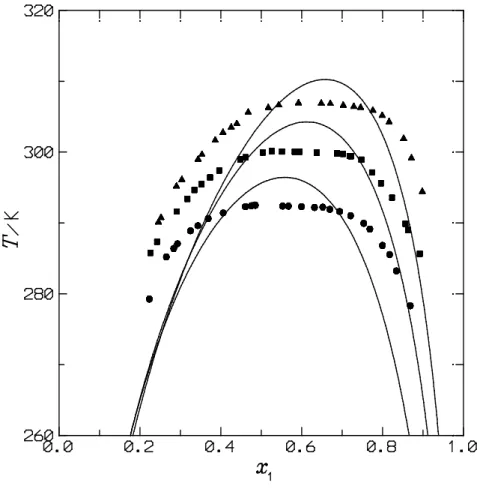
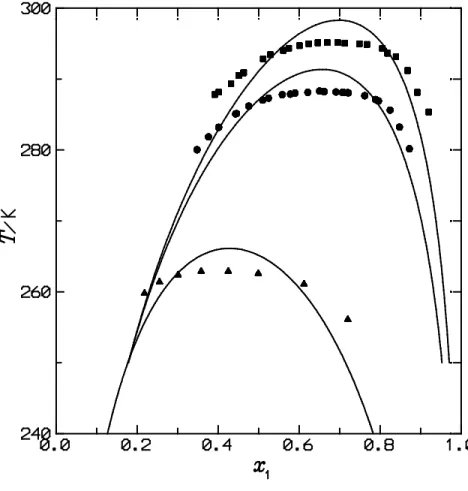
the literature for comparison. Figures 1 and 2 show the experimental results.
We note that the LLE curves of the present systems with 4-phenylbutan-2-one or benzyl
ethanoate show a rather flat maximum and become progressively skewed towards higher x1
values when the number of C atoms of the alkane is increased. In addition, the upper critical
solution temperature, UCST, of the solutions under study increases with the alkane size. These
features are also encountered in many others mixtures previously investigated as those formed
by alkane and 1-phenylethanone,11 or 1-phenylpropan-2-one13 or phenylmethanal,12 or aromatic
alcohols,10 or aromatic amines, or linear organic carbonate, or acetic anhydride, or
alkoxyethanol, or linear polyether (source of experimental data may be found in reference13 ).
The experimental (x1,T) pairs obtained for each system were correlated with the
equation:10-13,23-25
c c
/ / m
T K =T K+k y−y (1)
where
(
1)
experimental data. Particularly, (x1c, Tc) stand for the coordinates of the critical point. It should
be remarked that, when α = 1, equation (1) is similar to:26-28
depends on the theory applied to its determination.26,29
The adjustment of the m, k, α, Tc and x1c parameters was conducted by means of the
Marquardt algorithm30 with all the points weighted equally. Final values of m, k, α, Tc and x1c
and of the standard deviations for LLE temperatures,
σ
( )T , are given in Table 3. Thecorresponding
σ
( )T values are calculated from:( )
parameters. Equation (1) fits well the experimental measurements.
4. Discussion
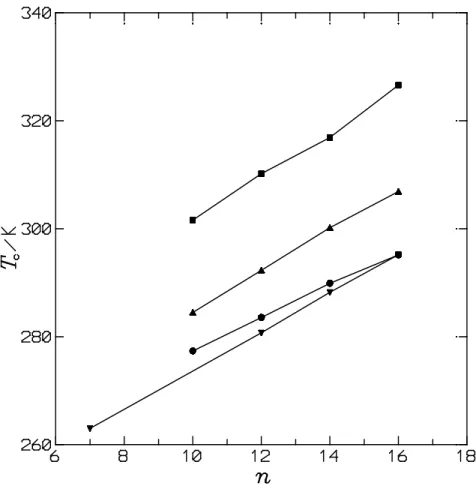
mixtures at temperatures not far from 298.15 K confirms this point (Figure 3).11,13 The observed
behaviour can be ascribed to the existence of proximity effects (intramolecular effects) between
the aromatic ring and the polar group within the same molecule. In contrast, intermolecular
effects are present in systems of the type linear polar compound + benzene, where the aromatic
ring and polar group belong to different molecules. These intermolecular effects lead to
E m
H (linear polar compound + benzene) < HmE(aromatic polar compound + heptane), as it is
indicated by the following examples (see above): HmE(benzene)/Jmol-1 = 138 (2-propanone);37
−
171 (2-hexanone);38 54 (propanal);39−
82 (pentanal);39 84 (ethyl ethanoate).35The variation of proximity effects with the separation between the polar group and the
aromatic ring strongly depends on the polar group under consideration. In the case of aromatic
alkanones, the mentioned effects become weaker in the sequence: 1-phenylpropan-2-one >
4-phenylbutan-2-one > 1-phenylethanone, as for mixtures with a given alkane, the corresponding
values of UCST (Figure 3) and of HmE decrease in the same order. Thus, HmE(n-C7 )/Jmol-1 =
1680 (1-phenylpropan-2-one)31 > 1604 (4-phenylbutan-2-one)40 > 1480 (1-phenylethanone).31
This set of experimental data allows conclude that alkanone-alkanone interactions become
weakened in the same sequence. Interactions between aromatic esters are also stronger in benzyl
ethanoate systems than in those with ethyl benzoate, as HmE(n-C7)/ Jmol-1 = 1783 (benzyl
ethanoate);41 1154 (ethyl benzoate).35 An inversion of this behaviour is encountered in mixtures
containing heptane and phenol (UCST = 327.3 K)42 or phenylmethanol (323.7 K).10
Now, we compare results for mixtures with isomeric polar molecules and an alkane.
Here, we remark the rather large difference between the UCST values of heptane mixtures
involving methyl 2-phenylacetate (278.7 K) or benzyl acetate (263.0 K),43 what clearly indicates
that interactions between polar molecules are stronger in 2-phenylacetate systems. On the other
hand, Figure 3 shows that the UCST values of 1-phenylpropan-2-one mixtures are higher than
those of benzyl acetate systems. Therefore, one can conclude that interactions between like
polar molecules are weaker in the latter solutions. However, the HmE(n-C7)/Jmol-1 values
change in the opposite way: 1783 (benzyl ethanoate)41 > 1680 (1-phenylpropan-2-one).31 This
suggests that interactions related to dispersive forces are more important in mixtures with the
ester.
In previous works,11,13 we have characterized aromatic alkanone or alkanoate + alkane
systems by means of DISQUAC,15,16 providing the needed interaction parameters. Here, we
have explored the validity of the mentioned parameters for the representation of the LLE curves
of the studied solutions. Details on DISQUAC, equations and fitting procedure, can be found
elsewhere.44,45 We merely remark that the functional dependence of the interaction parameters
with the temperature is expressed in terms of the DIS (dispersive) and QUAC (quasichemical)
interchange coefficients,44 Cst,lDIS;Cst,lQUAC where s ≠ t denote two contact surfaces present in the
mixture and l = 1 (Gibbs energy); l = 2 (enthalpy); l = 3 (heat capacity). The systems under
consideration are built by the three following surfaces: type a, aliphatic (CH3, CH2, in alkanes or
aromatic polar compounds), type b, aromatic (C6H5 in aromatic polar compound) and type k
(CO in aromatic alkanone, or COO in aromatic alkanoate). Therefore, in these solutions, we
have three contacts: (a,b); (a,k) and (b,k). The interchange coefficients of the (a,b) contacts are
purely dispersive and can be encountered in the literature.46 The (b,k) contacts in aromatic
alkanoate systems are also represented by DIS parameters only, while the remainder contacts
are described by both DIS and QUAC interchange coefficients.13 The Cbk,1DIS/QUAC(l =1,2,3)
coefficients have been used without modification.13 However, as in other previous DISQUAC
studies as those on mixtures including N,N-dialkylamides,44 or pyridine47 or phenylmethanol,10
or 1-phenylethanone,11 calculations show that the Cak,1DIS coefficients must be assumed to be
dependent on the alkane size (Table 4) in order to provide correct values of (x1c, Tc) (Table 3).
This can be explained taking into account that DISQUAC is a mean field theory and that,
therefore, theoretical calculations on LLE are developed under the assumption that GmE(molar
excess Gibbs energy) is an analytical function close to the critical point. However, it is well
known that, at temperatures close to the critical one, thermodynamic functions are expressed in
terms of scaling laws with universal critical exponents and universal scaling functions.26 This
also leads to the theoretical LLE curves are more rounded than the experimental ones at
temperatures not far from the UCST (Figures 1,2). Moreover, the calculated critical
temperatures are higher than the experimental values at UCST and lower than the experimental
results at the LCST26 (lower critical solution temperature). In spite of these shortcoming of
mean field theories, an important result obtained here is that DISQUAC correctly describes the
change in the symmetry of the LLE curves for the benzyl ethanoate mixtures when the alkane
size is increased (Figure 2).
5. Conclusions
LLE curves have been experimentally obtained for the mixtures 4-phenylbutan-2-one +
dodecane, or + tetradecane, or + hexadecane and benzyl ethanoate + tetradecane, or +
hexadecane. All the curves show an UCST, which increases with the alkane size.
Alkanone-alkanone interactions become weaker in the order: 1-phenylpropan-2-one >
4-phenylbutan-2-one > 1-phenylethan4-phenylbutan-2-one and proximity effects between the C6H5- ring and the CO group
become also weaker in the same sequence. Proximity effects are also more relevant in benzyl
ethanoate than in ethyl benzoate. DISQUAC provides rather accurate results for (x1c, Tc) and
represents correctly the shape of the LLE curves by means of dispersive Gibbs energy
parameters dependent on the alkane for the CH2/X (X =CO, or COO) contacts.
Funding
The authors gratefully acknowledge the financial support received from the Consejería
de Educación y Cultura of Junta de Castilla y León, under Project BU034U16 F. Hevia also
gratefully acknowledges the grant received from the program ‘Ayudas para la Formación de
Profesorado Universitario (convocatoria 2014), de los subprogramas de Formación y de
Movilidad incluidos en el Programa Estatal de Promoción del Talento y su Empleabilidad, en el
marco del Plan Estatal de Investigación Científica y Técnica y de Innovación 2013-2016, de la
Secretaría de Estado de Educación, Formación Profesional y Universidades, Ministerio de
Educación, Cultura y Deporte, Gobierno de España’.
6. Literature cited
(1) González, J.A.; Mozo, I.; García de la Fuente, I.; Cobos, J.C. Thermodynamics of
binary mixtures containing amines. IV. Systems with aniline. Can. J. Chem., 2005, 83,
1812-1825.
(2) González, J.A.; Alonso, I.; Alonso-Tristán, C.;. García de la Fuente, I.; Cobos, J.C.
Thermodynamics of mixtures containing amines. XI. Liquid + liquid equilibria and
molar excess enthalpies at 298.15 K for N-methylaniline + hydrocarbon systems.
Characterization in terms of DISQUAC and ERAS models. J. Chem. Thermodyn., 2013,
56, 89-98.
(3) Fernández-Regúlez, M.; Mozo, I.; González, J.A.; García de la Fuente, I.; Cobos, J.C.
Thermodynamics of mixtures containing amines. VI. Liquid-liquid equilibria of o
-toluidine + selected alkanes. Fluid Phase Equilib., 2007, 259, 39-44.
(4) Alonso-Tristán, C.; González, J.A.; García de la Fuente, I.; Cobos, J.C.
Thermodynamics of mixtures containing amines. XV. Liquid-liquid equilibria for
benzylamine + CH3(CH2)nCH3 (n = 8,9,10,12,14). J. Chem. Eng. Data 2014, 59,
2101-2105.
(5) Páramo, R.; Alonso, V.; González, J.A.; García de la Fuente, I.; Casanova, C.; Cobos,
C. Thermodynamics of mixtures containing amines. XIV. CpmE of benzylamine with
heptane at 293.15 K, or with methanol, 1-propanol, or 1-pentanol at 293.15-308.15 K.
Thermochim. Acta, 2014, 586, 75-79.
(6) Domanska, U.; Zawadzki, M.; Królikowski, M.; González, J.A. Phase equilibria and
excess molar enthalpies study of the binary systems (pyrrole + hydrocarbon, or an
alcohol) and modeling. Fluid Phase Equilib., 2014, 361, 116-129.
(7) González, J.A.; Domanska, U.; Zawadzki, M. Thermodynamics of organic mixtures
containing amines. VIII. Systems with quinoline. J. Chem. Thermodyn., 2008, 40,
1261-1268.
(8) Domanska, U.; Zawadzki, M.; González, J.A. Thermodynamics of organic mixtures
containing amines. X. Phase equilibria for binary systems formed by imidazoles and
hydrocarbons: experimental data and modelling using DISQUAC. J. Chem.
Thermodyn., 2010, 42, 545-552.
(9) González, J.A.; García de la Fuente, I.; Cobos, J.C. Application of a purely physical
model (DISQUAC) to binary mixtures of phenol and organic solvents. Ber. Bunsenges.
Phys. Chem., 1996, 100, 1746-1751.
(10) González, J.A.; Alonso-Tristán, C.; García de la Fuente, I.; Cobos, J.C.
Thermodynamics of mixtures containing aromatic alcohols. 1. Liquid−liquid equilibria
for (phenylmethanol + alkane) systems. J. Chem. Eng. Data, 2012, 57, 1186-1191.
(11) González, J.A.; Alonso-Tristán, C.; García de la Fuente, I.; Cobos, J.C. Liquid-liquid
equilibria for acetophenone + n-alkane mixtures and characterization of acetophenone
systems using DISQUAC. Fluid Phase Equilib., 2015, 391, 39-48.
(12) González, J.A.; Alonso-Tristán, C.; García de la Fuente, I.; Cobos, J.C. Liquid-liquid
equilibria for benzaldehyde + n-alkane mixtures and characterization of benzaldehyde +
hydrocarbon systems in terms of DISQUAC. Fluid Phase Equilib., 2014, 366, 61-68.
(13) González, J.A.; Alonso-Tristán, C.; García de la Fuente, I.; Cobos, J.C.
Thermodynamics of aromatic polar compound (alkanone, alkanal, alkanoate) +
hydrocarbon mixtures. Fluid Phase Equilib., 2016, 421, 49-58.
(14) Gmehling J.; Li J.; Schiller M. A modified UNIFAC model. 2. Present parameter
matrix and results for different thermodynamic properties. Ind. Eng. Chem. Res., 1993,
32, 178-193.
(15) Kehiaian H.V. Group contribution methods for liquid mixtures: a critical review. Fluid
Phase Equilib., 1983, 13, 243-252.
(16) Kehiaian H.V. Thermodynamics of binary liquid organic mixtures. Pure & Appl.
Chem., 1985, 57: 15-30.
(17) Meyer, E.; Castellano, R.K.; Diederich, F. Interactions with aromatic rings in chemical
and biological recognition. Angew. Chem. Int. Ed., 2003, 42, 1210-1250.
(18) Newberry, R.W.; Bartlett, G.J.; Van Veller, B.; Woolfson, D.N.; Raines, R.T.
Signatures of n→
π
* interactions in proteins. Protein Sci., 2014, 23, 284-288.(19) Yang, K.; Zhou, Y.X.; Wang, C.F., Du, S.S.; Deng, Z.W.; Liu, Q.Z.; Liu, Z.L.
Molecules, 2011, 16, 7320-7330.
(20) McManus, J.; Daly, H.; Thompson, J.M.; Connor, E.; Hardcare, C.; Wilkinson, S.K.;
Sedai Bonab, N.; ten Dam, J.; Simmons, M.J.H.; Stitt, E.H.; D’Agostino, C.; McGregor,
J.; Gladden, L.F.; Delgado, J.J. J. Catalysis, 2015, 330, 344-353.
(21) Ragnarsson, U.; Grehn, L. Dual protection of amino functions involving Boc. RSC Adv,
2013, 3, 18691-18697.
(22) CIAAW, Atomic weights of the elements 2015, ciaaw.org/atomic-weights.htm, 2015.
(23) Alonso, V.; Alonso, I.; Mozo, I.; González, J.A.; García de la Fuente, I.; Cobos, J.C.
Thermodynamics of mixtures containing a strongly polar compound. 9. Liquid-liquid
equilibria for
ε
-caprolactam + selected alkanes. J. Chem. Eng. Data 2010, 55,2263-2266.
(24) Ott, J. B.; Holscher, I. F.; Schneider, G. M., (Liquid-Liquid) phase equilibria in (methanol
+ heptane) and (methanol + octane) at pressures from 0.1 to 150 MPa. J. Chem.
Thermodyn. 1986, 18, 815-826.
(25) Haarhaus, U.; Schneider, G. M., (Liquid + liquid) phase equilibria in (methanol + butane)
and (methanol + pentane) at pressures from 0.1 to 140 MPa. J. Chem. Thermodyn. 1988,
20, 1121-1129.
(26) Rowlinson, J. S.; Swinton, F. L., Liquids and Liquid Mixtures, 1982.
(27) Stanley, H. E., Introduction to Phase Transitions and Critical Phenomena, 1971.
(28) Novak, J. P.; Matous, J.; Pick, J., Liquid-Liquid Equilibria, 1987.
(29) Rubio, M. A.; González, J. A.; García De La Fuente, I.; Cobos, J. C. Thermodynamic
properties of n-alkoxyethanols + organic solvents mixtures VIII. Liquid-liquid equilibria of
systems containing 2-methoxyethanol and alkanes (C6H12 and CH3-(CH2)u-CH3, u =
3,4,6,8). Fluid Phase Equilib. 1998, 143, 111-123.
(30) Bevington, P. R., Data Reduction and Error Analysis for the Physical Sciences, 1969.
(31) Urdaneta, O.; Haman, S.; Handa, Y.P.; Benson, G.C. Thermodynamic properties of
binary mixtures containing ketones IV. Excess enthalpies of acetophenone + an n-alkane
and phenylacetone + an n-alkane. J. Chem. Thermodyn., 1979, 11, 851-856.
(32) Urdaneta, O.; Handa, Y.P.; Benson, G.C. Thermodynamic properties of binary mixtures
containing ketones V. Excess enthalpies of an isomeric heptanone + n-heptane. J. Chem.
Thermodyn., 1979, 11, 857-860.
(33) Ferino, I.; Marongiu,B.; Solinas, V.; Torraza, S. Excess enthalpies of some aromatic
aldehydes in n-hexane, n-heptane and benzene. Thermochim. Acta, 1982, 57, 147-154.
(34) Ferino, I.; Marongiu, B.; Solinas, V. Torraza, S.; Kehiaian, H.V. Thermodynamic
properties of binary mixtures containing aldehydes. I. Excess enthalpies of some n
-alkanal + n-alkane mixtures: measurement and analysis in terms of a quasi-chemical
group contribution model and estimation of excess Gibbs energies. Fluid Phase
Equilib., 1983, 12, 125-142.
(35) Grolier, J.-P.E.; Ballet, D.; Viallard, A. Thermodynamics of ester-containing
mixtures. Excess enthalpies and excess volumes for alkyl acetates and alkyl benzoates +
alkanes, + benzene, + toluene, and + ethylbenzene. J. Chem. Thermodyn., 1974, 6,
895-908.
(36) Vidal, M.; Ortega, J. Thermodyanamic properties of (an ethyl ester + an n-alkane) IX.
E m
H and VmE for {x CH3(CH2)uCOOCH2CH3 + (1-x) CH3(CH2)2v+1CH3} with u = 0 to 5
and v =1 to 7. J. Chem. Thermodyn., 1997, 29, 47-74.
(37) Akamatsu, Y.; Ogawa, H.; Murakami, S. Molar excess enthalpies, molar excess
volumes and molar isentropic compressions of mixtures of 2-propanone with heptane,
benzene and trichloromethane at 298.15 K. Thermochim. Acta, 1987, 113, 141-150.
(38) Marongiu, B.; Dernini, S.; Lepori, L.; Matteoli, E. Calorimetric study of molecular
interactions in mixtures of substances containing carbonyl groups. Thermochim. Acta,
1989, 149, 111-121.
(39) Marongiu, B. Thermodynamics of binary mixtures containing aldehydes. Excess
enthalpies of n-alkanals + benzene and + tetrachloromethane. Thermochim. Acta, 1985,
95, 105-110.
(40) Marongiu, B.; Piras, A.; Porcedda, S.; Tuveri, E. Excess enthalpies of aromatic ether or
aromatic ketone(1) + n-heptane(2) mixtures. J. Thermal Anal. Calorim., 2008, 92,
137-144.
(41) Ortega, J.; Legido, J.L. Revision of interaction parameters for estimating the enthalpies
of mixtures of benzyl ethanoate + n-alkanes or 1-chloroalkanes using the UNIFAC
model with presentation of new experimental data. Fluid Phase Equilib., 1993, 86,
251-273.
(42) Matsuda, H.; Fujita, M.; Ochi, K. Measurement and correlation for high-viscosity binary
systems: aniline + methylcyclohexane, phenol + heptane, phenol + octane, and glycerol +
1-pentanol. J. Chem. Eng. Data, 2003, 48, 1076-1080.
(43) Manzini, G.; Crescenzi, V. Liquid-liquid equilibria in n-heptane + methyl phenylacetate
and n-heptane + phenylacetate mixtures. Int. Data Ser. Selec. DATA Mixtures, Ser. A.,
1977, 1, 60-61
(44) González, J.A.; García de la Fuente, I.; Cobos, J.C. Thermodynamics of mixtures with
strongly negative deviations from the Raoult's law. Part 4. Application of the
DISQUAC model to mixtures of 1-alkanols with primary or secondary linear amines.
Comparison with Dortmund UNIFAC and ERAS results. Fluid Phase Equilib., 2000,
168, 31-58.
(45) González, J.A.; Cobos, J.C.; García de la Fuente, I. Thermodynamics of liquid mixtures
containing a very strongly polar compound. Part 6. DISQUAC characterization of N,N
-dialkylamides. Fluid Phase Equilibria, 2004, 224, 169-183.
(46) Cannas, A.; Marongiu, B.; Porcedda, S. Thermodynamic properties of n-alkylbenzene +
n-alkane or cyclohexane mixtures. Comparison with DISQUAC predictions.
Thermochim. Acta, 1998, 311, 1-19.
(47) González, J.A.; Mozo, I.; García de la Fuente, I.; Cobos, J.C. Thermodynamics of
organic mixtures containing amines. V. Systems with pyridines. Thermochim. Acta
2006, 441, 53-68.
(48) Grolier, J.-P.E.; Kiyohara, O.; Benson, G.C. Thermodynamic properties of binary
mixtures containing ketones. II. Excess enthalpies of some aromatic ketones + n
-hexane, benzene, and + tetrachloromethane. J. Chem. Thermodyn., 1977, 9, 697-703.
(49) Chen, K.-D.; Lin, Y.F.; Tu, C.-H. Densities, viscosities, refractive indexes, and surface
tensions for mixtures of ethanol, benzyl acetate, and benzyl alcohol. J. Chem. Eng.
Data, 2012, 57, 1118-1127.
(50) Zhu, S.; Shen, S.; Benson, G.C.; Lu, B.-C.Y. Excess enthalpies of (methyl
1,1-dimethylpropyl ether + an n-alkane) at the temperature 298.15 K. J. Chem. Thermodyn.,
1994, 26, 35-39.
Table1
Properties of Pure Compounds at 0.1 MPa and 298.15 Ka
Compound CAS Source Initial mole
fraction
ρ
a/kgm-3 waterb content
Exp. Lit.
4-phenylbutan-2-one 2550-26-7
Sigma-Aldrich ≥98% 984.742
982.9548
984.3440
700
Benzyl ethanoate 140-11-4
Sigma-Aldrich ≥99% 1051.10 1051.13
49 350
Dodecane 112-40-3 Fluka ≥98% 745.508 745.3250 25
Tetradecane 629-59-4 Fluka ≥99% 759.275 759.31650 25
Hexadecane 544-76-3 Fluka ≥99% 770.221 770.31650 33
a
standard uncertainties are: u T( )=0.01 K; u P( )=1 kPa; the relative standard uncertainty for density
is ur( )
ρ
= 0.002 and 0.02 for water content; bin mass fraction (ppm)Table 2
Experimental Liquid-Liquid Equilibrium Temperatures for 4-Phenylbutan-2-one (1) or
Benzyl Ethanoate(1) + n-Alkane(2) Mixturesa at 0.1 MPa.
x1 T/K x1 T/K
4-Phenylbutan-2-one (1) + dodecane(2)
0.2232 279.3 0.5673 292.4
0.2653 285.2 0.5993 292.3
0.2833 286.4 0.6316 292.2
0.2929 287.1 0.6521 292.2
0.3250 288.9 0.6695 291.9
0.3431 289.6 0.6939 291.6
0.3688 290.6 0.7211 291.0
0.4059 291.4 0.7534 289.9
0.4605 292.3 0.7684 289.1
0.4775 292.4 0.7997 286.8
0.4844 292.5 0.8176 285.5
0.4853 292.5 0.8341 283.2
0.5528 292.4 0.8683 278.3
4-Phenylbutan-2-one (1) + tetradecane(2)
0.2262 285.8 0.5949 300.0
0.2421 287.3 0.6374 299.9
0.2911 291.6 0.6873 299.8
0.3173 293.4 0.7021 299.7
0.3346 294.7 0.7183 299.4
0.3524 295.5 0.7218 299.4
0.3731 296.4 0.7475 298.9
Table 2 (continued)
0.3958 297.4 0.7740 297.1
0.4479 299.0 0.7958 295.6
0.4610 299.3 0.8233 293.6
0.5040 299.9 0.8566 289.9
0.5259 300.1 0.8629 289.0
0.5511 300.1 0.8920 285.6
0.5826 300.0
4-Phenylbutan-2-one (1) + hexadecane(2)
0.2459 290.2 0.5920 307.0
0.2521 290.8 0.6483 307.0
0.2903 295.3 0.6709 306.9
0.3035 296.2 0.7028 306.7
0.3438 299.1 0.7288 306.5
0.3533 299.8 0.7457 306.4
0.3862 301.8 0.7760 306.0
0.4053 302.9 0.7991 305.3
0.4257 303.6 0.8161 304.4
0.4397 304.1 0.8521 302.0
0.4676 305.7 0.8714 299.3
0.5174 306.4 0.8981 294.5
0.5433 306.8
Benzyl ethanoate(1) + tetradecane(2)
0.3480 280.0 0.6619 288.2
0.3762 281.8 0.6909 288.2
0.4014 283.2 0.7069 288.1
Table 2 (continued)
0.4429 285.1 0.7088 288.1
0.4452 285.1 0.7198 288.1
0.4756 286.2 0.7213 288.0
0.5098 287.0 0.7619 287.6
0.5244 287.3 0.7887 287.1
0.5582 287.8 0.7958 286.9
0.5780 287.9 0.8243 285.6
0.5898 288.0 0.8476 283.2
0.6211 288.1 0.8721 280.2
0.6501 288.31
Benzyl ethanoate(1) + hexadecane(2)
0.3915 287.8 0.6463 295.1
0.4011 288.1 0.6695 295.1
0.4319 289.4 0.6952 295.1
0.4512 290.5 0.7127 295.0
0.4616 290.8 0.7487 295.0
0.4634 290.9 0.7671 294.9
0.5110 292.8 0.8052 294.3
0.5289 293.4 0.8184 293.6
0.5609 294.0 0.8390 293.2
0.5745 294.3 0.8676 291.2
0.6006 294.7 0.8917 288.1
0.6235 295.0 0.9109 285.3
a
standard uncertainties are: u x( )1 = 0.0005; u p( )=1 kPa; the combined expanded
uncertainty (0.95 level of confidence) for temperature is U Tc( )= 0.2 K
Table 3
Coefficients in eq. (1) for the Fitting of the (x1, T) Pairs Listed in Table 2 for
4-Phenylbutan-2-one (1) or Benzyl Ethanoate(1) + n-Alkane(2) Mixtures; σσσσ(T) is the
Standard Deviation Defined by eq. (5).
N a M k α Tc/K x1c σ(T)/K
4-Phenylbutan-2-one(1)+ dodecane(2)
26 3.792
−
949 0.906 292.3(296.4)b
0.552
(0.563)b
0.22
4-Phenylbutan-2-one(1) + tetradecane(2)
27 2.899
−
333 0.723 300.2(304.2)b
0.593
(0.613)b
0.24
4-Phenylbutan-2-one(1) + hexadecane(2)
25 3.488
−
627 0.532 306.9(310.2)b
0.653
(0.658)b
0.23
Benzyl ethanoate(1) + tetradecane(2)
25 3.372
−
589 0.445 288.2(291.3)b
0.668
(0.656)b
0.09
Benzyl ethanoate(1) + hexadecane(2)
24 2.728
−
223 0.476 295.2(298.3)b
0.698
(0.702)b
0.15
a
number of experimental data points; bDISQUAC value obtained using interchange coefficients
listed in Table 4
Table 4
Dispersive (DIS) and Quasichemical (QUAC) Interchange Coefficients, Cak,lDISand Csk,lQUAC (l
= 1, Gibbs energy; l = 2, Enthalpy; l = 3, Heat Capacity) for (a,k) Contactsa in
4-Phenylbutan-2-one or Benzyl Ethanoate + n-Alkane Mixtures.
CnH2n+2 DIS ak,1
C Cak,2DIS Cak,3DIS Cak,1QUAC Cak,2QUAC Cak,3QUAC
4-phenylbutan-2-one
n
= 10 2.33 1.5 2 5.75 5.75 2n
= 12 2.17 1.5 2 5.75 5.75 2n = 14 2.07 1.5 2 5.75 5.75 2
n = 16 1.98 1.5 2 5.75 5.75 2
Benzyl ethanoate
n< 10
−
1.65 0.21 2.8 2.25n ≥10
−
2 0.21 2.8 2.25a
type a, CH3, CH2 in n-alkanes, or in aromatic polar compounds considered; type k, CO in
4-phenylbutan-2-one, or COO in benzyl ethanoate
Figure 1. LLE for 4-phenylbutna-2-one(1) + dodecane(2) (●); + tetradecane(2)
(■); + hexadecane(2) (▲) systems. Point, experimental results (this
work); solid lines, DISQUAC calculations using interchange
coefficients listed in Table 4.
Figure 2. LLE for benzyl ethanoate(1) + heptane(2)43 (▲); + tetradecane(2) (●);
+ hexadecane(2) (■) (this work). Points, experimental results; solid
lines, DISQUAC calculations with interchange coefficients listed in
Table 4.
Figure 3. Upper critical solution temperatures, Tc, vs. n, the number of C atoms in
the n-alkane for aromatic polar compound + n-alkane mixtures: (●),
1-phenylethanone;11 (▲), 4-phenylbutan-2-one (this work);13 (■),
1-phenylpropan-2-one;13 (), benzyl ethanoate (this work).43
FOR TABLE OF CONTENTS USE ONLY
LIQUID-LIQUID EQUILIBRIA FOR SYSTEMS CONTAINING
4-PHENYLBUTAN-2-ONE OR BENZYL ETHANOATE AND SELECTED ALKANES
CRISTINA ALONSO TRISTÁN(1), JUAN ANTONIO GONZÁLEZ*(2), FERNANDO
HEVIA,(2) , ISAÍAS GARCÍA DE LA FUENTE(2) AND JOSÉ CARLOS COBOS(2)
(1)
Dpto. Ingeniería Electromecánica. Escuela Politécnica Superior. Avda. Cantabria s/n.
09006 Burgos, (Spain)
(2)
G.E.T.E.F., Departamento de Física Aplicada, Facultad de Ciencias, Universidad de
Valladolid, Paseo de Belén, 7, 47011 Valladolid, Spain,
*e-mail: [email protected]; Fax: +34-983-423136; Tel: +34-983-423757