UNIVERSIDAD DE CUENCA
FACULTAD DE FILOSOFIA, LETRAS Y CIENCIAS DE LA EDUCACIÓN
“Improving Speaking Skills Using Debate Activities for 12th Graders at Unidad
Educativa Particular Bilingüe “Principito & Marcel Laniado de Wind”
Trabajo de Titulación previo a la obtención del
título de Licenciado en Ciencias de la Educación
en Lengua y Literatura Inglesa
AUTORES:
Diego Omar Armijos Solano C.I. 0705864403
Adriana Karina Pacheco Padilla C.I. 0105780738
DIRECTORA:
Mgst. Adriana Patricia Mora Jaramillo C.I. 0103809828
RESUMEN
El propósito de este estudio es validar el uso de los debates para mejorar las habilidades
del habla en los estudiantes de la Unidad Educativa Particular Bilingüe Principito &
Marcel Laniado de Wind. Para lograr los objetivos propuestos, un estudio cuantitativo
basado en el modo causi-experimental fue llevado a cabo.
Los instrumentos que fueron utilizados para recolectar información fueron: pre-test,
post-test, una observación en el aula. De acuerdo con los resultados de esta
investigación, se concluye que la utilización de los debates pueden mejorar las
habilidades del habla en los estudiantes del colegio debido a que los estudiantes
demostraron un considerable mejoramiento desde el momento de la aplicación del
pre-test hasta el post-pre-test en parámetros como la organización y preparación, conocimiento
del tema, pronunciación, expresión corporal, y contacto visual.
Para investigaciones futuras, se recomienda aplicar la técnica del debate con un periodo
de tiempo más extendido.
ABSTRACT
The aim of this study is to validate the use of debate to enhance speaking skills in 12th
grade students at Unidad Educativa Particular Bilingüe Principito & Marcel Laniado de
Wind. In order to achieve the proposed goals, a quantitative study based on a
quasi-experimental design was carried out. Different research instruments were used to collect
the necessary data; they were the pre-test, post–test, and a classroom observation to give
the foundation to this study. This data also helped us to conclude that using debates can
improve speaking skills in students, as the results from the pre-test and the post-test on
parameters such as organization and preparation, subject knowledge, mechanics,
elocution, and eye contact improved after the intervention of these activities.
For further investigation, it is recommended to apply the Debate Technique for longer
periods of time.
CONTENTS
INTRODUCTION ... 11
1.1. DESCRIPTION OF THE PROJECT ... 12
1.2. JUSTIFICATION ... 13
1.3. BACKGROUND ... 13
1.4. Research Question ... 16
1.5. Objectives ... 16
1.6. LITERATURE REVIEW ... 16
2.1. COMMUNICATIVE APPROACH ... 20
2.2. THE SPEAKING SKILL ... 24
2.3. DEBATE AS A TEACHING TECHNIQUE ... 26
3.1. TYPE OF RESEARCH ... 38
3.2. TIME ... 38
3.3. PARTICIPANTS ... 39
3.4. RESEARCH METHODS ... 39
3.5. DATA COLLECTION TECHNIQUES AND INSTRUMENTS ... 39
4.1 RESULTS OF THE ANALYSIS ... 44
DEDICATION
This thesis is dedicated to my dear family. A special feeling of gratitude to my
parents Ramon Pacheco and Ximena Padilla, who have always loved me and supported
me, and whose good example taught me to be a good person and made me the person I
am. I also want to dedicate this thesis to my husband, Eric Kindred, whose words and
encouragement have supported me every day during this process.
Adriana
This thesis is dedicated to my beloved family. A special gratitude to my parents
Orlando Armijos and Ibelia Solano, who have always guided and supported me, and
whose good examples and valuable advice helped me to become a good person. In the
same way, I would like to dedicate this research paper to my dear wife, Sandra Huerta,
as well as my two lovely daughters, Kristell and Jeslie, who supported and inspired me
to never give up.
ACKNOWLEDGMENT
We would like to express our sincere gratitude and appreciation to all the people
who have helped us during this study. This thesis would not have been possible without
their support.
First of all, we would like to give special thanks to our thesis advisor, Magister
Adriana Mora, who provided us with many constructive suggestions and helpful advice
during all the stages of this work.
We sincerely thank the academic authorities and teachers of the School of
English Language and Literature of the University of Cuenca, as well as the staff and
students of Unidad Educativa Particular Bilingüe Principito & Marcel Laniado de Wind,
for giving us the opportunity to carry out our research project.
Finally, our special thanks to all the members of our family who walked next to
INTRODUCTION
The main purpose of this project was to enhance speaking skills by using debate
technique activities with 12th graders at Unidad Educativa Particular Bilingüe
“Principito & Marcel Laniado de Wind”, in the city of Machala. According to some
class observations, it was easy to notice the lack of time to practice speaking, due to the
number of students or the amount of class periods. It is imperative to mention that an
important aspect of this study is to make teachers aware of the advantages that debate
technique activities may have within an English classroom. Classroom debates can help
students feel confident when using the language to express ideas, thoughts, and points
of view, and at the same time, they allow students to work on all the other skills,
improving their overall learning.
This thesis is divided into five chapters that will provide information about the
importance and significance of this project. The first chapter explains the objectives that
guided the whole project. The second chapter describes some theories that support this
research project. The third chapter mentions the type of research as well as the
intervention that has been used to carry out this thesis. The fourth chapter details the
results of analysis, and the last chapter contains the conclusion, as well as possible
recommendations for further research.
Finally, we may say that this whole project can give novice, experienced, and
future teachers a better understanding of how to use debates to improve English class at
different levels and in various contexts. As a recommendation for further investigation,
it is recommended to conduct debates for longer periods, the entire scholastic year if
CHAPTER I
THE PROBLEM
1.1. DESCRIPTION OF THE PROJECT
The purpose of this project was to improve speaking skills through the use of
debate activities, working with 12th graders at Unidad Educativa Particular Bilingüe “Principito & Marcel Laniado de Wind”, in the city of Machala. Alongside this, the
debates were designed to motivate students, and give them the opportunity to talk in
class. A careful observation allowed us to identify a level of fear in most of the students
when they had to talk or give opinions inside the EFL classroom.
Another important aspect of this thesis is to propose ways to make students feel
more confident when speaking. In order to do this, all activities were developed under
the parameters of the debate activity. Students were given specific topics to discuss in
the classroom and had the chance to express their points of view or arguments for
themselves.
Some modern and innovative debate activities were adapted to match students’
level and interests. Additionally, original activities were created to cater student´s
abilities. Through a survey, it was possible to find what topics best suited 12th graders,
and what encouraged them to participate and speak during class.
Finally, this thesis provides information about the debate format, such as the
process of debating and the roles of the participants. Additionally, in order to use these
debate activities correctly, this thesis describes the methods involved, in order to
1.2. JUSTIFICATION
Nowadays, teachers have access to all types of resources that can be used in the
educational process, but the ones that should be considered the most are those that
motivate students to achieve accurate communication in English. Observation has
shown that English teachers just apply the same method for all type of students;
however, they do not realize that the educational process depends on the students` level,
interest and age. Most students do not take English because they want to; they take this
subject because it is mandatory in all levels of education. The only thing that students
want is to pass the school year, without giving importance to their learning.
Dörnyei (1994) argued that “the main factor to learn a foreign language is
motivation” (p.78). Teachers have to use the appropriate methodology to succeed in the
teaching - learning process. Some studies have shown that debates are very useful in
motivating students to learn a foreign language, and practice it in a meaningful way.
Throughout the investigation of this thesis, English teachers were guided to
improve their classes by motivating students to practice speaking, utilizing debates as
engaging activities for the classroom.
The main idea of this research is that English teachers and their students get
most of the benefit from using the language in a meaningful way inside and outside the
classroom; all the activities, as mentioned before, were based on students’ interests and
needs. Through debate activities, students had the opportunity to enhance their speaking
skills, and hence, students learned how to share their own opinions and ideas in a
dynamic and interactive way.
1.3. BACKGROUND
language properly inside as well as outside classrooms. Debating is a practice that
inspires learners to open their mouth, get into discussion, defend their own positions,
place counter arguments and also conduct research on related issues” (p. 147). Equally
important, debates can be used in EFL classes as a tool to assist students with real-life
language practice.
Krieger (2005) argued the following: debate is an excellent
activity for language learning because it engages students in a variety of
cognitive and linguistic ways. In addition to providing meaningful
listening, speaking and writing practice, debate is also highly effective
for developing argumentation skills for persuasive speech and writing.
As most people know, English has become the most common language for
communication among people who do not speak the same first language, as well as the
language of science; for these reasons, English is very important around the world and
everybody needs to learn it. Unfortunately, high school students do not feel confident
when giving their opinions and points of view due to the lack of motivation, the use of
poor communicative activities, or activities that are monotonous or without context.
In analyzing the educational process in Ecuador, there are many factors that
should be taken into consideration, including: the quality of the education depends on
the institution, whether it is public or private, students’ economic situation, regional
accents, the number of students in the classroom, and classroom environment.
Ecuador is separated into four different regions, but with two different school
periods (coastal and highlands), as well as some social, cultural, and behavioral
differences. The coastal region is comprised of El Oro, Guayas and the Galapagos
February. On the other hand, the highland region includes the Inter-Andean region and
the Amazon, where classes start in September and finish in June.
Unidad Educativa Particular Bilingüe “Principito & Marcel Laniado de Wind” is
in Machala, in the coastal province of El Oro. It is one of the best institutions in our
country due to its multiple virtues. The classroom environment is comfortable and
different from other institutions, since this is a private bilingual high school with the
goal of educating children and youth with a solid humanistic foundation, mastery of
science, and technology. Teachers are specialized and certified in languages. It is a
nationally recognized institution of excellence that boasts numerous partnerships,
programs and certifications, which demonstrate the excellence of their educational
programs. It offers an International Baccalaureate education, as well as national and
international certifications such as: EFQM (European Foundation for Quality
Management - Second Star), IBEC (International Certifications Sufficiency Computers)
and ADOBE, English language training, and French as a third language. There are
specialized teachers, certified at the B2, C1, and C2 levels according to the Common
European Framework, as well as virtual classrooms, and agreements with French
Alliance (Alianza Francesa), the British School of Languages, and Cambridge
University.
For all the reasons mentioned above, utilizing debate as a classroom activity
will prove to be very useful for language learners in improving their speaking skills; at
the same time, it will help students feel more motivated and allow them to participate
actively during classes, and in their future preparation. Thus, language learners may
1.4. Research Question
How can debate activities contribute to the improvement of speaking skills in
12th graders at Unidad Educativa Particular Bilingüe “Principito & Marcel
Laniado de Wind”?
1.5. Objectives 1.5.1. Aim
➢ To improve the speaking level of 12th graders through the use of debate
activities at Unidad Educativa Particular Bilingüe “Principito & Marcel
Laniado de Wind”, Machala
1.5.2. Specific Objectives
• To gather bibliographical and scientific information related to debate
technique.
• To design and conduct a survey with 25 students to determine which
debate topics they consider important and relevant.
• To analyze students’ level and it´s improvement through a pre-test and
post-test
• To create six lesson plans for each of the units in the book.
• To utilize debate activities in order to improve student´s speaking skills.
1.6. LITERATURE REVIEW
Nowadays, there are many methods and techniques that teachers can use to
improve their students’ oral skills. Many authors suggest a lot of techniques and
educational process, because they help develop speaking skills in both teachers and
language learners. Through this technique, teachers are able to create real situations in
class to teach English according to each student’s level and interest, while maintaining
their engagement.
Furthermore, speaking is one of the most important language skills that must be
mastered by students to become good communicators. Speaking is making use of
language in ordinary voice; uttering words; knowing and being able to use a language;
expressing oneself in words; making speech. (Hornby, 1995)
Snider (2011) emphasized that “debate is about change” (p. 97), referring to the
battles we have to fight in order to improve everything that surrounds us. Equally
important, Metsaki (2012) stated that “a debate also asks a person to be able to confirm
facts, persuade an audience, or make an appeal regarding a topic” (p. 207). In addition,
debating is used when we need to clarify the matter and present our points of view to
come to an agreement. Moreover, the activity of debate provides the chance to analyze
issues from different perspectives in order to make a final decision.
There are four skills in teaching English, and all of them are very important to
learn a foreign language. They have to be taught and practiced by English teachers at
schools. Language is a tool for people to communicate with others, especially foreign
people, and to express their ideas, opinions, emotions, attitudes and feelings. Moreover,
speaking is a very important skill, since people learn the language in order to use it for
communication purposes.
In teaching speaking, teachers have to present the material creatively, and they
should provide students with opportunities to practice it. At the same time, teachers also
Snider (2011) has mentioned the following, in order to improve
the speaking skill in students; the use of debate and dialogue techniques
should be implemented in the classroom to strengthen the language or
weak the fear to use it (p. 157).
Speaking is the action of conveying information or expressing one’s thoughts or
feelings in spoken language. To teach speaking, the teacher requires a scoring system
that will facilitate grading and evaluating improvement objectively in several key areas:
comprehension, vocabulary, fluency, grammar and pronunciation.
Vásconez (2015) argued that debate is a process of presenting an
idea or opinion in which two opposing parts try to defend their idea or
opinion. Equally important, she stated that a debate is an excellent
activity for language learning because it engages students in a variety of
cognitive and linguistic ways (p. 43).
As a result, debates must be considered an important way for students to
improve their oral skills, even though it may cause pressure on learners and teachers.
There are several techniques that teachers can use to teach speaking. The
techniques should be appropriate and interesting to involve students in the educational
process. Debates are a way of improving verbal communication and critical thinking,
and encouraging students to become more active in various situations. Additionally, it
can create active learning because students will learn how to construct their ideas, work
in groups, and share knowledge. It is useful to work as a group with students because in
this way students feel more confident when speaking, and they can help each other as
well.
Like every technique, debates have some advantages and disadvantages. As we
students get to hear both sides of a topic; they learn from each other, and are able to
appreciate different opinions and ideas. Moreover, it helps to develop students’
knowledge. While debating, they will hear updated information from other debaters,
which can enrich their awareness in the English language.
In fact, in the countries where English is treated as a foreign language, students
cope with lack of language knowledge that prevents them from using it outside the
classroom. The only place where students can practice the English language is at school.
Moreover, in most cases, EFL teachers fail to implement the best activities, approaches
and techniques in an appropriate manner. Debating can be used to learn English in both
formal and informal settings through real life situations. If debating is practiced
appropriately, students will learn both the English language and presentation skills,
which will make them confident users of English in academic, social and professional
settings.
For this reason, in the application of debate activities and the enhancement of
the speaking abilities with high school learners at Unidad Educativa Particular Bilingüe
Principito & Marcel Laniado de Wind. We will focus on the introduction and
implemention of debetes, not only to boost the use of the spoken language, but to
CHAPTER II
THEORETICAL FRAMEWORK
2.1. COMMUNICATIVE APPROACH
The Communicative Approach was articulated by Robert Lang, emphasizing
interaction and problem solving as both the means and the ultimate goal of learning
English or any other language (Richards, 2006). As such, it tends to highlight activities
such as role-play, pair work and group work. It changes the focus from traditional
language teaching, with its emphasis on grammar and the teacher-centered classroom, to
that of the active use of authentic language and a student-centered learning process.
According to Jack Richards (2006) “the communicative approach is based on
the idea that learning language successfully comes through having to communicate real
meaning. When learners are involved in real communication, their natural strategies for
language acquisition will be used, and this will allow them to learn to use the language”
(p. 1). Classroom activities guided by the communicative approach are characterized by
trying to produce meaningful and real communication, at all levels. As a result, there is
more emphasis on skills than systems, lessons are more learner-centered, and it uses
authentic materials. Practicing and provoking real situations for students to have
dialogues or debates are examples of the communicative approach, as they involve
meaningful communication.
Communicative Language Teaching (CLT) emphasized “self-direction for the
learners” (Kuhn Wei, 2010, p. 174). The role of teachers in this method is not to be
around to guide them the whole time; when learners speak the language outside the
learning. According to Kuhn Wei (2010) “this is essential to the active development of
the new language” (p.4). The learner should enter into situations where communication
takes place as much as possible to increase his or her communicative proficiency.
Teachers no longer rely on activities that require repetition, accuracy and
memorization of sentences and grammatical patterns; instead, they require learners to
negotiate meaning and to interact meaningfully with the new language. Learners have to
participate in classroom activities based on cooperative working rather than an
individualistic one; they need to listen to their peers in order to perform group work
successfully. The teacher adopts different roles, on one hand they are a “facilitator, a
guide and a helper” and on the other hand, a “coordinator, an idea-person and a
co-communicator” (Kuhn Wei, 2010, p. 10). They talk less and listen more to students’
output. In addition, the teacher also identifies students’ learning strategies, helps
students improve them if necessary and shows them how to work independently.
Instructional tasks become less important and fade into the background. That does not
mean that they are not used at all, but with less significance.
Richards and Rodgers (2001) supported that “these changes give the teacher
more scope for variety and creativity and she gives up her status as a person of authority
in a teacher-learner hierarchy” (p. 34). It is the teacher’s responsibility to be creative
and prepare appropriate material at home. The teacher can also assume other roles and
try to motivate students in order to make them speak more.
The central concept in CLT is “communicative competence” (Richards &
Rodgers, 2001, p.159), since it covers both the spoken and written language and all four
language skills. As Kuhn Wei (2010) stated, the “development of communicative
competence requires realistic interaction among learners using meaningful,
Learning strategies allow learners to become more self-directed and more
independent in learning the new language, and helps them actively participate in
communication. Savignon (2002) included a useful summary of the eight characteristics
of communicative language teaching from the linguist M. Berns:
1. Language teaching is based on a view of language as communication. That
is, language is seen as a social tool that speakers use to make meaning;
speakers communicate about something to someone for some purpose, either
orally or in written.
2. Diversity is recognized and accepted as part of language development, and it
is used by second language learners and users, as it is with first language.
3. A learner’s competence is considered in relative, not in absolute, terms.
4. More than one variety of language is recognized as a viable model for
learning and teaching.
5. Culture is recognized as instrumental in shaping speaker’s communicative
competence, in both their first and subsequent languages.
6. No single methodology or fixed set of techniques is prescribed.
7. Language use is recognized as serving ideational, interpersonal, and textual
functions and it is related to the development of learner’s competence in
each.
8. It is essential that learners be engaged in doing things with language – that is,
that they use language for a variety of purposes in all phases of learning.
(Richards, Communicative Language Today, 2006, p. 6)
According to Richards and Rodgers (2001) “one major feature of
communicative language teaching is pair and group work. This type of work is
is useful, since students learn to be more independent and accept responsibility for their
own learning.
Piepho (1981) discussed the following levels of objectives in a communicative
approach:
1. An integrative and content level (language as a means of expression)
2. A linguistic and instrumental level (language as a semiotic system and an
object of learning);
3. An affective level of interpersonal relationships and conduct (language as a
means of expressing values and judgments about oneself and others);
4. A level of individual learning needs (remedial learning based on error
analysis)
5. A general educational level of extra-linguistic goals (language learning within
the school curriculum).
These are proposed as general objectives, applicable to any teaching situation.
Particular objectives of CLT cannot be defined beyond this level of specification, since
this approach assumes that language teaching will reflect the particular needs of the
target language learners. These needs may be in the domains of reading, writing,
listening, or speaking, each of which can be approached from a communicative
perspective. Curriculum or instructional objectives for a particular course would reflect
specific aspects of communicative competence according to the learner's proficiency
level and communicative needs (Piepho, 1981).
Communicative Language Teaching facilitates and fulfills the learning process to
improve speaking skills. Communication is an important part of the goal of language
teaching. There are various reasons why Communicative Language Teaching (CLT) has
✓ Communicative Language Teaching is relevant to all four language skills.
✓ The concept of Communication can refer both to the properties of language
and to social behavior.
✓ CLT is a dynamic and intensely practical skill, providing the learners
opportunities for thorough and meaningful rehearsal of the English they will
need for effective communication.
✓ CLT enables the learners to use the target language to communicate in real
life.
✓ CLT places emphasis on developing skills, particularly speaking skills,
within a wide range of communicative settings.
According to Richards and Rodgers (2001) “The Communicative Approach in
language teaching starts from a theory of language as communication. The goal of
language teaching is to develop communicative competence” (p.76). Communicative
Language Teaching increases students’ opportunities to improve and develop speaking
skills, and for this reason, it is one of the best methods to strengthen speaking skills.
2.2. THE SPEAKING SKILL
Speaking is one of the most important skills to be mastered by students in order
to be better communicators. Speaking is the verbal use of language to communicate
with others. Speech is about making choices; students must choose how to interact in
expressing themselves and forming social relationships through dialogue or
conversations.
Rubiati (2015) has stated that speaking is an ability that is taken for granted
seen as the way to carry out feelings and thoughts through words, or even having a
conversation with others. It means that humans use words and phrases in an interactive
process in order to give them a meaning in a conversation, according to each given
situation and context.
2.2.1. Elements of speaking
Rubiati (2010) mentioned “there are many elements of speaking that must be
mastered by students in order to be good speakers” (p. 7). Explained by Rubiati, in
order to make students good communicators they have to know some elements of
speaking; in this way, students do not face difficulties when speaking, and as a result,
they will feel more confident.
According to this author the four elements of speaking that students must master
to become better communicators are:
✓ Connected speech: effective speakers of English need to be able not only to
produce the individual phonemes of English, but also to use fluent connected
speech. In connected speech, sounds are modified, omitted, added, or weakened.
It is for this reason that we should involve students in activities designed
specifically to improve their connected speech.
✓ Expressive devices: native English speaker change the pitch and stress on
particular parts of utterances, vary volume and speed, and show by other
physical and nonverbal means how they are feeling. The use of these devices
contributes to the ability to convey meaning and allows the extra expressions of
emotion and intensity to appear. Students should be able to deploy at least some
of such suprasegmental features and devices in the same way if they are to be
✓ Lexis and grammar: spontaneous speech is marked by the use of a number of
common lexical phrases, especially in their performance of certain language
functions. Teachers should therefore supply a variety of phrases for different
functions, such as: greetings, agreement and disagreement.
✓ Negotiation of language: In order to speak effectively, we can use the
negotiation of language. That means we ask for clarification when we do not
understand the message the speaker is trying to transmit, and when we show the
structure of what we are saying to the audience.
In short, speaking is not only having a range of vocabulary and knowing the
grammatical structures, but also mastering all elements of speaking, because each
one is very important and useful to become better speakers. Everyone will
understand the messages, if we master the elements of speaking. A useful way to
improve speaking skills is to practice utilizing debates, where the participants use
real communication to express their personal opinion, thoughts and feelings about a
specific topic.
2.3. DEBATE AS A TEACHING TECHNIQUE
Snider (2011) has emphasized that debate is about change, because we have to
be constantly involved in a struggle to improve our lives, our country, and our
community. He also mentioned the battles we have to fight in order to improve
everything that surrounds us. Thus, debating is used when we need to clarify matters
and present our points of view to come to an agreement.
Snider (2011) has also referred to “debating as a process that determines how
issues from different perspectives, which can be in favor or against an issue, in order to
make a final decision.
In addition, Snider (2011) stated that debates can give you the power to change
your world and yourself. The author asserted that your voice can be a powerful
instrument for changing everything in any place you are: for example, your school, your
community, your nation, and the world. However, before changing the world, debating
changes you, because it gives you new skills and abilities that you can use to achieve
the changes you want.
Equally important, Snider and Schnurer (2002) stated that, “in most high schools
and universities, students participate in debates only on competitions” (p. 135). This is
very important, because students like participating in competitions in order to know
who the best is; in a debate, all of them want to be winners, as nobody likes to be the
loser.
Additionally, Metsaki (2015) argued that “a debate also asks a person to be able
to confirm facts, persuade an audience, or make an appeal regarding a topic” (as cited in
Vásconez. p. 39). This author refers to how all these techniques allow students to
acquire argumentation and reasoning skills, and develop their critical thinking. In a
debate, the participants must take into account that they have to be responsible for their
arguments: either they are in favor or against the proposal.
Another important aspect that Snider (2011) has stated is the following; “there
are formal and informal debates” (p. 13). One example of formal debate is the political
debate, which requires the use of sophisticated debating skills. On the other hand,
informal situations like the ones at school, with friends, and with family will make
people discuss issues and look for solutions. Informal debates can occur anywhere,
because when we are in a meeting we tend to create discussions about anything and at
the end, we come up with different types of decisions.
2.3.1. The use of debates in the classroom
Debating can be used in the EFL classroom as a tool to make students practice
English skills in real-life situations. Only in that way, students will be engaged enough
to talk about something in front of others.
Quinn (2009) said that “debating gives you the chance to meet new people and
new ideas. Best of all, you have the opportunity to stand up and argue with someone in
public, in a stimulating and organized dispute about real issues” (p. 1). The author
argues that debates make students discuss their ideas, points of view or arguments to
convince people. Also, debating is an important and interesting way to discuss issues
that our society faces. When students discuss a topic, they have to show evidence to
defend their ideas, if they want to be the winners. Having a debate allows students to get
to know many different people with diverse points of view.
Furthermore, debating is part of opening tasks due to its features of enabling
learners to propose their point of views for or against different topics (Vásconez, 2015).
Moreover, the use of debates in the classroom is very important because it encourages
teamwork, language enhancement, and speaking skills improvement, among others.
Additionally, the debate is an excellent activity for language learning, because it
engages students in a variety of cognitive and linguistic ways. In addition to providing
meaningful listening, speaking and writing practice, debates are also highly effective for
developing argumentation skills for persuasive speaking and writing (Krieger, 2005).
Research by Alasmaril and Salahuddin Ahmed (2012) supported the theory that
These authors refer to debates as one of the best tools that English teachers should use
or apply in classroom when working on oral skill development.
Additionally, (Ali & Sayed Salahuddin, 2013)stated that the use
of debate, speech and conversation in EFL classes will first of all push
out the students’ fear about the English language. Moreover, regular
practice of debate, speech and conversation will improve the different
English skills such as fluency, pronunciation and vocabulary (p. 147).
As it has been written before, the authors stated that students should be familiar
with some jargon and technical terms when conversing, so in this way students will
learn more vocabulary. The role of the teachers will be to work as mediators; at the
same time, they will facilitate students’ learning.
Consequently, during debates students will improve several skills, learn many
new words, and collect information about numerous areas, which all together will
enrich their spoken English, and ultimately make them more confident speakers.
2.3.2. Types of debates
Rai stated that there are five kinds of debate in the classroom, and provided a
format and main characteristics for each one (as cited in Vázconez, 2015, p. 40):
1. Four-corner: The four corners of the class are defined as “strongly
agree,” “agree,” “disagree,” and “strongly disagree.” Learners are
asked to choose their point of view on a certain topic. When everyone
has selected a corner, the students sit down to write a paragraph
summarizing their opinion. An important characteristic of this format
is that the debate is not simply defined by dualism; students can
2. Fishbowl: When using this format, students can be arranged in
different ways. The first option is to put students in two groups,
taking an affirmative or negative position on a resolution. Each group
prepares their arguments, and engages in back and forth rebuttals.
Another solution is to divide the class into three groups. Two groups
gather the arguments for and against the topic, thereby becoming the
expert groups, while the third one acts as the audience.
3. Think-pair-share: Each student works individually writing their
arguments both for and against the topic. Then students are arranged
into pairs to compare their answers and outline their ideas. After that,
they are rearranged into groups of four to come to an agreement if
they are for or against the topic. Then, they compose their final
arguments to support their views and present them in front of the
class. Since this type of debate starts from students’ individual
performance leading up to group work, it makes all students practice
and develop their thinking, writing, listening, and speaking skills.
4. Role-play debates: For this kind of debate, students are asked to play
a stakeholder role that is appropriate for the topic. For instance, a
debate about banning smoking at universities could involve roles
such as a student, the principal of the university, the owner of a
tobacco company, a university student’s mother, etc. Each student
takes on the role and defends their point of view from the position
that can be associated with that role. In this manner, the debate can
bring up clashing arguments for and against a controversial topic. In
necessarily, present arguments associated with a person in authority
while considering the students’ point of view. However, this type of
debate could be seen as controversial if important perspectives like
cultural issues and women’s views were left out. Teachers should
increase their students’ sensitivity to diverse points of views as a
preliminary task.
5. Lincoln-Douglas debate: This debate format references the way in
which Abraham Lincoln and Stephen Douglas debated in 1858, for
an Illinois senate seat. Two students are asked to debate a topic with
arguments and rebuttals. It can also be set up with groups of six
students. In each group, two students debate and the rest are the
audience.
2.3.3. Characteristics of debaters
As we know, most people are afraid of public speaking because they are not
involved in these kinds of situations. However, if you understand and know how to use
your voice, gestures, and body, you will be more comfortable and find the experience
far more pleasant than you thought, and as a result, your presentation will be more
effective than other people who do not know or use these tips.
Snider (2011) described some important characteristics that debaters need to
have in order to give a successful and convincing speech by projecting energy,
enthusiasm, commitment, and variety in his/her discourse (p. 102):
✓ Voice: this is one of the most important communication tools for humans. In a
presentation, tone of voice plays an important role because you can
communicate concern, joy, fear, or curiosity. Also, there are important features
space you will be speaking in), pitch (to indicate emotional state), and speed (to
emphasize key points).
✓ Face: being one of the most expressive parts of the body, the face makes people
pay close attention to arguments that could be highlighted by facial expressions.
It is important that facial expressions match the points being put forward, and in
this way, the audience will not be confused.
✓ Eye contact: In most cases, establishing and maintaining eye contact is
considered an indicator of honesty. Arguments will appear stronger if people
look at their audience. In addition, good eye contact gives you valuable feedback
from the audience, such as if they understand, enjoy, or agree with your speech
or not.
✓ Body movement: The body presents the debater as a whole being. Therefore,
body movement should be varied according to the topic presented. A phrase will
capture audience attention not only if it is important, but also if it is emphasized
by appropriate body movements.
✓ Gestures: finally, this factor is very important because gestures energize and
animate the presentation. In addition, they punctuate the presentation with
meaning. Gestures can signal that you are numbering, sequencing, emphasizing,
demonstrating, illustrating, or comparing information. When a presenter uses
natural gestures, the efficacy of gestures will depend on their variation, but they
should be contextually appropriate to avoid distracting the audience.
2.3.4. Advantages of debate as a teaching technique
As a communicative and an interactive activity, debate can be integrated into the
classroom, students can improve their speaking skills automatically. A debate has many
advantages in the classroom:
✓ A debate allows students to share and cooperate with one another.
✓ It educates students about responsibility.
✓ It encourages creativity.
✓ Students are motivated to enjoy the activity.
✓ It can improve students’ speaking ability.
As has been mentioned previously, debate is a form of producing conversation
among people, and at the same time, within the smaller context of debate students can
gain more confidence. We may add that debates can be beneficial to the educational
process. Furthermore, Somjai & Jansem (2015) also stated that “debate has some
benefits in the teaching and learning process” (p. 29). The authors point out that through
debates, English teachers can obtain a lot of benefits and in this way, it may help
students to reach the desired outcome more quickly.
There are a number of other characteristics related to debates. Firstly, a debate
equips students to cope with both success and failure within social and academic
contexts. Secondly, students are able to make and defend informed choices about
complicated issues outside of their own area of interest. Thirdly, debate is not only a
way to connect students with academic subjects; it can also connect students to public
life. Finally, the policy that is used in debate specifically, can teach students to adapt to
multiple perspectives, which is described as one of the most important problem solving
skills.
Students will improve their speaking skills through the use of debate, because
they will feel motivated and engaged to learn and master the English language.
In the learning process, debate has some disadvantages during application. First
of all, debating can only be used for specific subjects, such as those concerned with
agreeing or disagreeing, and giving arguments. Secondly, a debate requires a long time
to prepare, in order to make sure it runs well. Students should prepare their arguments
before the debate to make it easier for them to discuss their opponents’ opinions.
Finally, debates require students to be controlled in defending their argument, and many
students cannot control their emotions when they defend their arguments, taking
everything personally.
Although debate has these disadvantages, the benefits outweigh the
disadvantages in the improvement of English learning. Furthermore, these are areas that
the English teacher must work on in order to minimize or avoid these drawbacks.
2.3.6. Motivation and debate in EFL.
Motivation plays an important role when learning, especially a foreign language.
It is an essential requirement for learners because it creates a satisfactory learning
environment. In other words, a motivated student is able to learn faster than others.
Dörnyei (1998) said that “motivation has been widely accepted by both teachers
and researchers as one of the key factors that influence the rate and success of
second/foreign language (L2) learning” (p. 117). Equally important, without sufficient
motivation, even individuals with the most remarkable abilities cannot accomplish
long-term goals. The author points out that the key to success in any situation is motivation,
so, for this reason, the teacher must be aware that before starting any class he/she needs
to motivate their students to use the language, as it will be the only way to reach
students’ required outcomes. On the other hand, if a teacher does not motivate their
students at the beginning of a class, students will feel bored, and as a result, they will
Dörnyei (1998) stated that there are four important subcategories inside
motivation; these are: extrinsic, intrinsic, instrumental, and integrative.
a) Extrinsic motivation occurs when students are motivated to
perform a behavior or engage in an activity to earn a reward
or avoid punishment, such as when a student wants to get a
good grade or to take part in a competition to win a
scholarship.
b) Intrinsic motivation occurs when students want to participate
in a sport because they find the activity enjoyable, or playing
a game because you find it exciting and you encounter
satisfaction within the activity itself.
c) Instrumental motivation occurs if a student wants to learn a
foreign language, and they just want to pass the exam to get
jobs, and to use the language for holidays in another country.
d) Integrative motivation occurs when a student takes interest in
knowing more about a foreign language knowing about the
culture and values. (p. 120).
Teachers must take into consideration all the aspects mentioned above because
at this time there are many students who do not like English; they just take it because it
is mandatory or they simply want to earn credits. Here is where teachers have to work
hard to motivate students.
In addition, in order to achieve success using debates, teachers will have to
design interesting activities, and to create situations according to students’ needs; only
in this way students will get motivated to learn new things and feel an affinity with the
According to Harmer (2007), “motivation is some kind of internal drive which
pushes someone to do things in order to achieve something” (p. 120). So, if the learner
enters the classroom with positive motivation, they will acquire the language more
quickly. Teachers must be prepared to use the correct methodology in order to apply
content in the classroom. If the teacher motivates their students, they will learn a
significant amount of knowledge and will apply this to real life situations according to
their needs, which prepares them to apply the activities before debating.
2.3.7. Activities before debating
During debates, students have to participate actively in class. Therefore, Stewart
and Pleisch recommended some activities before the final formal debate that can
enhance students’ speaking skills, such as fluency, vocabulary, and so on (as cited in
Vásconez, 2015). The authors suggest some activities that can be utilized before
holding a debate, as they will make students be more willing to use the language; the
recommended activities are:
Activity 1 – For and against fluency pairs: Learners are arranged in pairs to
practice for and against arguments. This kind of activity helps the student to be
engaged in exchanges and build confidence and fluency.
Activity 2 – Classification Tree: This is a brainstorming technique in which
learners are placed into groups and given a topic, and then write all the details to
support their argument. The main contribution of this activity to the debate is
that it helps to organize ideas and thoughts, so students can express and write
their opinions with greater ease.
Activity 3 – Argument/Counter-argument: Learners have to be able to confront
their classmates by using counter-arguments. They can record or listen to their
present a counter-argument to the class. This activity helps learners organize the
presentation of their arguments.
Activity 4 – Paraphrase and counter: This activity helps learners control the
language they need to present materials effectively, clarify research findings to
partners, synthesize information, and reach conclusions quickly. Learners work
in groups and each one gives an argument and responds to a counter-argument.
Activity 5 – The hot seat: This activity develops academic language skills,
fosters peer collaboration, and trains students to perform under difficult
conditions. Students practice formulating, anticipating, and responding to
possible debate questions created by one member of the group.
In conclusion, when debates are carried out in a meaningful context, learners
appear to participate in a highly motivated way, and speak more freely, without forcing
explicit grammar or vocabulary. Indeed, working with tasks fosters a particular quality
of learning satisfaction. In some other cases, this methodology has appeared to enhance
other language skills such as listening, reading, and writing. Additionally, learners show
CHAPTER III
RESEARCH METHODOLOGY AND INTERVENTION
3.1 OVERVIEW
This chapter explains the methodology applied to carry out the research study. It
describes the main characteristics of the debates, the participants involved, the
instruments used to collect information, and the procedures followed to complete the
research.
This research study was based on a quantitative methodology, and it followed a
quasi-experimental design. It was especially designed to find out if students’ speaking
skills would improve through the application of the debates in the classroom.
3.1. TYPE OF RESEARCH
This graduation work research was quasi-experimental, as it had an intervention
group. It was based on the analytic and scientific method (Clarke, 2005). This was
quantitative research because it was a formal, objective, and systematic process in
which numerical data was used to get information (Clarke, 2005).
3.2. TIME
The application of the project took place during July 2016- September 2016. Once
we received total consent from high school authorities and parents, the research study
was carried out between August 2nd to August 20th; four classes per week of 40
topics were not included within this time period; they were completed before the dates
mentioned above.
3.3. PARTICIPANTS
The research took place with 25 students from 12th grade at Marcel Laniado
High School; most students have a high economic status, and some of them have a B1
level of English. This prestigious private institution, Unidad Educativa Particular
Bilingüe Principito & Marcel Laniado de Wind, is located in Machala, in the coastal
province of El Oro. Students´ ages were between sixteen and seventeen years old.
3.4. RESEARCH METHODS
The research method was based on the analytical method, in which a problem is
first identified and then observations, experiments, or other relevant data is used to
explain it. The inductive method was also used as a working tool, whereby the
researchers tried to extrapolate from particular cases to a general idea (McDonald &
Headlam, 2011).
3.5. DATA COLLECTION TECHNIQUES AND INSTRUMENTS
A pre-test and post-test were designed to measure students’ ability to use the
target language before and after the intervention, as well as the group’s development
during the class. In order to analyze the data, it was necessary to design a rubric to
measure some important aspects of the English language, such as grammatical
structures, fluency, pronunciation, and vocabulary. In addition, this rubric helped us
A survey was also designed to learn about students’ favorite debating topics,
these topics were chosen from students’ course book, as well as topics suggested by the
students. Once the list of topics was ready, students chose six topics to debate. The idea
of this survey was to motivate students by using trendy and interesting content.
• School
This research study was carried out with 12th grade students at Unidad Educativa Particular Bilingüe “Principito & Marcel Laniado de Wind”. The goal of this high
school is to graduate independent language users with a B2 level according to the
Common European Framework of Reference (CEFR) for Languages. However, the
students who participated in this research do not belong to the bilingual group, and they
will be the last ones to graduate from school with an A2 level. However, some students
had a higher level of English compared to their classmates.
• Students
In order to conduct the debate, we were assigned to work with the
above-mentioned group, which consisted of 25 students, 13 females and 12 males. Their ages
were between 16 and 17. The ethics of a research study requires asking the participants’
and the parent/legal guardians’ permission, due to the participants’ young age. The
researchers also asked school authorities for consent to apply and use the gathered
information for our academic purposes. It is important to mention that this consent letter
included the main characteristics of the research project, participants’ role during the
process, the ethics of the research, and information about the researchers. Consequently,
the legal procedure took place in order to proceed with the research study on August 2nd,
2016.
One informed consent letter was accepted by the school board, and sent to the
person in charge of the English department. After that, another informed consent letter
was sent to the participants and their parents/legal guardians, in order to have a clean
start and avoid any future problems (see Annex 1).
3.5.2 Debate Questionnaires
It was important to find out the participants’ interest in debating topics.
Therefore, we designed a questionnaire to define which topics should be used in the
debates; it was carried out during the second week of July. The questionnaire presented
nine topics with an extra space in which students could write down an additional one. It
was necessary to take into account that the debating topics had to be related to the
course book, the high school vision, and the participants’ interest (see Annex 2).
3.5.3 Rubric
The rubric used for this research study was an analytical evaluation of the
participants’ performance in the research project. This rubric was taken from the
Rubistar site and we had to set up the indicators to be evaluated. It evaluated
performance in five sub-skills: organization and preparation, subject knowledge,
mechanics, elocution, and eye contact. Each item was graded from 1 to 4 points,
explained below.
Organization & preparation took into account how well students present
information in a logical, interesting sequence that the audience could follow.
Subject knowledge was evaluated by how well students answered class
questions, with explanations and elaboration, to demonstrate their knowledge.
Mechanics assessed the number of spellings or grammatical errors in the
Elocution was focused on the students use of a clear voice and correct, precise
pronunciation of terms so that all audience members could hear the presentation.
Eye contact required that the students maintain eye contact with the audience,
and seldom returned to their notes (see Annex 3).
3.5.4 Pre-test / Post-test
An oral test was used to assess participants’ speaking skills before and after the
treatment of the research project. This test was used to evaluate the five sub-skills
mentioned before, and then the results were compared.
3.5.5 Lesson Plans
The EFL course book did not include debate as a teaching technique. In fact, the
aim of this research study was to adapt this technique in order to enhance speaking
skills. Each topic had one lesson plan, which lasted 40 minutes; moreover, their
advantages and disadvantages were also explained to students. Additionally, students
were asked to brainstorm their ideas on the board, and then they were guided and told to
debate every topic in favor or against (see Annex 4).
3.5.6 Conducting the Debates
For the debate activities, the class was divided in four groups; two groups were
in charge of taking notes on the main points and giving their conclusions at the end of
the debate. The other two groups were responsible for carrying out the debate. These
groups had five minutes to organize their ideas before the debate started. One group was
in favor of each topics, and the other group was against it. Each member of the group
took turns expressing their points of view. We, as the researchers, were the mediators
during the process. In this way, all the students had the opportunity to speak and give
their points of view. After finishing each topic, students were asked to give a report to
After the completion of the project, the information from the pre-test, post-test,
and debates was organized, analyzed and interpreted using charts and graphics of
CHAPTER IV
RESULTS AND ANALYSIS
4.1RESULTS OF THE ANALYSIS
Before conducting the in-class debates, an observation was carried out. The
purpose was to measure students’ abilities when using the language. Students were
given three minutes to introduce themselves, give their personal information, and talk
about their hobbies and interests. During this presentation, we focused on students’
weaknesses, as they showed nervousness, shyness, and lack of vocabulary; in other
words, they did not feel confident. Most of them did not know how to give a good
speech, utilizing expressive gestures, good posture and eye contact, and varied voice
inflection.
A week after the observation, students were given a list of topics to choose from;
if they wanted to add an extra topic they had a blank space to write it down. After that,
we made a bar graph of the nine most popular topics.
Before we started the application of our study, we developed the pre-test, which
consisted of a random debate where each student had the opportunity to participate. We
used this to assess and measure students’ performance, and then developed a speaking
rubric to evaluate five sub-speaking skills. In the pre-test, we could observe that the
grades were not good at all. During the debate, students did not respect their turns; they
all wanted to speak at the same time. Thus, we had to re-explain how debates work, and
refresh their minds of the process, rules, and time limits. Moreover, it is important to
mention, that the pre-test was piloted with 12th graders at Benigno Malo High School
and this allowed us to change and fix this research instrument for our investigation.
After analyzing each evaluation parameter in the pre-test and post-test, we noted
observable results from the intervention that allow us, as researchers, to say that the use
of debates can help improve students’ speaking skills. It is important to mention that all
the graphics presented below show how students have improved or declined in each
parameter.
GRAPHIC 1
PARAMETER 1: ORGANIZATION AND PREPARATION
Created by: (Armijos &
96
4=Excellent 3=Very good 2=Fair 1=Poor
36
With this parameter, we wanted to explain how the organization and preparation
for the topics during the debates evolved from beginning to end. It is important to
remember that learners must prepare for debates using certain techniques, like
classification trees or argument/counter-argument exercises (Vásconez, 2015). It is
imperative to say that during the pre-test, 36% of the participants showed a very good
mastery in this parameter, allowing them to hold the debate in an organized and
sequential way for the audience to follow. 52% made a great effort as well, and they
demonstrated an average level. Although the results of the pre-test were good, we still
observed an improvement in scores after the intervention. In the post-test, 96% of the
participants (24 students) had completely mastered organization and preparation,
debating the topics in an organized, sequential and interesting way for the audience to
follow. None of the students scored fair or poor, since most of students made significant
progress. This teaching technique focused not only on speaking skills, but also on how
well students were able to construct and express their ideas.
GRAPHIC 2
PARAMETER 2: SUBJECT KNOWLEDGE
C
reated by: (Armijos & Pacheco, 2016)
0
4=Excellent 3=Very good 2=Fair 1=Poor
48 52
The second parameter was intended to analyze how much students studied the
different aspects of the subject to prepare for the debate. We need to remember that
debates encourage students to confirm facts through research of data and details
(Metsaki, 2015). Moreover, subject knowledge is important since it allows students to
internalize English vocabulary and grammar through real content. During the pre-test,
80% percent of the students showed a very good mastery of the subject, which means
they could answer questions related to the topic, extract ideas from the subject
dimensions, construct their own ideas, and create arguments. During the post-test, the
results were also positive; 48% of the students reached an excellent score, and 52% of
them scored a very good rating. The fair parameter, obtained during the pre-test,
completely disappeared, which led us to conclude that the use of the debate technique
allowed students to show confidence with their answers through the construction of
ideas by using relevant information during the debate.
GRAPHIC 3
PARAMETER 3: MECHANICS
Created by: (Armijos & Pacheco, 2016)
4=Excellent 3=Very good 2=Fair 1=Poor 60
The third parameter was based on mechanics, which includes grammatical
mistakes and misspellings made by students during the debate. This is probably one of
the most difficult elements to develop with students, since they are prone to make a lot
of mistakes in these areas. During the pre-test, 60% of students received a rating of
good. However, there were also 28% who scored fair, and 12% who did poor and did
not accomplish the evaluation objectives at all. It was observed that most of students
made three or four grammar mistakes and several misspellings, because of different
reasons such as lack of knowledge of grammar rules, shyness and nervousness.
However, during the application of the treatment, we could notice an improvement in
these elements, which were verified in the results of the post-test. 48% of students
reached the qualification of very good and 52% accomplished an excellent rating. This
improvement means that students overcame those language difficulties with the
structure of the language, and they started talking with more confidence and fluency,
which takes us to the following parameter.
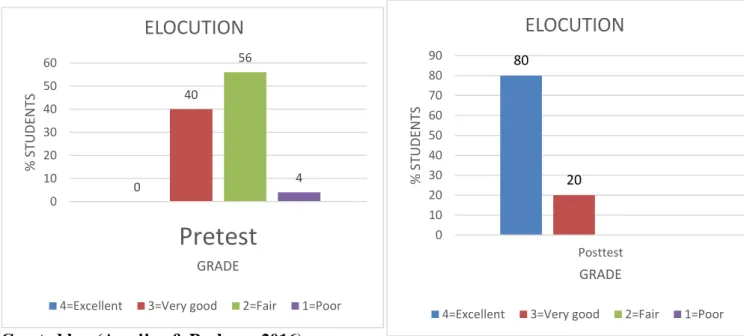
GRAPHIC 4 PARAMETER 4: ELOCUTION
Created by: (Armijos & Pacheco, 2016)
80
4=Excellent 3=Very good 2=Fair 1=Poor
0
With the elocution parameter, we wanted to assess how debating effects the
development of oral speech, including voice and gesture control. Notice that this
parameter emphasizes aspects such as volume (to appropriately fill the acoustic space),
pitch (to indicate emotional state), and speed (to emphasize key points) (Snider, 2008).
During the pre-test, 40% of students had mastered this skill in an excellent way, and
56% were very good. Nobody scored fair in this parameter, due to the fact that the
majority of the students performed very well. Some of the problems presented were
vocal clarity during the debate, and pronunciation issues that influenced comprehension.
In addition, students had difficulties expressing their ideas through their gestures.
However, the post-test showed us that 80% of students started to improve in these
aspects, and they reached an excellent level in this skill.
GRAPHIC 5
PARAMETER 5: EYE CONTACT
C reated
by: (Armijos & Pacheco, 2016)
92
4=Excellent 3=Very good 2=Fair 1=Poor
2
The last aspect evaluated was eye contact; this has to do with how confident
speakers are when talking, and the connection they have with the audience. When
students maintain eye contact during the debate, it means that they are not worried about
grammar mistakes or misspellings, but instead more focused on the idea they are trying
to communicate. During the pre-test, only 8% scored an excellent performance in the
eye contact parameter,24% of them demonstrateda very good performance, 64% of
students had developed this skill in a fair manner, and 4% scored poor. However, after
doing several exercises focused on this area during the treatment, students started to
look at the audience with a more positive attitude, appeared less shy, and showed
confidence in their skills. After the post-test, results showed that 92% of students
improved their level of eye contact, reaching an excellent level, and the remaining 8%
of language learners showed a very good performance, which means that they were able
to present their arguments to the audience using their body language and gesture in a
more relaxed and appropriate way.
GENERAL ANALYSIS BETWEEN PRE-TEST AND POST-TEST
Finally, when comparing the grades from the pre-test and the post-test; we can
say that in a general manner there was an improvement. The results show that during
the pre-test, most students were in a range between 13 and 15 points. However, after the
intervention, most students achieved between 18 and 20 points. Students managed to
develop their abilities since they learned how to talk in public using real language in
everyday contexts. Motivation had a fundamental role, since students were involved in a
project beyond regular classes or homework. The knowledge of the subject guaranteed
that students internalized the language and they were able to express themselves more
fluently and with confidence. Other elements from the treatment were demonstrated to
be important, too. Organization and preparation helped students to distribute ideas
according to the topic; mechanics aimed to improve grammar, and elocution and eye
contact were successful at pushing students to talk during debates with less stress and