Universidad de Especialidades Espíritu Santo Faculty: Economy and Entrepreneurial Sciences
Ecuador’s cement case under the new Antitrust Law
Prerequisite to present as a requisite to get the Bachelorette in Science of: Business Administration and Finance
Student: María Denisse Aguilera Hansen Vik
Tutor: Carlos Molina
Ecuador’s cement case under the new Antitrust Law
María Denisse Aguilera Hansen Vik
International Bachelorette in Economics, Espíritu Santo University - Ecuador, [email protected],
Economy and entrepreneurial sciences faculty, E Building, Edificio E, Espíritu Santo University, Km. 2.5 Puntilla Samborondón.
Summary
This paper will analyze the consequences of the Organic Law for Regulation and Control of Market Power in the cement sector in Ecuador. The cement industry in Ecuador is only composed by four market agents: Holcim, LaFarge, Chimborazo and Guapán. This leads to a potential problem due to market dominance. Therefore, the new Organic Law for Regulation and Control of Market Power is in charge of regulating and monitoring market imperfections to avoid unfair practices. In Ecuador, it is feasible to invest in a cement company. There are no restrictions about it. However, there are high entry barriers due to the high initial investment to create a cement factory, therefore there are not to many people that are willing or able to take the risk of investing in this sector. Due to the nature of the industry, especially for the high costs of machinery and transportation, it can be argued that a natural oligopoly is presented.
Key words: cement, oligopoly, market, agents, law, control, power Abstract
imperfecciones de mercado para evitar prácticas desleales. En Ecuador, es factible invertir en una empresa cementera. No hay restricciones al respecto. Sin embargo, existen altas barreras de entrada, debido a la alta inversión inicial para crear una fábrica de cemento, por lo tanto no hay muchas personas que estén dispuestas o en condiciones de asumir el riesgo de invertir en este sector. Debido a la naturaleza de la industria, especialmente para los altos costos de las máquinas y transportes necesarios, se puede argumentar que este es un caso de oligopolio natural.
Index
1. Introduction
2. Literary revision/Theoretical framework/Enouncing the problem 3. Methodology
1. Introduction:
In the cement market in Ecuador, there are only four market participants: Holcim, LaFarge, Guapán and Chimborazo. Holcim has 62% of the market share. Its mission is to be the most respected and successfully operating company in the cement industry, creating value for their customers, employees, investors and community opportunities. (Holcim, 2011) Lafarge is the second strongest competitor with 23% of the market share. Lafarge, worldwide leader of construction materials, creates materials derived from the earth to shape up the world that surrounds them. (LaFarge, 2013) Guapán, on the other hand, desires to contribute to the economic development and social improvements for the country, based on the production and supply of cement and related products of high quality. (Guapán, 2013) Finally, Chimborazo has the lowest market participation. Its mission is to produce and commercialize with high productivity and quality levels, to satisfy the needs of their clients, contributing to the development of the country with a socio-environmental responsibility (Cemento Chimborazo, 2013). This leads to a potential problem due to market dominance. The new Organic Law for Regulation and Control of Market Power regulates and monitors market imperfections to avoid unfair practices.
Thesis Statement:
Even though the cement sector in Ecuador has been referred to as <<an oligopoly>>, there is not conclusive proof that any of these companies have acted in a monopolistic or anticompetitive fashion.
2. Literary Revision / Literary revision/Theoretical framework/Enouncing the problem
Antecedents:
premised on maximizing consumer welfare through an examination of two variables: unit price and total output” (Tennis & Schwab, 2012). These laws induce competitiveness through government control over mergers, prohibiting anticompetitive activities or even by dissolving companies. “While most areas of antitrust law breed controversy over which types of business conduct should be illegal, there is one area of relatively broad consensus: price-fixing cartels should be condemned” (Leslie, 2006). It is considered that “competition generally produces efficiency at all economic levels in which it may take place. Therefore, it seems reasonable to reward competition - and sanction its obstruction wherever it may be involved, whether at the consumer level or elsewhere” (Wood, 2012).
The pioneers in the fighting laws against monopolies are the Sherman Act and the Clayton Antitrust Act. The Sherman Antitrust Act was posted on July 2, 1890 by the Federal Government of the United States to create barriers for the expansion of the power of monopolies. This law was the legal basis for promoting competition. John Sherman, from the State of Ohio, created the legal proposal and the President Benjamin Harrison ratified it. The law stated that "every contract or combination in the form of trust or otherwise, or conspiracy, in restraint of trade or commerce among the several states or with foreign nations, is declared illegal" (Sherman, 1890). “From its origins, antitrust law has been concerned with preventing the accumulation and exercise of economic power in big enterprises” (Markham, 2011).
This federal law was created in order to limit the monopolistic power that emerged during the Industrial Revolution, in particular the steel industry. This law sanctions anticompetitive actions though civil and even penal mechanisms. It reprimands any conspiracy that restricts trade, as well as any action that inhibits the expansion of competitors to protect market competition. This seeks to safeguard the welfare of consumers, because having several competing companies will offer more quantities of goods and services and, thus, lower prices.
mergers, collusion and acquisitions in a dominant or monopolistic market. This act was a supplement to the previous law that created the legal foundations to promote market competition. It was introduced by Democrat Henry De Lamar Clayton of Alabama and ratified by the government of Woodrow Wilson (United States Congress, 1914).
Following the same line, the Robinson-Patman Act complemented the previous laws, prohibiting a wide range of anti-competitive behavior. Specifically, it penalized pricing agreements in the market. This law also condemned dumping, which is when the price of a good or service is lower than the production cost. Price differentiation is only permissible when it is higher than the costs of manufacture, distribution, sales and delivery of the product (United States Congress, 1936).
To ensure the compliance of these Antitrust Laws in the United States was created the Federal Trade Commission, or FTC, in 1915. The mission of this group was and is to protect the interests of consumers by monitoring full obedience to these laws and to promote competition, ensuring free and fair trade. Five commissioners form this commission. These positions are elected by the Executive Power and ratified by the U.S. Senate.
The Commission can investigate complaints or issues that come to its attention. If, as a result of an investigation, the Commission believes the Commerce Act has been breached we can take a range of actions. This might include educating a business about how to comply with the Act or issuing a warning, or we can prosecute a business or person in the High Court. (Anti-Competitive Practices, 2013)
In this explanation of the Commission of New Zealand, we can point out that its mission is to assure that all the laws are followed.
administrations or complaints from private parties. The Authority may impose heavy penalties against restrictive agreements or abuses of dominant position. A merger must be notified to the Authority when total domestic gross turnover exceeds established thresholds. (Greenbaum & Alegi, 1994)
Holcim, the market leader
It is important to note that Holcim has extremely high standards of execution. In general, companies with high market shares try to regulate themselves in order to have the highest standards in the industry to ensure quality for the consumers. This is an advantage of big companies. They have enough resources to invest in quality procedures that ensures products with the best specifications available in the industry. Moreover, when these companies are multinational, in order to ensure their license to trade, they set themselves the highest standards of execution worldwide. They always try to be in the vanguard in the industry.
The government should get involved and forbid market power when it is affecting the consumer: when prices are elevated in comparison for other markets: when the quality provided is poor or when the consumer does not like the product. Then, it would be an appropriate time for regulation to intervene, otherwise not.
Companies look forward to becoming market leaders, to earn big margins. If they have poor practices would they be able to achieve this? In the majority of cases, no. There are of course a few markets like the drugs industry that achieved that without being competitive or with the best practices. In the other cases, company struggle through out several years and even decades to become market leaders: with competitive prices, quality, excellence in route to market, excellence in service, etc. This would be the case of Holcim.
Throughout this century, Holcim has grown from a modest enterprise in a small village in Swiss to become one of the world's top construction materials corporations.
the village of Holderbank, Canton Aargau. From the beginning, they realized that the domestic market could only offer limited opportunities to expand, which led them to seek opportunities abroad.
By the early 1920s, the company began investing in cement businesses in other European countries. After their success, they kept investing and expanding to other continents. They entered Egypt, Lebanon and South Africa. Fifteen years after their first expansion, a network of holdings began to develop in North and Latin America in the years 1950s and 1960s.
In the 70s decade, Holcim began to explore ventures in the emerging markets of the Asia-Pacific region successfully. In the 1980s, Holcim continued to expand into new markets, including Eastern Europe. A greater focus on aggregates and ready-mixed concrete production strengthened the company's position as a vertically integrated market leader.
A strong focus on core business activities in cement, concrete and aggregates characterized Holcim's activities during the 1990s. But, production was not the only focus of the company. They also invested in their employees with continuing professional development programs for them. These actions along with a best practices policy, ensured challenges were met with creative solutions and company performance were enhanced. With global leaders, without market miopia, saw further expansion opportunities for the Group in Asia.
In May 2001, the name of the Group was changed from "Holderbank" Financière Glaris Ltd. to Holcim Ltd. This name came from the combination of the village name in which it was founded “Holderbank” and "ciment", which is the French word for cement.
The Antitrust Law and the cement industry
The proposal for the Anticompetitive law became popular in march, 2011, when Rafael Correa, Ecuador´s current president, in his usual Saturday´s morning TV show said that oligopolistic attitudes of Holcim and Lafarge dominated Ecuadorian cement industry, which was broadcasted in 54 TV and radio channels.
The President alledged that Ecuador´s cement is extremely expensive and the oligopolistic attitude of Holcim and Lafarge generates indignation among Ecuadorians. He even argued that Holcim sells their cement in extremely high prices, with a profitability index of 100%.
During his speech, he announced that he would present an initiative to the Legislative Power, or Constituent Assemby, that would punish the monopolistic and anticompetitive practices. Correa also declared that his Project would not stop with the law. He even said that he would negotiate a strategic Alliance with the private sector to form a holding of a new cement Enterprise that could compete with these two big companies. This action was announced with the intention to force the industry to lower their prices.
The Economist President also commented that Holcim Ecuador was sold to Swiss multinational with the Price of a “sick chicken,” meaning a ridiculously low price. He finalized his speech by reinforcing the idea that he would not allow these companies to manipulate the price of cement.
Moreover, the corporation alleged that instead of the new law becoming a thread, it would be a positive action. They even went further by claiming that this new law would be beneficial for all the participants of the cement sector and all the productive sectors in the country.
Correa alleged that the elevated prices of cement in Ecuador are due to an illegal agreement between Holcim and Lafarge. However, Ecuador´s price for this commodity of 45 kg is among market price compared to other Latin American countries. Peter Gysel assured that Holcim does business in Ecuador by following strictly the rules of the Código Interno de Conducta, which prohibites any price agreement among competitors. He even remarked that the price for this product is based on supply and demand.
If we analize this law from the other side of the coin, we can realice that Holcim is extremely lucrative and profitable. LaFarge is the most profitable company worldwide followed by Holcim. They are both dedicated to commercializing cement and other aggregate products derived from stone and sand.
In Ecuador, Holcim suffered different stages of development before becoming part of this multinational group. It was first founded as Compañía Anónima de Industrias y Construcciones in 1923 and then as Cemento Nacional in 1948. Ecuador was one of the first companies in Latin America to become part of this group following Cuba in 1918 and Argentina in 1919.
Theoretical Framework:
According to the English government: “Competitive markets are the best way of making sure a country’s resources are put to their best use. They encourage enterprise and widen choice for consumers” (Department for Business, Innovation &
Skills, 2013). However, anticompetitive practices can be found in any country’s economy. The problem relies on the consumers. They have to pay higher prices and suffer the lack of innovation.
price for similar goods or services, the consumer is affected. This agreement protects the companies’ incomes, but leaves the consumer with lower options to choose. This
affectations that the buyer suffers need to be controlled. That is why many governments consider that “Anti-competitive activities can be very bad for consumers. That’s why they have to be identified and stopped as quickly as possible” (Department for Business, Innovation & Skills, 2013).
“In perfect competition, firms produce identical goods, while in monopolistic competition, firms produce slightly different goods” (Parkin & Bade, 2013). Therefore, we can define competition as the existence of a large number of suppliers for homogeneous goods or services. This makes the suppliers be price taker, meaning that no company has the power to influence the market price. Moreover, what makes competition so desirable is that: “Competition is marked by firms continuously trying to change their products so that consumers prefer their product to their competitors' products.” (Parkin & Bade, 2013)
Ecuador has industries with monopolies, duopolies and oligopolies. These are market imperfections that directly affect the consumer, because they need to pay higher prices for goods and services offered only by companies that are market controllers. This creates the need for Anti-monopoly or Antitrust laws in order to improve and induce market transactions to perfect competition.
Ecuador has developed three branches for the Antimonopoly Law, in order to prevent abuse in unfair competition issues. These are classified in: mergers, anti-competitive agreements and abuse of dominant position.
The most significant cases of unfair competition in Ecuador will be investigated to determine the impact that the Market Control Act has had on them. In addition, potential viable ways will be determined to promote a competitive market in Ecuador.
Conceptual framework
“A monopoly is an enterprise that is the only seller of a good or service. In the absence of government intervention, a monopoly is free to set any price it chooses and will usually set the price that yields the largest possible profit” (Stigler, 2013). These have the power to determine market prices, due to the fact that they are the only ones that sell a particular product in the market, which has no close substitutes. These companies, therefore, become price imposers.
The main reason why monopolies remain alone in the market is the high entry barriers. This may be given by the company’s control over a vital resource, by governmental agreements or by the company’s low production costs as the producer only market.
Government grants for exclusive rights to produce a good or service creates a conflict of interest. The government must act as a regulator of the economy, which ensures a harmonious fellowship between the business sector and households. “Economists, however, identify six major functions of governments in market economies. Governments provide the legal and social framework, maintain competition, provide public goods and services, redistribute income, correct for externalities, and stabilize the economy” (National Council on Economic Education NY, 2013). When the government loses this vision, favoring certain groups of power, the ones who are affected the most are consumers. They must pay higher prices for goods and services with lower value.
Intellectual property rights, including copyrights and patents, are legal means that the government uses to grant exclusive rights to sell a product or service in the country. This is a legal strategy used to safeguard the interests of the public interest, but affects the individuals.
specialization that is reached in the economies of scale. The cement industry could fit into this definition.
“Cement powder is the basic ingredient in concrete, along with stone, sand and water. Concrete is used to form bricks, blocks, pipes, culverts and pre-stressed badge spans. It is the primary structural component of office buildings, dams, tunnels, sewers, highways, airports, sidewalks, driveways and house foundations.” (Ferguson, 1992)
The first step in the elaboration of cement is the mixture of several elements. The main raw material is limestone, followed by loam and clay, or kaolin in the case of white cement. In few cases, silica sand, pozzolans and pyrite or other iron ores are also added to the manufacture. Calcining the raw materials produce in large kilns clinker. This, once ground and mixed with gypsum, which acts as a set-retarding), slag and/or ash resulting cement. In recent years, the industry has been increasingly using alternative substances proportion, usually from waste of other industrial activities. (Oficemen, 2009)
Due to the economic relevance of this construction element it is very important to ensure that its practices are competitive ones. In the past and even nowadays, there have been cases of unfair practices from this sector worldwide. “A lucrative pnce-fixing conspiracy they had masterminded was threat- ened with exposure and criminal sanctions. The French, Swiss, Spanish and British executlveswho met in the exclusiveKensington hotel help direct the mostpower- ful, clandestine cartelin the world-the cement cartel.” (Ferguson, 1992) When there are few market agents, they become price imposers, rather than price takers. This is a problem for the society, since the consumer has to pay the consequences of price arrangements.
In Ecuador, cement is the main raw material for construction. This activity has been characterized by steady growth in the past five years, 5.9% on average, even in adverse market situations like the financial crisis of 2009. (Investigación Ekos Negocios; Unidad de Análisis Económicos, 2011)
Ecuadorians prefer this material over any other for construction. Maybe, it is the favorite choice of Ecuadorians because of status, customs or quality. Given the conditions it can be said that the cement market in Ecuador is a entrepreneurial paradise for the companies involved in it, especially because the number of competitors is limited. In Ecuador this segment of four companies, the two largest ones are private multinational recognized worldwide for their leadership in the manufacture of this product (Holcim and Lafarge), while public (Chimborazo and Guapán) survive with self-generated resources. (Investigación Ekos Negocios; Unidad de Análisis Económicos, 2011)
The market participation is composed as followed:
Graph 1: Cement Market Participation Source: Diario Hoy
Elaborated by: Denisse Aguilera
It is important to note that the development cycle of the construction sector had a significant boom since the 90s, achieving significant growth after the end of the century. This is reflected on the results of some indicators, such as growth of real estate projects and the expansion of housing projects in other cities like Guayaquil, Cuenca, Manta and Ambato. Furthermore, it is relevant to mention that in spite of the
62%
24%
7%
7%
recovery of the construction sector in the year 2010, it is attributed mainly to the credit that has flowed from the IESS and financial system, mainly banks. (Jiménez, 2011)
Moreover, one of the key determinants for this behavior of the construction sector has been the increase in the population, since there arises the need for housing. According to reports the Ecuadorian Institute of Statistics and Census (INEC), in 2010 the population of Ecuador was composed of 14'306.876 inhabitants. This number is 14.60% higher than the one reported in the Census of 2001 (year in which the population came to 12'481.925 inhabitants), showing a growth rate of 1.52% per year. (Jiménez, 2011)
In reference to the contribution of gross domestic product (GDP) by the construction sector, this has shown steady growth over the 2006-2010 period: thus, in the year 2006 this came to 8.83% while for the year 2010, represented a 9.35% of total GDP. The growth of the construction sector is also visible in the new companies engaged in this business that enter the market each year. Therefore, it is important to consider the growing demand for labor in the sector and the activities that may be related. (Jiménez, 2011)
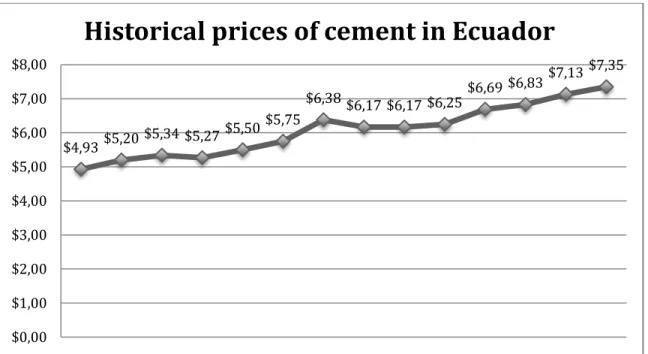
The unrealistic low price settled in 2007 influences this indicator and makes the tendency stay below its real potential. If we compare the first price of $4.93 year with the price 14 years later, we will find out that it has doubled has almost doubled.
In the analysis of this information on the evolution of prices in Ecuador, the mode, the mean and median is calculated, however it is not so suitable for this porpoise.
reflects a very similar to the average between the initial price and the final price. This data also can be supported by the frequency histogram that says 0.33 intervals are different numbers of data that are in the range indicating that such inflation is not constant, if there are periods of greater volatility than others.
Although the government owns 8% of market share in the cement industry has failed to make a brake on inflation on this segment. Moreover, the country wants to become the owner of 15% of the market with the merger between Guapán and Cementos Chimborazo. It is true that the level of inflation that handles the cement industry is lower almost every year than overall inflation Ecuadorian, however remains a critical pillar as investments made by individuals and businesses during construction are based highly on the behavior of the price of this good. It is also important to add that with a current price of $ 8, there is a 62% chance of selling well, although in economic terms for the situation and oligopolistic market, consumers should pay the prices that the four agents may have.
In addition, the Ecuadorian cement prices compared to neighboring countries is far below. For example, in Colombia the price is $ 11, while here we are still $7, about 35% less than the reference price. This makes multinational companies, as Holcim and LaFarge, capable of using as a strategy to improve revenue a potential increase in price of this resource for construction, which would have the power to affect strongly the Ecuadorian economy. Moreover, the situation gets more complicated when the market has only four competing agents. This potential problem makes this market more vulnerable to control and regulation by the government, but so far everything is handled within the boundaries of fair competition. It should be noted that participating companies have not yet made any bad move. They have maintained their moves, so far, within acceptable competency frameworks.
Legal framework
of Ecuador created the Organic Law of Regulation an Market power, in order to avoid, prevent, correct, eliminate and sanction the abuse of economic agents with market power. The prevention, prohibition and sanctions of collusion agreements and other restrictive or unfair practices; the control and regulation of the economic concentrations; in order to achieve market efficiency, fair commerce and general welfare of the consumers and users, to establish a solidary and sustainable social economic system. All legal entities, and even natural people, that are located in Ecuador are obligated to follow this law. Furthermore, foreign entities are also ruled by this legal framework, in the cases in which their activities and agreement produce or could produce prejudicial effects in the Ecuadorian market.
(National Assembly, 2011)
Superintendencia de Control del Poder de Mercado, which is the responsible organism to make sure this low is applied and followed in the market, will determine the relevant market to analyze each case. This market will be based on the market for that product or service, el geographical area and the relevant characteristics of the market participants. The market for the product or service is determined by the characteristics, preferences, uses and prices of the substitutes. (National Assembly, 2011)
Hypothesis:
The segment industry in Ecuador is composed by competitive companies within an uncompetitive market composition, therefore the market agents have good prices, fair license to trade and are great places to work and invest.
Enouncing the problem:
Nowadays, the cement industry in Ecuador is only composed by four market agents: Holcim, LaFarge, Chimborazo and Guapán. This leads to a potential problem due to market dominance. The new Organic Law for Regulation and Control of Market Power regulates and monitors market imperfections to avoid unfair practices.
Formulating the problem:
Holcim has too much power over market price. The Organic Law for Regulation and Control of Market Power should regulate anticompetitive practices.
Systematization of the problem:
Why are there only four market agents?
Are there high entry barriers in the cement sector? Are there unfair practices in the cement industry? Are there price irregularities in the cement industry?
Is the new Organic Law for Regulation and Control of Market Power a good way to regulate the cement industry?
What are most relevant cases of market imperfections in Ecuador?
General Objective:
Establish the consequences of the Organic Law for Regulation and Control of Market Power in the cement sector in the market.
Specific Objectives:
1. Analyze the Law of Market Control and Competition to establish the most relevant actions of imperfect competition in Ecuador that apply to the cement sector.
2. Determine the relevant cement market imperfections through surveys and quantitative analysis.
3. Suggest guidelines to be followed to assure the license to trade for cement enterprises under the new Law of Market Control and Competition.
Justification:
3.Methodology
It is a conceptual investigation. It will analyze the new Organic Law for Regulation and Control of Market Power in the cement sector in Ecuador. It will also find the market imperfections of the cement industry.
Population and Sample
Variability of the parameter to be estimated: Previous data, pilot studies. Only Ekos magazine has made a holistic analysis of the cement industry. For this study, the data will be recollected in Guayaquil.
Accuracy: Amplitude of the confidence interval: Confidence level (1 - α): usually 95% or 99%. For this investigation at 95% confidence level will be chosen.
During this research, the simple random sampling will be used. Population is defined and is constructed a list of all individuals, translates the size of the sample and are drawn at random elements. The sample will be 200 surveyed people in Guayaquil of different socio-economic levels.
Instruments for Data collection
Excel
Data analysis tool Surveys
Investigation techniques and steps to follow
Graphic 2: Variations of the cement Prices Source: Diario Hoy
Elaborated by: Denisse Aguilera
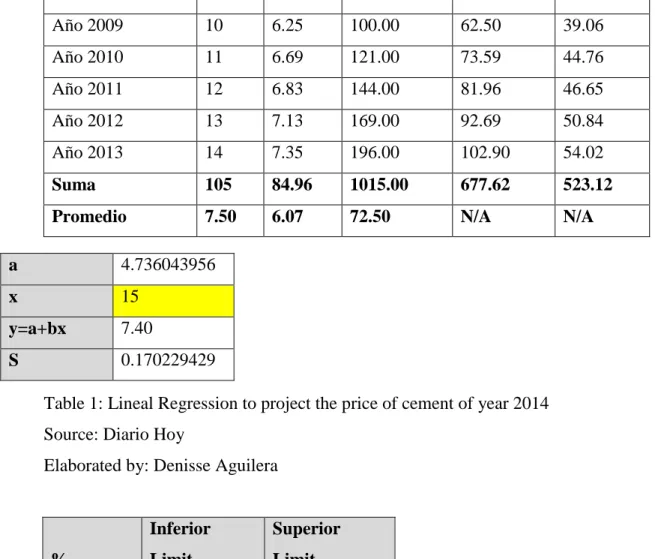
Regresion Lineal
Año x y x^2 xy y^2
Año 2000 1 4.93 1.00 4.93 24.30
Año 2001 2 5.20 4.00 10.40 27.04
Año 2002 3 5.34 9.00 16.02 28.52
Año 2003 4 5.27 16.00 21.08 27.77
Año 2004 5 5.50 25.00 27.50 30.25
Año 2005 6 5.75 36.00 34.50 33.06
Año 2006 7 6.38 49.00 44.66 40.70
Año 2007 8 6.17 64.00 49.36 38.07
$4,93$5,20 $5,34 $5,27
$5,50 $5,75
$6,38 $6,17 $6,17 $6,25$6,69 $6,83
$7,13 $7,35
$0,00 $1,00 $2,00 $3,00 $4,00 $5,00 $6,00 $7,00 $8,00
Año
2000 2001Año 2002Año 2003Año 2004Año 2005Año 2006Año 2007Año 2008Año 2009Año 2010Año 2011Año 2012Año 2013Año
Año 2008 9 6.17 81.00 55.53 38.07
Año 2009 10 6.25 100.00 62.50 39.06
Año 2010 11 6.69 121.00 73.59 44.76
Año 2011 12 6.83 144.00 81.96 46.65
Año 2012 13 7.13 169.00 92.69 50.84
Año 2013 14 7.35 196.00 102.90 54.02
Suma 105 84.96 1015.00 677.62 523.12
Promedio 7.50 6.07 72.50 N/A N/A
Table 1: Lineal Regression to project the price of cement of year 2014 Source: Diario Hoy
Elaborated by: Denisse Aguilera
%
Inferior Limit
Superior Limit
68.50% 7.23 7.57
95.70% 7.06 7.74
99.30% 6.89 7.91
Table 2: Confidence level Source: Diario Hoy
Elaborated by: Denisse Aguilera
With a confidence level of 68.50% the price limit is $ 7.23 and the upper limit is $ 7.57. With 95.7% the price range between $ 7.06 and $ 7.74, while that with a percentage of 99.30% has a minimum price of $ 6.89 and a maximum of $ 7.91.
a 4.736043956
x 15
y=a+bx 7.40
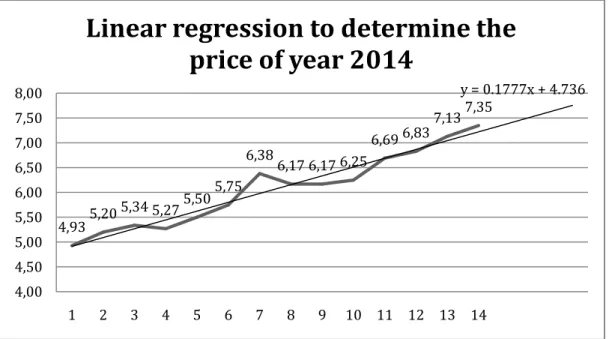
Graphic 3: Lineal Regression Source: Diario Hoy
Elaborated by: Denisse Aguilera
According to linear regression calculations the price projection for 2014 is $ 7.35, as we see in the graph this price curve has an upward trend with a slope of
x>8 0.325 Normal distribution table
Elaborated by: Denisse Aguilera
In the analysis of information on the evolution of prices in Ecuador, calculating fashion, the mean and median is not so suitable. The main price of this well-maintained construction increased 3.18% on average over the past 14 years. What we can note is that the presence of fashion shows that the only year the price was repeated from one year to another is that the government intervened to prevent a price increase that would affect overall inflation in the economy in 2007. Also, one can note that the mean and median indicates that the price increase is quite sharp in terms of percentage changes from year to year. Since the starting price is $ 4.93 and is now $ 7.35 so the midpoint of this reflects a very similar to the average between the initial price and the final price. This data also can be supported by the frequency histogram that says 0.33 intervals are different numbers of data that are in the range indicating that such inflation is not constant, if there are periods of greater volatility than others.
5.Analysis results
In addition, the Ecuadorian cement prices compared to neighboring countries is far below. For example, in Colombia the price is $ 11, while here we are still $ 4, about 35% less than the reference price. “A productivity growth paradigm would encourage the kind of competition that inspires innovation rather than the kind that keeps prices close to cost.” (Foer, 2002) This makes multinational level as Holcim and LaFarge be used as a strategy to improve revenue potential of these significant price increases that have the power to affect strongly the Ecuadorian economy. More so, when the market only four competing agents.
Other than vigilance in merger control, public policies can do little to change the structural features of markets that make cartels profitable, such as, inelastic demand, large numbers of buyers, sunk costs of entry, product homogeneity, and so forth. Policies can sometimes have salutary effects on exchange conditions, such as the publication of transaction prices in markets characterized by lack of transparency. (Connor, 2006)
This potential problem makes this market more vulnerable to control and regulation by the government, but so far everything has been handled as in a competition market. It should be noted that participating companies have not yet made any bad move. They have maintained their moves within acceptable competency frameworks.
5. Conclusion
antitrust law; given this we can conclude that the cement industry in Ecuador cannot be addressed, by definition, as an oligopoly.
Graphic 4 Source: APA
1 Bibliography
United States Congress. (1936). Robinson–Patman Act . Washington: Official Register of the United States.
United States Congress. (1914). The Clayton Antitrust Act. Washington: Official Register of the United States.
Wood, D. P. (2012). Theory and Practice in Antitrust Law: Judge Cudahy's Example. Yale Journal on Regulation , 403-418.
Anti-Competitive Practices. (2013, 06 21). Retrieved 06 22, 2013, from Commerce Commission New Zealand: http://www.comcom.govt.nz/anti-competitive-practices/
Bandyopadhyay, S. P. (2001). Getting the price right. CA Magazine , 47-50. Cemento Chimborazo. (2013, June 22). Quienes somos. Retrieved June 23, 2013, from Cemento Chimborazo Ecuador: http://www.cementochimborazo.com/ Connor, J. M. (2006). Effectiveness of Antitrust Sanctions on Modern
International Cartels. Springer Science Business Media , 195.
Constituent Assembly. (2008). Constitution of the Republic of Ecuador. Quito: Official Register.
Crane, D. A. (2010). Does monopoly broth make bad soup? Antitrust Law Journal , 663-675.
Crandall, R. W., & Winston, C. (2003). Does Antitrust Policy Improve Consumer Welfare? Assessing the Evidence. American Economic Association , 3-26.
Davis, B. (2010). China's Anti-monopoly Law: Protectionism or a Great Leap Forward? Boston College International & Comparative Law Review , 305-321. Department for Business, Innovation & Skills. (2013, 06 21). Preventing and reducing anti-competitive activities. Retrieved 06 22, 2013, from Inside
Government (UK): https://www.gov.uk/government/policies/preventing-and-reducing-anti-competitive-activities
Ferguson, J. (1992). Sultants of Cement. The Nation , 4.
Foer, A. A. (2002). The third leg of the antitrust stool. American Marketing Association , 227-231.
Guapán. (2013, June 22). La empresa. Retrieved June 23, 2013, from Guapán Ecuador: http://www.industriasguapan.com.ec/la-empresa
Greenbaum, J. P., & Alegi, P. C. (1994). Antitrust law. Euromoney Trading Limited .
Investigación Ekos Negocios; Unidad de Análisis Económicos. (2011). Cemento ¿Oligopolio? Revista Ekos , 214, 22-33.
Henderson, D. (2013, June 22). Monopoly. Retrieved June 23, 2013, from Library of Economics and Liberty: http://www.econlib.org/library/Enc/Monopoly.html Hoffman, D. B. (2010). Afterword: putting monopoly law into practice. Antitrust Law Journal; , 975-986.
Holcim. (2011, December 31). Declaración de Visión, Misión y Objetivos Organizacionales. Retrieved June 23, 2013, from Holcim Ecuador: http://www.holcim.com.ec/
KHAN, B. Z. (2011). ANTITRUST AND INNOVATION BEFORE THE SHERMAN ACT. Antitrust Law Journal , 757-786.
LaFarge. (2013, June 22). Visión y valores. Retrieved June 23, 2013, from LaFarge Ecuador: http://www.lafarge.com.ec/wps/portal/ec/1_2-Vision_y_valores
Leslie, C. R. (2006). Antitrust Amnesty, Game Theory, and Cartel Stability. Journal of Corporation Law , 453-488.
National Assembly. (2011). Organic Law of Regulation and Market Power . Quito: Registro Oficial.
National Council on Economic Education NY. (2013, June 22). WHAT ARE THE ECONOMIC FUNCTIONS OF GOVERNMENT? . Retrieved June 23, 2013, from Web Economic Lessons: http://ecedweb.unomaha.edu/
Markham, J. W. (2011). Lessons for competition law from the economic crisis: the prospect for antitrust responses to the "too-big-to-fail" phenomenon. Fordham Journal of Corporate & Financial Law , 261-322.
Oficemen. (2009). Cement. Madrid: ProQuest.
Pulso Publicidad S.A. (2013, January 14). Alimentos y Bebidas. Retrieved June 03, 2013, from AlimentarYá: www.alimentosecuador.com.
Parkin, M., & Bade, R. (2013). Foundations of Economics. Mexico: McGrawhill. Shepherd, G. B., Shepherd, J. M., & Shepherd, W. G. (2001). Antitrust and market dominance. Federal Legal Publications, Inc. , 44.
Sherman, J. (1890). Sherman Antitrust Act. Washington.
Stigler, G. (2013, June 22). Monopoly. Retrieved June 23, 2013, from Library of Economics and Liberty: http://www.econlib.org/library/Enc/Monopoly.html Tennis, R. S., & Schwab, A. B. (2012). Business Model Innovation and Antitrust Law. Yale Journal on Regulation , 307-351.