UNIVERSIDAD NACIONAL ABIERTA Y A DISTANCIA UNAD
ESCUELA DE CIENCIAS DE LA EDUCACIÓN ECEDU LICENCIATURA EN INGLÉS COMO LENGUA EXTRANJERA
LEARNING STRATEGIES TO PROMOTE THE CURRICULAR INTEGRATION OF ENGLISH AND NATURAL SCIENCE IN SANTA ANGELA MERICI SCHOOL.
BY
MARIA ALEJANDRA GÓNGORA IBARRA RESEARCH GRADE
Submitted in fulfillment of the requirements for the degree of Bachelor in English as a foreign language
Adviser: Yesenia Escobar Espitia
Contents
INTRODUCTION ... 1
CHAPTER I RESEARCH PROBLEM ... 2
1.1. Statement of the problem ... 2
1.2. Main question: ... 4
1.2.1. General objective: ... 4
1.2.2. Specific objectives. ... 5
1.3. RATIONALE ... 6
CHAPTER II THEORICAL FRAMEWORK. ... 8
2.1. Research background ... 8
Literature review ... 10
2.2. Second language acquisition ... 11
2.3. Teaching content areas in a second language (CLIL) ... 13
2.4. What is curriculum? ... 16
2.5. Curriculum elements ... 17
2.6. Curricular integration ... 19
2.7. Types of Curricular Integration. ... 20
2.8. Constructivism model. ... 22
2.1.0. Theory of second language teaching. ... 25
2.1.1. Ausubel concepts. ... 26
2.1.2. Meaningful learning. ... 27
CHAPTER III METHODOLICAL FRAGMEWORK. ... 28
3.2. Scope of research. ... 28
3.3. Research design. ... 29
3.4. Population and sample ... 29
3.5. Techniques and collecting data instruments... 30
CHAPTER IV ANALIZE OF INFORMATION ... 32
4.1. Teacher´s perception ... 32
4.1.1. Student`s perception ... 39
4.1.2. Document analysis of natural science curriculum and English in third grade. ... 45
4.1.3. Curricular analysis of English area. ... 47
4.4. Curricular analysis of natural science. ... 50
4.5. STRATEGY OR CURRICULAR PROPOSAL. ... 53
4.6. PROPOSAL ... 58
CONCLUSIONS ... 61
REFERENCES. ... 63
ANEXES ... 68
ANEXES 2 ... 69
ANEXES 3. ... 71
Graphic and table contents.
Graphic 1. Curricular elements 19
Graphic 2. Begging year 32
Grapphic 3. Articulation manner 33
Graphic 4. Lack reasons 34
Graphic 5. Maninnful learning of science in English 35
Grapich 6. Curricular break up 36
Graphic 7. Curricular integration and previous knowledge 38 Graphic 8. Curricular integration strategy for meaningful success. 39
Graphic 9. Begging year according students 40
Graphic 10. Learning between English and science 41
Graphic 11. Science class motivation. 42
Graphic 12. Necessary elements. 43
Graphic 13. English neccessary skills 44
Table 1. Begging year report. 32
Table 2. Articulation manner report 33
Table 3. Lack reasons report 34
Table 4. Meaningful learning of science in English report 35
Table 5. Curricular break up report 36
Table 6. Curricular integration and previous knowledge report 37 Table 7. Curricular integration strategy for meaningful learning success report 39
Table 8. Beginning year according students report 40
Table 10. Science class motivation report 42
Table 11. Necessary elements report 43
Table 12. English neccessary skills report 44
ANALYTIC SUMMARY
RESEARCH PROJECT: LEARNING STRATEGIES TO PROMOTE THE
CURRICULAR INTEGRATION OF ENGLISH AND NATURAL SCIENCE IN SANTA ANGELA MERICI SCHOOL.
AUTHOR: MARIA ALEJANDRA GÓNGORA IBARRA Degree Sought: Teaching English as a Foreign Language.
• Key words: Learning meaning, curricular integration, Integrated Content Learning and foreign language (CLIL)
Problem: The present search aims to characterize the factors and or institutional conditions existing to achieve the curriculum integration of English and Natural science in English areas, from the perspective of directives and teachers at third grade at Santa Angela Merici School. In order to consolidate a teaching strategy, that promotes the integration of the mentioned areas from the perspective of meaningful learning.
Methodology:
The investigation was based in a non manipulative observation conducted at SANTA ANGELA MERICI SCHOOL, Bogotá, with participation of 18 students (12 girls and 6 boys) aged between 7 and 9 years. The socio economic level is a stratum 3, of neighborhoods of Villas de Granada, Ciudadela Colsubsidio, Quirigua, Bolivia, Alamos norte, Cortijo, Bochica of
Engativa netbourhood. The literature reviewis based on the constructivism theory, as a study case. Case study is a method of quantitative descriptive used to understand social and
INTRODUCTION
The following research project wants to response the question that involves the project: What learning strategy can promote the curricular integration of English and natural science to bring closer the learning meaning at the students of third grade in Santa Angela Merici School? Our country, currently has proposed a bilingualism project, it searches that all the Colombian citizens can dominate English as a foreign language, which has become a great boom not only in the educational field; but in other fields such business, health, etc.
Santa Angela Merici School in Bogota also wants to introduce to its students in this process of bilingualism, through the curricular planning of science in English. This, with the purpose of encouraging students to learn a second language, especially when English has become a very important tool to handle the scientific topics associated to this area.
The acquisition of a foreign language is one of the biggest problems students have to face, because of the difficulties to practice; due to their mother tong is Spanish. Another problem is the lack of language teachers in the school.
However the main problem, the English curriculum planning and science curricular planning have a great gap; there is not integration beyond to the common language in this case, English.
This project inquires about these problems that avoid the curricular integration, analyze the curricular planning of English and natural science from the school and finally purposes a
CHAPTER I RESEARCH PROBLEM
1.1.Statement of the problem
Knowing a foreign language is now a prevailing need, to communicate in other languages is a necessity, and it is an essential ability in the currently world.
It is not just possible academic moving and job opportunities to people; it is one of the bases where is building the competitive capacity of a society and a tool to opens a news cultures and new experiences; to obtain knowledge that in other way escaping of our hands.
To know a new foreign language, for people represent a comparative advantage, an attribute of his/her competence and competitiveness. (Nacional, Ministerio de educacion Nacional, 2004, pág. 6)
Based on this argument, educational institutions have chosen to implement bilingual programs or an alternate English intensification program.
For that, they are using different strategies to achieve this goal; some of these institutions besides teaching English as a core area, are also implementing Content Based (Arnau, 2001, pp. 1,2,3)
The curricular integration is understood as a pedagogical purpose to increase the comprehension of what is being taught, also establishing a relationship between grammar, concepts, processes and methodologies of all content areas and developing strategies to a integrate of them successfully.
different types of strategies, mental integration of his/her knowledge, with the values, activities, and their lives. (Bernal, 2004)
Theoretically talking, the curricular integration is a flashy purpose, but the real life it is a difficult process. many educational institutions still are working by knowledge areas, they are working in an independent way, it not allows curricular integration , it left a fragment vision of reality, and it difficulty achievement meaningful learning.
There is a disarticulation between the English and Natural sciences. Although, the School has good English resource didactics (books, audios, videos, teacher training, etc.)
According to Natural Sciences and, the school has a multimedia platform called Raz kids, where students can practice. Though, all those things are not enough to close the current gap that there is between the contents and abilities that are developing in English class and science that is necessary to achievement the meaningful learning in Natural Science.
Natural Science area until 2012 began like a way to bilingualism process. It not has been easy to the school; it brings some difficulties, specially, in academic performance of the students. Currently, students are having low result in Natural Sciences; due to that students do not have a content or linguistic basic.
It is evidence when teacher explains and they cannot follow or execute the activities that the topics need, so is affecting the students motivation, interest to participate actively in class.
Other evidence is the result that obtained of teacher surveys.
These were applied to six teachers of English and natural sciences teachers.
Using teaching tools as teaching support to obtaining a meaningful learning; as this can achievement curricular integration into other knowledge areas.
The information says that curricular plans or content programs are designed and applied in a independent way, they are isolated, that avoid the linguistic progress in the use of second language ass English, evidence there is an important gap between what say and really it is, is necessary to guide the different institutional activities use first language (Spanish) at the work with students; this with the finally achievement in the moment knowledge (not meaningful learning).
According to these arguments, Santa Angela Merici School will achieve curricular integration of academic plans of English and Natural Sciences, besides because students could improve their foreign language level (English); likewise, to continue with an appropriate learning and
deepening in topic that correspond and this way, it is possible to achieve a meaningful learning in students of the third grade of the school.
1.2.Main question:
What learning strategy can promote curricular integration of English and natural sciences, to approach meaningful learning in students of third grade of Santa Angela Merici School?
1.2.1. General objective:
1.2.2. Specific objectives.
• To identify from the perspective of the teachers and students the factors and / or
institutional conditions that favor or not the curricular integration between ff English and sciences areas in third grade from Santa Angela Merici school.
• To analyze curriculum elements of third grade in English and Natural science in
English to establish relationship and coherence between them for meaningful learning of the students.
• To propose a teaching strategy that promotes curricular integration of English and
1.3. RATIONALE
One reason because this research project is important is it looks resolves a problem in an educational context that has been evidenced at the Santa Angela Merici school, lack of curriculum integration of English and Natural Science.
Achieving curriculum integration in Santa Angela Merici School has as mainly purpose obtains of successfully way that English as Natural Science, achievement curricular parameters of coherence, relevance, integration and coordination to meaningful learning of students.
As, English is not connected to social context of the everyday of students. Their families are not bilingual people, there are teachers that do not have English knowledge, and these factors do not encourage practice in students
It is relevant this research project because, it looks to contribute to knowledge of teaching content in English, in response of bilingualism promoted by the Ministry of National Education.
Ministery of national Education (MEN) purposes improves communication skills in English as a foreign language in educational sectors. (Nacional, Ministerio de Educacion, 2004, pág. 6) (According to MEN the idea is develop the foreing skills in the Colombian citizens.)According to this article, Ministry of National Education is trying that English could be as the second language without leaving aside the Spanish.
From didactic or methodological component also contributes to knowledge that pretend to design a teaching strategy of real implementation of integration of Natural Science and English that allows to student articulation and implementation of these areas.
This research project will contribute to development of skills, related to classroom research to transform them, to improve teaching practices, curriculum planning and improve student
CHAPTER II THEORICAL FRAMEWORK.
This project is frame in curriculum area, because seeks to identify how can happen curricular integration of planning between the subjects of English and natural sciences and achieve a meaningful learning of students in areas in question. To understand this, is necessary to take curriculum foundations and curricular integration, learning theories to emphasizing learning from constructivist perspective and acquisition.
2.1. Research background
For initial development of this research project, was necessary done a check research background. First research project done in Universidad Libre, with a curricular proposal for integration of English into area of natural sciences in national level and international level, other was analysis of bilingualism in teaching of the natural sciences in elementary education and finally an article with topic of learning English through academic content, at international level.
At institutional level, were checked a total of three research works, two of which are related to the curricular integration of English with natural sciences, and an article is related to learning of English through academic content for meaningful learning as:
There are with research project are titled: First PROPUESTA CURRICULAR PARA LA INTEGRACIÓN DEL INGLÉS AL ÁREA DE CIENCIAS NATURALES
(Alarcon Castiblanco, 2014), second, ANÁLISIS DEL BILINGÜISMO EN LA
ENSEÑANZA DE LAS CIENCIAS NATURALES EN EDUCACIÓN PRIMARIA (Conchero Gayan, 2016).
Law for improvement of educational quality, Bilingualism and third is an article, Introduction of English as foreign language, Social language or BICS (BASIC INTERPERSONAL
COMMUNICATION SKILL), Academic language O CALP (COGNITIVE ACADEMIC LANGUAGE PROFICIENCY) and Integrated content learning and foreign language (CLIL).
The research to before works were oriented to know way to achieve teaching of the English language through a curricular integration process to areas of knowledge as for example natural sciences, to achieve a process of bilingualism that are important to analyze and look for to realize this research project.
In concordance with third precedent reviewed, that corresponds to an article related with topic of teaching English as a second language through academic components, was developed on 2012: El aprendizaje de inglés a través de contenidos académicos. Un estudio de caso en EE. UU (Garcia Rico, 2012).
According to, conclusions some of them refer to:
Although is seeks bilingual proposal, it still presents many deficiencies to achieve this
purpose; starting that many curriculums are handled monolingual character; which makes
impossible a curricular integration between knowledge areas; but thanks to students and
teachers appreciation was possible to make a proposal for curricular integration between
science and English through of learning methodologies integrated learning of content learning
and foreign language (CLIL). (Alarcon Castiblanco, 2014)
Likewise, science is a wonderful that gives students option to explore and discover world
connection to basic subjects of knowledge, especially natural sciences, it causes that, for lack of
basic concepts in same, causes that students lose interest in learning of sciences. The idea is do
an analyze bilingual and non-bilingual texts and know if fulfill requirements of LOMCE
curricular components. (Conchero Gayan, 2016) (nevertheless, science is a fantastic subject,
studentsw lose the interest because they don’t have the minimal English basics so )
And finally, we can conclude from third work: A large percentage of Latin people more than
all Mexicans arrive to United States, counting on form of communication in L1, to can acquire
better second language, (English) was implemented observation strategies of its environment
that is a learning that naturally promotes acquisition of English. (Garcia Rico, 2012).
It is important to show that reading of the previous research antecedents helped to guide and outline some aspects of this research work both at a theoretical and methodological level,
ratifying need to continue deepening in the topic of curricular integration of English with natural sciences to generates meaningful learning and achieve a bilingual Colombia.
Literature review
2.2. Second language acquisition
According to (Ellis, 2002). He explained as people learn other language aside their own language, is in settings as much as inside as outside classroom and how the student acquired the language" as you can see acquision of a language depends greatly to assimilation and
appropriation of mother tongue, another definition of the acquisition of a second language is given as a cognitive skill in relation to learning skills.
Although, he defines that there are several hypotheses that confirm that acquisition of a second language is given: in analysis study of report and scientific planning’s. Like results indicate that cognitive skills, where production system achieves that through application of dynamics will obtain an acquisition of a second language. (O'Malley., 2008)
It is possible that t acquisition of a second language is only an experiment, where it is looking to prove through complex scientist studies, it is achieving as advance in a complex aspect. Or if it really is a cognitive process that with focused bases to language skills and an appropriate environment, it is possible that individual obtains a second language.
The unique true is that until moment of acquisition and learning together in a goal that is can communicate of successful way with not only our environment, also with world that currently is interconnected through different mass media. The simple fact of learning another language is not only learn it; it is important remember that we are in an era where technological tools, World Wide Web are opening a huge door of exchange cultural and experiences that they are shared in many languages (Ellis, 2002).
multilingual world. The Common European Framework of reference for languages indicates: learning, teaching-assessment besides to establishes guidelines so much to language, learning as assessment of competition in the different languages of a speaker.
These guidelines have been a key reference in curriculum. To achieve communication they must be achieve according to different fields, as for example family relationships, common social practices, education according to academic content of subject and other subjects of curriculum.
At elementary school the purpose is: uses of foreign language to communicate orally and written in simple situations. At high school to: The interaction and achieve to become understand themselves, and express their ideas.
Another important contribution is to achieve affective learning that is reflecting in a
productively way: speaking, writing, reading and hearing. It should generate an interest towards other language that will learning generates, an impact in our attitude towards this language that will transcend into the curriculum. (U.Granada, 2006, p. 3)
Can also argue that the process of acquiring a second language has been given like a communicative impact, will be able to use it in different contexts: Communicative principles (Chomsky), it is not necessary any method, it will be occurring gradually, depending of interest demonstrate by the student, will generates autonomy himself learning in a second language, the teacher is just a facilitator or as way that will provide the necessary tools for that students strength their bases in second language. (Coll, 2001, p. 15)
understanding and acquisition moreover of expanding our global knowledge; besides improves the communicative competence in develop each skill for different situation.
The key discourse for acquisition of a second language is currently, learning to learn with autonomous bases of learning depending of which method is facilitate better to students to learn a foreign language. Finally acquiring is generated by concepts of human competence and social. The tongue is one of first social interaction (U.Granada, 2006, p. 3).
It is generating one phenomenon of global dimensions such as learn second language, which is opening way to new cultures, new opportunities to grow intellectually and professionally. It is something that cannot be ignored. It is important to clarify that there are two reasons to learn a second language: depending of effectiveness second teaching success. As the brain fragments linguistic system with information that comes and it does effective. And other reason, social character that could influence positively or negatively in acquisition of a second language. (Klein, 1986)
2.3. Teaching content areas in a second language (CLIL)
With growing of demand of integral training, it is develops the approach content Integrated Learning Foreign Languages (CLIL), it as response to need of professionals and academics of use a second language to transfer knowledge. The CLIL concept is applies to educational contexts where language of instruction is different from mother tongue of students. (Manzano, 2012)
The main objective is to teaching content and topics of a specific subject in a second language, it means, purpose is to teach disciplines and thematic contents of a specific area, to that students will relate the importance of learn these content areas and a second language.
a. The progression in presentation of thematic topics. b. The language used and learned as a communication tool. c. The development of cognitive skills.
d. The multiculturalism, as implicit element in any situation in which it comes into contact with second or foreign language.
It seeks as final purpose; gives an useful to its meaningful learning from professional point of view, increases motivation and develops attitude of "I know that I can do it" to process of
learning a second language. Another purpose of this teaching method is not teaching from curricular contents, but from a functional standpoint. English is used as a resource or as an instrument, not like a purpose to itself. (Manzano, 2012)
Another method of teaching of foreign languages is: The teaching of foreign languages through content (Content Based Instruction). This is a pedagogical approach that integrates curricular contents of some subjects such as socials, science, math, etc. Where foreign language is a means of learning content through negotiation. (The foreign language teaching through content).
This method of acquiring a second language, is based in formal aspects, where student learns a second language, for example, to go a party, go shopping or do any other activity where use of second language have to be given in causal way to express his ideas. (Arnau, 2001, pp. 1,2,3)
This method that has like purpose teaching a second language in a different way to the traditional method where the main goal was just learning.
Language teaching and learning goal:
• Contextualization from structures or linguistic functions.
• First learned forms and are supposed to be used later. Integrated teaching of language and content.
• Context from contents.
• The learner uses language of significantly way; uses language to communicate.
• The Learner learns forms as he uses these, use these as he learned. (Arnau, 2001, pp. 1,2,3) The main purpose of language teaching is with purpose to learn to speak, but purpose of speaking is with a purpose support. The curricular integration method of contents of learning a second language is to find language as negotiation way, where its theoretical foundations can be developed, besides can giving a dialogue, and not fragmented sentences. When student achieves to integrate this second language to a natural context, achieves understand better its real
meaningful. (Arnau, 2001, pp. 1,2,3)
It is not just learning language, is learn to communicate. (Ellis, 2002) Learning can be easier because students can see relationships between parts and whole has a higher frame of reference, can establish deeper thinking, and establish more connections.
Besides, contents will learn better; when do references to topics of interest like: senses, where are used different strategies, such as preferences of like or not like, etc. (Arnau, 2001, pp. 1,2,3)
Other consequences of integration of curricular content in a second language are: • To integrate teaching of language and curriculum content to create an appropriate context for development need of students.
• When teaching language is separated of curriculum content, there is a risk of providing infantilized or outdated content, that do not allow learn anything new, especially now that foreign language teaching is incorporated increasingly early ages.
There is a psychology Vygotskian orientation, where speak a language is not just having basic communication skills, is to speak discourses of different cultural content: is talking of science, is talking about society, technology, is to talking about literature (about feeling and conflicts), is talking of math. (Arnau, 2001, pp. 1,2,3)
2.4. What is curriculum?
Curriculum integration is an educational approach that looking like goal individual achieve a real connection with his social environment, it is not only impart knowledge, but that these knowledge will can take to an experiential setting. The contents of curriculum integration should have as a final result taken these fundamentals to real context; besides curricular integration is adheres to following models: Building of content that will transcend the principles established by the government.
development of critical thinking, analytical and creative, connecting what is learned with real life and experiences, serving and respecting to all students and their needs, their learning styles, interests, etc. (Etim J. , 1992)
That is, curriculum is a vehicle of integration where is necessary include in detail way, so much learning objectives, which is purpose of these objectives without forgetting that is teaching or transmitting will not generate future conflicts between members that make up curriculum. (Etim J. , 1992)
achieve that individual independently develop these opportunities of personal development. In this moment is where the state demonstrates its commitment to help to achieve those personal goals. How the government achieve it. Providing educational materials and resources as current technological tools (Zabalza M. , 2000), also same author reinforces it concept of curriculum as a way of exposing topics that will be achieve, but curriculum is more than just providing
information, is a social experience that is disseminate as a medium of communication, now there is a greater relationship between educational link between teacher and students, the finally of generate some purposes in the curriculum so much in content, methods and the evaluation criteria’s.
also is important taking to account that is work on bases to contents already obtained with the finally of follow to strengthen a common knowledge . (Zabalza M. , 2000)
2.5. Curriculum elements
It is regulated under following guidelines for curriculum design: Ley general de Educación, Ley 115 de 1994
Decreto 1860 de 1994 Resolución 2343 de 1996 Decreto 1290 de 2009
Lineamientos curriculares de las diferentes áreas
Estándares básicos de competencias en diferentes áreas. So, under these guidelines curriculum elements are following:
According with these elements. The first OBJECTIVES or PURPOSES seek to carry out intentionality of curriculum that allows promoting with a clear orientation educational teaching process. Objectives are those that guide educational process of teaching and learning.
These are defined in:
General purposes: purposes of education that are expressed in a general and abstract way, according to behavior; also to social and individual needs.
• Goals: are manifest in form of desirable behaviors.
The second, CONTENT. Currently there have been changes in concept of contents; it is understood as something more than a selection of knowledge relevant of different areas of knowledge developed and formalized. (Gallegos, 1998, págs. 293-315)
The third SEQUENTIALIZATION is a series of linear components that are presented one Trans another one, that seeks an objective; therefore, it cannot change or alter some of its
components, so that, it must maintain a coherence that achieves a certain effect in its realization or practice that is the purpose of sequence itself. (Gallegos, 1998, págs. 293-315)
The fourth METHOD, nowadays method is meeting and synthesis of educational measures that are based about psychological knowledge, clear, safes and complete, about logical laws and realized with personal skill achieve without problem aim previously fixed. (Santander, 2004, pág. 80) Another method concept was developed by John Dewey, for him the method is order of development of abilities and child interests. (Santander, 2004, pág. 80)
everything that allows to teacher to carry out this proposed goal in the teaching process. (Santander, 2004, pág. 80)
Sixth EVALUATION previously used to measure results through qualification. But currently it is a structured and reflective analysis process, that allows us to understand nature of object of study and make judgments about it, giving information to help to improve and adjust educational action. (Santander, 2004, pág. 80)
Graphic No. 1 Curricular Elemements table. Retrieved from: Departamento de Educación del
Gobierno de Aragón
2.6. Curricular integration
When this objective is achieved, that the person analyzes beyond curricular purposes
(educational content), person autonomously discover and develop his/her own cognitive abilities with a successful in social integration. Integration as a curriculum design, where the overall objective is focuses curriculum in solution of problems in a real context where students analyze what they need to find solution of this problem through previously acquired knowledge to gives a solution. In this moment is where starting to give a meaningful learning in students. (Bross, 1997)
Thus, curricular integration occurs around a topic, a project, a theoretical or practical problem, an activity, a reading text, a story, a specific knowledge area (mainly with PEI emphasis) and a topic generator.
2.7. Types of Curricular Integration.
The main concepts of curriculum integration are: Integration around to a topic.
It indicates that The topic usually presents, grammatically talking, as a statement composed by a substantive name common or own, accompanied by an article and, in some sentences by a supplement:"The dinosaurs" "the water" "the ancient Greece.
it is says to us to that that they are topics around of them can elaborate thematic units and integrated topics, of each one of areas. (Cortes Ibarra, 2010, págs. 91- 102)
Integration around to activities.
It says that in educational institutions there are a lot of academic, cultural, businesses or recreational school activities. For example, in case of our city, it is evident in pedagogical outings, forums, etc. Moreover, these events have allowed integration of areas, to achieve successes in organization, planning and develop certain content, thematic units, skills and abilities.
besides, these events have allowed integration of areas, to achieve successes in organization, planning and develop certain content, thematic units, skills and abilities. We can also show them in activities such as LANGUAGE DAY or HALLOWEEN. (Cortes Ibarra, 2010, págs. 91-102) Integration around to a problem.
The problems feels by community are social, economic, access roads, lack of sports spaces, environmental and security. It is searches solution alternatives through of an integrated
curriculum. (Cortes Ibarra, 2010, págs. 91-102) Integration around to a project.
It indicates that in classroom projects, grade can found alternative of solution to problems of social and cultural context, that have into account multidimensionality, interdisciplinary,
cooperative learning and autonomous work. (Cortes Ibarra, 2010, págs. 91-102) Integration around development dimensions.
It indicates that in opposition to traditional pedagogy (heterostructure pedagogical models), student is located as center of development process.
Integration around a generator Topic.
Understanding is a pedagogical focus that allows integration of work by projects, solution of problems, articulating topic and dimensions of development (Cortes Ibarra, 2010, págs. 91-102).
This articulation seeks that through of abilities they are used to face problems of world. Integration from Reading Texts and Writing Stories.
Around reading of a text, it is possible to use only encyclopedic knowledge that reader or readers have.
it is common in a book we find integrated several topics of common interest such as philosophy, science, mathematics, socials, etc. (Cortes Ibarra, 2010, págs. 91-102) 2.8. Constructivism model.
The world is constantly changing; all fields of knowledge must be at forefront of these
changes. The field of education is no stranger to these changes that are occurring. Educationally, intended that students will be people that develop certain skills with purpose of overcome
memoristic learning. To achieve this purpose, insists, in different objectives, about importance of training to students, to analyze, critique and reasoning to through meaningful construction of knowledge and training to citizens life.
Constructivist pedagogical method is a novel approach, according to demands of current world. The educational level constructivism wants at individual and intrapsychic of how knowledge is constructed.
constructivism encourages and gives sparks of creativity; dynamism and interest in children are several aspects that influence in their learning. (Villamil, 2008)
rather than to definition of possible rules. Mental representations are hypothetical constructs that subject has to understand and explain a phenomenon, which may differ markedly in his content.
When faced a phenomenon, content of mental representation depends on questions what wants to answer, it depends on needs, interests and individual feelings. When subject knows world, participates in it, with interaction between two dimensions, external and world of ideas, which allows building representations. The previously information allows clarify that mental representation that people really have in your mind and that lead to use of things. (Villamil, 2008)
Automatically individual begins to discover of autonomous way what is really world in
relation to concept, what is creating of his environment according to information that is gradually getting; besides, depends of him that is meaningful to transform his environment and interpret it according to his needs. Adding to this is also important taking to account that to achieve this, affecting aspects such as visual perception, understanding, reasoning, symbolic interpretation (hermeneutics).
2.9. Contributions to constructivism method.
Great thinkers such as Piaget and Vygotsky have been key about constructivist theories. According to Piaget, cognitive development has been given in some factors as: maturation, experience, transmission and balance; where presides immediate experience. For example, a child of 7 year old develops cognitive skills as a child of 12 years old, with difference that child 7 year old still has an assimilation of knowledge that is based on concepts more visuals, while child 12 years old is more experimental, develop his critical thinking, analyst, in relation to reality with more abstract results.
According to Piaget (1992) Knowledge is a product of social interaction and culture. It is true that theory of Piaget never denied importance of social factors in development of intelligent. (Carretero, 1997)
Vygotsky contributes to this method with postulate of some theories that decades later give an important result in cognitive process. Perhaps one of most significant is that postulates
psychological processes higher (communication, language, reasoning, etc). Are acquired first in a social context and then are internalized. But precisely this internalization is product of a particular use of cognitive behavior in a social context. For example, we have case of the child who starts to interact with his environment pointing, he does it to catch up object, while for his mother is simply fact of pointing, and the child internalizes this action as a pointing factor. (Carretero, 1997)
In Vygotsky's own words:
"An interpersonal process is transformed into another intrapersonal. In child cultural
equally to voluntary attention, logical memory and concept formation. All mental functions higher are originated as relationships between human being” (Vygotsky, 1978).
Another important contribution of author is maximum area of development. According to with his terms it not other that distance between development real level determined though of ability to solve a problem under adult guidance or in collaboration schoolmates abler. The state of mental development of a child can be determined if only carried out a classification of two levels: the actual level of development and potential development area (Vygotsky, 1978).
This indicates that there are several aspects that determine close relationship between society and cognitive development of child of what is his reality, which sometimes needs support of others to determine his own concepts. (Carretero, 1997)
2.1.0. Theory of second language teaching.
When are talking from field of education acquisition a second language are talking about as through evolution of approaches methodologies have led to different acquisition ways of second language. The methodologies of the acquisition of a second language began to from 1880 and 1980 generated a search for strategies that we called methods. (Brown, 1997) Indicated that methodologies looking knowledge of an achievement, that looking natural learning a second language, that using strategies or resources it achieves through t classroom.
"Another theory according to Jack Richards and Theodore Rodgers (1982) indicates that methodology is as an umbrella terms for specification and interrelation of theory and practice" (Brown, 1997). The approach is defined such as "possible beliefs and theories about nature language and language learned" (Brown, 1997)
Design “is specify, relationship of theories to classroom materials and activities” and process as "techniques and practices that are derived from an approach and design" (Brown, 1997).
According to these theories about methods, argue that through implementation of process of methodologies are generated “currently do increase reference for methodology, as umbrella term said, where participated actively factors that involved in teaching”. (Brown, 1997).
2.1.1. Ausubel concepts.
According to aspects that mentioned Vygotsky and Piaget that learning occurs by aspects as child social environment, age, effective factors. Must have also in mind that child is learning into continuous construction process that transforms prior knowledge that the child has,
independently builds new knowledge or learning or meaningful learning.
Ausubel has been one of pioneers of this theory. The child in relation to prior information is building new knowledge. A strong criticisms done about traditional learning is that learning would so ineffective and meaningless to child if methods based on rote learning without taking it to a real context where have to find alternatives to social solutions (Carretero, 1997).
To Ausubel: learning is synonymous to understand. What will understand will be learned and remembered better because it will integrate into our structure of knowledge?. (Carretero, 1997)
important final product delivered by child as process that leads to a particular response. An example of this theory are assessments that are made to the child, where value quantitatively correct answers without taking to account, regardless incorrect answers, that can be key to understand if there is not a proper process of children understanding of these concepts. 2.1.2. Meaningful learning.
Meaningful learning is not a concept that has been given recently, compared to repetitive learning; looking also substantive objectives and not arbitrary objectives, where there is a link between what is to be learned (prior knowledge) and new content. Also have that attribute meaningful to material of learning to achieve this ultimate goal. This means, modification, revision and enrichment establishing new connections and relationships between them to meaningful learning. (Coll, 2001, p. 15)
Meaningful learning looks:
Innovate to old methods
Reduced not only possible techniques
Intervention directed to innovation and Renewal of school Changing attitudes of teachers and parents
According to Ausubel learning is meaningful new information (concept, idea, proposition) acquires meaning for student through of link of relevant aspects of individual existing cognitive structure, it means, ideas, proposals and existing in his knowledge (or meanings) with a certain degree of clarity, stability and differentiation. Meaningful learning there is an interaction between new and existing knowledge, both are changed.
constantly restructured during meaningful learning. The process is dynamic, knowledge is being built. (Moreira, 2006)
CHAPTER III METHODOLICAL FRAGMEWORK. 3.1. Research Focus
This research work will be taking place to keep track of quantitative focus, so that, this will allow us to identify: what learning strategies could promote curricular integration of English and sciences, to achieve the meaningful learning with students in third grade of Santa Angela Merici School?
Form an objective way keeping track of series of variables with characteristic clearly statistical. Quantitative "uses collecting and data analysis, at same time to solve questions of research, also test the established hypothesis with priority and plenty trusting numerical measurement ,the counting up and frequent use of statistics to establish with exact patterns of behavior of a population" (Hernandez Sampieri, 2006)
Those are proper characteristics which are related with methodological process, which means that each step and aspect will be taken into account for development of this work and
achievement of the goals. 3.2. Scope of research.
The descriptive research refers detailed to interpret what it itself is. This is related to
conditions and existing connections, practices that exist, opinions , points of views and attitudes that are maintained; these processes in action; effects that feel or tendencies that are developed, sometimes, the descriptive research is related with are preexisting fact.
This has influenced or affected a condition or done at present. Besides this, descriptive research process is based on in picking up and tabulation of data. It supposes that an
interpretative element of meaning or importance of what it is describing. So that, description is found combined many times with comparison or contrasting, implying measurement,
classification, analysis and interpretation (Best, 1983). 3.3. Research design.
In case of this research it assumes design of non- experimental. This design is one that is made without handling deliberately variables; this means that this is a research that does not vary intentionally independent variables.
In non-experimental research independent variables had occurred and these cannot be
handled, so that researcher has not direct control over these variables, they cannot be influenced over these because they already occurred, as the same as its own effects. In non experimental research there are not assignments at random. (Toro, 2006).
3.4. Population and sample
The population of this research is composed by two third grades, A and B. Total of 41 students from Santa Angela Merici School in Bogotá. Students are between ages 7 and 9 years old. And teachers that are working at school with a total of 14.
non-probabilistic sampling by criteria, which includes representation of third grade students and teachers by researcher criteria which is established through special characteristics which should fulfill with the criteria of the sample.
For specific case of this criteria work is following:
The presence of sample of students in third grade from Santa Angela Merici School.
The presence sample of teachers from English and sciences areas from school Santa Angela Merici
In total sample made for this research project was in total of 18 students and 6 English and sciences teachers from Santa Angela Merici School.
3.5. Techniques and collecting data instruments.
The instruments for collecting data of this research was through of survey technique and questionnaire technique.
The survey technique is one of instruments of this research best known and used, consisting of applying procedures, more or less standardized, of questionnaires to a sample of
representative subjects from a wider collective with purpose of obtaining information about some established aspects of reality and human behavior. This has as an advantage to encompass a fan of questions in same research, it facilitates comparison of results, because this allows to standardize data that could be analyzed statistically, these results could be generalized whole group population, which possibilities the obtaining of meaningful information, that allows to recover information about previous facts and allows the studies of non-directly observable concepts such as in the case of this research (Vidal, 2004).
and objective. Because it involves control of one or some variables, this is an useful way to picking up data in a relatively brief length of time also in its construction they could be used with close questions, open and mixed up ones.
For specific case of this research work main questions that are presented owe close alternative answers where there are pointed one or more items (categories option) in answer lists suggested and open questions to clarify or enlarging data. This survey was done to teachers and directors of Santa Angela Merici School on date September 26th, 2017. These were results( with an error range +- 1%). A total of 6 directors and teachers from English and sciences areas.
The applying for surveys was volunteer; there was not any pressure or handling at moment to apply these surveys.
CHAPTER IV ANALIZE OF INFORMATION 4.1. Teacher´s perception
• Year that began implementation of natural sciences in English at Santa Angela Merici
School. Table 1
Beginning year report.
AÑO PORCENTAJE
Antes del 2012 100%
En el 2012 En el 2013 En el 2015
Obtained information from institution (own elaborated)
Graphic 2. Beginning year.
As it is evident in graphic, implementation trying sciences subject in English, 100% of teachers recognize that it was in 2012 year.
The previous fact obeys that directives informed to community of implementing this as a strategy to strength English teaching, but as it is more forward evident, this was only one action, in science and English areas.
Antes del 2012
En el 2012
En el 2013
It is evident that school is aware of educative laws in relation with ministry of education which indicates that by year 2019 whole Colombian citizens should have English as a foreign language.
• Recognition by teachers if English and science areas in work in an articulate manner
in third grade. Table 2
Articulation manner report.
RESPUESTA PORCENTAJE
SI 16.6%
NO 83.3%
Obtained information from institution (own elaborated)
Graphic 3.Articulation manner.
According to is presented in graphic, 16.6% of teachers demonstrate that there is; but majority affirm that there is not being this a population of 83.3%.
Understanding curricular integration as “curricular integration involves integrating
disciplines, knowledge, flexibility, adaptation and permanent enrichment of syllabuses, with goals of forming students with a world vision which facilitate them transferring of what they are learning and the social reality" (Cortes Ibarra, 2010, págs. 91-102).
SI
Can see into curriculum that both English and science areas are not articulated effectively, it is important to take measurement actions were not only achievement of ministry of education settings but also to begin work in team with both areas of knowledge.(see curricular analysis chapter).
• Reasons of lack of integration between English and science in English.
Table 3
Lack reasons report
CAUSAS PORCENTAJE
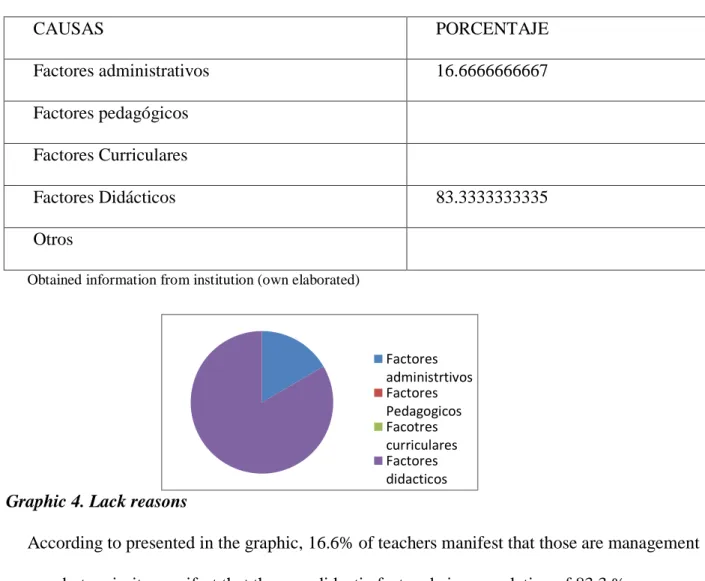
Factores administrativos 16.6666666667
Factores pedagógicos Factores Curriculares
Factores Didácticos 83.3333333335
Otros
Obtained information from institution (own elaborated)
Graphic 4. Lack reasons
According to presented in the graphic, 16.6% of teachers manifest that those are management causes; but majority manifest that they are didactic factors being population of 83.3 %.
Understanding didactics “in diverse ways understood: as a pure technique, applied science, theory or basic science of instruction. The didactics models, by their side could be theory
(descriptive ones, explanatory ones, and predictive ones) or technology ones (prescriptive ones and normative ones)” (Fierro Herrera, 2011).
It is evident that didactics are not only linked with theory part, there are many didactics that could be used to generate a meaningful learning in child, respecting his/her cognitive
development, his/her personality and individual differences, each didactic that is wanted to being used to secure his learning; also his confidence.
• Results of sciences in English in meaningful learning of students.
Table 4
Meaningful learning of sciences in English report
RESPUESTA PORCENTAJE
SI 16.6%
NO 83.3%
Obtained information from institution (own elaborated)
Graphic 5. Meaningful learning of sciences in English.
According to presented in graphic, 16.6.% of teachers manifest that there is a meaningful learning; but 5.83% say no.
Understanding meaningful learning “curricular integration is an educative focus which has as an objective to achieve that individual achieves a real connection with their social environment,
SI
but not only to impart knowledge, but those knowledge could take it to an experimental environment.” The curricular integration contents should have as a final result to take these fundaments into a real context, besides this curricular integration adheres following models:” Creation of contents that will transcend established principles by government”. Development of critical thinking, analytic and creative.
Connecting what it is learnt with real life and experiences, serving and respecting all students and their needs, their learning styles, and interests, and so on” (Etim J. , 1992).
It is evident that meaningful learning instead of its inconvenient in curricular integration, students are showing a relation between what they learnt with their reality. They assimilate that also many learnt concept or what they have heard during their learning is related with their lives.
• Curricular break up between English and science in English.
Table 5
Curricular break up report
RESPUESTA PORCENTAJE
SI 100
NO 0
Obtained information from institution (own elaborated)
SI
Graphic 6. Curricular break up.
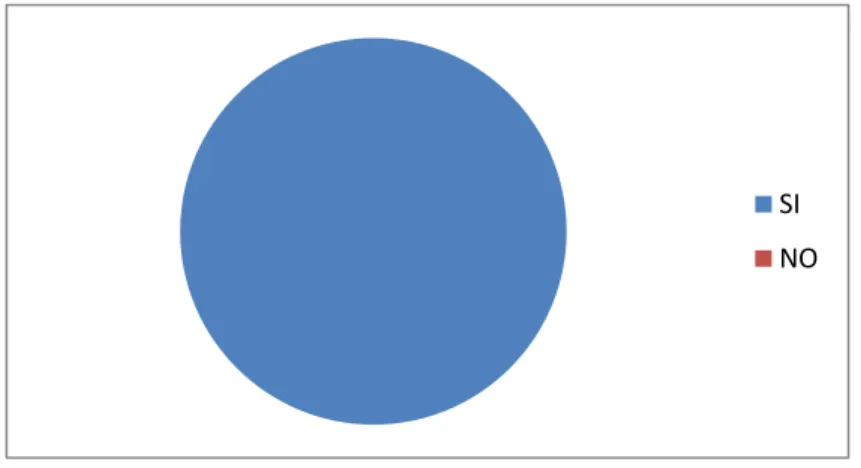
According to presented in graphic, 100% of teachers manifest that effectively there is a curricular gap or separation between English and science in English.
Understanding once more from other perspective “it means, curriculum is a vehicle of
integration where it is necessary to include in a detailed way, besides learning objectives, which goal of this proposal without forgetting that teaching or transmitting will not generate future conflicts between the members that will shape curriculum. (Etim J. , 1992).
It could be evident that curriculum integrates objectives through their dimensions which searches to be meaningful by students, to measure that this continues with respective school year and it is necessary to keep track of curricular established plan, starting to be evident that Little by Little a disarticulation between knowledge areas, becoming independent and isolated.
• The curricular integration can give opportunities of put on practice previous
knowledge. Table 6
Curricular integration and previous knowledge report.
RESPUESTA PORCENTAJE
SI 100%
NO 0%
Graphic 7. Curricular integration and previous knowledge.
According to presented in graphic, 100% manifest that effective curricular integration could put into practice students knowledge.
Understanding from other perspective meaningful learning “The integration of knowledge, where students sometimes face problematic situations which are necessary for giving a possible solution, and it is necessary to go into our previous knowledge without taking into account divisions if curriculum” (Beane J. , 2005).Since objective is achieved, person discovers and develops autonomously his own cognitive skills with success in social integration (Bross, 1997).
It could be evident that when there is a curricular integration between different knowledge areas, students can interconnected own knowledge with new knowledge to front different daily life situations and so evidence meaningful learning.
• The convenience of implementing a curriculum integration strategy for greater
success in meaningful learning. Table 7
Curricular integration strategy for meaningful learning success report
RESPUESTA PORCENTAJE
SI 100%
NO 0%
SI
Obtained information from institution (own elaborated)
Graphic 8. Curricular integration strategy for meaningful learning success.
According to presented in the graphic, 100% of teachers manifest that implementing an integrative curricular strategy would generate a greater success in meaningful learning.
Understanding o strategies are “integrated sequences of activities which are carried out with purpose of facilitating acquisitions, recovering and usage of knowledge. They are useful for translating efficiently and effectively information is answer” (Justicia y Cano, 1996, págs. 94-106)(It is evident that pedagogical strategies are not implicitly subjected to a curriculum to be used, but they are implied into teachers job as directly to teacher who wants to achieve in
students meaningful learning, and they could be used in different methodologies, tools in order to achieve that objective.
4.1.1. Student`s perception
• Year that began implementation of natural sciences in English at the Santa Angela
Merici School.
SI
Table 8
Beginning year according students report
AÑO NUMERO
ESTUDIANTES
PORCENTAJE
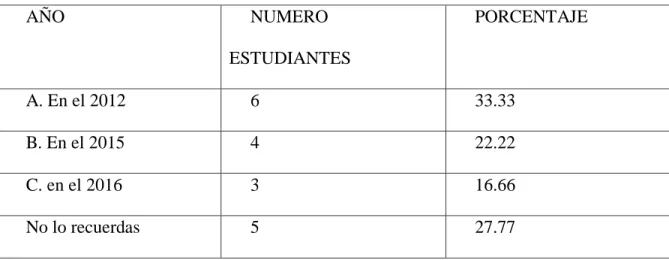
A. En el 2012 6 33.33
B. En el 2015 4 22.22
C. en el 2016 3 16.66
No lo recuerdas 5 27.77
Obtained information from institution (own elaborated)
Graphic 9. Beginning year according students.
According to graphic, sciences in English , 33.33% of students coincided that year 2012 was implemented of science in English started; 22.22% indicated that this year; and 16.66% affirmed that it was two years ago; while than 27.77% indicate that they do not remember.
The previous obeys that as teachers, students and family were informed and whole
community about interest of implementing this as strategy it strength English teaching, but as it is evident it was only one action.
It is evident that school on date thought continue implementation of subject in English, students do not have clear when began it.
6
4
3
• There is a real learning between English and science in English.
Table 9
Learning between English and science report
PREGUNTA NUMERO
ESTUDIANTES
PORCENTAJE
SI 3 16.6
NO 15 83.3
Obtained information from institution (own elaborated)
Graphic 10. Learning between English and science.
According to the graphic, 83% of students are not really increasing their learning; while 16% indicate that they are increasing their learning.
The previous obeys that students are really feelings that they have a meaningful learning “where there is a link between what they should learn (previous knowledge) and new content.” (Coll, 2001, p. 15).
It is shown that students really feel that are learning and this generates a meaningful learning; because they relate previous presented concepts during subjects.
• Science class motivation SI
Table 10
Science class motivation report
PREGUNTA NUMERO
ESTUDIANTES
PORCENTAJE
SI 1 5%
NO 17 95%
Obtained information from institution (own elaborated)
Graphic 11. Science class motivation.
According to graphic, 95% of students point that they are not feel motivated in science class; while that 5 % of them are motivated with science classes.
The previous obeys that “real learning in class depends on the teacher’s ability to maintain and improve motivation that they brought at beginning of course.
at any sense of motivation that they brought, it will be changed, from better to worse,
according to what occurs in classroom. Many factors affect the motivation of a student given for work and learning, as for example interest for a topic, utilities perception, and students patience. Not whole students come motivated in same way. And what is clear is that motivated students are more receptive and learn more, and motivation has an important influence in the learning.
SI
the evidence that depends on strategies used by teachers classes could be motivating for students or unmotivating; but in relation with science class; they feel motivated increasing their learning level so that creating a meaningful learning for them. (Sancho, 2017).
• The school has necessary elements to that there is a better learning in science in
English. Table 11
Necessary elements report
PREGUNTA NUMERO
ESTUDIANTES
PORCENTAJE
SI 17 95%
NO 1 5%
Obtained information from institution (own elaborated)
Graphic 12. Necessary elements.
According to graphic, 95% of students point that school has necessary tools to optimize learning of science; while 5% point that school does not count with necessary tools to optimize learning of science in English.
The previous obeys to since pedagogical labor has worried about finding meanings or
resources for improving teaching, for that reason, didactical resources, they are considered as a SI
pedagogical resource in which is reinforced as teacher act and it is optimized in learning process, providing an interactive tool to teacher.
It is evident that school tries to be on vanguard of innovation of tools to improve pedagogical practices; for example, technological virtual tools schools count on raz kids platform, innovates, laptops and last call TomI 7, students really perceive that their learning is more exciting and motivating than school which provides necessary tools and besides this teacher’s advice about management of ITCS.
• English skills are taken advantage of in an important way in natural sciences in
English. Table 12
English necessary skills report
RESPUESTA ESTUDIANTES PORCENTAJE
SI 13 73%
NO 5 27%
Obtained information from institution (own elaborated)
SI
Graphic 13. English neccessary skills.
According to graphic, 73% of students point that their abilities in science are increasing; while than 27% point that their abilities in English are not increasing.
The previous obeys that "according to mentioned aspects Vygotsky and Piaget learning occurs by aspects such as environment of child, his age, and affective factors, also they should take into account that child is learning in a building up continual process which transforms previous knowledge that they had. Ausubel has been one pioneers of this theory, child in relation with previous knowledge, is building new knowledge.
” learning is synonym of understanding. What it comprehended will be learnt and reminded better because this will be integrated in our knowledge structure”. (Carretero, 1997)
It is demonstrated that meaningful learning is an inherent gap that child has and only needs that necessary factors for being stimulated, in which he belongs a previous knowledge and if he relates with new knowledge then it starts to be meaningful., and relevant for himself. Here is where relationship between concepts in English and sciences; in any language.
4.1.2. Document analysis of natural science curriculum and English in third grade.
For achievement of goal “in elementary education there are established mandatory areas and fundamental or of the knowledge and forming up that they are necessarily offered according to institutional educative project. The group of mandatory areas and fundamental ones will be composed of the 80% of studios plans.
1. Natural science and environmental education
2. Social studies, history, geography, political constitution and democracy. 3. Artistic education
4. Ethics education and human values. 5. Physical education and sports. 6. Religious education.
7. Humanities, Spanish language and foreign languages. 8. Math.
9. Technology and informatics. (Ley 115 , 1994) The school takes into account following dimensions:
The first one: COGNITIVE. Which indicates that “developing a thinking in high level or order, which consists on mixing creative thinking with reflexive one which support demanding of the starting knowledge of preschool in framework of education for diversity and to
contribute personal development, familiar, multicultural, social and political, technologic”. (Portela Morales, 2006)
The second one: SOCIO AFFECTIVE. Indicates that: “developing socio affective
competences, for creating his personal way for living, feeling and expressing emotions in front of objects, animals and people around him, forming up an autonomous person, kind, and
responsible in framework of education for diversity to contribute with personal development, familiar, multicultural, social, political, technologic. (Portela Morales, 2006)
beings, expressive and social ones in framework of education for diversity to contribute personal development, familiar, multicultural, social, political, technologic” (Portela Morales, 2006)
The integrated Project as it was mentioned before, it is divided into clear concepts is
INTEGRATION AROUND A TOPIC; which indicates that “they are topics related each other in which there could be created integrated topics, from one of each of areas” here is where contents are separated traditional ones between teachers to define a common one and from his area they can propose specific concepts that could contribute common project.” (Cortes Ibarra, 2010, págs. 91-102)
4.1.3. Curricular analysis of English area.
The school in its curricular plan of English area is found in following goal:
“It recognizes basic vocabulary about different topics and creates short sentences focused in four communicative skills (speak, read, write and listen) in different situations.”
In relation with national ministry of education this level should: understand short stories in an easy language, develop strategies that help to understand some words, expressions and sentences that are read (development of four skills, speaking, listening, writing, and reading), besides this understanding basic language about daily aspects such as family and his environment, etc. (Ministerio de Educacion Nacional, 2006, pág. 96)
It could be evident that there is a connection between an established goal by national ministry of education and one presented by school. Which looks for students to little by little could include English language as fundamental part of their learning; national government decides that English is language that all Colombians should start to dominate. Focusing in four skills,
speaking, listening, and reading.(SEE ANNEXES).
THE OBJECTIVE, CONTENTS, SEQUENCING, METHOD, DIDACTIC RESOURCES
AND EVALUATION
The CONTENTS let remind” something else than a selection of contents of knowledge relevant to a diverse ambits of made and formalized knowledge “ (Gallegos, 1998, págs. 293-315)
As soon as contents managed by English area there is thin relationship between dimensions: COGNITIVE, SOCIO AFFECTIVE, PHYSICAL CREATIVE AND INTEGRATED
PROJECT. Each one looks for general goal in which student, little by little is being familiarized
with language through divided activities in previous dimensions of knowledge. Which is linked neatly with third element SEQUENCING.
The SEQUENCING “ this is a series of aligned components that are being presented behind each other, which looks for an objective; so that, components cannot be altered, due to coherence maintenance to find out a determined effect in its development or practice which is practice itself.” (Gallegos, 1998, págs. 293-315)
As it is shown in contents sequencing should be linked with curriculum in English area; dimensions where there are shown contents which curriculum has is sequencing, where sequencing indicates us how goals are being achieved or main goal which is to make basic sentences and raising their learning.
The METHODOLOGY “this is joining and synthesis of educative measurements which are founded over clear, safe psychological knowledge, over logical laws and made with personal ability which is achieved with a previous fixed goal.” (Santander, 2004, pág. 80)
knowledge in its four skills of knowledge, Little by Little routine topics are introduced for continuing their securing process.
The DIDACTICAL RESOURCES and MEANS” not only focus in materials and elements and instruments such as books; but also embraces a whole series of aspects as curriculum. Its components, of application of knowledge, punishments and socio-scholar environment, graphics, models, and easy and sophisticated audiovisuals meanings; electronic elements with a limited and high technology, all that which allows teacher to achieve that established objective in the teaching process.” (Santander, 2004, pág. 80)
This element is shown in curriculum PHYSICAL CREATIVE dimension activities to achieve main goal for dominating Little by Little four dimensions of knowledge; but besides of this school takes into account a great quantity of materials or resources to optimize learning of its students.
It was mentioned previously through virtual platforms (RAZKIDS) also training teachers in usage of different TICS; other technological resources such as TOMi7, besides printed part that schools manages an integrated workbook with the different areas of knowledge with worksheets in relation with topic that are being developed through year.
EVALUATION “ Is a structured process analyses and reflexive, which allows and embraces
nature of study object to emit value judgments over itself, providing information to help to improve and adjusting educative action” (Santander, 2004, pág. 80)