Continuum coupling in one-dimensional scattering using a transformed harmonic oscillator basis
I. Martel,1F. Pe´rez-Bernal,1M. Rodrı´guez-Gallardo,2 J. M. Arias,2 and J. Go´mez-Camacho2 1
Departamento de Fı´sica Aplicada, Universidad de Huelva, 21071 Huelva, Spain
2Departamento de Fı´sica Ato´mica, Molecular y Nuclear, Facultad de Fı´sica, Universidad de Sevilla, Apartado 1065, 41080 Sevilla, Spain
~Received 11 December 2001; published 24 April 2002!
The coupling to the continuum is studied in a one-dimensional problem that describes the interaction of a weakly bound composite object with a wall in a semiclassical approach. A transformed harmonic oscillator basis is introduced to provide an appropriate discrete and finite basis for treating the continuum part of the spectrum. The convergence of the scattering magnitudes is investigated as the number of states in the basis is increased. The role of bound-to-continuum and continuum-to-continuum coupling is investigated.
DOI: 10.1103/PhysRevA.65.052708 PACS number~s!: 03.65.Nk, 03.65.Sq, 24.10.Eq, 34.10.1x
I. INTRODUCTION
A composite quantum-mechanical object is described by an internal Hamiltonian that includes the kinetic energy of the constituents, as well as the interactions between these. The eigenstates of the internal Hamiltonian will be given, in general, by a finite ~or, at least, discrete! number of bound states, and a continuum of breakup states, which can be char-acterized by the relative momentum of the fragments. When such an object, initially in its ground state, which is bound, undergoes a scattering process from a structureless target the dynamics of the system is governed by the total Hamiltonian that includes the internal Hamiltonian of the object plus the interaction with the target. As a result, the object may be excited to other bound states, or to the continuum of breakup states. Even if the object ends up in the ground state, the scattering magnitudes will be affected by the coupling to bound and breakup states.
The effect of coupling to bound states can be described by means of a coupled-channels calculation. In a time-independent formalism, it involves the solution of a finite number of second-order coupled differential equations on the relative coordinate, which appear as a result of projecting the Schro¨dinger equation on the bound wave functions. In a semiclassical time-dependent formalism, one has to solve a finite number of first-order coupled differential equations on the time variable. In both cases, the procedure is rather straightforward, although it may be computationally difficult, if many bound states are considered.
The effect of coupling to breakup states is more difficult to describe. The continuum wave functions have an infinite range and are not normalizable. Thus, the coupling potentials from bound states to the continuum states have a very long range, and the coupling potentials from continuum-to-continuum states have an infinite range. That makes it nec-essary to use some discretization procedure to substitute the continuum of breakup states by a finite number of normaliz-able states, which, in the adequate limit, should represent the effect of coupling to the true continuum. Several methods have been proposed for this purpose. The R-matrix method @1#solves the many-body problem in a box and then make the matching with the adequate boundary conditions. The Sturmian basis@2– 4#uses bound states of scaled potentials,
which are orthogonal when weighted with the potentials. The Siegert pseudostate formulation @5# provides a finite basis representation of the outgoing wave solutions to the radial Schro¨dinger equation for cutoff potentials. The Gamow states @6#are non-normalizable solutions of the Schro¨dinger equation corresponding to outgoing boundary conditions characterized by complex energies. The method of con-tinuum discretization coupled channels @7# discretizes the continuum by means of taking fixed intervals, or bins, of k values in the continuum states. Finally, a complete basis of single particle wave functions, such as the harmonic oscilla-tor, can be used to expand both bound and scattering states @8#.
We have recently proposed the use of a transformed har-monic oscillator ~THO! basis to describe the effect of the continuum @9,10#. The basic idea is to define a local scale transformation @11–13#, which is such that converts the ground-state wave function of the weakly bound composite object cB(x) into a harmonic oscillator wave function f0
HO(s) @9,10#. The function s(x), which defines the local
scale transformation, is given, for a one-dimensional prob-lem, by
E
2` xucB~x
8
!u2dx8
5E
2` s
uf0 HO
~s
8
!u2ds8
511erf~2 s!. ~1!Then, one generates a set of orthogonal wave functions
fn THO(x)
5Hn„s(x)…cB(x), such that the state with n50
basis to describe the effect of the continuum in the scattering processes. We make use of the semiclassical approximation in which the relative motion of projectile and target is de-scribed by classical trajectories. This approach is valid when the wavelength associated to the relative motion is small compared to the range of the interaction@14#. This is the case for collisions of heavy nuclei, atoms, and molecules on a wide range of energies.
In this paper we make use of the THO basis to describe the effect of coupling to the continuum in a model one-dimensional problem. In Sec. II we present the model Hamil-tonian, we introduce the semiclassical approximation to de-scribe the scattering, and formulate the adiabatic and sudden approximations, which allow for an exact solution. In Sec. III we present the scattering calculation in the THO basis, and investigate the convergence of elastic and breakup prob-abilities as the number of states in the THO basis is in-creased. In Sec. IV we investigate the effect of including or neglecting the effect of continuum-to-continuum coupling. Sec. V is for the summary and conclusions.
II. ONE-DIMENSIONAL SCATTERING MODEL
In this work we discuss the application of the THO basis to a scattering problem. We consider a one-dimensional com-posite object, characterized by two particles with masses m1,m2, and coordinates x1 and x2. Their reduced mass is
m5m1m2/(m11m2) and the total mass is M5m11m2. The relative coordinate is x5x12x2, and the center of mass co-ordinate is X5(m1x11m2x2)/ M . The corresponding Hamil-tonian is given by
h52\ 2
2m d2
dx21vB~x!, ~2!
where the x is the relative coordinate andvB(x) is the inter-action that binds the particles. Initially, the composite object is in its ground state cB(x), which is an eigenstate of h
corresponding to an energy eB. This object collides with a
massive particle, or wall. The interaction of the system with the wall is given by a function V(X,x), which depends on the center of mass as well as on the internal coordinate. If the particles interact independently with the wall, then V(X,x)
5V1(x1)1V2(x2), but this will not be true in general, if there are polarization effects. Thus, the complete Hamil-tonian can be written as
H52 \ 2
2 M d2
dX21V~X,x!1h. ~3!
The x dependence of the interaction V(X,x) can be ex-panded in terms of a family of orthogonal polynomials Pm(x), where m represents the order of the polynomial.
These polynomials are orthogonal with respect to the weight function given bycB(x)
2, so that
E
dxcB~x!2Pm~x!Pn~x!5d~n,m!. ~4!Explicit expressions for the first few polynomials are, in terms of the expectation values of xnin the ground state, and assuming thatcB(x)5cB(2x),
P0~x!51, ~5!
P1~x!5 x
A
^
x2&
, ~6!P2~x!5
x22
^
x2&
A
^
x4&
2^
x2&
2. ~7!Thus, the interaction can be expanded as
V~X,x!5
(
m
Vm~X!Pm~x!, ~8!
Vm~X!5
E
dxcB~x!2Pm~x!V~X,x!. ~9!It should be noticed that the first term in this expansion, which is independent of the internal variable x, corresponds to the expectation value of the interaction V(X,x) in the ground state of the composite object, which is the folding potential. This is given by
Vf~X!5V0~X!5
E
dxcB~x!2V~X,x!. ~10!The other terms give rise to the tidal forces, which can in-duce the excitation of the composite object during the colli-sion. For the purpose of this paper, we will consider the case in which the composite object consists on two identical par-ticles. Then, the function V(X,x) is even in x, and only the polynomials of even order contribute to the expansion. Moreover, for the sake of simplicity, we will retain only the terms up to m52. Thus, we have
V~X,x!5Vf~X!1V2~X!P2~x!. ~11!
In a semiclassical approach@14#, the folding potential deter-mines the trajectory X(t) of the center of mass of the object. The trajectory can be obtained by solving the differential equation
M
2
S
dX~t!dt
D
21Vf~X!5E2eB. ~12!
The turning point of the classical trajectory X0 occurs when E2eB5Vf(X0). If the time t50 is taken when X(t)5X0, then the trajectory X(t) is an even function of the time. The tidal potential, which is responsible for the projectile excita-tion, is given by
VT~X,x!5V2~X!P2~x!. ~13!
In a semiclassical treatment, the trajectory X(t) is used to consider the tidal potential VT„X(t),x… as a time-dependent
cen-ter of mass and relative coordinates factorize, so that the effect of the tidal forces are described by the operator P2(x), which acts with an intensity F(t)5V2„X(t)…. The internal state will evolve satisfying the equation
i\ d
dtc~x,t!5@h2eB1F~t!P2~x!#c~x,t!, ~14!
with the boundary condition that for t→2`, the wave
func-tion is that of the ground state cB(x).
Recapitulating, Eq. ~14!represents, within some reason-able approximations, the time evolution of the internal state of a two-particle system that collides with a wall. This equa-tion contains derivatives with respect to t and x, and so it is difficult to solve it exactly. Besides, as the eigenstates of h contain both bound and continuum states, one cannot just project on the eigenstates of h and solve the coupled equa-tions.
We will show in the following section that the THO method provides a finite basis of normalizable states, which allow to find an approximate solution to Eq.~14!. Besides, as the number of THO states increases, the relevant scattering magnitudes converge.
We will also consider two dynamical approximations to Eq.~14!. The adiabatic approximation arises when the char-acteristic time scale of the interaction, given by the time range of the function F(t), is much longer than the time scale of the internal motion, \/eB. In this limit, the
time-dependent wave function can be approximated by the expres-sion
cAd~x,t!5N~t!
F
cB~x!2F~t!1 h2eB
P2~x!cB~x!
G
3exp@2if~t!#, ~15!
where N(t) is a normalization factor, which varies slowly, and the phasef(t) satisfies the equation
f~t!52a \
E
2`t
dt
8
F~t8
!2. ~16! The parameterais the polarizability associated to the opera-tor P2(x). It is given by the expressiona5
^
cBuP2~x! 1 h2eBP2~x!ucB
&
. ~17!It should be noticed that, in the adiabatic approximation, the object always emerges from the scattering process in its ground state. Indeed, the function F(t), which is associated to the couplings, vanishes as t→`. The only effect that arises from the coupling is a phase shift in the ground-state wave function. This phase shift is determined by the value of the polarizability a. So, the adequacy of any approximate treatment of continuum discretization can be judged by com-paring the value of a obtained from the discretization with the exact value. We will make this comparison in the follow-ing section for the THO basis.
The sudden approximation is opposite to the adiabatic one. It arises when the time scale of the interaction is much shorter than that of the internal motion. Thus, the internal coordinates are effectively frozen during the scattering. The sudden approximation is obtained by ignoring the term h
2eB in Eq.~14!. That allows to integrate with respect to the
time variable, to give
cSu~x,t!5cB~x!exp@2if~t!P2~x!#, ~18!
where the phasef(t) is given by
f~t!5\1
E
2`t
dt
8
F~t8
!. ~19! In the sudden approximation the object emerges from the scattering process in a state whose density distribution is the same as that of the ground state. However, it can be quite different from the ground state because the additional phase depends on the variable x. The probability amplitude for re-maining in the ground state is given by^
fBuA~ F !ufB&
5E
dxcB~x!2exp@2iFP2~x!#, ~20!whereF5f(`). If the configuration space is restricted, by means of some continuum discretization procedure, the ex-pression above will be modified. In the following section we will evaluate the convergence of the elastic amplitudes in the THO basis, as a function of F. Note that theF, which is associated to the integral of the coupling potential along the trajectory, is a dimensionless parameter that measures the importance of the coupling. Small values of F indicate that the elastic scattering dominates, while large values ofF im-ply that excitation dominates.
III. SCATTERING CALCULATIONS IN THE THO BASIS
We make use of the THO basis to expand the wave func-tionc(x,t). The THO basis@9#is obtained from the ground-state wave function by the expression
fnTHO
~x!5Hn„s~x!…cB~x!, ~21!
where Hn(s) is a properly normalized Hermite polynomial,
and s(x) is given by Eq. ~1!. For these calculations, the binding interaction has been taken as a Po¨schl-Teller poten-tial @15#, given by
vB~x!5v0/cosh2~bx!. ~22! The potential depth v052\2b2/m is taken so that it only accommodates one bound state, which has an energy eB5
2\2b2/2m, and that is given by the analytic wave function
cB~x!5N/cosh~bx!. ~23!
We can use the THO basis ~21!, with n50, . . . ,N, to diagonalize the Hamiltonian h. This gives rise to N11 eigenstatescj
h
(x), whose corresponding eigenvalues are ej,
statecB(x), which coincides withf0
THO(x). The other states are normalizable states, which represent the continuum in the THO basis.
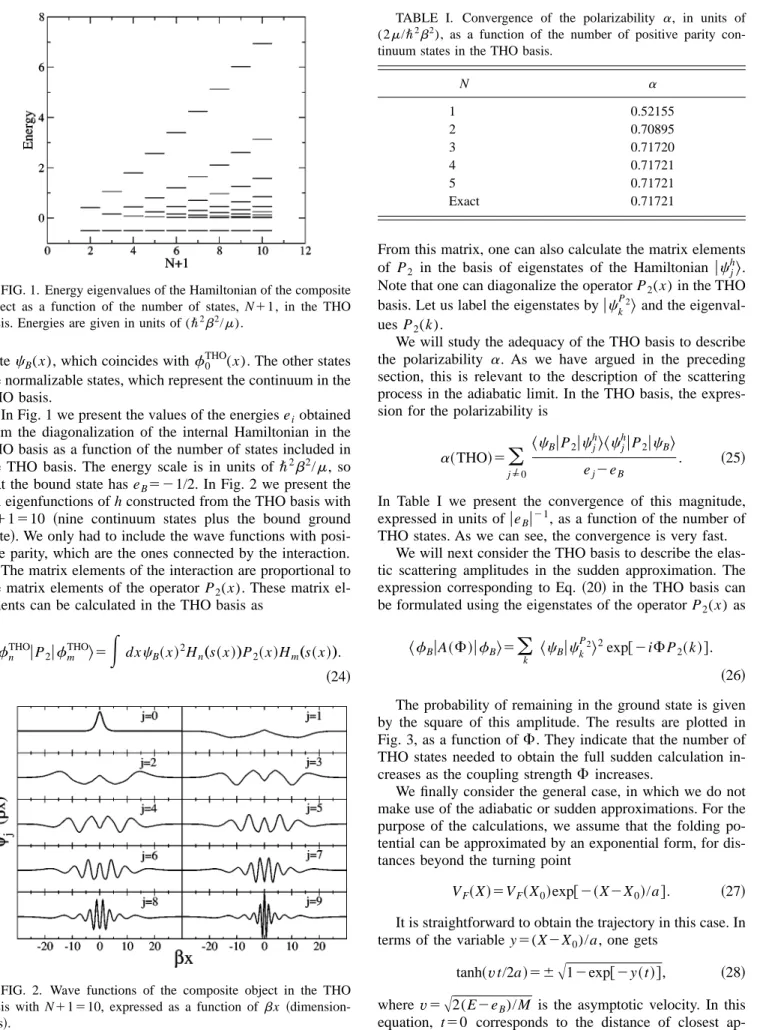
In Fig. 1 we present the values of the energies eiobtained from the diagonalization of the internal Hamiltonian in the THO basis as a function of the number of states included in the THO basis. The energy scale is in units of \2b2/m, so that the bound state has eB521/2. In Fig. 2 we present the
ten eigenfunctions of h constructed from the THO basis with N11510 ~nine continuum states plus the bound ground state!. We only had to include the wave functions with posi-tive parity, which are the ones connected by the interaction. The matrix elements of the interaction are proportional to the matrix elements of the operator P2(x). These matrix el-ements can be calculated in the THO basis as
^
fnTHOuP2ufmTHO
&
5E
dxcB~x!2Hn„s~x!…P2~x!Hm„s~x!….~24!
From this matrix, one can also calculate the matrix elements of P2 in the basis of eigenstates of the Hamiltonian ucj
h
&
. Note that one can diagonalize the operator P2(x) in the THO basis. Let us label the eigenstates byuckP2&
and theeigenval-ues P2(k).
We will study the adequacy of the THO basis to describe the polarizability a. As we have argued in the preceding section, this is relevant to the description of the scattering process in the adiabatic limit. In the THO basis, the expres-sion for the polarizability is
a~THO!5
(
j5”0
^
cBuP2ucj h&^
cjhuP2uc
B
&
ej2eB. ~25!
In Table I we present the convergence of this magnitude, expressed in units ofueBu21, as a function of the number of
THO states. As we can see, the convergence is very fast. We will next consider the THO basis to describe the elas-tic scattering amplitudes in the sudden approximation. The expression corresponding to Eq. ~20! in the THO basis can be formulated using the eigenstates of the operator P2(x) as
^
fBuA~ F !ufB&
5(
k
^
cBuck
P2
&
2exp@2iFP2~k!#. ~26!
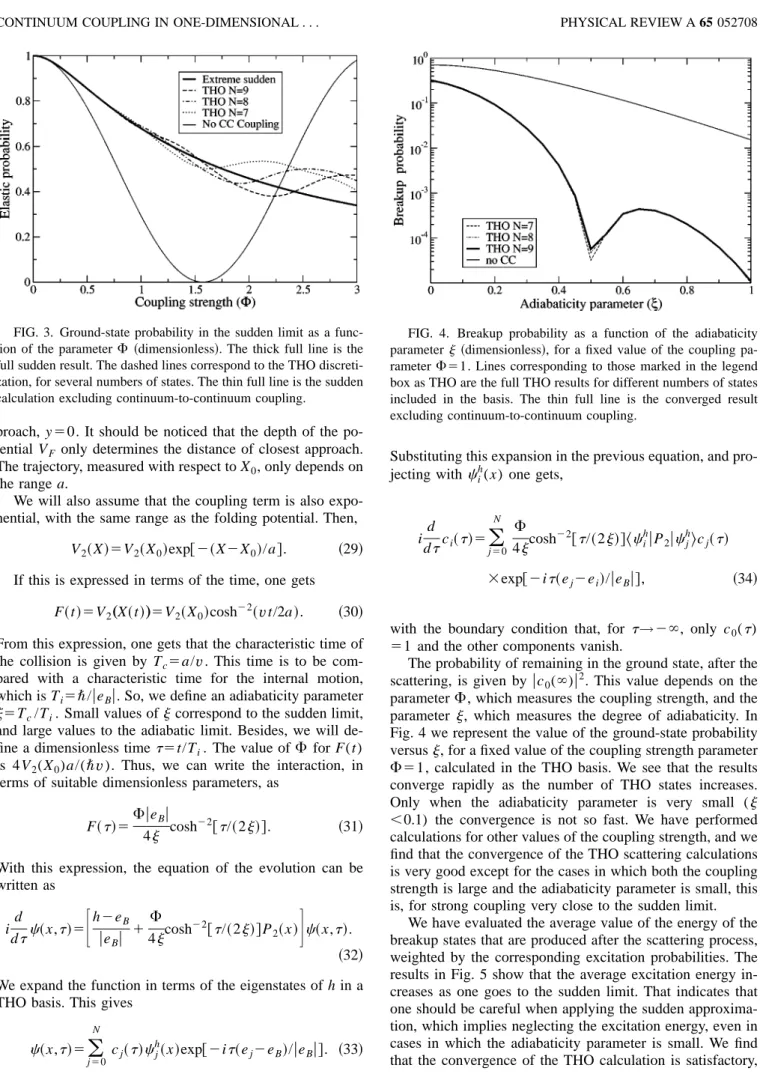
The probability of remaining in the ground state is given by the square of this amplitude. The results are plotted in Fig. 3, as a function ofF. They indicate that the number of THO states needed to obtain the full sudden calculation in-creases as the coupling strengthF increases.
We finally consider the general case, in which we do not make use of the adiabatic or sudden approximations. For the purpose of the calculations, we assume that the folding po-tential can be approximated by an exponential form, for dis-tances beyond the turning point
VF~X!5VF~X0!exp@2~X2X0!/a#. ~27!
It is straightforward to obtain the trajectory in this case. In terms of the variable y5(X2X0)/a, one gets
tanh~vt/2a!56
A
12exp@2y~t!#, ~28!where v5
A
2(E2eB)/ M is the asymptotic velocity. In this equation, t50 corresponds to the distance of closestap-TABLE I. Convergence of the polarizability a, in units of (2m/\2b2), as a function of the number of positive parity
con-tinuum states in the THO basis.
N a
1 0.52155
2 0.70895
3 0.71720
4 0.71721
5 0.71721
Exact 0.71721
FIG. 1. Energy eigenvalues of the Hamiltonian of the composite object as a function of the number of states, N11, in the THO basis. Energies are given in units of (\2b2/m).
proach, y50. It should be noticed that the depth of the po-tential VF only determines the distance of closest approach.
The trajectory, measured with respect to X0, only depends on the range a.
We will also assume that the coupling term is also expo-nential, with the same range as the folding potential. Then,
V2~X!5V2~X0!exp@2~X2X0!/a#. ~29!
If this is expressed in terms of the time, one gets
F~t!5V2„X~t!…5V2~X0!cosh22~vt/2a!. ~30! From this expression, one gets that the characteristic time of the collision is given by Tc5a/v. This time is to be com-pared with a characteristic time for the internal motion, which is Ti5\/ueBu. So, we define an adiabaticity parameter j5Tc/Ti. Small values ofjcorrespond to the sudden limit,
and large values to the adiabatic limit. Besides, we will de-fine a dimensionless timet5t/Ti. The value ofF for F(t)
is 4V2(X0)a/(\v). Thus, we can write the interaction, in terms of suitable dimensionless parameters, as
F~t!5FueBu 4j cosh2
2@t/~2j!#. ~31!
With this expression, the equation of the evolution can be written as
id
dtc~x,t!5
F
h2eBueBu 1
F 4jcosh
22@t/~2j!#P
2~x!
G
c~x,t!. ~32!We expand the function in terms of the eigenstates of h in a THO basis. This gives
c~x,t!5
(
j50
N
cj~t!cj h
~x!exp@2it~ej2eB!/ueBu#. ~33!
Substituting this expansion in the previous equation, and pro-jecting with ci
h(x) one gets,
i d
dtci~t!5
(
j50
N
F 4jcosh
22@t/~2j!#
^
c i huP2uchj
&
cj~t!3exp@2it~ej2ei!/ueBu#, ~34!
with the boundary condition that, for t→2`, only c0(t)
51 and the other components vanish.
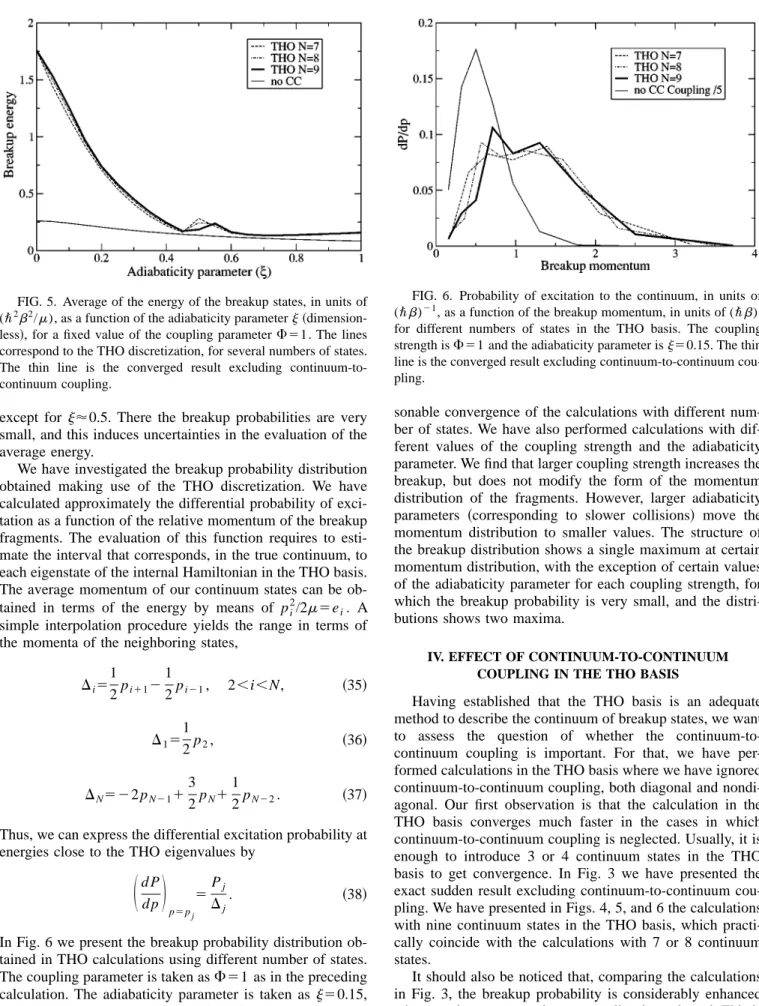
The probability of remaining in the ground state, after the scattering, is given by uc0(`)u2. This value depends on the parameterF, which measures the coupling strength, and the parameter j, which measures the degree of adiabaticity. In Fig. 4 we represent the value of the ground-state probability versusj, for a fixed value of the coupling strength parameter F51, calculated in the THO basis. We see that the results converge rapidly as the number of THO states increases. Only when the adiabaticity parameter is very small (j
,0.1) the convergence is not so fast. We have performed calculations for other values of the coupling strength, and we find that the convergence of the THO scattering calculations is very good except for the cases in which both the coupling strength is large and the adiabaticity parameter is small, this is, for strong coupling very close to the sudden limit.
We have evaluated the average value of the energy of the breakup states that are produced after the scattering process, weighted by the corresponding excitation probabilities. The results in Fig. 5 show that the average excitation energy in-creases as one goes to the sudden limit. That indicates that one should be careful when applying the sudden approxima-tion, which implies neglecting the excitation energy, even in cases in which the adiabaticity parameter is small. We find that the convergence of the THO calculation is satisfactory,
FIG. 3. Ground-state probability in the sudden limit as a func-tion of the parameterF ~dimensionless!. The thick full line is the full sudden result. The dashed lines correspond to the THO discreti-zation, for several numbers of states. The thin full line is the sudden calculation excluding continuum-to-continuum coupling.
except for j'0.5. There the breakup probabilities are very small, and this induces uncertainties in the evaluation of the average energy.
We have investigated the breakup probability distribution obtained making use of the THO discretization. We have calculated approximately the differential probability of exci-tation as a function of the relative momentum of the breakup fragments. The evaluation of this function requires to esti-mate the interval that corresponds, in the true continuum, to each eigenstate of the internal Hamiltonian in the THO basis. The average momentum of our continuum states can be ob-tained in terms of the energy by means of pi2/2m5ei. A
simple interpolation procedure yields the range in terms of the momenta of the neighboring states,
Di5
1 2pi112
1
2pi21, 2,i,N, ~35!
D15 1
2p2, ~36!
DN522 pN2113 2pN1
1
2pN22. ~37!
Thus, we can express the differential excitation probability at energies close to the THO eigenvalues by
S
d P d pD
p5pj
5DPj
j
. ~38!
In Fig. 6 we present the breakup probability distribution ob-tained in THO calculations using different number of states. The coupling parameter is taken asF51 as in the preceding calculation. The adiabaticity parameter is taken as j50.15, which correspond to an intermediate situation between the adiabatic and sudden limits. We can see that there is a
rea-sonable convergence of the calculations with different num-ber of states. We have also performed calculations with dif-ferent values of the coupling strength and the adiabaticity parameter. We find that larger coupling strength increases the breakup, but does not modify the form of the momentum distribution of the fragments. However, larger adiabaticity parameters ~corresponding to slower collisions! move the momentum distribution to smaller values. The structure of the breakup distribution shows a single maximum at certain momentum distribution, with the exception of certain values of the adiabaticity parameter for each coupling strength, for which the breakup probability is very small, and the distri-butions shows two maxima.
IV. EFFECT OF CONTINUUM-TO-CONTINUUM COUPLING IN THE THO BASIS
Having established that the THO basis is an adequate method to describe the continuum of breakup states, we want to assess the question of whether the continuum-to-continuum coupling is important. For that, we have per-formed calculations in the THO basis where we have ignored continuum-to-continuum coupling, both diagonal and nondi-agonal. Our first observation is that the calculation in the THO basis converges much faster in the cases in which continuum-to-continuum coupling is neglected. Usually, it is enough to introduce 3 or 4 continuum states in the THO basis to get convergence. In Fig. 3 we have presented the exact sudden result excluding continuum-to-continuum cou-pling. We have presented in Figs. 4, 5, and 6 the calculations with nine continuum states in the THO basis, which practi-cally coincide with the calculations with 7 or 8 continuum states.
It should also be noticed that, comparing the calculations in Fig. 3, the breakup probability is considerably enhanced when continuum-to-continuum coupling is neglected. This is due, in our calculations, to the properties of the operator
FIG. 5. Average of the energy of the breakup states, in units of (\2b2/m), as a function of the adiabaticity parameterj ~
dimension-less!, for a fixed value of the coupling parameterF51. The lines correspond to the THO discretization, for several numbers of states. The thin line is the converged result excluding continuum-to-continuum coupling.
FIG. 6. Probability of excitation to the continuum, in units of (\b)21, as a function of the breakup momentum, in units of (\b),
P2(x) in the tidal potential. The expectation value of this operator vanishes for the ground state. However, for con-tinuum states, with a large spatial extension, the expectation value is positive, and hence the tidal potential has a repulsive effect in these states, and this decreases the probability of breakup.
We have observed that this effect does not only occur in the sudden limit. For finite values of the adiabaticity param-eter, the calculations that ignore continuum-to-continuum coupling give in general larger breakup probabilities. This is shown in Fig. 4. This effect is more acute as the coupling strength is larger. For weak coupling strength F!1, the ef-fect of continuum-to-continuum coupling gets smaller.
We have also investigated the energy distribution of the breakup states obtained in calculations that ignore continuum-to-continuum coupling. As it is shown in Fig. 5, the average energy of the breakup states is lower in the cal-culations that neglect continuum-to-continuum coupling. Be-sides, as the collision is faster ~adiabaticity parameter smaller!the increase in the excitation energy is smaller than when continuum-to-continuum coupling is considered.
The momentum distribution of the breakup fragments is also very different in the calculations neglecting continuum-to-continuum coupling, as it is shown in Fig. 6. These calcu-lations give much larger breakup probabilities, which are concentrated on small values of the fragment momenta.
V. SUMMARY AND CONCLUSIONS
In this work we have made use of a recently proposed method to discretize the continuum of breakup states for weakly bound systems. The method, named THO, provides a basis of normalizable wave functions, which are generated by multiplying the ground state of the composite object by a number N11 of Hermite polynomials on a variable s(x). This variable is obtained as a local scale transformation from the physical variable x. As the number N increases, the basis approaches completeness, and the true continuum of breakup states should be accurately described in terms of the THO basis.
We have investigated the adequacy of the THO basis to describe the effect of the coupling to breakup states on the scattering of a composite object. We have considered a one-dimensional problem in which a composite object, made up of two structureless fragments that are initially bound, col-lides with a repulsive potential that depends both on the cen-ter of mass coordinate and on the relative coordinate of the fragments. This potential is approximated as the sum of a folding potential, which acts on the center of mass coordi-nate, and determines the classical trajectory, and a tidal po-tential, which is written as the product of a coupling form-factor times an operator acting on the relative coordinate. As a result of the collision, the composite object can breakup producing fragments with a certain energy distribution. We use a semiclassical approximation, by which the center of mass describes a trajectory that is determined by the folding potential. The evolution of the internal state of the composite system is determined by a time-dependent Schro¨dinger equa-tion, which is projected on a finite THO basis.
We find that the dynamics of the collision can be charac-terized within a semiclassical approximation in terms of two dimensionless parameters. One is the coupling strength, which is defined as the time integral of the coupling form-factor along the trajectory and the other is the adiabaticity parameter, which is the ratio of the collision time and the characteristic time for the internal motion.
When the collision is slow, the adiabaticity parameter is large and one is in the adiabatic limit. In this case, the effect of coupling to the continuum is just to induce a phase change in the elastic wave function. The calculations in the THO basis converge very quickly to the exact results in this case. When the collision is fast, the adiabaticity parameter is small and one is in the sudden limit. In this case, the number of THO states needed to obtain convergence in the elastic probability depends on the value of the coupling strength.
We have performed calculations in intermediate situa-tions, for different values of the coupling strength and the adiabaticity parameters. We find that the convergence in the THO basis is satisfactory, except in situations in which both the coupling strength is large and the adiabaticity parameter small, this is, in situations of strong coupling close to the sudden limit.
We have used the THO basis to evaluate different scatter-ing magnitudes in our model problem. We find that the prob-ability of breakup increases, in general, as the coupling strength increases, and as the adiabaticity parameter de-creases. However, there are certain values of the adiabaticity parameter, for each coupling strength, for which the breakup probability gets very small. We find that the THO calcula-tions, with different numbers of states, present consistently this feature.
We have used the THO basis to evaluate the energy dis-tribution of the breakup states. We find that the average ex-citation energy of the breakup states does not depend very much on the coupling strength, and increases significantly as the adiabaticity parameter decreases. We have also evaluated the energy distribution of the breakup states, finding that the distribution is wider for the lower adiabaticity parameter.
We conclude that the THO basis is adequate to describe the coupling to breakup states in scattering problems that can be treated within the semiclassical approximation. For a full quantum-mechanical calculation the THO basis provides with a finite set of normalized states that represent the con-tinuum of breakup states. These wave functions are used to evaluate diagonal and transition potentials, which enter in a standard coupled channel calculation. We have already
ap-plied this method to describe the scattering of deuterons on heavy targets with satisfactory results@16#.
ACKNOWLEDGMENTS
This work was supported in part by the Spanish DGICYT under Project Nos. PB98-1111 and FPA2000-1592-C03-02. We acknowledge useful discussions with R. Liotta, C.H. Dasso, and R.C. Johnson.
@1#Atomic and Molecular Processes: An R-Matrix Approach,
ed-ited by P. G. Burke and K. A. Berrington~IOP, Bristol, 1993!.
@2#M. Rotenberg, Adv. At. Mol. Phys. 6, 233~1970!.
@3#F. Antonsen, Phys. Rev. A 60, 812~1999!.
@4#R. Szmytkowski and B. Zywicka-Mozejko, Phys. Rev. A 62, 022104~2000!.
@5#O. I. Tolstikhin, V. N. Ostrovsky, and H. Nakamura, Phys. Rev. A 58, 2077~1998!.
@6#R. G. Lovas, R. J. Liotta, A. Insolia, K. Varga, and D. S. Delion, Phys. Rep. 294, 265~1998!.
@7#N. Austern, Y. Iseri, M. Kamimura, M. Kawai, G. Rawitsher, and M. Yahiro, Phys. Rep. 154, 125~1987!.
@8#M. Moshinsky and Y. Smirnov, The Harmonic Oscillator in
Modern Physics~Harwood Academic Publishers, Amsterdam, 1996!.
@9#F. Pe´rez-Bernal, I. Martel, J. M. Arias, and J.
Go´mez-Camacho, Phys. Rev. A 63, 052111~2001!.
@10#F. Pe´rez-Bernal, I. Martel, J. M. Arias, and J. Go´mez-Camacho, Few-Body Syst., Suppl. 13, 217~2002!.
@11#I. Zh. Petkov and M. V. Stoitsov, Yad. Fiz. 37, 1167 ~1983! @Sov. J. Nucl. Phys. 37, 692~1983!#.
@12#M. V. Stoitsov and I. Zh. Petkov. Ann. Phys. ~NY! 184, 121 ~1988!.
@13#M. V. Stoitsov, J. Dobaczewski, P. Ring, and S. Pittel, Phys. Rev. C 61, 034311~2000!.
@14#K. Alder and A. Winther, Electromagnetic Excitation~ North-Holland, Amsterdam, 1975!.
@15#G. Po¨schl and E. Teller, Z. Phys. 83, 143~1933!.
@16#A. M. Moro, J. M. Arias, J. Go´mez-Camacho, F. Pe´rez-Bernal, I. Martel, R. Crespo, and F. Nunes, Phys. Rev. C 65, 011602