Coupling to breakup channels using a transformed harmonic oscillator basis
A. M. Moro,1,3J. M. Arias,1J. Go´mez-Camacho,1I. Martel,2 F. Pe´rez-Bernal,2,*R. Crespo,3and F. Nunes4 1
Departamento de FAMN, Universidad de Sevilla, Apartado 1065, E-41080 Sevilla, Spain 2Departamento de FAIE, Universidad de Huelva, E-21071 Huelva, Spain
3Departamento de Fı´sica, Instituto Superior Te´cnico, Av. Rovisco Pais, 1049-001 Lisboa, Portugal 4Universidade Fernando Pessoa, Prac¸a 9 de Abril, 4200 Porto, Portugal
共Received 4 September 2001; published 12 December 2001兲
The application of a recently proposed procedure for discretizing the continuum to collision processes involving weakly bound nuclei is studied. In particular, the coupling to breakup states in the collision of d
⫹208
Pb at 50 MeV is discussed. For illustrative purposes, only the s-wave component of the bound state of the deuteron is considered, and the study is restricted to the case of nuclear s-wave breakup. The continuum discretization procedure provides a basis of transformed harmonic oscillator wave functions to accomplish the necessary calculations. Appropriate convergence of the elastic and breakup cross sections with increasing dimension of the basis is reported. In addition, it is shown that the results obtained converge to those of a standard continuum discretized coupled channels calculation, with the advantage that the convergence of the method is determined by only one parameter, namely the dimension of the basis.
DOI: 10.1103/PhysRevC.65.011602 PACS number共s兲: 24.10.Eq, 25.10.⫹s, 25.45.De, 25.60.Gc
The development of radioactive beam facilities has shed light on a variety of new nuclear structure problems 关1兴 which include neutron and proton rich nuclei close to the drip lines, and in particular halo nuclei. Given that these are weakly bound systems, their modeling should necessarily in-clude in some way the continuum part of the spectrum. This becomes essential when studying nuclear collisions, where the inclusion of the coupling to breakup channels is not only necessary for the description of processes leading to frag-mentation, but also when dealing with elastic scattering or transfer reactions.
Reaction calculations where breakup couplings are in-cluded have the additional complication that breakup states are not square-normalizable. This problem is generally sur-mounted replacing the states in the continuum by a finite set of normalized states, and proving that the calculation of scat-tering observables in the finite basis converges when increas-ing the number of states considered, or when modifyincreas-ing the parameters which define the normalized states.
Several procedures have been developed to obtain a finite basis of normalized states which describes the continuum. One of the most widely used of these approaches is the method of continuum discretization coupled channels 共CDCC兲 关2兴. It consists in discretizing the continuum by means of taking fixed intervals, or bins, of k values. Each bin is characterized by a single radial wave function, which is obtained as an average of the continuum wave functions over the bin. In this averaged radial wave function, the oscilla-tions of the different components tend to cancel beyond a certain distance, and so the bin radial wave function becomes normalizable. Formally, the CDCC method requires the so-lution of the Schro¨dinger equation for all共or, at least, many兲 energies in the continuum as a previous requirement to cal-culate the bin wave functions. Thus a practical CDCC
calcu-lation requires to fix the maximum k value considered and the interval ⌬k of the bins, so that the number of bins is given by M⫽kmax/⌬k. To demonstrate convergence in a CDCC calculation one has to show that the scattering mag-nitudes are not modified with increasing maximum energy (kmax) or decreasing the interval⌬k. However, when ⌬k is made smaller, the radius at which the bin wave functions vanish becomes larger, increasing the range of the coupling potential. As a consequence, CDCC calculations are typically very time consuming. In addition, as both ⌬k and kmax pa-rametrize the basis, demonstrating convergence is by no means trivial 共see 关3兴for a recent study of the convergence within CDCC兲. Despite these difficulties, the method has been successfully applied to a large number of nuclear reac-tions and is one of the most reliable approaches to reacreac-tions involving binary composite systems.
We have recently proposed the use of a transformed har-monic oscillator共THO兲basis as an alternative to describe the effect of the continuum关4,5兴. In Ref. 关4兴some applications to simple one-dimensional problems are presented and it is shown that, as the number of states in the THO basis in-creases, the eigenstates appear densely packed close to the breakup threshold, although some of them lie at higher ener-gies. Besides, it is shown that global structure magnitudes related to the coupling to the continuum, such as sum rules, are very accurately described using relatively small THO ba-sis states. In Ref. 关5兴 this study was extended to the more realistic case of the deuteron, showing similar results to the one-dimensional case. In the present work, we show that the same ideas can be useful in the study of nuclear collisions involving weakly bound nuclei.
In the case of a three-dimensional problem under central forces, the relevant part of the wave function is the radial one, that can be written as R(r)⫽(r)/r. In the following when referring to the wave function we always mean the radial function(r). The basic idea of the method presented in Ref.关4兴is to define a local scale transformation关6兴which converts the ground state wave function of a bound nucleus *Present address: Center for Theoretical Physics, Yale University,
b(r) into a harmonic oscillator wave function0
HO(s). The function s(r), which defines the local scale transformation, is given by
冕
0 r兩b共r
⬘
兲兩2dr⬘
⫽erf共s兲⫺2s exp共⫺s2兲
冑
. 共1兲Next, one generates a set of orthogonal wave functions mul-tiplying the ground state wave function by the appropriate polynomials Pn„s(r)…,
n
THO共r兲⫽P
n„s共r兲…b共r兲, 共2兲 such that the state with n⫽0 coincides with the ground state, and the states with n⬎0 describe the continuum, or other bound states if they exist. From the three-dimensional HO wave functions 关7兴
Pn共s兲⫽
1/4 2 k
兺
⫽0N
␣nks2k, 共3兲
␣nk⫽ 共⫺1兲k
k!
冑
2共n!兲⌫共n⫹3/2兲共n⫺k兲!⌫共k⫹3/2兲. 共4兲
Finally, one diagonalizes the Hamiltonian matrix using a fi-nite basis of THO states: the resulting positive energy eigen-states are taken as continuum wave functions. Hereafter N denotes the number of continuum states obtained after diago-nalization, thus the THO basis dimension is N⫹1.
The aim of this work is to investigate the adequacy of the THO basis for describing the effect of coupling to breakup states in nuclear reactions. For this purpose, we have consid-ered a test case where the coupling to the continuum is rel-evant: the elastic scattering and breakup of d⫹208Pb at 50 MeV. In order to study this process two ingredients are needed: the proton-neutron interaction and the interaction of the projectile constituents with the target. At this stage, we do not intend to do a full calculation of the effects of deu-teron breakup nor compare with the experimental data but to show that the THO discretization method is an adequate the-oretical tool for the modeling of reactions involving weakly-bound nuclei. As an illustration, we consider here a simple theoretical scenario: the deuteron is taken to be a pure s state, the effect of Coulomb breakup is neglected, and the nuclear interaction of the proton and neutron with the target induce the coupling to s-waves breakup states only. Within these restrictions, we perform a convergence study of the THO method and compare with the CDCC method. The realistic case, where the d component is incorporated in the ground state of the deuteron, and both Coulomb and nuclear breakup to l⫽0 states are coupled in, will be presented in a more extensive publication.
Concerning the structure of the projectile, we describe the proton-neutron interaction by means of a Poeschl-Teller po-tential,
V共r兲⫽⫺D 1
cosh2共␣r兲, 共5兲
with depth共D兲and range (␣) adjusted to reproduce the deu-teron binding energy and mean square radius: D
⫽102.85 MeV and ␣⫽0.9407 fm⫺1. A representation of this potential is shown in the inset of Fig. 1. The use of this potential provides an analytic ground state wave function for the deuteron, which is convenient, although not essential, for the calculations in the THO basis. The interaction of proton and neutron with the target is taken from the Becchetti-Greenless parametrization 关8兴, evaluated at half of the deu-teron incident energy. As mentioned above, only the coupling to s-wave breakup states is considered.
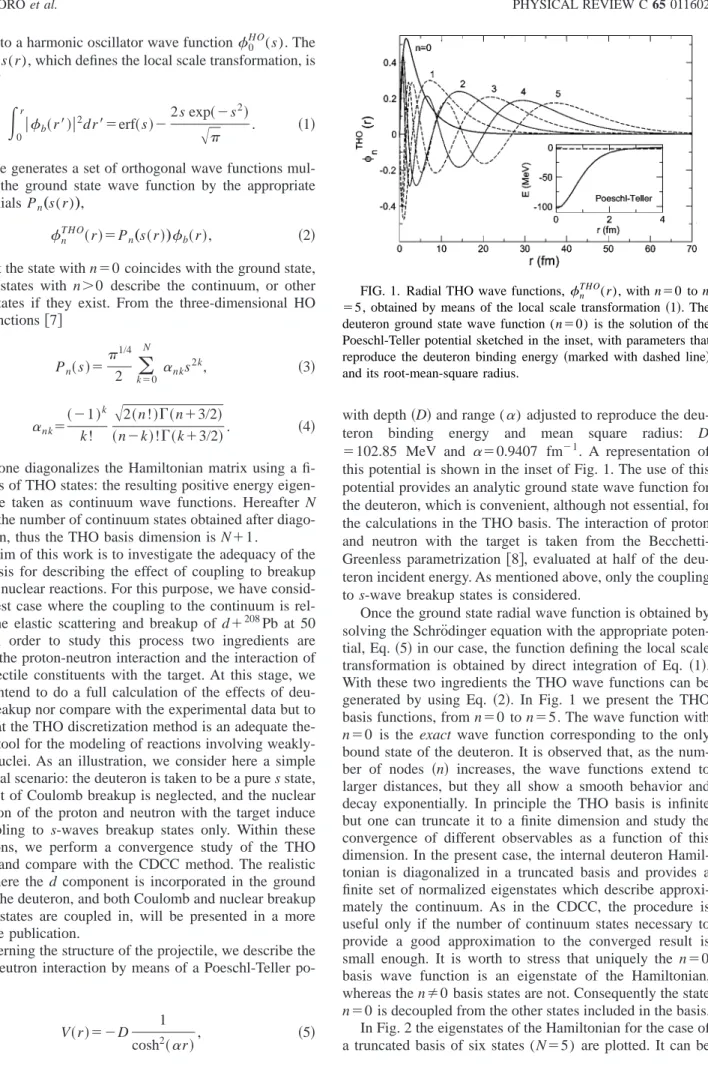
Once the ground state radial wave function is obtained by solving the Schro¨dinger equation with the appropriate poten-tial, Eq.共5兲in our case, the function defining the local scale transformation is obtained by direct integration of Eq. 共1兲. With these two ingredients the THO wave functions can be generated by using Eq. 共2兲. In Fig. 1 we present the THO basis functions, from n⫽0 to n⫽5. The wave function with n⫽0 is the exact wave function corresponding to the only bound state of the deuteron. It is observed that, as the num-ber of nodes 共n兲 increases, the wave functions extend to larger distances, but they all show a smooth behavior and decay exponentially. In principle the THO basis is infinite but one can truncate it to a finite dimension and study the convergence of different observables as a function of this dimension. In the present case, the internal deuteron Hamil-tonian is diagonalized in a truncated basis and provides a finite set of normalized eigenstates which describe approxi-mately the continuum. As in the CDCC, the procedure is useful only if the number of continuum states necessary to provide a good approximation to the converged result is small enough. It is worth to stress that uniquely the n⫽0 basis wave function is an eigenstate of the Hamiltonian, whereas the n⫽0 basis states are not. Consequently the state n⫽0 is decoupled from the other states included in the basis. In Fig. 2 the eigenstates of the Hamiltonian for the case of a truncated basis of six states (N⫽5) are plotted. It can be
FIG. 1. Radial THO wave functions,nTHO(r), with n⫽0 to n
noted that the range of these k(r) wave functions is deter-mined by the range of the last state included in the THO basis. All eigenfunctions of the Hamiltonian present a smooth behavior and are normalized.
In Fig. 3 we present the energies of the deuteron Hamil-tonian diagonalized in a THO basis as a function of the basis dimension. One can verify that the energy density of these states is higher close to the breakup threshold.
An attractive feature of this method is that the only re-quirement to construct the THO basis is solving the Schro¨-dinger equation for the ground state, either analytically or numerically. The THO basis is then obtained by means of Eqs. 共1兲 and共2兲. As the continuum wave functions are ob-tained through the Hamiltonian diagonalization, their calcu-lation does not require the integration of the Schro¨dinger equation. Furthermore, the scattering calculation is equiva-lent to a standard coupled channels calculation with bound states, whose internal energies and wave functions are given by the diagonalization of the deuteron Hamiltonian in this THO basis. The only discrete parameter to be changed in order to investigate convergence is the number of states to be
included in the basis. Using this input, we solve the coupled channels calculations using the computer code FRESCO关9兴.
In Table I we present the results of a standard CDCC calculation for the total breakup cross section, as well as the average final excitation energy and the average inverse exci-tation energy, using in both cases the breakup cross sections as weights. We have kept fixed the maximum excitation en-ergy at 30 MeV and have done calculations varying the num-ber of continuum bins and, accordingly, the bin size⌬k.
In Table II we present the same observables as in Table I, but now using the THO method. It is found that the conver-gence with respect to the number of states is very satisfac-tory. Taking the results for N⫽10 as reference, we find that the THO calculations with four, six, and eight continuum states give similar results. Even the THO calculation with just two continuum states gives as reasonable an estimate as the corresponding CDCC.
An unusual feature of the THO method is that the diago-nalization of the internal Hamiltonian in the THO basis may give rise to closed channels, i.e., states with excitation ener-gies larger than the scattering energy. Although these states do not contribute directly to the outgoing flux, they might be significantly excited in the proximity of the target, thus
af-FIG. 2. Radial eigenfunctions of the Po¨schl-Teller Hamiltonian,
k(r), with k⫽0 to k⫽5, obtained by diagonalizing the
Poeschl-Teller Hamiltonian in a six-dimensional THO basis.
FIG. 3. Ground state and continuum energies obtained upon diagonalizing the deuteron Hamiltonian as a function of the dimen-sion of the THO basis (N⫹1). Note that for N⬎5 the last state is out of scale.
TABLE I. Convergence of the breakup cross section (bu),
av-erage excitation energy (具⑀⫺⑀0典), and average inverse excitation
energy关具(⑀⫺⑀0)⫺1典兴in the CDCC calculation, with respect to the
number of continuum bins ( M ). All calculations were performed keeping kmax⫽0.85 fm⫺1共corresponding to a maximum excitation
energy of ⑀max⫽30 MeV) and using a different number of
con-tinuum bins.
M bu 具⑀⫺⑀0典 具(⑀⫺⑀0)⫺1典
共mb兲 共MeV兲 (MeV⫺1)
2 86.8 6.20 0.166
4 86.1 5.81 0.219
6 87.0 5.85 0.222
8 84.8 5.94 0.224
10 82.5 6.04 0.223
12 81.8 6.07 0.224
TABLE II. Calculated total breakup cross section (bu),
aver-age excitation energy (具⑀⫺⑀0典), and average inverse excitation
en-ergy关具(⑀⫺⑀0)⫺ 1典兴
, using the THO basis, for different choices of the number of continuum states (N). The column Ncou p indicates
the number of continuum states which are coupled together in the coupled channels calculation.
N Ncou p bu 具⑀⫺⑀0典 具(⑀⫺⑀0)⫺1典
共mb兲 共MeV兲 共MeV⫺1)
2 2 89.2 3.98 0.273
4 3 83.8 5.48 0.231
6 5 84.0 5.46 0.226
8 7 83.5 5.66 0.224
10 8 83.5 5.85 0.220
fecting the elastic and breakup cross sections. The direct method of solving differential equations used in FRESCO is numerically unstable for these states with high excitation en-ergies. Therefore, in order to investigate the importance of these states, R-matrix coupled channel calculations were per-formed. We found that states with excitation energies above 30 MeV play a minor role and, consequently, closed chan-nels do not affect the scattering observables for this reaction. With the exception of the last row, the calculations presented in Table II are performed excluding the coupling to closed channels. The number of states which are coupled in each case is indicated by the row labeled Ncou p.
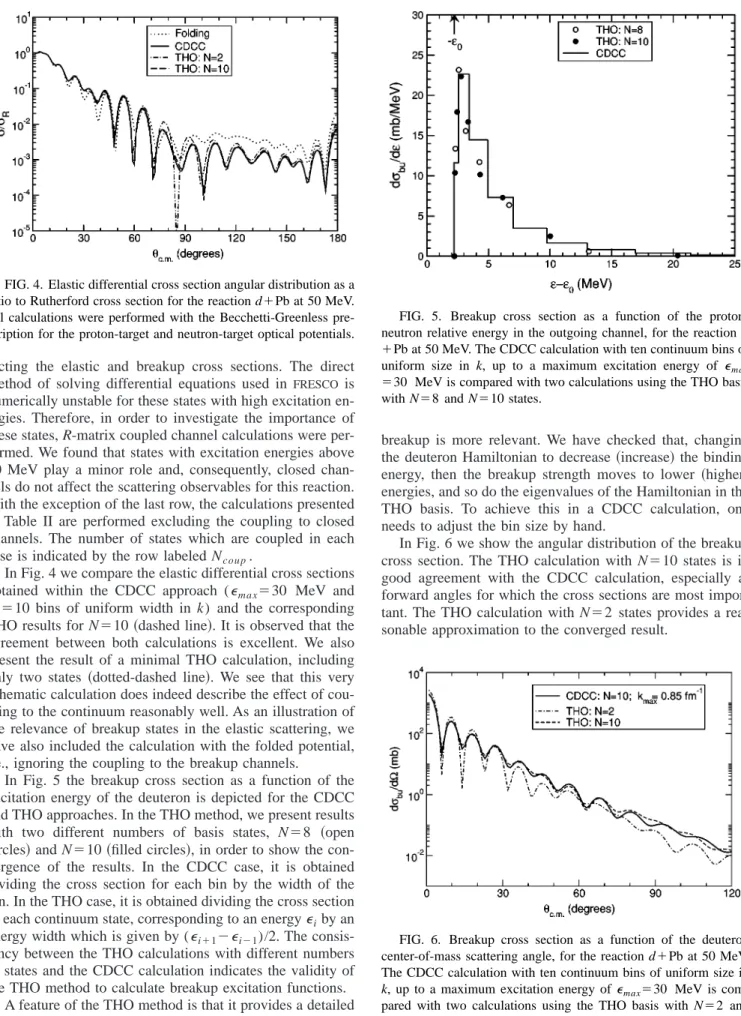
In Fig. 4 we compare the elastic differential cross sections obtained within the CDCC approach (⑀max⫽30 MeV and M⫽10 bins of uniform width in k) and the corresponding THO results for N⫽10共dashed line兲. It is observed that the agreement between both calculations is excellent. We also present the result of a minimal THO calculation, including only two states 共dotted-dashed line兲. We see that this very schematic calculation does indeed describe the effect of cou-pling to the continuum reasonably well. As an illustration of the relevance of breakup states in the elastic scattering, we have also included the calculation with the folded potential, i.e., ignoring the coupling to the breakup channels.
In Fig. 5 the breakup cross section as a function of the excitation energy of the deuteron is depicted for the CDCC and THO approaches. In the THO method, we present results with two different numbers of basis states, N⫽8 共open circles兲and N⫽10共filled circles兲, in order to show the con-vergence of the results. In the CDCC case, it is obtained dividing the cross section for each bin by the width of the bin. In the THO case, it is obtained dividing the cross section of each continuum state, corresponding to an energy⑀iby an energy width which is given by (⑀i⫹1⫺⑀i⫺1)/2. The consis-tency between the THO calculations with different numbers of states and the CDCC calculation indicates the validity of the THO method to calculate breakup excitation functions.
A feature of the THO method is that it provides a detailed description of the continuum in the low energy region where
breakup is more relevant. We have checked that, changing the deuteron Hamiltonian to decrease共increase兲the binding energy, then the breakup strength moves to lower 共higher兲 energies, and so do the eigenvalues of the Hamiltonian in the THO basis. To achieve this in a CDCC calculation, one needs to adjust the bin size by hand.
In Fig. 6 we show the angular distribution of the breakup cross section. The THO calculation with N⫽10 states is in good agreement with the CDCC calculation, especially at forward angles for which the cross sections are most impor-tant. The THO calculation with N⫽2 states provides a rea-sonable approximation to the converged result.
FIG. 4. Elastic differential cross section angular distribution as a ratio to Rutherford cross section for the reaction d⫹Pb at 50 MeV. All calculations were performed with the Becchetti-Greenless pre-scription for the proton-target and neutron-target optical potentials.
FIG. 5. Breakup cross section as a function of the proton-neutron relative energy in the outgoing channel, for the reaction d
⫹Pb at 50 MeV. The CDCC calculation with ten continuum bins of uniform size in k, up to a maximum excitation energy of ⑀max
⫽30 MeV is compared with two calculations using the THO basis with N⫽8 and N⫽10 states.
FIG. 6. Breakup cross section as a function of the deuteron center-of-mass scattering angle, for the reaction d⫹Pb at 50 MeV. The CDCC calculation with ten continuum bins of uniform size in
k, up to a maximum excitation energy of ⑀max⫽30 MeV is
com-pared with two calculations using the THO basis with N⫽2 and
In conclusion, we have shown in this Rapid Communica-tion that the continuum discretizaCommunica-tion method proposed in Ref. 关4兴 can be applied to problems of current interest in nuclear physics, in particular to the case of collisions involv-ing weakly bound nuclei. The only previous requirement for the application of the method is the knowledge of the ground state wave function of the nucleus, either in an analytical or numerical form. Then, Eqs. 共1兲 and 共2兲 provide the THO basis which can be used to diagonalize the nuclear Hamil-tonian. We have performed a series of schematic calculations for the case of the d⫹208 Pb elastic scattering and breakup at 50 MeV. The comparison of THO and CDCC results has demonstrated the validity of the first method and has shown that the THO discretization method works properly even
though the basis is truncated to very few states. One of the greatest advantages of the THO method is that it automati-cally distributes the basis states in the relevant energy re-gions of the continuum, offering an easy, computationally efficient, alternative to the standard CDCC method.
This work was supported in part by the Spanish DGICYT under Projects Nos. PB98-1111 and FPA2000-1592-C03-02 and by the Portuguese Science and Technology Foundation under Grant No. SAPIENS/36282/99. F.P.B. wishes to thank the financial support provided by the Spanish Direccio´n Gen-eral de Universidades 共Ministerio de Educacio´n, Cultura y Deporte兲 through a grant. We acknowledge useful discus-sions with R. C. Johnson and I. J. Thompson.
关1兴Report of Nuclear Physics European Collaboration Committee, edited by J. Vervier et al., 1997.
关2兴N. Austern, Y. Iseri, M. Kamimura, M. Kawai, G. Rawitscher, and M. Yahiro, Phys. Rep. 154, 125共1987兲.
关3兴R. Piyadasa, M. Kawai, M. Kamimura, and M. Yahiro, Phys. Rev. C 60, 044611共1999兲.
关4兴F. Pe´rez-Bernal, I. Martel, J. Arias, and J. Go´mez-Camacho, Phys. Rev. A 63, 052111共2001兲.
关5兴F. Pe´rez-Bernal et al. Few Body Syst.共to be published兲.
关6兴M. Stoitsov, J. Dobaczewski, P. Ring, and S. Pittel, Phys. Rev. C 61, 034311共2000兲.
关7兴M. Moshinsky and Y. Smirnov, The Harmonic Oscillator in
Modern Physics 共Harwood Academic, Chur, Switzerland, 1996兲.
关8兴F. Becchetti and G. Greenlees, Phys. Rev. 182, 1190共1969兲.