(Centre of Contemporaru Culture of Barcelona) on the occasion of its tenth anniversary.
Research directors: Joan Subirats and Joaquim Rius.
Research team: Joaquim Rius, Laia Ollé, Andrés Scagliola and Ismael Blanco, with the collaboration of Júlia Humet.
© Centre de Cultura Contemporània de Barcelona, 2006 Montalegre, 5
Presentation and first elements
Transformations
Many Ravals
Culture as a referent: the presence of the CCCB and the Plaça dels Àngels cluster
Conclusions and recommendations
Bibliography 7
11 31 47
Introduction
The Raval today is a great space of social change, a territory of creation, a laboratory of social and cultural blending in the city of Barcelona. This study, which was commissioned by the CCCB, aims to analyse the processes of social, economic and symbolic transformation in the Raval neighbourhood. We wish to symbolise these processes by calling this study “From the Xino1to the Raval”. In other words, we describe how in twenty years the neighbourhood has gone from being the Xino, which is to say a stigmatised area with a reputation of social exclu-sion and neglect, to being a neighbourhood in the middle of a process of renovation, one that is socially and culturally mixed and a place that is visited by residents of Barcelona and visitors from abroad alike. In the terms of reference of some cultural productions, it has gone from being the Xino of La Marge by André Pieyre de Mandiargues, or that of Nazario’s comic-strip character Anarcoma, to being the Raval of the film Una casa de locos [L’Auberge espag-nole, in its original title] or that of the cultural cluster of the Plaça dels Àngels.
The goals of the study, then, are to ascertain the magnitude of the change. To find out what roles have been played by the most significant interventions in the neighbourhood. What new dynamics we might find. What role is played, and can be played, by the Raval in twenty-first-century Barcelona. This is not to overlook the standpoints of the social actors and resi-dents in the area. We are aware that a study of this kind and with such goals might have been one of many types and carried out in different ways, for example, focusing on the phenome-non of migration, or social exclusion, public policy, the cultural institutions, and so on. Our aim has been to produce a study that to some extent covers all the Raval’s dimensions: demo-graphic, social, economic, urban planning, artistic, ideological, etcetera.
Behind this choice is the fact that we have taken into account a fundamental change in present-day societies in which, on the one hand, culture takes on a central economic
dimen-PRESENTATION AND
FIRST ELEMENTS
sion and, on the other, economic activities have become more open in style, while being less autonomous. The culture industries and cultural tourism are good examples of this mixture at the end of the twentieth century, and they appear to be among the key elements of the present historical stage. We should like to inquire whether the case of the Raval is a sufficient-ly clear example of what has been called “cultural regeneration”, which is to say urban reno-vation based on culture.
The research.This study was carried out over one year by a research team from the Institut de Govern i Polítiques Públiques (Institute of Government and Public Policy) at the Autonomous University of Barcelona. The directors were Joan Subirats and Joaquim Rius, and the team members Laia Ollé, Andrés Scagliola, Ismael Blanco, with the collaboration of Júlia Humet.
We should like to thank each of the 35people we have interviewed individually, enabling us to
meet first-hand the leading figures of this transformation. We are aware that, despite our efforts to record all the voices involved, it is very probable that we have missed people who have other views. We also wish to thank residents of the Raval and the Friends of the CCCB who made themselves available so that we could conduct the three discussion groups.
The study has been sponsored by the CCCB and without the determination of this institution to get to know the neighbourhood in which it was installed ten years ago it would never have been done. We thank the members of the Documentation Centre at the CCCB for their enthusiastic and efficient sup-port in logistical and bibliographical terms. We should also like to thank the CERC (Cultural Studies and Resource Centre, Regional Council of Barcelona) for having offered us the use of temporary premises, thus enabling us to carry out our research work from the heart of the Raval.
First elements
The Raval neighbourhood has undergone far-reaching transformation over the last twenty years. The balance today is essentially positive, although there are still many uncertainties as to the final results of this process of transformation. These doubts are due to variable factors such as immigration and new social and economic dynamics, which were not forseeable either at the start or during the early developments of the process. Hence, at this point we might speak of explic-itly desired and successfully achieved transformations (the establishment of new cultural institu-tions, economic stimulation, the resettlement of residents in refurbished buildings) and of not explicitly desired transformations (the very rapid, and to some extent uncontrolled, social and ethnic diversification of the neighbourhood, a reoccupation by immigrants of interstitial spaces or of areas that are substandard in town planning terms). We might even speak of completed transformations (the cultural cluster of the Plaça dels Àngels and the incorporation of private initiatives in the north-east sector of the Raval) and of pending transformations (the south Raval area, the presence of more private investment). And we still have questions that only time will answer. Will the Raval become just another normal neighbourhood of Barcelona? Will it start losing its social mix and end up opting for one of the contradictory identities that are present today (a cultural-commercial neighbourhood, an immigrant neighbourhood, a leisure zone)?
We shall go on to discuss this set of transformations below.
the neighbourhood are not neutral, but reflect different images, a range of appraisals and historical memories or situations in the city that are also divergent. We know that the word “Xino” does not apply to the whole of the territory that is now known as the Raval. It would be located, rather, in the south-ern sector of the Raval. However, with this term we wish to include two meanings, to some extent oppo-site, that hover over images of the neighbourhood:
1/ A Xino that would evoke bohemia, the canaille (the French term is untranslatable) milieu, the
dis-trict of cafés-concerts and cabarets of international renown. This would be a populist, nostalgic, posi-tive and romantic view.
2/ A Xino that would evoke working-class life, poverty, prostitution and delinquency. This would be a
view that sees only poverty, one that is pessimistic and critical.
The former is based on the glorious years of the “Barrio Chino”, the gold-fever years of the First World War that gave the neighbourhood its international reputation. The latter refers more to the idea of what was left of the Xino after the Civil War and the Franco dictatorship. The Xino of the artists and cabarets appears as the opposite of the working-class and poor Xino, the legend and the reality being as differ-ent as night and day. The duality, however, lingers on today, still relatively presdiffer-ent in the citizens’ imag-inary and in the thinking of some intellectuals, politicians and administrators.
The name Raval, nonetheless, also has a symbolic content. It is of medieval origin and was recovered very recently. Indeed, when people did not want to use the stigmatising word “Xino”, it was called the “Drassanes District” or “District V”, which was its administrative name. The fact that it was the only zone called by its administrative name shows, on the one hand, the desire to escape from the stigma of “Xino” and, on the other, the neighbourhood’s problem of identity. The Raval neighbourhood is a set of quite distinct territories and all they have in common is that they once occupied the space between the second and third city walls and that they were part of nineteenth-century urban planning. For some, simply using the name Raval represents the reform. There are even some people who speak of the name as one that was imposed from the top, by the powers-that-be, by the Administration. The name “Raval” corresponds to the “toponymy of rehabilitation”:
If there is a sentimental route that needs to be done urgently as a sales pitch in the turn-of-the-cen-tury Barcelona of design, it is that of the Xino neighbourhood. But please be politically correct and call it the Raval, the name on file for the toponymy of rehabilitation. Today’s Raval is a world of contrasts, as in the medinas.
Rafael Vallbona, “Adiós al Barrio Chino”, El Mundo. La Revista, no. 85, 13May 2001.
For others, the name has its origins in the neighbourhood movement that wanted to participate in the processes of renovation, as a way of designating the whole territory, presenting itself to the administra-tion as a single interlocutor:
The names adopted by the neighbourhood associations to delimit their respective terrains of action, names that were subsequently consolidated by the PERI (Special Plan for Integral Reform), are precisely those that have generated the new denomination. In other words, the neighbourhood movement, besides recovering more or less forgotten names of the districts, like Raval, or Fort Pius, or generating new names for zones that were so outside the general scheme that they did not even have a name, Nou Barris, for example, has modified the toponymy of the city’s oldest districts. Miquel Domingo and M. Rosa Bonet (1998), Barcelona i els moviments socials urbans (Barcelona and
From top to bottom: the desired reform
The transformation planned for the Raval has a core target that, while it bears some relation to previous attempts, also renews them and reworks the former aims and instruments. It is understood that the main player could only be the administration from the outset, and the way of going about it had to be completely hierarchical in the sense that it is done from top to bottom because it takes off from a certain basic assumption that it is rational and right. The standpoint adopted was, significantly, the same as the original idea of cleaning up, but to approach it with the aims of keeping the population in the neighbourhood, dignifying it and improving living conditions, while doing so by means of instruments that took advan-tage of and reinforced the neighbourhood’s somewhat underrated elements of historic val-ue, these being its central location, history, legacy and cultural potential. The idea, then, was to respect the residents while improving their living conditions by means of considerable public investment that would then bring in private investment, and diversifying the popula-tion and uses of the area. The danger that lurked in the background of this operapopula-tion, one that has been repeatedly pointed out over the years, was that the project as a whole would end up by causing the expulsion of the traditional and more vulnerable residents, along with a certain social desertification within a culturally and commercially oriented neighbourhood (pointing to the Marais distict in Paris as an example of what might happen).
If we leave to one side the whole set of urban planning projects for the internal reform of the neighbourhood, or of the Ciutat Vella (Old City) zone as a whole, which were being for-mulated throughout the twentieth century by the different political regimes, to focus instead on what began with the end of the Franco dictatorship and the transition to democracy, we can distinguish several phases (Table 1). These phases enable us to situate the entire period from 1976to 1988as that of formulation, and the period from 1988to 2002as that of appli-cation, while the present phase is that characterised by managing the results and setting up new challenges.
neglecting other aspects where significant public intervention has also been involved. We do not wish to deny the centrality of urban planning policies in the programme of the urban trans-formation of the old part of the city, but we do believe that these policies do not cover the entire range of interventions that have occurred in the territory. In particular, we believe that the strategy of transformation may be grouped into three main areas of intervention: first, indeed, are the polices that aim at the physical transformation of the territory (urban plan-ning policies); second are those policies that aim at the symbolic transformation of the terri-tory (cultural policies); and, finally, are those policies that aim at responding to the social needs of the residents (social policies).
Urban development and reforms
There was no need for large-scale studies for one to come to the conclusion that in the early 1980s the situation of the Raval in urban development terms was extremely serious. Some of the main problems of the neighbourhood were (and, in some cases, still are) a lack of public space (squares and green zones), insufficient neighbourhood and city facilities (social cen-tres, civic cencen-tres, libraries, museums, etc.) and infrastructure; the neglect of the buildings and, most particularly, of the housing estates; housing of very small dimensions and very poorly equipped even in terms of the most basic facilities (light, water, sanitary conditions, showers); a very high population density and insalubrious streets.
The policies for the urban transformation of the neighbourhood were thus geared to overcome some of the basic structural deficits that the Raval had been accumulating through-out its history.
The plan for the reform. The Special Plan for Integral Reform (PERI) of the Raval – approved on the basis of an agreement reached between the Raval Neighbourhood Association and Barcelona City Council – left aside the urban planning criteria on the basis of which the PGM (General Metropolitan Plan) had envisaged intervening in the district. The Plan is essentially based on four main areas (Gomà and Rosetti, 1998):
• To readjust the distribution of land uses in 10% of the total surface of the neighbourhood. The
pro-vision of new public facilities and open spaces (squares and green zones) was envisaged, thus shelv-ing the option of guttshelv-ing the area by means of large thoroughfares. In contrast with the PGM, the Raval PERI envisaged a radical decrease in the ground surface, residential ceiling and commercial ceiling that would be affected by the urban planning work.
YEARS PERIOD
1976-1979 Residents’ initiative phase
1979-1983 Basic formulation phase
1984-1986 Advanced formulation phase
1987-1988 Reformulation phase
1988-1995 Application phase
1995-2002 Advanced application phase
2002- Phase of managing results and new challenges
Table 1/ Stages in urban regeneration policy-making in Ciutat Vella (1976-2004)
• To demolish part of the most run-down housing estate in the neighbourhood in order to free ground space for collective uses, and provide new public housing and new facilities in the neighbourhood.
• To rehabilitate the least degraded sectors of the urban fabric through direct public support for pri-vate initiative, the introduction of new cultural facilities and creating open spaces.
• Finally, from the standpoint of the strategy of action in the territory, to centre the first interventions in the northern sector and its boundary areas until converging in the centre where the plan was to carry out a large-scale and concentrated policy of land management in order to create a big central square.
To give an idea of the magnitude of the change, it should be noted that in Ciutat Vella between 1980and 2002 approximately 500buildings were acquired by compulsory purchase and demolished, representing 400,000m2of built-up ground, 4,200dwellings, 800business prem-ises and 100,000m2of land thus freed.
During this period the Public Administration or related bodies constructed 1,246homes in the Raval out of a total of 2,725. Information provided by the company promoting the project, Procivesa (2002), states that 2,470families have been resettled throughout Ciutat Vella. However, calculating that the average number of people per home in the Raval is 2.3(according to the 1996District Register), we must suppose that today approximately 2,866people live in the accom-modation that is part of the rehabilitation project, which would mean 6.3% of the 45,581who live in the neighbourhood (according to the 2003District Register). Private investment destined for rehabilitation in real estate from 1988to 2002was 200million euros.
With regard to the rehabilitation of buildings, there are noticeable differences within the neighbourhood. As can be seen in the table below, the numbers of buildings involved between the areas to the north and south of Carrer Hospital are similar. Nonetheless, the renovation work has been a little more intensive in the northern sector, where the figure represents 49.8% of the buildings (Table 2). According to these figures, 45.4% of the buildings of the Raval have been totally or partially rehabilitated.
In the process of reforming the neighbourhood, the two main projects have been the con-struction of the buildings of the Casa de Caritat and the demolition and concon-struction work in what is now the Rambla del Raval.
• In the case of the Casa de Caritat complex, one only needs to remember that the CCCB was inaugurated in 1994, the MACBA (Museum of Contemporary Art of Barcelona) opened its doors in 1995, while FAD (Decorative Arts Association) moved into its new quarters in the Plaça dels Àngels in 1999. It is envisaged that in the academic year 2005– 2006some 6,000students will be enrolled in the new Geography and History Faculty.
• The Rambla del Raval is an avenue that is 317metres long and 58wide, representing a total of 18,300m2of public space in which there are 230trees and 800m2of lawn as
ZONE REHABILITATED TOTAL BUILDINGS %
North 382 767 49.8
South 301 737 40.8
Total 683 1,504 45.4
Table2/ Distribution of rehabilitation of buildings in the north and south of the Raval
well as a bicycle lane. This space was previously occupied by 62buildings that were demol-ished.
One of the features of the public-sector interventions in Ciutat Vella is the great diversity of administrative branches that are participating. Also noteworthy is the fact that none of them plays a clearly predominant role. However, the role of Promoció de Ciutat Vella SA (Procivesa)2
occupies first place with regard to outlay in terms of direct investment. Also to be highlight-ed is the fact that the sum of the combinhighlight-ed investment of Procivesa and Barcelona City Council represented almost half the available capital (Table 3).
How was the money distributed in this set of interventions? Most of it went to the installation of facilities for the city. Public space and new housing accounted for a similar amount, while the allocation for infrastructure and facilties at the neighbourhood level was considerably less (Table 4).
As the process of transformation goes ahead, several areas of conflict have emerged between the City Council and the residents:
BRANCHES OF THE ADMINISTRATION EUROS (MILLIONS) %
Procivesa 455. 35 37. 46
Barcelona City Council and Municipal Companies 153. 68* 12. 64
Regional Government of Catalonia and entities 285. 74 23. 51
Central Government and entities 163. 89 13. 48
Other public entities 156. 99 12. 91
TOTAL 1,215. 65 100. 00
Table3/ Direct investment by the Public Administration (1988-2001)
Source: Procivesa, 2002
PUBLIC INVESTMENT EUROS (MILLIONS) %
Infrastructure 103. 10 9. 71
Public space 215. 92 20. 33
New housing 207. 85 19. 57
Neighbourhood facilities 104. 32 9. 82
City facilities 430. 79 40. 57
TOTAL 1,061. 98 100. 00
Table4/ Use of Public Administration resources (1988-2001)
Source: Procivesa,2002
2.Promoció de Ciutat Vella SA (Promotion of Ciutat Vella – Procivesa) is the public-private municipal company that managed the reform. Based on public capital (the combined input of Barcelona City Council and Barcelona Regional Council represented approximately 60% of the company’s capital) and private capital (the remaining 40% was put up by promotion, finance and commercial entities), Procivesa was dissolved in 2002 to be replaced by Foment de Ciutat Vella SA (Focivesa).
• Conflicts arising from urban planning affectations in the commercial and residential spheres of the neighbourhood. Decisions about which families are eligible for the right of rehous-ing or indemnification, the fixrehous-ing of figures for indemnifications, decisions pertainrehous-ing to the architectural quality of the new buildings in the public sphere, and prices that are to be paid for new housing have led to misundertandings and tensions between the resi-dents’ movement and the institutions.
• Conflicts over the design and functions of the newly created public spaces and facilities. • Conflicts linked with increased housing costs as a result of higher land prices in the
neigh-bourhood as a whole.
It is precisely the real-estate market that has come to the forefront in the Raval neighbour-hood. It should be borne in mind that this was virtually non-existent until the 1980s because the owners of the vast majority of the flats owned the whole house as well. This means that the movement in this market has been much more intense than in other zones. In fact, this type of property now only accounts for 30% of the flats.
The city’s market dynamics – which have registered steady increases – mean that official figures on the evolution of prices are not reliable on the neighbourhood scale, and nor are they up-to-date in a lot of cases. This said, according to the statistical data since 1992, rents in the Raval have been only a little lower than elsewhere in Barcelona and have even gone high-er in recent years (Graph 1). These figures, which went up to 10euros per m2in 2003,
demon-strate that although it may seem cheaper to rent in the Raval (since the flats are smaller, the total quantity paid is less), this is not the case in relative terms.
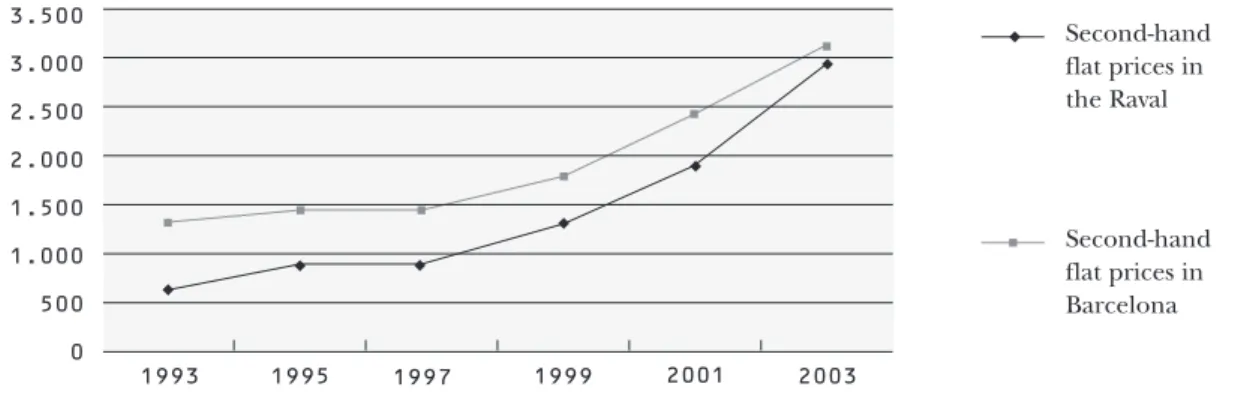
This negative differential in the case of renting a flat in the Raval does not apply in the case of homes for sale. In the market of flats for sale, there has been a significant increase in home prices and yet, according to the data available to us, the prices per m2are cheaper in
the Raval than in the city as a whole. If a Raval resident wishes to sell a second-hand flat, he or she might expect to receive more than three times as much now than eleven years ago (792 €/m2in 1992compared with 2,959€/m2in 2003). In the city as a whole the prices of
second-hand flats continue to be higher than those in the Raval, but the difference between them has been greatly reduced and the Barcelona prices did not undergo such a consider-able relative increase (the prices in Barcelona have gone up by about 25%, while in the Raval the increase is around 37%), as Graph 2shows.
Graph1/ Evolution of second-hand rent prices in Barcelona and the Raval (1998-2003)
1998 1999 2000 2001 2002 2003
Source: Department of Statistics, Barcelona City Council. Preus d’oferta dels habitatges de segona mà (Rent Prices) www.bcn.es/estadistica/catala/dades/timm/ipreus/h2mallo/merc0242.htm [Accessed November 2004]
Rent prices in the Raval
Rent prices in Barcelona
12.00
10.00
8.00
6.00
4.00
2.00
In the case of the market for newly constructed housing we only have figures from 1996onwards and, as may be seen, here too there has been an increase in prices, but not to the same extent as with second-hand flats. If we focus on the changes in the Raval we can see that despite some fluctuation the general tendency of prices is upwards, but not as much as the Barcelona figures (although according to these figures the Raval prices exceeded the city prices in 1996and 1997). The Raval is hence caught up in a consolidated tendency of price increases which, it is envisaged, will continue. This is a process that has not only affected this part of the city but has become general throughout Barcelona.
Shopping around. Given the scant reliability of data on changing prices, we undertook a small study in direct observation with five of the neighbourhood’s real-estate agents, which were mainly newly opened. From this sample of forty prices and surface areas of housing in different parts of the Raval, several significant points emerged (see table 5).
The average price is 201,889euros. The average surface area of the homes in the survey is 56.4m2,
which confirms that Raval flats are generally small. The average price per m2 is 3,853euros, while
the highest is 5,424euros for a flat on Paral·lel. The lowest price of 2,236is in Carrer Roig,
fol-lowed by a flat in Robadors at 2,287per m2. As we can see, the prices per m2vary considerably
with-in the Raval. The more expensive flats are to be found at the edge of the Raval or close to the mawith-in roads, while the cheaper flats are in the narrow streets, the so-called bad areas that are still to be rehabilitated.
Graph2/ Evolution of prices of second-hand homes in Barcelona and the Raval (1993-2003)
1993 1995 1997 1999 2001 2003
Source: Department of Statistics of the Barcelona City Council. Preus d’oferta dels habitatges de segona mà (Prices of second-hand homes)
www.bcn.es/estadistica/catala/dades/timm/ipreus/h2mave/merc0222.htm (Accessed November 2004)
Second-hand flat prices in the Raval
Second-hand flat prices in Barcelona
3.500
3.000
2.500
2.000
1.500
1.000
500
0
Average price 201,889
Average surface area 56,375
Average price m2 3,853
Highest price m2 5,424
Lowest price m2 2,236
Table5 / Prices of second-hand housing in the Raval (October 2004)
Social changes
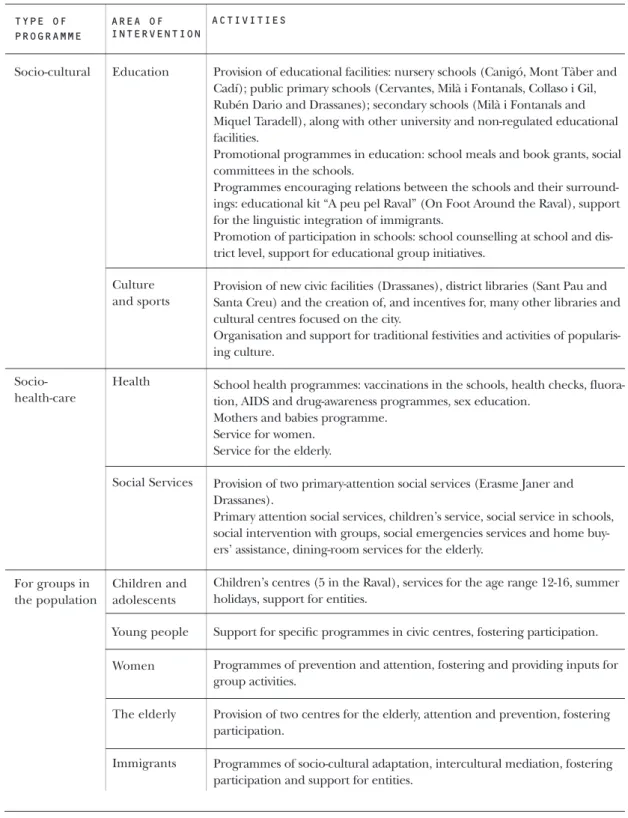
The policies of urban and cultural transformation have evolved in parallel with a sweeping programme of public-sector initiatives to attend to the social needs of the residents in the neighbourhood. The social policies for the Raval have been organised around three main areas of substantive action: socio-cultural programmes, socio-health-care programmes and pro-grammes aimed at specific groups within the population (Table 6).
Provision of educational facilities: nursery schools (Canigó, Mont Tàber and Cadí); public primary schools (Cervantes, Milà i Fontanals, Collaso i Gil, Rubén Dario and Drassanes); secondary schools (Milà i Fontanals and Miquel Taradell), along with other university and non-regulated educational facilities.
Promotional programmes in education: school meals and book grants, social committees in the schools.
Programmes encouraging relations between the schools and their surround-ings: educational kit “A peu pel Raval” (On Foot Around the Raval), support for the linguistic integration of immigrants.
Promotion of participation in schools: school counselling at school and dis-trict level, support for educational group initiatives.
Provision of new civic facilities (Drassanes), district libraries (Sant Pau and Santa Creu) and the creation of, and incentives for, many other libraries and cultural centres focused on the city.
Organisation and support for traditional festivities and activities of popularis-ing culture.
School health programmes: vaccinations in the schools, health checks, fluora-tion, AIDS and drug-awareness programmes, sex education.
Mothers and babies programme. Service for women.
Service for the elderly.
Provision of two primary-attention social services (Erasme Janer and Drassanes).
Primary attention social services, children’s service, social service in schools, social intervention with groups, social emergencies services and home buy-ers’ assistance, dining-room services for the elderly.
Children’s centres (5 in the Raval), services for the age range 12-16, summer holidays, support for entities.
Support for specific programmes in civic centres, fostering participation.
Programmes of prevention and attention, fostering and providing inputs for group activities.
Provision of two centres for the elderly, attention and prevention, fostering participation.
Programmes of socio-cultural adaptation, intercultural mediation, fostering participation and support for entities.
Socio-cultural Education
Socio-health-care
Health
For groups in the population Children and adolescents Young people Women The elderly Immigrants Culture and sports Social Services TYPE OF PROGRAMME AREA OF INTERVENTION ACTIVITIES Table6/ Social policy in the Raval (1980-2004)
As we have mentioned above, the Raval is a neighbourhood with serious social deficits and one that is also undergoing a process of constant transformations, some desired and oth-ers not. This is a key factor for undoth-erstanding the public-sector response (and its limitations) through social policies.
The synthetic indicator of social inequalities (ISDS) and the index of family economic capacity (ICEF) show that the Raval continues to be among the neighbourhoods with the worst conditions in all the city. Again, the ICEF shows that the differences in economic capacity between the different sectors of the Raval (where the north is better off and the south has more difficulties) still pertain and are even increasing. If to this situation we incorporate data of economic assistance offered by the Ciutat Vella social services (through the Inter-Departmental Programme of the Minimal Integration Income – PIRMI – and other economic assistance), we find that the Raval is the neighbourhood in the Ciutat Vella district that receives the most assistance (Graph 3). This is determined both by the greater number of residents in the Raval and by the sub-standard economic circumstances of some of the residents.
While only representing 7% of the city’s population, Ciutat Vella receives almost a third of all PIRMI assistance for Barcelona. Of this, the proportion going to Raval residents has been between 40% and 60%. If in the early 1990s the south Raval area received more than the north, the trend since the mid-1990s has levelled out. For example, in 2000 49.6% of PIRMI assistance went to the north and 50.4% to the south. However, it should be recalled that the population of the northern sector is greater than in the south (Graph 3).
Again, the other types of economic assistance offered by the Ciutat Vella social services mainly go to the Raval. This assistance is distributed among five territorial units, Barceloneta, Casc Antic, Gòtic, Raval North and Raval South (because of the high levels of demand the social services have divided the Raval into two administrative units), and a sixth non-territori-al category under the heading of Emergencies. In 2000the combined north and the south Raval zones received almost 40% of the total assistance, which would rise to 85% if we dis-counted the category of Emergencies.
In the cases of both Ciutat Vella as a whole and the two Raval zones, the main focus of this assistance is housing (once again taking the data of 2000as our basis). However, for Ciutat Vella in general, food costs were the second priority of this assistance, while in the north and south Raval zones the second position was occupied by health care. Dining-room and book Graph3/ PIRMI distribution in Ciutat Vella (2000)
Source : Serveis Personals (Personal Services), Barcelona City Council
Barceloneta Raval North Raval South Gòtic Casc Antic
350
300
250
200
150
100
50
0
87
245 249 247
grants are other benefits offered by the social services and are greatly in demand throughout Ciutat Vella. Different branches of the Administration work together in supplying these grants because a little over half of all the resources that go to cover this part of school expenses comes from the Department of Education, while the remaining costs are covered and managed by the Ciutat Vella District Administration. Almost half of the grants always go to the Raval, which is partly explained by the fact that it has the highest figures of registered population in all the Ciutat Vella zone (Graph 4).
Again, if we focus on the changes in the distribution of this benefit over the last ten school years, we can see that the number of grants to be distributed has risen, even though it is known that once the benefit is fully allocated there are still applicants who would be eligible but who do not receive it.
An Account of the tensions arisings over the distribution of resources. “The problem arises from the fact that demand has risen but the resources remain the same. On top of this, they say, ‘And you give it all to the Arabs’. Well yes, I say, because their situation is worse than yours so I make a list of the grants. For example, Ciutat Vella is the only place where they offer dining-room and book grants. There’s a lot of red tape with all the papers and documents they have to bring and then, of course, you have the list of who’s received the grant, and most of them ... well, of course, you’ve displaced the ones who were poor before but they haven’t stopped being poor. In other words, they’re telling us, ‘You’ve left us aside, and we’re from here,’ and this has a double sense. On the one hand, they are absolutely right but when you tell them why, you’re telling the truth, totally. ‘No, no, we’re giving it to them because they have even less than you,’ but it’s also true that people from here who had dining room and book grants before got them because they were on the list and they’d still be there except now they’re at the bottom of the receiving list. So, when you close the allocations, that’s where you’re left or, in other words, you’re reaching much less of the poor population.”
Interview with Irene Martínez, former head of Serveis Personals de Ciutat Vella (Ciutat Vella Personal Services), 4March 2004.
Despite the coming of a middle-class population (as we shall see below), the starting point for the Raval with the arrival of an immigrant population in very difficult economic cir-cumstances has meant that the problems of social exclusion and poverty not only
contin-Raval Gòtic Casc Antic Barceloneta Outside the district
Graph4/ Changes in the distribution of dining-room grants in Ciutat Vella (1993-2004)
1993 / 1994 1997 / 1998 2003 / 2004
Source: “Acció educativa a Ciutat Vella” (Educational Action in Ciutat Vella), in Barcelona societat, no. 9, Departament d’Educació i Districte de Ciutat Vella.
600
500
400
300
200
100
0
430
518
178213
115 75
540
149201
129 140
138 184
ue, but are also aggravated, especially in certain zones. Yet other indicators such as high-er education, unemployment and socio-professional ranking tend to present a brighthigh-er picture.
For example, in the case of educational statistics for the residents, even though the Raval figures remain below those given for the city as a whole at all educational levels, the propor-tion of members of the populapropor-tion who have received some educapropor-tion has been rising con-tinuously. The figures for people with secondary education, diplomas, university degrees and doctorates have risen. The population that has completed studies in this range of education has notably increased in the Raval, going from 4.32% in 1981to 12.18% in 2001. However, the fact is that today, like twenty years ago, most of these people live in the area delimited by Tallers-Pelai, Acadèmia Ciències and Casa de Caritat, or the north-east sector of the Raval, but it is also true that the number of inhabitants with a university degree has risen in each and every zone of the Raval covered in our research (Graph 5).
With regard to unemployment, even though between 1986and 2001the figures were always higher for the Raval than for Barcelona in general, they were also reduced by over half (from 37.58% in 1986to 15.88% in 2001). Between 1986and 1996the proportion of working-age population was less in the Raval than in the city, so the high rate of unemployed people in a smaller working-age population is conspicuous. However, in 2001, with the coming of a younger population to the Raval, the proportions evened out and the drop in unemployment, togeth-er with an increase in the employed population, is still more positive. All the zones have benefited with this drop in unemployment but, once again, the zones of the north-eastern sec-tor of the Raval (Tallers-Pelai, Acadèmia Ciències and Casa de Caritat) were the most favoured with the lowest unemployment figures in 2001.
This period also presents significant changes in the socio-professional status of the Raval residents (Table 7). While it is true that the category of low-level socio-profession-al status is still clearly the majority group, the reduction in its numbers at the end of the 1980s is quite clear, and this drop is enhanced by the considerable growth of the catego-ry of high-level socio-economic status (directors, technical experts, educators, scientists and intellectuals), this being just one more indicator of the growing diversity of the neigh-bourhood, which is now coming a little closer to the mean socio-professional composition of the city (Table 8).
1981 1986 1991 1996 2001
Graph5/ Evolution of the population with higher education in the Raval and Barcelona (1981-2001)
% people with higher education
in the Raval % people with higher educationin Barcelona
Source: doctoral thesis by Sergi Martínez, “El retorn al centre de la ciutat” (The Return to the City Centre, 2000), Register of inhabitants 1981, 1986-1991-1996 and the 2001 Census
25.00
20.00
15.00
10.00
5.00
0.00
4.32
10.9211.76
14.0315.74
21.15
4.03 4.57 6.93
SOCIO-PROFESSIONAL CATEGORY 1978 1986 2001
High-level category 1,221 678 2,402
% high-level category 3.79% 4.19% 16.16%
Medium-level category 6,985 1,027 2,827
% medium-level category 21.70% 6.35% 19.02%
Low-level category 23,069 14,178 9,612
% low-level category 71.68% 87.69% 64.86%
Artists and Armed Forces* 907 286 20
% artists and Armed Forces 2.82% 1.77% 0.13%
Total 32,182 16,169 14,861
% total 100.00% 100.00% 100.00%
Table7/ Socio-professional categories in the Raval according to census data
Source: doctoral thesis by Sergi Martínez, “El retorn al centre de la ciutat” (The Return to the City Centre,
2000) and the 2001 Census.
* Until 1996 there was a category that grouped Armed Forces and artists (sic) under a single heading, but the 2001 data only take into account Armed Forces professionals
RAVAL BARCELONA
High-level Category 16.16% 29.06%
Medium-level Category 19.02% 29.85%
Low-level Category 64.86% 41.09%
Table8/ Comparison of socio-professional categories between the Raval and Barcelona (2001)
Source: 2001 Census
3.The study was carried out by the architects Lluís Clotet, Òscar Tusquets and Francesc Bassó. The resulting plan came to be known as the “Del Liceu al Seminari” (From the Liceu to the Seminary) project. The aim of the study was to “evaluate the possibilities of creating a series of links, an itinerary with the historic legacy of the Raval while also assess-ing the architectural possibilities of a cultural reutilisation of spaces that, as former Church property, had been used for hospitals or hospices and that were now in semi-disuse.”
Cultural intervention
Plan gave new impetus to the project of the symbolic transformation of the Raval, which was already envisaged in the study, entitled “Del Liceu al Seminary” (From the Liceu to the Seminary). The Raval, along with the Montjuïc, Gòtic, Ribera and Ciutadella neighbourhoods, was then seen as one of the areas in which it was planned to reinforce cultural and museum infrastructure. In July 1987, confirming these plans, Barcelona City Council decided to con-struct a new building alongside the old Casa de Caritat to house the Museu d’Art Contemporani de Barcelona (Contemporary Art Museum of Barcelona – MACBA).4In the space occupied
by the Casa de Caritat, another new key facility for the city was created in 1994: the Centre of Contemporary Culture of Barcelona. Next-door to that came the Centre d’Estudis i Recursos Culturals (Centre of Cultural Studies and Resources – CERC), the same year. Moreover, as we have noted above, the new Geography and History Faculty of the University of Barcelona is almost completed now, to which can be added the Journalism Faculty of the Ramon Llull University. Around the Plaça dels Àngels other facilities of similar characteristics have also been installed, notably the Centre d’Informació i Documentació Internacional a Barcelona (Barcelona Centre for International Information and Documentation – CIDOB) and the prem-ises of the Foment de les Arts Decoratives (Decorative Arts Association – FAD).
Barcelona City Council thus decided to create on a large scale a number of cultural facil-ities that were to fulfil two functions: first, they were to provide new cultural services to the city as a whole and, second, they were to boost the strategy for regenerating the Raval neigh-bourhood. With the second aim, the policies for remodelling the neighbourhood were not unlike those adopted in other neighbourhoods that were considered as problem areas in other parts of Europe and the United States, where culture and art have modified the dynam-ics and processes of urban degradation.
Nonetheless, the installation of large-scale cultural facilities in the neighbourhood has given rise to significant disagreement between part of the residents’ movement and the insti-tutions concerned. Some critics have complained that installing these kinds of cultural facil-ities has a high opportunity cost because the authorfacil-ities have opted for a type of infrastruc-ture that is not directly beneficial for the local residents. It is also thought that these kinds of facilities have contributed in part to the rise in housing prices in the neighbourhood and hence may have contributed towards an indirect expulsion effect with some sectors of the popula-tion that were paying lower rent (gentrificapopula-tion). Again, it is also argued that their locapopula-tion, more or less at the periphery of the neighbourhood, has meant that the attraction effect of bringing in new users has not come about in the neighbourhood as a whole, as many people expected. Those in favour of the new facilities argue, in contrast, that these kinds of facilities have contributed towards the symbolic transformation of the neighbourhood. Thanks to them, they contend, the Raval neighbourhood has ceased to be seen as a decrepit and poverty-stricken place to become what is regarded as one of the most culturally dynamic spaces of the city. As a result the Raval has attracted new commercial activities like those mentioned above, which have turned the neighbourood into one of the most attractive zones of the city for young and go-ahead segments of the population. These facilities have also helped to regen-erate the economic fabric of the area, in particular with the installation of new art workshops and galleries. Finally, the neighbourhood has an enhanced appeal as a place of residence for new social groups, especially young people in the medium- and high-level income groups.
Whatever the case, what is not in doubt is the transformation effect wrought in the Raval by these new cultural facilities and the activities they generate (see below for the section in which we enlarge on this). The cultural policies in the neighbourhood have been acquiring their own significance beyond the general urban planning policies to the extent that they have been able to give content to the new facilities and to define their basic kinds of activity. However, whether these activities are the most appropriate in strictly neighbourhood terms is open to debate, but that is another matter.
From bottom to top, or the unforeseen changes: immigration
At the edges of this project, global dynamics and the great migratory movements of the end of the last century have meant that the Raval would go back to its traditional and recidivist con-dition as a neighbourhood of refuge for people with very few resources who come to the city seeking work and a future. This is a bottom-to-top process, which in practice has been much more far-reaching in its effects than the last time it occurred, but this time nobody imagined it would happen as it did.
The data on the Raval show that, traditionally, the numbers of people who leave the neigh-bourhood are higher than those for other parts of the city. Indeed, in recent years this ten-dency has been reinforced with a rise in the numbers of residents who have left – a trend shared with other zones appearing in the Ciutat Vella statistics, like the Gòtic (Gothic Quarter). They are even higher than the figures registered in the middle of the process of renovation, in the early- and mid-1990s.
What was not so usual in recent years was the great growth in population, which was reg-istered in the Raval not long ago, both if we look at the Municipal Register or if we take into account the numbers by default.5Hence, while in 1991the figure for newcomers to the
Raval population was around 14.9people for every thousand residents, in 2002it went up to 202.8. The number of newcomers to Barcelona as a result of immigration has risen consider-ably too, but not to the same degree (Table 9).
In 2002, 2,172residents registered in the Raval – most of them in the northern sector – left the neighbourhood. A little over half (51.15%) of those who left are Spanish citizens. The oth-er half consists of residents of othoth-er nationalities (Pakistanis, Ecuadorians and Moroccans). These figures are in line with the composition by nationality of the Raval residents, among whom the majority is Spanish. In 2004the most represented foreign nationalities in the neigh-bourhood were Pakistani, Filipino, Moroccan and Ecuadorian, precisely those who also
account-5.The figure for registrations by default takes in the new Municipal Registers, which are produced according to two different criteria: either people have not registered even though they might have been living in the city for some time, or they have not renewed their registration; or they are foreigners who have registered in the city for the first time without coming from any other part of Spain.
1991 1996 2002
Emigr. Immigr. Emigr. Immigr. Emigr. Immigr.
Raval 13.2 † 14.9 † 25.0 † 55.2 † 53.0 † 202.8 †
Barcelona 12.7 † 9.4 † 21.4 † 25.2 † 34.3 † 64.2 †
Table9/ Evolution of emigration and immigration figures in Barcelona and the Raval (1991-2002)
ed for the highest figures among people leaving the Raval. The group that we shall call “res-ident guiris”,6which by 2004represented a proportion among the residents that was even
high-er than for othhigh-er groups, has greathigh-er numbhigh-ers moving into the Raval than leaving it.
With regard to the figures for immigrants in the Raval, the numbers of people coming in are much higher than those for people leaving. Again, the majority of people moving in come to the northern sector. In this case it is noteworthy that the most well-represented immigrant nationality in the Raval in 2002was Pakistani (28.41%), after which came Spanish (12.28%) and Ecuadorian (11.22%). The Raval, then, continued to be the area that took in most of the immigrant population coming to Barcelona. While years ago the immigrant pop-ulation came from elsewhere in Spain, there has been an extraordinary increase in recent decades in the figures for new residents from outside Spain (Table 10).
If it was not until the beginning of the twenty-first century that the number of foreign resi-dents came to represent a significant part of the citizens of Barcelona as a whole, this fact was noticeable in the Raval well beforehand. Since the 1990s the Raval and Ciutat Vella have concentrated a higher proportion of residents of foreign origin than the rest of the city, so that they represented 48.8% of the Raval residents in 2004. It is in this sense that we might say (and we shall return to this below) that the neighbourhood can be understood both as a problem or as something to watch, and as a precedent or mirror in which the rest of the city should see itself.
RAVAL SOUTH RAVAL NORTH RAVAL PROPORTION OF IMMIGRANTS BY NATIONALITY
Spain 407 613 1,020 12.28 %
Resident guiris 290 546 836 10.06 %
Rest of Europe 68 158 226 2.72 %
Pakistan 989 1,371 2,360 28.41 %
Philippines 113 619 732 8.81 %
Rest of Asia 242 304 546 6.57 %
Morocco 209 386 595 7.15 %
Rest of Africa 73 106 179 2.15 %
Ecuador 237 695 932 11.22 %
Rest of America 337 543 880 10.59 %
Stateless / not stated 1 1 2 0.02 %
Total immigrants 2,966 5,342 8,308 100.00 %
% south/north in Raval as a whole 37.85% 64.30 % 100.00 %
Table10/ Nationalities of immigrants to the north and south sectors of the Raval (2002)
Source: the authors, on the basis of data from the Department of Statistics, Barcelona City Council (2002)
The increase in the numbers of foreign residents has been spectacular, and the Raval today is inseparable from an image of ethnic diversity. People of more than seventy nationalities live there. The most numerous are Pakistanis (10.34%), Filipinos (8,08%), Moroccans (5.40%) and Ecuadorians (5.40%).
With the newcomers the Raval has recovered many living spaces that had been left aside in previous years, and situations that appeared to have been definitively left behind after the years of high-density population in the neighbourhood in the 1950s and 1960s have now arisen again. Hence, previously abandoned or rejected sub-standard housing has reappeared on the market with people being packed into these dwellings so that former population den-sities have returned with the recent big waves of immigration. This time the immigrants come from all kinds of origins, and are of all colours, languages and religions. The new resi-dents fill up the spaces that have not been transformed and stop or slow the incorporation of private capital into the dynamics of change because of the questions raised by this sudden and unanticipated change. Some observers suggest that there is a danger that the Raval will close in on itself and that it will generate borders between the neighbourhood and its sur-roundings, becoming a ghetto and reinforcing its status of exclusion and stigmatisation (an example would be the French HLM, or social housing districts).
The other newcomers
Along with the process of renovation and the phenomenon of immigration, there is another factor, which although it may be less visible, is equally significant. We refer to other new inhabitants in the neighbourhood who, because of their characteristics, we might classify in a number of ways according to specific features, but the point is that they are clearly differ-ent from original inhabitants and immigrants alike. Hence, we speak of modern people, artists, professionals, Erasmus scholarship students and alternative people.
These people come from different origins (many are foreign), occupy very different spaces, generate different dynamics from those of the traditional residents and contribute ways of doing things, use references, have discourses and even cognitive frameworks that situate them in their own particular position with regard to the issues at stake in the aforementioned process-es of change in the Raval. Frequently their opinions and their actions prompt, or help to legitimise or illegitimise, the changes and alternatives that are appearing in the neighbour-hood. We might say that if we look back we could regard their presence as positive in that it has avoided a strict bipolarity between the economic and cultural transformation and the immi-gration-related transformation that could have appeared and become aggravated in recent years. It is also true that if their presence had been greater, they might have brought about the theme-park style of scenario that is well-known in other places (the SoHo distict of New York, and the Barcelona Ribera neighbourhood, for example).
Hence the changes in some of the socio-economic data for the Raval, such as the socio-pro-fessional standing of the residents or their educational level, indicate that most of the new residents who have registered (we estimate some 80% of the newcomers) are of Spanish cit-izenship and middle-class. As for the people leaving the neighbourhood, it seems that they can be evenly divided between the traditional Raval residents and middle-class residents.
the reforms well advanced and after a rise in housing costs thanks to that (and also a change in the Raval’s image outside the neighbourhood), this is no longer the only explanation for the arrival of a certain type of foreigner who comes to live there. Some, we would include among the resident guiris. Even though these residents are legally foreigners, in the eyes of the collec-tive imaginary they do not coincide with the characteristics of the usual kind of immigrant.
This conglomerate of residents from the richer countries is one of the fastest-growing in the Raval. Hence, if in 2001they represented about 2.70% of the Raval residents, the figure has doubled in three years and they are now ahead of other collectives (Table 11).
Cool people, trendies, trendy lefties, modish people, the smart set, gentrifiers … The fact that there are several different labels for pigeonholing these people shows that no one is very clear about what kind of group this is or if one can really talk of a group rather than individuals who differ considerably from each other. One of the main principles of the transformation in the neighbourhood was to facilitate the coming of middle-class people into the area. But what is appealing about the Raval for these sectors? Some factors are more evident than others and each one clearly has advantages and disadvantages (see the summary of this in Table 12).
How should we characterise these newcomers? If we had to produce a sociological por-trait we could say that they tend to have completed higher education (more in the field of the Arts than Sciences), that they tend not to occupy dominant or privileged positions with-in the with-intellectual professions, that they are not buswith-inesspeople and nor do they occupy significant decision-making positions. They are therefore people who are a little on the fringes of the usual economic activities. They may be divided into those with stable jobs (working in the Administration or for some institution) and those without stable work (in situations of waiting for opportunities), while others somehow prolong their student existence by taking on small jobs or leading a double life (some practical job linked with a specific ability) that enables them to go ahead with their artistic or intellectual trajectory.
POP. % OF TOTAL POP. % OF TOTAL
RAVAL 2001 POP RAVAL 2004 POP
Spain 26,956 74.47 % 20,978 51.19 %
Resident guiris 980 2.71 % 2,295 5.60 %
Pakistan* 1,998 5.52 % 4,237 10.34 %
Philippines 1,916 5.29 % 3,309 8.08 %
Morocco 1,234 3.41 % 2,211 5.40 %
Ecuador 929 2.57 % 2,211 5.40 %
Dominican Rep. 389 1.07 % 708 1.73 %
Other countries 1,794 4.95 % 5,024 12.26 %
TOTAL 36,196 100.00 % 40,973 100.00 %
Table11/ Social composition of the Raval (2001 and 2004)
Source: the authors, on the basis of data from the Department of Statistics, Barcelona City Council, 2004
ADVANTAGES
1. Rental market Cheaper and more abundant flats considerable renovation
2. Buying price Lower prices and smaller flats Repairs needed in flats and buildings
3. Types of flats Old flats with decorative elements of “recoverable value”
Need for work and regulation of major work
4. Neighbours Socially and ethnically diverse atmosphere Possible conflicts over uses and coexistence
5. Situation Historically central At some distance from the economic and
commercial centre
6. Connections Well-connected by metro and train, appro-priate for bicycle and walking
Vehicular transport is not easy: bus or car
7. Facilities Good cultural offer, public facilities and markets
Public services are saturated and there are few large open spaces
8. Social composition Multicultural coexistence, otherness Saturation of public spaces, perception of insecurity
9. Social image Lively, cool, creative neighbourhood Stigma of deviation from the norm and social exclusion
DISADVANTAGES
Table12/ Advantages and disadvantages of living in the Raval for middle-class residents
Source: compiled by the authors
This situation means that income in this social stratum tends to be discontinuous and uneven. They are not characterised, therefore, either by a particular social origin or by common ele-ments in their social and biographical trajectories. Hence we cannot overlook the fact that even though they belong to a certain kind of middle class, there are significant differences among them in terms of their access to property, family stability, age and their main reasons for coming to live in the Raval.
Beyond the differences we can identify within this new middle class in the Raval, there is a certain community of concerns. Going to live in the Raval is, to some extent, seeking a lifestyle that differs from that in other areas of middle-class residence. Living in the Raval, and to some extent anywhere in Ciutat Vella, usually means distancing oneself from the family (which tends to live outside the former walled city or in the peripheral zones) and also distancing one-self socially from both the upper classes (who reside in the north of the city) and from the working-class districts of the periphery. In any case, remaining in the neighbourhood is anoth-er question. One quite widespread view is that “you can’t have children in the Raval.”
when we come in at a certain age we end up leaving and this appears to be a serious problem for all the Raval, even though as far as schooling is concerned it is very good, they tell me, but the ques-tion is how to get to the school and what the kids do after school.
New residents’ discussion group, 20October 2004.
Another reason for living in the Raval is the contradictory perception of being somewhere between the anonymity offered by a big city and, simultaneously, its feeling as a neighbour-hood, a closed space where unlike other more impersonal zones of the city, the Eixample for example, a resident can identify with the area and feel at home.
And when I came here I took a room in Escudellers while I looked for a flat and what I liked, if not in the Raval, in Ciutat Vella, was something I didn’t have in Mataró, which is anonymity. But this is an anonymity that is different from what you have in the United States, which is one where you feel that you don’t matter to anybody. Here I found a kind of anonymity in which you feel welcome. You don’t have this sense of everyone just doing his or her own thing. Or at least in Nou de la Rambla my opinion has been reinforced: in the Raval you can be anonymous but without being totally alone in the world.
New residents’ discussion group, 20October 2004.
The choice of the Raval is often attributed to a question of chance or the fortuitous find of an appropriate and accessible place to live. But neither of these two factors is sufficient to explain the concentration of lifestyles and ways of being that we noted above. What is true is that choosing a low-rent and central zone has the twofold advantage for intellectuals of uncertain income or for artists, which is that they can continue as they are or keep studying while they work, something that high rents and mortgages would not permit.
Finally, it should be remarked that these new residents generally support the desire to bring about reforms to improve the neighbourhood as long as it keeps its character. They are gift-ed in cultural capital and hence with intellectual tools and abilities for working with symbol-ic questions. Neither should we overlook the fact that many of them are engaged in profes-sions that are related with the image or communication. They therefore have the ability to reverse the stigma and turn the neighbourhood into a place that is different, diverting, chic, cool, and so on. The work of evaluating the neighbourhood would thus be a collective sym-bolic task for this segment of the population, as can be seen in the numerous cultural pro-ductions about the zone.
The gay community. Among the collectives or communities attracted by this type of neighbourhood are gays and lesbians. One need not think of the Marais, which is known all over the world as a destina-tion of pink tourism. The case of the Raval, however, is not as clear as that of its Parisian counterpart. In the south of the neighbourhood, in the Xino, was one of the well-known homosexual meeting places of the city, which Jean Genet starkly describes in The Thief’s Journal. Despite the repression of the Franco dictatorship and the degradation of the area today, some of these bars and clubs still endure, for example La Concha and the Cangrejo en Carrer de Guàrdia. Moreover, if in the 1970s it seemed
fea-ture in the pages of Lonely Planet and Time Out and are full of tourists. Again, the underground bar La bata de boatiné, which is in the now-mythical street of Robadors, has been recommended by a maga-zine such as Cosmopolitan (October 2004). However, gay and lesbian businesses are more or less
centrated in the blocks known as the “Gayxample” (in the Eixample neighbourhood). The Raval con-tinues to be the neighbourhood of the poorer homosexuals and, since the 1970s, those who are most
The fact is that now (2005) we have many Ravals taking shape and overlapping. It is not pos-sible to say with any precision that it might be leaning to any one of the hypotheses we have discussed or any other that we might add. If we look at what happens in certain streets, squares and neighbourhood axes, or at what goes on in other parts of the area, we will end up with different signs and signals. The picture is complex because the reality of the Raval is com-plex. There are market dynamics (trends of buying and selling of business premises and housing, which are not yet clear) of marked ethnic and social homogeneity in some enclaves, along with very intense and tense mixtures, with potent manifestations of high culture in cer-tain zones, night-time leisure zones and a notable presence of restaurants and bars, emerg-ing cultural experiences without, however, a very significant presence of tourists (which is much more evident in other parts of the city). The Raval now has a present that is obviously better than it had in the 1970s, but it is also accumulating a lot of uncertainties that it did not have then.
The socially mixed Raval
Its complexity in Figures
In order to discover how many Ravals there are in the Raval one would need to do a break-down of the data that cover the neighbourhood as a whole. We can do this on the basis of the thirteen zones of small-scale research that are used by the municipal administration for sta-tistical highlighting.
The picture that has been taking shape in the northern part of the Raval, the part with the most positive indicators or that is closest to a more well-to-do situation, corresponds to the north-eastern sector of the Raval (Casa Caritat, Acadèmia Ciències and Tallers-Pelai). A quick glance at the social indicators shows that this part of the Raval has the highest levels of income. Furthermore, it is in this zone that one of the central projects of PERI was carried out, a com-plex that includes the MACBA, the CCCB and the future Geography and History Faculty of the University of Barcelona, which means that more members of the public now frequent this zone. As we have noted in the section on economic changes and new uses, a good part of the new businesses (restaurants, fashion shops, art galleries) have concentrated in this part of the Raval and are geared to a type of consumer with high acquisitive power.
The north-western sector of the Raval (Riera Alta, la Cera and Riera Baixa) is one of its most populated areas and it has one of the highest proportions of foreigners among its residents, in particular Filipinos (in 2001, more than 60% of the Filipino population of Barcelona lived in this area), but there are also Pakistanis, Moroccans and Ecuadorians. This is a sector of consid-erable migratory movement, except for Carrer Riera Alta because the Filipino community is very well established here. In this north-western sector there are also quite a lot of design and archi-tecture studios (many in Carrer Ferlandina). Modern restaurants are now being opened and there is a micro-zone in Carrer Riera Baixa of shops selling second-hand and vintage clothing. There is also what we would call a transitional zone, which we would locate between the Boquería market and the Plaça de Sant Agustí. This space is moving along the same lines as the north-eastern sector, at least with regard to the predominant tendency of the new shops and restaurants that are being opened, apart from the normal functioning of the market, which is the focus of attention for tourists and other regular shoppers. There is no doubt that this zone will be boosted with the future projects that are planned around it, for exam-ple the Robadors block project and the Filmoteca cinema and, in particular, the future underground car park in the Plaça de Gardunya and the new connection between the Boquería and the Antic Hospital de la Santa Creu, which is presently the headquarters of the Library of Catalonia and other cultural institutions.
The southern sector of the Raval, the Xino heartland, seems to be quite homogenous, with a significant presence of foreigners among its residents. In fact, the southern part is con-siderably more heterogeneous than it appears and we have, for example, the Drassanes zone that is very different from the cliché that associates the south Raval area with immigrants. Indeed, the demographic and socio-economic indicators for Drassanes suggest an area that is better-off than others in the neighbourhood, although it does not appear to be very active with regard to new businesses and other economic activities.
The zone that would evoke what we might call the Xino myth is the zone around the Liceu, which, despite the presence of the opera house that is so closely linked with the city’s elites, has the highest unemployment rates in the Raval, while in the 1990s its population also had the lowest incomes (according to ICEF [Index of Family Economic Capacity] data). It is also the zone that includes Carrer Sant Ramon and the Plaça Pieyre de Mandiargues, a nucleus of pros-titution that is still relatively active today. The renovation of the Robadors zone and the installa-tion of the Filmoteca are projects that aim to change precisely this situainstalla-tion.
The zone comprised by Palau Güell-Carrer Nou de la Rambla would be a robot portrait of the Raval with regard to the indicators since all of them, both socio-economic and demograph-ic, are always close to the average figures for the neighbourhood as a whole. This zone is notable because it is the one that takes us back to the history of the Xino canaille, the continuity of the Raval as one of the places of diversion for the rest of Barcelona. Even today, many of the nightlife spots of the neighbourhood, some of them almost legendary and the most visited in the city, especially in the early-morning hours, are to be found between Nou de la Rambla and Arc del Teatre.
societies and their premises, which recalls a tradition that was very widespread in the Raval in the past, revealing, therefore, a continuing presence of lifelong residents.
Except for Drassanes, it cannot be said that there is any part of the Raval that is not high-ly populated. All its areas have a higher population density than the rest of the city, in partic-ular the north-western zones (Riera Baixa, la Cera and Riera Alta). Nonetheless, the resi-dents of foreign origin are fairly well distributed throughout the Raval. What is to be highlighted, in fact, is that no part of the Raval has a lower percentage of foreign residents than in Barcelona as a whole. The zones that are above the mean figures for the Raval are some in the south, like Folch i Torres and Palau Güell, and others in the north-west like Riera Alta and la Cera. The distribution of the population by age explains the different death rates in the zones under consideration and also explains why the birth rates are higher where there are greater con-centrations of foreign residents because of the evident factor of population rejuvenation that their arrival has meant for the neighbourhood. Even so, in some areas like Riera Alta the birth rate is quite high and well above the Raval rates for children of Spanish parents. Arrivals and departures in the different Ravals do not reveal much difference between the different zones although, logically, fewer immigrants come to areas where housing prices are higher. Other less expensive zones have higher resident registration rates, as in the cases of la Cera or Riera Baixa in the north-east, or Plaça Folch i Torres in the south-west (one of the areas of the Raval that is most removed from the urban renovation projects) (see Table 13).
In the social indicators there are strong correlations between the trends indicated by the ICEF (Index of Family and Economic Capacity) and other indicators. Hence, apart from ICEF data,
Drassanes 1,240 14.3% 25.1% 18.6† 8.9† 81.8% 66.9† 121.8†
Palau Güell 4,179 26.6% 22.3% 13.4† 11.5† 52.1% 54.6† 204.4†
Liceu 1,721 20.3% 25.4% 12.8† 8.7† 60.0% 51.1† 216.2†
Sant Pau Camp 1,341 19.0% 28.0% 20.1† 9.7† 84.6% 43.3† 158.1†
Pl. Folch i Torres 4,023 30.1% 17.5% 9.7† 12.4† 58.0% 64.6† 248.3 †
Sant Agustí 1,840 26.4% 25.4% 14.7† 6.0† 72.7% 57.1† 205.4†
M. Boqueria 1,262 23.5% 27.6% 9.5 † 10.3‰ 38.5% 49.1† 216.3†
Riera Baixa 3,902 24.8% 21.5% 11.5† 5.6 † 59.1% 61.0† 245.3†
La Cera 5,874 29.3% 20.7% 11.4† 9.5 † 46.3% 58.2† 262.5†
Riera Alta 10,437 29.1% 22.1% 11.2† 12.5† 43.1% 46.0† 181.6†
Casa de Caritat 1,775 20.5% 28.4% 14.7† 9.0 † 37.5% 42.3† 148.7†
Ac. Ciències 2,603 14.4% 28.0% 14.6† 6.5 † 76.5% 43.4† 103.3†
Tallers-Pelai 771 18.4% 21.5% 11.7† 10.4† 100.0% 51.9† 184.2†
Raval 40,968 25.5% 22.8% 12.4† 10.0‰ 53.2% 53.0† 202.8†
BCN 1,527,190 6.3% 21.7% 10.1‰ 85.0‰ 80.2% 34.3† 64.2†
Table13/ Details and summary of some demographic figures in the research areas of the Raval
Source: compiled by the authors using data from the Department of Statistics, Barcelona City Council
%FOREIGN. POP. DEATH BIRTH % BIRTH TASA TASA
POPULATION POP. + 65 RATES RATES SPANISH EMIGR. IMMIGR.