
A "latinamericanization" of Southern Europe? : Anti neoliberal populisms in comparative perspective
661
0
0
Texto completo
(2) ACKNOWLEDGMENTS. [Please, let me use, in this opening section, different languages (my poor English, my slightly better Spanish, and my hopefully decent Italian). I just want to speak to different people through the language (the ‘code’) that we are used to employ to talk to each other. I am aware that perhaps this is not a proper decision, and I apologize for that. I just want to thank all of you as clearly as possible].. Scorrendo i ringraziamenti di diverse tesi di dottorato, magari poi divenute libri, ho letto svariate volte la frase ‘this was not a solitary enterprise’. Questa tesi, al contrario, è davvero frutto di una solitary enterprise. Ovviamente, non nel senso che quanto scritto in queste pagine sia esclusivamente farina del mio sacco, quando invece (e lo specificherò fra non molto) è frutto di un lunghissimo processo di confronto e di dibattito con moltissimi docenti, colleghi ed amici, i quali mi hanno aiutato a migliorarne il contenuto (ovviamente, valga il caveat “gli errori e le mancanze sono miei”). Si è trattata però di una solitary enterprise nel senso che la ricerca, l’elaborazione, la riflessione e la scrittura sono avvenute in gran parte in solitudine, in primo luogo fisica; a volte, negli inevitabili momenti critici, persino morale, benché sempre prontamente superata grazie al sostegno di tutti voi. Un’esperienza a tratti alienante, che ha reso spesso più faticosa quest’impresa, ma che mi ha sicuramente fortificato. Si è trattato di una navigazione in solitaria che si è rivelata persino piacevole, considerata l’enorme libertà di organizzazione del lavoro di cui ho potuto godere, e che mi ha regalato innumerevoli giornate in cui, per molte, molte ore, il computer con cui sto scrivendo è stato il mio unico compagno di viaggio. Una tesi di dottorato significa anche questo. Ciò premesso: non avrei mai potuto portare a compimento questa tesi senza l’aiuto ed il supporto di moltissime persone, che in molti casi non conoscevo sino a quasi cinque anni fa. Mi si lasci utilizzare, in questi ringraziamenti, la lingua (il ii.
(3) “codice”) con cui ho intrattenuto rapporti con queste persone speciali, ben conscio del fatto che tale scelta rappresenta una deviazione rispetto allo “standard” in uso nell’ambiente accademico. Ci sarà modo, mi auguro, in futuro, di far rientrare questa sezione della tesi nei canoni tradizionali. Oggi, però, è il momento di rivolgermi direttamente a queste persone, nella maniera in cui siamo abituati a dialogare. Mamma e papà, siete stati preziosi alleati e sostenitori, magari nascondendo le vostre perplessità circa la mia scelta di lasciare l’anelato “posto fisso” e di intraprendere questo percorso di dottorato. Spero di rendervi oggi un pochino orgogliosi. Filippo e Francesca, vi ho sempre sentiti vicinissimi anche da lontano. Anna, ed ora Riccardo, mi avete dato la gioia necessaria per tenere duro. Grazie a tutti voi. E grazie pure a Nonna, maestra di passione politica. Amiche ed amici più stretti, compagni della Mastenada, teatranti della Compagnia, vi devo moltissimo. Soprattutto per avermi insegnato cosa vuol dire far parte di un gruppo, rimanere coi piedi per terra e legati alle proprie radici, e per avermi sempre dispensato pacche sulle spalle e parole di incoraggiamento nei momenti più difficili. Ma anche per avermi stimolato un sacco di riflessioni che hanno guidato questo lavoro, in misura non inferiore rispetto a quanto appreso in (spesso aride) discettazioni accademiche. Non so se davvero desidero ringraziare i colleghi e le colleghe, gli amici e le amiche, che ho incrociato durante la mia precedente esperienza lavorativa. In fin dei conti, è soprattutto per colpa vostra, voi che avete reso molto più gradevole quell’esperienza, se ho ritardato tanto l’inizio dell’avventura accademica. Un abbraccio alle compagne ed ai compagni di Senso Comune, un’avventura politica alle prime armi che mi sta insegnando davvero tanto. Molte delle riflessioni contenute in questo lavoro sono state ispirate e sono emerse da questo fantastico progetto comune (e comunardo). Grazie per avermi dato una casa politica. Un abbraccio particolarmente stretto va ad alcuni amici e compagni, a volte colleghi: Raffaele Bazurli, Marcello Gisondi, Samuele Mazzolini, Paolo Gerbaudo, Tommaso Nencioni, Stefano Poggi, Stefano Bartolini, Michelangela Di Giacomo, Marco Adorni e Dodo Nicolai. iii.
(4) Gracias a los compas del doctorado UC. Gente brillante; ha sido un honor y un gustazo compartir tanto tiempo con ustedes. Aprendí mucho más de lo que pude aportar. Creo que lo pasamos muy bien, y les tengo mucho cariño. Un abrazo especial va a Rodrigo Espinoza, quién además es colocolino; a José Lugo, con quién compartí piso, chelas, y días enteros de debates sin comienzo y sin fin, muy buen gimnasio para aprender a argumentar; a María Cristina Escudero, porque siempre me caíste bien; a Anita Perricone, porque el cariño que se reserva a los italianos que encuentras por el camino es muy difícil de explicar; a María Marta Maroto, quién es demasiado argentina por no ser citada acá; y a todos los demás compañeros, colegas y docentes con quienes compartí cervezas y partidos de fútbol. Gracias a todas y todos las y los profesores del Instituto de Ciencia Política de la Pontificia Universidad Católica de Chile. Estaba acostumbrado a otro tipo de relación con los docentes. Debo decir que no hay comparación con cualquier otro lugar en que he estado. Siempre me alentaron, sostuvieron y aconsejaron. Creo que he podido establecer relaciones muy lindas con todas y todos ustedes. Y eso se valora mucho, sin olvidar la brillantez de los cerebros que trabajan por ahí y la calidad de los cursos que tomé, que me hicieron enamorar de cualquier subdisciplina que he podido profundizar. Gracias a las y los amigos y docentes que han facilitado mi trabajo de campo en Bolivia y Argentina, sin duda el periodo más entusiasmante y divertido de mi experiencia doctoral. He encontrado profesoras y profesores destacadísimos y muy disponibles. Gracias en particular a Moira Zuazo, Marité Zegada, Fernando Mayorga, y Sebastián Etchemendy, quién me dedicó mucho más tiempo de lo que hubiese podido imaginar. Agradezco mucho a Mafer, Juanma, Josema y Walter por su ayuda en La Paz, y un gran abrazo a Manuel Canelas, quién me abrió puertas inesperadas y que encontré en los lugares más impensables (por ejemplo, en La Morada de Madrid). En general, agradezco mucho a todas y todos los entrevistados de los distintos partidos y movimientos con que pude hablar. Mi trabajo de campo ha sido mucho más fácil de lo que temía, sobre todo gracias a la enorme disponibilidad que encontré en mis estadías a lo largo de Bolivia, Argentina, España e Italia. Es siempre riesgoso citar de iv.
(5) manera más específica, pero merece la pena recordar las charlas que tuve con Alejo, Alfonso, Fernando y Sarela en Bolivia; Héctor y Sebastián en Argentina; Edu, Julen, Laura y Rodrigo en España, y sobre todo Eva y María Jesús en Barcelona; Adriano, Tiziana y Alvise en Italia. Todas y todos estos son personas que realmente mejoran la imagen de ‘la política’, con empatía, disponibilidad, entusiasmo y competencia. Thank you to all my fellows at the Scuola Normale Superiore, where I spent an exciting period. I had the possibility to meet with prominent scholars and fantastic colleagues who substantially contributed to my academic formation and to make my stay extremely fun. Thank you in particular to Donatella Della Porta and Lorenzo Mosca for their great suggestions and help, and to Elias Steinhilper, Haris Malamidis and Benedetta Carlotti for laughs & beers and for coffees & cigarettes. Un gran abrazo a Sergio Mariscal, ojalá nos volvamos a ver pronto. Me parece absolutamente necesario citar específicadamente a las profesoras y los profesores que aceptaron integrar mi comité de tesis. Ha sido realmente un honor trabajar con ustedes, y no puedo no subrayar la enorme, enorme, enorme disponibilidad y dedicación que me demonstraron durante estos últmos dos años. Perdónenme por abusar de su paciencia y por mis atrasos. A Carla Alberti van todos mis agradecimientos por haber aceptado mi tardía invitación, y también por haberme dado una gran ayuda logística para mi estadía en Bolivia. Miles de gracias, Juan Pablo Luna, por los muchísimos y puntuales comentarios, en particular (pero no solamente, desde luego) en la fase inicial de este proyecto, cuando necesitaba mucha más claridad en mi cabeza (ojalá haya tenido éxito, en este sentido) para que esta investigación pudiese realmente despegar; y también por haber facilitado todos los asuntos burocráticos relacionados con mi tesis doctoral. Y bueno, también y quizás sobre todo por tus consejos y tus palabras de aliento, que siempre se necesitan durante un programa doctoral, aún más durante el periodo de tesis. Special thanks to Julia Lynch and Kenneth Roberts for having accepted to take part of my committee, for their great suggestions and for inspiring this work since its v.
(6) very early phases. I refer, in particular, to Julia’s Age in the Welfare State and Ken’s Changing Course in Latin America. The influence of these great books on my modest reflections is really difficult to overstate. Thank you, Ken, for the huge amount of time that you spent (much more than I had imagined!) reading, re-reading and greatly commenting the early drafts of my dissertation during my period at Ithaca (and, of course, for having accepted me as a visiting student in a prestigious institution such as Cornell!). Speciali e sentiti ringraziamenti vanno a Sydney Tarrow, per il tempo dedicato a commentare e migliorare il mio argomento ed il mio capitolo sul MoVimento Cinque Stelle. Un vero onore, per me. Un enorme grazie a Manuela Caiani. Nonostante ti abbia fatta dannare, ti abbia disturbato molto più di quanto avrei voluto, in modo a volte magari impertinente ed insistente, e ti abbia imposto un enorme carico aggiuntivo di lavoro, mi hai offerto sempre un preziosissimo e costante aiuto, in modo assolutamente disinteressato e generoso. Grazie per i tuoi commenti profondi, puntuali e precisi, per i tuoi consigli e per le calorose pacche sulle spalle. Se questa tesi alla fin fine risulta più strutturata, ordinata e precisa di quanto il mio caos mentale possa far presagire, è gran parte (sarei tentato di dire tutto) merito tuo. Grazie di cuore. Pierre Ostiguy ha sido el tutor de esta tesis y la guía de toda mi aventura en el programa de doctorado. Sería interesante calcular el tiempo total que has dedicado a esta disertación, en términos de horas efectivas (¿meses?) leyendo, reflexionando sobre el marco conceptual, dibujando gráficos y tablas, sugiriendo mejoras conceptuales y referencias bibliográficas, corrigiendo mi pésimo inglés, mis falacias teóricas y mi falta de conocimiento sobre los casos, facilitando contactos, empujándome para seguir firme en mi investigación, con palabras de cariño y muchas veces también con reproches firmes, irónicos y bien claros y ‘al grano’. Ojalá haya podido devolverte un décimo de todo lo que me has dado a lo largo de estos cuatro años y medio. Si hay un tutor que tiene tanta precisión y un cuidado por los detalles más pequeños y, al mismo tiempo, dispensa intuiciones geniales, ese sos vos. Y todo eso, dejando libre al estudiante vi.
(7) desarrollar su propio argumento y metodología, de manera totalmente agnóstica y crítica a la vez. Gracias Pierre, creo que fue largo y pesado, pero lo pasamos bien. E c’è Silvia. Solo tu sai a quante rinunce e sofferenze ti ho costretta per inseguire questo mio obiettivo. Per tutti questi anni, ho sognato questo preciso istante, quel momento in cui terminavo la sezione ‘ringraziamenti’ per poterti dedicare questo lavoro. Ci siamo. È tutta tua.. vii.
(8) Contents. ACKNOWLEDGMENTS ................................................................................................ ii Contents ......................................................................................................................... viii List of Tables...................................................................................................................xiv List of Figures ............................................................................................................... xvii List of Abbreviations.................................................................................................... xviii Chapter 1. Introduction. ..................................................................................................... 1 1.1 Research Questions and Scientific Relevance of the Dissertation ........................... 1 1.2 Explaining the Changes within the (political) National Lefts during a Neoliberal Crisis in Comparative Perspective. The State of the Art ................................................ 7 1.3 The Relationship between Anti-Austerity Social Movements and Political Parties. A Closer Look .............................................................................................................. 18 1.4 The posited ‘Scope Condition’. Why labour market Insider-Outsider divide is relevant to explain the changes in South American and Southern European Lefts...... 22 1.5 The Dependent Variable: Rises and Varieties of Anti-Neoliberal Populisms in Latin America and Southern Europe ............................................................................ 31 1.6 Research Design, Methods and Data ...................................................................... 41 1.7 Plan of the Dissertation .......................................................................................... 55 Chapter 2. The Argument................................................................................................. 57 2.1 Explaining Different Paths ..................................................................................... 57 2.2 The Critical Antecedents. The ‘Starting Conditions’ of Unions and Left-of-Centre Parties. .......................................................................................................................... 65 2.3 Social Mobilizations Against Neoliberal Model and Austerity ............................. 79 Chapter 3. The Populist Potential. ................................................................................... 92 3.1 The Eternal Debate: What is Populism? An Operational Definition ..................... 93 3.2 Populism as the articulation and the empowerment of ‘The people’ ................... 101 viii.
(9) 3.3 Populism and its ‘search for power’ ..................................................................... 105 3.4 The Populist Understanding of the Concept of ‘Representation’: Accountability and Popular Sovereignty ............................................................................................ 110 3.5 Populism as a Participative Project: Electoral-Delegative versus ParticipativeMobilising Populisms ................................................................................................. 113 3.6 Dealing with the Protesters: The Organizational Characteristics of Antineoliberal Populist Parties ........................................................................................................... 118 3.7 The Peoples of Populisms. Anti-Neoliberal Populisms in Historical Perspective .................................................................................................................................... 125 3.7.1 The ‘Classic Populisms’ ................................................................................ 127 3.7.2 The Neoliberal Populisms .............................................................................. 128 3.7.3 Radical Right-Wing Populisms ..................................................................... 129 3.7.4 Anti-Neoliberal Populisms ............................................................................ 130 Chapter 4. Bolivia: Movement-Based Populism in Power ............................................ 134 4.1 Introduction .......................................................................................................... 134 4.2 The Critical Antecedents ...................................................................................... 137 4.2.1 Party-Union Entrenchment: The Social and Political Isolation of the Bolivian Labour Movement................................................................................................... 137 4.2.2 Party Linkages to Outsider Sectors (1). Clientelism, Co-optation and Ineffective Universalism ......................................................................................... 141 4.2.3 Party Linkages to Outsider Sectors (II). The Rise of Indigenous and Peasant Social Movements................................................................................................... 144 4.2.4 Unintended Consequences of the Neoliberal Era: The Rise of the Cocaleros’ Movement ............................................................................................................... 150 4.3 The Critical Juncture: The Neoliberal Crisis and the Unified Popular Mobilizations (2000-2003) ................................................................................................................ 153 4.3.1 The Cochabamba Water War ......................................................................... 155 4.3.2 The El Alto Gas War ..................................................................................... 157 4.3.3 The Agenda de Octubre and the demand for a Constituent Assembly .......... 162 ix.
(10) 4.4 Rise and Consolidation of a Movement-Based Populism .................................... 165 4.4.1 From the ASP to the MAS-IPSP: the consolidation of Evo Morales’ leadership ................................................................................................................................ 165 4.4.2 The MAS-IPSP in its origins: Internal Organization of a Movement-Based Party ........................................................................................................................ 168 4.4.3. The Transition from a Movement-Based Party to a Participative-Mobilising Populism: Strengthened Leadership and Inclusion of Other Sectors ..................... 171 4.5 The MAS-IPSP in Power ..................................................................................... 180 4.5.1 The first Government of the MAS: New, Unified Mobilizations against ‘the Right’ ...................................................................................................................... 180 4.5.2 The Second Government of the MAS. Winners and Losers of the Proceso de Cambio .................................................................................................................... 190 4.6 Who votes for the MAS-IPSP? Sociological determinants of the masista vote ... 206 4.7 Conclusions .......................................................................................................... 219 Chapter 5. Argentina’s Kirchnerism: A Party-Rooted Populist Project Incorporating New Social Actors.......................................................................................................... 225 5.1 Introduction .......................................................................................................... 225 5.2 Critical Antecedents ............................................................................................. 228 5.2.1 Party-Union Entrenchment: The resilience of CGT’s loyalty to Neoliberal Peronism and the Birth of Antagonistic Unions ..................................................... 228 5.2.2 Party Linkages to the Outsider Sectors. Between Clientelism and Identitarian Factors: the PJ as a ‘neoliberal party of the poors’ ................................................. 235 5.2.3 The Origins of the Argentine Fragmented Protest Cycle: the Piquetero movement................................................................................................................ 244 5.3 The Critical Juncture: the collapse of the neoliberal model under De La Rùa's government ................................................................................................................. 249 5.4 Fragmented Mobilizations under Duhalde’s government: the division between ‘institutionalized’ and ‘antagonist’ piqueteros and within the union movement ....... 253 5.5 Unexpectedly in Power, and Unexpectedly Strong: Kirchner’s Party-Rooted Populism ..................................................................................................................... 257 x.
(11) 5.5.1 Elected by Chance: Néstor Kirchner’s Victory in the 2003 Presidential Elections.................................................................................................................. 258 5.5.2 Kirchner’s Transversalidad: 'incorporating populism' in action .................... 260 5.6 From Néstor to Cristina. The ambitious transition from party-rooted to leaderinitiated populism ....................................................................................................... 271 5.7 Conclusion: the Left Populist way to deal with Socio-Political Fragmentation .. 279 Chapter 6. Podemos. The Left-Wing Movement Populism that Renewed the Spanish Left ........................................................................................................................................ 284 6.1 Introduction .......................................................................................................... 284 6.2 Critical Antecedents: The Régimen del ’78. The Institutionalization of the Spanish Leftist Parties and Unions in a Dualised and Demobilised Society ........................... 287 6.3 The Critical Juncture. The Great Recession in Spain and the Moderate Unionist Strategy ....................................................................................................................... 300 6.4 The Unified Spanish Protest Cycle ...................................................................... 303 6.5 Podemos. The Assault to the Institutions by a ‘Movement-Party from Above’ .. 314 6.5.1 From the Complutense to the Media, from the Media to the Territories and to the Successful Electoral Debut (2010-2014) .......................................................... 314 6.5.2 The process of party-building: the elections for the internal charges and the strategic electoral decisions at the regional level (2014-2015)............................... 321 6.5.3 Podemos after the 2015 General Elections: the Renewal of the Spanish Left? ................................................................................................................................ 327 6.5.4 Podemos as a participative-mobilising populist movement party ................. 330 6.5.5 The relationship between Podemos and the unions: from antagonism to cooperation.............................................................................................................. 336 6.6 The Electorate of Podemos. Still the ‘Party of the Indignados’. .......................... 342 6.7 Conclusions .......................................................................................................... 353 Chapter 7. The Italian Five Star MoVement: A Leader-Initiated Populism against all the Existing Structures of Socio-Political Intermediation ................................................... 356 7.1 Introduction .......................................................................................................... 356 xi.
(12) 7.2 Critical Antecedents: From the PCI to the PD and the Radical Left diaspora. The Long Decline of the Italian Left ................................................................................. 359 7.2.1 Party-Union Entrenchment: a CGIL-PD’s insider bloc? ............................... 361 7.2.2 The Linkages of the Italian Left: the Cartelization of the PDS-DS-PD and the Radical Left’s ‘Betrayal’ of the Movements .......................................................... 370 7.3 The Critical Juncture in Italy. From Berlusconi to the ‘Salvific Technocrats’ .... 375 7.4 The Fragmented Italian Protest Cycle .................................................................. 377 7.4.1 Too Much Dependent on (Litigious) Institutional Actors: the Italian Leftist Anti-Austerity Movements ..................................................................................... 377 7.4.2 The Defence of the ‘Common Goods’: the Affinities between Territorial Movements and the M5S ........................................................................................ 380 7.5 ‘Opening the Institutions Like a Can of Tuna’: the Unmediated, Unstructured and Participative Populism of the Five Star Movement.................................................... 386 7.5.1. From beppegrillo.it to the M5S, from the web to the institutions: a brief resume (2005-2013) ................................................................................................ 387 7.5.2 The Evolution of the M5S’ Internal Organization: From a Grassroots Movement to a ‘Participative Parliamentary Party’ ............................................... 396 7.6 The Electorate of the M5S. The Party of the Outsiders? ...................................... 420 7.7 Conclusions .......................................................................................................... 431 Chapter 8. Venezuela, Uruguay, Portugal and Greece................................................... 435 8.1 The Rise of Venezuelan Chavismo....................................................................... 435 8.1.1 Critical Antecedents. The Long Crisis of the Punto Fijo Regime ................. 435 8.1.2 Critical Juncture and Social Mobilizations: Fragmented Groups in Competition for Scarce Resources .......................................................................... 443 8.1.3 The Rise of Chavismo: Ideology, Party Organization and Social Bases of a Leader-Initiated Populist Project ............................................................................ 445 8.1.4 Conclusion ..................................................................................................... 455 8.2 The Long and Winning Trajectory of the Uruguayan Frente Amplio .................. 457 8.2.1 Critical Antecedents. Segmented Linkage Strategy and Consistent but Loyal Opposition to Neoliberalism: the rise of a Social-Democratic Alternative ............ 457 xii.
(13) 8.2.2 The Critical Juncture: a Union-Party Hub Channelling Popular Discontent . 469 8.2.3 Epilogue. FA’s Victory and the Hegemony of an Inclusive Social-Democracy ................................................................................................................................ 471 8.3 Divided We Grow. The Electoral Strengthening of the Portuguese Left ............. 476 8.3.1 Critical Antecedents. Peripheral in the Party System, Dominant in Workplaces and in the Movements: the Portuguese Radical Left before the Great Recession .. 476 8.3.2 Critical Juncture and Social Mobilizations: the 'division of labour' between Unions (close to the Communists) and Movements (close to the Bloco) ............... 487 8.3.3 Epilogue. A timid Turn to the Left: the Portuguese Geringonça ................... 492 8.4 From the Streets to the Government: Greek Syriza’s Populist Transformation ... 501 8.4.1 Critical Antecedents. Clientelism and Unions' Control by a Former Populist Party ........................................................................................................................ 501 8.4.2 Critical Juncture and Social Mobilizations: Between momentary 'Unity of Action' and everlasting Ideological Fractures ......................................................... 509 8.4.3 The Rise of Syriza. A Populist Political Broker ............................................ 514 Chapter 9. Conclusions. ................................................................................................. 523 9.1 Assessing the Causal Argument ........................................................................... 523 9.2 Comparing the Argument with the Available Literature. Similarities and Differences. ................................................................................................................ 552 9.3 The External Validity of the Argument. Some Considerations............................ 556 9.4 Some Normative Reflections and Assessments: Populisms, their Incorporating Function and Their Impact on the Quality of Democracy .......................................... 570 9.5 Questions for Future Research ............................................................................. 577 List of Quoted Interviews............................................................................................... 583 References ...................................................................................................................... 588. xiii.
(14) List of Tables. Table 1.1 Literature Review of some Major Contributions about Anti-Austerity Mobilizations and Parties. ................................................................................................ 10 Table 1.2 Hypothesized Distribution of the Dependent Variable. ................................... 46 Table 2.1 The ‘Critical Antecedent’: Party-Union Alignments at the Threshold of the Critical Juncture, and the Risk and Opportunities for Left-of-Center Parties in Leading Opposition to Austerity. ................................................................................................... 75 Table 2.2 Patterns of Antineoliberal Popular Protests. .................................................... 88 Table 3.1 Summary of Four Main Theoretical Approaches to Populism ...................... 100 Table 3.2 Varieties of ‘Populist Waves’ in Latin America and Western Europe (1930onward). ......................................................................................................................... 126 Table 4.1 MAS’ percentages of the votes in general elections (2002-2014) ................. 178 Table 4.2 Presidential Revocatory Referendum, Percentage of the votes for Evo Morales per department (August 2008). ...................................................................................... 184 Table 4.3 Bolivian socioeconomic indicators (1999-2014). .......................................... 193 Table 4.4 Bolivian GDP Variation % (1999-2014) ....................................................... 194 Table 4.5 Public Investments in Agricultural and Industrial Sectors (1996-2014; $US billions). ......................................................................................................................... 196 Table 4.6 Percentages of the votes for candidate Evo Morales in 2002 presidential elections, according to region, job, education, income, age, ethnicity and participation. ........................................................................................................................................ 210 Table 4.7 Determinants of the votes for MAS-IPSP (2002 elections, probit models). .. 211 Table 4.8 Percentages of the votes for candidate Evo Morales in 2005 presidential elections, according to region, job, education, income, age, ethnicity and participation. ........................................................................................................................................ 213 Table 4.9 Determinants of the votes for MAS-IPSP (2005 elections, probit models). .. 214 xiv.
(15) Table 4.10 Percentages of the votes for candidate Evo Morales in 2009 presidential elections, according to region, job, education, income, age, ethnicity and participation. ........................................................................................................................................ 217 Table 4.11 Determinants of the votes for MAS-IPSP (2009 elections, probit models). 218 Table 5.1 Determinants of the votes for Cristina Fernández de Kirchner (2007 elections, probit models). ............................................................................................................... 274 Table 6.1 Strikes in Spain during 2009-2016 period (Non-Worked Days) ................... 309 Table 6.2 Determinants of Voting Choice, 2015 General Elections (Multinomial Logit Models. Reference Category: Voting for the PSOE). .................................................... 347 Table 6.3 Average Total Family Income Decile by Party Voted, 2015 General Elections. ........................................................................................................................................ 349 Table 6.4 Determinants of Preferences over Levels of Taxation and Public Spending, 2015 General Elections. ................................................................................................. 351 Table 7.1 Voting Share of the Main Italian Parties by Job Category. 2008 General Elections. ........................................................................................................................ 369 Table 7.2 Opinions over M5S’ Ideological Positioning according to Party Voted and Individual Ideological Self-Placement (ITANES 2013). ............................................... 423 Table 7.3 Determinants of Voting Choice, 2013 General Elections (Multinomial Logit Models. Reference Category: Voting for the PD). ......................................................... 428 Table 8.1 ‘Starting Conditions’ of left-of-centre parties in Venezuela. ......................... 442 Table 8.2 ‘Starting Conditions’ of FA in Uruguay. ....................................................... 468 Table 8.3 Determinants of Voting for Tabaré Vázquez, 2004 Presidential Elections (Logit Model). ................................................................................................................ 474 Table 8.4 ‘Starting Conditions’ of left-of-centre parties in Portugal. ............................ 486 Table 8.5 Party voted in 2015 legislative elections according to educational level and age group. ....................................................................................................................... 495 Table 8.6 Party voted in 2015 legislative elections according to job category. ............. 495 Table 8.7 Party voted in 2015 legislative elections according to number of family assets (House, Land, Savings, Stocks). .................................................................................... 496 Table 8.8 Determinants of Voting Choice, 2015 Portuguese Legislative Elections (Logit Models). ......................................................................................................................... 497 xv.
(16) Table 8.9 ‘Starting Conditions’ of left-of-centre parties in Greece. .............................. 508 Table 8.10 Voting Shares (%) for Syriza according to different sociological variables (June 2012 and June 2014 elections). ............................................................................ 521 Table 8.11 Determinants of Voting for Syriza, June 2012 Legislative Elections and June 2014 European Elections (Logit Models). ..................................................................... 522 Table 9.1‘Starting Conditions’ of Left-of-centre Parties in the Eight Selected Countries. ........................................................................................................................................ 532. xvi.
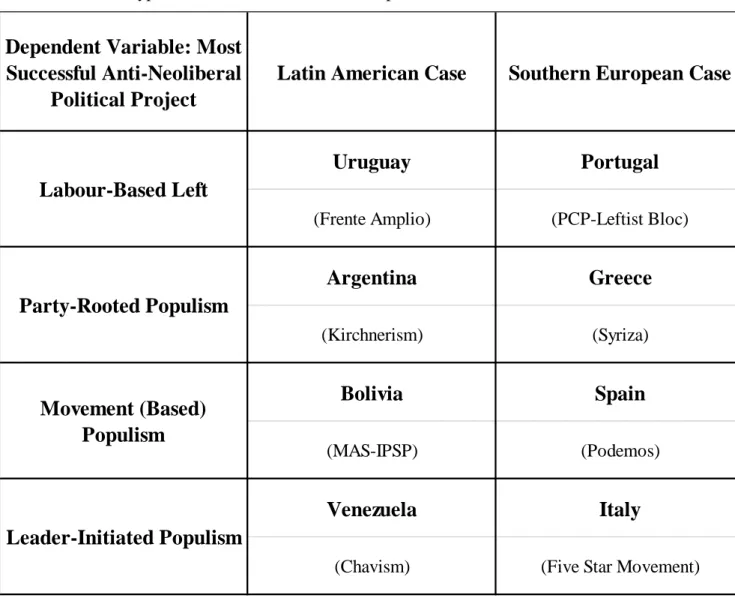
(17) List of Figures. Figure 1.1 The Insider-Outsider Divide and the Crisis of the Old Structures of SocioPolitical Intermediation. ................................................................................................... 31 Figure 1.2 The Dependent Variable. A Typology of the ‘Successful Political Projects’ shaping the National Lefts in the Aftermath of a Crisis of Neoliberalism....................... 34 Figure 2.1 The Argument ................................................................................................. 59 Figure 4.1 Bolivian Departments (in Red: 'Half Moon' Departments) .......................... 178 Figure 5.1 Spatial Political Position of the main Leftist and/or Peronist social and political organizations during the Néstor Kirchner’s presidency (2003-2007). ............. 271 Figure 6.1 Voting Shares by Educational Level and Age group (CIS 2015). ................ 343 Figure 6.2 Voting Shares amongst Union Members, 2015 General Elections. ............. 352 Figure 7.1 Evolution of the Italian Partisan Left (1991-2008). ..................................... 360 Figure 7.2 Union Density in Italy (Total Union Density and Membership Share of the Three Main Peak Unions). ............................................................................................. 363 Figure 7.3 The Influences of M5S’ Organizational Linkages’ on its Electoral Linkages. ........................................................................................................................................ 411 Figure 7.4 Voting Shares by Educational Level and Age group (ITANES 2013)......... 422 Figure 7.5 Previous Party Preferences and Ideological Self-Placements of M5S’ Voters (ITANES 2013). ............................................................................................................. 423 Figure 8.1 FA’s Voting Share by Job Category. ............................................................ 472 Figure 8.2 Union Density in Portugal (Total Union Density and Membership Share of the Main Peak Unions). .................................................................................................. 481 Figure 8.3 Evolution of the Temporary Employment Rate in Portugal (1987-2008). ... 482 Figure 8.4 Electoral Evolution of the Portuguese Left since the First Electoral Participation of the Bloco de Esquerda (1999-2015). .................................................... 499. xvii.
(18) List of Abbreviations. 15-M Indignados Movement (Spain) AD Acción Democrática – Democratic Action (Venezuela) ADEDY Anotati Diikisi Enoseon Dimosion Ypallilon – Confederation of Civil Servants’ Unions (Greece) ADN Acción Democrática Nacional – National Democratic Action (Bolivia) AGE Alternativa Gallega de Izquierda – Galician Leftist Alternative (Spain) AM Ahora Madrid – Madrid Now! (Spain) ANEL Anexartitoi Ellines – Independent Greeks (Greece) AP Alianza Popular – Popular Alliance (Spain) APRA Alianza Popular Revolucionaria Americana – American Popular Revolutionnary Alliance (Peru) ARI Afirmación para una República Igualitaria – Initiative for an Egalitarian Republic (Argentina) ASP Asamblea para la Soberanía de los Pueblos – Assembly for the Sovereignty of the Peoples (Bolivia) ATE Asociación de los Trabajadores del Estado – State Workers’ Association (Argentina) AU Asamblea Uruguay – Uruguayan Assembly (Uruguay). xviii.
(19) AUH Asignación Universal por Hijo – Universal Allowance per Child (Argentina) BE Bloco de Esquerda – Leftist Bloc (Portugal) BeC Barcelona en Comú – Barcelona in Common (Spain) BONOSOL Bono Solidario – Solidarian Cash-Transfer (Bolivia) CABA Ciudad Autónoma de Buenos Aires – Autonomous City of Buenos Aires (Argentina) CC.OO Comisiones Obreras – Workers’ Commissions (Spain) CCC Corriente Clasista y Combativa – Combative Classist Current (Argentina) CCZ Centro Comunal de Zona – Local Municipal Centre (Uruguay) CDS-PP Partido do Centro Democrático Social–Partido Popular – Centrist Social Democratic Party-Popular Party (Portugal) CEPS Centro de Estudios Políticos y Sociales – Centre of Political and Social Studies (Spain) CGIL Confederazione Generale Italiana del Lavoro – Italian General Confederation of Work (Italy) CGT Confederación General del Trabajo – General Confederation of the Work (Argentina) CGT Confederación General del Trabajo – General Confederation of the Work (Spain) CGT Confédération Générale du Travail – General Confederation of the Work (France). xix.
(20) CGTP Confederação Geral dos Trabalhadores Portugueses – General Confederation of the Portuguese Workers (Portugal) CIDOB Confederación Indígena del Oriente Boliviano - Indigenous Confederation of the Bolivian Orient (Bolivia) CISL Confederazione Italiana Sindacati Lavoratori – Workers’ Unions’ Italian Confederation (Italy) CLPP Consejos Locales de Planificación Pública - Local Public Planning Councils (Venezuela) CMS Coordinadora de Movimientos Sociales – Coordinator of the Social Movements (Ecuador) COB Central Obrera de Bolivia – Bolivian Workers’ Union (Bolivia) CO.BAS Comitati di Base – Bases’ Committees (Italy) COMIBOL Corporación Minera de Bolivia – Bolivian Mining Corporation (Bolivia) CONACRE Concertación Nacional para el Crecimiento - National Coordination for the Growth (Uruguay) CONAIE Confederación de Nacionalidades Indígenas del Ecuador – Confederation of Ecuadorean Indigenous Nations (Ecuador) CONAMAQ Confederación Nacional de las Markas y Ayllus del Qulla’suyu – National Confederation of Markas and Ayllus of Qulla’suyu (Bolivia) CONAPRO. Concertación. Nacional. Programática. –. National. Coordination (Uruguay) CONDEPA Conciencia de Patria – Fatherland Consciousness (Bolivia) xx. Programmatic.
(21) COPEI Comité de Organización Política Electoral Independiente – Committee of Independent Political-Electoral Organization (Venezuela) COR Central Obrera Regional – Regional Workers’ Union (Bolivia) CP Círculo Patriótico – Patriotic Circle (Venezuela) CPE Constitución Política del Estado – State Political Constitution (Bolivia) CSCB Confederación Sindical de los Colonizadores de Bolivia – Bolivian Settlers Unions’ Confederation (Bolivia) CSCIOB Confederación Sindical de las Comunidades Interculturales Originarias de Bolivia – Confederation of the Bolivian Intercultural Communities (Bolivia) CSI Corriente Sindical de Izquierda – Leftist Unionist Faction (Spain) CSQP Catalunya Sí que es Pot – Catalonia is Possible (Spain) CSUTCB Confederación Sindical Única de los Trabajadores Campesinos de Bolivia – Confederation of Bolivian Peasants’ Unions (Bolivia) CTA Central de los Trabajadores Argentinos – Argentine Workers’ Central (Argentina) CTD Coordinadoras de Trabajadores Desocupados – Unemployed Workers’ Coordinators (Argentina) CTEP Confederación de los Trabajadores de la Economía Popular – Popular Economy’s Workers’ Confederation (Argentina) CTERA Confederación de los Trabajadores de la Educación de la República Argentina - Argentina’s Education Workers Confederation (Argentina) CTN Comando Táctico Nacional – Tactical Nacional Command (Venezuela) xxi.
(22) CTV Confederación de los Trabajadores Venezolanos – Venezuelan Workers’ Confederation (Venezuela) CUT Central Única dos Trabalhadores – Workers’ Peak Union (Brazil) DAKE Democratic Independent Employees’ Movement (Greece) DC Democrazia Cristiana – Christian Democracy (Italy) DEN Dirección Estratégica Nacional – National Strategic Direction (Venezuela) DRY ¡Democracia Real YA! – Real Democracy Now! (Spain) DS Democratici di Sinistra – Leftist Democrats (Italy) DSV Double Simultaneous Vote (Uruguay) DTZ Direcciones Estratégicas de Zona – Zone’s Strategic Direction (Venezuela) ECB European Central Bank EFDD Europe of Freedom and Direct Democracy (EU Parliamentary Group) EMS European Monetary System ESK Ezker Sindikalaren Konbergentzia – Leftist Unionist Convergence (Spain) EU European Union FA Frente Amplio – Broad Front (Uruguay) FADI Frente Amplio de Izquierda – Leftist Broad Front (Ecuador) FBT Fuerza Bolivariana de los Trabajadores – Workers’ Bolivarian Force (Venezuela) FdG Front de Gauche – Front of the Left (France) xxii.
(23) FDS Federazione della Sinistra – Federation of the Left (Italy) FEDECAMARAS Federación de Cámaras y Asociaciones de Comercio y Producción de Venezuela – Venezuelan Federation of Chambers of Commerce (Venezuela) FEDECOR Federación Departamental Cochabambina de Regantes – Cochabamba’s Federation of the Water Suppliers (Bolivia) FEJUVE Federación de Juntas Vecinales – Neighbourhood Assembles’ Federation (Bolivia) FENCOMIN Federación Nacional de los Cooperativistas Mineros de Bolivia – National Federation of Bolivian Cooperativist Mineworkers (Bolivia) FER Frente de Esquerda Revolucionária – Front of Revolutionary Left (Portugal) FERVE Fartas/os d'Estes Recibos Verdes - Fed Up with False Green Receipts (Portugal) FETCTC Federación Especial de los Trabajadores Campesinos del Trópico de Cochabamba - Special Federation of the Peasant Workers of the Cochabamba Tropic (Bolivia) FHRC Fondo de Reparación Histórica del Conurbano – Conurbano’s Historic Reparation Fund (Argentina) FIOM Federazione Impiegati Operai Metallurgici – Steelworkers’ Federation (Italy) FPOe Freiheitliche Partei Oesterreichs – Austrian Freedom Party (Austria) FpV Frente para la Victoria – Victory Front (Argentina) FRENAPO Frente Nacional contra la Pobreza – National Front Against Poverty (Argentina) xxiii.
(24) FREPASO Frente para un País Solidario - Front for a Solidary Country (Argentina) FSTMB Federación Sindical de los Trabajadores Mineros de Bolivia – Union Federation of Bolivian Mineworkers (Bolivia) FSTPB Federación Sindical de los Trabajadores Petroleros de Bolivia – Union Federation of Bolivian Oilworkers (Bolivia) FTV Federación Tierra, Vivienda y Hábitat – Habitat, Land and Housing Federation (Argentina) FUCVAM Federación Uruguaya de Cooperativas de Vivienda por Ayuda Mutua – Uruguayan Federation of Housing Cooperatives (Uruguay) FUT Frente Unitario de Trabajadores – Workers’ Unitarian Front (Ecuador) GC Giovani Comunisti – Communist Youth (Italy) GJM Global Justice Movement GSEE Geniki Synomospondia Ergaton Ellados – General Confederation of Greek Workers (Greece) IDV Italia dei Valori – Italy of Values (Italy) IMF International Monetary Fund INRA Instituto Nacional de Reforma Agraria – National Institute of the Agrarian Reform (Bolivia) ISI Import Substitution Industrialization IU Izquierda Unida – United Left (Bolivia). xxiv.
(25) IU Izquierda Unida – United Left (Spain) KKE Kommounistiko Komma Elladas – Greek Communist Party (Greece) LAE Laiki Enotita – Popular Unity (Greece) LAOS Laikos Orthodoxos Synagermos – Orthodox Popular Group (Greece) LCC Liste CiViche Certificate – Certified Civic Slates (Italy) LCR La Causa Radical – The Radical Cause (Venezuela) LFI La France Insoumise – Unsubmissive France (France) LIPU Lega Italiana Protezione Uccelli – Italian League for Birds’ Protection (Italy) LN Lega Nord – Northern League (Italy) LPP Ley de Participación Popular – Law of Popular Participation (Bolivia) M5S MoVimento Cinque Stelle – Five Stars Movement (Italy) MAS Movimiento Al Socialismo – Movement Towards Socialism (Venezuela) MAS-U Movimiento al Socialismo-Unzaguista – Movement Towards Socialism‘Unzaguist’ (Bolivia) MAS-IPSP Movimiento al Socialismo-Instrumento Político para la Soberanía de los Pueblos – Movement Towards Socialism-Political Instrument for the Sovereignty of the Peoples (Bolivia) MBL Movimiento Bolivia Libre – Free Bolivia Movement (Bolivia) MBR-200 Movimiento Bolivariano Revolucionario – Revolutionary Bolivarian Movement (Venezuela) xxv.
(26) MEP Movimiento Electoral del Pueblo – Electoral Movement of the People (Venezuela) MGP Movimiento por el Gobierno del Pueblo – Movement for People’s Government (Uruguay) MIDES Ministerio de Desarrollo Social – Ministry of Social Development (Uruguay) MIP Movimiento Indígena Pachakutik – Indigenous Movement Pachakutik (Bolivia) MIR Movimiento de Izquierda Revolucionaria – Revolutionary Left Movement (Bolivia) MITKA Movimiento Indio Túpac Katari – Indian Movement Tupac Katari (Bolivia) MLN-Tupamaros Movimiento de Liberación Nacional – Tupamaros (Uruguay) MNR Movimiento Nacionalista Revolucionario – Nationalist Revolutionary Movement (Bolivia) MNRI Movimiento Nacionalista Revolucionario de Izquierda – Leftist Nationalist Revolutionary Movement (Bolivia) MPP Movimiento de Participación Popular – Popular Participation Movement (Uruguay) MRTKL Movimiento Revolucionario Túpac Katari de Liberación – Tupac Katari Revolutionary Movement of Liberation (Bolivia) MST Movimento dos Trabalhadores Rurais Sem Terra – Landless Rural Workers’ Movement (Brazil) MTA Movimiento de Trabajadores Argentinos – Argentine Workers’ Movement (Argentina) xxvi.
(27) MTD Movimientos de Trabajadores Desocupados – Unemployed Workers’ Movement (Argentina) MTL Movimiento Tierra y Libertad – Land and Freedom Movement (Argentina) MVR Movimiento Quinta República – Fifth Republic Movement (Venezuela) ND Nea Dimokratia – New Democracy (Greece) NEP New Economic Policy (Bolivia) NIDIL Nuove Identità di Lavoro – New Identities of Work (Italy) No MUOS Movement Against the Mobile User Objective System (Italy) No TAV Movement Against High Speed Railway (Italy) PAH Plataforma de Afectados por las Hipotécas – Platform of Victims of Banks’ Evictions (Spain) PAIS Patria Altiva i Soberana – Proud and Sovereign Fatherland (Ecuador) PANES Plan de Asistencia Nacional a la Emergencia Social – Plan of National Assistence for Social Emergency (Uruguay) PASKE PanHellenic Struggling Unionist Employees’ Movement (Greece) PASOK Panellinio Sosialistiko Kinima – Panhellenic Socialist Movement (Greece) PBA Provincia de Buenos Aires – Buenos Aires’ Province (Argentina) PC Partido Colorado (Uruguay) PCE Partido Comunista de España - Spanish Communist Party (Spain). xxvii.
(28) PCF Parti Communiste Français – French Communist Party (France) PCI Partito Comunista Italiano – Italian Communist Party (Italy) PCP Partido Comunista Português – Portuguese Communist Party (Portugal) PCR Partido Comunista Revolucionario – Revolutionary Communist Party (Argentina) PCU Partido Comunista de Uruguay – Communist Party of Uruguay (Uruguay) PCV Partido Comunista de Venezuela – Communist Party of Venezuela (Venezuela) PD Partito Democratico – Democratic Party (Italy) PdCI Partito dei Comunisti Italiani – Party of the Italian Communists (Italy) PdG Parti de Gauche – Party of the Left (France) PDL Popolo delle Libertà – People of the Freedom (Italy) PDS Partito Democratico della Sinistra – Democratic Party of the Left (Italy) PDVSA Petróleos de Venezuela Sociedad Anónima – Venezuelan Oil Ltd. (Venezuela) PER Programa de Empleo Rural – Rural Work Program (Spain) PI Precários Inflexíveis – The Inflexible Precarious (Portugal) PIT-CNT Plenario Intersindical de los Trabajadores–Convención Nacional de los Trabajadores – Workers’ Intersyndicalist Group-Workers’ National Convention (Uruguay) PJ Partido Justicialista – Justicialist Party (Argentina). xxviii.
(29) PJJHD Plan Jefes y Jefas de Hogar Desocupados – Unemployed Households’ Plan (Argentina) PN Partido Nacional – National Party (Uruguay) PP Partido Popular – Popular Party (Spain) PPT Patria Para Todos – Fatherland for All (Venezuela) PRC Partito della Rifondazione Comunista – Communist Refoundation Party (Italy) PRIST Programa Ingreso Social con Trabajo – ‘Social Income with Job’ Program (Argentina) PRO Propuesta Republicana – Republican Proposal (Argentina) PS Partido Socialista – Socialist Party (Portugal) PS Partido Socialista – Socialist Party (Uruguay) PSD Partido Social Democrata – Social Democratic Party (Portugal) PSE Partido Socialista Ecuatoriano – Ecuadorean Socialist Party (Ecuador) PSOE Partido Socialista Obrero Español - Spanish Socialist Workers’ Party (Spain) PSR Partido Socialista Revolucionário – Socialist Revolutionary Party (Portugal) PT Partido dos Trabalhadores – Workers’ Party (Brazil) PU Pacto de Unidad – Unity Pact (Bolivia) PVV Partij voor de Vrijheid – Party for Freedom (Netherlands) QLT Que se Lixe a Troika – Fuck the Troika! (Portugal) xxix.
(30) SA Sinistra Arcobaleno – Rainbow Left (Italy) SAT Sindicato Andaluz de los Trabajadores – Andalusian Workers’ Union (Spain) SEL Sinistra Ecologia e Libertà – Left, Ecology and Freedom (Italy) SERPAJ Servicio Paz y Justicia – Service for Peace and Freedom (Uruguay) SYN Synaspismos tis Aristeras ton Kinimaton kai tis Oikologias – Coalition of the Left, of the Movements and of Ecology (Greece) SYRIZA Synaspismos Rizospastikis Aristeras – Coalition of the Radical Left (Greece) TCO Tierras Comunitarias de Orígen – Originary Communitarian Land (Bolivia) TIPNIS Territorio Indígena Parque Nacional Isiboro-Sécure – Indigenous Territory of the Isiboro-Sécure National Park (Bolivia) UCD Unión de Centro Democrático (Spain) UCeDe Unión de Centro Democrático – Democratic Centre Union (Argentina) UCR Unión Cívica Radical – Radical Civic Union (Argentina) UCS Unión Cívica de Solidaridad – Civic Union of Solidarity (Bolivia) UDC Unione Democratica di Centro – Centrist Democratic Union (Italy) UDC Unione Democratica di Centro – Centrist Democratic Union (Switzerland) UDP União Democrática Popular – Popular Democratic Union (Portugal) UDP Unión Democrática Popular - Democratic Popular Union (Bolivia) UDU Unione degli Universitari – University Students’ Union (Italy) xxx.
(31) UGT União Geral de Trabalhadores – Workers’ General Union (Portugal) UGT Unión General de los Trabajadores – Workers’ General Union (Spain) UIL Unione Italiana del Lavoro – Italian Union of the Work (Italy) UKIP United Kingdom Independence Party (United Kingdom) UNT Unión Nacional de los Trabajadores – Workers’ National Union (Venezuela) URD Unión Republicana Democrática – Democratic Republican Union (Venezuela) USB Unione Sindacale di Base – Bases’ Unionist Union (Italy) VA Vertiente Artiguista – Artiguist Strand (Uruguay) YPFB Yacimientos Petrolíferos Fiscales Bolivianos -. Bolivian state-owned oil company (Bolivia). xxxi.
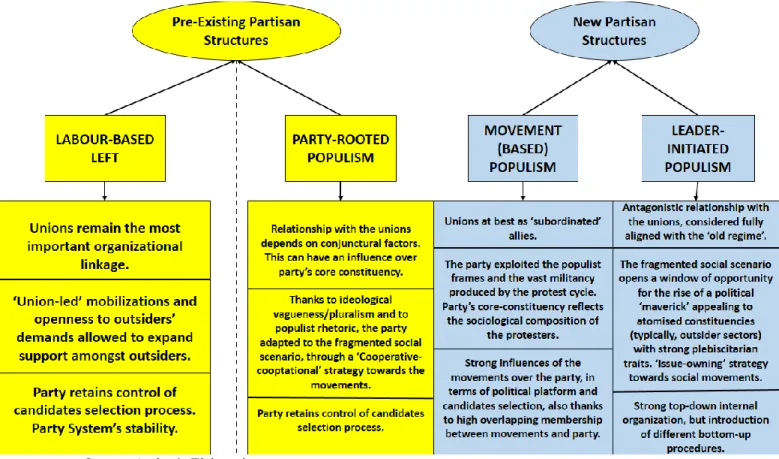
(32) Summary. The dissertation is a comparative analysis of the evolution of the electoral Left in Latin America and Southern Europe, in the aftermath of economic crises due to the shortcomings of the neoliberal model. The geographical focus is motivated by the existence, in the eight countries selected (Uruguay, Argentina, Bolivia, Venezuela, Portugal, Greece, Spain and Italy) of common factors that are causally relevant for my argument. Such factors are: the adoption of extensive market-friendly economic and labour policies in the pre-crisis era; a dualised welfare regime; and a union system with strong links with political referents at the partisan level. The main goal is to give an account of why in some countries, but not in others, the left side of the party spectrum has been shaped by the irruption of new ‘populist’ parties, and to provide a better categorization of these populist phenomena, by focusing on their party organization, on their relationship with the unions and on the sociological characteristics of their electoral bases. The concept of populism is discussed by relying on the vast existing literature, in order to provide a new conceptualization stressing its ‘sovereigntist’ characteristics, the ‘populist rediscovery’ of nation-State institutions, its ‘movementist’ and participative organizational features and its different social bases, if compared with the ‘old Left’. The research shows that two macro-factors can explain the (dis)continuity within the political-electoral Left, and the different forms assumed by the populist projects that emerged. The first factor is the eventual credibility enjoyed by the pre-existing structures of socio-political intermediations (unions and political parties) to defend a socioeconomic alternative to neoliberalism (as it occurred in Uruguay and Portugal). The second factor consists in the specific forms assumed by the anti-austerity social mobilizations (either ‘unified’ or ‘fragmented’). It is thus possible to build a causal typology of the different ‘populist outcomes’ that I observed: movement(based) populism (in Bolivia and Spain); leader-initiated populism (in Venezuela and Italy); and party-rooted populism (in Argentina and Greece). Each of these categories presents very different relationship with the unions; very different party organizations and processes of candidates’ selection and programmatic elaboration; and quite different electoral constituencies. The research well inserts into the historical-comparative tradition. It relies on indepth interviews with social and political key actors and with country experts (N=120 interviews in Bolivia, Argentina, Spain and Italy), and on survey data analyses in order to describe the electoral bases of the populist parties analysed. A vast secondary literature integrates the data collected through primary sources. xxxii.
(33) Resumen. Esta tesis es un análisis comparativo de la evolución de las izquierdas políticas en América Latina y Europa del Sur, tras crisis económicas debidas a las limitaciones del modelo socioeconómico neoliberal. El alcance geográfico se motiva por la existencia, en los ocho países seleccionados (Uruguay, Argentina, Bolivia, Venezuela, Portugal, Grecia, España e Italia), de factores causalmente relevantes para mi argumento. Dichos factores son: la adopción de políticas económicas y laborales neoliberals en la fase previa a la crisis; un sistema de bienestar dual; un movimiento sindical con fuertes lazos con partidos políticos. El objetivo principal es proveer una explicación del por qué en algunos países, pero no en otros, la izquierda política ha sido transformada por la irrupción de partidos ‘populistas’, y proveer una mejor categorización de estos fenómenos populistas, focalizándose en sus organizaciones partidarias, sus relaciones con los sindicatos y las características sociológicas de sus electorados. Se discute el concepto de populismo a partir de la amplia literatura existente, para proponer una nueva conceptualización que subraye sus características ‘soberanistas’, el ‘redescubrimiento populista’ de las instituciones del Estado-nación, su caracter ‘movimientista’, sus diferentes formas de organizacionales y las características de su electorado, en comparación a la ‘vieja izquierda’. La investigación muestra que dos macro-factores pueden explicar la (dis)continuidad de la izquierda político-electoral, y los diferentes tipos de proyectos populistas que emergieron. El primer factor es la eventual credibilidad de las preexistentes estructuras de intermediación socio-políticas (sindicatos y partidos políticos) en defender un modelo socioeconómico alternativo al neoliberalismo, tal como ocurrió en Uruguay y Portugal. El segundo factor consiste en las características asumidas (que se dividen en ‘unificadas’ o ‘fragmentadas’) por las movilizaciones sociales antiausteridad. Es posibile por ende desglosar una tipología causal de los diferentes ‘caminos populistas’ que se identifican: ‘populismos basados en movimientos’ (Bolivia y España); ‘populismos iniciados por un líder’ (Venezuela e Italia); ‘populismos basados en un partido’ (Argentina y Grecia). Cada categoría se caracteriza por: diferentes relaciones con los sindicatos existentes; diferentes tipos de organización partidaria, en términos de elaboración programática y de selección de los candidatos; diferentes coreconstituencies electorales. La investigación se basa en 120 entrevistas en profundidad a actores políticos y sociales claves y a expertos en Bolivia, Argentina, España e Italia, y en datos de sondeo xxxiii.
(34) para describir las bases sociales de los partidos populistas analizados. Una amplia literatura secundaria integra las fuentes primarias.. xxxiv.
(35) 1. Chapter 1. Introduction.. 1.1 Research Questions and Scientific Relevance of the Dissertation. The crises caused by the shortcomings of the neoliberal economic model and the austerity measures adopted with it have harshened the living condition of the most unprotected and poorest strata of the population of the countries involved and have also increased socioeconomic inequality. The crises and the austerity measures – often implying huge cuts in public social spending – have everywhere led to social and political discontent, visible in social mobilizations taking quite different forms. In the political-electoral arena, some political projects, often labelled ‘populist’, were born or able to increase dramatically their electoral supports, whereas other kinds of projects were not. In particular, the left side of the political spectrum has been reshaped in the early aftermath of the crises, producing major electoral realignments. Several, very substantive questions arise from this brief statement. For instance, how can we compare the different protest cycles that stemmed from the widespread discontent against austerity? What were the impacts of the protest cycles on the political arena? How did these movements relate to more traditional, ‘institutional’ actors, such as the existing leftist parties and the organised labour movement? Why in some countries did we observe a substantial continuity of the left side of the political spectrum, while in most cases we witnessed the emergence of new major political parties? Is it possible to offer a comprehensive and comparative account of the political realignments in the aftermath of a crisis due to the shortcomings of neoliberalism? How.
(36) can we compare left-wing (or, more specifically, anti-austerity) populisms across different countries and regions? Is left-wing populism ‘monolithical’? And, last but not least, what is populism? Why did it become so widespread? Why does it clearly differentiate itself from the ‘old Left’? The goal of this dissertation is to provide a theoretical framework to account for the variety of political realignments within the national Lefts, in a delimited set of countries (Latin American and Southern Europe 'dualized' societies), in the aftermath of a crisis (the decisive 'critical juncture', according to my argument: see Chapter 2) of the neoliberal model. The goal is admittedly ambitious, because the dissertation aims at building bridges between different strands of literature, while advancing an argument that intends to ‘travel’ across two regions obviously quite different in many aspects. The argument that I propose focuses on the complex interplay between the political-electoral arena, the social mobilizations against austerity, and the union movements, to explain the different paths followed by the national Lefts in the countries analysed and the different kinds of antineoliberal populisms that emerged. This dissertation offers several scientific contributions. First, it constitutes a comprehensive study of antineoliberal populism(s) in the regions where they became major political phenomena (Latin America and Southern Europe). The dissertation provides a theoretical chapter assessing why this populist subtype has achieved such a relevance in the set of countries analysed. In particular, I rely on the vast theoretical literature on populism to stress the strategic, ideological-programmatic, and organizational resources that made populism so common in the aftermath of the crisis of the neoliberal model. At the same time, the argument accounts for the variation within the antineoliberal populist category, by focusing on the internal party organizations, the different relations with the social movements and the unions, and the sociological profiles of the electorates of the different populist political projects. Last but not least, the research treats topics of enormous normative relevance, as populism (whatever the definition adopted) seems today a ubiquitous phenomenon whose multiple 2.
(37) consequences, particularly in terms of quality of democracy, are continuously discussed and debated. This dissertation, focusing on antineoliberal populisms, intends to contribute to this discussion by ‘unpacking’ the ‘populist category’ and by stressing the different consequences brought by different ‘populist’ experiences. Second, the dissertation relies on the literatures on welfare regimes for both delimiting the ‘scope conditions’ of the argument and generating several hypotheses that have driven the research. I chose to focus on ‘dualised societies’ experiencing a crisis during the neoliberal model, drawing from the literature on welfare regime dualization (see section 1.4). The relevance of this scope condition lies in at least two general hypotheses that could be advanced to explain the realignments within the national Lefts, and that animated since the beginning this dissertation and led me to the definition of the main argument. The first hypothesis derives from the central tenet of this literature: there are conditional (i.e., depending on the characteristics of the national welfare regimes) effects of the labour-market status on policy and partisan preferences that follows from the divide between insiders (i.e., salaried workers with open-ended, full-time contracts) and outsiders. We can define as outsiders the ‘unemployed, involuntary part-time and/or fixed-term employed workers, as well as the vast (particularly in Latin America) masses of workers occupied in the informal sectors, often in condition of self-employment’. Even the less well-to-do strata of the European 'petty bourgeoisie' can be included in the category. According to the literature on welfare regime dualization, there are pathdependent, self-reinforcing causal mechanisms at work in dualised societies, leading to an extension of the gap, in terms of social protection, between the two segments. In particular, as the core-constituency1 (Gibson, 1996) of the left-of-centre parties – as well. According to Gibson, the concept of core-constituency can be defined as “those sectors of society that are most important to [the party’s] political agenda and resources. The importance of the coreconstituency relation for the path/trajectory of representation a party/movement can take, lies not 1. 3.
(38) as the majority of the unionised workers – is composed of the insiders, this would generate fewer incentives to make social protections (in terms of labour rights and of social policies) more universalist and less segmented. Therefore, a first hypothesis revolves around the poor attention paid by the union-party hubs (Handlin and Collier, 2008) towards the outsiders’ interests, thus boosting the political discontent amongst this sector, whose size dramatically increased due to the crisis, towards the ‘existing Left’. This, in turn, has fostered either an electoral realignment of the outsiders towards parties advancing platforms closer to their interests, and/or the creation of alternative popular organizations at the societal and electoral level that politicised the divide and presented themselves as the representative of the interests of the outsiders (in this sense, Rueda, 2012). Following this reasoning, anti-neoliberal populisms would be a functionalist response to the political exclusion of the outsiders, thus providing their 'political incorporation' (e.g., Collier and Collier, 1991; Rossi, 2015), defined by Castillo and Barrenechea (2016: 5) as 'a process through which a previously excluded actor acquires policy benefits and (new forms of) representation in the state'. Such representation, according to Castillo and Barrenechea, can occur through corporatist arrangements, or through a personalistic/charismatic figure, or through a political party. A different source of grievances towards the ‘old leftist structures of political intermediation’ (the ‘Old Left’) may be hypothesized, though. This second hypothesis has more to do with the way the union movement historically acceded to the polity domain. In the set of countries selected (Latin American former ISI countries – Bolivia, Argentina, Uruguay and Venezuela - and Mediterranean ones – Spain, Italy, Portugal and Greece), even during the neoliberal period, the national union movements, despite their declining membership, were still major players in the civil society. Moreover, they kept resilient links with leftist or labour-based (Levitsky, 2003) political parties, with the partial exception of the Bolivian case. As unions lost much of their organizational and necessarily in the number of votes they represent, but in their influence on the party's agenda and capacities for political action” (Gibson 1996: 7).. 4.
(39) structural powers (Gumbrell-McCormick and Hyman, 2013; Rigby and García Calavia, 2017), due to trade and financial international integration and the changes in the productive system, the importance of defending these partisan links in order to have a stronger voice in the polity domain increased, particularly in Southern Europe and South America, where labour market issues are regulated more by law than through corporatist arrangements. However, left-of-centre and labour-based parties often opted for a centripetal strategy that put in perils many of the historical gains of the labour movement. Therefore, the unions faced a trade-off (Hyman, 2001) between ideological ‘purity’ and concrete political influence (from a subaltern position). The strategic choices made by the ‘mainstream’ unions during the pre-crisis period play a key role in my argument. It can be hypothesized that the ‘rebellion’ against the ‘old union-party hubs’ had to do more with their acceptance of the ‘neoliberal discourse’ (and practices) than with the poor attention paid to the outsiders’ interests or with the ‘over-protection’ of their insiders’ constituencies. From this second hypothesis, it derives that the discontent against neoliberal political parties and ‘collaborative’ unions grew among both the insiders and the outsiders, thus paving the way for an alliance across the insideroutsider divide. Third, the dissertation intends to contribute to the literature regarding the effects of social movements on electoral politics, at least in terms of formation or emergence of various kinds of populisms. The literatures on social movements and on party politics and party organizations have not talked to each other for a long time, although during the last years various attempts of integrating them have been made (e.g., MacAdam and Tarrow, 2010; Della Porta et al., 2017b). This dissertation offers a perspective about the relationship between non-institutional and political-electoral politics in times of crisis, as a part of a broader framework. Fourth, this dissertation falls within the old comparative-historical analysis tradition. In methodological terms, the research design allows the testing of a middle5.
Figure


+5




Documento similar
In 2004, the Universitat de Barcelona gave her a scholarship to spend the last semester of her undergraduate degree as an exchange student at Southern Cross University
Todo esto me íelató aquella buena mujer de la abue- la muy de su casa, mientras pasaba la nube que me habia obligado á buscar en la suya un refugio contra sus rigores; pero después
• Modelled mitigation strategies have been designed mostly for targeting primary pollutants and the traffic sector.
In sum, metaphorical linguistic expressions may vary widely cross- culturally but many conceptual metaphors appear to be potentially universal or near-universal.. This
Barcelona, Spain, 4 Vasculitis Research Unit, Department of Autoimmune Diseases, Hospital Clı´nic, University of Barcelona, Institut d’Investigacions Biomèdiques August Pi i
In the “big picture” perspective of the recent years that we have described in Brazil, Spain, Portugal and Puerto Rico there are some similarities and important differences,
Considering housing tenure status as a key factor (Kemeny 2001), this research is guided by three specific objectives: (1) to explore the distinctive feature of
‘intertwined crises’, political and economic ―as stressed by many analyses (e.g. Flesher Fominaya, 2017; della Porta, 2015; Lobera, 2011a) ― is essential in explaining the
