
Tolerance to air exposure: a feature driving the latitudinal distribution of two sibling kelp species
10
0
0
Texto completo
(2) 432. C. López-Cristoffanini et al.: Air exposure and kelp distribution. ROS exceed the buffering capacities of cells, causing the oxidation of macromolecules (Foyer and Noctor 2009). Activation of the antioxidant system, including enzymes and water- and lipid-soluble compounds, regulates the levels of ROS and thus prevents the development of oxidative stress conditions (Noctor and Foyer 1998, Asada 1999). In seaweeds, studies on adults and macroscopic juveniles have demonstrated the importance of several antioxidant enzymes, including ascorbate peroxidase (AP) and catalase (CAT), in attenuating the effects of excess ROS (e.g., Collén and Davison 1999a,b, Burritt et al. 2002, Contreras et al. 2005, Ratckevicius et al. 2005, Contreras-Porcia et al. 2011). Air exposure studies in seaweeds have focused on (i) upper intertidal species because they are expected to be tolerant to this condition (e.g., Bell 1993, Burritt et al. 2002, Contreras-Porcia et al. 2011) and (ii) both high and low intertidal species to understand the patterns of zonation at local scale (e.g., Dorgelo 1976, Dring and Brown 1982, Druehl and Green 1982, Schagerl and Möstl 2011, Contreras-Porcia et al. 2012). On the other hand, biogeographical studies of seaweeds have ignored air exposure, and the resulting desiccation stress, as a potential driving force modulating the patterns of algal distribution at larger spatial scales. Thus, experimental approaches linking physiology, environment, and biogeography seem to be lacking. Lower intertidal species appear to be ideal models to study the consequences of air exposure on geographical distribution, as minor changes in one or several environmental factors (e.g., low RH and high SST) that increase the intensity of desiccation may limit the species’ geographical distribution. In addition, because of their ecological importance in modulating biological diversity and community structure (Steneck et al. 2002), kelp species (Laminariales, Heterokontophyta) living in the lower intertidal zone are attractive subjects of study. Taking this into consideration, we selected as models two kelp species inhabiting the low intertidal zone of the Chilean coast: Lessonia berteroana Montagne and Lessonia spicata (Suhr) Santelices (Laminariales, Heterokontophyta). These two species are described as “sibling species” (i.e., cryptic species being phylogenetically closely related) (Bickford et al. 2006). Until the study by González et al. (2012), they had been regarded as a single taxonomic entity (Lessonia nigrescens Bory). Their morphological differences are subtle: on 19 external and 16 internal characters of adult individuals from three localities, González et al. (2012) identified only four external and three internal traits that were significantly different between the species. These authors also identified five of. these traits as diagnostic of the species: diameter of cortical cells, number of layers of cortical cells, density of medullary cells, pedicel length, and number of dichotomies. An interesting feature of these two cryptic species is their contrasted distribution along the Chilean coast, with L. berteroana occurring from 16°S to 30°S and L. spicata from 29°S to 41°S (Figure 1) (Tellier et al. 2009). In the region where their ranges overlap, from 29° to 30°S (∼150 km of coastline), a mosaic of monospecific patches (i.e., no coexistence, strict parapatry) with only genetically pure individuals was reported (Tellier et al. 2011a; see also Tellier et al. 2011b). Along the mainly linear Chilean coast (18–42°S; ∼3000 km), SST is known to increase as latitude decreases, whereas RH decreases (Thiel et al. 2007), resulting in a lati tudinal gradient of exposure to desiccation in intertidal species. Therefore, we expect that L. berteroana (16–30°S) populations are normally exposed more to higher air exposure and desiccation levels than L. spicata (29–41°S) populations. Tidal regimes seem somewhat similar along the Chilean coast, but the intertidal zone in the region is characterized by a much higher exposure to air during summer afternoons compared to other coastlines around the world (Finke et al. 2007). In a recent study, differential tolerance of the two species of Lessonia to high temperature was suggested as a factor limiting the species’ geographical distribution (Oppliger et al. 2012). Similarly, a different physiological ability to deal with air exposure. Figure 1 Geographical distribution of Lessonia berteroana and Lessonia spicata along the coast of Chile, including populations sampled. Distribution of L. berteroana is shown in black and L. spicata in gray.. Brought to you by | Pontificia Universidad Catolica de Chile Authenticated Download Date | 5/9/16 4:51 PM.
(3) C. López-Cristoffanini et al.: Air exposure and kelp distribution. could be determinant in defining the range of distribution of each species. Given the general low tolerance of the Lessonia sibling species to abiotic stresses, such as those caused by El Niño Southern Oscillation warm events (Martínez 1999), high temperatures (Oppliger et al. 2012) and high copper concentrations (Lovazzano et al. 2013), and the theoretically higher air exposure in the northern coastal region, we addressed the hypothesis that L. spicata has a lower tolerance to air exposure than L. berteroana; that is, tolerance responses are a species-specific trait. More explicitly, we assessed the effects of exposure to air on survival and development of the microscopic stages of the two sibling species and on the activity of two antioxidant enzymes (i.e., AP and CAT).. Materials and methods Study sites Previous genetic information (Tellier et al. 2009, 2011a) was used to choose the study sites. For Lessonia berteroana, we included Pan de Azúcar (26°09′S 70°40′W, hereafter population Lb-PAN) and Apolillado (29°10′50″S 71°29′W, hereafter Lb-APO), the latter near the southern range limit of the species. For Lessonia spicata, we selected Las Cruces (33°30′S 71°37′W, hereafter Ls-LC) and Ermitaño (29°10′05″S 71°29′W, hereafter Ls-ERM), the latter close to the northern range limit of the species. The populations Lb-PAN and Ls-LC are geographically distant (ca. 1000 km apart), while Lb-APO and Ls-ERM are separated by only about 1.5 km of sandy beaches (Figure 1) (Tellier et al. 2011a).. Climatic characteristics of the study sites To have a coarse estimate of the climatic characteristics at each sampling site, we used RH and SST as a proxy, considering the 1982–2007 period. RH variability was estimated from the 20th Century Reanalysis V2 climatic database (http://www.esrl.noaa.gov/psd/data/gridded/ data.20thC_ReanV2.html; Compo et al. 2011), considering RH data collected daily at 06:00 and 18:00 h (local time). SST variability was estimated from survey data collected by the Advanced Very-High Resolution Radiometer satellite (AVHRR), processed with the Pathfinder version 5 algorithm (Casey and Cornillon 1999). Analyses were done as in Oppliger et al. (2012).. 433. Sampling of reproductive fronds and culture conditions Species of Lessonia have a biphasic life history, with a macroscopic sporophyte generation (2n) alternating with a microscopic generation of separate male and female gametophytes (n) (Avila et al. 1985). Meiospores are produced by the diploid sporophyte within reproductive structures (sori). During the experiment, we followed the survival and the development of the spores into gametophytes and then, after fertilization, the early development of sporophytes. Reproductive fronds of 20 individuals were collected from each selected population. In the field, sori were excised from the fronds, gently brushed, and rinsed with 0.22-μm filtered seawater. Excised sori were immediately placed in 1000-ml glass vials with 750 ml of 0.22-μm filtered seawater and transported to the laboratory at ∼4°C to induce spore release. Spore suspensions with a concentration of 5–7 × 10⁴ cells ml-1 provided inoculates for Microwell plates (6 × 35 mm diameter wells, Nuclon Surface, Nunc, Roskilde, Denmark) and for Petri dishes (150 mm diameter). Microwell plates were used to monitor the effect of culture conditions on spore development, whereas the material incubated in Petri dishes was used for quantification of antioxidant enzymatic activity in response to air exposure. Inoculates were of 2 ml and 12 ml for Microwell and Petri dishes, respectively, to which was added sterile filtered culture (SFC) medium (Correa and MacLachlan 1991) (Microwell plates: 10 ml, Petri dishes: 20 ml). Culture conditions were 12 ± 2°C, and white light at 30–40 μmol photon m-2 s-1, and a photoperiod of 12:12 LD. Once spores settled, air exposure experiments were conducted according to Contreras-Porcia et al. (2012) in a growth chamber at 12 ± 2°C and 70–80 μmol photon m-2 s-1. Briefly, SFC medium was completely removed by turning upside down the Microwell plates and Petri dishes; Pasteur pipettes were used to remove any remaining medium. The microscopic stages of development were exposed to air for 0.5, 1, and 2 h daily during the light period, and then fresh SFC medium was added. In addition, control treatments with daily SFC medium change but no air exposure were included in the design.. Effects of air exposure on spore survival and development For each of the four sampled populations, development was monitored three times per week for 20–25 days, with an inverted microscope (TMS-F, Nikon Corp.,. Brought to you by | Pontificia Universidad Catolica de Chile Authenticated Download Date | 5/9/16 4:51 PM.
(4) 434. C. López-Cristoffanini et al.: Air exposure and kelp distribution. Tokyo, Japan) and a digital camera (DS-Fi1, Nikon Corp., Tokyo, Japan). This observation period was sufficient for spores to germinate and complete the development of all gametophytic and early sporophytic microscopic stages (Contreras et al. 2007). The surviving individuals were counted in three haphazardly placed 1-mm2 quadrats in each of five replicate wells. Because the 1-mm2 size of the quadrats was small in relation to the 964-mm2 area of the wells, it was unlikely that a given point was repeatedly sampled on different days. Classification of developmental stages followed Contreras et al. (2007): Stage I, settled spores with germ tubes; Stage II, immature and mature gametophytes; Stage III, early sporophytes (1–4 cells); and Stage IV, juvenile sporophytes (more than four cells). Cell viability at different stages was tested using neutral red (Repetto et al. 2008), which is incorporated and bound only by living cells. Sporelings were incubated for 20 min at 12°C in 25 ml of 0.01% neutral red in seawater filtered to 0.22 μm. After incubation, plates were rinsed several times to remove excess dye, and the presence of the dye in the sporelings was detected using an inverted microscope.. Protein extraction and quantification of antioxidant enzyme activities For Lb-PAN and Ls-LC populations, proteins were extracted, and the activity of ascorbate peroxidase (AP) was measured in each of three developmental stages: settled spores (Stage I), gametophytes (Stage II), and sporophytes (Stages III and IV, 15- to 18-day-old), all obtained from the control treatment. In addition, proteins were extracted, and both AP and catalase (CAT) activities were measured in 70-day-old juvenile sporophytes growing for 15 days in two conditions: control treatments and air exposure for 2 h daily. These enzymes were chosen as they are good biomarkers for oxidative damage in Lessonia spicata (Contreras et al. 2009). For all assays, 0.5–1 g of algal tissue was gently removed with a sterile paintbrush from each of three replicate Petri dishes and stored at -20°C overnight. Then, the tissue was frozen in liquid nitrogen and homogenized in a mortar using a ceramic pestle. Proteins were precipitated with ammonium sulfate, stabilized in 2-mercapto ethanol 2 mm (Contreras et al. 2005) and quantified by the bicinchoninic acid assay (Smith et al. 1985), using bovine serum albumin as a standard. The AP and CAT activities were measured according to Contreras et al. (2009). For AP, the reaction mixture contained 0.1 m phosphate buffer pH 7.0, 800 μm ascorbate (ASC), and 16 mm H2O2.. The consumption of ASC was measured at 290 nm for 1 min, and the activity was calculated using the extinction coefficient of ASC (ε = 2.8 mm-1 cm-1). For CAT, the reaction mixture contained 0.1 m phosphate buffer at pH 7.0 and 14 mm H2O2. The consumption of H2O2 was measured at 240 nm for 1 min, and the activity was calculated using the extinction coefficient of H2O2 (ε = 39.4 mm-1 cm-1).. Statistical analysis To compare the effect of air exposure on gametophyte survival in Lessonia berteroana and Lessonia spicata, the mean counts for the three quadrats in each well were used to estimate the percentage of individuals surviving after 11 and 18 days of incubation. For the analyses, to avoid the problem of unmeasured homogeneity of variances in an unreplicated repeated measures ANOVA, and given that interactions between the two dates of sampling do not matter with respect to the hypotheses, two separate threeway ANOVAs were done, adjusting α to 0.025 according to the Bonferroni procedure (see Underwood 1997, p. 407). In these analyses, the species was considered as a fixed effects factor with two levels, population was considered as a random effects factor with two levels nested in Species, and treatment was considered as a fixed effects factor with four levels (control, 0.5, 1, and 2 h of daily air exposure) crossed with the former two factors. Square root transformations were used to comply with the assumptions of the analyses, and significant differences were further explored with Tukey HSD test (Zar 2010). The proportion of gametophytes of each species completing different stages of their development, and the maximum percentage of individuals that reached Stage I (germinated spores) and Stage II (immature and mature gametophytes) in the four air exposure treatments, were compared with separate three-way ANOVA designs, as described for the survival data. Finally, to determine if the two species differ in their enzymatic activities in the control treatments, AP activity was compared among species and development stages with a two-way crossed ANOVA design. Species was considered as a fixed effects factor with two levels (Lb-PAN and Ls-LC), and developmental stage was considered as a fixed effects factor with three levels (spores, gametophytes, and sporophytes). For both CAT and AP, the data obtained from the 70-day-old sporophytes were analyzed with independent two-way crossed ANOVA designs, with Species (two levels: Lb-PAN and Ls-LC) and Treatment (two levels: control and 2 h of daily air exposure) as fixed effects factors.. Brought to you by | Pontificia Universidad Catolica de Chile Authenticated Download Date | 5/9/16 4:51 PM.
(5) C. López-Cristoffanini et al.: Air exposure and kelp distribution. Results Climatic characteristics of the study sites Monthly means of RH ranged from 78% to 21% at 33°S (Ls-LC site; 33°S) and from 60% to 19% at 30°S (near to Lb-APO and Ls-ERM sites; 29°S). For the Lb-PAN site (26°S), RH data were available only for a meteorological location south of the study site, at 27°S. There, RH ranged from 60% to 26%. Weekly mean SST ranged from 13°C to 18°C at 33°S (Ls-LC site), from 13°C to 18°C at 29°S (Lb-APO and Ls-ERM sites), and from 14°C to 20°C at 26°S (Lb-PAN site). Thus, according to these data, Lb-PAN and Ls-LC populations are exposed to contrasting levels of both SST and RH.. Effect of air exposure on gametophyte survival The mean number of spores that initially settled was variable among species. The samples of Lessonia berteroana had initial spore densities of 136 ± 43 and 56 ± 16 spores mm-1 for Lb-PAN and Lb-APO, respectively. For Lessonia spicata,. 435. the densities of spores were 121 ± 23 and 98 ± 9 for Ls-LC and Ls-ERM, respectively. Air exposure had a differential effect on gametophyte survival in L. berteroana and L. spicata. By day 11, gametophytes from L. berteroana (Figure 2, Lb-PAN and Lb-APO) had high survival (80–97%) in all treatments, while those of L. spicata (i.e., Ls-LC and Ls-ERM) exposed to air for 1 or 2 h were all dead (Species × Treatment interaction: F = 941.763, p < 0.0001). Gametophyte survival was not affected by Population (F = 5.975; p < 0.037, see Bonferroni adjustment in Statistical analysis). After 18 days of culture, more than 75% of the L. berteroana gametophytes survived in the control, 0.5 and 1 h of daily exposure to air (Figure 2; Lb-PAN and Lb-APO). On the other hand, only 60–72% of L. spicata gametophytes survived in the control and 0.5 h of daily exposure to air. All gametophytes exposed to air for a longer period had died by day 11 (Figure 2; Ls-LC and Ls-ERM).. Effect of air exposure on gametophyte development Air exposure had a significant effect on gametophyte development, and it varied according to the species. Figure 2 Gametophyte survival. Survivorship of Lessonia berteroana (Lb-PAN and Lb-APO) and Lessonia spicata (Ls-LC and Ls-ERM) gametophytes from different sites (abbreviations as in Figure 1), expressed as percentage of the initial spore number, exposed to different air exposure treatments: 0.5 h, 1 h, and 2 h, and controls (i.e., no air exposure). Values are mean ± SD of five replicates.. Brought to you by | Pontificia Universidad Catolica de Chile Authenticated Download Date | 5/9/16 4:51 PM.
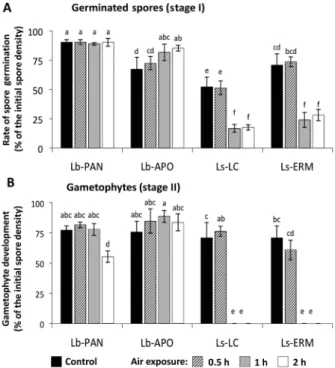
(6) 436. C. López-Cristoffanini et al.: Air exposure and kelp distribution. (Treatment × Population (Species): F = 4.829, p < 0.0004, and F = 7.112, p < 0.000008, for Stage I and Stage II, respectively). A higher proportion of spores from Lessonia berteroana germinated (Stage I) and produced gametophytes (Stage II) under the different air exposure treatments than those from Lessonia spicata (Figure 3A and B, respectively). More than 75% of settled spores from L. berteroana, particularly from Lb-PAN (Figure 3A), germinated in most of air exposure treatments, whereas only 28% or less of L. spicata did so in 1 and 2 h (Figure 3A) of daily exposure to air. The remaining treatments had intermediate values. A similar trend was observed in the levels of gametophytes development. With 1-h-long or shorter daily air exposure, 75% or more of the spores of L. berteroana developed into gametophytes (Figure 3B; Lb-PAN and Lb-APO). Even when exposed to air for 2 h daily, the lowest values were higher than 50% in the progeny from Lb-PAN. In contrast, none of the germinated spores from L. spicata developed into gametophytes when exposed to air for 1 or 2 h daily (Figure 3B; Ls-LC and Ls-ERM).. Antioxidant responses of early development of L. berteroana and L. spicata Basal AP activity, displayed under control conditions, was significantly influenced by stage of development and species (Stage: F = 13.83, p = 0.001, Species: F = 8.85, p = 0.012; Stage × Species: F = 1.85, p = 0.200). This activity was significantly higher in juvenile sporophytes from Lessonia berteroana (Lb-PAN) than in those from Lessonia spicata (Ls-LC) (Figure 4A). In 70-day-old sporophytes, although mean basal AP activity was higher in plantlets of L. berteroana than in L. spicata (Figure 4B), the difference between species was not significant (Species: F = 1.18; p = 0.319; Treatment: F = 3.70; p = 0.103; Species × Treatment: F = 0.002; p = 0.970). It is important to mention that basal AP activity was an order of magnitude higher in 70-day-old sporophytes (Figure 4B) than in juvenile sporophytes (15- to 18-dayold; Figure 4A). While AP activity tended to increase when plants were exposed to air, CAT activity displayed a significant decline (Treatment: F = 21.92; p = 0.003), particularly in L. spicata, compared with control plants (Figure 4B). No significant effects of Species (F = 0.52; p = 0.498) and Species × Treatment (F = 0.144; p = 0.718) were detected.. Discussion. Figure 3 Effect of air exposure on the development of spores from Lessonia berteroana (Lb-PAN and Lb-APO) and Lessonia spicata (Ls-LC and Ls-ERM) from different sites (abbreviations as in Figure 1). Treatments were daily exposure to air for 0.5, 1, or 2 h; control spores and germlings were not exposed to air during the trials. (A) Stage I: settled spores with germ tubes. (B) Stage II: immature and mature gametophytes. Spore germination rate and gametophyte development are expressed as percentage of the initial spore density. Values are mean ± SD of five replicates. Letters above histograms indicate results of Tukey tests; means with the same letter are not significantly different at p = 0.05.. Our results show that for both seaweed species, a long air exposure disrupts the normal life cycle, interfering with normal spore germination and survival, and with maturation of the microscopic stages of development. Our data also show that negative effects of long air exposure on the microscopic stages are accompanied by changes in the activity of CAT, revealing the generation of a desiccation stress condition. Our findings also show a clear differential level of tolerance to air exposure between the species, with spores and progeny of Lessonia spicata being less tolerant than those of its sibling Lessonia berteroana. Development of the microscopic life cycle stages in both sibling species was not different when their spores germinated in the absence of air exposure or when exposed to air during periods of 0.5 h per day. In contrast, under longer periods of daily air exposure (1 h), the normal life cycle of sporelings from the two populations of L. spicata was disrupted as spores suffered high mortality and displayed low germination rates, and gametophytes failed to reach sexual maturity. This clearly differed from the response of L. berteroana, whose spores and gametophytes were not affected by 1 h of daily air exposure.. Brought to you by | Pontificia Universidad Catolica de Chile Authenticated Download Date | 5/9/16 4:51 PM.
(7) C. López-Cristoffanini et al.: Air exposure and kelp distribution. 437. Figure 4 Activity of two antioxidant enzymes in the microscopic stages of Lessonia berteroana from Lb-PAN and Lessonia spicata from Ls-LC (site abbreviations as in Figure 1). (A) Activity of ascorbate peroxidase under control conditions (i.e., no air exposure). Dark gray bars, L. berteroana; light gray bars, L. spicata. Effects of developmental stage and species were significant; see text for details. (B) Activity of ascorbate peroxidase and catalase in 70-day-old sporophytes under control (no air exposure; open bars) and air exposure treatments (2 h daily for 15 days; hatched bars). Values are mean ± SD of three replicates. Effect of treatment was significant; see text for details.. However, prolonged air exposure (2 h per day) negatively affected both species, but in distinct ways. In L. spicata (Ls-LC and Ls-ERM), air exposure mainly affected germination and limited development in Stage I, whereas the main impact in L. berteroana (Lb-PAN and Lb-APO) was on gametophyte maturation (Stage II) and development after fertilization (early sporophytes, Stage III). In nature, these differences in timing could be crucial, particularly when individuals must face periods of intense desiccation generated by prolonged exposure to air. In this situation, L. berteroana, but not L. spicata, would be able to survive and continue its normal development. To distinguish the differences between species from differences among populations of the same species, two neighboring sites inhabited by each of the species (Lb-APO and Ls-ERM) were included in this study. These sites are separated by a 1.5-km-long sandy beach. The results show that, even though these populations occur at the same latitude, their tolerance to air exposure and therefore to desiccation stress was rather different. More over, the tolerance to air exposure is similar between populations of the same species, regardless of their latitude of origin (Figure 3). Thus, these results suggest that air. exposure tolerance is indeed a species-specific trait rather than an adaptation to a given local environment. Increasing the number of populations studied would certainly add robustness to this conclusion. Differential effects of air exposure, and therefore desiccation tolerance, between species at the early life stages are also reflected in their physiology and metabolism. The basal activity of the antioxidant enzyme ascorbate peroxidase (AP) was significantly higher in the early and juvenile sporophytes of L. berteroana than in those of L. spicata (Figure 4A). Owing to the absence of enzyme measurements for plants from neighboring populations, we cannot distinguish whether the differences are species specific or population specific. It has been reported that tolerant species respond to air exposure through their antioxidant system, which results in a rapid attenuation of ROS excess (ContrerasPorcia et al. 2011; Burritt et al. 2002). Both L. spicata and L. berteroana displayed CAT inactivation under air exposure (Figure 4B), suggesting a low capacity to attenuate ROS, particularly H2O2. As the antioxidant system is an important and widespread mechanism to protect all organisms from stress (Blokhina et al. 2003), our results, combined. Brought to you by | Pontificia Universidad Catolica de Chile Authenticated Download Date | 5/9/16 4:51 PM.
(8) 438. C. López-Cristoffanini et al.: Air exposure and kelp distribution. with those on spore and progeny development, suggest that an inactivation of antioxidant machinery to cope with redox cellular fluctuations in L. berteroana and L. spicata is also a species-specific attribute rather than an adaptation to local environments. Our results on the effect of air exposure on microscopic stages help, to some extent, to explain the geographic distribution of the sibling species L. spicata and L. berteroana. The capacity of L. berteroana to stand higher desiccation levels, due to a long air exposure, would likely confer an advantage to colonize and endure both lower and higher latitudes along the Chilean coast. In contrast, the northward distribution of L. spicata is probably limited by the higher levels of desiccation, which likely exceed the physiological tolerance to the stressor by this species. Thus, based on the results, it is suggested that the presence of L. berteroana, and the absence of L. spicata, at lower latitudes might be due to their differences in tolerating long air exposure and thus desiccation stress characteristic of this coastal region. Furthermore, and complementary to the potential effect of desiccation on the species’ latitudinal distribution, there are indications that temperature could also play a role in the latitudinal distribution of the species considered in our study. In this context, reports have shown that L. berteroana is also more tolerant than L. spicata to high temperatures (Oppliger et al. 2011, 2012; see also Martínez 1999), a feature that supports the occurrence of the former species in lower latitudes along the Chilean coast. Although the absence of L. spicata from lower latitudes could be reasonably explained by our results and those in the literature, the absence of L. berteroana at higher latitudes cannot be fully explained by any of the available studies. The mainly northward currents could certainly have an effect by limiting the dispersal of L. berteroana toward southern regions. However, far more research is needed in this context to support the eventual role of coastal oceanographic processes on the dispersal capacity of this kelp. Experimental evidence, on the other hand, suggests that it should be able to tolerate the levels of desiccation occurring in central-southern Chile. Nevertheless, Oppliger et al. (2012) reported a lower fitness of individuals of L. berteroana compared to L. spicata when exposed to low temperature (10°C). Oppliger et al. (2012) suggested that such a difference in fitness could be a factor influencing the absence of L. berteroana at higher latitudes. Clearly, as mentioned by numerous authors (see Sexton et al. 2009), species distributions depend upon multiple and interactive factors. Therefore, results on the patterns of tolerance to only a couple of factors as responsible for latitudinal distribution of the two species of Lessonia should be interpreted carefully.. It should also be considered that the main pattern of latitudinal variation of SST and air exposure does not exclude variations at smaller spatial scales. Although beyond the scope of this study, our results raise new questions. It seems unlikely that only temperature and air exposure can explain the absence of coexistence of species, and the fine distribution in a mosaic of pure populations of the two species where their ranges overlap (29–30°S) (Tellier et al. 2009, 2011a). Fine-scale characterization of one of the distribution limits for the two model species (only low intertidal individuals were sampled) (Tellier et al. 2011a) revealed the absence of coexistence of the two species. Considering our results, the need for further studies, including vertical sampling in order to assess the possibility of species coexistence within the same site but at different vertical heights, becomes apparent. At small geographic scales, several studies have demonstrated that tolerance to desiccation affects species distribution within the rocky intertidal zone, with tolerant species dominating the upper intertidal zone (Dring and Brown 1982, Smith and Berry 1986, Schagerl and Möstl 2011, ContrerasPorcia et al. 2012, 2013, Flores-Molina et al. unpublished data). In this context, and based on our results and those of Oppliger et al. (2012), it seems reasonable to expect that some sites sampled in the low intertidal by Tellier et al. (2011a) were occupied by L. berteroana, forcing L. spicata into the shallow subtidal of the same sites. A reasonable explanation for the occurrence of pure populations of L. spicata within the mosaic area is still required. Patches in the low intertidal within which L. spicata individuals occur are sizable (20–50 km of coastline, F. Tellier, pers. obs.) in this mosaic region. The current knowledge of the biology of the two Lessonia species does not allow us to understand the presence of these individuals in the lower intertidal zone, and further studies should consider factors such as species interactions, including competitive exclusion, reproductive output, and interference among germlings. Our present study highlights the importance of considering the vertical distribution of Lessonia individuals to detect potential coexistence on the same shore. The use of two sibling species has the additional advantage of allowing the inferential analysis of factors believed to be active during and after the speciation process. In this context, it seems reasonable to expect that differential air exposure and temperature tolerances may have played an important role during the speciation process. Tellier et al. (2009) suggested a budding speciation event, a type of parapatric speciation, involving the colonization of new habitat (in this case the northern Chilean coast) by a reduced number of individuals. It has been hypothesized that acquisition of an adaptive trait. Brought to you by | Pontificia Universidad Catolica de Chile Authenticated Download Date | 5/9/16 4:51 PM.
(9) C. López-Cristoffanini et al.: Air exposure and kelp distribution. might have allowed this colonization. Thus, if the new habitat was characterized by conditions similar to those present today (e.g., high air and SST, low RH, leading to the exposure of individuals to higher desiccation stress), adaptation to these conditions should have allowed the expansion of the range distribution and speciation in Lessonia, when combined with other evolutionary processes such as strong genetic drift and a likely low dispersal capacity.. Conclusion This study has demonstrated that the sibling species Lessonia berteroana and Lessonia spicata have contrasting developmental and physiological responses when submitted to air exposure. The greater tolerance to air exposure of L. berteroana compared to L. spicata could explain, to some extent, their contrasting geographic distribution along the climatic gradient characteristic of the Chilean coast. Air exposure affected the development of early life stages and the antioxidant system in the two species. A complete understanding of the mechanisms limiting the geographic distribution of these two cryptic species requires additional studies, including both the. 439. microscopic and macroscopic life stages. Management plans should consider these ecological differences in order to ensure a sustainable harvesting of these natural resources. Acknowledgments: This work was supported by FONDECYT 11085019 and FONDECYT 1120117 to L.C-P. Additional funding came from FONDECYT 11121504 grant and from the UCSC Dirección de Investigación to F.T., FONDAP 1501-0001 (CONICYT) to the Center for Advanced Studies in Ecology and Biodiversity (CASEB) Program 7, and ICA grant to J.C. Collaborative work was done within the framework of the GDRI “Diversity, Evolution and Biotechnology of Marine Algae “DEBMA.” We are especially grateful to C. Lovazzano, E. Guajardo, C. Sordet, M. R. Flores-Molina, and the Chango-Lab for field assistance, to J. Beltrán, D. Thomas, and L. Hiriart-Bertrand for help in culture work, to V. Flores for imaging acquisition and to B. Broitman, L. Chaparro, M. Valero, and N. Valdivia for their valuable suggestion in statistical and climatic analyses. We particularly appreciate the constructive comments from the Editor and from two anonymous reviewers that helped improve the manuscript.. Received 30 April, 2013; accepted 1 November, 2013. References Alpert, P. 2005. The limits and frontiers of desiccation-tolerant life. Integr. Comp. Biol. 45: 685–695. Asada, K. 1999. The water-water cycle in chloroplasts: scavenging of active oxygen and dissipation of excess photons. Annu. Rev. Plant Physiol. 50: 601–639. Avila, M., A.J. Hoffmann and B. Santelices. 1985. Interacciones de temperatura, densidad de flujo fotónico y fotoperiodo sobre el desarrollo de etapas microscópicas de Lessonia nigrescens (Phaeophyta, Laminariales). Rev. Chil. Hist. Nat. 58: 71–82. Bell, E.C. 1993. Photosynthetic response to temperature and desiccation of the intertidal alga Mastocarpus papillatus. Mar. Biol. 117: 337–346. Bergey, E.A., P. Bunlue, S. Silalom, D. Thapanya and P. Chantaramongkol. 2010. Environmental and biological factors affect desiccation tolerance of algae from two rivers (Thailand and New Zealand) with fluctuating flow. J. N. Am. Benthol. Soc. 29: 725–736. Bickford, D., D.J. Lohman, N.S. Sodhi, P.K.L. Ng, R. Meier, K. Winker, K.K. Ingram and I. Das. 2006. Cryptic species as a window on diversity and conservation. Trends Ecol. Evol. 22: 148–155. Blokhina, O., E. Virolainen and K.V. Fagerstedt. 2003. Antioxidants, oxidative damage and oxygen deprivation stress: a review. Ann. Bot. 91: 179–194.. Burritt, D.J., J. Larkindale and C.L Hurd. 2002. Antioxidant metabolism in the intertidal red seaweed Stictosiphonia arbuscula following desiccation. Planta 215: 829–838. Casey, K.S. and P. Cornillon. 1999. A comparison of satellite and in situ-based sea surface temperature climatologies. J. Climate 12: 1848–1863. Collén, J. and I.R. Davison. 1999a. Reactive oxygen production and damage in intertidal Fucus spp. (Phaeophyceae). J. Phycol. 35: 54–61. Collén, J. and I.R. Davison. 1999b. Reactive oxygen metabolism in intertidal Fucus spp. (Phaeophyceae). J. Phycol. 35: 62–69. Compo, G.P., J.S. Whitaker, P.D. Sardeshmukh, N. Matsui, R.J. Allan, X. Yin, B.E. Gleason, R.S. Vose, G. Rutledge, P. Bessemoulin, S. Brönnimann, M. Brunet, R.I. Crouthamel, A.N. Grant, P.Y. Groisman, P.D. Jones, M. Kruk, A.C. Kruger, G.J. Marshall, M. Maugeri, H.Y. Mok, Ø. Nordli, T.F. Ross, R.M. Trigo, X.L. Wang, S.D. Woodruff and S.J. Worley. 2011. The Twentieth Century Reanalysis Project. Q. J. R. Meteorol. Soc. 137: 1–28. Contreras, L., A. Moenne and J.A. Correa. 2005. Antioxidant responses in Scytosiphon lomentaria (Phaeophyceae) inhabiting copper-enriched coastal environments. J. Phycol. 41: 1184–1195. Contreras, L., M.H. Medina, S. Andrade, V. Oppliger and J.A. Correa. 2007. Effects of copper on early developmental stages. Brought to you by | Pontificia Universidad Catolica de Chile Authenticated Download Date | 5/9/16 4:51 PM.
(10) 440. C. López-Cristoffanini et al.: Air exposure and kelp distribution. of Lessonia nigrescens Bory (Phaeophyceae). Environ. Pollut. 145: 75–83. Contreras, L., D. Mella, A. Moenne and J.A. Correa. 2009. Differential responses to copper-induced oxidative stress in the marine macroalgae Lessonia nigrescens and Scytosiphon lomentaria (Phaeophyceae). Aquat. Toxic. 94: 94–102. Contreras-Porcia, L., D. Thomas, V. Flores and J.A. Correa. 2011. Tolerance to oxidative stress induced by desiccation in Porphyra columbina (Bangiales, Rhodophyta). J. Exp. Bot. 62: 1815–1829. Contreras-Porcia, L., S. Callejas, D. Thomas, C. Sordet, G. Pohnert, A. Contreras, A. Lafuente, M.R. Flores-Molina and J.A. Correa. 2012. Seaweeds early development: detrimental effects of desiccation and attenuation by algal extracts. Planta 235: 337–348. Contreras-Porcia, L., C. López-Cristoffanini, C. Lovazzano, M.R. FloresMolina, E. Guajardo, D. Thomas, A. Nuñez, J.A. Correa, M. Kube and R. Reinhardt. 2013. Differential gene expression in Pyropia columbina (Plantae, Rhodophyta) under natural hydration and desiccation stress. Lat. Am. J. Aquat. Res. 41: 933–958. Correa, J.A. and J.L. McLachlan. 1991. Endophytic algae of Chondrus crispus (Rhopophyta). III. Host specificity. J. Phycol. 27: 448–459. Dorgelo, J. 1976. Intertidal fucoid zonation and desiccation. Aquat. Ecol. 10: 115–112. Dring, M.J. and F.A. Brown. 1982. Photosynthesis of intertidal brown algae during and after periods of emersion: a renewed search for physiological causes of zonation. Mar. Ecol. Prog. Ser. 8: 301–308. Druehl, L.D. and J.M. Green. 1982. Vertical distribution of intertidal seaweeds as related to patterns of submersion and emersion. Mar. Ecol. Prog. Ser. 9: 163–170. Finke, G.R., S.A. Navarrete and F. Bozinovic. 2007. Tidal regimes of temperate coasts and their influences on aerial exposure for intertidal organisms. Mar. Ecol. Prog. Ser. 343: 57–62. Foyer, C.H. and G. Noctor. 2009. Redox regulation in photosynthetic organisms: signaling, acclimation, and practical implications. Antiox. Redox Signal. 11: 861–905. González, A., J. Beltrán, L. Hiriart-Bertrand, V. Flores, B. de Reviers, J.A. Correa and B. Santelices. 2012. Identification of cryptic species in the Lessonia nigrescens complex (Phaeophyceae, Laminariales). J. Phycol. 48: 1153–1165. Helmuth, B., B.R. Broitman, C.A. Blanchette, S. Gilman, P. Halpin, C.D.G. Harley, M.J. O’Donnell, G.E. Hofmann, B. Menge and D. Strickland. 2006. Mosaic patterns of thermal stress in the rocky intertidal zone: implications for climate change. Ecol. Monogr. 76: 461–479. Lovazzano, C., S. Andrade, C. Serrano, J.A. Correa and L. ContrerasPorcia. 2013. Comparative analysis of the peroxiredoxin activation in the brown macroalgae Scytosiphon gracilis and Lessonia nigrescens (Phaeophyceae) under copper stress. Physiol. Plant. 149: 378–388. Martínez, EA. 1999. Latitudinal differences in thermal tolerance among microscopic sporophytes of the kelp Lessonia nigrescens (Phaeophyta: Laminariales). Pac. Sci. 53: 74–81. Mislan, K.A.S., D.S. Wethey and B. Helmuth. 2009. When to worry about the weather: role of tidal cycle in determining patterns of risk in intertidal ecosystems. Glob. Change Biol. 15: 3056–3065. Noctor, G. and C.H. Foyer. 1998. Ascorbate and glutathione: keeping active oxygen under control. Annu. Rev. Plant Physiol. Plant Mol. Biol. 49: 249–279. Oppliger, L.V., J.A. Correa, S. Faugeron, J. Beltrán, F. Tellier, M. Valero and C. Destombe. 2011. Sex ratio variation in the Lessonia. nigrescens complex (Laminariales, Phaeophyceae): effect of latitude, temperature and marginality. J. Phycol. 47: 5–12. Oppliger, L.V., J.A. Correa, A.H. Engelen, F. Tellier, V. Vieira, S. Faugeron, M. Valero, G. Gomez and C. Destombe. 2012. Temperature effects on gametophyte life-history traits and geographic distribution of two cryptic kelp species. PLoS One 7: e39289. Ratkevicius, N., J.A. Correa and A. Moenne. 2003. Copper accumulation, synthesis of ascorbate and activation of ascorbate peroxidase in Enteromorpha compressa (L) Grev. (Chlorophyta) from heavy metal-enriched environments in northern Chile. Plant Cell Environ. 26: 1599–1608. Repetto, G., A. Peso and J.L. Zurita. 2008. Neutral red uptake assay for the estimation of cell viability/cytotoxicity. Nat. Prot. 3: 7. Schagerl, M. and Möstl, M. 2011. Drought stress, rain and recovery of the intertidal seaweed Fucus spiralis. Mar. Biol. 158: 2471–2479. Sexton, J.P., P.J. McIntyre, A.L. Angert and K.J. Rice. 2009. Evolution and ecology of species range limits. Annu. Rev. Ecol. Evol. Syst. 40: 415–436. Smith, C.M. and J.A. Berry. 1986. Recovery of photosynthesis after exposure of intertidal algae to osmotic and temperature stresses: comparative studies of species with differing distributional limits. Oecologia 70: 6–12. Smith, P.K., R.I. Krohn, G.T. Hermanson, A.K. Mallia, F.H. Garthner, M.D. Provenzano, E.K. Fujimoto, N.M. Goeke, B.J. Olson and D.C. Klenk. 1985. Measurement of protein using bicinchoninic acid. Anal. Biochem. 150: 76–85. Steneck, R.S., M.H. Graham, B.J. Bourque, D. Corbett, J.M. Erlandson, J.A. Estes and M.J. Tegner. 2002. Kelp forest ecosystems: biodiversity, stability, resilience and future. Environ. Conserv. 29: 436–459. Tellier, F., A.P. Meynard, J.A. Correa, S. Faugeron and M. Valero. 2009. Phylogeographic analyses of the 30°S south-east Pacific biogeographic transition zone establish the occurrence of a sharp genetic discontinuity in the kelp Lessonia nigrescens: vicariance or parapatry? Mol. Phylogenet. Evol. 53: 679–693. Tellier, F., J. Tapia, S. Faugeron, C. Destombe and M. Valero. 2011a. The Lessonia nigrescens species complex (Laminariales, Phaeophyceae) shows strict parapatry and complete reproductive isolation in a secondary contact zone. J. Phycol. 47: 894–903. Tellier, F., J.M.A. Vega, B.R. Broitman, J.A. Vásquez, M. Valero and S. Faugeron. 2011b. The importance of having two species instead of one in kelp management: the Lessonia nigrescens species complex. Cah. Biol. Mar. 42: 455–465. Thiel, M., E.C. Macaya, E. Acuña, W.E. Arntz, H. Bastias, K. Brokordt, P.A. Camus, J.C. Castilla, L.R. Castro, M. Cortés, C.P. Dumont, R. Escribano, M. Fernandez, J.A. Gajardo, C.F. Gaymer, I. Gomez, A.E. González, H.E. González, P.A. Haye, J.E. Illanes, J.L. Iriarte, D.A. Lancellotti, G. Luna-Jorquera, C. Luxoro, P.H. Manriquez, V. Marín, P. Muñoz, S.A. Navarrete, E. Perez, E. Poulin, J. Sellanes, H.H. Sepúlveda, W. Stotz, F. Tala, A. Thomas, C.A. Vargas, J. Vásquez and J.M.A. Vega. 2007. The Humboldt Current System of northern and central Chile. Oceanogr. Mar. Biol. Annu. Rev. 45: 195–134. Underwood, A. J. 1997. Experiments in ecology: their logical design and interpretation using analysis of variance. Cambridge University Press, Cambridge, UK. pp. 504. Zar, J.H. 2010. Biostatistical analysis. 5th Edition. Pearson PrenticeHall, Upper Saddle River, NJ. pp. 960.. Brought to you by | Pontificia Universidad Catolica de Chile Authenticated Download Date | 5/9/16 4:51 PM.
(11)
Figure


Documento similar
Growth of F113 was tested using nitrate and nitrite as final electron acceptors under anaerobic conditions in two different media: LB and SA.. In order to estimate optimal
The presence of both luminescent species at the interface, as well as the organization of the TSPP underneath the Ir-complex matrix in Langmuir and LS films, is inferred by surface
In this sample of non-smoking older adults from the US general population, exposure to SHS, as measured using serum cotinine concentrations and self-reported information on the
This Ph.D. dissertation is centered on the more “classical” applications of LS in the context of image coding: the analysis and improvement of existing wavelets as in §3.4.3 and
The principle behind this meth- od shown in Figure 1 is to create the desired channel model by positioning an arbitrary number of probe antennas in arbitrary positions within
THE EFFECT OF AIR–LUBRICATION ON SHIP FRICTION RESISTANCE 32 scale ship to predict the distribution of the air bubble void fraction on the hull surface, which
The aim of this study is to investigate the effect on the physical and mechanical properties of four different types of mortars after exposure to a sulfuric acid attack: (i) a
Here, we investigated the effect of fluoride- exposure on the reproductive ability of male rats and the relationship of oxidative damage and spermatozoa mitochondrial
