Removal of -pinene from waste
gases in one- and two-liquid-phase
gases in one and two liquid phase
stirred tank bioreactors and
biotrickling filters
María Montes Carro
UNIVERSITY OF A CORUÑA
DOCTORAL THESIS
REMOVAL OF
-PINENE FROM WASTE GASES IN ONE- AND
TWO-LIQUID-PHASE STIRRED TANK BIOREACTORS AND
BIOTRICKLING FILTERS
Author
María Montes Carro
Supervisor
Dr. Christian Kennes
Dra. María del Carmen Veiga Barbazán
UNIVERSITY OF A CORUÑA
DEPARTMENT OF PHYSICAL CHEMISTRY AND CHEMICAL
ENGINEERING I
TESIS DOCTORAL
ELIMINACIÓN DE
-PINENO DE EFLUENTES GASEOSOS EN
BIORREACTORES DE TANQUE AGITADO Y BIOFILTROS
PERCOLADORES EN UNA Y DOS FASES LÍQUIDAS
Autor
María Montes Carro
Director
Dr. Christian Kennes
Dra. María del Carmen Veiga Barbazán
UNIVERSIDADE DA CORUÑA
DEPARTAMENTO DE QUIMICA FÍSICA E ENXEÑERÍA
QUIMICA I
UNIVERSIDADE DA CORUÑA
DEPARTAMENTO DE QUÍMICA
FÍSICA E ENXEÑERÍA QUIMICA I
Facultade de Ciencias Campus da Zapateira, s/n. 15071 A Coruña (España)
Juan Arturo Santaballa López
, Director del Departamento de Química
Física e Enxeñería Química I de la Universidad de A Coruña,
Certifica
Que la Licenciada en Química
María Montes Carro
ha realizado en
este departamento, bajo la dirección del Dr. Christian Kennes y la
Dra. María del Carmen Veiga Barbazán, el trabajo titulado
Elimina-ción de
-pineno de efluentes gaseosos en biorreactores de
tan-que agitado y biofiltros percoladores en una y dos fases líquidas
,
que presenta para optar al grado de
Doctora en Química
.
Y para que así conste, expide y firma la presente en A Coruña,
a de de 2014.
UNIVERSIDADE DA CORUÑA
DEPARTAMENTO DE QUÍMICA
FÍSICA E ENXEÑERÍA QUIMICA I
Facultade de Ciencias Campus da Zapateira, s/n. 15071 A Coruña (España)
Christian Kennes y María del Carmen Veiga Barbazán
, Catedráticos
del Departamento de Química Física e Enxeñería Química I de la
Universi-dad de A Coruña,
Certifican
Que el trabajo titulado
Eliminación de
-pineno de efluentes
ga-seosos en biorreactores de tanque agitado y biofiltros
percolado-res en una y dos fases líquidas
ha sido realizado por la Licenciada
en Química
María Montes Carro
en el Departamento de Química
Física e Enxeñería Química I y que, como Directores del mismo,
au-torizan su presentación para optar al grado de
Doctora en Química
.
Y para que así conste, expiden y firman la presente en A Coruña,
a de de 2014.
Agradecimientos
Quiero expresar mi agradecimiento a todas aquellas personas que directa o indirectamente han participado y me han acompañado durante el desarrollo de este trabajo.
En primer lugar, a mis directores de tesis. Al Dr. Christian Kennes por su constante y paciente seguimiento, y por confiar en mí desde el primer día; y a la Dra. María del Carmen Veiga por su apoyo y dirección.
Al Ministerio de Ciencia e Innovación por la concesión del proyecto CTM 2007-62700/TECNO, cofinanciado con fondos FEDER de la Comunidad Europea, y a la Universidad de A Coruña. Gracias a su financiación he podido realizar esta tesis.
Thanks to Dr. Andrew Daugulis for allowing me a stay at Queen´s University (Ontario, Canada). Thanks to him and his group for their warm reception and make it an unforgettable experience.
My sincere thanks to Eldon, my daily supervisor, for his dedication and his support. I am thankful to him for his guidance and knowledge in assisting me throughout my research.
A mis amigos y compañeros del Laboratorio de Ingeniería Química de la UDC. Gracias por los buenos momentos que hemos pasado juntos, y por hacer que los días en el laboratorio hayan sido más llevaderos.
De manera muy especial quiero agradecer a Fani el apoyo recibido a lo largo de todo este tiempo a la hora de afrontar este gran reto.
Y, desde luego, llego al final de este proyecto gracias a mis padres que han hecho posible todo lo que he logrado; a mi hermano por su invaluable apoyo; y a Pablo, por su paciencia y comprensión.
i
Objectives and abstract
Each year, industrial countries generate billions of tons of pollutants that are emitted to the atmosphere causing changes in the structure and functioning of ecosystems. The need to monitor the concentrations of these emissions derives mainly from their toxicity, their ability to participate in photochemical reactions, and their importance as aerosol precursors. An alternative for the treatment of gaseous effluents prior to their release to the atmosphere is the use of biological systems in which microorganisms are specifically selected to biodegrade contaminants. Such systems have high removal efficiencies associated with low operating costs, making them ideal choices for pollutant treatment. The main objective of this research is the development and the optimization of bioreactors capable of performing efficiently the biodegradation of -pinene, found mainly in gaseous effluents from the wood industry, and from pulp and paper industries.
Initially, Chapter 1 summarizes the different physico-chemical and biological systems available for the removal of volatile organic compounds, as well as their advantages and disadvantages. Chapter 2 includes a review of the basic chemical properties of -pinene, and an overview of published studies based on its disposal. The materials and methods used for the determination of the different parameters to carry out this research are presented in Chapter 3.
In the following chapters, different experimental designs are conducted to optimize the bioreactors for -pinene removal, and the results obtained are presented. In Chapter 4, two biotrickling filters fed with an -pinene loaded gas stream, were inoculated at two different temperatures, with the fungus Ophiostoma. Their performance was evaluated in the presence of a single aqueous phase and in presence of two immiscible liquid phases, using silicone oil as organic phase. Also, we performed a similar study using another type of bioreactor, a stirred tank, inoculated with a bacterial co-culture whose results are described in Chapters 5 and 6.
ii
and a biotrickling filter, and the influence of temperature in their performance, were also evaluated. To summarize, the last section provides some conclusions and recommendations for future research.
iii
Objetivos y resumen
Cada año, los países industrializados generan miles de millones de toneladas de contaminantes que son emitidos a la atmósfera, ocasionando alteraciones en la estructura y el funcionamiento de los ecosistemas. La necesidad de vigilar las concentraciones de dichas emisiones deriva fundamentalmente de su toxicidad, de la formación de reacciones fotoquímicas, y de su importancia como precursores de aerosoles. Una alternativa para el tratamiento de efluentes gaseosos, previamente a su liberación a la atmósfera, es el empleo de sistemas biológicos en los que cultivos de microorganismos son seleccionados específicamente para biodegradar contaminantes. Dichos sistemas presentan elevadas eficacias de eliminación asociadas a bajos costes de operación, lo que los convierte en opciones ideales para el control y el tratamiento de emisiones atmosféricas. El objetivo principal de esta investigación es el desarrollo y la optimización de biorreactores aptos para realizar de manera eficiente la biodegradación del -pineno, que se encuentra fundamentalmente en efluentes gaseosos de industrias de la madera y de la producción de pasta y papel.
Inicialmente, en el capítulo 1 se resumen los diversos sistemas físico-químicos y biológicos para la eliminación de compuestos orgánicos volátiles, así como sus ventajas e inconvenientes.
El capítulo 2 incluye una revisión de las propiedades químicas básicas del -pineno, así como una visión general sobre diversos estudios publicados basados en su eliminación. Los materiales y los métodos utilizados para la determinación de los distintos parámetros durante la realización de este trabajo se presentan en el capítulo 3.
En los capítulos siguientes se presentan los diseños experimentales llevados a cabo para la optimización de los biorreactores para la eliminación de -pineno, junto con los resultados obtenidos. En el capítulo 4, dos filtros percoladores alimentados con aire contaminado de -pineno fueron inoculados a diferentes temperaturas con un hongo de la especie Ophiostoma. El rendimiento fue evaluado en presencia de una fase acuosa y de dos fases liquidas inmiscibles, utilizando aceite de silicona como fase orgánica. Paralelamente, se realizó un estudio similar utilizando otro tipo de biorreactor, un tanque agitado, inoculado con un co-cultivo bacteriano, cuyos resultados se describen en los capítulos 5 y 6.
iv
a cabo utilizando como fase de atrapamiento un polímero inerte en lugar de una fase orgánica. En el capítulo 7 se describen los ensayos realizados para la selección de dicho polímero, entre los que se incluyen la determinación del coeficiente de partición y difusión, y la biodegradabilidad. En los capítulos sucesivos (8, 9 y 10) se evaluó la capacidad de usar un polímero inerte para la biodegradación de -pineno, tanto en un tanque agitado como en un filtro percolador, y la influencia de la temperatura en el proceso. Finalmente, se incluye una sección que proporciona algunas conclusiones y recomendaciones para investigaciones futuras.
v
Table of contents
Objectives and abstract ... i
Objetivos y resumen ... iii
Table of contents ...v
Chapter 1. General introduction ...1
1.1 Air pollution ...2
1.2 Terpenes toxicology ...2
1.2.1 Limit values ...3
1.2.2 -Pinene emissions ...4
1.2.3 -Pinene release during industrial processes. Mechanisms ...5
1.3 Technologies for the treatment of waste-gases ...5
1.3.1 Physical-chemical technologies ...6
1.3.2 Biological technologies ...9
1.3.3 Novel bioreactors for waste-gas treatment ... 15
1.3.4 Other bioreactors configurations ... 20
1.3.5 Factors affecting bioreactor performance ... 23
1.3.6 Operating parameters of bioreactors ... 26
1.4 References ... 28
Chapter 2. Biodegradation of -pinene: Literature review ... 33
2.1 -Pinene: Global scenario ... 34
2.2 Basic properties of -pinene ... 34
2.3 Biodegradation of -pinene by different strains: reference pathway ... 38
2.4 Physical-chemical process for -pinene removal ... 39
2.5 Biological processes for -pinene removal ... 40
2.6 References ... 46
Chapter 3. Materials and methods ... 53
3.1 Microbial culture ... 54
3.1.1 Maintenance and isolation of strains ... 54
3.2 Continuous removal studies ... 54
3.2.1 Bioreactors ... 55
3.3 Batch studies ... 61
3.4 Analytical techniques ... 62
3.4.1 -Pinene ... 62
3.4.2 Carbon dioxide composition ... 63
3.4.3 pH ... 64
3.4.4 Absorbance ... 64
3.4.5 Temperature ... 64
3.4.6 Pressure drop ... 65
3.4.7 Air flow ... 65
3.4.8 Scanning electron microscopy... 65
vi
Chapter 4. Two-liquid-phase mesophic and thermophilic biotrickling filters for the
biodegradation of -pinene ... 67
4.1 Introduction ... 68
4.2 Materials and methods ... 69
4.2.1 Microbial seed and medium ... 69
4.2.2 Filter material ... 70
4.2.3 Biotrickling filters ... 70
4.2.4 Batch biodegradation experiments ... 71
4.2.5 Analytical methods ... 72
4.3 Results and discussion ... 73
4.3.1 Batch biodegradation experiments ... 73
4.3.2 Biotrickling filters performance without silicone oil ... 74
4.3.3 Biotrickling filters performance in presence of silicone oil ... 77
4.4 Conclusions ... 81
4.5 References ... 82
Chapter 5. Effect of oil concentration and residence time on the biodegradation of -pinene vapours in two-liquid phase suspended-growth bioreactors ... 85
5.1 Introduction ... 86
5.2 Materials and methods ... 87
5.2.1 Chemicals ... 87
5.2.2 Microorganism and growth conditions ... 87
5.2.3 Experimental ... 88
5.2.4 Analytical procedures ... 91
5.3 Results and discussion ... 92
5.3.1 Batch biodegradation experiments ... 92
5.3.2 Partition coefficients ... 94
5.3.3 Influence of silicone oil concentration on the uptake of biomass from the aqueous phase ... 95
5.3.4 Performance of the one-liquid-phase bioreactor ... 96
5.3.5 Performance of the two-liquid-phase bioreactor ... 99
5.3.6 Biomass concentration ... 102
5.3.7 Mass balance calculations ... 103
5.3.8 Shock-loads ... 105
5.4 Conclusions ... 108
5.5 References ... 108
Chapter 6. Steady- and transient-state performance of a thermophilic suspended-growth bioreactor for -pinene removal from polluted air ... 113
6.1 Introduction ... 114
6.2 Materials and methods ... 119
6.2.1 Chemicals ... 119
6.2.2 Microorganism and mineral salt medium ... 119
6.2.3 Experimental ... 119
vii
6.3 Results and discussion ... 122
6.3.1 Partition coefficients ... 122
6.3.2 Bioreactor performance under steady-state conditions ... 123
6.3.3 Effect of transient-state operations ... 127
6.3.4 Batch biodegradation tests ... 129
6.4 Conclusions ... 132
6.5 References ... 132
Chapter 7. Characterization of absorbent polymers for the removal of volatile hydrophobic pollutants from air ... 137
7.1 Introduction ... 138
7.2 Materials and methods ... 139
7.2.1 Chemicals and polymers ... 139
7.2.2 Biocatalyst and culture conditions ... 140
7.2.3 Polymer partition coefficient ... 140
7.2.4 Absorption tests ... 142
7.2.5 Diffusion coefficient of -pinene ... 142
7.2.6 Biodegradability ... 142
7.2.7 Analytical methods ... 142
7.3 Results and discussion ... 143
7.3.1 Polymer selection ... 143
7.3.2 Partition coefficients ... 143
7.3.3 Absorption tests ... 147
7.3.4 Diffusivity ... 148
7.3.5 Biodegradability ... 149
7.4 Conclusions ... 150
7.5 References ... 150
Chapter 8. Influence of polymeric material son the performance of a mesophilic biotrickling filters treating an -pinene contaminated gas stream ... 155
8.1 Introduction ... 156
8.2 Materials and methods ... 157
8.2.1 Chemicals and polymers ... 157
8.2.2 Microorganism and mineral salt medium ... 160
8.2.3 Experimental ... 160
8.3 Results and discussion ... 163
8.3.1 Partition coefficient ... 163
8.3.2 Diffusivity ... 164
8.3.3 Effect of operating conditions ... 165
8.3.4 Biotrickling filter performance ... 169
8.4 Conclusions ... 174
8.5 References ... 174
viii
Chapter 9. Optimization of the performance of a thermophilic biotrickling filter for -pinene removal from polluted air ... 179
9.1 Introduction ... 180 9.2 Materials and methods ... 182 9.2.1 Chemicals and packing material... 182 9.2.2 Microbial seed and culture media ... 182 9.2.3 Batch sorption experiments ... 183 9.2.4 Experimental system and operational conditions ... 183 9.2.5 Analytical techniques ... 184 9.3 Results and discussion ... 186 9.3.1 Partition coefficient ... 186 9.3.2 Biotrickling filter performance under steady-state conditions ... 186 9.3.3 Effect of transient-state operations ... 191 9.4 Conclusions ... 194 9.5 References ... 194 Chapter 10. Influence of solid polymers on the response of multi-phase bioreactors treating -pinene-polluted air ... 199
Chapter 1
Chapter 1
2
1.1 AIR POLLUTION
The air we breathe is a mixture of gases composed of oxygen (21%) nitrogen (78%), argon (1%), carbon dioxide (0.03%) and small amounts of other gases. Every day, each person inhales about 13000 to 15000 liters of air on an average. The effects of air pollution are diverse and numerous. From air quality depends the purity of our blood, body's ability to synthesize food, the elimination of toxic products, the energy of our muscles, the clarity of our brain and even the duration of our life. Unfortunately, the condition of the air we breathe nowadays is not good enough to keep our lungs pink and flexible.
The sources of air pollution can be divided into natural and artificial. The first, as emanations of volcanoes, are inevitable. We can only try to reduce damage and consequences. Sources of pollution that can be avoided are the artificial ones, produced by human activities. As one might expect, humans have been producing increasing amounts of pollution as time has progressed, and they now account for the majority of pollutants released into the air. Furthermore, it is widely recognized that excessive emissions of volatile organic compounds (VOCs) to the atmosphere can cause adverse impacts, such as high concentrations of ozone (O3). Ozone is a phytotoxic compound, and affects the cell permeability, leaf necrosis, crop yield reductions and it has a possible involvement in forest decline. This compound is formed in the troposphere by photochemical reactions involving reactive hydrocarbons in the presence of nitrogen oxides and sunlight. Among others, a range of monoterpene (C10H16) compounds are considered the most important species involved in this reaction (Hester and Harrison, 1995).
1.2 TERPENES TOXICOLOGY
General introduction
3
Exposure to monoterpenes such as -pinene, -pinene and 3-carene, showed no major changes in lung function, but showed chronic reaction in the airways (reduced lung function values which persist between shifts) in workers of joinery shops (Eriksson et al., 1997). It is
related to the high solubility of terpenes in human blood. Blood:air partition coefficient is 15 for -pinene suggesting that absorption by the lungs is very efficient (Falk et al., 1990a;
Masten, 2002). In studies of dwelling, bronchial hyper-responsiveness could be related to indoor air concentrations of d-limonene. Other studies did not find significant changes in the respiratory track. However, these studies postulate effects of metabolites of pinenes as relevant causative agents (Wypych, 2001).
Falk et al. (1990b) studied the toxicokinetics of -pinene in human volunteers by inhalation,
in which high affinity to adipose tissues was observed. Pulmonary uptake averaged about 60% for an exposure of 450 mg m-3 while the total blood clearance was about 1.1 L h-1 kg-1. However, after the exposure time only 0.001% of the total uptake was eliminated in the urine and about 8% by the exhaled air, resulting in long half-time poorly perfused tissues. In a study to determine the uptake of -pinene in rats, inhalation of turpentine at 300 ppm over eight weeks resulted in an accumulation of -pinene in the perinephric fat. Brain concentrations of -pinene did not exceed one-tenth the concentration found in the fat. There was an initial decrease in brain RNA, followed by recovery. It was concluded that for modest exposures (300 ppm or 1/7 LC50 for a six hour exposure), there was clearly an acute effect on brain RNA. The short-term effects returned to control levels after eight weeks (Masten, 2002).
1.2.1 Limit values
Relevant limit values for terpenes are rare because of a lack of basic information about specific terpene products and by-products and because of occupational and environmental exposures. The limit values which have been documented the best concern turpenine. A MAK-value of 100 ppm is defined in German regulations and noted to be dermally sensitive. For other terpenes, a MAK-value has not yet been established because of lack of information of their effects on animals or humans (Wypych, 2001).
Chapter 1
4
lower lung function was observed in workers than local referents, even when smokers and ex-smokers were excluded (Eriksson et al., 1997; Hedenstierna et al., 1983).
1.2.2
-Pinene emissions
Trees contain both non-volatile (fixed) compounds and VOCs, and emit the volatile compounds as part of the tree’s natural life cycle. As Beauchemin and Tampier (2010) reported, the most common volatile compounds originating from resin are primarily terpenes; -pinene, -pinene, -3 carene and sabinene, and the monocyclic terpenes limonene and terpinolene, that in part give forests their natural wood lands fragrance.
-Pinene is a principal member of the chemical category designated as “Bicyclic Terpene Hydrocarbons”. It is considered one of the most common C10 terpene hydrocarbons in nature and as a bicyclic terpene hydrocarbon, it is produced by the isoprene pathway, an integral part of normal plant biosynthesis. Estimates of atmospheric concentrations of - and -pinene in urban indoor air, rural outdoor air (Pinus forest canopy), and occupational environments have
been reported to be approximately 5-10 g m-3 (Samfield, 1992), 500-1200 g m-3 (Kodama
et al., 1977) and 200000-500000 g m-3, respectively (Sittig, 1977).
Related to the artificial emissions produced by human activities, the crude sulfate turpentine is a bicyclic terpene hydrocarbon which is obtained from wood pulp as a waste product in the manufacture of cellulose via the sulfate process. In the United State, the crude sulfate turpentine obtained from southern paper mills consists mainly of -pinene (60-70%), and -pinene (20-25%), together with small amounts of other compounds such as limonene (3-10%), anethole (1-2%) and aliphatic tertiary alcohols (3-7%) (EPA, 2002). Another minor source of bicyclic terpene hydrocarbons in wood turpentine is obtained by the steam distillation of chopped tree trunks and dead wood. In addition, bicyclic terpene hydrocarbons are also the principal constituents of all turpentine oils.
These turpentine emissions are related with the increase of temperature in the wood when it is heated. It is assumed that chemical degradation of wood is minimal below 65ºC and increases with temperature. However, the degradation of wood at lower temperatures is less understood while there is considerable literature discussing emissions from wood during pyrolysis at temperature higher than 200ºC (Milota et al., 2006). As lumber is typically dried at
General introduction
5
Thompson (1996) concluded that -pinene and -pinene were the most abundantly emitted compounds from a southern pine kiln, comprising 75 percent of the total hydrocarbon emissions. Other authors identified the same compounds emitted from southern pine knots, sapwood and oleoresin (Ingram et al., 2000). McDonald (2002) identified monoterpenes as
the predominant group of compounds emitted from industrially drying radiate pine lumber, and of these -pinene and -pinene were the two major compounds emitted.
1.2.3
-Pinene release during industrial processes. Mechanisms
The drying of wood, treated as a hygroscopic material, can be processed in three stages (Granström, 2005):
1. Evaporation of free water.
2. Appearance on the surface of the drying material of dry spots, at the critical moisture content.
3. Evaporation of the surface film of moisture.
Moisture in wood occurs as free water in the cell lumen and as bound water in the cell walls. When the wood moisture content is above the fiber saturation point, the cell walls are saturated and excess water is found in the lumen (Granström, 2005). Banerjee (2000) described in three steps the mechanism of the release of terpenes that can be involved in the release process of -pinene and other terpenes during drying of wood:
1. In the early process, a burst occurs and it seems to be because of the loss of pinene dissolved in surface water.
2. In a second process, -pinene and water are released in a near-constant ratio. The similar emission profiles indicate a common mechanism, probably -pinene dissolves with water and then moves with it. The temperature and the presence of surfactants in wood makes that the solubility of -pinene increases in this step.
3. Finally, when the wood is nearly dry, -pinene is emitted through evaporation.
These mechanisms of terpenes release have been shown to apply also to the commercial drying of lumber.
1.3 TECHNOLOGIES FOR THE TREATMENT OF WASTE-GASES
Chapter 1
6
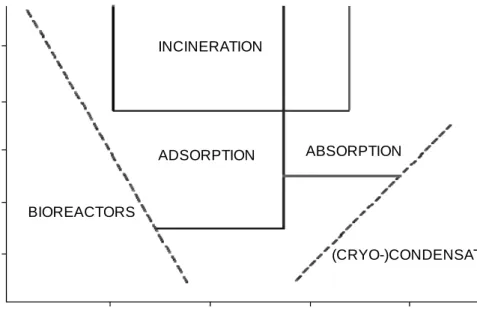
considerations must be taken into account: which is the odor problem, its nature, the volume, and air pollution characteristics and managements products generated. The range of applicability of the major waste air treatment technologies, in terms of gas flow rates and pollutant concentrations, is shown in Figure 1.1. A detailed analysis of these factors determine in each case the degree of effectiveness required and the appropriate treatment system.
Figure 1.1 Application range of major treatment techniques for waste-gas emissions
(Kennes and Veiga, 2001).
1.3.1 Physical-chemical technologies
Traditionally, physicochemical technologies have been used, including: incineration (thermal and catalytic oxidation), absorption, adsorption, condensation, UV oxidation and membrane processes. Each technology will briefly be described hereafter.
1.3.1.1 Incineration
Incineration is a waste-gas treatment technology that involves the combustion of organic substances contained in waste materials. The contaminant is captured by a system of extraction, preheated and oxidized at high temperatures. Under optimal conditions, hydrocarbons are converted to CO2 and water, although if combustion is not complete, it can release harmful byproducts more toxic than the original pollutant, such as dioxins, CO and nitrogen oxides. Incineration does not allow the recovery of the contaminant. Key factors for achieving complete combustion are temperature, turbulence (i.e., mixing) and residence
1 10 100 1000
Pollutant concentration, g m-3
General introduction
7
time (time of exposure to combustion temperatures), as well as sufficient oxygen. The burning mixture must be raised to a sufficiently high temperature to destroy all organic components. The combustion airflow is reduced to the minimum level needed to provide the oxygen for the support fuel (gas, oil, or coal) and the combustible wastes without forming high levels of CO and unburned hydrocarbons. This will raise the temperature to the level needed for good combustion.
There are two variants of incineration (Kennes and Veiga, 2001): thermal incineration, which takes place in most cases at temperatures between 700 and 1400ºC, and catalytic incineration, which is carried out at temperatures between 300 and 700ºC, introducing a catalyst in the combustion unit, such as metals (platinum, palladium, copper, etc.) or metal oxides (cobalt, manganese, iron, etc.).
1.3.1.2 Absorption
The purpose of this technique is the mass transfer of the contaminant from the gas phase to the non-volatile liquid phase. The disposal capacity of the liquid phase depends on the concentration balance between both phases. Various absorption techniques exist. All of them use an auxiliary scrubbing phase, frequently water, but also other solvents such as silicone oils are sometimes used. The pollutants are thus transferred to a liquid phase in which they then have to be treated. The mass transfer depends on the partition coefficient (Henry's law coefficient), as well as temperature and pH. A large contacting area is necessary for efficient gas-liquid phase mass transfer which is ensured by using packed or bubble columns, washing towers or venturi contactors. Whenever possible, the scrubbing liquid is water, although a high solubility of a gas in the liquid phase is required and can often be reached by selecting a liquid solvent with a similar molecular structure as the volatile compound to be absorbed. The main disadvantage of this technique is that the pollutant is transferred to a new phase instead of being destroyed, meaning that the pollution problem remains present. However, in some cases, recovery of the pollutants from the solvents is possible. Absorption involves both high investment and high operating costs.
1.3.1.3 Adsorption
In adsorption systems dealing with air pollution problems, the phases considered for mass transfer are a gas and a solid. A characteristic of some solids is their capability to adsorb volatile compounds upon their surface. There are two types of adsorption, i.e., chemical
Chapter 1
8
solid material can be regenerated easily, which does not occur in the chemical adsorption where the links are strong. Physical adsorption is a reversible process because the forces between the solid surface and the adsorbate are weak, so the adsorbed compound can be desorbed and recovered, usually by thermal treatment, using steam, inert gases, vacuum, etc. The most widely used adsorbents are activated carbon, activated aluminas, silica gel, and molecular sieves. Industrially, the use of physical adsorption is dominant. However, one possible disadvantage of this technique, apart from its high investment cost, is that the pollutant is merely transfered to a different phase.
1.3.1.4 Condensation
This technology is the conversion of a gas or a vapour into a liquid, and it is achieved either by pressure increase or by lowering the temperature, although combination of both temperature and pressure variations is also possible. By pressurization of air the molecules are brought closer together, while lowering the temperature reduces the kinetics energy of the molecules. Moreover, in many cases, the reduction in pollutant concentration is not enough, so that additional treatments need to be applied. The cryogenic technology is currently extending, using N2 or CO2. The removal efficiency of a condenser is generally close to 90% and is mainly because of the dew temperature and temperature of operation. There are 3 types of condensers as a function of temperature (Regina 2006): conventional (-18ºC to 4ºC), chilled (-100ºC) and cryogenic (- 195.5ºC). This technique is used when the concentration of pollutants is very high and the substance has a low boiling point, making it economically viable only for high vapor concentrations of compounds with high interest to recover. Contaminants with a high boiling point can be concentrated by simultaneous cycles of cooling and compression of gas (Devinny et al., 1999).
1.3.1.5 Ultraviolet oxidation
General introduction
9
However, this system presents some problems which need to be considered. High turbidity of the water would cause interferences. Moreover, this system does not destroy some VOCs such as trichloroethane (TCA). Instead, the contaminants may be vaporized and would need to be treated in an off-gas system.
1.3.1.6 Membrane processes
Membrane processes are based on different rates of diffusion of compounds through a thin membrane. The membrane is permeable to the pollutants but not to the air. The driving force is the pressure difference on both sides of the membrane. A vaccum pump creating a lower pressure on one side of the membrane respective to the other enhances the separation process. Because of this, 100% efficiency is not possible and inevitably some product will be lost. There are two types of membrane systems, i.e., with high pressure gas
phase on both sides and with low pressure of adsorbent liquid aside. The main parameters that govern the treatment efficiency include the gas flow rate, the temperature and the VOC concentration (Kennes and Veiga, 2001).
1.3.2 Biological technologies
The first biological treatment dates from 1923 (Bach 1923), using this technology for the elimination of H2S in a wastewater treatment plant. It is not until 1980 when their application extends to the removal of other compounds present in contaminated gases (Van Groenestijn and Hesselink, 1993). Biological waste air treatment techniques utilize the ability of microbial populations to degrade chemicals. Gaseous pollutants or vapours are sorbed into an aqueous phase prior to their biodegradation. In many cases, the volatile pollutant contains carbon and hydrogen atoms, although it may sometimes also contain oxygen. The final end-metabolites of aerobic biodegradation will generally be H2O and CO2 (Kennes and Veiga, 2013). If the pollutant is able to sustain growth, new biomass will be formed (Figure 1.2). So, the pollutants are used as carbon and energy sources and the overall reaction, which is exothermic, can be written as follows (Eq. 1.1):
Chapter 1
10
Figure 1.2 Pollutant biodegradation pathways (Adapted from Kennes et al., 2009a).
However this reaction does not take place in such a simple way as illustrated here, instead it involves elaborate degradation pathways at controlled pH, temperature and other necessary conditions. A common formula for biomass composition is C5H7NO2, although other similar ones have also been used (for example, C5H9NO2.5). This shows that microbial cells are mainly formed of carbon, hydrogen and oxygen atoms, although other elements such as nitrogen, phosphorus are also part of the cells composition. For biomass growth and in order to optimize microbial enzymatic activities, the presence or addition of macro and micro-nutrients (nitrogen, phosphorous, trace elements…) may sometimes be necessary in bioreactors. Biomass growth and composition will depend on different parameters, as the type of microorganism (genus, species) and the environmental conditions (Kennes et al.,
2009a).
Three major types of biological reactors can be found: bioscrubber, biotrickling filter (BTF) and biofilter. They differ according to the presence or not of a packing material, mobile phase(s) and the state of the active biomass. Biological treatment systems are considered green technologies and have some common advantages, among which (Van Groenestijn and Hesselink, 1993; Kennes and Thalasso, 1998; Devinny et al., 1999; Delhoménie and Heitz,
2005):
i. Their ability to degrade pollutants to harmless or less toxic pollutants at ambient temperature and pressure.
ii. Moderate investment costs.
iii. Relatively low operating costs, considering the high volume of gases that can be treated with low concentrations of contaminants.
iv. High yields of degradation in the treatment of a high number of air polluting compounds, with effective treatment of mixtures of organic and inorganic compounds. v. Process accepted by the public as "natural" and with low energy requirements in the
equipment. Pollutant
Biomass
Biodegradation products
Endogenous respiration
General introduction
11
As for the disadvantages, each has its own settings, but common are: i. Need for a conditioning step.
ii. Certain compounds of previous stages of purification or production processes may be toxic and/or lethal to microorganisms.
iii. Sensitive to changes in temperature, humidity and pH.
1.3.2.1 Bioscrubbers
Bioscrubbers are reactors in which the gaseous pollutants are first absorbed in a free liquid phase prior to biodegradation by either suspended or immobilized microorganisms (Fig. 1.3). This microbial process occurs in a separate bioreactor after absorption of the pollutant. These systems are appropriate when the contaminant is highly soluble in water, given the need to transfer the gas pollutant to the liquid phase (Ottengraf, 1986; Van Groenestijn and Hesselink, 1993; Kennes and Thalasso, 1998). Therefore, this technology is restricted to compounds with a Henry's constant <0.01 and at concentrations below 5 g m-3 (Kok, 1992). One advantage of the bioscrubber compared to other systems is that the aqueous mobile phase permits good control of temperature, pH and nutrient addition in the process (Van Groenestijn and Hesselink, 1993), and an easy removal of the reaction products and the consequent elimination of inhibitory effects (Kennes and Thalasso, 1998).
Figure 1.3 Schematic of a bioscrubber.
Polluted air Treated air
Absorption tower
Chapter 1
12
1.3.2.2 Biofilters
They consist of a biological filter filled with an organic medium (peat, compost, soil, etc.) whose function is to support the biomass and serve as a source of nutrients (Devinny et al.,
1999) (Fig. 1.4). Sometimes synthetic materials are added to reduce pressure drop. The gas stream prior humidification is fed through the bed and the pollutants are absorbed into the liquid film and degraded by the biomass. The main feature of biofilters is the absence of a mobile phase, so that they are suitable for treating low solubility contaminants (Kennes and Thalasso, 1998). They are used for compounds with a Henry's constant under 10 and concentrations less than 5 g m-3 (Kennes et al., 2009a).
Figure 1.4 Schematic of a biofilter.
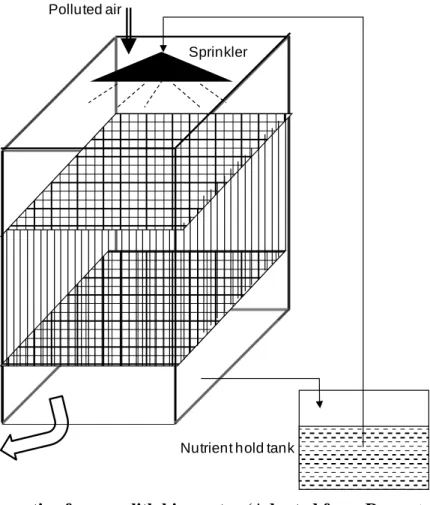
1.3.2.3 Biotrickling filters
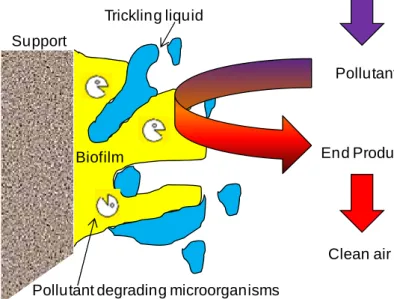
They consist of a biological filter packed with an inert packing material providing the necessary surface for biofilm attachment and for gas-liquid contact (Fig. 1.5). The basic mechanisms of biotrickling filtration are shown in Figure 1.6. Contaminated air is passed co- or counter-currently through a packed bed of inert materials on which a pollutant-degrading biofilm has established. A more detailed examination of the processes involved revels that elimination of the pollutant is the result of a combination of physical-chemical (diffusion, convection) and biological phenomena (growth, death and lysis, predation). During treatment, an aqueous phase is partly recycled over the packing. It supplies moisture, mineral nutrients and a means to control the pH and other operating parameters if necessary (Kennes and Thalasso, 1998). The system can continuously be supplied with essential minerals such as
Addition of media/water for irrigation
Treated air
Filter bed
Leachate collection Polluted air
General introduction
13
nitrogen, phosphorus, potassium and trace elements via the liquid phase. As the gas passes through the porous bed, contaminants are degraded by active biomass generally using them as a source of nutrients and/or energy, although part may also be removed by the microorganisms present in the recycled liquid. Based on typical growth media, BTF often receive less nutrients than stoichiometrically required. This is because the nutrients are also internally recycled through cell death, endogenous biomass digestion and predators.
Figure 1.5 Schematic of a biotrickling filter.
In this case, absorption and degradation of contaminants occur in the same column contrary to what occurs in bioscrubbers. The microorganisms responsible for pollutant removal in BTF are usually aerobic because BTF are most often aerated systems. Nevertheless, it has been proposed that the deeper parts of the biofilm, where anaerobic conditions probably prevail, can be utilized to perform anaerobic biodegradation of pollutants that are recalcitrant under aerobic conditions (Deshusses and Cox, 2002). However, anaerobic biodegradation processes may also generate new odour problems. It is usually used for biodegradation of compounds with Henry constants <1 and concentrations <5 g m-3 (Ribes, 2001). Pressure drop increase over time is one major problem in biotrickling filters (Kennes and Veiga, 2013). It results mainly from excess accumulation of biomass or metabolites such as solid sulphur during the oxidation of reduced sulphur compounds. Table 1.1 summarizes the main advantages and disadvantages of the conventional biological techniques.
Nutrient solution
Polluted air Treated air
Chapter 1
14
Figure 1.6 Basic mechanism of biotrickling filtration (Adapted from Kennes and Veiga,
2001, and Deshusses and Cox, 2002).
Table 1.1 Advantages and disadvantages of the most commonly used traditional
biological techniques.
Characteristics Application field Advantages Disadvantages
Bioscrubber Better control of reaction conditions (pH, nutrients) Low surface are for mass transfer
Simple and low cost technique
General introduction
15
Characteristics Application field Advantages Disadvantages
Biotrickling
Simple and low cost technology
Medium capital low operating cost Effective removal High O2 and pollutant transfer
1.3.3 Novel bioreactors for waste-gas treatment
Recently, several novel bioreactor configurations have been designed to overcome some operational limitations frequently encountered in conventional bioreactor configurations, such as flow resistance/pressure drop and oxygen depletion in biofilters, and mass transfer limitations for sparingly water-soluble pollutants in the case of biotrickling filters and bioscrubbers. Some of the major operating problems found in conventional bioreactor configurations are excessive or insufficientmoisture, nutrient limitation, pH control, headloss, clogging, and response to transient loadings (Schroeder, 2002). The next section briefly describes suspended-growth bioreactors and other emerging bioreactor configurations. The suspended-growth bioreactor is one of the alternatives used, together with the BTF, for -pinene removal during this research.
1.3.3.1 Suspended-growth bioreactors
Chapter 1
16
Figure 1.7 Schematic of a continuous suspended growth bioreactor (Adapted from Rene
et al., 2012).
1.3.3.2 Monolith bioreactors
Biological air pollution control in a monolith bioreactor is one alternative design sometimes overlooked for the treatment of waste-gas (Fig 1.8), although similar systems based on structured packing are now also being used in full-scale reactors (Kennes and Veiga, 2013). Generally, the biomass is attached in a structural support made of plastic, ceramic or metal with uniform parallel channels separated by thin walls (Jin et al., 2006). The wall is wetted by
a thin liquid film, while the volatile pollutant is easily transported through the film which enhanced the mass transfer rates. The bio-catalytically active biofilm layer remains attached at the wall when the liquid slug passes by. Inside the liquid slug itself, a recirculation pattern is observed, fact that enhances the transfer of gas from caps of the bubble to the biocatalyst with higher removal by the attached biomass (Rene et al., 2012).
The main advantages of this configuration are:
i. Simple reactor configuration and energy efficient operation due to low pressure drop. ii. High external surface area and high mechanical strength.
iii. High interfacial mass transfer.
iv. Enhancement of liquid distribution at low liquid flow rates. v. Scaling up promises to be relatively easy.
The main disadvantage is:
i. Continuous supply of nutritive aqueous phase.
Due to the above advantages, in environmental applications, the monolith is widely used as support for non-biological catalytic reactions, such as in the cleaning of automobile exhaust gases and industrial off gases.
Treated air
CO2
Polluted air
Clarifier
Settled biomass for recycle
Influent Efluent
Air diffuser
General introduction
17
Figure 1.8 Schematic of a monolith bioreactor (Adapted from Rene et al., 2012).
1.3.3.3 Air-Lift Bioreactors
Air-lift bioreactors are reactors where the contaminant in the gaseous phase is in contact with a liquid medium (Fig. 1.9). It is characterized by three sections: riser, gas-liquid separator and downcomer. The waste-gas is introduced into the air-lift bioreactor, through a sparger located in the central bottom section, to supply oxygen to the bacteria and for mixing. The inner draft tube improves circulation and oxygen transfer, and equalizes shear forces in the reactor. The hydrostatic pressure difference causes a circulating motion in different parts within the reactor (Rene et al., 2012). At the top of the reactor, adequate headspace is provided to separate the
treated gas from the medium, which descends by gravity flow to the bottom of the reactor where it is again moved to the top, resulting in a well controlled fluid circulation pattern (Villadsen et al., 2011). The biomass is usually dispersed in the liquid medium or attached to
a support material, also suspended in the liquid phase (Vergara-Fernández et al., 2008). Nutrient hold tank
Monolith block
Treated air
Polluted air
Chapter 1
18
Figure 1.9 Schematic of an air-lift bioreactor (Adapted from Rene et al., 2012).
The main advantages of this configuration are:
i. Gas is well mixed and homogeneously distributed. ii. Homogeneous distribution of nutrients.
iii. No clogging. iv. Low shear rate.
v. Absence of mechanical agitators. No need for liquid recirculating pump. vi. Low power consumption for agitation and oxygenation.
vii. Stable microbial growth. Disadvantages of this system:
i. Scale-up problematic. ii. High pressure drop.
Air-lift bioreactors have been extensively used in water treatments, although their application in waste-gas treatment has been hardly developed (Vergara-Fernandez et al., 2008).
1.3.3.4 Fluidized-Bed Bioreactor
In this type of reactor, the polluted air is passed through a granular solid material at high enough velocities to suspend the solid and cause it to behave as a fluid (Fig 1.10). These
Polluted air Treated air
General introduction
19
bioreactors are generally constructed as a hollow cylinder with a perforated plate, known as a distributor, placed just above the sparger. The polluted air is then forced through the distributor up through the solid material. At lower fluid velocities, the solids remain in place as the fluid passes through the voids. However, at higher fluid velocity, the reactor reaches a stage where the force of the fluid on the solids is enough to balance the weight of the solid material. This stage is known as incipient fluidization and occurs at this minimum fluidization velocity. The fluidization stage can also affect the mass and heat transfer characteristics, and the pollutant removal in the bioreactor. It is influenced by the particle size, distribution, density, shape and the moisture content (Clarke et al., 2008). As solid phase, small particles
coming from sand, carbon, fly ash, anthracite, glass, etc. can be used. Depending on the operating conditions and properties of the solid phase various flow regimes can be observed in this reactor (Rene et al., 2012).
Figure 1.10 Schematic of a fluidized-bed bioreactor (Adapted from Fernandes and
Lona, 2000).
1.3.3.5 Foamed emulsion bioreactor
It consists of an emulsion of a highly active pollutant-degrading bacterial culture and a water-immiscible organic phase which is made into foam with the air being treated (Fig. 1.11). After the desired treatment is achieved, the foam is continuously collapsed and the cells with the emulsion reused. In order to promote growth and flush excess biomass, continuous feeding of
Bubble
Catalyst + biomass Nutrient addition
Disengagement zone
Treated air
Chapter 1
20
a mineral nutrients solution and purge of the spend emulsion is required. This system has high oxygen and pollutant mass transfer rates due to the large interfacial area between gas and liquid of the fine foam and the favorable partitioning for the pollutants into the organic phase. Rapid biodegradation of the pollutants is achieved by a high-density, actively growing, bacterial culture. Bed clogging and pressure drop problems are prevented by using moving foam rather than an immobilized culture growing on a support (Kan and Deshusses, 2006).
Figure 1.11 Schematic of foamed emulsion bioreactor (Adapted from Kan and
Deshusses, 2008).
1.3.4 Other bioreactors configurations
Besides the above mentioned techniques, the efficiency of new modes of operation have recently been evaluated with some conventional reactors. This is the case of two-liquid-phase packed-bed and suspended-growth bioreactors, using either an organic phase or solid polymers as a second phase. The pollutants are concentrated in the new phase because of the favourable partition coefficient and are continuously subsequently biodegraded in the aqueous phase. In any case, the auxiliary phase must satisfy a number of conditions; among others, it should neither be biodegradable nor stripped by the gas phase. The key characteristics of a non aqueous phase (NAP) for two-phase partitioning bioreactors (TPPBs) construction are (Quijano et al., 2009; Kennes et al., 2009a):
Foamed emulsion bed
reactor
Polluted air
Liquid recycle Foam Defoamer
Treated air
Reservoir for liquid collection/recycle
General introduction
21 i. Biocompatible.
ii. Non-biodegradable.
iii. High affinity for the target compound. iv. Low emulsion-forming tendency.
v. Non hazardous.
vi. Non-toxic for the biocatalyst. vii. Available in bulk quantities. viii. Low cost.
ix. Inmiscible with water. x. Low vapour pressure. xi. Relatively low viscosity
xii. Density different from the density of water. xiii. Odourless.
xiv. Good hydrodynamic characteristics.
Silicon oils have so far shown the best properties from a chemical engineering and thermodynamic point of view. In most cases, the treatment of VOCs in a bioreactor is based on the capacity of microorganisms to use these substances as carbon and energy sources. So, the pollutant and the oxygen (aerobic conditions) must first be transferred from the gas to the aqueous phase, where they can be metabolized. The non-aqueous phase of high affinity towards the substate is added to overcome the limitation caused by the poor transfer of hydrophobic pollutants (Figure 1.12).
Figure 1.12 Scheme of the mechanisms involved in two liquid phase bioreactors
(Adapted from Déziel et al., 1999).
Substrate
Microorganism
Chapter 1
22
In the case of solid polymers, their optimal characteristics for delivery of poorly water-soluble substances to the degrading organisms in solid-liquid TPPBs were described by Rehmann et
al. (2007) as follows:
i. Commercially available. ii. Low cost.
iii. Non-toxic to employed organisms.
iv. Not used as carbon and energy source and not biodegradable. v. Not promoting biofilm formation under optimal conditions. vi. Possessing desirable affinity for the target molecule.
vii. Stable in aqueous medium at the pH of the employed culture medium.
viii. Stable in the medium employed to load the polymer with the target compounds.
Gels could also be used instead of an organic phase or solid polymer. In the course of the last decades numerous methods of immobilization on a variety of different materials have been developed. Although the study of cell immobilization is comparatively novel, the methods that have been developed are very effective (Bucke, 1983). Immobilization implies the prevention of free movement of a material of one phase within another. Immobilized cells are currently the object of considerable interest, and the involved methods can be aggregation, adsorption onto a support material or entrapment within gels, of which natural polysaccharides such as calcium and sodium alginate have proved the most useful. Entrapment within gels allows the retention of cell viability and activity. Also, by supplying full growth media, cells can multiply within the beads of gel, resulting in very high cell densities (Bucke, 1983). The use of immobilized cells normally offers several advantages over free ones, such as increased stability, localization, and retention of the molecules at the material surface (Costa et al., 2004). The main advantages of entrapment in alginate are:
i. Cheap in use.
ii. Cell viability retained. iii. Cell division occurs readily.
iv. Gas bubbles released without damage to gel. v. Activities survive for extended periods.
General introduction
23
1.3.5 Factors affecting bioreactor performance
For proper biodegradation it is necessary to control and optimize parameters that affect the bioreactors performance. Otherwise, only low waste-gas removal efficiencies would be reached. In this section, fundamentals and different operating parameters affecting the bioreactors performance are described, using -pinene for biodegradation during this research with biotrickling filters and continuous stirred tank bioreactors.
1.3.5.1Factors affecting biotrickling filter performance
Packing material
Different types of packing materials have been tested in BTF. They should be chosen based on different criteria such as:
Sorption characteristics. Packing should guarantee a large surface area for both microbial immobilization and pollutant mass transfer.
Porosity. Typical porosities or void volume are between 40 and 80%.
Mechanical properties. The filter bed structure should remain stable with time. Neither clogging nor shrinking of the bed due to material composition should occur.
Bacterial attachment. Research has proven that packing materials which are rough, porous and hydrophilic are more readily colonized by microorganisms. The rough surface and pores protect the microorganisms from any adverse conditions.
Cost. Packing materials with low purchase costs will increase the economical viability. Moreover, it should be easily and cheaply disposable. It should provide good removal characteristics, at least, for a period from 2-4 years. Materials commonly used as filter beds are Pall rings, silicate supports (perlite and celite), activated carbon, polyurethane foam products and lava rock because of their properties. Lava rock was used in the present study. It provides a large specific surface area, a porous structure that facilitates colonization by microorganisms and has a relatively low price. However it presents some disadvantages; (i) it has not a high void volume (~50%); (ii) its relatively heavy weight requires special reactor construction; (iii) literature reports that is sometimes not a chemically inert material because a substantial weight loss can occur after waste-gas removal applications at low pH, especially for the treatment of hydrogen sulphide.
Inoculum
Chapter 1
24
activation of the microorganisms is crucial to ensure system operation. Kennes and Veiga (2001) described the most common inoculum sources for BTF:
Activate sludge from wastewater treatment plants
Soil or water samples from sites or plants contaminated with the pollutant/s of interest Consortia enriched in the laboratory with the pollutant/s of interest
Pure cultures
Samples of previously operated bioreactors treating the same or a comparable waste-gas stream.
In any case, the use of adapted microorganisms with a high biodegradation potential is favorable when treating gases containing poorly biodegradable pollutants. Adaptation of the inoculum may dramatically affect the start-up and performance of the system.
Nutrients
Inorganic media, such as lava rock, do not contain nutrients. They must be added in order to provide enough energy and carbon for the microbial growth. Microorganisms require nutrients such as nitrogen, phosphorous, potassium, sulfur, calcium, magnesium, sodium and iron, among others. They are usually supplied through the liquid phase. At the same time, pH can be adjusted. In addition, microorganisms required an abundant supply of carbon for growth, to form new cells, to facilitate membrane transport and for biodegradation of pollutants (Kennes and Veiga, 2001). In BTF packed with inorganic media, the waste-gas pollutant often provides the carbon source, except in the case of autotrophs. In this situation, considering that the pollutant is the limiting substrate, the amount biomass formed should be proportional to the amount of pollutant degraded.
Liquid recycling
BTFs are continuously supplied with water and essential mineral nutrients via a liquid fed in either co- or counter-current mode, although cross-flow is also possible, but rather unusual (Duan et al., 2005). The recycled liquid also removes possible biodegradation metabolites via
General introduction
25
Temperature
Some microorganisms can adapt to a wide variety of environmental stresses. However, their microbial activity is strongly influenced by temperature. Considering that industrial emissions are often subject to changing temperatures, it is a factor that has to be controled, depending on the particular application. In any case, two parameters may counterbalance considering the effect of temperature, i.e., the mass transfer and the diffusion coefficient. At higher
temperature, the Henry coefficient decreases, having a subsequent effect on the driving force for mass transfer, while the diffusion coefficient increases. The treatment at high or low temperatures can be carried out depending on the main microorganisms present in the bioreactor, allowing a pre-treatment of the waste-gas after the industrial emissions.
Oxygen
Oxygen represents 21% of the total composition of air which is several orders of magnitude higher than the pollutant concentration to be treated. Its presence is essential for the aerobic biodegradation of VOC. However, the oxygen gas-liquid partition coefficient is 33.5 (Devinny et al., 1999), meaning that it will mainly be in the gas phase rather than dissolved in
the liquid phase. This fact can generate anaerobic zones in some parts in the filter bed when working at high substrate loads and/or in presence of thick biofilms. Moreover, oxygen limitation will also depend on the values of the diffusion coefficient of oxygen and VOCs in water, and oxygen could be exhausted before the VOC is completely degraded. Although enrichment of air with oxygen to avoid its limitation might avoid this problem and in some cases improve the bioreactor performance, such a procedure might not be cost-effective at industrial scale.
1.3.5.2 Factors affecting the performance of suspended growth bioreactors
Inoculation
Chapter 1
26
Solubility of the pollutant
Since all biological mechanisms take place in the presence of an aqueous-phase, the pollutants need to have a relatively high water-solubility for an effective treatment. Therefore, there are many studies based on the addition of an organic-phase with more affinity for the target compound than for water (Kennes et al., 2009b). The most common used organic phases are
dodecane, hexadecane, and silicone oil, among others (Muñoz et al., 2008). However,
silicone oil seems to be the only solvent that did not present any problem so far, in terms of biodegradability or biocompatibility. Nevertheless, silicone oil has certain disadvantages such as its relatively high cost. Also, its recovery may increase process costs. Recently, it has been proposed that solid polymers could be used as an alternative organic-phase, for the degradation of hydrophobic compounds (Daugulis and Boudreau, 2008).
1.3.6 Operating parameters of bioreactors
Operation and performance of biological reactors for air pollution control are generally reported in terms of removal efficiency (RE), or pollutant elimination capacity (EC) as a function of the pollutant inlet loading rate (ILR), or the gas empty bed residence time (EBRT) or the volumetric loading rate (VLR). The ILR is the mass of the contaminant entering the system, per unit area or volume of filter material or medium, in the case of stirred tank bioreactor, per unit of time. The RE and EC are used to describe the performance of the biological system, being the RE the fraction of the contaminant removed in the bioreactor, while the EC is the mass of contaminant degraded per unit of filter material, or medium, per unit time. These terms are defined in the following equations:
g m‐3 h‐1 (1.2)
g m‐3 h‐1 (1.3)
100 % (1.4)
s or min (1.5)
h‐1 (1.6)
Where Cin and Cout are the inlet and outlet pollutant concentrations (g m-3), respectively, V is the volume of the packed bed or medium (m3) and Q is the air flow rate (m3 h-1).
General introduction
27
generated through other processes in bioreactors as for example, endogenous respiration. The CO2 production rate can be defined as:
, , (g m‐3h‐1) (1.7)
Where CO2,out and CO2,in are the outlet and inlet carbon dioxide concentrations (g m-3), respectively.
In a typical elimination capacity vs. pollutant loading curve representation (Figure 1.13), there
are essentially three operating regimes as described by Deshusses and Cox (2002):
1. Under low load conditions, the pollutant is completely removed as a result of identical elimination capacity and loading rate. In this stage, the system is operated below its maximum elimination capacity.
2. When higher inlet concentrations or higher air flow rates is applied, the elimination capacity increases, but to a lesser extent than the loading rate. This point is typically called the critical load or critical elimination capacity.
3. At high loads, the system is operated at its maximum elimination capacity (ECmax). At this stage, increases in pollutant concentration or in the air flow rate do not result in further increases in elimination capacity, resulting in a decrease in the removal efficiency.
Figure 1.13 Schematic of a typical elimination capacity vs. load curve (Adapted from
Kennes and Veiga, 2001, and Deshusses and Cox, 2002).
Considering this fact, for the evaluation of the performance of a biological system, two parameters should be considered: the maximum elimination capacity and the removal
100% removal line
ECmax
Critical load Inlet loading rate, g m-3h-1
E
lim
ina
tio
n
c
a
p
aci
ty
, g
m
-3
h
Chapter 1
28
efficiency. All the parameters described above depend on the gas phase pollutant concentration. Pollutant concentrations in gas phase are usually given in g m-3 (mass per volume) or ppmv (parts per million by volume). The advantage of using volumes rather than masses is that the former are constant even for changes of pressure or temperature (Kennes and Veiga, 2001). Conversion of volumetric to mass concentrations is done based on the ideal gas law:
⁄
273 22.4
(1.8)
At room temperature the above equation is:
⁄
24776 (1.9)
Where C is the pollutant concentration, MW the molecular weight of the pollutant (g mol-1), P is the pressure (atmospheres) and T the temperature (Kelvin).
1.4 REFERENCES
Bach H. 1923. Schwefel im Abwasser (Sulfur in wastewater). Gesundheits-Ingenieur 46:370-376 [In German].
Banerjee S. 2000. Mechanisms of terpene release during sawdust and flake drying. IPST Technical paper series number 840. Institute of Paper Science and Technology. Georgia. Beauchemin P, Tampier M. 2010. Emissions and Air Pollution Controls for the Biomass
Pellet Manufacturing Industry. Reference ITQ Number: 12/01/2008. Envirochem. Services Inc. Vancouver.
Bucke C. 1983. Immobilized cells. Phil. Trans. R. Soc. Lond. B 300:369-389.
Costa SA, Azevedo HS, Reis RL. 2005. Enzyme immobilization in biodegradable polymers for biomedical applications. In: Reis RL, Roman JS (Eds) Biodegradable Systems in Tissue Engineering and Regenerative Medicine, CRC Press, Boca Raton, 301-323.
Clarke K, Hill GA, Pugsley T. 2008. Improved VOC bioremediation using a fluidized bed peat bioreactor. Proc. Saf. Environ. Prot. 86:283-290.
Daugulis AJ, Boudreau NG. 2008. Solid-liquid two-phase partitioning bioreactors for the treatment of gas-phase volatile organic carbons (VOCs) by a microbial consortium. Biotechnol. Lett. 30:1583-1587.
General introduction
29
Deshusses MA. 1994. Biodegradation of mixture of ketone vapours in biofilters for the treatment of waste air. PhD thesis, Swiss Fed. Inst. of Technol. Zurich, Switzerland. Deshusses MA, Cox HHJ. 2002. Biotrickling filters for air pollution control. In: G. Bitton
(Ed.) Encyclopedia of Environmental Microbiology (Volume 2, pp.782-795), Wiley-Interscience, Hoboken, N.J.
Devinny JS, Deshusses MA, Webster TS, 1999. Biofiltration for air pollution control. Lewis Publishers, Boca Raton.
Déziel E, Comeau Y, Villemur R. 1999. Two-liquid-phase bioreactors for enhanced degradation of hydrophobic/toxic compounds. Biodegradation. 10:219-233.
Duan H, Koe LCC, Yan R. 2005. Treatment of H2S using a horizontal biotrickling filter base don biológica activated carbon:reactor setup and performance evaluation. Appl. Microbiol. Biotechnol. 67:143-149.
EPA. 2002. Flavor and Fragrance High Production Volume Consortia. The Terpene Consortium: Test Plan for Aromatic Terpene Hydrocarbons.
Eriksson KA, Levin JO, Sandstrom T, Lindstrom-Espeling K, Linden G, Stjernberg NL. 1997. Terpene exposure and respiratory effects among workers in Swedish joinery shops, Scan. J. Work. Environ. Health. 23:114-120.
Falk A, Gullstrand E, Löf A, Wigaeus-Hjelm E. 1990a. Liquid/air partition coefficients of four terpenes. Br. J. Ind. Med. 47:62-64.
Falk AA, Hagberg MT, Lof AE, Wigaeus-Hjelm EM, Wang ZP. 1990b. Uptake, distribution and elimination of alpha-pinene in man after exposure by inhalation. Scand. J. Work Environ. Health 16(5):372-378.
Fernandes FAN, Lona LMF. 2000. Fluidized bed reactor for polyethylene production. The influence of polyethylene prepolymerization. Braz. J. Chem. Eng. 17:163-170.
Granström K. 2005. Emissions of volatile organic compounds form wood. Karlstad University, Division for Engineering Sciences, Physics and Mathematics, Karlstad, ISBN: 9185335460.
Hedenstierna G, Alexandersson R, Wimander K, Rosén G. 1983. Exposure to terpenes: effects on pulmonary functions. Int. Arch. Occup. Environ. Health. 51:191-198.
Chapter 1
30
Hester RE, Harrison RM. 1995. Volatile organic compounds in the atmosphere. The Royal Society of Chemistry.
Ingram L, Templeton MC, McGraw GW, Hemingway RW. 2000. Knot, heartwood, and sapwood extractives related to VOCs from drying southern pine lumber. J. Wood Chem. Technol. 20(4):415-439.
Jin Y, Veiga MC, Kennes C. 2006. Development of a novel monotith bioreactor for the treatment of VOC-polluted air. Environ. Technol. 27:1271-1277.
Kan E, Deshusses MA. 2006. Scale-up and cost evaluation of a foamed emulsion bioreactor. Environ. Technol. 27:645-652.
Kan E, Deshusses MA. 2008. Modeling of a foamed emulsion bioreactor: II. Model parametric sensitivity. Biotechnol. Bioeng. 99:1096-1106.
Kennes C, Rene ER, Veiga MC. 2009a. Bioprocesses for air pollutions control. J. Chem. Technol. Biotechnol. 84:1419-1436.
Kennes C, Montes M, López ME, Veiga MC. 2009b. Waste gas treatment in bioreactors: environmental engineering aspects. Can. J. Civ. Eng. 36:1887-1894.
Kennes C, Thalasso F. 1998. Waste gas biotreatment technology. J. Chem. Technol. Biotechnol. 72:303-319.
Kennes C, Veiga MC. 2001. Bioreactors for waste gas treatment. Kluwer Academic Publishers, Dordrecht, The Netherlands.
Kennes C, Veiga MC. 2013. Air pollution prevention and control: Bioreactors and Bioenergy. J. Wiley and Sons, Chichester, United Kingdom.
Kok HJG. 1992. Bioscrubbing of air contaminated with high concentrations of hydrocarbons. In: Dragt AJ, Harn J van (Eds) Biotechniques for Air Pollution Abatement and Odour Control Policies, Proceedings of an International Symposium, Maastricht, The Netherlands. Elsevier, Amsterdam.
Kodama R, Okubo A, Sato E, Araki K, Noda K, Ide H, Ikeda. 1977. Pinene concentrations in forest canopies. Oyo Yakuri, 13,885.
Masten S. 2002. Turpentine (turpentine oil, wood turpentine, sulfate turpentine, sulfite turpentine). Review of Toxical Literature. National Institute of Environmental Health Sciences.
McDonald AG, Dare PH, Gifford JS, Stewards D, Riley S. 2002. Assessment of air emissions from industrial kiln drying of Pinus radiata wood. European Journal of wood and wood