
The translation of Robert Koch’s scientific articles on tuberculosis (German Spanish) Appraisal and translation techniques
24
0
0
Texto completo
(2) María Pilar Castillo Bernal. translation generates a considerable amount of work,1 while the translation of scientific texts – mostly into English – is nowadays mainly restricted to academia. By contrast, Montgomery’s book Science in Translation (2000) provides a groundbreaking historiographical account of the role of translation in the dissemination of science across the centuries and continents. The author highlights the variety of translation practices in the past, often involving oral and written exchange, performed by individuals, by teams, by groups or entire communities, even by machines, on materials including original texts, copied and altered texts, reconstructed and stolen texts, fabricated, falsified, and even imaginary texts. The translation techniques used in these scientific texts were accordingly varied: rewriting, adaptation, ideological reconstitution, word-forword faithfulness or paraphrasing, to name but a few (Montgomery, 2000: 4). Such phenomena certainly called for further research, and so scientific translation has gained momentum in the last two decades. Special issues such as Meta no. 61 on Sciences in Translation (2016) or The Translator 17:2 (2011) on Translating Science include some samples of this research. 1.1 Prior research on German scientific translation Until now, research on scientific production in German in the 19th century and its translation has been surprisingly scarce, if we take into account the the possibilities digitalisation has afforded us in the past decades by granting access to journals and even entire books that used to be accessible in selected physical libraries only. The importance of this so-called heroic age of the German sciences is undeniable, as showed by the several Nobel prizes and discoveries by German scientists leading to the rise of bacteriology, biochemistry and even genetics. Among the few works on scientific texts translated from German into Spanish, it is worth mentioning Quijada and Gutierrez’ lexicographic studies (2017, 2016, 2015), as well as Sanchez’ (2011) analysis of the translator’s intervention in a treatise by German neurologist Möbius. Mayor Serrano et al. (2011) dedicated a section to psychoanalysis and translation in a special issue of the 1. According to Gamero (2001: 28): “Si acudimos a la práctica profesional de la traducción, comprobaremos que en cuanto a porcentaje de mercado, la traducción técnica se sitúa por delante de la científica, ya que la demanda generada por la industria es mucho mayor que la producida en el seno de los organismos de investigación.”. 2.
(3) The translation of Robert Koch’s scientific articles on tuberculosis (German-Spanish). journal Panace@ on German, where they explored the first renderings of Freud into Spanish in terms of accuracy and translation strategies for key concepts introduced by the Austrian psychiatrist. However, to the best of my knowledge, no study has been conducted so far on linguistic features of scientific articles and translation practice in the 19th century, which this paper aims to explore. The present study arises from a previous work on the translation of German scientific articles from the 19th century into Spanish (Castillo, 2019) and focuses on the research by the German microbiologist and Nobel laureate Robert Koch on tuberculosis. The purpose is to locate published articles on the subject and their translations, as well as to describe their textual features and the translation techniques employed. 1.2 Objectives and research method The abovementioned prior review of translated 19-century German articles on microbiology and biochemistry revealed interesting features both in the style of the originals and in the translations, which I now intend to analyse. Focusing on the figure of Robert Koch, considered one of the founders of modern microbiology together with Louis Pasteur, the objectives of this paper are as follows: − To locate and describe Koch’s scientific articles on tuberculosis and their translations − To analyse papers translated into Spanish in terms of appraisal resources − To ascertain which translation techniques were used in these articles With this I aim to contribute to the research on the translation of science from a diachronic perspective, offering a reflection on possible differences in science translation practices at the time the original texts were published and in the present day. For the analysis of the translations, the classification of techniques proposed by Byrne (2014: 118-131) shall be used. These include literal translation, borrowing, calque, equivalence, transposition, modulation, adaptation (cultural substitution, paraphrasing, omission), expansion/contraction, generalising/ particularising, compensation, restructuring, and iconic linkage.. 3.
(4) María Pilar Castillo Bernal. In turn, the textual features of German scientific articles shall be discussed according to the categories of appraisal established by Martin and White (2005) and to the description of scientific articles by Byrne (2014: 63-82) and Montgomery (2009). 2. Theoretical framework Since this paper focuses on the translation of scientific articles, a definition of this field of work should be provided first. This is by no means a simple task, since the translation of scientific articles can take multiple and varied forms. According to Montgomery (2009: 9-10), these include: − traditional translation of a completed (published) text from one language to another; − translating sections of an article, report, or book for personal use; − translating one’s own writing for the purpose of publication; − submitting one’s writing to a translation agency or an individual translator; − partial (incomplete) or less skilful rendering of one’s own writing, which is then sent to a colleague or friend (or family member) for full conversion; − writing/reading of emails, letters and other communications in a nonnative language, requiring mental translation during the process; − discussion among colleagues (in the mother tongue) of an article or talk; − simultaneous translation/interpretation of a talk; − scripting one’s talk in the mother tongue, then translating this for delivery at a conference; − audio or video recording a talk, then providing commentary (spoken or written) in the mother tongue; − reviewing the product when a publisher has one’s writing (scientific book, article, web site) translated into another language;. 4.
(5) The translation of Robert Koch’s scientific articles on tuberculosis (German-Spanish). − explaining to a colleague or friend the meaning of an important finding, article, announcement, etc.; − explaining to a media representative the meaning of one’s research, including translation of important phrases, conclusions. It is probably safe to assume that such varied formats present differences in macrostructural and microstructural features which should be taken into account in a translation analysis. Given that my object of study is written and published translations of scientific articles, I shall refer to the description of this text genre provided by Byrne (2014: 63) in terms of the macrostructure of scientific journal papers, as well as the translation techniques mentioned in section 1.2 above. As to appraisal theory, it was first introduced by Martin and White (2005) in line with the systemic functional linguistics model of language (Halliday and Martin, 1993). Subsequently, it has been applied to translation by Munday (2012, 2015), whose work will be the basis of my analysis. More specifically, Munday provides an overview of appraisal resources based on Martin and White as shown in Table 1. Domain of appraisal. Category. Attitude. Affect. Feelings and emotional reactions. Happy, sad. Judgement. Of ethics, behaviour, capacity. Wrong, brave. Appreciation. Of things, phenomena, reactions. Beautiful, authentic. Monogloss. Single-voiced. Categorical assertion. Heterogloss. Contractive. Show, certainly. Expansive. Claim, nearly, possibly. Raise. Totally extinct. Engagement. Graduation. Force. Value. Illustrative realisation. 5.
(6) María Pilar Castillo Bernal. Focus. Lower. Slightly worried. Sharpen. A true champion. Soften. Kind of blue. Table 1. Appraisal resources (Munday, 2015: 3-4, adapted from Martin and White, 2005: 38 and Munday, 2012: 34). 1. The domain of ‘attitude’ is divided into affect (emotional), judgement (ethical) and appreciation (aesthetic). According to Munday (2015: 4), despite possible omissions, “translation shifts between attitudinal categories are often relatively minor unless there is a high degree of manipulation, or the value is contested or in some way ambiguous”. 2. The second domain, ‘engagement’, conveys the speaker’s position towards possible responses. It can either be monogloss (when the speaker contemplates no alternatives to their ideas) or heterogloss (which acknowledges possible alternative viewpoints), which in turn can be ‘dialogically expansive’ (opening up to other voices) or ‘dialogically contractive’ (restricting possible responses) (Munday, 2015: 5), as shown in Figure 1.. Figure 1. The engagement system: heteroglossic resources (Martin and White, 2005: 134). 6.
(7) The translation of Robert Koch’s scientific articles on tuberculosis (German-Spanish). 3. Finally, as shown in Figure 2, ‘graduation’ is realised by a scalable axe of focus (a prototypicality of phenomena, upscaled or downscaled, the focus respectively becoming sharper or more blurred) and force (degree of quantification or intensification) (Munday, 2015: 18). The author argues that because intensification is linked to a shared value between writer and reader, the translator may disrupt it due to a lesser investment in the text than that of the intended interlocutors.. Figure 2. System network for graduation: force and focus (Martin and White, 2005: 154). Munday concludes that the intervention of a translator/interpreter risks affecting the rhetorical effect by modifying engagement resources towards a distancing from the deictic centre (typically occupied by the speaker) and downscaling the intensity of both attitudinal and engagement values (ibid., 21). He calls for more work in this field to test this hypothesis in order to understand how and under what conditions such variations may occur. To test this theory, the appraisal system will be applied here to the scientific discourse from a diachronic perspective.. 7.
(8) María Pilar Castillo Bernal. 3. Analysis In this section, I shall look at two papers on tuberculosis written in German by microbiologist Robert Koch and their translations published in Spanish: − Koch, R. (1891) ‘Fortsetzung der Mittheilungen über ein Heilmittel gegen Tuberculose.’ Deutsche medicinische Wochenschrift, 17(3), pp. 101102. − Koch, R. (1891) ‘Tercera comunicación sobre el tratamiento de la tuberculosis. Composición y preparación de la linfa.’ Semanario farmacéutico, XIX (17), 25 January, pp. 135-139. − Koch, R. (1890) ‘Weitere Mittheilungen über ein Heilmittel gegen Tuberculose.’ Deutsche medicinische Wochenschrift, 16(46), 1029-1032. − Koch, R. (1890) ‘Nueva comunicación sobre el tratamiento de la tuberculosis.’ Crónica Médica, 13, pp. 681-690. The translation of Koch’s paper from 1891 was also printed in Crónica Médica: − Koch, R. (1891) ‘Tercera comunicación sobre el tratamiento de la tuberculosis. Composición y preparación de la linfa.’ Crónica Médica, 14, pp. 41-46. However, as both publications are almost identical, with the exception of a few punctuation marks and the title, the translation analysed here will be the one published in Semanario farmacéutico. 3.1Text genre In my previous work on scientific articles written in German, a lack of a consistent superstructure and of spelling and formal standardisation was detected, suggesting that scientific articles were not consolidated as a genre in the 19th century. According to Byrne (2014, p. 63), a typical section division of this genre consists of abstract, introduction, materials (and methods), procedures, results, discussion, conclusions and references. By contrast, Koch’s articles and their translations are structured as shown in Table 2. Article Koch (1891). Original No sections. Translation Preámbulo Cómo hice el descubrimiento La composición de la linfa. 8.
(9) The translation of Robert Koch’s scientific articles on tuberculosis (German-Spanish). Koch (1890). No sections. No sections. Table 2. Sections in articles by Robert Koch and their translations into Spanish. It should be noted that both published translations of the 1891 article (in Crónica Médica and Semanario farmacéutico) present the same additional sections, while no sections were inserted in the 1890 translation. As to the title of the articles, the followings adaptations in Table 3 have been carried out in the translations. Article Koch (1891). Original. Translation. Fortsetzung der Mittheilungen über ein Heilmittel gegen Tuberculose.. [In Semanario farmacéutico]. Von Prof. R. Koch.. NUEVO TRATAMIENTO DE LA TUBERCULOSIS POR EL MÉTODO DE KOCH TERCERA COMUNICACIÓN SOBRE EL TRATAMIENTO DE LA TUBERCULOSIS POR EL PROFESOR. ROBERTO KOCH COMPOSICIÓN Y PREPARACIÓN DE LA LINFA (Del Deutsche med. Wochenschrift del 15 de enero) Koch (1891). Fortsetzung der Mittheilungen über ein Heilmittel gegen Tuberculose.. TERCERA COMUNICACIÓN. Von. TRATAMIENTO DE LA TUBERCULOSIS. Prof. R. Koch.. [In Crónica Médica] SOBRE EL. POR EL PROFESOR KOCH. COMPOSICIÓN Y PREPARACIÓN DE LA LINFA Koch (1890). I. Weitere Mittheilungen über ein Heilmittel gegen. NUEVA COMUNICACIÓN SOBRE. 9.
(10) María Pilar Castillo Bernal. Tuberculose.. UN TRATAMIENTO DE LA TUBERCULOSIS. Von Professor R. Koch, Berlin. POR EL. PROFESOR R. KOCH Table 3. Titles of articles by Robert Koch and their translations into Spanish. The article from 1891 shows again an expanded title, which is even longer in the translation published in Semanario Farmacéutico with a reference to the original journal (“Del Deutsche med. Wochenschrift del 15 de enero”), which has been included in the title. It is remarkable that this article should also be numbered as the “third” on this topic, while there is no such mention in the original number nor could I locate any other article by Koch translated into Spanish as a “second communication”. 3.2 Appraisal In this section I will present some fragments of the abovementioned articles2 where appraisal resources can be observed, as described in section 2. Fragment 1 shown in Table 4 is the second paragraph of the article and provides some background information about the publication of Koch’s research on tuberculosis. Original. Translation. Eigentlich war es meine Absicht, die Untersuchungen vollständig zum Abschluss zu bringen und namentlich auch ausreichende Erfahrungen über die Anwendung des Mittels in der Praxis und seine Herstellung in grösserem Maassstabe zu gewinnen, ehe ich etwas darüber veröffentlichte. Aber es ist trotz aller Vorsichtsmaassregeln zu viel davon, und zwar in entstellter und übertriebener Weise, in die Oeffentlichkeit gedrungen, so dass es mir geboten erscheint, um keine. Declaro que hubiera preferido terminar completamente las experiencias, sobre todo en lo que concierne á la colección de experiencias suficientes al empleo del remedio en la práctica. Hubiera querido también estudiar y establecer reglas exactas sobre el método de la fabricación de este agente en gran escala, antes de hablar al público médico. Pero en estos momentos, á pesar de todas las precauciones tomadas, se ha hablado mucho y no con toda la. Archaic spelling can be observed in both German and Spanish. I have not altered this in my transcription (e.g. Maassstabe, Injection, á, éstas). 2. 10.
(11) The translation of Robert Koch’s scientific articles on tuberculosis (German-Spanish). falschen Vorstellungen aufkommen zu lassen, schon jetzt eine orientierende Uebersicht über den augenblicklichen Stand der Sache zu geben. Allerdings kann dieselbe unter den gegebenen Verhältnissen nur kurz ausfallen und muss manche wichtige Fragen noch offen lassen.. exactitud que fuera de desear, que me ha parecido debía orientar á los médicos sobre el estado actual de esta cuestión, con el objeto de que sea imposible que se formen ideas falsas. Es verdad que no puedo decir mucho aun y que debo dejar de tratar más de una cuestión importante.. Table 4. Fragment 1 of Koch (1890: 1079). As Báguena points out, Koch was probably forced to publish some of his preliminary results by the German government due to the competition between his country and France in terms of microbiological research: En 1890, Koch expuso los resultados de una investigación que había llevado en secreto y completamente solo en su laboratorio: el descubrimiento de una sustancia que podía prevenir el crecimiento del bacilo tuberculoso tanto en el tubo de ensayo como en el organismo. Su inoculación en cobayas los hacía resistentes a la enfermedad. Koch no hacía mención a la naturaleza y preparación de esta sustancia y probablemente se vio presionado por el gobierno alemán para anunciar unos resultados todavía provisionales debido a la encarnizada lucha con Francia y Pasteur a la cabeza, por la supremacía en la investigación microbiológica. Se le presionó también para que ensayara su medio en el hombre y así se hizo en el hospital de la Charité de Berlín. (Báguena, 2011: 4). In this context, the following appraisal resources can be observed in Fragment 1: − Attitude: markers of judgement about the quality of the information that has become public. In entstellter und übertriebener Weise is translated with a lesser emphasis as “mucho y no con toda la exactitud que fuera de desear”. By contrast, the appreciation marker wichtige Fragen is correctly translated as “cuestión importante”. − Engagement: Koch expresses his original intentions (Absicht, translated with a lesser emphasis as “preferir”) with numerous heteroglossic resources both to contract (counter: trotz, aber) and expand (entertain: mir geboten erscheint). They are not always translated with precision into Spanish: “declaro” introduces a stronger proclaim-pronounce resource than the original proclaim-concur-concede eigentlich; by contrast, “es. 11.
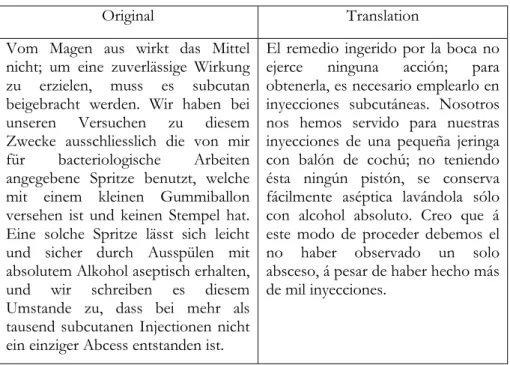
(12) María Pilar Castillo Bernal. verdad” is a much weaker proclaim-concur-concede marker than the original monoglossic expression kann nur. However, the stronger modification in this fragment is Koch’s interlocutor: from Öffentlichkeit (omitted) and veröffentlichen, which refer to the public in general, the translation mentions “el público médico” and “los médicos”, thus restricting a matter of public interest (and national competition) to the attention of medical professionals. − Graduation: a few force resources (vollständig, aussreichend, kurz) are adequately translated. In the following fragment in Table 5 some omissions have been detected. Original. Translation. Vom Magen aus wirkt das Mittel nicht; um eine zuverlässige Wirkung zu erzielen, muss es subcutan beigebracht werden. Wir haben bei unseren Versuchen zu diesem Zwecke ausschliesslich die von mir für bacteriologische Arbeiten angegebene Spritze benutzt, welche mit einem kleinen Gummiballon versehen ist und keinen Stempel hat. Eine solche Spritze lässt sich leicht und sicher durch Ausspülen mit absolutem Alkohol aseptisch erhalten, und wir schreiben es diesem Umstande zu, dass bei mehr als tausend subcutanen Injectionen nicht ein einziger Abcess entstanden ist.. El remedio ingerido por la boca no ejerce ninguna acción; para obtenerla, es necesario emplearlo en inyecciones subcutáneas. Nosotros nos hemos servido para nuestras inyecciones de una pequeña jeringa con balón de cochú; no teniendo ésta ningún pistón, se conserva fácilmente aséptica lavándola sólo con alcohol absoluto. Creo que á este modo de proceder debemos el no haber observado un solo absceso, á pesar de haber hecho más de mil inyecciones.. Table 5. Fragment 2 of Koch (1890: 1079). − Attitude-appreciation markers zuverlässig (reliable) and sicher (safely) have not been translated, as well as the second occurrence of subcutan. − Koch’s self-reference von mir für bacteriologische Arbeiten angegeben (indicated by myself for bacteriological work) has also been left out; the graduation-force marker klein is displaced in the translation as referring to Spritze (jeringa) instead of Gummiballon. By contrast, the quantification expressions nicht ein einziger and mehr als tausend have been 12.
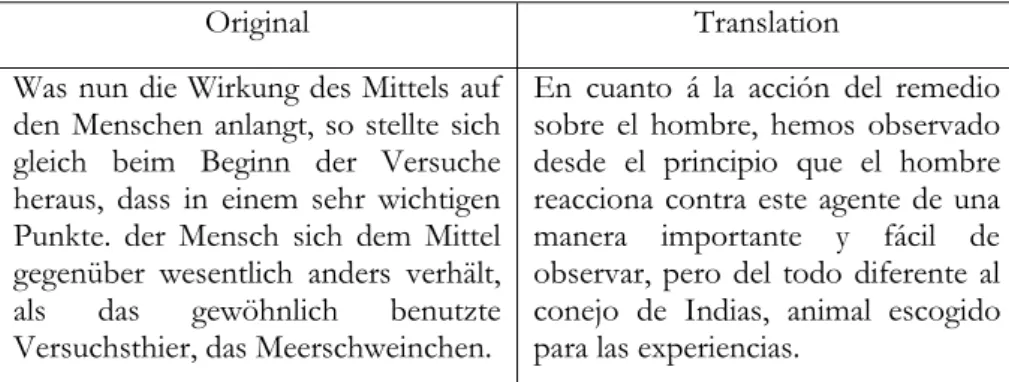
(13) The translation of Robert Koch’s scientific articles on tuberculosis (German-Spanish). adequately translated with the equivalent emphasis as “no un solo” and “más de mil”. − As to engagement, the first-person singular has been introduced in “creo” (a marker to expand-entertain) instead of the plural wir schreiben… zu, which is in fact an expression to contract-proclaimpronounce. Further modifications have been detected in fragment 3 of Table 6. Original. Translation. Was nun die Wirkung des Mittels auf den Menschen anlangt, so stellte sich gleich beim Beginn der Versuche heraus, dass in einem sehr wichtigen Punkte. der Mensch sich dem Mittel gegenüber wesentlich anders verhält, als das gewöhnlich benutzte Versuchsthier, das Meerschweinchen.. En cuanto á la acción del remedio sobre el hombre, hemos observado desde el principio que el hombre reacciona contra este agente de una manera importante y fácil de observar, pero del todo diferente al conejo de Indias, animal escogido para las experiencias.. Table 6. Fragment 3 of Koch (1890: 1079-1080). Here, there is again a displacement of the attitude-appreciation marker wichtig (importante) where the information “(reacciona) de una manera importante y fácil de observar” is added, thus anticipating information that is otherwise explained in the following paragraphs of the original. The quantification-extent marker gewöhnlich (common) is omitted. Further omissions have been detected throughout the article as can be seen in Table 7.3 Original. Translation. Der gesunde Mensch reagirt, wie wir Hemos visto que el hombre gesehen haben, auf 0,01 ccm gar nicht indemne apenas reacciona á la dosis mehr oder in unbedeutender Weise. de 1 centímetro cúbico. Die Kranken werden von dem Anfall Los enfermos se fatigan ligeramente auffallend wenig angegriffen por el acceso (…) kann schliesslich einen ganz (…) este estado llega al punto en bedeutenden Grad erreichen, so dass que el tejido luposo presenta aqui y das Lupusgewebe stellenweise allá un color rojo obscuro y se 3. I have underlined omitted words in Table 7 and slightly altered expressions in Table 8.. 13.
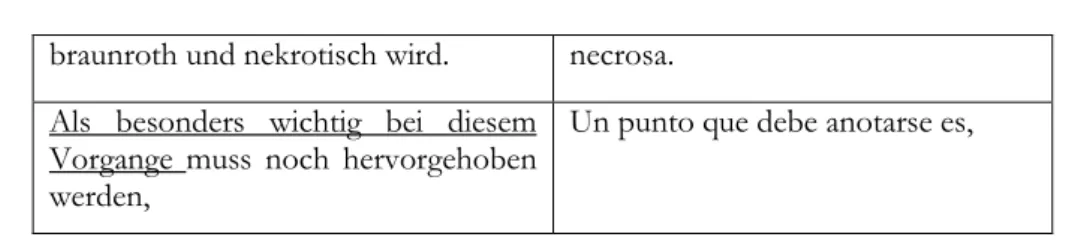
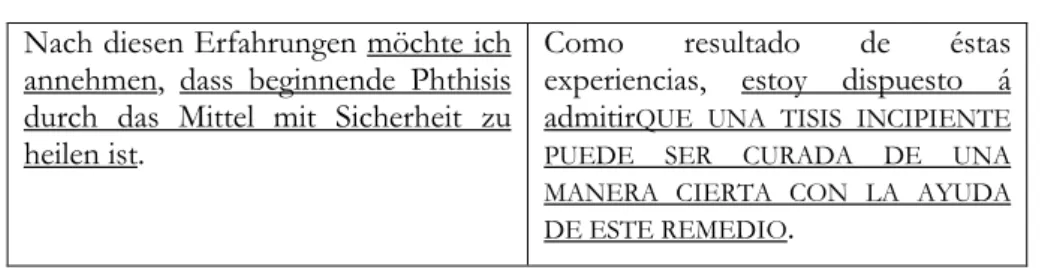
(14) María Pilar Castillo Bernal. braunroth und nekrotisch wird.. necrosa.. Als besonders wichtig bei diesem Un punto que debe anotarse es, Vorgange muss noch hervorgehoben werden, Table 7. Omissions in Koch (1890: 1080 and ff.). These affect mainly appreciation and quantification resources (important, apparent, etc.). Otherwise, there are minor alterations in the rendering of engagement markers as observed in Table 8. Original. Translation. (…) ich glaube deswegen nicht zu weit zu gehen, wenn ich annehme, dass das Mittel in Zukunft ein unentbehrliches diagnostisches Hülfsmittel bilden wird.. He aquí por qué creo poder decir que para el porvenir estas inyecciones nosservirán como un medio precioso para el diagnóstico.. Man wird damit im Stande sein, (…) Mediante este líquido, se podrá selbst dann noch zu diagnosticiren diagnosticar (…) (…) In welcher Weise dieser Vorgang sich vollzieht, lässt sich augenblicklich noch nicht mit Bestimmtheit sagen, da es an den erforderlichen histologischen Untersuchungen fehlt.. Yo no puedo decir exactamente hasta el día de qué manera se verifican estos procesos, toda vez que hacen falta los exámenes histológicos necesarios.. Das Mittel tödtet also, um es noch El líquido, repito, no mata, pues, los einmal kurz zu wiederholen, nicht die bacilos de los tubérculos (…) Tuberkelbacillen (…) Ob diese Auffassung und die sich El porvenir nos demostrará si esta daran knüpfenden Folgerungen idea y las conclusiones que yo richtig sind, das wird die Zukunft deduzco son justas. lehren müssen. Dieses milde Verfahren schien mir Según creo, este procedimiento ha namentlich bei solchen Kranken de seguirse en enfermos que tienen geboten, deren Kräftezustand ein pocas fuerzas geringer war.. 14.
(15) The translation of Robert Koch’s scientific articles on tuberculosis (German-Spanish). Nach diesen Erfahrungen möchte ich annehmen, dass beginnende Phthisis durch das Mittel mit Sicherheit zu heilen ist.. Como resultado de éstas experiencias, estoy dispuesto á admitirQUE UNA TISIS INCIPIENTE PUEDE SER CURADA DE UNA MANERA CIERTA CON LA AYUDA DE ESTE REMEDIO.. Table 8. Koch (1890: 1080 and ff.). As can be seen above, these modifications affect verbal forms which undergo the following procedures: − contraction, mainly as modal verbs, sometimes combined with personification: nicht zu weit...(poder decir), im Stande sein (podrá), lässt sich nicht sagen (no puedo decir) − omission of the force marker selbst dann noch (even then) − personalisation: um es noch einmal zu wiederholen (repito), sich daran knüpfenden (yo deduzco) − variation: schien mir geboten (a formal expression translated with a more colloquial verb “creo”), möchte ich annehmen (estoy dispuesto a admitir) − emphasis introduced by small caps in the last Spanish fragment. Overall, a tendency to simplify and personalise hedging or impersonal structures typical of academic writing seems to pervade the Spanish text, perhaps with a view to shortening the translated text. As regards Koch’s article published in 1891, a preliminary analysis of translation techniques is to be published in Castillo (2019, forthcoming), so in what follows I will focus more specifically on appraisal resources. First, it should be noted in Table 9 that the beginning of the text refers to the previous article published in 1890.4. 4. Original. Translation. Seit der vor 2 Monaten erfolgten Veröffentlichung (cf. diese Wochenschr. 1890, Nr. 46a) meiner Versuche mit einem neuen. Desde la publicación, acaecida hace dos meses, de los experimentos practicados según mi nuevo procedimiento de curación de la. In the following tables I have underlined both omitted and modified expressions.. 15.
(16) María Pilar Castillo Bernal. Heilverfahren gegen Tuberkulose haben viele Ärzte das Mittel erhalten und sind dadurch in den Stand gesetzt, sich durch eigene Versuche mit den Eigenschaften desselben bekannt zu machen.. tuberculosis, muchos médicos han recibido el remedio y pueden darse cuenta por sí propios de las propiedades del mismo.. Table 9. Fragment 4 of Koch (1891: 669). Neither the translation published in Seminario farmacéutico nor the one in Crónica Médica include this self-reference, even though the translation of the 1890 article was published in the latter journal. The version in Seminario farmacéutico does, however, credit the source of the 1891 original in the title, as discussed in 3.1. Regarding appraisal, slight differences have been detected in the translation of the following fragments in Table 10. Original. Translation. Darüber, daß das Mittel eine spezifische Wirkung auf tuberkulöses Gewebe ausübt und. infolgedessen als ein sehr feines und sicheres Reagens zum Nachweis versteckter und zur Diagnose zweifelhafter tuberkulöser Prozesse verwertet werden kann, ist man wohl allgemein einig.. Todos están de acuerdo al reconocer que este remedio ejerce una acción específica sobre los tejidos tuberculosos y que, por consecuencia, puede ser empleado como un reactivo muy delicado y muy seguro para la demostración de un proceso tuberculoso latente y para el diagnóstico de los casos dudosos.. Auch in bezug auf die Heilwirkung des Mittels wird von den meisten berichtet, daß trotz der verhältnismäßig kurzen Dauer der Kur bei vielen Kranken schon mehr oder weniger weitgehende Besserung eingetreten ist. In nicht wenigen Fällen soll wie mir berichtet wurde, selbst Heilung erzielt sein. Nur ganz vereinzelt ist behauptet, daß das Mittel nicht allein bei zu weit vorgeschrittenen Fällen gefährlich. En cuanto á la virtud curativa, la mayoría de los informes hacen constar que, á pesar de la duración, relativamente corta, de la cura, en muchos enfermos prodúcese una mejoría más ó menos considerable; en casos bastante numerosos hasta se ha. llegado á confirmar una curación completa. Según algunos hechos aislados este remedio podría, no tan sólo ser peligroso en casos de tuberculosis. 16.
(17) The translation of Robert Koch’s scientific articles on tuberculosis (German-Spanish). werden könne, was man ohne weiteres zugeben wird, sondern daß es den tuberkulösen Prozeß geradezu befördere, also an und für sich schädlich sei.. muy avanzada (lo que se puede admitir sin dificultad), sino también activar el proceso tuberculoso, y por consecuencia ejercer una acción nociva.. Table 10. Koch (1891: 669). In the first case, the engagement-expand-entertain marker wohl has been omitted in the translation, therefore turning a heteroglossic expression (it seems like everybody agrees) into a monoglossic one (everybody agrees). In the second fragment, an und für sich (in itself) has also been omitted, thus placing less emphasis on the original contract-proclaim-pronounce utterance. It is also interesting to observe that the verb tense “prodúcese” (present form) does not convey the meaning of the original ist eingetreten (has occurred): together with the omission of schon (already), this diminishes the emphasis introduced by the contract-disclaim-counter trotz (despite). As to the expand-attributeacknowledge verbal form ist behauptet (it has been stated), it has been translated by the modal form “podría”, which again diminishes both the appraising hedging effect and the formal register of the original. Finally, as to graduation resources, the force-quantification marker In nicht wenigen Fällen has been translated as “casos bastante numerosos”, thus increasing the emphasis. Focus expression geradezu (precisely) has been translated as an addition (“también”). In the following fragments in Table 11 we shall turn our attention to markers of attitude and force. Original. Translation. Solange es nur darauf ankam, meine Angaben auf ihre Richtigkeit zu prüfen, war es nicht erforderlich zu wissen, was das Mittel enthält und woher es stammt. Es mußte im Gegenteil die Nachprüfung um so unbefangener ausfallen, je weniger von dem Mittel selbst bekannt war. Nachdem nun aber die Nachprüfung, wie mir scheint, in hinreichendem Maße stattgefunden und die Bedeutung des Mittels ergeben hat,. Mientras se trataba solamente de saber el valor clínico del remedio, no era indispensable conocer su origen, ni de dónde procedía. Lo mismo de la noción relativa á su composición, aseguraba la mayor garantía de los experimentos. Ahora que éstos han sido ya efectuados en suficiente escala, según creo, la independencia del médico exige el absoluto conocimiento de la composición del remedio en. 17.
(18) María Pilar Castillo Bernal. wird es die nächste Aufgabe sein, das cuestión, por lo cual voy á dar Mittel auch über den bisherigen cuenta del modo cómo he Bereich der Anwendung hinaus zu preparado el líquido. studieren und womöglich die Prinzipien, welche der Entdeckung desselben zugrunde liegen, auch auf andere Krankheiten anzuwenden.Diese Aufgaben verlangen selbstverständlich die volle Kenntnis des Mittels, und ich halte deswegen den Zeitpunkt für gekommen, daß nach dieser Richtung hin die erforderlichen Angaben gemacht werden, was in folgendem geschehen soll. Nachdem diese eigentümliche Tatsache gefunden war, habe ich sie nach allen Richtungen hin weiter verfolgt, und es ergab sich dann weiter, daß abgetötete Reinkulturen von Tuberkelbazillen, nachdem sie verrieben und im Wasser aufgeschwemmt sind, bei gesunden Meerschweinchen in großer Menge unter die Haut gespritzt werden können, ohne daß etwas anderes als eine lokale Eiterung entsteht1).. Yo he perseguido este fenómeno particular en todas las direcciones posibles, y he reconocido después que los cultivos puros y muertos de bacilos de la tuberculosis, pulverizados y empapados en agua, pueden ser inyectados en gran cantidad bajo la piel de los conejillos sanos, sin determinar otro fenómeno que una supuración local.. Table 11. Koch (1891: 669-670). In the first fragment, the attitude-appreciation marker unbefangen (unhindered) has been translated with a particularisation (“mayor garantía”); a technique also applied also to some terminological units, such as meine Angaben (“el valor clínico del remedio”) and enthält (“composición”). It is remarkable how the reference to the application of Koch’s discovery to other illnesses has been omitted, perhaps with the purpose of keeping the reader’s attention focused on the matter at hand (tuberculosis). In the second fragment, the force-quantification-extent-proximity marker Nachdem…gefunden war (after it was found) has been omitted and the. 18.
(19) The translation of Robert Koch’s scientific articles on tuberculosis (German-Spanish). engagement-contract-proclaim-endorse marker es ergab sich weiter (furthermore it was detected) is rendered as a proclaim-pronounce personalisation: “he reconocido”. In comparison with the 1890 article, fewer omissions of specific appraisal resources have been detected in this text. By contrast, whole sentences and paragraphs have been left out in the Spanish version of 1891. In Table 12 below, the translations provided are my own. Original. My translation. 1). Derartige Injektionen gehören zu 1) Este tipo de inyecciones es uno den einfachsten und sichersten de los medios más sencillos y Mitteln, um Eiterungen zu erzeugen, seguros de generar supuraciones welche frei von lebenden Bakterien libres de bacterias vivas. sind. Der praktischen Anwendung solcher Aufschwemmungen von abgetöteten Tuberkelbazillen stellte sich aber der Umstand entgegen, daß an den Injektionsstellen die Tuberkelbazillennicht etwa resorbiert werden oder in anderer Weise verschwinden, sondern unverändert lange Zeit liegen bleiben und kleinere oder größere Eiterherde erzeugen.. A la aplicación práctica de tales soluciones se oponía sin embargo la circunstancia de que en los puntos inoculados los bacilos tuberculosos no se reabsorben ni desaparecen de ningún otro modo, sino que permanecen presentes durante un largo tiempo sin alteración y producen focos supurantes de mayor o menor tamaño.. Auf solche Weise läßt sich, wenigstens vorläufig, ungezwungen der spezifische Einfluß, welchen das Mittel in ganz bestimmten Dosen auf tuberkulöses Gewebe ausübt, ferner die Möglichkeit, mit diesen Dosen so auffallend schnell zu steigen, und die unter nur einigermaßen günstigen Verhältnissen unverkennbar vorhandene Heilwirkung des Mittels erklären.. De este modo se consigue sin esfuerzo, al menos provisionalmente, el efecto específico que ejerce el remedio en dosis muy concretas sobre el tejido tuberculoso, además de la posibilidad de aumentar dichas dosis de manera tan perceptiblemente rápida, y que explican el indiscutible efecto sanador producido en circunstancias solo moderadamente favorables.. Table 12. Omitted fragments in Koch (1891: 670-672). 19.
(20) María Pilar Castillo Bernal. As mentioned above, the most likely explanation for these omissions is the desire to focus the discourse on the matter at hand and avoid additional explanations that are deemed unnecessary. However, the omission in the last fragment corresponding to the conclusion of the article causes the Spanish text to end in a somewhat abrupt manner: “En los tuberculosos una cantidad mucho menor de esta substancia basta para provocar en puntos particulares, y al mismo tiempo una necrosis de las células y fenómenos correlativos que invaden el conjunto del organismo.” 3.2 Translation techniques Although it is not within the scope of this study to provide a quantitative analysis of the detected translation techniques, it is worth commenting briefly on some of the abovementioned findings in this regard. Almost all the techniques proposed by Byrne have been identified in the analysed translations, with the exception of borrowing, cultural substitution and iconic linkage. The most frequently detected techniques as regards the translation of appraisal resources were: − omission: either applied to specific appraisal items or entire fragments which have been left out. − restructuring and expansion: mainly referred to titles, footnotes, references, sections, etc., as well as the use of capitals or small caps and italics in order to highlight fragments that were not otherwise marked in the original. − particularisation: meanings and items were found to be more often specified than generalised. − transposition and modulation: often used in combination with a change of order of the sentence as required by the target language. − contraction: mostly applied to verbal forms in engagement expressions, perhaps in search of an economy of words. − variation: although this is not a technique explicitly mentioned by Byrne in the context of scientific and technical translation, it should be mentioned that omissions and adaptations of expressions typical of academic writing do have an impact on the overall tone of the text, as they diminish the formality of the register.. 20.
(21) The translation of Robert Koch’s scientific articles on tuberculosis (German-Spanish). − displacement:5 this concerns mainly omissions of references and of fragments in order to focus and adapt the contents to the expectations of the target reader, who had a presumable interest in a remedy for tuberculosis only given the impact of this illness at the time. Since no equivalence issues were detected, it can also be assumed that the correct terminological equivalents were equally used throughout the texts. 4. Conclusions The articles analysed here present an array of appraisal resources that show how scientific texts are not absolutely universal and objective acts of communication, but are subject to discourse strategies and elements that require careful consideration and reader awareness, especially when translated. Among other circumstances, the context in which scientific research is carried out often pervades the text and its undertones, as has been shown here in the case of the microbiology competition between France and Germany in the 19th century. Above all, the purpose of the translation and the adjustment to the target culture seem to be at the core of translators’ decisions here. This is apparent in the adaptations, the particularisation of information and structures, and even the simplification detected in the Spanish texts. As to the target readership of the translations, it seems to be the medical community rather than the general public as was the case in Germany. One should bear in mind the differences in scientific cultures in the two countries at the time: not only was microbiology an unknown field in Spain unlike Germany where it was on the rise, but the context of national competition with France was also foreign to Spanish physicians, whose main interest resided in the epidemiological problem posed by infectious diseases and how to combat them. Alterations in the translation of appraisal resources do not seem to have an impact on the general meaning of the texts; indeed, the translations have been found to comply with the target language conventions and an easy read at that. The overall tone of the texts, however, can be affected by techniques such as As described by Montgomery (2000: 280): “the collection of efforts within the receiving culture to erase or diminish any overt signs of debt to the source culture”; for example by glossing, reorganisation, substitution of indigenous names, titles or terms. 5. 21.
(22) María Pilar Castillo Bernal. personalisation and contraction, which indeed cause a distancing from the deictic centre of the original, especially in attitudinal and engagement values as predicted by Munday. More specifically, impersonal and collective expressions of authorship are modified in the translations to focus on Koch’s persona. Nevertheless, graduation resources have also been affected in the analysed translations, albeit to a lesser degree. A further effect of these modifications is a variation in the register of the translation, which becomes noticeably less academic and formal than the original. It can also be concluded that neither scientific articles as a text genre nor translations as a professional activity were consolidated at the time, judging from the lack of compliance with genre conventions (i.e. macrostructure) and translation techniques (omissions being mostly inadvisable in specialised translation nowadays). More comprehensive, diachronic research in this field should shed further light on both points.. 22.
(23) The translation of Robert Koch’s scientific articles on tuberculosis (German-Spanish). References Báguena Cervellera, M. J. (2011) ‘La tuberculosis en la historia.’ Anales Reial Acadèmia de Medicina de la Comunitat Valenciana, Nº. 12. [Online] [Accessed on 18thApril 2019] https://www.uv.es/ramcv/2011/VI.%20SESIONES%20CIENTIFICAS/CONF ERENCIAS/Dra.%20Baguena/Dra.%20Baguena.pdf Byrne, J. (2014) Scientific and technical translation explained. London & New York: Routledge. Castillo Bernal, M. P. (2019) ‘The translation of scientific literature from German into Spanish at the turn of the 20th century.’ Translation & Interpreting, 11(2), Special Issue on the History of Translation and Interpreting edited by Myriam Salama-Carr (forthcoming). Gamero, S. (2001) La traducción de textos técnicos. Descripción y análisis de textos (alemánespañol). Barcelona: Ariel. Gutiérrez Rodilla, B. M. and Quijada Diez, C. (2015) ‘La adaptación del contenido en los diccionarios médicos traducidos y publicados en España en el siglo XIX.’ In Aullón de Haro, P. and A. Silván (eds.) Translatio y Cultura, Madrid: Dykinson, pp. 201-207. Halliday, M. A. K. and Martin, J. R. (1993) Writing science: literacy and discursive power. London: Falmer. Koch, R. (1891) ‘Fortsetzung der Mittheilungen über ein Heilmittel gegen Tuberculose.’ Deutsche medicinische Wochenschrift, 17(3), pp. 101-102. In: Koch, R. (1912) Gesammelte Werke. - Bd. 1. Leipzig: Thieme, pp. 669-672 [Online] [Accessed on 18th April 2019]https://edoc.rki.de/bitstream/handle/176904/5175/669672.pdf?sequence=1&isAllowed=y Koch, R. (1891) ‘Tercera comunicación sobre el tratamiento de la tuberculosis. Composición y preparación de la linfa.’ Semanario farmacéutico, XIX (17), 25 January, pp. 135-139. [Online] [Accessed on 18th April 2019]http://hemerotecadigital.bne.es/issue.vm?id=0026893367&search=&lang=e s Koch, R. (1891) ‘Tercera comunicación sobre el tratamiento de la tuberculosis. Composición y preparación de la linfa.’ Crónica Médica, 14, pp. 41-46. Koch, R. (1890) ‘Weitere Mittheilungen über ein Heilmittel gegen Tuberculose.’ Deutsche medicinische Wochenschrift, 16(46), 1029-1032. [Online] [Accessed on 18th April 2019] https://www.thiemeconnect.com/products/ejournals/abstract/10.1055/s-0029-1207546 Koch, R. (1890) ‘Nueva comunicación sobre el tratamiento de la tuberculosis.’ Crónica Médica, 13, pp. 681-690.. 23.
(24) María Pilar Castillo Bernal. Martin, J. R. and White, P. R. R. (2005) The language of evaluation: Appraisal in English. London: Palgrave. Mayor Serrano, M. B., Quijada Diez, C. and Turrión, M. (eds.) (2011) ‘El alemán en la traducción y la comunicación médico-sanitarias.’ Panace@, Vol. XII, 34. Montgomery, S. L. (2009) ‘English and Science: realities and issues for translation in the age of an expanding lingua franca.’ JoSTrans, 11 [Online] [Accessed on 18th April 2019] https://www.jostrans.org/issue11/art_montgomery.php Montgomery, S. L. (2000) Science in Translation: Movements of Knowledge through Cultures and Time. Chicago: University of Chicago. Munday, J. S. (2015) ‘Engagement and Graduation resources as markers of translator/interpreter positioning.’ Target, 27(3), pp. 406-412. Online] [Accessed on 18th April 2019] http://eprints.whiterose.ac.uk/92141/1/Munday_Target_accepted.pdf Munday, J. S. (2012) Evaluation in Translation: Critical Points of Translator Decision-making. Abingdon: Routledge Olohan, M. (2016). Scientific and Technical Translation. New York: Routledge. Quijada Diez, C.and Gutiérrez Rodilla, B. M. (2017) ‘La traducción al español de diccionarios médicos alemanes en el siglo XIX.’ Revista de Lexicografía, XXIII, pp. 185-199 [Online] [Accessed on 18th April 2019] http://revistas.udc.es/index.php/rlex/article/view/rlex.2017.23.0.4702 Quijada Diez, Carmen (2016) ‘Traducción al español del diccionario médico alemán de Albert Eulenburg.’ In Sariego López, I., Gutiérrez Cuadrado, J. and Garriga Escribano, C. (eds.)El diccionario en la encrucijada: de la sintaxis y la cultura al desafío digital, Santander: Escuela Universitaria de Turismo Altamira y Asociación Española de Lexicografía Hispánica, pp. 369-380. Sanchez, D. (2014) ‘Productive paradoxes of a feminist translator: Carmen de Burgos and her translation of Möbius' treatise, The Mental Inferiority of Woman (Spain, 1904).’ Women's Studies International Forum. Special issue Rethinking Women and Translation in the 3rd Millennium, 42, pp. 68-76. Sánchez, D. (2011) ‘Translating Science: Contexts and Contests. On the Translation of a Misogynist Scientific Treatise in Early Twentieth-Century Spain.’ The Translator, 17(2), pp. 325-48. White, P. R. R. (2000) ‘Un recorrido por la teoría de la valoración.’ Translation by Elsa Ghio [Online] [Accessed on 18th April 2019] http://www.grammatics.com/appraisal/spanish_tr/spanishtranslationappraisaloutline.pdf. 24.
(25)
Figure



+5

Documento similar
The draft amendments do not operate any more a distinction between different states of emergency; they repeal articles 120, 121and 122 and make it possible for the President to
Abstract: Transepidermal water-loss (TEWL), stratum-corneum hydration (SCH), erythema, elas- ticity, pH and melanin, are parameters of the epidermal barrier function and
No obstante, como esta enfermedad afecta a cada persona de manera diferente, no todas las opciones de cuidado y tratamiento pueden ser apropiadas para cada individuo.. La forma
Silvina Ocampo’s translation of Emily Dickinson is a case in point: the lexical mismatches are so serious that they alter the context of the poem or simply make the
In the previous sections we have shown how astronomical alignments and solar hierophanies – with a common interest in the solstices − were substantiated in the
Díaz Soto has raised the point about banning religious garb in the ―public space.‖ He states, ―for example, in most Spanish public Universities, there is a Catholic chapel
teriza por dos factores, que vienen a determinar la especial responsabilidad que incumbe al Tribunal de Justicia en esta materia: de un lado, la inexistencia, en el
We analysed the prevalence of gross (GH) and microscopic (mH) haematuria in 19,895 patients that underwent native renal biopsies from the Spanish Registry of Glomerulonephritis..
