
Life style and sports practice in peripubertal boys and girls on bone mineral density and body composition – preleminary study
9
0
0
Texto completo
(2) 134. ESHPA - Education, Sport, Health and Physical Activity. 2020, 4(1): 133-141. (P) Estilo de vida e prática esportiva em crianças e adolescentes, peripubertales sobre a densidade mineral de hueso e composição do cuerpo: estudio preleminar Resumo Introdução: Existem vários estudos publicados nos últimos vinte anos que tentam estabelecer a relação entre as reações do esqueleto para diferentes cargas específicas em jovens desportistas Objectivos: O objetivo desta pesquisa é estudar o impacto da atividade física regular (basquetebol, futebol e natação) em sujeitos peri-puberais através da densidade mineral óssea (DMO) e composição corporal.Métodos: Trata-se de um estudo seccional, descritivo e correlacional envolvendo nadadores (n = 17 mulheres e 10 homens), jogadores de futebol (n = 13 mulheres e 19 homens), jogadores de basquetebol (n = 14 e 15 homens) e grupo controle (n = 20 fêmeas e 12 machos) num total de 120 indivíduos. Foi aplicado um questionário sobre a atividade física e ingestão alimentar e estatura, massa corporal e circunferência abdominal. A DMO foi avaliada usando ultrassonografia quantitativa do calcâneo. O teste de Kruskal-Wallis foi utilizado para estudar o efeito do esporte nas variáveis do estudo. Resultados e discussão: A DMO para o grupo controle é menor do que para todos os outros grupos para ambos os sexos, (Nadadores (f: 0,521; m: 0,533), Futebol (f: 0,634; m: 0,639), Basquetebol (f: 0,688; m: 0,657) Grupo Controle (f: 0,462; m: 0,472) Os jogadores de basquete têm os maiores valores de DMO para ambos os sexos, seguidos por jogadores de futebol e nadadores, e o teste de Kruskal-Wallis mostra que há esportes acima da DMO [X2 (3)=82.796; p<0.001]. Conclusões: A atividade física regular em sujeitos peripubertais promove aumento na DMO, os esportes de confronto são os que apresentam maiores valores no esqueleto para ambos os sexos. Palavras-chave: Atividade física; composição do corpo; osteoporose; reabsorção óssea; remodelação óssea. Ribeiro, L.; Pinheiro, J; Ribeiro, A.; Machado-Rodrigues A.; (2020). Title. ESHPA - Education, Sport, Health and Physical Activity. 4(1): 133-141. doi: ESHPA - Education, Sport, Health and Physical Activity - ISSN: 2603-6789.
(3) 135. ESHPA - Education, Sport, Health and Physical Activity. 2020, 4(1): 133-141. I. Introduction / Introducción There are several studies published in the last twenty years that try to stablish the relationship between skeleton reactions to diferent loads particular in sports youth (Chilibeck, Sale & Webber, 1995; American Academy of Pediatrics, 2001; Guy & Micheli, 2001; Gracia-Marco, Moreno LA, Ortega FB, et al., 2011; Vlachopoulos et al., 2017). The benefits of physical activity are known and the adaptations associated with the stimuli of the same in the morphology of the individuals, with different responses in the different stages of life, associated with other factors, such as the hormonal and alimentary, can help us to understand the different responses to the practice of physical activity, preventing the reduction of bone loss (Warden & Fuchs, 2018; Rusley, Cueto & Donaldson, 2018). Bone mineral density (BMD) loss as we age is aggravated when bone skeletons in the first decades of life are not stimulated enough to promote gains in bone remodeling and remodeling mechanisms capable of preparing the increased risk of fractures associated with the turn of half a century of life and consequent impact on public health (Tan, Macdonald, Kim, et al. (2014). The purpose of this study is to know the impact of regular and prolonged sports activity (basketball, soccer, swimming, control group) in peripubertal in the values of bone mineral density (BMD) and body composition.. I.1.Aims / Objetivos: The aim of this research is to study the impact of regular physical activity (basketball, soccer and swimming) on peri-puberal subjects by bone mineral density (BMD) and body composition. II. Methods / Material y métodos This is a cross-sectional study, descriptive and correlational involving swimmers (n=17 females and 10 males), soccer players (n=13 females and 19 males), basketball players (n=14 females and 15 males) and a control group (n=20 females and 12 males) in a total of 112 subjects. A questionnaire on physical activity and food intake was applied and stature, body mass and abdominal girth. BMD was assessed using quantitative ultrasound of the calcaneus (QUS), the instrument used was the Sahara Hologic Bone Densitometer. Later, an International Lifestyles Questionnaire was delivered to the entire sample, as well as the acquisition of anthropometric data through a Tanita CS601 digital scale that provided various values such as weight, height, body mass index, percentage of lean mass and weight of muscle mass. Regarding the descriptive statistics, data was analyzed in the form of tables and graphs, done through the Ribeiro, L.; Pinheiro, J; Ribeiro, A.; Machado-Rodrigues A.; (2020). Title. ESHPA - Education, Sport, Health and Physical Activity. 4(1): 133-141. doi: ESHPA - Education, Sport, Health and Physical Activity - ISSN: 2603-6789.
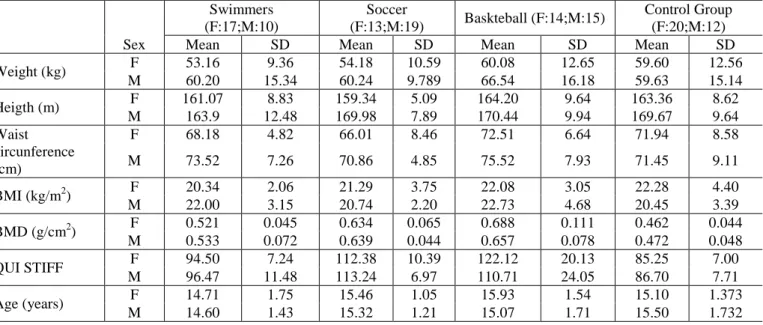
(4) 136. ESHPA - Education, Sport, Health and Physical Activity. 2020, 4(1): 133-141. software Statistical Package for the Social Sciences (SPSS), such as descriptive statistics, mean, standard deviation and some correlational tests, namely Kruskall Wallis. A p-values < 0,05 was considered statistically significant. SPSS version 20 was used for statistical analyses.. III. Results / Resultados The sample characterization involving the 120 participants from all groups is presented in Table 1 represents information about age and body composition variables, and sports activity information is also included according sex. The BMI values for both sexes differs by only one tenth. The values of BMD are very close. In the Table 2 the sample is presented by sport modality groups separed by sex considering information about age and body composition variables. The anthropometric variables in both sexes present higher values in the basketball players comparing with the other modalities, only the control group have slight increase in the BMI. On the other hand the control group presents considerably poorer BMD values when compared with the other groups. Not being a normal distribution we had to adopt by non-parametric tests know the efect of sports. The Kruskal-wallis test show there is efecte of sports above the BMD [X2 (3)=82.796; p<0.001], Qui_STIFF [X2 (3)=77.126; p<0.001] and Waste [X2 (3)=8.299; p<0.05]. In the Graphs bellow is represented the box plot for each variable whom p<.05, is possible to observe the differences for the subgroup of sports in the BMD, BMI and Qui_STIFF varibles.. Ribeiro, L.; Pinheiro, J; Ribeiro, A.; Machado-Rodrigues A.; (2020). Title. ESHPA - Education, Sport, Health and Physical Activity. 4(1): 133-141. doi: ESHPA - Education, Sport, Health and Physical Activity - ISSN: 2603-6789.
(5) 137. ESHPA - Education, Sport, Health and Physical Activity. 2020, 4(1): 133-141. Table 1 - Descriptive characteristics of the sample (mean ± standard deviation, percentages by subgroup) according sex, age, BMI, BMD, QUI STIFF and sports modality percentage. Variables. n 120. Weight (kg) Heigth (m) Waist Circunference (cm) BMI (kg/m2) BMD (g/cm2) QUI STIFF Age (years) Sport Modality Swimmers Soccer Basketball Control Group. n 27 32 29 12. Mean ± SD/Percentage Female (n=64) Male (n=56) 53.3% 46,7% 56.9 ± 11.58 61.8 ± 13.81 162.1 ± 8.35 168.96 ± 9.76 69.8 ± 7.59 72.71 ± 9.76 21.5 ± 3.49 21.4 ± 3.46 0.562 ± 0.112 0.589 ± 0.962 101.2 ± 18.66 72.71 ± 9.76 15.25 ± 1.50 15.16 ± 17.72 % 26.6% 17.9% 20.3% 33.9% 21.9% 26.8% 31.2% 21.4%. Table 2 - Descriptive characteristics (M ± SD) for the total sample (n=112) by sex, for extern morphology and bone mass density variables by subgroup sports modality.. Weight (kg) Heigth (m) Waist circunference (cm) BMI (kg/m2) BMD (g/cm2) QUI STIFF Age (years). Swimmers (F:17;M:10) Mean SD 53.16 9.36 60.20 15.34 161.07 8.83 163.9 12.48 68.18 4.82. Soccer (F:13;M:19) Mean SD 54.18 10.59 60.24 9.789 159.34 5.09 169.98 7.89 66.01 8.46. M. 73.52. 7.26. 70.86. F M F M F M F M. 20.34 22.00 0.521 0.533 94.50 96.47 14.71 14.60. 2.06 3.15 0.045 0.072 7.24 11.48 1.75 1.43. 21.29 20.74 0.634 0.639 112.38 113.24 15.46 15.32. Sex F M F M F. Mean 60.08 66.54 164.20 170.44 72.51. SD 12.65 16.18 9.64 9.94 6.64. Control Group (F:20;M:12) Mean SD 59.60 12.56 59.63 15.14 163.36 8.62 169.67 9.64 71.94 8.58. 4.85. 75.52. 7.93. 71.45. 9.11. 3.75 2.20 0.065 0.044 10.39 6.97 1.05 1.21. 22.08 22.73 0.688 0.657 122.12 110.71 15.93 15.07. 3.05 4.68 0.111 0.078 20.13 24.05 1.54 1.71. 22.28 20.45 0.462 0.472 85.25 86.70 15.10 15.50. 4.40 3.39 0.044 0.048 7.00 7.71 1.373 1.732. Baskteball (F:14;M:15). Ribeiro, L.; Pinheiro, J; Ribeiro, A.; Machado-Rodrigues A.; (2020). Title. ESHPA - Education, Sport, Health and Physical Activity. 4(1): 133-141. doi: ESHPA - Education, Sport, Health and Physical Activity - ISSN: 2603-6789.
(6) 138. ESHPA - Education, Sport, Health and Physical Activity. 2020, 4(1): 133-141. Table 3 - Kruskal-wallis test for the total sample (n=112) by sex, for extern morfology and bone mass density variables by subgrupo sports modality. Weight (kg) Chi-Square df Asymp. Sig.. 4.279 3 .233. Heigth (m) 3.342 .342. Waist circunference (cm) 8.299. BMI (kg/m2). BMD (g/cm2). QUI STIFF. Age (years). 3.960. 82.79. 77.126. 4.074. .266. .000. .000. 0.253. .040. IV. Discussion / Discusión In a study with a sample of 821 subjects, including children (n = 217), adults (n = 235) and the elderly (n = 369), Magkos, Magios, Babaroutsi, Manios and Sidossis (2004) concluded that age, height and diet variables affect the quantitative ultrasound indices of the calcaneus. These values were higher in adults, in overweight and obese individuals, as well as in those who practice physical activity. According to Saadi, Reed, Carter, Dunn, Qazaq and Al-Suhaili (2003), in a study with a random sample of about 183 families with only females included, the QUS parameters are influenced by anthropometric, reproductive and lifestyle factors. This information was also confirmed by the present study, especially when the Kruskall Wallis test was performed, where it was verified that the practice of physical activity and the waist circumference influence BMD. Additionally, BMI is also a good indicator, considering that includes weight and height that are related to lifestyle and diet.. Ribeiro, L.; Pinheiro, J; Ribeiro, A.; Machado-Rodrigues A.; (2020). Title. ESHPA - Education, Sport, Health and Physical Activity. 4(1): 133-141. doi: ESHPA - Education, Sport, Health and Physical Activity - ISSN: 2603-6789.
(7) 139. ESHPA - Education, Sport, Health and Physical Activity. 2020, 4(1): 133-141. The most relevant finding of this study was the similarity related to bone mass between active peripubertal in different sports activities have higher BMD for both sexes then the control group. The basketball subgroup present higher values overall, with a with a slight advance on the girls, with the possibility of being explained by the maturational advance (Malina, Bouchard & Oded Bar-Or, 2004). If we consider the height they are around to the Portuguese national median (163cm), while boys are still below the national average for men (172,9 cm) because had not reached Peak Height Velocity and therefore, it can be said that the bone mass (density and mineral content) will increase further more (at the moment lower than girls) (Greene, Courteix, & Baxter-Jones, 2017). Size and quantity of bone tissue are strongly affected by biological maturation that causes hypertrophy and hyperplasia in different human tissues (Rizzoli, Bonjour, & Ferrari, 2001; Loud & Gordon, 2006). Several research demonstrated that high-impact sports in early life can be a beneficial factor for bone growth (directly or mediated by muscle levers), boosting natural development, and improving bone health in adulthood (Barbieri & Zaccagni, 2013; Tan, Macdonald, Kim, Nettlefold, Gabel, Ashe, et al., 2014; Goolsby, & Boniquit, 2016). Although this finding the biological explanation to support then are few (Ducher, Courteix, Meme et al, 2005), adults engaged in sports from early life have increased osteocalcin production and vascularization of bone tissue when compared to adults that were sedentary. The limitations of this study should be recognized. The cross-sectional design does not allow to conclude if peripubertal whom have sport practice had higher bone mass than the control group ones prior to their engagement in sports. Finally, the bone geometry should be considered in future studies.. Ribeiro, L.; Pinheiro, J; Ribeiro, A.; Machado-Rodrigues A.; (2020). Title. ESHPA - Education, Sport, Health and Physical Activity. 4(1): 133-141. doi: ESHPA - Education, Sport, Health and Physical Activity - ISSN: 2603-6789.
(8) 140. ESHPA - Education, Sport, Health and Physical Activity. 2020, 4(1): 133-141. V. Conclusions / Conclusiones In summary, peripubertal engaged in high-impact sports presented higher bone mass then those who are sedentary. Efforts should be made to encourage modification of all risk factors for osteoporosis early on life such as government policies to promote the sports practice. VI. Acknowledgements / Agradecimientos. VII. Conflict of interests / Conflicto de intereses The autor claim there are no conflicto of interests VIII. References / Referencias American Academy of Pediatrics, Committee on Sports Medicine and Fitness (2001). Strength training by children and adolescents. Pediatrics. 107:1470-2. Barbieri, D. & Zaccagni. L. (2013). Strength training for children and adolescents: Benefits and risks. Coll Antropol. 37(2): 219-225. Chilibeck, P.D.; Sale, D.G. & Webber, C.E. (1995). Exercise and bone mineral density. Sports Med;19:103-22. Ducher, G.; Courteix, D.; Meme, S.; Magni, C.; Viala, J. & Benhamou, C. (2005). Bone geometry in response to long-term tennis playing and its relationship with muscle volume: a quantitative magnetic resonance imaging study in tennis players. Bone. 37(4): 457-466. Goolsby, M. A., & Boniquit, N. (2016). Bone Health in Athletes. Sports health, 9(2), 108-117. Gracia-Marco, L.; Moreno, L.A.; Ortega, F.B., et al. (2011). Levels of physical activity that predict optimal bone mass in adolescents: the HELENA study. Am J Prev Med. 40(6):599–607. Greene, G.N.; Courteix, D. & Baxter-Jones, A. (2017). Resilient, Responsive, and Healthy Developing Bones: The Good News About Exercise and Bone in Children and Youth. Pediatric Exercise Science, 29, 437-439 Guy, J.A. & Micheli, L.J. (2001). Strength training for children and adolescents. J Am Acad Orthop Surg.9:29-36. Loud, K.J.; & Gordon, C.M. (2006). Adolescent bone health. Arch Pediatr Adolesc Med. Oct 1;160(10):1026–32. https://doi.org/10.1001/archpedi.160.10.1026. Malina, R.M., Bouchard, C., & Bar-Or, O. (2004). Growth, maturation, and physical activity (2nd.). Champaign, Ill, USA: Human Kinetics. Magkos, F.; Manios, Y.; Babaroutsi, E. et al. (2006). Development and validation of a food frequency questionnaire for assessing dietary calcium intake in the general population Osteoporos Int 17: 304.. Ribeiro, L.; Pinheiro, J; Ribeiro, A.; Machado-Rodrigues A.; (2020). Title. ESHPA - Education, Sport, Health and Physical Activity. 4(1): 133-141. doi: ESHPA - Education, Sport, Health and Physical Activity - ISSN: 2603-6789.
(9) 141. ESHPA - Education, Sport, Health and Physical Activity. 2020, 4(1): 133-141. Rizzoli, R.; Bonjour, J. & Ferrari, S. (2001). Osteoporosis, genetics and hormones. J Mol Endocrinol. 26(2): 79-94. Rusley, J., Cueto, J. & Donaldson, A.A. (2018). Bone Health Considerations for the Adolescent Female Athlete. Curr Pediatr Rep. 6: 89. DOI 10.1007/s40124-018-0160-0 Saadi, H. F., Reed, R. L., Carter, A. O., Dunn, E. V., Qazaq, H. S., & Al-Suhaili, A. R. (2003). Quantitative ultrasound of the calcaneus in arabian women: relation to anthropometric and lifestyle factors. Maturitas, 44(3), 215–223. doi:10.1016/s0378-5122(02)00339-0 Tan, V.P.; Macdonald; H.M.; Kim, S.; Nettlefold. L.; Gabel, L.; Ashe, M.C.; et al. (2014). Influence of physical activity on bone strength in children and adolescents: a systematic review and narrative synthesis. J Bone Miner Res. 29:2161–81. Vlachopoulos, D.; Barker, A.; Williams, C. et al. (2017). The Impact of Sport Participation on Bone Mass and Geometry in Male Adolescents. Med Sci Sports Exerc. 49(2):317–326. doi: 10.1249/MSS.0000000000001091. Warden, S. J. & Fuchs, R. K. (2018). Physical Activity to Promote Bone Health in Adolescents. In A Practical Approach to Adolescent Bone Health, ed. S. Pitts, C. M. Gordon . pp.55-76. https://doi.org/10.1007/978-3-319-72880-3_4. Ribeiro, L.; Pinheiro, J; Ribeiro, A.; Machado-Rodrigues A.; (2020). Title. ESHPA - Education, Sport, Health and Physical Activity. 4(1): 133-141. doi: ESHPA - Education, Sport, Health and Physical Activity - ISSN: 2603-6789.
(10)
Figure

Documento similar
Overall, the major aims on this study are: (i) to compare the physical–chemical properties of bone mineral from extinct mammoths and recent elephants, which allows us to
The expansionary monetary policy measures have had a negative impact on net interest margins both via the reduction in interest rates and –less powerfully- the flattening of the
Jointly estimate this entry game with several outcome equations (fees/rates, credit limits) for bank accounts, credit cards and lines of credit. Use simulation methods to
Background: The aim of this study was to evaluate the incidence and the risk factors of osteonecrosis of the jaw (ONJ) in a group of patients treated with zoledronic acid (ZA) for
La cantidad y el tipo de deporte practicado modulan la autoestima, de hecho ésta es superior entre los adolescentes practicantes de deportes colectivos. La edad no es un
The main goal of this study was analysing the characteristics of School Sports trainers and assistants in the city of Segovia and learning their opinion on values connected to
Therefore, the purpose of this article is to know the specialized training in sports (any kind) that European prison sports educators have and the use they make of
Aim: Our objective was to determine changes in bone mineral density (BMD), trabecular bone score (TBS), and body composition after 2 years of therapy with recombinant
