SOL-GEL INCORPORATION OF ORGANOMETALLIC COMPOUNDS INTO SILICA:
USEFUL PRECURSORS TO METALLIC NANOSTRUCTURED MATERIALS
CARLOS DIAZ
a, MARIA LUISA VALENZUELA
b, DENISSE GARRIDO
aAND PEDRO AGUIRRE
ca Departamento de Química, Facultad de Ciencias, Universidad de Chile, Las Palmeras 3425, Ñuñoa Casilla 653, Santiago, Chile. b Universidad Andres Bello, Departamento de Ciencias Quimica, Facultad de Ciencias Exactas, Av. Republica 275, Santiago, Chile.
c Departamento de Química Analítica e Inorgánica, Facultad de Ciencias Químicas y Farmacéuticas, Universidad de Chile, casilla 233, Santiago, Chile.
(Received: October 12, 2011 - Accepted: March 22, 2012)
ABSTRACT
Inclusion of the organometallic MLn = [HOC5H4N•Cp2TiCl][PF6] (1), HOC5H4N•W(CO)5 (2), HOC5H4N•Mo(CO)5 (3), [HOC6H4CH2CN•Cp2TiCl][PF6]
(4), HOC6H4CH2CN•W(CO)5 (5) and HOC6H4CH2CN•Mo(CO)5 (6) into amorphous silica using the gelator precursor TEOS and N3P3{NH[CH2]3Si[OEt]3}6
afford the gels (MLn)(SiO2)n. The inorganic-organic hybrid nanocomposites were pyrolyzed under air at 800°C to give nanostructured metal oxides and/or metal
pyrophosphates (phosphates) included in the silica matrices. The morphology of the monolithic nanocomposites exhibited a strong dependence on the gel precursor used being mainly laminar for those prepared using N3P3{NH[CH2]3Si[OEt]3} as gelator. TEM images show different shape and size such as circular nanoparticles,
nanocables and agglomerates in some cases with sizes of 20 nm for the circular nanostructures, and diameter about 25 nm for the nanocables.
Keywords Sol–gel, Nanostructured, Nanocomposites, Pyrophosphates.
INTRODUCTION
Since the Ebelmen discovery of the polymerization of TEOS(tetraethoxysilane)1 to give amorphous SiO
2, great amounts of the
material glasses and other have appeared 2, 3. When an organic moiety was
attached to the Si(OR)3 moiety as R-Si(OR)3 or (OR)3Si-R- Si(OR)3 interesting
“hybrid organic-inorganic” materials emerged4,5. It was found that the organic
groups are capable of modifying the properties of the bulk materials. Also inclusion of some inorganic substrates gives rise to metallic structures included inside the SiO2 matrix6, 7. Owing to the discovery of the ordered mesoporous
SiO2 assisted by surfactants, a new field emerged 8,9.Actually several organic
and inorganic substrates have been included in ordered mesoporous giving rise to interesting materials10,11 . Organometallic compounds included in periodic
mesoporous silica have been also discussed12. Although ordered mesoporous
silica with substrate included, are the most studied, amorphous form and its inclusion compounds could have also interesting an unforeseen reactivity pattern12. Some examples of metal and metal oxides included in amorphous
silica have been reported13-24 .
The most used method within this type of materials is the hydrolysis of TEOS in presence of metal salts (usually metal nitrate). By this method for instance metal oxide/SiO2 as Fe2O3/SiO213,14 , Cr2O3/SiO215 and metal/SiO2 as
Au/SiO2, Ag/SiO2, Cu/SiO2, Pt/SiO2 and Pd /SiO216,17 have been prepared.
Another related approximation uses TEOS with metal salts in presence of citric acid for the reduction. Ni, Co, Ag, Fe /SiO2 composites were obtained18 .
Hydrolysis of the metal/alkoxy as Cr(OtBu)
4 in presence of HOSi(OtBu)3 affords
nanostructured chromium oxides inside amorphous silica19. Impregnation of
Cu(NO3)2 salts in a SiO2 xerogel gives CuxO 20 . Another different approximation
to metal oxide/SiO2, is the use of precursor of the type MXn•H2N(CH2)3Si(OEt)3
with a co-condensation with TEOS to give MO•nSiO2 nanocomposites 21. Xia 22 in another way use a novel procedure to obtain nanocables of Ag covered
with amorphous silica. The preformed Ag nanocables were covered with SiO2
generated using the Stöber procedure.
Only two ways to include organometallic compounds inside amorphous silica have been reported23,24 . One used the precursor23 MLn•R
2P(CH2)2Si(OEt)3,
MLn = Fe(CO)5, RuCl2(h6-cymene), Co2(CO)9, and hydrolyzing in
presence of Si(OCH3)423. The another approximation uses the precursor
cis-Ru(Cl((CO)2P(R)(R’)(CH2)xSi(OCH3)3 in presence of TEOS24. Here we report
a new simple way to include the organometallics [HOC5H4N•Cp2TiCl][PF6],
HOC5H4N•W(CO)5, HOC5H4N•Mo(CO)5, [HOC6H4CH2CN•Cp2TiCl][PF6],
HOC6H4CH2CN•W(CO)5 and HOC6H4CH2CN•Mo(CO)5 inside amorphous
silica. The inclusion was performed by Sol-gel method using TEOS and N3P3{NH[CH2 ]3Si[OEt]3}6 as agent gelant and in presence of the respective
organometallic dissolved in the adequate solvent. N3P3{NH[CH2 ]3Si[OEt]3}6
was, for the first time used as gelator.
Pyrolysis of these gels at 800 °C under air affords nanostructured metal oxides and metal phosphates inside the silica. To the best our knowledgement the organometallic complexes (1-6) included in amorphous silica have been not reported. The organometallic (1-6) were select with the aim to obtain
nanostructured with Ti, W and Mo containing nanostructured materials inside SiO2. Here we report a simple, suitable and general way to prepare metallic
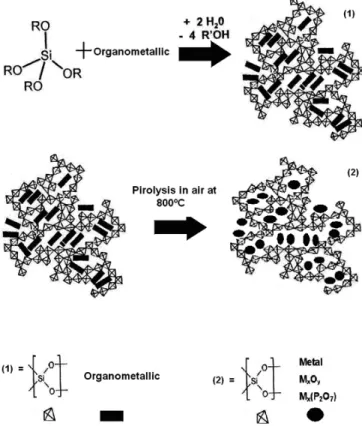
nanostructured nanoparticles as metal oxides and phosphates, inside amorphous silica from organometallic precursors see figure 1. We have previously shown the preparation of nanostructured materials from pyrolysis of molecular and macromolecular precursors 25-29 .
Fig. 1 Schematic representation of the Sol-gel/pyrolysis method to obtain nanostructured metallic, materials inside amorphous silica.
EXPERIMENTAL Organometallic precursor preparation
Si(OEt)4 and NH4F were purchased from Aldrich. The complexes (1), (2) and
(4) were prepared as previously reported 25, 28 .
Preparation of (3) HOC5H4N•Mo(CO)5: 0.51 g, 1.93 mmol, of MoCO)6
in methanol (130 ml) was irradiated under a UV- lamp for 45 min. After this the solution was transferred and 0.18 g, 1.8 mmol, of HOC5H4N was added
under inert atmosphere and stirred for 2 h. Then, the solvent was eliminated under vaccum and the solid washed with diethylether and dried under reduced pressure. IR (KBr) 3225 cm-1 (nOH), 1974 cm-1 (nCO), 1635 cm-1, 1508 cm-1,
1152 cm-1, 1189 cm-1, 835 cm-1. Elemental analysis: Calc. C 39.09 ; H 1.62 ; N
4.62. Found C 38.53; H 2.03; N 4.69.
Preparation of (5) HOC6H4CH2CN•W(CO)5: 0.65 g, 1.84 mmol of W(CO)6
in methanol was irradiated under a UV- lamp for 45 min. After this the solution was transferred and 0.26 g, 1.95 mmol, of HOC6H4CH2CN was added
under inert atmosphere and stirred for 2 h. The solvent was then eliminated under vaccum and the solid washed with diethylether and dried under reduced pressure. IR (KBr) 3422 cm-1 (nOH), 2345 cm-1 (nCN), 1936 cm-1 (nCO),
1635 cm-1, 1511 cm-1, 1241 cm-1, 1061 cm-1 , 1002 cm-1 , 942 cm-1, 578 cm-1.
Elemental analysis: Calc. C 36.04; H 1.61; N 3.23. Found C 35.53; H 1.75; N 3.45.
Preparation of (6) HOC6H4CH2CN•Mo(CO)5: 0.51 g, 1.93mmol, of
MoCO)6 in methanol (130 ml) was irradiated under a UV- lamp for 45 min. After
this, the solution was transferred and 0.25 g, 1.87 mmol, of HOC6H4CH2CN
was added under inert atmosphere and stirred for 2 h. Then, the solvent was eliminated under vaccum and the solid washed with diethylether and dried under reduced pressure. IR (KBr) 3367 cm-1 (nOH), 2267 cm-1 (nCN), 1987
General procedure: The organometallic (see table 1 for details) was dissolved in 50 ml of ethanol and then Si(OEt)4 (0.41g-0.81g) followed by
0.141g-0.745 g of nanopure water and NH4F 0.0197 g as catalyst. The
beaker was covered with Parafilm and the reaction mixture was left at room temperature until dryness. Photographs were taken at this stage. Further details for all the organometallic are shown in table 1.
Table 1 Preparative detail of the gels.
Gelant agent Si(OC2H5)4 N3P3{ NH [CH2 ]3Si[OEt]3}6
To the respective organometallic (see details in table 1) dissolved in ethanol, in a beaker, N3P3{NH[CH2]3Si[OEt]3}6 was added followed by water
and NH4F according to amounts given in table 1. The mixture was stirred until
dryness after which photographs of the gels were taken.
Pyrolysis of the gels
Solid samples of the as prepared gels were ground to a powder and then placed into an alumina crucible. The alumina crucible containing the sample was inserted into the furnace. (Thermolyne 1400 oven) The temperature of the system was ramped to 300°C and then to 800 °C. Following thermal treatment, the samples were cooled to room temperatures over ca. 2h.
Characterization
IR spectra were recorded on an FT-IR Perkin-Elmer Spectrum BX II spectrophotometer. Magic Angle Spinning (MAS) Nuclear Magnetic Resonance (NMR) spectra were obtained using an Oxford wide bore 9.4 T magnet equipped with a Bruker Avance II console and employing a 4 mm H/X-CPMAS probe. For all samples, 1H-X Cross Polarization (CP) experiments
were acquired using a CP mixing time of 2 ms (X being 13C, 29Si and 31P).
A strong 1H decoupling during acquisition time was applied by using the
two-pulse phase modulation (TPPM) scheme. Spectra were acquired at 20ºC temperature controlled by a BRUKER BCU unit.
For 13C experiments the spectral frequency was 100.577 MHz and the NMR
chemical shifts are externally referenced to adamantane (major peak positioned at 38.6 ppm). For 29Si experiments spectral frequency was 79.46 MHz and the
NMR chemical shifts are externally referenced to DSS. For 31P experiments
spectral frequency was 161.923 MHz and the NMR chemical shifts are externally referenced to ADP. X-ray diffraction (XRD) was carried out at room temperature on a Siemens D-5000 diffractometer with q-2q geometry. The
XRD data was collected using Cu-Ka radiation (40 kV and 30 mA). Scanning electron microscopy (SEM) was performed on a SEM LEO 1420 VP, Oxford Instruments equipped with EDS. Transmission electron microscopy (TEM) was carried out on a JEOL SX100 TEM, on the finely powered samples were dispersed in isopropanol and dropped on a conventional carbon-coated copper grid dried under a lamp. Thermogravimetric analysis (TGA) and differential scanning calorimetry (DSC) measurements were performed on a Mettler TA 4000 instrument and Mettler DSC 300 differential scanning calorimeter, respectively.
RESULTS AND DISCUSSIONS Preparations of the organometallic precursors
The complexes (1), (2) and (4) have been reported previously 25,28
. The complexes (3), (5) and (6) were prepared using standard method (see experimental part). The new compounds are brown or yellow solid insoluble in common organic solvent. IR spectra exhibits clearly the presence of the M(CO)5 moiety, M = Mo and W moiety. IR bands at 1974 cm-1 and 1951 cm-1
for (3), a broad absorption between 1987-1880 cm-1 for (6) and a broad band
at 1936 cm-1 for (5) corresponding to n(CO) vibrations were observed for the
Mo and W derivatives. Additionally the expected n(CN) band was observed for the complexes (5) and (6)31. For the pyridine complex (3) the emergence of a
band at 1635 cm-1 typical of coordination of pyridine ligand, was also observed 30 . The n(OH) band for (3), (5) and (6) was observed normally at 3435 cm-1,
3422 cm-1 and 3367 cm-1 although slightly shifted respect to that of free ligand.
Preparations of the Gels
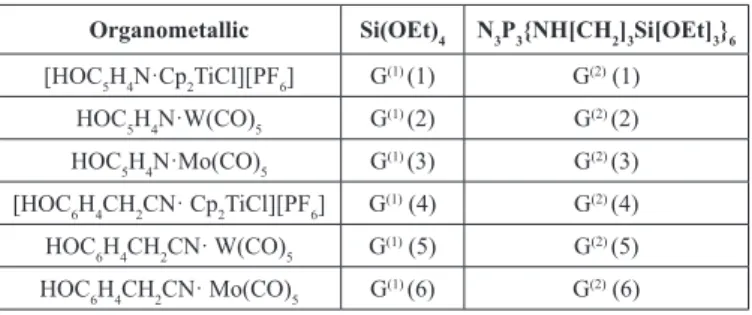
Table 2 summarizes all the gels formed. In the symbol G(i)(x), (i) means the
gelator used ie. TEOS (1) or N3P3{NH[CH2]3Si[OEt]3}6 (2) and (x) represent
Table 2 Gels, G(i)(x) prepared using the sol-gel/pyrolysis method.
Experimental details are given in experimental section. The gels adopt approximately the color of the organometallic precursor ie. orange forG(1)
(1), G(2)(1) and G(2)(4), yellow for G(1)(2), G(1)(5), G(2)(2) and G(2)(5) and
white for G(1)(4) and G(1) (1) and see electronic supplementary materials (S 1).
Additionally the 29Si MAS NMR spectroscopy confirms the presence of T1 (-
59.2 ppm for G(2)(4)) and T2 (- 68.38 ppm for G(2)(1)) structures corresponding
to R-Si(OSi)2OH and R-Si(OSi)(OH)2 links in the gels typical of condensation
of TEOS 4 .The presence of the organometallic inside the corresponding gel
is evidenced by their 13C MAS NMR which exhibits signals at 44ppm, 26.4
ppm, 23 ppm and 17 ppm for G(2)(1)). Thus, a signal observed at 64 ppm can
be assigned to some uncondensed Si-O-CH2CH3 arising from TEOS. For the
gelation with {N3P3{NH[CH2]3Si[OEt]3}6 a 31P NMR signal at 22.89 ppm
typical of the N3P3 evidenced the presence the phosphazene ring in the matrix 31 .Further MAS NMR data for another representative compounds are given in
supplementary materials S2.
Pyrolysis of the gels under air at 800 °C affords solids with pyrolytic yields in the range of 14- 64 %. XRD of the solids exhibits a broad peak around 2θ = 23° which is characteristic of amorphous silica13. A representative XRD is
showed for G(1)(1)in figure 2a. At the left the peaks values tabulated and
present in the sample are also given.
In another case, the broad peak around 2θ = 23° masks the possible peaks corresponding to the presence of metal oxide or metal phosphate inside the silica matrix. However, in some cases some peaks characteristic of the titanium oxides mixtures TiO2/Ti3O5 were observed as shown in figure 2a, for
the product from G(1)(1).In some cases the typical peak at 2θ = 6° typical of
lamellar silica was observed as shown in figure 2b for the pyrolytic product from G(2) (2).Table 3 summarizes the pyrolytic products identified by XRD.
Table 3 Summary of the pyrolytic products from precursors gels G(i)(x).
G(y)(x) Pyrolytic products G(y)(x) Pyrolytic products
G(1)(1) Ti3O5 (ortorrombic)
respective metal phosphate and pyrophosphates as pyrolytic products, which
are absent when the gelator is TEOS ; in this case only the metal oxides are obtained. An exception is for G(1)(2) where the PW
8O product can arise from
the PF6 anion of the precursor (1).
Compound (pattern)2q (sample)2q
Ti3O5
Compound (pattern)2q (sample)2q
P4O7
Fig. 2 Representative X-Ray diffraction pattern powder of the pyrolytic product from the gel G(1)(1),(a)and from G(2)(2)(b). On the right of each
pattern, a detailed comparison of the observed lines with those of the reported are showed.
IR spectra of the pyrolyzed gels exhibits a very simple pattern with an intense band around 1100 cm-1 and a less intense one at 800 cm-1, which can
be assigned to Si-O, Si-O-Si vibrations of the silica 33-35. A medium intensity
band around 470 cm-1 is assigned to a Si-O-Si rocking modes. In the spectra
of gels derived from the gelator N3P3{NH[CH2]3Si[OEt]3}6 the band around
1100 cm-1 appears broad due to the presence of P=O bands arising from metal
pyrophosphates and phosphates 36. Additionally, a weak band around 1640 cm-1
was assigned to an overtone of the O-H stretching band of the residual Si-OH bonds 33-35. This appears in the range of 4320-3420 cm-1. A representative IR
Fig. 3 Representative IR spectra (KBr) of the pyrolytic power product from precursor for G(1)(5) (a) and G(2)(1) (b).
The morphology of the products observed by SEM is summarized in table 4.
Table 4 Mainmorphology of the products obtained by SEM.
Organometallic Si(OEt)4 N3P3{NH[CH2]3Si[OEt]3}6 [HOC5H4N·CpTiCl][PF6] Porous Foam
HOC5H4N·W(CO)5 Laminar Laminar/Inner, porous Porous
HOC5H4N·Mo(CO)5 --- Laminar
[HOC6H4CH2CNCpTiCl][PF6] Dense Laminar
HOC6H4CH2CN· W(CO)5 Dense Laminar
HOC6H4CH2CN· Mo(CO)5 Porous Laminar
The laminar morphology in silica has been observed in other sol-gel products 32 . In the laminar morphologies, almost always the typical peak at
2θ = 6° typical of lamellar silica was observed. It is interesting to observe that the laminar morphology is obtained mainly when the precursor N3P3{NH[CH2]3Si[OEt]3}6 is used as gelator, see figure 4. This can be owing
to the self-organization induced by the N3P3 moiety. EDS analysis showing the
expected presence of the corresponding elements are displayed on top of figure 5b, 5c for G(1)(5) and G(1)(6) respectively .
TEM images exhibited different shapes and sizes. For G(1)(1)the typical
nearlycircular nanoparticles of mainly Ti3O5 were observed as shown in figure
5a.The most gray back corresponds to SiO2 .
Fig. 4. SEM image of the pyrolytics products from from G(2)(2) (a), G(1) (5) (b) and G(1)(6) (c) illustrating the morphologies laminar, dense and porous. respectively. For G(1)(5) below fig. (b) and for G(1)(6) below fig.(c) their respective EDX are also showed.
Fig. 5 TEM image of the pyrolytic products from precursors G(1)(1) (a),
G(1)(4) (b) and G(1)(6) (c).The image (d) is a magnification of the squared
marked zone of (c).
Similar TEM of metallic nanoparticles inside SiO2 have been reported
13,16,21,23 . Some more irregular shapes were observed for G(1)(4), figure 5b
(titanium oxides tetragonal phase mainly)and for G(1)(6)(two mainly phases,
molybdenum oxides and SiP2O7), see figure 5c. Similar image TEM have been
reported for other metallic nanoparticles included inside SiO2 6,14 . Figure 5d
show a magnification of the square zone exhibited in figure 5c.The line below the image of figure 5d show a particle with a mean size of 3.5nm.
Interestingly for the pyrolytic product from G(2)(5) (tungsten oxides
and SiP2O7 phases mainly) a nanocable was observed as shown in figure
6. Comparing with similar TEM of nanocables of metallic, metal oxides nanowires coated with amorphous silica 37,38 , the TEM observed for G(2)(5) can
be suggested to be nanowires of WOx/SiP2O7 coated with amorphous silica.
Also metal nanotubes encapsulated in ZrO2 exhibit similar TEM images 39 .
Fig. 6 Nanocables observed from pyrolysis of G(2)(5) (a), (b) and G(2)(1) c,
For G(2)(1)two different zones were observed, one with small nearly circular
nanoparticles and another with nanotubes. The most dark structures probably are Ti(PO3)3. The observed TEM image 6d is similar to the one decorated in
nanowires nanostructures 39-41. For instance, iron oxides nanoparticles inside
carbon nanotubes 39,40 and SiO
2-coated CdTe nanowires exhibit similar TEM
images 41 . For another pyrolyzed gel and as observed normally in metal inside,
SiO2 gels19, agglomerates were observed by TEM see supplementary materials
S3.
Evidence of the mechanism of formation of the metallic nanostructures in the silica matrix, from gels precursors, was obtained by TG/DSC analysis. Important differences were observed in the TG patterns either being the gel either was obtained by using TEOS or N3P3{NH[CH2]3Si[OEt]3}6 as
gel precursor. For the former two main weight losses in contrast to when using the phosphazene-Si precursor, four weight losses were observed. In Supplementary material S4 representative curves TG/DSC for G(1)(1), and G(2)
(1) are shown. For the G(1)(i) series the first weight loss was attributed to the
residual water molecules and/or removal of solvent molecules. The second weight may be assigned to a loss of water from condensation of residual Si-OH units. An appreciable mass loss is detectable between 300 and 600 °C, which correspond to strong exothermic peaks in the DTA curves. This is due to the combustion of organic which arises from another residual CH3CH2 of
TEOS and/or the organic groups of the organometallic compound included in the silica.
For the series G(2) (i) a first weight loss around 100 °C can be attributed
to a loss of solvent and/or water molecules consistently with the endothermic peak around this temperature observed in their DSC curve. The expected combustion of the organic matter was observed in several steps starting around 300 °C with strong loss around 400 °C and 500 °C in agreement with their DSC showing exothermic peaks at these temperatures. This thermogravimetric behavior is similar and typical of those of another metal/organometallic/SiO2
system 14,19,42,43 .
4.-General discussion
As discussed previously (see introduction section) few examples of organometallic compounds included into SiO2 have been reported. Also few
report of metallic oxides incorporated inside amorphous SiO2 have appeared.
The most of these last type of compounds arise from catalyst system of the type metal oxide/SiO2 44-46or mixture of metal oxides systems (metal oxide)1(metal
oxide)2 /SiO 2 47,48
In comparing TEOS and N3P3{NH[CH2]3Si[OEt]3}6 as gelators some
conclusion emerge. As can be expected in agreement with our previous results
25-29 when the gelator was N
3P3{NH[CH2]3Si[OEt]3}6 metal phosphates and
pyrophosphates were obtained. Also this latter as a new gelator agent 49 induce
materials with mainly laminar morphologies.
The actual technological application usually requires the use of metallic nanoparticles 50-52 in solid-sate devices. This in turn, requires the development
of adequate methods for the solid-state preparation of nanoparticles. Thus this is one of the main challenges of the nanochemistry. Then, the here presented method, can be a useful and general method to obtain metal phosphates, pyrophosphate and metal oxide inside amorphous silica, materials with potential technological application in solid-state device 50-52 .
5. CONCLUSIONS
The organometallic MLn = [HOC5H4N•Cp2TiCl][PF6] (1),
HOC5H4N•W(CO)5 (2), HOC5H4N•Mo(CO)5 (3), [HOC6H4CH2CN•Cp2TiCl]
[PF6] (4), HOC6H4CH2CN• W(CO)5 (5) and HOC6H4CH2CN•Mo(CO)5 (6)
were successfully included into amorphous SiO2 using the gelator precursor
TEOS and N3P3{NH[CH2]3Si[OEt]3}6 .The products, gels of composition
(MLn)(SiO2)n, after pyrolysis afford mainly laminar products using the
N3P3{NH[CH2]3Si[OEt]3}6 as gelator and either dense or porous using
TEOS as gelator. Diverse shapes as nanocables and nanowires of WOx/
SiP2O7 and Ti(PO3)3 probably coated with amorphous silica were observed.
The method can be a new easy and simple way to obtain nanostructured metallic containing inside amorphous SiO2.In contrast when the gelator
was TEOS and the organometallic does not contain any phosphorus atoms, the metal oxide inside silica was obtained. The sililated cyclotriphosphazene N3P3{NH[CH2]3Si[OEt]3}6 as a new gelator ,induce the formation of mainly
laminar SiO2 matrix.
ACKNOWLEDGMENT
To project Fondecyt 1085011 for financial support
REFERENCES
1. M Ebelmen Ann Chim Phys16, 129,(1846)
2. C. J. Brinker, G. Scherrer Sol-Gel Science; Academic Press,(2002), London. 8. C.T. Kresge, M.E. Leonowics, W.J. Roth, J.C. Vartuli, J.S. Beck Nature
359, 710(1992).
9. J. S. Beck, J.C. Vartuli, W.J. Roth, M.E. Leonowics, C.T. Kresge, K.D. Schmit, C.T. Chu, D.H. Olson, E.W. Sheppard, S.B. McCullen, J.B. Higginns, J.L. Schlenker, J Am Chem Soc114, 10834, (1992).
10. K. Moller, T. Bein, Chem Mater 10, 2950,(1998).
11. J. V. Walker, M. Morey, H. Carlsson, A. Davidson, G.D. Stucky, A. Butler, J Am Chem Soc 119, 6921,(1997).
12. R. Anwander, Chem Mater13, 4419,(2001).
13. F. Del Monte, M.P. Morales, D. Levy, A. Fernandez, M. Ocaña, A. Roig, E. Molins, K.O. Grady, C.J. Serna, Langmuir13, 3627(1997). 14. C. Cannas, M.F. Casula, G. Concas, A. Corrias, D. Gatteschi, A. Falqui,
A. Musinu, C. Sangregorio, G. J. Spano, Chem Mater11, 3180 (2001). Ferreira, Y. Maniette, J.Á. Varela, Chem Mater14, 3722 (2002). 19. K. L. Fujdala, T. Don Tilley Chem Mater, 13, 1817, (2001).
20. V. S. Gurin, A.A. Alexeenko, V.B. Prakapenka, D.L. Kovalenko, K.V. Yumashev, P.V. Prokoshin, J Mater Science Mat In Elect, 14, 333 (2003). 21. B. Breitscheidel, J. Zieder, U. Schubert, Chem Mater3, 559(1991). 22 Y. Yin, Y. Lu, Y. Sun, Y. Xia, Nano Lett2, 427,(2002).
23. C. M. Lukehart, S.B. Milne, Chem Mater, 10: 903, (1998).
24. E. Lindner, A. Jager, T. Schneller and H.A. Mayer, Chem Mater 9, 81, (1997).
25. C, Díaz, M.L. Valenzuela, Macromolecules39, 103,(2006).
26. C. Díaz, M.L. Valenzuela, S. Ushak, V. Lavayen, C. O’Dwyer, J Nanoscience and Nanotechnology 9, 1825 (2009).
27. J. Jiménez, A. Laguna, J. Antonio Sanz, C. Díaz, M.L. Valenzuela, P.G. Jones Chem Eur J,15,13509,(2009).
28. Díaz C, Valenzuela ML, Zuñiga, L, O’Dwyer C, J Inorg Organomet Polym,19, 507 (2009).
29. C. Díaz, M.L. Valenzuela, D. Bravo, V. Lavayen, C. O’Dwyer, Inorganic Chemistry47, 11561, (2008).
30. G. A. Carriedo, F.J. Garcia-Alonso, J.L. Garcia Alvarez, C. Díaz, N. Yutronic,Polyhedron 21, 2587, (2000).
31. C. Diaz , M. Barbosa, Z. Godoy, Polyhedron 23,1027,(2004).
32. R. K. Donato M.V. Migliorini, M.A. Benvegnu, M.P. Strake, M.A. Gelesky, F.A. Pavan, C.M.L. Screkker, E.V. Benvenutti, J. Dupont, H.S. Schrekker, J. Sol Gel Sci Technnol 49, 71,(2009).
33. Y. Zhang, Y. Li, G. Li, H. Huang, H.L.W. Chan, W.A. Daoud, J.H. Xin
40. G. Kormeva, H. Ye, Y. Gogotsi, D. Halverson, D. Friedman, J.C., Bradley, K.G. Kornev Nano Lett5, 879, (2005).
41. Y. Wang, Z. Tang, X. Liang, L.M. Liz-Marzan, N.L. Kotov, Nano Let,4, 225, (2004).
42. U. Schubert, S. Amberg-Schwag, B. Breitscheidel, Chem Mater, 3, 576,(1989).
44. S. M. Lomnicki, H. Wu, S. N. Osborne, J. M. Pruett, R.L. McCartey, E. Poliakoff, B. Dellinger, Material Science and Engineering B175, 136 (2010)
45. T. Uemura, D.Hiramatsu, K. Yoshida, S. Isoda, S. Kitagawa J Am Chem Soc 130, 9216, (2008).
46. S. Polarz, F.Neues, M.W.E. van den Berg, W. Grunert, L. Khodeir J Am Chem Soc 127, 12028, (2005).
47. W. C. Vining, J. Strunk, A. T. Bell J. Catal. 285, 160 (2012)
48. B. Yan, Y. Zhao, Q-P, Li J. Photochem. Photobiol. A: Chem. 222, 351 (2011)
49. C. Diaz, M.L Valenzuela, N. Yutronic, P. Aguirre, J. Chil. Chem. Soc.
55, 415 (2010).
50. G. Walters, I. P. Parkin, J. Chem Mater19, 574, (2009).
51. G. B.Khomutov, V.V. Kislov, M. N. Antipirina, R.V.Gainutdinov, S. P.Gubin, A.Yy Obydenov, S.A. Pavlov, A.A. Rakhnyanskaya, A.N. Sergeev-Cherenkov, E. S. Soldatov, D.B. Suyatin, A.L. Toltikhina, A. S. Trifonov, T.V.Yurova, Microelectronic Engineering,69 373, (2003). 52. E. C. Walter, K. Ng, M.P. Zach, R.M. Penner, F.Favier Microelectronic
SUPPLEMENTARY MATERIALS TO:
JOURNAL OF THE CHILEAN CHEMICAL SOCIETY
C. DÍAZ
a, M.L. VALENZUELA
b, D. GARRIDO
aAND P. AGUIRRE
c Incorporation of Organometallic compounds into silica: useful precursors to metallic nanostructured materialsS1
Photographie showing the color of some of the as synthesized gels : (I) G(1)
(2) , (II) G(2)(6) and (III) G(2)(5)
S2
29 Si- MAS- NMR for some representative G(I)(x) gels
Gel 29 Si (ppm)
G(1)(5) 59.2 68.38
G(2)(4) 59.74 68.17
G(1)(2) 59.62 69.56
G(2)(1) 59.52 68.10
G(2)(6) 59.54 68.35
S3 TEM images for another pyrolytic products
1) TEM from precursor G(1)(2).
2) TEM from precursor de G(2)(2).
3) TEM from precursor G(2)(3).
4) TEM from precursor G(2)(4).
S4 Some TG and DSC data for some representative G(1)(x) gels
TG and DSC curves of G(1)(1) and G(2)(1)
DSC of G(1)(1) TG of G(2)(1)