
TítuloFungal biofiltration of α pinene: Effects of temperature, relative humidity, and transient loads
16
0
0
Texto completo
(2) Introduction. Biofiltration is an established technology for air pollution control and the alternative of choice compared to conventional physicochemical treatment techniques. In recent years it has received increasing attention as a viable technology for the control of air emissions in composting facilities, municipal wastewater treatment plants, intensive stock breeding, industrial manufacturing, food and chemical industries, foundries, wood processing, surface coating and kitchens, among others. Biofiltration is a promising technology involving the flow of a polluted air stream through a packed-bed containing microorganisms that are able to degrade the pollutants (Kennes and Veiga, 2001). Biofiltration is a viable and potentially cost-effective alternative for the treatment of lowconcentration polluted air streams. The low operating/energy costs result from the utilization of microbial oxidation processes under ambient conditions instead of oxidation by thermal or chemical means. Under the proper conditions, high removal efficiencies can be achieved. Besides, biofiltration is environmental-friendly since the pollutants are degraded instead of being transferred to another phase. The end- products are basically harmless or even reusable (Jin et al., 2005). Although biofiltration has emerged as an attractive technique in the treatment of waste gases, it still needs to be further optimized. One possible drawback is its working temperature, usually below 408C. This hinders its application to hot waste gases, except when either a cooling step is included in the overall process or when thermophilic conditions can be used. High temperature (thermophilic) operation is preferred over cooling as it avoids the increase of capital and operation costs associated with pre-cooling. Pre-cooling would also introduce an aqueous waste stream requiring further treatment. In addition, higher treatment rates can potentially be achieved in biological systems operated at relatively elevated temperatures. Some research works have recently been performed to explore the potential of thermophilic waste gas biotreatment. Matteau and Ramsay (1999) explored the use of active compost in a semi-continuous process to degrade toluene at temperatures up to 60C. Lu et al. (1999) evaluated the effects of temperature changes in the range of 15–50C on the performance of a trickle-bed biofilter for treating benzene, toluene, ethylbenzene, and o-xylene (BTEX) vapors in air streams. In the steady-state condition, the BTEX removal efficiency increased as the operating temperature increased in the range of 15–30C and decreased at temperatures above 30C. The optimum temperature range was 25–35C. Another recent study by Cox et al. (2001) showed that ethanol could be treated in a biotrickling filter at temperatures up to 62C. Dhamwichukorn et al. (2001) examined the treatment of methanol and pinene in biofilters at concentrations of 110 and 15 ppm, respectively, at a temperature of 55C, but they required very long retention times between 6 and 18 min. Flanagan et al. (2002) investigated the development of biofilters for the thermophilic removal of NO from an oxygen-free synthetic flue gas using denitrifying microorganisms. The temperature of the biofilters were maintained at 53–55C. They compared the performance of three packing materials (compost, perlite, and biofoam) for the removal of nitric oxide from a simulated wet-scrubbed combustion gas. Although all three materials performed well (>85% NO removal) at residence times of 70–80 s, the compost performed better than the other materials at shorter residence times (13–44 s). Fungi-based biofilters are more resistant to acid and dry conditions and take up hydrophobic compounds from the gas phase more easily than wet bacterial biofilms (Kennes and Veiga, 2004). In a previous study, several biofilters fed α-pinene-polluted air were inoculated with a new fungal isolate of Ophiostoma species. α-Pinene is a volatile 2.
(3) pollutant (with a boiling point of 1568C) typically found in waste gases from the pulp and paper industry and the forest products industry. The biofilters were packed either with lava rock or Pall rings alone or with a mixture of perlite and Pall rings. Our initial results showed that complete removal was observed up to an a-pinene load of 100 g*m3* h-1, while an elimination capacity of 143 g*m-3* h-1 with 89% removal efficiency was reached with complete mineralization to CO2. These results are significantly better than the elimination capacities of 3–45 g*m-3* h-1 reported in the literature and summarized elsewhere (Jin et al., 2006). Biofiltration systems can be exposed to dynamic pollutant loadings in field applications, including peak concentrations of toxic compounds produced from batch cycles. Shock loads of inhibitory compounds may cause instability of the biological process, perturbation between steady states, or even worse, make steady-state operation impossible. To date little attention has been given to the characterization and optimization of transient loading responses in biofilters (Deshusses et al., 1996). However, based on observations of both lab and field applications, transient loadings are common and often result in increased bed penetration and contaminant breakthrough. Furthermore, pollutant starvation may be the result of interruptions in the plant operation, weekend recess, holiday breaks, or equipment malfunctions leading to interruptions in the feed of polluted air. Nitrogen is a very important nutrient for microbial growth. MacFarlane and Bagley (1997) suggest that the use of 𝑁𝑁3− instead of 𝑁𝑁4+ for microbial growth requires more energy and thus results in reduced cell growth rates. Smith et al. (1996) studied the nitrogen effect (nitrate or ammonium) on the biofiltration of toluene. They found that the addition of nitrogen in the form of 𝑁𝑁3− instead of 𝑁𝑁4+ helped to reduce biomass production and prevented excess biomass accumulation in the filter bed. Jorio et al. (2000) observed that higher styrene elimination rates (up to 141 g*m-3* h-1) were reached in a biofilter supplied ammonia as major nitrogen source in comparison to the lower elimination performance (up to 50 g*m-3* h-1) obtained when nitrate was provided. In the present work, the behavior of a lab-scale biofilter inoculated with an Ophiostoma species was studied in order to investigate the optimal conditions for the removal of αpinene polluted gas. The effects of the inlet gas concentration, temperature changes in the range of 15–40C, as well as the nitrogen source of the nutrient solution and the relative humidity (RH) of the inlet gas phase on the removal efficiency of α-pinene were investigated. In addition, the reactor’s behavior during the initial startup period is described. Finally, the transient response to regular shock loads, and the influence of a starvation period were studied and explained. Materials and Methods Microorganism Inoculation A Ophiostoma species was used as inoculum. It was isolated on a-pinene from a biofilter in which a high maximum elimination capacity of 143 g-pinene m-3* h-1 with 89% removal efficiency had been reached (Jin et al., 2006). The Ophiostoma species was maintained on potato dextrose agar (PDA) at 4C. For the preparation of cell suspensions, the fungus was cultured for 10–12 days in 100 mL mineral medium in a 500 mL flask at 35C with shaking at 150 rpm. The bottle was sealed with a Teflon-lined screw cap, and 15 mL of α-pinene was added to the medium. After the culture had degraded six additions of α-pinene, it was transferred to a 5 L bottle containing 2 L nutrient medium. After the culture had degraded three 0.5 mL additions of α-pinene in that bottle, it was re-circulated through the packed bed bioreactor 3.
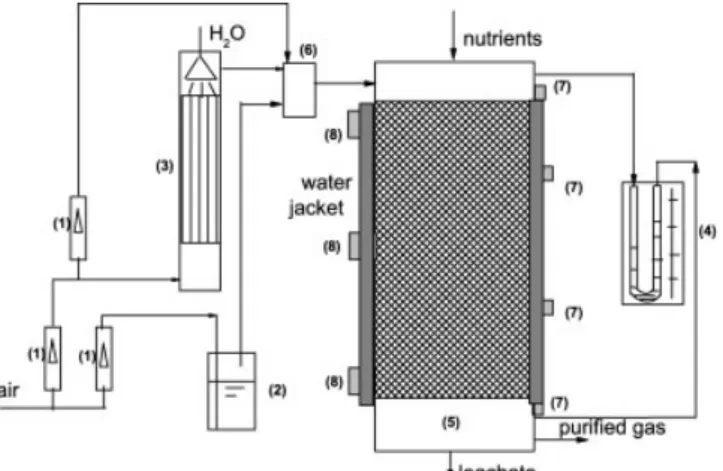
(4) using a peristaltic pump (model 323E/D, Watson-Marlow Ltd., Falmouth, Cornwall, UK) at a rate of 0.5 L * min-1 for 24 h in order to allow the biomass to attach to the support material. Filter Material In the experiments, irregular grains of perlite with a mean diameter of 4.5 mm were used as filter material. Approximately 50% (weight) polypropylene Pall rings of a nominal height of 15 mm (VFF GmbH & Co, Ransbach-Baumbach, Germany) was mixed with perlite to decrease the pressure drop and to obtain a more homogenous gas flow through the filter bed. The Pall ring bed had an initial porosity of 91% and a specific surface area of 350 m2*m-3. As perlite and Pall rings are inert materials and nutrient-poor for fungal growth, extra nutrient addition was necessary. Media Composition Batch experiments were undertaken with an aqueous culture medium containing (per liter): 4.5 g KH2PO4, 0.5 g K2HPO4, 2.0 g NH4Cl, and 0.1 g MgSO4 *7H2O. The culture medium was autoclaved at 120C for 20 min before adding filter-sterilized solutions of vitamins and trace minerals. The composition of the vitamins solution was (per liter): 0.2 g thiamine HCl, 0.1 g riboflavin, 1.0 g nicotinic acid, 2.0 g Capantothenate, 0.1 g biotin, 0.1 g thioctic acid, 0.1 g folic acid, and 0.25 g pyridoxine HCl. The composition of the trace minerals solution was (per liter): 120 mg FeCl3, 50 mg H3BO3, 10 mg CuSO4*5H2O, 10 mg KI, 45 mg MnSO4* H2O, 20 mg Na2MoO4 *2H2O, 75 mg ZnSO4*7H2O, 50 mg CoCl2 *6H2O, 20 mg KAl(SO4)2 *12H2O, 13.25 mg CaCl2 *2H2O, and 10,000 mg NaCl. The original pH of that medium was 5.9. Stock cultures of the fungus were maintained on petri dishes or on slants using either PDA or the same mineral medium as described above supplemented with 16 g-agar * L-1. When using the mineral medium, the plates were incubated in a tank or desiccator at 30C, in the presence of a-pinene vapors as sole carbon source. Stock cultures on PDA were stored in a refrigerator at 4C as described previously (Estévez et al., 2005a). Experimental Setup The schematic of the biofilter used in this study is shown in Figure 1. The biofilter consisted of a cylindrical glass column with an inner diameter of 10 cm and a total height of 70 cm, provided with four gas sampling ports located along the reactor at 5 (outlet), 25, 45, and 65 (inlet) cm from the bottom of the reactor. It was operated at an empty bed residence time (EBRT) of 65 s. Three filter material sampling ports were uniformly distributed on the other side of the reactor. The length of the biofilter bed was 60 cm, leading to a working volume of approximately 4.71 L. A punched Teflon sieve plate was placed at the bottom of the column. It was covered by a Pall ring layer to improve water drainage as well as to prevent clogging. A large stream of compressed air was humidified by passing it through a tower humidified with water. A small stream of air was bubbled through a vial containing pure α-pinene and was mixed with the larger humidified gas stream. Gas phase α-pinene concentrations ranging from 0 to 400 ppm were obtained by changing the flow rates of the gas streams. The resulting synthetic waste gas was introduced through the top of the column in concurrent flow. An aqueous mineral medium was re-circulated over the packed bed once a week in order to add fresh nutrients and remove accumulated metabolites. The pH of the leachate was measured in order to monitor the growth environment for the fungi. The temperature of the biofilter column was maintained at 20, 25, 30, 35, or 40C using awater jacket in order to study the influence of the temperature on the biofilter’s performance. The RH of the waste air was adjusted by 4.
(5) modifying the flow rates of both a dry and a humidified air stream in order to study the effect of the RH on the reactor’s performance. The RH of the waste gas was measured online both in the inlet and outlet pipes of the biofilter. Different experiments were undertaken in order to evaluate the optimal operating conditions regarding temperature, RH, and the nitrogen source. In a first experiment, the temperature was increased from 15 to 40C in steps of 5C. In another experiment, the RH was increased from 85 to 95%, and then subsequently decreased to 45 and 16%. In a third experiment, on the effect of the nitrogen source, three compositions of nitrogen sources were successively used: 𝑁𝑁4+ alone, 𝑁𝑁3− alone, and a mixture of 𝑁𝑁4+ : 𝑁𝑁3− (1:1); corresponding to 𝑁𝑁4+ concentrations of 2, 0, and 1 g *L-1, respectively. All experiments were repeated three to five times with identical operating conditions. The data shown in the figures are the mean values of the experiments.. Figure 1. The schematic of the fungal biofilter: (1) flow meters, (2) a-pinene vessel, (3) humidification system, (4) manometer, (5) biofilter, (6) mixing chamber, (7) gas sampling ports, (8) filter bed sampling ports.. Analytical Methods Gas phase concentrations of α-pinene in the biofilters were measured via gas chromatographic analysis using a Hewlett-Packard 5890 series II GC. The GC was equipped with a flame ionization detector (FID). The following flow rates were used: H2 30 mL *min-1, air 300 mL* min-1. The inlet and outlet streams were sampled, as well as the air between the different biofilter sections. The GC was equipped with a 50 m TRACER column (TR-WAX, internal diameter 0.32 mm, film thickness 1.2 mm) and Helium was used as the carrier gas (flow rate 2.0 mL *min-1). The α-pinene concentration was determined at the oven temperature of 175C and using a FID at 250C. Similarly, the CO2 concentration was measured using another Hewlett-Packard 6890 GC equipped with a thermal conductivity detector (TCD). The CO2 concentrations were determined at an injection temperature of 90C, an oven temperature of 258C and using a TCD at 1008C (Estévez et al., 2005b). Pressure drop was measured using a U-tube manometer filled with water at the start and at the end of the operation. From the difference between the inlet and outlet values of the manometer, the pressure drop was calculated and the value was normalized per meter packing height. Inlet and outlet relative humidities and temperatures were measured simultaneously using a Hand-held Thermo-hygrometer C210 with flexible probe (G. Lufft Mess-und Regeltechnik GmbH, Germany). It was measured three times a day, for periods of 1 h. The RH of the inlet air stream was maintained above 85% for the entire experimental period, unless otherwise specified. The temperature of the filter bed was measured by means of a FlashCheck Pocket Probe Digital thermometer. Samples of colonized packing material exposed to α-pinene were prepared for observations under the electron microscope according to a standard procedure as reported previously (Jin et al., 5.
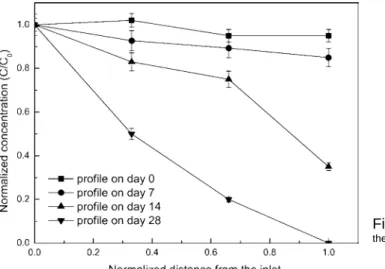
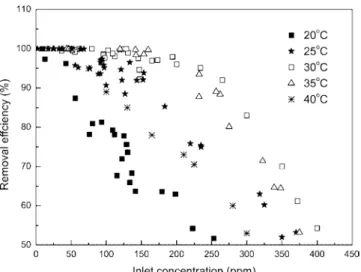
(6) 2005). Examination was performed with a JEOL JSM-6400 SEM working at a voltage of 20 kV and a working distance of 15 mm, and with Oxford Instruments EDX equipment. Samples were photographedextensively to ensure that representative images of the filter bed had been taken. The moisture content was measured by removing small samples of perlite from the filter bed. A standard method protocol was used to determine the moisture content (APHA 2540B) (Clesceri et al., 1998). Results and Discussion Startup of the Biofilter During the startup period, the inlet concentration of α-pinene was maintained around 50 ppm. It took several weeks before the Ophiostoma sp. had grown and attached enough to the packing material. Almost 28 days were needed before complete removal of α-pinene took place, as shown in Figure 2. On day 0, before inoculation, no degradation of α-pinene was observed indicating the absence of any abiotic removal. During the next 7 days, αpinene degradation was observed only in the section of the reactor closest to the inlet. Subsequently, α-pinene degradation moved progressively toward the outlet section of the biofilter bed. The data indicate that the inoculated Ophiostoma species first grew near the inlet section of the biofilter column and then spread out to the sections of the bed closer to the outlet over a period of 4 weeks. The regular addition of the nutrient solution probably helped fungal spreading.. Figure 2.. a-Pinene profiles in the filter bed during the startup of the biofilter.. Effect of Temperature on the Biodegradation Kinetics After steady-state was reached, the biofilter was fed different α-pinene inlet concentrations under the operating temperatures of 20, 25, 30, 35, and 40C (corresponding to average packing bed temperatures of 20.2, 25.3, 30.3, 35.1, and 39.4C), with the EBRT maintained at 65 s. According to the data shown in Figure 3, in the lower range of α-pinene concentrations, that is, less than 50 ppm, the temperature had no visible effect on the removal efficiency, among others because less than the full filter bed depth was required for completely removing the pollutant, irrespective of the temperature. Although the temperature most probably also affected the degradation rate at low pollutant concentrations, this effect was not detected because α-pinene was totally removed before reaching the outlet of the reactor. However, a non-negligible enhancement of α-pinene removal was found when gradually increasing the temperature to 30–35C, at α-pinene concentrations higher than 50 ppm. This indicated that at higher α-pinene concentrations, that is, high loads, the pollutant’s removal rate was limited by the temperature, but at lower 6.
(7) α-pinene concentrations, the effect of temperature was not detected because of the residence time’s effect.. Figure 3.. Steady-state a-pinene removal efficiencies as a function of operating temperatures.. Microbial activity tends to increase with temperature up to a given value, after which the activity gradually drops again. The temperature dependence of the reaction can be described using the Arrhenius relationship as presented in the following equation (1) (Metcalf and Eddy, 2003): 𝑑(𝑙𝑙𝑙) 𝐸 = 2 𝑑𝑑 𝑅𝑅. Integration of Equation (1) between T1 and T2 gives (2):. The Arrhenius equation is commonly used to model the effect of temperature on biological removal kinetics in wastewater treatment systems. Because most wastewater treatment 𝐸 operations and processes are carried out at or near ambient temperature, the quantity 𝑅𝑅 𝑇 1 2. in the equation may be assumed to be almost constant for practical purposes. If the value of 𝐸 is denoted by m, then Equation (2) can be simplified as(3) : 𝑅𝑅 𝑇 1 2. Rearranging Equation (3) and replacing em with a temperature coefficient θ yields (4):. The approximation is accurate over temperature ranges typically encountered in biological treatment systems. Similarly, for biofiltration of waste gases, this simplified equation is still applicable to describe the temperature effect on the reaction rate. Since the bioreaction rate first increases until the optimum temperature Topt is reached, and then decreases with 7.
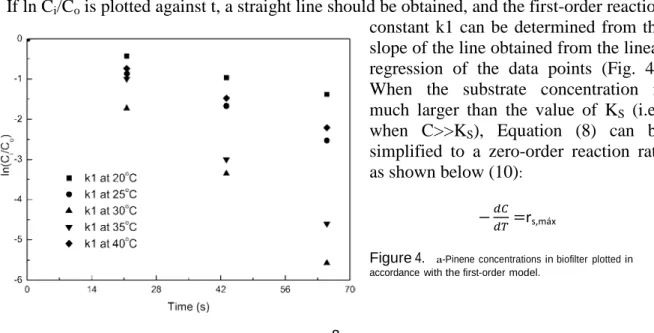
(8) the temperature above this value, a small modification needs to be made for the equation (5). 𝑘𝑜𝑜𝑜 = 𝜃 𝑇−𝑇𝑜𝑜𝑜 𝑘. Taking natural logarithms on both sides of Equation (5) Yields (6): ln kopt= ln k + (T-Topt)* ln θ. The value of u can be determined from a semilog plot of k versus |T- Topt|. In biological systems, the biodegradation rate usually drops faster at temperatures below the optimum than at temperatures above the optimum. This is also clear from the data of Figure 3. This asymmetrical effect suggests that two different values of u must be obtained depending if one works at temperatures above or below the optimal one. Besides, the kinetics for cellular systems can be described by the Monod equation when no inhibitory effects are observed. According to this equation, the substrate consumption rate can be expressed as follows (7): −. 𝑑𝑑 𝐶 = 𝑟𝑠,𝑚á𝑥 𝑑𝑑 𝑘𝑠 + 𝐶. When the substrate concentration is much smaller than the value of KS (i.e., when C<<KS), Equation (7) can be simplified to a first-order reaction rate as (8):. −. 𝑑𝑑 𝑟𝑠,𝑚á𝑥 = 𝐶 𝑘𝑠 𝑑𝑑. In such a case, the rate of reaction is proportional to the substrate concentration. Defining the new constant k1=rs,máx/ ks and integrating Equation (8) with the boundary condition C=Ci at t=0, one obtains (9): 𝑙𝑙. 𝐶𝑖 = 𝑘1 𝑡 𝐶0. If ln Ci/Co is plotted against t, a straight line should be obtained, and the first-order reaction constant k1 can be determined from the slope of the line obtained from the linear regression of the data points (Fig. 4). When the substrate concentration is much larger than the value of KS (i.e., when C>>KS), Equation (8) can be simplified to a zero-order reaction rate as shown below (10):. Figure 4.. −. 𝑑𝑑 𝑑𝑑. =rs,máx. a-Pinene concentrations in biofilter plotted in accordance with the first-order model.. 8.
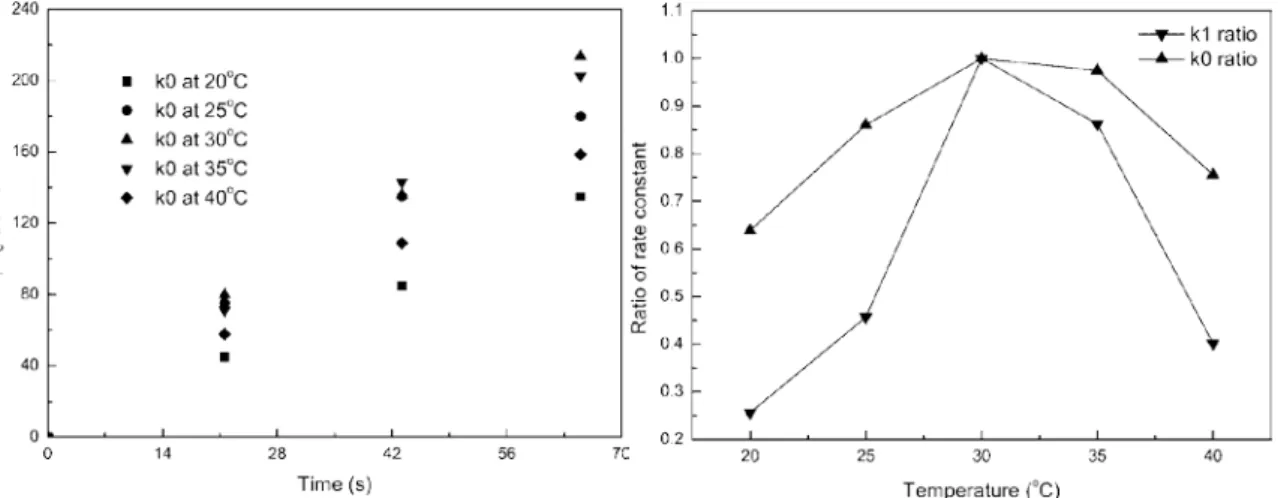
(9) The integrated form of Equation (10) becomes (11): C0=Ci – k0t If Ci-C0 is plotted against t, a straight line should be obtained from the linear regression of the data points, and the slope k0 is the maximum elimination capacity of the microbes for the substrate (Fig. 5). Figure 6 shows the effect of the temperature on the rate constants for α-pinene loads of 69 and 31 g *m-3 * h-1. The maximum rate constants were obtained at 308C under both low and high load conditions. The θ values can be determined from the slope of the line of the best fit of the measured data according to Equation (6). The estimated θ values are 1.150 T≤30C, R2=0.99) and 1.082 (T≥30C, R2=0.84) for first-order kinetics, and 1.043(T≤30C, R2=0.96) and 1.024 (T≥30C, R2=0.78) for zero-order kinetics. It seems that the u values were slightly higher for the low α-pinene loads. This indicates that the effect of temperature on α-pinene removal in biofilters is more significant under low α-pinene loads. The values of u ranged from 1.024 to 1.150, which is similar to typical ranges for some commonly used aerobic wastewater treatment processes, for example, 1.0–1.08 for activated sludge; 1.04– 1.10 for aerated lagoons; 1.02–1.08 for trickling filters (Metcalf and Eddy, 2003). Since the optimum temperature is around 30C, further studies were undertaken to evaluate the effect of other parameters on biofilter performance at that temperature.. Figure 5. a-Pinene concentrations in biofilter plotted in accordance with the zero-order model.. Figure 6 Rate constants at different temperatures, for zeroorder kinetics (k0) at high loads and for first-order kinetics (k1) at low loads.. Effect of the Relative Humidity of the Inlet Gas The RH of air is one of the most important parameters influencing the performance of conventional biofilters. In order to study the effect of the RH on the elimination of αpinene, experiments were conducted varying its value while maintaining the optimum temperature of 30C. Relative humidities of 16, 45, 85, and 95% were maintained in the inlet stream, keeping the same inlet loading rate of 31g *m-3 *h-1 in all experiments. At such load, the conversion of α-pinene could initially be kept well above 90% in all cases. It was then recorded for how long this high removal efficiency could be maintained. Figure 7 shows how long it lasted before the optimal performance started to decrease below 90% at different relative humidities of the inlet gas.. 9.
(10) Figure 7.. Period of maximal performance of biofilter at different relative humid- ities of the polluted gas.. At the highest RH (95%), the period of optimal performance slightly dropped from 148 to 135 h compared to the steady performance at 85% RH. This may be due to the fact that with the increase in moisture content, water adsorption is favored, which in turn limits the mass transfer of α-pinene from the gas phase to the biofilm and finally decreased bioconversion. The difference in performance at 95% or 85% RH is, however, not very large. At low RH values, the thickness of the water layer between the gas phase and the fungal biofilm would be smaller, which, here again, results in a faster mass transfer of hydrophobic compounds from the air to the biocatalyst. The results suggest that the fungal biofilter performs well with a RH of 85%. At a RH of 45%, the time period of optimal performance still remained around 91 h (Fig. 7). Kraakman (2001) reported that a biofilter could treat the emission of a settling tank of anaerobic water purification at a potato processing plant with a RH of 70–90%. Furthermore, it was observed that biofilters perform well when treating similar emissions from a brewery plant at a RH of 60–80%. Although the irrigation frequency is not mentioned in those studies, those data as well as our present findings are different from those available in the literature, which consider that biofilters begin to fail when the RH of the gas phase falls below about 98% (Leson and Winer, 1991). This may be due to the following reasons: on the one hand, fungi as used in the present study are more tolerant to a low water content and a reduced water activity than bacteria (Kennes and Veiga, 2004). For optimal growth of most bacteria, the water activity should be above 0.90, while xerotolerant fungi are capable of growing at water activity values as low as 0.60. On the other hand, low RH values make the mass transfer easier. However, despite the positive effect of low RH values on mass transfer rates, the negative effect on the microbial activity and biodegradation rates is more significant at the lowest RH values, leading to an overall decrease of performance over time. At the lowest RH of 16%, the performance was significantly affected as the relatively dry air flowing through the medium caused a progressive and quite fast evaporative drying out phenomenon affecting the biodegradation of α-pinene. The 33 h high performance period at 16% RH may have resulted from the inherent moisture of the packing after being submerged in the fresh nutrient solution on starting the experiment. The 16% RH inlet gas flow strips moisture from the packing media and accelerates media drying out since any deficit in the saturation level of the inlet gas will result in a net. 10.
(11) removal of moisture from the media. Eventually it becomes impossible to maintain an adequate media moisture content required for an optimal biological degradation capacity. The present results confirm that when treating waste gases in gas-phase bioreactors, a major concern is to maintain a high enough level of moisture to avoid a drop of performance. Since increasing back pressures increase the variable costs of the systems it seems to be preferable to prevent drying out of the material mainly by controlling the RH of air entering the filter instead of sprinkling water on top of the filter which should only be done occasionally. Furthermore, hold-up of too much water in the filter may lead to unnecessarily high back pressures. According to the present data, in a fungal biofilter as used in this study, a weekly irrigation would be enough to maintain removal efficiencies exceeding 90% if the RH of the waste gas is around or above 85%. Performance During Transient Conditions The occurrence of transient loads is common in industry due to normal cycles in process operations, overnight and weekend closures, and scheduled maintenance activities. Since the inlet α-pinene concentration cannot always be kept at a steady value in real conditions, a 1 month experiment was carried out to examine the performance of this immobilized fungal biofilter with shock loads by altering the inlet concentration, under otherwise constant operating conditions, including a temperature of 30C and an EBRT of 65 s. In this study, transient operating conditions were simulated on a regular basis. The biofilter was run over two distinct periods that comprised one complete cycle with a normal load (13 h), followed by a peak load (4 h). Inlet and outlet concentrations of apinene during and after the 4 h shock loads were monitored. As can be seen from Figure 8, the removal of α-pinene exceeded 95% and remained constant when the inlet concentration was around 120 ppm, corresponding to the normal load. When the inlet concentration was increased to values higher than 170 ppm (peak load) (Fig. 8), the removal always gradually dropped slightly during the periods of shock load. However, the performance of the biofilter quickly recovered after the 4 h shock load, reaching a removal efficiency always above 90% over the 13 h period after the shock load. Elimination capacities and removal efficiencies as high as 60 g *m-3 * h-1 and >90% respectively could be maintained even after 1 month operation. This results from the fact that the microorganisms inside the filter bed maintained their activity despite the shock loads. Therefore, it can be concluded that this immobilized fungal biofilter had a good potential to withstand shock loads.. Figure 8. Illustration of the effect of regular step loads on the fungal biofilter’s performance.. Figure 9. Starvation and re-acclimation periods during three starvation experi ments.. 11.
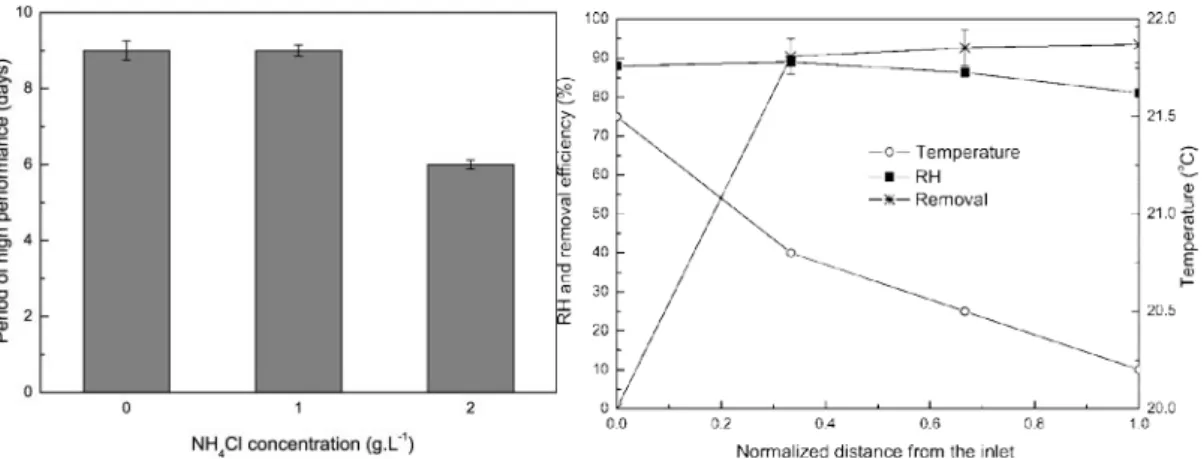
(12) Starvation Experiment After long-term operation, the air compressor stopped working accidently on three occasions, for 7, 5, and 3 days, respectively. During these starvation periods (no α-pinene feeding), only a small flow rate (0.3 L_h_1) of air was fed to the bioreactor by means of a gas pump, reaching an EBRT of 942 min. During this starvation period, the data of CO2 concentrations confirmed that endogenous respiration of biomass was significant inside the reactor. After the air compressor was fixed, the system was re-started under the same conditions as prior to the interruption (60 ppm αpinene, EBRT of 65 s), and within 24, 18, and 5 h, respectively, the performance of the biofilter rapidly recovered its original level (Fig. 9). This indicates that longer periods of starvation required longer periods of reacclimation but that the system was able to recover in all cases. Additionally, our laboratory experience shows that a non-contaminant load (only water saturated air was flowing through the biofilter) experienced a shorter re-startup time as compared to idle periods of no-use (no air at all flowing through the biofilter). The present experiment proves that after 3–7 days stoppage, prompt and efficient treatment can be re-established. Besides, the results show that the reacclimation period after starvation (a few hours) is much shorter than the initial startup phase (several days). It does also prove that the Ophiostoma species could withstand a 1 week starvation and remain active. Some other researchers also observed that shut-down periods of 2 days to 2 weeks have no significant effect on the styrene removal in biofilters (Jorio et al., 2000). After such shut-down periods, the biofilters recovered their original efficiency within a few hours. The same authors reported that excellent biofiltration performance for toluene removal was still obtained on restart after a shut-down period of 8 months (Jorio et al., 2000). In another study with an airlift bioreactor treating dichloromethane-polluted air, as much as 2 days were required to recover efficient elimination after a 3 days shutdown period. Also, Deshusses et al. (1996) observed that biofilters treating a MEK and MIBK mixture immediately recovered full performance after 5 days starvation. Influence of the Nitrogen Source Some fungi can use nitrate instead of ammonium or organic nitrogen as nitrogen source, and it has been reported that fungi are capable of surviving under nitrogen-limited conditions (Woertz et al., 2001). Ammonium can be used as a nitrogen source by Ophiostoma species, as shown in the previous experiments. Since the consumption of 𝑁𝑁4+ leads to the release of protons, the pH may drop in poorly buffered media and in gas-phase biofilters. This is a major concern in cases where acidification may negatively affect the performance of the reactors. Therefore, the ability to simultaneously degrade αpinene and use nitrate was checked, since acidification is much less with such a nitrogen source. Three compositions of nitrogen sources (𝑁𝑁4+ ;𝑁𝑁3− ; and 𝑁𝑁4+ : 𝑁𝑁3− =1:1) were used subsequently, while maintaining the total amount of nitrogen similar according to the original composition given in Materials and Methods.The Ophiostoma species can use both nitrate and ammonium as nitrogen source, but it appears that a higher performance was attained when using nitrate alone (Fig. 10). However, the performance of the biofilter was not significantly affected when supplying either exclusively nitrate or nitrate+ammonium. In all cases, the amount nitrogen supplied to the biofilter was more than the minimal carbon to nitrogen ratio required for optimal activity, meaning that only the nature of the nitrogen source affected the reactor’s performance. Therefore, the outstanding biofiltration performance with 𝑁𝑁3− indicates that this nitrogen source may be most advantageous than 𝑁𝑁4+ for fungal biofilters treating α-pinene emissions. 12.
(13) Figure 10.. Period of high performance of the biofilter with different NH4Cl concentrations in the nutrient solution.. Figure 11.. Temperature, RH, and a-pinene removal along the filter. bed.. Profile of a-Pinene Concentration, Relative Humidity, and Temperature Along the Filter Bed After Long-Term Operation Figure 11 shows the RH, removal efficiency, and temperature profiles versus the length of the biofilter at room temperature, after 200 days operation with an inlet concentration of 127 ppm. The initial RH of 88% first slightly increased to 89% and then gradually decreased to 81% at the outlet of the reactor. As much as 90% α-pinene removal took place in the inlet section of the reactor, corresponding to the upper one-third filter bed layer. The rest of the packing material of the reactor only played a minor role in the removal. This was mainly due to the nonhomogeneous distribution of the biomass in the filter bed, as easily confirmed by visual observation and observations under the microscope. In the inlet section, the growth of fungi was dense, while only sparse fungal growth appeared near the outlet section. Some researchers also observed that operational problems such as excessive biomass accumulation and uneven biomass distribution may occur in biofilters subjected to high loading rates. Several alternatives are suitable to avoid or remove such excess biomass (Kennes and Veiga, 2002). In our case, although excess biomass accumulation did not happen, an uneven biomass distribution was observed, which caused that some part of the reactor hardly contributed to α-pinene removal. It has been reported in the literature (Song and Kinney, 2001) that the microbial population density in biofilters may decrease by one to four orders of magnitude between the inlet and outlet when biofilters are operated under nominally steady-state unidirectional loading conditions. Recent studies have suggested that biomass distribution and performance could be improved with a directionally switching operation, in which the contaminant inlet feed is periodically reversed between the top and bottom of the bioreactor column (Song and Kinney, 2001) or using a split-feed operation mode (Mendoza et al., 2003). Scanning Electron Microscopy Observations Samples of the support were withdrawn from the biofilter and observed under SEM. Figure 12 shows that filamentous fungi on the surface of both the Pall rings and perlite were observed. These observations confirm the absence of any possible significant bacterial contamination and that the Ophiostoma species remained the only dominant microorganism in the biofilter.. 13.
(14) Figure 12.. Scanning electron microphotographs of packing material taken from inside the fungal biofilter. a: Pall ring. b: Perlite.. Conclusions The following conclusions can be drawn from the results presented in this study: • The α-pinene removal efficiency increased as the operating temperature increased from 20 to 30C. • However, an opposite trend was observed at temperatures between 30 and 40C. The activity dropped faster at temperatures below the optimum. • The optimal RH of the inlet waste gas stream for the fungal biofilter was around 85%. • The fungal biofilter showed a good potential to withstand shock loads. • The fungal biofilter reached a higher performance and was more stable when nitrate was used as nitrogen source rather than ammonium. • The fungal biofilter was shown to be capable of withstanding 3–7 days periods of complete starvation with rapid recovery of its full performance when starvation ceased. Nomenclature C Ci Co E KS k, kT1, kT2, kopt k1 k0 m R rS,max T, T1, T2, Topt t. substrate concentration α-pinene inlet concentration α-pinene outlet concentration constant characteristic of the reaction, that is, Arrhenius activation energy, (J _ molS1) saturation constant reaction rate constants first-order reaction rate constant zero-order reaction rate constant E/RT1T2 Ideal gas constant, 8.314 (J * mol-1 *K-1) maximum substrate degradation rate absolute operating temperatures (K) reaction time (s). Greek Symbol. θ. temperature coefficient. The present research was financed by the Spanish Ministry of Education and Science (Project CTM2004-00427) and the Xunta de Galicia (Project PGIDIT05PXIC10304PN). Yaomin Jin was financially supported through a fellowship of the Agencia Española de Cooperación Internacional (AECI) and the Spanish Ministry of Foreign Affairs.. 14.
(15) References Clesceri LS, Eaton AD, Greenberg AE. 1998. Standard methods for the examination of water and wastewater. Washington: American Public Health Association. p 2–55, 2–56. Cox HHJ, Sexton T, Shareefdeen ZM, Deshusses MA. 2001. Thermophilic biotrickling filtration of ethanol vapors. Environ Sci Technol 35(12):2612–2619. Deshusses MA, Hamer G, Dunn IJ. 1996. Transient-state behavior of a biofilter removing mixtures of vapors of MEK and MIBK from air. Biotechnol Bioeng 49(5):587–598. Dhamwichukorn S, Kleinheinz GT, Bagley ST. 2001. Thermophilic biofiltration of methanol and alpha-pinene. J Ind Microbiol Biotechnol 26(3):127–133. Estévez E, Veiga MC, Kennes C. 2005a. Biodegradation of toluene by the new fungal isolates Paecilomyces variotii and Exophiala oligosperma. J Ind Microbiol Biotechnol 32(1):33–37. Este´vez E, Veiga MC, Kennes C. 2005b. Biofiltration of waste gases with the fungi Exophiala oligosperma and Paecilomyces variotii. Appl Microbiol Biotechnol 67(4):563– 568. Flanagan WP, Apel WA, Barnes JM, Lee BD. 2002. Development of gas phase bioreactors for the removal of nitrogen oxides from synthetic flue gas streams. Fuel 81(15):1953–1961. Jin Y, Veiga MC, Kennes C. 2005. Effects of pH, CO2, and flow pattern on the autotrophic degradation of hydrogen sulfide in a biotrickling filter. Biotechnol Bioeng 92(4):462–471. Jin Y, Veiga MC, Kennes C. 2006. Performance optimization of the fungal biodegradation of a-pinene in gas-phase biofilter. Process Biochem 41(8):1722–1728. Jorio H, Bibeau L, Heitz M. 2000. Biofiltration of air contaminated by styrene: Effect of nitrogen supply, gas flow rate, and inlet concentration. Environ Sci Technol 34(9):1764– 1771. Kennes C, Veiga MC. 2001. Conventional biofilters. In: Kennes C, Veiga MC, editors. Bioreactors for waste gas treatment. Dordrecht, Boston: Kluwer Academic Publishers. p 47–98. Kennes C, Veiga MC. 2002. Inert filter media for the biofiltration of waste gases characteristics and biomass control. Rev Environ Sci Biotechnol 1(3):201–214. Kennes C, Veiga MC. 2004. Fungal biocatalysts in the biofiltration of VOCpolluted air. J Biotechnol 113(1–3):305–319. Kraakman NJR. 2001. New bioreactor system for treating sulphur- or nitrogen compounds. In: Kennes C, Veiga MC, editors. Bioreactors for waste gas treatment. Dordrecht, Boston: Kluwer Academic Publishers. p 269–284. Leson G, Winer AM. 1991. Biofiltration: An innovative air pollution control technology for VOC emissions. J Air Waste Manage Assoc 41(8):1045– 1054. Lu CS, Lin MR, Chu CH. 1999. Temperature effects of trickle-bed biofilter for treating BTEX vapors. J Environ Eng 125(8):775–779. MacFarlane S, Bagley DM. 1997. Design and operations tool to predict nitrogen requirements in a biofilter, in AWMA (Ed.), Air & Waste Management Association 90th Annual Meeting and Exhibition, Toronto, Ontario, Canada. p 11. Matteau Y, Ramsay B. 1999. Thermophilic toluene biofiltration. J Air Waste Manage Assoc 49(3):350–354. Mendoza JA, Veiga MC, Kennes C. 2003. Biofiltration of waste gases in a reactor with a split-feed. J Chem Technol Biotechnol 78(6):703–708. Metcalf and Eddy. 2003. Wastewater engineering treatment and reuse. Boston: McGrawHill. 1819 p. 15.
(16) Smith FL, Sorial GA, Suidan MT, Breen A, Biswas P, Brenner RC. 1996. Development of two biomass control strategies for extended, stable operation of highly efficient biofilters with high toluene loadings. Environ Sci Technol 30(5):1744–1751. Song J, Kinney KA. 2001. Effect of directional switching frequency on toluene degradation in a vapor-phase bioreactor. Appl Microbiol Biotechnol 56(1–2):108–113. Woertz JR, Kinney KA, Szaniszlo PJ. 2001. A fungal vapor-phase bioreactor for the removal of nitric oxide from waste gas streams. J Air Waste Manage Assoc 51(6):895– 902.. 16.
(17)
Figure
+6



Documento similar
