Study of NH
3
removal by gas-phase
biofiltration: effects of shock loads and
watering rate on biofilter performance
GUILLERMO BAQUERIZO, JUAN PEDRO MAESTRE*, XAVIER GAMISANS, DAVID GABRIEL* AND JAVIER LAFUENTE*
Department of Mining Engineering and Natural Resources, Universitat Politècnica de Catalunya, Bases de Manresa 61-73, 08240 Manresa, Spain
*Department of Chemical Engineering, Universitat Autònoma de Barcelona, Edifici C, 08193 Bellaterra, Barcelona, Spain
ABSTRACT
Ammonia biofiltration performance under shock loads episodes was studied in a reactor packed with coconut fiber as carrier material. Periodical gas and leachate samplings were analyzed and used to characterize the biofilter performance in terms of removal efficiency (RE) and elimination capacity (EC). Nitrogen fractions in the leachate were quantified to identify the experimental rates of nitritation and nitratation.. In a primary experiment a sudden increment of ammonia load was applied for 1 day by changing the ammonia inlet load from 5.2 to 29.1 g N.m-3.h-1. Even though
stable operation was obtained (RE of 99.9%), a notable accumulation of nitrite was verified in the leachate. Experimental rates showed that nitritation increased at the same the same ratio that ammonia load was varied. However the nitratation seemed to be largely affected by high ammonia and nitrite concentration. In a subsequent experiment varying the inlet ammonia load, the system was rapidly recovered by increasing the watering rate. Since ammonia was partially removed by physicochemical process as observed in previous experiments, a final experimental was conducted to improve the nitritation capacity. The addition of inorganic carbon source demonstrated to enhance the capacity of the biofilter to degrade a higher amount of ammonia.
1 INTRODUCTION
Ammonia is a colorless, toxic, and strong odor gas produced in many industrial and agricultural processes (Ryer-Power, 1991). Traditionally physical-chemical treatments have been applied to remove ammonia from contaminated air streams (Busca and Pistarino, 2003). Although traditional methods provide high odor removal efficiency, some drawbacks such as elevated cost operation, important energy consumption or by-products generation are associated to these technologies. During the last years biofiltration has emerged as a reliable, environmental friendly and cost effective technology for odor control. This technology has been successfully used to treat a wide range of pollutants at relatively low concentration (Devinny et al., 1999; Kennes and Thalasso, 1998). The main advantage of biofiltration is that pollutants are oxidized into harmless products.
Currently a few number of studies dealing with ammonia abatement by biofiltration are available in literature. The majority of these works have been focused in determining ammonia removal capacity using different carrier materials (Chen et al., 2005; Hartikainen et al., 1996; Hirai et al., 2001;. Kim et al., 2000; Yani et al., 1998). Indeed a broad range of operation conditions have been applied in biofilters treating ammonia. While EBRT is normally set lower than 1 minute, ammonia inlet concentrations have been varied in the range of 10 to 1000 ppmv. Consequently substantial differences have been reported regarding the maximum ammonia elimination capacity obtained by biofiltration. In early studies, capacities lower than 10 g N.m-3.h-1 at inlet concentration between 10 and 50 ppm
v were reported (Joshi et
al., 2000; Van Langenhove et al., 1998).
Additionally some of these studies pointed out that biofilter removal efficiency are strongly affected at ammonia inlet concentration exceeding 60 ppmv (Don, 1985; Hartikainen et al., 1996). More recently elimination capacities up to 40 g N.m-3.h-1
have been reported operating at inlet concentration up to 1000 ppmv (Kanagawa et al., 2004). By the other hand studies dealing with the effects of fluctuating conditions in ammonia operation have been scarcely reported in literature, despite biofiltration operation is often exposed to varying operating conditions.
Partial oxidation of ammonia during biofiltration has been frequently reported. Some works have found that 50% of ammonia is nitrified and the other is retained in the packed bed as ammonium (Chen et al., 2005; Don, 1985; Smet et al., 2000). Likewise amounts of ammonia and nitrate at a ratio of 1:1 have recurrently observed in either liquid drain or packed bed in ammonia biofilters (Baquerizo et al., 2005; Chen et al., 2005; Kanagawa et al., 2004; Kim et al., 2000; Liang et al., 2000).
nitrification is better described as two intermediate steps: oxidation from ammonium to nitrite and oxidation from nitrite to nitrate (Baquerizo et al., 2005). Nitrification inhibition by nitrogen species have been reported but this phenomenon is usually ignored in the Monod kinetic approach.
The objective of this study is to determine the influence of both shock loads and watering rate on the performance of a biofilter treating ammonia. The study was performed using data collected from both gas and leachate measurements. Nitrogen fractions in the leachate were employed to identify the experimental rates (nitritation and nitratation). The utilization of a carbon supply to improve the nitrification capacity of the biofilter was also studied.
2 MATERIALS AND METHODS
2.1 EXPERIMENTALSETUP
The biofiltration experiments were performed in a laboratory-scale plant. As main characteristics of the setup, the reactor was constructed using transparent PVC and divided into four equivalent modules, with a total bed height of 1 m and an inner diameter of 0.1 m. Each module was packed with coconut fiber to a height of 20 cm, meaning a total volume of the filter bed of 6.3 L. A schematic of the pilot-unit and a comprehensive description of biofilter automation and characterization of the organic packing material can be found elsewhere (Baquerizo et al., 2005).
The inlet gaseous stream was obtained by mixing compressed air and pure ammonia from a cylinder. Both gas flows were measured and controlled by means of digital mass flow controllers (Bronkhorst, NL) which allowed adjusting accurately the EBRT and the ammonia inlet concentration. The air stream was previously humidified using a PVC humidification column. The reactor was operated in up flow mode and a nutrient solution was supplied periodically from the top of the reactor. The bottom was fitted with an automated liquid drain system. The watering load applied to the reactor was equal to 750 ml.d-1.
Coconut fiber used as packing material was withdrawn from a full-scale biofilter at a municipal solid waste treatment plant facility. No inoculation was needed since the full-scale biofilter had been running for more than 2 years at an average ammonia inlet concentration of 40 ppmv (Gabriel et al., 2007).
2.2 ANALYTICALMETHODS
Conductivity and pH were measured with lab probes (Crison, microCM 2100 and MicropH 2001 respectively) prior to filtering. The concentration of NO2- and NO
3 - in
aqueous samples (leachate) was determined by capillary electrophoresis in a Quanta 4000E unit (Waters). Ammonia and ammonium content in leachate was measured in a continuous flow analyzer (Baeza et al., 1999).
2.3 NITRIFICATIONRATESANDMASSBALANCES
In this study the nitrification process is described by means of two intermediate steps: oxidation from ammonium to nitrite (nitritation) and oxidation from nitrite to nitrate (nitratation). Stoichiometric equations for each reaction can be derived assuming a representative biomass composition (Baquerizo et al., 2007). Experimental nitritation and nitratation rates are calculated according to the Equations (1) and (2), which are directly derived from ammonia measurements in the gas phase and leachate analysis.
(1)
(2)
where R1 is the nitritation rate (g N-NH4+ consumed.m-3 h-1), NH
4(abs) is the
amount of ammonium (g N-NH4+) absorbed in the packed bed during the time interval
«t over two leachate sampling events, NH4(leach) is the amount of ammonium (g N-NH4+) collected in the leachate during the time interval Δt (h), and V is the reactor bed
volume (m3). R
2 is the nitratation rate (g N-NO3
- produced.m-3 h-1), and NO
3(leach) is the
amount of nitrate (g N-NO3-) collected in the leachate during the time interval Δt (h).
3 RESULTS AND DISCUSSION
3.1 EFFECTSOFAMMONIASHOCKLOAD
Prior to the experiment, the biofilter had been operated under steady-sate conditions at an average inlet concentration of 90 ppmv for more than 1 year with a EBRT of 36 s (EC equal to 5.2 g N.m-3.h-1). Stable and efficient operation (RE equal to
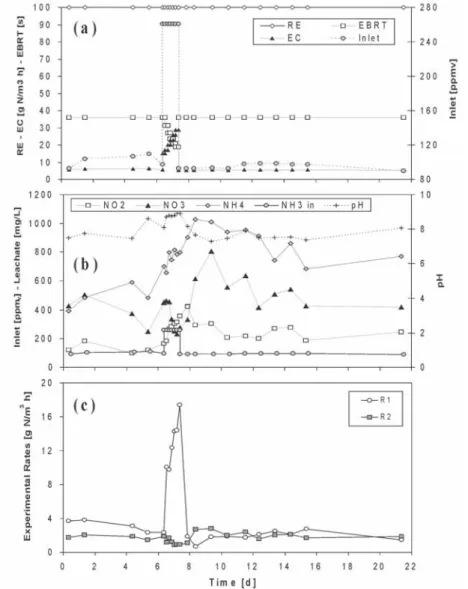
99.9%, data non shown) was verified during the aforementioned period. Afterward a stepwise increasing of ammonia load was applied by both varying the inlet concentration from 90 to 260 ppmv and decreasing the EBRT from 36 to 19 s (Figure 1). Ammonia inlet load was raised up from 5.2 to 29.1 g N m-3 h-1 in a period of 1 day.
was maintained at 100% over the whole experiment as can be seen in Figure 1. Results are in coincidence with previous ammonia biofiltration studies in which high RE were achieved under sudden variation or, at least, short acclimation periods (less than 2 days) were necessary to recover a complete removal efficiency after some operating condition variation (Chen et al., 2004; Kim et al., 2000).
Figure 1. Evolution of the main biofilter parameters: (a) removal efficiency, EBRT, EC, and inlet concentration; (b) nitrite, nitrate, ammonium, and pH; (c) experimental nitritation
However drain analyses showed important variations in the leachate composition. Ammonium and nitrite concentration increased while nitrate decreased notably. A slight increment of pH was observed for high load operation. Higher pH values indicate that sorption processes prevail over the ammonia biodegradation (nitrification). The examination of experimental rates reveals that nitritation rate increased at the same ratio as ammonia load was augmented. It should be emphasized that nitritation and nitratation rates show similar values before the increasing of ammonia load. In that sense, nitritation rate seems to be not affected by elevated ammonium and nitrite concentrations. Conversely nitratation rate kept constant after the load increase, showing that nitrite oxidizing bacteria are largely affected by high both ammonium and nitrite concentration (higher than 800 and 300 mg N L-1,
respectively). Consequently an increase of nitrite concentration was observed in the leachate. Inhibition of nitrogen species over the nitrification process have been reported previously (Baquerizo et al., 2005), but no experimental report had been provided so far specifying the species affecting either nitritation or nitratation in ammonia biofiltration.
Analyses performed after shock load episode showed a rapid increment of nitrate concentration while a slight diminishing of nitrite concentration was also observed. High amount of ammonium recovered in the leachate in subsequent days are probably explained for ammonia accumulation in the packed bed during the high load operation. In overall, more than 1 week was necessary for recovering the same reactor conditions (i.e. leachate composition and experimental rates) before the shock load episode.
3.2 EFFECTSOFWATERINGRATETORECOVERBIOFILTERCONDITIONSAFTERSHOCKSLOADS EPISODES
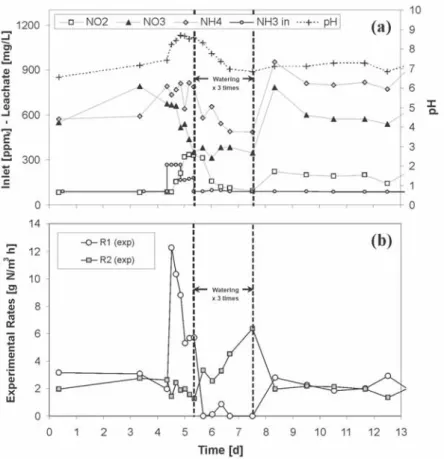
The influence of watering rate to recover biofilter performance under rapid changes in ammonia load was also studied. Keeping the EBRT constant (24 s), high load shocks were applied by increasing inlet ammonia concentration from 90 to 260 ppmv for 12 h, corresponding to an inlet load variation from 5.2 to 15.4 g N.m-3.h-1.
Subsequently inlet concentration was varied from 260 to 170 ppmv for 12 h (load from 15.4 to 9.9 g N. m-3.h-1). Similarly to the previous experiment, RE showed a
Figure 2. Profiles for experiment varying the watering rate: (a) nitrite, nitrate, ammonium, and pH; (b) experimental nitritation and nitratation rates.
Leachate analyses showed an increment of ammonia concentration while a continuous reduction of nitrate was verified. In addition a constant increase of nitrite was also observed (Figure 2). Watering rate was increased 3 times (i.e. 2250 ml.d-1) in
High values of nitrogen species concentration observed after watering increase (day 8) are explained for the drastic reduction of water amounts applied over the reactor bed (watering was reestablished to the initial rate). Indeed the amounts of nitrogen species collected from day 8 (i.e. g N-recovered d-1) are similar to those
observed before the increase of ammonia load. Furthermore, a similar value of both experimental rates (R1 and R2) was verified after day 8. Therefore, the reestablishment of the operating conditions before the shock loading episode was confirmed after 3 days by applying higher water flows over the reactor bed.
3.3 EFFECTSOFINORGANICCARBONSUPPLYTOENHANCETHENITRIFICATIONPROCESS
Ammonium mass percentage of about 50% was encountered in the leachate in the experiment described above as well as in long operation periods at ammonia inlet concentration of 90 ppmv. This result confirms that ammonia removal by biofiltration is also achieved by sorption processes. High concentrations of ammonium in the leachate may lead to think that the nitrification capacity of the biofilter could be enhanced. In order to improve the nitritation rate (i.e. decreasing the amount of ammonium recovered in the leachate), a carbon supply was applied to the biofilter. Sodium bicarbonate was used as carbon source to improve the performance of autotrophic ammonium oxidizers bacteria. A concentration of 2 g C-NaHCO3.L-1 was
supplied in each watering.
Before applying the extra carbon source the reactor was operated at 260 ppmv using an EBRT of 24 s (load of 0.55 kg N m-3 d-1) for more than 100 days. Stable
operation and removal efficiencies around 98-100% were obtained but a high concentration of ammonium in the leachate was also confirmed (mass percentage of 50%, data no shown).
A decrease of 20% of ammonium mass percentage in the leachate after applying sodium bicarbonate (from 50% to 40%) can be observed in Figure 3. The inorganic carbon supply allowed increasing the ammonia removal capacity in the reactor by biodegradation instead of absorption. However a decrease of nitrate amounts collected in the leachate was also observed due to the increase of nitrite concentration which inhibited the nitratation process.
Figure 3. Mass percentage distribution in the leachate for carbon supply experiment.
4 CONCLUSIONS
Effects of shock load over ammonia biofiltration have been studied including both gas phase behavior and drain analyses. Results demonstrated that biofilter is capable to operate at high removal efficiencies (higher than 99%) under sudden increases of ammonia load. However substantial alterations in experimental rates describing the overall nitrification process were observed. The nitritation rate increased at the same ratio than ammonia load was augmented revealing that the first nitrification step is not affected by accumulation of ammonium and nitrite in the packed bed. On the contrary nitratation rate is largely inhibited by accumulation of nitrite and thus its value remained constant under the ammonia load increment. Despite RE kept constant, experimental rates need several days to recover their original values. Increasing of watering load allow accelerating the recovering process. However excessive amount of water may promote that the fraction of ammonia removed by sorption process increases.
Experimental results showed that practically the 50% of the total nitrogen species collected in the leachate correspond to ammonium, confirming that sorption process play a fundamental role in ammonia biofiltration. The addition of the inorganic carbon source (NaHCO3) enhances the activity of the autotrophic ammonium oxidizing consortium, improving the reactor capacity to biodegrade ammonia. Nevertheless a higher nitritation rate causes larger concentration of nitrite that inhibits the oxidation of nitrite to nitrate. Higher removal capacities can be obtained avoiding high amount of nitrogen species in the filter bed by increasing the EBRT and modifying the watering rate.
REFERENCES
Baquerizo, G., Maestre, J.P., Sakuma, T., Deshusses, M.A., Gamisans, X., Gabriel, D. and Lafuente, J. (2005) A detailed model of a biofilter for ammonia removal: model parameters analysis and model validation. Chem. Eng. J. 113(2-3): 205-214.
Baquerizo, G., Gamisans, X., Gabriel, D. and Lafuente, J. (2007) A dynamic model for ammonia abatement by gas-phase biofiltration including pH and leachate modelling. Biosyst. Eng. In press.
Baeza, J., Gabriel, D. and Lafuente, J. (1999) An expert supervisory system for a pilot WWTP.
Environ. Modell. & Software. 14(5): 383-390.
Busca, G. and Pistarino, C. (2003) Abatement of ammonia and amines from waste gases: a summary.
J. Loss. Prev. Process. Indust. 16(2): 157-163.
Chen, Y-X., Yin, J. and Wang, K-X. (2005) Long-term operation of biofilters for biological removal of ammonia. Chemosphere. 58(8): 1023-1030.
Chung, Y-C. and Huang, C. (1998) Biotreatment of ammonia in air by an immobilized Nitrosomonas europaea biofilter. Environ. Prog. 17(2): 70-76.
Devinny, J.S., Deshusses, M.A. and Webster, T.S. (1999) Biofiltration for air pollution control. Boca Raton: Lewis Publishers. 299 p.
Don, J.A. (1985) The rapid development of biofiltration for the purification of diversified waste gas streams. VDI Berichte. 561: 63-73.
Gabriel, D., Maestre, J.P., Martín, L., Gamisans, X. and Lafuente, J. (2007) Characterisation and performance of coconut fibre as packing material in the removal of ammonia in gas-phase biofilters. Biosyst. Eng.In press.
Hartikainen, T., Ruuskanen, J., Vanhatalo, M. and Martikainen, P.J. (1996) Removal of ammonia from air by a peat biofilter. Environ. Technol. 17(1), 45-53.
Hirai, M., Kamamoto, M., Yani, M. and Shoda, M. (2001) Comparison of the biological NH3 removal characteristics among four inorganic packing materials. J. Biosci. Bioeng. 91(4): 428-430.
Joshi, J.A., Hogan, J.A., Cowan, R.M., Strom, P.F. and Finstein, M.S. (2000) Biological removal of gaseous ammonia in biofilters: space travel and earth based applications. J. Air Waste Manage. Assoc. 50(9): 1647-1654.
Kanagawa, T., Qi, H. W., Okubo, T. and Tokura, N. (2004) Biological treatment of ammonia gas at high loading. Water Sci.Technol. 50(4): 283-290.
Kennes, C. and Thalasso, F. (1998) Waste gas biotreatment technology. J. Chem. Technol. Biotechnol.
72(4): 303-319.
Kim, N-J., Hirai, M. and Shoda, M. (2000) Comparison of organic and inorganic packing materials in the removal of ammonia gas in biofilters. J. Hazard. Mater. 72(1), 77-90.
Liang, Y., Quan, X., Chen, J., Chung, J.S., Sung, J.Y., Chen, S., Xue, D. and Zhao, Y. (2000) Long-term results of ammonia removal and transformation by biofiltration. J. Hazard. Mater.
80(1-3): 259 -269.
Ryer-Power, J.E. (1991) Health effects of ammonia. Plant/Operations Prog. 10(2): 228-232.
Smet, E., Van Langenhove, H. and Maes, K. (2000) Abatement of high concentrated ammonia loaded waste gases in compost biofilters. Water, Air, Soil Pollut. 119(1-4): 177-190.
Van Langenhove, H., Lootens, A. and Schamp, N. (1988) Elimination of ammonia from pigsty ventilation air by wood bark biofiltration. Med. Fac. Landbouww. Rijksuniv. Gent. 53: 1963-1969.
Yani, M., Hirai, M. and Shoda, M. (1998) Ammonia gas removal characteristics using biofilter with activated carbon fiber as a carrier. Environ. Technol. 19(7): 709-715.